



LEARNING OBJECTIVES
After reading this article you will be able to:
-
• apply a hypothetico-deductive approach by generating and testing falsifiable competing hypotheses during psychiatric assessment
-
• use a reliability hierarchy to weigh clinical evidence and seek disconfirming data before committing to a formulation
-
• document uncertainty proportionately and set time-bound reviews that integrate bias-countering prompts into routine practice.
Why investigative reasoning matters
Psychiatry is practised in conditions of uncertainty: signals are often ambiguous, data arrive in fragments and what is most salient is not always most reliable. Decisions routinely affect safety, liberty, relationships and work, so errors in inference carry significant consequences for patients and services alike, including treatment missteps, prolonged trajectories through care and erosion of trust (Graber Reference Graber, Franklin and Gordon2005; National Academies of Sciences, Engineering, and Medicine (NASEM) 2015: Summary). These difficulties stem less from clinician intent than from the form of the information available and from the pressures under which decisions must be taken. Clinical reasoning therefore benefits from being explicit, disciplined and open to revision (Croskerry Reference Croskerry2002; NASEM 2015: Ch. 2).
This article presents a proposed investigative framework for psychiatric reasoning. It is offered as a structured approach intended to make formulation more transparent, teachable and revisable; it is not, at present, an empirically validated intervention. Its educational and clinical value would need to be tested against routine practice through clinical and educational research, including comparison with care provided as usual.
Every assessment begins within a pre-formed narrative frame. Referral letters emphasise some details and omit others; electronic records propagate prior formulations with variable evidential weight; and the patient’s account reflects distress, culture, incentives and memory. Meaning is conveyed by content, delivery and context: language, affect, psychomotor state and form of thought remain the craft skills that anchor psychiatric observation (Oyebode Reference Oyebode2015: p. 3). Observation alone, however, does not guarantee sound inference; observations must be organised into competing explanations, actively tested against disconfirming data, and weighted according to reliability (NASEM 2015: Ch. 2; Croskerry Reference Croskerry2002).
Factors that compromise clinical reasoning
Cognitive load and time pressure tend to push thinking underground. Under routine service pressures in community teams and in-patient wards, clinicians may default to first impressions, template-led documentation and readily available explanations. Once formed, early hypotheses are difficult to dislodge. Anchoring – the tendency to remain attached to the first impression even as new data emerge – pulls attention back to the initial frame; availability bias – the tendency to overweight what comes most readily to mind – inflates the perceived likelihood of recent or vivid cases; and confirmation bias – the tendency to seek and weigh evidence that supports an existing hypothesis while discounting evidence that contradicts it – favours data that fit the emerging story (Croskerry Reference Croskerry2002). Affective and overconfidence biases add further drag, especially when interactions are emotionally charged.
Beyond individual cognition, system-level factors compound these tendencies. Handover frames, templated records and service incentives shape what gets recorded and therefore passed on. Documentation drift, where copied formulations outlive their evidential base, perpetuates earlier conclusions even when their supporting evidence has evaporated (NASEM 2015: Ch. 2). These factors are predictable and situational rather than a mark of incompetence; they reflect human cognition operating under constraint. Making reasoning visible – stating leading and rival explanations, recording confidence and specifying what would change the plan – counteracts these forces at the point of care (Croskerry Reference Croskerry2002; Kahneman Reference Kahneman2011: pp. 20–4).
The hypothetico-deductive method in psychiatry
The hypothetico-deductive method provides the core scaffold for investigative reasoning. The investigative framework presented in this article does not propose abbreviating or replacing thorough history taking; a careful history, mental state examination and risk assessment remain essential. The framework instead structures how reasoning unfolds within and alongside that history. Rather than collecting data passively and deciding only at the end, the clinician proposes a small set of working explanations early, directs subsequent enquiry to separate them and updates the list as new information appears (Lawson Reference Lawson and Gunstone2015). This is iterative, not linear: the broad sweep continues throughout the encounter, and earlier hypotheses are revised as the picture develops.
Crucially, each hypothesis must be formulated so that it is falsifiable: the clinician identifies, in advance, the specific finding whose presence or absence would materially lower confidence in a given explanation. A hypothesis that cannot be tested in this way – because it could accommodate any observation – offers no clinical traction and should be reformulated or set aside.
In practice, falsifiability is operationalised by pairing each leading explanation with a discriminating test: a question, observation, laboratory result or piece of collateral information that would change the probability meaningfully. For example, if the leading hypothesis is bipolar spectrum disorder, the falsifying test might be the absence of any corroborated period of reduced sleep with preserved energy, despite careful collateral enquiry. If the rival is unipolar depression, the falsifying test might be the emergence of clear episodic elevation on mood charting. Not all psychiatric hypotheses lend themselves equally to acute falsification: personality disorder formulations, for instance, rest on longitudinal patterns rather than a single discriminating test. In such cases, the clinician specifies what longitudinal evidence would be needed and sets correspondingly longer review intervals, rather than abandoning the hypothesis-testing stance. A safety-oriented minimum data-set still anchors the interview, but subsequent enquiry is chosen for its capacity to change probabilities, not to complete a checklist. The crucial protective habit is deliberate search for disconfirming evidence before committing to a plan (Lawson Reference Lawson and Gunstone2015; NASEM 2015: Ch. 2).
Dual-process theory and metacognitive switching
Dual-process theory helps explain how expert clinicians apply the hypothetico-deductive scaffold in real time. Two modes of thinking operate during assessment: a fast, pattern-recognition mode (sometimes labelled system 1) that detects familiar contours, and a slower, analytical mode (system 2) that tests whether expected features are present (Kahneman Reference Kahneman2011: pp. 20–4). Expertise lies not in favouring one mode over the other, but in the deliberate switching between them, particularly when emotion, fatigue or time pressure threaten to lock the toggle in place (Kahneman Reference Kahneman2011: pp. 24–5). Metacognition – the discipline of thinking about one’s own thinking – is what enables that switch. Brief metacognitive prompts, such as a pre-prescribing ‘time out’ (pause for reflection), a one-line confidence statement and a note of what evidence would change the plan, support that switching under routine pressures (Croskerry Reference Croskerry2002).
Likelihood is shaped by context, so base rates – the underlying frequency of a condition in a given population, time or setting – keep decisions realistic (Kahneman Reference Kahneman2011: pp. 146–51). Stating this baseline likelihood briefly, tailored to the person in front of the clinician, prevents striking details from silently overriding what is most likely and invites constructive challenge from colleagues. Equally, recency effects – the tendency for the most recently encountered information or case to disproportionately influence current judgement – can distort probabilities; an awareness of one’s recent caseload mix is a partial counter (Kahneman Reference Kahneman2011: pp. 11–2, 234–7; Lawson Reference Lawson and Gunstone2015).
Clinical intuition, pattern recognition and the case for structured reasoning
Experienced clinicians often describe diagnostic insight as intuitive or epiphanic: a pattern clicks into place before it can be fully articulated. Such pattern recognition is a legitimate and powerful cognitive resource, grounded in years of accumulated case exposure (Kahneman Reference Kahneman2011: pp. 234–7). It carries risks, however, when applied without a checking mechanism, particularly in psychiatry, where the same symptom can have different meanings across ages and contexts and where objective confirmatory tests are scarce. The proposed investigative framework does not oppose clinical intuition; it provides a structure for testing intuitive impressions against evidence before they harden into premature conclusions. A clinician may intuitively recognise a manic presentation within seconds of entering the room; the framework’s contribution is to prompt the question ‘What would this look like if I am wrong?’ before that recognition forecloses enquiry. Junior clinicians, who lack the case library from which to drive epiphany, stand to benefit most from explicit hypothesis-testing, but even seasoned practitioners benefit from the discipline of naming what would change their mind (Goldberg Reference Goldberg and Stahl2024).
Positioning the proposed framework: relationship to existing approaches
Several prior contributions have addressed clinical reasoning in psychiatry and inform the present proposal. Fernando et al (Reference Fernando, Cohen and Henskens2013) proposed a systematic approach grounded in deductive, inductive and abductive logical inferences as a teaching tool for diagnostic reasoning and case formulation. Their method formalises the inferential steps connecting observed phenomena to diagnostic categories, but operates primarily at the level of symptom–diagnosis mapping and does not address bias mitigation, proportionate action or the equity dimensions of formulation.
More recently, Goldberg & Stahl (Reference Goldberg and Stahl2024) provided a comprehensive treatment of clinical reasoning and decision-making in psychiatry, framing clinical decisions as testable hypotheses and integrating risk–benefit analysis, measurement-based care, shared decision-making and pharmacogenetics. Their approach shares the present framework’s emphasis on iterative hypothesis-testing while extending further into pharmacological decision-making – territory beyond the scope of this article, which prioritises the upstream reasoning process.
The present article builds on both contributions by offering a stepwise, context-sensitive scaffold designed for the time-pressured realities of UK general adult psychiatry, with particular attention to bias mitigation at the point of care, proportionate action before diagnostic closure, and equity-aware formulation (Box 1).
Equity-aware clinical formulation: prompts for the clinician
-
• Language and access: skilled interpreter; health-literacy adaptations
-
• Culture and meaning: patient’s name for the problem; usual helper; normativity of symptoms
-
• Prior labelling effects: how earlier diagnoses or stigma may shape this contact
-
• Structural pressures: housing; state/government benefits; immigration; police involvement; work
-
• Communication needs: sensory sensitivities; concrete questions; processing time
-
• Fair weighting: current observation and reliable collateral information preferred over old record
-
• Shared plan: uncertainty, proportionate action and next test explained to patient and family
The proposed investigative framework: a stepwise method
The framework is designed for routine use in community teams, in-patient wards and liaison psychiatry services. Each step has a clear decision point and feeds into the next. Figure 1 summarises the pathway as a flowchart; the sections below elaborate each step. The method comprises six steps: (1) make a broad sweep to (2) identify targeted probes, then (3) build and rank competing hypotheses, (4) weigh the clues through a reliability hierarchy, (5) probe timelines and function, and (6) document uncertainty and plan next tests. Proportionate action under uncertainty and a review loop complete the cycle.
The proposed investigative pathway for clinical formulation under uncertainty.

FIG 1 Long description
The flowchart outlines the investigative steps and gate questions for clinical formulation under uncertainty. It begins with a broad sweep, followed by targeted probes focusing on sleep, psychomotor change, thought form, affect, energy, substances, and function. The next step involves identifying competing hypotheses and determining what would make each unlikely. Evidence weighing follows, considering observations, collateral records, and uncorroborated reports. The timeline and function are then assessed, followed by documentation and action. The process includes a review loop to update hypotheses with new data. The flowchart emphasizes the importance of organizing observations into competing explanations, actively testing them against disconfirming data, and weighting them according to reliability.
Broad sweep to targeted probes
The assessment opens with a brief, uninterrupted patient narrative: ‘Tell me what has been happening, in your own words’. The clinician attends to language, tempo, affect and behaviour, noting anomalies such as incongruence between reported despair and lively affect. Once the broad shape is clear, enquiry moves to high-yield domains that separate common diagnostic rivals: sleep architecture, psychomotor state, form and content of thought, affect congruence, energy and goal-directed activity, substance use and prescribed medication effects, and functional change in work, study and social life. The decision point is to state one leading and one rival explanation, and the single finding that would tip confidence towards or away from each. Throughout, the clinician continues to gather routine history, mental state examination findings and information on risks; the broad sweep is integrated into, not substituted for, comprehensive assessment.
Vignette A: The sweep and probes
A 28-year-old reports months of low mood; screening suggests severe depression. On opening enquiry, speech is slightly faster than typical; affect more animated than the words used imply; the patient mentions being ‘oddly productive at night’. Targeted probes reveal 3–4 h of sleep but no fatigue, late-night projects, a partner noting increased talkativeness, and a relative who experiences ‘highs and lows’. Absent are psychomotor retardation, early-morning waking and pervasive guilt. The provisional stance retains two co-leads; collection of targeted collateral information and mood charting are arranged; treatments that could worsen a non-dominant possibility are deferred.
Build and rank competing hypotheses
After the sweep and probes, plausible explanations are listed, including medical, substance-related and psychosocial contributors. Hypotheses are ranked using two lenses: ‘seriousness if missed’ (risk to life, liberty or major function if delayed) and ‘base rate and fit’ (age, gender, course, family history, and observed signs). Two co-leads are kept alive; for each, one discriminating test – a question, observation, laboratory test or collateral finding – is named that would materially lower confidence. The clinician asks: ‘What would make this unlikely, and has it been checked?’ The output is the top two explanations, a confidence level (low, moderate, high) and the single next step most likely to shift confidence.
Weigh the clues – a reliability hierarchy
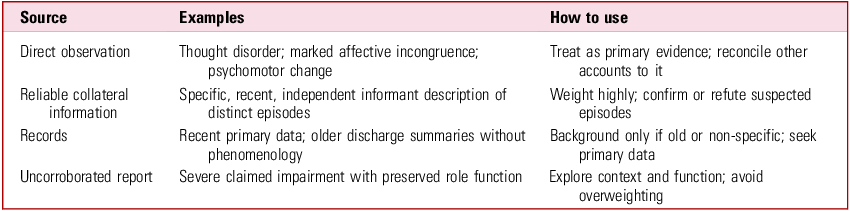
Not all evidence is equal. Direct observation during interview or on the ward (form of thought, affect, psychomotor state) is treated as primary evidence because it is unmediated by the informant’s memory, incentives or interpretive frame. Reliable collateral information from informants with close, recent contact and low incentive to distort is weighted next. Records follow, with recency favoured. Uncorroborated report, especially when discordant with observed function, is weighted last. Reliability of collateral information is judged on the informant’s proximity, specificity, independence from incentives and competence. Table 1 sets out examples.
Weighing the evidence (reliability hierarchy) in clinical formulation

TABLE 1 Long description
A table categorizing sources of clinical evidence by reliability. The table includes four sources: direct observation, reliable collateral information, records, and uncorroborated report. Each source is accompanied by examples and instructions on how to use the information. Direct observation is treated as primary evidence, reliable collateral information is weighted highly, records are used for background, and uncorroborated reports are explored for context and function.
Probe timelines and function
Psychiatric diagnosis is often temporal. A visual timeline – a hand-drawn line on a sheet of paper, with months marked and key events, symptoms and functional anchors plotted, which can be completed collaboratively with the patient in under 5 min – marks onset and offset of key symptoms and events, with sleep pattern, energy, risk behaviours and anchors such as new medication, job loss or substance binges. Clarifying questions include: ‘What was different the week before this began?’ and ‘Has anything similar happened before; which month or season?’ Function – attendance, performance and role fulfilment – often diverges from narrative intensity and separates distress that impairs from distress that leaves roles intact. The assessment ends with a dated one-page timeline made available to the patient and team.
Document uncertainty and plan the next tests
Documentation makes reasoning visible and revisable. Documentation requires a single-line entry under each of four headings: certainty level, proportionality rationale, plan to reduce uncertainty, and review time point. A certainty statement names the competing possibilities and confidence in each. A ‘what would move the needle?’ entry specifies the finding that would increase or decrease confidence. A time-bound review records the next steps, the data to be obtained and when the decision will be revisited. Model entries are given in Box 2. Concise, structured entries of this kind align the written record with the live clinical picture, reduce the risk of documentation drift, and make notes auditable, teachable and transparent to patients (NASEM 2015: Ch. 2).
Documenting uncertainty: model entries in four domains
-
• Certainty: ‘Working formulation: primary psychosis versus stimulant-related syndrome. Certainty: moderate for primary psychosis; low-to-moderate for substance-related’
-
• Proportionality: ‘Disorganisation and impaired self-care justify admission with a time-limited antipsychotic trial; risks of non-treatment outweigh medication risks’
-
• Plan to reduce uncertainty: ‘Collateral from housemates; observed toxicology; repeat assessment after rest; medical screen, including inflammatory markers and ECG’
-
• Review: ‘Structured review at 48 h with registrar and ward team; decision to continue, taper or switch based on mental state change, toxicology and collateral’
Countering bias at the point of care
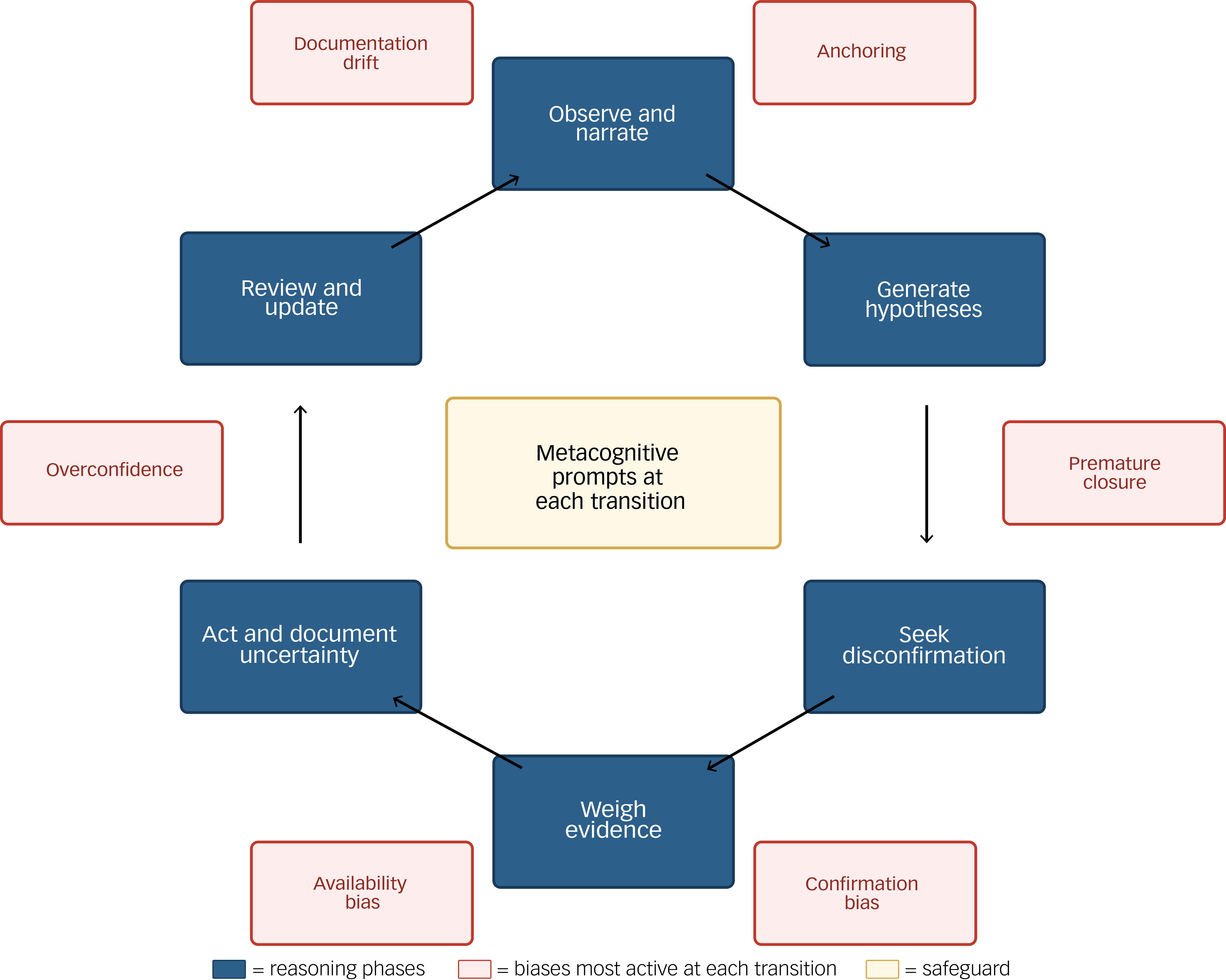
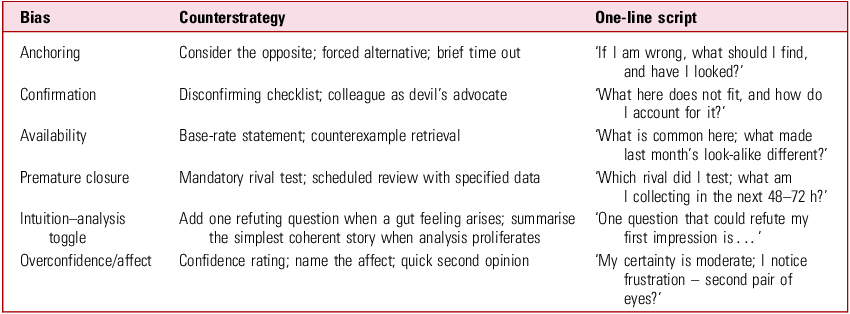
Effective bias mitigation treats cognitive error as a modifiable task–team–system phenomenon – that is, errors arise not only from individual cognition (task), but also from how teams communicate and hand over information (team) and from the documentation structures, incentive systems and time pressures within which clinicians operate (system). The aim is not to memorise a taxonomy of errors, but to alter the workflow so that small ‘forcing’ steps interrupt automaticity at the moments it is most risky. In practice, this means three things. First, make the competing story visible: name two leading explanations, the strongest clue and its source, and one finding that would lower confidence in the favourite. Second, time-limit uncertainty: specify the next discriminating data point and book a review so that unresolved questions generate action rather than inertia. Third, build prompts into team rituals: ward rounds and community reviews start with a base-rate statement and end with a one-line certainty rating. Figure 2 illustrates how specific biases map onto the reasoning cycle and where metacognitive prompts interrupt them. Table 2 summarises common biases, counterstrategies and one-line scripts. When embedded into routine notes and conversations, these moves reduce variance without erasing judgement and make it easier for colleagues and for patients to understand how conclusions were reached and how they will be revisited (Croskerry Reference Croskerry2002; Kahneman Reference Kahneman2011: pp. 20–6; NASEM 2015: Ch. 2). For self-directed bias-revealing questions, see Box 3.
Bias mitigation integrated into the reasoning cycle during clinical formulation.

FIG 2 Long description
Flowchart illustrating bias mitigation in clinical reasoning cycle. The process begins with observing and narrating, which can lead to documentation drift or anchoring. This step transitions to reviewing and updating or generating hypotheses, with metacognitive prompts at each transition to prevent overconfidence or premature closure. Reviewing and updating leads to acting and documenting uncertainty, while generating hypotheses leads to seeking disconfirmation. Both paths converge at weighing evidence, where availability bias and confirmation bias are considered. The cycle then loops back to observing and narrating, incorporating metacognitive prompts to mitigate biases throughout the process.
Common biases and high-yield counterstrategies in clinical formulation

TABLE 2 Long description
The table presents a structured comparison of cognitive biases, their corresponding counterstrategies, and one-line scripts used in clinical formulation. It consists of three columns: Bias, Counterstrategy, and One-line script, with six rows detailing specific biases such as Anchoring, Confirmation, Availability, Premature closure, Intuition-analysis toggle, and Overconfidence/affect. Each row lists the bias, the recommended counterstrategy, and a one-line script to mitigate the bias. For example, the bias of Anchoring is countered by considering the opposite, forced alternative, or brief time out, with the one-line script ‘If I am wrong, what should I find, and have I looked?’. The table aims to help clinicians alter workflows to interrupt automaticity and reduce cognitive errors.
Questions that reveal bias in clinical formulation
-
• What finding would change my mind?
-
• What am I explaining away because it does not fit?
-
• If I could not use this label, how else would I describe the problem?
-
• Which clue am I overweighting; which am I underweighting?
-
• What is the base rate for each leading possibility in this context?
-
• What did a colleague who disagrees suggest, and did I test it?
-
• What is the smallest safe action now, and what will reduce uncertainty fastest?
Vignette B: Bias mitigation
In three recent patients, acute paranoia was judged to be substance-induced. A fourth patient, aged 23, presents with persecutory beliefs after a weekend with friends. An initial toxicology screen is sent. The assessing clinician implements bias mitigation: the availability counter – state base rates for first-episode psychosis and stimulant-related syndromes, and list two co-leads; the anchoring counter – force a rival diagnosis (primary psychosis) with paired disconfirming probes (duration of clear-headed symptoms after last use, negative symptoms, family history and objective sleep disruption); the confirmation counter – include one item that does not fit each leading explanation. The clinician initiates safety measures, then gathers collateral information from housemates and arranges a repeat assessment after the patient has rested, a second toxicology test and a review at 48 h with a colleague arguing the opposing case. At review, the housemate collateral revealed a 6-month history of social withdrawal and decline in personal care pre-dating the weekend, shifting the balance towards primary psychosis and prompting referral to the early intervention in psychosis (EIP) pathway.
Proportionate action under uncertainty
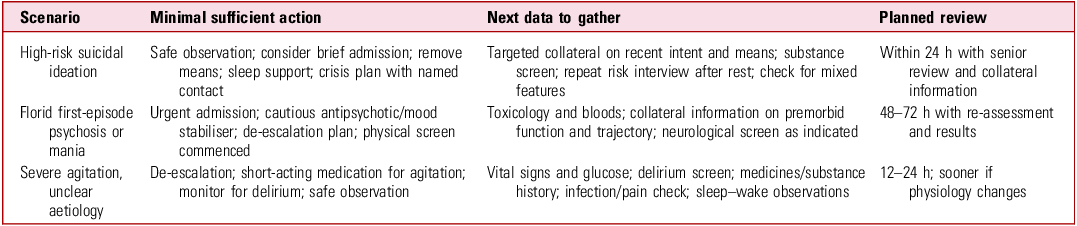
Some decisions cannot wait for diagnostic closure. The clinician acts when risk is credible, matches the action to the risk and continues the investigation in parallel, applying local Mental Health Act and capacity frameworks (National Institute for Health and Care Excellence 2014, 2022). Situations demanding early action include high-risk suicidal ideation with a credible plan, means or rapidly worsening intent; florid first-episode psychosis or mania with disorganisation, impaired self-care and escalating risk; and severe agitation of unclear aetiology, where delirium, intoxication, withdrawal or primary psychiatric syndrome cannot yet be distinguished. For each, the clinician defines the minimal sufficient intervention that achieves safety while gathering data to shrink uncertainty. Table 3 summarises actions, next data to gather and timing of review.
Acting before certainty in clinical formulation

TABLE 3 Long description
The table presents a structured approach for clinical scenarios requiring immediate action before diagnostic certainty. It includes three columns: Scenario, Minimal sufficient action, Next data to gather, and Planned review. The scenarios listed are high-risk suicidal ideation, florid first-episode psychosis or mania, and severe agitation of unclear aetiology. For each scenario, the table outlines the minimal sufficient action needed, the next data to gather, and the planned review timing. For high-risk suicidal ideation, actions include safe observation and removing means, with targeted collateral on recent intent and means as the next data to gather, and a review within 24 hours. For florid first-episode psychosis or mania, urgent admission and cautious antipsychotic are suggested, with toxicology and bloods as the next data to gather, and a review within 48-72 hours. For severe agitation of unclear aetiology, de-escalation and short-acting medication are recommended, with vital signs and glucose checks as the next data to gather, and a review within 12-24 hours.
Treatment as test
Time-limited pharmacological trials can arbitrate between hypotheses when end-points are set in advance. A selective serotonin reuptake inhibitor where depressive disorder is probable is reviewed at 2–4 weeks for tolerability and activation, with clear instructions to stop and seek urgent review if emergent hypomania develops. An antipsychotic for suspected first-episode psychosis is reviewed at 48–72 h. A mood stabiliser for probable bipolar spectrum presentation is reviewed at 1–2 weeks for sleep consolidation. Treatment trials are probes, not verdicts; improvement, deterioration, or neutrality are all data. As noted above, the documentation requires single-line entries under four headings (Box 2).
Vignette C: Proportionate action with incomplete collateral information
At 22:30 a 31-year-old is brought in by police after sending goodbye messages and being found standing on a bridge railing. He reports exhaustion and hopelessness, denies current intent and appears guarded. Alcohol level is low; vital signs are stable. Family cannot be reached. The clinician considers proportionate action: recent behaviour indicates credible risk; ongoing intent is uncertain owing to missing collateral information. Observation in a ligature-safe environment is arranged; means are removed; sleep support is offered. Detention thresholds are considered and documented according to local law. No antidepressant is started overnight; the aim is to observe whether rest alters the organisation and intensity of suicidal thinking by morning. Planned data collection: calls to two named contacts at 08:00, pharmacy check for medication changes, and mixed-features screen. Multidisciplinary review arranged for 10:00 with registrar and night nurse; decision on admission extension or step-down to be based on collateral information and repeat assessment.
Integrating the proposed framework with biopsychosocial formulation
The proposed investigative framework and the biopsychosocial model serve complementary functions, and their relationship is central to the proposal. The biopsychosocial model organises understanding of biological, psychological and social contributors to a person’s presentation, conventionally structured as predisposing factors (long-standing vulnerabilities such as genetic loading, adverse childhood experiences or chronic illness), precipitating factors (proximate triggers such as bereavement, substance use or sleep deprivation), perpetuating factors (mechanisms that sustain the problem, such as unemployment, isolation or unhelpful coping) and protective factors (resources that buffer or facilitate recovery, such as supportive relationships or stable housing). The investigative framework addresses the process by which the clinician arrives at, tests and revises the content of that formulation.
The two interact at every step. During the broad sweep, the clinician gathers narrative data across all three biopsychosocial domains. During hypothesis generation, competing explanations may differ in the relative weight given to biological factors (e.g. a primary affective disorder), psychological factors (e.g. unresolved grief or trauma) and social factors (e.g. housing crisis, with secondary demoralisation). The reliability hierarchy guides the clinician in evaluating which domain’s evidence is most robust for the individual patient: a biological hypothesis may rest on observed mental state findings and family history; a psychological hypothesis on collateral about life events and the patient’s own meaning-making; a social hypothesis on objective housing, financial or occupational data. Proportionate action draws on the biopsychosocial formulation to determine not only pharmacological but also psychological and social interventions, each of which can itself be a ‘next test’ of the underlying formulation.
To illustrate concretely: in vignette D below (a patient in housing crisis reporting long-standing voice hearing), the biopsychosocial formulation might identify chronic housing instability as a perpetuating social factor, possible psychotic spectrum experience as a biological/psychological hypothesis to be tested, and disrupted family contact as a precipitating and perpetuating factor. The investigative framework then generates the testable prediction that genuine psychotic symptoms would persist after emergency accommodation is secured, whereas symptoms primarily shaped by the housing crisis would attenuate. The ‘next test’ (signposting housing support and observing change) and the proportionate action (avoiding premature antipsychotic initiation) both follow from this integrated formulation. A formulation that recognises structural pressures – housing instability, benefit uncertainty, insecure immigration status and discrimination – as perpetuating factors will generate different ‘next tests’ and proportionate actions from one that foregrounds neurobiology alone (NASEM 2015: Ch. 2; Goldberg Reference Goldberg and Stahl2024).
The framework also operationalises the principle of formulation hierarchy: biological, psychological and social hypotheses are not in competition for primacy but ranked iteratively by their explanatory power for the observed phenomena and by their amenability to testing within the available timeframe. The investigative framework thus operationalises the biopsychosocial model by providing a disciplined method for populating, testing and revising each domain’s contribution, and for documenting the reasoning so that subsequent clinicians can see which elements of the formulation rest on robust evidence and which remain hypotheses awaiting test (NASEM 2015: Ch. 2; Goldberg Reference Goldberg and Stahl2024).
Thick description and the investigative stance
The anthropologist Clifford Geertz (Reference Geertz1973) distinguished ‘thin description’ – a surface account of behaviour – from ‘thick description’, which captures symbols, routines, cultural meanings and situated behaviour. The concept has since been developed considerably in medical anthropology and qualitative health research, and translates directly to psychiatric assessment. A thin description might record ‘patient reports hearing voices; appears anxious’. A thick description adds phenomenological detail (how the voices are experienced), cultural formulation (the patient’s explanatory model and usual help-seeking routes) and functional narrative (what the patient can and cannot do). Such richness provides explanatory power beyond categorical labels, supports individualised plans and clarifies risk. Importantly, thick description is relevant to all patients, not only those from minority cultural backgrounds: a middle-class professional whose self-harm is embedded in a specific workplace culture, family dynamic and gendered expectation requires contextual understanding just as much as an individual whose distress is shaped by migration or faith. Within the proposed framework, thick description can be captured succinctly: ‘Patient understands low mood as a spiritual test; sought help from imam before GP [general practitioner]; voices experienced as comforting presence of deceased mother – culturally normative; main functional impact is withdrawal from childcare role’. This level of detail materially affects hypothesis ranking, proportionate action and the review plan (Geertz Reference Geertz1973; American Psychiatric Association 2022).
Special contexts that amplify uncertainty
Certain presentations require an even tighter investigative stance: data are noisier, stakes higher and bias more likely. The method is the same; the emphasis sharpens.
Possible secondary gain
The clinician combines compassion with scepticism, aligns non-clinical supports early (housing, legal advice and advocacy) and tests claims without accusation. Direct observation and high-quality collateral are prioritised; incentives shaping accounts are recognised; timelines, function and corroboration are the focus. Discrepancies and planned checks are recorded; conclusions beyond the evidence are avoided.
Vignette D: Using biopsychosocial formulation within the investigative framework
A 45-year-old requests a letter for emergency accommodation; he reports 5 years of persecutory voices. Employment records and relatives describe continuous full-time work and no treatment. Descriptions vary between interviews; content mirrors the housing narrative. Two co-leads are maintained: a psychotic-spectrum disorder and a presentation shaped by structural stressors with possible secondary gain. Targeted collateral information, structured observation and a functional timeline are pursued. Housing advice and legal support are signposted. Documentation records what would increase confidence in a psychosis diagnosis and the review point after collateral information is gathered.
Cultural formulation
Explanatory models, idioms of distress and help-seeking routes differ across cultures; neglect breeds error and mistrust. The clinician asks how the problem is understood and who is usually turned to for help, checks normativity (e.g. hearing a deceased relative during grief), involves a trained interpreter or cultural liaison when meaning is unclear (with consent), maps how beliefs affect risk and engagement, and co-produces a plan with the patient that respects meaning while addressing risk. A quick run through an interview such as the DSM-5 Cultural Formulation Interview is often sufficient (American Psychiatric Association 2022). For equity-aware prompts to embed in everyday practice, see Box 1.
Age and neurodevelopment
Age and neurodevelopmental profile can influence three parameters of the investigative process: the base rates that inform hypothesis ranking; the sources and quality of available collateral information; and the communication modalities required for reliable assessment. In young people, neurodevelopmental profiles (attention, social communication and sensory sensitivities) shift the differential, carers and schools provide essential collateral information, and tighter review loops are needed to reflect the pace of change. In older adults, the differential widens to include medical and cognitive aetiologies; informant history establishes cognitive baseline; medicines and interactions require review; and lower thresholds for physical work-up apply. Across ages, neurodivergent individuals benefit from adapted interviews – additional processing time, concrete questions and attention to camouflaging effects on function – anchored in behaviour and structured collateral information.
Artificial intelligence and clinical reasoning in psychiatry
Artificial intelligence (AI) is increasingly discussed as a tool for augmenting psychiatric practice. Machine learning models have shown promise in screening for depression and psychosis using speech and language features, predicting treatment response from electronic health record data, and flagging patterns in longitudinal symptom trajectories (Linardon Reference Linardon2025; Rony Reference Rony, Das and Khatun2025). Natural language processing (NLP) can extract structured diagnostic cues from unstructured clinical notes (Abbas Reference Abbas and Lee2025).
In the UK, clinicians may already encounter AI-enabled tools such as triage chatbots deployed by the National Health Service for self-referral to psychological therapies, and electronic health record-based risk flags that alert teams to patients at elevated risk of self-harm or readmission. However, most AI tools in psychiatry remain at validation stage. The ‘black-box’ nature of many models sits uneasily with the transparency that the proposed investigative framework demands. Psychiatry’s reliance on phenomenological nuance, the therapeutic relationship and contextual meaning is a domain in which human judgement is unlikely to be fully automated. Furthermore, algorithmic bias – for example, a risk-prediction model trained predominantly on data from White male patients that systematically underestimates risk in women or ethnic minorities – may compound rather than correct the health inequalities that equity-aware formulation seeks to address (Zheng Reference Zheng and Zhang2025).
The proposed framework is compatible with, but not dependent on, AI tools. Where validated applications become available – for example, structured risk-prediction models or record summaries driven by NLP – they may serve as an additional data source within the reliability hierarchy, subject to the same scrutiny as any other evidence. AI can complement the reasoning process; it cannot replace the disciplined curiosity and relational attunement on which good psychiatric formulation depends (Goldberg Reference Goldberg and Stahl2024).
Implementation: tensions, practical solutions and the need for evaluation
Any framework must contend with service realities. Time is the most cited barrier: community appointments may be 30 min; in-patient assessments compete with ward tasks. Three practical mitigations are offered. First, the proposed investigative framework is modular: a straightforward presentation may need only a brief certainty statement and review date; complex cases warrant fuller documentation. Second, outputs are concise by design: a certainty statement, a discriminating test and a review time point fit into three lines within any electronic record. Third, team rituals embed the framework without adding time: a ward round that opens with a base-rate statement and closes with a certainty rating produces a more transparent record at no extra cost (Croskerry Reference Croskerry2002; NASEM 2015: Ch. 2).
The following simple teaching exercise distils the process: present a short case vignette; ask the trainee for a one-sentence problem representation and the top three differentials, with the single next test most likely to change management; model thinking aloud, revealing alternative hypotheses; then debrief by identifying bias risks, missing context and how the plan would be documented. Over time, this builds a shared language that enhances efficiency and safety on ward rounds and in community reviews.
The framework is offered as a proposal. It has limitations: it has been developed for general adult psychiatry in the UK, and its applicability to highly specialised settings (forensic, perinatal and neuropsychiatry) requires adaptation; its effectiveness depends on clinician engagement and institutional support for reflective practice. Furthermore, it has not yet been formally piloted or evaluated in a controlled study, and any claim of educational or clinical superiority awaits empirical test. Future work should compare the framework with care provided as usual on outcomes including formulation quality, diagnostic accuracy, time to intervention, patient and trainee experience, and effect on disparities in care. Pilot studies in foundation and core psychiatric training, and qualitative evaluation in community and in-patient teams, would be reasonable next steps.
Conclusions
Clinical care improves when reasoning is made visible. The investigative framework proposed in this article translates the hypothetico-deductive method into a stepwise approach for psychiatric assessment: generating and testing falsifiable competing hypotheses, weighing evidence through a reliability hierarchy, acting proportionately under uncertainty and documenting reasoning transparently. The proposed framework operationalises biopsychosocial formulation, incorporates contextual and cultural richness through thick description and acknowledges the emerging role of AI. As noted, it has limitations. Nonetheless, it offers a scaffold for making the craft of psychiatric reasoning explicit, sharable and open to challenge – sustaining psychiatry’s core discipline: a curious, humble search for the best explanation, open to revision as new evidence emerges.
MCQs
Select the single best option for each question stem
-
1 The evidence source that should be weighted most highly when accounts diverge is:
-
a patient report
-
b an old discharge summary
-
c direct observation
-
d distant collateral information
-
e online screening tools.
-
-
2 The most effective safeguard against anchoring in an initial assessment is:
-
a a longer interview
-
b ordering more laboratory tests
-
c considering the opposite and testing a rival explanation
-
d using a generic checklist
-
e changing the assessor.
-
-
3 In the hypothetico-deductive method, a falsifiable hypothesis is best defined as one that:
-
a has strong supporting evidence from the literature
-
b can be confirmed by any clinical finding regardless of what is observed
-
c specifies in advance the finding whose presence or absence would materially lower confidence in the explanation
-
d relies on clinical intuition confirmed by a senior colleague
-
e is based on the most common diagnosis for the presenting complaint.
-
-
4 Of the following, the statement that best describes the relationship between the proposed investigative framework and biopsychosocial formulation is:
-
a the investigative framework replaces the biopsychosocial model
-
b the biopsychosocial model provides content; the investigative framework provides the process for testing and revising that content
-
c they are identical approaches with different names
-
d the biopsychosocial model is used only for chronic presentations and has no role in acute assessment or formulation under uncertainty
-
e the investigative framework applies only to biological hypotheses.
-
-
5 An equity-aware assessment should prioritise:
-
a old records over observation
-
b interpreter use when needed and a brief enquiry based on, for example, the Cultural Formulation Interview
-
c avoidance of collateral information, to reduce bias
-
d pre-specifying the diagnosis to reduce uncertainty
-
e skipping risk questions to build rapport.
-
MCQ answers
-
1 c
-
2 c
-
3 c
-
4 b
-
5 b
Data availability
Data availability is not applicable to this article as no new data were created or analysed in this study.
Acknowledgement
I thank colleagues in community mental health and in-patient services for feedback on the early ideas that led to this article.
Funding
This work received no specific grant from any funding agency, commercial or not-for-profit sectors.
Declaration of interest
None.
Vignettes and consent statement
The vignettes in this article are fictitious and constructed for educational purposes. No real participants were involved; therefore, consent is not applicable.




eLetters
No eLetters have been published for this article.