




No CrossRef data available.
Report of the Editor of Perspectives onPolitics, 2004–2005
Published online by Cambridge University Press: 13 February 2006
Extract
As of December 2005, Perspectives on Politics willhave published three complete volumes of four issues each. As formereditor of the journal (until June, 2005), I have published twoprevious reports (see PS, January 2004, 143–149;PS, January 2005, 141–144) this one covers theperiod from August 1, 2004 through July 31, 2005.
Information
- Type
- ASSOCIATION NEWS
- Information
- Copyright
- © 2006 The American Political Science Association
As of December 2005, Perspectives on Politics will have published three complete volumes of four issues each. As former editor of the journal (until June, 2005), I have published two previous reports (see PS, January 2004, 143–149; PS, January 2005, 141–144) this one covers the period from August 1, 2004 through July 31, 2005.
Previous reports have described the somewhat unusual editorial structure and review process of Perspectives on Politics compared with other political science journals; I will not repeat that description here, but readers should refer to it if need be to make sense of the tables below. Note that Perspectives does not categorize papers by approach, as does the APSR, for two reasons. Articles using technical methods or specialized vocabularies are not appropriate for Perspectives and, more importantly, we seek manuscripts that cut across conventionally defined subfields of the discipline, disciplinary lines, and methods. Note also that by the last few issues of this reporting period, roughly half of the articles submitted to Perspectives did indeed cut across conventional subfield boundaries in political science. We hope that proportion continues to rise. Thus the subfield categorizations below are more than usually inexact; in future reports, editors might consider dropping this rubric altogether since it may be more misleading than helpful.
Submissions
I start with the number of submissions, noted in Table 1.
Submissions, August 1, 2004–July 31, 2005, in percentages (Ns in parentheses). Note 1: The Proposals column includes only proposals for which we had not yet received full submissions by July 31, 2005.

Table 2 combines the subdivisions of Table 1, and reports the 331 submissions by subfield in political science (the first six columns) and by non-academics (the final column).
Submissions by Primary Subfield or Type of Author, August 1, 2004–July 31, 2005, in percentages (Ns in parentheses)

Processing
Table 3 shows how manuscripts fit into the different stages of Perspectives' process for review and decision-making. It includes the 331 new manuscripts of this report year, and an additional 88 that were first submitted prior to August 1, 2004 (for a total of 419 ms. handled this year).
Submissions at Various Stages of Decision-Making, August 1, 2004–July 31, 2005, in percentages (Ns in parentheses)

We made decisions on over half of the submissions dealt with during this 12-month period; a large majority of those are rejections before review. (Remember that many pre-review rejections occur because the article is not appropriate for the distinctive mission of Perspectives, not because of any judgment about quality.) We sent detailed suggestions for revision to almost half of authors. At any one time, only a small fraction of submissions to the journal are under review or being revised for final consideration after review.
Table 4 shows the amount of time taken by these various stages. Note that the number of items in each row varies, and that the table includes only articles on which we have made decisions. We take special pride in the first row of Table 4. My letter proposing pre-review revisions followed an evaluation by at least two editors and two student assistants to the editor, as well as a discussion of each set of evaluations. So a great deal of careful work goes into that innocuous-sounding first stage.
Average Time for Each Stage of Review, August 1, 2004–July 31, 2005 (N in parentheses)

This is an opportune moment to thank reviewers for responding to our requests for assistance; as the second row shows, with few exceptions their comments have been reasonably prompt. Even more importantly, reviews have almost always been clear, detailed, and extremely helpful.
Outcomes
Table 5 reports the overall outcomes for the report year.
Acceptance Rates for Submissions by Stage of Review, August 1, 2004–July 31, 2005, in Percentages (Ns in Parentheses)

Table 6 provides more detail for interpreting Table 5. It shows acceptance rates for all submissions according to the subfields of political science (first six rows) or the non-academics (next row).
Acceptance Rates by Subfield or Type of Author for Submissions, August 1, 2004–July 31, 2005, in Percentages (Ns in Parentheses)

Our rejection rate was highest for the two subfields in which we had the largest number of submissions, which partly reflects Perspectives' commitment to publish widely across the discipline of political science. Our acceptance rate, however, is also slightly higher for the same two subfields, although it is more even across the major subfields than last year. Remember that all of these results are substantially an artifact of how we categorized articles that cut across two or more subfields, especially since these percentages are based on small numbers.
Table 7 summarizes the results of decisions made during this report year by the editors of Perspectives.
Acceptance Rates, August 1, 2004–July 31, 2005, in Percentages (Ns in Parentheses)

Note that the 78% of manuscripts that did not go to outside review reflects both manuscripts that we turned down before review, and manuscripts that authors chose not to send back after we sent suggestions for pre-review revisions.
Publication
Table 8 shows the published results of everything I have described up to this point. To maintain consistency with earlier reports, it covers volume 2, issue 4 (December 2004) of Perspectives, and volume 3, issues 1, 2, and 3 (March, June, and September 2005). It provides raw numbers, not percentages, since the totals are so low.
Items Published in Perspectives on Politics, December 2004–September 2005

We see a reasonable distribution across the five subfields that one would expect to contribute most of the articles in Perspectives, except for the fact that American politics may be too predominant. But each article is excellent; we would have been sorry not to publish any of them.
Book Reviews
As Table 9 shows, from July 31, 2004 to August 1, 2005, the book review office (at the University of North Carolina, Chapel Hill until the end of June 2004), received over 1,200 books and planned to review close to 400 for an overall acceptance rate of 31%. The number of books received is somewhat lower than in recent years for the second year in a row (several years ago, the book review office received 1,600 to 1,800 books). It is not clear whether this marks a trend in submissions or simply an unusual few years. The decline in numbers does permit a higher proportion of the books received to be reviewed.
Books Received and Book Reviews Commissioned, August 1, 2004–July 31, 2005, in Percentages (Ns in Parentheses)

The subfield distribution of books sent to the review office fluctuates some from year to year; typically, although not this year, the field of American politics is one of the two largest, and international relations is closer to political theory in the number submitted.
The book review editors give first priority for review to singly- or co-authored works published by university presses. They also consider singly- or co-authored works by other presses, as well as edited volumes with a strong thematic focus. The overall acceptance rate of 31% is relatively high, compared with recent past years, for the book review section. The proportion of books reviewed is generally higher in the subfields of political theory and international relations because the books received are primarily singly- or co-authored scholarly works. (By contrast, in the subfield of American politics and, to some extent, in comparative politics, many of the books received are textbooks, non-scholarly works, or books from other disciplines.) However, in comparing these figures to previous years, the proportion of books accepted in political theory is unusually high.
Table 10 shows the number of book reviews per subfield published in Perspectives on Politics from Vol. 2, issue 4 (December 2004) through Vol. 3, Issue 3 (March, June, and September 2005).
Published Book Reviews, December 2004–September 2005, in Percentages (Ns in Parentheses)

For the second year in a row, the number of books in the subfields of American and comparative politics is slightly higher than has traditionally been the case, and the number in international relations and political theory is correspondingly lower. We aim to have the distribution of books relatively equal across the subfields, but are limited in any given year by the number and quality of books submitted in each subfield.
Conclusion
Completing this report is my last formal task as editor of Perspectives on Politics, and I want to end by thanking everyone involved for making it such a fascinating four years. In particular, I want to thank the associate editors, the APSA staff, the managing editors, and the APSA officers and Council—as well, of course, as the authors and reviewers. Like everything else in Perspectives on Politics, the annual report remains a work in progress. The editors and staff welcome queries that were not answered above and suggestions for topics to include in future reports. We welcome even more your suggestions, proposals, and manuscripts for future publication in Perspectives.

Submissions, August 1, 2004–July 31, 2005, in percentages (Ns in parentheses). Note 1: The Proposals column includes only proposals for which we had not yet received full submissions by July 31, 2005.
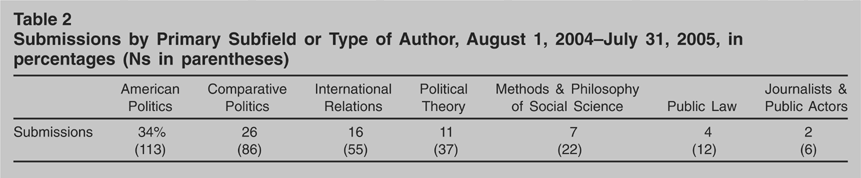
Submissions by Primary Subfield or Type of Author, August 1, 2004–July 31, 2005, in percentages (Ns in parentheses)
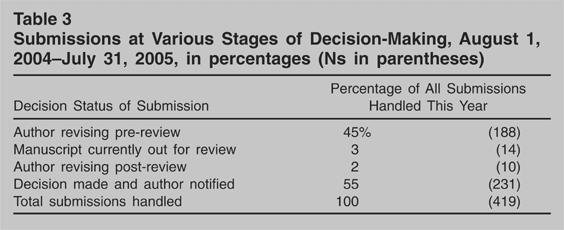
Submissions at Various Stages of Decision-Making, August 1, 2004–July 31, 2005, in percentages (Ns in parentheses)
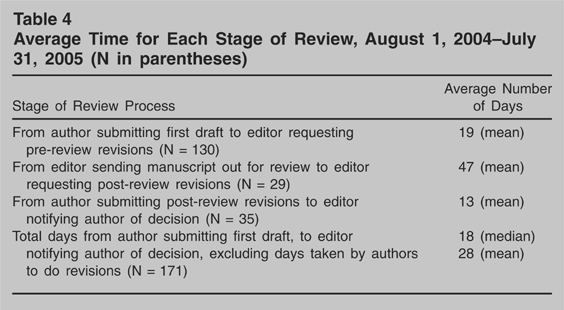
Average Time for Each Stage of Review, August 1, 2004–July 31, 2005 (N in parentheses)
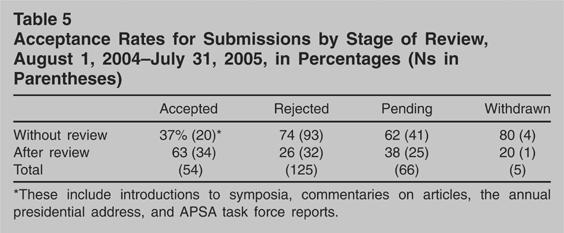
Acceptance Rates for Submissions by Stage of Review, August 1, 2004–July 31, 2005, in Percentages (Ns in Parentheses)
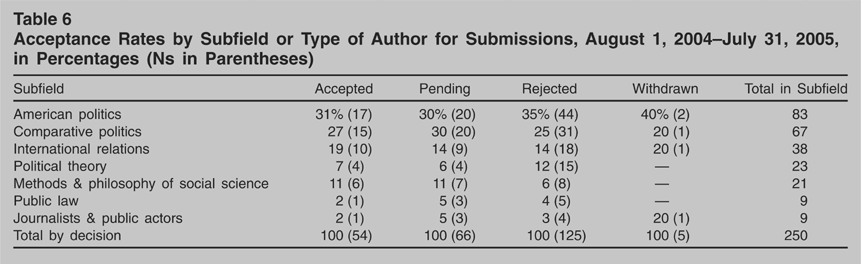
Acceptance Rates by Subfield or Type of Author for Submissions, August 1, 2004–July 31, 2005, in Percentages (Ns in Parentheses)
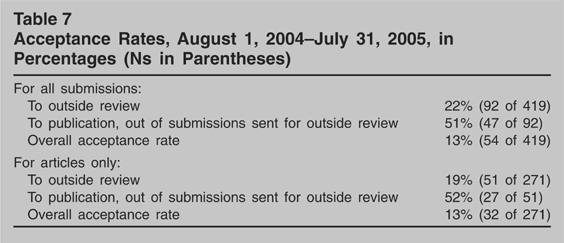
Acceptance Rates, August 1, 2004–July 31, 2005, in Percentages (Ns in Parentheses)
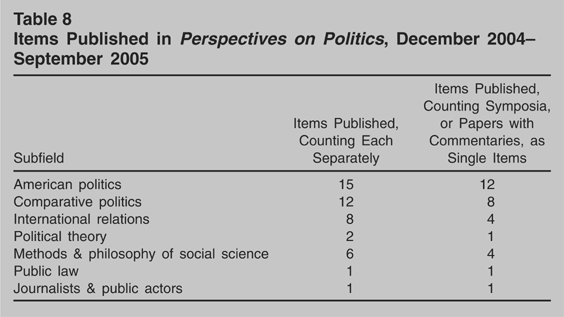
Items Published in Perspectives on Politics, December 2004–September 2005
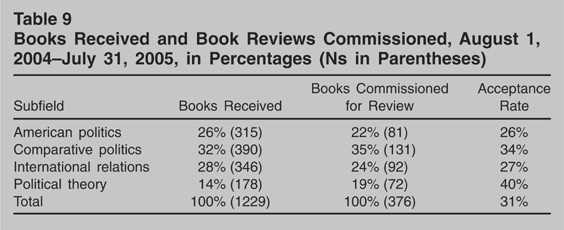
Books Received and Book Reviews Commissioned, August 1, 2004–July 31, 2005, in Percentages (Ns in Parentheses)
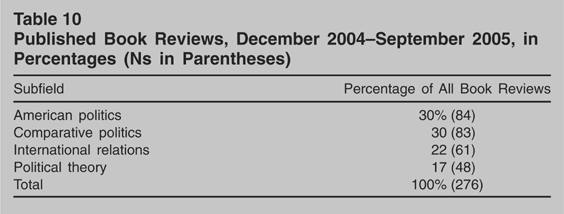
Published Book Reviews, December 2004–September 2005, in Percentages (Ns in Parentheses)
 You have Access