The powerful concept of orientalism has undergone considerable refinement since Edward Said popularized the term with his eponymous book in 1978.Footnote 1 In a nutshell, orientalist discourses construct an essentialized perception of “the East,” broadly construed, that enables and justifies unequal power relations between “West” and “East.” Orientalism typically is presented as a totalizing, hegemonic process that creates polar oppositions between a masculine, vigorous, superior West and a feminine, passive, subordinate East. Cultural critics have argued, however, that orientalism is, in Lisa Lowe's words, “a heterogeneous variety of discursive formations of cultural difference,”Footnote 2 and, that given the contradictory, dynamic, and unstable nature of orientalist discourses, it is more productive to speak of multiple orientalisms, which are distinguished by time, place, and circumstances of a discourse's origin, as well as the geographic location and characteristics of the imagined East it creates.
Recent analyses of orientalist discourses also question the polar opposition of West and East, and acknowledge that Westerners can identify with as well as position themselves against the characteristics usually associated with the Orient. Mari Yoshihara suggests, for example, that some U.S. women engaged in orientalist discourses in part to challenge their own subordinate status.Footnote 3 American orientalisms reflect uniquely American approaches to situating one's self within larger communities and forging a coherent identity by articulating relationships to one's community and drawing boundaries with one's Others. Although Said focused his analysis narrowly on European literature that engaged with the Near and Middle East, the same basic principle has been used widely to analyze other imaginaries as well, and the “Orient” often subsumes the whole or parts of East Asia, Southeast Asia, the Indian subcontinent, and even Africa. U.S. orientalisms often focus on East and Southeast Asia, reflecting a geographic and political proximity to the Pacific Rim, as well as significant immigration of East and Southeast Asians to the United States.
Over the last century a panoply of musical gestures has come to represent the oriental in Western music. Derek B. Scott's impressive list of such devices, which occupies fully half a page of text in his book From the Erotic to the Demon: On Critical Musicology,Footnote 4 includes such stalwart, if nonspecific, markers of the East as pentatonicism, parallel fourths and fifths, drones and ostinati, and melodic arabesques, among others. For the most part, these musical characteristics do not correspond precisely to actual Asian musical elements. Scott argues that such music's “purpose is not to imitate but to represent.”Footnote 5 Exactly what such music represents to its Western listeners varies. It may evoke an imagined East that is timeless and simple, provide a vicarious window into desires and practices that are generally reviled yet strangely compelling, or justify colonial, imperial, and racist power differentials. The significance of the East conjured by orientalist music lies primarily in its dramatic contrast with the West and how this contrast contributes to the construction of viable representations of, as Richard Taruskin puts it, “the reduced and totalised Other against which we construct our (no less reduced and totalised) sense of ourselves.”Footnote 6
This article explores the ways in which the same musical source materials, in the hands of three different individuals who adapted traditional Javanese melodies into ‘exotic’ Western art songs, manifest contrasting orientalisms. I argue that the three—Charles T. Griffes, Eva Gauthier, and Paul J. Seelig—are bound by a common interest in using authentic melodies to articulate their identities. They are divided, however, by their strategies in mobilizing the tunes to respond to their own particular needs. Each of the three mined the same unassuming Sundanese melodies from West JavaFootnote 7 to achieve quite different ends, but their divergent styles of appropriation and adaptation contributed to their creating and maintaining quite different identities, each with its own sense of self and its own set of Others.
I draw on a useful typology of the ways in which musical borrowings contribute to the articulation of identities proposed by Georgina Born in her introduction to Western Music and Its Others. Although this list is perhaps oversimplified and by no means exhaustive, it does provide a helpful framework within which to examine the different approaches Griffes, Gauthier, and Seelig took in transforming the melodies they adapted into multifaceted vehicles for enacting their own identities. Music, Born writes, can
1. Create purely imaginary identification by modeling a fantasy substitute for, or imaginary extensions of, the subject's real identity
2. Prefigure emergent identities by renegotiating “the boundaries between social categories, between self and other”
3. Reproduce or memorialize extant identities by reinforcing existing categories and helping to repress identity transformations, and
4. Facilitate after-the-fact reinterpretations of past identities by recontextualizing its artifacts to create discursively a new version of history.Footnote 8
Griffes, Gauthier, and Seelig
Born's first approach applies to the most famous of my three subjects: Charles Tomlinson Griffes (1884–1920), the U.S. composer who died in 1920 just as his career was taking flight. Although Griffes resisted being labeled an exclusively orientalist composer,Footnote 9 many of his works exhibit clear and explicit references to Eastern musical materials and ideas. Malini Johar Schueller has argued that, for Americans in particular, “the Oriental encounter opens up possibilities of homoerotic gendering that cannot be freely articulated at home.”Footnote 10 Some musicologists have speculated that Griffes's attraction to things Oriental was at least in part an escapist response to his own life situation—he was a homosexual who found himself teaching at a boys' academy in a small town. The complexities of maintaining a discrete and ambiguous sexual identity predisposed him to covet the qualities of ambiguity and simplicity he saw in Oriental music.Footnote 11 Orientalist gestures in music can reference alternate sexualities with generally maligned desires and activities, which, when displaced onto an Asian Other, enter into the realm of both the possible and the enjoyable.Footnote 12 Griffes never actually traveled to Asia, but he was an avid reader, and, once he started spending his summers in New York City in 1915, he was an eager audience for any performance with an Asian flair.Footnote 13 Griffes sought out individuals in New York who could acquaint him with the cultures he wanted to experience. He found a mentor—“just the kind of person Griffes found stimulating”Footnote 14 as well as a fount of exotic musical materials—in Eva Gauthier.
Unlike Griffes, the Canadian-born, European-trained mezzo-soprano Eva Gauthier (1885–1958) had significant experience traveling in Asia. In 1910, after a couple of years of modest success singing in Europe, she moved to the island of Java, then a part of the Netherlands East Indies, to marry Frans Knoote, a Dutch plantation administrator. At the turn of the twentieth century there was a thriving European music scene in the Indies, which provided diversion and entertainment for the many expatriate Netherlanders who lived there. Dutch residents of Java's major urban centers were patrons of kunstkringen (art circles), which provided venues for local musicians to perform and brought internationally famous performers to their stages as well.Footnote 15 European music and dance were also part of the lives of some upper-class Indonesians, who regarded acquaintance with European music as a sign of sophistication.
Knoote wrote a letter to Musical America, published in the 11 August 1910 edition, suggesting that Java was a much less competitive market for aspiring singers than Europe. All evidence suggests that Knoote convinced Gauthier that her musical talents would be better appreciated in the Indies than they were in Europe, one additional reason that she might have chosen to join him there. Their marriage was short lived, and Gauthier later confessed in her unpublished memoirs that if her European career had been more successful, she never would have gone to Java or married Knoote.Footnote 16 In any case, as Knoote predicted, her tours of Southeast Asia, in which she sang arias and art songs to audiences of expatriate Europeans, were quite successful. As a result of some extraordinary circumstances, however, including the collapse of her marriage and the outbreak of World War I, in late 1914 she found herself alone in New York with few resources besides her singing skills and experience.
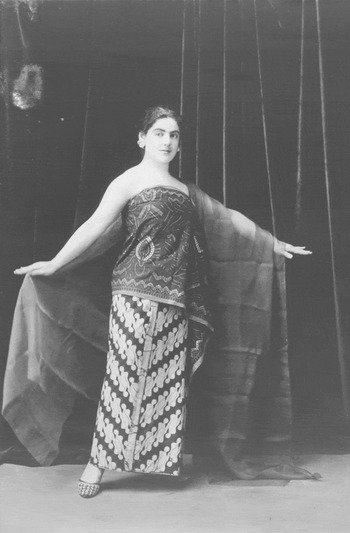
Gauthier quickly discovered that her experiences in Southeast Asia provided her with a valuable mark of distinction, and she soon created a new identity for herself as an intrepid collector and interpreter of exotic songs. In doing so, she exemplified Born's fourth approach to articulating an identity through music: after-the-fact reinterpretations of past identities in which musical artifacts are recontextualized to create discursively a new version of history. Gauthier's eventual prominence in the New York music scene was due in no small part to her success singing what she characterized as “Javanese” and “Malay” songs while draped in lavish batik costumes (see Fig. 1). The public was convinced that Gauthier brought a deep, authoritative knowledge to her performances by virtue of the four years she had spent living in Java before arriving in New York. Few in her audiences noticed that her so-called folk songs had been transformed, as Henry Cowell once characterized them, into “perfect French art songs.”Footnote 17 Her batik costumes were likely bought in North America,Footnote 18 and most of the lore of Javanese music with which she regaled her audiences came from readily available books and magazine articles.Footnote 19
Eva Gauthier in “Javanese” costume. Library and Archives Canada, Éva Gauthier fonds, MUS 81, nlc-2461.

Although exaggerated, her claim to authority was not completely fabricated. Most of Gauthier's experience with the musics of Java were the result of her relationship with pianist and composer Paul Johan Seelig (1876–1945). According to Gauthier's own account, she met Seelig at one of her recitals in Java, when he filled in at the last minute for her regular pianist. She was surprised to discover that a “half-caste,” as she described him, could play so well with so little preparation, and she later engaged him to be her accompanist.Footnote 20 On a tour to Australia, Seelig suggested that she perform some of his arrangements of “native” songs. Under his influence she developed an interest in Javanese and Sundanese traditional music, and using Seelig's contacts, she began to make arrangements to study Javanese music, with the ambitious goal of bringing a group of gamelan musicians on a tour of Europe and America.
Although born in Breda, the Netherlands, in 1876, Seelig spent most of his early childhood in the Indies, where his father was a choir director. At age fourteen he returned to Europe to study at the Leipzig Conservatory, and four years later he returned to Java to teach music and play cello in his father's orchestra. In 1900, after a few more years studying in Europe, he was appointed the director of the orchestra in the kraton (palace) of the susuhunan of Surakarta, one of the main royal courts of Central Java. In 1907 Seelig began a three-year stint as the director of the king of Thailand's orchestra. In 1910 he returned to Java and settled in Bandung, West Java, where he took over his father's music store and established the music publishing house “Edition Matatani.” Except for occasional trips abroad, Seelig remained in Bandung until his death in a Japanese prison camp in 1945.Footnote 21
Seelig was a successful musician, businessman, and composer. He was trained in European music but engaged with the traditional music of the Indies as well. Many of his compositions make use of the Indies melodies and texts he collected. Although he self-identified as Dutch, he loved the island of Java and considered it his home. His compositions, which aim to achieve a seamless blend of materials from the Indies with European sensibilities, are consistent with this dual identity.
Seelig's engagement with traditional cultures and musics of the Dutch East Indies was deep. It is possible that his mother was Javanese (although his children refute such claims),Footnote 22 and it is likely that he was at least well acquainted with, if not fluent in, several Malay languages. In advertisements for his music store (see Fig. 2), Seelig boasts that he sells not only pianos and sheet music, but also gamelan instruments, wayang puppets, and masks.Footnote 23 R. Grooss suggests that, as a boy, Seelig heard gamelan rehearsals in his hometown of Semarang.Footnote 24 During his tenure as music director at the kraton, he assembled a large collection of Javanese gamelan melodies (from existing printed sources as well as oral sources), which he later published under the title Gending Djawi in Reference Seelig Paul1922.Footnote 25 Seelig maintained a close friendship with the royal family even after he left Surakarta. He also had completed a manuscript on the history of Javanese music by 1937, which was never published and was among the many possessions that disappeared during the war.Footnote 26
Advertisement for Seelig's Music Store in Bandung, West Java (Bandoeng, 1906–1931: Officieele Jubileum Uitgave Ter Gelegenheid Van Het 25 Jarig Bestaan Van De Gemeente Bandoeng Op 1 April 1931 [Bandoeng: Algemeen Indisch Dagblad De Preangerbode, 1931]). By permission of the Royal Netherlands Institute of Southeast Asian and Caribbean Studies, KITLV Collections, M b 518.

Seelig began composing at the urging of Felix Weingartner during his studies in Germany, and his earliest compositions were difficult to distinguish from the works of his European-trained contemporaries. Miep Zijlstra describes his early songs as having “the stamp of the high Romantic, with influence from Hugo Wolf, Richard Strauss, and the French impressionists.”Footnote 27 A large number of pieces in Seelig's oeuvre nevertheless bear some connection to the musics and languages of the Dutch East Indies, although such influences take many different forms. In some cases he simply started with Malay-language texts, which he set in his high-romantic or impressionist manner. In other cases he arranged melodies drawn from a variety of Indies sources, including urban, diatonic kroncong tunes as well as more traditional Sundanese and Javanese sung poetry, gamelan music, and children's songs. Some of his larger-scale works use kroncong or gamelan melodies as themes, which he subjects to Western-style development and variation. Although much of his instrumental writing conforms to conventional European models, there are often clear attempts to imitate the timbre and texture of Indies source materials, such as gamelan. Such compositional approaches reflect well Seelig's own identification as both a European and a permanent resident of the Indies; they represent Born's second approach to mobilizing music to articulate identity, the renegotiation of “the boundaries between social categories, between self and other.”Footnote 28
Seelig was a prolific composer who disseminated many of his pieces through his own publishing outfit, “Edition Matatani,” which distributed internationally through agreements with European publishers. Quite a few of his works were performed in Europe and the United States as well as in Southeast Asia, and his international reputation earned him a biography in the fifth edition of Grove's Dictionary of Music and Musicians.Footnote 29 Unfortunately his own collection of personal papers and possessions was lost when he was interned during World War II, and although many of his compositions are available in libraries and archives, many more are not and may be lost forever.Footnote 30
Taken as a whole, Seelig's oeuvre reflects his desire to assimilate Indies materials into European art music without exoticizing them. Henk Mak van Dijk describes his approach as “reverse exoticism” because the Indies were hardly foreign or strange to Seelig—they were his home.Footnote 31 He elected to remain in Bandung to run his store and conduct his research even when his wife and children lived in the Netherlands. That he nevertheless identified as European is evidenced by the way he regarded his forays into musics of the Indies as research and his adhering to the colonialist musicologists' conventions of the time in refraining from actually playing Javanese or Sundanese musical instruments.Footnote 32
Seelig's approach to incorporating Indies materials into his composition evinces his own dual identities as European and Dutch-Indonesian. He treats Malay-language texts as he might treat a text in any other language; in several cases he provides a German or English rendition (or both) of the texts in an apparent effort to make the language issues transparent to non-Malay speakers. He provides late-romantic chromatic harmonies even for the pentatonic and diatonic melodies he borrows directly from Indies music traditions. Nadia Turbide comments that “Seelig's unobtrusive accompaniments nevertheless transformed these Javanese melodies into Occidental compositions of romantic or impressionistic bent.”Footnote 33 His fellow expatriate colonials, who preferred to cultivate their Dutchness and avoid things that smacked of local cultures, were not particularly receptive to Seelig's adaptations. On the other hand, non-Dutch European and North American audiences, removed from any immediate experience of the Indies and in search of exotic and novel experiences, found Seelig's “pantun”-based songs appealing. They were, according to Grooss, performed more often in Europe and America than in the Dutch East Indies.Footnote 34
Javanese Songs in New York
In hopes of gaining increased exposure outside of Java, Seelig was understandably eager to assist Eva Gauthier in her endeavors. In 1914 he drew on his friendship with the susuhanan of Surakarta to solicit an invitation for Gauthier to spend time in the kraton to prepare for the ambitious “Javanese season,” as she characterized her planned tour of a gamelan group in Europe and North America. According to an article in De Locomotief (Semarang) in Gauthier's scrapbooks, the program was to have had three sections: (1) Javanese songs with gamelan accompaniment, (2) Sundanese songs with angklung (bamboo rattles) accompaniment, and (3) Malay songs with gamelan.Footnote 35 Gauthier herself would sing some of the songs dressed in Javanese clothing; she planned to prepare by spending a month in Surakarta studying Javanese music. Although Gauthier did indeed spend time in the kraton, the tour never materialized. She instead accepted an offer to tour Australia with violinist Mischa Elman, after which she sailed to the United States, fearing the war would make life difficult in the Indies. She never returned to Java.Footnote 36
Seelig dedicated a pair of songs to Gauthier, op. 24, with the very un-Malay title Zwei malayische Lieder, which nevertheless featured Malay-language texts.Footnote 37 These songs were among the pieces she performed, in Javanese costume, during her first New York appearances in late 1914 and early 1915. Before relocating to North America, she generally gave Seelig full credit for his songs. An article in Sydney's Daily Telegraph quotes Gauthier: “Seelig, a pupil of Felix Weingartner, has been in Java for 10 years, and has been studying this music. He has succeeded in transcribing it into European notation, and has in this way collected examples of the Javanese and Siamese music.”Footnote 38
Gauthier learned early in her U.S. career that the novelty value of her Javanese experiences was an asset worth cultivating. She was prone to exaggerate the details of her life there, and a mythology surrounding her time in Java gradually accrued—abetted, no doubt, by a press eager for sensational stories. In New York Gauthier dropped the German title of Seelig's songs; the program for one of her earliest appearances at the MacDowell Club on 29 December 1914, billed the songs, modified further, as “Javanese Folk Songs—collected and arranged by Paul Seelig of Java.” A 1915 interview in the Buffalo Times provides a slightly embroidered provenance for Seelig's songs by conflating the time she spent in the kraton with Seelig's compositions. She said,
After I had gained the confidence of the young women of the harem they sang for me and I worked with them daily, learning their songs.. . . These songs were arranged for me by a half-caste, whose father was a European and whose mother was a Javanese. Knowing the work of both civilizations intimately, he has arranged them in a wonderfully accurate way.Footnote 39
During a vaudeville tour in 1916–17, Gauthier billed the songs as “Javanese Folk Songs collected by Eva Gauthier . . . arranged by Paul Seelig.”Footnote 40 Later press reports rarely mention Seelig's name at all in conjunction with his songs. Gauthier clearly wanted her U.S. public to regard her as an expert in Javanese music and culture, steeped in the traditions of the Indies, and to think of the songs she sang as unmediated. Exaggerating the depth of her own involvement with Javanese music—suggesting that she learned the songs directly from Javanese musicians—was one means toward this end. Critic Frederick Martens was certainly convinced of Gauthier's authority:
The Javanese songs of Mlle. Gauthier are authentic. . . . They have the vague melancholy of many of the melodies developed on a pentatonic scale and while, no doubt, they lose in effect when not set off by a Javanese gamelan (orchestra) with its bells, its variety of wooden and metal gongs, and the interpolated Arab r'ebab, and with the concessions demanded by a transcript for Occidental instruments, yet they add their quota to the exotic folk-song quality of the Ballet intime's music.Footnote 41
Gauthier's performance style in her “Javanese” and “Malay” songs differed from her more conventional repertory only in the language of their texts. Gauthier made no attempt to alter her vocal technique or style for the songs. She once remarked, “The Javanese sing falsetto, and like it, but, much as . . . I like their music, I do not like their voices and I am sure my audience would not.”Footnote 42 A recording of one of her Malay songs, “Nina Bobo,” bears no signs of the vocal styles of the Indies.Footnote 43 She delivers the simple diatonic lullaby in a rich bel canto style that is quite at odds with the tense, focused vocal timbre cultivated by Javanese female singers.Footnote 44 Southeast Asian theater scholar Matthew Isaac Cohen describes her Malay diction on the recording as “uneven” and points out many mispronounced words.Footnote 45 Press reviews, however, indicate that her audiences responded enthusiastically to her fanciful costumes and evocative stories, and imagined that they heard much that was genuinely Javanese in her performances.
The Tunes That Bind
It was around this time, in 1917, that Gauthier met Griffes, whose compositional career was just gaining steam. She is reputed to have provided him with some Javanese and Japanese melodies, which he dutifully copied into his notebooks for future use as source material for his compositions. Some of Griffes's notebooks, now in the collection of the New York Public Library for the Performing Arts, include a group of such melodies. An undated notebook contains Indies melodies in Griffes's hand.Footnote 46 My examination of these melodies suggests that some—perhaps most—came from a variety of published sources. A few of the melodies closely match early transcriptions of Javanese tunes published in nineteenth-century tomes on Javanese culture written by Stamford Raffles and John Crawfurd.Footnote 47 Although Griffes could have conceivably taken the melodies directly from these books, it seems more likely that he copied Gauthier's own copies. Gauthier certainly was aware of the published collections; her papers, housed in the New York Public Library for the Performing Arts, include a handwritten bibliography of literature on Javanese culture, including the Raffles and Crawfurd books.
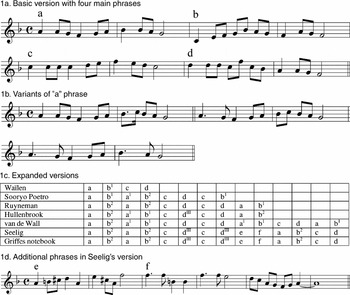
Two tunes in the undated notebook match quite closely some of Paul Seelig's compositions. One of them, already mentioned, was “Nina Bobo,” a favorite of many Dutch-Indonesians because it was a lullaby sung in colonial times by local nursemaids to the Dutch babies in their care. Although it is true that this song is well known, quite a few distinct variant melodies and arrangements were published in the early decades of the twentieth century. Example 1a shows the most basic version of “Nina Bobo.”Footnote 48 It consists of four two-measure phrases (labeled a, b, c, and d). Other published versions of the song differ in two ways from this basic model. First, the rhythmic and melodic details of the phrases vary. (Example 1b provides some of the “a” phrase variants that distinguish one version from another.) Second, the strophe is expanded through repetitions of the four phrases. (Example 1c summarizes the phrase structures of published versions.) At times the melodic variants lend a rather different contour to the phrase; these variants are marked with superscript numbers in Example 1c. Phrase “d” usually ends on the tonic, but the versions in which it ends on the third degree are marked with a superscript Roman numeral III in the example. Taking into account all these small variations makes each version unique. Seelig's rendition of “Nina Bobo” is distinguished not only in its particular turns of phrases, but also in its addition of strikingly different melodic material (labeled e and f in the Example 1c and notated in Example 1d), which briefly modulates to the relative minor for dramatic effect. The version in Griffes's notebook matches exactly the quirks of Seelig's own version (see Example 1c), which was among Seelig's arrangements that Gauthier sang (and recorded) during her first years in the United States and which Seelig published as a piano solo in 1920.Footnote 49
“Nina Bobo” melodies.

The other melody with a clear connection to Seelig is the only Javanese melody in the Griffes notebook that includes a text. The tune is cast in a hemitonic pentatonic pelog tuning, with several auxiliary tones, and the text is a Javanese-language version of the Islamic shahada (profession of faith). The same melody provides the theme for a Seelig piano solo, “Haståkå kuswålå,” a title that refers to one of the forms of Javanese Sanskrit-derived poetry called tembang gede.Footnote 50 Although the Seelig version is instrumental, the sheet music does include the text at the top of the page (without the odd misliterations of the Griffes notebooks).
What was the original source of Griffes's melodies? Gauthier herself is vague about the provenance of her collection of melodies. She once described her collection process: “While in Japan I renewed the practice I pursued in Java of collecting original material. In particular I found a book of native music in which were things I liked, and I copied a number of them out, not knowing precisely what I should do with them.”Footnote 51 Thus it appears that Gauthier's collection of exotic melodies was copied from various printed sources, despite the impression given in most of the literature on Gauthier and Griffes that she learned and transcribed her melodies directly from Javanese and Sundanese musicians. I speculate that her sources included Seelig's materials—notes, manuscripts, and published compositions—to which she would have had ready access during her collaboration with him during her years in Java.
Griffes was interested in incorporating genuine Asian melodies into his work in a way that somehow preserved those qualities that he found compelling. He used the verb “developed” to characterize his treatment of the Japanese melodies he incorporated into his 1917 composition Sho-Jo. Griffes criticized composers who simply set exotic melodies with
harmonization [that] might have come from Broadway. Modern music tends more and more toward the archaic, especially the archaism of the East. . . . There is a striving for harmonies which suggest the quarter-tones of Oriental music, and the frequent employ of the characteristic augmented second, as well as of the organ point common to both systems. In the dissonance of modern music the Oriental is more at home than in the consonance of the classics. And all this I have borne in mind in the development of the Sho-Jo music.Footnote 52
In other words, Griffes felt that he was setting the tunes in an idiom that highlighted their essential qualities and yet made them relevant to a modernist Western musical aesthetic. As Iwao Asakura points out, Griffes's goal was not to reproduce the authentic sounds of the Orient, but rather, “what he ‘imagined’ an Oriental sound to be.”Footnote 53
Gauthier sang some of Griffes's songs in her recitals, especially those with an orientalist twist (e.g., “Waikiki” and Five Poems of Ancient China and Japan), to critical acclaim. It probably seemed a natural progression in their professional relationship that Griffes would “develop” some Javanese songs especially for Gauthier.
Griffes's “Three Javanese Songs”
The Javanese songs Griffes composed for Gauthier survive only as fairly complete manuscripts, now in the New York Public Library for the Performing Arts, which owns two sets of manuscripts. One set is in Griffes's hand and was apparently once bound; the pages on which these scores are written include fragments of other sketches as well. The other set came from Eva Gauthier and is in the hand of a copyist. The songs in this manuscript are essentially the same as those in the autograph, except that they include texts as well.Footnote 54
According to one of Griffes's biographers, Edward Maisel, Griffes's diary reports that he began to compose the Javanese songs on 14 April 1919 and he visited Gauthier on 21 May to show her the results.Footnote 55 Gauthier intended to present the songs at her 11 February 1920 recital at Aeolian Hall in New York; her own collection of newspaper clippings includes an advertisement for the concert, in which “Folk Songs of Java— arranged by Charles T. Griffes” were featured prominently. The planned premiere did not materialize, however; in an obituary for Griffes, Gauthier is quoted as saying she “had planned to sing them at her concert last Spring, but he did not have them ready.”Footnote 56
After Griffes's death his sister Marguerite and his publisher, Schirmer, were eager to disseminate his remaining compositions. The Three Javanese Songs were advertised as forthcoming in a number of publications. Some penciled notations on the manuscripts that probably date from this time read: “The title is tentative. Publish the three together as a set not separately. Wait until Madame Gauthier returns.”Footnote 57 (Gauthier was in Cuba at the time.)Footnote 58 Gauthier instructed Schirmer not to publish the songs, however. She wrote to the publisher: “They were not supposed to be published[;] he did them for me specially . . . and as I have not yet had the time to produce them myself I don't feel that they should be published.”Footnote 59 Gauthier never did sing them in public. Schirmer eventually published the songs in 1995, edited by Donna K. Anderson, with English texts by Jonathan Elkus.Footnote 60
From the point of view of someone familiar with Indonesian musics, the three Griffes songs—“Hampelas,” “Kinanti,” and “Djakoan”—represent a quite eclectic mix of source materials. The text for “Hampelas” is in the Sundanese language, which is the dominant language in the highland areas of West Java, where Seelig's hometown of Bandung is located. It is cast in a light poetic form known as sisindiran, which is used in many different contexts. Sisindiran accompaniments are usually cast in a regular, duple meter. The melody set by Griffes is mostly anhemitonic pentatonic (i.e., black-key), which approximates the Sundanese tuning system known as salendro (slèndro in Javanese). Salendro often is theorized as an equidistant pentatonic scale, in which each interval is somewhere between a major second and an augmented second. The non-salendro part of the melody is a curious opening melodic motif that features a half step. It is consistent with the Sundanese scale called sorog, which is characterized by such intervals, and in Sundanese performance practice salendro is often mixed with sorog.
“Kinanti” also has a Sundanese text. The term kinanti refers to a particular poetic meter, which is one of several known collectively in West Java as pupuh and in other parts of Java as macapat. In contrast to light sisindiran poems, pupuh forms are rather serious. Each of the meters has a particular affect associated with it; the kinanti meter evokes feelings of brooding, apprehensiveness, or hopeful expectancy.Footnote 61 Two performance traditions are found. In the older style singers recite all poems in the kinanti form using one of a few basic “kinanti” melodic forms, which they sing without accompaniment in rather free rhythm. The focus of such performances is the poetry and the affect. The melody is more accurately described as a reciting formula that helps listeners identify the poetic meter and contributes to the meter's particular affect. The singing of such verses is an informal activity, in which one might indulge when alone, working, or with friends. Around the turn of the twentieth century, a newer style emerged in which a variety of new melodies were composed for pupuh poems, to which the accompaniment of a zither called kacapi and a bamboo flute called suling might be added. This more formal, yet still essentially social, form was initially associated with aristocrats from the West Javanese town of Cianjur. Over the last century, increasingly professionalized musicians have cultivated the more formal style, which in recent decades has been called tembang Sunda, and it has come to be associated with modern conceptions of Sundanese cultural refinement.Footnote 62 My Sundanese consultants do not immediately recognize the melody set by Griffes as a standard kinanti melody, and it does not match any of the Sundanese or Javanese tunes transcribed by Margaret Kartomi.Footnote 63 Nevertheless, it shares stylistic traits with known kinanti melodies, and it is conceivable that the tune may have been a kinanti melody at one time.
The third song, “Djakoan,” is a children's song in a dialect of the Javanese, rather than the Sundanese, language, which apparently includes some Dutch words as well.Footnote 64 Both the melody—also an anhemitonic pentatonic—and text are instantly recognizable to most Javanese (see Example 2). The renowned Javanese composer Ki Nartosabdho once used the song as the basis for a gamelan composition.Footnote 65
“Jagoan” (“Djakoan”) excerpt.

The melodies that became the source for Griffes's Three Javanese Songs do not appear in his notebook, but since the notebooks are essentially “loose leaf,” it is conceivable that these melodies, too, were once copied into them and those pages have since been lost. A few measures from one of the melodies found in the notebooks, however, appear in the musical fragment that precedes the complete autograph of one of the Griffes songs. That melody also appears in one of Paul Seelig's compositions (“Haståkå kuswålå”); in this way, then, Griffes's Three Javanese Songs are connected at least tentatively to the notebooks—and to the work of Seelig.
The connections don't stop there, however: the melodies of two of these three songs are identical (albeit transposed) to pieces published by Seelig. Although all of the melodies came from the oral tradition, and could therefore have been collected and transcribed any number of times, the exactitude of some of the notated melodic details—grace notes, tempo changes, and the like—suggests either that Seelig and Griffes copied from a common source, or, as I believe is more likely, that Gauthier acquired the transcribed melodies from Seelig and gave them, unaltered, to Griffes. It is entirely possible that the third Griffes song (“Hampelas”) also has a Seelig counterpart that is missing, or at least that I have not yet been able to identify.
Two Settings of “Kinanti”
One of the songs—“Kinanti”—in which Griffes's and Seelig's versions share not only the melody but the text as well—illustrates the divergence of the two composers' treatments of the same source material especially well. Seelig's version was published in a set of three songs, collectively titled Tembang Sunda. Each of the three songs in the collection (“Sinom,” “Kinanti,” and “Dandang gula miring”) bears the name of one of the pupuh poetic meters. The Sundanese word tembang refers to a refined type of singing. As noted previously, the term tembang Sunda currently refers to a style of singing pupuh poems with the accompaniment of zither and flute (kacapi and suling), but in Seelig's time its connotation was probably not so specific. Seelig's Tembang Sunda bears the opus number 28 and a publication date of 1922—two years after Griffes's death.
Seelig includes both the Sundanese text as well as a German version; no translator is listed on the title page; so it is likely that the translation is the composer's own. The Sundanese poem describes the experience of an aristocrat deigning to enter the market and act like a commoner. Although he is thrilled by his momentary impersonation of an ordinary person, his “slumming” is inevitably colored by his status, as all those who see him rush to make way for him. The lesson: it is pleasant, but ultimately impossible, to escape one's fate.
The German translation is, on the surface, quite different from the Sundanese, in that it instead describes a beautiful young woman who appears to have a fleeting, and ultimately unfulfilled, romantic fantasy.
Despite the significant change in characters and plot, the German version does reproduce the theme that it is possible to step outside one's station in life for a moment, but ultimately impossible to escape one's destiny—a message entirely consistent with the affect of a kinanti poem. I speculate that Seelig was being sensitive to the differences between Sundanese poetic conventions, which are not always transparent to European sensibilities, and European literary language, which routinely uses romantic love as a metaphor for more profound themes.
Each pupuh meter is characterized by its number of lines, the number of syllables in each line, and a specific ending vowel sound. For example, a verse in kinanti meter has six lines, each of which contains eight syllables; the six lines end with the vowels u, i, a, i, a, and i, in that order. The German version, however, makes no attempt to follow these formal prescriptions. Seelig provides an alternate scansion for the German text, which departs dramatically from the original melody's rhythm at times, but which coordinates well with the accents of the German text. In short, Seelig's treatment of the text shows sensitivity to both the poetic conventions and the sonic qualities of the Sundanese and German languages.
In contrast, it is unlikely that Griffes had much sense at all of the text's meaning or even its pronunciation. Although it is possible that Gauthier passed along some translations, her own Sundanese language skills were at best rudimentary. Griffes's autograph versions of the three songs feature a number of linguistic faux pas. In “Kinanti,” for example, he divides the Dutch spelling of the word “itu” (“itoe”) into three syllables (i-to-e) rather than two, and he includes the non-Sundanese syllable “toi” as the last syllable. The spelling of the title “Djakoan” is inconsistent with the more modern spelling (djagoan) in the song's text. In all the songs words are often missyllabified. For Griffes, I suspect, the words were no more than vocables, and their very inscrutability enhanced the exotic Otherness for which he aimed. For Seelig, however, the text was of primary importance. In contrast to Griffes, Seelig's arrangement of the song strove to translate the text's theme—not literally, but into a form that performers and audiences familiar with European music could comprehend.
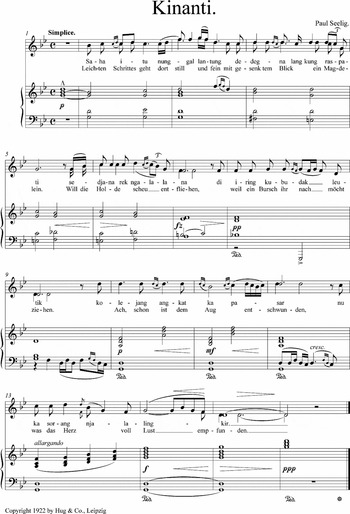
Griffes's and Seelig's piano accompaniments reveal the two composers' different goals as well. In keeping, perhaps, with the conventional performance practice of pupuh melodies—i.e., either unaccompanied or with an understated ostinato accompaniment from a zither—Seelig's accompaniment is quite sparse. Imitating a Sundanese zither player, perhaps, who likely would provide the singer with a pitch reference, Seelig's piano part (Example 3) opens with a block G-minor triad (m. 1) and proceeds to hold half- and whole-note chords under the more florid melody. This slow rhythmic density, along with the occasional echo of a melodic gesture by the piano with a slightly different rhythmic twist, gives the melody an almost free-rhythm feel.
Paul J. Seelig's “Kinanti” from Tembang Sunda, op. 28 (Bandoeng: Matatani, 1922).

The harmonic progression, with its lush seventh chords, is quite un-Sundanese, and it is this aspect of the setting, I suspect, to which Seelig applied a European compositional approach—deploying harmonic conventions to enhance the mood of the text. The first two phrases, the text of which suggests the protagonist's refined character, start out in G minor. The bass line descends (mm. 3–4), conventionally enough, but then oscillates with uncertainty (mm. 5–6). The most stridently dissonant chord in the piece underpins the last syllable of the second line in the first half note of m. 7, where the poem's protagonist considers doing something out of character. This chord resolves to the dominant of the relative major in the second half note of m. 7 and finally to a refreshingly simple B-flat triad in m. 8, which contrasts with the rest of the piece's somber minor mood and reflects the momentary emotional change. The major sonority does not last long, however; a low G grounds the piece back in the minor mode in the second half of m. 8, and a G pedal point extends all the way to the end, coloring all that occurs with a melancholy G-minor tinge—including the submerged melodic figurations in mm. 9 and 12, which furtively try to outline B-flat-major triads but never quite make it to the chord's root. This bittersweet harmonic treatment captures the feelings one might experience during an impulsive straying from one's station in life, which, even though unfulfilled, leaves in its wake a submerged sense of exhilaration. The exhilaration, however, then disappears completely with the return to the unaltered G-minor triad at the end. Overall the setting enhances the text's description of a fleeting escape fantasy and the ultimate letdown of the return to reality.
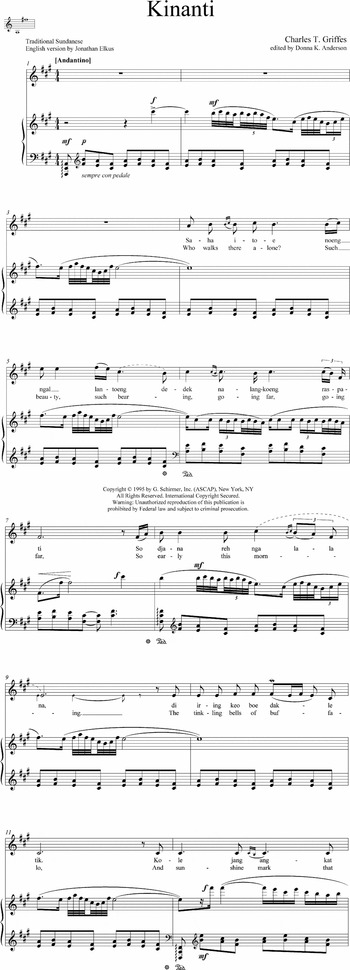
Griffes's accompaniment (Example 4), in contrast, is full of conventional orientalisms—ostinato figures, parallel fourths and fifths, rhapsodic arabesques, and pianistic imitations of gong sounds. In contrast to Seelig's lush harmony, which obscures the melody's obstinate pentatonicism, Griffes never once strays from the five-tone pitch vocabulary. Griffes probably did his homework to identify specifically Javanese musical gestures. Iwao Asakura has pointed out that the rolled open-fifth chords that appear at the beginnings of many phrases (e.g., m. 1) are meant to imitate gong strokes, and their presence articulates phrases in a manner analogous to the gong strokes in gamelan music.Footnote 68 (It should be noted, however, that a Javanese musician would place the gong strokes at the end of each phrase, rather than at the beginning.) The accompaniment has two other musical strata: a steady oscillation in eighth notes of parallel fourths or fifths, and intermittent bursts of florid, improvisatory-sounding high-pitched passages, which generally complement the vocal melody with sophisticated heterophony. These various strata move along under the melody without much variation or change as the song progresses. The gong sounds, the stratified polyphony, and the heterophony suggest that Griffes was studiously—and effectively—imitating the sound and texture of a gamelan. The static quality he achieves is consistent with a general perception in the West of Javanese gamelan music's flow without what Westerners would consider “progression,” evoking the orientalist's eternal East.
Excerpt from Charles T. Griffes's “Kinanti” from Three Javanese Songs, in Songs of Charles Griffes, Volume III. Copyright 1995 by G. Schirmer, Inc. (ASCAP), International copyright secured. Reprinted by permission.

In short, whereas Seelig sought to make the song familiar by blending Sundanese and European sensibilities in his setting, Griffes emphasized the song's exoticism by keeping the meaning obscure and providing an accompaniment that imitated the structure, texture, and instrumental idioms of Javanese gamelan music. Seelig mobilized the conventions of European harmony to adapt for European ears the affect of a kinanti poem and melody, but Griffes used a conventional cluster of orientalist musical gestures and an incomprehensible text to evoke a unfathomable Orient.
Western Selves and Javanese Others
Ralph P. Locke points out that musical representations of the East are achieved primarily through “familiar Western procedures and techniques,” even when the musical materials in question are “more-or-less-accurate musical borrowings—‘authentic’ tunes, rhythms, timbres, and harmonies” faithfully borrowed directly from Asian traditions.Footnote 69 My analysis demonstrates that the kinds of Western procedures employed to adapt such genuine materials are often more meaningful than any residual significance the original materials might carry. In other words, regardless of the provenance of the melodies and musical gestures, or how faithful or fanciful their treatment, orientalist pieces reveal nothing about any Eastern Others. They can, however, tell us a great deal about the Western selves who collect, compose, perform, and enjoy such music.
The human connections among the three subjects of this article were serendipitous, but their adaptations of the same Sundanese tunes nevertheless bind them, despite their astonishingly different backgrounds. Each—Griffes, Seelig, and Gauthier—saw markedly different qualities in the unassuming tunes that linked them. All capitalized on the legitimacy that the melodies could bestow on their respective identity projects. However, the kind of identity each was articulating, and the ways in which each of them manipulated the materials, were quite different.
Charles Griffes was indulging Born's method no. 1 for using music to create an identity: “purely imaginary identification” with the melodies. To him, they lent a patina of reality to his idealized, simple, ambiguous Orient. As an outsider he adopted the music's sounds, but not its original meanings, to represent his imaginary Orient.
Paul Seelig, on the other hand, used the melodies according to Born's method no. 2: to prefigure his own unprecedented, blended, but coherent identity. By seamlessly incorporating Malay language and melodies into a well-established European art song tradition, Seelig rationalized his own dual identity and established it as nonambiguous by producing aesthetic objects that made unified sense of such cross-fertilizations. He clearly had a sense of the melodies' original performance practice and meaning, but rather than imitate performance practice, his settings instead present an insider's approach to translate, rather than imitate or represent, an understanding of the songs.
Finally, Eva Gauthier, by disseminating the melodies she purported to have collected, was actualizing Born's method no. 4: reinterpreting her own past. Whether she liked it or not, she had spent four years in Java. On her return to North America, she discovered that her Javanese connection could prove quite lucrative. Unfortunately the most marketable part of that experience—a deep engagement with Javanese music—was one that she had not exploited to its fullest during her stay. So she set about reinventing herself as an intrepid musical adventurer in the Indies. Her performances, her costumes, her pretensions of expertise, and, of course, her melodies made this reinterpreted identity convincing to everybody—even to herself.
I suppose only the Sundanese music makers who once sang the songs in their original context, overheard, perhaps, by whoever initially transcribed them, might represent Born's method no. 3—“reproducing extant identities.” Melodies, tunes, and songs, through transcription, recording, dissemination, and arrangements, become a kind of currency in the economy of identity politics; they can be invested, traded, and spent in any number of ways. What makes musical expressions meaningful is not how unchanged they remain from their original source, but how well they can satisfy the new needs to which they are brought to bear. The tunes that bind Griffes, Gauthier, and Seelig are only the raw materials from which they created their own unique orientalisms, each with its own sense of self and its own Javanese others.