The middling classes of artisans and shopkeepers were not a community of equals. Individuals and groups of shoemakers, tailors, barbers, bakers, innkeepers and others of this economic and social condition were divided not only by issues of age, gender, family background and the practised trade or craft, but their status also depended on the position the individual occupied within a single occupation. Master artisans and shop-owners, skilled and unskilled assistants and apprentices each held a very different professional status within their trade.Footnote 1 This was not only reflected in the income, and in the power, professional and familial opportunities and social prestige that individuals and families enjoyed within their own immediate group and the wider community, but also in their desire to differentiate, and to contest and negotiate such differentiations through behaviour and display.Footnote 2
In an attempt to locate the complex and often changing dynamics of early modern social groups, historians have often emphasized the importance of urban public space, highlighting particularly the role of the neighbourhood as the key ground from which wider claims to identities could be launched into the broader community.Footnote 3 While such studies have provided a valuable basis for understanding some of the ways in which individuals formed and asserted their identities in urban space, the close identification of ‘public’ with the city's streets, quarters, taverns, marketplaces and civic and religious buildings has meant that relatively little attention has been paid to domestic space as a social context for creating and shaping urban identities. This is particularly the case when we talk about the lower social groups in sixteenth-century Italy for, while the ‘middling’ groups are relatively well analysed for early modern England, practically nothing is known about the domestic social and cultural practice, nor of the role that domestic consumption and the visual display of honour played in the complex processes of identity-formation at the local levels of artisans in fifteenth- and sixteenth-century Italy.Footnote 4
This article asks whether local artisans, small shopkeepers and others of relatively limited economic and social condition could use the private urban house in sixteenth-century Siena in a meaningful way to construct individual or collective identities and to facilitate social relations, and whether this might have wider implications to the ways in which individuals and groups of the lower social orders were viewed in sixteenth-century Italian society. Analysing a set of household inventories, the intention is, first, to evaluate how the house was set up as a social space at the lower levels of society. The discussion will then proceed to discuss some of the ways in which domestic space, and the visual strategies employed within it, may have helped individuals to form communities and define their position within the broader urban social fabric. The discussion will centre on the more prosperous Sienese craftsmen, shopkeepers and traders that, broadly, occupied an economic and social position in the city between notaries, merchants and lawyers, on the one hand, and salaried workers and day-labourers, on the other.Footnote 5
The domestic interior as a ‘public’ space
Sixteenth-century Italian houses have been traditionally viewed as private spaces, devoted to the preservation of family wealth and daily household affairs.Footnote 6 Recent studies of the domestic interior and material culture, however, have shown that the distinction between ‘public’ and ‘private’ in early modern urban space was much more complex. As Flora Dennis, Marta Ajmar-Wollheim and Elizabeth and Thomas Cohen, among others, have shown, rather than being discrete spaces isolated from the public life of the city, the houses of fifteenth- and sixteenth-century Italy were sites for a growing range of social activities that varied from formal business negotiations to informal evening gatherings and large wedding banquets.Footnote 7 The frequency of visits by friends, relatives, neighbours and business associates to each other's private homes made both a culturally and socially dynamic space of the sixteenth-century house.
Modern scholars of sixteenth-century Italy have tended to assume that domestic sociability – and the role it played in the complex processes of identity-formation – was limited to the households of the wealthy elites. Referring to artisan properties in early modern Genoa, one historian recently suggested, for example, that the absence of appropriate decorative furnishings, furniture and tableware from the artisans’ reception rooms indicates that all major social activity among families of the lower social rank, including family dining, may have taken place outside in taverns or streets.Footnote 8 Such a framework implies that the lower and higher ranking citizens living in the urban space of sixteenth-century Italy operated within two relatively distinct spheres, which placed the ‘high’ and the ‘low’ in different categories in both social and cultural terms.
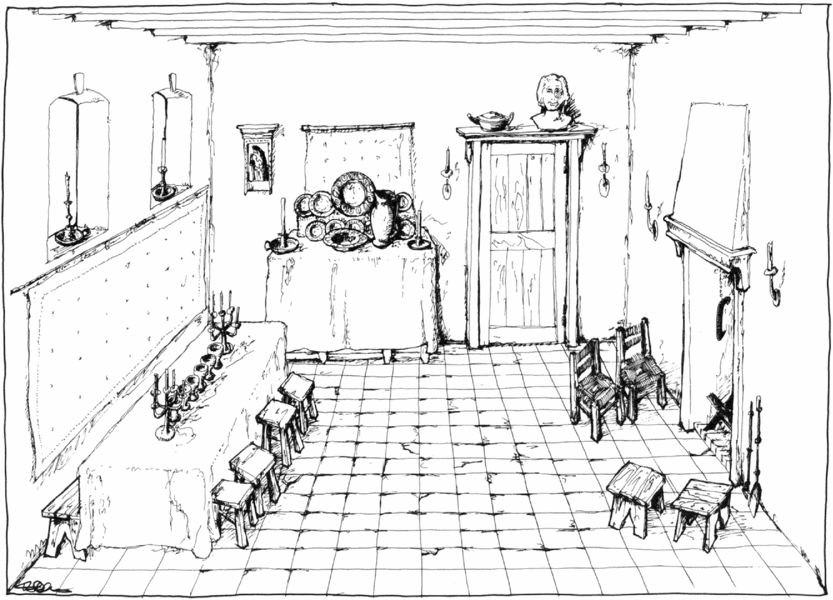
Archival evidence from early modern Siena, however, provides a more varied picture, suggesting that, as far as cultural and social practices are concerned, the gap between the higher and lower ranking citizens may not have been necessarily as wide as we tend to assume. Household inventories drawn up for local artisans and shopkeepers by the government Office of the Wards (Curia del Placito) in the first half of the sixteenth century indicate that the ‘public’ character of the house became an issue of growing concern for at least some artisan and shopkeeper families. Family valuables and the most prestigious possessions were no longer exclusively confined to the chamber, but a wider range and quality of material goods were also distributed in the less private areas of the house. This changing location of objects of value, together with the appearance of new domestic possessions, meant that the reception room developed from a more or less functional kitchen and storage room into a comfortable, well-furnished social space. This was furnished according to contemporary standards with furniture and furnishings designed for social interaction, such as a folding dining table, benches, a sideboard, some decorative furnishings, a few rush chairs and some wooden stools that were arranged around the fireplace (Figure 1).Footnote 9 This change is significant from the point of view of sociability, because the reception room, known in Siena as the sala, was the main location in household in the sixteenth century for receiving and entertaining guests, and it represented the ‘public’ world of the house.Footnote 10
An imaginary reconstruction of the artisans’ reception room (sala), based on 82 Sienese artisans’ and shopkeepers’ household inventories in ASS, CPD 648–748 (1500–55) and fifteenth- and sixteenth-century images of objects and interiors. @ Timo Helameri & Paula Hohti.

Although the reception room probably continued to be used in most artisan households for various daily domestic activities such as needlework, spinning, weaving, washing clothes, cooking or even sleeping, the furnishings of the room suggest that in at least a number of artisan houses the space also functioned as the family's ‘dining room’. Along with a long trestle table and seats found in reception rooms, many artisan families had a ewer and a basin on the sideboard for washing hands before and after the meal as well as embroidered linen towels, tablecloths, linen napkins and a range of dinnerware in the cupboard below, which could be set on the folding table for dining.Footnote 11 In addition, many families had embroidered linen towels, tablecloths, linen napkins and a range of dinnerware in the cupboard of the sideboard, which could be set on the folding table for dining. Some families also had a separate, well-stocked kitchen, suggesting that meals were frequently prepared at home.Footnote 12
The range, quality and quantity of dinnerware and furniture held in the sala of Sienese artisans and shopkeepers suggests, furthermore, that the room may have also provided a space for receiving guests. Pietro, a Sienese tailor, for example, had a dining table and seats for fourteen people in his reception room as well as several sets of tablelinen and dinnerware that would have made it possible to host a meal for many guests. The dinnerware included fourteen serving bowls, eighteen metal plates, twelve drinking glasses, jugs and a wine-cooler, six large tablecloths, eight linen towels and seventeen napkins.Footnote 13 Several artisans also owned items of fine quality, which allowed them to perform relatively elaborate dining rituals.Footnote 14 Pietro's dinnerware included a fine gilded marble bowl, a gilded all'antica cup, two gilded knives, one fork and a silver spoon, but his case was not unique; examples of refined objects associated with dining, such as crystal jugs, drinking glasses, maiolica plates and gilded serving-dishes, were listed in a relatively high number of artisan inventories, including carpenters, shopkeepers and second-hand dealers as well as bakers and masons.Footnote 15 One of the finest examples in the sample were two large Venetian cristallo-glass cups (tazzoni), found in the house of mattress-maker Bernardino di Pietro.Footnote 16 This type of glassware corresponded to the latest technical innovations and, as opposed to common glass, it also enjoyed great prestige among the more elevated members of society.Footnote 17
The sense of refinement associated with the reception area was not limited to the tableware but it extended to the broader decoration of the room as well, suggesting that the space was furnished for the public eye. Sixteenth-century inventories of Sienese artisans and shopkeepers indicate that even at the lower social levels, the sala was often decorated with wooden cornices or spalliera hangings placed behind the dining table, as well as with paintings, small statues of saints, and portrait busts (Figure 1).Footnote 18 However, several artisan families were able to turn their reception rooms into highly decorative spaces by applying various ornamental elements that enhanced the decorative appearance of the space. For example, Cesario di Albertino, a barber, had eight chairs with arms and several leather cushions instead of the usual chairs and benches, in order to provide greater comfort and dignity around the dining table.Footnote 19 He had further enhanced the aesthetic appearance of the space by placing three ‘beautiful’ lacquered vases, an elaborate gilded, rectangular mirror and a roundel decorated with coats-of-arms around the room.Footnote 20 Other artisans had expensive textiles and furnishings in the space. The tailor Pietro had stored or displayed two painted textiles and five further spalliere hangings in his reception room, while his contemporary Vincenzo, a dealer in second-hand goods, had several ornamental furnishings of stunning quality in his sala, including a gilded leather hanging, gold-trimmed decorative cushions, fine embroidered linen table cloths and several carpets for tables and benches.Footnote 21 Like most of their contemporaries, all three men had further ornamental items stored in the bedroom chests, which could be taken out and put on display on social occasions.
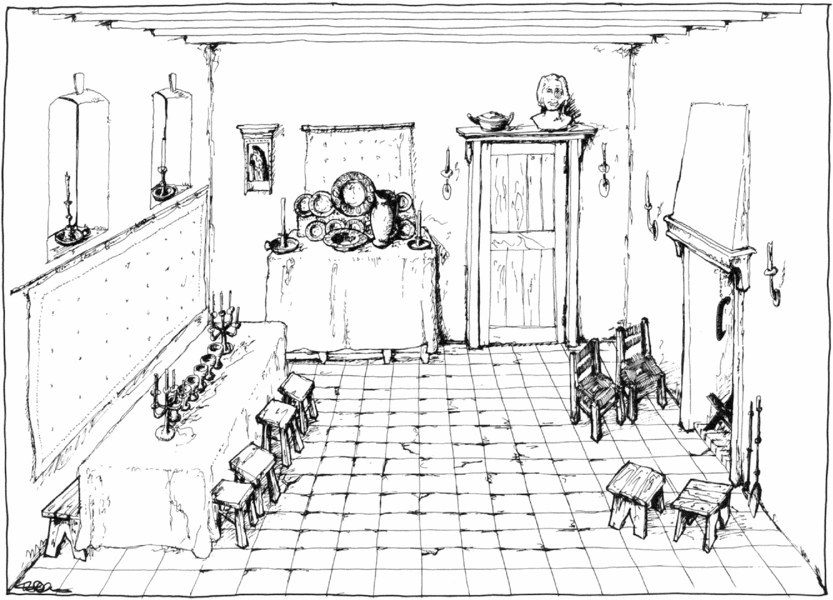
However, one of the most elaborate objects of display and an essential element of the Tuscan reception room from the late fifteenth century onwards was the dressed sideboard, the credenza (Figure 2). By the mid-sixteenth century, even artisans had credenze as decorative display pieces, created by placing expensive textiles and decorative plates, basins and ewers on view.Footnote 22 The shoemaker Girolamo, for example, had placed a credenza in front of an elaborate, framed hanging that included familial coats-of-arms, and had set a ‘beautiful, decorated basin’ specifically designed for the credenza on a decorative tablecloth. He also had steps or shelves on which to display further items, including an ewer, a large plate and other tableware, four candleholders and some lamps that he may have kept in the cupboard below.Footnote 23 The relatively high quality of the objects that were placed on the sideboard by artisans, as well as the care with which the displays were created, suggests that the credenza not only represented a level of prestige among the lower classes, but also that it had come to occupy a central role in artisans’ reception rooms, even in the most modest families. For example, the local baker Stefano, a man of modest wealth and possessions, had a bench that, according to the inventory of the reception room, was ‘used as a credenza’.Footnote 24
An imaginary reconstruction of the artisans’ reception room (sala), showing the dressed credenza, based on 82 Sienese artisans’ and shopkeepers’ household inventories in ASS, CPD 648–748 (1500–55) and fifteenth- and sixteenth-century images of objects and interiors. @ Timo Helameri & Paula Hohti.
A strong sense of the growing refinement of the most public spaces of the house, together with the increasing presence of objects and furniture designed for dining, entertainment and social interaction indicates that parallel developments toward greater domestic sociability took place also at the lower levels of society. This is also suggested by literary accounts, which confirm that both informal social gatherings as well as more elaborate family occasions, such as childbirth rituals, funerals or wedding celebrations were held at artisans’ home. Describing his sister Caterina's wedding in his Ricordanze (1478–1526), the Florentine coppersmith Bartolomeo Masi, for example, reports that right after the bride had received the ring, more than 30 guests were invited for a banquet, organized on the ground floor reception room (salotto) of his house.Footnote 25 The growing attention paid by artisans and shopkeepers to the ‘public’ character of the urban house suggests that the domestic space became an increasingly important physical site of mediation between the inhabitants and the wider city, also at the local level of artisans and shopkeepers. This may have had important social consequences, especially for the more prosperous craftsmen, shopkeepers and traders, for in sixteenth-century Italy, the interior and its furnishings that were visible for guests on social occasions could provide an important set of visual tools with which individual and collective identities could be asserted within the broader urban communities.
Household goods and identity
Sixteenth-century Italians were well aware that the ‘public’ appearance of the house was an issue of considerable importance. Their sensitivity on this subject was connected to the late fifteenth- and sixteenth-century idea that houses and elaborate family possessions, from chests and sculptures to textile decorations and silverware, embodied the family's honour, status and pride, and contributed to creating a sense of hierarchy between those individuals, groups and communities who owned, used and saw them. As Reino Liefkes has noted, with the exception of clothing, there was no context more suitable for expressing social aspirations than dining.Footnote 26 Writing on the subject in his De splendore, the Naples-based humanist Giovanni Pontano, for example, stated that status should be made visible not only through personal adornment, but also through hospitality and conspicuous display of household furnishings and decorative objects:
The base man and the splendid man both use a knife at table. The difference between them is this. The knife of the first is sweaty and has a horn handle; the knife of the other man is polished and has a handle made of some noble material that has been worked with an artist's mastery . . . the goods of the splendid man should therefore be both polished and abundant. Not only should they correspond to his wealth but also to the expectations of others and to his dignity.Footnote 27
Although Pontano was addressing his lines mainly to the wealthy elites, there were also sets of more general unwritten codes about honour and propriety, as Elizabeth and Thomas Cohen have noted, and about family, ownership and neighbourliness that were known more broadly, all of which might have had an impact on received perceptions of domestic space, also at the lower economic and social levels of society.Footnote 28
All craftsmen, traders and shopkeepers discussed in this article can be identified from the Sienese tax records (Lira) as relatively modest local figures who, for their lack of surnames, rights to hold political office or notable property or business investments, held a relatively modest economic and social position in Sienese society.Footnote 29 For example, despite their relatively elaborate interiors, the barber Cesario, the tailor Pietro, the shoemaker Girolamo and the dealer Vincenzo, all mentioned above, appear in the Sienese tax registers without family names, and with a total taxable wealth of between 175 and 320 lire.Footnote 30 These figures correspond more or less to the average total taxable wealth of Sienese artisans, calculated at 231 lire in 1509, which was considerably lower than figures estimated for their social superiors, including the classes of merchants and professionals.Footnote 31
Yet, the growing refinement of the reception room and the dining table, together with other furnishings of the household, suggests that the four artisans, among several others, enjoyed a level of prosperity within their own social circles. The barber Cesario, the tailor Pietro, the shoemaker Girolamo and the dealer Vincenzo were all shop-owners or master craftsmen who ran relatively successful business enterprises in Siena. Cesario, the barber, for example, had a spacious and well-furnished barber's shop on the Piazza della Barberia where he was assisted by seven shop assistants.Footnote 32 Vincenzo, the dealer, had a well-stocked second-hand goods shop on Siena's main piazza, the Campo, where he sold a wide range of household goods, particularly cloth and clothing.Footnote 33 Large shops such as these must have provided the two men with a relatively steady income, and a degree of economic power.Footnote 34 In addition to their potential economic prosperity, the success of their business enterprises may also have guaranteed the four men a level of social and professional esteem within their own occupational communities. The second-hand dealer Vincenzo, at least, seems to have been a respected figure in his trade, since, in the event of a death, he was called by the government Office of the Wards to assess the value of household goods that were prepared for sale.Footnote 35
The relative economic prosperity and social position enjoyed by these men may have provided an incentive for the barber Cesario, the dealer Vincenzo and other more prosperous master craftsmen and shop-owners to suggest a shared sense of identity and lifestyle that set them above the rest of the ‘ordinary’ Sienese artisans. Within the complex process of social definition, the display of objects in the domestic interior might have been a particularly useful way to suggest status, for the decoration of the home at the lower levels of society was not as strictly regulated by sumptuary laws as appearance and dress.Footnote 36 Thus, through domestic objects that reflected their status and position, whether real or imagined, some master craftsmen, traders and shop-owners might form communities and networks of solidarities that would help them to identify with the city's merchants and professionals working in international trade, manufacture or medicine, rather than with salaried artisan-workers.
While the quality, quantity and novelty of the domestic objects could all signal the wealth and status of such individuals, several artisans and shopkeepers had reinforced the messages of a superior status by including coats-of-arms in some of the most prestigious objects that they owned, such as elaborate hangings, chests, bed-frames, roundels, mirrors, drinking glasses and serving dishes. Although we know that second-hand objects with the coats-of-arms of elite families were widely available in the market, several examples show that at least in some cases the devices were associated with their particular owner.Footnote 37 For example, the shoemaker Girolamo, owner of the credenza discussed above, had placed a hanging with the coats-of-arms of ‘this Girolamo’ above his sideboard, while the dealer Vincenzo had the gilded arms ‘of his household’ in his reception room.Footnote 38 The display of arms may reflect efforts on the part of these individuals to establish a more permanent position – a kind of a ‘surname’ – within the wider Sienese communities. The desire to create an established local family history in the city would seem to be a convincing explanation in at least the shoemaker Girolamo's case, because records indicate that his family had immigrated to Siena from Bologna.Footnote 39
In addition to providing the possibility of shaping individual and collective identities, objects and furniture used and displayed in domestic social events provided an important means for artisans and shopkeepers to negotiate hierarchies and mediate between people of different rank in a more pragmatic way. Sixteenth-century norms guiding domestic social practice, defined and debated in prescriptive sources such as that of Pontano's De splendore referred to above, required that social distinctions should be made visible on domestic occasions by, for example, reserving the finest seats and the most elaborate tableware for the host or guests of the highest rank.Footnote 40 Although strict rules of etiquette were primarily designed to regulate the social behaviour of the elites, some artisan accounts show that a clear sense of a hierarchy was expressed also in social situations at the lower social levels.Footnote 41 For example, in the account of Caterina's wedding banquet, mentioned earlier, the Florentine artisan stressed that the most important 30 guests were placed at the first table (prima tavola) ‘according to their rank’.Footnote 42
Within such cultural parameters, which required that the furniture and objects should match the rank of the user, fine household wares performed a crucial role. The ownership of objects fitting for important visitors enabled artisans and shopkeepers to invite guests of relatively high rank into their homes, including potential marriage candidates or business partners from well-established families. This held a particular significance in early modern Italian society, because the most important relationships, such as professional partnerships and marriage arrangements, were usually negotiated at home.Footnote 43 The shoemaker Girolamo provides a useful example; records indicate that he had succeeded in marrying above artisan circles into the Berti family, whose various members were associated with the Sienese ruling political parties.Footnote 44 If the coats-of-arms referred to those of the Berti family, this alliance may explain the inclusion of the arms in one of Girolamo's textile hangings, as objects decorated with arms and devices were frequently commissioned in early modern Italy to celebrate and publicize a successful marriage.
Elaborate furniture, expensive textiles, decorative objects and precious dinnerware then were not only useful as signs of personal or collective status, but they also represented the means through which social and professional relationships might be formed with people who held greater power and a superior status in society. Even artisans of a relatively modest rank could associate with power in this way, because all the family's valuables, even if they consisted only of one gilded marble bowl, one maiolica plate, or two crystal drinking cups might be set at the visitor's table.Footnote 45 Such networks, together with the social image created by visible domestic material wealth, fundamentally determined artisans’ place and professional opportunities in early modern society and helped individuals and families to define thier social position within families, and among neighbours and professional communitites in the broader urban environment.
Thus, although the public spaces of the city, such as streets, taverns, squares and religious and civic buildings functioned as important spaces to assert urban identites, the growing ‘public’ character of the middling class interior towards the mid-sixteenth century suggests that the private house may have provided an increasingly important location for at least some Sienese artisans and shopkeepers to form communitites and define and negotiate identities within the broader urban environment. This meant that although artisans and shopkeepers generally occupied a relatively modest economic and social position in sixteenth-century Sienese society, some of the more economically and professionally successful of them could contest their identity and signal hierarchical differences between different artisan groups through domestic objects, display and social exchange.
This argument may have important social and cultural implications to the way in which the middling classes of craftsmen, shopkeepers and traders are positioned and viewed in the historical scholarship of sixteenth-century Italy. As far as social definition was concerned, it has been argued that the lower and higher ranking citizens did not necessarily operate within entirely different cultural spheres. Inventories of Sienese artisans and shopkeepers from the first half of the sixteenth-century not only suggest that domestic consumption may have played a crucial role in the processes of identity-formation at the middle and lower levels of society. But the documents also indicate that concepts regarded in the fifteenth and sixteenth centuries as crucial for a respectable identity by authors such as Giovanni Pontano – the codes about honour and propriety as manifested through refined objects and behaviour within the domestic space – were understood and manipulated by a much broader range of social groups than we may have previously assumed.