Introduction
The predominance of herbicide-resistant weeds in corn (Zea mays L.), soybean [Glycine max (L.) Merr.], and cotton (Gossypium hirsutum L.) have limited the weed control options in these systems (Norsworthy et al. Reference Norsworthy, Ward, Shaw, Llewellyn, Nichols, Webster, Bradley, Frisvold, Powles and Burgos2012). Although farmers are beginning to use various tactics to diversify their weed control programs such as planting cover crops, use of harvest weed seed destruction tools, tillage, and precision weed management (Bajwa et al. Reference Bajwa, Mahajan and Chauhan2015; Palhano et al. Reference Palhano, Norsworthy and Barber2018), most farmers still rely primarily on herbicides for weed control. Recently, agrochemical companies have developed soybean and cotton that are resistant to dicamba and 2,4-D (Behrens et al. Reference Behrens, Mutlu, Chakraborty, Dumitru, Jiang, LaVallee, Herman, Clemente and Weeks2007; Wright et al. Reference Wright, Shan, Walsh, Lira, Cui, Song, Zhuang, Arnold, Lin and Yau2010). Recent deregulation of crop cultivars that are resistant to dicamba and 2,4-D in the United States allows farmers to utilize these technologies to control herbicide-resistant weeds with in-season applications (USDA-APHIS 2014, 2015). Previous research indicates that dicamba and 2,4-D are effective on difficult-to-control weeds such as waterhemp [Amaranthus tuberculatus (Moq.) J. D. Sauer], horseweed [Conyza canadensis (L.) Cronq.], Palmer amaranth (Amaranthus palmeri S. Wats.), and giant ragweed (Ambrosia trifida L.), which are some of the most problematic weed species found in soybean and cotton (Craigmyle et al. Reference Craigmyle, Ellis and Bradley2013; Johnson et al. Reference Johnson, Young, Matthews, Marquardt, Slack, Bradley, York, Culpepper, Hager and Al-Khatib2010; Kruger et al. Reference Kruger, Davis, Weller and Johnson2010; Robinson et al. Reference Robinson, Simpson and Johnson2012; Shergill et al. Reference Shergill, Bish, Biggs and Bradley2017; Spaunhorst et al. Reference Spaunhorst, Siefert-Higgins and Bradley2014; Van Wychen Reference Van Wychen2017). Therefore, it is likely that the adoption of crops that are resistant to dicamba and 2,4-D will result in a greater number of applications of dicamba and 2,4-D in the future.
Like other herbicides, dicamba and 2,4-D are susceptible to off-target movement upon application, and the degree to which this occurs can be influenced by wind speed, nozzle type, boom height at the time of application, and by the herbicide formulation itself (Alves et al. Reference Alves, Kruger, da Cunha, de Santana, Pinto, Guimarães and Zaric2017; Egan and Mortensen Reference Egan and Mortensen2012; Holterman et al. Reference Holterman, Van De Zande, Porskamp and Huijsmans1997; Nordby and Skuterud Reference Nordby and Skuterud1974; Sosnoskie et al. Reference Sosnoskie, Culpepper, Braxton and Richburg2015; Wang and Rautmann Reference Wang and Rautmann2008). Previous research has shown that increased wind speed results in greater off-target movement of dicamba and 2,4-D (Alves et al. Reference Alves, Kruger, da Cunha, de Santana, Pinto, Guimarães and Zaric2017; Wolf et al. Reference Wolf, Grover, Wallace, Shewchuk and Maybank1993). Dicamba and 2,4-D are also susceptible to volatilization, which is influenced by temperature, relative humidity, vapor pressure, and formulation (Behrens and Lueschen Reference Behrens and Lueschen1979; Bish et al. Reference Bish, Farrell, Lerch and Bradley2019; Egan and Mortensen Reference Egan and Mortensen2012; Mueller and Steckel Reference Mueller and Steckel2019; Shaner Reference Shaner2014; Sosnoskie et al. Reference Sosnoskie, Culpepper, Braxton and Richburg2015).
Greater use of dicamba and 2,4-D in soybean and cotton production systems increases the risk for off-target movement of these herbicides, which can cause injury to neighboring sensitive plant species. Previous research has been conducted on the effects of off-target movement of dicamba and 2,4-D on soybean (Egan et al. Reference Egan, Barlow and Mortensen2014; Jones et al. Reference Jones, Norsworthy, Barber, Gbur and Krueger2019; Kniss Reference Kniss2018; McCown et al. Reference McCown, Barber and Norsworthy2018; Solomon and Bradley Reference Solomon and Bradley2014), cotton (Egan et al. Reference Egan, Barlow and Mortensen2014; Marple et al. Reference Marple, Al-Khatib, Shoup, Peterson and Claassen2007), and fruit and vegetable species (Culpepper et al. Reference Culpepper, Sosnoskie, Shugart, Leifheit, Curry and Gray2018; Hemphill and Montgomery Reference Hemphill and Montgomery1981; Mohseni-Moghadam and Doohan Reference Mohseni-Moghadam and Doohan2015), but limited research has been conducted on these effects on perennial and woody plant species. One perennial species that has been extensively studied is grapevines (Vitis vinifera L.; Al-Khatib et al. Reference Al-Khatib, Parker and Fuerst1993; Bhatti et al. Reference Bhatti, Al-Khatib and Parker1996, Reference Bhatti, Al-Khatib and Parker1997; Comes et al. Reference Comes, Marquis and Kelley1984; Mohseni-Moghadam et al. Reference Mohseni-Moghadam, Wolfe, Dami and Doohan2015; Ogg et al. Reference Ogg, Ahmedullah and Wright1991). Mohseni-Moghadam et al. (Reference Mohseni-Moghadam, Wolfe, Dami and Doohan2015) found that 2,4-D applied at 1/30 of the normal use rate resulted in 66% visual injury 42 days after treatment (DAT), while dicamba applied at 1/30 of the normal use rate resulted in 47% injury at the same time interval following treatment. Similar studies with 2,4-D caused significant injury to grapevines (Al-Khatib et al. Reference Al-Khatib, Parker and Fuerst1993; Bhatti et al. Reference Bhatti, Al-Khatib and Parker1996, Reference Bhatti, Al-Khatib and Parker1997).
In addition to grapevines, tree species have demonstrated sensitivity to dicamba and 2,4-D. Samtani et al. (Reference Samtani, Masiunas and Appleby2008) studied the effects of several herbicides, including dicamba and 2,4-D, on white oak (Quercus alba L.) seedlings. Following application, leaf cupping, downward leaf margin rolling, elongation of leaf tips, necrosis, chlorosis, and parallel venation was observed, and the authors suggested that herbicides containing dicamba or 2,4-D should be applied near white oaks before the leaf unfolding stage or after the leaf expansion stage to minimize injury to trees (Samtani et al. Reference Samtani, Masiunas and Appleby2008). Al-Khatib et al. (Reference Al-Khatib, Parker and Fuerst1992) observed 5% to 52% visual injury as a result of 2,4-D treatments ranging from 1/100th to ⅓ the normal use rates on sweet cherry (Prunus avium L.) trees. Al-Khatib et al. (Reference Al-Khatib, Parker and Fuerst1992) also noted that 1-yr-old trees were more sensitive to herbicide treatments compared with 2-yr-old trees. Three-year-old established Siberian elms (Ulmus pumila L.) injured by 3 to 25 ppm 2,4-D had signs of leaf cupping, abnormal bark formation, and trunk defects (Otta Reference Otta1974).
Collectively, these results demonstrate the sensitivity of a few woody perennial species to dicamba and 2,4-D; however, there are many more economically important tree and ornamental species that have not been studied. The objective of this research was to determine the sensitivity of various common ornamental, fruit, and nut plant species to driftable rates of 2,4-D and dicamba with or without glyphosate.
Materials and Methods
General Trial Information
In 2017 and 2018, 18 perennial plant species including apple (‘Granny Smith’), peach (‘Contender’), grapevine (‘Norton’), red raspberry (‘Heritage’), strawberry (‘Earliglow’), American elderberry, flowering dogwood, red maple, pin oak, Sargent crabapple, American elm, hydrangea (‘Glowing Embers’), nannyberry viburnum, eastern redbud, sweetgum, pecan, black walnut, and knockout rose (‘Radrazz’) were obtained and transplanted in 10- to 20L plastic pots. Plant species were selected based on their economic importance in Missouri. Apple, peach, black walnut, pecan, grapevine, red raspberry, and strawberry were purchased from nurseries (Stark Bro’s, Louisiana, MO; Cumberland Valley Nursery, McMinnville, TN; Forrest Keeling Nursery, Elsberry, MO; and Indiana Berry Company, Plymouth IN) and transplanted as 1-yr-old bare root plants in early April each year before treatment. The remaining species were 2-yr-old plants purchased from Forrest Keeling Nursery. Potting soil media was a custom blend consisting of 59% pine bark, 9% sphagnum peat moss (BM1, Berger, 121 1e Rang E, Saint-Modeste, QC G0L 3W0, Canada), 6% sand, 6% vermiculite (Vermiculite, Therm-O-Rock West Inc, 6732 W. Willis Road #5014, Chandler, AZ), and 20% perlite (Perlite, Therm-O-Rock West, Inc). Media was supplemented with 1.5 kg of granular, slow-release fertilizer with a 38-0-0 N-P-K content (Nitroform, Koch Turf & Ornamental, 4111 East 37th St. N, Wichita, KS); 1.7 kg of granular micronutrient fertilizer (Micromax, ICL Specialty Fertilizers, PO Box 3310, Dublin, OH) containing 17% Fe, 2.5% Mn, 0.10% B, 1% Cu, 0.05% Mo, and 1% Zn; and 2 kg of slow-release fertilizer with a 13-13-13 N-P-K content (Osmocote, ICL Specialty Fertilizers) to every 1.0 cubic meter batch of soil mix. In both years, all plants were maintained at the University of Missouri Horticulture and Agroforestry Research Center located in New Franklin, Missouri (39.0161°N, 92.7534°W) in an outdoor nursery area where overhead irrigation was provided twice daily. The nursery area was equipped with 55% shade cloth (DeWitt Company, 905 S. Kingshighway, Sikeston, MO) on all sides to prevent wildlife herbivory. Overhead shade cloths were also used to prevent sun scorch on dogwood trees. Before herbicide treatments both years, plants of each species were pruned to uniform heights. Rose, strawberry, red raspberry, grapevine, and hydrangea ranged from 20 to 60 cm; American elderberry, nannyberry viburnum, black walnut, pecan, crabapple, and peach ranged from 60 to 155 cm; apple, dogwood, red maple, and eastern redbud ranged from 155 to 200 cm; and pin oak, sweetgum, and American elm ranged from 200 to 260 cm in height. Additionally, 20 g of fertilizer (Osmocote Plus 15-9-12, ICL Specialty Fertilizers) was added to each pot approximately 2 wk prior to herbicide treatment to prevent nutrient deficiencies during the experiments.
The herbicide treatments evaluated included 2,4-D choline (Enlist One, Dow AgroSciences LLC, 9330 Zionsville Road, Indianapolis, IN), 2,4-D choline plus glyphosate (Enlist Duo, Dow AgroSciences LLC), dicamba DGA plus Vapor Grip (Xtendimax plus Vapor Grip, Monsanto Company, 800 North Lindbergh Blvd, St. Louis, MO), and dicamba DGA plus Vapor Grip plus glyphosate (Roundup Powermax, Monsanto Company). Each of these herbicide treatments was applied at ½, 1/20, and 1/200 of the manufacturer’s recommended use rates (1 × rates) for in-crop applications in 2,4-D- or dicamba-resistant soybean. The 1 × rates used for calculations were 1.09, 1.09 plus 1.10, 0.56, and 0.56 plus 1.10 kg ae ha−1 for 2,4-D choline, 2,4-D choline plus glyphosate, dicamba, and dicamba plus glyphosate, respectively. A nontreated control of each species was included for comparison. Herbicide treatments were applied on June 8, 2017, and June 12, 2018, with a CO2-pressurized backpack sprayer equipped with 8002 XR nozzles (TeeJet®, Spraying Systems Co., PO Box 7900, Wheaton, IL) at 140 L ha−1 and 131 kPa. Applications were made with a 3-m boom spraying approximately 45 cm directly over the top of each species. Flat-fan nozzles were used to simulate the size of droplets most likely to drift from the application and move to the sensitive species. All species except roses were in a vegetative stage of growth at the time of treatment. Roses were in a flowering stage of growth. Following herbicide application, plants were kept with their respective treatment for 24 h and did not receive overhead irrigation. After 24 h, plants were returned to the nursery where they received overhead irrigation twice daily for the remainder of the season. The experimental design was a randomized complete block design in a split-plot arrangement with five single-plant replications of each treatment combination. Individual species were whole plots, whereas subplots consisted of herbicide treatments.
Data Collection
Before herbicide treatments, three shoots per plant were tagged and initial shoot lengths were recorded. Initial trunk diameter was also recorded before herbicide treatments by measuring 10 cm above the potting medium for dogwood, red maple, pin oak, crabapple, American elm, eastern redbud, sweetgum, pecan, and black walnut using a digital caliper (Absolute, Mitutoya, 965 Corporate Blvd., Aurora, IL). For apple and peach, initial trunk diameter was measured 10 cm above the graft union. Following treatments, shoot lengths were recorded at 28 and 112 DAT. Additionally, trunk diameter measurements were recorded at 112 DAT. Increase in tree trunk diameter was calculated by subtracting the initial measurement from the measurement 112 DAT. To quantify leaf malformation, three newly expanded individual leaves were sampled from each plant 28 DAT to measure leaf length and width. Leaves were removed from each plant and photographed alongside a 5-cm reference. Following sampling, length and width measurements were recorded using ImageJ software (U.S. National Institutes of Health, 9000 Rockville Pike, Bethesda, MD). Leaf length-to-width ratios were calculated for each leaf by dividing the leaf length by width to quantify leaf malformation, similar to that described by Nath et al. (Reference Nath, Crawford, Carpenter and Coen2003). Overall injury evaluations were recorded 28 and 56 DAT. Injury ratings were assessed visually and in a similar fashion to those described by Bauerle et al. (Reference Bauerle, Griffin, Alford, Curry and Kenty2015). Injury evaluation included epinasty/leaf malformation, chlorosis, necrosis, stem cracking/swelling, axillary branching, and reduced growth compared with the nontreated controls, using a scale of 0% (no injury) to 100% (plant death). By 112 DAT, leaf drop occurred so injury ratings were not recorded at that time.
Statistical Analysis
Data were analyzed using SAS software (SAS 9.4, SAS Institute Inc., 100 SAS Campus Drive, Cary, NC) using the PROC GLIMMIX procedure. A rank transformation was performed on visual ratings taken 28 and 56 DAT; however, results were similar to those of nontransformed data; therefore, nontransformed data are presented. Least square means were separated using Fisher’s protected LSD with P ≤ 0.05. Herbicide, rate, perennial species, and their interactions were considered fixed effects. Type III statistics were used to test fixed effects and all possible interactions. Year and replication nested within year were considered random effects. Years were classified as random to provide conclusions about species or treatments over a wide range of environments (Blouin et al. Reference Blouin, Webster and Bond2011; Carmer et al. Reference Carmer, Nyquist and Walker1989). Herbicide treatment effects on shoot length, trunk diameter growth, and leaf length:width ratios were analyzed by species due to the unique growth patterns of each species.
Results and Discussion
Visible Estimates of Injury
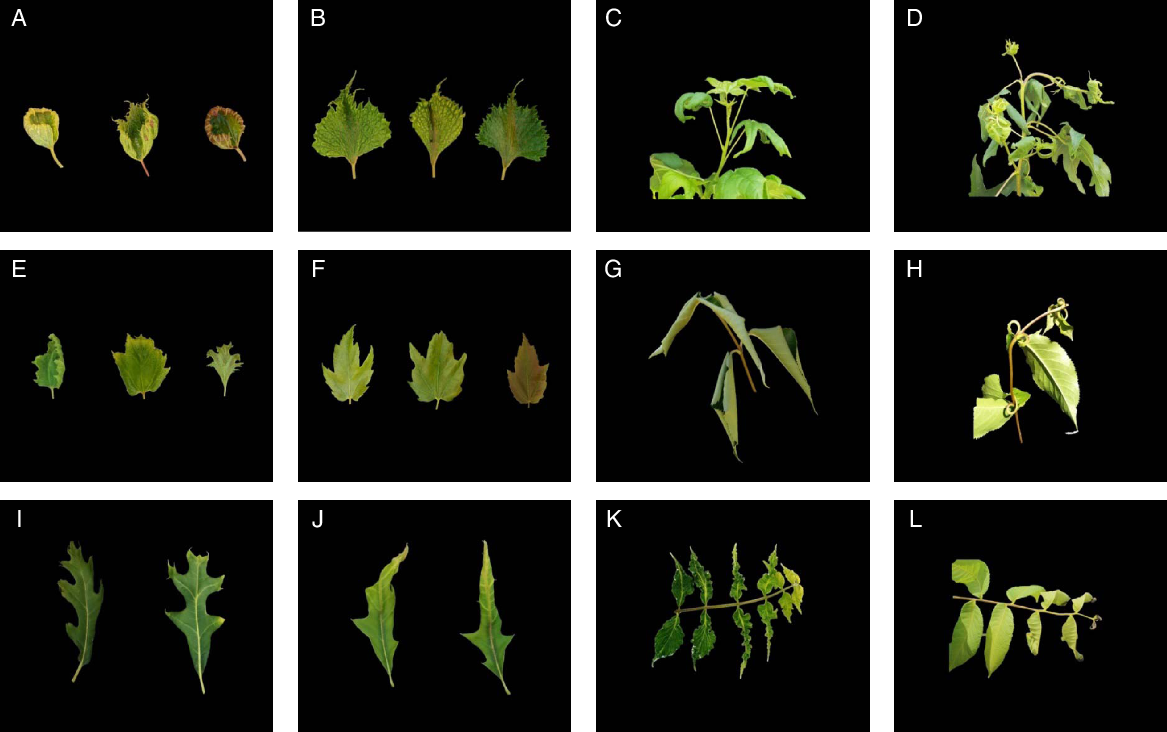
Following treatment with either dicamba or 2,4-D, a variety of injury symptoms were observed. These included epinasty of stems and petioles, leaf cupping, strapping, and rolling, pronounced internode elongation, chlorosis, necrosis, leaf margin malformation, and stem swelling and cracking. Figure 1 illustrates some of the unique effects of dicamba injury compared with 2,4-D injury on grapevine, sweetgum, red maple, nannyberry viburnum, pin oak, and black walnut that were observed in 2017 and 2018. For example, dicamba treatment to grapevines (Figure 1A) caused the newest leaves to become cupped and they were smaller. In contrast, 2,4-D treatments on grapevines caused fasciated veins of newly emerging leaves, which causes the leaves to be strapped in appearance (Figure 1B; Bondada Reference Bondada2011). These results confirm those previously reported by Mohseni-Moghadam et al. (Reference Mohseni-Moghadam, Wolfe, Dami and Doohan2015). Dicamba injury to nannyberry viburnum (Figure 1G) resulted in leaf rolling, whereas 2,4-D treatments caused significant epinasty of stems, petioles, and leaves (Figure 1H). Black walnut was unique in response to each herbicide. Figure 1K shows dicamba injury, which consisted of leaflet strapping and margin malformation. In contrast, 2,4-D injury caused epinasty, chlorosis, and necrosis of terminal leaflets on young leaves (Figure 1L). Al-Khatib et al. (Reference Al-Khatib, Parker and Fuerst1992), Feucht (Reference Feucht1988), Mohseni-Moghadam et al. (Reference Mohseni-Moghadam, Wolfe, Dami and Doohan2015), and Samtani et al. (Reference Samtani, Masiunas and Appleby2008) reported similar symptoms in response to applications of dicamba or 2,4-D on other tree and grapevine species.
Symptomology differences between dicamba (A, C, E, G, I, and K) and 2,4-D (B, D, F, H, J, and L) on various ornamental, fruit, and nut tree species. The response to 1/20 × rates of dicamba (0.028 kg ae ha−1) and 2,4-D (0.055 kg ae ha−1) is shown for grapevine (A and B), red maple (E and F), and pin oak (I and J); the response to ½ × rates of dicamba (0.28 kg ae ha−1) and 2,4-D (0.55kg ae ha−1) is shown for sweetgum (C and D), nannyberry viburnum (G and H), and black walnut (K and L).

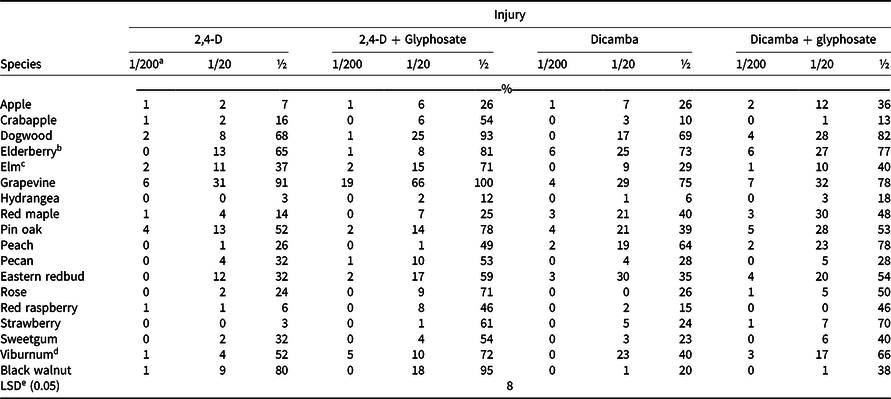
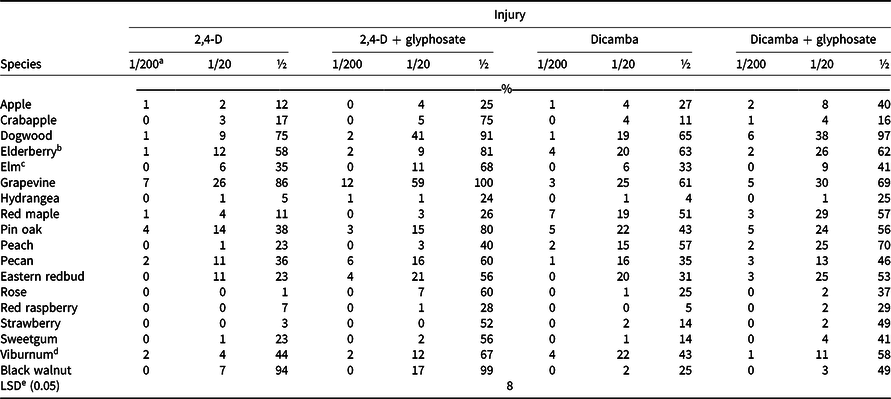
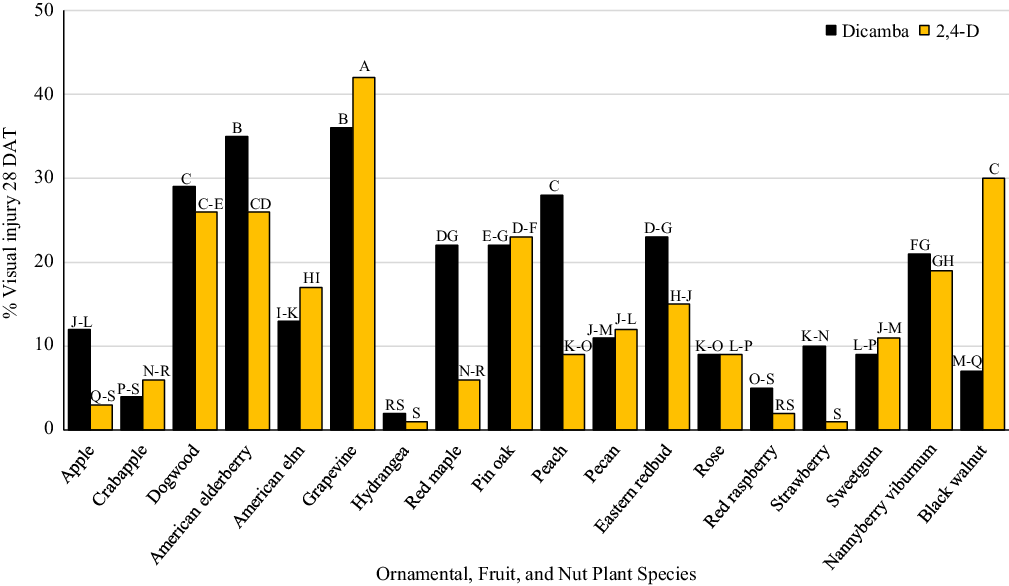
For both 28 and 56 DAT ratings, there was a species-by-rate-by-herbicide interaction (P < 0.0001). As rates increased across herbicide treatments and species, injury generally increased (Tables 1 and 2). Hydrangea injury did not follow this trend because the high rates of dicamba and 2,4-D resulted in similar levels of injury as the low rates at both 28 and 56 DAT (Tables 1 and 2). Red raspberry and strawberry responded similarly to 2,4-D across rates at both dates. A visual summary showing those species that exhibited greater injury toward 2,4-D compared to those that were more visually injured by dicamba is shown in Figure 2. Apple, American elderberry, red maple, peach, eastern redbud, and strawberry were more sensitive to dicamba treatments than to 2,4-D treatments (Figure 2). Perry and Upchurch (Reference Perry and Upchurch1968) and Sterrett (Reference Sterrett1968, Reference Sterrett1969) reported similar results for red maple trees, which were more susceptible to treatments containing dicamba in comparison to 2,4-D. Strawberry foliage has a high tolerance to 2,4-D (McMurray et al. Reference McMurray, Monks and Leidy1996), and in this study had 3% injury at the highest rate compared with 24% injury by dicamba (Table 1). While 2,4-D is labeled for weed control in field plantings of established strawberry, application during floral initiation results in deformed fruits (Maas, Reference Maas1998). In this study, black walnut and grapevine were more sensitive to 2,4-D than dicamba. When averaged across all rates of dicamba and 2,4-D, grapevine and black walnut expressed 6% and 23% greater visible injury to 2,4-D compared to dicamba, respectively (Figure 2). The remaining species did not differ in injury from 2,4-D or dicamba treatments (Figure 2).
Visible estimates of injury to ornamental, fruit, and nut plant species in response to driftable rates of 2,4-D and dicamba 28 d after treatment.

a Rates of herbicides are presented in the fraction of 1 × rate (1 × rate of 2,4-D = 1.09 kg ae ha−1, 1 × rate of dicamba = 0.56 kg ae ha−1 and 1 × rate of glyphosate = 1.10 kg ae ha−1).
b American elderberry.
c American elm.
d Nannyberry viburnum.
e Species × rate × herbicide interaction P < 0.001.
Visible estimates of injury to ornamental, fruit, and nut plant species in response to driftable rates of 2,4-D and dicamba 56 d after treatment.

a Rates of herbicides are presented in the fraction of 1 × rate (1 × rate of 2,4-D = 1.09 kg ae ha−1, 1 × rate of dicamba = 0.56 kg ae ha−1, and 1 × rate of glyphosate = 1.10 kg ae ha−1).
b American elderberry.
c American elm.
d Nannyberry viburnum.
e Species × rate × herbicide interaction P < 0.001.
Injury of ornamental, fruit, and nut plant species in response to dicamba or 2,4-D treatments 28 d after treatment. Results are combined across rates. Bars with the same letters are not different (P < 0.05).

When glyphosate was included in the treatments, most species had greater injury caused by the ½ × rate than with either dicamba or 2,4-D alone at the ½ × rate (Tables 1 and 2). Crabapple and American elderberry were the only species with similar injury from either the ½ × rate of dicamba or ½ × rate of dicamba plus glyphosate at 28 and 58 DAT. However, all plant species exhibited greater injury in response to 2,4-D plus glyphosate compared to 2,4-D alone at the ½ × rate at both 28 and 56 DAT (Tables 1 and 2).
At the 1/20 × rates, injury from dicamba and/or 2,4-D plus glyphosate was greater on dogwood, grapevine, red maple, and black walnut compared to dicamba or 2,4-D alone (Tables 1 and 2). Mohseni-Moghadam et al. (Reference Mohseni-Moghadam, Wolfe, Dami and Doohan2015) found that combinations of dicamba or 2,4-D with glyphosate resulted in greater injury on grapevine compared with dicamba or 2,4-D alone.
With the exception of grapevine and red maple, all plant species exhibited less than 8% visual injury in response to the 1/200 × rates of all treatments 28 and 56 DAT (Tables 1 and 2). Grapevine was the most sensitive species to the 1/200 × rates of herbicide treatments and resulted in up to 19% injury (Table 1). These results are similar to those reported by Al-Khatib et al. (Reference Al-Khatib, Parker and Fuerst1993), who found that grapevines exhibited 21% injury from a 1/100 × treatment of 2,4-D plus glyphosate. In addition, Bhatti et al. (Reference Bhatti, Al-Khatib and Parker1996) reported that 1-yr-old grapevines had extreme sensitivity to 2,4-D applied at 1.2 g ha−1 (approximately 1/900 ×). In contrast to grapevines, hydrangea was found to be the least sensitive species to driftable rates of 2,4-D or dicamba. All rates of herbicides applied to hydrangea 28 and 56 DAT resulted in less than 19% and 26% injury, respectively (Table 1 and 2). Furthermore, when all rates of 2,4-D or dicamba were combined, hydrangea resulted in less than 3% injury overall (Figure 2).
Unlike many annual species such as soybean or vegetables, which begin to show signs of recovery by 28 DAT (Mohseni-Moghadam and Doohan Reference Mohseni-Moghadam and Doohan2015; Solomon and Bradley Reference Solomon and Bradley2014), most species studied here continued to show signs of injury 56 DAT (Table 2). Previous research has shown that cotton, which is unique in that it is grown as an annual but is a perennial, expressed similar or slightly elevated injury up to 120 DAT in response to 2,4-D treatments (Everitt and Keeling Reference Everitt and Keeling2009; Marple et al. Reference Marple, Al-Khatib, Shoup, Peterson and Claassen2007). Grapevines also expressed similar or greater levels of injury at 90 DAT than at 14 DAT with 2,4-D (Al-Khatib et al. Reference Al-Khatib, Parker and Fuerst1993). Results from these studies indicate that ornamental, fruit, and nut plant species injured by dicamba or 2,4-D are likely to show injury for longer periods of time compared with annual plant species.
Shoot Length
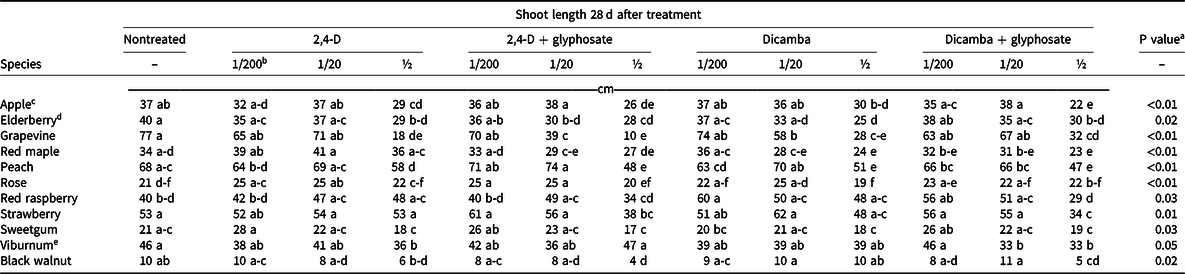
A few species had a significant rate-by-herbicide interaction for shoot length at 28 and 112 DAT. However, to directly compare injured plants with nontreated plants, it was necessary to combine rate and herbicide into a single variable, labeled as treatment (Tables 3 and 4). There was not a significant species-by-treatment interaction for shoot length on crabapple, dogwood, American elm, hydrangea, pin oak, pecan, or eastern redbud (P > 0.05; data not shown) at 28 DAT. Dicamba at the ½ × rate resulted in reduced shoot length on American elderberry, grapevine, red maple, and peach (Table 3). Dicamba plus glyphosate applied at the ½ × rate caused reduced shoot length on all species, except those not presented and rose, red raspberry, and sweetgum, when compared with their untreated controls. The ½ × rate of 2,4-D resulted in shorter shoot lengths of apple, American elderberry, grapevine, peach, and nannyberry viburnum than their nontreated controls. 2,4-D plus glyphosate applied at the ½ × rate caused reductions in shoot length of all species except red maple, rose, red raspberry, sweetgum, and nannyberry viburnum (Table 3). Also, 2,4-D plus glyphosate applied at the 1/20 × rate reduced shoot length on American elderberry and grapevine compared with their respective nontreated controls. When 2,4-D plus glyphosate was applied at the 1/20 × rate, grapevine and red maple were the only species to have greater reductions in shoot length compared with 2,4-D applied alone at the same rate (Table 3). Apple, red raspberry, and black walnut had reduced shoot lengths following ½ × treatment of dicamba plus glyphosate compared with dicamba alone (Table 3).
Shoot length of ornamental, fruit, and nut plant species in response to driftable rates of 2,4-D and dicamba 28 d after treatment.

a Data for crabapple, dogwood, American elm, hydrangea, pin oak, pecan, and eastern redbud are not presented; shoot length differences were not observed for these species 28 d after treatment (P > 0.05).
b Rates of herbicides are presented in the fraction of 1 × rate (1 × rate of 2,4-D = 1.09 kg ae ha−1, 1 × rate of dicamba = 0.56 kg ae ha−1, and 1 × rate of glyphosate = 1.10 kg ae ha−1).
c Species were analyzed separately. Means within a row followed by the same letter are not significantly different (P < 0.05).
d American elderberry.
e Nannyberry viburnum.
Shoot length of ornamental, fruit, and nut plant species in response to driftable rates of 2,4-D and dicamba 112 d after treatment.

a Data for apple, crabapple, American elm, hydrangea, pin oak, pecan, red raspberry, eastern redbud, strawberry, and sweetgum are not presented; shoot length differences were not observed for these species 112 d after treatment (P > 0.05).
b Rates of herbicides are presented in the fraction of 1 × rate (1 × rate of 2,4-D = 1.09 kg ae ha−1, 1 × rate of dicamba = 0.56 kg ae ha−1, and 1 × rate of glyphosate = 1.10 kg ae ha−1).
c Species were analyzed separately. Means within a row followed by the same letter are not significantly different (P < 0.05).
d American elderberry.
e Nannyberry viburnum.
Nannyberry viburnum treated with dicamba plus glyphosate was the only species that had shorter shoot lengths than the nontreated controls 28 DAT. The 1/200 × rate of all herbicide treatments did not reduce shoot length for any species 28 DAT (Table 3). These results differ from those reported by Mohseni-Moghadam et al. (Reference Mohseni-Moghadam, Wolfe, Dami and Doohan2015), who found that 2,4-D or 2,4-D plus glyphosate applied at the 1/300 × rate resulted in significant shoot length loss on grapevines. These different results may be attributed to the use of different herbicide formulation, cultivars, or environmental conditions in the greenhouse versus a nursery. Select treatments applied at the 1/200 × or 1/20 × rates resulted in increased shoot lengths on rose and red raspberry. The 1/200 × and 1/20 × rates of 2,4-D and 2,4-D plus glyphosate resulted in greater shoot lengths (124%) compared with the nontreated control on rose (Table 3). This is most likely a result of hormesis, which results in inhibitors becoming growth stimulants at low doses (Mattson Reference Mattson2008). Hemphill and Montgomery (Reference Hemphill and Montgomery1981) also reported that 2.1 g ha−1 of 2,4-D (approximately 1/500 ×) applied to pepper resulted in 136% yield of the nontreated control and concluded this result was likely due to increased branching and flowering. Additionally, dicamba applied to red raspberry at the 1/200 × rate caused greater shoot length (150%) than the nontreated control (Table 3).
When shoot length was measured again 112 DAT, there was not a significant species-by-treatment interaction for apple, crabapple, American elm, hydrangea, pin oak, pecan, red raspberry, eastern redbud, strawberry, or sweetgum (P > 0.05, data not shown). Shoot lengths were shorter for dogwood, American elderberry, grapevine, and peach at each of the ½ × rates compared with the nontreated controls (Table 4). This was consistent with observations of American elderberry, grapevine, and peach at 28 DAT assessments; however, there was no effect on dogwood shoot length 28 DAT (Tables 3 and 4). In contrast, by 112 DAT grapevine treated with 1/20 × rate of 2,4-D resulted in 30-cm greater shoot length compared with the nontreated controls. Similarly, red maple trees treated with the 1/200 × rate of 2,4-D resulted in 12-cm greater shoot length compared with the nontreated controls. Similar results reported by Mohseni-Moghadam et al. (Reference Mohseni-Moghadam, Wolfe, Dami and Doohan2015) show that Riesling grapevines recovered shoot length following 1/30 × treatments of 2,4-D or dicamba with or without glyphosate by 357 DAT. Overall, these results indicate that some species are adversely affected by herbicides later in the growing season, whereas others may experience shoot length reductions early in the season, but recover.
Differences in shoot length between herbicides within a species also occurred 28 and 112 DAT (Tables 3 and 4). Red maple and peach had shorter shoot lengths after ½ × treatment of dicamba in comparison to 2,4-D, which is similar to the 28 DAT visual rating results. In contrast, grapevine and black walnut had shorter shoot lengths from ½ × treatment of 2,4-D in comparison to dicamba 112 DAT.
Leaf Length: Width Ratio
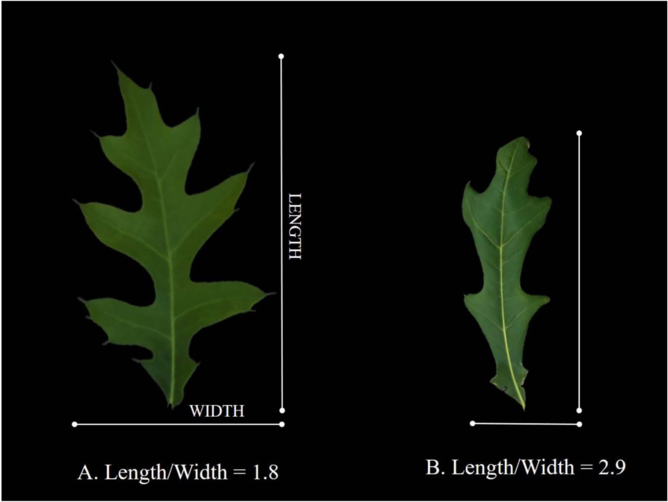
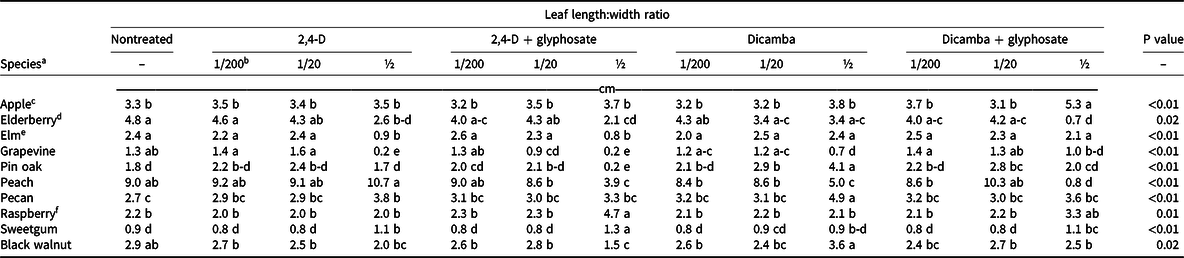
To quantify leaf malformation or curvature from herbicide treatments, leaf length and width were measured 28 DAT using methods similar to those reported by Nath et al. (Reference Nath, Crawford, Carpenter and Coen2003). Ratios greater than the control indicated leaf width decreased and/or leaf length increased. Figure 3 shows a pin oak leaf that was treated with a 1/20 × rate of dicamba, which resulted in a higher ratio due to decreased leaf width compared with the nontreated control. Samtani et al. (Reference Samtani, Masiunas and Appleby2008) described similar symptomology on white oak seedlings that were injured with dicamba. Dicamba at the 1/20 × and ½ × rates and dicamba plus glyphosate at the 1/20 × rate all resulted in higher ratios on pin oak leaves compared with nontreated leaves (Table 5). Similar results were not observed for 2,4-D, and this ratio may be a distinct phenotype for dicamba-injured oak.
Increased leaf length:width ratio in response to 1/20× treatment of dicamba on pin oak. The length:width ratio is determined by dividing overall leaf length by width. (A) Nontreated control. (B) 1/20× dicamba (0.028 kg ae ha−1).

Leaf length:width ratio of ornamental, fruit, and nut plant species in response to driftable rates of 2,4-D and dicamba 28 d after treatment.

a Data for crabapple, dogwood, hydrangea, red maple, eastern redbud, rose, strawberry, and nannyberry viburnum are not presented; leaf length:width differences were not observed for these species (P > 0.05).
b Rates of herbicides are presented in the fraction of 1 × rate (1 × rate of 2,4-D = 1.09 kg ae ha−1, 1 × rate of dicamba = 0.56 kg ae ha−1, and 1 × rate of glyphosate = 1.10 kg ae ha−1).
c Species were analyzed separately. Means within a row followed by the same letter are not significantly different (P < 0.05).
d American elderberry.
e American elm.
f Red raspberry.
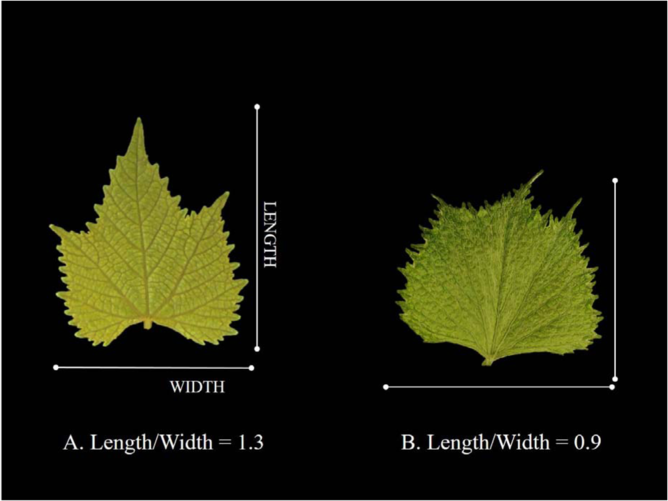
Leaf length:width ratios less than the control indicated an increase in leaf width and/or a decrease in leaf length. Figure 4 shows a grapevine leaf that was treated with a 1/20 × rate of 2,4-D plus glyphosate, which resulted in increased leaf width compared with the nontreated control and a corresponding decrease in the overall ratio. Similar symptomology on grapevine leaves injured with 2,4-D was described by Mohseni-Moghadam et al. (Reference Mohseni-Moghadam, Wolfe, Dami and Doohan2015). The ½ × rate of dicamba also decreased leaf ratio for grapevine compared with the nontreated control (Table 5), indicating both 2,4-D and dicamba result in similar outcomes of length:width ratios on injured grapevine leaves.
Decreased leaf length:width ratio in response to 1/20× treatment of 2,4-D plus glyphosate on grapevine. The length:width ratio is determined by dividing overall leaf length by width. (A) Nontreated control. (B) 1/20× 2,4-D plus glyphosate (0.055 plus 0.055 kg ae ha−1).

There was not a significant species-by-treatment interaction for leaf length:width ratios on crabapple, dogwood, hydrangea, red maple, eastern redbud, rose, strawberry, and nannyberry viburnum (P > 0.05, data not shown). Overall, the ½ × rate generally caused the greatest change in leaf length:width ratio across all remaining species. When 2,4-D plus glyphosate was applied at the ½ × rate American elderberry, American elm, grapevine, pin oak, peach, and black walnut had lower ratios than their controls, whereas the same treatment resulted in increased ratios on red raspberry and sweetgum (i.e., elongated and/or narrow leaves; Table 5). The ½ × rate of dicamba plus glyphosate caused fewer differences in the leaf length:width ratios compared to that of the ½ × rate of 2,4-D plus glyphosate. However, dicamba plus glyphosate altered leaf shapes on apple, American elderberry, peach, and sweetgum (Table 5).
In addition to grapevine, 2,4-D and dicamba caused similar leaf symptomology on pecan. The use of ½ × rates of 2,4-D and dicamba resulted in increased leaf length:width ratios of 3.8 and 4.9 cm on pecan, respectively, compared with their controls (2.7 cm; Table 5). Peach had lower leaf length:width ratios when 2,4-D plus glyphosate and dicamba plus glyphosate were used at the ½ × rates compared with those of their nontreated controls. Additionally, the peach leaves treated with ½ × rate dicamba alone had a lower leaf:width ratio than the nontreated control. This was not observed when the ½ × rate of 2,4-D alone was used and supports the visual injury findings in which peach was more sensitive to dicamba than to 2,4-D (Figure 2). Grapevine and pin oak were the only species to show differences in leaf ratios with 1/20 × rates of 2,4-D plus glyphosate and dicamba plus glyphosate, respectively, compared with the nontreated controls. No species exhibited significant differences from the nontreated controls in response to 1/200 × rates of the herbicide treatments (Table 5).
Trunk Diameter
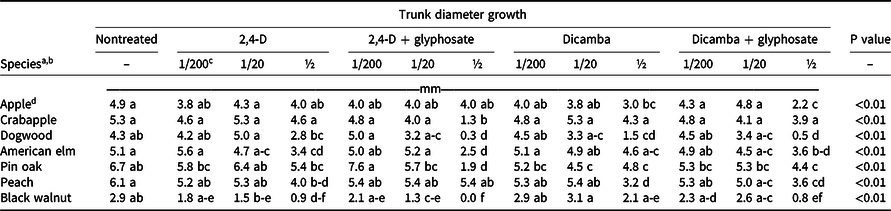
Several studies have quantified tree growth by measuring trunk diameter (Comes et al. Reference Comes, Marquis and Kelley1984; Daniell and Hardcastle Reference Daniell and Hardcastle1972; Norton and Storey Reference Norton and Storey1970; Otta Reference Otta1974; Patterson and Goff Reference Patterson and Goff1994; Putnam Reference Putnam1976). There was not a significant species-by-treatment interaction for red maple, pecan, eastern redbud, or sweetgum (P > 0.05, data not shown). Across the seven remaining tree species, the ½ × rate of dicamba plus glyphosate caused reduced trunk diameters compared with nontreated controls for all species except crabapple, whereas 2,4-D plus glyphosate at the ½ × rate caused reduced trunk diameter growth in all species compared with nontreated controls, except apple and peach (Table 6). Dogwood and black walnut had the least trunk diameter growth in response to ½ × treatment of 2,4-D plus glyphosate (0.3 and 0.0 mm, respectively). Dicamba at the ½ × rate affected adversely apple, dogwood, pin oak, and peach trunk growth, whereas 2,4-D at the ½ × rate affected American elm, peach, and black walnut trunk growth.
Tree trunk diameter growth of ornamental, fruit, and nut tree species in response to driftable rates of 2,4-D and dicamba 112 d after treatment.

a Data for red maple, pecan, eastern redbud, and sweetgum are not presented; trunk diameter growth differences were not observed for these species (P > 0.05).
b Nontree species, including American elderberry, grapevine, hydrangea, red raspberry, rose, strawberry, and nannyberry viburnum trunk diameters were not measured and were therefore not included in the analysis.
c Rates of herbicides are presented in the fraction of 1 × rate (1 × rate of 2,4-D = 1.09 kg ae ha−1, 1 × rate of dicamba = 0.56 kg ae ha−1, and 1 × rate of glyphosate = 1.10 kg ae ha−1).
d Species were analyzed separately. Means within a row followed by the same letter are not significantly different (P < 0.05).
Black walnut trunk diameter growth was also affected following 2,4-D plus glyphosate application at the 1/20 × rate (Table 6). The 1/20 × rate of dicamba plus glyphosate did not cause reduced trunk growth on any species; however, dicamba applied at the 1/20 × rate resulted in a 37% reduction in trunk diameter growth on pin oak trees (Table 6). These results indicate that driftable rates of dicamba could adversely affect trunk growth of pin oak trees, whereas black walnut trunk diameter growth can be reduced from a driftable rate of 2,4-D plus glyphosate. No herbicide treatments at the 1/200 × rate caused a reduction in tree trunk diameter growth 112 DAT.
Based on a combination of measurements and visual evaluations, several species expressed an overall difference in sensitivity to 2,4-D or dicamba. For example, apple was more sensitive to dicamba than 2,4-D based on trunk diameter growth and injury evaluations (Figure 2 and Table 6). Shoot length and injury ratings indicate that red maples were more sensitive to dicamba than to 2,4-D (Figure 2 and Tables 3 and 4). Peach tree shoot length and injury assessments revealed that peach trees were more sensitive to dicamba than to 2,4-D (Figure 2 and Table 3). Injury ratings, trunk diameter growth, and leaf length:width ratios indicate that pin oak trees were more sensitive to the 1/20 × rate of dicamba than to 2,4-D (Tables 1, 2, 5, and 6). Sterrett (Reference Sterrett1969) also reported that dicamba had greater efficacy on chestnut oak compared to 2,4-D. Collectively, these results demonstrate that apple, red maple, pin oak, and peach trees are more sensitive to dicamba. However, some species exhibited a greater sensitivity to 2,4-D. For example, American elm leaf length:width ratios and trunk diameter growth were affected by 2,4-D at the ½ × rate but not dicamba at the same rate (Tables 5 and 6). Black walnut trees exhibited 60% and 64% greater injury and reduced shoot length as a result of ½ × treatment of 2,4-D compared to dicamba, respectively (Tables 1 and 4). Overall, grapevines, American elm, and black walnut trees were more sensitive to 2,4-D (Figure 2). Some species did not differ in sensitivity to 2,4-D or dicamba, including dogwood hydrangea, pecan, red raspberry, and rose (Figure 2 and Tables 1 and 2). In addition to herbicide sensitivity, symptomology differences were also evaluated (Figure 1). These unique symptomology differences between 2,4-D and dicamba can prove useful in determining whether plants were injured from either herbicide.
Across most plant species in this study, treatments containing glyphosate generally resulted in greater visual injury and reductions in shoot length compared with treatments that contained 2,4-D or dicamba alone. Based on visual injury, grapevine was the most sensitive species to the lowest doses of all herbicide treatments. Following grapevine, dogwood, pin oak, and American elderberry were the next most sensitive species in this study. Conversely, hydrangea was found to be the least sensitive species overall in this study, expressing less than 3% injury across all rates of 2,4-D or dicamba (Figure 2).
Results from this study also indicate that many species express injury symptoms in response to 1/200 × rates of 2,4-D or dicamba with or without glyphosate. Egan et al. (Reference Egan, Barlow and Mortensen2014) reported that driftable rates corresponding to the 1/200 × rate was likely to occur in field settings. However, in many instances in this research, the 1/200 × rates did not result in reductions in shoot length or trunk diameter growth. Compared with previous studies that examined the effects of 2,4-D and dicamba on annual species such as soybean or vegetable crops (Culpepper et al. Reference Culpepper, Sosnoskie, Shugart, Leifheit, Curry and Gray2018; Kruger et al. Reference Kruger, Johnson, Doohan and Weller2012; Solomon and Bradley Reference Solomon and Bradley2014), most perennial species in this study were found to be less susceptible to driftable rates of 2,4-D or dicamba. However, drift may occur on perennial plants in multiple years. It also appears that perennial species may experience injury for longer periods of time compared to annual plant species. Species examined in this study are native or ornamental that have a high monetary and aesthetic value to a wide range of audiences. Additionally, many fruit and nut plants are grown as crops and have a very high monetary value. Therefore, it is unlikely that visual injury resulting from 2,4-D or dicamba would be tolerated by homeowners or commercial growers of these species. Off-target movement of these herbicides can ruin edible fruit and nut crops and also necessitates their disposal. Furthermore, if 2,4-D or dicamba drifts onto a certified organic crop, producers must destroy the injured crop and lose organic certification for 3 yr according to the Organic Materials Review Institute. Thus, applications of dicamba or 2,4-D with or without glyphosate should be made with extreme care near areas where these ornamental, fruit, and nut species may exist.
Acknowledgments
This work was funded by United States Department of Agriculture–NIFA Crop Protection and Pest Management, Extension Implementation Program award number 2017-70006-27185. We thank Eric Oseland, Gatlin Bunton, Bailey Johnson, and Cooper Sutter for assistance with data collection. No conflicts and interest have been declared.