Introduction
Military health care providers (HCPs) have an ever-evolving role in disaster, humanitarian and civic assistance (DHCA) operations. Since 2001, the US Department of Defense (DoD) has become increasingly engaged in DHCA under the auspices of conflict prevention, counterinsurgency, counterterrorism, nation building, humanitarian aid, and medical readiness training.Reference Drifmeyer and Llewellyn1, Reference Bourdeaux, Lawry, Bonventre and Burkle2 Children have comprised 30-50% of patient encounters during disaster, humanitarian and civic assistance activities.Reference Fernald and Clawson3-Reference Gnauck, Nufer, LaValley, Crandall, Craig and Wilson-Ramirez5 As many as 92% of children seen by disaster medical assistance teams were discharged to home,Reference Gnauck, Nufer, LaValley, Crandall, Craig and Wilson-Ramirez5 making the outpatient primary care role in these settings critical. Despite the clear need and relatively frequent occurrence, health care providers consistently report feeling poorly prepared to care for pediatric populations in austere or disaster situations.Reference Almonte6, Reference Slepski7
Domestically, health care providers and institutions are ill-prepared to care for children following disasters in the US.8 As such, in the 2009 report to the US Department of Health and Human Services Assistant Secretary for Preparedness and Response,9 the Institute of Medicine (IOM) noted that health care professionals are obligated to provide the best care they reasonably can, but catastrophic disasters are so distinctly different that they call for a different standard of professional care specific to the situation. The IOM endorsed five key elements for crisis standard of care planning: (1) ethical grounding; (2) community and provider engagement; (3) legal authority; (4) clear triggers and lines of responsibility; and (5) evidence-based clinical processes and operations.9 In the subsequent Crisis Standards of Care framework, the IOM indicated that evidence-based interventions and specific response measures must be identified for high-risk populations, principally children and those with medical special needs, who are especially vulnerable during a disaster.10 To uphold these recommendations, the National Commission on Children and Disasters has asked the Department of Defense to establish education programs and appropriately source medical response teams prepared to care for and transport children during emergencies.8
The Model for Military Disaster Nursing attempted to guide expectations and preparations for disasters and related emergencies.Reference Wynd11 The model described three phases of disaster: (I) Preparedness/Readiness (Pre-disaster/Pre-impact); (II) Response/Implementation; and (III) Recovery, Reconstruction and Evaluation. The pre-disaster preparedness and readiness functions are arguably the most important phase. This phase incorporates six components of readiness: (1) personal, psychological and physical readiness; (2) clinical competency; (3) operational competency; (4) soldier/survival skills; (5) leadership and administrative support, and (6) group integration and identification. Responders must apply knowledge and skills specific to disasters, and implement interventions to minimize health hazards and threats to life. The fundamental duties include prevention, treatment, caring, advocacy, and education. The model describes proficiency in caring for pregnant women, children, non-battle injury and disease as indispensable. The ability to care for indigenous people by understanding the cultural beliefs, values, traditions and history of the country where the disaster occurs is key.Reference Wynd11
During DHCA missions, military HCPs encounter populations, clinical problems and settings not typically faced in western cultures. Care for vulnerable populations such as children often occurs in settings and circumstances outside of the comfort zone of most HCPs. While family medicine12 and family nurse practitioner programs13 provide baseline training competencies for pediatric care and may address some of the foundational skills needed, most curricula do not specifically focus on skills needed for DHCA or the standards of care associated with these situations. In reality, practitioners gain a variety of pediatric skills in their practice and lose others.
Because HCPs are increasingly providing care for children in DHCA operations, it is essential that they possess the appropriate knowledge and skills to optimize patient outcomes. This integrative review was designed to identify the clinical skills and knowledge that military health care providers need for pediatric clinical and operational competency in the Preparedness/Readiness phase of the Model for Military Disaster Nursing.
Purpose
The purpose of this integrative review of the literature was to describe from recent literature the knowledge and clinical skills that military health care providers might require in order to provide appropriate care for pediatric patients during civic assistance, humanitarian, and disaster relief efforts. An integrative review of the literature is a descriptive summary of past theoretical and empirical literature conducted to provide a comprehensive understanding of the phenomenon of interest.Reference Whittemore and Knafl14 An integrative review identifies, analyzes and synthesizes findings from independent studies to determine what is currently known about a specific topic. Systematic reviews of the literature are restricted to using research evidence to explain the phenomenon of interest. When there is a paucity of research evidence on a particular topic, integrative reviews of the literature can fill the gap by incorporating not only experimental and non-experimental studies, but also theoretic literature and opinions.Reference Bibb and Wanzer15 Like systematic reviews, integrative analyses also require a high degree of rigor and replicability.
To ensure consistency in this review, “general or background clinical knowledge and skills” was defined as the application of clinical knowledge in the care of children. For example, general knowledge would include the ability to apply knowledge of water-borne and food-borne disease in educating a family on the selection of appropriate food and water sources. Clinical knowledge includes both the ability to apply history and physical exam findings to arrive at or treat a diagnosis, as well as specialized skills such as the ability to debride a wound.
Methods
This project was approved as “exempt” from Institutional Review Board review at the Uniformed Services University of the Health Sciences (USUHS) under protocol number HU61Q6-01 and at the University of Alabama Office of Research Compliance under protocol number 2850.
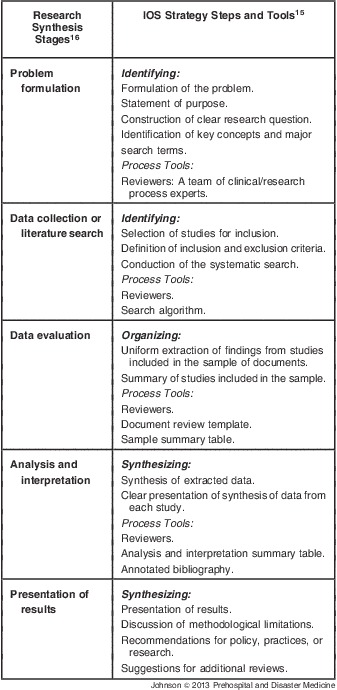
To ensure reliability, the Identifying, Organizing, and Synthesizing strategy was used to guide the project.Reference Bibb and Wanzer15 The original five steps for an integrative research review included problem formulation, data collection or literature search, data evaluation, analysis and interpretation, and presentation of the results.Reference Cooper16 The Identifying, Organizing, and Synthesizing (IOS) strategy (Table 1) compiled these steps and addressed the concerns of replication and rigor for an integrative review of the literature.Reference Bibb and Wanzer15 This integrative review followed the IOS strategy steps to ensure accuracy and replicability.
Steps of integrative research review and relative IOS Strategy Steps, adapted with permission from Bibb and WanzerReference Bibb and Wanzer15

Data Collection/Literature Search
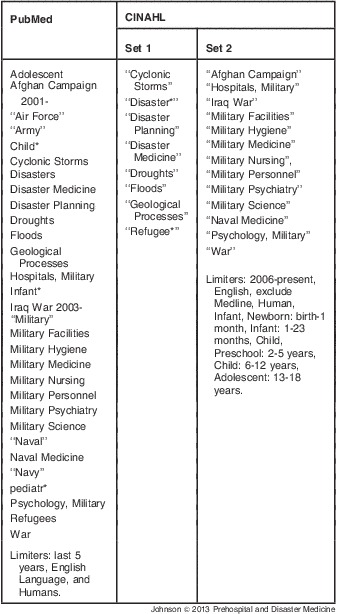
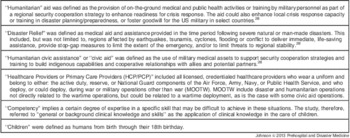
The literature review was intended to provide an up-to-date picture of the skills and knowledge used in recent DHCA operations and therefore the search covered publications from the last five years that answered the DHCA question. The authors developed the search algorithm in consultation with a research librarian at the Uniformed Services University. The searches of the PubMed and Cumulative Index of Nursing and Allied Health Literature (CINAHL) databases were conducted on two separate occasions within a 24-hour period to ensure replicability and protect against longitudinal bias. The searches yielded the same number of hits. While the initial number of articles from the searches seemed excessive, attempts to further limit the terms removed relevant materials, so it was deemed wiser to sort through the larger number of articles ensuring a broad capture of pertinent resources. Table 2 contains the MeSH and Keyword terms and limiters used to search the PubMed and CINAHL databases. Table 3 contains the key concepts and operational definitions utilized in the integrative review.
MeSH and Keyword Search Terms

Key Concepts

Inclusion Criteria
The study included all primary and secondary articles, summaries, and case reports related to skills, knowledge and medical conditions encountered relating to the care of children during DHCA and clinical experiences, clinical competencies, clinical needs or public health issues that deployed primary care providers may encounter in an outpatient setting. It also included all articles related to military or civilian disciplines performing a primary care or similar function (eg, family, pediatric or internal medicine physician, nurse practitioner, physician assistant, public health, dermatology) published in the English language within the last five years and involving human subjects.
Exclusion Criteria
Articles dated earlier than the five-year time frame and articles pertaining exclusively to medical services rendered solely by foreign countries; leadership, logistics or other non-clinical skills; surgery; long-term acute or inpatient hospital care; adult or deployed service members; long-term care and psychosocial health of children following disaster were excluded. In addition, articles that applied only to communication platforms, telemedicine, and Chemical, Biological, Radiological, Nuclear and high-yield Explosives (CBRNE) surveillance, modeling, planning and preparedness were excepted.
Search Strategy and Final Population
The search of the PubMed database occurred on January 19, 2012. The initial population included 862 articles from PubMed (613 from MeSH only terms, 249 from MeSH + Keywords) which were downloaded to EndNote X4 (Version Bld 4845, Thomson Reuters, Carlsbad, California USA), a software program designed to search bibliographic databases and organize references to assist with tracking and sorting. Of the 862 original articles, 113 were duplicates and were discarded; an additional 100 were discarded because the date was outside of the scope of the study, leaving a population of 649 articles.
After comparing the titles against the inclusion and exclusion criteria, 360 of the original articles were discarded because the title clearly depicted that the article did not meet the scope of the studies’ inclusion and exclusion criteria, leaving 289 articles in the sample. After reviewing all 289 abstracts, 229 were discarded because they did not meet inclusion criteria, leaving 60 articles in the PubMed sample.
Search of the CINAHL database was conducted using sets of search terms based on disaster and related terms (set 1) and military and related terms (set 2) as outlined in Table 2. CINAHL was searched on January 20, 2012 using set 1 search terms with an initial population of 18,858 articles. An additional search using set 2 search terms yielded 456 results. After combining the searches and applying the limiters for age, past five years, English language, and excluding Medline, eight articles remained. After reviewing the titles, abstracts and full text of those articles, none met inclusion criteria. This left a CINAHL population of zero and a PubMed collection of 60.
After review of the full text of the remaining population of 60 articles, 39 were discarded because they did not contain pertinent information. The remaining 21 articles were retained, along with 10 publications discovered through manual searches or by contacting organizations that routinely provide care for children during humanitarian and disaster missions (eg, the American Red Cross). The final sample contained 31 articles.
Data Evaluation
After reviewing each of the 31 articles, pertinent information and relevant data regarding clinical skills and knowledge were entered into separate evidence appraisal forms and stratified based on the hierarchy of evidence recommended by Fineout-Overholt and colleagues.Reference Fineout-Overholt, Melnyk, Stillwell and Williamson17 This hierarchy assigns levels from I to VII to the type of evidence as follows:
(I) The strongest level of evidence from systematic reviews or meta-analyses;
(II) Randomized, controlled trials;
(III) Controlled trial without randomization;
(IV) Case control or cohort study;
(V) Systematic review of qualitative or descriptive studies;
(VI) Qualitative or descriptive study; and
(VII) The lowest level of evidence, opinion or consensus.Reference Fineout-Overholt, Melnyk, Stillwell and Williamson17
Analysis and Interpretation
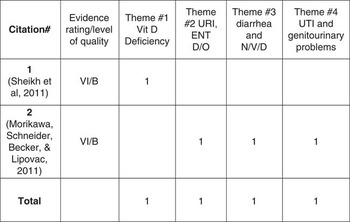
Following retrieval and evaluation of the articles, the data was synthesized and placed in a table with the appraisal form number and article citation on the vertical axis and the clinical skill or condition on the horizontal axis. As each new clinical skill or knowledge theme arose, it was added to the table, and tallied in the appropriate column. Figure 1 contains a sample portion of the evidence synthesis table. Sixty-five major themes emerged after all of the data was compiled. After a review of all of the entries was complete, each publication and appraisal form was reviewed again to ensure that the data and themes were appropriate, accurate and complete.
Sample Portion Evidence Synthesis Table

Overlap was seen among some themes. For example, various articles referred to diarrhea and infectious diarrhea separately. To manage overlap, infectious diarrhea was included in infectious diseases, but nonspecific diarrhea was incorporated into the category that included diarrhea, dehydration and other gastrointestinal conditions. Conversely, upper and lower respiratory tract disorders were described only in general terms and were not included in the infectious disease category. It was difficult to discern if the term chronic cough referred to asthma, tuberculosis, or neither, so it was reconciled to accompany chronic lower respiratory tract disorders. Some themes, such as autoimmune and inflammatory skin conditions, were mentioned relatively infrequently, but referred to a significant number of conditions within the category (eg, acne, alopecia areata, contact dermatitis, eczema, hidradenitis suppurativa, lichen amyloidosis, lupus, psoriasis, scleroderma, vesiculobullous disorders, skin cancer, rashes, warts and vitiligo).Reference Satter18 These conditions were relegated to the single category of autoimmune and inflammatory skin conditions. Overall, the authors’ judgment was used to determine the best fit for each concept.
Results
This integrative review included the final population of 31 articles. The articles spanned the hierarchy of evidence from IV through VII. Three articles were classified as level IV (case control or cohort studies), 11 as level VI (qualitative or descriptive studies), and 17 as category VII (evidence from the opinion of authorities and/or reports of expert committees).
Most articles contained more than one theme. There was a range of 1-21 themes, with a mean of 9.65 themes per article. Some of the articles discussed only one major theme. For example, one article discussed only the estimates of HIV burden in countries affected by conflict, natural disaster or displacement,Reference Lowicki-Zucca, Spiegel, Kelly, Dehne, Walker and Ghys19 another simply addressed vitamin D deficiency in refugee children.Reference Sheikh, Wang, Pal, MacIntyre, Wood and Gunesekera20 Other articles described pediatric conditions and treatments encountered during humanitarian operations in great detail.Reference Won, Ancona, Carrigan, Laverty and Rhee21, Reference Morikawa, Schneider, Becker and Lipovac22 The articles are clearly not homogeneous and therefore cumulative frequency of citation was used instead of percentage of overall articles to describe frequency of reporting.
Further analysis of the 65 themes showed that multiple entries related to endemic, epidemic, or vector-borne diseases and vaccines or vaccine-preventable diseases. Infectious diseases were discussed in 25 of the publications and vaccines were mentioned in 15, therefore infectious diseases were consolidated into one theme, and vaccines into another, leaving 49 major themes.
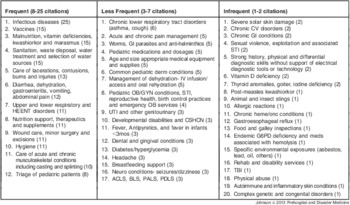
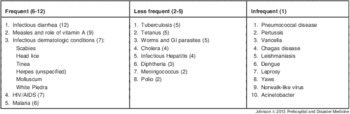
Infectious diseases, vaccines, malnutrition, sanitation, and care of injuries and wounds were the five most frequently cited themes revealed in the literature. Table 4 contains the overarching themes by frequency of citation. Infectious diarrhea, measles, infectious dermatologic conditions, HIV/AIDS and malaria held the top five positions in the infectious and vaccine-preventable diseases categories. The specific infectious, endemic, epidemic, vector-borne and vaccine preventable diseases mentioned in the articles are listed in Table 5 by frequency of citation.
Pediatric Clinical Skills and Knowledge Requirements by Frequency of Citation

Abbreviations: ACLS, Advanced Cardiac Life Support; BLS, Basic Life Support; CV, Cardiovascular; GI, Gastrointestinal; GYN, Gynecologic; HEENT, Head, Eyes, Ears, Nose and Throat; HIV/AIDS, Human Immunodeficiency Virus/Acquired Immunodeficiency Syndrome; MeSH, Medical Subject Headings; OB, Obstetric; PALS, Pediatric Advanced Life Support; PDLS, Pediatric Disaster Life Support; STI, Sexually Transmitted Infections; TBI, Traumatic Brain Injury; UTI, Urinary Tract Infection
Pediatric Endemic, Epidemic and Vector-borne Diseases by Frequency of Citation

Discussion
Since endemic and vector-borne diseases significantly worsen during disasters and emergency situations, it is unsurprising that infectious diseases were mentioned in such frequency.Reference Mancuso, Price and West23 Widespread vaccination is not as prevalent in many areas affected by disaster or requiring humanitarian or civic assistance as it is in the US and other western nations. Routine vaccination has become one of the major missions in DHCA and a primary focus of organizations such as the American Red Cross that support these types of operations.24 Primary care training programs provide education on vaccination and vaccine-preventable diseases in varying depth and these are topic areas that would require enrichment.
Many of the concepts described in the literature fall out into groups that are the purview of primary care, though these skills would require augmentation as many of these conditions are not routinely encountered in the US (eg, kwashiorkor and marasmus, protein deficiency malnutrition and protein plus energy deficiency malnutrition). Even those who deal exclusively with children may not have had the opportunity to manage pregnant children or had much experience with Glucose-6-Phosphate Dehydrogenase (G6PD) deficiency, and may need a formal review of these topic areas or a refresher course prior to entering into DHCA operations. Another area that hasn't received much attention is the care of children with developmental disabilities and/or children with special health care needs (CSHCN) in DHCA.8, Reference Galeckas25, Reference Hollon and Hickey26 Although these disorders have received a lot of attention in the US, many developing countries have not provided much in the way of support or resources for this vulnerable population. This theme was an unexpected revelation in the literature. Given the impact of malnutrition and helminthes on rates of anemia, vitamin deficiencies, and the subsequent physical and intellectual developmental consequences, this theme should not be surprising.Reference Hollon and Hickey26 Those deploying in support of DHCA missions need culturally specific knowledge to address and support these special needs populations. This may be especially challenging given the very different values of cultures related to CSHCN.
Other knowledge and clinical skills not typically considered primary care would require specific education and training. Critical topics like sanitation procedures, waste disposal, water treatment and selection of water sources are not routinely included in primary care curriculum. Many HCPs may have job-related exposure to suturing, casting, splinting, intravenous (IV) catheter insertion and dehydration management of children, but may not have established competency in these procedures. Standard severity and triage categories designed for adults are ineffective for children, so knowledge of pediatric-specific field severity tools is necessary.Reference Gnauck, Nufer, LaValley, Crandall, Craig and Wilson-Ramirez5 Ready-to-use therapeutic and supplementary foods are typically only encountered in humanitarian missions, and providers need to know the makeup of supplements and when to prescribe them.Reference Cabrol27 Heavy reliance on history and physical examination skills, and the ability to develop accurate and thorough differential diagnoses without the use of technology or electrically powered diagnostic tools, were only mentioned in two articles.8, Reference Won, Ancona, Carrigan, Laverty and Rhee21 They are arguably the most critical skills needed by HCPs participating in DHCA operations. Their significance cannot be over-emphasized.
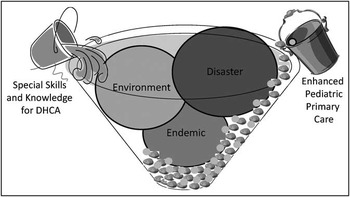
Endemic, epidemic and vector-borne diseases are present in every geographic area and economic sector. When a disaster or other emergency occurs, it puts pressure on the local condition, compounding the influence of environmental, self-care and infectious disease problems. Disasters and humanitarian issues typically increase injury rates, environmental insults and infectious diseases, stressing already limited health care resources. Enhancing the pediatric primary care skills of HCPs can be the bedrock that helps to support the needs of children in disaster, humanitarian and civic assistance missions. Special pediatric skills and knowledge for DHCA can fill the gaps for outpatient care. Figure 2 represents a visual depiction of the pressure environmental factors and disaster place on already present endemic issues and how children can be supported with enhanced primary care, and how special skills and knowledge for DHCA can fill the gaps.
Model for Pediatric Care in Disaster, Humanitarian and Civic Assistance Operations

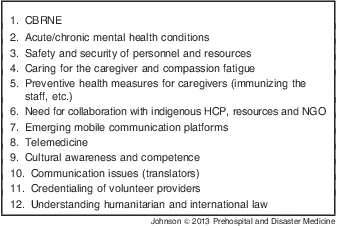
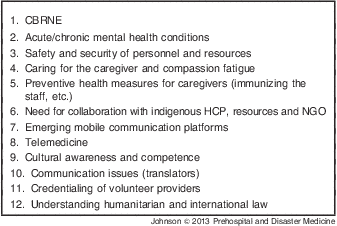
It is worth noting some of the additional themes that did not meet inclusion criteria for this study, but did receive a significant amount of attention in the literature. The majority of the articles discarded by title related to Chemical, Biological, Radiological, Nuclear and high-yield Explosives (CBRNE) surveillance, modeling, planning, and preparedness, and acute and chronic mental health conditions in children affected by disaster or other emergencies. Table 6 contains other pertinent themes that arose from the literature.
Other Themes
The results reported here provide a fundamental overview of the pediatric clinical skills and knowledge required to care for children during DHCA missions. This is a critical step in identifying areas needing evidence-based interventions and specific response measures for the pediatric high-risk population that were called for by the IOM Crisis Standards of Care framework.10 It is also integral to answering the call for the development of education programs and medical response teams prepared to care for and transport children during emergencies.8 While the Model for Military Disaster NursingReference Wynd11 was not tested in this study, it was useful in identifying and conceptualizing themes for inclusion. The model translates well to other health care disciplines and humanitarian and civic assistance operations in addition to disasters.
Limitations
A major limitation of this study is the lack of articles with higher levels of evidence, such as systematic reviews and randomized, controlled trials (RCTs). Since RCTs would be impossible to perform for a variety of reasons, researchers must rely on the descriptive evidence currently available. The authors elected to use only PubMed and CINAHL to search for literature. Including other databases may have led to additional resources that answer the question. Similarly, excluding journals that are not in English and articles that address care exclusively provided by other countries is a limitation. Errors in search terms or search strategies could have led to appropriate primary sources being missed or dismissed, and the review and analysis strategy could have led to data being excluded or incorrectly coded. For example, the terms diarrhea and infectious diarrhea were used in different articles, but may have referred to similar or very different clinical problems. Lack of details and differences in reporting of data could have caused the authors to make assumptions and code data under an incorrect theme. Finally, lack of stratification of reported data in journal text might have resulted in adult information being interpreted as pediatric data.
Recommendations
Future directions for research include a review of selected military health care curricula to identify education and training gaps. The information gleaned here is critical in developing educational programs for HCPs preparing to care for children during DHCA operations. Timing, intensity, DHCA topics and who is best qualified to teach the topics are areas requiring more investigation. Most significantly, further research examining frequencies, reporting and coding procedures for the care provided in each of these situations is warranted to better understand the clinical conditions and skills utilized in DHCA operations.
Conclusions
Military HCPs have an integral and evolving role during deployment missions for humanitarian, disaster relief and civic assistance programs. Up to 50% of patients encountered in these settings are children, so primary care providers must be prepared to provide care to children in these practice settings. The 31 articles included in this review revealed 65 major themes; the most commonly mentioned involved infectious diseases, vaccinations, malnutrition, sanitation and care of injuries and wounds. The clinical skills and knowledge required to care for children in these settings are congruent with skills expected of primary care clinicians, although some supplemental information, such as caring for pregnant children or those with G6PD deficiency, would require specific DHCA training. Health care providers must rely heavily on history and physical exam skills, and need to be comfortable developing differential diagnoses without relying on technology or electrically powered diagnostic tools. Although this study focused on military HCPs, the data presented easily translate to civilian HCPs who care for children during these missions.
Disclaimer
The assertions contained herein are the views of the authors and do not necessarily represent the views of the Uniformed Services University of the Health Sciences, the US Air Force or the Department of Defense.