



Ebstein’s anomaly is a rare, congenital cardiac anomaly of the tricuspid valve and the right ventricle first described by Wilhelm Ebstein in 1866.Reference van Son and Konstantinov 1 Cases were traditionally diagnosed at all ages, with the worst outcomes in neonates who need interventions for cyanotic disease.Reference Oxenius, Attenhofer Jost and Pretre 2 Diagnosis is increasingly happening prenatally; as this anomaly develops throughout fetal life, it can occur in cases with an apparently structurally normal heart on earlier ultrasonic scan.Reference Zimmer, Blazer and Lorber 3 High rates of spontaneous abortion throughout pregnancy have been reported.Reference Celermajer, Bull and Till 4
An association between Ebstein’s anomaly and maternal lithium exposure was first reported in the 1970sReference Nora, Nora and Toews 5 and led to recommendations that are still in place today to switch to other antipsychotics during pregnancy where possible, 6 but this association has been disputed in more recent literature.Reference Diav-Citrin, Shechtman and Tahover 7 Associations have also been found with other exposures, including benzodiazepines,Reference Correa-Villasenor, Ferencz and Neill 8 antihypertensives,Reference Caton, Bell and Druschel 9 valproic acid,Reference Ozkan, Cetinkaya and Koksal 10 marijuana,Reference Jenkins, Correa and Feinstein 11 and organic solvents.Reference Jenkins, Correa and Feinstein 11
A previous study of congenital anomalies associated with selective serotonin reuptake inhibitors use, using some of the same data, found an association with Ebstein’s anomaly.Reference Wemakor, Casson and Garne 12 The aims of the present study were to test the robustness of this finding by using a larger population and different controls and set it in the context of other mental health-related exposures, as well as to ascertain other aspects of the epidemiology of Ebstein’s anomaly.
Methods
The European Surveillance of Congenital Anomalies (EUROCAT) is a network of population-based registries of congenital anomalies in 21 countries of Europe.Reference Boyd, Haeusler and Barisic 13 The methods of registry case ascertainment are fully described elsewhere.Reference Greenlees, Neville and Addor 14 The central database includes standardised data on live-born congenital anomaly cases, stillborn cases and fetal deaths after 20 weeks of gestation, and prenatally diagnosed cases resulting in termination of pregnancy for fetal anomaly; 1-week survival is also ascertained for live-born cases. 15 All registries record diagnoses made prenatally or at birth, most registries record diagnoses made up to 1 year of life, and some registries record diagnoses made in later childhood.Reference Greenlees, Neville and Addor 14
The 15 EUROCAT congenital anomaly registries in 12 countries (Table 1), which agreed to take part, collect data on maternal illness before and during pregnancy and on maternal drug exposure in the first trimester of pregnancy. Most sources of exposure data were prospective to outcome, except in one centre where exposure data are ascertained exclusively by interviewing mothers and clinicians after the congenital anomaly has been diagnosed; three other registries use maternal interviews to confirm their data (Table 1).
Study population (births) by country and year.

CI=confidence interval
*Ireland=Cork and Kerry 1996–2010 and SE Ireland 1997–2010
**Italy=Tuscany 1982–2011 and Emilia Romagna 1982–2011
***Spain=Basque Country 1990–2010 and Valencia 2007–2010
MMedication ascertainment from maternal medical/midwifery notes
IInformation on medication exposure taken from or confirmed through maternal interviews
PInformation available on maternal prescriptions
XTuscany has information from maternal interviews only, Emilia Romagna from both interviews and notes
Other variables used in this study were syndrome and malformation diagnoses, coded to International Classification of Diseases versions 9 and 10 with British Paediatric Association extension, family history of congenital anomaly, maternal age and parity, and gestational or postnatal age at diagnosis. 15 Denominators including live births and stillbirths are available by registry and year.
The total study population was 5,644,312 births covering the years 1982–2011. (Table 1; Supplementary Table 1A). In total, 145,084 babies/fetuses with major congenital anomalies were registered, of which 264 were diagnosed as having Ebstein’s anomaly (Table 1). All cases were included in the descriptive prevalence study. A case-malformed control study was also carried out comparing cases of Ebstein’s anomaly with controls with cardiac and non-cardiac major malformations from the database separately. Excluded from both cases and controls were cases with chromosomal syndromes (11 cases and 20,316 controls), genetic syndromes (two cases and 2898 controls), skeletal dysplasia (no cases and 649 controls), and teratogenic syndromes (one case and 677 controls). Controls with only hip dysplasia (n=5698), associated with higher gestational age at birth, were also excluded, leaving 250 cases and 35,904 controls with cardiac and 78,678 with non-cardiac anomalies for the analysis of maternal and family exposures (see Supplementary Fig 1A for details of exclusions). Analyses of maternal medication involved 173 EA cases and 26,184 cardiac and 51,024 non-cardiac controls from a population of 3,662,154 births since 1995 (see Supplementary Fig 1A) as medication data were not available for all years (Table 1). International Classification of Diseases 9/10 codes for maternal diseases/conditions and Anatomical Therapeutic Chemical codes for medication corresponding to the categories analysed are given in the online Supplementary Table 2A. Maternal diabetes included both pre-gestational and gestational diabetes due to the potential for undiagnosed pre-gestational diabetes among those with gestational diabetesReference Cowie, Rust and Ford 16 , Reference Correa, Gilboa and Besser 17 and the possibility of late development of Ebstein’s anomaly.Reference Zimmer, Blazer and Lorber 3
Statistical analysis
Total prevalence of Ebstein’s anomaly cases per 10,000 births was calculated as follows: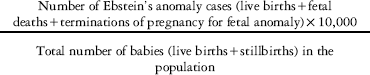
Prevalence and proportions by prenatal diagnosis and pregnancy outcome were calculated for three time periods (Fig 1) and for each country for the years 1992–2011 (Fig 1) when prevalence had stabilised in time.
Ebstein’s anomaly: prevalence per 10,000 births over time and by country with 95% confidence intervals.

Odds ratios, with 95% CIs, estimated using logistic regression to analyse risk factors are only presented where there are at least three exposed Ebstein’s anomaly cases. Odd ratios were adjusted for year of birth, with the data divided into the time periods – 1982–1991, 1992–2001, and 2002–2011 – and country (pooling data from registries within the same country: Table 1). For analysis of maternal age, maternal age was divided into three groups: <25, 25–34, and >34. All cases exposed to maternal diabetes, even if it occurred later in pregnancy, were excluded from the mental health analysis and vice versa to avoid confounding.
Previous hypotheses for investigation were lithium, selective serotonin reuptake inhibitors, other mental health medications, maternal depression and other mental health conditions, and maternal diabetes. For other exposures, an exploratory analysis first examined the data to find out which maternal diseases/conditions and medication exposures were recorded for at least three Ebstein’s anomaly cases, and these exposures were then subject to statistical analysis.
Results
Associated syndromes, malformations, and family history
Of the 264 Ebstein’s anomaly cases, 11 (4.17%) had chromosomal anomalies (Supplementary Table 3A), less than the 11.9% proportion of chromosomal anomalies among non-Ebstein cardiac anomaly cases; two cases (0.76%) were diagnosed with other genetic syndromes (Supplementary Table 3A) compared with 2.35% of other cardiac anomalies. A few cases had any recorded family history (Supplementary Table 4A). Of the 250 non-syndromic Ebstein’s anomaly cases, 86 had other cardiac anomalies (34%), including 23 reported as having an atrial septal defect only; twenty Ebstein’s anomaly cases had other right ventricular outflow tract obstruction anomalies – pulmonary valve atresia or stenoses – and nine cases had coarctation of the aorta. Ebstein’s anomaly cases were less likely to be associated with non-cardiac anomalies (8.8%, 22 cases) than other cardiac anomaly cases (17.6%) (Supplementary Table 5A). No specific anomaly was associated with Ebstein’s anomaly in more than two cases.
Prevalence, age at diagnosis, pregnancy outcome, and sex ratio
The average total prevalence of Ebstein’s anomaly was 0.47 (95% CI 0.41–0.53) per 10,000 births ranging from 0.27 (95% CI 0.20–0.36) in Italy to 0.95 (95% CI 0.53–1.72) in Malta (Table 1). The total prevalence rose significantly from 0.29 (95% CI 0.20–0.41) in the decade 1982–1991 to 0.55 (95% CI 0.46–0.67) in the decade 1992–2001 (trend p<0.01) remaining high at 0.48 (95% CI 0.40–0.57) in the decade 2002–2011 (Fig 1; Supplementary Table 6A). The decrease in prevalence between the second and third decades was not statistically significant.
The prevalence of prenatally diagnosed cases, where either Ebstein’s anomaly or an associated anomaly were prenatally diagnosed, per 10,000 births rose over time and varied between countries (Fig 2). The proportion of all cases that were prenatally diagnosed rose over time to 54% in the last decade (Fig 2) with 57% of all the isolated Ebstein’s anomaly cases prenatally diagnosed in that decade. The proportion of terminations of pregnancy for fetal anomaly rose to 16.7% in the last decade (Fig 3). The prevalence and proportion of terminations of pregnancy for fetal anomaly varied between countries (Fig 3). Termination of pregnancy for fetal anomaly is illegal in both Malta and Ireland. Of the 97 prenatally diagnosed, non-syndromic cases where gestational age at diagnosis was known, 85 (87.6%) were diagnosed at or after 20 weeks of gestation and 44 (45.4%) after 24 weeks of gestation. Overall, 16.5% of postnatally diagnosed live-born cases were diagnosed after the 1st week of life, not varying substantially between decades. Only five cases (2%) were diagnosed after 1 year of life.
Ebstein’s anomaly: prevalence per 10,000 births by time, country, termination of pregnancy for fetal anomaly (TOPFA) and prenatal diagnosis.

Ebstein’s anomaly: prevalence per 10,000 births by time, country, termination of pregnancy for fetal anomaly (TOPFA) and pregnancy outcome.

In all, 16 Ebstein’s anomaly cases were stillbirths, 0.03 (95% CI 0.02–0.05) per 10,000 births (Fig 3); 22 Ebstein’s anomaly cases were known to be early neonatal deaths, a rate of 0.04 (95% CI 0.03–0.06) per 10,000 births (Fig 3).
Out of 250 non-syndromic cases, 50.8% were male, excluding three cases of unknown sex.
Case-malformed control analysis of risk factors
Neither the odds of older or younger maternal age was significantly different from controls (Table 2), but the odds of being a firstborn child, adjusted for maternal age, were significantly lower than that of all controls (Table 2). Cases were non-significantly more likely to have been from multiple births than non-cardiac controls (Table 2). There was one pair of co-twins concordant for Ebstein’s anomaly, a monozygotic pair with twin-to-twin transfusion. Ebstein’s anomaly cases were non-significantly less likely to have had assisted reproduction than either control group (Table 2).
Ebstein’s anomaly: number, crude odds ratios (OR), and odds ratios adjusted for country and time (adjOR) for maternal characteristics and medication exposures compared with non-cardiac malformed control cases.

CI=confidence interval
Bold values are statistically significant
mAnalysis restricted to years with medication data available (Table 1)
XPExcluding cases and controls exposed to mental health issues (zero cases, 18 cardiac, 40 non-cardiac controls). Two pre-gestational, three gestational
XDExcluding cases and controls exposed to diabetes (zero cases, 18 cardiac, 40 non-cardiac controls)
* Cases and controls where the total number of previous pregnancies was unknown were excluded (47 (18.8%) cases 16,958 (21.6%) controls). OR adjusted for country and time were also adjusted for maternal age
** 1992–2011 only
*** There were no cases with recorded exposure to maternal mental illness who were not exposed to psycholeptic or antidepressant medications; three of the nine cases with medications had no diagnosis recorded, including one who took an antipsychotic. In addition, two cases exposed to psycholeptics, both exposed to a benzodiazepine derivative (anxiolytics), were also exposed to a Selective Serotonin Reuptake Inhibitor (SSRI). There were two cases exposed to SSRIs only; one mother, who took both a benzodiazepine derivatives and an SSRI, was also using β-blockers and drinking >5 units of alcohol per day. The other eight had no relevant medical history, were not known to have used assisted reproductive therapies (ART), and all had singleton births
In total, nine cases were exposed to mental illness and/or an antidepressant or a psycholeptic medication or both (adjOR 2.80, 95% CI 1.42–5.51, non-cardiac controls, Table 2). The odds ratio was similar when compared with cardiac controls (adjOR 2.64, 95% CI 1.33–5.21), indicating that this effect was specific to Ebstein’s anomaly (Table 2). High odds ratios were found for all the subcategories analysed – psycholeptic medications, antidepressants, selective serotonin reuptake inhibitors, diagnosis of anxiety, diagnosis of depression (Table 2). No Ebstein’s anomaly case was exposed to lithium, but five cardiac and eight non-cardiac controls were exposed to lithium. Further details of exposures of Ebstein’s anomaly cases are given in the footnote of Table 2; three of the five cases of selective serotonin reuptake inhibitors exposure we found were also found in our previous study,Reference Wemakor, Casson and Garne 12 which covered an overlapping population – that is, 28% of the population of this study.
Ebstein’s anomaly was non-significantly associated with diabetes compared with non-cardiac controls and was as likely to be associated with diabetes as other cardiac anomalies (Table 2). Cases were not more likely than controls to have been exposed to non-psychotropic/non-diabetic medications (0.87, 95% CI 0.54–1.39, Table 2).
Cases were more likely to have been exposed to maternal β-thalassemia (adjOR 12.9 (95% CI 3.85–43.0)) based on only three cases (Table 2). Haemorrhage in early pregnancy/threatened abortion was associated with an elevated odds ratio (Table 2).
Discussion
Ebstein’s anomaly and mental health conditions and their medication
We found that the risk of Ebstein’s anomaly rises nearly threefold when the mother is reported to have mental health conditions with medication. Our data suggest that it is not lithium or benzodiazepines specifically that are associated with Ebstein’s anomaly as had been previously assumedReference Nora, Nora and Toews 5 , Reference Diav-Citrin, Shechtman and Tahover 7 , Reference Correa-Villasenor, Ferencz and Neill 8 or Selective Serotonin Reuptake Inhibitors specifically as we and others had previously shown,Reference Wemakor, Casson and Garne 12 but that medicated mental illness in general is a risk factor. We had no data on unmedicated mental illness, and cannot effectively distinguish medication from indication, although the lack of a specific medication effect points to the possibility of the risk being associated with the underlying health condition. Our analyses suggest that switching away from specific medications such as lithium does not protect the fetus. Our data also robustly suggest that these exposures are much more strongly associated with Ebstein’s anomaly than cardiac anomalies in general. Recent literature has explored the relationships between congenital cardiac anomalies and both psychiatric conditions and the complex combinations of medications used to control them; other exposures of sufferers may also influence risk or act as confounders.Reference Monk, Newport and Korotkin 18 We had no systematic data on factors such as smoking, alcohol, or recreational drugs. We excluded those with diabetes from the mental health analyses to avoid confounding due to the association of diabetes and depression.Reference Hasan, Clavarino and Dingle 19
Ebstein’s anomaly and other maternal illnesses
Pre-gestational diabetes is known to be associated with cardiac and other congenital anomalies,Reference Correa, Gilboa and Besser 17 , Reference Garne, Loane and Dolk 20 but has not been specifically investigated with regard to Ebstein’s anomaly. Ebstein’s anomaly, although it can be detected as early as 14 weeks of gestation, is known to occasionally develop later in pregnancy.Reference Zimmer, Blazer and Lorber 3 It has been hypothesised that as women diagnosed with gestational diabetes are more likely to be overweight or obese they may have suffered from undiagnosed type 2 diabetes before pregnancy,Reference Correa, Gilboa and Besser 17 and thus we grouped gestational and pre-gestational disease together, finding a weak association between Ebstein’s anomaly and diabetes when compared with non-cardiac controls. This odds ratio is likely to be underestimated because of the inclusion in the control group of other malformations associated with diabetes.Reference Correa, Gilboa and Besser 17 , Reference Garne, Loane and Dolk 20 The lack of elevated odds compared with cardiac controls suggests that Ebstein’s anomaly has a similar association with diabetes as cardiac anomalies in general.Reference Correa, Gilboa and Besser 17 , Reference Garne, Loane and Dolk 20 Although an association was found between right ventricular outflow tract anomalies and pre-gestational diabetes in one study, none of the exposed cases in that study had Ebstein’s anomaly,Reference Correa, Gilboa and Besser 17 and five exposed cases were not available for analysis in another;Reference Garne, Loane and Dolk 20 therefore, we conclude that, although diabetes is an important risk factor for congenital cardiac anomalies in general, it is not specifically associated with Ebstein’s anomaly.
We were not able to confirm an association between maternal febrile illness, especially genitourinary tract infections, and right ventricular outflow tract obstructionsReference Botto, Panichello and Browne 21 as being specific to Ebstein’s anomaly.
Our finding that there is a strong association with β-thalassemia is new, but it is based on only three cases and not hypothesis driven, and thus needs confirmation in an independent data set.
Epidemiology of Ebstein’s anomaly
We estimate a prevalence of Ebstein’s anomaly in Europe of 0.47 cases per 10,000 births, which is consistent with those in other populations – 0.39 per 10,000 births in Hawaii (1986–1999),Reference Forrester and Merz 22 0.52 per 10,000 births in Baltimore (1981–1989),Reference Correa-Villasenor, Ferencz and Neill 8 0.6 per 10,000 in Atlanta (1992–2005),Reference Reller, Strickland and Riehle-Colarusso 23 and 0.72 per 10,000 births in Texas (1999–2005).Reference Lupo, Langlois and Mitchell 24 Our cases were drawn from a population of 5.6 million births, more than twice the population of the next largest of these studies.Reference Lupo, Langlois and Mitchell 24 The highest European prevalence in our study was found in Malta where the estimate is based on small numbers, but where the prevalence of congenital cardiac anomalies is known to be high relative to the rest of Europe.Reference Dolk, Loane and Garne 25 , Reference Khoshnood, Loane and Garne 26
The significant increase in prevalence that we found from the 1980s to the 1990s may be due in part to the increase in prenatal diagnosis and in terminations of pregnancy for fetal anomaly as a proportion of cases was lost spontaneously in late pregnancy.Reference Zimmer, Blazer and Lorber 3 , Reference Celermajer, Bull and Till 4 Prenatal and early diagnosis may also lead to better ascertainment of cases that might have been diagnosed later in life in the first study decade or missed in late fetal and neonatal deaths. More than half of cases were prenatally diagnosed since the 1990s, mostly after 20 weeks of gestation, and often diagnosed after 24 weeks of gestation. There is evidence that the majority of cases can be diagnosed by ultrasound as early as 14 weeks of gestation,Reference Zimmer, Blazer and Lorber 3 and, although infrequently Ebstein may develop after 20 weeks, diagnosis in late pregnancy may reflect the timing of routine congenital anomaly scans throughout Europe. 27
Our finding that Ebstein’s anomaly is less likely to be part of chromosomal syndromes than other cardiac anomalies is consistent with other studies.Reference Correa-Villasenor, Ferencz and Neill 8 Less than 1% of our cases were known to have a monogenic or microdeletion syndrome, but this may be partly because specific genetic testing has been infrequently carried out; two cases – both terminations of pregnancy for fetal anomaly – were reported to have thymic agenesis, which could indicate an undiagnosed genetic syndrome. In genetic studies of the disease, microdeletions have been found.Reference Postma, van Engelen and van de Meerakker 28 Although there are reports of familial associations of the disease, these are rare,Reference McIntosh, Chitayat and Bardanis 29 and first-degree relatives of Ebstein’s anomaly cases are more likely to have other CHDs.Reference Attenhofer Jost, Connolly and Dearani 30
The association of Ebstein’s anomaly with multiple births is inconsistent in the literatureReference Reller, Strickland and Riehle-Colarusso 23 , Reference Lupo, Langlois and Mitchell 24 and we found only a weak association. It is interesting that, similar to Correa–Villasenor and co-workers,Reference Correa-Villasenor, Ferencz and Neill 8 we found a twin pair concordant for Ebstein’s anomaly. Monozygotic twins are usually discordant for CHD, with the lesion possibly occurring either as a result of a disturbance in laterality in one twin during separation or as a result of imbalance in placental blood flow.Reference Manning 31 Although our twins did have a twin-to-twin transfusion, it is difficult to imagine that such a transfusion caused an identical lesion in both the donor and the recipient twin – more likely there was a genetic disposition, a teratogenic cause, or a combination of both. Correa–Villasenor’s twins were reportedly dizygotic and had an older sibling also diagnosed with Ebstein’s anomaly; one of the other twins in our data was reported to have had a twin-to-twin transfusion, but in that case the co-twin was not reported as having a congenital anomaly. We can hypothesise that the higher rate of haemorrhage in early pregnancy/threatened abortion in cases than controls, although not reaching statistical significance, may indicate the early loss of co-twins.Reference Verp 32
Our finding that Ebstein’s anomaly cases are less likely to be firstborn children support the findings of Correa–Villasenor and co-workers,Reference Correa-Villasenor, Ferencz and Neill 8 but our data do not support their findings of an association with older maternal age or assisted reproductive therapy.
Strengths and limitations of this study
The strengths of our study are the large population with standardised data on congenital anomaly diagnoses, the inclusion of all pregnancy outcomes such as live births, stillbirths, and terminations of pregnancy, and the prospective nature of most medication recording, blind to anomaly status. The main limitation of our data was probable under ascertainment of exposure status across a range of variables, although this would have been unbiased in the case-malformed control design. We used controls who had the same probability of exposure and of ascertainment of that exposure as the cases,Reference Schlesselman 33 , Reference Dolk and Wemakor 34 and could therefore judge the specificity of association with Ebstein’s anomaly in comparison both with non-cardiac and with other cardiac anomalies; however, the disadvantage of the case-malformed control design is that any exposure that is related to the controls will lead to an underestimate of the odds ratio for Ebstein’s anomaly – the so called “teratogen non-specificity bias”Reference Prieto and Martinez-Frias 35 – for example, this could have diluted the OR for diabetes or selective serotonin reuptake inhibitors use where other anomalies are also implicated.Reference Wemakor, Casson and Garne 12 , Reference Correa, Gilboa and Besser 17 , Reference Garne, Loane and Dolk 20 We analysed multiple exposures in our exploratory analyses, and the results should be interpreted taking into account the possibility of chance associations. As Ebstein’s anomaly may sometimes develop later than first trimester,Reference Zimmer, Blazer and Lorber 3 later medication exposures may be aetiologically significant, but EUROCAT data include only first trimester exposures.
Conclusions
Ebstein’s anomaly is diagnosed in approximately one in 21,000 babies in Europe. Ebstein’s anomaly is associated with a range of maternal health conditions and related medications, and our data support and broaden previous literature. There is a new signal in our data for an association between Ebstein’s anomaly and maternal β-thalassemia, which requires further confirmation.
Acknowledgements
The authors thank Hermien de Walle from University Medical Center Groningen, Department of Genetics, University of Groningen and the people throughout Europe involved in providing and processing information, including affected families, clinicians, healthcare professionals, medical record clerks, and registry staff.
Financial Support
This study was funded by European Operating Grant 2013 3307 UU. EUROCAT registries are funded as fully described in Paper 6 of Report 9 – EUROCAT Member Registries: Organization and Activities (http://onlinelibrary.wiley.com/doi/10.1002/bdra.20775/pdf).
Conflicts of Interest
None.
Ethical Standards
Permission to carry out this study as part of the EUROCAT project was granted by the Institute of Nursing and Health Research, School of Nursing Research Governance Filter Committee at Ulster University on behalf of the Ulster University Ethics Committee.
Supplementary materials
To view supplementary material for this article, please visit http://dx.doi.org/10.1017/S1047951116001025



