Epidemiological studies suggest that most individuals in the US will be exposed to trauma at some point in their lifetime (Benjet et al., Reference Benjet, Bromet, Karam, Kessler, Mclaughlin, Ruscio, Shahly, Stein, Petukhova, Hill, Alonso, Atwoli, Bunting, Bruffaerts, Caldas-De-Almeida, De Girolamo, Florescu, Gureje, Huang, Lepine and Koenen2016; Kilpatrick et al., Reference Kilpatrick, Resnick, Milanak, Miller, Keyes and Friedman2013), with interpersonal trauma (IPT; i.e., physical assault, sexual assault, other unwanted/uncomfortable sexual experiences) exposure being a particularly potent form of trauma that is prevalent during adolescence and emerging adulthood (Breslau et al., Reference Breslau, Peterson and Schultz2008). Notably, estimates suggest that 39% of first-year college students report lifetime IPT exposure (Overstreet et al., Reference Overstreet, Berenz, Kendler, Dick and Amstadter2017). Findings from extant research suggest that exposure to IPT is associated with increased likelihood of psychiatric and substance use disorders (Kessler et al., Reference Kessler, Berglund, Demler, Jin, Merikangas and Walters2005; Keyes et al., Reference Keyes, Hatzenbuehler and Hasin2011). Building off of longstanding theory regarding the stress-buffering role of relationships (Cohen & Wills, Reference Cohen and Wills1985; Kiecolt-Glaser & Wilson, Reference Kiecolt-Glaser and Wilson2017; Umberson et al., Reference Umberson, Crosnoe and Reczek2010), in an earlier study we found evidence that relationship status and partner alcohol use moderated the associations between IPT and alcohol use in an emerging adult college student sample (Smith et al., Reference Smith, Dick, Amstadter, Thomas and Salvatore2021). However, what remains less clear is whether and how these IPT exposures might be associated with relationship outcomes in and of themselves. In particular, it has been hypothesized that trauma exposure may disrupt the resolution of key developmental tasks (Cicchetti & Handley, Reference Cicchetti and Handley2019). Among emerging adults, especially salient developmental task is the formation and exploration of romantic relationships (Arnett, Reference Arnett2004; Shulman & Connolly, Reference Shulman and Connolly2013; Umberson et al., Reference Umberson, Crosnoe and Reczek2010). To this end, our primary goal here was to examine relationship formation, relationship satisfaction, and partner alcohol use as a function of timing of IPT exposure among a sample of emerging adult college students.
Associations between trauma and romantic relationships
There is relatively little direct knowledge of the associations between IPT exposure and relationship formation among college students, representing a significant gap in the literature. Yet complementary bodies of research suggest that exposure to broad trauma may impact individuals’ ability to form and maintain romantic relationships (Karney & Bradbury, Reference Karney and Bradbury1995; Marshall & Kuijer, Reference Marshall and Kuijer2017; Taft et al., Reference Taft, Watkins, Stafford, Street and Monson2011). For example, individuals exposed to traumatic events earlier in development are more likely than those without trauma exposure to have insecure (i.e., anxious or avoidant; Owen et al., Reference Owen, Quirk and Manthos2012) or avoidant attachment styles (McCarthy & Taylor, Reference McCarthy and Taylor1999), which may impede their ability to form romantic relationships. Further, individuals exposed to traumatic events are less likely than those without trauma exposure to develop positive self-concepts (Goodman et al., Reference Goodman, Quas and Ogle2010; Sachs-Ericsson et al., Reference Sachs-Ericsson, Medley, Kendall-Tackett and Taylor2011), which is concerning because having a positive self-concept is prospectively associated with bonded love in young adulthood (Seiffge-Krenke, Reference Seiffge-Krenke2003). Thus, extrapolating from extant research on the pathogenic effects of broad trauma, exposure to IPT during emerging adulthood likely negatively impacts the ways in which individuals connect with potential romantic partners, such that individuals exposed to IPT may be less likely to form romantic partnerships. Nevertheless, additional research is needed to directly study these associations.
For those in romantic relationships, it is well-established that exposure to traumatic events may impede individuals’ ability to maintain high-quality and stable partnerships (Karney & Bradbury, Reference Karney and Bradbury1995; Marshall & Kuijer, Reference Marshall and Kuijer2017; Taft et al., Reference Taft, Watkins, Stafford, Street and Monson2011; Zamir, Reference Zamir2021). Insecure attachment styles, which are more common among those with a history of traumatic exposures, may negatively influence later relationship satisfaction (Lassri et al., Reference Lassri, Luyten, Cohen and Shahar2016) and quality (McCarthy & Taylor, Reference McCarthy and Taylor1999). There is also evidence that individuals who experience traumatic events in adulthood become less engaged and have more negative interactions with their partners, which can lead to decreased satisfaction over time (Karney & Bradbury, Reference Karney and Bradbury1995; Marshall & Kuijer, Reference Marshall and Kuijer2017; Randall & Bodenmann, Reference Randall and Bodenmann2009; Whisman, Reference Whisman2014). Dissatisfying relationships are associated with increased psychological distress, negative affect, and hostility (Karney & Bradbury, Reference Karney and Bradbury1995; Lewis et al., Reference Lewis, McBride, Pollak, Puleo, Butterfield and Emmons2006; Robles et al., Reference Robles, Slatcher, Trombello and McGinn2014), as well as less willingness to engage in problem-solving behaviors (Marshal, Reference Marshal2003). Thus, exposure to traumatic events, including IPT, may negatively impact the ways in which individuals interact with their romantic partners and the satisfaction they derive from their relationships. Despite this robust line of research, the majority of these prior studies have focused on broad trauma in adult samples using cross-sectional research designs. This raises questions about whether these same patterns of effects are observed among college students exposed specifically to IPT, a particularly potent form of trauma, and whether these effects endure over time.
Lastly, little is known about the associations between IPT exposure and partner selection, representing another important gap in the literature. Nevertheless, extant literature suggests that individuals exposed to stressful life events may be more likely to select deviant partners (Quinton et al., Reference Quinton, Pickles, Maughan and Rutter1993; Zoccolillo et al., Reference Zoccolillo, Pickles, Quinton and Rutter1992). The extent to which individuals select deviant romantic partners has implications for one’s own health outcomes and psychosocial adjustment, including social connectedness, stress levels, and substance use (Umberson et al., Reference Umberson, Crosnoe and Reczek2010). For example, in prior work, we found evidence that partner substance use exacerbated the pathogenic association between IPT and alcohol use in an emerging adult college student sample (Smith et al., Reference Smith, Dick, Amstadter, Thomas and Salvatore2021), giving rise to the question of whether individuals exposed to IPT are likely to select partners high in substance use. As previously noted, exposure to traumatic events is associated with having insecure attachment styles (McCarthy & Taylor, Reference McCarthy and Taylor1999; Owen et al., Reference Owen, Quirk and Manthos2012) and poor emotion regulation (Goodman et al., Reference Goodman, Quas and Ogle2010; Ogle et al., Reference Ogle, Rubin and Siegler2013), which are in turn associated with using substances to cope (Molnar et al., Reference Molnar, Sadava, DeCourville and Perrier2010). It is also well-established that individuals tend to assortatively pair with romantic partners similar to themselves and supportive of their behaviors (McPherson et al., Reference McPherson, Smith-Lovin and Cook2001; Rhule-Louie & McMahon, Reference Rhule-Louie and McMahon2007; Yamaguchi & Kandel, Reference Yamaguchi and Kandel1993). Thus, it follows that individuals exposed to trauma may select into relationships with partners high in substance use because of similarities and compatibility related to coping styles. Taken together, these converging lines of evidence suggest that IPT exposure may influence the types of romantic partners individuals choose.
Developmental timing and sex-specific effects
An important consideration in understanding the associations between IPT and romantic relationships is developmental timing and duration of effect. Trauma exposure earlier in development is more strongly associated with negative psychological health and psychosocial functioning compared to trauma experienced later in life (Cloitre et al., Reference Cloitre, Stolbach, Herman, Kolk, Pynoos, Wang and Petkova2009; Ogle et al., Reference Ogle, Rubin and Siegler2013), with prospective studies indicating that trauma that occurs during early life can have lasting effects on developmental trajectories (e.g., Kim & Cicchetti, Reference Kim and Cicchetti2003; Norman et al., Reference Norman, Byambaa, De, Butchart, Scott and Vos2012; Oshri et al., Reference Oshri, Kogan, Kwon, Wickrama, Vanderbroek, Palmer and MacKillop2018). For example, research suggests that trauma exposure during childhood and adolescence can impact key socioemotional developmental processes, including emotion regulation, attachment formation, sense of self (Goodman et al., Reference Goodman, Quas and Ogle2010; Ogle et al., Reference Ogle, Rubin and Siegler2013), and neurobiological responses to stress (Stevens et al., Reference Stevens, van Rooij and Jovanovic2018). In other words, traumatic experiences may scaffold the development of competence (or lack thereof) in romantic relationships. Trauma exposure that occurs later in development, such as during emerging adulthood, may undermine positive schemas and achievement in psychosocial domains of functioning (e.g., educational achievement, social relationships; Berntsen et al., Reference Berntsen, Rubin and Siegler2011). Yet, it remains unclear whether emerging adulthood trauma has similarly enduring effects on romantic relationships. To answer this question, we examined whether IPT exposure that occurs at different points in development may have differential effects on college students’ romantic relationship outcomes and whether IPT exposure in emerging adulthood has lagged associations with their relationship characteristics over a 1-year period.
A second consideration in the associations between IPT and relationship characteristics is understanding potential sex/gender differences. (We recognize that, although sex and gender are often highly correlated, they are not synonymous. However, prior studies in this area have used various operational definitions making research in this area somewhat convoluted. For simplicity, we use the term sex differences.) Research suggests that females tend to experience more adverse outcomes following trauma exposure compared to males, such as higher rates of trauma-related distress and anxiety (Overstreet et al., Reference Overstreet, Berenz, Kendler, Dick and Amstadter2017) and greater risk for posttraumatic stress disorder (PTSD; Breslau et al., Reference Breslau, Chilcoat, Kessler, Peterson and Lucia1999; Kessler, Reference Kessler1995; Stevens et al., Reference Stevens, van Rooij and Jovanovic2018). For example, the prevalence of PTSD is approximately twice as high in females compared to males (Breslau et al., Reference Breslau, Chilcoat, Kessler, Peterson and Lucia1999; Perrin et al., Reference Perrin, Vandeleur, Castelao, Rothen, Glaus, Vollenweider and Preisig2014), and these sex differences are most pronounced during emerging adulthood (Breslau et al., Reference Breslau, Chilcoat, Kessler, Peterson and Lucia1999). Prior research indicates that symptoms of PTSD (e.g., increased vigilance, social withdrawal) may interfere with one’s ability to form or maintain a romantic relationship (Monson et al., Reference Monson, Taft and Fredman2009; Taft et al., Reference Taft, Watkins, Stafford, Street and Monson2011); moreover, trauma-related distress and PTSD are associated with higher levels of relationship discord and dissatisfaction (Marshall & Kuijer, Reference Marshall and Kuijer2017; Taft et al., Reference Taft, Watkins, Stafford, Street and Monson2011). In view of these earlier findings, we hypothesized that associations between IPT and relationship characteristics may vary as a function of sex, with stronger effects observed for females than males.
Current study
Despite strong evidence that broad trauma is associated with poor romantic relationship quality in adults (Zamir, Reference Zamir2021), questions remain. Namely, it is unclear whether these patterns of effects are relevant to relationship formation and partner selection among college students, whether the same pattern of effects is observed for IPT specifically, and whether these effects endure over time. To address these gaps, the present study aimed to examine the associations between IPT and romantic relationship formation (i.e., relationship status) and relationship characteristics (i.e., relationship satisfaction, partner alcohol use) using a developmental lens. Using a sample of emerging adult college students from a large, longitudinal project, we examined (1) whether precollege IPT predicted relationship formation or characteristics; (2) whether college-onset IPT had concurrent or lagged associations with relationship formation or characteristics; and (3) whether any of these associations varied in a sex-specific manner.
We hypothesized that college students exposed to precollege or concurrent college-onset IPT would have a greater likelihood of being single versus being in a committed relationship. For those in a relationship, we hypothesized that those exposed to precollege or concurrent college-onset IPT, relative to those not exposed to IPT, would report lower relationship satisfaction and higher partner alcohol use. Next, we hypothesized that college-onset IPT would have lagged associations with relationship characteristics. We hypothesized that individuals exposed to college-onset IPT would have a greater likelihood of being single versus being in a relationship the following year. Similarly, for those in a relationship, we hypothesized that those exposed to college-onset IPT would report lower relationship satisfaction and higher partner alcohol use the following year. Lastly, we hypothesized that the pattern of effects would be stronger for females compared to males. Study hypotheses were preregistered on the Open Science Framework at https://osf.io/7t5mf.
Method
Participants
Data were from the Spit for Science project, a university-wide longitudinal study focused on substance use and behavioral health among college students at a large, urban, 4-year public university (Dick et al., Reference Dick, Nasim, Edwards, Salvatore, Cho, Adkins, Meyers, Yan, Cooke, Clifford, Goyal, Halberstadt, Ailstock, Neale, Opalesky, Hancock, Donovan, Sun, Riley and Kendler2014). The Spit for Science project began in fall 2011, and new cohorts were recruited in 2012, 2013, 2014, and 2017 (N = 12,358). Each year, all incoming freshmen over age 18 were invited to participate in the Spit for Science study. Those who consented to participate completed the baseline survey during the fall or spring of their freshman year and were invited to complete follow-up surveys every spring thereafter. Study data were collected and managed using REDCap electronic data capture tools (Harris et al., Reference Harris, Taylor, Thielke, Payne, Gonzalez and Conde2009).
Participants were included in the present study if they completed surveys at baseline and at least one follow-up (M follow-up assessments = 1.70, range = 1–4); 57.3%, 36.0%, 25.3%, and 13.7% of participants completed one, two, three, and four follow-up assessments, respectively. Follow-up data for the fifth cohort (2017) were unavailable at the time of data analysis and were therefore excluded. We derived two analytic subsamples from the full Spit for Science sample. The first subsample included individuals who were part of the analyses focused on relationship status as an outcome of IPT exposure (n = 1,132). The second subsample included those who were part of the analyses focused on relationship satisfaction and partner alcohol use as outcomes of IPT exposure. This subsample was limited to those individuals who were in a relationship at one or more assessments and was thus eligible to answer questions about their relationships (n = 1,913).Footnote 1
Measures
Interpersonal trauma exposure
Precollege IPT was a time-invariant measure assessed at baseline, and college-onset IPT was a time-varying measure assessed at each follow-up. IPT exposure was measured as participants’ self-reported exposure to potentially traumatic events, assessed via the following items from the abbreviated Life Events Checklist (Gray et al., Reference Gray, Litz, Hsu and Lombardo2004): physical assault, sexual assault, and other unwanted or uncomfortable sexual experiences. At the baseline assessment, participants were coded as having precollege IPT if they reported having ever experienced a physical assault, sexual assault, or other unwanted sexual experience (Berenz et al., Reference Berenz, Cho, Overstreet, Kendler, Amstadter and Dick2016; Hawn et al., Reference Hawn, Lind, Conley, Overstreet, Kendler, Dick and Amstadter2018; Overstreet et al., Reference Overstreet, Berenz, Kendler, Dick and Amstadter2017). Participants were coded as having college-onset IPT if they reported experiencing any potentially traumatic events “since starting college” during the spring of their freshman year or “in the last 12 months” at any subsequent follow-up assessments (i.e., years 2 through 4; Berenz et al., Reference Berenz, Cho, Overstreet, Kendler, Amstadter and Dick2016; Hawn et al., Reference Hawn, Lind, Conley, Overstreet, Kendler, Dick and Amstadter2018; Overstreet et al., Reference Overstreet, Berenz, Kendler, Dick and Amstadter2017). Precollege and college-onset IPT were coded dichotomously, with participants exposed to IPT (1) or not exposed to IPT (0).
Relationship status
Relationship status was a time-varying measure assessed at each follow-up assessment in which, participants described their current relationship status by selecting one of the following: (1) “not dating”; (2)“dating several people”; (3)“dating one person exclusively”; (4) “engaged”; (5)“married”; or (6) “married but separated.” Relationship status was collapsed into two categories: in a committed relationship (1) and not in a committed relationship (0). Participants who identified as dating one person exclusively, being engaged, or being married were coded as being in a committed relationship. Those who identified as not dating, dating several people, and married but separated were coded as not in a committed relationship. Our decision to collapse participants who indicated that they were not dating anyone, dating several people, and married but separated into “not in a committed relationship” was guided by the small sample sizes of the latter two relationship statuses (< 12.1% and < 0.12% of the sample, respectively).
Relationship satisfaction
Relationship satisfaction was a time-varying measure, comprised of three items from the Relationship Assessment Scale (Hendrick et al., Reference Hendrick, Dick and Hendrick1998), assessed at each follow-up assessment. Participants in a committed relationship at the time of assessment reported on their general relationship satisfaction, how well their partner meets their needs, and how good their relationship is compared to most. Response options ranged from “not at all” (0) to “a lot/very much” (100) and were presented on a slider scale that participants could move to indicate their response. Responses were averaged across all three items and transformed to a one to seven scale. Higher scores indicated higher relationship satisfaction.
Partner alcohol use
Partner alcohol use was a time-varying measure, comprised of two items adapted from a measure of peer deviance (Kendler et al., Reference Kendler, Jacobson, Myers and Eaves2008; Smith et al., Reference Smith, Dick, Amstadter, Thomas and Salvatore2021), assessed at each follow-up assessment. Participants in a committed relationship at the time of assessment reported how often they perceived their partner “drinks alcohol” and “has a problem with alcohol (like hangovers, fights, accidents).” Participants responded using a Likert-type scale ranging from “never” (1) to “every day” (5). A composite score for partner alcohol use was created from the sum of the endorsed items (inter-item r = 0.46). Higher total scores indicated higher levels of partner alcohol use (Kendler et al., Reference Kendler, Jacobson, Myers and Eaves2008).
Covariates
Covariates included age, race/ethnicity, time in school, and cohort. Sex was included as a covariate for the first two research aims and used as a moderator for the third research aim. All covariates, except time in school and cohort, were self-report items, measured at baseline. Age was measured in years. Race/ethnicity was coded as White, African American/Black, Asian, Hispanic/Latino, other race/ethnicity, and more than one race/ethnicity. Participants who reported their race/ethnicity as unknown or chose not to answer were coded as missing. Sex was coded as male (0) or female (1). Because of the longitudinal nature of the study, time in school was measured in years to correspond to each year in college at which participants were assessed. Finally, cohort corresponded to the year in which participants were recruited, with cohort one set as the reference group. Covariate selection was informed by prior analyses in this sample in which we found that relationship status and partner alcohol use, but not relationship satisfaction, moderated the associations between IPT and alcohol use (Smith et al., Reference Smith, Dick, Amstadter, Thomas and Salvatore2021). In view of this, and because all covariates were significantly correlated with at least one outcome of interest (i.e., relationship status, relationship satisfaction, or partner alcohol use), we opted to retain these measures as covariates.
Data analysis plan
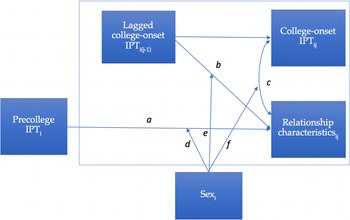
We conducted a series of analyses to examine (1) whether precollege and college-onset IPT predicted relationship status, relationship satisfaction, and partner alcohol use; (2) whether college-onset IPT had lagged or concurrent associations with these relationship characteristics; and (3) whether any of these associations varied in a sex-specific manner. Figure 1 represents the conceptual model for the research aims. Pathway a represents the effect of precollege IPT on each relationship characteristic. Pathway b represents the lagged associations between college-onset IPT and each relationship characteristic. Pathway c represents the concurrent associations between college-onset IPT and each relationship characteristic. Pathway d represents the moderating effects of sex on the associations between precollege IPT and each relationship characteristic. Lastly, pathways e and f represent the moderating effects of sex on the lagged and concurrent associations between IPT and each relationship characteristic, respectively. Separate models were run for relationship status, relationship satisfaction, and partner alcohol use outcomes. We retained a p-value threshold of < .05 because each relationship characteristic represents a unique construct.
Conceptual model for analyses examining 1) whether precollege and college-onset interpersonal trauma (IPT) predicted relationship status, relationship satisfaction, and partner substance use; 2) whether college-onset IPT had lagged or concurrent associations with these relationship characteristics; and 3) whether any of these associations varied in a sex-specific manner. The pathway denoted by subscript a represents the effect of precollege IPT on each relationship characteristic. The pathway denoted by subscript b represents the lagged associations between college-onset IPT and each relationship characteristic. The pathway denoted by subscript c represents the concurrent associations between college-onset IPT and each relationship characteristic. The pathway denoted by subscript d represents the moderating effects of sex on the associations between precollege IPT and each relationship characteristic. Lastly, the pathways denoted by subscripts e and f represent the moderating effects of sex on the lagged and concurrent associations between IPT and each relationship characteristic, respectively. Although represented as one model, a parallel series of models was run for each relationship characteristic (relationship status, relationship satisfaction, partner substance use) with p-value thresholds of < .05 for each model because each characteristic represents a unique construct. College-onset IPT and all three relationship characteristics were treated as time-varying variables in these analyses (denoted by the subscripts ij), while sex and precollege IPT were treated as time-invariant variables (denoted by the subscript i).

We first fit generalized estimating equation (GEE) models with a logit link function and autoregressive (AR1) correlation structure using the “geepack” package (Højsgaard et al., Reference Højsgaard, Halekoh and Yan2005) in R (R Core Team, 2014) to estimate the main effects of precollege IPT (pathway a), lagged college-onset IPT (pathway b), and concurrent college-onset IPT (pathway c) on relationship status. Next, we fit linear mixed models with restricted maximum likelihood estimation (REML) and AR1 correlation structure using the “nlme” package (Pinheiro et al., Reference Pinheiro, Bates, DebRoy and Sarkar2018) in R (R Core Team, 2014) to estimate the main effects of precollege IPT (pathway a), lagged college-onset IPT (pathway b), and concurrent college-onset IPT (pathway c) on relationship satisfaction and partner alcohol use. Random effects of intercept were incorporated to account for clustering within individuals. Lastly, to examine whether any of these associations varied in a sex-specific manner, we fit GEE and linear mixed models to estimate the two-way interactions between sex, precollege IPT (pathway d), lagged college-onset IPT (pathway e), and concurrent college-onset IPT (pathway f) to predict relationship status, relationship satisfaction, and partner alcohol use.
Effect sizes are reported as odds ratios (ORs) converted to percentages for the GEE models and as marginal R 2 for the unique variance accounted for by predictors and interaction terms in the linear mixed models. College-onset IPT and all three relationship characteristics were treated as time-varying variables in these analyses, while precollege IPT was a time-invariant variable. Cohort, age, and race/ethnicity were included as time-invariant covariates, and time in school was included as a time-varying covariate in these analyses. Sex was treated as time-invariant when included as a covariate and as a moderator.
Results
Descriptive statistics
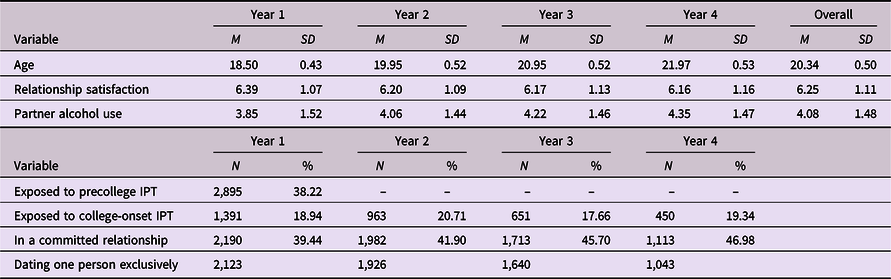
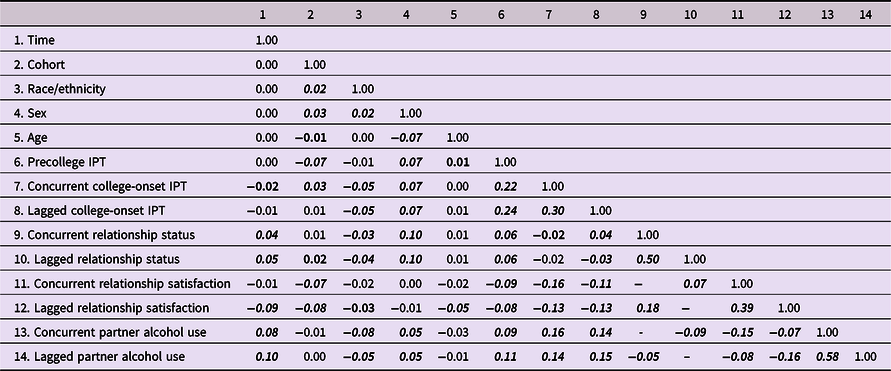
Table 1 contains means and standard deviations for all continuous variables, as well as frequencies and percentages for all categorical variables. Less than half of all respondents were in a committed relationship at each assessment, but the percentage of students in relationships increased between freshman and senior year (39.4% to 47.0%). Across all assessments, the majority of respondents in a committed relationship were dating one person exclusively (> 93.7%), with relatively few (< 2.7%) who were engaged or married. Among those not in a committed relationship, the majority of respondents were not dating (> 87.8%), with relatively few who were dating several people (< 12.1%) or married but separated (< 0.12%). Approximately 38.2% of respondents reported a history of precollege IPT, and college-onset IPT ranged from 17.7% to 20.7% across assessments. Zero-order correlations for key study variables are shown in Table 2. Representativeness analyses comparing those included in the analytic sample to those excluded from the analytic sample suggested small but significant differences with respect to age, sex, and prevalence of IPT. Participants included in the analytic samples were significantly more likely to be younger, female, and have higher rates of precollege or college-onset IPT than those excluded from the analytic samples. All of these differences were of small effect as measured by Cohen’s d (all < .26; see Supplemental Information).
Means, standard deviations, frequencies, and percentages by year for all continuous and categorical variables

Note. IPT = interpersonal trauma; M = mean; SD = standard deviation; N = frequency of respondents who positively endorsed that variable; % = percentage of respondents who positively endorsed that variable.
Means and standard deviations were calculated using longitudinal data, and frequencies and percentages were calculated using cross-sectional data.
Zero-order correlations between key study variables

Note. IPT = interpersonal trauma.
Bold type indicates p < .05.
Bold italic type indicates p < .01.
Associations between IPT and relationship characteristics
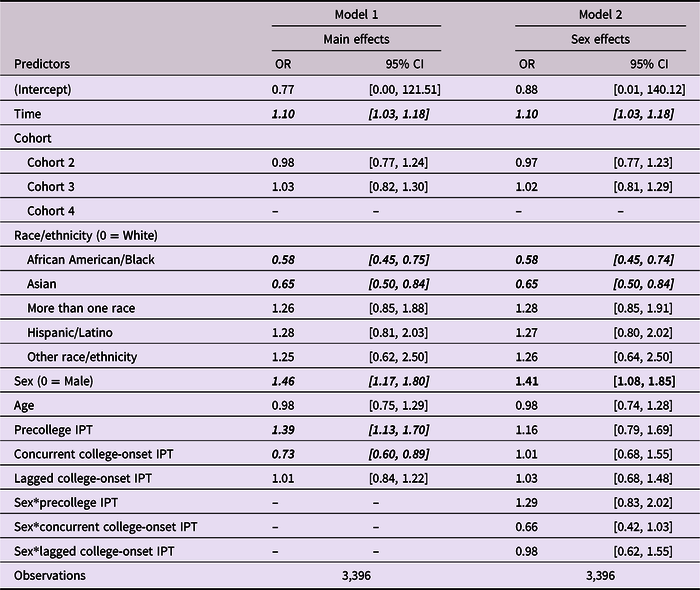
Table 3 shows the parameter estimates from GEE models examining the main effects of precollege, concurrent college-onset, and lagged college-onset IPT exposure on relationship status (model 1) and the two-way interaction between sex and IPT exposure to predict relationship status (model 2). IPT exposure emerged as a significant main effect. Individuals who reported precollege IPT were approximately 39% more likely (OR = 1.39; 95% CI [1.13, 1.70]) to be in a relationship during college compared to those without a history of precollege IPT. In contrast, individuals who experienced concurrent college-onset IPT were 27% less likely (OR = 0.73; 95% CI [0.60, 0.89]) to be in a relationship than those without concurrent college-onset IPT, when controlling for the effects of lagged IPT. Finally, there was not a significant effect of lagged college-onset IPT on relationship status, meaning that experiencing college-onset IPT was not associated with relationship status the following year. There was no evidence that the associations between IPT and relationship status use varied in a sex-specific manner (all ps > .070).
Associations between precollege IPT, college-onset IPT exposure, sex, and relationship status

Note. IPT = interpersonal trauma.
Bold type indicates p < .05.
Bold italic type indicates p < .01.
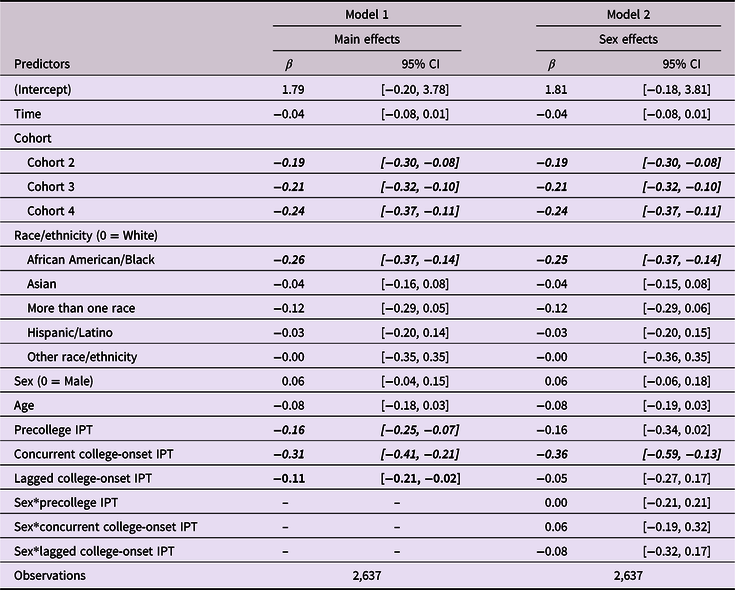
Table 4 contains the parameter estimates from the linear mixed models examining the main effects of precollege IPT, concurrent college-onset IPT, and lagged college-onset IPT exposure on relationship satisfaction (model 1) and the two-way interaction between sex and IPT exposure to predict relationship satisfaction (model 2). Individuals exposed to precollege IPT reported lower relationship satisfaction compared to those without IPT exposure, with precollege IPT accounting for 0.81% of the variance in relationship satisfaction. Individuals exposed to concurrent college-onset IPT reported lower relationship satisfaction than those without concurrent college-onset IPT, accounting for 1.17% of the variance in relationship satisfaction. Furthermore, there was a lagged effect of college-onset IPT, such that those with college-onset IPT (compared to those without) reported lower relationship satisfaction the following year. Lagged college-onset IPT accounted for 0.99% of the variance in relationship satisfaction. There was no evidence to suggest that the associations between IPT and relationship satisfaction varied in a sex-specific manner (all ps > .524).
Associations between precollege IPT, college-onset IPT exposure, sex, and relationship satisfaction

Note. IPT = interpersonal trauma.
Bold type indicates p < .05.
Bold italic type indicates p < .01.
Relationship satisfaction was standardized.
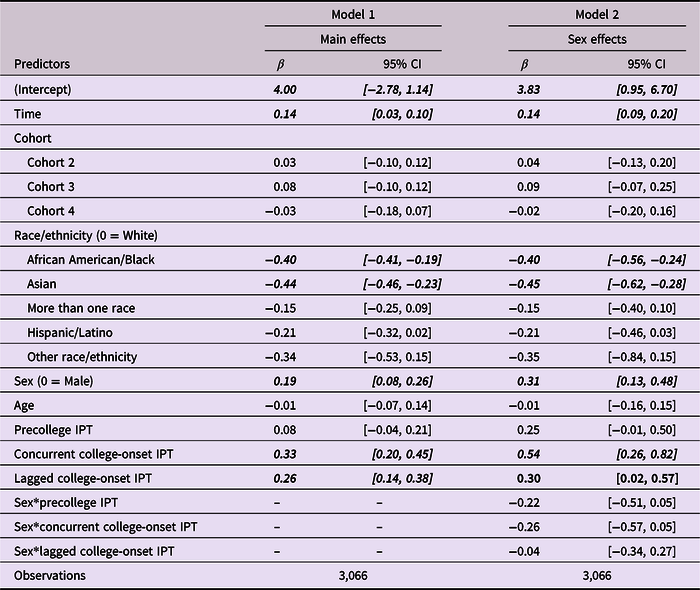
Table 5 contains the parameter estimates from the linear mixed models examining the main effects of precollege, concurrent college-onset, and lagged college-onset IPT exposure on partner alcohol use (model 1) and the two-way interaction between sex and IPT exposure to predict partner alcohol use (model 2). Individuals with concurrent college-onset IPT reported higher partner alcohol use compared to those without concurrent college-onset IPT, accounting for 1.12% of the variance in partner alcohol use. There was also a lagged effect of college-onset IPT, such that those with college-onset IPT (compared to those without) reported higher partner alcohol use the following year. Lagged college-onset IPT accounted for 0.09% of the variance in partner alcohol use. There was no evidence that precollege IPT exposure was associated with partner alcohol use (p = .193), or that the associations between IPT and partner alcohol use varied in a sex-specific manner (all ps > .105).
Associations between precollege IPT, college-onset IPT exposure, sex, and partner alcohol use

Note. IPT = interpersonal trauma.
Bold type indicates p < .05.
Bold italic type indicates p < .01.
Partner alcohol use was standardized.
Discussion
In this longitudinal study of emerging adult college students, we examined (1) whether precollege IPT predicted relationship status, relationship satisfaction, and partner alcohol use; (2) whether college-onset IPT had concurrent or lagged associations with those relationship characteristics; and (3) whether these associations varied in a sex-specific manner. We observed significant effects of precollege and college-onset IPT on relationship status and relationship satisfaction, and significant effects of college-onset IPT on partner alcohol use. Despite previous findings that females experience more adverse outcomes following trauma exposure compared to males, such as higher rates of trauma-related distress and anxiety (Overstreet et al., Reference Overstreet, Berenz, Kendler, Dick and Amstadter2017) and greater risk for PTSD (Breslau et al., Reference Breslau, Chilcoat, Kessler, Peterson and Lucia1999; Kessler, Reference Kessler1995; Stevens et al., Reference Stevens, van Rooij and Jovanovic2018), we did not observe any sex-specific associations between IPT and relationship characteristics. We discuss each of our key findings in turn.
Relationship status
Consistent with prior research on the associations between broad trauma exposure and relationships among adults (Karney & Bradbury, Reference Karney and Bradbury1995; Marshall & Kuijer, Reference Marshall and Kuijer2017; Taft et al., Reference Taft, Watkins, Stafford, Street and Monson2011), we found that IPT exposure was significantly associated with the formation of romantic relationships among college students. Interestingly, the direction of association varied depending on the developmental timing of IPT exposure, which we speculate may reflect a number of potential processes based on complementary lines of evidence. We found that individuals exposed to precollege IPT were more likely than those not exposed to precollege IPT to be in a relationship. This effect was unexpected in view of previous research suggesting that trauma which occurs earlier in development leads to long-term maladaptive changes in affective, relational, and self-regulatory functioning (Cloitre et al., Reference Cloitre, Khan, Mackintosh, Garvert, Henn-Haase, Falvey and Saito2019; van der Kolk et al., Reference van der Kolk, Roth, Pelcovitz, Sunday and Spinazzola2005) and is associated with insecure adult attachment styles (i.e., anxious and avoidant; Mickelson et al., Reference Mickelson, Kessler and Shaver1997; Riggs et al., Reference Riggs, Cusimano and Benson2011), all of which may jeopardize one’s ability to develop self-esteem and self-control (Crittenden & Ainsworth, Reference Crittenden, Ainsworth, Cicchetti and Carlson1989; Riggs et al., Reference Riggs, Cusimano and Benson2011). Considering these lines of research in tandem, however, we posit the possibility that individuals exposed to precollege IPT may be more likely to enter into relationships, relative to staying single, because they fear being alone, consistent with previous research that romantic partners can help with one’s own self-regulation (Riggs et al., Reference Riggs, Cusimano and Benson2011).
In contrast, and consistent with our expectations, those exposed to concurrent college-onset IPT were more likely to be single compared to those who did not experience concurrent college-onset IPT. The ways that individuals cope with stressful life events, such as IPT exposure, vary based on their appraisal of the event and the psychosocial resources available (Moos, Reference Moos1992). We thus speculate that individuals exposed to concurrent college-onset IPT may be less likely to form romantic partnerships because they are instead focused on coping with the recent traumatic event and have fewer resources to devote to forming a relationship. This is consistent with previous research that suggests that exposure to stressful experiences may impact individuals’ ability to form protective relationships in the first place (Karney & Bradbury, Reference Karney and Bradbury1995; Marshall & Kuijer, Reference Marshall and Kuijer2017; Taft et al., Reference Taft, Watkins, Stafford, Street and Monson2011). Importantly, however, this pattern of effects was time-delimited, as there was no lagged effect of college-onset IPT on individual’s relationship status the following year.Footnote 2
Relationship satisfaction and partner alcohol use
For college students in relationships, our findings suggest IPT exposure can influence the perceived characteristics of their romantic relationships. Individuals exposed to precollege and concurrent college-onset IPT were more likely to report lower relationship satisfactionFootnote 3 , and those exposed to college-onset IPT also reported higher partner alcohol use. Moreover, college-onset IPT was associated with relationship satisfaction and partner alcohol use the following year, suggesting a protracted interplay rather than a time-delimited one. The association between IPT and characteristics of romantic relationships is consistent with previous studies conducted with adults which suggest that individuals who experienced a traumatic event become less connected, less satisfied, and more negative with their partners (Karney & Bradbury, Reference Karney and Bradbury1995; Marshall & Kuijer, Reference Marshall and Kuijer2017; Randall & Bodenmann, Reference Randall and Bodenmann2009; Robles et al., Reference Robles, Slatcher, Trombello and McGinn2014; Whisman, Reference Whisman2014). Additionally, previous research indicates that individuals from high-risk backgrounds, such as those with a history of trauma exposure, are more likely to choose deviant partners with higher levels of substance use (Quinton et al., Reference Quinton, Pickles, Maughan and Rutter1993; Zoccolillo et al., Reference Zoccolillo, Pickles, Quinton and Rutter1992). Taken together, this suggests that IPT-exposed college students who are in committed relationships are more likely to be in relationships that are not necessarily healthy or protective, and similar to the long-term consequences of childhood trauma (Norman et al., Reference Norman, Byambaa, De, Butchart, Scott and Vos2012), this pattern of effects endures over time.
Implications
As relationship problems are one of the most common reasons that college students seek counseling services (Mistler et al., Reference Mistler, Reetz, Krylowicz and Barr2012), clinicians working with this population should be aware that a history of IPT can modestly influence key relationship characteristics. Clinicians should also understand and consider the implications of being in a relationship following precollege IPT, as it may not always be adaptive if the relationship is not satisfying and involves a deviant romantic partner (Rhule-Louie & McMahon, Reference Rhule-Louie and McMahon2007; Robles et al., Reference Robles, Slatcher, Trombello and McGinn2014). Clinicians can also use this information to educate their clients on the range of potential consequences they may experience following IPT. For example, clinicians can educate clients on the potential long-term effects of precollege IPT as it relates to social relationships, including emotional regulation, attachment formation, and stress responses (Overstreet et al., Reference Overstreet, Berenz, Kendler, Dick and Amstadter2017). They can also teach clients about the potential effects of college-onset IPT, including challenges it poses to forming relationships with prosocial partners, and healthy ways to cope with such challenges (Berenz et al., Reference Berenz, Cho, Overstreet, Kendler, Amstadter and Dick2016; Smith et al., Reference Smith, Dick, Amstadter, Thomas and Salvatore2021). In taking these actions, clinicians can help minimize relationship dissatisfaction, while promoting healthy methods of self-regulation.
Understanding the implications of IPT exposure on romantic relationship formation and perceptions is also of clinical significance in light of substantial research documenting the moderating effect of relationships on health outcomes (Cho et al., Reference Cho, Smith, Bucholz, Chan, Edenberg, Hesselbrock, Kramer, McCutcheon, Nurnberger, Schuckit, Zang, Dick and Salvatore2020; Kiecolt-Glaser & Wilson, Reference Kiecolt-Glaser and Wilson2017; Rauer et al., Reference Rauer, Pettit, Samek, Lansford, Dodge and Bates2016; Smith et al., Reference Smith, Dick, Amstadter, Thomas and Salvatore2021). Of particular relevance, in our prior work, we found that involvement in romantic relationships buffers against the effects of precollege IPT exposure on alcohol use, while being involved with a partner higher partner alcohol use exacerbated the effects of college-onset trauma on alcohol use (Smith et al., Reference Smith, Dick, Amstadter, Thomas and Salvatore2021). Considered with other research suggesting that individuals exposed to trauma are at risk for problematic alcohol use (Berenz et al., Reference Berenz, Cho, Overstreet, Kendler, Amstadter and Dick2016; Overstreet et al., Reference Overstreet, Berenz, Kendler, Dick and Amstadter2017), knowledge about individuals’ relationship status and the characteristics of their relationships is critical.
More broadly, findings from the present study can contribute to our understanding of the associations between IPT exposure and the navigation of salient psychosocial developmental tasks. As noted, a key developmental task in emerging adulthood is the formation and exploration of romantic relationships (Arnett, Reference Arnett2004; Shulman & Connolly, Reference Shulman and Connolly2013; Umberson et al., Reference Umberson, Crosnoe and Reczek2010). Involvement in romantic relationships during college is important for normative development because it provides opportunities to learn and improve one’s social and emotional competence, skills that are necessary for future successful romantic relationships (Rauer et al., Reference Rauer, Pettit, Lansford, Bates and Dodge2013; Seiffge-Krenke, Reference Seiffge-Krenke2003). In view of evidence that IPT exposure shapes social and emotional competence in important ways earlier in development (Cicchetti & Doyle, Reference Cicchetti and Doyle2016; Kim & Cicchetti, Reference Kim and Cicchetti2003), it also follows that IPT is also associated with individuals’ likelihood of forming and maintaining healthy, satisfying romantic relationships in adulthood. In sum, findings from the present study can inform our understanding of impediments to normative development, including those that contribute to developmental psychopathology. Future research can expand on this work to provide additional insight into these associations.
Limitations
Results from the present study should be considered in the context of its limitations. First, data were collected via self-report and may be subject to self-presentation biases. Second, we did not account for IPT severity or posttraumatic stress symptoms because we were unable to directly link individuals’ symptoms to their IPT exposure. Third, there were high levels of attrition in later waves of the sample. To determine the impact of this on our sample composition, we conducted a series of representativeness analyses. Our analytic samples were younger, comprised of more females, and were more likely to report IPT exposure than those excluded from our analytic samples; however, these differences were all of small effect (see Supporting Information). Lastly, we only studied IPT among college students at a large, urban university. Therefore, our findings may not generalize to other types of traumatic events or to a broader emerging adult population.
The present study should also be considered in the context of the small observed effect sizes. We conducted a series of sensitivity analyses to determine whether our small effect sizes were attributable to the way our variables were measured. First, in light of previous research suggesting that cumulative IPT exposure confers greater risk than a single traumatic event (Cloitre et al., Reference Cloitre, Stolbach, Herman, Kolk, Pynoos, Wang and Petkova2009), we ran a set of sensitivity analyses in which we examined whether our pattern of results changed when using cumulative IPT exposure as our predictor. Next, to evaluate the possibility that relationship length and relationship stability might change our observed patterns of results, we ran two sets of sensitivity analyses in which we included relationship length and past-year break-up as time-varying covariates. Across all sets of sensitivity analyses, we largely observed the same pattern of effects (see Supporting Information). This suggests that the small observed effect sizes are likely not due to the way that our variables were measured. Further, despite the small effect sizes, our findings shed insight on the factors that influence the formation of romantic relationships and the characteristics of those relationships.
Conclusions and future directions
The present study address key gaps in the scientific understanding of whether and how IPT exposure influences romantic relationship status, relationship satisfaction, and partner alcohol use among emerging adult college students, and whether these effects persist over time. Results from the present study suggest that IPT exposure, and the developmental timing of IPT, may affect college students’ relationship status. Those exposed to precollege IPT were more likely to be in a relationship, while those exposed to college-onset IPT were less likely to be in a relationship. Findings also suggest that IPT affects their ability to form satisfying relationships with prosocial partners. Future research is needed to better understand whether IPT exposure influences other important relationship characteristics (e.g., perceptions of partner commitment, future orientation as it pertains to their romantic relationships). Additionally, future research (e.g., using ecological momentary assessment methods) is needed to gain deeper insight into individuals’ posttraumatic stress symptoms, interactions with their partners, and general perceptions of their relationships in real time. Better understanding and consideration of the interplay between IPT exposure and romantic relationships is critical, as it represents a potentially useful component of treatment and the promotion of wellbeing.
Supplementary material
The supplementary material for this article can be found at https://doi.org/10.1017/S0954579421001243
Acknowledgements
We would like to thank the Spit for Science participants for making this study a success, as well as the many University faculty, students, and staff who contributed to the design and implementation of the project. Jessica E. Salvatore is now in the Department of Psychiatry, Robert Wood Johnson Medical School, Rutgers Behavioral and Health Sciences.
Author contributions
The Spit for Science Working Group: Director: Danielle M. Dick, Co-Director: Ananda Amstadter. Registry management: Emily Lilley, Renolda Gelzinis, Anne Morris. Data cleaning and management: Katie Bountress, Amy E. Adkins, Nathaniel Thomas, Zoe Neale, Kimberly Pedersen, Thomas Bannard & Seung B. Cho. Data collection: Amy E. Adkins, Kimberly Pedersen, Peter Barr, Holly Byers, Erin C. Berenz, Erin Caraway, Seung B. Cho, James S. Clifford, Megan Cooke, Elizabeth Do, Alexis C. Edwards, Neeru Goyal, Laura M. Hack, Lisa J. Halberstadt, Sage Hawn, Sally Kuo, Emily Lasko, Jennifer Lend, Mackenzie Lind, Elizabeth Long, Alexandra Martelli, Jacquelyn L. Meyers, Kerry Mitchell, Ashlee Moore, Arden Moscati, Aashir Nasim, Zoe Neale, Jill Opalesky, Cassie Overstreet, A. Christian Pais, Kimberly Pedersen, Tarah Raldiris, Jessica Salvatore, Jeanne Savage, Rebecca Smith, David Sosnowski, Jinni Su, Nathaniel Thomas, Chloe Walker, Marcie Walsh, Teresa Willoughby, Madison Woodroof & Jia Yan. Genotypic data processing and cleaning: Cuie Sun, Brandon Wormley, Brien Riley, Fazil Aliev, Roseann Peterson & Bradley T. Webb.
Funding statement
Spit for Science has been supported by Virginia Commonwealth University, P20 AA017828, R37AA011408, K02AA018755, P50 AA022537, and K01AA024152 from the National Institute on Alcohol Abuse and Alcoholism, and UL1RR031990 from the National Center for Research Resources and National Institutes of Health Roadmap for Medical Research. This research was also supported by the National Institute on Drug Abuse of the National Institutes of Health under Award Number U54DA036105 and the Center for Tobacco Products of the U.S. Food and Drug Administration. Rebecca Smith was supported by 1F31AA028720-01A1 from the National Institute on Alcohol Abuse and Alcoholism. The content is solely the responsibility of the authors and does not necessarily represent the views of the NIH or the FDA. Data from this study are available to qualified researchers via dbGaP (phs001754.v2.p1).
Conflicts of interest
None.