Introduction
Cretaceous strata are distributed widely around the globe and form an important source of information about Earth’s paleogeography and paleoclimate during this significant geologic time. Chronostratigraphic correlation of Cretaceous strata, among various provinces and with the European stage stratotypes, has relied traditionally on ammonite cephalopods for shallow marine, shelf strata, and on microfossil groups (e.g., planktic foraminifers, calcareous nannofossils) for more offshore facies or from drill cores. For the Upper Cretaceous, the ranges of species within the ammonite family Baculitidae (orthoconic forms derived from planispiral lytoceratids in the early Late Cretaceous) define more biostratigraphic zones than any other ammonite group during the Turonian through Maastrichtian (Klinger and Kennedy, Reference Klinger and Kennedy2001).
Most baculitids are interpreted to have principally occupied the mid- to upper levels of the water column (Westermann, Reference Westermann2013), allowing for their dispersal across a variety of marine environmental facies and lithologic types. This aspect of their distribution is reflected in their often-great abundance compared to other, coeval ammonites, as well as their occurrence in a wider variety of marine facies than many other ammonites, especially within the Campanian Stage; in fact, it is within this stage where the genus Baculites reaches its acme of diversity as well as abundance. Baculitid successions have proven particularly useful in zoning the Campanian of northern Europe, Madagascar, South Africa, Australia, Antarctica, Japan, and the North American Western Interior (WI) and Pacific coast regions (summarized in Klinger and Kennedy, Reference Klinger and Kennedy2001).
To date, the highest resolution chronostratigraphy using baculitid species ranges has been developed from the Campanian and Maastrichtian stages of the WI (Fig. 1.2), where 18 of 29 faunal zones are based on Baculites species (Kennedy and Cobban, Reference Kennedy and Cobban1976; Cobban et al., Reference Cobban, Walaszczyk, Obradovich and McKinney2006). Within this province, integration of these zones with other chronostratigraphic tools, including inoceramid bivalves, radiometric dating of ash beds, magnetostratigraphy, and strontium age dating has resulted in what appears to be the highest resolution (zones/million years) chronostratigraphy for any interval of the Phanerozoic, with a mean duration of 0.43 million-years/faunal zones (Hicks et al., Reference Hicks, Obradovich and Tauxe1999; Cobban et al., Reference Cobban, Walaszczyk, Obradovich and McKinney2006).
Ranges of key Campanian Baculites species in North America. (1) Western Interior (modified after Larson et al., Reference Larson, Jorgensen, Farrar and Larson1997; Hicks et al., Reference Hicks, Obradovich and Tauxe1999; Kennedy and Cobban, Reference Kennedy and Cobban1999; Cobban et al., Reference Cobban, Walaszczyk, Obradovich and McKinney2006). (2) Pacific coast (modified after Ward et al., Reference Ward, Haggart, Mitchell, Kirschvink and Tobin2012). Time scale modified after Ogg et al. (Reference Ogg, Hinnov and Huang2012) and Ward et al. (Reference Ward, Haggart, Mitchell, Kirschvink and Tobin2012). 87Sr/86Sr values after McArthur et al. (Reference McArthur, Kennedy, Chen, Thirlwall and Gale1994, Reference McArthur, Crame and Thirlwall2000). Abbreviations: MAAS=Maastrichtian; SAN=Santonian; Sca.=Scaphites.; Didy.=Didymoceras; Exit.=Exiteloceras.; Hopl.=Hoplitoplacenticeras.; Desmo.=Desmoscaphites.

Despite the large number of individual zones based on Baculites in the WI basin, however, current published information suggests that there is little to no overlap between successive baculitid species (Fig. 1.2); the implication is that, at any given time, there may have been no more than one extant species of the genus in the basin. In terms of biogeography, most of the WI baculitid species are considered endemic (Larson et al., Reference Larson, Jorgensen, Farrar and Larson1997; Klinger and Kennedy, Reference Klinger and Kennedy2001) and, in fact, in most cases globally, the baculitids used in biostratigraphy are limited to a single province (Klinger and Kennedy, Reference Klinger and Kennedy2001). These observations suggest that Baculites species were both short-lived and had high speciation as well as extinction rates, with poor dispersal capability, and, furthermore, that each basin around the world had a separate and distinct radiation of baculitid taxa with little, if any, gene flow with other provinces (Klinger and Kennedy, Reference Klinger and Kennedy2001).
Similar to most other Cretaceous faunal provinces, the North Pacific Province also had a succession of baculitid species during Santonian through Maastrichtian time (Fig. 1.1). A half-century of biostratigraphic analysis of the many basins comprising the Pacific coast North America Upper Cretaceous Series (Fig. 2) has identified baculitid successions in Alaska (Jones, Reference Jones1963), Washington and British Columbia (Usher, Reference Usher1952; Jeletzky, Reference Jeletzky1970; Ward, Reference Ward1978a, Reference Ward1978b), California (Anderson, Reference Anderson1958; Matsumoto, Reference Matsumoto1959; Ward and Haggart, Reference Ward and Haggart1981; Haggart, Reference Haggart1984; Haggart and Ward, Reference Haggart and Ward1984), and Baja California (Matsumoto, Reference Matsumoto1959; Backus, Reference Backus1998). The recognized baculitid successions in all these regions have generally been based on collections made over many years, and within a well-established biostratigraphic framework based on other taxa (Matsumoto, Reference Matsumoto1960; Jeletzky, Reference Jeletzky1970; Elder and Saul, Reference Elder and Saul1993; Squires and Saul, Reference Squires and Saul2001, Reference Squires and Saul2002, Reference Squires and Saul2003; Ward et al., Reference Ward, Haggart, Mitchell, Kirschvink and Tobin2012).
Locations of the key Cretaceous stratigraphic sections discussed in text, including Sucia islands, Washington, USA, and Punta San Jose, Baja California, Mexico.
In contrast to the currently accepted range definitions for baculitids recorded from the North American WI, the ranges of individual Pacific coast Baculites species appear to be appreciably longer, and the overall diversity of recognized taxa for the Santonian though Maastrichtian interval is significantly less: the Alaska through Baja California localities have yielded a total of nine species within the family Baculitidae (eight named species within the genus Baculites and one in Eubaculites; Matsumoto, Reference Matsumoto1959). In comparison, the same interval in the WI has yielded 33 species within the family, whereas 23 have been recognized in Europe, 30 from the basins in and around South Africa, and 19 from the North America Gulf/Atlantic states (Klinger and Kennedy, Reference Klinger and Kennedy2001).
This disparity between WI and Pacific coast baculitid biostratigraphic ranges is puzzling. To identify factors that might be responsible for the discrepancy, we wanted to assess morphological distinctiveness of the two regions. Using the standard morphological descriptor characters for baculitids, however, suggested to us that many forms in both the WI and Pacific coast regions were actually conspecific, although given different names. Thus, we have developed a quantitative methodology of assessing character variability and morphological variation and similarity.
This new methodology provides a technique by which a baculitid species’ morphology can be described quantitatively, and then compared with other taxa to assess taxonomic uniqueness or similarity. We believe that such an approach is necessary to fully assess whether baculitid lineages in different basins around the world are truly unique and independent. Indeed, it is perplexing that so many species have been named in the two numerically dominant genera within the family Baculitidae (i.e., Baculites, Eubaculites; 169 species combined), as compared to planispiral and even other heteromorphic ammonites, because baculitids have appreciably fewer shell characters with which to differentiate species. If such quantitative morphological assessment shows that some or many of these are, in fact, not dissimilar, the methodology then provides a basis upon which they might be revised systematically.
Morphological description of baculitids
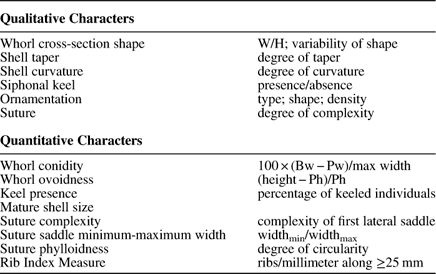
Lacking the numerous shell-shape characters inherent within the planispiral bauplans, description and species differentiation within the orthoconic baculitids has depended on inconsistent application and assessment of a number of morphological characters related to shell shape and ornamentation and the septal suture. Inevitably, baculitid species definition has become based on a few principal characters, including suture complexity, presence or absence of a keel, and/or characteristic ribbing, with others sometimes replacing or supplementing these three (Ward, Reference Ward1978b). The principal morphological characters that have traditionally been used to differentiate baculitid species qualitatively are listed in Table 1, with summary descriptions as follows.
Qualitative and quantitative characters to describe baculitid ammonites
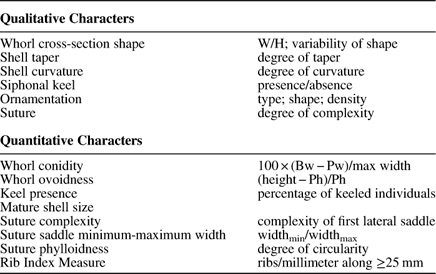
Character names presented on left, brief description on right; see text for details of measurements and equations. Shaded quantitative characters defined but not used in this analysis.
Whorl cross-section shape
The cross-sections of the baculitid conchs (from both body chamber and phragmocone) provide some of the most important shell descriptors for species level identification. These include both the shape of the cross-section at a given diameter, as well as the more complicated but data-rich trajectory of geometric change in the cross-sections through ontogeny. Two methods of describing whorl cross-section shape have been used in the past: the first is the ratio of the cross-section width-to-height (W/H; Fig. 3.3), while the second is a qualitative description of the shape using terms such as compressed, egg-shaped, pear-shaped, or oval, without quantification of these terms. However, use of the width-to-height (W/H) measure without other morphometric data is inadequate, and the absence of anything better has long hindered modern and replicable descriptions of cross-sections. For instance, the same width-to-height measure can characterize a perfect ellipse as well as a shape with a greatly distended base and a narrow upper region. Bookstein and Ward (Reference Bookstein and Ward2012) introduced a novel means of cross-section shape description using a modified Procrustes analysis of the bilaterally symmetrical baculitid outline.
Morphological characters used to describe species of baculitids and used in this study. (1) Characters describing suture shape. The maximum (max) and minimum (min) measures of the first lateral saddle of the suture are shown. (2) Assessment of suture complexity. The total length of run of the first lateral saddle, from a to b along suture, is divided by the width of the saddle, w (after Westermann, Reference Westermann1977). (3) Characters describing whorl cross-section. Ph and Pw are chord measures on the Pointed end of the oval; Bh and Bw are chord measures on the Blunt end of the oval. (4) Characters of ornamentation and calculation of the Rib Index measure.
Shell taper
The shell taper reflects the rate of whorl height increase relative to shell length and is typically measured as an angle in various shell regions.
Shell curvature
Some baculitid species show a pronounced overall curvature of the shell, which has been used as a taxonomic characteristic, for instance in the widely distributed species plexus of B. reduncus Cobban 1977.
Presence/absence of keel
Some specimens of Baculites show the presence of a “keel,” which, when present, is found on the venter and consists of the whorl cross-section having either a distinctive indentation on either side of the venter, or an observable change of shape of the cross-section from convex to concave on either side of the venter. Some species, such as most specimens of B. chicoensis Trask 1856 from the North America Pacific coast, have a keel with associated distinct grooves on either side, and this feature has been used as one of several characters in differentiating not only B. chicoensis from the overlying B. inornatus along the Pacific coast, but also in distinguishing B. scotti Cobban Reference Cobban1958 from the underlying B. gregoryensis Cobban 1951 in the WI (Cobban, Reference Cobban1958). Compared to B. chicoensis, other species, including B. inornatus studied here, show a much less pronounced but still observable keel in a limited number of specimens.
Ornament
Depending on the species, individuals of Baculites can be ornamented or essentially smooth (save for growth lines). Ornament occurs in two places on the shell—as a series of ribs crossing the venter, and/or as a series of larger ribs on the lateral flanks of the shell (Fig. 3.4); other than ornamentation in the dorsolateral position on some species, ribbing in the dorsal region is unknown in Baculites (but see the closely related, but rare Trachybaculites for forms with circumlateral ornamentation: e.g., Klinger and Kennedy, Reference Klinger and Kennedy2001, fig. 190; but even here some forms have quite reduced ribbing across the dorsum). Ribs range from low, wide, and blunt to sharp and narrow; from widely spaced to tightly packed; from nearly straight to highly crescentic. Other kinds of ornament include nodes, tubercles, and/or broad undulations, sometimes in combination, and usually changing during ontogeny. In the past, the traditional method of ornament description has been both qualitative (describing the shape of the rib or variety of tubercle) and quantitative: the number of ornamental units found along a flank distance equal to the shell height for different parts of the shell (Matsumoto, Reference Matsumoto1959; Cobban, Reference Cobban1962a, Reference Cobban1962b; Klinger and Kennedy, Reference Klinger and Kennedy2001), referred to as the Rib Index, although this measure has not been widely or consistently applied.
Suture
The morphology of individual suture elements has been discussed extensively in characterizing baculitid taxa. The typical Baculites suture retains the ancestral lytoceratid pattern of ELUI lobes, with large lateral and umbilical saddles between E and L, and an umbilical saddle, often slightly larger, between the U and I lobes. The minimum width of the lateral lobes just above its first two lateral branches has been used as a taxonomic character (e.g., a feature characteristic of the taxa Baculites gregoryensis and Baculites scotti from the WI; Cobban, Reference Cobban1958). The terminal parts of suture saddles have been characterized qualitatively as either lytoceratid in pattern, with angled edges, or phylloceratid in form, with highly rounded ends (Ward, Reference Ward1978b).
The perceived complexity of the baculitid suture and/or lobe or saddle morphology has also typically been described qualitatively, when the suture pattern has been available (e.g., Meek, Reference Meek1862; Cobban, Reference Cobban1958; Matsumoto, Reference Matsumoto1960; Ward, Reference Ward1978b; Klinger and Kennedy, Reference Klinger and Kennedy2001). Some sutures (especially those of the Santonian species) have been described as “simple,” whereas others as “complex” or “highly complex” (Cobban, Reference Cobban1962a, Reference Cobban1962b). We are not aware of an actual measure of overall suture complexity, such as the Index of Sutural Complexity (Ward, Reference Ward1980), being used in baculitid taxonomic differentiation.
In summary, taxonomic differentiation within the baculitids has thus been largely qualitative and subjective. Because of the geological need for stratal differentiation of species units, the overall scientific theme and goal in the study and identification of baculitids has been an emphasis on species discrimination to the finest degree possible. More often than not, the differentiation of two species is based on the perceived, qualitative difference in a single character—such as one “species” sometimes having a keel, another not. Of the above morphological characters, only the whorl width-to-height ratio, the spacing of ribs, and the taper of the shell have been quantified and used in taxonomy, but comparisons based on even these quantitative characters have been rare, with inadequate documentation on the amount of intra-specific variability inherent in each character. To date, the only quantitative attempt to describe any aspect of baculitid morphology beyond the simple measures of taper or rib frequency has been undertaken by Bookstein and Ward (Reference Bookstein and Ward2012), although even this contribution is limited in application (to whorl cross-section shape description only).
Quantification of morphological characters
To more precisely quantify morphological variations within baculitids for both inter- and intra-specific systematics, we have defined seven quantitatively based characters. These include three independent characters describing whorl shape (using parameters developed previously by Peterson [Reference Petersen1992] to characterize the morphology of bird eggshells, a shape that is fundamentally similar to most Baculites whorl cross-sections), three independent characters describing sutural morphology, and one character describing ornament. These characters are (1) the width-to-height ratio (W/H) of the cross-section, (2) the conidity of the cross-section, (3) the ovoidness of the cross-section, (4) the complexity of the first lateral saddle (and by extension, the entire sutural complexity), (5) the ratio of minimum-to-maximum width of the first lateral saddle, as shown in Figure 3.1, (6) the phylloidness of the median lateral foliole, and (7) the rib index measure. These seven characters are summarized in Table 1 and illustrated in Figure 3, and discussed in more detail below.
Whorl cross-section shape characteristics
Cross-sections of Baculites whorls are usually egg-shaped and we thus turned to the ornithological literature for more precise quantitative character assessments of such shapes. We found the most useful work to be that of Petersen (Reference Petersen1992), who defined a suite of characters to quantitatively model the two-dimensional cross-sections of individual Emperor Geese eggs. Using this system, Petersen was able to recognize different eggs laid by the same individual goose over successive years, and could differentiate the eggs of one goose from those laid by others.
To quantitatively describe the two-dimensional whorl cross-section shape of baculitids, we useed Petersen’s (Reference Petersen1992) characters of conidity and ovoidness. Conidity is calculated as:
 $${\rm 1}00{\times}({\rm Bw}{\,\minus}\,{\rm Pw})/{\rm max}\,{\rm width},$$
where Bw=width at the half-distance from the maximum width line to the blunt end and Pw=width at the half-distance from the maximum width line to the pointed end. Ovoidness is calculated as:
 $$({\rm Height}{\,\minus}\,{\rm Ph})/{\rm Ph},$$
where Ph=height from the maximum width line to the blunt end.
These descriptors are ideal for describing the whorl cross-sections of Baculites specimens. In both goose eggs and Baculites, the parameter ovoidness increases as the measures for top and bottom halves of the cross-section shape diverge; a low value indicates near-symmetry of the top and bottom halves of the cross-section. Conidity increases as a cross-section’s apex radius lowers in value, as the radius of the bottom portion increases, or when the maximum width and the midpoint of the whorl height become increasingly separated. This value also becomes markedly greater when a keel is present.
Presence or absence of keels
We have found no reliable way to quantify the morphology of keels on a single baculitid specimen. However, we have noted that assemblages of species with keels will have members that are keel-free, if sufficient numbers of specimens are observed, and the opposite is true as well. Many assemblages of Baculites species we have observed in various museums (over and above the B. inornatus studied here) often include a small number of “keeled” specimens within a larger population of “unkeeled” fossils. This pattern was also noted by Cobban (Reference Cobban1958) in his original description of the Western Interior species Baculites scotti. It is possible that these variations may reflect sexual dimorphism within the species involved, but we have no data with which to assess this further. We thus use the percentage of keeled individuals as a species-specific trait.
Shell size at maturity
A further quantitative character is the size of the shell when it reaches maturity. Perhaps a third or more of the 159 Baculites species deemed valid by Klinger and Kennedy (Reference Klinger and Kennedy2001)—the closest there is to a global taxonomic atlas of the genus – are significantly smaller in size than the majority of named species. Size can therefore be used as a quantitative character if mature modifications of the conch are present. In species of the modern ectocochliate genera Nautilus and Allonautilus, maturity is marked by septal approximation (a crowding) of the final two and sometimes three septa, which coincides with the final growth of apertural shell. Septal approximation has long been known from ammonoids as well as nautiloids, and it has been assumed to similarly mark the attainment of maturity and the cessation of apertural (and septal) growth. Immature shells do not show this, and because virtually all Baculites specimens are incompletely preserved, fossils with approximated septa are always a subset of any collection. In our collections, we separated out all specimens showing approximation, and took a measure of the maximum whorl height at the last formed, approximated septum. In larger collections of adult shells, this can allow a statistically meaningful measure of the maximum height of the phragmocones at maturity, itself a proxy for maximum adult shell size, which is used as a species-specific character in many different cephalopods.
Suture (septal) morphology
It has long been presumed that ammonoid sutures contain a wealth of morphological characters, but other than the relatively recent and promising GIS methodology (Manship, Reference Manship2004; Yacobucci, 2005; Yacobucci and Manship, Reference Yacobucci and Manship2011), surprisingly little has been produced historically that could add to a quantitative species-level character suite suitable for specific-level differentiation of specimens. Here, we use measures of suture complexity (Ward, Reference Ward1980; Saunders, Reference Saunders1995; Saunders and Work, 1996, Reference Saunders and Work1997) and quantify two characters previously used only qualitatively: the minimum-to-maximum width of the first lateral saddle (Cobban, Reference Cobban1958), and the degree of roundness found in saddle apices (Ward, Reference Ward1978b).
Traditionally, establishing quantitative measures of the suture complexity character is both time consuming (the suture must be reproduced photographically or with a camera lucida, transformed to two dimensions while at the same time minimizing spherical distortion, and then measured) and suffers from the paucity of museum specimens in which the shell layer has been removed sufficiently to expose an entire side from dorsum to venter. Our initial attempt at measuring sutural complexity based on the total length of the suture for a large number of specimens proved difficult for both these reasons.
Fortunately, Westermann (Reference Westermann1977) showed that the complexity of any portion of the suture is directly related to the complexity of the entire suture length, and we have reconfirmed this by comparing the suture complexity of the first lateral saddle to the entire suture (of one side) in one species of Baculites (Fig. 10). Based on these results, we used suture complexity of the first lateral saddle only as a proxy for the complexity of the entire suture (Fig. 3.2).
In addition to suture complexity, we propose two more characters of the suture that can be used to compare different Baculites species. The first is a quantification of Cobban’s (Reference Cobban1958) saddle minimum-to-maximum width character by measuring the minimum saddle width as well as maximum width from photographs. The second is a quantification of Ward’s (Reference Ward1978b) sutural “phylloidness” character (the degree to which the apices of saddles approach circularity). This character is computed using ImageJ on the terminus of a foliole down to its first constriction. The first describes the overall shape of a saddle, while the second, phylloidness, quantifies a character long known to vary more between than within baculitid species, a trait not studied or not present in other ammonoid genera.
Shell ornament
As its name implies, Baculites inornatus is largely without ornament. In a minority of specimens, however, there are weak ribs on the flanks, and for these we here define a new trait that we name the Rib Index Measure (RIM), a quantitative measure similar to that of prior workers as described above, but more accurate. Prior workers defined the Rib Index as the number of ribs divided by the height of the whorl. This is useful for those specimens where the whorl height is exceptionally great, and/or the number of ribs is high. But for specimens of small size with sparse (well-spaced) ornamentation, the taxonomist is required to essentially make estimates based on fractional ribs. Thus, we used a ribs/mm measure that was obtained by dividing the number of ribs occurring along at least a length of 25 mm of body chamber. There are problems here as well if only phragmocones are available for measure, since ribbing decreases in frequency in ever-larger specimens. However, this problem is allayed by using body chambers where growth has ceased because maturity was attained.
In summary, we used five quantitatively based morphological characters to assess morphological variation in baculitid assemblages: (1) the width-to-height ratio of the whorl cross-section (W/H), (2) the ovoidness of the cross-section, (3) the conidity of the cross-section, (4) the ratio of minimum-to-maximum width of the first lateral saddle, and (5) the complexity of the first lateral saddle and, by extension, the entire suture. We also propose two more useful characters, not used in this analysis as we are looking at a single species: (6) the phylloidness of the median lateral foliole, and (7) the Rib Index Measure.
Fossil samples and methods
Target species
We selected the early to middle Campanian Baculites inornatus, one of the most geographically widespread and temporally long-lived baculitid species found in any of the Pacific coast North American Cretaceous basins, for the first use of the quantitative methodology used herein. In addition to its abundance in several stratigraphic sections along the Pacific coast (including but not restricted to the two sampled here), this species has also been recognized in Japan and Sakhalin, Russia (Matsumoto and Obata, Reference Matsumoto and Obata1963), a full ocean away, although, at present, nowhere else in North America other than the Pacific coast.
Baculites inornatus has been described in detail by Matsumoto (Reference Matsumoto1959) and Ward (Reference Ward1978b) as a medium-size Baculites with ornament that ranges from smooth (hence its name) to variants that have weak flank (but not ventral) ribs that are distantly spaced (as much as one shell diameter at any point). Ornament of specimens of B. inornatus is illustrated in Figure 4 and typical whorl cross-sections are shown in Figure 5. The suture is essentially quadrate, with saddles and lobes squared off, and with saddle minimum width as much as 80% of maximum saddle width (Fig. 6). In comparison, the species that precede (Baculites chicoensis) and succeed (B. rex Anderson Reference Anderson1958) Baculites inornatus in the Pacific coast successions both show saddles with far narrower minimum-to-maximum widths. The suture of B. inornatus is also highly phylloid, in contrast to those of both B. chicoensis and B. rex.
Baculites inornatus from Punta San Jose and Sucia Island. (1) UW No. 651423, Punta San Jose. (2) UW No. 651425, Punta San Jose. (3) UW No. 721425, Sucia Island. (4) Specimen UW No. 651779, Punta San Jose, showing ribbing amplitude and shape. Ribbed specimens from Sucia Island show similar spacing. The majority of specimens from both localities exhibit no ornament at all, however.
Whorl cross-section shapes in Baculites inornatus from Punta San Jose, Baja California, demonstrating the range of cross-section variation found in this population. Specimens are all from the body chambers of mature shells as demonstrated by approximated sutures at the end of the phragmocones. Numbers refer to specimen identification numbers; all specimens curated into the collections at the Thomas Burke Museum, University of Washington, Seattle.
Suture patterns of different Baculites species from Punta San Jose, Baja California, Mexico. The two species overlap at the top of the Punta San Jose stratigraphic section. (1) Baculites inornatus, UW No. 722188, 20 mm whorl height. (2) B. rex, 18 mm whorl height. E, L, U, and I indicate sutural elements: E=External lobe; L=Lateral lobe; U=Umbilical lobe; I=Internal lobe. The examples illustrate the appreciable morphological differences in the two species’ sutures. The sutural “min/max” is 0.65 in 1, and 0.2 in 2. The sutural complexity is 6.1 in 1, and 12 in 2.
Fossil samples and age
We analyzed two groups of baculitids that have been assigned previously to Baculites inornatus. Sixty-nine specimens came from Cedar District Formation beds on Sucia and Little Sucia islands, Washington State (chronostratigraphy discussed by Muller and Jeletzky, Reference Muller and Jeletzky1970; Ward, Reference Ward1978a), from where the types of the species originated (Meek, Reference Meek1862, Reference Meek1876), while 167 specimens came from the Rosario Formation at Punta San Jose, Baja California (Filmer and Kirschvink, Reference Filmer and Kirschvink1989). Specimens of B. inornatus from Punta San Jose were also studied by Bookstein and Ward (Reference Bookstein and Ward2012). We refer to the different groups as different populations, recognizing that they are time-averaged assemblages rather than strict biological populations.
The Punta San Jose specimens were all collected from a nearly 90 m-thick measured section, and can be placed with an approximate error of 20 cm within the section, which is water-covered at its base and top. In contrast, the majority of the Sucia islands specimens available to us come from museum collections, as Sucia Island is now a Washington State Park and collecting is prohibited to preserve the rapidly eroding fossils for posterity. The overall stratigraphic range of the species at Sucia islands is about 200 m, and like the Punta San Jose section, the base and top of this section are also covered by water.
The sedimentology of the strata of both the Sucia islands and Punta San Jose localities suggests accumulation in mid- to outer-shelf depositional environments (Ward et al., Reference Ward, Haggart, Mitchell, Kirschvink and Tobin2012) and the ages of both of the baculitid groups are well understood (Fig. 7). Ward et al. (Reference Ward, Haggart, Mitchell, Kirschvink and Tobin2012) used both Sr (SIS dating) and magnetostratigraphy to show that the Punta San Jose locality is younger than the Sucia islands locality; the latter locality contains entirely reversed polarity strata (Chron 33R), while the Punta San Jose locality exhibits only normal polarity strata (Chron 33N). Furthermore, the SIS dating of both localities indicates that the differences in ages could be four to five million years (Fig. 7).
Schematic representations of various Santonian-Maastrichtian Pacific coast North America stratigraphic sections plotted against time and current ammonite zonation for this region (modified after Ward et al., Reference Ward, Haggart, Mitchell, Kirschvink and Tobin2012). Absolute ages after ICS (2013). 87Sr/86Sr ratios from McArthur et al. (Reference McArthur, Kennedy, Chen, Thirlwall and Gale1994, Reference McArthur, Crame and Thirlwall2000); vertical bars adjacent to select stratigraphic columns show approximate strontium value ranges and error for samples from the sections. Absolute ages of BPTS chrons approximate.
Co-occurring, age diagnostic ammonites from the Sucia Island beds include the zonal index fossil Hoplitoplacenticeras vancouverense (Meek 1861), as well as Canadoceras newberryanum (Meek 1857) and Desmophyllites diphylloides (Forbes 1846) (Ward, Reference Ward1978a; Haggart, Reference Haggart1989). Baculites subanceps Haughton 1925 is also found at the very top of the section on Big Sucia Island (authors’ collections). The co-occurring ammonites at the Punta San Jose locality are indicative of a younger age than any of the Sucia Island strata, with large numbers of Didymoceras nebrascense (Meek and Hayden 1856) (a zonal index fossil from the WI) and Baculites rex (a nearly identical homeomorph or conspecific taxon with Baculites gregoryensis) found in the top 20 m of section there (but both co-occurring with B. inornatus to the top of the section; authors’ collections). A single specimen of B. subanceps has also been recovered in this highest zonule.
Measurement methodology
We only used specimens showing no sign of compression and in no case was more than one datum per character taken from any single specimen. Specimens analyzed were all in a size range between 15 and 40 mm (measured by height of whorl at the point of measurement), with the assumption that while whorl shape, ornamentation, and suture characteristics all undergo substantial changes from the hatchling shell to adult (mature) or near-adult size, once specimens reach this size the relative relationships of their morphological features stabilize.
Specimens from both Punta San Jose and Sucia islands had one end sawn off perpendicular to the long axis so as to better expose the cross-section and, where possible, specimens had exterior shell removed locally to expose the suture line. Photographs of cross-sections, ornamentation (if present), and the suture line were taken, enlarged, and then analyzed by computer using the National Institute of Health (NIH) morphometric program ImageJ, as well as by a program written for this project that allowed automated measurements of cross-sections to be completed by computer. We also noted if ribbing and/or a keel were present (presence/absence data) and, if ornament was present, its measurement (ribs/mm). Finally, if sutural approximation was present (a reflection of sexual maturation), the whorl diameter at the position of the last septum was measured and used as a comparative value. Thus, the values obtained for size at maturation represent not the maximum shell size, found at the end of the mature body chamber (which, in fact, is rarely preserved), but the maximum size of the phragmocone.
Controlling for ontogenetic character change
A major problem affecting the use of any morphological characters is that they may change systematically through ontogeny. This is certainly the case for all of the characters used in this study: cross-section shape in baculitids begins as a circle but then becomes more ovate through time; sutural complexity is initially at very low values but then increases rapidly; and measures of ornamentation (not present at all on the hatchling and very young shell) start high but then decrease with increasing whorl-section size. However, it has long been known that ectocochliates do not continue growing throughout ontogeny but reach stable shell shapes, thus it is important to assess the size ranges that can be meaningfully compared on a character-by-character basis. The question thus becomes whether each of these character states continues to change throughout growth, or if they change rapidly up to a certain shell size and then remain constant thereafter; if the former, only very similarly sized species should be compared, which would markedly reduce sample sizes.
To assess this, we measured one of the shell shape characters and one of the sutural characters in a range of newly-hatched to mature shells of the WI species Baculites compressus Say 1821. We selected this taxon because the nature of fossilization in the Pacific coast Upper Cretaceous unfortunately precludes preservation of specimens of B. inornatus less than about 5 mm in whorl height, while specimens between 5 and about 10 mm are invariably distorted; we have confidence that these WI data can be applied for a generalization that is applicable to all baculitids. Results of our analysis are presented below.
Results
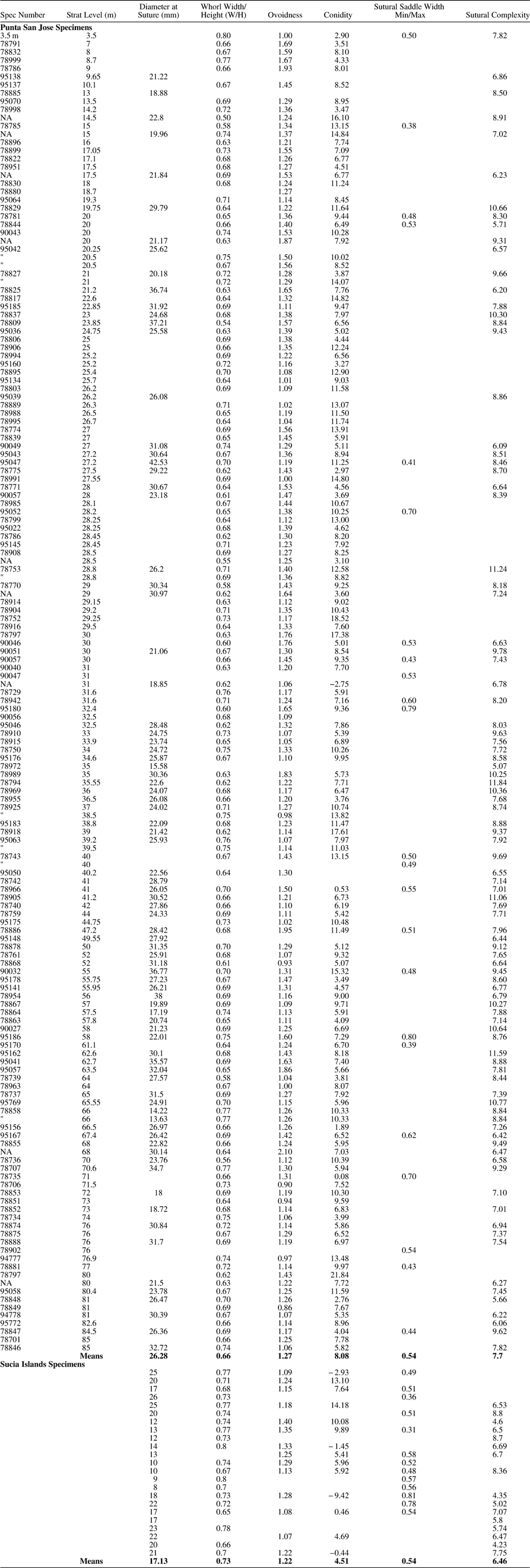
The complete numerical data set of morphological characters for the Sucia islands and Punta San Jose specimens is presented in Appendix 1; these characters include both direct measurements as well as calculated measures (such as the calculations leading to shell shape descriptors and sutural descriptors).
Assessment of ontogenetic character change on specimen characterizations
The results of our analysis of ontogenetic character change in Baculites compressus are shown in Figures 8 and 9. In both shell shape and sutural complexity, the most rapid changes occur at shell diameters between 1 to around 8 mm; after this, these measures slow their rate of increase and become nearly or completely constant above approximately 12–15 mm diameter. Once the larger sizes are reached, values for the various measures stabilize in both whorl cross-section shape (Fig. 8) and sutural complexity (Fig. 9). We have also found that the latter character can be adequately estimated by measuring complexity for just one saddle, rather than the entire suture line (Fig. 10). Because most B. inornatus specimens lack ornament, we cannot produce a graph showing how ornament frequency changes through growth; where we have used rib measures, however, they were obtained from specimens ranging from 20 to 30 mm in whorl height. Based on these findings, it is only necessary to use measures for our various character descriptors from specimens of greater than 20 mm shell height. In no case is more than one character measure per specimen used.
Ontogenetic change of whorl width/height (W/H) measure for specimens of Baculites compressus from the WI, showing rapid change from nearly circular (W/H=1) to whorl width being much lower than height.
Ontogenetic change in sutural complexity through time for specimens of B. compressus.
Comparison of sutural complexity of first lateral saddle, horizontal axis, with sutural complexity for total (ILUE) suture, vertical axis, showing that complexity of a single saddle is sufficient for estimating total sutural complexity.
Comparison of the two populations
A comparison of the distribution of shell shape data in the two populations of Baculites inornatus is shown graphically in Figure 11 and the raw data behind this figure are presented numerically in Appendix 1. Based on these data, it is evident that the two sampled groups show similar degrees of variability in the five characters that we analyzed. Lack of stratigraphic control for the Sucia islands specimens (they were thus assessed as being a single stratigraphic collection) precludes their use in assessing potential changes in individual characters through time; however, the excellent stratigraphic control for the Punta San Jose specimens allowed us to assess such changes in that population through that section, as well as allowing direct comparison with the Sucia islands specimens.
Comparison of (1) ovoidness character and (2) W/H character versus Whorl Height for Baculites inornatus specimens from Punta San Jose (○) and Sucia islands (+). Ellipses show the inclusion of 90% of all specimens of each group.
Although the two populations showed similar ranges of values for all five morphological characters, the most striking differences between them were found at their mean size at maturity, with the Punta San Jose specimens showing approximated septa at around 26 mm shell height (the height of the shell where the approximated sutures are found, rather than the height of the apertures in these specimens, since it is rare to have entire body chambers attached to phragmocone fossils), compared to around 21 mm for the Sucia Island specimens observed with approximated sutures. While this might be an indicator of sexual dimorphism, which has been posited (Klinger and Kennedy, Reference Klinger and Kennedy2001) but never demonstrated quantitatively in Baculites (at least to our knowledge), it seems highly unlikely that populations from two different time intervals would all consist of only one sex or the other. Instead, the most parsimonious explanation is that there was phyletic size increase in the baculitids over the time interval spanning deposition of the two stratigraphic sections.
A third prominent difference in the two baculitid groups is in the number of specimens with keels in each population (Fig. 12.1). Our data do not show a correlation of keel presence with size of individuals. However, whereas keels are present in less than 10% of the specimens from the Sucia islands, the specimens from Punta San Jose show, on average, more keels as a percentage of the population. In fact, this character can be seen to change appreciably when plotted stratigraphically using approximately 10 meter bins (Fig. 12.1), as does the percentage of the population that is ornamented with weak flank ribbing (Fig. 12.2).
Changes in frequency of keeled forms (1) and ornamented forms (2) of B. inornatus through stratigraphic section at Punta San Jose.
In all other measures, however, the two groups are quantitatively similar. The measures of cross-section using W/H and ovoidness through the approximately 90 m of section at the Punta San Jose locality, are shown in Figures 13.1, 2. All other characters show a similar relationship – variable changes through time without directionality. Additionally, the number of specimens that are ribbed and the rib spacing on the shells of the ribbed forms are indistinguishable.
Data for W/H character (1) and ovoidness character (2) plotted through the stratigraphic section at Punta San Jose.
Discussion
We have established a new, relatively simple and easy to use methodology, using multiple quantifiable morphological characters, to describe whorl morphology and suture pattern in Baculites inornatus from the Campanian of the North American Pacific coast region. This methodology provides a more sophisticated approach than qualitative description for characterizing morphological variation in B. inornatus from the Pacific coast region and is applicable to other baculitid specimens as well.
Our methodology adopts the egg-shape descriptors defined by Peterson (Reference Petersen1992) and applies them to the oval shapes of baculitids. Over the last two decades, a variety of other quantitative means of describing irregular ovals, such as those in bivalves – and Baculites – have been employed using Fourier analysis (Crampton and Gale, Reference Crampton and Gale2005), obtained using the “Hangle” program described in Haines and Crampton (Reference Haines and Crampton2000). However, as pointed out to us recently (F. Bookstein, personal communication, 2012), there is no a priori statistical reason why Fourier is superior to the method we use here. Converting a whorl cross-section for Fourier analysis requires many more steps, ranging from digital photography, to figure tracing, to multivariate analysis. We believe that the method used here suffices on theoretical grounds, is equally valid statistically, and, being far faster to measure, is superior on practical grounds.
A ramification of the use of our new method is the direct comparison it allows with the modified Procrustes analyses introduced by Bookstein and Ward (Reference Bookstein and Ward2012). In fact, their analyses of evolutionary change, as shown in their figures 7 and 8, closely mirror the results presented in Figure 13 of this paper. However, the method we advocate here can be done with far fewer measures than the technique of Bookstein and Ward (Reference Bookstein and Ward2012); the scientific community will eventually decide which method is preferable.
In addition to assessing population morphological characteristics and variation, our analysis of specimens derived from specific levels within the 92-m-thick Punta San Jose stratigraphic section provides insights into the nature of evolutionary change through time within baculitids. Although specimens of Baculites inornatus from throughout this single section show variable changes in characters through time, there is no distinct directionality in character change, other than phyletic size increase. As well, the new methodology allows a more sophisticated comparative analysis of baculitid assemblages in different sedimentary basins to be undertaken. Although the specimens from Punta San Jose (Baja California, Mexico) section represent a time period several million years younger than that of the specimens from Sucia islands (Washington, USA), the specimens in both regions are morphologically indistinct and therefore demonstrated to be conspecific.
Our results indicate that, because of its relatively high degree of variability, whorl cross-section shape (including the presence or absence of a keel) cannot be used as a stand-alone character for species identification within Baculites. Furthermore, while the morphology of the ribs or nodes (when present), as well as the various suture characters, can provide valuable contributions to species definition, only through comparing the values taken from multiple characters can accurate species discrimination be obtained.
Our new methodology can also be used as the basis of multivariate Discriminant Function Analysis in future tests of possible species synonymies among currently accepted Baculites species, both within and between sedimentary basins. As an example, we have noted above that a number of taxa morphologically quite similar to Baculites inornatus were present globally during the same time interval that B. inornatus was present along the Pacific coast of North America. The most geographically proximal of these are specimens currently assigned to either two or three different taxa from the Campanian of the WI: Baculites sp. (smooth early form); B. sp. (weak flank ribs); and Baculites sp. (smooth late form) (Fig. 1) (Cobban, Reference Cobban1962a, Reference Cobban1962b; Cobban et al., Reference Cobban, Walaszczyk, Obradovich and McKinney2006). Cobban (Reference Cobban1962a, Reference Cobban1962b) and subsequently Klinger and Kennedy (Reference Klinger and Kennedy2001) have previously suggested that B. sp. (smooth) and B. sp. (weak flank ribs) were endemic to the WI and Gulf Coast regions; indeed, they posited that the majority of Baculites species from the WI were endemics. These workers have also recognized, however, that there was substantial faunal interchange among both planispiral and heteromorphic ammonites of the WI and Indo-Pacific faunal provinces during the Campanian (Kennedy and Cobban, Reference Kennedy and Cobban1999), demonstrating that at least these kinds of ammonites were moving freely between the WI and the Pacific coast at this time. The fact that B. inornatus is found both along the Pacific coast of North America as well as in Japan attests to the ability of this taxon to propagate across great distances, so its presence in the WI should be readily expected. We submit, based on our analysis above, that this is indeed the case and that unrecognized synonymies exist between one or more WI species and B. inornatus.
Indeed, the question also arises as to whether B. inornatus may also have existed in other areas of the globe in addition to the Pacific coast, Japan, and possibly WI regions of North America. For example, specimens virtually identical to B. inornatus are found in South Africa and Chile, assigned to the species Baculites duharti Hünicken 1975 (Klinger and Kennedy, Reference Klinger and Kennedy2001). We can also corroborate the finding of Olivero (Reference Olivero1992) that Baculites inornatus is present in Antarctica, through our own new collections. More recently, Olivero (Reference Olivero2012) reported new collections of baculitids that he refers to B. delvallei Riccardi 1980; these, too, appear to be B. inornatus and equivalent in age to Baculites sp. (smooth late form) in the WI, and B. inornatus from Punta San Jose. We hypothesize that there was a series of global Baculites and Eubaculites species during the Santonian through Maastrichtian, and that a great deal of taxonomic reassessment will be necessary if, as we propose, quantitative measures of Baculites species at similar time intervals around the globe show morphological equivalence. Confirmation of this suggestion must await what we advocate here—the use of rigorous quantitative shell character description followed by robust comparison of such data from different biogeographic provinces.
Our results, and similar data collected from other sites, may also help answer important questions concerning the range of morphological variation present in wide-ranging versus highly endemic species in the fossil record. For example, do species from small biogeographic units, where separation of individual populations is small, show different degrees of morphological variation than species that live(d) in very large biogeographic units? Do speciation events occur more frequently in a smaller or larger province among species that were presumably part of the nekton, and were capable of wide dispersal through drift of hatchlings and even adults? How could faunal isolation, for instance, have taken place in the WI baculitids? Certainly, the data shown in Figure 1, if assumed correct, indicate that isolation did indeed take place, and more frequently than in the far larger North Pacific Province at the same time. While these differences may be the result of quite different biological context in the differing habitats that both of these provinces presented, at the present time it cannot be ruled out that variance in taxonomic differentiation methods provides part of the answer as well.
These intriguing questions will have to await further analysis of global collections. Fortunately, the methodology established in this paper will aid greatly in unraveling the complexities of baculitid systematics and their biogeographic distributions.
Conclusions
Biostratigraphic ranges of Late Cretaceous baculitid ammonites vary greatly between the Western Interior and Pacific coast regions of North America. The former region is characterized by a succession of short-ranging baculitids, many of them apparently endemic, while the latter region is typified by a much smaller number of recognized species with much longer stratigraphic ranges. To assess how morphology varies between all these baculitid species, we have developed a new quantitatively based methodology that is superior to the traditional qualitative descriptions used previously.
We have applied this methodology to the study of different populations of the long-ranging Late Cretaceous ammonite species Baculites inornatus in widely separated sedimentary basins of the Pacific coast of North America and have demonstrated that the different populations of B. inornatus of the Pacific coast, while separated by several thousands of kilometers and several million years in age, are indistinguishable morphologically. As well, variation within the populations of B. inornatus suggests that, except for phyletic size increase, morphological evolutionary change within the species was non-directional.
Quantitative-based analysis of the ammonite genus Baculites is a powerful tool for discriminating morphological change within baculitid populations. Our quantitative methodology is directly applicable to other species of Baculites, and to other members of the family Baculitidae. This tool also has potential for establishing taxonomic similarity or uniqueness of widely-separated baculitid taxa. Baculites inornatus was a long-ranging taxon in the Indo-Pacific province and perhaps extended into the WI and Austral provinces as well, and our analysis suggests that it might be far more widely distributed than currently accepted.
Acknowledgments
We would like to thank Graham Beard of the Qualicum Beach Museum, Qualicum Beach, British Columbia, and the Burke Museum, University of Washington, Seattle, for allowing study of their B. inornatus specimens, the United States National Museum for access to the types of B. inornatus, and the California Institute of Technology for fieldwork assistance in Baja California. This paper was partially funded by NSF OPP 0739432. Geological Survey of Canada Contribution 20130364.
Table of morphological character data for specimens of Baculites inornatus from Punta San Jose, Baja California, Mexico, and Sucia islands, Washington State, USA