How do political decision makers attempt to protect their policies from hostile reviewing institutions? Members of the US Congress must pass legislation in the shadow of presidential vetoes and judicial review. Presidents must work with Congress to generate significant legislative policies, and federal courts must consider the responses of political actors who execute and implement their decisions. Given the nontrivial probability of institutional checks, a central question facing all of these actors is how to protect their decisions from potentially unfavorable review. That is, how can they capture policy gains and simultaneously depress the prospect of review?
We believe that to protect their policy choices, policy makers imbed their decisions with features that make supervisory review more difficult (Tiller and Spiller Reference Tiller and Spiller1999; King Reference King2007). To be sure, such behavior will not completely inoculate their decisions. After all, there are likely to be circumstances under which reviewing actors will incur even severe costs to undo a policy. Nevertheless, by increasing the costs associated with oversight, actors can decrease the likelihood of subsequent unfavorable review (Smith and Tiller Reference Smith and Tiller2002). As such, in a potentially hostile and interdependent political system, policy makers may be able to secure and then preserve policy gains by crafting their decisions in a manner that makes review and reversal less likely.
We apply this theory to the US Supreme Court, analyzing whether justices strategically write opinions in the attempt to circumvent separation of powers constraints. More specifically, we argue that when theoretically constrained by Congress, justices will obfuscate the language of the majority opinion as a means to minimize the likelihood that Congress will pursue retaliatory measures. Increased transaction costs imposed by the Court—from more obfuscated opinions—can decrease the probability that Congress reviews its decisions. This is the case because members of Congress face significant time and resource constraints that force them to consider electoral and transactional opportunity costs. On average, spending resources on imprecise Supreme Court opinions is unlikely to offer the most efficient and productive means to improve their reelection chances. Thus, they will largely avoid those issues. Justices might, therefore, be able to manipulate the language of their opinions to evade a politically hostile Congress. Certainly justices face a trade-off in this context in terms of potential benefits. Opinion language that significantly obfuscates the Court’s decision may impose less constraint on interpreting and implementing actors. Still, however, moving policy even marginally toward their sincere preferences may be worth the necessary complexity.
To examine whether justices strategically obfuscate their opinions to avoid separation of powers (SOP) constraints, we examine the “readability” (Coleman Reference Coleman2001, 489) of over 500 randomly selected Supreme Court majority opinions published between the 1953 and 2009 Court terms. Readability indexes measure the ease with which one may read a document. While they do not directly address the complexity of legal doctrine or the nuances involved with legal writing per se, they do provide a rough estimate of the ease with which members of Congress (and others) can read Court opinions. In other words, we examine judicial obfuscation by focusing on opinion readability—one measure among many that scholars might employ.
Our results suggest that as the Court’s majority coalition in a case becomes increasingly distant ideologically from the relevant pivots in Congress, justices craft more obfuscated (i.e., less readable) opinions—those that require a higher level of sophistication to comprehend. Furthermore, these results are robust to alternative specifications of pivotal legislative actors. To be sure, our readability measure does not fully capture the intricacies involved with legal writing. We believe, therefore, that the results may actually understate the power of the Court to use judicial language strategically. If the general readability measure we employ here uncovers significant results, we have reason to believe that more precise measures might, in the future, discover a larger effect. Overall, then, our findings suggest that justices engage in nuanced strategic behavior when confronted by SOP constraints—findings that we believe may also have implications for other institutional settings and underscore how actors might use language strategically.Footnote 1
Separate Institutions Evading Review
In a constitutional system of separate institutions sharing powers, political actors rarely make decisions free from external political constraints. Instead, other institutions often review and modify their decisions. Congress, for example, passes statutes that courts must interpret. Congressional committees must beware the preferences of their parent chambers, lest they propose legislation that a chamber majority amends to a less favorable outcome. At nearly all times, legislators must address the threat of a presidential veto (Cameron Reference Cameron2000). Not only must executive branch agencies understand the preferences of Congress, the president, and the Court (McCubbins and Schwartz Reference McCubbins1984; Moe Reference Moe1987; Ferejohn and Shipan Reference Ferejohn1990), but they must also operate under legislative frameworks designed specifically to constrain them (McCubbins, Noll, and Weingast Reference McCubbins1987).
Perhaps the central question facing actors in these institutions is how to accomplish their policy goals in the shadow of potential review. While each institution is unique, they all possess some power to engage in what Tiller and Spiller (Reference Tiller and Spiller1999) broadly call “strategic instrumentalism.” For example, Tiller and Spiller show that when faced with judicial scrutiny, agencies will employ high-cost approaches (e.g., adjudication) rather than low-cost approaches (e.g., rule making) in order to make it more difficult for reviewing courts to change their policies. As the preferences of the agency and reviewing court diverge, the agency often makes policy by adjudication rather than broad rule making because it is more costly for reviewing courts to supervise them. King (Reference King2007) provides one empirical test of the general argument, suggesting that the Court is more likely to invoke constitutional grounds to justify a decision when theoretically constrained by Congress. Likewise, Smith and Tiller (Reference Smith and Tiller2002) find that circuit courts review agency decisions with an eye toward obstructing Supreme Court review. That is, circuit judges strategically base their decisions on legal grounds that make Supreme Court review more costly. As the circuit court becomes increasingly distant ideologically from the agency decision, the probability that the circuit court utilizes factual “reasoning process” review (i.e., looking at the facts of cases) rather than statutory interpretation increases concurrent with the threat of Supreme Court review. In a similar vein, Schanzenbach and Tiller (Reference Schanzenbach and Tiller2006) find that judges depart from sentencing guidelines on factual rather than legal grounds to make it costly for reviewing courts to overturn their sentence modifications. While upper court review is not impossible under all these scenarios, it becomes more costly and, therefore, less likely.Footnote 2
In a related line of research, Staton and Vanberg (Reference Staton2008) argue that when courts anticipate that political actors will refuse to comply with their decisions, they will publish more ambiguous opinions. Theorizing the conditions under which judges strategically craft clear or ambiguous opinions, the authors argue that judges make trade-offs when writing opinions. On the one hand, clear opinions are more likely to communicate to external actors what a court wants. At the same time, however, it is easier for the public to detect politicians’ noncompliance with clear opinions. Thus, to prevent themselves from looking ineffectual, courts (especially those with low levels of institutional legitimacy) may need to avoid crafting clear opinions if they believe politicians will refuse to comply with them. Courts thus will be more likely to write ambiguous opinions as the cost to the legislature of overturning court decisions decreases. By masking noncompliance with opinion ambiguity, judges can protect their legitimacy.Footnote 3
Taking our cue from these studies, we suggest that justices use opinion language as an instrument to protect their decisions from hostile legislative actors. Justices are policy-seeking actors who want their opinions to reflect their personal policy preferences. They therefore must predict and anticipate how the political branches will react to their rulings and attempt to protect those rulings from legislative rebuke. Obfuscation in Court opinions can depress the probability of legislative rebuke by deterring Congress from pursuing (costly) review and, thereby, shield the Court’s decisions.
Obfuscating the Court’s opinions by making them less readable may expose some of Congress’s weaknesses, such as members’ scarcity of time and resources and their collective action problems. Congress has finite resources and time. Members, therefore, must make trade-offs in the legislative process—trade-offs that generally lead them to pursue simple measures that produce immediate electoral payoffs. Members of Congress are elected with broad political platforms and general policy goals. But once they arrive in Washington, they find themselves seeking answers to complex questions. Even the simplest problems require information and resources that members may not have. Hall and Deardorff (Reference Hall and Deardorff2006), for example, show that interest groups are necessary for Congress to operate. They provide policy information to otherwise information-starved members, helping to fill the void for a Congress that has neither the policy information to do its job effectively nor the time to collect such information. Likewise, Cox and McCubbins (Reference Cox and McCubbins1993) explain how members must use parties to overcome their collective constraints. While interest groups and party leaders can help members overcome some constraints, they do not always lead them to obtain their goals. Put plainly, Congress has scarce time and resources to accomplish what all 535 members desire.
The significant costs imposed on members to pass legislation often lead them to avoid difficult issues. For example, action in the Senate is often stymied by opportunity costs. Reflecting on these costs, Senate Majority Leader Harry Reid (D-NM) once stated: “There isn’t enough time in the world—the Senate world, at least—to move cloture on every one of these [filibustered issues]” (Wilson and Murray Reference Wilson2010). Similarly, scholars emphasizing the role of party organization in the House have argued that scarce time for floor debate and the need to overcome collective action problems is a persistent problem (Cox and McCubbins Reference Cox2005). Combined with the ubiquitous need to generate benefits for constituents and to claim legislative successes, there is a premium on the time and resources of House members. Furthermore, across both chambers, the shrinking numbers of committee staffers makes it harder for Congress to gain substantive knowledge over matters that require expertise, thus further degrading Congress’s ability and desire to understand effectively and legislate on complex issues. As Lee (2010) explains, “Over the last two decades there has been a decline of committee staffing levels. … A significant share of the new leadership office staff has been dedicated to ‘war room,’ political, and ‘message’ activities rather than to substantive policy expertise” (228). This reduction in staff, coupled with other changes, has made Congress “less serious and substantive as a policymaking institution” (228).Footnote 4 The combination of scarce resources and time, the need to obtain immediate benefits, and collective action problems leaves members little choice but to focus predominately on the simplest legislative issues.
Obfuscated Court opinions can generate heightened review costs and thereby deter congressional responses. To understand complex and obscure Court decisions, Congress must expend additional—and scarce—resources. A member who wishes to alter the Court’s policies or otherwise punish the Court must examine the central logic and tenets of the Court’s opinions and may even need to examine how the opinion compares to others written in the past by the Court. In some cases, the Court’s opinion may be clear. In those cases, members may easily internalize the degree to which they favor the political content of the majority opinion. Yet the Court also has the ability to obfuscate opinions by making them less readable. In those instances, the heightened legislative costs required to address the opinion may increase. By writing a less readable opinion, justices might craft a desired judicial policy while simultaneously deterring a legislative response by making it more difficult for Congress to address it.
To be clear, we are not arguing that Congress can never override obfuscated Supreme Court decisions. There are certainly examples in which Congress reversed such Court decisions (Eskridge Reference Eskridge1991). Rather, we argue that opinion obfuscation affects the costs necessary for Congress to take up the issue and undo the Court’s decisions. By writing such opinions, the Court may dull the edges of their decisions, making the public presentation of the outcome less transparent and therefore more difficult for members to understand, frame, and attack. While Congress can rely on outside groups to learn about the Court’s decisions, those groups must first obtain access to members, no easy task in itself. They also must overcome similar information constraints and then convince a majority of members in each chamber. Simply put, even when interest groups participate, hurdles still arise.
Our own view of a sample of data suggests that members of Congress are, in fact, most likely to attack and undo more readable Court opinions. We examined a random sample of 300 Supreme Court decisions and coded whether Congress later overrode those decisions (or portions of those decisions). The results were telling. The mean readability score of the overridden cases (using the Coleman-Liau Index, as described below) was 9.401. On the other hand, the mean score of the cases that Congress did not override was 9.78 (and for the purposes of this example, higher values indicate an opinion that is more difficult to read—one that would require higher costs to override). A t-test confirms that the difference is statistically significant (p < .057). Similarly, following Eskridge’s (Reference Eskridge1991) work on congressional overrides, we compared the readability scores of Court decisions that Congress examined but never overrode versus those that it did override. Among the 35 cases during the 99th and 100th Congresses that were examined but never overridden, the readability score was 10.26. On the other hand, the clarity score dropped to 9.97 among the 26 cases that Congress overrode during the same time period. This is, of course, a small sample, but even the cursory look is informative. Just as Congress largely avoids complex issues that require relatively more of its legislative time and resources, it appears less likely to override obfuscated Supreme Court opinions.
Of course justices are not likely to achieve their most preferred policy outcomes when they obfuscate the language of their opinions. Such opinions might induce only gradual policy change. Justice Powell’s opinion in Regents of the University of CA v. Bakke, 438 U.S. 265 (1978), for example, shifted policy on affirmative action toward Powell’s preferred position, but it did so slightly and only gradually. The same could be said for Justice O’Connor’s opinion in Grutter v. Bollinger, 539 U.S. 306 (2003). And in Hampton v. Mow Sun Wong, 426 U.S. 88 (1976), the Court had to determine the permissibility of a Civil Service Commission regulation that prevented aliens from the federal civil service. Rather than clearly stating that such a rule was (im)permissible under the Constitution, the Court merely held that “if a class of people were going to be deprived of federal employment, it had to be as a result of a decision by politically accountable officials” and not by unelected bureaucrats (Sunstein Reference Sunstein1997, 47). Policy shifted toward the Court’s preferences, but the language of the opinion limited its reach.
Still, while justices are unlikely to achieve all they desire when obfuscating their opinions, we do not wish to overstate this problem. Certainly, it is likely that an obfuscated opinion is more difficult for other actors such as lower courts to implement, but there is little reason to expect such opinions, for example, to lead to lower court decisions that are worse for the majority justices than the status quo. Put plainly, opinion obfuscation is likely to represent a trade-off between an incremental but nevertheless positive gain for the Court versus no gain at all (either through an override or because the Court refuses to hear a case). Obfuscation thus may allow the Court to push an idea in the face of political resistance.
SOP Opinion Obfuscation Hypothesis. A Court majority will craft an obfuscated (i.e., less readable) opinion when it is theoretically constrained by, and becomes increasingly distant ideologically from, pivotal legislative actors.
Data and Measures
To test our theory that the Supreme Court obfuscates by crafting less readable majority opinions when confronted by an ideologically hostile Congress, we drew a random sample of 529 orally argued cases from the 1953 to 2008 Court terms.Footnote 5 We downloaded the majority opinion from each of these cases into a text-searchable format and then, as we explain below, measured their readability.
To measure the amount of obfuscation in a majority opinion—our dependent variable—we estimate the readability of the Court’s majority opinion in each case. We rely on the Coleman-Liau Index (CLI), one type of readability measure.Footnote 6 Before we explain the Coleman-Liau measure specifically, we think it is necessary to elaborate on the importance and capabilities of readability measures more generally.
Readability scores have a long empirical history and were originally developed by reading specialists and scholars in the education field to define the appropriate reading level for educational books.Footnote 7 Readability indexes measure the degree of difficulty inherent in reading and understanding a written text (DuBay 2004). They provide “quantitative, objective estimates of the difficulty of reading selected prose” (Coleman 2001, 489). “Generally speaking, the readability score should provide a reasonable estimate of the actual difficulty of comprehending examined prose” (Coleman 2001, n. 17). As applied here, the readability score offers a quantifiable measure of the difficulty that one is likely to encounter when reading the Court’s opinion. Our conjecture, again, is that as the Court’s opinion becomes more difficult for members of Congress to read, they will be less likely to address the opinion.
We are not alone in employing readability measures. A host of recent empirical legal studies have employed readability scores. Consider, for example, Law and Zaring (Reference Law2010), who use readability measures to estimate the complexity of federal statutes. They find that the Supreme Court is 18% more likely to refer to legislative history when interpreting less readable statutes. Along the same lines, Coleman and Phung (Reference Coleman2010, 103) examine the readability of over 9,000 party briefs spanning over three decades of Supreme Court decisions and find a “gradual historical trend towards plainer legal writing,” suggesting that the focus of plain legal English writing has become increasingly widespread. Similarly, Coleman (Reference Coleman2001) uses readability scores to compare the writings of Justice Cardozo and Lord Denning with their contemporaries, and he finds “strong empirical support for the widely held claim that Cardozo and Denning’s judicial opinions are written in a style that is comparatively plain and clear” (491).
Scholars have applied readability measures in other settings as well. Bligh, Kohles, and Meindl (Reference Bligh, Kohles and Meindl2004) examine the content of President Bush’s pre- and post-9/11 speeches to compare how he spoke to the American people. Hart (Reference Hart1984) uses readability scores to find that, on average, presidents spoke more plainly than corporate executives, social activists, political campaigners, and religious leaders, but that modern presidents use more complex language than their predecessors. Converse (Reference Converse1976) uses readability scores to examine the complexity of polling questions.
To be sure, readability measures do not capture the complexity of specific legal rules. They do not, for example, measure whether the Court clarified a particular area of law or made a legal test more difficult to apply. Nor do the measures focus specifically on legal language—language that is complex in its own right. Rather, the readability scores are much more modest—they point to the general difficulty of reading a text. Does this generality undercut our approach? We think not. Indeed, there are benefits of employing readability measures in this context. First, they are objective, quantifiable, and reliable. Second, the generality of the measure would seem to cut against the results we find. That is, if we find the Court’s opinions are, in general, less readable during separation of powers constraints, it is easy to believe that a more refined measure that focuses specifically on legal text would uncover stronger results. Thus, while we certainly recognize the limitations inherent in our readability measures as proxies for opinion obfuscation, we nevertheless believe that they are sufficiently useful to enable a meaningful empirical analysis to proceed.
Having established the usefulness of readability measures for examining legal texts, we examine our measure more closely. To reiterate, we use the Coleman-Liau Index. The formula for the Coleman-Liau Readability Index (CLI) is

As the formula shows, the Coleman-Liau Index is a composite of the length of words, which is measured by the number of characters, the number of words, and the number of sentences within a text. The two ratios and their placement in the formula are primarily responsible for determining the CLI values. Specifically, the formula will treat a text as more difficult to read (e.g., produce higher values) when a text contains “bigger” words (e.g., words with more characters) compared to smaller words. Likewise, “long” sentences with a large proportion of words are treated as more difficult to read than “shorter” sentences. In other words, the index does not automatically rate a text as more difficult if it only includes more words. Additionally, the formula does not automatically rate a text as more difficult if it simply has more sentences, only if it has longer sentences. In our sample, the mean CLI is 9.68 (with a standard deviation of 1.29).
To illustrate the face validity of our measure, we highlight a few texts. Consider, first, the commonly said Lord’s Prayer. With a CLI score of 4.33, its text is readable, and the words are easily understandable even among the least sophisticated thinkers. Looking more specifically at Court opinions, consider Washington v. Recuenco, 548 U.S. 212 (2006)—a sentencing case where a trial judge applied a 3-year enhancement to Recuenco’s conviction based on something the jury did not find. The trial judge’s decision violated the Blakely precedent, which essentially held that sentencing enhancements must be found by a jury, not a judge. Thus, the Court examined a relatively simple question—whether violating the Blakely rule was “legally harmless.” Justice Thomas’s majority opinion was very readable. It was just over 3,000 words long, with 400 sentences and roughly 7.5 words per sentence. Compared to other opinions (see below), his was a model of readability, yielding a CLI score of 6.2.Footnote 8 Consider, further, Elk Grove Unified School District v. Newdow, 542 U.S. 1 (2004), the famous case that examined the “under God” phrase in the Pledge of Allegiance. In a straightforward opinion, the Court dismissed Newdow’s claim because he lacked standing. The CLI score for that opinion was 8.08—well below the mean in our sample.
On the other hand, consider the Declaration of Independence. Not a particularly easy document to read, it has a CLI score of 12.48, meaning that a reader must be a relatively sophisticated thinker to understand its text. Again, looking more specifically at Court opinions, we highlight Lucus v. Forty-Fourth General Assembly of Colorado, 377 U.S. 713 (1964)—an equal protection case that challenged a state apportionment plan that would permit one house in the Colorado General Assembly to be apportioned on factors other than population. Chief Justice Warren’s opinion was not easy to understand. It used 8,372 words and averaged just under 16 words per sentence. For example, consider the following: “While a court sitting as a court of equity might be justified in temporarily refraining from the issuance of injunctive relief in an apportionment case in order to allow for resort to an available political remedy, such as initiative and referendum, individual constitutional rights cannot be deprived, or denied judicial effectuation, because of the existence of a nonjudicial remedy through which relief against the alleged malapportionment, which the individual voters seek, might be achieved” (377 U.S. at 736). The opinion, not surprisingly, received a CLI score of 13.28, a score that suggests it was difficult to read.Footnote 9
Independent Variables
Our central claim is that justices will pen less readable opinions to protect the Court from congressional rebuke. Of course, justices need not always worry about the preferences of Congress. The effect is conditional on the ideological relationship between the Court and pivotal members of Congress. When the Court is more liberal or conservative than pivotal legislators, justices might alter their behavior to avoid an override or some form of punitive response (see, e.g., Epstein, Segal, and Victor Reference Epstein and Segal2002; Clark Reference Clark2009; Owens Reference Owens2010; Segal, Westerland, and Lindquist Reference Segal2011). To measure the institutional (in)congruence between the Court and Congress, we examine the ideological distance between pivotal actors in each of these branches.
First, looking at the Supreme Court, we follow the lead of recent research by Clark and Lauderdale (Reference Clark2010) and Carrubba et al. (Reference Carrubba and Martin2012) and argue that the ideological location of the majority opinion is best defined by the ideological position of the median justice in the majority coalition. Specifically, Clark and Lauderdale (Reference Clark2010 examine two areas of the law—search and seizure and freedom of religion—and find evidence that best supports the median of the majority coalition as the pivotal Court actor. In addition, Carrubba et al. (Reference Carrubba and Martin2012) show results that the ideological distance to the median of the majority coalition provides the best empirical fit when taking into account separate concurring opinion writing.Footnote 10
The task of identifying the pivotal actor in Congress is more difficult (Owens Reference Owens2010). The congressional literature presents four competing models of legislative decision making, identifying different members of Congress as pivotal to policy outcomes. First, proponents of the chamber median model contend that policy outcomes generally reflect the ideological preferences of the median legislators in the House and the Senate (Riker Reference Riker1962; Krehbiel Reference Krehbiel1995). A second model—the committee gatekeeping model—emphasizes the importance of legislative committees and their gatekeeping role that can either preserve the status quo or endorse legislative change (Smith Reference Smith1989). Proponents of the party gatekeeping model argue that the majority party will control the floor calendar and exercise agenda control such that only policies favorable to the majority party’s “brand name” will achieve successful passage (Cox and McCubbins Reference Cox2005). Finally, the filibuster pivot model specifies that the existence of the filibuster rule in the Senate acts as a significant obstacle in the legislative process, such that policies require the consent of the 60 senators necessary to invoke cloture (and stop the endless debate; Krehbiel Reference Krehbiel1998).
Accordingly, we construct four variations of our primary independent variable. We compute the absolute value of the ideological distance between the Court (using the ideal point of the median of the majority coalition in each case) and each corresponding pivotal actor in Congress when the Court majority is theoretically constrained; zero otherwise. When choosing between either the House or the Senate to reflect legislative preferences in the chamber median, committee gatekeeping, and party gatekeeping models, we use the actor that is most ideologically proximate to the Court. We use the Judicial Common Space scores to identify the ideological position of each important institutional actor (Poole and Rosenthal Reference Poole1997; Epstein et al. Reference Epstein, Martin and Segal2007). The four variables are distance to filibuster pivot, distance to chamber median pivot, distance to judiciary committee median, and distance to majority party median.Footnote 11
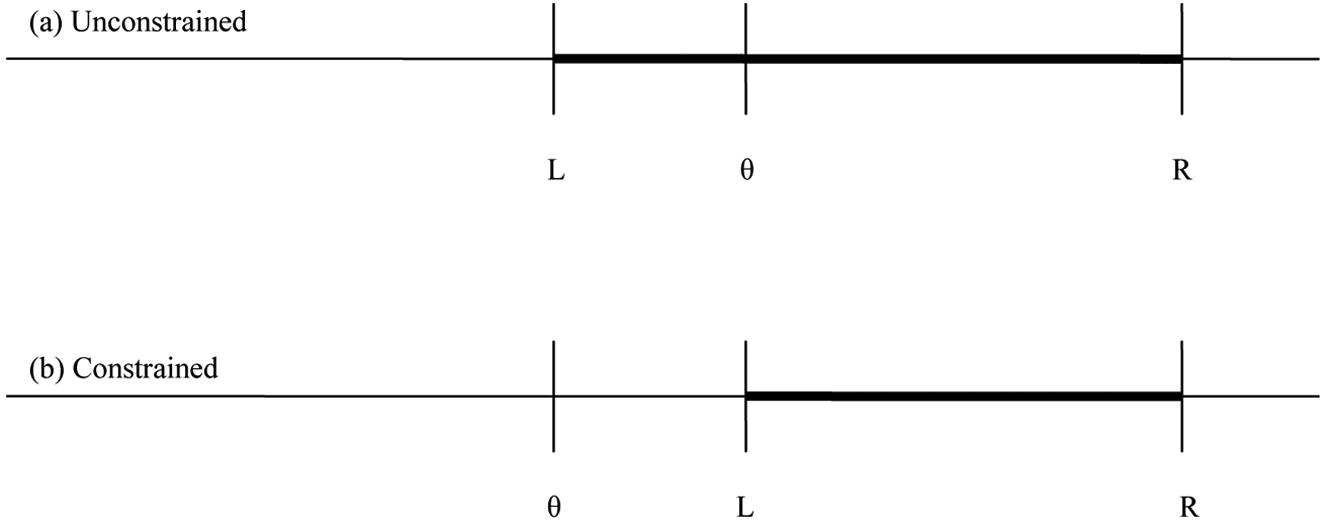
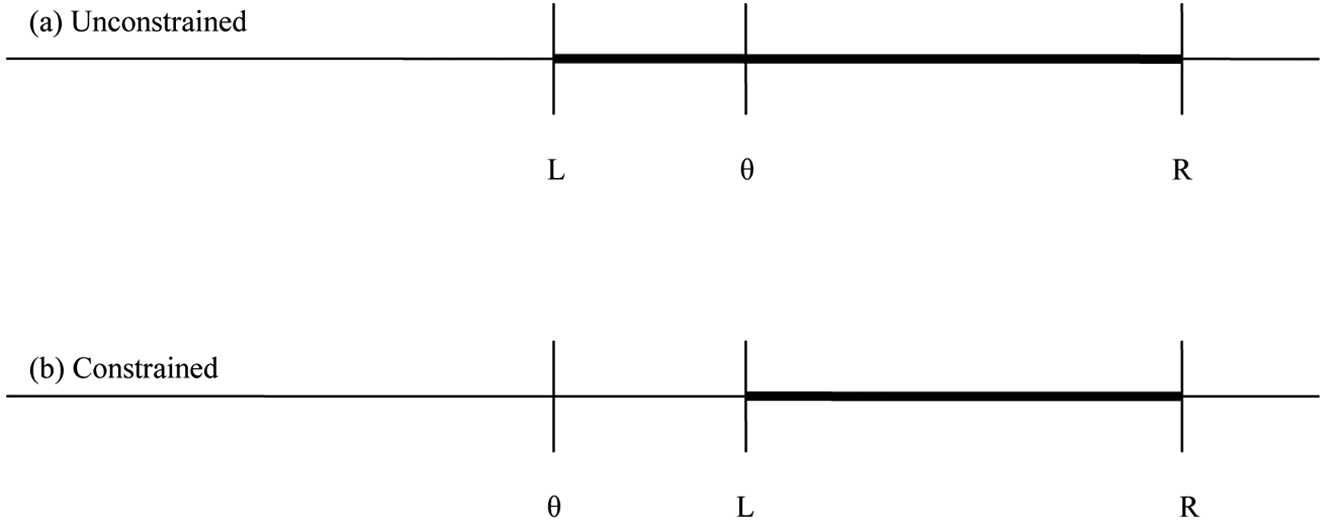
Figure 1 illustrates the conditions under which the Court is theoretically constrained.Footnote 12 The location of θ represents the Supreme Court majority’s sincere policy desire in a case while L is the left-most legislative pivot and R is the right-most legislative pivot. In figure 1(a), the Court majority’s sincere policy preference (θ) falls between the left and right legislative pivots. Thus, because there is no policy that both pivots prefer to the Court’s outcome, the majority need not worry about an override or punitive action—and thus will not need to obfuscate its opinions. The Court here is unconstrained. Anytime θ falls between L and R, the value for distance to pivot equals zero. Figure 1(b) represents a constrained Court, with the Court majority’s sincere policy preference outside the legislative equilibrium—it is more liberal than the legislative pivots. Here, the Court will obfuscate its opinion to decrease the odds of an override or some other punitive legislative response. In such a setting, the distance to pivot equals the absolute value of the distance between the Judicial Common Space score (Epstein et al. 2007) of the median justice in the majority and the closest legislative pivot. We expect that as this distance increases, the majority opinion will become less readable.
Spatial configurations of the Court’s policy decision (θ), the left-most legislative pivot (L), and the right-most legislative pivot (R). Court policies within (L, R) are unconstrained while policies outside are constrained.
Control Variables
We account for other factors that also could affect the readability of a majority opinion.Footnote 13 First, we control for instances where the Court reviewed a case to resolve conflict among the lower federal courts. When lower courts disagree on the proper interpretation of federal law, the Court is expected to resolve that conflict (Black and Owens 2009). As such, we might expect justices to craft more readable opinions in cases that purport to resolve lower court conflict. If the Court opinion notes that justices granted review to the case to clear up conflict, we code lower court conflict as one; zero otherwise.Footnote 14 We also control for the complexity of the case, as opinions in more complex cases might be less readable. Collins (2008) argues that increasing amicus curiae briefs adds a layer of complexity to a case. As a result, case complexity measures the number of amicus curiae briefs filed in the case.Footnote 15
Justices may craft more readable opinions when articulating legal rules that alter the Court’s own precedents or strike federal laws. Thus, precedent alteration takes on a value of one if the Supreme Court Database codes the majority opinion as having altered precedent; zero otherwise. We code judicial review as one if the majority opinion struck down a federal statute; zero otherwise. We also control for the ideological heterogeneity of the majority coalition in a case, as more ideologically disparate coalitions are likely to produce less readable opinions (see generally Owens and Wedeking Reference Owens2011; Owens and Simon Reference Owens and Simon2012). Coalition heterogeneity represents the standard deviation of the Martin-Quinn scores of the justices in the majority opinion coalition in the case (Martin and Quinn Reference Martin and Quinn2002). Finally, since the readability of a majority opinion might be systematically related to the identity of the author and the primary issue area involved in each case, we include fixed effects for the individual justice that crafts the majority opinion and the case’s primary issue area.Footnote 16
Results
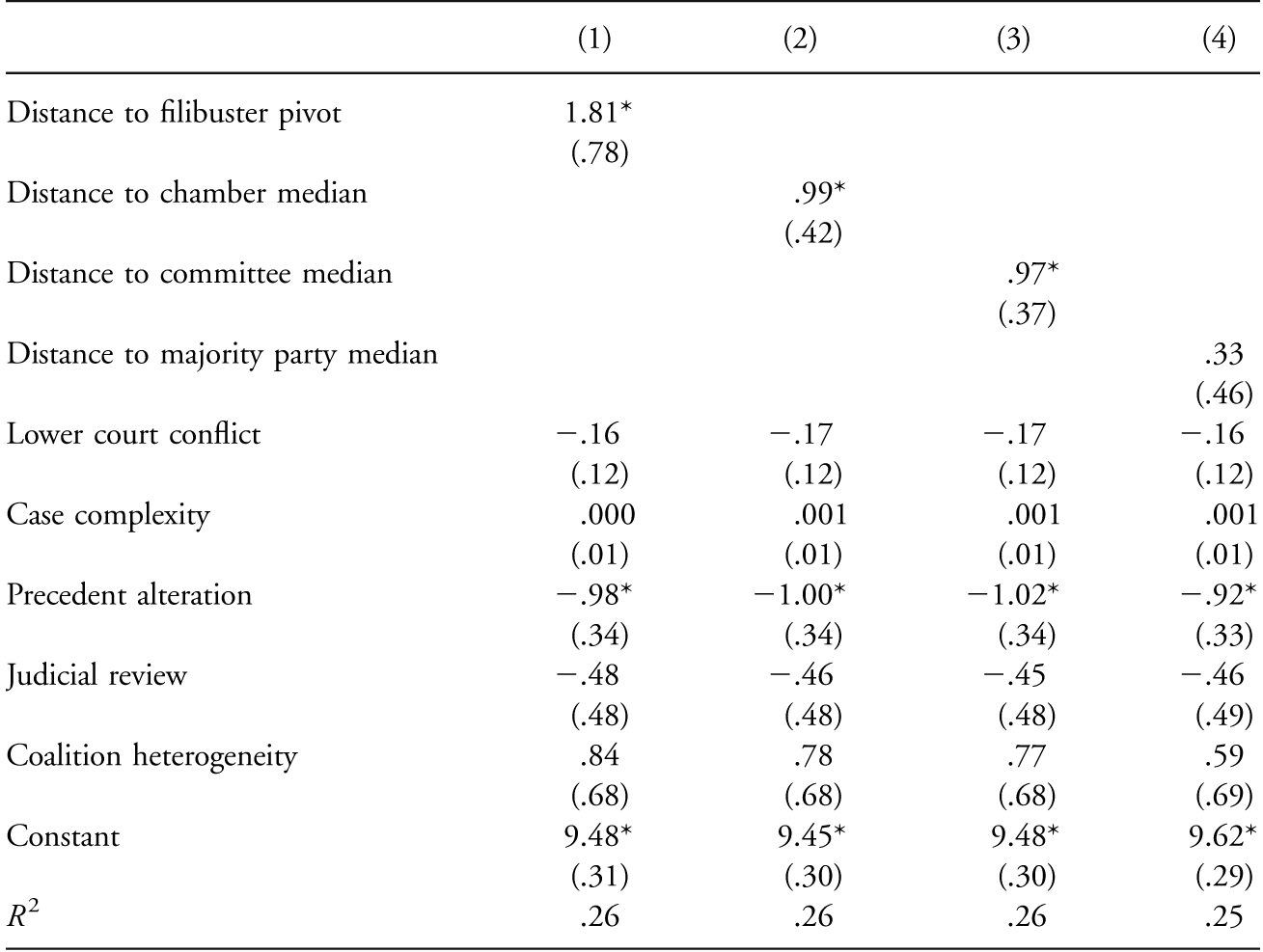
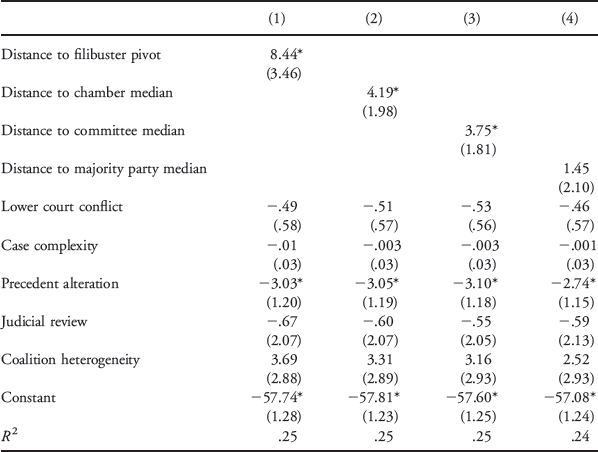
Because our dependent variable is measured on a continuous scale, we estimate ordinary least squares regression models. Additionally, we estimate robust standard errors, clustered on each Supreme Court term, to account for the possibility of correlated errors within each term. Table 1 reports these regression results predicting the readability of Court opinions. The four models represent the same test of our theory, but each specifies a different measure of the critical congressional pivot.
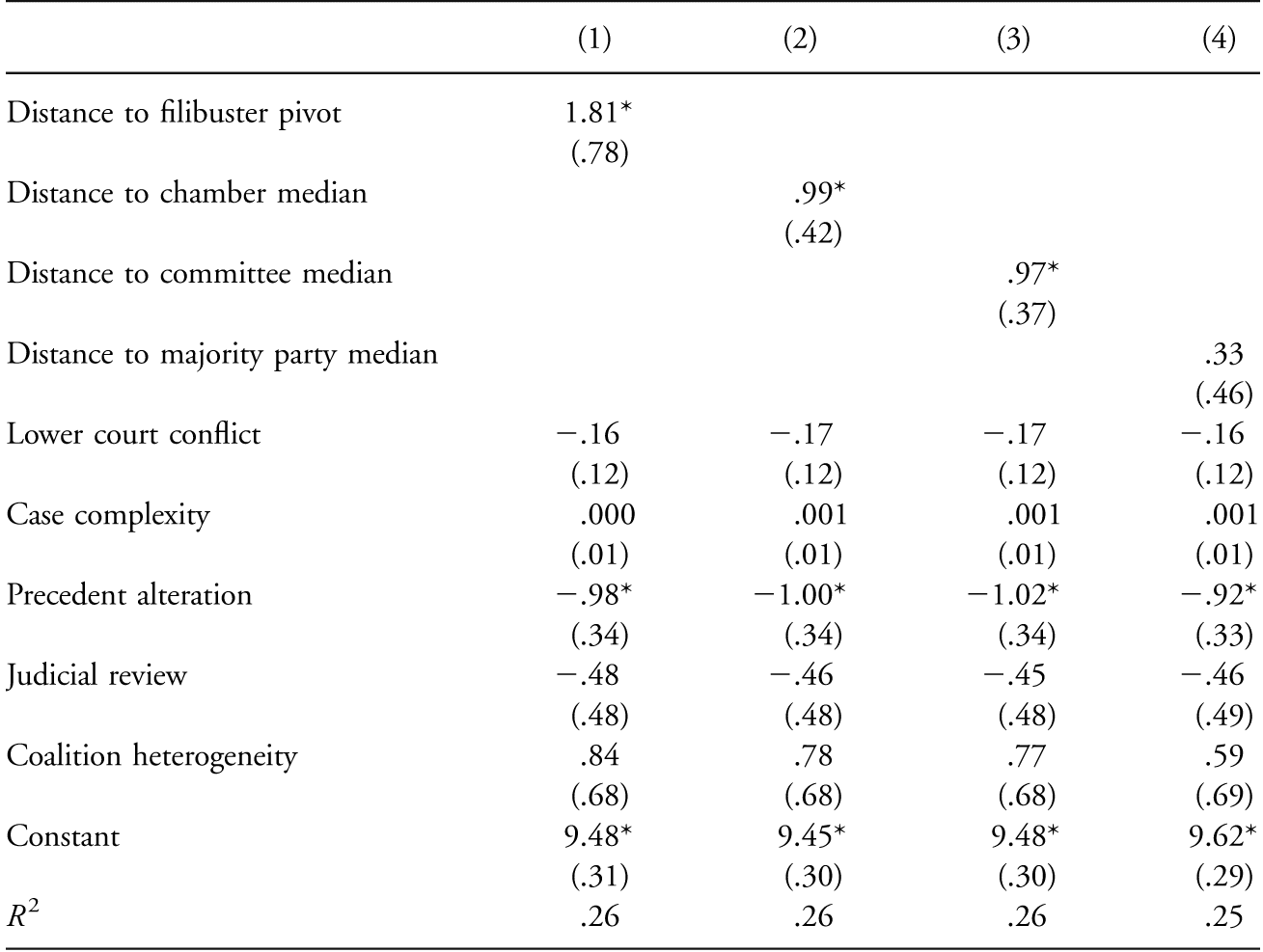
Note N = 529. Table entries are ordinary least squares coefficients. Robust standard errors, clustered on each Supreme Court term, are in parentheses. All models include fixed effects for the majority opinion’s author and primary issue area (not shown). The dependent variable represents the readability of a Supreme Court majority opinion, where higher values reflect more obfuscation (i.e., less readable opinion).
* p < .05, one-tailed.
The data show that the Court’s opinions become less readable when justices face an increasingly distant Congress. Each of the first three models shows strong support for our hypothesis, namely, that as the ideological distance between Congress and the Court increases, the Court’s opinions become more difficult to read.Footnote 17 Stated differently, as Congress and the Court become less ideologically compatible (and Congress presents a theoretical institutional constraint on the justices), the Court’s majority opinion author writes opinions at a more sophisticated level. Even the most stringent Congressional pivot test (distance to filibuster pivot) is statistically significant. Furthermore, the results are generally robust, as only the distance to majority party median model does not reach statistical significance. While this does present a limitation to our findings, the results are robust to three of the four measurement strategies most prevalent in the congressional literature. Furthermore, the Bayesian Information Criterion (BIC) associated with the party median model is substantially higher compared to the other model specifications, meaning that the other models are preferred to it.Footnote 18
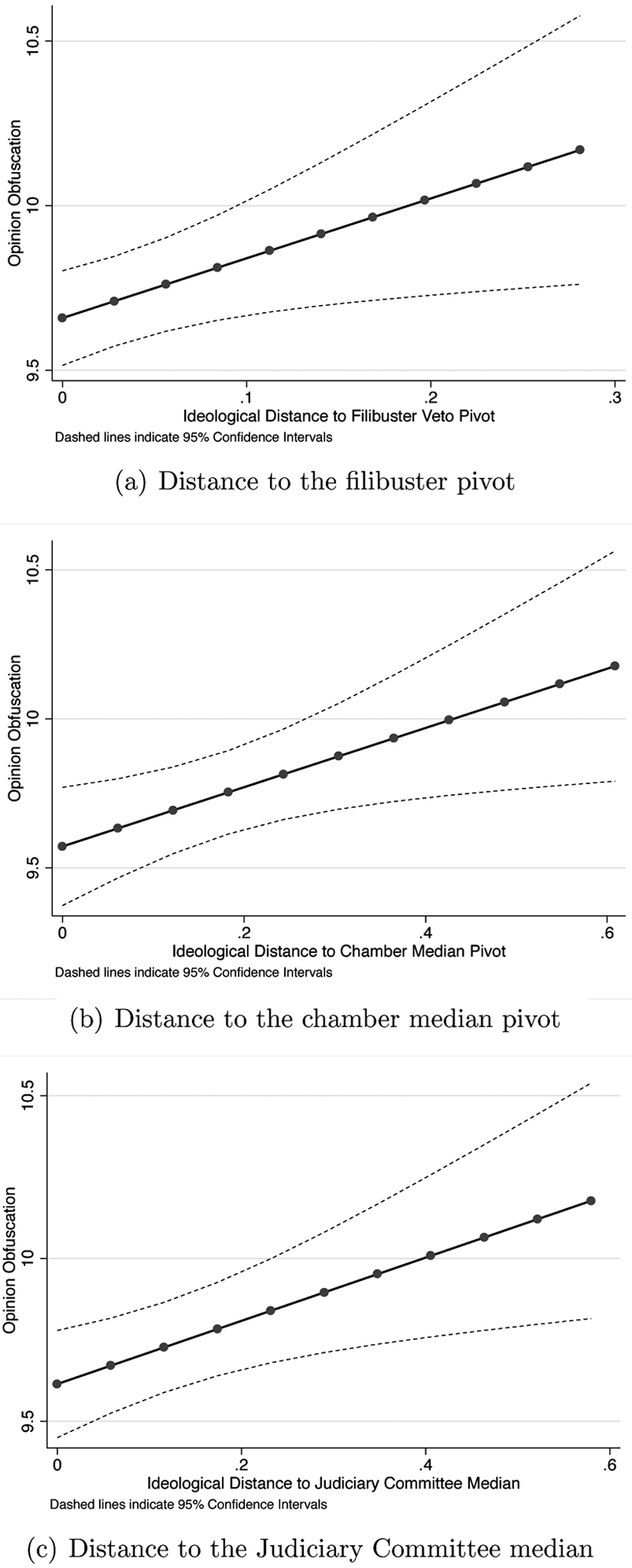
Figure 2(a) displays the predicted change in the readability of the Court’s opinion across the observed range of the ideological distance from the Court majority to filibuster veto pivot. As the distance between the Court and the filibuster veto pivot increases, opinions become less readable. That is, the figure provides an estimate of how much the Court, on average, obfuscates its opinions based on changes in the ideological distance between it and Congress. While the data exhibit a generally modest effect, the Court majority does tend to increase the difficulty of its opinions across the observed range of the Court-Congress ideological distance, and it does so in a meaningful way. The figures for the other two significant pivots, the distance to chamber median pivot and the distance to judiciary committee median, illustrate substantively similar results. Figure 2(b) and figure 2(c) display the predicted impact of ideological distance using the chamber median and judiciary committee pivots, respectively, on opinion obfuscation. Each of these two alternative specifications also demonstrate how the expected degree of opinion readability shifts across the observed range of ideological distance.
Predicted change in opinion readability based on the ideological distance between Congress and the Supreme Court majority. Estimates generated from table 1 using Long and Freese’s (2006) SPOST commands.
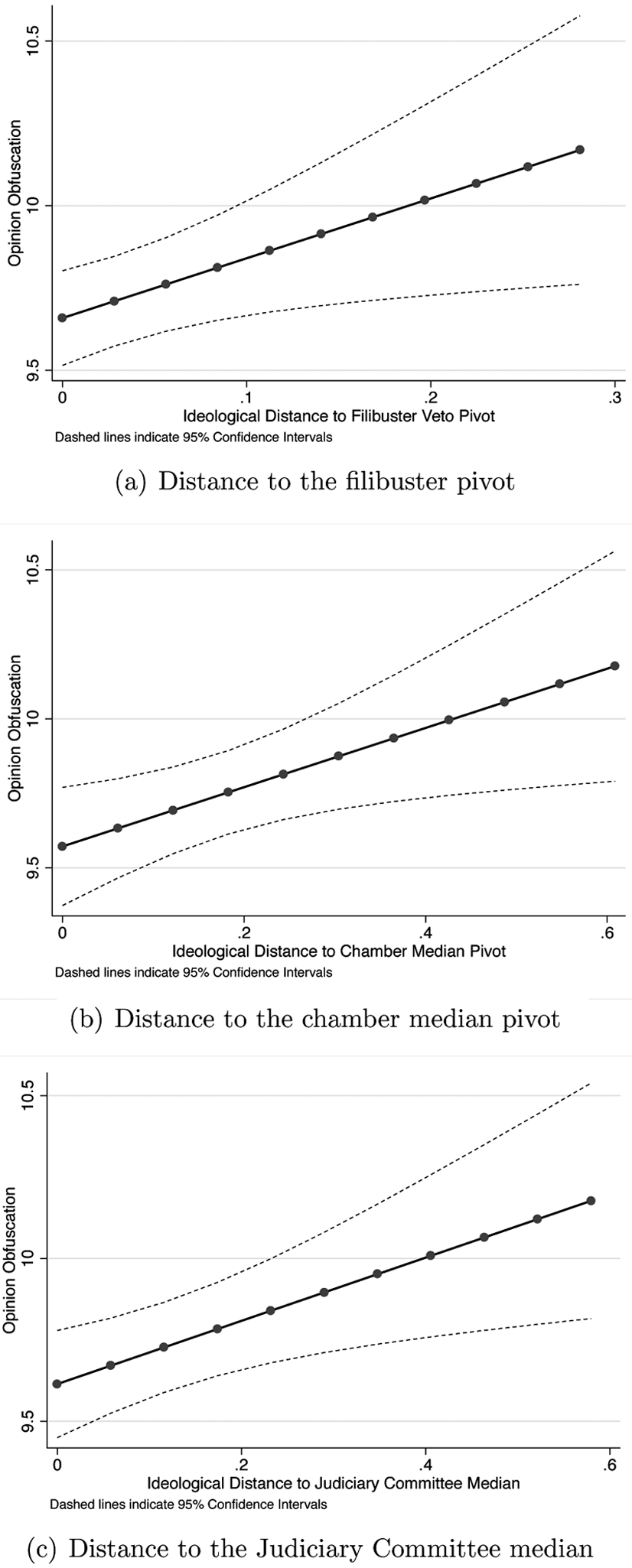
That the average readability of the Court’s opinions increases from 9.7 to 10.2 due to the SOP constraint may not appear to be severe. Nevertheless, the shift is detectable and, as we argue, substantively meaningful. For example, consider the readability of two affirmative action opinions: Regents of the University of California v. Bakke, 438 U.S. 265 (1978) and Grutter v. Bollinger, 539 U.S. 306 (2003). The readability difference between the two opinions is nearly identical to the differences displayed in figure 2(a). Bakke received a CL score of 10.74, while Grutter received a score of 10.2. To many observers, the Court’s exposition in Grutter was clearer than in Bakke.
To underscore further that a readability shift of 0.5 is detectable, we took an excerpt from Justice Brennan’s concurring opinion in Bakke and modified it. Brennan originally wrote: “A state government may adopt race-conscious programs if the purpose of such programs is to remove the disparate racial impact its actions might otherwise have and if there is reason to believe that the disparate impact is itself the product of past discrimination, whether its own or that of society at large.” We then modified the language of this excerpt to make it 0.5 units clearer. Our modified excerpt reads: “A state may adopt a race-conscious program under two conditions. First, it may adopt such a program if the purpose of the program is to remove the disparate racial impact its actions might otherwise have. Second, it may adopt such a program if it believes the disparate impact itself is the product of past discrimination. Past discrimination includes discrimination created by the state or by society.”
The shift in language is noticeable, with the second excerpt offering a more direct explanation that is easier to read and internalize. This is the same type of readability change we observe as a result of the SOP constraint. Thus, while a 0.5 unit change in readability is generally modest, it is nevertheless noteworthy.
One additional way to assess whether these readability differences are meaningful is to identify situations when the Court wants Congress to read its opinions and follow up with legislation. For example, Hausegger and Baum (1999) examine the conditions under which the Court invites Congress to overturn its decisions. The uniqueness of this situation is that justices explicitly invited Congress in the text of the majority opinion to pass judgment on its decision and possibly override it. Hausegger and Baum (1999) identify 27 majority opinions, from 1986 to 1990, that contained either very strong or moderately strong invitations. These “invitations” are situations where we expect the Court not to obfuscate since it explicitly articulated the desire for some subsequent action by Congress. Consistent with our expectations, the average CLI score of these opinions is 9.51, which is lower than the sample mean and roughly equivalent to the lower range of the average expected level of readability generated by the SOP distance predictors.
As for our control variables, precedent alteration is statistically significant and negatively signed. In particular, the data suggest that opinions altering precedent observe a CLI value of 8.76 compared to an average value of 9.74 among opinions that do not alter precedent.Footnote 19 This suggests, consistent with Hansford and Spriggs (2006), that when the majority opinion alters precedent, the opinion writer attempts to explain the deviation by writing a more readable opinion. The statistical models also exhibit statistically significant differences across some issue areas (not shown), as the average expected value on the readability scale is 10.25 among First Amendment cases, 10.31 for cases involving unions, and 9.89 among civil rights issues.Footnote 20 Overall, these results provide further context to suggest that the predicted effect of the SOP constraint represents a meaningful impact, as it exhibits an effect equal to, or greater than, the expected differences across issue areas and more than half the impact of a precedent-altering opinion. None of the other control variables exhibit statistically significant effects.Footnote 21
Conclusion
A vast literature portrays the Supreme Court as an institution that is influenced by various external constraints in the American political system (e.g., Clark Reference Clark2009; Casillas, Enns, and Wohlfarth Reference Casillas, Enns and Wohlfarth2011; Black and Owens Reference Black2012). In this article, we set out to examine a novel and more nuanced way that the Supreme Court might strategically anticipate its political environment. We looked at whether justices obfuscate language in majority opinions as a means to increase the costs of congressional review and thereby decrease the likelihood that such review will occur.
The results show that actors who face supervisory review can engage in strategic behavior to protect their decisions. Importantly, and consistent with the intuition of Staton and Vanberg (Reference Staton2008) and others (Tiller and Spiller Reference Tiller and Spiller1999; Smith and Tiller Reference Smith and Tiller2002; King Reference King2007), we show that Supreme Court justices have a powerful tool at their disposal to evade legislative review—namely, the ability to manipulate the readability of their opinions. At the same time, these findings highlight that the Supreme Court is influenced by the separation of powers and that existing studies that find to the contrary have simply been unable to detect this nuanced behavior. Most existing studies—which largely have found no SOP effects—examine whether external threats force justices to change their votes (see, e.g., Segal Reference Segal1997; Sala and Spriggs Reference Sala2004; Owens Reference Owens2010, Reference Owens2011) or refrain from striking congressional laws (see, e.g., Segal et al. Reference Segal2011). Our findings suggest that the separation of powers forces justices to engage in much more intricate strategic behavior. Rather than changing their votes, justices might vote sincerely but attempt to protect those decisions through the words they use in their opinions.
This is not to say that supervisory review is absent. Opinion obfuscation does not completely prevent congressional review. Nevertheless, if congressional review becomes more difficult and time consuming, justices may be able to preserve policy gains even in the face of an ideologically hostile Congress. To be sure, some of these gains may be limited because justices must revert to obfuscation, but, for the Court, even a marginal policy gain may be better than none at all. Thus, the Court might effectively circumvent its primary institutional check in the American separation of powers system by manipulating opinion language.
Future scholarship should look into a host of topics that extend beyond the scope of this article. First, scholars might consider devising more specific measures of legal clarity. We recognize the limitations inherent in our measurement of readability, with scores that apply to sentence structure and general textual elements. The measure does not—and cannot—focus specifically on legal text or legal concepts. Nevertheless, that we find a SOP effect even with this general measure suggests that scholars should develop more sophisticated measures of legal clarity. Scholars might also consider evaluating the cost-benefit analysis justices face when writing their opinions. After all, justices are likely to write less readable opinions when the benefits of doing so outweigh the costs. Measuring the costs of writing opinions would be useful for a number of studies on the Court. Future scholarship might also examine how opinion readability influences the treatment of Supreme Court precedent by lower court judges and future Supreme Court justices.
The results of this study also hold implications for other institutional actors in American politics. Scholars might apply our general approach, for example, to examine how federal bureaucrats pursue their policy goals when constrained by executive superiors or by Congress. Given the numerous political constraints that federal agencies regularly face, bureaucrats might be able to manipulate the language of rules and regulations to circumvent negative scrutiny from Congress and the president. Likewise, international institutions in different political systems throughout the world that confront broader auditing constraints may also protect their decisions by altering the readability of their decisions. In sum, whether political actors can protect their policies from hostile reviewing institutions is a question that applies to institutions generally—not just the Court—and the methods we employ here might translate to those institutions and generate new insights about institutional interdependence more broadly.
Appendix
In the text, we report that our statistical results are robust to additional model specifications. This appendix provides the empirical results for those supplementary models. Each model below reports statistical results that are consistent with those in the text, thereby reinforcing the inferences and conclusions that we draw. We continue to provide four separate model specifications within each general robustness check—a different model for each pivotal legislative actor. Table A1 below reports the model results after substituting the Coleman-Liau Index (CLI) with an alternative measure of opinion obfuscation-the Flesch Reading Ease Score (FRES), recoded so that higher values signify more difficult (or obfuscated) opinion text.
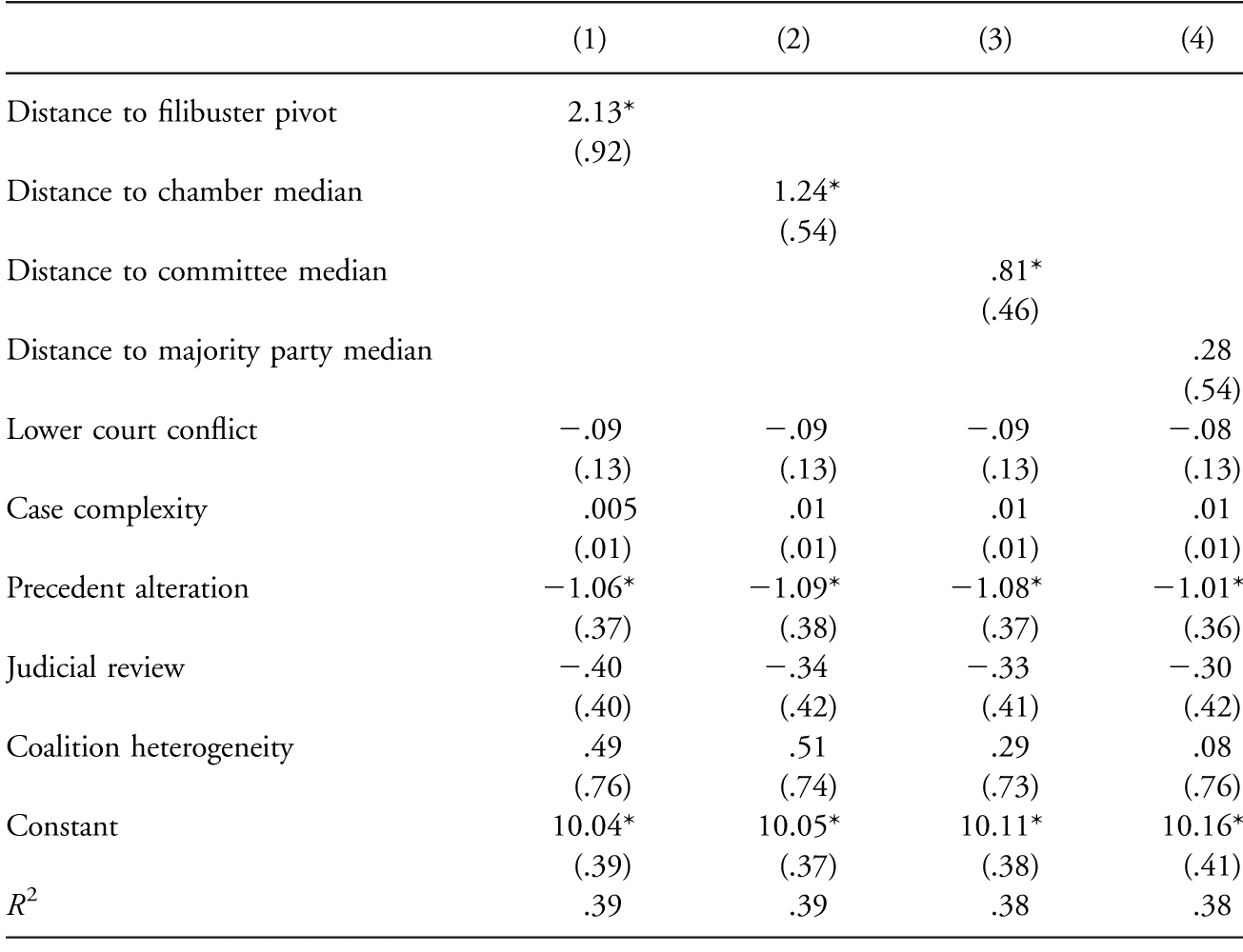
Next, we report results after including two additional control variables that might affect the degree of obfuscation inherent in the Court’s majority opinion. Table A2 presents the model specification reported in the text with additional fixed effects for both natural court and the type of legal provision. These controls allow us to test whether our argument can generalize across both different membership configurations and historical eras as well differences between constitutional and statutory cases. We include fixed effects for each natural court and type of legal provision present in the case using the “naturalCourt” and “lawType” variables in the Supreme Court Database, respectively.
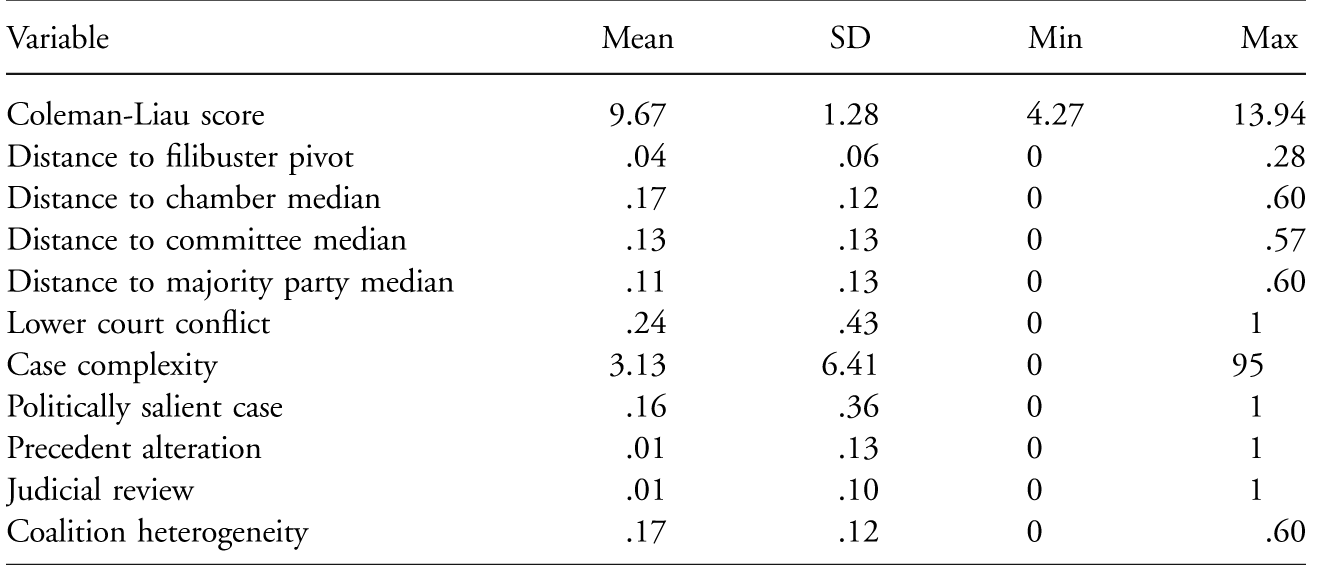
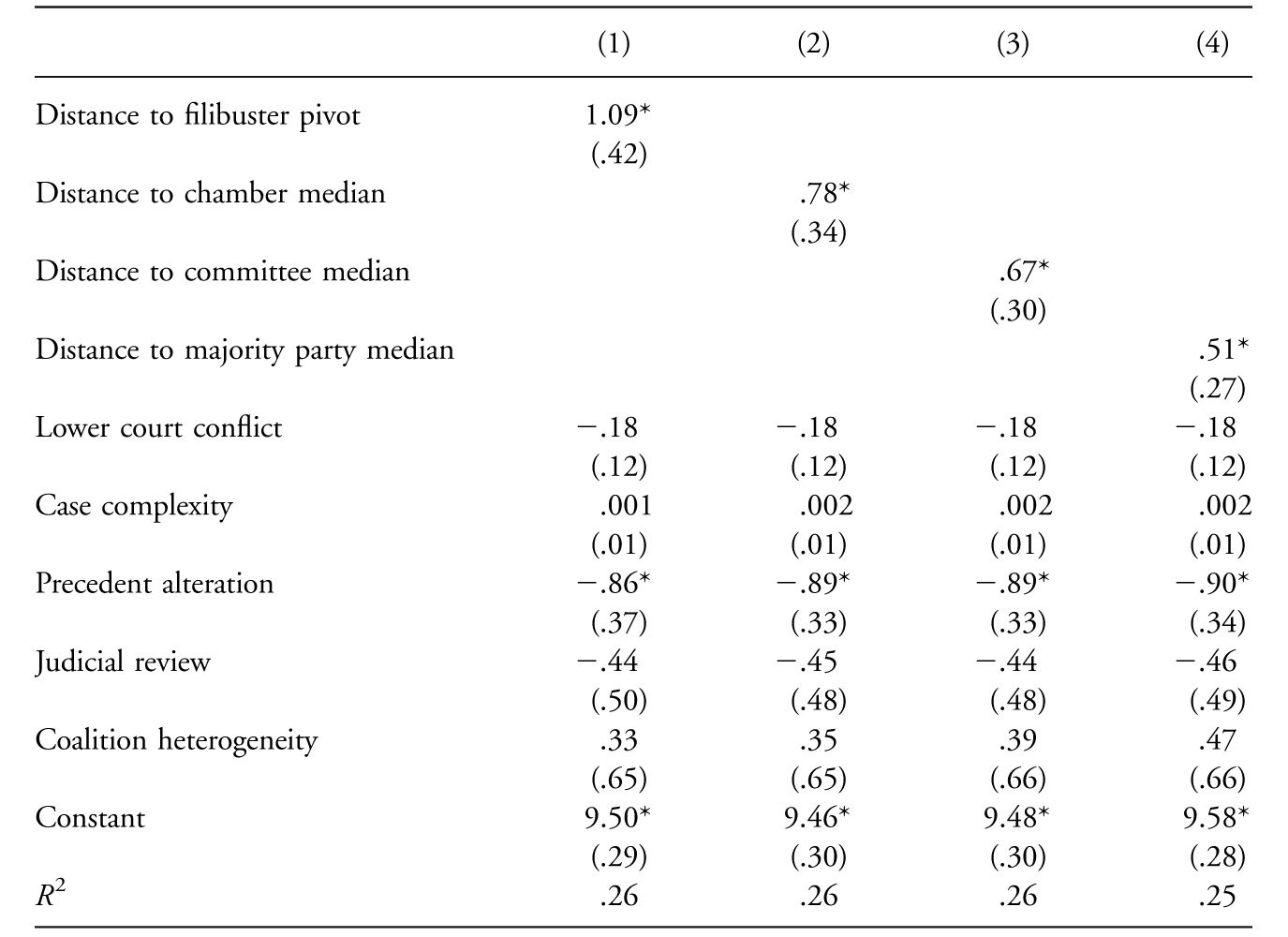
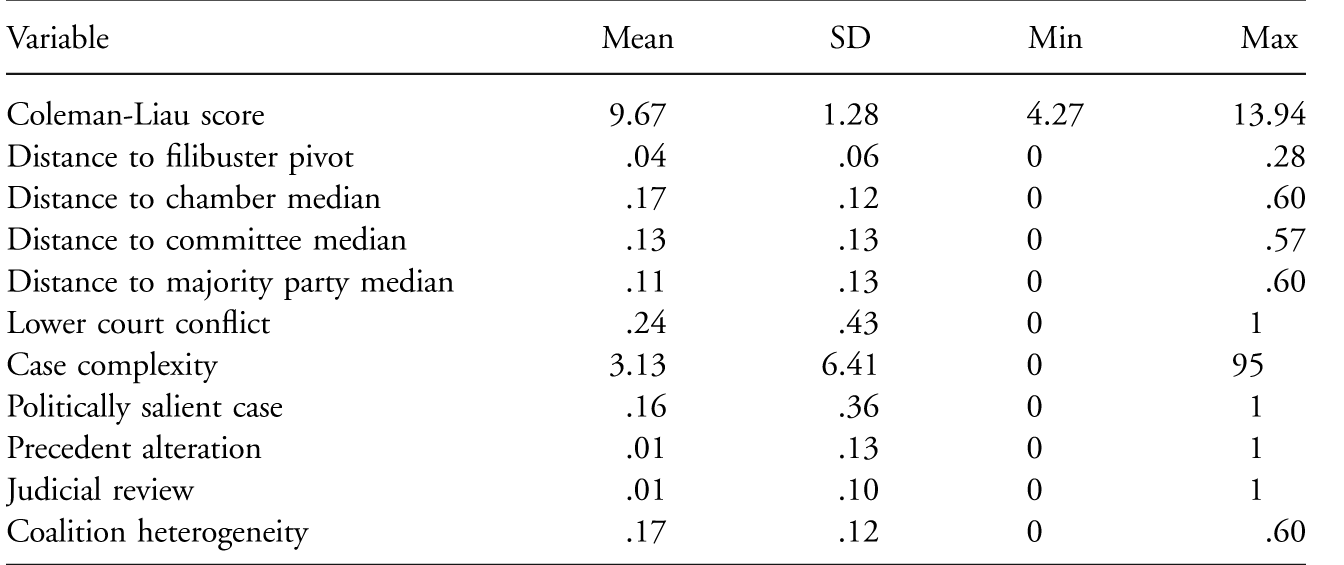
Next, we report the results of the model estimates that substitutes the opinion author as the pivotal Court actor. In table A3, the results strongly support the findings reported in the full article. Specifically, in addition to showing robust support for our models in the main text, we see that the fourth model, where distance to majority party median is the key predictor, is also statistically significant. Finally, table A4 reports the descriptive figures for the predictors displayed in the text.
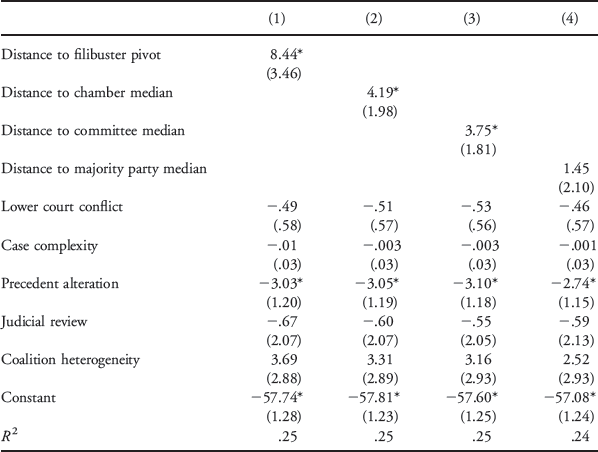
Note N = 529. Table entries are ordinary least squares coefficients. Robust standard errors, clustered on each Supreme Court term, are in parentheses. All models include fixed effects for the majority opinion’s author and primary issue area (not shown). The dependent variable reflects the Flesch-Kinkaid reading ease value for each majority opinion, recoded so that higher values reflect more difficult (or obfuscated) opinion text.
* p < .05, one-tailed.
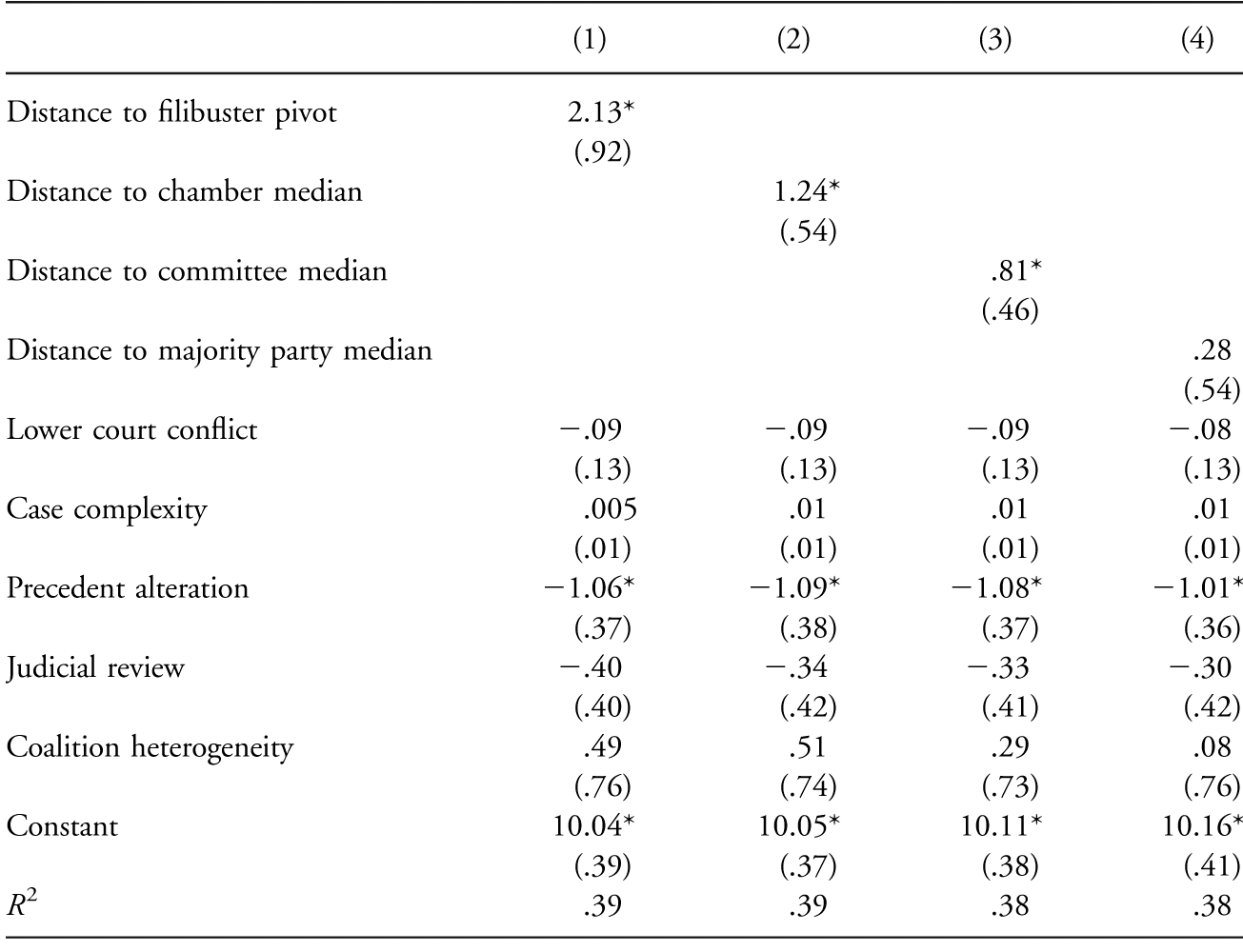
Note N = 491. Table entries are ordinary least squares coefficients. Robust standard errors, clustered on each Supreme Court term, are in parentheses. All models include fixed effects for the majority opinion’s author and primary issue area (not shown). The dependent variable represents the readability of a Supreme Court majority opinion, where higher values reflect more obfuscated (or less readable) opinion text.
* p < .05, one tailed.
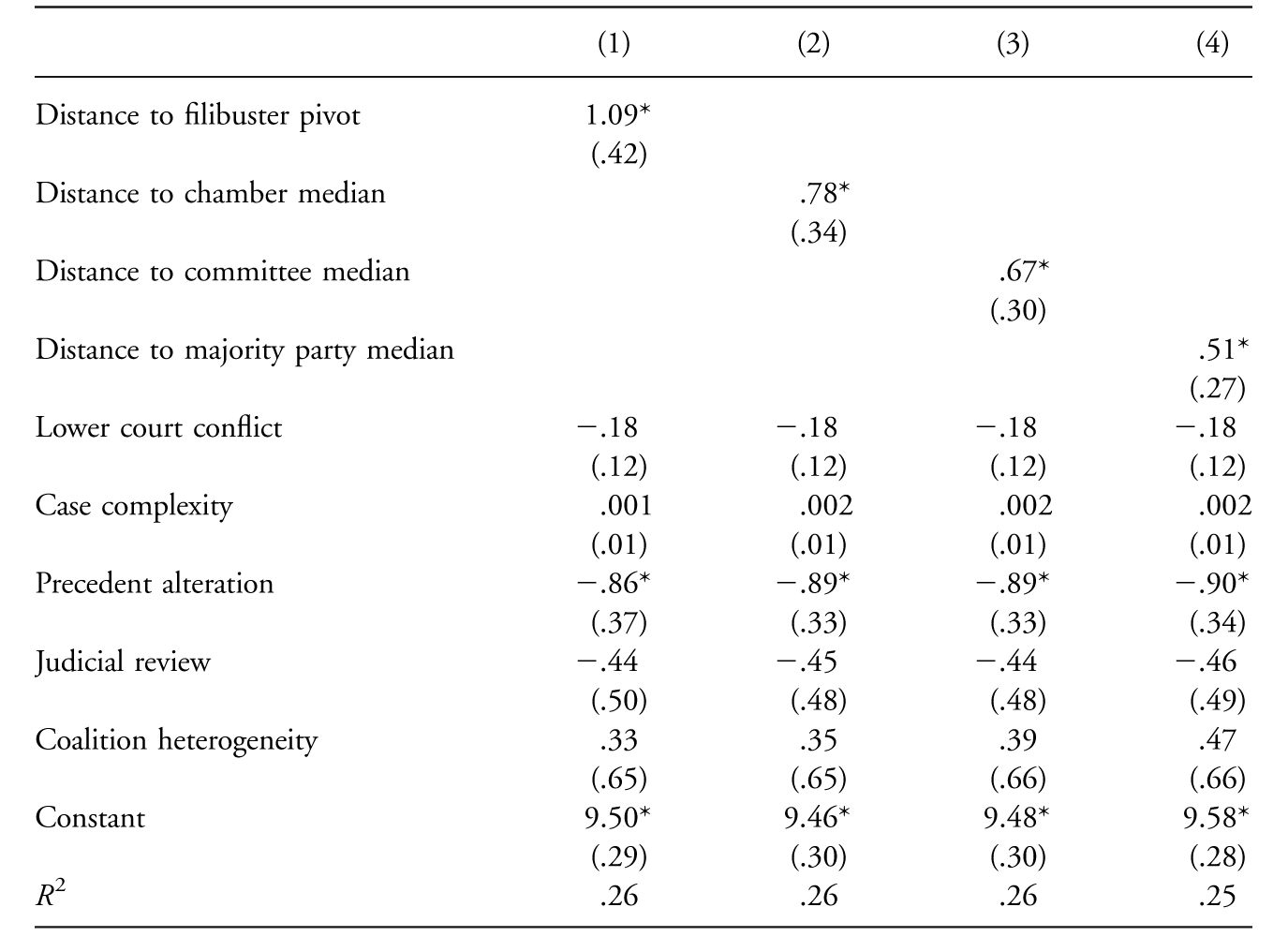
Note N = 529. Table entries are ordinary least squares coefficients. Robust standard errors, clustered on each Supreme Court term, are in parentheses. All models include fixed effects for the majority opinion’s author and primary issue area (not shown). The dependent variable represents the readability of a Supreme Court majority opinion, where higher values reflect more obfuscated (or less readable) opinion text.
* p < .05, one-tailed.