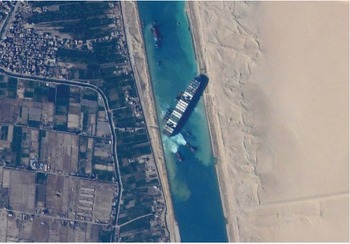
In March 2021, the Ever Given cargo vessel became lodged sideways in the Suez Canal, blocking traffic along the shortest shipping route between Asia and Europe. As companies weighed the economic inefficiency of alternative routes, speculation centered on the impact on global trade; according to Lloyd’s List, US$6.7 million was lost in revenue every minute this artery of capitalism remained blocked (Baker et al. Reference Baker, Watkins and Osler2021). The sheer magnitude of the blockage miniaturized the earth’s moving equipment, ideal fodder for social media memes attentive to this poetics of scale. More than a symbol, the clot was felt around the world, capturing a discrete moment of attention against the backdrop of the durational and fictive experiences of the pandemic.
The container ship Ever Given stuck in the Suez Canal in Egypt, viewed from the International Space Station, 27 March 2021, 13:01:03. (Courtesy of NASA JSC ISS image library)

Our own experiences of the disembodied presence of the Ever Given —from where we live in the US and the UK, Romania, and Australia—has forced us to rethink our recent experiences of presence as more distributed and contingent. In ¡Presente!, Diana Taylor reflects on the embodied politics of presence in relation to a process of “learning of a situation by living it in the flesh” (2020:3). Taylor’s project is one that tends to the intersection between the epistemic, the political, the artistic, and the pedagogic, framing presence (¡presente!) as a contextually definable experience, “an act, a word, an attitude” that is also a form of showing up—a “commitment to witnessing” (4). Outside of Taylor’s own moving beyond borders—geographically and conceptually—the book emerges from her time spent on the road through Central America, Mexico, and the US border region as an act of revisiting the legacies of colonial conquest and witnessing neoliberal extractive practices—a form of active attunement and solidarity via cultural canals. What we find so resonant in this expansive body of work is a provocation to reconsider not only the frames of legibility that have articulated presence as an ontological, rather than epistemic concept within and beyond performance studies, but also the political project of presence against shifting epistemes of crisis—its articulation and experience.
The Ever Given, registered in Panama, is managed by a German company (Bernhard Schulte Shipmanagement), owned by a Japanese shipbuilding company (Shoei Kisen Kaisha), insured by a British company (UK P&I Club), staffed by an Indian crew, and operated by a Taiwan-based shipping conglomerate, the Evergreen Marine Corporation, a subsidiary of the Evergreen Group. The global distribution of responsibilities and liabilities of this ship illustrates the complexities of a logistical infrastructure usually obscured from view. The “crisis” gave the immateriality of global trade and flows of capital a presence: the vessel made tangible structures of finance, logistics, international relations, and multinational corporations. The sudden, global visibility of these geopolitics of trade failed to make visible an even more complex web of labor structures that underpin and reproduce it. The lodging exposed the ease with which “crisis” is articulated in geo-economic terms, but presence itself—the visible, material labor structures and geographic extensions that it comes with—were sidelined. Precarious bodies (racialized bodies, migrant bodies, disabled bodies, marooned bodies), whose presence and engagement are fundamental to its logistics, were rendered absent. The lodging of the Ever Given makes evident the need for a metered engagement with presence that accounts for these relations—the affective, material, temporal, and spatial.
Presence after Taylor
Towards a Visual Politics of Multiplicity
Despite rendering absent the many precarious bodies, the affective relations spurred by the event intervened in a realm of representation foreclosed by the pandemic itself, shaped by fractious and contentious relations to presence and scale, mediated by screens, for bodies in lockdown. As the pandemic eviscerated work/life boundaries, exposed a pervasive surveillance, and forced some forms of labor into domestic spaces (with domesticity itself as a site of labor), the digital acted as a strange site of binds and conflicting networks of relations. The crossing of the Ever Given into the realm of visual culture exposes these fraught relations between visible and invisible and, more importantly, presence and absence, inherently exposing the connection between multiple temporalities and spatialities. In thinking through these visual cultures, we want to format a different articulation of presence that accounts for the possibility of a metered togetherness.
Using the lodged Ever Given cargo vessel as our orientation, we propose that presence is more than the coterminous junction of shared time and space; instead, we propose to understand presence as multiple and emergent. Our engagement follows the diffracted forms of presence that emerge in the wake of the Ever Given’s lodging in order to expose what we call metered togetherness: a multiple, scaled, and relative assembly, at once localized and networked. We also examine how, adjacent to this, temporal proximities shape this experience of presence at this political juncture. We move away from ontological concerns with immediacy and mediation that saturate our field towards a prioritization of the demand and supply of attention and its politics. In doing so, we trace temporal drifts, divergences, logisticalities,Footnote 1 and networks of relation as manifesting an insistence towards messy togetherness. The variegated experiences of the global pandemic have foregrounded how precarity, governance, racialization, and conflict configure who gets to be present, how, and for whom; to this end, our engagement with presence complicates singularity whilst holding on to solidarities that emerge across temporalities and sites.
The visual culture surrounding the Ever Given becomes central to our method, as it enables us to concentrate on the ways in which the multiplicity of presence is political in nature and global in impact, embedded in constructs of colonization, globalization, and mechanization that meter our togetherness even as we drift apart. In this way, we position metered togetherness as an encounter between affect, global politics, decolonial time, and acts of listening.
In her work on the particular temporality of Chinese cinema, Melancholy Drift: Marking Time in Chinese Cinema, art historian Jean Ma reminds us that the present moment has resulted in a dispelling of “the assurance of continuity between past, present and future” in the face of the “the sheer rapidity of change” (2010:6); her affect-led engagement with cinematic temporalities productively unsettles normative time, navigating an “attenuated present unanchored by the past and before which a vastly different future looms of an unknown quality” (7). Ma’s project seeks to mobilize cinematic strategies. Her work introduces a spectrality that resonates with the simultaneous clogs in global capitalism that the pandemic foregrounded, and the Ever Given’s lodging so aptly manifested, inclusive of its memed circulation. As Ma proposes, the “plenitude of the image falls under the shadow of absence, taking on a spectral hue” (14). Is spectrality an experience of presence, and has the pandemic really rendered our experience of presence simultaneous with a denigration of global capitalism?
Such a spectrality similarly unmasks an engagement with presence that manifests a different embodied experience of time and physical proximity, helpfully materialized through Rajni Shah’s work on the poetics of assembly and listening in Experiments in Listening, where they speak in particular of the project Lying Fallow, which sought to create space to sit “beside the world in which it took place” (2021:133), rather than outside it. Whilst dominant conceptions of presence and time are oriented toward being within an event, the Ever Given motivates us to look at how adjacency might also constitute presence and togetherness. Shah’s own conception of gathering as “an act through which a certain visibility and audibility become possible” (118) makes evident how connecting, taking stock, or being with are also shared experiences. The embodied experience of pandemic presence resonates strongly here, marked for many by failures and limitation rather than pause and possibility. Flipping such a discourse, however, might enable us to account for the rifts in global capitalism that were marked by pandemic time, and therefore the sheer affective qualities of its experience. To fall asleep in one’s chair in the darkened theatre or to drift off into other thoughts during a class is to be present and accounted for, but the teacher who brings a student crashing back from a daydream by asking “are you with us?” attests to the importance of the quality of presence (attention) alongside the quantity of presence (duration). In this way, the Ever Given is not a parallel but a weave, a part of this experience of presence, set against the temporal rifts of the pandemic and the visual cultures of relation emergent within it—a set of ties, or bonds.
Logistics in a Global Attunement
The Politics of a Disappearing Presence
The sea—in this case the canal—is inextricably connected to the passage, violent erasures, to slavery and coloniality, expansionism and extraction. The Ever Given’s disruption, its possibility as an event to act as an affective anchor, also opens up the possibility of a different articulation of presence that might be messy, disjointed, affective, corporeal in other ways: a presence that begins lodged in Egypt but expands toward Germany, Japan, Great Britain, India, and Taiwan when cargo ceases to be viewed only in the singular present. As the field of Black studies exposes, presence vibrates with the ungraspable problem of absence and removal. It is in the nexus of these frictions, to draw on Anna Lowenhaupt Tsing, that we might tend to the multiple resistances that constantly shape how we understand presence and relation in and through performance. And thinking alongside Lowenhaupt Tsing, this warrants an encounter with the interstices offered by differences that “simmer within global capitalism” (2005:xiii). This allows a scalar thinking about metered togetherness. We think here of Christina Sharpe’s attention to the track left on the water’s surface by a ship, or the disturbance caused by bodies moving through water. “To be in the wake,” Sharpe declares speaking of Blackness and being, “is to occupy and be occupied by the continuous and changing present of slavery’s as yet unresolved unfolding” (2016:13). The Ever Given’s temporary social media virality marked the canal as a site for paradoxical and simultaneous experiences—getting stuck and unstuck; clogging and setting free, disturbance and trace, presence and absence.
An attunement to the ways in which logisticality informs or shapes experiences of presence is significant here. Stefano Harney and Fred Moten address explicitly how logistics poses the “problem” of the body. “Logistics,” Harney and Moten argue, “calculates as an absence that it cannot have but always longs for” (2013:93). Every attempt by logistics to “dispel strategy, to banish human time, to connect without going through the subject, to subject without handling things, resists something that was already resisting it, namely, the resistance that founds modern logistics” (91). This locating of logisticality in relation to modernity is relevant for how we might understand the fractious proximities of presence. Logistics expose the operations of capitalism as always corporeal and material. In its cultural currencies, the ship is not only a wedge in the smooth operations of logistics that render bodies absent from maintenance, but also a representational space for embodied perceptions of scale and time. In most of its articulations, the Ever Given sets out the momentous and global vis-à-vis the minute and affective—creating shared affective bonds.
The affective resonances that rippled out from the concentrated attentions at the Suez Canal echoed the nascent public practice of contact tracing, in which presence was not configured as linear but concentric in its spheres of relationality. This form of proximal identification forced an attention to presence-via-absence, as we traced lines of former contact to ensure a protected future. It was a reach into the past to safeguard the future, yet largely neglected the now. As such, our attentions were diverted between past and future and presence became unbound from the present. The circulation of bodies, beyond this individual sphere of having-been, also shifted as the circulation and flows of bodies changed during the pandemic. Traffic and commutes came to a halt, and borders became more rigidly closed. Emerging from these interconnected lines of inquiry, how might we understand presence beyond the spatial and temporal, shaped as it is by the politics that define our current moment? Or, to ask the question differently, how might we make disappearance present? In this slowed world, perceptions of time and presence shifted, not intentionally, but indifferently, into a lackluster state of affairs.
Detached from an assembled presence, normalized ethical positions also unraveled. With presence so tethered to time in the synchronous-asynchronous divide (rather than the intersection of time and space where society has typically located presence), time became a commodity more than ever: to spend, to give, to receive. Employers, students, caregivers, and coworkers experienced a generosity and forced generosity with regard to time and attention as availability was too often presumed in the absence of a commute. Mark Fisher observed that “as soon as there is email, there are no longer working hours nor a workplace” (2012). And now, as soon as there is Zoom, the home is a workplace; it is no longer private. But not all time or space is created equal, and the tension between attention and refusal resulted in new labors of resistance. Presence might have become increasingly scripted as a virtual experience, but the temporal stress and exertion still impressed themselves onto our corporeal form, as postures slumped and eyesight strained in the blue light of the night. Zoom fatigue overlaid itself onto the physical fatigue of machine labor. To disavow presence—by a gesture as minimal as turning a camera off—was an act of defiance.
Temporal Drifts Through the Commodified Timescape of Presence
The collective global spectatorship of stalled logisticality suggests a shared time, but with overlapping temporalities of clock time and network time and with their respective colonial politics. When the Ever Given became lodged sideways in the Suez Canal, orderly logistic timeframes were disrupted, making previously predictable forecasts for “fulfillment” uncertain. In contrast, the real-time updates of this breaking news, traveling at high speed, drew a global audience together into a shared durational experience, commencing with the first reports and images of the stuck ship and resolved seven days later with cheerful reports of the successful dislodgment by the Suez Canal Authority (SCA) and the Dutch salvage company Boskalis. Each of these temporal regimes—the timeframes of logistics and the real-time news updates—were materially tied to a bodily knowing and reckoning; within this, time is understood and experienced in different measures or meters, but across which certain assemblies might form.
This presence we are most familiar with in our discipline, of bodies in conterminous time and space as part of a performance event, is the product of carefully curated time: the assemblage and synchronization of actants, brought together through scheduling made possible by the time of the clock. This curation of time is ever present, structuring the call and curtain, right down to the milliseconds programmed into lighting consoles. This mechanized rhythm of regimented clock time continues to surround us, and seeps not only into our practices of making and performing, but permeates the structure of our day-to-day life.
Yet before clocks were sufficiently accurate and small enough to carry around, reckoning time was a more sensorial process, and measures more fluid. In Shaping the Day (2009), Paul Glennie and Nigel Thrift observe that hours have always been rigidly uniform—with Ancient Egyptians the first to divide the day into 24 hours (bringing us back for a moment to the location of the Suez), but using sundials divided the day and night equally into 12 hours, so fluctuation in daylight meant hours grew and shrank throughout the year. The word “clock” traces its etymology to the bell, Footnote 2 a signal for people to congregate, to come together in a moment of presence—just as the chimes signal the end of an intermission, untethered from clock time. The canonical hours, and other calls to daily prayer, are notable because they suggest a type of assembly where people might share time without necessarily sharing place, but are united by the omnipresence of a god. The devotion to a spiritual presence allows us to drift away from the empirical accounting of being present toward more attentive and distributed modalities—to consider the spectral and ghostly presences and haunting, which as Avery Gordon argues, “alters the experience of being in time, the way we separate the past, the present, and the future” (2008:xvi). Footnote 3 Congregation, devotion, and haunting all suggest the possibility of presence at once out of time (or at least, rigid clock time), but also actively alters our very experience of time.
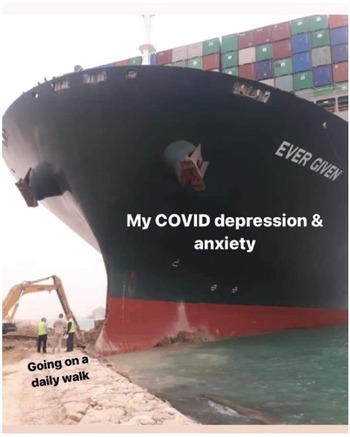
Ever Given meme. A picture of the side of the cargo vessel. The overlaid text reads “my covid depression and anxiety” on the vessel, and “going on a daily walk” by the digger. (Screenshot by TDR)

In some of the earliest images to circulate of the Ever Given, the colossal scale of the ship is measured in relation to a single excavator, perched on the canal bank, digging. The image distilled the disjointed perceptions of time felt during the pandemic’s duration, but more immediately enticed a global league of pundits and armchair experts to speculate as to how long (if ever) it would take to free the boat with only this equipment. Conjecture swirled regarding the competence of the captain and crew, and the scale of the response from the Egyptian Government and Suez Canal Authority. Much of the chatter, inference, and commentary, almost entirely based on the circulating images, suggested the initial response to this crisis was incompetent. This was, of course, influenced by the limited information released, exemplified by the Guardian’s reporting that “few observers expect transparency about the circumstances of the grounding or the timetable for the ship’s rescue from the Egyptian authorities” (Michaelson Reference Michaelson2021). However, lurking as subtext to many of the comments was a pervasive prejudice that dredged up the various perceptions of “Egyptian time.”
In On Time: Technology and Temporality in Modern Egypt On Barak draws a comparison between “Egyptian time” and “Western time,” calling for a social organizing principle that resists a normative Eurocentric tradition by dismantling timekeeping itself, slowing down or delaying expectations of productivity, making an “ethical commitment to a temporality that would privilege the communal” (2013:20). Barak’s historical investigation both affirms and troubles Barbara Adam’s observation that “[T]ime has been a most effective colonizing tool” (2004:137), and details a long and fraught history between Western time and Other times that has been shaped by political, cultural, and technological factors, particularly the impacts of colonization and subsequent processes of resistance and revolution. Importantly, this genealogy of Egyptian timekeeping throughout the 1890s to the 1930s shows a remarkable trajectory—“from embracing strict punctuality in the beginning of this period […] to a growing critique of efficiency and speed, and an eroticization of delay toward its end” (Barak Reference Barak2013:18). This critical stance to an industrial temporality—empirical time, clock time, or as Max Weber termed it, “the spirit of capitalism” ([1905] 2013)—is all the more notable in light of the turn toward shared, communal time, measured in other ways than by the clock.
On Barak argues that resistance is “predicated on discomfort with the time of the clock and a disdain for dehumanizing European standards of efficiency, linearity, and punctuality” (2013:5). In rupturing the bank of the Suez, the Ever Given seems to snag and create a countertempo of its own, bringing multiple temporalities or, as Barbara Adams suggests, “timescapes” (2004) into tension, if not conflict. And so the fragment circulates as a viral presence that calls out beyond a strictly shared time and space and attests to the more and less subtle processes of colonization and resistance, scaling from micro to macro.
Becoming Lodged
Affective Resonances
Part of the uncanny reception of this logistical narrative was its synchronous nature between the event and its mediation. Besides the usual nearly instantaneous memes, a website devoted to displaying the Ever Given’s lodged status called istheshipstillstuck.com was live within three days, receiving 50 million views in just five days (comparable to New York Times numbers). Without such a delay—or lag, or drag, or drift—latent perspectives became entangled with those present. In this scene, the archive lacked a stable signature—that Derridean mark of “having-been present”—contra a mass-produced and collectively received date-less form of creation or receipt. Instead, the viral attention in the archive that formed thus amassed its own temporality, which always indexed the present: as long as they circulated, the memes were current. A relation emerged between two parallel realities: one in which the ship remained stuck and memes swirled in global currents; another in which once the ship became unstuck, the memes of its lodging settled into perpetuity’s sediment. This relation is complicated by the virtual presence of the ship’s lodging—an account of the event that maintains a currency in the archive.
In the dissonance between an event and its aftermath (phrased alternatively as the expansive reach of “presence” marketed in the digital age and exemplified by virtual surveillance), perspective begins to collapse in on itself and the potential for critical distance is either eclipsed or accelerated. In that derived compression, we open vulnerably toward “the incredible possibility of a ‘civilization of forgetting,’” in the words of Paul Virilio, “a live (live-coverage) society that has no future and no past, since it has no extension and no duration, a society intensely present here and there at once—in other words, telepresent to the whole world” (1997:25). Presence became likewise compressed in the affective virtuality of pandemic parameters. Embodied presence was eclipsed in favor of screen presence, and livestreaming remained “close enough.” We tuned in from afar as though we were there, or at least as if it were near.
Forced into a mediated reality in which presence was separated from its embodiment, we collectively entered a cinema of time with temporal density saturating the moment with a singular fixation. “The disorienting effect of this shadowed time,” writes Jean Ma, “is further amplified by the sheer profusion of images in a media culture that threatens to obliterate the boundaries of the present. Paradoxically, the very ubiquity of images of the past reinforces our feeling of disconnection from its reality” (2010:14). Though writing with regard to the highly aesthetic realm of cinema, Ma’s critical thought on shadowed time echoes within the present presumption of mediated time. The memes of the Ever Given, while overwhelmingly public and political, are as aesthetic as Ma’s case studies are political. Their multitude held a melancholic exhaustion; take for example, the excavator’s miniscule proportion that signaled futile, invisibilized labor akin to the pandemic fatigue in which government-sanctioned advice amounted to an infantilizing reminder to wash one’s hands. Dissonant public health measures and the excess fatigue of pandemic laboring were held by this aestheticized melancholy.
In 2020, the cargo ship lodged a unifying global attention in the contested waterway, and indexed the shared politics of the “industrializing, urbanizing, and mediatizing forces of global capitalism” (Ma Reference Ma2010:6). It simultaneously returned us to a previous impasse. The Suez Crisis, not unlike the crisis spawned by Covid-19, was a historical event with deeply affective resonances: a mise-en-scène of independence and global statehood ignoring the lingering shadow of Empire. From its origins, the Suez Canal has carved out not only a channel for logistics, but a site for rehearsing ideas of nationality, coloniality, and privatization on a global scale. The crisis of the Suez Canal (in both 1956 and 2020) Footnote 4 damned not only arteries of capitalism but obstructed a linear progression toward a truly global modernity. Stalled from these idealized flows of progress, historical flashpoints sedimented to erode a utopian view of globalizations.
Attending to this same geographical position nearly 65 years prior to our writing, a young Edward Said vouched for the integrity of Egypt’s then-president Gamal Abdel Nasser’s choice to nationalize the Suez Canal despite the discord it caused: “it is in this writer’s opinion that Nasser must be considered as a sincere, dedicated, (if inexperienced) man” (Said Reference Said1956). Then only 20, Said wrote passionately and confidently on this “latest crisis” in The Daily Princetonian (1956). Returning to his editorial position 40 years later, Said reflects on the curious lack of any notable critical or political response to his strident nationalism:
The article was published without provoking the kind of response that it might have had if it had appeared after 1967. It was my first piece of political writing, but so quiescent were political passions and so muted were Zionist opinions—this was, after all, when Eisenhower in effect compelled Israel to withdraw from Sinai—that I was able to publish it quite easily. (Said Reference Said1999)
It is curious that Said chose to reflect on this particular piece of writing given the lack of attention it garnered, as if haunted by the ambivalent promises of the past scripted so beautifully by Sara Salem (Reference Salem2019). First writing as an unknown student and then as a well-known academic, in both instances Said emphasized the economic significance of the canal and its entanglement in sociocultural and political debates. In the former, in which the gap between event and aftermath was condensed, he wrote with impulsivity. As the gap widened over the next 40 years, his viewpoint adopted a more metered tone. But beneath this language of political attention, the personal flows. The personal stakes of “my first piece” suggests to the reader a productive ambivalence between reminiscence, revision, and resuscitation. Does Said bring the past into the present, or does he return his presence to the past in a gesture of nostalgia? Can it be both? The possibility to be present with, again? Said’s reflection produces an inevitable melancholic drift and suggests an ever-changing orientation to the Event and the Self that is a part of the gap. While hindsight is infamously 20/20 and foresight remains commendable, this narrative return to Said’s editorial reflects the value of the present, of writing from within the now before it has the chance to become stuck.
Said’s conflation of past-presence echoes experiences of the pandemic—an out of place, untethered from geographic specificity as it shifted in the ethosphere of the interweb. Footnote 5 It is this experience of the “temporal dimensions of dislocation” against the “spatial tropes of border-crossing, migrations, diasporal, travel, and exile” that the Ever Given revealed (Ma Reference Ma2010:10). But instead of being “out of” place we might more productively be “beside” to articulate a relation rather than an exclusion. Some precarized bodies may live at the front, and others at the back, but those at the front—including in the frontlines of the pandemic—are also rendered outside of care: invisibilized or hybervisiblized in upholding the registers of capitalism.
In 2020, crisis after crisis accumulated, such that one could not hold all the global traumas at once: infection rates and insurrections, bushfires and drone bombs, mass shootings and massive unemployment indicative of a widening income gap. We lost count and lost perspective in such crisis ordinariness, as our individual presence was rendered insignificant when the world went virtual and viral at once. As Ma writes:
Spatio-temporal unity and linear causality dissipate under the pressure of uncanny doublings and juxtapositions of seemingly unconnected moments and places, flashbacks and digressions that confuse the boundaries among temporal planes, and protracted long takes that impress upon the viewer the strangeness of a present tense in which screen time and real time overlap as “dead” time. Within these intervals of suspended chronology, reality bleeds into inner worlds of fantasy and desire, subjective and objective perspectives commingle, and memory competes with history. (2010:7)
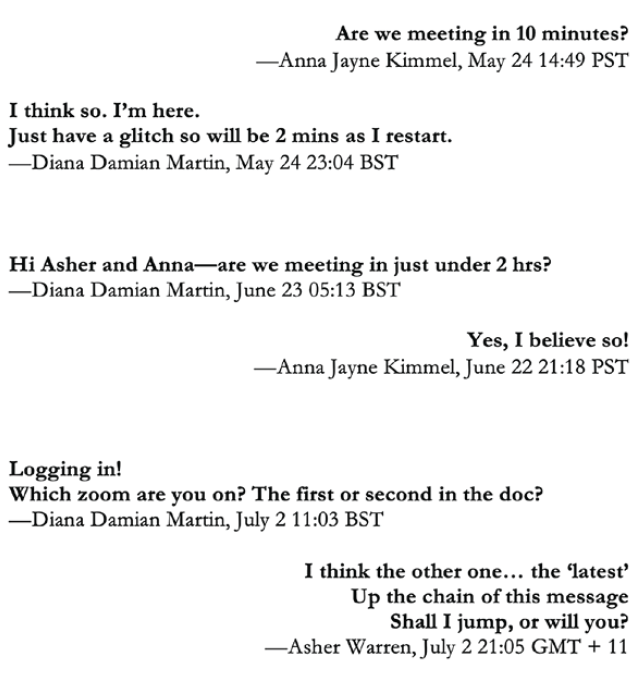
Reflecting on these affective resonances that rippled forth from the Suez Canal, and the absences that rippled in its wake, we entered a landscape dramaturgy without a dramaturg to guide us toward a finale or a director to shape time and experience. Yet this new landscape lacked a linear horizon, and instead looped constantly back to the now: a Zoom meeting ending in which your experience was either great or “had issues” in a market-take on reflection; your face perpetually reflected back at you as you Facetimed with family; a meeting at 3:00pm EST three hours before it was 3:00pm for you in PST; the 2020 Olympics playing out in anachronistic style in 2021; or the Euro Football Cup of 2020, likewise a year later; or a constant gesture to the uncanny repetition of rhetoric from the 1918 influenza pandemic. This apparent referentiality of presence undermined its discrete nature and the zeitgeist of “unprecedented times” implied a singular linearity of succession without repetition, a false nomenclature as we simultaneously experienced anachronistic déjà vu, or déjà disparu. “The indeterminate circuits of this drift among remainders result in open-ended narrative trajectories that elude conventions of closure and rely upon intervals of arrest, inaction, silence” (Ma Reference Ma2010:14). Instead, the past, present, and future of the horizon faded until we could not distinguish between making sense of time that had passed versus time yet to come versus time unfolding.
Hito Steyerl, writing in 2011 on the experience of free-falling, reflected that “it may actually feel like perfect stasis—as if history and time have ended and you can’t even remember that time ever moved forward” (2011). A decade later, these prescient words reverberate. But unlike the free-fall that Steyerl described, presence followed not a vertical perspective of descent but a detached and nondirectional buoyancy in which the local and the global collapsed into one. And the resulting condition of groundlessness was not one of freedom, but precarity. In the pandemic moment of the Ever Given, inequality gaps widened: unemployment skyrocketed while Jeff Bezos went into space.
In a collective anticipation of a postvaccine existence, a valorization of presence emphasized by theatre-makers and performance studies scholars was foregone. The world waited. Alone. Some people experienced a nostalgia manifested in a desire to return to a prepandemic world where contact was not only permitted but often encouraged. Some compulsively archived the present, which due to its virtual nature, could be captured by just pressing record—preserving an entire gathering. With this ease of data collection, content flowed (while the ship remained lodged). Lectures in California were streamed to Cairo, and international conferences convened via personal screens. Our mediated copresence is a ghostly, weakened creature; lethargic and emaciated.
Ralph Lemon predicted this restless circularity when his 2010 work asked, How Can You Stay in the House All Day and Not Go Anywhere? The title itself now brings to mind stay-at-home orders issued during Covid-19 and the subsequent feeling of being stuck in one’s/one (social) position. In his choreographic event on impermanence, Lemon calls into question experience and perception, memory and media, reality and indeterminacy. He references the same disjointed, asynchronous time of Ma’s Chinese cinema—with its “topography of haunted spaces and spectral gliders, of restive pasts that invade the boundaries of the present, of nostalgic longing and melancholic fixation, inhabited by characters who endure and resist the experiences of loss, mornings, and trauma in idiosyncratic ways” (2010:7)—in his take on the quotidian sphere of the racialized United States replete with its own violences. Marked with eclectic, frivolous, and even humorous moments, a scene with a water hose grounds the performance in severity as the force of the water’s flow topples a dancer, evoking scenes from Birmingham in which Civil Right activists were quelled by policemen using high-pressure fire hoses. The present was forced into the past, even as the performer remained, attentions dislodged from the protections of the here and the now.
Contested Presence
Overlapping Exposures and Flattened Temporalities
Much of our collective experience of the pandemic has been shaped by an experience of stasis, felt as a temporary lodging of a different kind that emphasizes the impact of logistics on an individual scale. For some, the ability to remain at a remove from virality in public space was shaped by a labor privilege—and as many have already explored, it was the “frontline” work that kept bodies in permanent contact with the virus, while others tried to navigate the fog of unsustainable remote work or domestic temporalities. Françoise Vergès points to the ways in which “wear and tear of the body is inseparable from an economy that divides bodies between those who have a right to good health and to relax, and those who do not have the right to rest” (2019:76). Covid-19 intensified these economies of exhaustion, even as governments attempted to continue to foster a global vision of capitalism’s continual clean remake. As Vergès argues, “capitalism is an economy of waste, and this waste must disappear before the eyes of those who are entitled to enjoy a good life” (2019:17). The Ever Given’s digital discourse sought to emphasize the lodging as a problem of and for capitalism, without granting visibility to the multiple forms of labor—operational labor, care labor, and rescue labor—required to dislodge, to return to operations. It is perhaps imperative to witness these forms of labor so that we might resist the incessant spectrality forced upon them. In this entanglement, presence must, as Taylor reminds us, be understood in relation to witnessing, always tethered or committed to interdependence. In the curious experience of biopolitical management, temporal simultaneity, and performativity; of digital fatigue and domestic capture, presence emerges as a strangely disjointed experience, one inclusive of absence.
Our digitally mediated telepresence on Zoom screens and the capacity for a stuck ship to speed around the globe are both markers of a shift from the temporal regime of clock time to what Robert Hassan identifies as “network time” (2009). Manuel Castells interrogates the widespread understanding of these networks as working in “real time”—as in instantaneous — and notes the subsequent proclamations of “timeless time” ([1996] 2010:406).
The flattening of time suggested here, of technologies accelerated to the point of atemporality, seems to rely on a particular reading of the instantaneousness of networked flows of information. Hassan argues it is incorrect to suggest that these tools are instantaneous, suggesting a misreading of the term “real time” as immediate action (as in no time), when it is more accurate to say that computer scientists and programmers use the term to mean something more like fast enough to be perceived as immediate. Computational processes still take time. It is just measured in remarkably short computational cycles, and it has to be, since sequential processing—“clocked” through a processor—remains integral to conventional computation. Our Zoom/Skype/Teams/Jitsi/Hangouts/Facetimes might function with imperceptible delays; but are—as is persistently evident—not instantaneous. Similarly, the use of the terms synchronous and asynchronous in computer science might seem to be reversed from a quotidian understanding. To execute a synchronous operation is to proceed in sequence, one at a time, with each stage beginning only after the preceding is complete. Asynchronous operation describes multiple operations being performed at the same time. The delay emerges as a consideration of a/synchronicity—a lag. What these brief detours to computer science illuminate is not a flattening of time, but of nuanced management of delay and latency.
“Digital correspondence.” An extract from a conversation from a Telegram group chat. (Screenshot by Anna Jayne Kimmel)

Just as it is vital to differentiate the (very fast) sequential processing of a computer from instant processing, we might also identify the importance of sequence and delay as part of the experience of being present. The perceptible delay of sound experienced by those in attendance at a large stadium does not suggest differing categories of presence, or suppose that those furthest from loudspeakers or the action are less present. Nor is presence contested on the variances in milliseconds taken for sensory information to travel through differently arranged networks of neurons. Attentive presence may include (or demand) holding onto the moment before, but also necessitate processing (in computer science terminology) asynchronously, as with: the arrival of multiple physical and affective sensations all at once, a barrage of synaptic firing, the recollection of a memory short- and long-term, of prediction and anticipation. A perfect presence (omnipresence) without duration or delay entails instant and simultaneous sending and receiving, the dissolution of boundaries. It is also a dramaturgical nightmare, an unstructured sensory overload. While Paul Virilio supposes our cocooning in our homes and engagement through telepresence flattens time (1997:25), the pandemic-enforced experience suggests a bumpier ride through the visceral discomfort and fatigue of duration.
Inevitably in these experiences of event that include both the live and its mediation, slippages and glitches occur as affective encounters that pierce the real. As the TDR Consortium editors of this issue asked, “What, if any, real distinctions between presence and absence, liveness and mediation, etc., have been too hastily elided or dismissed as nominal? What ways of interrogating presence have taken on greater urgency?” Consider how Zoom technologists scripted presence as a visual encounter, adding to the sonic layer of the telephone, but omitted the embodied, the tactile, the kinesthetic. Collaboration was flattened into two-dimensional zones, mere “lustrous points” by comparison to more corporeal perceptions (Abbott Reference Abbott1963). Yet rather than fixate on the ontological purity of presence, what was the experience of its interruption, of having been required to live in the condition that Linda Stone has called “continuous partial attention,” where our attention is habitually distributed across multiple communication platforms in a dizzying oscillation that never quite settles (2009).
That the sudden increase in exposure to the temporal logics of the network induced both discomfort and fatigue (a “stay-at-home” version of jetlag) is unsurprising given the different temporal regime of the network. While incorporating clock time, network time is relational, always measured between nodes and activity within the network. This is not a collapse of time but rather the suturing, overlapping, and interweaving many different timescapes. Rather than a generalized arrival, there is a growing awareness, within a networked global space of flows, of the complexity of our individual timescapes as they interact and intersect with others.
What we experience, albeit in very nascent form, is the recapture of the forms of temporality that were themselves displaced by the clock. That is to say, the embedded times in humans and nature and in society that formed the timescapes that intersected our lives, the timescapes we increasingly failed to fully experience, appreciate or understand […;] a smashing of the uniform and universal linearity of the clock into a billion different time contexts within the network. (Hassan Reference Hassan2009:91)
Not only does this suggest we might be able to experience presence without physical proximity or temporal synchronization, it suggests we might understand presence in more scalable, overlapping, and dynamic ways.
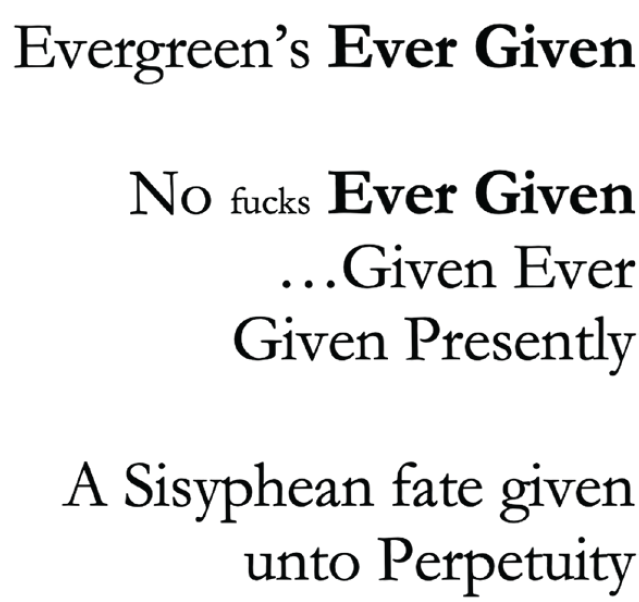
Ever Given meme text. The text reads: “Evergreen’s Ever Given. No fucks Ever Given …Given Ever Given Presently. A Sisyphean fate given unto Perpetuity.” (Screenshot by Anna Jayne Kimmel)

To extend presence through processes of projection and mediation suggests a capacity to linger or delay—through periods of inaction, inattention. As Rebecca Schneider argues, the hail, a gesture that “(re)inaugurates duration and the open possibility of response” (2018:286), might extend through time and space; holding open response-ability. The SARS-CoV-2 virion offers a (virulent) variation: dormant on hard surfaces and carried on airborne particles, when attached, an incursion of RNA is recognized at the cellular level and reproduced—an attention, a knowing, a distribution. The virus is present now, even when it is not: present in the hand washing, the mask wearing, the check-in apps and registers, and the awkward indecisions about touch.
Relations of Proximity Reimagined
Uncertainty and precarity over the past decade and beyond have defined articulations of the experience of the pandemic and extractive capitalism. As Gargi Bhattacharyya argues, “all inflections of being can be reconditioned to become accessories to commodification” (2018:183). The perspective that Black Marxism brings returns us to the importance of a critically engaged consideration of extraction. We’ve seen this play out through the articulation of the Ever Given’s multiple crises—material but also economic—folded into the warped temporalities of the pandemic, but also offering a possibility to consider how we value and render legible proximity as solidarity. We shift then, from precarity to exposure—capturing the variegated experiences of risk and devalued labor, isolation and connection.
How does exposure also enable us to understand presence in relation to proximity? As Paul B. Preciado proposes, the management of the pandemic has exposed “sovereignty’s dreams of omnipotence—and its impotence” (2020). This staging of a community through regulation and governance is another example of the erasure of variegated experiences and their illegibility. As many digital applications seeking to map threats of Covid-19 exposure revealed, this approach to public health stratifies experiences rather than seeks to protect the most vulnerable, as it relies not on structural changes to enable mobility, but risk management that seeks to disable it. However, we might instead see exposure not as a mechanism of governance, but as a potential form of connectivity—a multimodal presence.
Exposure enables us to stretch presence to an unlikely assembly with multiple relations to time, space, and embodiment. Through exposure, we build assemblies that cross different spatial and temporal communities. As Judith Butler has argued, assemblies “bring into being a different sociality” (2015:8)—states of attentiveness shift orientations to sociality itself. This articulation resonates with Rajni Shah’s proposition in Experiments in Listening that we might consider not being on the outside but being beside as being in relation—as an assembly. Shah proposes besideness as “a defining trait” (2021:126). The implication of Shah’s articulation of besideness is that we might seek to understand presence not only as being there, but being beside—a more complex poetics of relation. Further to this, such a poetics of relation needn’t be tied to an outcome or an effect, and as such, it is less extractive and harder to manage. As Shah proposes, here we have a “relationship with knowing and not-knowing simultaneously” (49). Exposure is such a double-bind—and this position enables a different articulation of presence that makes legible experiences that are not always predetermined by relation.
Reflecting on the kinds of unlikely assemblies produced by the pandemic, Shah’s own project, Lying Fallow (2014), a series of gatherings taking place over seven months involving different exposures to the passing of time, to being in a space, or besides a gathering, echoes just such a relationality of presence. Footnote 6 In Lying Fallow, temporal, spatial, and bodily markers aren’t so neatly legible in the terrains of capitalism. We see resonance between this lying fallow and the experiences of the pandemic—our besideness rather than within-ness. Even in the midst of viral exposures, we’ve learned the limits of what a body can do for another at times of extreme hardship, but also witnessed the extent of what a body can do for another—a simultaneous helplessness and helpfulness. Our affective relations with the Ever Given’s lodging, this feeling of time passed and time stuck, this lodging, its erasure of labor and exposure of capitalist crises, offer another example of how presence has come to be as much about participation as the feeling of besideness.
We propose that this proximity can be understood as an exposure to new attunements and potentialities for presence. As Shah invites us to consider, “the work of gathering is always tied up with and in relation to the invitation that instigated it” (2021:133). So what precisely is the invitation? In Queer Correspondence, a mail art project curated by Eliel Jones in 2020 for Cell Project Space in London featuring artist commissions sent as letters to audiences, presence emerges as an invitation to an unlikely gathering, dispersed yet nurturing. The project sought to “nurture the indeterminate spaces of possibility that are put forward by subcultural lives” (Jones Reference Jones2020), offering a series of letters by queer artists sent via physical mail to a limited number of audience members exploring queerness as related to “intimate and invisible gaps.” This offline mail art project then sought to bridge distance through slowness, and included reflections on “being at odds” from Atiéna, virality and self-decay in self-correspondence by David Lindert, and explorations of ideas of fabrication in “world” and “future” by Ezra Green and Martin Hansen. Running as a limited set of printed letters across several months, the centering of queer relations as a method in the project centered correspondence as a space for presence and gathering through dispersal, intimacy, grief, and resistance. Queer Correspondence remains precisely committed to bodies through the intimacy of mail art, and explores processes of maintenance and resistance—in some ways, a critical care towards exposure. Echoing Shah’s provocation of being beside rather than outside of the world, such explorations of presence during the pandemic continued to feel both artificial and lived, be it through the unlikely associations of contact tracing or sudden intimacies with strangers through exposures; modes of negotiating distance through dislocation, mutuality, and extension; or the sudden affective affinity with the Ever Given itself.
We might then understand presence as not only exposure but also drift; drifting is another form of being beside, of moving past, provoking us to consider how we witness, participate, tend to, or stand beside assemblies at a time of change and disruption. Drifting back towards logisticality, what is exposed in the gaps and fissures of the Ever Given’s lodging and digital presence, is the detritus of ongoing structural and epistemic violence; such an attunement doesn’t seek to “restore” presence to a normality, but instead, to embrace the abnormality of our multiple experiences in the now. Exposure emerges as the where are we, where can we be, and how can we be together through strange acts of alliance and evasion—a sort of exhausted hopefulness.
Metered Togetherness
A Disjuncted Assembly
On 29 March 2021, the Ever Given was freed from its lodged position. Relief and celebrations flashed briefly; but within days, the last few waves of reportage and reflection had all but broken, the multitude that assembled in a diffuse but attentive presence to this event dissipated. The Ever Given, though, remained impounded for months for refusal to pay government fines. It would remain legally stuck until July, as compensation claims were settled. Less than a year later, logistics have stalled again, as headlines worldwide warn of supply-chain shortages and gridlocked ports drowning in accumulated capital with nowhere to go. US American news outlets cried of holiday season woes, but others among us feel (for) the exhausted human labor beneath these delays.
In light of this staggered, always partial, release, can we look towards dissonant, sometimes dispersed assemblies, messy assemblies, unlikely assemblies that exceed the colonized forms of clock time? Assemblies lodged by the moon’s force and held by mere legalese? We have sought to articulate a presence that acknowledges isolation, dispersal, being stuck, being beside — but that still allows scope for an expanded presence, for drifts and divergences in our time together. “Contrary to what one might imagine,” writes Preciado, “our health will not come from a border or separation, but only from a new understanding of community with all living creatures, a new sharing with other beings on the planet […] We must go from a forced mutation to a chosen mutation” (2020). Assembly becomes a protected right of this community, a freedom for the multitudes of forms of presence to manifest, and those forms we must insist on. To be on and with this planet deserts the spatial as the dominant element of presence (as opposed to being of this planet, for example), reconfigured beyond the single space.
Returning to the cinematographic, Ma repeats this language of mutation in articulating an unstable but collective duration, noting the “implications of narrative mutation at a moment when the assurance of temporal continuity erodes under the pressure of historical rupture, globalization, and a discrediting of narrative’s ability to impose a stable order upon the experience of time” (2010:126). Disassembled from a stabilized, linear time, assembly suggests a being-with and being-there through shared resonances of affect, of captured attention, of viral spread. The politics of presence, then, as argued by Diana Taylor, extends not only to the individual choice to be present —a choice of showing up that is overtly political—but to the politics that create the very conditions of presence in an increasingly global and networked world. A recognition of the regulation of public time, as much as public space.
We reside in a holding space of mixed attentions that blur the boundaries of eventness, of presence; at the time of writing, it feels that gaps between past and future widen in the space of the archive until all come to be captioned as present; not unlike the ambiguities of the referent, as the multitude of signs elsewhere stabilize its presence here and now. The question left is how to close the gap of Ma’s shadowed time. Are there means that exceed embodiment and touch, and instead include mere traces of having been present? Might adjacency, spectrality, attunements, and unlikely assemblies offer such spaces for presence as an experience of multiplicity? If increased mobility is not always the equivalent of presence, and if our attentions are navigating capture in new ways, what might a care-centered lens offer to articulating presence as drift, as metered togetherness? Or, to take our cue from Rajni Shah’s work, what if presence can also be a besides, not always within the world? Read alongside Shah, it is an attention not to the bodies themselves but to the material waves that radiate from them. It is an attention to the body’s natural wake, living wake, that causes presence to matter so much.
Perhaps the solution lies in the serendipitous yet revealing mistranslation we encountered as we wrote this article, where the familiar signature keep in touch was rephrased keep touching. This inverted translation provides a jolt, a glitch: keeping touching what? When? Whom? Where? “Keep in touch” extends the clearly implied invitation to keep in touch “with me,” whereas “keep touching” opens to an array of potential relations, at once overwhelming and ridiculous but upon second reflection earnest and affirming. As such, it forces a realization that, by the phrase “keep in touch,” we mean contact through every means but touch itself and in so doing, strip presence from its embodied essentiality. Rather, it’s an invitation to remind one another of each other’s presence, to affirm my own presence through yours, to participate in a game of tag-witnessing that drifts across any temporal and spatial boundaries, a playground of attentions that creates a presence-scape. Our metered togetherness might be shaped by regulated canals of governance, coloniality, and capitalist preoccupation, but in our temporal proximity we might rehearse a shared presence worthy of the future: a politics of presence ever given to each other, legible across scales.