


Self-harm (self-poisoning or self-injury) is a major public health concern, particularly in adolescents. Reference Hawton, Rodham, Evans and Weatherall1 It is one of the strongest predictors of completed suicide, Reference Hawton, Harriss, Hall, Simkin, Bale and Bond2-Reference Owens, Horrocks and House4 with adolescents who self-harm four times more likely to die by suicide than those who have not self-harmed. Reference Goldacre and Hawton5 Although considerable research has highlighted the characteristics of adolescents who self-harm, Reference Hawton, Rodham, Evans and Weatherall1,Reference Cloutier, Martin, Kennedy, Nixon and Muehlenkamp6-Reference O'Connor, Rasmussen, Miles and Hawton11 our understanding of many aspects of self-harm in young people is fragmented. Many more adolescents have thoughts of self-harm (ideators) than go on to engage in this behaviour (enactors), yet we know little about the factors that differentiate these two groups of adolescents. Reference Hawton, Rodham, Evans and Weatherall1,Reference O'Connor, Rasmussen, Miles and Hawton11 This is an important issue because of its relevance to the assessment of risk of self-harm.
The integrated motivational-volitional (IMV) model Reference O'Connor, O'Connor, Platt and Gordon12 is a new tripartite framework (including biological, psychological and social factors) that provides a theoretical basis for factors associated with the development of suicidal ideation and the translation of these thoughts into suicidal behaviour (Fig. 1). It integrates predominant factors from existing models including Williams' arrested flight model, Reference Williams13 with the diathesis-stress hypothesis Reference Schotte and Clum14 and a dominant model of health behaviour. Reference Ajzen15 Crucially, the conceptualisation of this model is that self-harm is not simply a by-product of clinical disorder Reference O'Connor, O'Connor, Platt and Gordon12 but it is a behaviour that develops through three phases: the pre-motivational phase (consisting of background factors and triggering events that set the biosocial context), the motivational phase (consisting of factors associated with the formation of suicidal thoughts and intention to end one's life) and the volitional phase (consisting of factors associated with the translation of thought into action).
In brief, the IMV model posits that stressful life events that are appraised as being defeating or humiliating and that lead to feelings of entrapment increase the risk of suicidal ideation. Whether suicidal ideation emerges from entrapment, however, is determined by a range of factors, labelled motivational moderators, which include low levels of social support, few positive thoughts for the future and dysfunctional goal regulation. Reference Rasmussen, Fraser, Gotz, MacHale, Mackie, Masterton and McConacie16-Reference O'Connor, Fraser, Whyte, MacHale and Masterton18 The psychological processes that underpin the transitions from defeat through to suicidal ideation are outlined in the motivational phase of the IMV model (Fig. 1). Finally, the volitional moderators are a distinct group of factors that increase the risk that an individual will act on their suicidal thoughts (i.e. engage in suicidal behaviour), the latter include impulsivity, access to the means of suicide and exposure to others who have engaged in suicidal behaviour. Although it was developed with suicidality in mind, the IMV model is applicable to understanding non-fatal self-harm irrespective of motive.
A key premise of the model is that the factors and processes underpinning the development of thoughts of self-harm are different from those associated with engaging in self-harm/suicidal behaviour. Reference O'Connor, O'Connor, Platt and Gordon12 For example, brooding rumination (passively focusing on the reasons for personal distress), a motivational phase variable, may increase thoughts of self-harm as it leads to repetitious focus on negative aspects of life, thus contributing to a vicious cycle of despair. It is not associated, however, with behavioural enaction per se. Conversely, exposure to others who self-harm or beliefs about what individuals think others do (descriptive norms), both volitional phase variables, may be associated with behavioural enaction as they may provide a behavioural model that can bridge between thoughts and behaviour (descriptive norms are distinct from subjective norms (motivational phase variable), which are concerned with the social pressure to act in a particular way). Negative life events, despite being situated within the pre-motivational phase, are associated with behavioural enaction as well as ideation, because within a diathesis-stress framework, they act as triggering events to self-harm and as their occurrence increases so does the likelihood of behavioural enaction. Although the IMV model does not model developmental changes explicitly, the impact of puberty and brain maturation would fit within the pre-motivational phase, as the former provides the biosocial context for self-harm or suicide.
We have investigated a range of established risk factors for self-harm Reference Hawton, Rodham, Evans and Weatherall1,Reference O'Connor, Rasmussen, Miles and Hawton11,Reference Portzky, De Wilde and Van Heeringen19-Reference O'Connor, Fraser, Whyte, MacHale and Masterton22 to assess their relevance to the three phases of the IMV model Reference O'Connor, O'Connor, Platt and Gordon12 in a sample of adolescents with and without a
Integrated motivational-volitional model of self-harm/suicidal behaviour. Reference O'Connor, O'Connor, Platt and Gordon12

history of self-harm ideation/acts. Specifically, based on the IMV model we have tested the hypotheses that (a) ideators and enactors would differ significantly from controls (without thoughts/acts of self-harm) on the pre-motivational phase personality measures and motivational phase measures (namely, on socially prescribed perfectionism, self-esteem, brooding rumination, optimism), but there would be no differences between ideators and enactors on these measures; and (b) ideators and enactors would differ from controls on the volitional phase measures (namely, on descriptive norms, having family members and friends who have self-harmed in the past, impulsivity) and the experience of negative life events, but ideators would also differ from enactors on these measures.
Method
Participants
A total of 5604 school pupils (2776 female, 2821 male, 7 participants did not indicate their gender) were recruited from 41 secondary schools in Scotland (where 13/45 schools agreed to participate) and Northern Ireland (where 28/70 schools agreed to participate) as part of the Scotland and Northern Ireland Lifestyle and Coping Surveys. Reference O'Connor, Rasmussen, Miles and Hawton11,Reference O'Connor, Rasmussen and Hawton23,Reference O'Connor, Rasmussen and Hawton24 All secondary schools in Glasgow (west Scotland) and Stirling (central Scotland) (n = 45) and a random sample of 70 of all the secondary schools in Northern Ireland were invited to participate. All pupils were in secondary years S4/Year 11 and S5/Year 12 and in classes in which 90% of the young people were aged 15-16 years. This sample was broadly representative of the target populations in terms of school type, ethnic minorities, educational attainment and socioeconomic deprivation. The total sample represented approximately 80% of those eligible to participate. Timetable constraints and absenteeism were the main reasons for non-participation. Ethical approval was obtained from the Psychology Department's ethics committee at the University of Stirling. Parents were informed of the project by letter and asked to notify the school if they did not want their child to participate. Two or three weeks before data collection, the nature of participation was explained in detail to the teachers. On the day of participation, pupils were given the choice of opting out and not participating. Respondents completed a modified version of the Child and Adolescent Self-harm in Europe (CASE) study questionnaire. Reference Hawton, Rodham, Evans and Weatherall1,Reference Madge, Hewitt, Hawton, de Wilde, Corcoran and Fekete25 This is an anonymous self-report questionnaire that takes approximately 30 min to complete. The original survey was developed in collaboration with experts in school-based studies and underwent extensive piloting in schools and an adolescent psychiatric unit. We only report on those measures pertinent to the present study here (see O'Connor et al for full details of procedure and measures). Reference O'Connor, Rasmussen, Miles and Hawton11,Reference O'Connor, Rasmussen and Hawton23
Measures
Self-harm acts were recorded if a respondent answered ‘yes’ (labelled enactor) to the following question: ‘Have you ever deliberately taken an overdose (e.g. of pills or other medication) or tried to harm yourself in some other way (such as cut yourself)?’. Self-harm thoughts were recorded if a respondent answered ‘yes’ (labelled ideator) to the following question: ‘Have you ever seriously thought about taking an overdose or trying to harm yourself but not actually done so?’ and ‘no’ to the self-harm act question. The ideator group, therefore, is only comprised of adolescents who had seriously thought about self-harm and have never acted on these thoughts. Mood (depression and anxiety) was assessed via the 14-item Hospital Anxiety and Depression Scale (HADS), Reference Zigmond and Snaith26 which is validated for adolescents. Reference White, Leach, Sims, Atkinson and Cottrell27 Socially prescribed perfectionism assesses the degree of belief that others hold unrealistically high expectations of one's behaviour and that they would only be satisfied with these standards. It is assessed via the modified 7-item subscale of the Child and Adolescent Perfectionism Scale (CAPS). Reference O'Connor, Dixon and Rasmussen28
Brooding rumination assesses the extent to which individuals passively focus on the reasons for their distress. In addition, optimism and self-esteem were assessed via the revised Life Orientation Scale (LOT-R) Reference Scheier, Carver and Bridges29 and a modified version of the Self-Concept Scale Reference Robson30,Reference Hawton, Rodham and Evans31 respectively. Four variables that tap the volitional phase were also included: self-harm by friends, self-harm by family, descriptive norms and impulsivity. Respondents were asked the following questions about self-harm by close friends and family: ‘Has anyone among your close friends [your family] attempted suicide or deliberately harmed themselves?’ Four items assessed descriptive norms, Reference O'Connor, Armitage and Gray32 defined as the beliefs about self-harm and the self-harm behaviour of peers and friends. Two items (‘I do things on the spur of the moment’ and ‘I do things impulsively’) from the Plutchik Impulsivity Scale assessed impulsivity. Reference Plutchick, van Praag, Picard, Conte and Korn33 Negative life stress is a composite of 18 potentially stressful life events that are relevant to adolescent school children. Reference O'Connor, Rasmussen and Hawton24 The life events measure was developed following extensive piloting in schools and an adolescent psychiatric unit. Reference Hawton, Rodham and Evans31 Examples of events include ‘Have you been bullied at school?’ and ‘Have you been seriously physically abused?’ A higher score indicates the experience of more life events.
Statistical analyses
To test the two overarching hypotheses, a series of univariate multinomial logistic regression analyses were conducted in which we determined whether each pre-motivational, motivational or volitional phase variable differentiated between the three groups (ideators v. enactors v. controls). Given established gender differences, Reference Hawton and van Heeringen3 gender was controlled for in all analyses. To ensure that variations in mood and age did not account for the hypothesised effects, we also controlled for levels of depression and anxiety in all analyses. To control for the number of comparisons we employed Holm's sequential Bonferroni correction method. Finally, to adjust for potential clustering effects, we employed the Huber-White sandwich estimator method using logistic regression within the complex samples procedure in PASW (version 18) on Windows, specifying school as the clustering variable in all analyses. The analyses in Tables 1 and 2 are looking at changes in single points of continuous measures and are predicated on reasonably normally distributed responses.
Results
Of the overall sample of 5604 school pupils, 675 (12.2%) reported thoughts of self-harm without acting upon them (ideators), 628 (11.4%) reported acts of self-harm (enactors) and 4219 (76.4%) reported no history of thoughts or acts (controls; 82 respondents did not answer either or both of the self-harm questions). Significantly more girls than boys were ideators (64% female, odds
Univariate multinomial logistic regression analyses (adjusting for clustering and controlling for age, mood and gender) of the association between self-harm status and pre-motivational (background variables) and motivational phase variables a

| Pre-motivational and motivational phase variables | Self-harm status | OR | 95% CI | P |
|---|---|---|---|---|
| Socially prescribed perfectionism (scale range: 7–35) b,d | ||||
| No self-harm behaviour or self-harm ideation | v. self-harm behaviour | 1.06 | 1.04–1.08 | 0.0001 |
| No self-harm behaviour or self-harm ideation | v. self-harm ideation | 1.06 | 1.04–1.08 | 0.0001 |
| Self-harm thoughts | v. self-harm behaviour | 1.01 | 0.99–1.03 | 0.622 |
| Brooding (scale range: 0–15) b,c,d | ||||
| No self-harm behaviour or self-harm ideation | v. self-harm behaviour | 1.18 | 1.15–1.22 | 0.0001 |
| No self-harm behaviour or self-harm ideation | v. self-harm ideation | 1.21 | 1.17–1.26 | 0.0001 |
| Self-harm thoughts | v. self-harm behaviour | 1.03 | 0.99–1.06 | 0.137 |
| Self-esteem (scale range: 0–24) b,d | ||||
| No self-harm behaviour or self-harm ideation | v. self-harm behaviour | 0.86 | 0.84–0.89 | 0.0001 |
| No self-harm behaviour or self-harm ideation | v. self-harm ideation | 0.87 | 0.84–0.89 | 0.0001 |
| Self-harm thoughts | v. self-harm behaviour | 1.00 | 0.96–1.03 | 0.744 |
| Optimism (scale range: 6–30) b,d | ||||
| No self-harm behaviour or self-harm ideation | v. self-harm behaviour | 0.92 | 0.90–0.94 | 0.0001 |
| No self-harm behaviour or self-harm ideation | v. self-harm ideation | 0.92 | 0.90–0.94 | 0.0001 |
| Self-harm thoughts | v. self-harm behaviour | 1.00 | 0.97–1.02 | 0.858 |
a Each of the pair-wise comparisons that is significant remains significant after applying Holm's sequential Bonferroni correction method.
b As these are dimensional/continuous measures, the odds ratio represents each one-point increase in score.
c Brooding was only included in the Northern Ireland Lifestyle and Coping Survey.
d As these are dimensions/continuous measures, the odds ratio represents each one-point increase in score.
ratio (OR) = 2.09, 95% CI 1.56-2.79, P = 0.0001) and enactors (75% female, OR = 3.73, 95% CI 2.78-5.00, P = 0.0001).
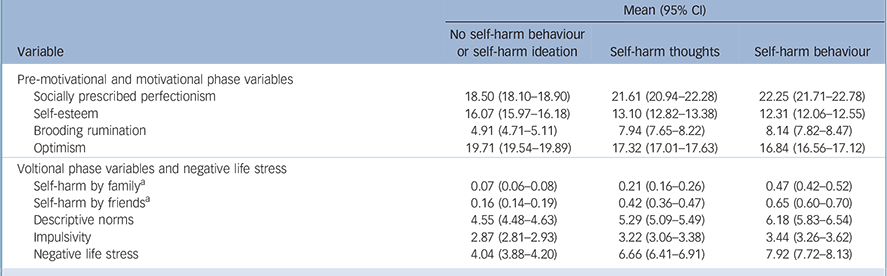
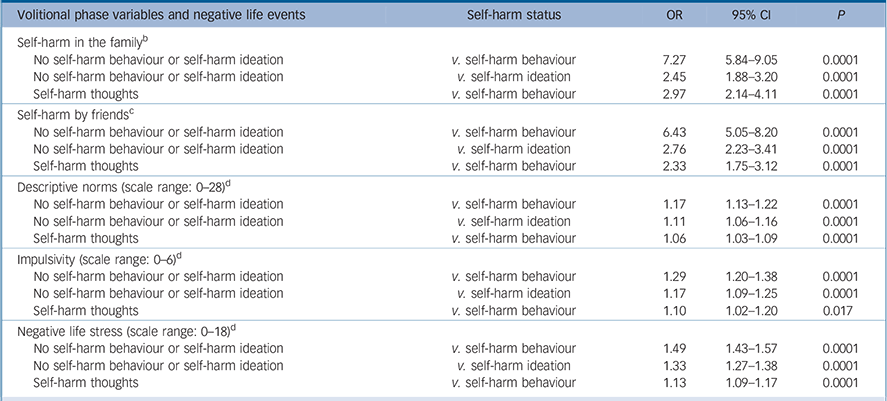
Both self-harm groups (ideators and enactors) differed significantly from the control group on socially prescribed perfectionism, brooding, self-esteem and optimism (i.e. the pre-motivational (background variables) and motivational phase variables) in the predicted directions (Table 1). In addition, ideators did not differ significantly from the enactors on any of these variables. The ideators and the enactors differed significantly from the control group and each other in the predicted directions on the volitional phase variables (self-harm by family, self-harm by friends, descriptive norms and impulsivity) and negative life stress (Table 2). The means and confidence intervals for each variable by self-harm status are presented in Table 3. Finally, when we entered those variables that significantly distinguished between ideators and enactors at the univariate level into a multivariate multinomial logistic regression to determine their relative contributions, being female (OR = 1.51, 95% CI 1.10-2.08, P = 0.014), having a family member (OR = 2.60, 95% CI 1.79-3.77, P = 0.0001) or close friend (OR = 1.80, 95% CI 1.28-2.52, P = 0.001) who had self-harmed and negative life stress (OR = 1.05, 95% CI 1.01-1.08, P = 0.021) emerged as significant distinguishing factors. Depression (OR = 1.04, 95% CI 1.00-1.08, P = 0.063) approached significance in the final model.
Discussion
Main findings
We found evidence to support both of our hypotheses. First, adolescents who were ideators or enactors differed significantly from the controls on the pre-motivational phase personality variables and motivational phase variables (i.e. socially prescribed perfectionism, self-esteem, brooding rumination and optimism). In addition, the ideators and enactors did not differ from each other on any of these measures. Second, it was the volitional phase variables (i.e. self-harm by family, self-harm by friends, descriptive norms and impulsivity) and the experience of negative life stress that distinguished the ideators from the enactors. Relative to ideators, those adolescents who acted on their thoughts of self-harm were significantly more likely to have a family member and/or close friend who had self-harmed, to believe that their
Univariate multinomial logistic regression analyses (adjusting for clustering and controlling for age, mood and gender) of the association between self-harm status and volitional phase variables and negative life events a

| Volitional phase variables and negative life events | Self-harm status | OR | 95% CI | P |
|---|---|---|---|---|
| Self-harm in the family b | ||||
| No self-harm behaviour or self-harm ideation | v. self-harm behaviour | 7.27 | 5.84–9.05 | 0.0001 |
| No self-harm behaviour or self-harm ideation | v. self-harm ideation | 2.45 | 1.88–3.20 | 0.0001 |
| Self-harm thoughts | v. self-harm behaviour | 2.97 | 2.14–4.11 | 0.0001 |
| Self-harm by friends c | ||||
| No self-harm behaviour or self-harm ideation | v. self-harm behaviour | 6.43 | 5.05–8.20 | 0.0001 |
| No self-harm behaviour or self-harm ideation | v. self-harm ideation | 2.76 | 2.23–3.41 | 0.0001 |
| Self-harm thoughts | v. self-harm behaviour | 2.33 | 1.75–3.12 | 0.0001 |
| Descriptive norms (scale range: 0–28) d | ||||
| No self-harm behaviour or self-harm ideation | v. self-harm behaviour | 1.17 | 1.13–1.22 | 0.0001 |
| No self-harm behaviour or self-harm ideation | v. self-harm ideation | 1.11 | 1.06–1.16 | 0.0001 |
| Self-harm thoughts | v. self-harm behaviour | 1.06 | 1.03–1.09 | 0.0001 |
| Impulsivity (scale range: 0–6) d | ||||
| No self-harm behaviour or self-harm ideation | v. self-harm behaviour | 1.29 | 1.20–1.38 | 0.0001 |
| No self-harm behaviour or self-harm ideation | v. self-harm ideation | 1.17 | 1.09–1.25 | 0.0001 |
| Self-harm thoughts | v. self-harm behaviour | 1.10 | 1.02–1.20 | 0.017 |
| Negative life stress (scale range: 0–18) d | ||||
| No self-harm behaviour or self-harm ideation | v. self-harm behaviour | 1.49 | 1.43–1.57 | 0.0001 |
| No self-harm behaviour or self-harm ideation | v. self-harm ideation | 1.33 | 1.27–1.38 | 0.0001 |
| Self-harm thoughts | v. self-harm behaviour | 1.13 | 1.09–1.17 | 0.0001 |
a Each of the pair-wise comparisons that is significant remains significant after applying Holm's sequential Bonferroni correction method.
b Exposure to family self-harm (n) is 309/4201, 142/673, 295/626 in the no self-harm history, ideator and enactor groups, respectively.
c Exposure to friends’ self-harm (n) is 687/4207, 280/673, 404/623 in the no self-harm history, ideator and enactor groups, respectively.
d As these are dimensional/continuous measures, the odds ratio represents each one point increase in score.
friends/peers engaged in self-harm (descriptive norms) and they were significantly more impulsive. Our findings are not explained by mood or age variations across the groups nor can they be attributed to clustering within schools. Moreover, in the final multivariate analyses, we included all univariate predictors as explanatory variables (including age, gender, anxiety and depression), and neither index of mood entered the final model to distinguish enactors from ideators (although there was a non-significant trend for depression).
We have extended the findings of previous studies of self-harm in adolescents considerably by providing evidence for a priori hypotheses derived from a theoretical model that makes specific predictions about the types of factors that are associated with behavioural enaction of self-harm. Reference Hawton, Rodham, Evans and Weatherall1,Reference McMahon, Reulbach, Corcoran, Keeley, Perry and Arensman9,Reference O'Connor, Rasmussen, Miles and Hawton11,Reference Hargus, Hawton and Rodham34 This is a significant advance as it moves beyond describing characteristics of self-harm phenomena to formulating inferential, theory-driven hypotheses about those factors that are associated with the development of self-harm thoughts v. those factors that facilitate the behavioural enaction of those thoughts. This is also the first study to
Means (and 95% confidence intervals adjusting for clustering) by self-harm status controlling for age, mood and gender
| Mean (95% CI) | |||
|---|---|---|---|
| Variable | No self-harm behaviour or self-harm ideation | Self-harm thoughts | Self-harm behaviour |
| Pre-motivational and motivational phase variables | |||
| Socially prescribed perfectionism | 18.50 (18.10–18.90) | 21.61 (20.94–22.28) | 22.25 (21.71–22.78) |
| Self-esteem | 16.07 (15.97–16.18) | 13.10 (12.82–13.38) | 12.31 (12.06–12.55) |
| Brooding rumination | 4.91 (4.71–5.11) | 7.94 (7.65–8.22) | 8.14 (7.82–8.47) |
| Optimism | 19.71 (19.54–19.89) | 17.32 (17.01–17.63) | 16.84 (16.56–17.12) |
| Voltional phase variables and negative life stress | |||
| Self-harm by family a | 0.07 (0.06–0.08) | 0.21 (0.16–0.26) | 0.47 (0.42–0.52) |
| Self-harm by friends a | 0.16 (0.14–0.19) | 0.42 (0.36–0.47) | 0.65 (0.60–0.70) |
| Descriptive norms | 4.55 (4.48–4.63) | 5.29 (5.09–5.49) | 6.18 (5.83–6.54) |
| Impulsivity | 2.87 (2.81–2.93) | 3.22 (3.06–3.38) | 3.44 (3.26–3.62) |
| Negative life stress | 4.04 (3.88–4.20) | 6.66 (6.41–6.91) | 7.92 (7.72–8.13) |
a To be consistent, means are presented (0 = no self-harm by family/friends, 1 = self-harm by family/friends). A similar pattern emerges if the data are presented as frequencies.
demonstrate that motivational factors do not distinguish ideators from enactors, rather that volitional factors and the extent of life stress seem to govern behavioural enaction, determining when thoughts of self-harm are translated into acts of self-harm. Of the volitional factors, having family or friends who have self-harmed was statistically the most important. This is in keeping with the notion that contagion is an important influence on self-harm in adolescents. Reference Hawton, Harriss and Rodham35 Although the rate of ideation is often reported to be higher than enaction in studies of this kind, Reference Schotte and Clum14 the lower rate of ideation in the present study reflects the fact that our ideator group is comprised only of those adolescents who have reported serious ideation and never acted on such thoughts, i.e. they are an ideator-only group.
Strengths and limitations
Key strengths of the study include it being based on a theoretical model of self-harm/suicidal behaviour and it comprises a large representative community sample of adolescents. However, as the present study has demonstrated, only an association between volitional phase factors and retrospective thoughts and behaviours, a large-scale prospective study is required to determine the extent to which volitional moderators and negative life stress actually predict those individuals with thoughts of self-harm who go on to engage in self-harm. Also, the volitional factors included here are not exhaustive; future research is required before we can generate a more definitive list of volitional factors that govern behavioural enaction. We also relied on self-reported incidence of thoughts of self-harm and actual self-harm. Despite the large sample of adolescents included in the study, the vast majority of those who reported/thought about self-harm were female thereby precluding reliable group analyses by gender in the present study.
Implications
This study provides support for the tripartite IMV model of self-harm/suicidal behaviour. It also helps establish self-harm as a ‘health’ behaviour, not just a sign of clinical disorder. Consequently, future research should examine the extent to which self-harm is amenable to established behaviour change techniques Reference Abraham and Michie36 as well as traditional therapeutic approaches. It also reinforces the view that we need to move beyond just psychiatric diagnosis to better understand self-destructive behaviours. Reference O'Connor, O'Connor, Platt and Gordon12,Reference Van Heeringen and van Heeringen37 It is also worth highlighting that the large sample size cannot account for the statistically significant differences between ideators and enactors on the univariate volitional phase variables. If these differences were statistical artefacts, one would expect to find similar differences among the pre-motivational phase personality and motivational phase variables. No such differences were evident. The implications for clinical practice and prevention are also considerable.
First, the present findings suggest that it may be important in therapy to use psychosocial interventions that differentially address the pre-motivational/motivational and the volitional phases of self-harm. For example, a cognitive-behavioural intervention could address some of the underlying processes that contribute to the development of thoughts of self-harm. Reference Wenzel, Brown and Beck38 These may include tackling perfectionistic beliefs or brooding rumination. In addition, a behaviour change-based intervention may be used to address the effect of exposure to self-harm on behavioural enaction. Reference Abraham and Michie36,Reference Dixon and Johnston39 From a public health perspective one might consider interventions to try to modify adolescent norms associated with self-harm.
Second, these findings also provide guidance on the types of questions and issues that clinicians may wish to address if a young person discloses having thoughts of self-harm. Asking about exposure to self-harm by others could be beneficial, as could a closer inspection of the individual's propensity to be impulsive.
Given the apparent role of so-called exposure or social learning variables (i.e. self-harm of others) in the aetiology of self-harm enaction, future research should investigate potential mechanisms to explain how they bridge the self-harm thoughts-behaviour gap. In another component of the present study, we obtained some evidence for social learning and legitimisation of self-harm explanations (such as an adolescent saying ‘if it is okay for my mother to self-harm when she is under pressure, it is okay for me to do so as well’). Reference O'Connor, Fraser, Whyte, MacHale and Masterton22 Using data from the CASE study in England, Hargus et al Reference Hargus, Hawton and Rodham34 found that adolescents who explained their self-harm in terms of being suicidal were more likely to have family members who had died by suicide than those who explained their self-harm in other ways, who were more likely to have friends who had self-harmed. Thus, the context and nature of the exposure to others who have self-harmed may be important. We also need to determine the role of such factors in repeat self-harm v. single-episode self-harm as well as among those expressing suicidal intent v. those who do not.
Funding
The Northern Ireland Lifestyle and Coping Survey was funded by the Department of Health, Social Services and Public Safety (NI) and supported by the Department of Education (NI).
Acknowledgements
Thanks to staff and pupils at the schools in Scotland and Northern Ireland for their participation. Thanks also to Michelle Scott who coordinated the data collection in Northern Ireland and Dr Jeremy Miles for statistical advice. K.H. is a National Institute for Health Research Senior Investigator.






eLetters
No eLetters have been published for this article.