I
Like much of the West Riding, Rigton was a late adopter of the Poor Law Amendment Act of 1834, not joining a New Poor Law Union until 1861. This continued relative autonomy from the centralised authority of the Poor Law Commission at Somerset House was substantively due to its situation within the largest Gilbert Union in the country. Gilbert's Act of 1782 enabled townships to combine to share a workhouse situated at most ten miles from each of them.Footnote 2 Other than this shared provision however, townships operated independently. Reporting on the West Riding Gilbert Unions, Poor Law Commissioner Alfred Power observed:
the guardians do not as a body undertake the relief of the poor in the several townships; they merely have the occupation of a common workhouse, and their meetings take place only monthly, for the purpose of settling the monthly accounts of the workhouse, and paying their proportions.Footnote 3
The existence of four such Gilbert Unions, encompassing 160 townships around Leeds and towards York, and centred on Carlton (in Guiseley parish), Great Ouseburn, Barwick-in-Elmet and Great Preston, obstructed the formation of spatially coherent unions which could operate under the New Poor Law. As the Commissioners noted:
[T]ownships . . . are frequently intermixed with the townships of other [Gilbert] Unions, while a great number . . . closely adjoining . . . are not included in any of the Unions; and the whole number so omitted is about equal to the number included. The entire tract therefore comprises about 300 townships[.]Footnote 4
Rigton, the most populous township in the parish of Kirkby Overblow, joined the Carlton Union in 1826.Footnote 5 This union also included seven of the ten out-townships of the Borough of Leeds, boosting its combined population to 59,778 in 1841.Footnote 6 The union's workhouse was in the small township of Carlton, northwest of Leeds: a converted farmhouse, it housed a maximum of one hundred paupers.Footnote 7 Consequently the prevalence of outdoor-relief was pronounced: whilst, in 1846 and 1847, the national proportion of those in receipt of indoor-relief was over 13%, and in the West Riding 6%, only 2% of Carlton Union paupers were relieved in the workhouse. In February 1846 the Carlton Union's members relieved more paupers (2,310) than three English counties: Westmorland (2,125), Rutland (927), and Huntingdonshire (2,270).Footnote 8 Some recent overviews surprisingly contend that all Gilbert Unions were ‘in the East, South-east, and Midlands’.Footnote 9 The error probably stems from the Webbs.Footnote 10 Other studies have, however, recognised the existence of the Gilbert Unions in the West Riding. Michael Rose acknowledged they were a barrier to the introduction of the New Poor Law, and Roger Wells noted ‘concentrations of obdurate Gilbert Unions in . . . the West Riding’.Footnote 11 The existence and size of these sprawling incorporations helps explain the late adoption of the New Poor Law in the region. Not only could Gilbert townships administer relief with relative autonomy, and a continued emphasis upon outdoor-relief, but so might townships interspersed between them. Rigton remained independent of the more centralised administration of the New Poor Law until it quit its Gilbert incorporation and joined the Wetherby Union in 1861; the validity of it and eight other townships' membership having been negated at the Queen's Bench in 1860.Footnote 12 However, other townships, including several from Leeds, remained within the Carlton Union until 1869, when these incorporations were finally dissolved following the repeal of Gilbert's Act.
This article, establishing the critical role of the West Riding Gilbert Unions in delaying the full implementation of the New Poor Law, investigates the nature of relief in one of the incorporated townships of the most populous Gilbert Union in the country. Their importance in the region has hitherto been neglected or misconceived, whilst the focus of the West Riding's resistance to the New Poor Law has emphasised the antagonism in urban settings, rather than existing structures. The parishes of Bradford and Huddersfield, where hostility was pronounced,Footnote 13 had only one Gilbert incorporated township between them (Eccleshill in Bradford), whereas Leeds had seven, with most of its surrounding townships additionally in Gilbert Unions. In reconstructing Rigton, and by the biographical reconstitution of its historical actors (particularly two generations of a labouring family), this article evaluates the changing economies and strategies of the northern rural labouring poor from the time of the French Wars to beyond the incorporation of the township into a New Poor Law Union in 1861. Following an overview of the methodology employed, it assesses the demographics of the township and the administration of poor relief within it, and evaluates the levels of relief and other mechanisms' roles. After investigating the economies of Rigton's labouring poor, their wages, and the necessary ancillary strategies open to them, it presents narrative biographical reconstitutions that highlight those changing economies and strategies, including township relief, across two generations of the same family. In conclusion it argues that whilst the township's incorporation in a Gilbert Union protected its poor from the workhouse culture of the New Poor Law, and aspects of parochial welfare remained intact (most notably the provision of social housing), it emphasises that the eradication of outdoor relief to able-bodied men, that central tenet of the Poor Law Amendment Act, occurred nonetheless, and was replaced by almost universal male subscription to a local Friendly Society.
As Henry French has highlighted, assembling ‘pauper biographies’ might help evaluate ‘the flows of relief across the life-course’, and he highlights the work of Samantha Shave and Samantha Williams in this field.Footnote 14 Their studies reconstitute the lives of paupers in communities in the southern counties of Dorset and Bedfordshire, in the years leading up to the Poor Law Amendment Act. This microhistory, at least partially because of the late local adoption of the New Poor Law, encompasses a later chronology, and is undertaken in a northern rural community. In iterating his own microhistorical premises Barry Reay cited Keith Wrighton's ‘total history’ approach, ‘the assembly of every discoverable record relating to a particular locality and the attempt to obtain as full a picture of local life as the sources permit’.Footnote 15 The methodology underpinning this article is founded in that approach, and builds from the reconstruction of a community, to reconstituting individual lives and families, and placing those lives within the contexts of the community. Reay developed Pamela Sharpe's vision of ‘total reconstitution’, linking the Cambridge Group for the History of Population and Social Structure (CAMPOP)’s family reconstitutions with a large variety of other sources, whilst Williams focused on the nominal linkage of all poor law records with the family reconstitution data for Campton and Shefford.Footnote 16 Jeremy Boulton and the Pauper Biographies Project combine the particularly rich records of the large Metropolitan parish, St Martin-in-the-Fields to ‘reconstruct the lives of the poor’ of the long eighteenth century, whilst Shave has constructed microhistorical biographies and relief time charts for individuals without CAMPOP data, for Motcombe in Devon, based on the linkage of ‘relief histories to demographic data’.Footnote 17
Rigton, or rather its parent parish, Kirkby Overblow, is not one of CAMPOP's reconstitution parishes. However, the parish church of All Saints has had its records of baptism, marriage and burial digitised as part of West Yorkshire Archive Service (WYAS)’s programme of comprehensive digitisation of parish and other records; these are presented online on a commercial platform.Footnote 18 Rigton township records, conventionally archived, and held at Harrogate Central Library (HCL), with additional material at Yorkshire Archaeological Society (YAS), are very rich, and include the accounts of overseers, surveyors, constables and churchwardens, along with vestry minutes, measurements and valuations, farmers' accounts, poor rate books, apprenticeship indentures, and Friendly Society minutes and accounts. Transcribing and linking these with all other available records for the community, and the families and individuals who lived and worked in that community, has constituted the groundwork of this research. This linkage has taken advantage of the digitisation of locally held parish records, noted above, and also census returns by The National Archives (TNA), along with the exhaustive digitisation of parliamentary papers.Footnote 19
Overseers' accounts are the initial and major focus of the reconstitution process, and datasets expressed in terms of individuals, and their cycles of relief over time (initially by financial year, as per the records) are constructed. These then form the basis of a large alphabetical dataset, of all those individuals who had an interaction with poor relief across the chronology of this article. Named occurrences in the other township records are then transposed into this cross-referenced dataset. Additionally, for the later period, a transcription of the 1851 census of the township has been annotated with individuals' interfaces with poor relief, rate-paying status, and for the elites, local office holding. Life cycle biographies of individuals and their families are then made. These are constructed chronologically and form a timeline of incidences of interactions with relief; into this timeline are inserted biographical details, birth and baptism, marriage, and burial, along with information from census returns, local valuation and rating, and Friendly Society records. In the process of exposition, the methodology of narrative biographical reconstitution, built upon a contextual social and demographic framework, inferences of life cycle economies and strategies, the constraints and agencies of the poor, are revealed.
II
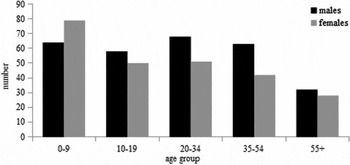
Francis Simpson was an agricultural labourer born into poverty in Rigton in 1824. Reconstituting his, his siblings' and parents' life cycles enables a fine-grained investigation into the complex and changing coping strategies of labourers and their interactions within a rural community.Footnote 20 Rigton was a predominantly agricultural township, whose population was stagnating: in 1821 it had 429 inhabitants; by 1851 it had risen by just 8%.Footnote 21 In 1831, sixty-five of its ninety families were ‘chiefly employed’ in agriculture: of 106 males aged twenty or over sixty-four were described as labourers.Footnote 22 In 1841 labourers (including girls or women designated ‘female servant’), and labourers' families, comprised 53% of Rigton's population aged ten or over.Footnote 23 Rural stagnation was marked by gender and age group imbalances. Pat Hudson argues that ‘migration patterns . . . thrown up by sex-specific movement are fundamental to our understanding of demography and labour supply in the industrial revolution’.Footnote 24 Localised migration was female-led, with girls and young women finding work in service and, particularly, textile mills. The Borough of Leeds' population was 51.5% female in 1841; Rigton's was 46.7% female, having fallen from 47.7% in 1831.Footnote 25 Leaching of Rigton's young female population to manufacturing areas during this period resulted, by 1841, in a pronounced imbalance among the family-raising age groups, 20–34 and 35–54 (Figure 1). This was reflected in marriage levels: by 1851 there were twenty bachelors aged thirty-five or over, but only seven spinsters. Francis Simpson's brother James, also an agricultural labourer, remained in Rigton and unmarried, living with his aged mother until his death in 1874. Female-driven (and, via parental agency, child-driven) migration is illustrated in the reconstitutions; Francis's widowed sister Mary and her three youngest children moved to the textile manufacturing township of Idle around 1849, where Mary found her children work in the worsted mills.
Number of males and females by age group. Rigton, 1841.

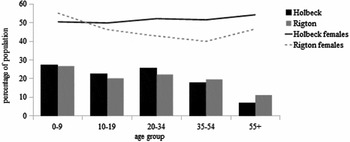
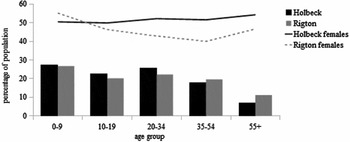
Comparison with a textile manufacturing township, Holbeck, in the Borough of Leeds, reveals contrasting gender proportions across age groups. Holbeck contained large flax mills, including Marshall's, which employed 1,234 by 1834, 786 (63%) of whom were female.Footnote 26 Migration of young females from agricultural to industrial localities impacted on both communities' gender profiles and age profiles (Figure 2). By 1841 Rigton had a smaller proportion of its population in the more productive age groups, 10–19 and 20–34, than the industrialised township, and a higher proportion in the less productive, 55+. An older population would engender more pension payments: that year Rigton levied a poor rate equal to 6s 4½d per head of population; Holbeck levied 4s 9d per head.Footnote 27 Francis Simpson's parents Thomas and Lydia received a township couple's pension of 5s a week until Thomas's death when Lydia received a pension of 2s 6d per week, alongside social housing and free healthcare, at least until the township's incorporation into the Wetherby Union in 1861.
Gender balance by age group and age groups as a proportion of the population. Rigton and Holbeck, 1841.
The administration of poor relief in Rigton was governed by a select vestry in accordance with the Sturges Bourne Acts of 1818 and 1819, adopted with some enthusiasm in Yorkshire and the industrialising north more generally, as Anthony Brundage and Steven King have noted.Footnote 28 Vestry minutes of December 1831, the first in a new minute book, record the election of ‘eleven substantial householders and occupiers’.Footnote 29 However, there are indications that a select vestry was in operation earlier; minutes from November 1818, detailing the employment of the poor in breaking stones, was ‘signed and allowed by’ eleven ratepayers. All but one of them held or would hold township office.Footnote 30 Rigton had taken advantage of the Sturges Bourne reforms that effectively devolved, or at least consolidated, local power to oligarchies of middling-sorts: legislation that ‘systematised parish government and did so exclusively in the interests of the elite’.Footnote 31 All nineteen farmers who held land of over fifty acres in 1838 held township office, all but one serving as overseer between 1820 and 1861. Just as farms passed down the generations, so did administrative roles. Additionally, seven farmers of fewer than fifty acres also fulfilled the office of overseer. A cut-off point for eligibility for service based on land-holding or ratepaying, at around twelve or thirteen acres, or £15–£17 rateable value, appears to have operated. The office of constable, however, was more open than that of overseer to lower status individuals, including tradesmen who had small-holdings. Whilst the posts of surveyor and overseer involved distribution of monies from the rates, that of constable, at least from 1829–30, did not; he was impursed by the overseer for expenses. A hierarchy of office, and of responsibility or trust, based on land and rateable value is apparent. Because of its incorporation in a Gilbert Union, the administration of poor relief in the township continued autonomously in the tradition of the old poor law and overseers were responsible to vestry alone, and not to a board of guardians until 1861.
III
Those without land or property qualification did not hold office, nor were they members of the select vestry. This group of thirty-four householders comprised those in need of township relief. Of twenty-eight householders in 1838, described as labourers in 1841, nineteen (68%), would at some point be in receipt of poor relief from Rigton township, rising to twenty-three (82%), if solely medical relief is included. Township relief was a significant part of the survival strategies of most labouring families, particularly up to the 1840s.
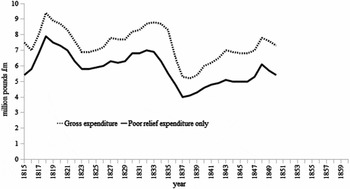
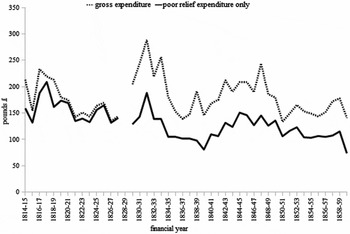
After the French wars, national relief expenditure rose steeply.Footnote 32 However, Sturges Bourne's legislation may have ‘achieved its stated objective in reducing relief costs’:Footnote 33 the trend, despite rising in the 1820s and 1830s, was an overall fall in poor relief costs between 1820 and 1850 (Figure 3). This fall, and the major troughs and peaks of expenditure, were mirrored in Rigton, despite the township's non-adoption of the New Poor Law (Figure 4).
Gross welfare expenditure and net poor relief expenditure. England, 1815–50.

Gross welfare expenditure and net poor relief expenditure. Rigton, 1815–61.

It is tempting to cite such close comparisons as a reason to expound Rigton as a microcosmic exemplar of national trends. However, as Steven King argues, attaching clear meaning to fluctuations in expenditure, both nationally and locally, is problematic.Footnote 34 Very particular and changing needs in a small community might determine such fluctuations. For example, workhouse expenditure was similar for 1833–4 and 1843–4, £11 to £12 per annum, but in 1853–4 spending was almost £20, implying greater reliance on workhouse provision, and less on outdoor-relief, but the earlier years saw only one Rigton pauper in Carlton Workhouse and 1853–4 two, as the unfortunate, ‘weakminded’, Eden Patrick, in and out of the workhouse since her illegitimate birth in 1822, was re-admitted that year.Footnote 35
Relief mechanisms were not restricted to township relief. While in some areas charity played a major role (for example charities in Odiham, Hampshire relieved its poor with a full package of provision), in Rigton charitable relief was minimal, with no records of distributions in the churchwardens' accounts (which survive up to 1825).Footnote 36 Neither Rigton, nor Kirkby Overblow parish, are listed amongst Yorkshire charity providers in the 1826 parliamentary report.Footnote 37 However, some small bequests are listed in the 1843 inquiry, and the parish curate detailed these: distributions to the poor of the parish in corn and wheat, and clothes for ‘six Poor Girls, to go to church in on Sundays’.Footnote 38 Yet the township had both a school and a Sunday school.Footnote 39 School fees might be paid by the township: orphan George Briggs's fees were paid by the overseer in 1858, whilst in 1809 the constable's accounts record the payment of £5, Francis Ingle's ‘yearly allowance for teaching 4 Poor Children to read’. His allowance was still being paid out of the rates in 1822.Footnote 40
Although charity provided little economic succour, a local Friendly Society contributed significantly to the poor's welfare during the later part of this investigation.Footnote 41 The society was established in 1827, and admitted new members aged eighteen to thirty-five.Footnote 42 Subscription rates are uncertain, but were probably around 2s 6d quarterly: Askrigg (Wensleydale) Society, charged this amount in 1833, rising to 3s in 1876, whilst textiles operative David Brook also paid half-a-crown quarterly in Leeds in 1832.Footnote 43 During the later 1840s payments to cover sickness escalated. Although membership rose gradually from 91 in 1846 to 112 in 1850, payments rose six-fold, from seventeen sick days to ninety-eight: funeral payments also increased. Subscribers who joined in the society's early years would be in their late fifties and beginning to find sustaining the fitness and health for manual labour difficult. This is comparable with increases in pre-pension poor relief payments, which can be detected from analysis of overseers' accounts, to those ineligible for society membership, or in receipt of township relief prior to the formation of the society: for example, relief termed ‘pay’, the usual nomenclature for a pension, given to Thomas Simpson in his fifties, discussed later. Those over sixty at the 1851 census would have been disqualified from joining by age restrictions (being thirty-six or over in 1827), consequently the following calculation includes only males aged eighteen to fifty-nine at the time of the census: 127 males fulfilled that criteria, and the returns state 120 society members, suggesting almost universal subscription, although there were probably also members who had moved away from Rigton.Footnote 44
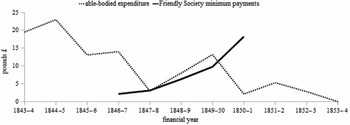
Biographical reconstitution of poor relief recipients determines those in receipt of able-bodied relief; annual amounts of such relief might then by collated with Friendly Society payments. Potential payments of society sick pay has been levelled at 2s 6d (the rule-of-thumb weekly ‘Town's pay’), funeral costs a minimal 40s. Indeed, in 1893, the first year from which Rigton Friendly Society accounts survive, 2s 6d was the most common amount of weekly sick pay: payments descended a sliding scale, starting at 8s, to this amount over time, corresponding with the length and frequency of an individual's claims.Footnote 45 Although spending on able-bodied relief fluctuated, the overall trend was a decline to zero spending; commensurately Friendly Society payments rose steeply (Figure 5).
Able-bodied relief (1843–54), and minimum Rigton Friendly Society payments (1846–50).

Although, as discussed later, medical care and social housing remained in the township's remit, at least until 1861, Friendly Society payments replaced township relief for the able-bodied during this later period. Sick pay became self-funded, and the ratepayers' duty of care, and decreased overall expenditure, became primarily restricted to widows, orphans and the elderly. Francis and James Simpson were members of the Rigton Friendly Society, and both served on its committee: unlike the vestry, the society's governance was more egalitarian. In later life Francis needed its insurance: in his late sixties, he became too sick to work and had six months sick pay; the first seventeen weeks at 8s weekly, the rest at 6s. A few years later, seventy-two-year-old Francis again received sick pay: the first five weeks at 6s, descending to the minimum 2s 6d per week – the same amount his mother and other pensioners had received in township pensions half a century before.Footnote 46
IV
Even in full employment, agricultural labourers' wages alone were rarely sufficient to sustain a family. As Arthur Young highlighted with regard to Sussex, ‘the wages of labour are inadequate to the price of provisions’.Footnote 47 Consequently rural labourers were most in need of local relief mechanisms and ancillary survival strategies. Though northern labourers were regarded as better off than southern workers,Footnote 48 Yorkshire wages were hardly more sufficient. Progressing down Wharfedale in 1850–1, James Caird observed ‘farm labourers are paid 12s. to 14s. a week’.Footnote 49 Comparison with Rigton's five closest neighbouring townships that answered the Poor Law Commission's 1834 query regarding agricultural labourers' wages suggests reasonable concurrence.Footnote 50 However, the accounts books of two generations of Rigton farmers disclose these may be somewhat optimistic appraisals. Isaac Denison and his son each employed one regular labourer, supplemented by casual labour. Thomas Wade, in his forties, received a regular weekly wage of 10s 6d between 1808 and 1813; Thomas Clapham, in his fifties, commanded just 10s weekly in 1827.Footnote 51 Wages increased only very gradually over the chronology of this investigation: as Alan Armstrong concludes ‘noticeable advance in real earnings’ did not begin until around 1869.Footnote 52
Contemporary budgetary studies highlight their inadequacy. Barry Reay details a Berkshire labouring family of the 1860s: two adults and four children under ten spent almost 16s weekly (74% on food), whilst the whole family's average total earnings was only 14s 10d. In 1832 Leeds flax-spinner and one-time acolyte of Richard Carlile, Humphrey Boyle estimated the lowest weekly wage that would procure ‘a sufficiency of food, clothing & other necessaries’ for a family of five as 20s 3d (62% on food).Footnote 53 An enquiry of 1863 reveals that almost half of a sample of thirty-two Yorkshire rural labourers' households reportedly consumed a weekly monetary ‘value of food’ exceeding their total income once rent was deducted.Footnote 54
Wages were below subsistence, and not the sole contributor to the labouring poor's economies. Even in full employment ancillary coping strategies had to be in place. Young highlighted this:
Those labourers who can rent a cottage and garden, can frequently keep poultry and fatten a hog; and all have frequent and great help from the charitable and considerable farmers, such as milk, broth and inferior meat, which must make the deficiencies of earnings.Footnote 55
Many such strategies, as Samantha Williams notes, defy quantification.Footnote 56 Foraging for food, firewood, and acorns for pigs would be, as Reay notes, commonplace, and a role children might undertake; similarly, the taking of small perquisites from the fields, scrumping, and poaching rabbits might tacitly be condoned.Footnote 57 Indeed, there is no mention of apprehensions for poaching in the Rigton constables' accounts. Wages paid to wives and children could contribute significantly to a family's economy. In 1841, Yorkshire agricultural labourer Joseph Allen's wife and young son contributed 29% (over £8 and almost £6 respectively) of the family's monetary income that year.Footnote 58 Nicola Verdon has discussed the variable levels of rural women's earnings, concluding they were important though not necessarily ‘central to the family economy’.Footnote 59 However, such earnings barely figure in Rigton farmer Denison's accounts: the only such entry being 6s paid to a labourer's wife at harvest in 1809.Footnote 60 Gleaning rights may also not have been as widespread, nor such ‘a vital piece in the jigsaw of makeshifts’ as Peter King has argued for central and eastern England.Footnote 61 A newspaper correspondent in 1839 decried that around Leeds and elsewhere in the West Riding, farmers refused to let the poor glean ‘until all the corn is removed from the fields, and in some instances to enter at all’.Footnote 62 However, Rigton labourers may have had additional employment beating, like the ‘staff of beaters’ consisting of farm labourers in a newspaper account of another West Riding grouse shoot, as Kirby Overblow's parson owned over 500 acres of moorland and high pasture in the township, and held a game certificate.Footnote 63
Although some remain unquantifiable, it is possible to identify a range of ancillary strategies. Thomas Clapham would have been unable to feed a family on his meagre wages, and supplementary strategies must have been deployed. One such was bulk purchasing from his employer, possibly at cost, or wages supplemented by grain: in 1826 he bought half a sack of wheat (two and a half bushels, or ten stone) for 14s, whilst the following January he was paid the same amount of wheat alongside his wages.Footnote 64 Thomas rented a cottage and garden of seven perches (c. 212 square yards), sufficient for vegetable cultivation and keeping a pig and fowl.Footnote 65 By way of a comparison, a modern allotment has an ‘accepted size’ of ten perches.Footnote 66 However, there is little evidence that Rigton labourers were significantly the beneficiaries of the allotment movement. At the 1838 valuation, two, both at one time in receipt of poor relief, occupied small parcels of land, including Thomas Shutt's fifty-six perches of meadowland belonging to Benjamin Kent, a plot size corresponding with that indicated by Burchardt for the period, fifty-one perches.Footnote 67 However, maps, which clearly delineate allotments in other, relatively local townships, for example Burley-in-Wharfedale, show none in Rigton.Footnote 68
John Simon observed that Yorkshire families might be ‘able to keep [a] cow in the lanes gratuitously’, although some ‘were compelled by the parish to pay for the food which the cow obtained’.Footnote 69 Rigton surveyors' accounts often record amounts ‘received by cow gates in the lains’. Whilst these amounts are usually aggregated and anonymised, in 1811–12 individuals who each paid 10s 6d annually for ‘road beasts’ were named. They were almost all farm labourers, many recipients of relief. In 1815 and 1816, payees were also listed and included Thomas Clapham, who paid 16s for two years for one cow, whilst seven of the twelve kept two cows. Keeping a cow might significantly contribute to a family's economy: Jane Humphries suggests that the poor in the late eighteenth century, grazing animals on common land, ‘valued their cows round 5s or 6s each per week’.Footnote 70 Leigh Shaw-Taylor argues that cow-keeping on commons, in samples from Cambridgeshire, was undertaken by ‘insignificant through to substantial minorities’ of labourers.Footnote 71 Of the twelve lane-cow keepers in Rigton in 1816, at least nine can be identified as labourers (or a labourer's widow), over 30% of labourer heads of household. Six received poor relief: keeping an animal here did not preclude relief. The practice continued throughout the period. Vestry minutes of October 1865 record a resolution to reduce charges with 2s returned ‘to each of the parties that have been charged 15s each for the Gate of their Cows’. A month later the vestry clamped down on roaming pigs, resolving that henceforth ‘no Pigs be allowed to wander about the Streets or Lanes within this Township . . . without being properly tended’, suggesting that (tended) pig-grazing in the lanes was also allowed. Confirmation of continuing grazing of labourers' cows in the lanes is also evident in a resolution of May 1867:
Cottagers of this Township be allowed to have their Cows upon the Lanes from the 6th day of May until the 23rd day of Nov in the present year, subject to the following restrictions viz that they pay after the rate of [between] 10/- per head . . . & 12/- per head . . . That each person should obtain a proper Licence. That they are tended by day and taken up at night (They are not to be tended by children).
Thirteen owners of lane-cows, including Francis Simpson, signed vestry minutes agreeing to these conditions.Footnote 72
V
Local relief mechanisms would also have an important role in these makeshift economies, but their nature and significance changed over time. Developing linkage methodology into reconstituting two generations of families, and their differing interactions within the community permits deeper insight into poverty and its mitigation. Eight biographical reconstitutions of Rigton families have been made.Footnote 73 Their selection criteria are intended to show the variety of causes of, interactions with, and strategies against, poverty in that community. There is not space here to recount the narratives of all eight families. In selecting just one, several criteria were appraised: how representative were they of families of poverty? Did their life cycles encompass the timespan of the investigation? How well documented were the lives of its members? Which might most illuminate the understanding of those causes, interactions and strategies? The Simpsons best fulfilled those criteria.
Francis Simpson's parents Thomas and Lydia began their married life in 1811, in Beamsley, a township that would also become a member of the Carlton Union, fourteen miles west of Rigton. The family first received non-resident relief from the Rigton overseer in 1812, when their first child Mary was toddling and Lydia pregnant with their second. It is unrecorded how Thomas acquired his Rigton settlement (his parentage was in Weston, betwixt Beamsley and Rigton) and is assumed he did youthful service on a Rigton farm for more than a year, or was apprenticed there.Footnote 74 The family, with four children born in Beamsley received a variety of non-resident relief: casual payments, and clusters of payments both in cash and in kind (cotton and coals) when Lydia was lying-in. Most casual payments to Rigton's poor were typically a couple of shillings and only occasionally up to 5s or so for a single week. However, during particular times of crisis, like Lydia's confinement when the family received 10s 6d (equivalent to a labourer's weekly wage), payment levels might, albeit very temporarily, exceed Steven King's estimate that ‘the relief system could only have provided a family of five with a maximum of 42 per cent of the living standard of a similar family in work’.Footnote 75 But the largest relief component by far received by the Simpsons was housing allowance: payments amounting to full rental costs were paid half-yearly in most years.
In 1817 Thomas began to receive more regular casual relief payments. This triggered the family's removal to Rigton the following year. Ancillary survival strategies would be less readily available for newcomers. Garden produce required an established garden: keeping a pig, poultry, or a lane-cow needed capital, and the latter local social acceptance, as might other strategies. Acceptance and integration of an incomer family whose head had obtained settlement by youthful service (perhaps for as little as one year) would have disrupted community dynamics. K. D. M. Snell has revealed a community's poor acting in concord with ratepaying middling-sorts in settlement disputes against potential claimants. Antagonism may have manifested itself in resentment of the incoming removed, like the Simpsons, as additional claimants on already ‘marginal local resources’, not just poor relief, but employment opportunities, gleaning, foraging and other perquisites.Footnote 76 This was more likely, given they had no family locally to help them. In their first two full years after arriving in Rigton, the Simpsons received almost treble the relief in cash, coals and goods, including a bakestone, harden (canvas) for making a bed, and bedding, than in their next two more consolidated years, despite the arrival of a fifth child during that time. And the town continued to pay their 52s a year rent. Indeed, during these years 20% of all Rigton overseers' distributions were specifically rental payments (money that would return to ratepaying landlords), or towards housing repairs.
All six of Lydia's children survived into adulthood. In 1824, when confined with her last child, Francis, Lydia was assisted at the Town's expense by midwife/wise-woman Ann Wilkinson. Such assistance was provided when births were potentially complicated, and a longer interval between Lydia's fifth and sixth child may suggest a recent miscarriage or stillbirth. Neighbour Elizabeth Mountain had a complicated birth with her sixth child, who died in infancy: a bill of 20s was paid to a specialist surgeon, not the regular salaried Town's surgeon, for attending her in 1833. Elizabeth's next and last confinement was, like Lydia's, attended by Ann Wilkinson. However, nursing and caring attendance of the labouring poor by the labouring poor, paid for by the township, was less prevalent in Rigton than in the Bedfordshire communities, Campton and Shefford.Footnote 77 Free healthcare, in the form of attendance by the salaried town's surgeon was available for the labouring poor throughout the chronology of this investigation. Lydia's name was on the vestry minutes list of ‘those poor whom the surgeon’ was ‘requested to attend upon in sickness’ in 1855, and in 1859. As elsewhere, Rigton's children benefitted from the Vaccination Act of 1840, and an inoculation programme began in February 1842 when thirty-six children were vaccinated at the cost to the ratepayers of 1s each.
Coincidental with Francis's arrival the family were moved into social housing. The cottage windows were glazed in anticipation of its new tenants, and a saving in heating costs. Four other Town's cottages' windows were glazed concurrently in 1817. The cottages were regularly whitewashed and rethatched. The township housing stock consisted of, up to the 1840s, six cottages; by 1849 it had been reduced to one row of five (still standing and of substantial stone construction). Hitherto rent-free, a peppercorn rent of between 1s and 2s 6d per annum was levied from this time. Social housing remained a linchpin of Rigton's welfare system until 1863, when the vestry consented to ‘the Guardians of the Poor of the Wetherby Union’ selling the four remaining Town's cottages, citing the act which allowed it.Footnote 78 This is a later illustration of the ‘disposal programme’ of ‘Thatcherite antecedent’ in Roger Wells's discourse. Lydia Simpson, and bachelor son James lived in their Town's cottage until this time, their tenancy protected by their township belonging to a Gilbert Union, sheltered from the selling-off of social housing that Wells highlights as a tenet of the 1834 Poor Law Report: ‘parish-owned stock [and] assistance towards tenants’ rents' were ‘systematically undermined, if not eradicated, by the PLC [Poor Law Commission]’.Footnote 79
Certain tenancy stipulations were in force. By 1851 Francis had returned from live-in farm service to live with his widowed mother. They shared the cottage with Francis's seventeen-year-old nephew Hugh Brumfitt, and twenty-four-year-old Sarah Mountain, daughter of socially-housed neighbours. Francis's brother James, in reciprocation, lodged at the Mountain's Town's cottage, an inner cottage on the same row. It might be deduced then that these were two-bedroomed, and both gender propriety and maximised accommodation were maintained by separating poor families. Thus at the Simpson's Sarah Mountain would share a room with Lydia, while Francis shared with nephew Hugh. At the Mountain's, husband and wife John and Elizabeth would share a room, while son John shared with James Simpson. The nine perches of land that the end cottage and garden occupied gave the family opportunity to grow vegetables and potatoes, and perhaps keep a pig or poultry. From 1825, with housing provided and some potential supplementary food economies in place, Thomas and Lydia kept their family (in 1825 comprising Mary (fourteen), John (twelve), Ann (ten), Thomas (seven), James (four), and Francis (one)) with only slight and intermittent recourse to casual relief.
However, at this time the Simpson children began to be boarded out by the township. John was kitted out with an unusually substantial wardrobe: clothing and footwear to the cost of about £6, including making up ‘a suit of clothes’, several pairs of shoes, clogs, shirts, stockings, a hat and even a handkerchief, suggesting that John was found a place in domestic service. As Peter Jones has argued regarding the south of England, ‘parishes employed a very specific strategy to get pauper children into service: they furnished and maintained them with sufficient quantities of good quality clothing’.Footnote 80 Two years later Ann and Thomas were also boarded out: both had allowances of 40s paid to their new masters, and were amongst a group of five children whose allowances, all 40s, were recorded concurrently. There is no record of the eldest, Mary being placed by the township: she may have had greater relative economic value undertaking domestic work at home. However, in addition to indentured apprenticeships, non-indentured placements, like John's, and township-funded boarding out, informal, and unrecorded, boarding out arrangements often occurred. The placing of children might be an imposition. In December 1833 vestry resolved that Thomas have ‘no more relief until his two sons [James and Francis] are put out apprentice’. In May that year, vestry had declared that James, along with two other children ‘be put out as Towns Apprentice’. One indenture, for Eden Patrick, survives: aged eleven, she was apprenticed to a farmer. However, James Simpson was not put out concurrently, but finally apprenticed to a widowed farmer in January 1834, after vestry stopped his father's relief. James's father was paid 3s by the overseer for expenses at Knaresborough when having the apprenticing verified before the magistrate. The indenture identifies thirteen-year-old James as ‘a Poor Child, of the said Township (whose parents are not able to maintain him)’, and was signed by the overseers and churchwarden. Pauper apprentices, as those in Rigton illustrate, were far less likely to be indentured into the thorough learning of a skilled trade, to which the term ‘apprenticeship’ is traditionally applied.Footnote 81 There is no record of Francis's apprenticeship. Francis, however, would be boarded out in Rigton, although no formal payments or arrangements are recorded. The 1841 census records him at the farm of John Wilkinson, the overseer who apprenticed his brother, as a ‘male servant’, enumerator's terminology for a young live-in farm labourer. The resolution disallowing Thomas relief was qualified within a year.
At various points in his life, when he had no work farm labouring, the township, via the offices of either overseer or surveyor, employed Thomas for stone-breaking, mostly for the odd day or two. Day wages could have parity with farm labour; however, paid between 1s 6d and 2s per day, Thomas was perhaps considered a somewhat below-average worker, and later in life his daily rate would fall to between 1s 3d and 1s 6d. Other labourers in receipt of relief were consistently paid the highest daily rate of 2s, although some had only 1s 6d. Older men commanded just 1s a day. In 1832 vestry minutes record ‘Thomas Simpson shall have 7 shillings and 6 pence per week for working in the quarry.’ This was below the daily 1s 6d paid to lower-rated labourers, but was more regular employment. Both regularity and amount may imply that Thomas, perhaps through illness or injury, was regarded as less employable by Rigton farmers. Some labourers might be employed on an almost full-time basis. Regular relief recipient Thomas Bradley earned between £15 and almost £30 per year during 1823 to 1825 working in the Town's quarry. Such work, quarrying, stone-breaking and road-mending was also undertaken as part of the township's Common Day Works, a communal strategy for offsetting the cost to the ratepayer of subcontracting their obligation to maintain the township's highways. Both rate-paying middling-sorts (often represented by their live-in farm servants) and labourers, including those contemporaneously on relief, would undertake stone-breaking at the same piecework rate.Footnote 82
As Thomas grew older, despite having grown-up children who may have contributed financially (in 1841 young Thomas and James shared the family home in the Town's cottage), sporadic cash relief began to become consolidated into pre-pension type payments. In his early fifties Thomas received several weeks standardised weekly relief of 6s, and later, 5s – the latter stipulated as sick relief. Payments throughout this time were often termed ‘pay’, a term usually reserved for pension payments. This was consolidated into a regular couple's pension of 5s a week in September 1849, in recognition that Thomas's health was failing him terminally, for he died the following March, aged sixty-two. The township paid the 45s for his funeral. Lydia received a standardised widow's pension of 2s 6d. In January 1855 all Rigton's pensioners had a temporary raise to 3s ‘in consequence of the high price of provisions’.Footnote 83 Pensions returned to the weekly half-crown in April 1857. Pension payments were parsimonious: the rule-of-thumb 2s 6d weekly tallies with calculations in other studies. For example, in venturing an optimistic case for aged welfare provision, David Thomson surmised that ‘[e]lderly dependants from the 1830s to the 1870s received from their communities cash allowances with values equivalent to two-thirds or more of the incomes of non-aged working class adults’; however, he later noted that ‘standard payments . . . amount[ed] for a single aged person to 2s 6d to 3s a week in the opening decade of Victoria's reign.’Footnote 84 Likewise Samantha Williams calculated that in Bedfordshire single elderly paupers might receive a weekly pension averaging ‘2.7s in the 1820s, and 2.3s in the 1830s’.Footnote 85 These half-crowns, in Rigton, represented just 25% of even an ageing labourer's meagre wages.
VI
The biographical reconstitutions of five Simpson children reveal differing experiences of work, family, poverty and its alleviation from those of their parents, although three would have recourse to some form of cash relief from Rigton overseers in adulthood. Strategies employed by their generation, whilst incorporating some of those of their parents were more varied. Their nature suggests a fading cultural sense of ‘settlement, parochial belonging and entitlement’.Footnote 86 They imply greater individual agency, strategies perhaps less in response to a past paternalistic or moral economy, and more in response to the consolidation of a dominant political economy driven by laissez-faire. Outdoor relief was far less a factor in their children's generation than in Thomas and Lydia's, but just as in their parents' generation, none would enter the workhouse. Nor would they be likely to, because of the enduring autonomy of Rigton's welfare system, and its incorporation in the Carlton Gillbert Union until 1861. At the time of the 1834 report into the poor laws, Carlton workhouse, enlarged to hold one hundred, had just sixty inmates (from a population of 52,000 in 1831, rising to over 67,000 by 1851). The commissioner reported that there were ‘No able-bodied men in the house except one, who was unwell when he came.’Footnote 87 In 1841 it had eighty-nine: of these only eleven were men of able-bodied age, between twenty and fifty-nine years old; the largest group was single mothers and their children. In 1851 there were seventy-seven inmates, with a larger proportion of able-bodied men, twenty-three under sixty, although two of these were blind, whilst a report by the Commissioners in Lunacy in 1848 notes that ten male inmates of able-bodied age were ‘idiotic’, ‘imbecile[s]’, ‘weakminded’, had ‘fits’, or had ‘attempted suicide’.Footnote 88 Rigton's working poor had a greatly decreased likelihood of entering the workhouse than those of other areas.
Francis Simpson received no form of relief as an adult, whilst James, his mother's carer, only benefitted from social housing. Thomas had very minimal relief, but was eligible for free healthcare. The two eldest children, however, would have greater interaction with the vestry and the overseer. John, returned to Rigton from the placement the township had kitted him out for, received a substantial relief payment before he and his wife and two small children were, in 1842, removed by magistrate's order to Bingley, where he had gained his settlement when placed. Mary married in 1829 and four of her five children survived infancy. Her husband moved around in seeking work, their first child was born in Bingley, their third in Otley. Although their Rigton cottage had no substantial garden and precluded any self-sufficiency, they supplemented their income by taking in a lodger, while eldest daughter Selina was informally boarded out with her paternal grandmother. The family had recourse to cash relief in the year leading up to Mary's husband's death in 1844, after which she had a widow's pension, enhanced for her children's support, and paid as non-resident relief when she migrated for employment in 1849. Although the relief system was in terminal decline for the able-bodied in this period, it remained intact for widows and the aged, like Mary and her mother. Pension payments rose from 51% of total relief expenditure in 1823–4 to 70% in 1853–4. Mary also received rental payments, additional sick pay, and, aged twelve, her son Hugh was clothed and shod, and found a place by the township in a similar way that her siblings and their peers had been in earlier years. The provision of clothing for, and placement of, working-age children by the overseers continued well into the era of the New Poor Law in this township, shielded by its membership of a Gilbert Union from the edicts of a more central authority, whose commissioners, by this time ‘were condemning even the provision of outdoor relief clothing to boys and girls entering service’.Footnote 89
It is however problematic to assess and compare the differences in outdoor provisions between Old Poor Law (or, as in Rigton, Old Poor Law style) administration and that of the earlier years of the New, because, as Steven King notes, of the lack of local studies.Footnote 90 Nonetheless, it must be reiterated that despite the township's incorporation in a Gilbert Union, the central policy of the Poor Law Commission, the elimination of ‘outdoor relief to the able-bodied in rural areas’ was accomplished.Footnote 91 The mechanism of relief to the able-bodied poor in times of sickness was replaced by that of the self-funded local Friendly Society.
Biographical reconstitutions might add qualitative flesh to the quantitative bones of demographic analyses, and, in comparison, be illustrative of strategies. Nationally, the mean age of women's first marriage fell from 23.6 years in 1810–19 to 23.1 years in 1830–7.Footnote 92 Earlier marriage by poor women was an economic strategy, both for the bride and her parents. Daughter of a labourer in endemic poverty, Mary Simpson married at eighteen. After Mary was widowed and pauperised, her daughter Catherine married at nineteen. Ellen Norfolk, daughter of a labourer and recipient of poor relief, married Mary's brother Thomas, aged seventeen. Likewise Rigton orphan Leah Briggs, boarded out by the overseers aged ten, married at eighteen. Mary was pregnant at her wedding. It is, however, problematic to consider prenuptial pregnancy as a female economic strategy. Mary's mother and all three sisters-in-law whose marriage and baptismal records can be collated, were pregnant brides. Yet the same was true of two of three other reconstituted labouring families who had no recourse to poor relief. Prenuptial pregnancy was more an expectation of the marriage bond. Reconstitutions in Rigton give northern rural resonance to Hampshire and Surrey magistrate Henry Drummond's statement of 1824, that he ‘never knew an instance of a girl being married till she was with child’.Footnote 93
Mary's husband took an itinerant approach to seeking work, and, until his final illness, barely troubled the overseer. Although he remained an agricultural labourer, others were prepared to change employment. Thomas, John, and widowed Mary all migrated to (relatively local) manufacturing areas: only James and Francis remained in Rigton. John's migration was forced: like his father before him, he was removed to where he obtained his settlement via youthful service. Once there however, he changed occupation to woolcomber. Thomas became a quarryman, whilst Mary worked as a charwoman. But employment opportunities for children in textile mills were a major incentive to migrate: Mary's younger children worked in the worsted mills, as did Thomas's boarded-in nephew. John's girl-heavy family all found employment in textile mills. As discussed earlier, the non-woollen sectors had majority ratios of female workers, and migration to textile manufacturing areas was female-led. By the time of his death aged forty-five in 1858, John Simpson and his family had moved to Saltaire. In 1861 unmarried Susannah, twenty-four, a worsted twister, headed a household of four sisters; alpaca weavers and spinners at Titus Salt's state-of-the-art mill, and lived in that paternalistic entrepreneur's model village.
The informal boarding out of children had continuity from the previous generation, and took advantage of family connections. Mary's daughter Selina benefitted significantly from boarding with her paternal grandmother, a smallholder and schoolmistress, and became a school assistant herself before marrying into the small-farmer class and remaining in Rigton. Her son Hugh however, boarded with his maternal grandmother, Lydia Simpson, remained a labourer, eventually migrating to Leeds with his brother. Family and neighbourly connections might be crucial in times of crisis. Francis's first wife died in childbirth in spring 1856. Returning from the adjacent township of Stainburn he and his infant daughter moved to Rigton's Town's Street, neighbours with brother Thomas and sister-in-law Ellen, and with his mother and brother James. This familial proximity, notably to Thomas and Ellen, who had only one child (and who were later prepared to raise their grandson and nephew) would have been greatly beneficial to Francis: his infant daughter would need particular care during the months after her mother's death, and Francis would need to be working to provide for them financially. However, a father's early remarriage was a more secure survival strategy for a nursed infant, and late in 1856 Francis remarried. Francis's children had regular and plentiful milk, for as noted earlier, he kept a lane-cow. A developing strategy, however, was taking in lodgers: except bachelor James, carer of his widowed mother, all the Simpson children did so. Whilst Thomas took in his boarded out nephew, the others accommodated non-family lodgers: Francis Simpson's lodger strategy extended, in later life, to fostering nurse children. Such foster carers often advertised their services, for example: ‘A Respectable Married Couple . . . want NURSE CHILD: well experienced with children: terms moderate’.Footnote 94
Family size and relief's necessity unsurprisingly had significant correlation. The Simpsons, along with other reconstituted labouring families the Baileys and Mountains, had larger numbers of children and substantial recourse to relief, whilst the smaller family units of the Greaves and the Hornbys had no such recourse. The Simpson children's birth intervals suggest that lactational infecundity was the prime mover in birth control, and the Bailey's, Mountain's, and additionally the Clapham's birth intervals almost certainly do.Footnote 95 However, the smaller Greaves and Hornby families, and those of Thomas and Francis Simpson, suggest other forms. Contraceptive campaigns by Francis Place and Richard Carlile in the 1820s included the circulation of ‘thousands of hand-bills throughout the populous districts of the North’.Footnote 96 Hera Cook highlights ‘the very sharp decline in the birth-rate’ during the 1820s and 1830s, from analysis of CAMPOP data, and the continued, but gentler, decline thereafter.Footnote 97 Although the campaigns' effects are unquantifiable, they were symptomatic of, and contributed to, a climate of growing awareness which ‘set in motion . . . the tendency towards controlled parenthood’.Footnote 98 And whilst Robert Woods concluded that ‘[d]emographers and social historians simply lack basic information about the means of family limitation used’, Reay has argued, from quantitative analysis of three rural Kent parishes, ‘figures for the labouring population suggest that those at the bottom of society were moving towards fertility control in the nineteenth century’.Footnote 99 Biographical reconstitutions in Rigton suggest that those means and moves were, at least in part, an economic strategy instigated by a changing awareness that smaller families equalled less poverty.
One later Rigton family of five surviving children who, although not in receipt of relief, was entitled to free medical care, was the Wades. And whilst this larger number of children took the family to the fringes of poverty, it was offset by William Wade's membership of Rigton Friendly Society. For Francis Simpson sick pay from the society in his later years was a major contributor in alleviating poverty. The society's membership covered the vast majority of Rigton's eligible working men, and its role in providing security against poverty was crucial.
VII
The economies and strategies of the rural poor in northern communities have hitherto been understated in the historiography of work, poverty and welfare, and studies of those in southern settings have concentrated on the years leading up to 1834. This article establishes some of the constraints and agencies of the poor in a Yorkshire township beyond this chronology, spanning the poor law crisis of the early nineteenth century into the Poor Law Amendment Act's late implementation in the West Riding. In doing so it highlights the role of Gilbert Unions in protecting the poor from the workhouse culture of the New Poor Law, and emphasises the changing agencies of working families, most notably the replacement of reliance on township relief with subscription to a local Friendly Society.
The methodology underpinning this microhistory, narrative biographical reconstitution, enables us to uncover the strategies of northern rural labouring families across two generations. Township relief was just one, important but decreasingly significant, plank in their raft of coping agency. Reconstitutions reveal the complex minutiae and very many strands of labouring families' lives and their relationship with poverty. Collated with reconstructions of their communities, as undertaken here, they help us reveal the changing dynamics of the mitigation of poverty from the life cycle experiences of the poor themselves.
Rigton was a member of the country's largest Gilbert Union. This was adjacent to, and interlocked with, three other large sprawling Gilbert Unions, forming a spatial phalanx against the implementation of the Poor Law Amendment Act. Most of the township's labouring families received some kind of life cycle outdoor relief, and the protection of Gilbert's Act meant that very few of Rigton's poor (or indeed the Carlton Gilbert Union's poor) would enter the incorporation's small workhouse. However, they had, until the township joined a New Poor Union in 1861, access to good quality, parochially-maintained social housing. Housing and healthcare remained significant linchpins of welfare provision into the 1860s, and outdoor-relief to the able-bodied continued well into the 1840s. Nonetheless, labouring families were still subject to the decline and eradication of able-bodied relief. Whilst relief of widows, orphans and the aged continued primarily in the tradition of the Old Poor Law, outdoor-relief of the able-bodied in this rural community predominantly ended, despite the township's late adoption of the New Poor Law.
In response the labouring poor adapted old and adopted new strategies. Working on the land for a below-subsistence pittance in the township of settlement, with proximity to that township's relief umbrella, was replaced by a strategy of migration, changed occupation and the finding of work for children in the textile mills, with a consequential gender and age imbalance in a stagnating, older, female-depleted, rural population. The boarding out of children, particularly those from larger families, became a secondary strategy to the taking in of lodgers, particularly in families with fewer children. And, significantly, families became smaller through birth control. Whilst adapting some of the strategies of their predecessors, the labouring poor developed new ones to complement their makeshift economies. Francis Simpson, a child of poverty, never troubled the overseer in adulthood, and employed several of these newer strategies; yet, in the late 1860s, like Thomas Clapham at the start of the century, still kept a cow on Rigton's lanes. But most crucially, township relief in times of sickness for able-bodied men was replaced by the self-help strategy of subscription to a Friendly Society, an institution that represented a new and alternative culture of belonging to that of settlement and entitlement, and to which almost all Rigton's working men would subscribe.