
Introduction
GeTe-based alloys, exhibiting a phase transition upon heating from a low temperature rhombohedral (R3 m) to a high-temperature cubic NaCl structures,[Reference Jeong, Park, Park, Ahn, Han, Yang, Jeong and Cho1] are known as highly efficient p-type thermoelectric (TE) elements, for power generation applications, due to TE figure of merit, ZT (=α 2T/ρ/κ, where α-Seebeck coefficient, T-absolute temperature, ρ-electrical resistivity, and κ-thermal conductivity), values as high as 2.2 and efficiency values of ~13%.[Reference Hazan, Ben-Yehuda, Madar and Gelbstein2]
Such alloys were previously obtained upon alloying with AgSbTe2 (the TAGS system, applied for NASA's space missions),[Reference Davidow and Gelbstein3] PbTe,[Reference Gelbstein, Dashevsky and Dariel4] SnTe,[Reference Dado, Gelbstein, Mogilansky, Ezersky and Dariel5, Reference Gelbstein, Ben-Yehuda, Dashevsky and Dariel6] Bi2Te3,[Reference Gelbstein, Davidow, Leshem, Pinshow and Moisa7] and more.
Alloying with AgSbTe2 was applied for obtaining the TAGS system resulted in multi-phase samples with improved mechanical and TE properties, compared with pure GeTe, mainly due to lattice disordering and electronic contribution of the secondary Ag2Te and Sb2Te3 rich phases, the involved doping action and possibly the ductility of the Ag-rich Ag2Te phase. PbTe (with and without SnTe) alloyed GeTe compositions, were mainly applied for the purpose of sub-micron phase separation into GeTe- and PbxSn1−xTe-rich phases, resulting in reduced lattice thermal conductivity, κ l, values and enhanced ZTs and mechanical properties, even compared to the TAGS system. For the latter, Bi2Te3 was introduced as a donor doping agent for compensating of the high holes concentration of GeTe for electronic optimization. More recently, the effect of Bi2Te3 alloying of GeTe, without any additions of PbTe or SnTe was investigated, indicating also a phase separation in this less complicated system into GeTe- and Bi2Te3-rich phases with reduced κ l values compared with pure GeTe.[Reference Hazan, Madar, Parag, Casian, Ben-Yehuda and Gelbstein8]
Besides GeTe, phase separation as a method for κ l reduction and enhancement of ZT, was applied in the recent years for various TE materials classes including PbTe (upon mixing with PbS),[Reference Girard, He, Zhou, Shoemaker, Jaworski, Uher, Dravid, Heremans and Kanatzidis9–Reference Wu, Zhao, Zheng, Wu, Pei, Tong, Kanatzidis and He12] half-Heusler TiNiSn (upon mixing with the Heusler TiNi2Sn phase)[Reference Scheall and Balke13–Reference Kirievsky, Gelbstein and Fuks15] and CoTi1−xMnxSb (separated into CoTiSb and CoMnSb)[Reference Graf, Klaer, Barth, Balke, Elmers and Felser16–Reference Rausch, Balke, Stahlhofen, Ouardi, Burkhardt and Felser17] phases, and Bi2TexSe3−x (separated into Bi2Te3 and Bi2Se3 rich phases).[Reference Takashiri, Kurita, Hagino, Tanaka and Miyazaki18] The significance of this method for high temperature TE applications is based on its thermodynamic driving force for high-temperature sub-micron or even nano-scale phase separation of a single solid solution phase upon cooling into a miscibility gap in the phase diagram of a binary or quasi-binary system, exhibiting a positive enthalpy of mixing (or positive interaction parameter) between the involved elements or compounds. It is well established that sub-micron or nano features are highly effective in the scattering of phonons and consequently a reduction of κ l and enhancement of ZT without adversely affecting the electron concentration of the materials.[Reference Snyder and Toberer19–Reference Zhao, Tan, Hao, He, Pei, Chi, Wang, Gong, Xu, Dravid, Snyder, Wolverton and Kanatzidis20] Yet, most of the nanostructures, obtained by nano-inclusions, nano-precipitating, consolidation of nano-powder, etc., are thermodynamically instable at the operating high temperatures of practical TE generators, tending to grow into the micrometer range, due to the material's driving force of decreasing the interfacial free energy, by coarsening into larger features, with a reduced relative amount of interfaces. This limitation can be overcome by generating thermodynamically driven nano-features, which are thermodynamically stable at the operating temperature. For this purpose, systems with a positive enthalpy of mixing, ΔH m, generating a miscibility gap in the phase diagram, are required. Gibbs free energy of mixing, ΔG m, is defined as ΔG m = ΔH m-TΔS m, where ΔS m is the entropy of mixing and T-temperature. Since the entropy of mixing is always increased upon mixing of two elements (−TΔS m is always negative), systems with negative interaction parameter or negative ΔH m will tend to form a single solid solution phase, while those with positive values, will tend to separate into two phases in a rapid process, generating very fine and stable features in the sub-micron or nanoscale. Yet, minimal κ l values, as being obtained in phase separated systems, are not the only requirement for maximizing of ZT, requiring also electronic properties (α, ρ, and electronic thermal conductivity, κ e) optimization, as can be generally obtained by additional chemical doping, and adequate mechanical properties. Electrically active dopants might also affect the phase separation tendency of the base matrix and might contribute to the mechanical durability of the TE leg, as required for practical operation conditions.
In the current research, the TE and mechanical potentials of undoped or either 10 wt% Ag- or Cu-doped (GeTe)0.96(Bi2Te3)0.04 alloys were investigated. Bi2Te3 alloyed GeTe was chosen as a reference material allowing both phase separation and some donor action for compensating the high holes concentration of the undoped p-type GeTe toward thermoelectrically optimal values, while Cu or Ag at a higher concentration than the expected solubility limits in GeTe, which were never reported before, were chosen as alloying elements of (GeTe)0.96(Bi2Te3)0.04, enabling precipitation of secondary ductile phases (as in the case of the previously described TAGS system), positively affecting the mechanical durability of GeTe. Their combined contribution to the TE properties as both secondary phases and electrically active dopants at the expected limited solubility concentration in (GeTe)0.96(Bi2Te3)0.04, was also investigated. In the case of a non-negligible solubility, their tendency for either phase separation or dissolution can be estimated as follows.
The enthalpy of mixing, ΔH m, for n-component systems can be determined considering a regular solution, according to Eq. (1).[Reference Yang and Zhang21]
 $$\Delta H_{\rm m} = \mathop \sum \limits_{i \ne j}^n 4\Delta \,H_{ij}^{{\rm mix}} \cdot C_i \cdot C_j$$
where,  $4\Delta H_{ij}^{{\rm mix}} $, sometimes referred as Ωij, and C i or C j are the regular solution interaction parameter and atomic percentages of the i th and j th elements.
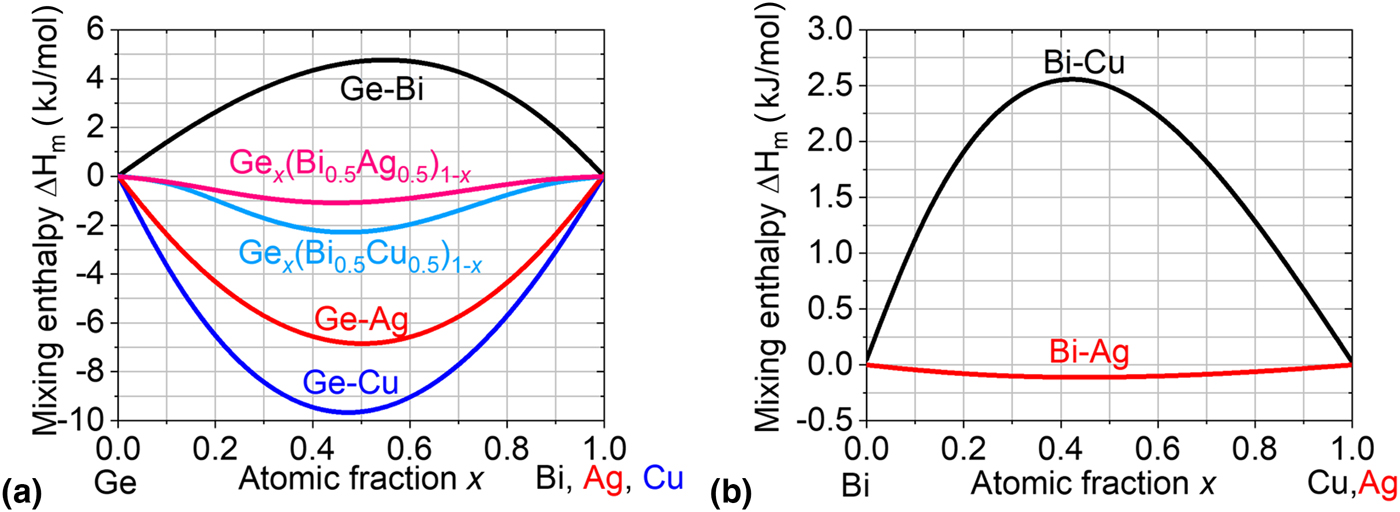
 $\Delta H_{ij}^{{\rm mix}} $, represents the enthalpy of mixing of any binary derivative of the multi-component alloy. For the case of the currently investigated undoped or either Ag- or Cu-doped (GeTe)0.96(Bi2Te3)0.04 alloys, the enthalpies of mixing for the binary derivatives Ge-Bi, Ge-Ag, Ge-Cu, Bi-Cu and Bi-Ag, in the cations site, were obtained based on Miedema's macroscopic model,[Reference Debski, Debski and Gasior22] as shown in Figs 1(a) and 1(b).
Mixing enthalpies for: (a) binary derivatives of Ge-Bi, Ge-Ag, Ge-Cu as well as the ternary Gex(Bi0.5Cu0.5)1−x and Gex(Bi0.5Ag0.5)1−x cases of the cations site of Ag- or Cu-doped (GeTe)x(Bi2Te3)1−x alloys, based on Miedema's macroscopic model,[Reference Debski, Debski and Gasior22] (b) binary derivatives of Bi-Cu and Bi-Ag.

It is clear from Fig. 1(a) that in the Ge-Bi system, indicating the cations mixing condition upon alloying of GeTe by Bi2Te3, a positive ΔH m is apparent, implying on the possibility of phase separation by either the spinodal decomposition or nucleation and growth mechanisms, into Ge- and Bi-rich phases, as was previously experimentally validated for undoped (GeTe)x(Bi2Te3)1−x alloys for TE applications.[Reference Hazan, Madar, Parag, Casian, Ben-Yehuda and Gelbstein8, Reference Madar, Givon, Mogilyanski and Gelbstein23–Reference Weintraub, Davidow, Tunbridge, Dixon, Reece, Ning, Agote and Gelbstein24]
In contrast, in the Ge-Ag and Ge-Cu systems, negative ΔH m values are expected upon mixing of either Ag or Cu with Ge atoms, implying on a tendency for dissolution into a single phase matrix. It can be seen in Fig. 1(a) that for each atomic fraction of the alloying element in Ge, the negative ΔH m obtained for the case of Ag or Cu exhibit higher absolute values than the positive values obtained upon mixing with Bi, suggesting that upon co-mixing of both Ag and Bi or Cu and Bi with Ge, the competition between the phase separation and the dissolution tendencies will result in a solid solution, at least within the solubility limit of Cu and Ag in (GeTe)x(Bi2Te3)1−x, with reduced phonon scattering and consequently higher κ l than the expected without the introduction of Cu or Ag. For getting a more accurate analysis of this effect, the mixing enthalpies between either Ag or Cu with Bi were also calculated by the same method, as shown in Fig. 1(b), indicating negative and positive trends, respectively, with lower absolute values than obtained before. Due to the fact that no values of the solubility limit of Cu or Ag in (GeTe)x(Bi2Te3)1−x were reported up to date, analyses of the ΔH m were made as case studies for Gex(Bi0.5Cu0.5)1−x and Gex(Bi0.5Ag0.5)1−x, using Eq. 1, as shown in Fig. 1(a). It can be clearly seen by these two curves, that even upon taking into account the Bi–Ag and Bi–Cu interactions [Fig. 1(b)], negative ΔH m values are obtained for any given atomic fraction of Ge, indicating a tendency for a formation of a single solid solution phase, within the solubility limits of Ag and Cu. Due to the fact that the formation of a single solid solution phase upon introduction of Ag or Cu to (GeTe)0.96(Bi2Te3)0.04 might increase the κ l compared with the undoped phase separated condition, adversely affecting ZT, with some additional electronic contribution to the electronic transport properties, a correlation between the TE and mechanical properties was made.
Experimental
Undoped or either 10 wt% Ag- or Cu-doped(GeTe)0.96(Bi2Te3)0.04 alloys were synthesized from pure elements (purity of 5N) by arc-melting (Edmund Bühler furnace) under argon atmosphere. The melt prime batches were evacuated and sealed in quartz ampoules under a vacuum of 10−6 Torr. The ampoules were placed in a rocking furnace (Thermcraftinc.) for 15 minutes at 850°C, then water quenched. Milling of the cast ingots to a maximal powder particle size of 50 mesh was performed using agate mortar and pestle. The sieved powder was subsequently hot pressed under a mechanical pressure of 350 MPa at 450°C, resulting in high-density values of >95% of the theoretical density. The temperature dependent Seebeck coefficient and electrical resistivity values were measured by Linseis LSR-3/800 Seebeck coefficient/electrical resistivity measuring system while those of the thermal conductivity were determined using the flash diffusivity method (LFA 457, Netzsch). The electronic contribution to the thermal conductivity, κ e = L ρ −1T, where L-Seebeck coefficient dependent Lorenz number was evaluated based on the measured Seebeck coefficient and electrical resistivity values, in a procedure described previously.[Reference Appel, Zilber, Kalabukhov, Beeri and Gelbstein14] The phonon or lattice contribution to the thermal conductivity was simply evaluated by subtraction of κ e from the measured κ values.
The crystal structures of the samples were analyzed by x-ray powder diffraction (XRD; Rigaku DMAX 2100 powder diffractometer). The microstructure and phases compositions were investigated by scanning electron microscopy (SEM; JEOL JSM-7400) and electron dispersive spectroscopy (EDS), respectively. Young's modulii, E, were measured both by ultrasound (US) time of flight measurements and quasi-static compression test. Quasi-static compression specimens for E as well as the ultimate compression strength, σ UCS, and strain, ε UCS, evaluation were cut by EDM into diameter of 6 mm and height of 12–13 mm. Vickers hardness indention test was conducted on a Zwick ZHU micro-hardness tester, upon 0.49N load applying for 25s. The specimen's fracture toughness, K IC, was calculated using the Japanese Institution of Standards (JIS) 1607R standard for an average of 10 acceptable indentations, based on the K IC = 0.026(E 1/2P 1/2a)/c 3/2 relation, where a is the average diagonal length of the indention [m], P is the hardness load [N] and c is the crack's length [m].
Results and discussion
The XRD patterns and SEM micrographs of the synthesized (GeTe)0.96(Bi2Te3)0.04, GBT, 10 wt% Ag-doped GBT, GBT(Ag), and 10 wt% Cu-doped GBT, GBT(Cu), are shown in Fig. 2. As can be seen in this figure, only the low temperature rhombohedral (R3 m) phase of GeTe was identified by XRD and low magnification SEM micrograph for the GBT composition, while for the GBT(Ag) and GBT(Cu) compositions precipitations of the Ag-rich Ag8GeTe6 and Cu-rich Cu2Te phases, respectively, out of the GeTe-rich GBT matrix with an introduction of pure Ge phase, were noticed.
x-ray diffraction (XRD) patterns and scanning electron microscope (SEM) micrographs of the synthesized (GeTe)0.96(Bi2Te3)0.04, GBT (a, d), 10 wt% Ag-doped GBT, GBT(Ag) (a, c), and 10 wt% Cu doped GBT, GBT(Cu) (a, b). Asterisk represents the rhombohedral (R3 m) GeTe phase. Etched SEM micrographs of 10 wt% Cu doped GBT, GBT(Cu), highlighting a rough (corresponds to brittle) GeTe-rich matrix with embedded smooth (corresponds to ductile) Cu2Te precipitates (e). Under a higher magnification of the GeTe-rich matrix, a considerable twinning can be seen (f).

Therefore, precipitations strengthening of the GBT matrix is expected upon Cu and Ag alloying, as required for withstanding the mechanical conditions applied in practical applications. Higher SEM magnifications for the GBT(Cu) and GBT(Ag) compositions did not reveal any additional phases beyond those observed by XRD [Fig. 2(a)] and lower SEM magnifications [Fig. 2(b) and 2(c), respectively]. Yet, Higher SEM magnification of the GBT composition [the insert of Fig. 2(d)] indicated a sub-micron phase separation of the matrix, presumably into GeTe-richer and leaner (GeTe)0.96±δ(Bi2Te3)0.04±δ phases with δ beyond the detection limit of the XRD, in agreement with the ΔH m estimations, shown in Fig. 1(a), and previous experimental reports for other (GeTe)x(Bi2Te3)1−x compositions.[Reference Hazan, Madar, Parag, Casian, Ben-Yehuda and Gelbstein8] As can be seen in Fig. 2(d), this phase separation was found in the vicinity of grain-boundaries (GBs) of the matrix. It was reported before regarding phase separation in the quasi-ternary PbTe-GeTe-SnTe system that phase separation by either the spinodal-decomposition or nucleation and growth mechanisms is initiated in the vicinity of GBs as discontinuous phase separation, in an analogy to the known discontinuous precipitation mechanism, apparent in many known systems, which is also initiated at the vicinity of GBs.[Reference Gelbstein25] No such matrix separation was noticed in the Ag- or Cu-alloyed systems, in agreement with the theoretical estimations shown in Fig. 1(a).
SEM examination of all of the investigated compositions following etching, revealed much rougher GeTe-rich matrix (implying on a mechanically brittle nature) than the smoother embedded Cu- or Ag-rich precipitates, implying on their more ductile mechanical nature, as can be seen as a representative case for the GBT(Cu) sample in Fig. 2(e).
Furthermore, the etching revealed extensive twinning effect in the GBT matrix of all of the investigated compositions, as can be seen in Fig. 2(f). Since twinning can be regarded as a plastic deformation mechanism in materials, and since some plasticity is required for practical TE applications of the brittle in nature IV–VI TE alloys, such an effect can be regarded as positive in terms of mechanical durability under the involved mechanical and thermal stresses of such alloys.
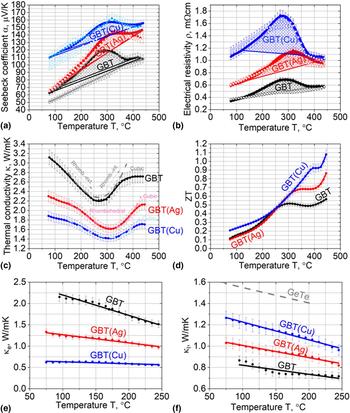
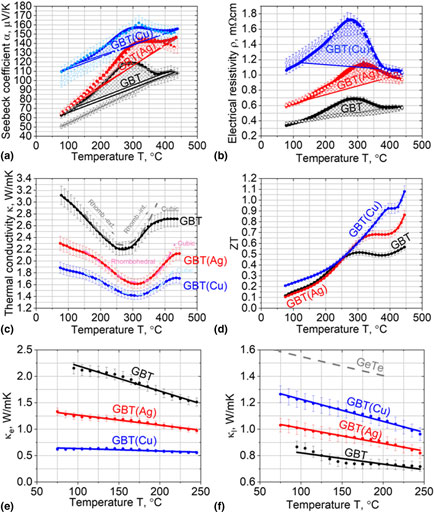
The measured TE transport properties; α, ρ, κ, and the TE figure of merit, ZT, as well as the electronic and lattice contributions to the thermal conductivity of the currently investigated GBT, GBT(Ag), and GBT(Cu) alloys are shown in Figs 3(a)–3(f), respectively. The α and ρ values of five different samples of each composition were measured both upon heating and cooling of the samples, as shown by the colored ranges for each composition in Figs 1(a) and 1(b), indicating a hysteresis effect between heating and cooling, which is typical for phase-transformed GeTe-based alloys. Furthermore, these curves as well as those of the thermal conductivity, Fig. 3(c), indicate three typical temperature zones of an extrinsic range of the low temperature rhombohedral (R3 m) phase (up to the maximum of the α, ρ curves, and minimum of κ), intrinsic range of the R3 m phase up to the phase transition temperature into the high temperature cubic (NaCl) phase and a high temperature zone beyond the phase transition, as marked in Fig. 3(c).
Temperature dependencies of the Seebeck coefficient, α, (a), electrical resistivity, ρ, (b), thermal conductivity, κ, (c), and TE figure of merit, ZT, (d) of the currently investigated GBT, GBT(Ag), and GBT(Cu) alloys. Temperature dependencies of the electronic, κ e (e), and lattice, κ l (f), contributions to the thermal conductivity of the investigated GBT, GBT(Ag), and GBT(Cu) alloys. A comparison with previously reported κ l values of GeTe[Reference Davidow and Gelbstein3] is given in (f).

The lower α and ρ values of GBT compared with GBT(Ag) and GBT(Cu) at any given temperature might be associated with the previously reported high holes concentration of GBT, which is balanced (partially compensated) by some donor doping action of Cu and Ag within their solubility limit in GBT. Alternatively, higher electrons or lower holes conduction in the secondary Cu2Te and Ag8GeTe6 phases (Fig. 2) compared with the GBT matrix might also result in an effective lower holes concentration than the GBT matrix by its own. It is most likely that both of these effects take place in increasing the α and ρ values of the Cu- and Ag-alloyed samples. The higher α and ρ values for GBT(Cu) compared with GBT(Ag) clearly indicate that the effective donor doping action of Cu either as a GBT matrix dopant or as a secondary rich phase is stronger than that of the Ag.
For the analysis of the measured κ values, shown in Fig. 3(c), the electronic and lattice contributions to the thermal conductivity in the extrinsic range of the low-temperature rhombohedral structure of GBT, were calculated, as was described in the experimental chapter, for obtaining the values shown in Figs. 3(e) and 3(f), respectively. From the κ e values, Fig, 3(e), an opposite trend to that of the α, ρ values described above, of decreasing values while introducing of Ag and Cu to GBT, can be seen, highlighting again the donor doping action of Cu and Ag to GBT, while reducing the net holes concentration of the GBT matrix. Yet, regarding the κ l values [Fig. 3(f)], some additional insights can be obtained.
As can be seen in Fig. 3(f), GBT exhibits the lowest κ l values among the investigated compositions, the introduction of Ag, GBT(Ag), increased the values compared with GBT, while Cu introduction, GBT(Cu), resulted in the highest values, approaching those reported previously for GeTe.[Reference Davidow and Gelbstein3] The major κ l reduction of GBT compared with GeTe, can be associated with phase separation into Bi2Te3- and GeTe-rich phases, as was reported for the (GeTe)x(Bi2Te3)1−x system before,[Reference Hazan, Madar, Parag, Casian, Ben-Yehuda and Gelbstein8] was described in the introduction related to Fig. 1(a) and was experimentally observed in Fig. 2(d). Yet, it can also be associated with enhanced phonon scattering due to the substitution of Ge (with an atomic weight of ~73 amu and radius of 122 pm) by the heavier (~209 amu) and larger (156 pm) Bi atoms in the cations sub-lattice of GeTe. As was described referred to Fig. 1(a), co-alloying of both Bi and Ag, GBT(Ag), or Bi and Cu, GBT(Cu), of GeTe, is associated with negative ΔH m, inhibiting phase separation and favoring a single solid solution phase within the perspective solubility limits, with higher κ l than the phase separated GBT, as can be seen in Fig. 3(f). Cu in the cations sub-lattice of GeTe exhibits the closest atomic weight (~64 amu) and radius (128 pm) to those of Ge, enabling minimal distortion of the lattice and minimal scattering of phonons, explaining the highest κ l observed. Ag obtains intermediate atomic weight (~108 amu) and radius (144 pm) values, between those of Cu and Bi and distort accordingly the lattice in an extent that scatters phonons less than Bi and more than Cu for obtaining the intermediate observed κ l values. The combined effects of the lattice distortion, reducing κ l, and the electronic doping action of Cu and Ag on α, ρ, and κ e, resulted in the ZT values shown in Fig. 3(d). The positive effect of the phase transition from the low temperature rhombohedral to the high-temperature cubic phases, on increasing the ZT beyond the local maximum associated with the onset of the intrinsic conduction of the GBT matrix, can be seen in all of the ZT curves of the investigated compositions. Without this phase transition, the ZT values were expected to reduce monotonically beyond this local maximum. Yet, it can be also clearly seen that upon both Cu and Ag doping the maximal ZT values were increased beyond those of the undoped GBT, with the highest value of ~1.1 obtained for GBT(Cu) at 450°C. From a practical standpoint, this means that thermo-elements based on GBT might hold the potential to serve at higher temperatures than 450°C with greater efficiencies if volume change and internal stresses associated with the phase transformation could be dealt. The fact that GBT(Cu) with the lowest lattice distortion and the highest κ l values, exhibit the maximal ZTs among the investigated compositions, clearly indicates the significance of reduction of the high inherent holes concentration of GBT for an optimal TE performance. Any future possibility of combining such electronic optimization with a significant lattice distortion is expected to the enhance of ZT much more.
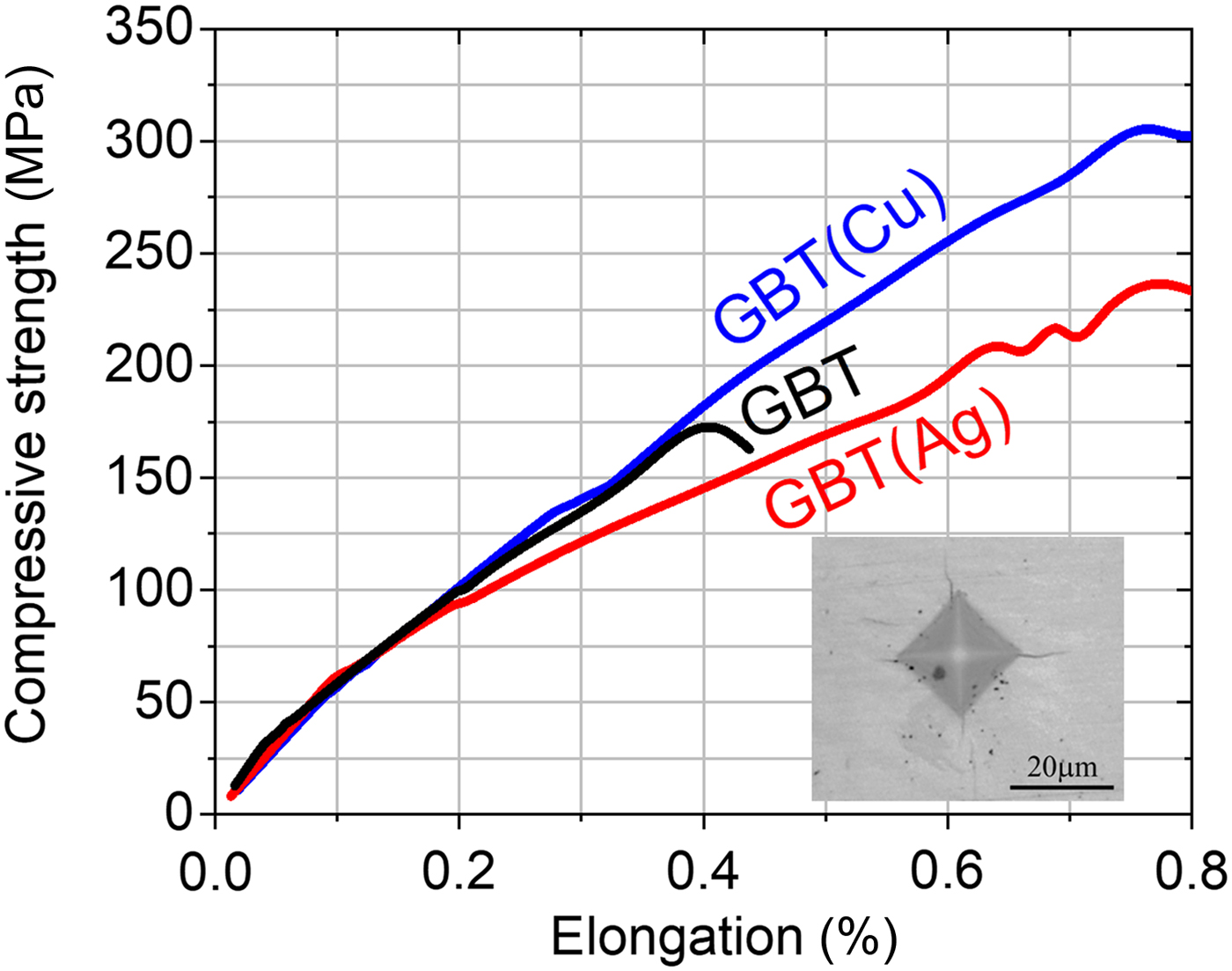
The lattice distortion described above related to κ l is expected to affect also the mechanical properties, summarized in Table 1, as follows. The Young modulii, E, of the investigated compositions, obtained from the stress-strain slope in the elastic range of the mechanical compression curves, shown in Fig. 4, were found as in agreement (within a measurement error of ± 15%) with those measured by US time of flight measurements as can be seen in this table.
Stress-strain curves of the currently investigated GBT, GBT(Ag), and GBT(Cu) alloys. The insert shows an optical microscope image of a representative Vickers hardness indentation of GBT.

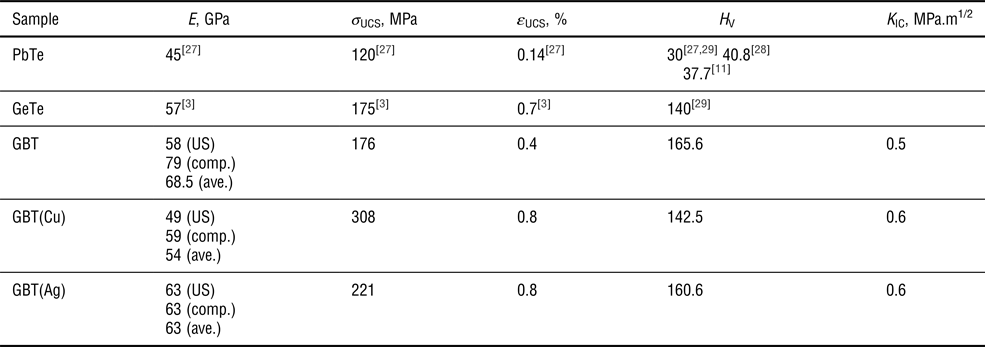
Young modulus, E; ultimate compression stress, σ UCS, and strain, ε UCS; Vickers hardness, H V and fracture toughness K IC of the investigated GBT, GBT(Ag) and GBT(Cu) alloys

A comparison with previously reported values for PbTe[Reference Wu, Zhao, Tong, Li, Wu, Tan, Pei, Huang, Li, Zhu and Kanatzidis11, Reference Gelbstein, Gotesman, Lishzinker, Dashevsky and Dariel27–Reference Perumal, Roychowdhury, Negi, Datta and Biswas29] and GeTe[Reference Davidow and Gelbstein3, Reference Perumal, Roychowdhury, Negi, Datta and Biswas29] is given.
While comparing the average E values, reflecting the lattice stiffness, obtained by both of these methods for each of the investigated compositions, it can be seen that the highest stiffness with a nominal value of 68.5 GPa, was obtained for GBT, with the highest lattice distortion, as was discussed related to the κ l values, the lowest (54 GPa) was obtained for GBT(Cu) with the lowest lattice distortion and GBT(Ag) obtained an intermediate value of 63 GPa. This trend is in agreement with the Vickers microhardness, H V, values of 165.6, 142.5, and 160.6, respectively, shown in the table, as expected from the linear H V3/E2 proportion reported before for various TE materials classes.[Reference Rogl, Grytsiv, Gürth, Tavassoli, Ebner, Wünschek, Puchegger, Soprunyuk, Schranz, Bauer, Müller, Zehetbauer and Rogl26]
As can be seen in the table, GBT(Cu), the least stiff of the investigated compositions, exhibit similar E value to the reported for GeTe (57 GPa[Reference Davidow and Gelbstein3]), which is higher than the previously reported (45 GPa) for PbTe.[Reference Gelbstein, Gotesman, Lishzinker, Dashevsky and Dariel27] As mentioned above the difference between the lattice characteristics of our investigated GeTe rich compositions to PbTe, can also be seen by the considerably higher (>140) measured H V values than the 30–40 range reported for PbTe.[Reference Wu, Zhao, Tong, Li, Wu, Tan, Pei, Huang, Li, Zhu and Kanatzidis11, Reference Gelbstein, Gotesman, Lishzinker, Dashevsky and Dariel27–Reference Perumal, Roychowdhury, Negi, Datta and Biswas29] These higher stiffness and hardness values of GeTe-based alloys can be related to the phase transition from cubic to rhombohedral upon cooling, while introducing a mechanical strain upon the lattice distortion, which is absent in the cubic PbTe phase. The unique combination of lower κ l values for the stiffer structure of rhombohedral-based GeTe lattices compared with the cubic PbTe[Reference Pereira, Sergueev, Gorsse, Dadda, Müller and Hermann30] compound, as was observed in the current research, can be correlated with the larger anharmonicity of GeTe.[Reference Littlewood31] The anharmonicity, quantified by the Grüneisen parameter, is proportional to the elastic modulus and inversely proportional to the lattice thermal conductivity.[Reference Gelbstein, Davidow, Leshem, Pinshow and Moisa7] Therefore, larger anharmonicity, as was reported for GeTe-based alloys, results in larger stiffness along with lower κ l, explaining the observed trends. As can be seen in Table 1, even in the plastic deformation regime, much higher ultimate compression strength, σ UCS, values of more than 175 MPa were obtained for the currently investigated GeTe rich compositions, compared with the previously reported value of 120 MPa[Reference Gelbstein, Gotesman, Lishzinker, Dashevsky and Dariel27] for PbTe, from similar considerations. In this regime, also much higher ultimate compression strain, ε UCS, values of more than 0.4% were obtained for the investigated compositions compared with the reported 0.14% value for[Reference Gelbstein, Gotesman, Lishzinker, Dashevsky and Dariel27] PbTe. The enhanced plastic deformation of all of the investigated GeTe-based alloys compared with PbTe can be partially attributed to the observed twinning in the investigated compositions, shown in Fig. 3(b), deforming the materials more than the expected just by crystal planes sliding via dislocations, as in PbTe. Upon Cu and Ag introduction to the GBT matrix, the increased σ UCS and ε UCS values can be attributed to strengthening by precipitation of the observed Cu-rich Cu2Te Ag-rich and Ag8GeTe6 phases, Fig. 2, with their associated ductility, respectively. The latter is in agreement with the higher fracture toughness, values listed in Table 1, which were evaluated by investigating the cracks originated by the Vickers microhardness indentations, as shown in the insert of Fig. 4.
Conclusions
The current research deals with the TE and mechanical potential of undoped and either 10 wt% Ag- or Cu-doped (GeTe)0.96(Bi2Te3)0.04, GBT, alloys. It was found that although Ag or Cu doping diminish the thermodynamic tendency of phase separation and κ l minimization of GBT, their electronic contribution either as donor dopants or in the formation of Cu-rich Cu2Te and Ag-rich Ag8GeTe6 phases, enhance the ZT values considerably. The formation of secondary ductile Cu- and Ag-rich precipitates, increase both the maximal strength and elongation behavior compared with undoped GBT, which is highly significant for withstanding the severe thermo-mechanical conditions apparent in practical TE applications. Upon Cu doping, a maximal ZT of ~1.1 at 450°C was observed with ultimate compression strength and strain of 308 MPa and 0.8%, respectively, which are significantly higher than those observed for undoped GBT and those reported for both GeTe and PbTe TE compounds, highlighting its potential for being incorporated in practical energy conversion applications.
Acknowledgement
The work was supported by the Ministry of National Infrastructures, Energy and Water Resources grant (3/15), No. 215-11-050.