Introduction
Sodium bromate is a strong oxidant that is commonly used as a neutraliser for permanent wave hair styling kits in Asia (e.g. Japan, Korea and Taiwan) and is rarely used in suicide.Reference Matsumoto, Morizono and Paparella1–Reference Eom, Lee, Cho and Cho6 Sodium bromate is tasteless and odourless, and bromate intoxication can cause vomiting, diarrhoea, acute renal failure, central and peripheral nervous system disorder symptoms, and hearing loss.Reference Sashiyama, Irie, Ohtake, Nakajima, Yoshida and Sakai3, Reference Ryu, Jang, Kim, Park, Do and Yoon5, Reference Campbell7, Reference Gradus, Rhoads, Bergstrom and Jordan8 Although acute renal failure can be cured by early initiation of haemodialysis, severe-to-profound sensorineural hearing loss caused by bromate intoxication is generally believed to be irreversible.Reference Uchida, Sugiyama, Kanehisa, Harada, Fujiwara and Ono4, Reference Campbell7
This paper reports the first case in the English literature of bromate intoxication with partial hearing recovery measured by formal audiological assessment. Written informed consent was obtained from the patient.
Case report
A 72-year-old female barber was referred to our hospital for management of bromate intoxication. Approximately 36 hours before admission, she had attempted suicide by intentionally ingesting 200 ml of cold wave neutraliser containing 5.71 per cent sodium bromate (a total of 12 g sodium bromate). She noticed profound hearing loss 15 hours after ingestion. She had been admitted to a neighbouring clinic where intravenous infusion therapy was performed. She had continued complaints of nausea, diarrhoea and profound hearing loss before being transferred to our hospital; she developed anuria at this point.
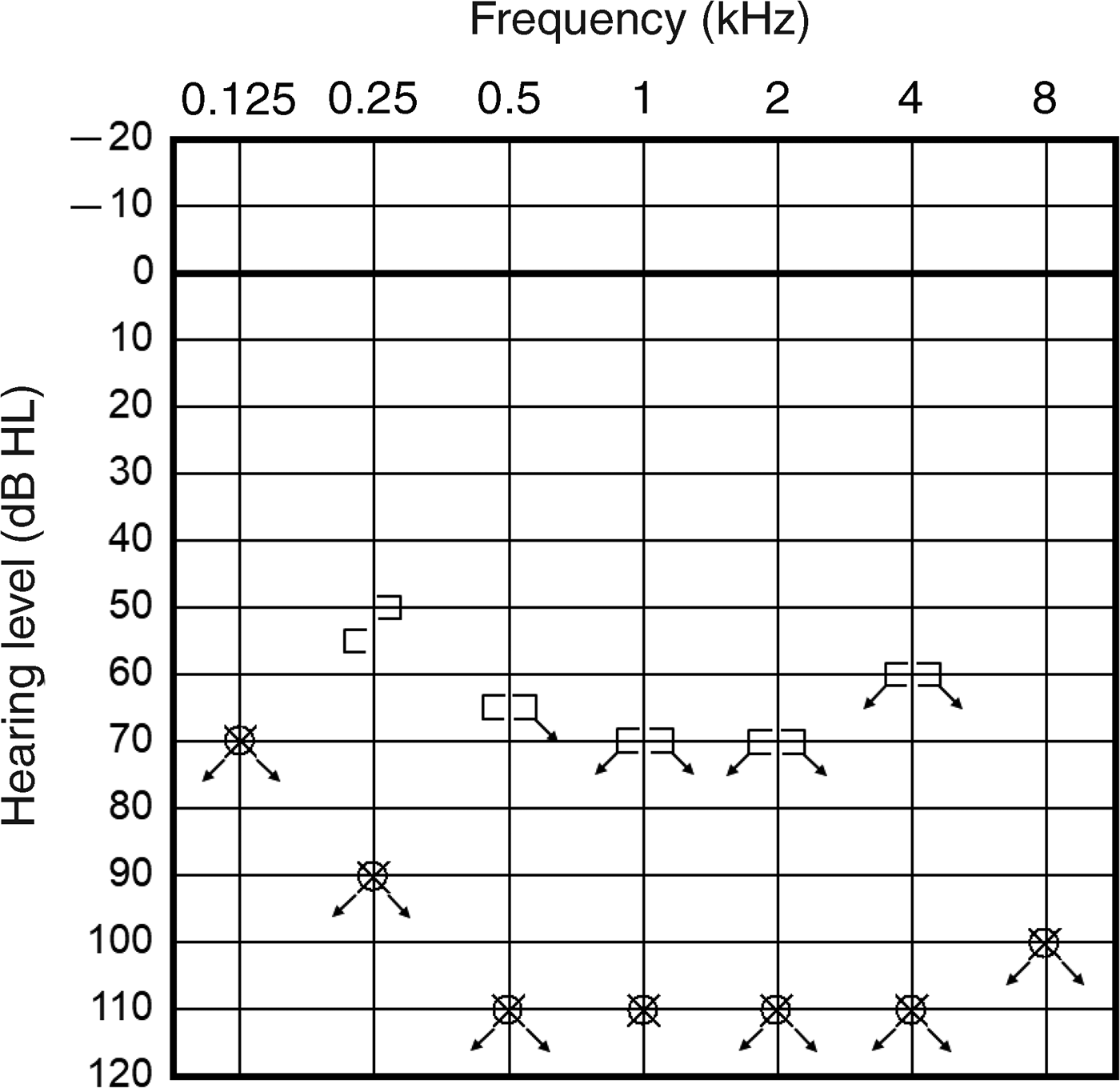
On admission, her vital signs included the following: body temperature of 36.7 °C, blood pressure of 106/58 mmHg and heart rate of 93 beats per minute. Her Glasgow Coma Scale score was 15. Her laboratory data showed the following: haemoglobin level of 12.6 g/dl, white blood cell count of 20 000 cells per ml, platelet count of 133 000 per ml, serum sodium level of 120 mmol/l, potassium level of 3.9 mmol/l, chloride level of 88 mmol/l, blood urea nitrogen level of 34.8 mg/dl, creatinine level of 3.61 mg/dl and estimated glomerular filtration rate of 10.3 ml/minute/1.73 m2. Brain computed tomography and electrocardiogram results were unremarkable. Pure tone audiometry showed profound bilateral deafness (Figure 1). Auditory brainstem responses (ABRs) were not observed at 100 dB HL, in either ear.
Pure tone audiometry upon patient's first presentation to our department, which revealed profound bilateral deafness. Arrows indicate no response. [ = bone conduction masked (right ear); ] = bone conduction masked (left ear); ○ = air conduction unmasked (right ear); × = air conduction unmasked (left ear)

Under the diagnosis of bromate-induced acute renal failure and sensorineural hearing loss, continuous haemodiafiltration was started on the day of hospitalisation and continued for eight consecutive days. Additional haemodialysis was performed until hospital day 14 when the patient's urine volume recovered (1200 ml per day), and serum creatinine gradually decreased thereafter.
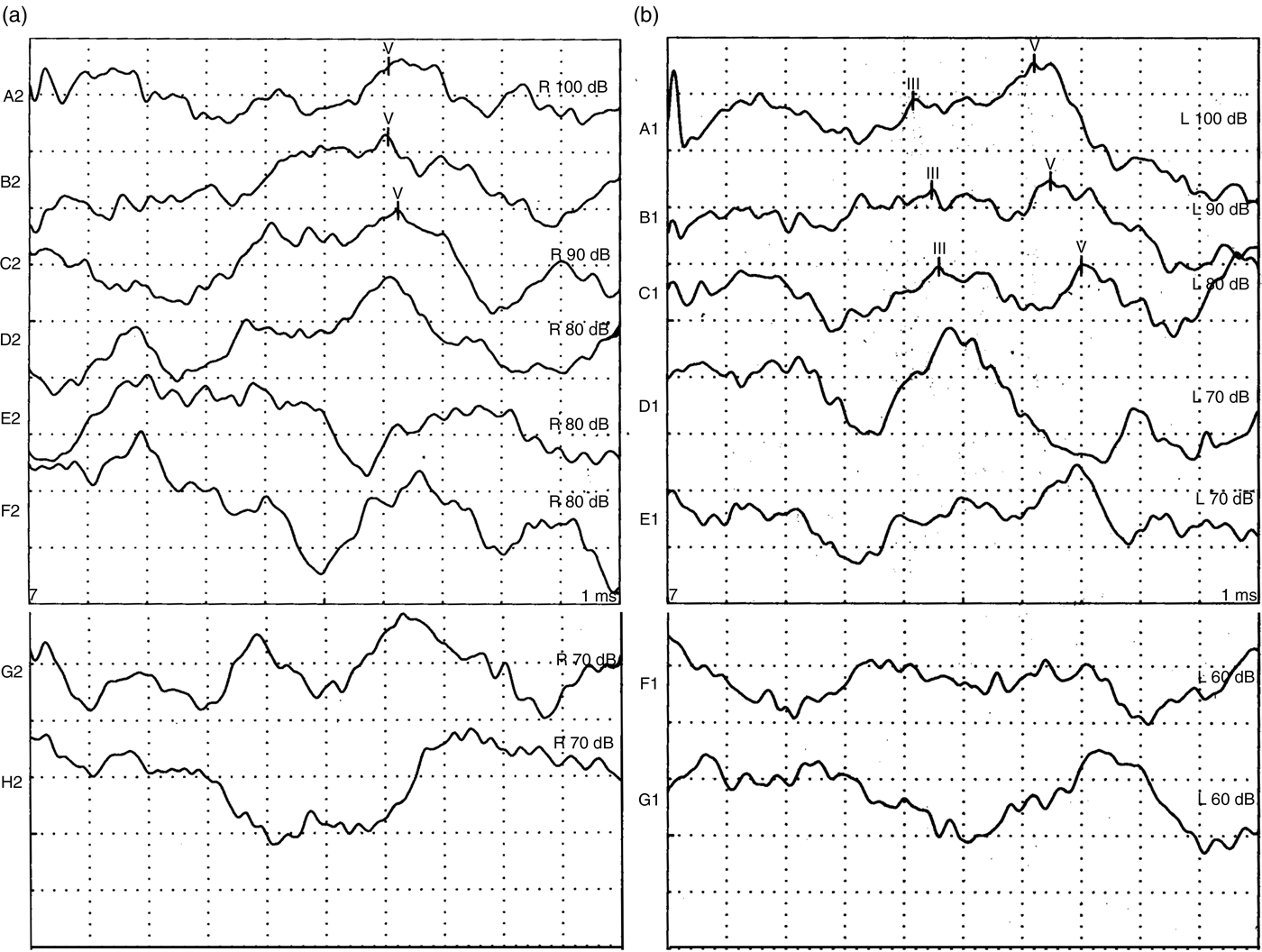
On hospital day 40, the patient noticed that she could hear a loud voice as a metallic sound, and pure tone audiometry showed apparent threshold recovery from profound bilateral deafness (right ear = 78.8 dB HL, left ear = 82.5 dB HL; arithmetic mean of pure tone thresholds at 0.5, 1, 2 and 4 kHz). Auditory brainstem responses were correspondingly observed at 80 dB HL in both ears (Figure 2). Serum creatinine levels decreased to 1.32 mg/dl on hospital day 77, and the patient was discharged on hospital day 79.
On hospital day 40, auditory brainstem responses (ABRs) were observed at 80 dB HL in both the (a) right (R) and (b) left (L) ears. ‘A1’ – ‘H2’ represent electrode sites, and ‘V’ and ‘III’ indicate ABR waves V and III respectively.

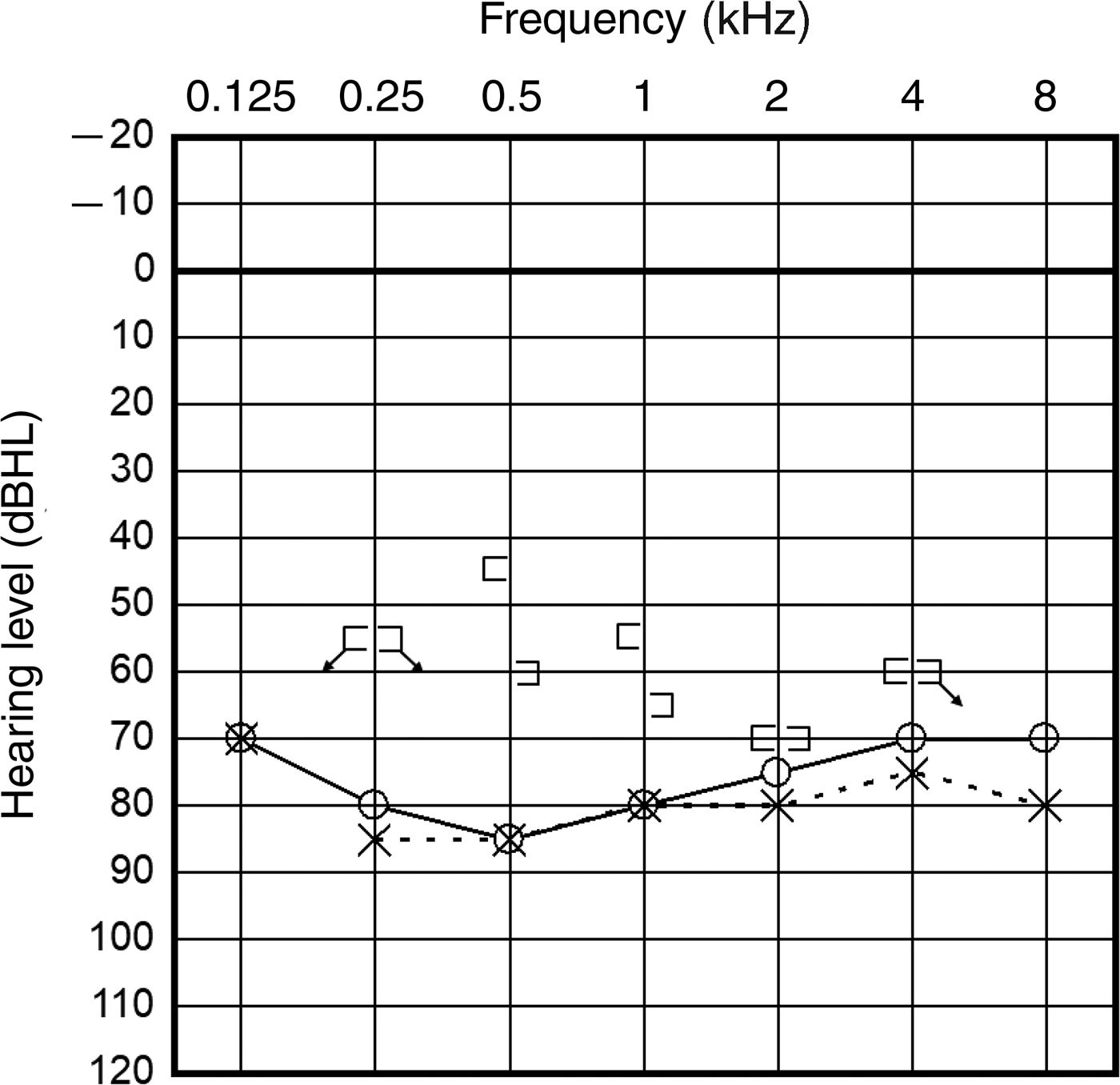
Three months after hospital discharge, the patient's hearing threshold was slightly decreased (right ear = 77.5 dB HL, left ear = 80.0 dB HL; Figure 3), and she could perform daily activities with a hearing aid and written conversation.
Pure tone audiometry 5.5 months after bromate intoxication, which showed apparent threshold recovery from profound deafness in both ears (right ear = 77.5 dB HL, left ear = 80.0 dB HL; arithmetic mean of pure tone thresholds at 0.5, 1, 2 and 4 kHz). Arrows indicate no response. [ = bone conduction masked (right ear); ] = bone conduction masked (left ear); ○ = air conduction unmasked (right ear); × = air conduction unmasked (left ear)

Discussion
Severe-to-profound sensorineural hearing loss is a common symptom of bromate intoxication and can occur within 4–16 hours after ingestion.Reference Matsumoto, Morizono and Paparella1, Reference Campbell7 Life-threatening symptoms such as acute renal failure may result in a delayed hearing loss diagnosis.Reference Gradus, Rhoads, Bergstrom and Jordan8 Bromate damages the stria vascularis and Reissner's membrane, and consequently decreases the endocochlear potential in the cochlea.Reference Asakuma and Snow9, Reference Muratsuka, Ueda and Konishi10 Bromate also damages cochlear hair cells and nerve endings.Reference Muratsuka, Ueda and Konishi10 However, the mechanism of bromate ototoxicity is not yet fully understood.Reference Campbell7
• Bromate intoxication has been believed to cause irreversible severe-to-profound sensorineural hearing loss
• This is the first case in English literature of bromate-induced hearing loss with partial hearing recovery on formal audiological assessment
• Bromate-induced hearing loss may be partially treated
• Early application of continuous haemodiafiltration might be a useful treatment for bromate-induced hearing loss
Treatment for bromate intoxication is generally empirical; gastric lavage, sodium thiosulphate, active charcoal, furosemide and renal replacement therapy are used as treatment without sound evidence.Reference Campbell7 Although these treatments have been applied to patients with bromate-induced hearing loss, severe-to-profound hearing loss may be irreversible. No report in the English literature has definitely demonstrated hearing recovery measured by formal audiological assessment.Reference Campbell7
Our patient showed a partial but definite improvement in hearing thresholds in both pure tone audiometry and ABRs, indicating that bromate-induced hearing loss can be at least partially treated. We started continuous haemodiafiltration on the day of hospitalisation: a case study in Japanese literature had reported that bromate-induced hearing loss was slightly improved after early continuous haemodiafiltration.Reference Tojima, Suzuki, Hanamitsu, Fukui, Sakurai and Shimizu11 Continuous haemodiafiltration efficiently removes middle-to-high molecular weight substances compared with intermittent haemodialysis.Reference Oda, Hirasawa, Shiga, Nakanishi, Matsuda and Nakamura12 Although sodium bromate has a low molecular weight, toxic middle-to-high molecular weight substances produced by sodium bromate may be involved in the mechanism of bromate-induced ototoxicity, as continuous haemodiafiltration therapy resulted in partial recovery of sensorineural hearing loss in these patients. Further research is needed to evaluate the therapeutic effect of early continuous haemodiafiltration application on bromate-induced hearing loss.
Cochlear implants are an effective treatment for individuals who are deaf or have profound sensorineural hearing loss. Although our patient did not receive a cochlear implant, several reports have shown good outcomes when cochlear implants are used for patients with bromate-induced sensorineural hearing loss.Reference Eom, Lee, Cho and Cho6, Reference Tono, Ushisako, Morimitsu and Takenaka13
In conclusion, bromate intoxication can cause severe-to-profound sensorineural hearing loss. Bromate-induced hearing loss may be partially treated, and early application of continuous haemodiafiltration might be effective in treating this intractable disease.
Acknowledgements
We thank Dr R Murai, Dr D Komazawa, Dr D Mizobuchi and Dr F Yoshida for their clinical management.
Competing interests
None declared