INTRODUCTION
Climate change (CC) is expected to have unprecedented global impacts, requiring collective action to mitigate its effects and adapt to a changing world. Increased flooding and droughts (Michener et al. Reference Michener, Blood, Bildstein, Brinson and Gardner1997), rising sea levels (Min et al. Reference Min, Zhang, Zwiers and Hegerl2011) and reduced food security (Turral et al Reference Turral, Burke and Faures2011) all seem likely. CC behaviours, including using public transport, conserving energy at home and recycling, are important mitigation behaviours that individuals may adopt (Stern Reference Stern2000; Chawla & Cushing Reference Chawla and Cushing2007; Peterson et al. Reference Peterson, Peterson and Liu2013; Chen et al. Reference Chen, De La, Rosa, Peterson, Zhong and Lu2016). Promoting behaviour changes that address environmental challenges is a foundational component of environmental education (EE) (UNESCO 1978; Hungerford & Volk Reference Hungerford and Volk1990), but understanding what motivates people to engage in behaviours to address and mitigate CC is complex. Knowledge, risk perception, social norms and belief in personal responsibility regarding CC all influence CC behaviour, but do so in complex and sometimes unexpected ways (Gifford Reference Gifford2011).
Scholars have identified several cultural and psychological barriers to proactive CC-related behaviours. First, simply presenting knowledge of CC does not effectively increase engagement or overcome scepticism (Whitmarsh et al. Reference Whitmarsh, O'Neill and Lorenzoni2013). CC is a complex topic that even the scientifically literate struggle to fully grasp (Sterman Reference Sterman2011), often leading people to rely on heuristics (mental shortcuts) to assess risk. Some of the most dominant heuristics people rely on are political ideology and cultural worldviews (Kahan et al. Reference Kahan, Jenkins‐Smith and Braman2011; Brownlee et al. Reference Brownlee, Powell and Hallo2013). In short, people tend to get information from and trust those that think like them (Cohen Reference Cohen2003), leading to over-reliance on politicized and scientifically inaccurate news sources (Hamilton Reference Hamilton2011) and selective acceptance of new information that reinforces ideologically supported beliefs (Kahan et al. Reference Kahan, Peters, Wittlin, Slovic, Ouellette, Braman and Mandel2012). Other barriers faced by CC communicators include the belief that CC is a distant issue, and that adaptation and mitigation strategies challenge lifestyles (Hulme Reference Hulme2009; Spence et al. Reference Spence, Poortinga and Pidgeon2012).
These barriers create a dilemma for those striving to increase CC behaviour among the general public. Communicators can attempt to employ strategic frames for communication that may more effectively reach heterogeneous audiences (Nerlich et al. Reference Nerlich, Koteyko and Brown2010; Whitmarsh et al. Reference Whitmarsh, O'Neill and Lorenzoni2013). This may include using proximate causes as motivators for behavioural change. For example, governments may ‘nudge’ consumers towards more climate-friendly products by highlighting the energy-saving aspects of a product or service (Whitmarsh et al. Reference Whitmarsh, O'Neill and Lorenzoni2013). This approach, however, may be ineffective for critical behaviours that require more effort than green consumerism (Chen et al. Reference Chen, De La, Rosa, Peterson, Zhong and Lu2016) or require greater lifestyle changes, such as using public transport (Whitmarsh et al. Reference Whitmarsh, O'Neill and Lorenzoni2013). Similarly, Bernauer and McGrath (Reference Bernauer and McGrath2016) found that a simple reframing of CC was not associated with changes in support for climate-friendly public policies.
Adolescents may represent a vital segment of the population for CC communication both because they are the future policy- and decision-makers who will live with the major impacts from CC and because they appear to bring less ideological bias to their assessments of CC. CC forecasts project major impacts, including sea-level rises, increased extreme weather events and food shortages, to become disruptive in the mid-21st century (Pachauri et al. Reference Pachauri, Allen, Barros, Broome, Cramer, Christ, Church, Clarke, Dahe and Dasgupta2014). This means that it is critical to prepare today's adolescents to adapt to those impacts and to mitigate future impacts as they reach adulthood. Research shows that adolescents differ from adults regarding several aspects of CC knowledge, perceptions and behaviours. Generally, climate scepticism is less likely among younger age groups (Feldman et al. Reference Feldman, Nisbet, Leiserowitz and Maibach2010), and this scepticism may be overcome with education (Stevenson et al. Reference Stevenson, Peterson, Bondell, Moore and Carrier2014), even though similar efforts may be more difficult among adults (Kahan et al. Reference Kahan, Peters, Wittlin, Slovic, Ouellette, Braman and Mandel2012). Stevenson et al. (Reference Stevenson, Peterson, Bondell, Moore and Carrier2014) found that for middle-school adolescents, CC acceptance increased with CC knowledge, and did so more quickly among students with worldviews typically associated with CC scepticism among adults. This may be in part because worldviews are developing and forming during adolescence (Vollebergh et al. Reference Vollebergh, Iedema and Raaijmakers2001), and may not influence CC risk perceptions among adolescents as heavily as they do in adults. Climate risk perception appears to be a key driver of CC behaviour among adolescents (Taber & Taylor Reference Taber and Taylor2009; Ojala Reference Ojala2012). Some CC messages (e.g. fear-based messaging decoupled from potential solutions), however, may cause adolescents to psychologically distance themselves from the topic (Ojala Reference Ojala2015).
Despite these findings, less is known about how psychological and social variables shape CC behaviours among adolescents than among adults. In previous EE research, low socioeconomic status (SES) negatively predicted environmental behaviour (Stevenson et al. Reference Stevenson, Peterson, Bondell, Mertig and Moore2013), but it is unclear if this relationship translates to CC behaviours. SES typically refers to the household-level economic and educational position relative to others (Bradley & Corwyn Reference Bradley and Corwyn2002). Similarly, studies comparing environmental behaviour by residency (urban–rural or urban–suburban) return conflicted results because residency predicts specific behaviours (e.g. rural residents have higher support for conservation behaviours and urban residents engage in more anti-pollution behaviours), but not general trends in environmental behaviour (Berenguer et al. Reference Berenguer, Corraliza and Martín2005; Ambrosius & Gilderbloom Reference Ambrosius and Gilderbloom2015). Because views on CC clearly associate with political affiliation in the USA (Dunlap & McCright Reference Dunlap and McCright2008), and that affiliation aligns with rural and urban divisions (Morrill Reference Morrill2016), comparing CC behaviours between urban and rural schools provides a valuable opportunity to evaluate the extent to which such divisions have already developed among adolescents. To effectively engage with adolescents, more research is needed to understand the relative importance of the predictors of CC behaviour so that communication strategies can engage those factors in ways that promote individual and collective action among adolescents.
Emerging research suggests that communication type and frequency may be important but underexplored variables related to engaging adolescents in CC behaviour. This research suggests that adolescents in families that discuss CC are more likely to seek information about the topic (Mead et al. Reference Mead, Roser-Renouf, Rimal, Flora, Maibach and Leiserowitz2012), and that increased frequency of communication with both groups promotes CC concern (Stevenson et al. Reference Stevenson, Peterson and Bondell2016). Similarly, a study of adolescents in Belgium suggested parents influence their children's environmental concerns, and more frequent communication raised those concerns (Meeusen Reference Meeusen2014). Furthermore, adolescents are more likely to engage in community actions if their parents give them encouragement or approval (Fletcher et al. Reference Fletcher, Elder and Mekos2000), and adolescent behaviours, in the cases of deviant and risky behaviours, are often mediated by parental relationships (Deković et al. Reference Deković, Wissink and Meijer2004). A study of UK adolescents highlighted the importance of informal communication channels, especially involving peers, in developing attitudes of efficacy and responsibility towards mitigating CC (Devine‐Wright et al. Reference Devine-Wright, Devine-Wright and Fleming2004). Despite these findings, little is known about the role of communication from teachers, who serve as important CC literacy educators for adolescents (Chawla & Cushing Reference Chawla and Cushing2007). We do know that teachers can improve CC knowledge among students, especially when students engage in hands-on activities (Taber & Taylor Reference Taber and Taylor2009). Teachers are commonly mentioned as significant childhood influences by adults who are concerned about the environment, have positive environmental attitudes and choose environmental careers (Chawla Reference Chawla1998). General motivation and engagement of adolescents in traditional education settings increases when students perceive high teacher support (Ryan & Patrick Reference Ryan and Patrick2001).
We begin to address the need to situate the role of communication with teachers in adolescent CC behaviour using a case study of middle-school students (ages 11–15 years) in North Carolina (USA). This study provides a first assessment of teachers’ roles as CC communicators. We tested the following novel hypotheses: adolescents who more frequently discuss CC with teachers in classroom settings, adolescents who come from urban backgrounds and students from schools with higher SES are more likely to engage in CC behaviours. We include several other important variables in our analyses that allow us to situate communication with teachers within the context of previous research on adolescent CC behaviours. We include frequency of communication with friends and family, allowing us to assess whether previously identified positive effects on CC behaviour persist while considering communication with teachers. Similarly, we control for several variables that have predicted CC behaviour in previous research (e.g. CC knowledge, CC concern and gender; Ojala Reference Ojala2012; Stevenson et al. Reference Stevenson, Peterson, Bondell, Mertig and Moore2013; Stevenson et al. Reference Stevenson, Peterson, Bondell, Moore and Carrier2014) to avoid identifying spurious relationships.
METHODS
Sampling
For this study, we surveyed 1371 middle-school students in North Carolina. We first compiled a list of all 770 public middle schools in North Carolina from the North Carolina Department of Public Instruction. We then randomly selected 85 of these schools and compiled a list of all science teachers (n = 377) at these schools using each school's website. We randomly selected 205 of these teachers to recruit based on published response rates from teachers in the same region, in which an initial contact of 150 teachers was associated with a usable sample of 426 students (Stevenson et al. Reference Stevenson, Peterson, Bondell, Moore and Carrier2014). Given the number of variables tested, we wanted to increase the power of the analysis by increasing the student sample size by at least a third, which gave us a sample of 205. Of these teachers, 58 responded and 30 consented to participate. Each teacher was asked to include at least one of their classes in the study. An average of 60 students per teacher participated in this study, ranging from 5 to 123 students per teacher. In January 2014, we sent all participating teachers survey materials and instructions by mail. We requested teachers return surveys within 2 weeks of receiving them, and sent weekly reminders from 1 month after the deadline. Six teachers did not return surveys, citing a lack of time.
Instrument development
We built on previous studies predicting adolescent CC behaviour by including a variable addressing teachers’ roles as climate communicators. We measured CC behaviour with a multi-item scale asking respondents about behaviours linked to lowering carbon emissions – household behaviour, information-seeking behaviour and transportation choice – representing three sub-factors. This scale has been successfully used with adolescents and has previously displayed high reliability (Stevenson & Peterson Reference Stevenson, Peterson and Bondell2016). To measure CC knowledge, we used items that originally tested adults’ CC knowledge (Tobler et al. Reference Tobler, Visschers and Siegrist2012) and have been modified for adolescents (Stevenson et al. Reference Stevenson, Peterson, Bondell, Moore and Carrier2014). For CC concern, we used a scale that has been previously implemented in CC literacy studies with both adolescents and adults (Stevenson et al. Reference Stevenson, Peterson, Bondell, Moore and Carrier2014; Stevenson et al. Reference Stevenson, Lashley, Chitwood, Peterson and Moorman2015). We used five-point Likert scale questions to ask participants how often they discussed CC (CC discussion) with friends – “How often have you discussed climate change with your friends outside of class (never, once, two or three times, four or five times, more than five times)?” – and with their family – “How often have you discussed climate change with your family?” (Stevenson et al. Reference Stevenson, Peterson and Bondell2016). A similar five-point scale question was used to measure CC discussion with teachers – “How often have you discussed climate change at school during class?” Combining this question with those addressing established predictors (e.g. knowledge, concern and communication with friends) allowed us to reduce the likelihood of potentially spurious findings and to place our findings in the context of other research focusing on knowledge and concern.
Because we modified established scales and generated new items, we conducted quantitative and qualitative pretesting among adolescents to reduce the chances of measurement error. The first draft instrument was administered to 27 seventh-grade students (ages 12–13 years) and 33 eighth-grade students (ages 13–14 years). Students were asked to identify questions that were difficult to understand and to make notes for possible improvement. We also completed cognitive interviews (Desimone & Le Floch Reference Desimone and Le Floch2004) with five students to gather additional feedback and suggestions for item wording and clarity, and to assess construct validity. We tested the behaviour, knowledge and concern scales for reliability and validity. We used Cronbach's α to measure the degree to which items within a scale were measuring the same construct. An α score above 0.9 is considered excellent and a score above 0.7 is considered acceptable (Gliem & Gliem Reference Gliem and Gliem2003). The α scores for the behavioural scale and the knowledge scale were acceptable (α = 0.78 and α = 0.72, respectively). The concern scale was above the acceptable α level of 0.60 in exploratory analysis (Hair et al. Reference Hair, Black, Babin and Anderson2010) and similar to other measures of general risk perception (Weber et al. Reference Weber, Blais and Betz2002).
Data analysis
To determine which factors positively predicted CC behaviour, we constructed a predictive model using multiple linear regression in STATA version 14.1. We examined the overall goodness of fit for our model with an R 2 value. We observed the p-value of each variable to test our hypotheses, and used standardized β-coefficients to compare the relative importance of CC knowledge, CC concern, CC discussion with teachers, CC discussion with family and CC discussion with friends in predicting CC behaviour. We also included school-level variables, Title I status (within the model: 0 = non-Title I, 1 = Title I status) and urban–rural status (0 = rural, 1 = urban) as controls, which were determined using data available through the National Center for Education Statistics (NCES 2013). Because institutional review board restrictions limited collection of personal SES data, we used Title I status as a proxy. Title I status is commonly used as an indicator of low SES, as these schools receive additional federal funding based on their high percentage of low-income students (107th Congress 2002). The National Center for Education Statistics categorizes schools into 12 categories (large city, midsize city, small city, large suburb, midsize suburb, small suburb, fringe town, distant town, remote town, fringe rural, distant rural and remote rural areas); we collapsed these variables into urban (including all sizes of cities and suburbs) or rural (including all sizes of towns and rural areas). Urban residency and high SES have been considered to be predictors of environmental concern (Van Liere & Dunlap Reference Van Liere and Dunlap1980), but interactions between them are not typically accounted for in studies of environmental literacy among adolescents (Bogner & Wilhelm Reference Bogner and Wilhelm1996; Yilmaz et al. Reference Yilmaz, Boone and Andersen2004; Stevenson et al. Reference Stevenson, Peterson, Bondell, Mertig and Moore2013). To test for the differential effects of SES among urban and rural respondents, an interaction effect between urban schools and Title I status was included in our model. Because political ideologies likely differ between urban and rural populations in our study area (Morrill Reference Morrill2016), and those differences are linked to differential levels of concern among adults (Dunlap & McCright Reference Dunlap and McCright2008), we included urban–CC knowledge and urban–CC concern interactions in our model. Age has been an inverse predictor of environmental concern and behaviour among adolescents (Bogner & Wilhelm Reference Bogner and Wilhelm1996), and was included using the students’ grades. Gender (male = 0, female = 1) and ethnicity (white = 0, non-white = 1) have been associated with differing levels of climate literacy (McCright Reference McCright2010; Stevenson et al. Reference Stevenson, Peterson, Bondell, Moore and Carrier2014) and were also included as controls.
RESULTS
Our sample included 217 sixth graders (94.0% between ages 11 and 12 years), 346 seventh graders (94.8% between ages 12 and 13 years) and 812 eighth graders (94.5% between ages 13 and14 years). The gender ratio was approximately even (51.6% female) and mostly white (63.3%). Most students (65.6%) attended a Title I school, and most (57.8%) attended a rural school. On average, students were moderately informed about CC, with CC knowledge scored at 14.3 out of 21 (SD = 3.2). Students were also moderately concerned about CC; the mean CC concern score was 9.6 out of 17 (SD = 3.1). On average, students scored 26.8 out of 50 on the CC behaviour scale (SD = 6.6). This average score would reflect a student who ‘sometimes’ recycles at home (x = 3.20 on a 1–5 scale; SD = 1.5), ‘rarely’ walks for transportation (x = 2.44 on a 1–5 scale; SD = 1.1) and ‘often’ turns off lights at home when not in use (x = 4.04 on a 1–5 scale; SD = 1.0). Factor analysis of the CC behaviour scale confirmed the expected three sub-factors: household behaviour, information-seeking behaviour and transportation choice (Stevenson & Peterson Reference Stevenson and Peterson2015). Results for individual survey items for CC knowledge, concern and behaviour, including factor loadings, are available in Supplemental Materials (Tables S1–S3; available online).
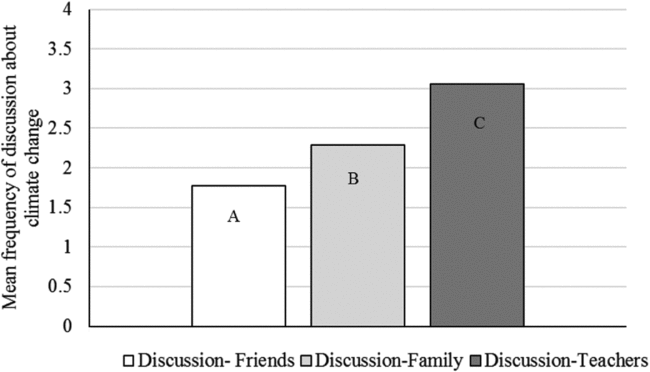
Communication about CC with friends, family and teachers was relatively infrequent. Over half of the students (57.5%) reported that they had never discussed CC with their friends. Almost 40% of students (39.9%) reported that they had never discussed CC with their family and 20.6% of the students reported that they had only discussed CC with their family once. CC discussions occurred more frequently with teachers than with friends or family (Fig. 1). Only 14.5% of students reported that they had never discussed CC in class.
Mean frequency of discussions about climate change with friends, family and teachers. Means were calculated using five-point Likert questions for frequency of discussions about climate change (0 = never, 1 = once, 2 = two or three times, 3 = four or five times, 4 = more than five times). Different letters reflect significant differences based on a one-way analysis of variance with Sidak's corrections (F 2,375.21 p < 0.001).

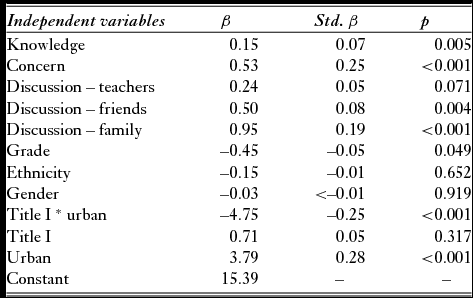
Communication with family and friends, CC knowledge and CC concern positively predicted CC behaviour. Among these variables, CC concern was the strongest predictor of CC behaviour (Table 1). Discussion with family was a stronger predictor of CC behaviour than discussion with friends or teachers (Table 1). The interaction effect for discussion with family and discussion with friends was not significant, and thus not presented in our model. CC knowledge was also a predictor of CC behaviour (Table 1). Our overall model was a modest predictor of CC behaviour (R 2 = 0.248). All hypotheses, except for a positive relationship between increased classroom discussion with teachers and CC behaviour, which approached significance (p = 0.071), were supported by our model. Post-hoc tests for collinearity suggested no collinearity issues among independent variables (mean variance inflation factor = 2.2, all variance inflation factor values <5.4) (O'brien Reference O'brien2007).
Climate change knowledge, concern, communication and demographic variables predicting climate change behaviour among middle-school adolescents in North Carolina, USA (n = 1371).

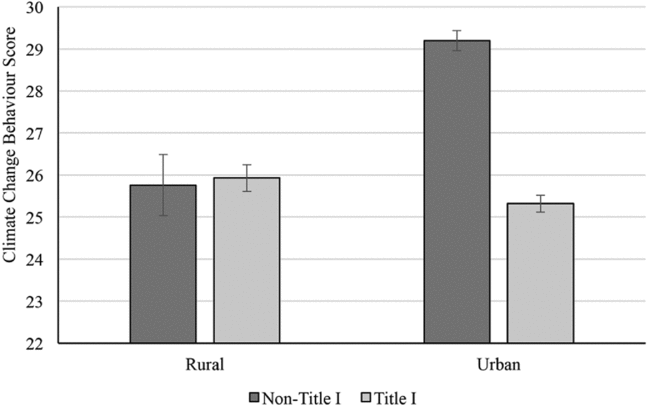
Among the demographic predictors, interactions between rural–urban and Title I status and grade level were both negatively related to CC behaviour (Table 1). CC behaviour was low in rural schools regardless of Title I status, but much higher among students in non-Title I status (wealthier) urban schools than among students at Title I status urban schools (Fig. 2). Interactions between urban and CC knowledge and between urban and CC concern were sequentially added to the model to avoid collinearity, but neither were significant, and we excluded them from our final model. The student's grade inversely predicted CC behaviour, with students in higher grades being less likely to engage in CC behaviour (Table 1). Neither gender nor ethnicity predicted CC behaviour after accounting for the variance explained by other key predictors (Table 1).
Means and SEs of climate change behaviour scores by students attending urban, rural and Title I and non-Title I schools (n = 1371).

DISCUSSION
Our results provide preliminary evidence that conversations with peers and family may independently predict CC behaviour, suggesting pedagogical approaches encouraging discussion about CC outside the classroom may be particularly important. Although students were far more likely to discuss CC with teachers, that discussion did not relate to CC behaviour, whereas relatively rare discussions with family and friends did predict CC behaviour. Thus, teachers may need to leverage frequent engagement with CC in the classroom by using pedagogical approaches that encourage peer discussions in the classroom and family discussions outside the classroom. These types of educational interventions may use norms and peer influence from friends and family to impact CC behaviour (Ojala Reference Ojala2015; Stevenson et al. Reference Stevenson, Peterson and Bondell2016). Frequent discussion can increase the salience of descriptive norms already established by family and friends (Mead et al. Reference Mead, Roser-Renouf, Rimal, Flora, Maibach and Leiserowitz2012). Teaching strategies that incorporate group discussions, projects and informal learning opportunities typically encourage discussion with peers (Maxwell Reference Maxwell2002), and may help solidify behavioural norms if integrated into CC education efforts. Similarly, assignments that encourage students to talk with or interview parents may increase information-seeking (Mead et al. Reference Mead, Roser-Renouf, Rimal, Flora, Maibach and Leiserowitz2012), in addition to promoting family conversations about CC. Future research identifying the context of CC conversations with teachers (e.g. which courses) may help unravel the mechanisms driving the relationships, or lack thereof, between conversations and CC behaviour.
Given the need for discussion outside classrooms highlighted in our findings, informal learning opportunities may provide another valuable approach for engaging adolescents in CC behaviours. Informal learning refers to free-choice learning, in which the learner decides whether, how much and how to interact with a particular learning opportunity (Falk Reference Falk2005). Informal learning can be facilitated at nature centres, zoos or aquaria (Rennie & McClafferty Reference Rennie and McClafferty1995), but also occurs in everyday living around dinner tables, on social media (Robelia et al. Reference Robelia, Greenhow and Burton2011) or while watching television (Heimlich & Falk Reference Heimlich and Falk2009). Free-choice learning often occurs in family groups (e.g. parents taking adolescents to a nature centre) or with peers (e.g. interaction over social media) (Falk Reference Falk2005), which provides adolescents with opportunities for discussions with the people that our results suggest may be most important in promoting behaviour change. Research has linked informal education to increased self-efficacy (Devine‐Wright et al. Reference Devine-Wright, Devine-Wright and Fleming2004) and CC knowledge (Sellmann & Bogner Reference Sellmann and Bogner2013), and one study found that adolescents were more likely to seek information and to commit to changing their behaviour after engaging with CC content on Facebook (Robelia et al. Reference Robelia, Greenhow and Burton2011). Initiatives such as the National Network for Ocean and Climate Change Interpretation (NNOCCI 2016), which trains zoo and aquaria interpreters to facilitate conversations around CC, are particularly encouraging, as they may spur discussion among adolescents and their peers and parents. Our results suggest that similar efforts to infuse CC topics into informal learning opportunities in ways that promote discussion with friends and families may be effective at promoting CC behaviours among adolescents. Research documenting the ideological basis of such family discussions may be an important variable in future research, given the polarized nature of CC conversations in many locations (Morrill Reference Morrill2016).
The interaction between urban residence and school poverty levels identified in this study may highlight potential barriers for CC behaviour faced by rural adolescents and low SES urban adolescents. Ideology, physical constraints on behaviour and action-related knowledge may drive the interaction effect in our study. Rural ideology may explain lower CC behaviour among rural students because rural communities nationwide, including in our study site, tend to be more politically conservative than urban areas (Morrill Reference Morrill2016), and Republican political affiliation aligns strongly with doubt about CC and anthropogenic CC (Dunlap & McCright Reference Dunlap and McCright2008). Similarly, rural residents often engage less in pro-environmental behaviours (Jones et al. Reference Jones, Fly, Talley and Cordell2003). The divide among urban adolescents identified in this study, however, seems less likely to be driven by ideology, given that students exhibited similar levels of concern about CC. Constraints on the ability to act among poor urban adolescents may help explain the behaviour disparity. First, crime and safety concerns may limit walking and bicycling (Cutts et al. Reference Cutts, Darby, Boone and Brewis2009) and access to open spaces in low SES urban areas (Slater et al. Reference Slater, Fitzgibbon and Floyd2013). Further, behaviours such as recycling may be limited because low SES urbanites are less likely to have access to recycling facilities (Berger Reference Berger1997). Urban adolescents may also have less knowledge about which actions may help mitigate CC, limiting their ability to engage in new or alternative behaviours (Semenza et al. Reference Semenza, Hall, Wilson, Bontempo, Sailor and George2008). Future research is needed to explain the degree to which physical constraints and knowledge about CC behaviours drive the interactions in this study, but immediate efforts to remove constraints on climate-friendly behaviour for low SES urbanites and improve their climate literacy may provide key avenues for engaging low SES urban adolescents in addressing CC. Engaging rural adolescents may be more difficult if a politically conservative ideology underlies their lower CC behaviour scores. Evans et al. (Reference Evans, Milfont and Lawrence2014) suggest that discussing local CC adaptation increases willingness to engage in future mitigation efforts, even among sceptics, by presenting them with the local consequences of CC (Evans et al. Reference Evans, Milfont and Lawrence2014). Because CC poses a direct threat to the persistence of many rural communities dependent on agriculture (Prokopy et al. Reference Prokopy, Morton, Arbuckle, Mase and Wilke2015), both the local challenges posed by CC (e.g. drought) and the urgency associated with addressing them provide fertile material for efforts to highlight local consequences in climate literacy efforts. Future research may further explore specific ways in which EE programming can address some of the potential barriers we highlight (i.e. structural and ideological barriers). Krasny and Tidball (Reference Krasny and Tidball2009) offer that the most successful EE programmes may focus on community resilience and action in ways that empower citizens and encourage engagement with local policy systems to overcome structural barriers that are in some cases endemic to urban environments. Further, EE research may be a promising outlet for overcoming ideological barriers to CC behaviour, as some research suggests EE with children may help shape the environmental attitudes and behaviours of adults regarding topics ranging from recycling to more contentious topics like biodiversity conservation (Duvall & Zint Reference Duvall and Zint2007). Though this approach is understudied in CC contexts, it may provide a pathway to addressing ideological barriers among both current and future generations.
The important role of CC concern may be leveraged to shape how educational efforts promote CC behaviours among adolescents. Concern about CC shared the strongest impact on CC behaviour, along with the interaction effect, aligning with previous research on climate-related behaviour. Concern is an especially important emotion for motivating CC behaviour (Smith & Leiserowitz Reference Smith and Leiserowitz2014) that can promote information seeking to decrease risk (Beckjord et al. Reference Beckjord, Finney Rutten, Arora, Moser and Hesse2008). As opposed to fear-based appeals, which can cause people to disengage with or dismiss an issue (Smith & Leiserowitz Reference Smith and Leiserowitz2014), concern is a less intense emotion that can activate cognitive and analytical processing of risk information, enabling deliberative and iterative decision-making (Smith & Leiserowitz Reference Smith and Leiserowitz2014). Future research might further explore the impact of educational efforts that integrate promoting discussion with family with material intended to foster CC concern and CC hope (Ojala Reference Ojala2012; Stevenson & Peterson Reference Stevenson and Peterson2015).
Our results build on the emerging research among adolescents by documenting that communication with teachers is the most prevalent way adolescents discuss CC, but communication with friends and family may be needed to elicit CC behaviours. Thus, CC education, including activities engaging friends and family, particularly via informal learning pathways, may be an especially efficacious way to promote CC behaviour among adolescents. The interaction we observed between urban and low SES schools highlights the importance of place when conceptualizing and reacting to CC. Our research does have several limitations. First, our observational study could not elucidate causality. Future experimental research could determine if and how different types of CC communication influence CC behaviour. Second, adolescents and educational systems in North Carolina are not necessarily representative of their counterparts elsewhere in the United States or other regions of the world. Fortunately, our findings largely coincide with those of studies with adolescents from diverse places, including Sweden (Ojala Reference Ojala2015), the United Kingdom (Senbel et al. Reference Senbel, Ngo and Blair2014) and among a nationally representative sample of the United States (Mead et al. Reference Mead, Roser-Renouf, Rimal, Flora, Maibach and Leiserowitz2012). Given this widespread consistency in findings from regional research, it seems unlikely that unique attributes of North Carolina would render our novel findings about CC communication regional in nature. Future research could help unify these regional case studies if scholars within this subject area begin direct collaborations and design intercultural instruments and treatments that facilitate direct comparison. Our results associated with the urban versus rural divide in CC behaviour, however, may reflect novel attributes of our study area. Like much of the United States, North Carolina has become politically polarized, largely along an urban and rural division (Morrill Reference Morrill2016). Perspectives on CC follow political divides among adults (Hamilton et al. Reference Hamilton, Hartter, Lemcke-Stampone, Moore and Safford2015), with rural residents less likely to be accepting of anthropogenic CC. Further, the conservative 2012 North Carolina state legislature restricted local municipalities and other agencies to using sea-level rise projections designated and approved by the North Carolina Coastal Resource Commission (Opt Reference Opt2015), serving as one example of several in which the political climate of our study area may impact individual perceptions of CC, as well as public policy. A geographic divide in CC behaviour and beliefs may differ or not exist in other regions of the world, but this does highlight how future research exploring the geography of CC behaviour may provide valuable insights. Although our findings are preliminary, they clearly suggest that adolescents in the most resource-starved schools (rural and low SES urban) need additional help to fully engage CC within their curricula.
ACKNOWLEDGEMENTS
We would like to thank the teachers and students who participated in this project. We also thank the anonymous reviewers for providing feedback that improved this paper.
FINANCIAL SUPPORT
We gratefully acknowledge the financial support of the NC Sea Grant (Project ID #6411). During the writing of this paper, tuition support was provided by the Southeast Climate Science Center and the NC State University Department of Forestry & Environmental Resources.
CONFLICT OF INTEREST
None.
ETHICAL STANDARDS
The authors assert that all procedures contributing to this work comply with the ethical standards of the relevant national and institutional committees on human experimentation and with the Helsinki Declaration of 1975, as revised in 2008, and the protocol was approved by the North Carolina State University Institutional Review Board (IRB #4099).
Supplementary material
For supplementary material accompanying this paper, visit https://doi.org/10.1017/S0376892917000443