


Introduction
Eurypterids were a diverse and ecologically important group of aquatic chelicerates that lived from the Middle Ordovician to the late Permian (Lamsdell et al. Reference Lamsdell, Briggs, Liu, Witzke and McKay2015). Divided into two orders, the Eurypterina modified their most distal podomeres of their sixth appendage into paddles that they used for swimming, whereas the Stylonurina lacked this modification and used their sixth appendage for walking. Of these two clades, the Eurypterina comprise ~75% of all known eurypterid species and ~95% of all specimens, making the Stylonurina rare in comparison (Tetlie Reference Tetlie2007). Despite their sparse fossil record, stylonurines have a longer temporal range and include the youngest known eurypterids (Ponomarenko Reference Ponomarenko1985; Tetlie Reference Tetlie2007).
While swimming eurypterids were probably active predators (Anderson et al. Reference Anderson, McCoy, McNamara and Briggs2014; McCoy et al. Reference McCoy, Lamsdell, Poschmann, Anderson and Briggs2015), it has been suggested the benthic stylonurine eurypterids had a mode of life similar to modern horseshoe crabs (Poschmann et al. Reference Poschmann, Schoenemann and McCoy2016) with the exception of two clades, the Stylonuroidea and the Mycteropoidea, both of which appear to have independently evolved modifications for sweep-feeding on their anterior appendages (Lamsdell et al. Reference Lamsdell, Braddy and Tetlie2010). Rather than hunting specific individuals, sweep-feeders capture prey en masse with strokes of their appendage armature (see “Terminology”) either through the water column as a form of active filter feeding or through the substrate as a form of rake deposit feeding. Both stylonuroids and mycteropoids possessed spines on their anterior prosomal appendages that they most likely used to entrap small organisms or collect food particles from suspension. Of these two clades, the mycteropoids were more specialized sweep-feeders; rather than indiscriminately raking through the surrounding medium, their armature included sensory setae which allowed them to tactilely detect organisms. While the stylonuroids did not survive the Late Devonian mass extinction, the mycteropoids radiated in the Late Devonian and persisted into the late Permian (Lamsdell et al. Reference Lamsdell, Braddy and Tetlie2010).
The known prey-capture appendages (comprising appendage pairs II, III, and sometimes IV) in Stylonurina exhibit moderate diversity (Fig. 1), tending to be morphologically conserved in major clades. Rhenopteroidea—the clade that includes the oldest known stylonurine eurypterid, Brachyopterus stubblefieldi (Størmer Reference Størmer1951)—are characterized by the possession of Rhenopterus type appendages, which comprise short fixed projections on the distal podomere margins. Most clearly demonstrated in exceptionally preserved material of Rhenopterus (Størmer Reference Størmer1936), Rhenopterus type appendages are also recorded in the rhenopteroids Brachyopterus, Brachyopterella, and Kiaeropterus (Størmer Reference Størmer1934, Reference Størmer1951). Rhenopteroids have been suggested to be bottom scavengers (Waterston Reference Waterston1979), a mode of life supported in at least Rhenopterus through studies of the visual acuity of the lateral eyes that demonstrated Rhenopterus to have similar vision to modern horseshoe crabs (Poschmann et al. Reference Poschmann, Schoenemann and McCoy2016). The anterior prosomal appendages in Kokomopteroidea, a relatively poorly known clade of Silurian–Devonian stylonurines, are only well preserved in Kokomopterus (Clarke and Ruedemann Reference Clarke and Ruedemann1912). The prey-capture appendages of Kokomopterus are Hughmilleria type, which bear paired movable spines on each podomere, as does the sole preserved anterior appendage of the kokomopteroid Hallipterus (Tetlie Reference Tetlie2008). Hughmilleria type appendages are also known from the stylonuroids Parastylonurus and Stylonurella (Waterston Reference Waterston1979). Stylonuroidea is the best known of the stylonurine clades in terms of appendage structure; as well as Parastylonurus and Stylonurella, prey-capture appendages are known from Ctenopterus (Clarke and Ruedemann Reference Clarke and Ruedemann1912), Soligorskopterus (Plax et al. Reference Plax, Lamsdell, Vrazo and Barbikov2018), and Laurieipterus and Pagea (Waterston Reference Waterston1962). These four taxa all bear Ctenopterus type appendages, which consist of podomeres bearing multiple pairs of fixed spines. The close spacing and ventral orientation of the spines on the Ctenopterus type appendages, in combination with the greatly elongated hind-leg pairs (V and VI), led to the suggestion that these taxa may have adopted a “dragnet” style of feeding, whereby the spines were used to indiscriminately entangle soft-bodied prey (Lamsdell et al. Reference Lamsdell, Braddy and Tetlie2010). The appendages of the final stylonurine clade, Mycteropoidea, are less well known but appear to be the most morphologically diverse. The earliest mycteropoid, Drepanopterus, possessed appendages with fixed spines and broad movable “blades” bearing setae (Lamsdell et al. Reference Lamsdell, Braddy and Tetlie2009; Lamsdell Reference Lamsdell2013) that may have been used as a tactile probe to detect prey (Lomax et al. Reference Lomax, Lamsdell and Ciurca2011). The Carboniferous mycteropoids Woodwardopterus and Megarachne also appear to have possessed broad blades on their anterior appendages (Selden et al. Reference Selden, Corronca and Hünicken2005), although the available specimens do not preserve the appendages in detail. The best-known examples of appendages in Mycteropodoidea come from the Carboniferous taxa Hibbertopterus and Cyrtoctenus. Hibbertopterus, like Drepanopterus, has an appendage structure consisting of fixed spines and broad movable blades with sensory setae (Waterston Reference Waterston1957). Cyrtoctenus appears to represent an extreme modification of this appendage type, in which the fixed projections are developed into filamentous rachis that have been interpreted to function as filter devices as part of a sweep-feeding life habit (Waterston et al. Reference Waterston, Oelofsen and Oosthuizen1985).
Prey-capture appendages of Stylonurina. Rhenopterus type appendages consist of short, fixed projections from the ventero-distal podomere margins; Hughmilleria type appendages possess paired movable spines at the ventero-distal podomere margins; Ctenopterus type appendages comprise podomeres with a series of ventrally projecting fixed spines; Hibbertopterus type appendages have large, broad fixed ventero-distal projections with associated broad movable spines; Cyrtoctenus type appendages develop large fixed filamentous rachis on the postero-lateral podomere margins with associated broad movable spines.

It has been shown among a diverse group of extant suspension feeders that there is a linear correlation between the average spacing of feeding structures and prey sizes (Vinther et al. Reference Vinther, Stein, Lungrich and Harper2014). Here we extrapolate this relationship to several sweep-feeding eurypterids in order to estimate the range of prey sizes that they could capture and to compare them with other fossil and extant forms. This will offer insight into possible correlations between eurypterid prey sizes and survival rates during the Late Devonian mass extinction, when the majority of eurypterid clades became extinct. It is hypothesized that prey sizes decreased over time as sweep-feeding eurypterids evolved more complex appendage armatures and the success of the mycteropoids was due, at least in part, to their ability to capture smaller prey items.
Materials and Methods
Measurements of inter-armature spacing were taken from specimens stored in the National Museum of Scotland in Edinburgh and the British Geological Society in Nottingham. These measurements were supplemented with those of other sweep-feeding eurypterids derived from the literature (see Table 1 for a list of eurypterid specimens included in this study). Armature spacing results were omitted in cases where spine length did not exceed 1 mm (e.g., Rhenopterus diensti), as such minute armature would have been ineffective in prey capture. To assess phylogenetic trends in prey size, Spearman's rank correlation coefficient ρ (Spearman Reference Spearman1904) and Moran's I (Moran Reference Moran1950) statistical tests were performed in R (R Core Team 2018). For Spearman's rank correlation, the distance of a species from the root of the clade was determined using the cladistic rank method (e.g., Gauthier et al. Reference Gauthier, Kluge and Rowe1988; Benton and Storrs Reference Benton and Storrs1994).
List of eurypterid specimens in which inter-armature spacing was measured. Measurements of the following specimens were derived from figures in the referenced publications: Rhenopterus (Størmer Reference Størmer1936), Brachyopterella (Størmer Reference Størmer1934), Kiaeropterus (Størmer Reference Størmer1934), Hallipterus (Clarke and Reudemann Reference Clarke and Ruedemann1912), C. dewalquei (Størmer and Waterston Reference Størmer and Waterston1968), and C. wittebergensis (Waterston et al. Reference Waterston, Oelofsen and Oosthuizen1985). See “Institutional Abbreviations” section for specimen code prefixes.

Pectinate appendages have evolved not only in eurypterids, but also convergently at various times across several arthropod lineages, such as in numerous eumalacostracan taxa and insects (Jones et al. Reference Jones, Feldmann, Hannibal, Schweitzer, Garland, Maguire and Tashman2018). Furthermore, pectinate claws have evolved independently multiple times in crustaceans but differ functionally from the sweep-feeding eurypterids in that they are able to change mesh size by varying the angle at which they hold the free ramus of the claw (Tshudy and Sorhannus Reference Tshudy and Sorhannus2000). However, two Late Devonian fossil decapod crustaceans bore pectinate appendages in which the spines protruded ventrally in a manner similar to the Stylonurina and were included in this study for comparison. Maxilliped III of Palaeopaleomon newberryi and maxilliped I of Angustidontus seriatus were enlarged, highly spinose appendages that were capable of moving dorsoventrally (Jones et al. Reference Jones, Feldmann, Hannibal, Schweitzer, Garland, Maguire and Tashman2018). While Angustidontus is considered a pelagic predator (Rolfe and Dzik Reference Rolfe and Dzik2006), Palaeopaleomon possibly raked the sediment for infaunal prey (Jones et al. Reference Jones, Feldmann, Hannibal, Schweitzer, Garland, Maguire and Tashman2018) as has been hypothesized for several of the stylonurine eurypterids.
Inter-armature spacing for the decapods Angustidontus and Palaeopaleomon were measured from the literature. Angustidontus measurements were taken from specimens NMNH 530461a, NMNH 530455, and NMNH 530453a figured in Rolfe and Dzik (Reference Rolfe and Dzik2006). Palaeopaleomon measurements were taken from specimens USNM 617308b, USNM 618374, and CMNH 4106 figured in Jones et al. (Reference Jones, Feldmann, Hannibal, Schweitzer, Garland, Maguire and Tashman2018). The mesh sizes and estimated prey sizes of the anomalocarids Tamisiocaris borealis and Pahvantia hastata were compiled from Vinther et al. (Reference Vinther, Stein, Lungrich and Harper2014) and Lerosey-Aubril and Pates (Reference Lerosey-Aubril and Pates2018), respectively. The mesh and prey sizes for several modern filter feeders were also gathered from the literature. Data from Jenkin (Reference Jenkin1957), Boyd et al. (Reference Boyd, Heyraud and Boyd1984), Budy and Haddix (Reference Budy and Haddix2005), and Tanaka et al. (Reference Tanaka, Aoki and Ohshimo2006) compiled in Figure 4 of Vinther et al. (Reference Vinther, Stein, Lungrich and Harper2014) were extracted using the WebPlotDigitizer application (Rohatgi Reference Rohatgi2018). The average mesh spacing for each fossil specimen was used to infer the range of prey sizes that could be captured by applying the lower- and upper-bound equations from Vinther et al. (Reference Vinther, Stein, Lungrich and Harper2014), which are y = 1.4452x 1.0083 and y = 11.772x 0.8928, respectively, where x is the average mesh spacing, and y is the estimated prey size.
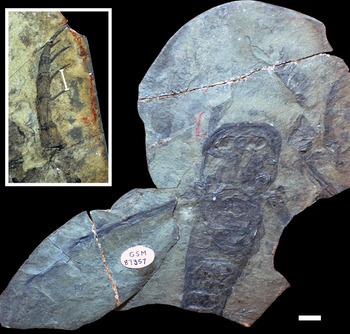
Specimens were photographed with a Canon EOS 80D camera. The spacing between the distal ends of spines was measured with a caliper from photographs, with all measurements from individual specimens averaged before applying the prey size equations (see Fig. 2 for example measurement). In cases where spacing between adjacent spines varied along their lengths due to variation in the origination angle or significant spine curvature, multiple measurements were taken along the lengths of adjacent spines and averaged. Spacing measurements between adjacent spines were not taken in cases where it was not clear whether the individual spines originated from an anterior or posterior row on the appendage. Spacing measurements were also not taken between adjacent spines in cases where spines appeared to be missing, possibly having broken off before fossilization.
The benthic scavenging parastylonurid Stylonurella spinipes with disarticulated appendages (BGS GSE 87357). Bar indicates example measurement. Scale bar, 10 mm.

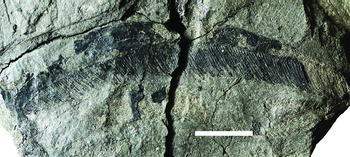
In the case of Cyrtoctenus armature (Fig. 3), comb filaments appeared to be flexible, with sections along the lengths of adjacent filaments often overlapping. Therefore, measurements were taken from a more proximal location along the length of the filaments, closer to where they originate from the rachis and where there appeared to be less flexion and clear separation between individual filaments. In some cases, spacing measurements could not be taken, because adjacent filaments overlapped throughout their entire lengths.
Disarticulated sweep-feeding armature of the mycteropoid Cyrtoctenus peachi. A comb-rachis bearing two rows of filaments protruding from the anterior margin (BGS GSE 2127). Scale bar, 10 mm.

Terminology
Terminology for appendage morphology follows Tollerton (Reference Tollerton1989) as modified by Lamsdell (Reference Lamsdell2011). Labeling of appendages follows Selden (Reference Selden1981). “Armature” refers to the cuticular spines projecting from the appendages. Terminology of mycteropoid appendage armature follows Lamsdell (Reference Lamsdell2013), while the movable broad spines associated with the fixed comb rachises of Cyrtoctenus are referred to as “fingers,” which have highly modified, dagger-shaped scales on the posterior margins termed “fulcra.” “Filaments” refers to the thin spines radiating from the comb rachis of Cyrtoctenus.
Institutional Abbreviations
BGS, British Geological Survey, Nottingham; BKM, Trudovoy Slavy Museum, Soligorsk; CMNH, Carnegie Museum of Natural History; FMNH, Field Museum of Natural History; MfN, Museum für Naturkunde, Berlin; NMNH, Smithsonian National Museum of Natural History; NMS, National Museums of Scotland; NYSM, New York State Museum; PMO, Paleontologisk Museum, Oslo; UL, Laboratoire de Paleontologie, University of Liege; USS, University of Stellenbosch.
Results
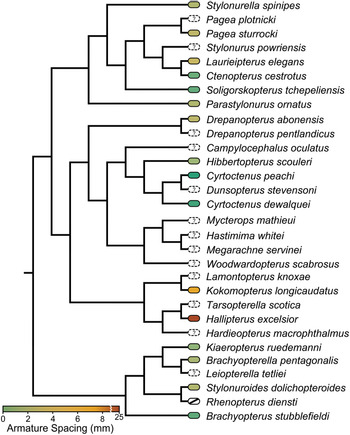
The average armature spacing for most stylonurines considered to be sweep-feeders was between 1.14 mm and 4.02 mm (Fig. 4), which overlaps completely with the average armature spacing of the stylonurines not considered sweep-feeders. Cyrtoctenus species were outliers, with average filament spacings ranging from ~67 μm to ~503 μm (Fig. 5), which is more comparable to Palaeopaleomon (~424 μm) and the pelagic predator Angustidontus (~823 μm). There were no clear trends in prey size estimates among stylonurine eurypterids or within major clades (Fig. 6). Spearman's rank correlation yielded a ρ of −0.141, indicating no strong directional trend in prey size within the phylogeny; therefore, armature spacing does not consistently decrease throughout stylonurine evolution. The retrieved Moran's I value of 0.149 indicates a marginal phylogenetic clustering of armature spacing within the phylogeny, suggesting that, to some degree, closely related species have a marginally higher propensity for similar armature spacing. However, Moran's I indicates that the distribution of appendage armature spacing is still largely random across the phylogeny.
Estimated prey size ranges of eurypterids generally considered to be sweep-feeders (circles), which include stylonurids (gray), drepanopterids (black), and hibbertopterids (white), and bottom scavengers (squares), which include parastylonurids (gray), rhenopteroids (black), and kokomopteroids (white).

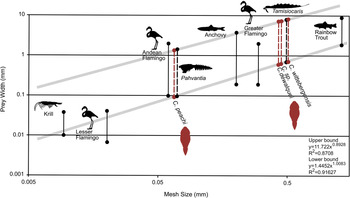
Prey size ranges of a diverse group of modern and fossil suspension feeders. Dashed lines indicate prey size ranges that were estimated from filter mesh size (modified from Vinther et al. Reference Vinther, Stein, Lungrich and Harper2014).

Cladogram of stylonurine eurypterids after Lamsdell and Selden (Reference Lamsdell and Selden2017). Colors correspond to the average inter-armature spacing of each species.

Discussion
Possible Prey Items and Feeding Strategies of Stylonurina
The results (Fig. 4) suggest that the prey sizes that most stylonurines could capture with their appendage armatures were very similar, and thus stylonurines potentially had very similar diets. Excluding the outlying Cyrtoctenus values, the average armature spacing of a sweep-feeding stylonurine eurypterid was ~2.7 mm, which provides an average prey size diameter of ~3.8 mm to ~36 mm. This suggests that the armature of the sweep-feeding Stylonurina was optimally suited for capturing small benthic macrofauna rather than suspended particles. Benthic macroinvertebrates such as crustaceans, mollusks, and trace fossils attributed to wormlike organisms are commonly found in association with eurypterids and would be manageable prey items (Størmer and Waterston Reference Størmer and Waterston1968; Clarkson et al. Reference Clarkson, Milner and Coates1994, Reference Clarkson, Harper, Taylor and Anderson2009). This is consistent with observations of modern horseshoe crabs. Adult horseshoe crabs prey primarily upon mollusks and marine worms (Botton Reference Botton1984; Chatterji et al. Reference Chatterji, Mishra and Parulekar1992), and bivalve mollusks with shell lengths between 1 mm and 20 mm are a diet staple of Limulus polyphemus (Botton Reference Botton1984), with bivalves >10 mm being preferred (Botton and Ropes Reference Botton and Ropes1989). The smaller armature spacing of Soligorskopterus and Ctenopterus suggests that they could also capture smaller food particles, such as benthic algae and invertebrate larvae. These prey items could have been picked directly from the appendage armature as it was drawn toward the oral region by the chelicerae. It is possible that eurypterids did not separate sediment grains from their prey; the gut content of modern horseshoe crabs includes a large proportion of sediment and microorganisms such as foraminifera, indicating that these aquatic chelicerates ingest a large amount of incidental material with their prey (Botton Reference Botton1984; Botton and Haskin Reference Botton and Haskin1984).
In addition to appendage armature, multiple aspects of eurypterid morphology, such as eye position, body size, and masticatory processes may provide key insights into their diets and mode of predation (Waterston Reference Waterston1979). The mode of life of the swimming Eurypterina contrasts with that of the Stylonurina, whose long posterior appendage pairs indicate that they were benthic crawlers or walkers. Although several Eurypterina such as Mixopterus and Megalograptus also possessed spiniferous anterior appendages, Waterson (Reference Waterston1979) stated that they cannot be compared functionally to the spiniferous appendages of the Stylonurina; the anterior appendages of these Eurypterina are clearly indicative of an active form of predation in which the forward-facing spines were used in active prey capture. This is in contrast to the Stylonurina, whose armature protrudes from the ventral surfaces of the podomeres, indicating food was collected beneath their prosoma. Thus, in the case of the stylonuroids and mycteropoids, it has been suggested that the anterior appendage armature was used to rake through the substrate in search of infaunal organisms (Lamsdell et al. Reference Lamsdell, Braddy and Tetlie2009). However, if they were able to externally rotate their appendages so that their armature was directed anteriorly, they may have been capable of actively trapping prey as well.
Although morphological aspects of stylonurine eurypterids may indicate an inclination to one particular feeding strategy, they may have been generalized feeders and not specialized for just one form of prey capture or food collection. To explain the occurrence of specific trace fossils in the Devonian Campbelton Formation of New Brunswick, Canada, King et al. (Reference King, Miller and Stimson2017) proposed that, in addition to active prey capture, Pterygotus also used its denticulate chelicerae to rake the substrate for prey (although this would have required the cheliceral claws to open to a degree that may have been functionally impossible). Additionally, modern crayfish are known to employ several feeding strategies, including active predation, foraging, and scavenging (Longshaw and Stebbing Reference Longshaw and Stebbing2016). This may have also been the case with the stylonurine eurypterids. For example, Drepanopterus prosomal appendages retained the Hughmilleria type conical spines in addition to developing blades suitable for raking through the substrate. Therefore, Drepanopterus may have been capable of collecting smaller infaunal organisms in addition to larger invertebrates (Lamsdell et al. Reference Lamsdell, Braddy and Tetlie2009).
The similar average armature spacings of the supposedly sweep-feeding stylonurines are comparable to the scavenging parastylonurids (Fig. 4). Thus, it may be the case that these eurypterids were not specifically adapted to a sweep-feeding mode of life and were more generalized feeders. In addition to scavenging, they may have been capable of piercing and trapping epifaunal organisms with their appendage armatures. For example, Pagea may have used its long primary spines to impale organisms, while the smaller accessory spines would have prevented its victims from struggling free. The hibbertopterids, however, do appear to be specialized for sweep-feeding. The broad, blunt spines of Hibbertopterus, which bore sensory setae, were clearly not suitable for piercing or grasping prey, nor were the thin and flexible filaments of Cyrtoctenus, which were clearly adapted for straining the water for fine organic particles. However, Cyrtoctenus retained narrow gnathobasic teeth similar to those of Hibbertopterus, indicating Cyrtoctenus could still masticate larger food items or crush up harder shell material (Lamsdell et al. Reference Lamsdell, Braddy and Tetlie2009).
Cyrtoctenus sp. (NMS G 1987.7.24), Cyrtoctenus dewalquei, and Cyrtoctenus wittebergensis had nearly identical prey size estimates that range from 0.60 mm to 8.2 mm, which corresponds to a diet of mesoplankton and is very similar to the estimated prey sizes of the anomalocarid Tamisiocaris (Vinther et al. Reference Vinther, Stein, Lungrich and Harper2014; Fig. 5). This prey size range also overlaps with those of the greater flamingo, anchovy, and rainbow trout. The greater flamingo commonly preys upon small crustaceans such as isopods and brine shrimp (Jenkin Reference Jenkin1957). Anchovy feed primarily on ostracods (Tanaka et al. Reference Tanaka, Aoki and Ohshimo2006), while cladocerans are a dietary staple of rainbow trout (Budy and Haddix Reference Budy and Haddix2005). Carbonita ostracods were abundant in the Midland Valley of Scotland during the Carboniferous and fall within the estimated prey size range of Cyrtoctenus (Bennett et al. Reference Bennett, Siveter, Davies, Williams, Wilkinson, Browne and Miller2012). Filter-feeding fish such as acanthodians are often found in association with Cyrtoctenus and may have competed with it for similar prey items (Størmer and Waterston Reference Størmer and Waterston1968; Evans Reference Evans1999). However, Cyrtoctenus may have been able to avoid competition with these fish to some extent by feeding at the benthos, while acanthodians were nektonic feeders.
The estimated prey size range of Cyrtoctenus peachi is most comparable to that of the anomalocarid Pahvantia (Lerosey-Aubril and Pates Reference Lerosey-Aubril and Pates2018) and the Andean flamingo, which has a reported mesh size of ~60 μm and a diet dominantly composed of diatoms that range in size from 0.1 mm to 2 mm (Jenkin Reference Jenkin1957). Andean flamingos feed along the margins of lagoons and saline lakes by sweeping their bills across the surface of the substrate to suspend small food particles that can then be filtered by the lamellae within their bills as water is pumped through the oral region by the motion of the tongue (Jenkin Reference Jenkin1957). It is noteworthy that flamingos and Cyrtoctenus both occupied marginal and lacustrine environments, and perhaps the appendages and movable fingers of Cyrtoctenus were used to disturb the substrate to suspend food particles that could then be filtered by the combs, much as Andean flamingos feed (Jenkin Reference Jenkin1957).
Eurypterids and the Late Devonian Mass Extinction Event
After enduring the Ordovician mass extinction, eurypterids radiated in the Silurian. However, decreased speciation rates in the Devonian caused diversity to decline significantly, and their lack of recovery after the Late Devonian mass extinction may have been due to their reduction in ecospace after transitioning to freshwater environments (Lamsdell and Selden Reference Lamsdell and Selden2017). Decreased origination rates in the Late Devonian have been attributed to marine transgressions that facilitated range expansions and the invasion of species that ultimately reduced instances of vicariant speciation (Abe and Lieberman Reference Abe and Lieberman2009; Stigall Reference Stigall2010, Reference Stigall2012).
During the Late Devonian mass extinction, the Eurypterina suffered major losses, and only the Adelopthalmidae persisted into the Carboniferous (Romer Reference Romer1933; Lamsdell and Braddy Reference Lamsdell and Braddy2010). Abiotic factors such as marine transgressions may have reduced instances of endemism, resulting in a decline in speciation rates as background extinctions continued to reduce their diversity throughout the Devonian (Lamsdell and Selden Reference Lamsdell and Selden2017). The Stylonurina fared better, and their diversity was relatively stable throughout the Devonian (Lamsdell and Braddy Reference Lamsdell and Braddy2010). During the Late Devonian and Carboniferous, mycteropoid diversity increased, and they underwent the last major eurypterid radiation (Tetlie Reference Tetlie2007). Mycteropids and the hibbertopterids were the only Stylonurina to persist into the late Paleozoic, and they attained a more global distribution after the formation of Pangea (Tetlie Reference Tetlie2007). Their success has been attributed to their sweep-feeding mode of life, which would have allowed them to avoid competition with nektonic predators (Lamsdell and Braddy Reference Lamsdell and Braddy2010).
It was hypothesized that as sweep-feeding eurypterids evolved more advanced armature, they would have developed finer prey capture abilities. However, there are no significant trends in prey size among stylonurine eurypterids or within major clades (Spearman's rank correlation ρ = −0.141). Kokomopteroids had the largest average inter-armature spacing among the four major stylonurine clades (156 mm), and the basal rhenopteroids had the smallest (2.3 mm), which is most likely due to their particularly small body size. There was also no clear distinction in average armature spacing among the stylonuroids (3.1 mm for parastylonurids and 2.5 mm for stylonurids). While the mycteropoids do have a smaller average inter-armature spacing than the stylonuroids (2.1 mm and 2.7 mm, respectively), this does not hold true if the outlying Cyrtoctenus values are excluded (3.0 mm). Among the mycteropoids, the hibbertopterids have the smallest inter-armature spacing (1.4 mm), as was expected for these highly specialized sweep-feeders. Furthermore, armature spacing shows no preponderance to be clustered or dispersed phylogenetically, with a Moran's I value of 0.149 indicating a moderate degree of clustering but an overall distribution closer to randomness. This indicates that prey sizes are not especially phylogenetically conserved; most likely, the conflicting signal is due to the competing interactions of phylogenetic history (which would favor clustering) and ecological opportunity (which would favor dispersal) (Congreve et al. Reference Congreve, Falk and Lamsdell2018). These results suggest that prey size, which neither steadily decreases over their evolutionary history nor acts as a defining characteristic of clades, does not mediate survival in the Late Devonian, and the success of the mycteropoids in comparison to the stylonuroids cannot be attributed to finer prey capture abilities.
Although eurypterids may have originally been temporarily driven to brackish and freshwater habitats to avoid predators while they molted (Braddy Reference Braddy2001), chasmataspidids (Lamsdell and Briggs Reference Lamsdell and Briggs2017), xiphosuran (Lamsdell Reference Lamsdell2016), and several eurypterid groups (Lamsdell and Braddy Reference Lamsdell and Braddy2010) independently transitioned to freshwater environments in the Devonian, suggesting a concerted response to large, widespread environmental changes (Lamsdell et al. Reference Lamsdell, Congreve, Hopkins, Krug and Patzkowsky2017). Their transition from marine environments may have been facilitated by the high temperatures in the Devonian, as most of the continental land masses were positioned at low latitudes (Waterston Reference Waterston1979). Studies of modern crabs have revealed that there is a greater tolerance to lower-salinity environments in warmer temperatures (Anger Reference Anger1991). The transition to freshwater may have also been a case of ecological opportunism. In order for sweep-feeding eurypterids to have taken up permanent residence in freshwater environments, a benthic fauna must have been established in fluvial and lacustrine settings by this time. Trace fossil evidence suggests that fluvial channels and marginal lacustrine environments were first invaded by benthic invertebrates in the Devonian. During the Carboniferous, a more diverse detritus-feeding epifauna and shallow infauna became established in lacustrine environments (Fig. 7). The timing of this invasion has been attributed to the influx of nutrients into nonmarine aquatic habitats from the dispersal of land plants (Buatois et al. Reference Buatois, Mangano, Genise and Taylor1998). It is noteworthy that this invasion into freshwater habitats by the benthos coincides with the radiation of the predominantly freshwater sweep-feeding mycteropoids, whose success was likely strongly contingent on the availability of such benthic prey items.
Plot of ichnogenera diversity of 166 assemblages of alluvial to deep-lake environments from the Silurian through to the Carboniferous (modified from Buatois and Mangano Reference Buatois and Mangano1993).

Another factor that may have contributed to the success of the mycteropoids was their geographic range. The mycteropoids were able to achieve a much larger spatial distribution than the stylonuroids, and the total range of the hibbertopterids in particular was quite extensive. Cyrtoctenus had the largest range among all genera; it extended from southern Gondwana to the present-day Czech Republic (Dunlop et al. Reference Dunlop, Penney and Jekel2019). Perhaps the survival of the hibbertopterids into the late Permian was partly due to their wide distribution, which would have reduced the likelihood of random events causing their extinction (Payne and Finnegan Reference Payne and Finnegan2007; Jablonski Reference Jablonski2008).
Potential Sources of Error
Prey size estimates were based upon suspension feeders and may underestimate the true prey size of arthropods using well-developed spines for prey capture, which would have been more powerful and robust than the typical filtering structures of organisms that strain the water for food particles. Furthermore, fossil material with preserved appendage armature was limited for most taxa, and very few individuals from each species were available for inclusion in this study. Excluding the hibbertopterids, which may have developed combs capable of collecting food particles out of suspension in later molt stages, prey sizes likely increased through ontogeny as individuals achieved larger body sizes. Taking these factors into account, the estimated prey sizes likely do not encompass the entire spectrum of prey sizes consumed by sweep-feeding eurypterids.
Because of the flexibility of the comb filaments of Cyrtoctenus, they likely spread outward as the appendages were swept toward the ventral body wall due to the opposing water current that was generated. Thus, their mesh sizes may have been underestimated. The dimensions of the fulcra of the associated movable fingers were measured in order to approximate the maximum inter-filament spacing. If the fulcra of the movable fingers were inserted between the filaments in order to scrape them clean and eject captured prey into the oral region, as has been suggested by Waterston et al. (Reference Waterston, Oelofsen and Oosthuizen1985), the fulcra may provide a reliable approximation of maximum filament spacing. The average width of these fulcra in specimens BGS 599, BGS GSE 2184, BGS GSE 2186, and BGS GSE 9682 was 0.56 mm, which provides a prey size estimate of 0.79 mm to 9 mm. Even taking into account this maximum estimate of armature spacing, Cyrtoctenus still has the smallest estimated prey sizes among all Stylonurina and still falls within the mesoplankton size range.
Conclusions
The majority of eurypterids were found to have very similar appendage armature spacing, and there is no obvious distinction between those considered to be sweep-feeders and the bottom-scavenging parastylonurids, with the more closely spaced armature of rhenopteroids attributable to their smaller body sizes; while kokomopteroids had larger armature spacing as would be expected from these non–sweep-feeders. Among those eurypterids generally considered to be sweep-feeders, only Cyrtoctenus had an inter-armature spacing outside a range of 1.14 mm to 4.02 mm, which corresponds to a prey size range of 1.6 mm to 52 mm. This suggests that the armature of the sweep-feeding stylonuroids was optimally suited for capturing small macrofauna. Benthic macroinvertebrates such as small crustaceans, mollusks, and wormlike organisms would be manageable prey items.
The similarity of armature spacing among eurypterids with presumably different ecological roles and the lack of more advanced modifications for sweep-feeding like those found in the hibbertopterids suggests that they may have been more generalized feeders. In addition to capturing individual benthic prey organisms, they may have been capable of trapping organisms with their spiniferous appendages. Cyrtoctenus was clearly a specialized sweep-feeder and has an estimated prey size range indicative of a diet of mesoplankton. This prey size range is most similar to those of filter-feeding fish like anchovy and rainbow trout, as well as flamingos.
The results of this study do not support the hypothesis that prey sizes among sweep-feeding eurypterids decreased over time, and prey size does not appear to mediate survival in the Late Devonian. While the success of the hibbertopterids may have been due to their wide distribution and sweep-feeding mode of life, which would have allowed them to avoid competition with nektonic predators, mycteropoids as a whole likely benefited from the expanding benthos, which was invading freshwater environments in the Devonian and Carboniferous.
Acknowledgments
The authors would like to thank A. Ross of the National Museum of Scotland, P. Shepherd of the British Geological Society, and L. Amati of the New York State Museum for facilitating access to specimens. The article benefited from thorough reviews from two anonymous referees. This work was supported by a Paleontological Society R. M. Feldmann grant to E.S.H.