Introduction
In recent years, a number of influential historians – most notably Kenneth Pomeranz in his seminal book, The Great Divergence – have argued that one of the main factors in explaining the birth of the modern world was that Britain became able to break the constraints of the old ecological regime. According to this interpretation of history, the access to colonies and coal became crucial for the take-off during the late eighteenth and early nineteenth centuries. Overseas territories could most importantly contribute with the enormous acreage of land necessary for feeding and clothing the population of Europe, and Britain in particular.Footnote 1
Pomeranz’s book has received some criticism from other scholars focusing upon the issue of whether or not Europe and China actually were as developed economically by the turn of the nineteenth century as the author claims. This article will look at another argument in the book, which until now has received far less attention from scholars: Pomeranz’s own explanation of the Great Divergence, and in particular the contribution of colonies and/or peripheral areas to British economic development. The article will also consider British trade with the Baltic periphery in particular, a region that had long contributed crucial raw materials for British manufacture, in order to compare the trade with this region to the trade with the Americas, emphasized by Pomeranz.
Previous research
The idea that peripheral areas, and/or colonies in particular, contributed to European industrialization has been highly controversial in much scholarly literature, both before and after Pomeranz’s work. As early as 1944, Eric Williams’ famous book Capitalism and slavery argued that the gains from slavery and the slave trade with the American colonies were important to the Industrial Revolution in Britain.Footnote 2 Since Williams’ book was published, the debate has raged back and forth, without reaching a consensus on the issue.Footnote 3
Pomeranz’s The Great Divergence argued that previous explanations for the rise of Europe were unsatisfactory. Comparing European and Chinese history, and more specifically the history of England and the Yangzi delta, he concluded that there is no evidence that the English economy was more advanced than the economy in the Yangzi delta at the beginning of the nineteenth century.Footnote 4 This argument has received some criticism from other scholars, who declare that there is actually much evidence of a divergence taking place from an earlier date.Footnote 5
However, far less attention has been given to Pomeranz’s argument concerning the importance of peripheral regions for British development. On this issue, Pomeranz contributed with an innovative approach by trying to assess quantitatively to what extent the periphery contributed to relieving Britain from the constraints of the old ecological regime. He did this by using the concept of ghost acreages: how large an acreage would have been required to substitute domestic for imported timber; also comparing the number of calories acquired from the wheat grown domestically in Britain with the calories that were historically acquired from colonial sugar, as well as the acreage necessary for substituting wool for imported cotton. Thus the assumption that these goods might be considered as substitutes, at least theoretically, is at the heart of the argument. His findings show that the ghost acreage necessary for just substituting domestic alternatives for imported timber, cotton, and sugar would have required some 25–30 million acres of land by the 1830s. This is almost twice the size of the total amount of arable land available domestically in Britain. Exploiting the vast acreage of a peripheral region, the argument goes, thus enabled Britain to abolish its ecological constraints. According to Pomeranz, this phenomenon also appeared at the right time to explain the Great Divergence.Footnote 6
Pomeranz claimed, furthermore, that a ‘new kind’ of periphery, only to be found in the Americas, was crucial to the Great Divergence. No other peripheral region of the Old World could have sufficed to abolish the ecological constraints facing Britain at the time. The Americas not only had vast amounts of land available; the colonies (and later ex-colonies) were also practically set up for exports, and thereby demanded virtually everything apart from the cash crops produced for export.Footnote 7
Few scholars seem to have put Pomeranz’s argument about the contribution of peripheries under close scrutiny. One who has is P. H. H. Vries, who noted that one problem with Pomeranz’s book is that the author presented hardly any data on British international trade in order to support his thesis.Footnote 8 Such data are, however, available from previous research. As is clear from the statistics on British trade assembled by Ralph Davis, the New World had indeed become an important market for manufactured goods during the eighteenth century, and was purchasing a large share of British exports by the time British industrialization started to take off – importing almost 40% of all British exports of manufactured goods. During the early years of the British Industrial Revolution, the demand from the Americas also grew significantly.Footnote 9 During the nineteenth century, on the other hand, demand for British cotton goods experienced a very low growth in both Europe and the British colonies (and former colonies) in North America. The most important areas of incremental demand were by this time instead to be found in new markets: in Latin America, the Near East, India, and Australia.Footnote 10
Gregory Clark, Kevin O’Rourke, and Alan Taylor have recently used Davis’ data on trade in order to test formally the role of British trade with the New World, using a computable general equilibrium (CGE) model. These authors aggregated the data on trade between Britain, the New World, and the rest of the world, focusing to a large extent upon British exports of manufactured goods, and analysed what happened when a number of counterfactual assumptions were applied to the model. They came to the conclusion that the British Industrial Revolution would have looked very much the same even if the Americas had not existed. According to these scholars, there existed alternative markets where British goods could have been sold, and alternative supplies of raw materials.Footnote 11
Theoretical considerations
This article will look at the contribution of peripheral regions to British development. In particular, it will be concerned with Pomeranz’s distinction between the ‘new’ kind of periphery that he found in the New World and the ‘old’ peripheries in other parts of the world. In contrast to the recent work by Clark, O’Rourke, and Taylor, this article will not aggregate the data of British trade, but will look closely instead at the trade with one crucial ‘old’ peripheral region – the Baltic. Contrasting British trade with the Baltic to the trade with the Americas, given such prominence by Pomeranz, might lead us to a more thorough understanding of to what extent the different peripheral regions could, or could not, contribute to processes leading to the Great Divergence.
There is no doubt among scholars that the Baltic constituted an important region for exports of many raw materials to western Europe during the early modern period. Western Europe imported vast amounts of grain, timber, flax, hemp, naval stores, and iron from diverse ports in the Baltic region.Footnote 12 In the specific case of Britain, approximately one-third of all raw materials imported by the late eighteenth century came from this region – making it the single most important region for imports of raw materials during this period.Footnote 13 Pomeranz claims, however, that the countries in eastern Europe (presumably including those bordering the Baltic Sea) were unable to meet the increasing British demand for inputs because the region was stagnating economically owing to bad institutions.Footnote 14 This argument also seems to find some support in older literature dealing with eastern and/or north-eastern Europe.Footnote 15
The research question of this article is therefore: to the extent raw materials were important as inputs for British industries, what set the New World periphery apart from ‘old’ peripheral regions such as the Baltic?
The most important primary source for this article will be data on the trade in goods in the Baltic, gathered by the author from the Sound Toll Chamber Commodity Records.Footnote 16 This source has been used previously in the research of a number of scholars.Footnote 17 The source accounts for the quantities of individual goods passing the Sound (Öresund), going to or coming from the Baltic, during the period 1773–1856. The data are broken down at the source so that it is possible to discern where the individual goods were coming from and going to. Other data used in this paper include British trade statistics; such data have been gathered from earlier literature.
As was mentioned above, Pomeranz’s comparison between Europe and Asia has received a great deal of attention from previous scholars. For that reason, this article will not devote attention to Asia but instead focus upon the British relation with the north-eastern European peripheral region. Pomeranz hardly ever mentions the Baltic as a region in his book, though he writes occasionally about eastern Europe.Footnote 18 Some countries in eastern Europe (such as Poland, the Baltic states, and Baltic Russia) had access to the Baltic Sea, and the Baltic ports were very important gateways for these nations. In British trade statistics, on the other hand, we find the term ‘Northern Europe’, which includes the Baltic, Scandinavia, and Russia.Footnote 19 In this article, the Baltic is taken to mean the ports around the Baltic Sea (east/south of the Sound), and the effective hinterland of these ports. In most cases, the countries referred to here as the Baltic effectively belong to the greater region of eastern Europe, since the commodities discussed came almost exclusively through ports in this region (and not ports in Scandinavia). The following section looks at empirical data on the supply of raw materials from the Baltic, and how that changed over the time of the early Industrial Revolution in Britain. The key issue to be studied is whether supply was stagnating during the period, as Pomeranz has claimed.
A stagnating Baltic supply of raw materials?
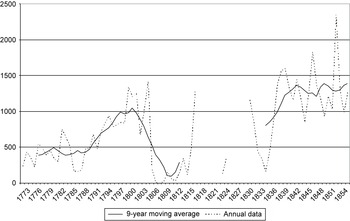
For several centuries, the Baltic had been an important grain-producing and grain-exporting region, supplying western Europe with large amounts of foodstuffs. Milja van Tielhof has demonstrated how exports of grain from the Baltic experienced a period of growth during the late eighteenth century.Footnote 20Figure 1 shows data on exports of wheat from the Baltic for the late eighteenth and early nineteenth centuries. It can be seen that exports of wheat increased significantly during periods of peace. The French Revolutionary and Napoleonic wars disrupted this trend of growth severely. As soon as the wars ended, the exports from the Baltic started to grow very rapidly again, and continued to do so at least until the middle of the nineteenth century. On average, exports of wheat grew at a rate of 4.4% annually prior to the Napoleonic wars, and at a rate of 3.4% annually during the post-war period.
Exports of wheat from the Baltic, 1773–1856 (annual data and nine-year moving average, in 1,000 hectolitres). Source: DNA, STCCR 1773–1856.

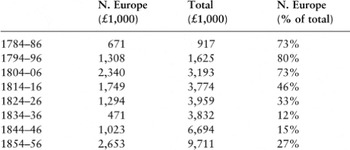
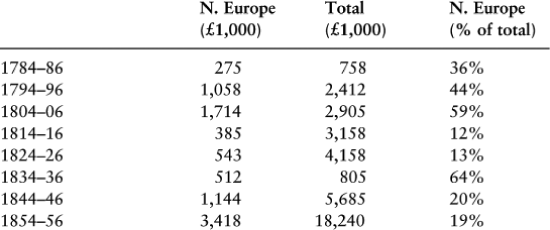
The majority of the Baltic exports of grain went not to Britain but elsewhere. During the eighteenth century, Britain was still largely a net exporter of grain. Only occasionally did imports contribute to the domestic consumption of food, and then at most a couple of per cent of the total consumption.Footnote 21 When Britain started importing more grain than it exported after the Napoleonic wars, the Baltic region was able to retain a significant share of the British markets, at least during much of the first half of the nineteenth century, as can be seen in Table 1. However, from the middle of the nineteenth century, Baltic grain lost out in the competition with the American grain ‘invading’ the British market.
British imports of grain, 1784–1856
Source: Davis, Industrial Revolution, tables 57–64.
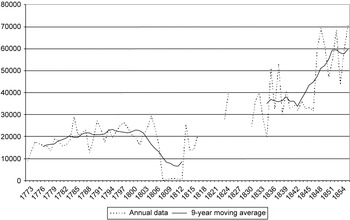
To a large extent, the British textile industry became dependent upon the industrialized production of cotton textiles. Can a limited and/or stagnant supply of substitutes, such as wool or flax, explain this choice of raw material? It is unclear whether Britain really had reached any ecological limits in the production of wool: Pat Hudson argues that there is no evidence that this was so, at least not prior to the 1870s.Footnote 22 This is of course largely due to the fact that Britain primarily imported and processed both wool and other textile fibres, such as cotton. But even if Britain had reached such ecological limits, domestic production of wool was not the only available substitute for cotton. Hudson has suggested that wool could have been imported from France, if there had been a demand for it. British demand for wool had also sparked off an export boom from eastern Europe (including Russia, Hungary, and Poland) as early as the late eighteenth century.Footnote 23 Yet another option would have been to use flax (and/or hemp) instead, and it is noteworthy that there was a flax-based linen industry in Scotland and Ireland during the eighteenth century.Footnote 24 Pomeranz mentions briefly that it was difficult to increase the domestic supply of these goods in Britain.Footnote 25 Even if this was so, there was the potential for imports from other regions of the world, such as Ireland or the Baltic. Hemp and flax were two of the major Baltic exports, and were traded with Britain in particular. Figure 2 shows the data on Baltic exports of flax during the period. We can see that the trend was a steady increase in exports during the late eighteenth and early nineteenth centuries (again with the exception of the years of the Napoleonic wars and the Continental Blockade). Exports grew at a rate of 1.6% annually before the Napoleonic wars, and 2.8% annually in the post-war period.
Exports of flax from the Baltic, 1773–1856 (annual data and nine-year moving average, in tons). Source: DNA, STCCR 1773–1856.

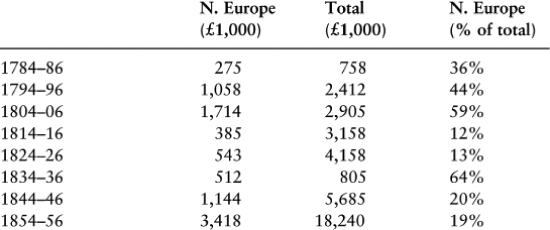
A large share of the British imports of timber during this time came from the semi-peripheral regions of northern and eastern Europe. H. S. K. Kent has shown that Norway in particular became of great importance for British timber imports around the middle of the eighteenth century.Footnote 26 The importance of northern European markets can also be seen in Table 2, which shows the value of imports of timber to Britain in total, alongside the percentage share of the imports from northern Europe. As can be seen, the value of the supply from northern Europe increased in absolute terms during the period prior to the French Revolutionary and Napoleonic wars. Sven-Erik Åström, who has studied the issue in close detail, has shown how Dutch sawmilling technology spread throughout the Baltic region during the eighteenth century. As a result, the value of exports of timber from, for example, Sweden-Finland more than trebled during the last decades of the century.Footnote 27 However, the imports from northern Europe shrank drastically in both absolute and relative terms during the periods of conflict in Europe. Thus the American colonies became all the more important for supplying the British market. Imports from the Baltic also continued to shrink after the end of the wars, and only started to increase in absolute terms again from the 1830s onwards.
British imports of timber, 1784–1856

Source: Davis, Industrial Revolution, tables 57–64.
Annual growth of exports
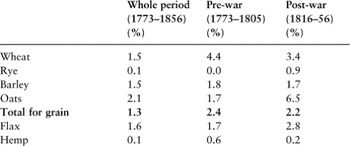
Table 3 summarizes data on the annual growth of the volume of exports for the four major grains exported from the Baltic region, as well as for hemp and flax.Footnote 28 The table shows the data for the period 1773–1856, as well as two columns showing the development before (1773–1805) and after the Continental Blockade (1816–56). The data confirm the analysis from the graphs presented above: there was a strong percentage growth in exports of wheat and flax both before and after the wars. The exports of oats also increased significantly, especially after the wars, but started from a much lower level and thus did not lead to as large a change in absolute figures. There was no significant growth in the exports of either hemp or rye over the period, and only a modest growth in the exports of barley (both in relative and absolute terms). The data clearly show, however, that the significant growth in the exports of wheat and flax was not at the expense of exports of other grains or textile fibres. Thus it is not a question of a shift in exports between different types of grain or fibres, but a general trend towards an increase in the export of all of these goods.
Annual average growth rate of quantity of exports from the Baltic, 1774–1856

Note: Growth rates are estimated from the coefficient of the variable in an OLS-regression of the natural logarithm of the quantity of exports during the periods in question.
Source: DNA, STCCR 1773–1856.
To a certain extent, the growth rates for the post-war period reported in Table 3 are made up of exports recovering from the shock of war. Since there are unfortunate gaps in the data during the 1820s, it is difficult to determine conclusively how fast the recovery was. But the tentative impression is that the actual recovery seems very rapid. Already in 1815, just a few years after the Continental Blockade had ended, the exports of hemp and flax were back to about the same level as before the Blockade. The exports of barley and oats were of significantly smaller quantities, but in both cases seem to have recovered to the pre-Blockade levels, at least by 1817. Finally, the exports of rye and wheat were almost back to pre-Blockade levels in 1816/17. Both these grains, on the other hand, seem to have experienced severe volatility during the immediate post-war period, so the actual recovery may have taken a much longer time.
A more detailed analysis of the effects of the post-war recovery, and efforts at reducing these effects in the estimates, are reported in the Appendix to this article. The results show that the main difference occurred in the case of the estimated growth rate for wheat exports, where the post-war growth, to some extent, might be said to have been due to a recovery from the shock of war (the case of rye was similar, but the post-war growth of rye exports was very small to begin with). For the other crops that experienced a substantial growth in exports in the post-war period (flax, barley, and oats), very little of the post-war growth was due to recovery from the war.
Institutional changes and the growth of exports
It is a common view that eastern Europe experienced a long-term decline in agricultural production from the sixteenth century onwards.Footnote 29 Peter Gunst has argued, however, that eastern Europe was actually made up of two quite different zones or spheres. The western half, including countries from the Baltic states and Poland to Croatia, ‘was strongly influenced by Western European economic, political and cultural development’.Footnote 30 The eastern half, including Russia, Romania, and the Balkan states, on the other hand, was much less influenced by west European economies. Institutional reforms such as the introduction of modern agricultural techniques and the emancipation of serfs also came much earlier to what Gunst calls ‘middle Europe’ than they did to Russia, for example.Footnote 31 In the western half of the east European region, in particular, enclaves of more modern forms of agriculture appeared during the late eighteenth and early nineteenth centuries, using ‘new plows, sowing machines, drainage, rotations systems instead of the old field system, new and previously unknown fodder plants, stabled animal breeding, acclimatization of new animal species, and in places the hiring of wage laborers’.Footnote 32 During the late eighteenth century, such enclaves were very rare, but over the period in question they spread through the eastern European region. Oliver Volckart has suggested that the institutional changes in central Europe enabled a move towards a more dynamic market economy in that region during the early modern era, and that we should therefore expect to find a growth of productivity, perhaps especially during the late eighteenth century.Footnote 33
While eastern European agricultural productivity certainly had stagnated for a long time during the early modern period, the first signs of improvement were thus starting to show (at least in some parts of the region) during the second half of the eighteenth century.Footnote 34 Recent research therefore has a somewhat less pessimistic view of the agricultural development in the region at this time. Nonetheless, agricultural productivity seems to have experienced little or no growth in large parts of central and eastern Europe, compared to the most significant growth in some countries in western Europe.Footnote 35 Furthermore, productivity and production are two different things. Agricultural productivity may not have increased more than modestly during the period in question, as previous research has shown. In contrast, agricultural production for exports – such as the export supply of grain or textile fibres – did, in many cases, grow significantly.
The data on exports from the ports around the Baltic Sea reported in the previous section naturally reflects the development of production in the hinterland of the ports. Thus, the largely feudal economies of the Baltic region seem to have contained elements that were dynamic enough to respond to external demand by increasing the output of export goods, at least to some extent. This conclusion seems consistent with previous research on the dynamics of the markets in the region. Witold Kula, for example, has used price data from grain markets in Amsterdam and Danzig to show that there was a high degree of correlation of prices on the two markets as early as the sixteenth century. The conclusion he drew from his data was that, even though the external market had limited importance for overall agricultural production in Poland, it had considerable importance for the commercial production of agricultural products.Footnote 36 Later scholars have shown how the prices for grain on the markets in the North Sea and the Baltic converged over the sixteenth to eighteenth centuries, implying that the markets became more integrated.Footnote 37 In eastern Europe, this dynamic of commercial production was not unique to the Baltic region. During the Napoleonic wars, other areas also experienced something of an agrarian boom, which left marks on the agrarian development in the whole region. In Hungary and Croatia, for example, grain production increased by approximately 1.6% per year during the first half of the nineteenth century, largely driven by export demand.Footnote 38
Thus it seems as if some of the institutional constraints on the agricultural production of central (and some parts of eastern) Europe started to diminish by the late eighteenth century, giving a further impetus to the dynamic elements already present in the feudal system in the region. Given the institutional development during the period in many parts of the region, it is perhaps not surprising to find that the exports of agricultural crops grew during the late eighteenth and early nineteenth centuries.
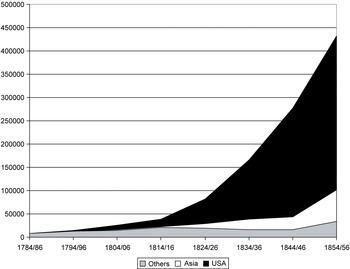
The development of a textile industry in Britain was crucial for the Great Divergence. However, Baltic textile fibres such as hemp and flax also contributed to this development, with growing amounts of inputs. In order to supply the British industry with ever-increasing quantities of raw materials, cotton imports grew at a much more rapid pace during the early nineteenth century, as shown in Figure 3, averaging approximately 6% per annum. Given this very rapid growth, could more exports from the Baltic really have mattered that much? If there had been a demand, could the Baltic have supplied quantities of grain and textile fibres not only to the extent that it actually did but also larger than that, and large enough to become an effective substitute for raw materials imported from the New World? This question does, of course, entail counterfactual assumptions and can therefore at best be answered tentatively.
British imports of cotton, by region of production (in tons). Note: Graph reconstructed from data in Davis, Industrial Revolution, table 26.

We know from the empirical evidence that exports from the Baltic were very volatile between individual years. Over certain periods of time, there was a boom – at times approaching 10% annually in the case of wheat, and 8% annually in the case of flax. Such extreme export booms could perhaps not have been sustainable over long periods of time. But even with more modest average growth rates than that over a long period of time, by the middle of the century the exports would have grown to quite significant quantities, if measured in absolute figures. Let us, as an illustration, assume that the growth rate for the exported quantities of flax could have been sustained at 5% per annum during the post-war period. This is higher than the 2.8% observed in actual fact, but significantly lower than the growth rates during the more intensive export booms. Such a growth rate, if sustained over the post-war period, would have meant that the absolute quantities of flax exported would have grown to some 150,000 tons by the middle of the century – 100,000 tons more than what was actually exported. Thus this could theoretically have substituted for approximately 20% of the cotton imported to Britain at the time, had the textile industry demanded it. Only with unrealistically high growth rates could flax from the Baltic alone have been substituted for all American cotton imported to Britain, but the potential for substituting one-fifth of the imports hardly seems negligible.
The case of timber deserves some special attention, since the explanation of the patterns of trade seems to be somewhat different from the case of agricultural crops. Britain had already, during the late seventeenth century, tried to reduce the country’s dependence upon the Baltic market for the supply of forestry products, most importantly naval stores. The alternative was to favour production in the American colonies.Footnote 39 The Napoleonic wars disrupted British access to the Baltic supply, thereby favouring timber from Canada instead of the Baltic. Imports from Russia, in particular, were also temporarily impeded by a short-lived Russian prohibition (1798–1801) against exports of timber products. The effects of these constraints were later reinforced by new British tariff policies, giving preferential treatment to colonial timber from Canada. Such preferential duties had already been imposed during the wars, and remained until the 1840s.Footnote 40 Therefore the decline in British imports of timber from the Baltic, noted above, does not seem to be related to a general decline in exports from that region. There were, at this time, vast areas of forest still available in both Scandinavia and Russia.Footnote 41 Exports were also increasing from a number of Baltic ports (for example, Riga, Narva, and Finnish ports), in some cases quite soon after the end of the Napoleonic wars, according to the data presented by Sven-Erik Åström.Footnote 42 Indeed, Åström has argued that the war, in combination with prohibitive tariffs in Britain, actually impeded the expansion of Swedish, Finnish, and Russian timber exports.Footnote 43
Ghost acreage and the alternative cost of Baltic exports
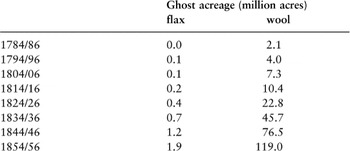
There is of course an alternative cost to the production of export goods, since the acreage used for export crops cannot then be used to produce goods for the domestic population. The alternative cost does to a large extent depend on the size of the acreage necessary for the production of the export crops. Table 4 shows data for the acreage necessary to produce substitutes (flax or wool) for all the British imports of cotton. What the data show is that the acreage necessary for the production of substitutes for the imported cotton differed enormously. Flax production would not have required a very large acreage compared to that necessary for wool. The planting of flax (as well as cotton, for that matter) gave rise to significantly higher output per acre than the raising of sheep for wool production. Planting flax to substitute all the cotton imported by Britain by the middle of the nineteenth century would therefore have required approximately two million acres (roughly 800,000 hectares) of agricultural land, while the production of the same amount of wool would have required an acreage some sixty times larger.
Ghost acreage for theoretical substitutes to British imports of cotton, 1784–1856

Note: the substitution ratio between wool and cotton for producing yarn have been adjusted in the same way as in Pomeranz, Great Divergence, appendix D.
Source: import figures taken from Figure 3. Yield figures from Pomeranz, Great Divergence, appendix D.
Even if we were to calculate the ghost acreage assuming lower average flax yields, in order to take a generally lower agricultural productivity in eastern Europe into account, and/or we were to include an estimate for the acreage necessary for the production of foodstuffs to support the population working on the cotton plantations or flax farms (which sheep farmers arguably might not need to the same extent), the difference in ghost acreage required for the growing of cotton or flax on the one hand, and the production of wool on the other, would still be of great magnitude.
Data from a few countries in eastern Europe on the arable acreage give us some indication of the acreages available at the time. In Hungary and Austria, the arable acreage available by the mid nineteenth century amounted to some ten million hectares in each country. In Russia, a further eighty million hectares were available.Footnote 44 In parts of Poland, the cultivated acreage even decreased during the early modern period, so that the arable acreage actually used for cultivation was lower by the late eighteenth century than it had been some two centuries earlier.Footnote 45 Compared to the arable acreage available in the region at the time, the acreage that would have been required to produce substitutes for British imports of cotton was therefore not overwhelming. An increasing demand might also have stimulated continued cultivation on lands that were abandoned, such as in Poland, or further clearing of virgin lands in the hinterlands of the Baltic ports.
Thus the Baltic had the potential for exporting larger volumes of traditional raw materials, had there been a demand for it. This does not, of course, mean that Britain would have been the only country importing these goods. Exactly where the exports would have gone would have depended upon the dynamics of the international markets for these commodities. Nevertheless, emphasizing institutional constraints on supply as the main explanation why the central or eastern European countries in general did not come to play a crucial role in British imports of raw materials, and thus in the Great Divergence, does appear rather misleading.
Substitutes or different goods?
Geography certainly mattered. The vast acreage of the Americas could, at least in theory, provide European markets with a number of crucial raw materials. But, as Ronald Findlay has argued, the European discoveries of the Americas ‘should not be considered as having made available at an instant a large additional supply of land and other natural resources. Rather they opened up a new “frontier” where land could be extended indefinitely but only at a rising marginal cost in terms of other real resources.’Footnote 46 This is perhaps most evident in the case of the grain trade. Grain was produced both in eastern Europe (including the Baltic region) and in the Americas, and was in that sense a competitive good. For much of the early modern period, however, transport costs outweighed the potential profits that could be made from the trade across the Atlantic. Therefore, very little grain was traded between the Americas and Europe, especially prior to the Napoleonic wars. Unlocking the natural resources by opening the vast American frontier would, as many scholars have noted, have required development of both international and domestic transport technology and infrastructure. Following the nineteenth century transport revolution, in tandem with British liberalization of trade policies from the middle of the century, it was to a very large extent American grain that would ‘invade’ the European markets.Footnote 47
The opening up of the American frontier for grain production thus shows the importance of the vast size of the American acreage under grain production. However, it can hardly explain the process of the Great Divergence, which supposedly started to occur a century or more earlier. Pomeranz’s argument that the American colonies were crucial for the Great Divergence therefore mainly refers to the production of plantation crops rather than grain, in particular cotton and, to a lesser extent, sugar. Cultivation of both cane sugar and cotton requires a long growing season and a tropical or sub-tropical climate (until the nineteenth century when there were innovations for processing sugar beets, which enabled the production of beet sugar in Europe). It was therefore not possible to grow sugar cane or cotton simply anywhere in the world and certainly not in the temperate zone, including Britain and the Baltic. In this sense, the crops were non-competing, which contributes to explaining why the price differential between the markets could cover the comparatively high transport costs. When the European demand started to increase for these tropical commodities, particularly cotton, neither Britain nor the old peripheries in Europe such as the Baltic region could produce these goods to satisfy the growing demand.
Had Britons wanted to consume wheat instead of sugar in order to acquire the same amount of calories, it is not impossible that an increasing supply in the Baltic and/or elsewhere could have relieved much, if not all, of the British ecological constraints. Sugar is, however, a substitute for wheat only in very abstract terms, and most certainly not perceived consciously as such by most consumers. With increasing living standards in Europe, an increasing share of the population acquired both a sweet tooth and the economic means to indulge in the luxury of satisfying the demand for sugar. That demand would not be met by consuming grain instead, even were it high-quality wheat.
The case is perhaps not as evident when it comes to textile fibres. Baltic exports of flax were certainly growing in parallel with the growth of cotton exports from America, even though at more modest rates. It is, however, noteworthy that, at the same time as the Baltic ports were exporting ever larger quantities of flax (mainly to British ports), imports of American cotton to the same region was growing rapidly (largely via British ports).Footnote 48 It is true that the exports of flax came mainly from ports in the south-east of the Baltic, while virtually all of the cotton was imported by Russia through St Petersburg. Still, had cotton and flax been good substitutes, there would have been little sense in Russian textile manufacturers not importing the flax produced in the region instead of American cotton. Mikhail Tugan-Baranovsky even argued that the Russian flax and hemp industries declined because of the rapid development of cotton. With increasing technological development in the cotton industry, and falling prices of cotton textiles, the demand for linen experienced a decrease relative to cotton, thus leading to a crisis for the Russian hemp and flax industries.Footnote 49
That the British (and in a similar manner the Russian) textile industry did not primarily choose to use flax or hemp but mainly opted for cotton cannot be explained simply by supply-side constraints (i.e. insufficient acreage domestically in Britain, and/or a stagnating supply in the Baltic), but ought mainly to be attributed to other factors.Footnote 50 Beverly Lemire has argued that, for a long time, British linen production developed in tandem with the cotton industry. However, linen did start to lose out in the competition even before many of the technological breakthroughs of the cotton trade.Footnote 51 Mechanized spinning of cotton developed many decades before that of flax. Other important factors contributing to the demand for the respective textile fibres were of course the price of the raw materials and the quality of the cloths that could be produced from the fibres.Footnote 52
Regarding the three commodities studied in particular by Pomeranz – sugar, cotton, and timber – supply is thus certainly not the only factor explaining the contribution of the respective peripheries. We also need to take into consideration the effect of substitutability of the raw materials in demand. The patterns of British technological innovations and investments had a huge impact upon the demand for specific raw materials. The mechanization of cotton spinning long before flax spinning, for example, increased the demand for cotton relative to flax. The development of domestic coal-based production of iron reduced the demand for Baltic iron in a similar manner. Increasing living standards contributed to increasing demand for new luxuries such as sugar. The substitutability was perhaps best in the case of sugar since it had a domestic European substitute in honey, but even this substitute was far from perfect.
Thus, many of the commodities in growing demand in Britain – perhaps most importantly cotton, but also luxuries such as sugar – could not be produced domestically in the temperate zones of Europe. Nor could substitutes be provided by other goods that could be produced effectively in temperate zones. Furthermore, trade on the Baltic was to some extent shaped by patterns of tramp shipping, where shipmasters were interested in finding profitable return cargoes. In practice, this demand further reduced the substitutability between goods carried on different routes.Footnote 53 The Americas therefore became a highly competitive producer of many specific agricultural crops that largely complemented what could be produced in the ‘old’ peripheries of Europe. It was to a very large extent this growth in demand for specific raw materials, rather than a generally stagnant economy in the Baltic region itself, that can explain why the Baltic became of less importance than the Americas during the Great Divergence.
Reflections on the contribution of the American periphery
As Clark, O’Rourke, and Taylor have argued, the New World (and North America in particular) was certainly not the only region in the world that could, theoretically, have produced the tropical goods in demand in Britain.Footnote 54 In time, other regions of the world (e.g. in Asia) would also develop plantations along lines similar to the Americas. For example, the Dutch expanded coffee and sugar production in the Dutch East Indies from the 1830s onwards, using forced labour.Footnote 55 But only by the late nineteenth century were other producers of cotton able to compete effectively with the US South – during the first half of the century, the United States became the totally dominant source of cotton imported by Britain.Footnote 56 Many markets demanded British manufactured goods, and the New World (North America in particular) became crucial for the supply of inputs, particularly cotton. As was shown in Figure 3 above, the growth of British imports from the United States was a staggering 6% per year during the first half of the nineteenth century, supplying around 80% of Britain’s demand by the middle of the century.
A vast acreage (and thus a potential for a comparatively low land rent) was certainly crucial for expanding production of certain agricultural crops as rapidly as was required to supply the booming British economy. To that extent, the North American acreage of arable land was fundamental for the Great Divergence. But the Americas (and the United States in particular) were not the only regions in the world where such a frontier could have been opened up. In order to explaining the prominence of American (and in particular US) production other factors also have to be taken into consideration. These include not least the real cost of capital and labour, as well the development of transport and communications.
Many scholars have emphasized how the nineteenth-century transport revolution of railways and steam engines opened up the American continent – especially North America, owing to the rapid development of canals and railways – for both settlement and export production of grain in particular.Footnote 57 A further factor that might have made a big difference was access to capital. Nineteenth-century North American agriculture had a comparatively high stock of capital in general, and this ought to have increased the productivity of American agriculture compared to many of its competitors.Footnote 58 The exploitation of slaves in the Americas is another important factor to take into consideration. Previous research on the economics of slavery has led to a long and intensive scholarly debate, with seminal contributions from authors such as Alfred Conrad and John Meyer, as well as Robert Fogel and Stanley Engerman. Though many scholars have criticized different arguments put forward in Fogel and Stanley’s book, the early estimates regarding the generally high profitability of the slave regime have so far not undergone any major revisions, but have rather tended to receive further support from more recent research. Why this was so has, however, been an issue for much further research. The main results seem to point towards the conclusion that the slave regime was effective in extracting work from the slave labour force, compared to other modes of agricultural production. What the slave regime lost in incentives for the slaves to work diligently was more than made up for by brutally enforced intensification of the work.Footnote 59
It might finally be argued that the New World constituted a peripheral region like no other at the time, since the Americas had been colonized by the Europeans during the early modern period. This could certainly have been true at least until the late eighteenth century. However, the revolutions in the American colonies (first in the British, later also in the French and Spanish colonies) changed the political map of the continent. By the early nineteenth century – the time from which the data underlying Pomeranz’s argument about the importance of the vast American acreage is derived – there was little left of the formal European political empires in the Americas. Economic ties remained, however, with the now politically independent countries of the Americas exporting many raw materials to Europe but in a relationship quite similar to many other peripheral regions. Still, some tropical colonies in the West Indies, as well as Canada, remained under British control during the nineteenth century. As can be seen in the case of timber, for example, British trade policy particularly favoured production in the British colony of Canada.
It is theoretically likely that land rents were lower in the Americas than in many competing regions of agricultural goods production, as an effect of the vast acreage. It is, however, an open question to what extent this particular factor alone contributed to the United States becoming the most important area for cotton production during the early nineteenth century. While such a discussion is beyond the scope of the present article, this ought to be an important area for further research.
Conclusion
In The Great Divergence, Pomeranz has argued that the New World contributed to British industrialization, most importantly through providing vast acreages of arable land, which was necessary for the production of foodstuffs and raw materials. Producing domestic substitutes for the commodities imported from the Americas would have required an acreage far too large for the British Isles. The acreage of the New World, together with domestic coal, thus enabled Britain to break away from the old ecological constraints. The alternative was not, however, total autarky. Britain had long been involved in trade with many regions of the world. Many raw materials – including foodstuffs and textile fibres – would have been available for British producers and consumers even without trade with the Americas. One region that had for centuries exported many such raw materials to western Europe was the Baltic.
One core finding of this article is that Pomeranz’s claim of an economic stagnation in the Baltic region is not supported by empirical data. While agricultural productivity might not have improved much in eastern compared to western Europe, agricultural production for exports certainly grew. Apart from the years of intense conflict in Europe during the French Revolutionary and Napoleonic wars, exports from the Baltic increased substantially for some of the most important goods from the region – including grain and textile fibres – during the late eighteenth and early nineteenth centuries. The export production in the Baltic region increased even further thereafter, particularly on the back of institutional reforms that started in the late eighteenth century. It seems reasonable to assume that the Baltic region could have supplied many more of the inputs for the British markets, had there been a demand for it.
A second core finding is that the required ghost acreage for the production of the goods necessary to supply the British market would have been quite small compared to the arable acreage potentially available in the region. This leads to the conclusion that the alternative cost for the production of more export crops in the Baltic would not have been overwhelming.
The article has argued, however, that the Baltic goods were not good substitutes for the tropical goods from the Americas, such as sugar and cotton. British technological innovations and investments increased the demand not just for any raw materials (e.g. any textile fibres) but for specific ones (such as cotton in particular). There was a low degree of substitutability between the goods in question. The New World regions of export became important to British industry and trade to a large extent just because the commodities that could possibly be produced there had no ready substitutes that could be produced domestically or in the old peripheries of Europe, such as the Baltic. When cotton, in particular, experienced a rapidly growing demand, the Baltic region was simply not able to meet that demand. Thus the issue was not so much a question of stagnant institutions in the Baltic, but rather that the specific goods in demand, because of qualitative aspects of the factor endowments (i.e. the climate for agriculture), could not be produced in Europe. The Baltic region, which for such a long time had been a winner in the commodity lottery, simply drew a blank around the time of the British Industrial Revolution.
It is theoretically possible that other tropical regions in the world could have developed a supply of the industrial inputs in demand, had there been no trade at all with North America, as Clark, O’Rourke, and Taylor have argued. However, the actual fact is that few other producers were able to compete with the cheap cotton from the US South during the first half of the nineteenth century. To that extent, the New World was certainly crucial for the Great Divergence. To what extent the land endowment (and not other factor endowments, such as capital or labour, or the organization of production and transport costs) was critical in favouring production in the United States in particular is, however, an open question.
Appendix: post-war growth of Baltic exports and the recovery from war
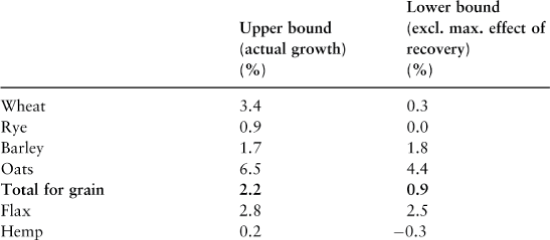
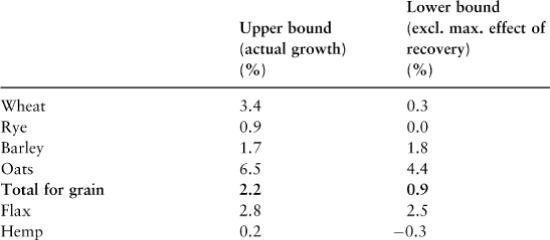
If parts of the post-war growth of exports were due to recovery from the shock of war, rather than a sustained growth over the period, it would imply that the intercepts estimated in the OLS-regressions are too low, giving rise to much too positive growth figures. Assume therefore, that the recovery was quite fast, so that exports in the years immediately after the war equalled the pre-Blockade figures (1800-05). While the actual growth rates reported in Table 3 give us an upper bound for the growth figures, this method gives us a lower bound. Assuming that the recovery was slower than this (which at least seems to have been the case for rye and wheat exports), then it can be shown that the rates of growth for the post-recovery period were somewhere in between our upper and lower bounds. The annual growth rates implied from such an assumption of a lower bound estimate are reported in Appendix Table 1, along with data on the actual growth rates from the period.
Annual average growth rate of quantity of exports from the Baltic, 1816–56
Source: DNA, STCCR 1816–56.
As can be seen in the table, the most important change is in the case of wheat, where the post-war growth seems quite sluggish on average, if we accept the lower bound figures for growth. This is mainly due to the fact that growth seems to have been very low, if not even zero, during the first decade after the war. When growth actually started, by the late 1820s, it was very rapid, experiencing a growth trend of approximately 10% per year, until the early 1840s. From the 1840s, again, growth in exports of wheat seems to have been non-existent.
The average rate of growth for other commodities is somewhat lower if one disregards the period of recovery after the war, but the difference between the two methods of calculation is quite small. Most importantly, the exports of flax still showed a strong annual average growth rate for the post-war period as a whole. This pattern is especially pronounced over short periods of time. The exports of flax were, for example, booming during the 1840s, when the annual growth of exports approached 8%.