Introduction
The structural integrity of the anterior cingulum has been repeatedly observed to be abnormal in patients with schizophrenia (Kubicki et al., Reference Kubicki, Westin, Nestor, Wible, Frumin, Maier, Kikinis, Jolesz, McCarley and Shenton2003; Sun et al., Reference Sun, Wang, Cui, Breeze, Du, Wang, Cong, Zhang, Li, Hong and Zhang2003; Fujiwara et al., Reference Fujiwara, Namiki, Hirao, Miyata, Shimizu, Fukuyama, Sawamoto, Hayashi and Murai2007; Abdul-Rahman et al., Reference Abdul-Rahman, Qiu and Sim2011; Fitzsimmons et al., Reference Fitzsimmons, Schneiderman, Whitford, Swisher, Niznikiewicz, Pelavin, Terry, Mesholam-Gately, Seidman, Goldstein and Kubicki2014; Mandl et al., Reference Mandl, Pasternak, Cahn, Kubicki, Kahn, Shenton and Hulshoff Pol2015; Oestreich et al., Reference Oestreich, Pasternak, Shenton, Kubicki, Gong, McCarthy-Jones and Whitford2016; Seitz et al., Reference Seitz, Zuo, Lyall, Makris, Kikinis, Bouix, Pasternak, Fredman, Duskin, Goldstein, Petryshen, Mesholam-Gately, Wojcik, McCarley, Seidman, Shenton, Koerte and Kubicki2016; Viher et al., Reference Viher, Stegmayer, Giezendanner, Federspiel, Bohlhalter, Vanbellingen, Wiest, Strik and Walther2016). Most of these studies have utilized the fractional anisotropy (FA) metric computed from diffusion tensor images, to infer structural integrity of the cingulum. FA of a given white matter region is affected by both the microstructural composition [e.g. fiber count, fiber organization, extracellular volume, and directionality (Stikov et al., Reference Stikov, Perry, Mezer, Rykhlevskaia, Wandell, Pauly and Dougherty2011)] as well as the myelin content (Schmierer et al., Reference Schmierer, Tozer, Scaravilli, Altmann, Barker, Tofts and Miller2007). Studies that specifically report on radial diffusivity, a proxy measure of myelin, suggest that most of the observed structural deficit of cingulum is likely to be a result of aberrant myelination in schizophrenia (Abdul-Rahman et al., Reference Abdul-Rahman, Qiu and Sim2011; Oestreich et al., Reference Oestreich, Pasternak, Shenton, Kubicki, Gong, McCarthy-Jones and Whitford2016; Seitz et al., Reference Seitz, Zuo, Lyall, Makris, Kikinis, Bouix, Pasternak, Fredman, Duskin, Goldstein, Petryshen, Mesholam-Gately, Wojcik, McCarley, Seidman, Shenton, Koerte and Kubicki2016; Kelly et al., Reference Kelly, Jahanshad, Zalesky, Kochunov, Agartz, Alloza, Andreassen, Arango, Banaj, Bouix, Bousman, Brouwer, Bruggemann, Bustillo, Cahn, Calhoun, Cannon, Carr, Catts, Chen, Chen, Chen, Chiapponi, Cho, Ciullo, Corvin, Crespo-Facorro, Cropley, De Rossi, Diaz-Caneja, Dickie, Ehrlich, Fan, Faskowitz, Fatouros-Bergman, Flyckt, Ford, Fouche, Fukunaga, Gill, Glahn, Gollub, Goudzwaard, Guo, Gur, Gur, Gurholt, Hashimoto, Hatton, Henskens, Hibar, Hickie, Hong, Horacek, Howells, Hulshoff Pol, Hyde, Isaev, Jablensky, Jansen, Janssen, Jönsson, Jung, Kahn, Kikinis, Liu, Klauser, Knöchel, Kubicki, Lagopoulos, Langen, Lawrie, Lenroot, Lim, Lopez-Jaramillo, Lyall, Magnotta, Mandl, Mathalon, McCarley, McCarthy-Jones, McDonald, McEwen, McIntosh, Melicher, Mesholam-Gately, Michie, Mowry, Mueller, Newell, O'Donnell, Oertel-Knöchel, Oestreich, Paciga, Pantelis, Pasternak, Pearlson, Pellicano, Pereira, Pineda Zapata, Piras, Potkin, Preda, Rasser, Roalf, Roiz, Roos, Rotenberg, Satterthwaite, Savadjiev, Schall, Scott, Seal, Seidman, Shannon Weickert, Whelan, Shenton, Kwon, Spalletta, Spaniel, Sprooten, Stäblein, Stein, Sundram, Tan, Tan, Tang, Temmingh, Westlye, Tønnesen, Tordesillas-Gutierrez, Doan, Vaidya, van Haren, Vargas, Vecchio, Velakoulis, Voineskos, Voyvodic, Wang, Wan, Wei, Weickert, Whalley, White, Whitford, Wojcik, Xiang, Xie, Yamamori, Yang, Yao, Zhang, Zhao, van Erp, Turner, Thompson and Donohoe2018).
In recent times, aberrant myelination has emerged as a pathophysiological mechanism of interest in schizophrenia. Variations in neuregulin-1, a well-established candidate marker for schizophrenia, results in oligodendrocyte dysfunction and defective myelination (Roy et al., Reference Roy, Murtie, El-Khodor, Edgar, Sardi, Hooks, Benoit-Marand, Chen, Moore, O'Donnell, Brunner and Corfas2007), and is shown to affect the structural integrity of the anterior cingulum in patients with schizophrenia (Wang et al., Reference Wang, Jiang, Sun, Teng, Luo, Zhu, Zang, Zhang, Yue, Qu, Lu, Hong, Huang, Blumberg and Zhang2009). Substantial evidence indicates a downregulation of myelin-related gene expression, especially in the anterior cingulate cortex [for a review, see Table 1 in Takahashi et al. (Reference Takahashi, Sakurai, Davis and Buxbaum2011) and Katsel et al. (Reference Katsel, Davis and Haroutunian2005); Bennett (Reference Bennett2011); Voineskos et al. (Reference Voineskos, Felsky, Kovacevic, Tiwari, Zai, Chakravarty, Lobaugh, Shenton, Rajji, Miranda, Pollock, Mulsant, McIntosh and Kennedy2013); Roussos and Haroutunian (Reference Roussos and Haroutunian2014)]. Whitford et al. (Reference Whitford, Ford, Mathalon, Kubicki and Shenton2012) marshaled the accumulating evidence in favor of aberrant myelination of frontal cortex in schizophrenia and suggested that conduction delays resulting from aberrant frontal myelination reduces the cortical suppression of self-generated sensation, thus linking passivity symptoms with myelin defects. In two subsequent studies, Whitford et al. demonstrated that patients with delusions of control had significantly lower FA and increased radial diffusivity (indicating reduced myelin content) in the cingulum bundle relative to patients without such delusions (Whitford et al., Reference Whitford, Kubicki, Pelavin, Lucia, Schneiderman, Pantelis, McCarley and Shenton2015; Oestreich et al., Reference Oestreich, Pasternak, Shenton, Kubicki, Gong, McCarthy-Jones and Whitford2016).
While evidence to date has been obtained using diffusion tensor imaging, abnormal tract-specific changes in myelin content can be more directly inferred by using magnetization transfer (MT) imaging (Henkelman et al., Reference Henkelman, Huang, Xiang, Stanisz, Swanson and Bronskill1993; Schmierer et al., Reference Schmierer, Scaravilli, Altmann, Barker and Miller2004). Magnetization transfer ratio (MTR) is one of the most widely used non-invasive measures that is histopathologically validated to measure myelin (Schmierer et al., Reference Schmierer, Scaravilli, Altmann, Barker and Miller2004). MTR is often used as a benchmark to evaluate the performance of other myelin mapping approaches (Ganzetti et al., Reference Ganzetti, Wenderoth and Mantini2014). MTR values decrease with demyelination and local inflammation and increase with remyelination and resolution of inflammation in multiple sclerosis (Brown et al., Reference Brown, Narayanan and Arnold2014). Furthermore, unlike diffusion tensor imaging-based proxy indices of myelin such as Radial Diffusivity and FA, MTR is a more direct quantification of myelin that is not affected by fiber orientation or organization (Mädler et al., Reference Mädler, Drabycz, Kolind, Whittall and MacKay2008). In particular, at ultra-high field 7T MRI, macromolecular imaging using MT benefits from the increased signal-to-noise ratio, prolongation of water T1 relaxation time, and increased chemical shift between the myelin (and other macromolecules) and free-water pool (Mougin et al., Reference Mougin, Coxon, Pitiot and Gowland2010).
In a whole brain analysis of 7T MT imaging, we have previously reported that the maximal reduction in MT ratio in schizophrenia occurs proximal to the visual processing regions of the inferior temporal cortex (Palaniyappan et al., Reference Palaniyappan, Al-Radaideh, Mougin, Gowland and Liddle2013). In the current study using the same sample, we test the following hypotheses: (1) does the cingulum region shows a reduction in the MTR in schizophrenia? (2) Is there a relationship between the presence of passivity delusions and reduced MTR-indexed myelin content in cingulum? We expected to see a more pronounced reduction in the MT ratio in the cingulum of patients who continue to be burdened by passivity delusions despite receiving antipsychotic treatment. In keeping with prior observations (Vavasour et al., Reference Vavasour, Laule, Li, Traboulsee and MacKay2011; Wang et al., Reference Wang, Sun, Wang, Trinkaus, Schmidt, Naismith, Cross and Song2015), we interpret reduction in the MTR as a composite index of demyelination and neuroinflammation, both factors being relevant to the mechanistic pathways of schizophrenia (Kroken et al., Reference Kroken, Løberg, Drønen, Grüner, Hugdahl, Kompus, Skrede and Johnsen2014; Najjar and Pearlman, Reference Najjar and Pearlman2015).
Methods
We originally recruited 20 patients with Diagnostic and Statistical Manual of Mental Disorders (DSM)-IV (American Psychiatric Association, 1994) diagnosis of schizophrenia and 21 healthy controls group matched for age, gender and parental socioeconomic status with the patient group. Here, we report the data from 17 patients and 20 controls as we excluded subjects with motion artifacts as described in our prior work. Diagnosis was made using a consensus procedure (Leckman et al., Reference Leckman, Sholomskas, Thompson, Belanger and Weissman1982) after reviewing clinical notes, collecting information from the psychiatrists providing clinical care and conducting a structured diagnostic interview [Signs and Symptoms in Psychotic Illness (Liddle et al., Reference Liddle, Ngan, Duffield, Kho and Warren2002)] with the patients. Patients receiving community based care for psychotic symptoms were specifically recruited in a stable phase of illness (defined as a change of no more than 10 points in their Global Assessment of Function [GAF, DSM-IV (American Psychiatric Association, 1994)] score, assessed 6 weeks prior and immediately prior to study participation). The mean duration of illness was 7.0 years (s.d. = 7.9). Subjects with neurological disorders, current substance dependence, or intelligence quotient (IQ) < 70 (Ammons and Ammons, Reference Ammons and Ammons1962) were excluded. All healthy subjects were recruited from the local communities through advertisements and were excluded if there was a personal or family history of psychosis. All subjects were recruited from the county of Nottinghamshire, UK.
Handedness was assessed using the 12-items Annett scale (Annett, Reference Annett1970). The median defined daily dose (DDD) of antipsychotics (WHO Collaborating Centre for Drug Statistics and Methodology, 2003) was calculated for all patients. All subjects were interviewed on the same day as the scan and symptom scores assigned according to the signs and symptoms of psychotic illness (SSPI) for both patients and controls. The single item SSPI score for Schneiderian delusions includes both the passivity delusions or delusions of control (made affect, made volition and made acts) as well as the first-rank thought phenomena such as thought insertion, withdrawal and broadcast. Delusional perception, also described by Schneider, is not included in this score as this symptom is very rarely seen in established cases of schizophrenia (Tandon and Greden, Reference Tandon and Greden1987). SSPI rating of Schneiderian delusions is distinct from the scoring of non-Schneiderian delusions (of reference, persecution, grandiosity, and guilt). Delusions of control and passivity are rated using a single item (Schneiderian delusions) in the SSPI scale. Permission for the study was obtained from Nottinghamshire research ethics committees. All participants gave written informed consent.
MRI data acquisition
Scanning was performed on a 7T Philips Achieva system with a 32-channel receive coil. T1-weighted images were acquired using a 3D Magnetization Prepared-Turbo Field Echo (IR-TFE) (MPRAGE) with 0.6 mm isotropic voxel size; Field of View (FOV) = 192 × 180 × 140 mm; TE = 5.6 ms; TR = 15 ms; flip angle of the TFE readout pulse = 8°; 260 slices; TFE factor per inversion = 148; inversion time = 1175 ms; shot-to-shot interval = 3000 ms; total scan time = 12 min. MT images were acquired using a 3D Magnetization Transfer Prepared-Turbo Field Echo (MT-TFE) sequence in two volumes, in which one volume was acquired without applying MT saturation pulse, while the other volume was acquired with the application of an off-resonance (−1.05 kHz) MT saturation pulse (sensitive to magnetization and chemical exchange saturation transfer effects) with 1 mm isotropic voxel size; FOV = 200 × 169 × 74 mm; TE = 5.8 ms; TR = 10.2 ms; flip angle = 8°; 74 slices; total scan time = 9 min.
MT images from one control subject and three patients were discarded due to significant motion artifacts. The final sample included 20 controls and 17 patients for the MTR analysis. The excluded patients had a similar clinical and demographic profile to the subjects who were included in the final analysis as reported in our prior work.
Data preprocessing
For each voxel in the MT images, the MTR was calculated on a voxel-by-voxel basis using the formula: MTR = [(M 0 − M s)/M 0] × 100% units, where M 0 and M s are the mean signal intensities without and with the saturation MT pulse, respectively. The reference volume (M 0) in the MT images was co-registered to the T1-weighted image with six degrees of freedom using the FLIRT linear registration algorithm in FSL.
Due to the difference of contrast between the T1 images and reference volume in the MT images, the ‘mutual information’ cost function was used. The registration matrix was applied to the calculated MTR maps to transfer them into the same space of the T1 images.
Preprocessing using SPM 8 was carried out for T1 and the MTR images using identical procedures to ensure that the images from both modalities had voxel-to-voxel spatial correspondence. Using the SPM8 Diffeomorphic Anatomical Registration Through Exponentiated Lie algebra (DARTEL) (Ashburner, Reference Ashburner2007) algorithm, gray, white and CSF tissue was segmented. Grey Matter and White Matter images were separately warped onto the group average template. For MTR images, modulation was carried out to account for tissue distortion during template warping. The resultant images were resampled to isotropic 3 mm voxels and normalized to Montreal Neurological Institute (MNI) space to enable identification of regions of interest.
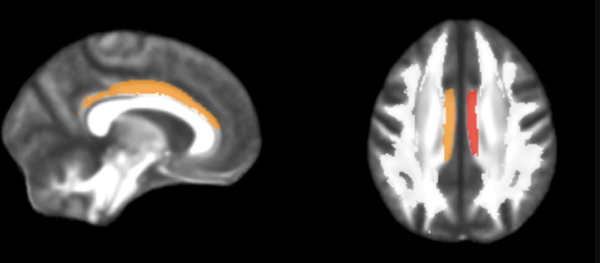
We used the approach employed by Kennis et al. (Reference Kennis, van Rooij, Tromp, Fox, Rademaker, Kahn, Kalin and Geuze2015) to delineate the dorsal cingulum (Fig. 1). Cingulum, a C-shaped structure that runs between the anterior cingulate cortex and the entorhinal cortex, was identified from the JHU-ICBM-81 atlas template (version 28 December 2012; http://www.loni.usc.edu/ICBM/Downloads/Downloads_DTI-81.shtml). This group-averaged atlas is based on hand-segmented parcellation data from 81 healthy controls, with 50 ‘core white matter’ structures of low variability are labeled on FA maps using 0.25 of FA as an inclusion threshold (Mori et al., Reference Mori, Oishi, Jiang, Jiang, Li, Akhter, Hua, Faria, Mahmood, Woods, Toga, Pike, Neto, Evans, Zhang, Huang, Miller, van Zijl and Mazziotta2008). This atlas is available in the MNI space (based on ICBM-152 template), to which our T1 and MTR images were registered as described above. We were particularly interested in the role of dorsal cingulum in Schneiderian delusions as it connects the action initiating areas of the premotor cortex with the higher order, motivation-related areas of the cingulate cortex.
Regions of interest. Right (red) and left (orange) dorsal cingulum regions of interest from JHU-ICBM-81 atlas displayed on FMRIB58_FA template image obtained from averaging 58 FA images from healthy male and female subjects aged between 20 and 50 (https://fsl.fmrib.ox.ac.uk/fsl/fslwiki/FMRIB58_FA). Other white matter tracts are whitened out.

Statistical analysis
Mean MTR values were extracted for the right and left cingulum ROIs for each subject. We used IBM SPSS Statistics v.25.0 (IBM Corporation, Armonk, NY) for statistical analysis.
For patient v. control and SchD+ v. SchD− comparisons, independent t tests were used along with estimates of Hedge's g for effect sizes, with p < 0.05 as statistical threshold. For correlation analyses limited to the patient sample, non-parametric correlations were sought using Kendall's rank correlation coefficient [denoted by τ (Kendall, Reference Kendall1938)] to relate symptom scores, GAF and DDD variables to MTR measures. To demonstrate specificity of the relationship between Schneiderian delusions and MTR, scores from disorganization, psychomotor poverty and reality distortion symptoms were covaried with the MTR measure. Mann–Whitney U test was used to compare the baseline symptom profiles of SchD+ and SchD− groups.
Results
Clinical and demographic variables
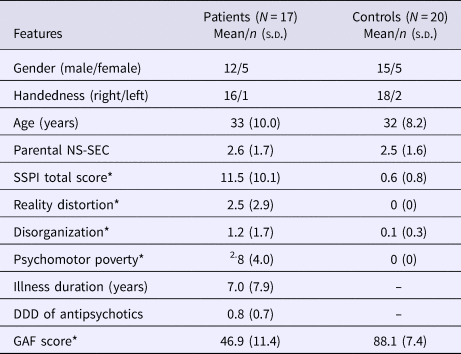
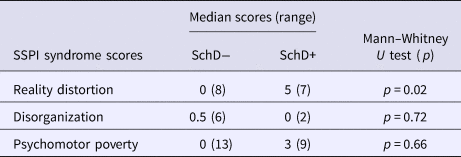
The demographic and clinical characteristics of the sample are presented in Table 1. Patients had a mean current symptom burden of 11.5 units (s.d. = 10.1; range 1–25) measured using the SSPI (out of a maximum possible score of 80). Twelve patients had no current Schneiderian delusions (score 0 on SSPI Schneiderian Delusions item), while five had delusions of varying severity (three with score 1, one each with scores 3 and 4). Compared with patients with Schneiderian delusions (SchD+), those without (SchD−) had no significant differences in the severity of disorganization and psychomotor poverty scores, but had a lower burden of reality distortion symptoms (Table 2). There were no differences in age (t (15) = 0.08, p = 0.94), DDD of antipsychotics (t (15) = −0.36, p = 0.72) or GAF scores (t (15) = −0.38, p = 0.71) between the SchD+ and SchD− groups.
Clinical and demographic features

NS-SEC, National Statistics Socio-Economic Classification; SSPI, Signs and Symptoms of Psychotic Illness; DDD, Defined Daily Dose; GAF, Global Assessment of Functioning.
*Significantly different between the two groups using unpaired t test (p < 0.05).
Symptom differences between patients with (SchD+) and without (SchD−) Schneiderian delusions

SSPI, Signs and Symptoms of Psychotic Illness scale; SchD+, patients with scores 1, 2 or 3 in SSPI item Schneiderian delusions; SchD−, patients with score 0 in SSPI item Schneiderian delusions.
MTR of cingulum region
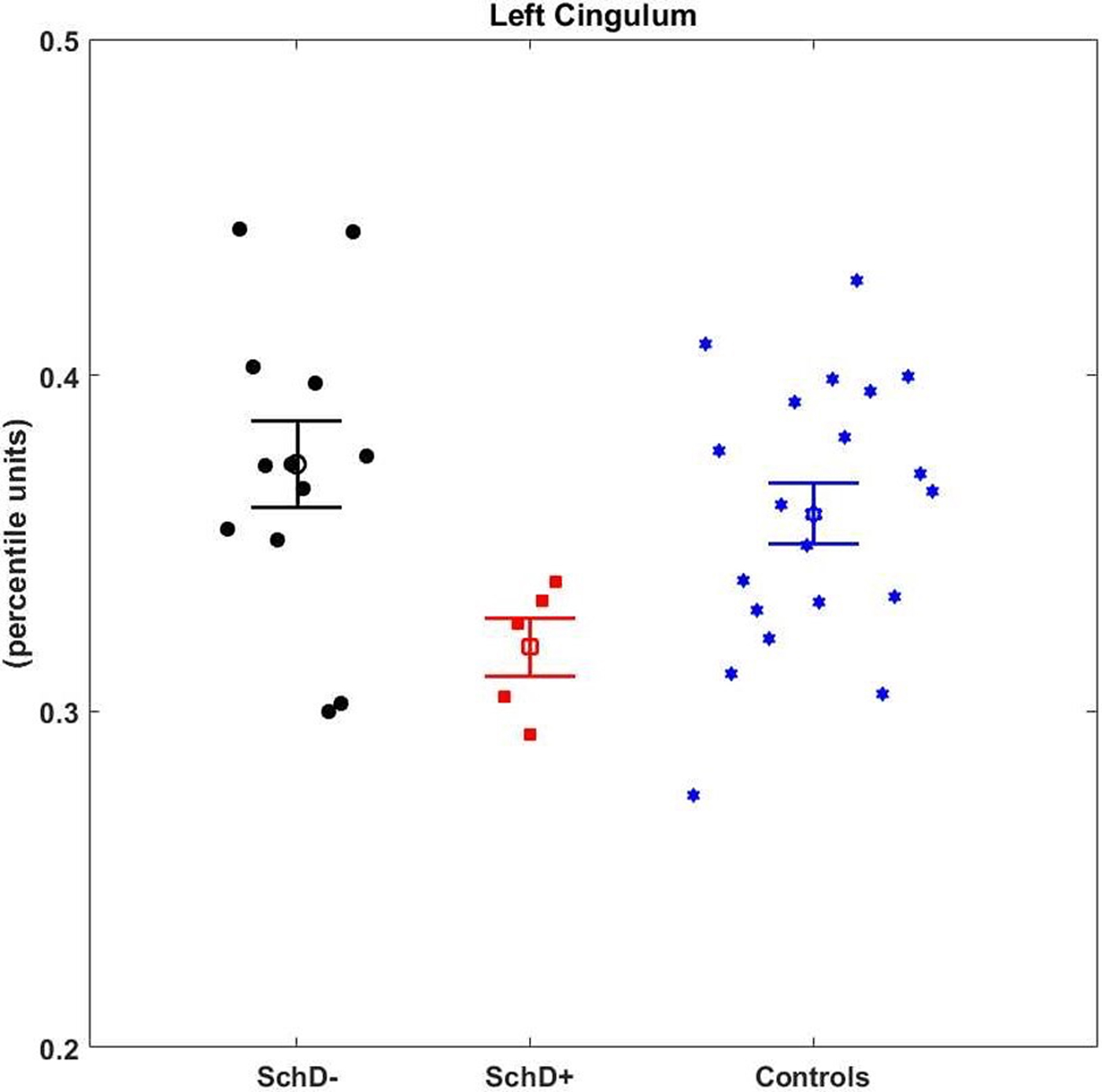
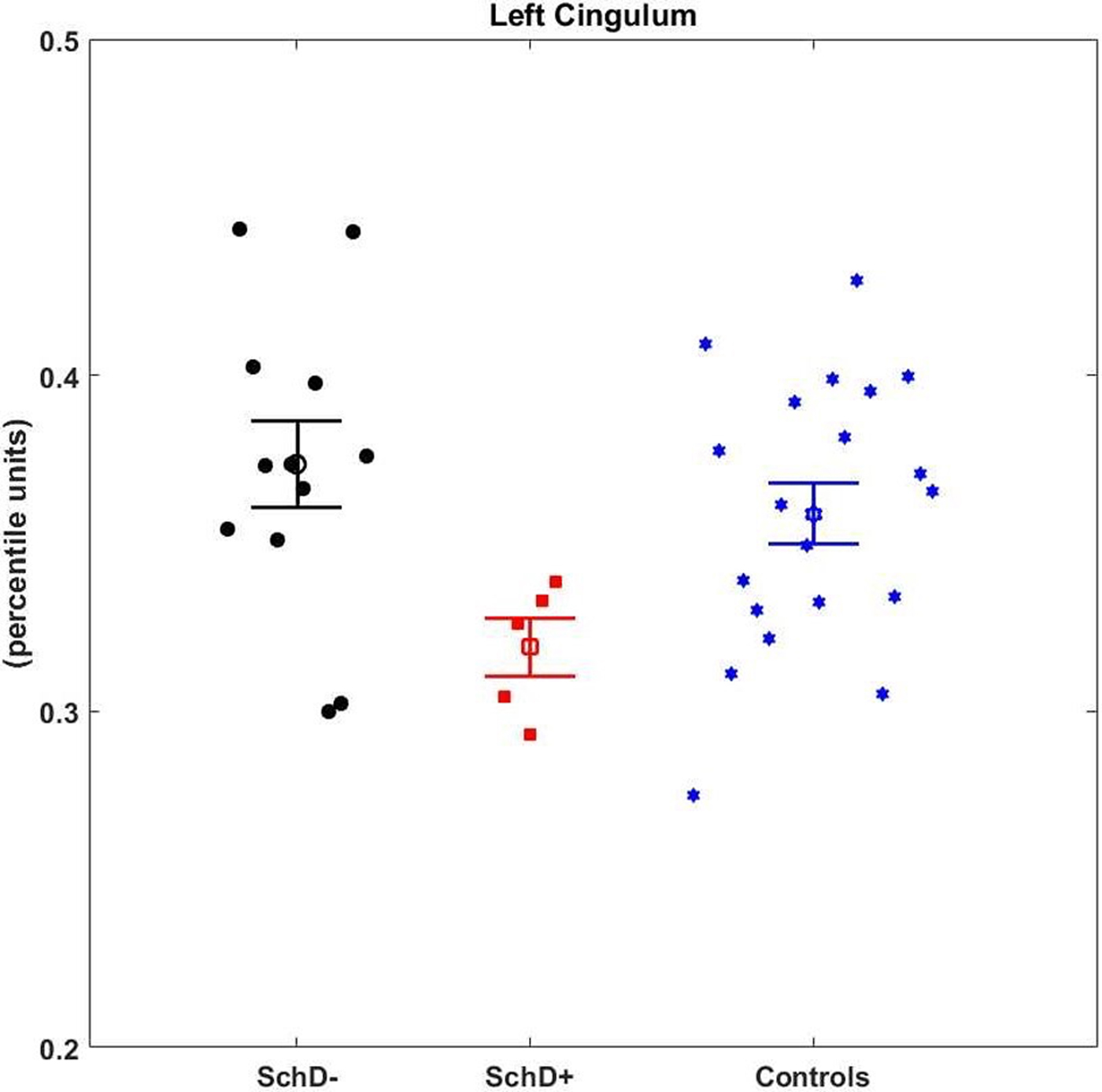
When compared with healthy controls, patients had a significant reduction in the MTR in the right (Hedge's g = 0.91, p = 0.007) but not in the left (g = 0.03, p = 0.92) cingulum bundle, with overall mean cingulum MTR reduction being significant (Hedge's g = 0.68). Higher MTR of left cingulum was associated with lower severity of Schneiderian delusions (τ = −0.45, p = 0.026) but no such relationship was seen for the right cingulum MTR (τ = −0.136, p = 0.50) among patients. In direct group comparison (Fig. 2), patients with Schneiderian delusions (n = 5) showed a significantly reduced MTR of left cingulum compared with patients (n = 12) with no Schneiderian delusions (Hedges’ g = 1.36, p = 0.02) as well as healthy controls (Hedges’ g = 1.33). This difference persisted even when the variance due to the severity of other clinical syndromes (disorganization, psychomotor poverty and other symptoms of reality distortion) was included as covariates in the analysis (F 1,12 = 7.33, p = 0.019). We did not find any association between the three major symptom dimensions of schizophrenia [τ/p for reality distortion (−0.27/0.14), disorganization (0.01/0.96), psychomotor poverty (0.09/064)] and left cingulum MTR. There were also no associations between cingulum MTR and DDD of antipsychotics [τ/p for left = 0.091 (0.62), right = 0.288 (0.12)].
MTR values of left cingulum in patients with Schneiderian delusions (SchD+), without Schneiderian delusions (SchD−) and healthy controls. Color figure available online.
Discussion
Our findings suggest that MTR changes in anterior cingulum resulting from either dysmyelination or neuroinflammation are present in clinically stable patients with schizophrenia despite their medicated status. We also confirm the expected relationship between reduced myelin content in the cingulum and the presence of active Schneiderian delusions despite antipsychotic treatment in patients with schizophrenia. These observations add support to Whitford's hypothesis that passivity phenomenon may relate to delayed conduction of corollary discharges along prefrontal-limbic white matter bundles.
We noted a larger MTR reduction on the right hemisphere, but this right-sided abnormality was not related to Schneiderian delusions. This pattern is consistent with several previous studies in patients of comparable age group that show a predominantly right sided reduction in the integrity of cingulum at the group level (Voineskos et al., Reference Voineskos, Lobaugh, Bouix, Rajji, Miranda, Kennedy, Mulsant, Pollock and Shenton2010; Abdul-Rahman et al., Reference Abdul-Rahman, Qiu and Sim2011; Whitford et al., Reference Whitford, Lee, Oh, de Luis-Garcia, Savadjiev, Alvarado, Westin, Niznikiewicz, Nestor, McCarley, Kubicki and Shenton2014; Seitz et al., Reference Seitz, Zuo, Lyall, Makris, Kikinis, Bouix, Pasternak, Fredman, Duskin, Goldstein, Petryshen, Mesholam-Gately, Wojcik, McCarley, Seidman, Shenton, Koerte and Kubicki2016), despite a left-lateralized relationship with the severity of present state delusions (Oestreich et al., Reference Oestreich, Pasternak, Shenton, Kubicki, Gong, McCarthy-Jones and Whitford2016). The left lateralized relationship between cingulum MTR and Schneiderian delusions can be considered in the context of theories that posit schizophrenia as a language disorder with a predominant loss of left-hemispheric function. For example, Mitchell and Crow asserted that ‘The nuclear (Schneiderian) symptoms themselves represent a disintegration of the components of language, specifically the passivity phenomena reflect a failure of the transition from thought to speech production and action’ (Mitchell and Crow, Reference Mitchell and Crow2005). Previous reports from positron emission tomography studies also support predominant left-cingulate cortex involvement in Schneiderian delusions (Spence et al., Reference Spence, Brooks, Hirsch, Liddle, Meehan and Grasby1997; Franck et al., Reference Franck, O'Leary, Flaum, Hichwa and Andreasen2002).
While reduced MTR signal has been mostly attributed to dysmyelination, the most prominent macromolecule content in the white matter, we cannot rule out the contribution of increased free-water content that may result from inflammation and reduce MTR signal. Oestreich et al. (Reference Oestreich, Pasternak, Shenton, Kubicki, Gong, McCarthy-Jones and Whitford2016) investigated this by using free-water corrected diffusion imaging and reported that delusions that persisted despite treatment were related to both free-water corrected radial diffusivity, indexing dysmyelination, as well as extracellular free-water in the left-cingulum bundle indicating a role for inflammatory changes. Probing other markers of inflammation [e.g. microglial activity, pH levels (Sun and Sorensen, Reference Sun and Sorensen2008; Stoll and Bendszus, Reference Stoll and Bendszus2010)] in addition to the MTR, ideally in a longitudinal design that captures the active as well as remitted states of delusions, would be best suited to resolve this issue.
In addition to the current neuroimaging observations, several other lines of evidence suggest a critical role for dysmyelination in schizophrenia (Davis et al., Reference Davis, Stewart, Friedman, Buchsbaum, Harvey, Hof, Buxbaum and Haroutunian2003; Walterfang et al., Reference Walterfang, Wood, Velakoulis and Pantelis2006). A 14–22% reduction in the density and the quantity of oligodendrocytes (Hakak et al., Reference Hakak, Walker, Li, Wong, Davis, Buxbaum, Haroutunian and Fienberg2001; Hof et al., Reference Hof, Haroutunian, Copland, Davis and Buxbaum2002, Reference Hof, Haroutunian, Friedrich, Byne, Buitron, Perl and Davis2003; Uranova et al., Reference Uranova, Vostrikov, Orlovskaya and Rachmanova2004, Reference Uranova, Vostrikov, Vikhreva, Zimina, Kolomeets and Orlovskaya2007, Reference Uranova, Kolomeets, Vikhreva, Zimina, Rachmanova and Orlovskaya2013; Vostrikov et al., Reference Vostrikov, Uranova, Rakhmanova and Orlovskaia2004; Schmitt et al., Reference Schmitt, Steyskal, Bernstein, Schneider-Axmann, Parlapani, Schaeffer, Gattaz, Bogerts, Schmitz and Falkai2009; Kerns et al., Reference Kerns, Vong, Barley, Dracheva, Katsel, Casaccia, Haroutunian and Byne2010; Williams et al., Reference Williams, Marsh, Macdonald, Jain, Pearce, Hirsch, Ansorge, Gentleman and Maier2012; Kochunov and Hong, Reference Kochunov and Hong2014; Mauney et al., Reference Mauney, Pietersen, Sonntag and Woo2015; Stedehouder and Kushner, Reference Stedehouder and Kushner2017), downregulation of myelin-related genes and proteins, especially in the cingulum [see Takahashi et al. (Reference Takahashi, Sakurai, Davis and Buxbaum2011) for a review; also see Flynn et al. (Reference Flynn, Lang, Mackay, Goghari, Vavasour, Whittall, Smith, Arango, Mann, Dwork, Falkai and Honer2003); Katsel et al. (Reference Katsel, Davis and Haroutunian2005); Dracheva et al. (Reference Dracheva, Davis, Chin, Woo, Schmeidler and Haroutunian2006); Bennett (Reference Bennett2011); Voineskos et al. (Reference Voineskos, Felsky, Kovacevic, Tiwari, Zai, Chakravarty, Lobaugh, Shenton, Rajji, Miranda, Pollock, Mulsant, McIntosh and Kennedy2013); Roussos and Haroutunian (Reference Roussos and Haroutunian2014)]. Recent genomic studies indicate a cardinal role for oligodendrocyte-related genetic polymorphisms and myelin-related candidate genes in schizophrenia (Ripke et al., Reference Ripke, Sanders, Kendler, Levinson, Sklar, Holmans, Lin, Duan, Ophoff, Andreassen, Scolnick, Cichon, St Clair, Corvin, Gurling, Werge, Rujescu, Blackwood, Pato, Malhotra, Purcell, Dudbridge, Neale, Rossin, Visscher, Posthuma, Ruderfer, Fanous, Stefansson, Steinberg, Mowry, Golimbet, De Hert, Jönsson, Bitter, Pietiläinen, Collier, Tosato, Agartz, Albus, Alexander, Amdur, Amin, Bass, Bergen, Black, Børglum, Brown, Bruggeman, Buccola, Byerley, Cahn, Cantor, Carr, Catts, Choudhury, Cloninger, Cormican, Craddock, Danoy, Datta, de Haan, Demontis, Dikeos, Djurovic, Donnelly, Donohoe, Duong, Dwyer, Fink-Jensen, Freedman, Freimer, Friedl, Georgieva, Giegling, Gill, Glenthøj, Godard, Hamshere, Hansen, Hansen, Hartmann, Henskens, Hougaard, Hultman, Ingason, Jablensky, Jakobsen, Jay, Jürgens, Kahn, Keller, Kenis, Kenny, Kim, Kirov, Konnerth and Konte2011; Duncan et al., Reference Duncan, Holmans, Lee, O'Dushlaine, Kirby, Smoller, Öngür and Cohen2014; Goudriaan et al., Reference Goudriaan, de Leeuw, Ripke, Hultman, Sklar, Sullivan, Smit, Posthuma and Verheijen2014). In addition, reduced glutathione levels, indicating oxidative stress, is also associated with reduced structural integrity of cingulum bundle in patients with schizophrenia (Monin et al., Reference Monin, Baumann, Griffa, Xin, Mekle, Fournier, Butticaz, Klaey, Cabungcal, Steullet, Ferrari, Cuenod, Gruetter, Thiran, Hagmann, Conus and Do2015).
Limitations
We used a region-of-interest approach based on probabilistic estimate of the cingulum bundle, as MT images lack the directional information that could be obtained from diffusion tractography. Furthermore, in the presence of myelin abnormalities, the FA values are likely to be affected within the tract, thus producing a systematic bias against reliable estimation of the tract's anatomy in the disease group. Our atlas-based approach obviates this issue though partial volume effects affecting the MTR computation cannot be fully ruled out. Second, we focused on cingulum and the Schneiderian delusions of control given the strong prior literature. We lacked sufficient power to relate MTR changes in other white matter bundles to symptom scores. Though our study was sufficiently powered to demonstrate an association between Schneiderian delusions and MTR, we cannot rule out the possibility that the lack of a statistically significant relationship between MTR and symptoms other than Schneiderian delusions is a type-2 error.
SSPI used for the assessment of symptoms in the current study is scored based on the burden of current symptoms (i.e. the past 1 week). We did not have the symptom severity scores recorded during acute phases of illness for this sample. As a result, based on the current study, while reduced cingulum MTR relates to the presence of cross-sectionally assessed Schneiderian delusions that persist despite treatment in established illness, we are not able to infer the role of cingulum MTR in relation to the historical presence or absence of Schneiderian delusions.
It is worth highlighting that the existing magnetisation transfer imaging literature based on whole brain analyses indicates that the maximal reduction in the MTR in schizophrenia involve occipitotemporal and superior frontal regions, not the cingulum bundle. As whole-brain studies use conservative corrections for multiple comparisons, subtler but important effects that correlate with symptoms can be missed. Consistent with this, our prior work on the current sample indicated a large effect size MTR reduction in the inferior occipitotemporal region (Cohen's d = 1.54) in the patient group; the illness-related MTR reduction in cingulum that we report here is of lower effect size (Cohen's d = 0.68).
Our results indicate that reduced myelin and/or inflammation of the cingulum is a feature of schizophrenia that relates to the first rank symptoms of delusional control/passivity and thought disturbances. Thus the state of the integrity of cingulum may be an important contributor to the phenotypic heterogeneity seen in schizophrenia.
Acknowledgements
We acknowledge the participants and their family members who supported this study.
Financial support
This work was supported by the Medical Research Council (grant number MRC G0601442); Wellcome Trust (grant number WT096002/Z/11); Canadian Institute of Health Research Foundation Grant (grant number CIHR 375104) and an internal grant from the School of Community Health Sciences, University of Nottingham. LP is supported by the Academic Medical Organization of South-Western Ontario (Opportunities Fund), Bucke Funds, and Chrysalis Foundation Funds.
Conflict of interest
LP reports personal fees from Otsuka Canada, Canadian Psychiatric Association and SPMM Course (UK); investigator-initiated educational grants from Janssen Canada, Otsuka Canada not related to the submitted work. Other authors report no relevant conflicts.