Introduction
Approximately, 58% of planets in the habitable zone of stars are super-terrans (http://phl.upr.edu/projects/habitable-exoplanets-catalog). These worlds have greater than an Earth's mass of material and proportionately greater gravitational field strengths (Kite et al., Reference Kite, Manga and Gaidos2009). While the impact of planetary mass on the kind of surface terrain has been considered (Kite et al., Reference Kite, Manga and Gaidos2009; Cowan and Abbot, Reference Cowan and Abbot2014; Rogers, Reference Rogers2015), the effect on vegetation has not been examined.
If we assume that all super-terrans have sub-aerial surfaces, which may not be true (Alibert, Reference Alibert2014; Rogers, Reference Rogers2015), what will the effect of planetary mass be on vegetation cover? For example, it is understood that the maximum height vegetation reaches on Earth is primarily determined by the availability of carbon dioxide and water (Niklas, Reference Niklas2007; Jasechko et al., Reference Jasechko, Sharp, Gibson, Birks, Yi and Fawcett2013) and the height to which water may be transported through the xylem vessels (Jeje et al., Reference Jeje and Zimmermann1979; Zimmermann, Reference Zimmermann1983; Friend, Reference Friend, Solomon and Shugart1993; Zwieniecki et al., Reference Zwieniecki, Melcher and Holbrook2001a, Reference Zwieniecki, Melcher and Holbrook2001b; Koch et al., Reference Koch, Sillett, Jennings and Davis2004; Brienen et al., Reference Brienen, Gloor, Clerici, Newton, Arppe, Boom, Bottrell, Callaghan, Heaton, Helama, Helle, Leng, Mielikäinen, Oinonen and Timonen2017). The latter appears to be principally determined by biophysical constraints imposed by gravity (Niklas, Reference Niklas2007). Water is drawn through specialized vessels, known as xylem. These contain a number of adaptations that facilitate the adhesion of molecules to the wall, as well as the maintenance of a continuous water column between the roots and the atmosphere (Maa, Reference Maa2017). The evaporation of water through the stomata then draws more water up from below: cohesion tension (Pockman et al., Reference Pockman, Sperry and O'Leary1995). In this system, there is then a trade-off between the upward pull of cohesion tension; adhesion to the xylem walls; turbulence, generated by fluid flow over the walls of the xylem; and the gravitational pull of the planet (Koch and Fredeen, Reference Koch, Fredeen, Holbrook and Zwieniecki2005). This provides a physical constraint on physical transport of water to the leaves, which then impacts biological processes that occur there (Smirnoff, Reference Smirnoff1993).
In this paper, we apply the physical constraints on water transport to determine the maximum height of vegetation on telluric planets and then apply this information to illustrate how climate is affected in quantitative and qualitative manners. We find that planetary mass grossly constrains the height of vegetation and this, in turn, affects wind velocity and flow structure.
Methods
Mass of super-terran and gravitational field strength
Gravitational field strength varies with mass and radius by equation (1), where g is the field strength at its surface (technically, the distance from the centre of mass), M is the mass of the planet and r is its radius.
 $$g = \displaystyle{{GM} \over {r^2}}.$$
If the density of the planet is lower than telluric values, then the field strength will scale to lower values at any given depth. However, planets with significantly lower density than the Earth are unlikely to be habitable for complex species, because these worlds will have surfaces capped by deep oceans and/or thick atmospheres (Rogers, Reference Rogers2015). Therefore, for the sake of this gedankenexperiment, we consider planets where the surface is at least partly sub-aerial. While this may not be physically reasonable for many super-terran planets, it remains a valuable consideration as many super-terrans orbit red dwarf stars, where substantial loss of volatiles may occur in the first billion years of the planet's existence (Wheatley et al., Reference Wheatley, Louden, Bourrier, Ehrenreich and Gillon2016).
Gravitational field strength and maximum height of vegetation
When the pressure (the water potential) falls below −2 Mpa (an upward suction), evaporation from the air spaces in the leaf tends to drive cavitation or the collapse of xylem vessels. With either the breaking of the continuous water column, or the collapse of the xylem vessel, transpiration will cease and the leaves die (Smirnoff, Reference Smirnoff1993). This limits tree growth on Earth to heights of 122–130 m on Earth. If we assume that the same physical principle applies then we can extrapolate from the pressure at which cavitation occurs to determine the maximum height of vegetation on a super-terran planet. In principle, there should be a simple scaling between the maximum height of terrestrial vegetation and that on a super-terran. This will be proportional to the gravitational field strength as in equation (2), where h S is the maximum height of super-terran vegetation, h E is the maximum height of terrestrial vegetation; g S is the gravitational field strength on the surface of the super-terran; and g E is the equivalent on Earth.
 $$h_{\rm S} = h_{\rm E}.\displaystyle{{g_{\rm E}} \over {g_{\rm S}}}.$$
Next, one can consider the Hagen–Poiseuille equation (Niklas, Reference Niklas2007), which relates the length of a column of water in a narrow tube to the volumetric flow rate, if the flow is laminar (non-turbulent). This is illustrated in equation (3):
 $$J_{\rm v} = -\left( {\displaystyle{{{\rm \pi} r^4} \over {8\eta}}} \right)\displaystyle{{{\rm d}P} \over {{\rm d}l}},$$
where J v is the volumetric flow rate, r is the radius of the tube, η is the solution viscosity and the differential function dP/dl is the negative hydrostatic pressure gradient, which relates column pressure, P, with its length, l. While this relationship is based on conditions in idealized laboratory settings, the relationship reliably predicts the maximum height of a tree on Earth to be approximately 100 m.
The cohesion-tension theory gives a hydrostatic gradient (dP/dl) of 0.0098 MPa m−1 (Koch et al., Reference Koch, Sillett, Jennings and Davis2004; Niklas, Reference Niklas2007). Once the pressure declines below −1 MPa, cavitation of the vessels or loss of turgor in photosynthesising cells limits the viability of the tree (Smirnoff, Reference Smirnoff1993). Observations by Koch et al. show that when transpiration is minimal, the hydrostatic gradient due to gravity is of the order −0.0096 MPa, in line with theoretical considerations; but that this increases to −0.0106 MPa m−1 at midday, when transpirational losses and tension are at their greatest (Koch et al., Reference Koch, Sillett, Jennings and Davis2004). In Redwoods, the minimum pressure of Koch et al. sample was −1.84 + /−0.04 MPa at 108 m height, implying that two-thirds of the impact on xylary pressure was due to gravity.
There is no evidence to suggest that terrestrial vegetation has ever exceeded 122–130 m. While this is marginally more than would be predicted by equation (3), the gain is marginal and the observed maximum height in the fossil record is approximately 130 m (Koch et al., Reference Koch, Sillett, Jennings and Davis2004; Koch and Fredeen, Reference Koch, Fredeen, Holbrook and Zwieniecki2005). Irregularities in true xylem vessels should reduce flow rates, while increases in the diameter facilitate faster transpirational flow, but increase the likelihood of cavitation.
As the theoretical and observational decline in xylary pressure agree closely, we can use the value 0.01 MPa m−1 as a constant in further calculation. This approximates the upper end of the narrow range of pressures that exist in xylem throughout the terrestrial day. As the pressure varies with the acceleration due to gravity, g, we can derive the simple relationship between the acceleration due to gravity, g, on Earth and a super-terran in relationship to this factor. Applying the constant 0.01 MPa m−1 gives us equation (4).
 $$-1.0 \le h\displaystyle{{g_{\rm E}} \over {g_{\rm S}}}0.01,$$
where h is the maximum tree height; g E and g S have the same meaning as in equation (2); and 0.01 is an approximate constant that is derived from cohesion-tension theory and observation (Koch et al., Reference Koch, Sillett, Jennings and Davis2004; Koch and Fredeen, Reference Koch, Fredeen, Holbrook and Zwieniecki2005). Rearranging equation (4) gives us equation (5) which allows us to determine the maximum height as:
 $$h \le 100\displaystyle{{g_{\rm E}} \over {g_{\rm S}}}.$$
Therefore, in the absence of compensatory mechanisms, the maximum tree height on a super-terran is always <100 m. Empirically, we can adjust the output of this equation to match terrestrial observation 122–130 m versus the theoretical value of 100 m, by the addition of a further dimensionless constant 1.2, which covers the additional effects of other adaptations. The value ‘100’ becomes ‘122–130’. However, physiologically, there is a limit to how much this figure can be increased, through widening of the xylem vessels or changes to the composition of the xylary fluid (Jei and Zimmerman, 1979; van Ieperen et al., Reference van Ieperen, van Meeteren and van Gelder2000; Niklas, Reference Niklas2007).
Finally, to determine maximum tree height, based on planetary mass and radius, we substitute equation (1) into (5) to get equation (6). This is then in a usable form using astrophysically available data.
 $$h \le 100\displaystyle{{M_{\rm E}r_{\rm S}^2} \over {M_{\rm S}r_{\rm E}^2}}, $$
which may be written as:
 $$h \le 100M_{\rm E}r_{\rm S}^2 M_{\rm S}^{-1} r_{\rm E}^{-2}, $$
where M E and r E are the mass and radius of the Earth, respectively. M S and r S are the corresponding mass and radius for a super-terran (or any exoplanet). If these values are known, then they can be used directly to determine the maximum height of vegetation, where water movement is driven by cohesion tension.
Relevance – Earth mass and radii
For reasonable planetary masses and Kepler observations, this likely limits masses to <7-Earths (Dressing and Charbonneau, Reference Dressing and Charbonneau2015; Zeng et al., Reference Zeng, Sasselov and Jacobsen2016). With terrestrial compositions, this limits their radii to <1.6-Earths (Rogers, Reference Rogers2015). This may well be an upper limit as Kepler data suggests that at around 1.6-Earth radii, there is an abrupt decrease in planetary density, suggesting that these planets rapidly deviate from telluric structures, towards Neptune-like organizations (Rogers, Reference Rogers2015). Planets in the range 1.4–1.6-Earth radii may be aquaplanets. Therefore, realistically in terms of radii, only those planets with radii <1.4-Earths may be worth considering.
Determination of g using a mass–radius relationship
In order to constrain g for a variety of viable planetary systems, where only r or M is known with precision, we can use equation (2) from Zeng et al. (Reference Zeng, Sasselov and Jacobsen2016). This has a reasonably good fit for a variety of planets, including the Earth and Venus. This is described in equation (8) as:
 $$\displaystyle{R \over {R_{\rm E}}} = \lpar {1.07-0.21.{\rm CMF}} \rpar .\left( {\displaystyle{M \over {M_{\rm E}}}} \right)^{1/3.7},$$
where R is the radius of the exoplanet, R E is the radius of the Earth; M is the exoplanet mass; M E the mass of the Earth and CMF is a function, relating to the mass of the core in relation to the mass of the planet as a whole, where the value 0.30 appears to fit most observed planets in the range 0.8–7-Earth masses (Zeng et al., Reference Zeng, Sasselov and Jacobsen2016).
Frictional coefficients and wind velocities on low relief and vegetation planets
Terrestrial surface winds have steadily reduced over the last four decades. Measurements from 1979 until 2008 show a reduction in mean wind velocities (stilling) on the order of 5–15% (Vautard et al., Reference Vautard, Cattiaux, Yiou, Thépaut and Ciais2010). A significant proportion of this effect appears attributable to increases in vegetation height. Mathematical modelling suggests reductions in wind velocity at the surface can be attributed using the following relationship from Vautard et al. (Reference Vautard, Cattiaux, Yiou, Thépaut and Ciais2010).
 $${\rm \delta} U = {\rm aln}\left( {\displaystyle{{z_0} \over {z_{0c}}}} \right),$$
where δU is the change in velocity of surface winds to a height of 10 m; a is a constant, which has a value of 0.48–0.37 m s−1 when the surface is roughened (the lower end pertaining to a generic increase in roughness; and the upper value pertaining to an increase in the roughness of grassland); z 0c is a standard roughness value and z 0 representing the new value caused in this instance by an increase in vegetative cover. An increase in roughness height by a factor of two (a doubling in vegetation height) would reduce wind velocities by 0.26–0.33 m s−1 (Vautard et al., Reference Vautard, Cattiaux, Yiou, Thépaut and Ciais2010). This amounts to a reduction in mean, surface winds of 5–15% over continental areas. These impacts on wind velocity are now applied to two aspects of super-terran habitability. For simplicity, we adopt the approximate mean value of 0.30 m s−1 for a doubling in height of vegetation.
Results
Vegetation height
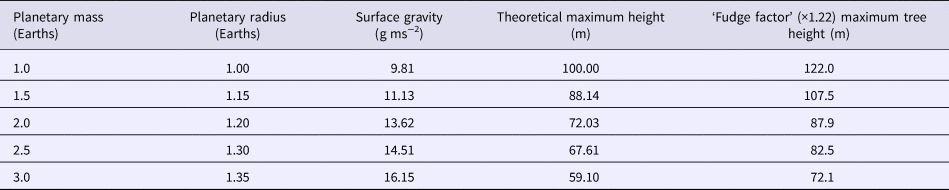
The maximum height to which vegetation can grow on any planet is given by equation (6). Application to possible exoplanets is illustrated in Table 1. Reasonable planetary masses are included, with the higher masses likely only applicable with increasingly significant losses of planetary volatiles through atmospheric stripping (Wheatley et al., Reference Wheatley, Louden, Bourrier, Ehrenreich and Gillon2016). Otherwise, one presumes the surface, if habitable, would be drowned in oceans (Cowan and Abbot, Reference Cowan and Abbot2014).
Variation in tree height with g

The value of ‘g’ for various planetary masses and radii is derived from Zeng et al., Reference Zeng, Sasselov and Jacobsen2016. The fudge factor is simply an empirical add-on, based on terrestrial observations as described in the text.
In general, if one assumes that vegetation on an exoplanet has the same basic necessities as terrestrial plants, then one would expect greater abundances and heights of vegetation as one moves towards areas of greatest precipitation (Pockman and Sperry, Reference Pockman and Sperry2000; Niklas, Reference Niklas2007; Brienen et al., Reference Brienen, Gloor, Clerici, Newton, Arppe, Boom, Bottrell, Callaghan, Heaton, Helama, Helle, Leng, Mielikäinen, Oinonen and Timonen2017; Rosell et al., Reference Rosell, Olson and Anfodillo2017; Liu and El-Kassaby, Reference Liu and El-Kassaby2018). On asynchronously, rotating planets, like the Earth, the distribution of precipitation is dictated by the mass, spin and energy supply to the surface and atmosphere. We, therefore, assume that the distribution of vegetation height will follow the same rules as on Earth.
Impact of reduced vegetation height on surface wind velocities and climate models
Equation (7) shows that an increase in plant height by 10 m reduces surface wind velocity by around 0.3 m s−1(Vautard et al., Reference Vautard, Cattiaux, Yiou, Thépaut and Ciais2010). Winds become more turbulent as they flow over trees (Frederick, Reference Frederick1961; Marshall, Reference Marshall1998; Mohamed et al., Reference Mohamed, David and Wood2015). Therefore, we can deduce that the greatest impact of trees on wind velocities will be on planets with the lowest masses, with all other variables kept constant. At greater masses, vegetation height is lower. Indeed, on a 3-Earth-mass planet, the wind velocities are likely to be approximately 3 m s−1 faster in forested areas than would be found in a similar climatic region on an Earth-mass world. This obviously depends on the precise means of water transport, but if cohesion tension is the driving force, this is a reasonable expectation.
Effect on climate models for synchronously rotating worlds
In principle, if the planet is telluric and with land, these values should apply generically to planets of different masses, irrespective of the underlying nature of the planet concerned. However, the distribution of precipitation is important in restricting the maximum height. Increased water stress reduces carbon dioxide fixation and with it the propensity for the tree (or other vegetation) to grow to its full potential (Smirnoff, Reference Smirnoff1993). In general, one would expect a greater tensile force in areas where water stress is greatest. In hot, dry areas, the evapotranspiration rate will be higher (Kitaya et al., Reference Kitaya, Tsuruyama, Kawai, Shibuya, Kiyota, Kubota and Changhoo2000; Jacobsen et al., Reference Jacobsen, Pratt, Tobin, Hacke and Ewers2010; Maa, Reference Maa2017; Liu and El-Kassaby, Reference Liu and El-Kassaby2018) but the supply of water through the xylem will be lower. If nothing else is altered then there will be a greater propensity for the water column to break, leading to a loss of cohesive-tensile force along the column length (Pockman and Sperry, Reference Pockman and Sperry2000; Woodruff et al., Reference Woodruff, Bond and Meinzer2004; Olson and Rosell, Reference Olson and Rosell2013).
On tidally locked planets, the focus of precipitation is at the sub-stellar point (SSP, Haqq-Misra, et al., Reference Haqq-Misra, Wolf, Joshi, Zhang and Kopparapu2017). In that sense, terrestrial vegetation broadly increases with height in response to both temperature and humidity. Therefore, in locations distal to the SSP, one would expect at best very limited distributions of low height vegetation. The exception would be in areas where orographic rainfall was significant (Stevenson, 2019, in press). However, these may be very limited in distribution, particularly on planets of higher mass, where vertical relief is likely to be more limited (Kite et al., Reference Kite, Manga and Gaidos2009; Cowan-and Abbot, Reference Cowan and Abbot2014).
While it is beyond the scope of this article to consider climate impact in terms of precipitation, one would consider two likely effects. In the first, the overall reduction in wind velocity caused by surface vegetation might broaden the focus uplift and enhance precipitation over a larger area than would be seen when surface frictional forces are smaller. This means that there will be a greater impact on planets with lower masses, as the frictional effects of vegetation will be less. Secondly, terrestrial vegetation is responsible for the greatest transport of water from the soil to the atmosphere over continental areas (Jasechko et al., Reference Jasechko, Sharp, Gibson, Birks, Yi and Fawcett2013). Jasechko et al show that 80–90% of the return of precipitated water from the soil to the atmosphere is through transpiration. Higher wind velocities cause increases in evapotranspiration rate (Kitaya et al., Reference Kitaya, Tsuruyama, Kawai, Shibuya, Kiyota, Kubota and Changhoo2000). Therefore, in areas of lower vegetation, evapotranspiration will be greatest, because wind velocities will be greatest: this will be experienced on the surfaces of planets of higher mass. This will lead to higher precipitation rates towards the SSP in higher mass planets, because there will be more water in the atmosphere above forested areas of lower height.
Moreover, in general, most climate models for synchronously rotating planets have >90% of the precipitation falling within 30o either side of the SSP (Boutle et al., Reference Boutle, Mayne, Drummond, Manners, Goyal, Lambert, Acreman and Earnshaw2017). Some are more restrictive than this (Merlis and Schneider, Reference Merlis and Tapio Schneider2010). While these models apply specifically to aquaplanets, the climate models do offer a means of interrogating climate on telluric planets with land areas (Stevenson, 2018). If we consider realistic distributions of precipitation and consider the physiological impacts of this on water transport (Friend, Reference Friend, Solomon and Shugart1993; Pockman and Sperry, Reference Pockman and Sperry2000; Brienen et al., Reference Brienen, Gloor, Clerici, Newton, Arppe, Boom, Bottrell, Callaghan, Heaton, Helama, Helle, Leng, Mielikäinen, Oinonen and Timonen2017), one should expect vegetation with lower heights in areas removed from the SSP on synchronous rotators. Thus, frictional effects will vary from distance from the SSP, being greatest closest to it.
Discussion
In this paper, we show that changes in planetary mass result in changes in vegetation height, which then impacts climate models.
One immediately may ask, is it reasonable to quantify photosynthetic organism growth on a planet if we haven't yet observed it? After all, if we set terrestrial benchmarks, are these applicable to extraterrestrial organisms? In short: yes. One may well fancifully produce some sort of producer with an organ that can pump fluids from its roots to its branches. However, for a photosynthetic organism to do so, it must harvest and store significantly more energy during the day than is observed in all terrestrial producers. Operating the equivalent of a muscular system requires a significant energy input of the kind not seen in any producer on Earth. Therefore, one returns to the cohesion-tension system as the most likely system through which fluids are delivered from the soil to the atmosphere in a producer (Vogel, Reference Vogel1981; Friend, Reference Friend, Solomon and Shugart1993; Pockman et al., Reference Pockman, Sperry and O'Leary1995; Thompson and Holbrook, Reference Thompson and Holbrook2003; Woodruff et al., Reference Woodruff, Bond and Meinzer2004; Koch and Fredeen, Reference Koch, Fredeen, Holbrook and Zwieniecki2005; Niklas, Reference Niklas2007; Kim et al., Reference Kim, Park and Ildoo Hwang2014; Maa, Reference Maa2017; Rosell et al., Reference Rosell, Olson and Anfodillo2017). Therefore, the model applied here works and shows a simple but testable model, whereby the greater the planetary mass, the lower the height of the vegetation.
In principle, the effect is then to reduce frictional coefficients for vegetation for planets of higher mass. This matches the overall reduction in friction that will be associated with surfaces of lower topographical relief on planets of greater mass (Cowan and Abbot, Reference Cowan and Abbot2014). Therefore, it is essential that once climate models for planets with continental surfaces are considered, the effect of vegetation height and topographic relief are incorporated.
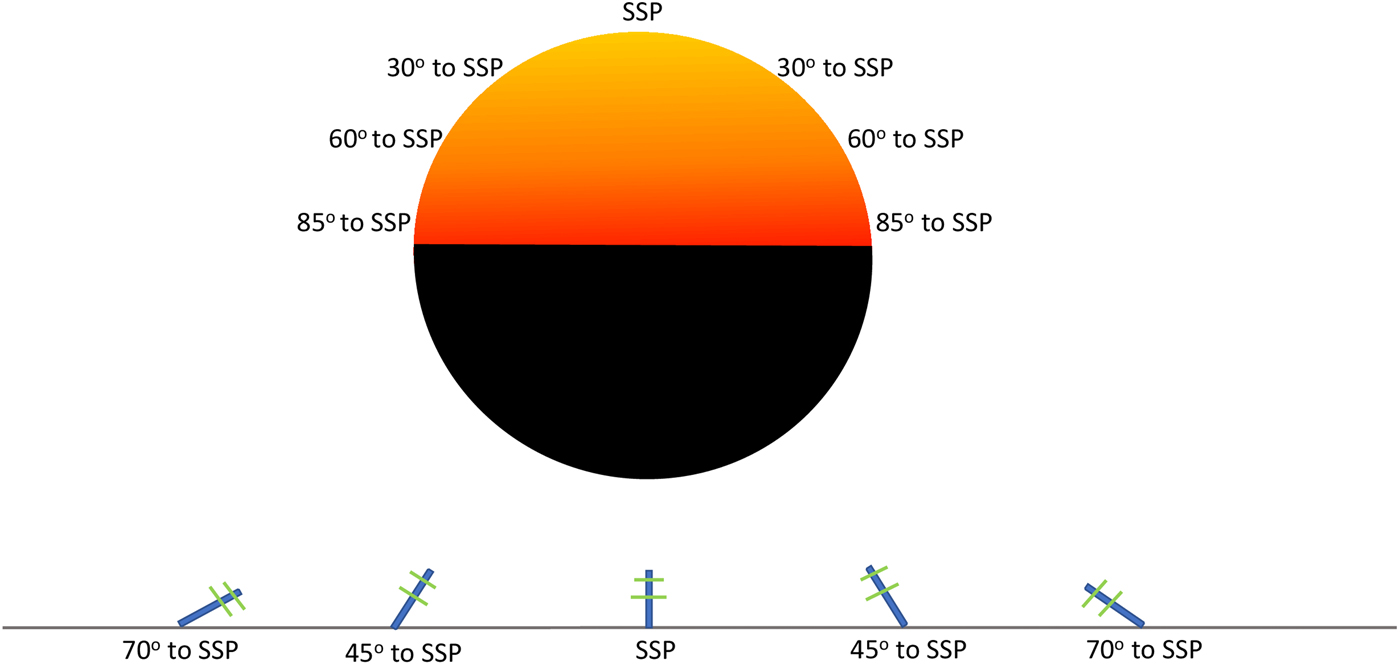
A final thought concerns the manner in which vegetation might grow in response to habitation of synchronous rotators. While, not formally considered here, one notes that terrestrial vegetation grows towards the light. As the Sun moves across the terrestrial sky, vegetation primarily grows in a vertical direction. However, on a synchronous rotator, light constantly illuminates the surface from one direction. Consequently, plants must either grow their stems towards the light, or orientate their leaves towards it, while the stems grow vertically. This effect varies with the angular separation from the SSP (Fig. 1). If the former strategy is adopted, plants will be compelled to grow at increasingly shallow angles with respect to the planetary surface as one approaches the terminator. In this regard, vegetation will lower in height as one moves away from the SSP and towards the terminator, irrespective of any effect imposed by precipitation. This will also reduce the frictional coefficients in a manner dependent on angular separation and (by inference) the angle of illumination. If this strategy was adopted, the effect of limb and trunk weight would need to be included.
The angular separation from the sub-stellar point and the effect on the angle of plant growth. If plants orientate themselves rather than their leaves, then plants will have to adopt strategies to prevent rupture of the trunk or limbs.

Branches and trunks in terrestrial vegetation breaks at specific wind velocities, which applies a force over which the trunk is no longer able to accommodate the increased strain through bending. This tends to happen at 42 m s−1 (Xi et al., Reference Xi, Peet, Decoster and Urban2008; Virot et al., Reference Virot, Ponomarenko, Dehandschoewercker, Quéré and Clanet2016). However, while such wind velocities are unlikely to be a factor on synchronous rotators (Kopparapu et al., Reference Kopparapu, Wolf, Haqq-Misra, Yang, Kasting, Meadows, Terrien and Suvrath Mahadevan2016), the equivalent force would be produced by growth at an angle. Plants, may adopt various strategies to maximise the capture of incident radiation. This could include dropping new rooting stems from the diagonally extending trunk, or simply by growing low, over the ground or over one another. Fortunately, as the majority of habitable planets that orbit red dwarfs are likely to be slowly rotating, airflow will be radially directed towards the SSP and, therefore, in the same direction as vegetation is orientated.
Acknowledgements
I would like to gratefully acknowledge the assistance of N. Stevenson and D. Hemstock in the production of this manuscript.