Introduction
Mass casualty incidents (MCIs) are complex emergencies that result in a high volume of patients, often overwhelming existing health care resources.Reference Sellers and Ranse1 From a hospital emergency management perspective, MCIs operate outside of the typical workflow: demanding extensive planning, rapid resource mobilization, and workflows that differ significantly from routine operations. The response requires expedited triage processes, often relying on minimal patient identifiers, and occurs at a faster pace than standard care delivery.
Nationwide factors, including rising patient boarding and chronic Emergency Department (ED) overcrowding, already constrain hospital throughput and bed availability, reducing the system’s ability to absorb sudden patient surges.Reference Puri, Tsay and Goldberg2, Reference Morley, Unwin and Peterson3 During an MCI, these baseline limitations become operational bottlenecks, as staffing, space, stretchers, and other critical resources are simultaneously scarce. In our experience, effective surge plans must include detailed protocols for activating additional staff, assigning clear leadership roles, designating alternative care spaces to decompress the ED, deploying subspecialty personnel, and ensuring that frontline triage teams can manage incoming patients using simple, reliable tools.
Recent cyberattacks against health care institutions further underscore the need for redundancy and resilient tools to support patient assessment during electronic downtime and patient surges. During cyberattacks like those against Change Healthcare,Reference Alder4 online registration and rapid triage systems were suddenly unavailable: all-too-real scenario hospitals increasingly face amid rising cyber threats and infrastructure strain. During exercises, our institution has experienced firsthand how electronic downtimes can disrupt electronic health record (EHR) access, online registration, and electronic triage tools, leaving teams to function without the digital systems they typically rely on. During such events, our teams were able to transition smoothly into downtime operations, using a pre-developed triage toolkit that allowed patient intake and tracking to continue with minimal disruption.
This triage toolkit and resource binder, known as the MCI Toolkit, was developed by the NYU Langone Hospital—Brooklyn Emergency Department in collaboration with the Emergency Management and Enterprise Resilience (EM+ER) Department. Created in response to both past MCI events at our institution and the growing risk of cyber and infrastructure disruptions, the toolkit was designed to function as a dual-purpose resource: supporting rapid, structured triage, and patient tracking during mass casualty incidents, while also serving as a reliable downtime solution when electronic systems are compromised. Figure 1 outlines the development process in greater detail.
Developing the MCI Toolkit.

Overview of the MCI Toolkit
The MCI Toolkit (an abridged version viewable here: https://drive.google.com/file/d/14aQn3PZWwzD9Q9t_Xazup6YWP2dpBaa5/view) is an operational resource consisting of 1) a tracking tool designed to facilitate the triage, placement, tracking, and reconciliation of MCI patients, and 2) a repository of critical resources that can be utilized during MCI response.
Triage and Tag Patients
The Triage Tracker facilitates standard rapid triage assessments as a primary triage tool for patients who present as self-triage and as a secondary (confirmatory reassessment) triage tool that reevaluates pre-hospital categorization, incorporates the hospital team’s clinical expertise, and accounts for changes in patient status for those who arrive via EMS (see Figure 2). Studies have shown that manual triage tracking is quicker than electronic methods by about 8.4 seconds per patient.Reference Bolduc, Maghraby and Fok5 Additionally, it acts as part of the downtime procedure in the event of an EHR system interruption.
Triage tracking process.

The Tracker aligns with MCI START (Simple Triage and Rapid Treatment) Triage protocols in which patients are initially sorted according to clinical presentation into 4 categories: expectant (black tag), immediate (red tag), delayed (yellow tag), and minor (green tag).Reference Lin, Chen and Wang6 The START adult triage algorithm is used for patients over 8 years old and enables triage level calculation in less than 60 seconds. In comparison, the Emergency Severity Index Algorithm, often used in EDs during day-to-day operations, is a 5-tier triage system with a median triage time of 10 minutes in Emergency Medicine.Reference González and Soltero7
While START was initially developed for field triage, it is also effective in the hospital setting when adapted for multidisciplinary teams of nurses, Physician Assistants (PAs), Nurse Practitioners (NPs), and physicians. This differs from traditional ED triage by basing the triage team’s approach on three significant factors: vitals, mental status, and airway.Reference Zhang, Liu and Chen8 This streamlined approach allows for a standardized, simple, and rapid triage of patients, helping to determine which patients need immediate care and should be assigned critical resources. The START Triage protocol is able to identify emergent patients requiring immediate intervention and those who are deceased, with triage “accuracy” typically defined as agreement between assigned category and outcome-based severity and measured using sensitivity, specificity, and over-/under-triage rates.Reference Kahn, Schultz and Miller9 In ED-based studies, START has demonstrated high sensitivity for the immediate and deceased categories and acceptable discriminative performance for predicting downstream outcomes such as surgery and ED disposition.Reference Lin, Chen and Wang6 Additionally, studies have shown that utilizing a pre-determined triage system can decrease patient waiting time.Reference Yousefi, Feizollahzadeh and Shahsavarinia10
At the scene of the MCI, EMS providers, who also utilize START Triage as per New York State EMS protocols,11 first place a triage tag on the patient denoting an initial triage category and transport priority. Upon arrival at the emergency department, patients are then re-triaged using START, and pre-hospital tags are removed. It is important to note that while the START Triage algorithm is used by both pre-hospital and hospital teams, the objectives are different. In the pre-hospital care setting, providers are focused on identifying patients for transportation priority, while in the hospital setting, providers are assessing the patient to ensure that they are connected to the appropriate clinical teams and resources.
The ED triage and tracking process can be broken into the following 3 steps:
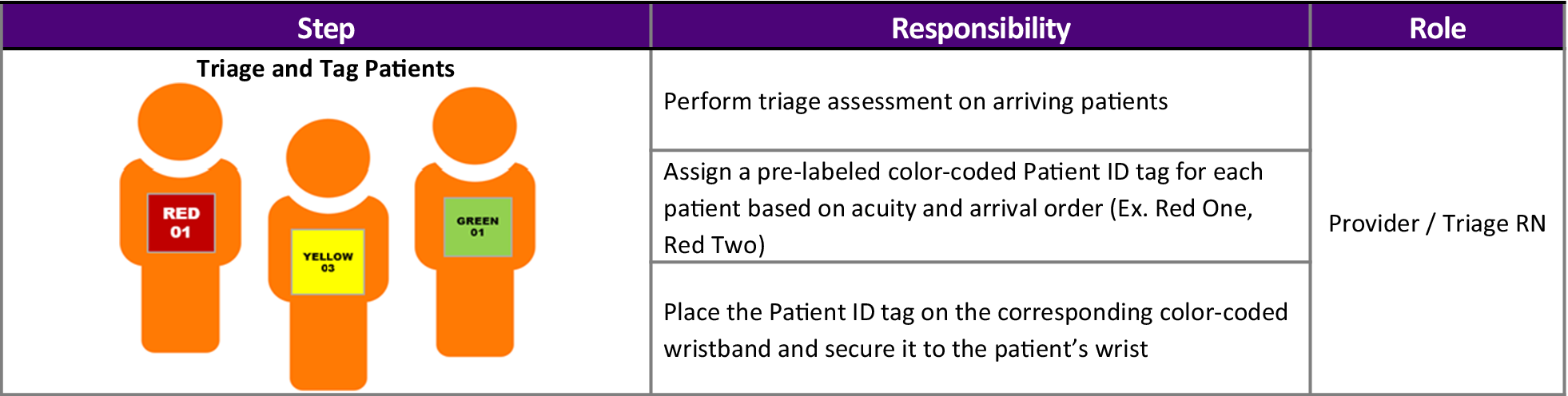
Step 1: The initial ED triage team consists of an RN, PA, MD, and 2 registration clerks. The RN, PA, or MD completes a rapid triage based on the START protocol. Based on acuity, each patient is assigned a color-coded wristband (red, yellow, green, or black) with a pre-printed ID tag that reflects both acuity and arrival order (e.g., Red 01, Green 03). A corresponding sticker tag is then logged in a paper tracker by a triage team member. Simultaneously, an EHR mini registration is completed using acuity and basic patient identifiers. See Figure 2a.
Triage and tag patients—Step 1.

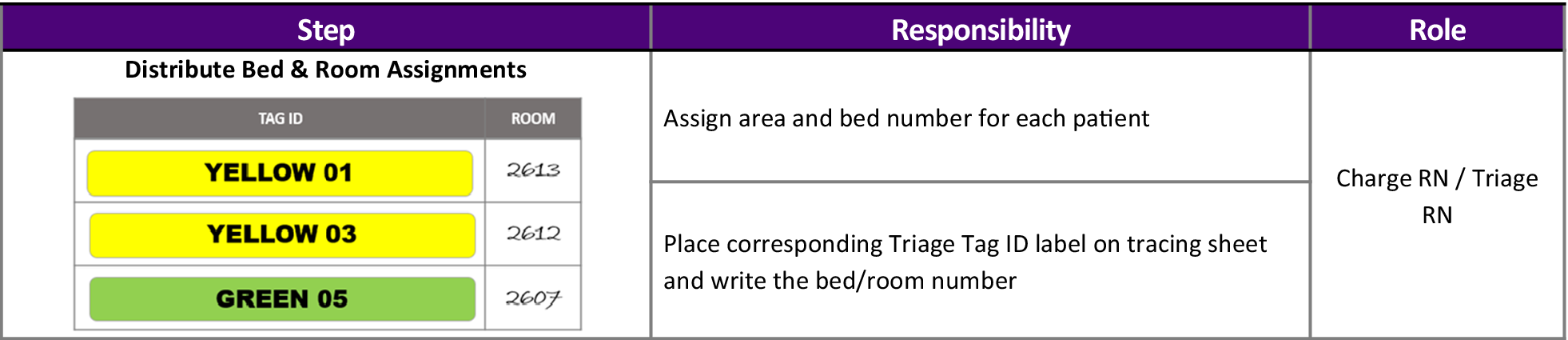
Step 2: As patients are triaged, the triage RN places the corresponding Patient ID sticker in section two of the tracker and writes the room number next to it. This provides real-time visibility into patient distribution by acuity and location. Our experience shows that tracking acuity and bed assignments allows for easier communication, faster direction of arriving clinicians and other personnel, and quicker transport to radiology, operating rooms, and inpatient beds. See Figure 2b.
Distribute bed and room assignments—Step 2.

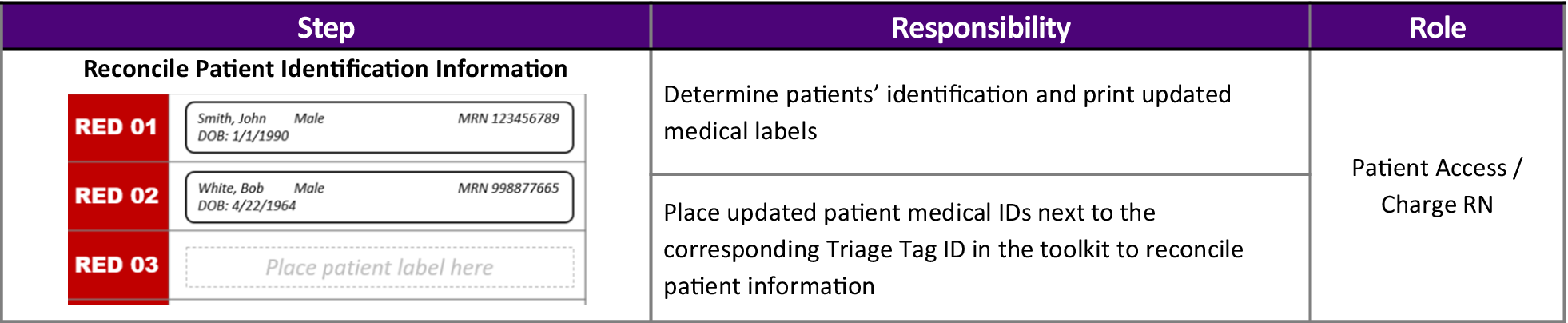
Step 3: As the MCI response continues, patient identification records must be reconciled. Section three of the Tracker includes a list of all Patient ID Tags with a space for the patients’ official medical ID tags to be printed and placed once confirmed. Completing this step acts as a secondary verification and ensures all arriving patients have been recorded in the electronic medical record system. See Figure 2c.
Reconcile patient identification information—Step 3.

Overall, this tracker acts as a vital bridge between frontline triage operations and the Incident Command team. As each patient is triaged, their acuity-based ID tag alongside their location and treatment zone is immediately recorded on dedicated paper logs, ensuring real-time visibility of the MCI census. This allows Incident Command to know, at any given moment, how many patients have arrived, where they are located, and what level of care they require. In our experience, the Triage team communicated with Incident Command and specialty teams upon ED arrival. Efficiency was increased as incoming teams were directed to critical areas and were aware of the numbers of critical patients and bed assignments. This also helps expedite decisions regarding decompression and the movement of inpatient teams to accommodate incoming critical patients in the ICU, PACU, OR, and Med-Surg floors. Once the initial Emergency Department assessment is complete, the appropriate inpatient teams assume responsibility for the MCI patients.
Additionally, unlike traditional electronic registration workflows, which can falter in the event of EHR failure, digital downtime, or under the pressure of rapid patient surges, this manual process ensures no patient is overlooked. While Patient Access staff may occasionally miss individuals during high-volume registrations, particularly when speed is prioritized and multiple registration questions must be completed, the toolkit’s triage-first model ensures that no patient enters the ED without being assessed and recorded by the clinical triage team. This process ensures that every patient is accurately identified and tracked without the need for names or medical record numbers during the critical early moments of an MCI response. This creates a reliable, front-loaded accountability system that enhances clinical safety and preserves operational situational awareness, reinforcing the Incident Commander’s ability to efficiently allocate resources, request support, and coordinate downstream care effectively.
The Appendix
The materials included in the appendix section of the MCI Toolkit equip clinicians with critical operational resources to enable teams to respond quickly and cohesively. Below is an example of the types of resources included in our appendix, but institutions should customize their appendix to align with their own workflows, systems, and available resources:
-
• START triage protocols
-
• Critical contact sheets
-
• Patient placement maps based on acuity level
-
• Mass transfusion protocols
-
• Role-specific job action sheets
-
• Incident briefing scripts
-
• Supply and critical equipment locations
-
• CBRNE response guides
-
• Hospital Incident Command System (HICS) Job Action Sheets
Methods
NYU Langone Hospital—Brooklyn, a 450-bed academic medical center and Level I Trauma Center, collaborated with its Emergency Management team to design and evaluate a paper-based triage tracking system for use during MCIs. The tool was integrated into the hospital’s annual full-scale emergency preparedness exercises, utilized during 2 real-world MCIs, and has been tested at both a Level I Trauma Center and a non-trauma stand-alone ED to attest for versatility.
The Triage Tracker was developed as part of a broader MCI Toolkit and implemented as the primary triage and tracking method during 6 full-scale simulation exercises between January 2021 and January 2025. Exercises were designed to simulate various surge scenarios, including explosions, crowd surges, and mass shootings, and ranged from 15 to 27 patients. In total during that timeframe, the ED triage team utilized this tool to track and facilitate the rapid treatment of 91 mock patients and 40 low-complexity pediatric and adult real-world patients. Further, an exercise in October of 2023 included an unannounced EHR downtime to simulate the operational impact of an MCI compounded by a sudden loss of electronic systems. This scenario required the clinical and incident command teams to transition immediately from their standard electronic triage and registration workflows to the paper-based Triage Tracker.
The tool consists of 3 core steps: rapid patient triage using START criteria, real-time logging of acuity and placement on a paper tracker, and post-triage reconciliation of patient identity. During each exercise, frontline clinicians (MDs, PAs, NPs, and RNs), supported by registration staff, assigned pre-printed wristbands based on acuity and arrival order (e.g., Red 01, Green 02). These along with ID stickers, were affixed to both the patient and the paper logbook, then bed assignments and tracking reconciliation were updated in real-time.
To ensure familiarity with the MCI Toolkit, staff were prepared through a combination of brief just-in-time instruction at the start of exercises, along with structured preparedness talks throughout the year and targeted one-to-one refreshers for key manager/leadership roles likely to be members of the triage team. Training emphasized practical use of the paper tracker, downtime procedures, and role-specific responsibilities.
Feedback was then collected during structured post-event debriefs. Exercise participants, including clinical staff, incident command leadership, and support services, provided qualitative assessments on the tool’s clarity, speed, and effectiveness.
Results
Per the internal MCI standard drill protocol, an interdisciplinary pre-event huddle was completed before each exercise, where all personnel received known casualty information. Delineation of clinical, nursing, leadership, and other specialty team roles was reviewed by ED Leadership. The triage team was then instructed to retrieve the Toolkit and prepare for an incoming influx. Due to the user-friendly nature of the guide, RNs unfamiliar with the Toolkit were assigned to triage (e.g., October 2024 exercise), and minimal instruction and training were needed before the drill. ED, Trauma, Simulation, and EM+ER personnel were strategically placed with the triage team and in other key areas to assess the accuracy of triage and ease of use of the Toolkit.
The evaluators reported that the tool enabled rapid triage and logging of patients without reliance on the EHR. During the hospital’s October 2023 Mass Shooting MCI Exercise, the EHR system was suddenly offline, and there was no access to the mini-registration and rapid triage systems. As a result, the Triage tool was utilized, which was a seamless transition for staff as they were previously educated in its use. Rapid patient triage and intake were completed, and a combination of the experienced triage team and physical Toolkit based on the START triage protocol led to efficient patient throughput and assignment times. During one of the MCI drills, a simulation-trained ED fellow without prior ED leadership experience assumed the role of incident commander to evaluate fidelity of operations using the resources developed in the appendix (e.g., critical contact lists and patient placement maps).
Based on the Hot Wash discussions with the hospital’s Senior Leadership, ED, Trauma, EM+ER, and other interdisciplinary services, the usefulness of the Toolkit was acknowledged during the full-scale exercises. It was noted that it was easy to comprehend. Additional user and staff feedback was that the Toolkit provided structure and made it easy to track room assignments, even during the downtime event. Additionally, Incident Command noted a straightforward event overview, facilitated by the Toolkit, and essential information included the number and category of patients, which allowed for activation and escalation of the appropriate clinical and adjunct services. Senior Leadership in the Command Center noted the timely updates provided by the Incident Commander and their resulting increased ability to provide timely support as needed. Overall, the tool consistently supported operational continuity during both exercises and real events and was integrated into institutional surge and downtime protocols.
Limitations
Challenges during Mass Casualty Incident (MCI) events include differences in the composition of triage teams, which may consist of MDs, PAs, NPs, and RNs, as well as variability in triage consistency. Higher-acuity patients (immediate and expectant/deceased) were consistently identified and prioritized for appropriate resource allocation. During a 2023 drill with 20 patients, all red and black patients were categorized by the triage team as expected (confirmed by simulation-trained attendings). However, 3 green patients were up-triaged to yellow. Similar patterns were observed in prior exercises, with most discrepancies occurring between lower-acuity yellow and green categories, rather than among patients requiring immediate intervention. This variability may also reflect the START algorithm’s trauma-focused design, which can be less discriminating for lower-acuity or non-traumatic presentations, and more reliably transition higher-acuity patients to care.Reference Cross, Petry and Cicero12
Further, staff feedback suggested that these lower-acuity discrepancies were often related to interpretation of actor portrayals, moulage application, and familiarity with MCI triage processes, particularly when assessments are conducted with abbreviated triage information (in accordance with the START protocol) by personnel who have varying levels of training in MCI protocols. To improve triage accuracy, team performance, and patient outcomes, it is essential to prioritize staff education and customize the triage toolkit according to the specific needs of each facility. Multiple Triage Toolkits can be used from different entry points to the hospital for walk-in and ambulance access points; however, it is crucial that the numbers are continuously reconciled by staff during and after the event. Also notable is that the triage tool is not an electronic tool and is not linked to an EHR; therefore, patient information must be manually reconciled.
Discussion
Based on a review of available literature, this appears to be one of the first tools designed to support both triage and patient placement during an MCI without relying on electronic records. While exercise survey results have highlighted the value of the toolkit, it’s crucial to emphasize that further research is required to validate the tool and measure the time providers save in the triage process during a surge of patients. However, based on the Toolkit usage and staff performance, it is believed that using a simple triage tool could expedite MCI triaging and assist with tracking and placing patients. Apart from its use in mass casualty incidents, there is also value in having a backup method that is not reliant on electronic health record systems, as downtime events may occur, as well as cyber-attacks.Reference Jenkins, Sharfeen Qureshi and Moinudheen13
Conclusion
During a mass casualty incident (MCI), time, space, and resources are significant challenges. Rapid assessments are crucial during such events, and both pre-hospital and hospital-based teams should have a standardized, mobile, simple, and non-electronic triage tool to allow quick evaluation of as many patients as possible. The paper-based Triage Tracker, integrated into our broader MCI Toolkit, allowed our teams to quickly triage, place, and track patients while keeping Incident Command updated with real-time census and acuity data. Across 6 exercises and 2 incidents, the tool consistently supported operational continuity, even in high-pressure conditions without electronic health records. Our experience showed that the tool’s simplicity allowed staff with limited to no prior exposure to use the tool, and its accompanying appendix resources allowed non-leadership clinicians to step into incident command and other critical roles when needed. For our intuition, this toolkit is now essential for our surge readiness and downtime preparedness, and it offers a practical, adaptable model for other institutions seeking the same.
Author Contributions
Abstract: J.M.; Background research and source identification: J.M.; Clinical subject matter expertise (Emergency Medicine): K.C.; Data collection and analysis: S.M.; Development of the MCI Toolkit and Triage Tracker: S.S.; Final review and edits: N.R., C.F.; Final review and edits, subject matter expertise: S.S., I.W.; Graphics and figures: S.M.; Manuscript drafting: S.M.; Manuscript drafting and critical revisions: K.C., J.M.; Methodology: K.C.
Competing Interests
The author(s) declare none.