





It is broadly accepted that children with intellectual disability are at higher risk of traumatic experiences, as demonstrated by previous cross-sectional studies. Children with intellectual disability are 2–3 times more likely to experience maltreatment Reference McDonnell, Boan, Bradley, Seay, Charles and Carpenter1 than children without intellectual disability; they are also overrepresented (11.3% v. 3% in the general population) in substantiated reports of child abuse and neglect, and experience more severe maltreatment. Reference Dion, Paquette, Tremblay, Collin-Vézina and Chabot2 In the general population, childhood traumatic experiences are associated with substance misuse, self-harm and suicide, and increased risks of psychosis, mood disorders and anxiety disorders. Reference Hughes, Bellis, Hardcastle, Sethi, Butchart and Mikton3–Reference Kessler, McLaughlin, Green, Gruber, Sampson and Zaslavsky5 It is not known whether these associations are similar in people with intellectual disability, and the current research base for this is lacking. Reference Wigham, Hatton and Taylor6,Reference Crompton, Duncan and Simpson-Adkins7 We know that some features of the home environment affect outcomes of children. Social disadvantage has been shown to be associated with increased rates of mental illness in people with intellectual disability in a cross-sectional study Reference Emerson and Hatton8 and in people with borderline intellectual functioning in a cohort study. Reference Hassiotis, Brown, Harris, Helm, Munir and Salvador-Carulla9
Clinical studies involving children with intellectual disability have shown increased rates of conduct disorder among victims of childhood sexual abuse Reference Soylu, Alpaslan, Ayaz, Esenyel and Oruç10 and a dose-dependent relationship between numbers of adverse childhood experiences and problem behaviours and stress disorders among children in residential care. Reference Vervoort-Schel, Mercera, Wissink, Mink, Van der Helm and Lindauer11 These findings suggest that outcomes in people with intellectual disability may present as behavioural problems and are different from those of the general population. Others have similarly argued that effects of trauma may be more likely to manifest or be interpreted as behavioural features such as aggressive behaviour, rather than as recognised symptoms meeting criteria for specific psychiatric diagnoses. Reference Wigham, Hatton and Taylor6,Reference McNally, Taggart and Shevlin12 This may be due to communication difficulties and reliance on informant reporting, leading to underrecognition of trauma. Therefore, it is important to understand the prevalence and types of trauma that people with intellectual disability are most likely to be exposed to, and the specific outcomes among this population group. Borderline intellectual functioning (IQ in the range 70–85 Reference Fernell and Gillberg13 ) is comparable to intellectual disability in terms of risk factors, Reference Fernell and Gillberg13 comorbidities Reference Emerson, Einfeld and Stancliffe14,Reference Barnevik Olsson, Holm, Westerlund, Lundholm Hedvall, Gillberg and Fernell15 and difficulties in functioning. Reference Peltopuro, Ahonen, Kaartinen, Seppälä and Närhi16 However, people with borderline intellectual functioning are a neglected group in terms of research. Reference Martínez-Leal, Folch, Munir, Novell, Salvador-Carulla and Group17
In this study, we aimed to add to the literature by providing longitudinal population level data with respect to a range of childhood trauma experiences and the psychiatric, pharmacological and behavioural primary care outcomes among people with intellectual disability and borderline intellectual functioning. We hypothesised that the incidence of childhood trauma would be higher among individuals with intellectual disability and borderline intellectual functioning, and that trauma would be related to primary care outcomes among those with intellectual disability and borderline intellectual functioning. We use the term childhood trauma experiences in reference to specific exposures studied here, recognising that other terms such as adverse childhood experiences are also used in the literature.
Method
Cohort description and eligibility
The Avon Longitudinal Study of Parents and Children (ALSPAC) is a population-based cohort study of children born to 14 541 pregnant mothers residing in the former county of Avon, UK, with an expected delivery date between 1 April 1991 and 31 December 1992. Reference Boyd, Golding, Macleod, Lawlor, Fraser and Henderson18–Reference Major-Smith, Heron, Fraser, Lawlor, Golding and Northstone20 Of these initial pregnancies, 13 988 children were alive at 1 year of age. When the oldest children were approximately 7 years of age, eligible individuals who did not join the study initially were contacted, and additional participants were recruited, resulting in a total sample size of 15 447 pregnancies. Of these, 14 901 children were alive at 1 year of age.
Eligibility criteria for inclusion in the analysis set were having linked primary care records (3780 excluded), having available information on intellectual disability (324 excluded), having any trauma information available (894 excluded) and having primary care follow-up from age 12 years onwards (1441 excluded, lost to follow-up). Following application of the eligibility criteria, there were 8661 participants in the analysis set. Categories were not mutually exclusive; counts of participants falling into multiple categories are provided in Supplementary Table 1 available at https://doi.org/10.1192/bjo.2026.12072.
Measures
Intellectual disability and borderline intellectual functioning
Intellectual disability and borderline intellectual functioning were identified in ALSPAC using composite measures; these have been described in detail previously Reference Madley-Dowd, Thomas, Boyd, Zammit, Heron and Rai21 and comprised IQ scores, free-text information, statements of special educational needs, general practitioner records, hospital episode statistics and interactions with mental health services (see Supplementary Methods for further detail). Owing to the longitudinal study design, the count of individuals with IQ < 70 was small. We therefore analysed both this group and a wider group of individuals with borderline intellectual function (defined as IQ < 85) to assess whether effects extended into this borderline group. People with borderline intellectual functioning are often overlooked in research, and their inclusion allowed us to draw conclusions for a broader clinical group with less statistical uncertainty. Participants were classified as having an intellectual disability if two or more sources indicated intellectual disability, using IQ < 70 where this source of information was used. Participants were classified as having borderline intellectual functioning in the same way, except that a threshold of IQ < 85 was used.
Traumatic experiences in childhood
The measures of childhood trauma available in ALSPAC have been described in detail elsewhere. Reference Croft, Heron, Teufel, Cannon, Wolke and Thompson22 In brief, we used measures of childhood trauma derived from questionnaires and interviews involving parents and children at different time points when children were between the ages of 0 and 11 years regarding domestic violence, physical abuse, emotional abuse, emotional neglect (available between ages 5 and 11 years only), sexual abuse and bullying victimisation (see Supplementary Methods for further detail). Each type of trauma was coded as present or not, and a single trauma variable was created to represent exposure to any type of trauma.
Primary care outcomes: affective disorder, anxiety, challenging behaviour, suicidal and self-harm behaviour, and prescription for psychotropic medication
Owing to the presence of missing data in outcomes within the ALSPAC data-set, we used linked primary care data for our outcome measures, as this was a complete data-set with no missing data. Diagnosis of affective disorder, anxiety, challenging behaviour, suicidal and self-harm behaviours, and prescriptions for psychotropic mediations were captured using a defined list of Read codes, checked by a clinician, in linked primary cared records (see Supplementary Methods for further detail). Challenging behaviour has been defined as ‘culturally abnormal behaviour(s) of such an intensity, frequency or duration that the physical safety of the person or others is likely to be placed in serious jeopardy, or behaviour which is likely to seriously limit use of, or result in the person being denied access to, ordinary community facilities’. Reference Emerson and Bromley23 Challenging behaviour is a widely recognised and clinically relevant term; such behaviour is recognised as a communication of unmet needs and is the focus of therapeutic interventions within learning disability services (https://www.challengingbehaviour.org.uk). Challenging behaviour was identified in Read codes using related behavioural clinical terms, as challenging behaviour as a clinical term is not present in Read codes. We refer to the codes collectively as ‘challenging behaviour’ in this paper. Primary care records were available from 1990 to 2016, when the oldest participants were 25 years of age. Only diagnoses and prescriptions from age 12 years onwards were used to indicate the outcome, to restrict the findings to events that occurred after our measure of trauma. Individuals without a diagnosis or prescription in primary care were considered to not have the outcome. Participants without primary care follow-up from age 12 were considered to have been lost to follow-up and were excluded from the study.
Confounders and covariates
Potential confounding factors included in model adjustment sets were child sex assigned at birth (male/female), maternal parity (≤1 child versus ≥2 children), major financial problems in the family when the child was 8 months old (yes/no), maternal highest educational attainment at 32 weeks gestation (university educated versus not university educated), maternal age at delivery of child, maternal Crown–Crisp anxiety scores recorded at 18 weeks gestation Reference Crown and Crisp24 and maternal depression measured with the Edinburgh Postnatal Depression Scale (18-week-gestation score ≥13). Reference Cox, Holden and Sagovsky25
Further child-related factors such as the presence of other neurodevelopmental disorders or whether the child attended special school or mainstream school were not included as confounding factors. This was because we could not be certain that these factors would not contribute to the causal pathway between childhood trauma and later outcomes, and we did not wish to risk overadjustment.
Statistical analyses
All analyses were performed in Stata 18 for Windows (StataCorp LLC, College Station, TX, USA; https://www.stata.com/stata18/). We conducted descriptive analyses to compare the distribution of confounders between individuals with and without intellectual disability or borderline intellectual functioning in the whole sample, and between individuals who had and had not experienced trauma among those with intellectual disability or borderline intellectual functioning.
Primary analyses
We assessed the relationship between trauma experienced between ages 0 and 11 years (outcome) and the presence of intellectual disability or borderline intellectual function (exposure; repeated using intellectual disability alone) in the total sample, using logistic regression adjusted for confounders. Using model-estimated parameters, we calculated the adjusted marginal risk of the outcome and adjusted risk difference according to intellectual disability and/or borderline intellectual functioning status using g-computation via Stata’s margins command.
Secondary analyses
In the sample with intellectual disability or borderline intellectual functioning, we compared primary care outcomes in those with and without childhood trauma experiences (exposure), and repeated this comparison in the sample with intellectual disability. We assessed the relationship using logistic regression adjusted for confounders (maternal education was removed from the adjustment set owing to problems of perfect prediction). Adjusted marginal risks and risk differences were calculated using g-computation. Our reason for running an additional sensitivity analysis on the group with the stricter definition according to IQ score where this was available was to show that findings within the group with the stricter IQ criterion were comparable with those for the broader IQ group. However, as our group included individuals for whom there was no IQ score available (measures indicating intellectual disability were obtained from multiple sources), we were unable to distinguish intellectual disability from borderline intellectual functioning in all participants; therefore, we did not feel we could reliably compare one group with another.
Missing data
We attempted to address bias from missing data in covariate and trauma information using multiple imputation. For both primary and secondary analyses, we used complete records analysis and repeated analyses using multiple imputation by chained equations via Stata’s mi impute chained command with 30 imputations and 20 burn-in iterations. Details of the imputation models and a missing data assessment are presented in the Supplementary Material.
Sensitivity analysis
We used both multiple imputation and complete records analysis to look at missing data and considered both borderline intellectual functioning and intellectual disability to explore whether the definition used affected results.
Ethical approval
The authors assert that all procedures contributing to this work comply with the ethical standards of the relevant national and institutional committees on human experimentation and with the Helsinki Declaration of 1975, as revised in 2013. Ethical approval for the study was obtained from the ALSPAC Ethics and Law Committee and the Local Research Ethics Committee (NHS Haydock REC: 10/H1010/70). Informed written consent for the use of data collected via questionnaires and clinics was obtained from participants following the recommendations of the ALSPAC Ethics and Law Committee. Participants could contact the study team at any time to retrospectively withdraw consent for their data to be used. Study participation was voluntary, and information was provided on the intended use of data during all data collection sweeps. At age 18 years, children participating in the study were sent ‘fair processing’ materials describing ALSPAC’s intended use of their health and administrative records and were given clear means of consenting or objecting via a written form. Data were not extracted for participants who objected or who were not sent fair processing materials. Some data were collected and managed using REDCap (Research Electronic Data Capture). Reference Harris, Taylor, Thielke, Payne, Gonzalez and Conde26
Results
Sample characteristics
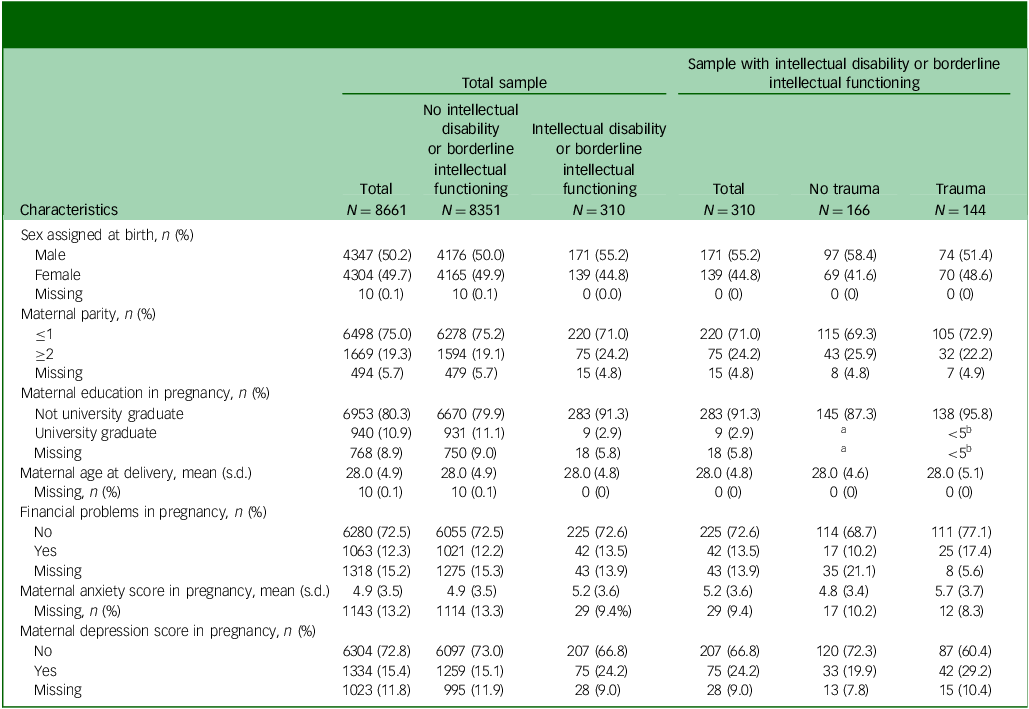
Of a total of 8661 participants, 310 had borderline intellectual functioning or intellectual disability (IQ < 85), 107 had intellectual disability (IQ < 70) and 8351 had no borderline intellectual functioning or intellectual disability. We present descriptive statistics of cohort characteristics in Table 1 (according to presence of intellectual disability or borderline intellectual functioning) and Supplementary Table 2 (according to intellectual disability). Children with intellectual disability or borderline intellectual functioning were more likely to be male (55.2% v. 50.0%), to have higher maternal parity (≥2 children; 24.2% v. 19.1%), to have a mother with lower education at the time of pregnancy (university graduate; 2.9% v. 11.1%), to have a mother who experienced depression during pregnancy (24.2% v. 15.1%), to have come from a family experiencing financial problems during pregnancy (13.5% v. 12.2%) and to have a mother with higher anxiety scores during pregnancy (mean 5.2 v. 4.9). Maternal age at delivery was the same across both groups (both means 28.0 years).
Descriptive statistics of cohort characteristics according to intellectual disability or borderline intellectual functioning (using IQ threshold of <85 where IQ score was available; total sample) and trauma (sample with intellectual disability or borderline intellectual functioning)

Table 1 Long description
The table presents descriptive statistics of cohort characteristics according to intellectual disability or borderline intellectual functioning and trauma. It includes data for a total sample of 8661 participants, with 310 having borderline intellectual functioning or intellectual disability and 8351 having no such conditions. The table is divided into several columns and rows, detailing various characteristics such as sex assigned at birth, maternal parity, maternal education, maternal age at delivery, financial problems in pregnancy, maternal anxiety score, and maternal depression score. Each characteristic is further broken down into subcategories with corresponding percentages or mean values. For example, under the characteristic of sex assigned at birth, the table shows the percentage of males and females in each group. The table also includes a comparison of these characteristics within the sample with intellectual disability or borderline intellectual functioning, further divided into those with and without trauma. The data highlights differences in various factors between the groups, such as higher maternal parity and lower maternal education in the group with intellectual disability or borderline intellectual functioning.
a. Could not be presented owing to secondary disclosure.
b. Values of <5 could include 0.
In the sample of individuals with intellectual disability or borderline intellectual functioning, children who experienced trauma were more likely to be female (48.6% v. 41.6%), to have lower maternal parity (≥2 children; 22.2% v. 25.9%), to have a mother with higher anxiety scores during pregnancy (mean 5.7 v. 4.8), and to have a mother who experienced depression during pregnancy (29.2% v. 19.9%) and had lower maternal education in pregnancy (95.8% not university graduate v. 87.3%). Maternal age at delivery was the same across both groups (trauma: 28.0 years; no trauma: 28.0 years).
Primary analysis: risk of experiencing trauma in group with intellectual disability and borderline intellectual functioning
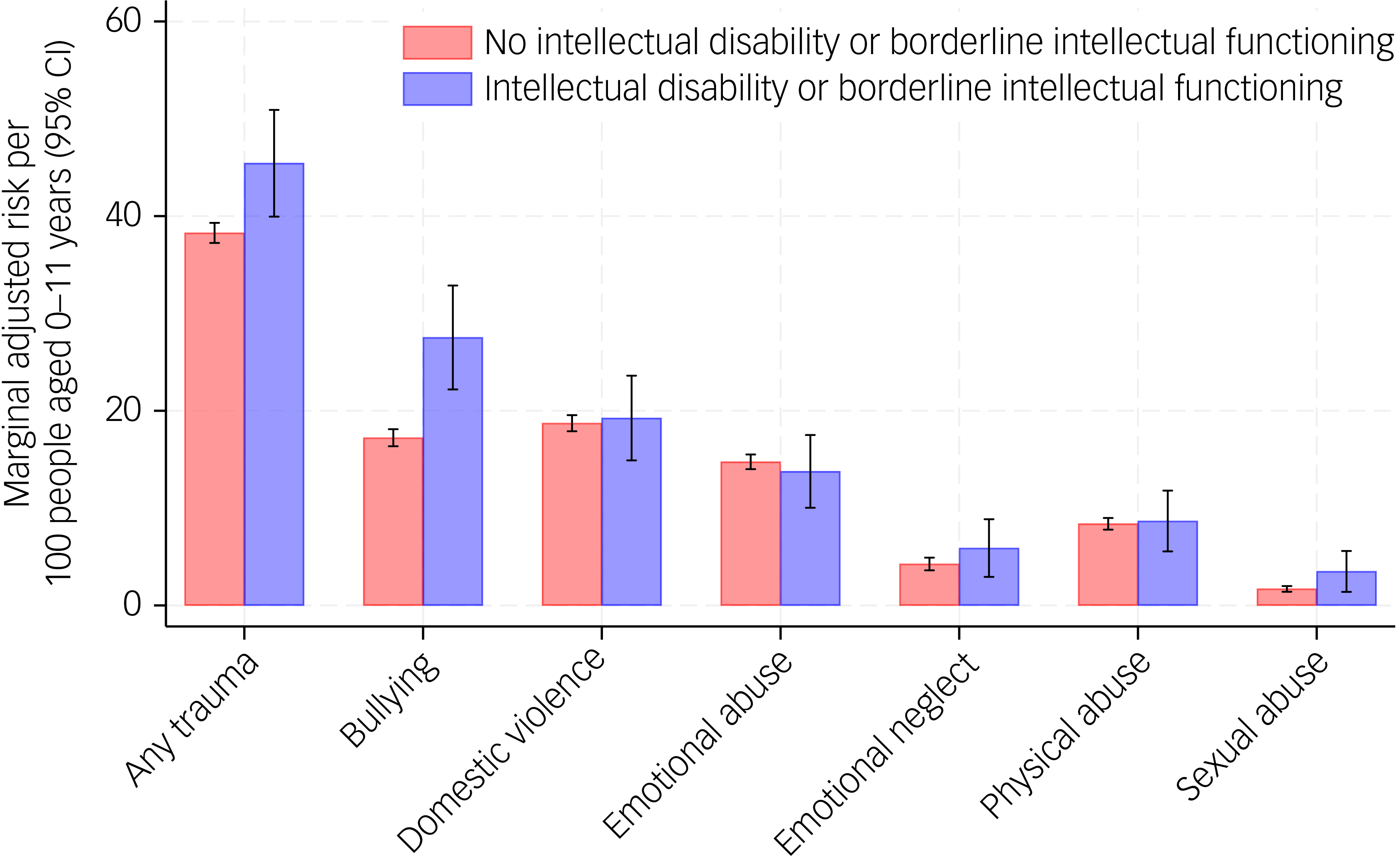
Figure 1 shows the adjusted marginal risk (estimated using multiply imputed logistic regression models) for each trauma type according to the presence of intellectual disability or borderline intellectual functioning (counts and estimate values, including those for unadjusted and complete records analysis models, are presented in Supplementary Tables 3 and 4). Among those without intellectual disability or borderline intellectual functioning by age 11 years, the adjusted marginal risk of any trauma was 38.27% (95% CI: 37.25–39.30), that of bullying was 17.23% (95% CI: 16.36–18.10), that of domestic violence was 18.73% (95% CI: 17.89–19.56), that of emotional neglect was 14.76% (95% CI: 3.61–4.91), that of physical abuse was 8.39% (95% CI: 7.80–8.99) and that of sexual abuse was 1.70% (95% CI: 1.41–1.99).
Marginal adjusted risk of trauma at age 0–11 years according to intellectual disability or borderline intellectual functioning. Estimates were made using multiple imputation and g-computation of adjusted logistic regression models.

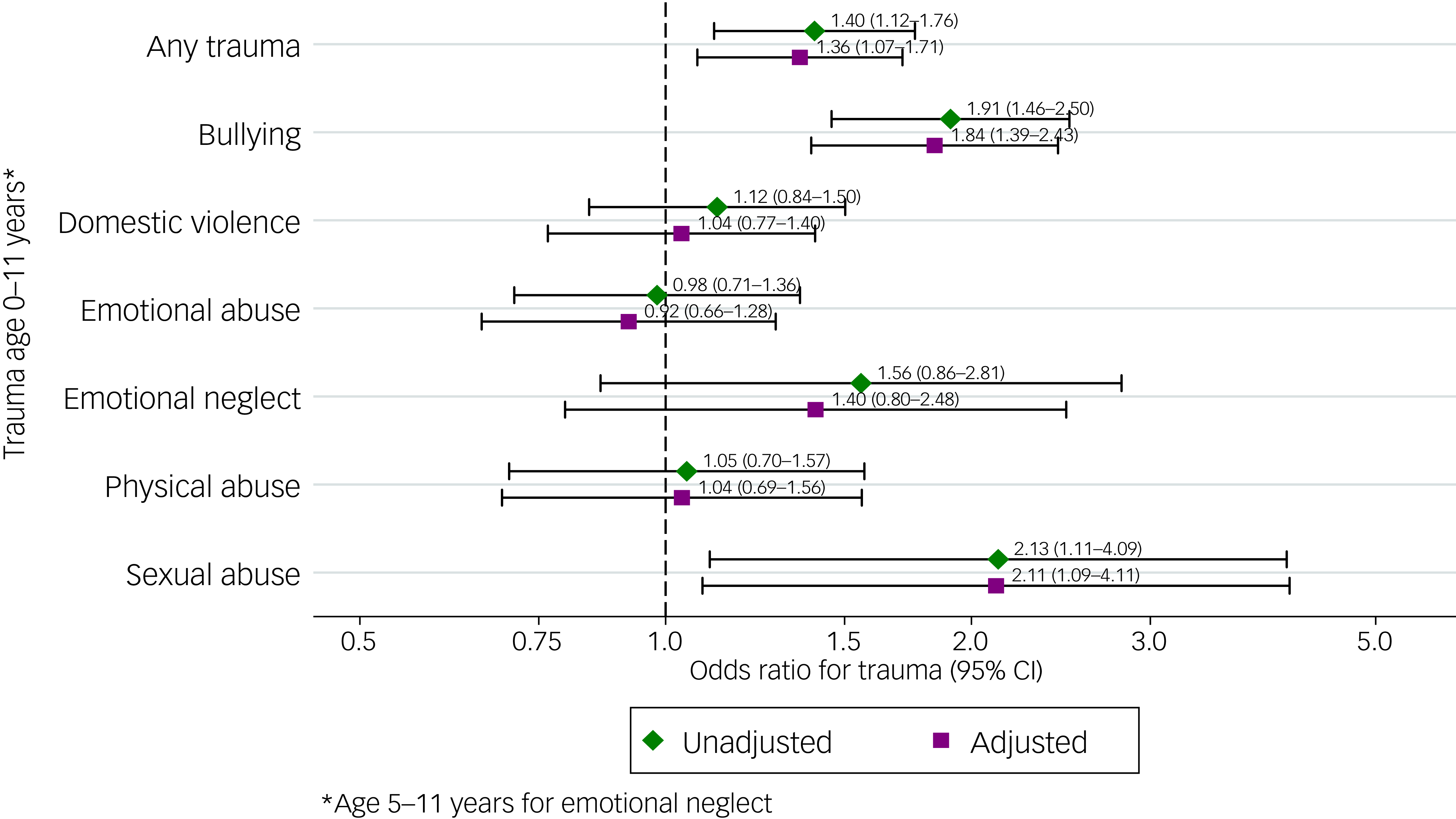
Comparing children with intellectual disability or borderline intellectual functioning with those without intellectual disability or borderline intellectual functioning, we found evidence for increased odds of any trauma, bullying and sexual abuse (Fig. 2; odds ratio of any trauma 1.36, 95% CI: 1.07–1.71; odds ratio of bullying 1.84, 95% CI: 1.39–2.43; odds ratio of sexual abuse 2.11, 95% CI: 1.09–4.11). We did not find evidence of increased odds of domestic violence, emotional abuse, emotional neglect or physical abuse (odds ratio of domestic violence 1.04, 95% CI: 0.77–1.40; odds ratio of emotional abuse 0.92, 95% CI: 0.66–1.28; odds ratio of emotional neglect 1.40, 95% CI: 0.80–2.48; odds ratio of physical abuse 1.04, 95% CI: 0.69–1.56).
Odds ratios for trauma according to intellectual disability or borderline intellectual functioning (IQ < 85 where IQ score was available) (yes/no; reference: no) estimated using multiply imputed logistic regression models.

When we repeated the analysis using a stricter criterion of IQ < 70 to indicate intellectual disability (Supplementary Tables 5 and 6), our estimate for bullying was attenuated and more uncertain (odds ratio of bullying 1.66, 95% CI: 0.97–2.86), whereas estimates for any trauma and sexual abuse were reversed and contained substantial uncertainty (odds ratio of any trauma 0.80, 95% CI: 0.53–1.20; odds ratio of sexual abuse 0.69, 95% CI: 0.09–5.09). There was no evidence for an association with any other trauma variable investigated (odds ratio of domestic violence 0.65, 95% CI: 0.37–1.16, odds ratio of emotional abuse 0.69, 95% CI: 0.38–1.25; odds ratio of emotional neglect 0.38, 95% CI: 0.05–3.19).
Secondary analysis: primary care outcomes of people with intellectual disability or borderline intellectual functioning that experienced trauma
Further analysis in the sample with intellectual disability or borderline intellectual functioning was performed to determine primary care outcomes of individuals aged 12–25 years according to trauma experience between ages 0 and 11 years. Among those with intellectual disability or borderline intellectual functioning but no experience of trauma, the adjusted marginal risk for developing an affective disorder was 21.78% (95% CI: 15.79–27.77), that for anxiety was 36.19% (95% CI: 29.01–43.38), that for challenging behaviour was 8.10% (95% CI: 3.93–12.26), that for psychotropic prescribing was 28.51% (95% CI: 21.75–35.27) and that for suicidal and self-harm behaviour was 5.46% (95% CI: 1.84–9.07). Counts for the analyses are presented in Supplementary Table 7.
As shown in Figs. 3 and 4 and Supplementary Table 8, in the group with intellectual disability or borderline intellectual functioning, there was evidence of associations between bullying and challenging behaviour (odds ratio 2.62, 95% CI: 1.05–6.57), bullying and psychotropic prescribing (odds ratio 2.73, 95% CI: 1.55–4.81), bullying and suicidal and self-harm behaviour (odds ratio 3.42, 95% CI: 1.15–10.20) and emotional abuse and challenging behaviour (odds ratio 3.31, 95% CI: 1.28–8.53). We found no evidence of a difference in risk for affective disorders or anxiety with any trauma variables. We found no evidence of associations of exposure to domestic violence, emotional neglect, physical abuse or sexual abuse with any primary care outcome.
Odds ratios for affective disorder, anxiety and challenging behaviour according to trauma type (yes/no; reference: no) estimated using multiply imputed logistic regression models in the sample with intellectual disability or borderline intellectual functioning. GP, general practitioner.

Odds ratios for prescriptions for psychotropic medication and suicidal and self-harm behaviours according to trauma type (yes/no; reference: no) estimated using multiply imputed logistic regression models in the sample with intellectual disability or borderline intellectual functioning. GP, general practitioner.

In the sample with intellectual disability alone, using the stricter criterion of IQ < 70, findings were broadly consistent with those of the analyses using a definition of IQ < 85 (counts are presented in Supplementary Table 9 and estimates in Supplementary Figs. 1 and 2 and Table 10). Stronger associations (though with greater uncertainty) were found for bullying and challenging behaviour (odds ratio 5.61, 95% CI: 1.17–27.02) and bullying and psychotropic prescribing (odds ratio 8.63, 95% CI: 2.68–27.78). We also found evidence for associations of bullying with affective disorder (odds ratio 5.49, 95% CI: 1.34–22.58) and anxiety (odds ratio 5.01, 95% CI: 1.52–16.50). There was no evidence of any association between bullying and suicidal or self-harm behaviour (odds ratio 3.03, 95% CI: 0.45–20.63), although counts of individuals with both trauma and outcome were very low in this analysis (see Supplementary Table 9). We found evidence of an association between emotional abuse and challenging behaviour (odds ratio 6.30, 95% CI: 1.41–28.21), with additional evidence (not seen in the sample with intellectual disability or borderline intellectual functioning) of an association between emotional abuse and anxiety (odds ratio 4.73, 95% CI: 1.22–18.30). We found no evidence of associations of domestic violence or physical abuse with any primary care outcome in the sample with intellectual disability. Owing to low counts of individuals with trauma and primary care outcomes in the sample with intellectual disability, we were not able to run analyses for trauma types comprising sexual abuse, emotional neglect or some of the physical abuse/outcome combinations.
Discussion
In this study, we aimed to understand the prevalence of childhood trauma in people with and without intellectual disability or borderline intellectual functioning and outcomes of trauma in people with intellectual disability or borderline intellectual functioning. In our primary analysis, we found increased odds of experiencing bullying and sexual abuse in the group of individuals with intellectual disability or borderline intellectual functioning, compared with people without intellectual disability or borderline intellectual functioning, whereas the odds of domestic violence, emotional neglect and physical abuse did not differ according to intellectual disability or borderline intellectual functioning status. The strength of the association was not maintained when we used intellectual disability alone as the exposure (using a stricter definition of IQ < 70): the odds ratio estimate for the outcome of bullying was attenuated compared with when the broader exposure definition of either intellectual disability or borderline intellectual functioning was used, whereas the odds ratio estimate for sexual abuse as the outcome showed a reversed direction and was substantially uncertain. It is not possible to say whether this change in estimates was the result of sparser data or differing effect magnitudes according to level of intellectual disability for the bullying outcome, but it is likely to be the former for the sexual abuse outcome.
In the secondary analysis, our findings provided evidence of an association of bullying and emotional abuse with adverse primary care outcomes, in particular, associations of bullying with challenging behaviour, psychotropic prescribing and suicidal self-harm behaviour, and of emotional abuse with challenging behaviour. These associations was maintained in both the borderline intellectual functioning and intellectual disability groups.
Overall, our findings support clinical experience that people with intellectual disability are vulnerable to the effects of childhood traumatic experiences.
Findings in the context of current literature
The findings of the present study provide a more conservative estimate of the increased odds of experiencing childhood trauma in people with intellectual disability compared with other population studies that used health and social care linkage data. Reference McDonnell, Boan, Bradley, Seay, Charles and Carpenter1,Reference Dion, Paquette, Tremblay, Collin-Vézina and Chabot2 The lower odds ratio estimate in the present study may be explained by underreporting of trauma by carers of people with intellectual disability. The finding in this study of an association of intellectual disability and borderline intellectual functioning with higher rates of sexual abuse in individuals aged 0–11 years is supported by other studies investigating this. Reference Helton, Gochez-Kerr and Gruber27 Children with intellectual disability may be less able to recognise features of sexual abuse and to report sexual abuse to others, Reference Jojo, Nattala, Seshadri, Krishnakumar and Thomas28 making them more vulnerable. A preventative training programme designed to help children recognise and respond preventively to abuse situations did not lead to a reduction in children’s vulnerability to sexual abuse. Reference Reis, Häßler, Daubmann and Chodan29 Research into development of effective system-wide prevention programmes for vulnerable children is necessary.
A previous study examined trauma as having a mediating role in development of psychosis among people with intellectual disability and borderline intellectual functioning. Reference Dardani, Underwood, Jones, Rammos, Sullivan and Hull30 The present study expanded this by using a broader set of mental health outcomes and including a comparison of trauma in people with and without intellectual disability or borderline intellectual functioning. The finding that emotional abuse was particularly associated with adverse outcomes was consistent with literature findings of higher levels of carer strain for parents Reference Baker, Devine, Ng-Cordell, Raymond, Hughes and consortium31 and attachment difficulties among children with intellectual disability. Reference Hamadi and Fletcher32 Families of children with intellectual disability may benefit from additional emotional, social and parenting support to build resilience.
The rates of bullying reported here are comparable with those reported by other studies. Reference Maïano, Aimé, Salvas, Morin and Normand33 The findings of this study were also consistent with those of studies that examined bullying and behavioural associations in adolescents in special educational school settings, Reference Reiter and Lapidot-Lefler34 whereas rates and outcomes of bullying in children of primary school age have not previously been described. A previous study found that lower social skills were predictive of higher rates of victimisation, Reference Christensen, Fraynt, Neece and Baker35 offering a possible explanation for the finding of this study of a stronger association of negative outcomes of bullying in individuals with intellectual disability (IQ < 70) compared with those with borderline intellectual functioning (IQ < 85). Existing government antibullying campaigns have not been specifically studied for people with intellectual disability or borderline intellectual function, and few studies have investigated antibullying interventions for individuals with intellectual disability. Reference McGrath, Jones and Hastings36 Adaptations to existing interventions may be needed to ensure children with intellectual disability receive appropriate support to reduce bullying.
Strengths and generalisability
Previous studies investigating outcomes of childhood traumatic experiences in people with intellectual disability have been cross-sectional or used clinical samples and were limited by reliance on retrospective reporting and inability to infer causal relationships, or by being selective and not representative. Reference Emerson and Hatton8–Reference Vervoort-Schel, Mercera, Wissink, Mink, Van der Helm and Lindauer11 Our study used a prospective cohort design with a long follow-up period from birth to 25 years, allowing better understanding of the temporality and causality of events than previous cross-sectional or clinical studies. Our study was also unique in its investigation of a range of outcomes, including diagnostic, behavioural and prescribing outcomes, for a range of trauma exposures including bullying. The investigation of outcomes relating to challenging behaviour and prescriptions make this study clinically relevant to people with intellectual disability and borderline intellectual functioning, particularly given current national UK policy and patient safety priorities around Stopping Over Use of Medication in People with Intellectual Disability and Autism. 37
The ALSPAC resource contains questionnaire, interview and clinical information with links to health and education records. We used these data to identify intellectual disability and borderline intellectual function using a clearly defined multiple-source approach to reduce measurement error and missingness. We further defined clinical outcomes using linked primary care data to reduce missing outcome data in our secondary analysis and aid clinical relevance. These outcomes were reliant on Read codes Reference Chisholm38 (Supplementary Methods), which have been found to have good diagnostic validity, Reference Khan, Harrison and Rose39 although they have not been validated in the intellectual disability population.
Limitations of the study
The lack of evidence in this study for adverse outcomes associated with trauma variables of domestic violence, neglect and physical abuse may have been due to underreporting, as these variables are more likely to occur in the home environment, causing a bias in the data. Extensive data have been collected for the ALSPAC cohort on trauma variables at various time points that have been validated elsewhere. Reference Houtepen, Heron, Suderman, Tilling and Howe40 These data relied on a combination of carer report and self-report and as such were particularly susceptible to missing data, probably owing to unobserved values (i.e. data were unlikely to be missing at random). Missing carer report data have been supplemented by retrospective self-report in the ALSPAC cohort; however, this may have been confounded by the presence of intellectual disability and borderline intellectual functioning, as self-report is more difficult for individuals with intellectual disability, causing inherent attrition bias in the data. Use of these trauma variables used as the outcome in models (our primary analysis) may have led to bias, although this is less likely where these variables were used as exposure variables. Reference Bartlett, Harel and Carpenter41,Reference Hughes, Heron, Sterne and Tilling42 We attempted to account for missing data using multiple imputation. As all available trauma information within ALSPAC was used to derive these variables, no auxiliary variables that would have made the missing-at-random assumption more plausible were available. Reference Madley-Dowd, Curnow, Hughes, Cornish, Tilling and Heron43,Reference Madley-Dowd, Hughes, Tilling and Heron44 We instead attempted to use socioeconomic variables as auxiliary information (Supplementary Methods) to impute incomplete trauma and confounder variables.
Although the cohort was large, the study was affected by low sample size owing to the relative rarity of intellectual disability; this may have affected the strength of evidence for many associations. In many cases, the numbers of individuals with both intellectual disability and experience of a specific trauma type were too low to analyse. The relatively small number of participants in the group with the strict definition for intellectual disability of IQ < 70 resulted in analyses involving that group having low statistical power. To improve sample sizes and statistical power, we included both individuals with borderline intellectual functioning and those with intellectual disability in our analysis (with our exposure definition using IQ < 85 where IQ score was available). This resulted in a more heterogeneous group from which clinical implications were harder to infer. However, we believe that it is relevant to include this group in research, as such individuals fall through the gap between services and are neglected in research. Further work identifying trauma in electronic healthcare records may allow larger, better-powered analyses of relationships between trauma and primary care outcomes in this specific population.
Our separation of exposures from outcomes by looking at childhood trauma up to age 11 years only and primary care outcomes from ages 12 to 25 years enabled greater inference of causal direction and represents a strength of this study. However, this meant that exposure to childhood trauma experiences during ages 12–25 years are not included in this analysis, and, as these may have a causal relationship with outcomes, this may have led to underestimation of effects.
In many UK healthcare record environments, Read codes have been superseded by SNOMED codes, which this study did not use, and there may be some differences in the way that clinical outcomes are coded between the two systems. In particular, Read coding did not have a term for ‘challenging behaviour’, whereas the SNOMED system does. Therefore, approximate terms have been used (see the codelists section of the Supplementary Materials). It is possible that some of the presentations coded using these approximate behavioural terms would not have been coded as challenging behaviour under SNOMED coding.
Implications and future research
This study adds longitudinal population data on risk and outcomes of childhood trauma in people with intellectual disability and borderline intellectual functioning. The findings showed that people with intellectual disability and borderline intellectual functioning were more likely to experience bullying and sexual abuse than people without. As people with intellectual disability are less able to self-report on trauma and abuse owing to communication challenges, and carers may underreport abuse, development of robust systems to identify (and prevent) trauma and abuse is necessary. Given evidence of higher rates of bullying in children with intellectual disability and borderline intellectual functioning, and adverse outcomes associated with bullying in these children, further work is needed to develop effective campaigns and interventions for this population group.
Supplementary material
The supplementary material is available online at https://doi.org/10.1192/bjo.2026.12072
Data availability
The informed consent obtained from ALSPAC participants does not allow the data to be made available through any third-party-maintained public repository. Supporting data are available from ALSPAC on request under approved proposal number B4018. Full instructions for applying for data access can be found at http://www.bristol.ac.uk/alspac/researchers/access/. The ALSPAC study website contains details of all available data (http://www.bristol.ac.uk/alspac/researchers/our-data/). The code used to conduct these analyses can be found at https://github.com/pmadleydowd/BailyThomas-IntellectualDisability-and-MentalHealth.
Acknowledgements
We thank all the families who took part in this study, the midwives for their help in recruiting them, and the whole ALSPAC team, including data collection staff, data and administration staff, technical managers, and the technical staff of the Bristol Bioresource Laboratory, based in the University of Bristol.
Author contributions
A.G., L.D.H., D.R. and P.M.-D. conceived the original idea and developed the methodology. P.M.-D and C.D. contributed to data acquisition and analysis. All authors contributed to interpretation of the data. A.G. and P.M.-D. drafted and edited the manuscript, and L.D.H., D.R., C.D., J.U. and L.H. revised and edited it. All authors provided final approval of the version to be published.
Funding
The UK Medical Research Council (MRC) and Wellcome (grant ref: MR/Z505924/1) and the University of Bristol provide core support for ALSPAC. A comprehensive list of grant funding is available on the ALSPAC website (http://www.bristol.ac.uk/alspac/external/documents/grant-acknowledgements.pdf). This work was specifically funded by the Wellcome Trust and MRC (grant refs: 076467/Z/05/Z; 203776/Z/16/Z; 092731/Z/10/Z; 086118/Z/08/Z; MC_PC_17210). This publication is the work of the authors, and A.G. and P.M.-D. serve as guarantors for the contents of this paper. C.D. is supported by a postdoctoral fellowship from the South-Eastern Norway Regional Health Authority (2024078). D.R. and P.M.-D. are supported by the Baily Thomas Charitable Fund (TRUST/VC/AC/SG/6075-9277). P.M.-D. also acknowledges support from the MRC Integrative Epidemiology Unit at the University of Bristol (MC_UU_00032/2). D.R. and P.M.-D. also acknowledge funding from the NIHR Bristol Biomedical Research Centre (NIHR 203315). The views expressed are those of the authors and not necessarily those of the NIHR or the Department of Health and Social Care. J.F.G.U. is supported by a GW4-CAT Clinical Doctoral Fellowship (22284921) and an HEIW Welsh Clinical Academic Training Fellowship. L.H. is supported by an Early Career Fellowship from the Elizabeth Blackwell Institute (University of Bristol) and Rosetrees Trust.
Declaration of interest
None.


 Open access


eLetters
No eLetters have been published for this article.