Implications
A better knowledge of the molecular mechanisms underlying mammary lipogenesis may help us understand, and eventually modulate, the effect of nutrition on milk fat production and quality. This work was conducted in dairy sheep to investigate whether responses in milk fatty acid (FA) composition to dietary linoleic-rich oils could be related to tissue mRNA abundance of genes involved in lipid metabolism. The study was carried out with ewes fed a diet supplemented with sunflower oil for 7 weeks, and shows that effects on milk FA profile were not accompanied by major changes in either FA composition or mRNA abundance of lipogenic genes in mammary or adipose tissue.
Introduction
The addition of a moderate amount of sunflower oil (SO) to a forage-rich diet has proved in dairy ewes to modulate milk fat composition without negatively affecting its production (Toral et al., Reference Toral, Hervás, Gómez-Cortés, Frutos, Juárez and de la Fuente2010; Gómez-Cortés et al., Reference Gómez-Cortés, de la Fuente, Toral, Frutos, Juárez and Hervás2011). However, mechanisms explaining changes in milk fatty acids (FA), including mediation via co-ordinated downregulation and upregulation of genes involved in lipid metabolism, are still poorly understood. In addition, there are very few studies characterizing mammary expression of genes and gene networks for diets causing variations in milk FA composition without altering milk fat secretion (Shingfield et al., Reference Shingfield, Bernard, Leroux and Chilliard2010). The available information is almost limited to cows suffering from milk fat depression (MFD; Piperova et al., Reference Piperova, Teter, Bruckental, Sampugna, Mills, Yurawecz, Fritsche, Ku and Erdman2000; Peterson et al., Reference Peterson, Matitashvili and Bauman2003) or to goats (Bernard et al., Reference Bernard, Leroux, Bonnet, Rouel, Martin and Chilliard2005a, Reference Bernard, Rouel, Leroux, Ferlay, Faulconnier, Legrand and Chilliard2005b and 2009a), a species in which this syndrome is not often observed, but little work has been published yet on ewes (Dervishi et al., Reference Dervishi, Joy, Sanz, Alvarez-Rodriguez, Molino and Calvo2012; Bichi et al., Reference Bichi, Frutos, Toral, Keisler, Hervás and Loor2013).
Although the physiological adaptations of the mammary gland or adipose tissues (AT) occurring during lactation have been well described in ruminants (Vernon, Reference Vernon1980; Chilliard, Reference Chilliard1999; Bauman, Reference Bauman2000), the possible contribution of AT to the regulation of mammary lipogenesis still needs to be documented (Shingfield et al., Reference Shingfield, Bernard, Leroux and Chilliard2010). Studies on diet-induced MFD in cows report an increase in the mRNA abundance of lipogenic genes in AT related to the preferential partitioning of nutrients towards non-mammary tissues (Harvatine et al., Reference Harvatine, Perfield and Bauman2009; Thering et al., Reference Thering, Graugnard, Piantoni and Loor2009; Schmitt et al., Reference Schmitt, Ballou, Correa, DePeters, Drackley and Loor2011). On the contrary, lipid supplementation inducing no changes or increases in milk fat yield in goats is not accompanied by alterations of the mRNA abundance or activity of lipogenic enzymes in AT (Bernard et al., Reference Bernard, Leroux, Bonnet, Rouel, Martin and Chilliard2005a and 2009a). Although it is complicated to discern whether these differences are linked to the diet, its interaction with species or other factors, there is no information at all in sheep.
Furthermore, most works relied on the study of subcutaneous AT (Harvatine et al., Reference Harvatine, Perfield and Bauman2009; Thering et al., Reference Thering, Graugnard, Piantoni and Loor2009; Bichi et al., Reference Bichi, Frutos, Toral, Keisler, Hervás and Loor2013), despite the fact that differences among AT in FA composition, lipogenic gene expression or enzyme activity have been described (Chilliard et al., Reference Chilliard, Sauvant, Bas, Pascal and Morand-Fehr1981; Bas et al., Reference Bas, Chilliard, Morand-Fehr, Rouzeau and Mandran1987; Barber et al., Reference Barber, Ward, Richards, Salter, Buttery, Vernon and Travers2000). Data on the FA profile of AT could complement results on gene mRNA abundance to improve our understanding of lipid metabolism, but simultaneous measurements are seldom reported (Toral et al., Reference Toral, Bernard, Delavaud, Gruffat, Leroux and Chilliard2013). Similarly, most studies last for up to only four weeks (Piperova et al., Reference Piperova, Teter, Bruckental, Sampugna, Mills, Yurawecz, Fritsche, Ku and Erdman2000; Bernard et al., Reference Bernard, Leroux, Faulconnier, Durand, Shingfield and Chilliard2009b; Jacobs et al., Reference Jacobs, van Baal, Smits, Taweel, Hendriks, van Vuuren and Dijkstra2011), and mechanisms involved in a longer-term response are not considered. On the other hand, according to previous results in dairy ewes (e.g. Toral et al., Reference Toral, Hervás, Gómez-Cortés, Frutos, Juárez and de la Fuente2010; Gómez-Cortés et al., Reference Gómez-Cortés, de la Fuente, Toral, Frutos, Juárez and Hervás2011), the longer the time on lipid-supplemented diets, the greater the differences in milk fat composition. Therefore, it may be expected that changes in the mRNA abundance of genes involved in lipid metabolism would also be more easily observed after relatively long periods on lipid treatments.
Thus, an assay with lactating ewes receiving SO for 7 weeks was conducted based on the hypothesis that SO-induced changes in milk FA profile would be mediated by variations in mammary lipogenic gene expression, this response also being putatively related to changes in AT.
Material and methods
Animals, experimental diets and management
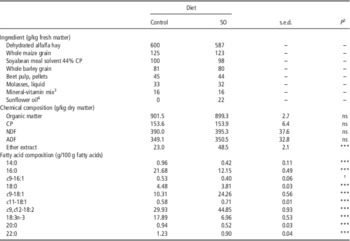
A total of 10 multiparous Assaf ewes (84.1 kg BW, s.d. 8.35; 75 days in milk, s.d. 3.7) were divided into two groups (n=5), balanced for milk yield, BW, days in milk and number of lactation, and were assigned to one of the following two experimental treatments (diets): control and supplemented with SO. Diets, prepared weekly, consisted of a total mixed ration (TMR) based on dehydrated alfalfa hay (particle size >4 cm) and a concentrate (60 : 40) supplemented with 0 (control diet) or 25 (SO diet) g of SO/kg of diet dry matter (DM). The ingredients and chemical composition of the experimental diets, which included molasses to reduce selection of dietary components, are given in Table 1. Clean water was always available and fresh diets were offered daily ad libitum at 0900 and 1900 h.
Ingredients and chemical composition of the experimental dietsFootnote 1

1 For each experimental diet, n=7.
2 Probability of significant effects due to experimental diet.
3 Contained (g/kg): salts [NaHCO3 (458.3), CaCO3 (250.0), NaCl (125.0)], minerals and vitamins (104.2) and wheat bran (62.5).
4 Carrefour S.A. (Madrid, Spain). Contained (g/100 g fatty acids): 16:0 (5.5), 18:0 (4.4), c9-18:1 (36.4) and c9,c12-18:2 (50.3).
ns (P>0.10); † P<0.10; ***P<0.001.
Ewes were milked twice daily at 0830 and 1830 h in a 1×10 stall milking parlour (DeLaval, Madrid, Spain). The experiment lasted for 7 weeks and was carried out in accordance with the Spanish Royal Decree 1201/2005 for the protection of animals used for experimental purposes.
Measurements and sampling procedures
Representative samples of offered and refused diets were collected weekly, stored at −20°C and then freeze-dried. Diet samples were analysed for DM, ash, CP, NDF, ADF and ether extract as outlined in Toral et al. (Reference Toral, Hervás, Gómez-Cortés, Frutos, Juárez and de la Fuente2010).
On day 48 of the experiment, individual milk yield was recorded both at morning and evening sessions of milking, and milk samples were collected from each animal and stored at 4°C with a preservative (bronopol) until analysed for fat, CP, lactose and total solids by infrared spectrophotometry as described in Toral et al. (Reference Toral, Hervás, Gómez-Cortés, Frutos, Juárez and de la Fuente2010). Milk fat composition was determined in unpreserved samples stored at −30°C.
At the end of the experiment (day 49), the ewes were slaughtered humanely by an intravenous injection of a euthanasia drug (T-61, Intervet, Salamanca, Spain; 0.1 ml/kg BW) and samples of the mammary secretory tissue as well as subcutaneous (abdomen) and perirenal AT were collected under sterile conditions. The samples were immediately frozen in liquid N2 and stored at −80°C until lipid and RNA extraction.
Lipid analysis
Fatty acid methyl esters (FAME) of lipid in TMR and milk were prepared in a one-step extraction-transesterification procedure, as outlined previously by Shingfield et al. (Reference Shingfield, Ahvenjärvi, Toivonen, Äröla, Nurmela, Huhtanen and Griinari2003). Total lipids in 500 mg of mammary secretory tissue and in 30 mg of subcutaneous and perirenal AT were extracted (Folch et al., Reference Folch, Lees and Sloane-Stanley1957) and converted to FAME using a base-acid catalysed transesterification procedure (Glass, Reference Glass1971). Methyl esters were separated and quantified by gas chromatography using a temperature gradient programme, and isomers of 18:1 were further resolved in a separate analysis under isothermal conditions (Shingfield et al., Reference Shingfield, Ahvenjärvi, Toivonen, Äröla, Nurmela, Huhtanen and Griinari2003). Peaks were identified based on retention time comparisons with authentic standards (from Nu-Chek Prep., Elysian, MN, USA; Sigma−Aldrich, Madrid, Spain; and Larodan Fine Chemicals AB, Malmö, Sweden) and milk samples for which the FA composition was determined based on gas chromatography analysis of FAME and GC-MS analysis of corresponding 4,4-dimethyloxazoline derivatives (Shingfield et al., Reference Shingfield, Reynolds, Hervás, Griinari, Grandison and Beever2006).
RNA isolation and quantitative PCR
Total RNA from each tissue was isolated and purified further, as described in Bernard et al. (Reference Bernard, Rouel, Leroux, Ferlay, Faulconnier, Legrand and Chilliard2005b). Concentration and purity of RNA were determined by spectrophotometry using a Nano-Drop ND-1000 spectrophotometer (Nano-Drop Technologies, Wilmington, DE, USA). The RNA integrity was evaluated using the Agilent Bioanalyzer system (Agilent Technologies, Santa Clara, CA, USA), the RIN value for all the samples being 7.2±0.14. Reverse-transcription qPCR was carried out (Bernard et al., Reference Bernard, Rouel, Leroux, Ferlay, Faulconnier, Legrand and Chilliard2005b) using specific primers and probes (Supplementary Table S1) for the following genes: acetyl-CoA carboxylase alpha (ACACA) and fatty acid synthase (FASN), involved in de novo FA synthesis; lipoprotein lipase (LPL), thrombospondin receptor or fatty acid translocase (CD36) and fatty acid-binding proteins 3 (FABP3) and 4 (FABP4), involved in the uptake and intracellular transport of FA; stearoyl-CoA desaturase (SCD1 and SCD5), involved in Δ9-desaturation of FA; glycerol-3-phosphate acyltransferase (GPAM), involved in the esterification of FA to glycerol; carnitine palmitoyl transferase 2 (CPT2), involved in the mitochondrial oxidation of FA; fatty acid elongases 5 and 6 (ELOVL5 and ELOVL6), involved in the elongation to very long-chain and long-chain FA, respectively; milk fat globule-EGF factor 8 (MFGE8) and xanthine dehydrogenase (XDH), encoding two of the major proteins of the milk fat globule membrane; and the transcription factors: sterol regulatory element binding transcription factor 1 (SREBF1) and peroxisome proliferator-activated receptor gamma (PPARG). To account for variations in RNA integrity, RNA quantification and cDNA synthesis, mRNA abundance was normalized using the geometric mean of three housekeeping genes: peptidylprolyl isomerase A (PPIA), ubiquitiously expressed transcript (UXT) and eukaryotic translation initiation factor 3 subunit K (EIF3K), which were identified as suitable internal controls among several tested (Bonnet et al., Reference Bonnet, Bernard, Bes and Leroux2013). Abundance of gene transcripts was expressed as the log value of mRNA copy number relative to the geometric mean of the three housekeeping genes.
Statistical analysis
All statistical analyses were performed using the MIXED procedure of the SAS software package (version 9.3, SAS Institute Inc., Cary, NC, USA). Data of diet composition, animal performance, milk and mammary FA profiles, as well as mammary mRNA abundances of candidate genes were analysed by a one-way ANOVA with a statistical model that included the fixed effect of the diet. Two-way ANOVA was applied to data of FA composition and gene mRNA abundance of AT, the statistical model including the fixed effects of the diet, the adipose site and their interaction. In both cases, animals were nested within the treatment and used as the error term to contrast the effect of SO supplementation. Differences between means were evaluated using the ‘pdiff option’ of the ‘LS means’ statement of the MIXED procedure. They were declared significant at P<0.05, and considered as tendencies towards significance at P<0.10. Least square means are reported throughout.
Results
Animal performance and milk FA composition and secretion
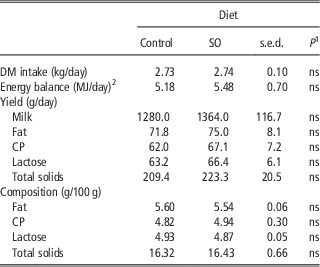
The inclusion of SO did not affect any of the animal performance parameters studied (i.e. DM intake, calculated energy balance, milk yield and milk fat, protein, lactose and total solid composition and yields; Table 2; P>0.10).
Milk yield and composition in ewes fed a total mixed ration plus 0 (control diet) or 25 g of sunflower oil/kg dry matter (SO diet)

1 Probability of significant effects due to experimental diet.
2 Calculated according to INRA (2007).
ns (P>0.10).
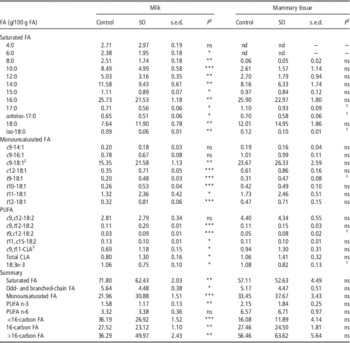
In contrast, as shown in Table 3 and Supplementary Table S2, milk FA profile changed noticeably. The dietary addition of SO decreased milk concentrations of <16 and 16-carbon FA and increased those of >16-carbon FA (P<0.01). The proportions of 18:0, some 18:1 intermediates, such as c9-18:1, t11-18:1 and t10-18:1, and some conjugated linoleic acid (CLA) isomers (e.g. c9,t11-CLA) were augmented in response to dietary SO (P<0.05). Lipid supplementation also caused significant variations in other milk FA, such as decreases in 12:0, 14:0, 16:0, c9-17:1, t11,c15-18:2 and 18:3n-3 and increases in most minor 18:2 isomers.
FA composition of milk and mammary tissue from ewes fed a total mixed ration plus 0 (control diet) or 25 g of sunflower oil/kg dry matter (SO diet)

FA=fatty acid; nd=non-determined; PUFA=polyunsaturated fatty acid.
1 Probability of significant effects due to experimental diet.
2 In milk, contains c10-, t13-, t14- and t15-18:1 as minor components. In mammary tissue, contains t13-, and t14-18:1 as minor components.
3 In milk, contains t7,c9-CLA and t8,c10-CLA as minor components.
ns (P>0.10); † P<0.10; *P<0.05; **P<0.01; ***P<0.001.
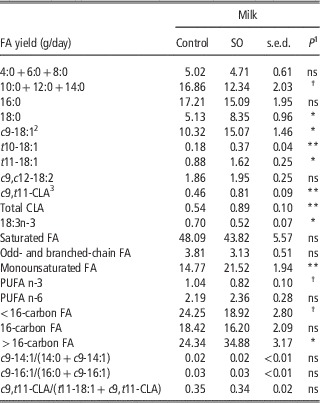
The effect of dietary treatment on milk FA secretion is presented in Table 4. The inclusion of SO significantly augmented the yield of >16-carbon FA, whereas no effect was detected on 16-carbon, and <16-carbon FA tended to be reduced (P<0.10). Reflecting the effects reported for milk FA concentrations, the secretion of 18:0, some 18:1 isomers and total CLA (particularly c9,t11-CLA) was higher with the SO diet. On the other hand, SO supplementation did not affect saturates, odd- and branched-chain FA (OBCFA) and PUFA n-6 secretion (P>0.10).
Milk FA yield in ewes fed a total mixed ration plus 0 (control diet) or 25 g of sunflower oil/kg dry matter (SO diet)

FA=fatty acid; PUFA=polyunsaturated fatty acid; CLA=conjugated linoleic acid.
1 Probability of significant effects due to experimental diet.
2 Contains c10-, t13-, t14- and t15-18:1 as minor components.
3 Contains t7,c9-CLA and t8,c10-CLA as minor components.
ns (P>0.10); † P<0.10; *P<0.05; **P<0.01.
Mammary and AT FA composition
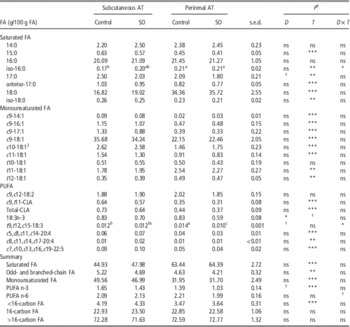
Most of the diet-induced differences observed in milk FA composition were not detected in the mammary secretory tissue (Table 3 and Supplementary Table S3), where changes due to SO were limited to a tendency (P<0.10) to a reduction of some OBCFA (17:0, anteiso-17:0 and iso-18:0) and a rise in some trans isomers (t5- to t9-18:1 and t9,c12-18:2). Major differences in the FA composition of AT were related to the effect of tissue site rather than to dietary treatment (Table 5 and Supplementary Table S4). The subcutaneous AT was richer in OBCFA, unsaturated FA, especially Δ9-desaturase products, other cis-18:1 and CLA isomers and 20- and 22-carbon PUFA n-3 and n-6 (P<0.05), whereas the perirenal AT showed a higher content of 18:0 and trans-18:1 (P<0.01). Some of the few differences in FA profile due to dietary treatments (P<0.05) were in line with those mentioned for the mammary tissue (e.g. the decrease in 17:0 and 18:3n-3). Significant interactions between the effects of tissue site and diet were only observed for minor FA (namely t9,c12,c15-18:3 and iso-16:0; Table 5).
FA composition of subcutaneous and perirenal AT from ewes fed a total mixed ration plus 0 (control diet) or 25 g of sunflower oil/kg dry matter (SO diet)

FA=fatty acid; AT=adipose tissues; PUFA=polyunsaturated fatty acid; CLA=conjugated linoleic acid.
a,b,cMeans within a row with different superscripts differ significantly (P<0.05).
1 Probability of significant effects due to experimental diet (D), tissue (T) and their interaction (D×T).
2 Contains t15-18:1 as a minor component.
ns (P>0.10); † P<0.10; *P<0.05; **P<0.01; ***P<0.001.
mRNA abundances of candidate genes in mammary and AT
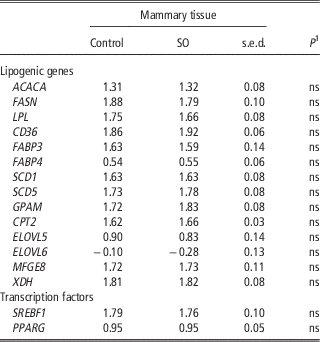
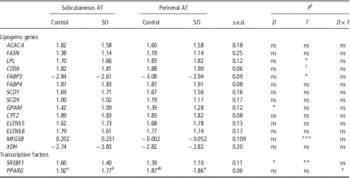
The mRNA abundance of some candidate genes (Tables 6 and 7 and Supplementary Table S5) was tissue specific: MFEG8, XDH and FABP3 were higher in the mammary tissue and FABP4 and ELOVL6 in AT. The consumption of SO did not significantly affect the mRNA abundance of the analysed genes in the mammary tissue, but caused a decrease of GPAM and SREBF1 in both AT (P<0.05) and of PPARG in the subcutaneous depot (interaction diet×AT, P<0.05). There were also differences between AT, with SREBF1 being more abundant in the subcutaneous (P<0.01) and LPL (P<0.05) and CD36 (P<0.10) in the perirenal AT. The mRNA abundance of MFGE8 (P<0.001) and FABP3 (P<0.05) also varied between depots, but their levels were always very low.
mRNA relative abundance (log transformed data) of genes of the mammary tissue involved in lipid metabolism in ewes fed a total mixed ration plus 0 (control diet) or 25 g of sunflower oil/kg dry matter (SO diet)

mRNA levels are expressed in arbitrary units determined as the abundance relative to the geometric mean of PPIA, UXT and EIF3K mRNA.
1 Probability of significant effects due to experimental diet.
ns (P>0.10).
mRNA relative abundance (log transformed data) of genes of subcutaneous and perirenal AT involved in lipid metabolism in ewes fed a total mixed ration plus 0 (control diet) or 25 g of sunflower oil/kg dry matter (SO diet)

AT=adipose tissues; SO=sunflower oil.
mRNA levels are expressed in arbitrary units determined as the abundance relative to the geometric mean of PPIA, UXT and EIF3K mRNA.
a,bMeans within a row with different superscripts differ significantly (P<0.05).
1 Probability of significant effects due to experimental diet (D), tissue (T) and their interaction (D×T).
ns (P>0.10); † P<0.10; *P<0.05; **P<0.01; ***P<0.001.
Discussion
Animal performance and milk FA composition and secretion
The present results provide further support that feeding a moderate amount (2.5% DM) of SO modulates milk FA composition in the absence of negative effects on ewe performance (Toral et al., Reference Toral, Hervás, Gómez-Cortés, Frutos, Juárez and de la Fuente2010; Gómez-Cortés et al., Reference Gómez-Cortés, de la Fuente, Toral, Frutos, Juárez and Hervás2011). The observed variations in milk FA composition and secretion (lower levels of medium-chain saturated FA, and greater of c9,t11-CLA and t11-18:1) are related to potentially beneficial effects for human health (Shingfield et al., Reference Shingfield, Chilliard, Toivonen, Kairenius and Givens2008). Nevertheless, and in contrast to what was expected from previous experiments in ewes fed similar diets (e.g. Toral et al., Reference Toral, Hervás, Gómez-Cortés, Frutos, Juárez and de la Fuente2010; Gómez-Cortés et al., Reference Gómez-Cortés, de la Fuente, Toral, Frutos, Juárez and Hervás2011), the addition of SO increased the content of t10-18:1, together with that of t9- and t12-18:1, which might be potentially detrimental to consumers (Shingfield et al., Reference Shingfield, Chilliard, Toivonen, Kairenius and Givens2008). Their concentrations, however, were kept relatively low (⩽0.48%, 0.53% and 0.81% of total FA, respectively).
Mammary lipid metabolism
The tendency to a reduction in the secretion of <16-carbon FA and the lower milk percentages of <16 and 16-carbon FA in response to SO were not associated with changes in the mRNA abundance in the mammary secretory tissue of the candidate genes involved in de novo synthesis (i.e. ACACA and FASN). These results are consistent with data on gene expression and enzymatic activities reported in goats (Bernard et al., Reference Bernard, Rouel, Leroux, Ferlay, Faulconnier, Legrand and Chilliard2005b and 2008) and beef cows (Murrieta et al., Reference Murrieta, Hess, Scholljegerdes, Engle, Hossner, Moss and Rule2006) fed high forage diets supplemented with plant oils and showing no reductions in milk fat synthesis.
The SO treatment also increased the proportion and secretion of milk long-chain FA with no evidences of significant changes in the mRNA abundances of genes related with the uptake, transport and trafficking of long-chain FA in the mammary epithelial cells (i.e. LPL, CD36 and FABP3). These findings are consistent with previous research in dairy goats fed plant oils (Bernard et al., Reference Bernard, Bonnet, Leroux, Shingfield and Chilliard2009a and 2009b; Ollier et al., Reference Ollier, Leroux, de la Foye, Bernard, Rouel and Chilliard2009), suggesting that, in the absence of MFD, diet-induced changes in the content of milk long-chain FA might not be mediated by changes in the mRNA abundance of these particular candidate genes. They would also suggest that other regulatory mechanisms such as post-transcriptional events linked to higher availability of 18-carbon FA may be involved (Bernard et al., Reference Bernard, Leroux and Chilliard2008). Nonetheless, given the high inter-individual variation in gene expression and the low statistical power of the experiment, it cannot be ruled out that changes are also mediated by modifications in the candidate genes occurring below the level of detection.
With regard to Δ9-desaturation, despite the fact that SO modified the milk content of several substrates for (14:0, 16:0, 18:0 and t11-18:1) and products of (c9-18:1 and c9,t11-CLA) mammary SCD, no variation in the milk Δ9-desaturase indices (used as a proxy for the SCD activity) was observed, indicating that the SO treatment did not affect the activity of this enzyme. In the same way, no changes in the mRNA abundance of SCD1 and SCD5 were detected, suggesting that variations in the availability of substrates did not have a significant effect on the transcription of these genes.
This weak relationship between mammary SCD mRNA abundance and Δ9-desaturase activity suggests a greater relevance of post-transcriptional regulatory events such as mRNA stability, initiation of translation or turnover and activity regulation of the enzymatic protein, as observed in rodents (Ntambi, Reference Ntambi1999) and ruminants (Bernard et al., Reference Bernard, Leroux and Chilliard2013).
Concerning the FA profile of the mammary tissue, there is very little literature reporting this data in ruminants (Christie, Reference Christie1981; Toral et al., Reference Toral, Bernard, Delavaud, Gruffat, Leroux and Chilliard2013) and no information is available in lactating ewes. In the present study, the virtual absence of shorter-chain FA (4 to 9 carbons, which are present in the milk) would suggest not only that residual milk was well removed but also a minor contribution of unsecreted cytosolic lipid droplets to extracted lipids. Nevertheless, the few changes detected in the longer-chain FA in response to SO treatment suggest that variations in milk FA profile and secretion had no significant reflect in mammary FA composition, as previously observed in goats (Toral et al., Reference Toral, Bernard, Delavaud, Gruffat, Leroux and Chilliard2013).
AT lipid metabolism
Few changes were observed in lipogenic gene expression in subcutaneous and perirenal AT in response to SO treatment, which agrees with the lack of variation in energy balance and milk fat secretion and with data reported in cows and goats (Shingfield et al., Reference Shingfield, Bernard, Leroux and Chilliard2010). However, the mRNA abundance of SREBF1 (which might have a central role in lipid synthesis; Harvatine et al., Reference Harvatine, Perfield and Bauman2009) was decreased in response to SO in both AT (Table 7), and that of PPARG in the subcutaneous depot. Although changes in these transcription factors have been related with the upregulation or downregulation of several lipogenic genes (Harvatine et al., Reference Harvatine, Perfield and Bauman2009; Schmitt et al., Reference Schmitt, Ballou, Correa, DePeters, Drackley and Loor2011), no effect of SO on the mRNA abundance of genes related to lipogenesis was detected in the present study, and only GPAM mRNA showed a co-ordinated downregulation. Yet, since GPAM is involved in the esterification of FA to glycerol, this can hardly be related with the few effects of dietary SO on the FA composition of AT (reductions in 18:3n-3 and 17:0), which were probably caused by potential reductions in their availability for tissue uptake, as a result of the negative impact of SO on their ruminal concentration (Toral et al., Reference Toral, Belenguer, Shingfield, Hervás, Toivonen and Frutos2012). Putative effects of SO on the availability of other long-chain FA, as inferred from their changes in milk fat or in the rumen fluid of ewes fed similar diets (Toral et al., Reference Toral, Belenguer, Shingfield, Hervás, Toivonen and Frutos2012), had no substantial consequences on AT composition. Previous data in cows showed that a high availability of exogenous FA (through duodenal infusion of rapeseed oil) had no effect on AT lipogenic activities during early lactation, but caused a reduction after the lactation peak, when the activity was observed to increase in cows receiving the control diet because of variation in the energy balance (Chilliard et al., Reference Chilliard, Gagliostro, Flechet, Lefaivre and Sebastian1991). The few changes observed in the present study in mid-lactation ewes in positive energy balance are likely a result of the relatively low amount of supplemental SO.
When comparing AT, the greater content of saturated FA (mainly 18:0) and trans-18:1 isomers (t11- and t12-18:1) in the perirenal AT and of cis-18:1, c9,t11-CLA and n-3 PUFA in the subcutaneous AT are in line with previous data in ruminants (Christie, Reference Christie1981; Bas et al., Reference Bas, Chilliard, Morand-Fehr, Rouzeau and Mandran1987). These specificities due to tissue site have also been correlated with a depot-specific expression of lipogenic genes (Barber et al., Reference Barber, Ward, Richards, Salter, Buttery, Vernon and Travers2000; Bernard et al., Reference Bernard, Leroux, Bonnet, Rouel, Martin and Chilliard2005a). However, the higher proportion of Δ9-desaturase products (mainly c9-14:1, c9-16:1, c9-17:1, c9-18:1 and c9,t11-CLA) and the lower proportion of Δ9-desaturase substrates (mainly 18:0 and t11-18:1) observed in subcutaneous compared with perirenal AT were not associated with differences in tissue mRNA abundance of SCD1, which is consistent with previous research in non-lactating sheep (Barber et al., Reference Barber, Ward, Richards, Salter, Buttery, Vernon and Travers2000) but not in goats (Bernard et al., Reference Bernard, Rouel, Leroux, Ferlay, Faulconnier, Legrand and Chilliard2005b).
Subcutaneous and perirenal AT exhibited different levels of LPL and CD36 mRNA, suggesting potential divergences in FA uptake. The higher abundance of LPL transcripts in the perirenal AT is in line with results of the corresponding enzyme activity in lactating goats (Chilliard et al., Reference Chilliard, Sauvant, Bas, Pascal and Morand-Fehr1981; Bernard et al., Reference Bernard, Leroux, Bonnet, Rouel, Martin and Chilliard2005a) and cows (Chilliard and Robelin, Reference Chilliard and Robelin1985). The lack of significant variation due to SO is also consistent with previous data in goats fed soyabeans (Bernard et al., Reference Bernard, Leroux, Bonnet, Rouel, Martin and Chilliard2005a).
Altogether, these results show only marginal changes in the mRNA abundance of the candidate genes and related transcription factors in AT. Although it cannot be dismissed that the lack of more significant differences is due to statistical power limitations of the experiment, they agree with previous observations in goats fed plant lipids (Bernard et al., Reference Bernard, Leroux, Bonnet, Rouel, Martin and Chilliard2005a and 2009a) and in sheep fed marine algae (Bichi et al., Reference Bichi, Frutos, Toral, Keisler, Hervás and Loor2013) for which, respectively, an increase and a decrease of milk fat yield were observed.
Conclusions
This study provides novel and complementary information on the response to diet supplementation with SO in terms of milk FA composition and secretion, and FA profile and lipogenic gene expression of mammary and AT in lactating ewes. Dietary inclusion of a moderate amount (2.5% DM) of SO for 7 weeks modifies the FA profile of the milk, but has only slight effects on that of mammary and adipose tissues. No relationship is detected between these changes and results on mammary mRNA abundance of the candidate genes and transcription factors involved in lipid metabolism. Neither the marginal repercussion of SO feeding on the gene expression in subcutaneous and perirenal AT, after 7 weeks on the diet, is related with differences in FA profile between adipose sites or with milk fat secretion. Nevertheless, it cannot be ruled out that the response to linoleic-rich diets is mediated by other genes, post-transcriptional mechanisms or particularly the availability of FA of dietary origin, which would support the need for further studies.
Acknowledgements
This study was supported by the Spanish Ministry of Economy and Competitiveness (AGL2011-23700), the Council of Castile and Leon (CSI023U13) and the INRA (UMR1213; France). T. Castro-Carrera was granted a pre-doctoral fellowship from the Spanish National Research Council (CSIC; JAE Programme) supported by European Social Fund. The authors gratefully acknowledge the staff from the Instituto de Ganadería de Montaña (Spain) for their help in the fieldwork and in feed and lipid analyses, and S. Bes from INRA (France) for assistance in RNA analyses.
Supplementary material
To view supplementary material for this article, please visit http://dx.doi.org/10.1017/S1751731114002882