Introduction
para1The genus Camellia L. (Theaceae) has 119 to 280 species (Gao et al., Reference Gao, Parks and Du2005), the large range in estimated number of species due to very different taxonomic opinions. It should also be noted that the taxonomy of the genus Camellia, represented by the three taxonomic systems of Sealy (Reference Sealy1958), Chang & Bartholomew (Reference Chang and Bartholomew1984) and Ming & Bartholomew (Reference Ming, Bartholomew, Wu and Raven2007), is in disarray and at best can be considered to be provisional and unsatisfactory (Chapman & Wang, Reference Chapman and Wang2002). Further, although Gao et al. (Reference Gao, Parks and Du2005) follow the outline of Chang’s taxonomic system (Chang & Bartholomew, Reference Chang and Bartholomew1984), their sectional taxonomic treatment of the genus and the assignment of species to individual Camellia sections is not the same. These dissimilarities are sometimes rather substantial (e.g. in Camellia sect. Archaecamellia) and thus for all practicable purposes the taxonomic system of Gao et al. (Reference Gao, Parks and Du2005) may be considered to be a fourth taxonomic treatment of the genus.
To accommodate the diverse morphological characteristics of Camellia oconoriana we elected to base the new species on the taxonomic treatment of Chang & Bartholomew (Reference Chang and Bartholomew1984). The salient morphological characteristics of the new species warrant a transitional placement into Camellia sect. Chrysantha ser. Chrysanthae (Chang, Reference Chang1981).
Historically only a relatively small number of Camellia species were considered to be native to the southern mountain regions of Vietnam. The northern parts of Vietnam (e.g. the Tam Dao National Park and the adjacent geographical areas which are relatively close to the Chinese border) were traditionally considered to be the major centres of distribution of Vietnamese Camellia species (Sealy, Reference Sealy1958; Chang & Bartholomew, Reference Chang and Bartholomew1984; Gao et al., Reference Gao, Parks and Du2005). Recent systematic exploration carried out by a team of scientists on the Da Lat Plateau and the Lang Biang Massif (1999–2012) resulted in the discovery of several new Camellia taxa, some of which have already been published (Orel, Reference Orel2006; Orel & Wilson, Reference Orel and Wilson2010a, Reference Orel and Wilson2010b, Reference Orel and Wilson2012). The discovery of another new species, Camellia oconoriana, in the south of the country not only confirms the floral richness of this geographical area but further establishes it as an important centre of Theaceae genetic diversity and the possible northern boundary of the hypothesised area of origin for genus Camellia (Orel & Marchant, Reference Orel and Marchant2006).
Species Description
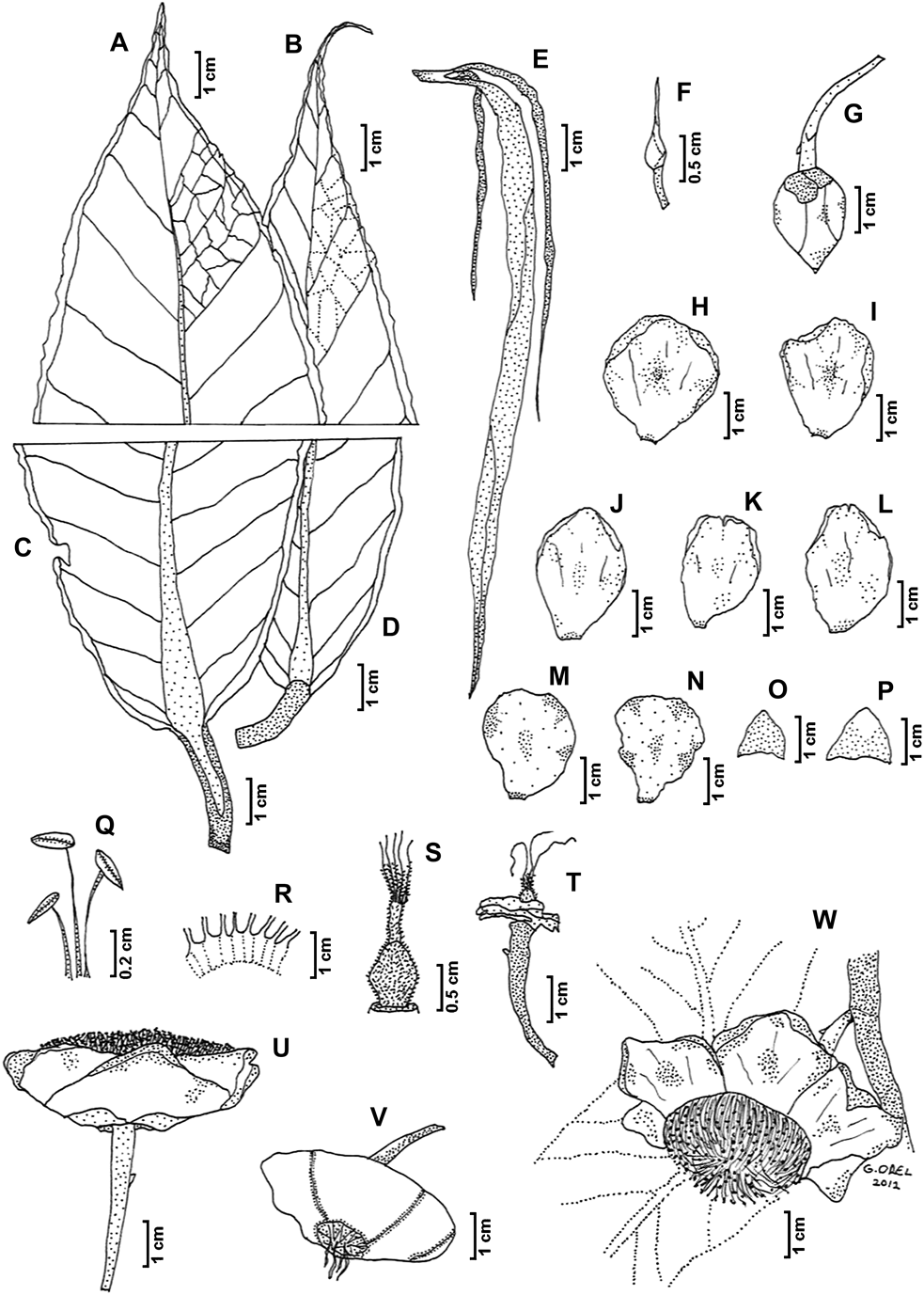
plantnameCamellia oconoriana Orel, Curry & Luu, sp. nov.Fig. 1.
diagnosisApud species sect. Chrysanthae combinatione characterum sequentium distinguitur: folia magna, anguste elliptica; flores semper axillares; sepala duo comparate magna; petala straminea marginibus carneolis tinctis; bases stylorum persistentes. – Type: Vietnam, Lam Dong Prov., unnamed mountain c.120 km south-west from the City of Da Lat, 22 xi 2010, Orel & Curry 0720 (holo NSW; iso VNM).
Camellia oconoriana Orel, Curry & Luu. A, adult leaf, apex, primary, secondary and tertiary venation, adaxial view; B, adult leaf, apex, primary, secondary and tertiary venation, abaxial view; C, adult leaf, leaf base and petiole, adaxial view; D, adult leaf, leaf base and petiole, abaxial view; E, juvenile leaves at differing stages of development; F, apical leaf bud; G, flower bud; H & I, petals of the outer whorl; J, K & L, petals of the inner whorl; M & N, sepals; O & P, bracts; Q, anthers; R, filaments forming a ring-like structure; S, gynoecium; T, spent flower with senescing styles; U, developing flower, lateral view; V, adult fruit capsule with persisting styles; W, branchlet with a flower and leaves. Drawn by G. Orel from the holotype, Orel & Curry 0720.

para1Perennial, medium to large evergreen shrub to 7.5 m high; sometimes multi-stemmed, sparsely branched, upright habit; juvenile branches glabrous, green towards the terminals, grey proximally; semi-mature branches entirely light grey, leaf scars not prominent; adult branches and trunk shiny, light grey, rather rough, no striations present. Petiole falcate, slightly twisted, round, thick, of the same colour as the leaf, primary vein continues as a shallow channel on the adaxial side of the petiole, 20–25(–30) mm long, 4–5(–7) mm wide, up to 4 mm thick, attached to branches at 45–80° angle. Axillary leaf buds rudimentary, dull, brown to light brown, slightly falcate, with sharp apex, 4–5 mm long; terminal buds slender, thin, narrow, distinctly and unevenly falcate, with sharp, soft apex, up to 10 mm long, 1–3 mm wide. Leaves: juvenile leaves very narrow elliptic, margins without serrations, slightly undulate, soft and pendulous, dull, of soft lilac colour, midrib also dull, but brightly lilac-pink; mature leaves very narrowly elliptic to narrowly elliptic, irregularly, shallowly and sparsely serrate, unevenly undulate, 30–36.5 cm long, 8–8.5 cm wide; slightly coriaceous; leaf apex cuspidate to acuminate; base obtuse, acute on smaller leaves; adaxial leaf surface glabrous, mid green, shiny, lighter green and shiny below; primary venation 4–7(–9) mm wide proximally, less than 1 mm wide distally, abaxially prominent, adaxially less so; secondary venation shallow, brochidodromous, with up to 24 pairs of veins adaxially sunken, abaxially prominent; tertiary veins indistinct, sparse, craspedodromous, at almost right angles to the secondary venation, evenly distributed, adaxially and abaxially marginally sunken, areolation indistinct, meshes unevenly triangular/tetragonal and of relatively inconstant size, maximum areole dimension 10 × 5 mm, but typically less (Hickey, Reference Hickey, Metcalfe and Chalk1979). Bracts persistent, distinctly differentiated from sepals, pliable, not woody, arranged in 2 whorls of (–2) 3 and 3 respectively; the outer whorl, bracts unevenly triangular with rounded apex, slightly concave, proximally slightly overlapping, soft, green with randomly distributed brown, corky areas, sparsely and very shortly hairy on adaxial surfaces, keel and striations lacking, margins thin, undulate, tightly appressed to the inner whorl, 10–12 mm long, 9–10 mm wide; the inner whorl, bracts unevenly triangular with rounded apex, slightly concave, proximally slightly overlapping, soft and entirely green, glabrous, keel and striations lacking, margins thin, undulate, 12–14 mm long, 10–11 mm wide. Flowers pedicellate, pedicel slightly variable in shape, 30–40 mm long, distally up to 6 mm wide, pendulous, glabrous, light green to pink, with 1–3 small bracteoles, 1–2 mm long, 1–2 mm wide; flowers always axillary, solitary or in twos; flower buds pendulous, globose to ovate with blunt apex, yellow with green and light pink areas; adult flowers 50–60 mm diameter, light to mid yellow, with dark pink-lilac to purple blush on the petal margins, fleshy, waxy, rigid, petal margins partially folded; developing flowers narrowly oblongoid in lateral section, senescing flowers cream to almost white. Petals arranged in two, basally joined whorls which form a shallow cup, fully mature and senescing petals widely reflexed; the outer whorl of (2–)3 petals, concave, roughly obovate, proximally overlapping, rather asymmetric, sometimes emarginate, margins sometimes translucent, striations absent, 25–30 mm long, 20–25 mm wide; the inner whorl of 3 petals, concave, roughly obovate, not overlapping, rather asymmetric, sometimes emarginate, margins sometimes translucent, striations absent, 25–30 mm long, 15–20 mm wide. Sepals 2, large, distinctly recognisable, rigid but not woody, strongly concave, glabrous, of yellow-green colour, with pink randomly distributed pigmentation, 20–23(–25) mm long, 18–20 mm wide. Stamens numerous (300–350), in a circular formation, 30–35 mm diameter; filaments thin, of variable thickness, glabrous, yellow, slightly shiny, 16–18 mm long, outer filaments proximally fused for c.6 mm forming a circular, ring-like structure of intensely orange colour; anthers dorsifixed, narrow, c.2 mm long, 1 mm or less wide, dark yellow to orange, later yellow-brown to brown, with a single dark brown-black line joining the distal and proximal ends. Style compound, 3–5-parted, finely hairy proximally, glabrous distally, light yellow to white, proximally fused for 4–5 mm, 14–15 mm long; stigmas indistinct, also light yellow to white. Ovary superior, 4–5-carpellate, unevenly rotund, finely and densely tomentose; ovary c.7 mm long, 5–6 mm wide. Fruit: juvenile fruit capsules light green and shiny; mature fruit mid brown, not shiny, unevenly round, distinctly oblate, style remnants persistent, 4–5-lobed, with chambers that are not always bi-locular, 4–5.5 cm diameter, c.2.5 cm deep.
cheadDistribution and habitat. Camellia oconoriana occurs in a mountainous, tall, wet, subtropical rainforest, where it forms part of a dense understorey layer, enduring low light and high humidity conditions in nutrient-poor soils. It is known only from the type collection from the lower slopes of an unnamed mountain in Lam Dong Province, Vietnam. The species provenance details are withheld for conservation reasons.
cheadPhenology. Collected in flower in November. Fruiting and seeding in February to March.
cheadIUCN Red List Category. The type specimen was collected from a population of some 10 adult plants which covered an area of less than 1 km2. Juvenile plants or seedlings were not found. Despite a detailed search of the area around the type locality only one population was discovered. Given this situation, we consider the IUCN category of Critically Endangered (CR D) to be appropriate (IUCN, 2011).
cheadEtymology. The specific epithet honours Geoffrey and Rachel O’Conor, long-time members of the New South Wales Camellia Research Society, Sydney and supporters and benefactors of scientific research in Australia.
Discussion
para1Taxonomic treatments of Camellia are generally based on one of the systems of Sealy (Reference Sealy1958), Chang & Bartholomew (Reference Chang and Bartholomew1984) or Gao et al. (Reference Gao, Parks and Du2005). Therefore, we examined the classification systems of these authors in some detail to determine the taxonomic position of the new species. To accommodate the diverse morphological characteristics of Camellia oconoriana we found the sectional treatment of Chang (Reference Chang1981) and the species concepts of Chang & Bartholomew (Reference Chang and Bartholomew1984) to be the most practical.
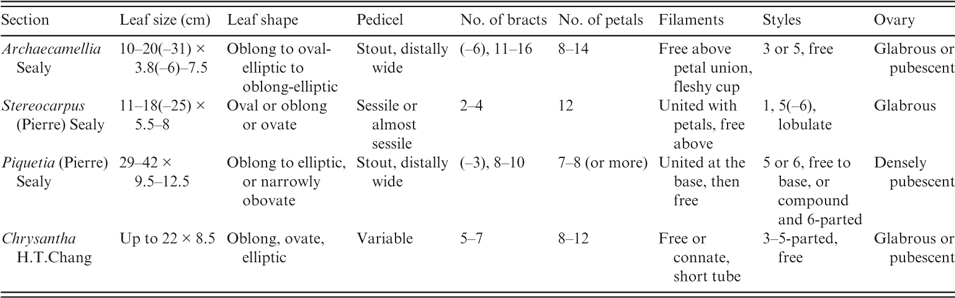
Camellia oconoriana possesses a number of morphological characteristics common to species of Camellia sections Archaecamellia Sealy, Stereocarpus (Pierre) Sealy, Piquetia (Pierre) Sealy and Chrysantha H.T.Chang (Sealy, Reference Sealy1958; Chang, Reference Chang1981; Chang & Bartholomew, Reference Chang and Bartholomew1984; Ho, Reference Ho1991; Richards et al., Reference Richards, Orel, Harland and Jones2002; Tran, Reference Tran2002; Gao et al., Reference Gao, Parks and Du2005; Orel, Reference Orel2006; Ming & Bartholomew, Reference Ming, Bartholomew, Wu and Raven2007) and, in some cases, C. oconoriana exhibits morphological traits belonging to more than one section (Table 1). However, the possession of 5–7 bracts, connate filaments that fuse into a short tube or ring, 3–5-parted styles and pubescent ovaries place Camellia oconoriana closer to, but not firmly within, Camellia sect. Chrysantha H.T.Chang where we provisionally place it pending further research (see Table 1). As Camellia oconoriana does not exhibit any profound novelties in basic Camellia floral morphology it was not considered appropriate to establish a new Camellia section, either within the taxonomic system of Sealy (Reference Sealy1958), or in that of Chang & Bartholomew (Reference Chang and Bartholomew1984).
Comparison of selected morphological characters of Camellia sections Archaecamellia, Stereocarpus, Piquetia and Chrysantha
Data from Sealy (Reference Sealy1958), Chang (Reference Chang1981), Chang & Bartholomew (Reference Chang and Bartholomew1984), Richards et al. (Reference Richards, Orel, Harland and Jones2002), Gao et al. (Reference Gao, Parks and Du2005), Orel (Reference Orel2006) and Ming & Bartholomew (Reference Ming, Bartholomew, Wu and Raven2007).
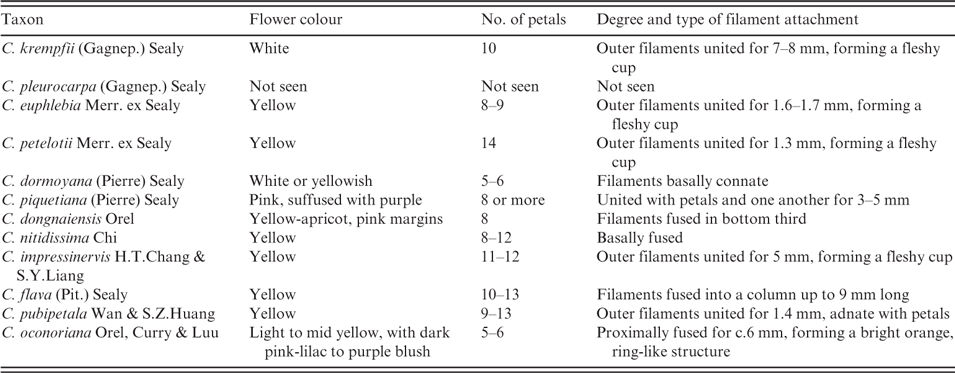
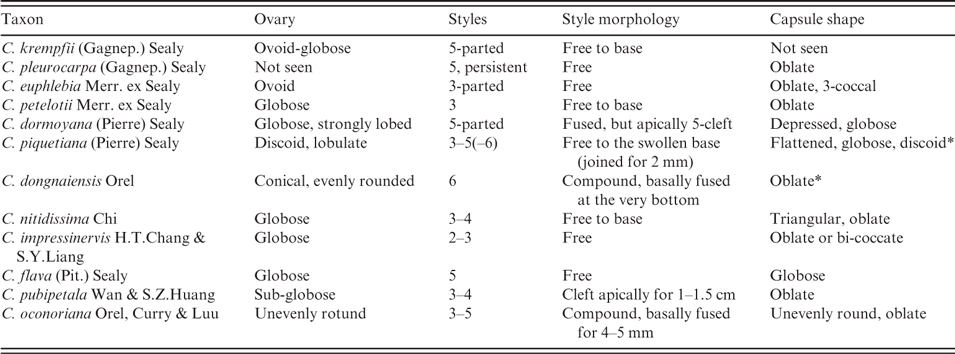
Camellia oconoriana possesses a number of morphological characteristics in common with particular species of the above-mentioned sections of Camellia, so we selected the following species, which have traits similar to those of C. oconoriana: Camellia krempfii (Gagnep.) Sealy, C. pleurocarpa (Gagnep.) Sealy, C. euphlebia Merr. ex Sealy and C. petelotii Merr. ex Sealy (section Archaecamellia) (Sealy, Reference Sealy1958), C. dormoyana (Pierre) Sealy (section Stereocarpus) (Sealy, Reference Sealy1958), C. piquetiana (Pierre) Sealy and C. dongnaiensis Orel (section Piquetia) (Sealy, Reference Sealy1958; Orel, Reference Orel2006) and C. nitidissima Chi, C. impressinervis H.T.Chang & S.Y.Liang, C. flava (Pit.) Sealy and C. pubipetala Wan & S.Z.Huang (section Chrysantha) (Gao et al., Reference Gao, Parks and Du2005). Tables 2a and 2b show a comparison of selected morphological characters of Camellia oconoriana and these 11 species. Flower colour (mostly yellow), the arrangement of the filaments (basally united and forming a ring or fleshy cup) and the shape of the seed capsules (mostly globose or oblate) seem to be the main morphological traits that these species have in common. However, the tables also show that Camellia oconoriana is well distinguished from these other species, particularly in the bright orange, ring-like base of the androecium, and the unevenly shaped ovaries and capsules.
Interspecific morphological comparison of Camellia oconoriana with the selected member species from sections Archaecamellia Sealy, Stereocarpus (Pierre) Sealy, Piquetia (Pierre) Sealy and Chrysantha H.T.Chang
Data from Pitard (Reference Pitard and Lecomte1910), Sealy (Reference Sealy1958), Chang & Bartholomew (Reference Chang and Bartholomew1984), Ho (Reference Ho1991), Richards et al. (Reference Richards, Orel, Harland and Jones2002), Gao et al. (Reference Gao, Parks and Du2005), Orel (Reference Orel2006) and Ming & Bartholomew (Reference Ming, Bartholomew, Wu and Raven2007).
Interspecific morphological comparison of Camellia oconoriana with the selected member species from sections Archaecamellia Sealy, Stereocarpus (Pierre) Sealy, Piquetia (Pierre) Sealy and Chrysantha H.T.Chang (continued)
Data from Pitard (Reference Pitard and Lecomte1910), Sealy (Reference Sealy1958), Chang & Bartholomew (Reference Chang and Bartholomew1984), Ho (Reference Ho1991), Richards et al. (Reference Richards, Orel, Harland and Jones2002), Gao et al. (Reference Gao, Parks and Du2005), Orel (Reference Orel2006) and Ming & Bartholomew (Reference Ming, Bartholomew, Wu and Raven2007).
* G. Orel – unpublished data, 2009.