Clinical Implications
□ All included studies evaluating cognition in HD patients presented fair quality.
□ Patients with HD showed impairment only in categorization skills.
□ Patients with HD may show deficits in social cognition, and further work on this theme is warranted.
□ Different tests were used to assess cognitive domains and subdomains, and data regarding information on comorbidities, medication use, and global cognitive efficiency were mostly unavailable.
Introduction
Saving and collecting possessions might be conceptualized along a continuum of common and adaptive habits to pathological and maladaptive behavior.Reference Albert, De Cori, Barbaro, Fernández de la Cruz and Nordsletten 1 , Reference Bodryzlova, Audet, Bergeron and O’Connor 2 Hoarding disorder (HD) is defined as a persistent difficulty in discarding items regardless of value, urges to save items and distress associated with discarding, and the accumulation of possessions which compromise use of the home.Reference Bodryzlova, Audet, Bergeron and O’Connor 2 , Reference Davidson, Dozier and Pittman 3 Epidemiological studies suggest HD to affect around 2.5% of population, with prevalence increases of 20% every 5 years, particularly after age 35.Reference Davidson, Dozier and Pittman 3 - Reference Mataix-Cols and Fernández de la Cruz 5 HD is a progressive disease with an early onset, usually in adolescence, and few individuals reporting a waxing and waning course.Reference Davidson, Dozier and Pittman 3 , Reference Mataix-Cols and Fernández de la Cruz 5 , Reference Zaboski, Merritt and Schrack 6 Older adults with HD commonly suffer from self-neglect and are at risk for food contamination, malnutrition, medication mismanagement, falls, and eviction from their homes.Reference Davidson, Dozier and Pittman 3 HD is associated with poor quality of life not only in patients but also in family members.Reference Bodryzlova, Audet, Bergeron and O’Connor 2 , Reference Ong, Pang, Sagayadevan, Chong and Subramaniam 7
Before the recognition in the Diagnostic and Statistical Manual 5th edition (DSM-5) that HD is distinct from obsessive-compulsive disorder (OCD), neuroimaging studies compared OCD patients with and without clinical hoarding symptoms. These studies found preliminary evidence for increased hoarding-related brain function in lateral prefrontal and ventro-medial/orbitofrontal brain regions associated with cognitive control and self-referential processing during tasks designed to provoke hoarding symptoms, and decreased activity in posterior cingulate and cuneus during a task-free resting state.Reference Stevens, Levy, Halion, Wooton and Tolin 8 Several candidate neural systems have been implicated in HD, but the strongest evidence is for abnormality in the cingulo-opercular network (comprising primarily the dorsal anterior cingulate cortex and anterior insula). Neuroscience theories of decision-making also show involvement of lateral prefrontal–parietal systems to cognitive/executive aspects of value-based learning that might be compromised in HD. Also, semantic cognition guides decision-making choices via both executive control processes that engage lateral prefrontal cortex regions and the representation of semantic knowledge in various lateral temporal lobe regions. Collectively, the evidence suggests that these might be the impaired neural systems most directly associated with the central behavioral symptoms found in most HD patients.Reference Stevens, Levy, Halion, Wooton and Tolin 8
Frost and HartlReference Frost and Hartl 9 described the cognitive-behavioral model associated with HD, which highlights information-processing deficits, problems in forming emotional attachments, behavioral avoidance, and erroneous beliefs about the nature of possessions. The cognitive-behavioral model of compulsive hoarding suggests that executive dysfunction may contribute to the development and maintenance of hoarding behaviors.Reference Steketee and Frost 10 Cognitive impairment may interact with a person’s genetic vulnerabilities and learned core beliefs to result in increased hoarding tendencies.Reference Steketee and Frost 10 Cognitive impairment in patients with HD seems to be associated with the severity of saving and acquiring behavior.Reference Tolin, Hallion and Wooton 11 Once the current treatment is based on a cognitive behavioral model,Reference Mataix-Cols and Fernández de la Cruz 5 it is important to re-evaluate the evidence supporting the presence of cognitive impairment in HD patients. A previous systematic review evaluated hoarding symptoms in OCD main diagnostic and demonstrated that subjects with hoarding symptoms present impairments at planning/problem-solving decisions, visuospatial learning and episodic memory, sustained attention, working memory, and organization.Reference Woody, Kellman-McFarlane and Welsted 12 The most recent systematic review focused specifically on information processing, which is one aspect of executive functioning.Reference Gledhill, Bream, Drury and Onwumere 13 The authors showed that attention, motor inhibition, and organization domains were impaired in HD patients,Reference Gledhill, Bream, Drury and Onwumere 13 although visuospatial learning and working memory seem to be not compromised.Reference Gledhill, Bream, Drury and Onwumere 13
In the present study, we aimed to perform a systematic review by evaluating cognitive performance including attention, episodic memory, executive functioning (including working memory, information-processing speed, planning, decision making, inhibitor mental control flexibility, categorization skills, and memory), visuospatial ability, and social cognition in patients with HD compared with those in controls. We hypothesized that HD patients would present greater cognitive impairment than controls.
Methods
Search strategy and study selection criteria
A systematic search of the literature using the electronic databases MEDLINE, SCOPUS, and LILACS was conducted in May 2020, with no date limit. The search terms were “hoarding disorder,” “cognition,” “neuropsychology,” “cognitive impairment, and “cognitive deficit.” There was no restriction regarding the date of publication. Studies written in English, Portuguese, or Spanish were selected for review. Two reviewers (B.P.S. and M.S.F.M.) independently evaluated the titles and abstracts and then the full text for inclusion eligibility A third reviewer (I.G.B.) evaluated disagreements. Only original studies assessing cognitive functioning in patients with HD were eligible for inclusion. Reviews and case studies were searched for the manual extraction of additional possible references. Studies with animals, children, or adolescents and without control group were excluded from the review. Participants without HD symptoms were considered as controls.
Data extraction process and literature quality assessment
We developed a data extraction table based on the Cochrane template.Reference Chandler, McKenzie, Boutron and Welch 14 Two investigators (B.P.S. and M.S.F.M.) extracted data and a third reviewer (I.G.B.) verified the data. In addition, two reviewers (B.P.S. and M.S.F.M.) independently assessed the quality of studies included using the Study Quality Assessment Tools of the National Heart, Lung, and Blood Institute (NHLBI) of the National Institutes of Health (NIH) for quality assessment of case–control studies. 15
In the current study, we considered a study that scored ≥7 points to be of good quality. 15 Studies that scored 5 or 6 points were considered to be of fair quality, and studies that received ≤4 points were considered to be of poor quality and were excluded from this review. Any disagreement between authors was resolved by consensus and, if necessary, a third author (I.G.B.) was consulted. As referred by the NIH classification: “good” studies refer to studies with a low risk of bias and results were considered valid, “a fair” study is susceptible to some bias deemed, although not sufficient to invalidate the results, and “poor” studies indicate significant risk of bias. 15
The data extracted included the first author’s last name and the year of publication; sample size (number of patients and controls); whether subjects fulfilled diagnostic criteria for HD; both inclusion and exclusion criteria; the selection setting; the diagnostic assessment, scales, and neuropsychological tests that were used; the characteristics of the study population (mean age, sex, and mean level of education); and the main outcomes. This systematic review was registered on Prospero under the protocol CRD42020167964.
Results
Description of the studies
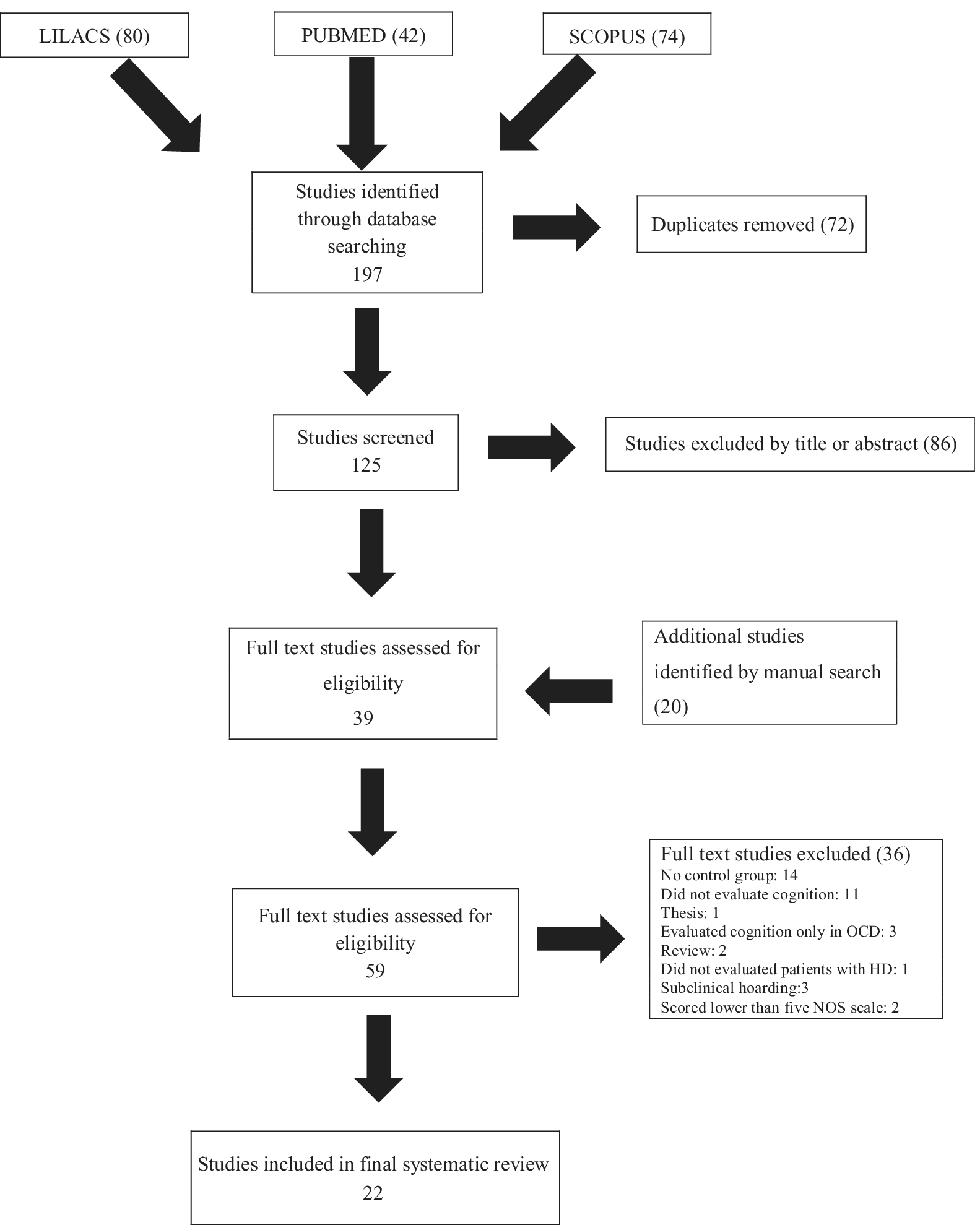
A total of 197 studies were initially identified through database search (PUBMED: 42, SCOPUS: 74, and LILACS: 81). Duplicate studies (N: 72) and studies unrelated to the topic of the review according to title and abstract screening (N: 86) were excluded. Twenty additional studies were identified through reference lists.
Of the 59 studies selected for full text review, 37 were excluded, that is, 14 did not include control subjects,Reference Kim, Steketee and Frost 16 - Reference Paloski, Ferreira, Costa, Oliveira, Moret-Tatay and Irigaray 29 11 did not evaluate cognition,Reference Frost and Gross 30 - Reference Hamblin, Lewin, Salloum, Crawford, McBride and Storch 40 3 included patients with subclinical hoarding,Reference Lawrence, Wooderson, Mataix-Cols, David, Speckens and Phillips 41 - Reference Fitch and Cougle 43 1 was a PhD thesis,Reference Fitch 44 3 evaluated cognition only in patients with OCD,Reference Goldman, Martin and Calamari 45 - Reference Dondu, Sevincoka, Akyol and Tataroglu 47 2 were literature reviews,Reference Woody, Kellman-McFarlane and Welsted 12 , Reference Tolin 48 1 did not evaluate participants with HD,Reference Lee, Lewis, Leighton, Harris, Long and Macfarlane 49 and 2 scored <5 according to The Study Quality Assessment Tools of the NHLBI of the NIH for quality assessment of case–control studies.Reference Blom, Samuels and Grados 50 , Reference Lee 51 A total of 22 studies composed the final selection for this review (Figure 1).
Flow chart of the studies included in the systematic review.

Characteristics of included studies
All selected studies comprised case–control studies.Reference Tolin, Hallion and Wooton 11 , Reference Steketee, Frost and Kyrios 52 - Reference Suñol, Martínez-Zalacaín and Picó-Pérez 72
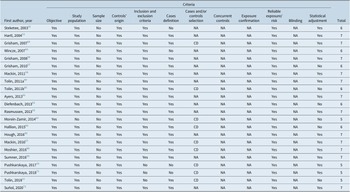
Seven studies diagnosed patients with HD according to the DSM-5 criteria.Reference Ayers, Wetherell, Schiehser, Almklov, Golshan and Saxena 61 , Reference Diefenbach, DiMauro, Frost, Steketee and Tolin 62 , Reference Morein-Zamir, Papmeyer and Pertusa 64 , Reference Hough, Luks and Lai 66 , Reference Mackin, Vigil and Insel 67 , Reference Sumner, Noack, Filoteo, Maddox and Saxena 69 , Reference Suñol, Martínez-Zalacaín and Picó-Pérez 72 In these studies, 1757 patients were evaluated. The mean age ranged from 41.7Reference Pushkarskaya, Tolin and Ruderman 70 to 71.5 years.Reference Mackin, Areán, Delucchi and Mathews 58 The frequency of female gender varied from 44.2%Reference Ayers, Wetherell, Schiehser, Almklov, Golshan and Saxena 61 to 85.5%.Reference Sumner, Noack, Filoteo, Maddox and Saxena 69 The mean level of education ranged from 12.8Reference Suñol, Martínez-Zalacaín and Picó-Pérez 72 to 17.1 years,Reference Grisham, Brown, Savage, Steketee and Barlow 54 , Reference Grisham, Norberg, Williams, Certoma and Kadib 57 although approximately one third of the studies included did not provide this information. All included studies scored between five to seven, according to the Study Quality Assessment Tools of the NHLBI 15 (Table 1).
Quality Assessment of Case–Control Studies

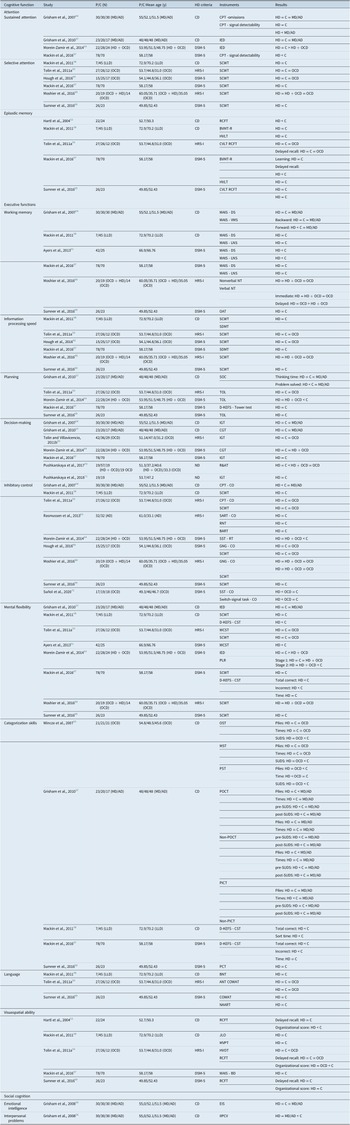
Studies differed in terms of controls used for comparison with HD patients: 9 included controls,Reference Tolin, Hallion and Wooton 11 , Reference Hartl, Frost and Allen 53 , Reference Ayers, Wetherell, Schiehser, Almklov, Golshan and Saxena 61 , Reference Diefenbach, DiMauro, Frost, Steketee and Tolin 62 , Reference Hallion, Diefenbach and Tolin 65 - Reference Mackin, Vigil and Insel 67 , Reference Sumner, Noack, Filoteo, Maddox and Saxena 69 , Reference Pushkarskaya, Tolin, Henick, Levy and Pittenger 71 6 included controls and OCD patients,Reference Steketee, Frost and Kyrios 52 , Reference Wincze, Steketee and Frost 55 , Reference Tolin, Villavicencio, Umbach and Kurtz 59 , Reference Tolin and Villavicencio 60 , Reference Morein-Zamir, Papmeyer and Pertusa 64 , Reference Suñol, Martínez-Zalacaín and Picó-Pérez 72 3 employed controls and patients with major depression or anxiety disorders,Reference Grisham, Brown, Savage, Steketee and Barlow 54 , Reference Grisham, Steketee and Frost 56 , Reference Grisham, Norberg, Williams, Certoma and Kadib 57 2 used OCD patients and comorbid OCD and HD,Reference Moshier, Wootton and Bragdon 68 , Reference Pushkarskaya, Tolin and Ruderman 70 1 included patients with anxiety disorders,Reference Rasmussen, Brown, Steketee and Barlow 63 and 1 included late life depression patientsReference Mackin, Areán, Delucchi and Mathews 58 (Table 2).
Studies Evaluating Cognitive Tasks in Patients with HD in Comparison with Controls
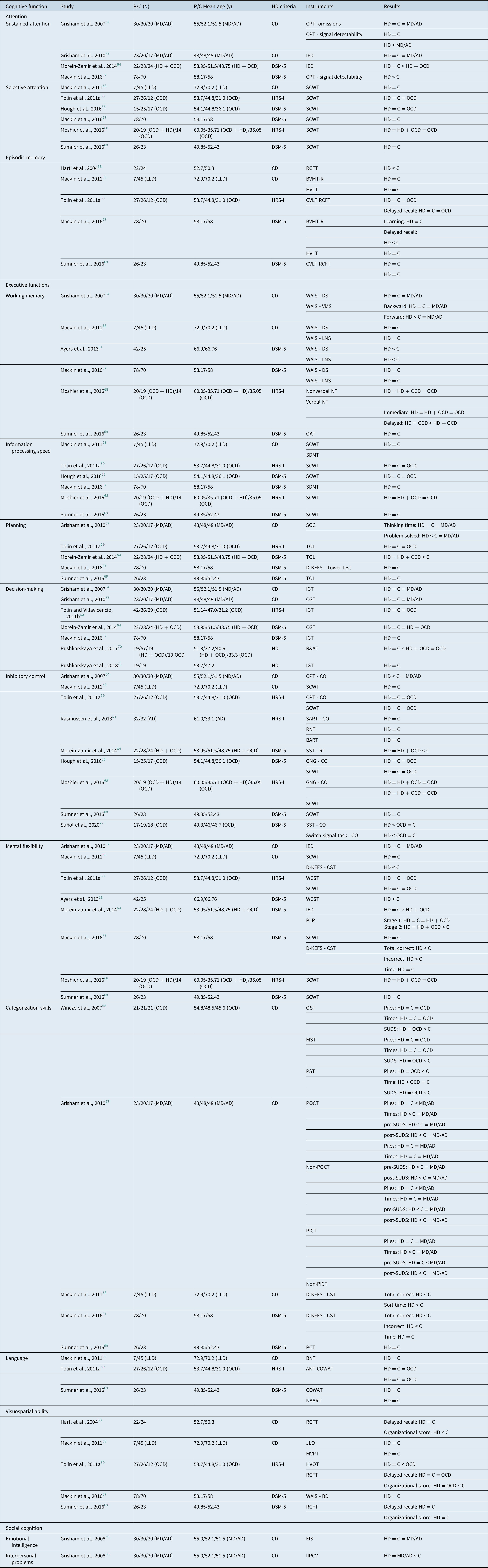
Abbreviations: AD, anxiety disorder; AGN, affective go/no-go; ANT, animal naming test; BART, balloon risk analog task; BD, block design; BNT, Boston naming test; BVMT-R, brief visuospatial memory test revised; C, control; CGT, Cambridge gambling task; CD, clinical diagnosis; CO, commission errors; CST, card sorting task; COWAT, controlled oral word association test; CPT, Conners’ continuous performance test; CVLT, California verbal learning test; D-KEFS, Delis–Kaplan executive function system; DS, digit span; DSM-5, Diagnostic and Statistical Manual 5th Edition; EIS, Emotional Intelligence Scale; GNG, go/no-go; HD, hoarding disorder; HRT, hit reaction time; HSR-I, Hoarding Rating Scale Interview; HVLT, Hopkins verbal learning test, HVOT, Hooper visual organization test; IED, intra-extra dimensional set shifting; IIPCV, inventory of interpersonal problems-circumplex version; IGT, Iowa gambling task; JLO, judgment of line orientation; LLD, late life depression; LNS, letter number sequencing; MD, mood disorder; MST, modified sorting task; MVPT, motor free visual perception test; N, number; NAART, North American adult reading test; ND, not described; NT, NeuroTrax; OAT, object alternation task; OST, object sorting task; P, patients; PCPT, PEBL continuous performance test; PCT, perceptual categorization task; PICT, personal index cards categorization task; PLR, probabilistic learning and reversal; POCT, personal objects categorization task; PST, personal sorting task; RCFT, Rey–Osterrieth complex figure test; R&AT, risk and ambiguity task; RNT, recent negatives task; RT, reaction time; S, similarities; SART, sustained attention to response task; SCWT, Stroop color and word test; SDMT, symbol digit modalities test; SIHD, structured interview hoarding disorder; Sim, similarities; SOC, Stockings of Cambridge; SST, stop-signal task; SUDS, Subjective Units of Distress Scale; TOL, Tower of London; VMS, visual memory span; Voc, vocabulary; WAIS, Wechsler Adult Intelligence Scale; WCST, Wisconsin card sorting test.
Attention
Nine out of 22 studies evaluated attention in patients with HD in comparison with controls.Reference Grisham, Brown, Savage, Steketee and Barlow 54 , Reference Grisham, Norberg, Williams, Certoma and Kadib 57 - Reference Tolin, Villavicencio, Umbach and Kurtz 59 , Reference Morein-Zamir, Papmeyer and Pertusa 64 , Reference Hough, Luks and Lai 66 - Reference Sumner, Noack, Filoteo, Maddox and Saxena 69 Six out of nine studies did not demonstrate differences in attention between HD patients and controls.Reference Grisham, Norberg, Williams, Certoma and Kadib 57 - Reference Tolin, Villavicencio, Umbach and Kurtz 59 , Reference Hough, Luks and Lai 66 , Reference Moshier, Wootton and Bragdon 68 , Reference Sumner, Noack, Filoteo, Maddox and Saxena 69
Sustained attention
Four out of 22 studies evaluated sustained attention in patients with HDReference Grisham, Brown, Savage, Steketee and Barlow 54 , Reference Grisham, Norberg, Williams, Certoma and Kadib 57 , Reference Morein-Zamir, Papmeyer and Pertusa 64 , Reference Mackin, Vigil and Insel 67 according to the Conners’ continuous performance test (CPT)—omissions and signal detectabilityReference Grisham, Brown, Savage, Steketee and Barlow 54 , Reference Mackin, Vigil and Insel 67 and intra-extra dimensional set shift (IED).Reference Grisham, Norberg, Williams, Certoma and Kadib 57 , Reference Morein-Zamir, Papmeyer and Pertusa 64 Patients with HD did not differ from controls in three studies.Reference Grisham, Brown, Savage, Steketee and Barlow 54 , Reference Grisham, Norberg, Williams, Certoma and Kadib 57 , Reference Morein-Zamir, Papmeyer and Pertusa 64 One study demonstrated that HD patients showed poor performance than controls.Reference Mackin, Vigil and Insel 67 One study demonstrated a poorer performance in patients with HD than in patients with mood or anxiety disorders at signal detectability on CPT.Reference Grisham, Brown, Savage, Steketee and Barlow 54
Selective attention
Six out of 22 studies evaluated selective attention in patients with HD,Reference Mackin, Areán, Delucchi and Mathews 58 , Reference Tolin, Villavicencio, Umbach and Kurtz 59 , Reference Hough, Luks and Lai 66 - Reference Sumner, Noack, Filoteo, Maddox and Saxena 69 always with the Stroop color and word test (SCWT).Reference Mackin, Areán, Delucchi and Mathews 58 , Reference Tolin, Villavicencio, Umbach and Kurtz 59 , Reference Hough, Luks and Lai 66 - Reference Sumner, Noack, Filoteo, Maddox and Saxena 69 According to these studies, there was no difference when HD patients were compared with controlsReference Mackin, Areán, Delucchi and Mathews 58 , Reference Tolin, Villavicencio, Umbach and Kurtz 59 , Reference Hough, Luks and Lai 66 , Reference Mackin, Vigil and Insel 67 , Reference Sumner, Noack, Filoteo, Maddox and Saxena 69 and with OCD patients.Reference Tolin, Villavicencio, Umbach and Kurtz 59 , Reference Hough, Luks and Lai 66 , Reference Moshier, Wootton and Bragdon 68
Episodic memory
Five out of 22 studies evaluated episodic memory in patients with HD.Reference Hartl, Frost and Allen 53 , Reference Mackin, Areán, Delucchi and Mathews 58 , Reference Tolin, Villavicencio, Umbach and Kurtz 59 , Reference Mackin, Vigil and Insel 67 , Reference Sumner, Noack, Filoteo, Maddox and Saxena 69 The neuropsychological instruments employed in these studies were the Rey–Osterrieth complex figure test (RCFT),Reference Hartl, Frost and Allen 53 , Reference Tolin, Villavicencio, Umbach and Kurtz 59 , Reference Sumner, Noack, Filoteo, Maddox and Saxena 69 the brief visuospatial memory test—revised (BVMT-R),Reference Mackin, Areán, Delucchi and Mathews 58 , Reference Mackin, Vigil and Insel 67 the Hopkins verbal learning test (HVLT),Reference Mackin, Areán, Delucchi and Mathews 58 , Reference Mackin, Vigil and Insel 67 and the California verbal learning test (CVLT).Reference Tolin, Villavicencio, Umbach and Kurtz 59 , Reference Sumner, Noack, Filoteo, Maddox and Saxena 69
Three studies did not demonstrate differences between HD patients and controls in episodic memory.Reference Mackin, Areán, Delucchi and Mathews 58 , Reference Tolin, Villavicencio, Umbach and Kurtz 59 , Reference Sumner, Noack, Filoteo, Maddox and Saxena 69 In one study, patients with HD did not differ from patients with OCD.Reference Tolin, Villavicencio, Umbach and Kurtz 59 HD patients presented poorer episodic memory than controls in the RCFTReference Hartl, Frost and Allen 53 and delayed recall subtest on BVMT-R.Reference Mackin, Vigil and Insel 67
Executive functions
Sixteen out of 22 studies evaluated executive functions in patients with HD in comparison with controls.Reference Grisham, Brown, Savage, Steketee and Barlow 54 , Reference Wincze, Steketee and Frost 55 , Reference Grisham, Norberg, Williams, Certoma and Kadib 57 - Reference Ayers, Wetherell, Schiehser, Almklov, Golshan and Saxena 61 , Reference Rasmussen, Brown, Steketee and Barlow 63 , Reference Morein-Zamir, Papmeyer and Pertusa 64 , Reference Hough, Luks and Lai 66 - Reference Suñol, Martínez-Zalacaín and Picó-Pérez 72
Working memory
Six out of 22 studies evaluated working memory in patients with HD.Reference Grisham, Brown, Savage, Steketee and Barlow 54 , Reference Mackin, Areán, Delucchi and Mathews 58 , Reference Ayers, Wetherell, Schiehser, Almklov, Golshan and Saxena 61 , Reference Mackin, Vigil and Insel 67 - Reference Sumner, Noack, Filoteo, Maddox and Saxena 69 The neuropsychological instruments employed in these studies were subtests of the Wechsler adult intelligence scale (WAIS): digit span (DS),Reference Grisham, Brown, Savage, Steketee and Barlow 54 , Reference Mackin, Areán, Delucchi and Mathews 58 , Reference Ayers, Wetherell, Schiehser, Almklov, Golshan and Saxena 61 , Reference Mackin, Vigil and Insel 67 letter number sequencing (LNS),Reference Mackin, Areán, Delucchi and Mathews 58 , Reference Ayers, Wetherell, Schiehser, Almklov, Golshan and Saxena 61 , Reference Mackin, Vigil and Insel 67 and visual memory span (VMS)Reference Grisham, Brown, Savage, Steketee and Barlow 54 ; the NeuroTrax (NT) verbal and non-verbal memory testsReference Moshier, Wootton and Bragdon 68 ; and the object alternation task (OAT).Reference Sumner, Noack, Filoteo, Maddox and Saxena 69
Three studies did not demonstrate differences between HD patients and controls in terms of working memory.Reference Mackin, Areán, Delucchi and Mathews 58 , Reference Mackin, Vigil and Insel 67 , Reference Sumner, Noack, Filoteo, Maddox and Saxena 69 In one study, patients with HD did not differ from patients with OCD.Reference Moshier, Wootton and Bragdon 68 HD patients presented poorer working memory than controls in WAIS DS and LNS subtestsReference Ayers, Wetherell, Schiehser, Almklov, Golshan and Saxena 61 and in forward WAIS VMS subtest.Reference Grisham, Brown, Savage, Steketee and Barlow 54
Information-processing speed
Six out of 22 studies evaluated information-processing speed and demonstrated no differences between patients with HD and controls.Reference Mackin, Areán, Delucchi and Mathews 58 , Reference Tolin, Villavicencio, Umbach and Kurtz 59 , Reference Hough, Luks and Lai 66 - Reference Sumner, Noack, Filoteo, Maddox and Saxena 69 The neuropsychological instruments employed were the symbol digit modalities test (SDMT)Reference Mackin, Areán, Delucchi and Mathews 58 , Reference Mackin, Vigil and Insel 67 and SCWT.Reference Mackin, Areán, Delucchi and Mathews 58 , Reference Tolin, Villavicencio, Umbach and Kurtz 59 , Reference Hough, Luks and Lai 66 - Reference Sumner, Noack, Filoteo, Maddox and Saxena 69 One study assessed category learning and demonstrated that patients with HD showed a trend toward less implicit learning and greater use of explicit learning strategies during perceptual categorization task (PCT) compared with controls.Reference Sumner, Noack, Filoteo, Maddox and Saxena 69
Planning
Five out of 22 studies evaluated planning in patients with HD in comparison with controls.Reference Grisham, Norberg, Williams, Certoma and Kadib 57 , Reference Tolin, Villavicencio, Umbach and Kurtz 59 , Reference Morein-Zamir, Papmeyer and Pertusa 64 , Reference Mackin, Vigil and Insel 67 , Reference Sumner, Noack, Filoteo, Maddox and Saxena 69 The neuropsychological instruments employed were the Stockings of Cambridge (SOC),Reference Grisham, Norberg, Williams, Certoma and Kadib 57 the Tower of London (TOL),Reference Tolin, Villavicencio, Umbach and Kurtz 59 , Reference Morein-Zamir, Papmeyer and Pertusa 64 , Reference Sumner, Noack, Filoteo, Maddox and Saxena 69 and the tower test on the D-KFES.Reference Mackin, Vigil and Insel 67 Three studies demonstrated that HD patients did not differ from controls,Reference Tolin, Villavicencio, Umbach and Kurtz 59 , Reference Mackin, Vigil and Insel 67 , Reference Sumner, Noack, Filoteo, Maddox and Saxena 69 and one study demonstrated that they did not differ from patients with OCD.Reference Tolin, Villavicencio, Umbach and Kurtz 59 One study showed poor performance in patients with HD in comparison with controls on the TOLReference Morein-Zamir, Papmeyer and Pertusa 64 and one study demonstrated that HD patients, compared with controls, performed poorly at problem solving on the SOC.Reference Grisham, Norberg, Williams, Certoma and Kadib 57
Decision-making
All seven studies that evaluated decision-making in patients with HD demonstrated that they do not differ from controlsReference Grisham, Brown, Savage, Steketee and Barlow 54 , Reference Grisham, Norberg, Williams, Certoma and Kadib 57 , Reference Tolin and Villavicencio 60 , Reference Morein-Zamir, Papmeyer and Pertusa 64 , Reference Mackin, Vigil and Insel 67 , Reference Pushkarskaya, Tolin and Ruderman 70 , Reference Pushkarskaya, Tolin, Henick, Levy and Pittenger 71 or from patients with mood or anxiety disorders.Reference Grisham, Brown, Savage, Steketee and Barlow 54 , Reference Grisham, Norberg, Williams, Certoma and Kadib 57 The main neuropsychological instruments employed to assess decision-making were the Iowa gambling task (IGT)Reference Grisham, Brown, Savage, Steketee and Barlow 54 , Reference Tolin and Villavicencio 60 , Reference Mackin, Vigil and Insel 67 , Reference Pushkarskaya, Tolin, Henick, Levy and Pittenger 71 and the Cambridge gambling task (CGT).Reference Grisham, Norberg, Williams, Certoma and Kadib 57 , Reference Morein-Zamir, Papmeyer and Pertusa 64
Inhibitory control
Nine out of 22 studies evaluated inhibitory control in patients with HD.Reference Grisham, Brown, Savage, Steketee and Barlow 54 , Reference Mackin, Areán, Delucchi and Mathews 58 , Reference Tolin, Villavicencio, Umbach and Kurtz 59 , Reference Rasmussen, Brown, Steketee and Barlow 63 , Reference Morein-Zamir, Papmeyer and Pertusa 64 , Reference Hough, Luks and Lai 66 , Reference Moshier, Wootton and Bragdon 68 , Reference Sumner, Noack, Filoteo, Maddox and Saxena 69 , Reference Suñol, Martínez-Zalacaín and Picó-Pérez 72 The main neuropsychological instruments employed for the assessment of inhibitory control were the commission errors on the CPT,Reference Grisham, Brown, Savage, Steketee and Barlow 54 , Reference Tolin, Villavicencio, Umbach and Kurtz 59 the SCWT,Reference Mackin, Areán, Delucchi and Mathews 58 , Reference Tolin, Villavicencio, Umbach and Kurtz 59 , Reference Hough, Luks and Lai 66 , Reference Moshier, Wootton and Bragdon 68 , Reference Sumner, Noack, Filoteo, Maddox and Saxena 69 the Stop-Signal task (SST),Reference Morein-Zamir, Papmeyer and Pertusa 64 , Reference Suñol, Martínez-Zalacaín and Picó-Pérez 72 and the commission errors on go/no-go task (GNG).Reference Hough, Luks and Lai 66 , Reference Moshier, Wootton and Bragdon 68 Five studies demonstrated that patients with HD did not differ from controlsReference Mackin, Areán, Delucchi and Mathews 58 , Reference Tolin, Villavicencio, Umbach and Kurtz 59 , Reference Rasmussen, Brown, Steketee and Barlow 63 , Reference Hough, Luks and Lai 66 , Reference Sumner, Noack, Filoteo, Maddox and Saxena 69 or from patients with OCD.Reference Tolin, Villavicencio, Umbach and Kurtz 59 , Reference Hough, Luks and Lai 66 , Reference Moshier, Wootton and Bragdon 68 Three studies demonstrated that HD patients presented poorer performance than controls,Reference Grisham, Brown, Savage, Steketee and Barlow 54 , Reference Morein-Zamir, Papmeyer and Pertusa 64 , Reference Suñol, Martínez-Zalacaín and Picó-Pérez 72 from patients with OCDReference Suñol, Martínez-Zalacaín and Picó-Pérez 72 and mood or anxiety disorders.Reference Grisham, Brown, Savage, Steketee and Barlow 54
Mental flexibility
Eight out of 22 studies compared mental flexibility in patients with HD.Reference Grisham, Norberg, Williams, Certoma and Kadib 57 - Reference Tolin, Villavicencio, Umbach and Kurtz 59 , Reference Ayers, Wetherell, Schiehser, Almklov, Golshan and Saxena 61 , Reference Morein-Zamir, Papmeyer and Pertusa 64 , Reference Mackin, Vigil and Insel 67 - Reference Sumner, Noack, Filoteo, Maddox and Saxena 69 The main neuropsychological instruments that assessed mental flexibility were the IED,Reference Grisham, Norberg, Williams, Certoma and Kadib 57 , Reference Morein-Zamir, Papmeyer and Pertusa 64 the SCWT,Reference Mackin, Areán, Delucchi and Mathews 58 , Reference Tolin, Villavicencio, Umbach and Kurtz 59 , Reference Mackin, Vigil and Insel 67 , Reference Moshier, Wootton and Bragdon 68 the card sorting task (CST) on the D-KEFS,Reference Mackin, Areán, Delucchi and Mathews 58 , Reference Mackin, Vigil and Insel 67 and the Wisconsin card sorting task (WCST).Reference Tolin, Villavicencio, Umbach and Kurtz 59 , Reference Ayers, Wetherell, Schiehser, Almklov, Golshan and Saxena 61 , Reference Sumner, Noack, Filoteo, Maddox and Saxena 69 Four studies demonstrated that patients with HD did not differ from controlsReference Grisham, Norberg, Williams, Certoma and Kadib 57 , Reference Tolin, Villavicencio, Umbach and Kurtz 59 , Reference Ayers, Wetherell, Schiehser, Almklov, Golshan and Saxena 61 , Reference Sumner, Noack, Filoteo, Maddox and Saxena 69 or from patients with mood or anxiety disordersReference Grisham, Norberg, Williams, Certoma and Kadib 57 and OCD.Reference Tolin, Villavicencio, Umbach and Kurtz 59 , Reference Moshier, Wootton and Bragdon 68 Two studies demonstrated that patients with HD showed poor performance at CST on the D-KEFS compared to controls,Reference Mackin, Areán, Delucchi and Mathews 58 , Reference Mackin, Vigil and Insel 67 and one study demonstrated that HD patients performed poorly than controls on stage 2 of the probabilistic learning and reversal (PLR).Reference Morein-Zamir, Papmeyer and Pertusa 64
Categorization skills
Five out of 22 studies evaluated categorization skills in patients with HD.Reference Wincze, Steketee and Frost 55 , Reference Grisham, Norberg, Williams, Certoma and Kadib 57 , Reference Mackin, Areán, Delucchi and Mathews 58 , Reference Mackin, Vigil and Insel 67 , Reference Sumner, Noack, Filoteo, Maddox and Saxena 69 The main neuropsychological instrument employed was the card sorting test (CST) on the D-KEFS.Reference Mackin, Areán, Delucchi and Mathews 58 , Reference Mackin, Vigil and Insel 67 One study demonstrated that patients with HD did not differ from controls.Reference Sumner, Noack, Filoteo, Maddox and Saxena 69 In three studies, HD patients presented longer time to sort items than controls.Reference Wincze, Steketee and Frost 55 , Reference Grisham, Steketee and Frost 56 , Reference Mackin, Areán, Delucchi and Mathews 58 One study demonstrated that patients with HD presented poorer confidence to complete categorization tasks.Reference Mackin, Vigil and Insel 67
Language
Three studies did not demonstrate differences between HD patients and controls in language.Reference Mackin, Areán, Delucchi and Mathews 58 , Reference Tolin, Villavicencio, Umbach and Kurtz 59 , Reference Sumner, Noack, Filoteo, Maddox and Saxena 69 The main neuropsychological instrument employed was the controlled oral word association test (COWAT).Reference Tolin, Villavicencio, Umbach and Kurtz 59 , Reference Sumner, Noack, Filoteo, Maddox and Saxena 69 One study demonstrated that HD patients did not differ from patients with OCD in language.Reference Tolin, Villavicencio, Umbach and Kurtz 59
Visuospatial ability
Five out of 22 studies evaluated visuospatial ability in patients with HD,Reference Hartl, Frost and Allen 53 , Reference Mackin, Areán, Delucchi and Mathews 58 , Reference Tolin, Villavicencio, Umbach and Kurtz 59 , Reference Mackin, Vigil and Insel 67 , Reference Sumner, Noack, Filoteo, Maddox and Saxena 69 mostly with the RCFT.Reference Hartl, Frost and Allen 53 , Reference Tolin, Villavicencio, Umbach and Kurtz 59 , Reference Sumner, Noack, Filoteo, Maddox and Saxena 69 Three studies demonstrated that HD patients did not differ from controls.Reference Mackin, Areán, Delucchi and Mathews 58 , Reference Mackin, Vigil and Insel 67 , Reference Sumner, Noack, Filoteo, Maddox and Saxena 69 Two studies demonstrated that patients with HD had lower organizational scores on the RCFT.Reference Hartl, Frost and Allen 53 , Reference Tolin, Villavicencio, Umbach and Kurtz 59
Social cognition
Only one study evaluated social cognition in patients with HD, applying self-reported questionnaires: the emotional intelligence scale (EIS) and the inventory of interpersonal problems-circumplex version (IIPCV).Reference Grisham, Steketee and Frost 56 Patients with HD did not differ in emotional intelligence, but HD patients and patients with mood or anxiety disorders reported higher levels of interpersonal problems than controls.Reference Grisham, Steketee and Frost 56
Discussion
The purpose of this systematic review was to compare cognitive performance in patients with HD and controls. The present systematic review included 22 studies that evaluated 1757 HD patients who were 41 to 72 years old. More than 70% (16/22) of the included studies evaluated executive performance, and contrary to our hypothesis, HD presented impairment only in categorization skills in comparison with controls, particularly at confidence to complete categorization tasks. Regarding attention, episodic memory, working memory, information-processing speed, planning, decision-making, inhibitory control, mental flexibility, language, and visuospatial ability, HD patients did not present impairment when compared with controls. All included studies presented fair quality.
Two studies demonstrated that patients with HD performed poorer at categorization skills only when the items being sorted presented some personal value.Reference Wincze, Steketee and Frost 55 , Reference Grisham, Norberg, Williams, Certoma and Kadib 57 One study showed that indecision is an important factor in categorizing behavior and raised the possibility that differences would be more pronounced if the experiment employed real personal items rather than items written on cards and a home-based rather clinic-based environment.Reference Wincze, Steketee and Frost 55 Another study demonstrated that patients with HD reported indecisiveness on a self-report questionnaire, but their performance on a decision-making task was unimpaired, suggesting the presence of subjective memory difficulties or that these patients have decision-making deficits that are specific to items of personal relevance.Reference Grisham, Norberg, Williams, Certoma and Kadib 57 The accumulated items and the under-inclusiveness categorization are thought to underlie difficulty in discarding items.Reference Frost and Hartl 9 For these patients, as different objects are included in a unique category, organization becomes impossible, explaining why so many objects are amassed and disposed in disorganized piles.Reference Woody, Kellman-McFarlane and Welsted 12 The only study that compared categorization skills in patients with HD to patients with OCD demonstrated that HD patients took longer to sort personal objects probably because of stronger emotional associations to these items.Reference Wincze, Steketee and Frost 55 These findings suggest that the underinclusive categorization of personally relevant objects for these patients is a characteristic of compulsive hoarding.Reference Wincze, Steketee and Frost 55
Cognitive-behavioral, psychodynamic, attachment, and self-determination theories suggest a compensatory process in HD patients where interpersonal problems (“unmet relatedness needs”) lead to greater object attachment and the use of possessions for comfort and safety.Reference Yap and Grisham 73 However, HD patients’ relationship with objects is marked by ambivalence and insecurity. On the one hand, they depend on objects for comfort, while on the other hand, the lack of control over possessions and fears about losing items trigger negative emotions such as anger and anxiety.Reference Yap and Grisham 73 Also, the resulting clutter often leads to conflict with family, friends, and neighbors, which paradoxically worsen social isolation and loneliness among those with HD.Reference Yap and Grisham 73 Social cognition refers to the ability to identify, manipulate, and adapt behavior based on social information perceived and processed in a specific context.Reference Adolphs 74 Individuals who hoard seem to exhibit impaired sensitivity to their own and others’ emotions and a variety of negative personality traits.Reference Grisham, Steketee and Frost 56 Poor insight, difficulties with emotion-based decision-making, and impaired interpersonal relationships in this population suggest possible deficits in social cognition.Reference Grisham, Steketee and Frost 56 However, there is a paucity of studies on social cognition in HD patients, and further work on this theme is warranted.
HD patients seem to not demonstrate impairments in attention, episodic memory, working memory, information-processing speed, planning, decision-making, inhibitory control, mental flexibility, language, and visuospatial ability when compared with controls. These findings are inconsistent with previous reviews.Reference Woody, Kellman-McFarlane and Welsted 12 , Reference Gledhill, Bream, Drury and Onwumere 13 Different from the most recent review,Reference Gledhill, Bream, Drury and Onwumere 13 we used less stringent inclusion criteria. We also chose to include broad cognitive aspects and included studies that compared patients with HD to a clinical control sample rather than a healthy control sample.Reference Mackin, Areán, Delucchi and Mathews 58 , Reference Rasmussen, Brown, Steketee and Barlow 63 , Reference Moshier, Wootton and Bragdon 68
We expected that HD patients present impairment in sustained attention, as supposed by clinical observations that suggest hoarding individuals present difficulty in staying focused on tasks and are easily distracted.Reference Fitch and Cougle 43 One possible confounding factor is this data is due to baseline inattentiveness or the distracting power of emotion once patients with HD experience strong emotions during some tasks.Reference Tolin, Hallion and Wooton 11 Other systematic reviews were unable to draw firm conclusions about impaired attention in HD patients.Reference Woody, Kellman-McFarlane and Welsted 12 , Reference Gledhill, Bream, Drury and Onwumere 13 One possible explanation is that patients with HD could have a more subtle dysfunction in anterior cingulate cortex.Reference Tolin, Hallion and Wooton 11 , Reference Gledhill, Bream, Drury and Onwumere 13 Another hypothesis is that neuropsychological tests do not capture the multiple cognitive and emotional processes that influence complex behavior, and future studies should compare cognitive functions under stress vs neutral conditions.Reference Gledhill, Bream, Drury and Onwumere 13 Interventions that aim to shift biased perceptions about cognitive abilities and improve emotion regulation may hold more promise for the treatment of HD.Reference Woody, Lenkic, Neal and Bogod 75
The present study has some strengths, such as the inclusion of non-English written studies and the use of NHLBI for the quality assessment of results. As limitations intrinsic to the literature on cognitive functioning in HD, though, sample sizes were small, most samples were not matched for age and education, controls were heterogeneous, tests used to assess cognitive domains and subdomains were broadly different, and data regarding information on comorbidities, medication use, and global cognitive efficiency were mostly unavailable. We also have to consider that the samples of patients with HD may not be representative of the larger population of individuals with HD. Furthermore, the influence of sociodemographic variables like education, socioeconomic, and cultural contexts should be taken into account.Reference Fuentes, Malloy-Diniz and Camargo 76
In conclusion, except for categorization skills, the cognitive performance in HD patients does not seem to be impaired when compared with controls. In the future, it will be important to evaluate the relationship between cognitive performance in HD and different phenotypes, neuroimaging studies, genetic and neurobiological findings in order to improve the treatment and prognosis of these patients.
Financial support
This research received no specific grant from any funding agency, commercial, or not-for-profit sectors.
Author contributions
Conceptualization: L.C.d.S., F.L.R., L.F.F., and I.G.B.; Investigation: B.P.S., M.S.F.M., and I.G.B.; Methodology: L.C.d.S. and I.G.B.; Project administration: I.G.B.; Supervision: I.G.B.; Writing—original draft: B.P.S. and I.G.B.; Writing—review and editing: L.C.d.S., F.L.R., and L.F.F.
Disclosures
The authors do not have anything to disclose.