INTRODUCTION
Researchers, largely working in Western countries, have examined how observable interviewer traits affect data quality. Most studies focus on significant characteristics in North America, including race (Schaeffer Reference Schaeffer1980; Schuman and Converse Reference Schuman and Converse1971), class (Katz Reference Katz1942), age (Ehrlich and Riesman Reference Ehrlich and Riesman1961), language (Fellegi Reference Fellegi1964), ethnicity (Webster Reference Webster1996), and gender (Benstead Reference Benstead2013b; Flores-Macias and Lawson Reference Flores-Macias and Lawson2008; Kane and Macaulay Reference Kane and Macaulay1993).
While surveys are conducted in every region, including the Middle East and North Africa, interviewer effects research is limited outside Western countries (but see Blaydes and Gillum Reference Blaydes and Gillum2013; Dionne Reference Dionne2014; Koker Reference Koker2009). Institutes such as the Palestinian Center for Policy and Survey Research poll citizens on religiously-sensitive issues, including support for Hamas.Footnote 1 Cross-national studies including the World Values Survey, Arab Barometer, Gallup, and Pew Global Attitudes Project are conducted regularly, informing research on the relationship between religiosity and support for democracy and gender equality (Ciftci Reference Ciftci2010; Esposito and Mogahed Reference Esposito and Mogahed2007; Jamal Reference Jamal2006; Norris and Inglehart Reference Norris and Inglehart2001; Tessler Reference Tessler2002).Footnote 2
Since the Arab uprisings, survey research has also expanded and increasingly informs debate in transitional countries, including discussion about the role of religion in public life. While positive, these developments renew concern about bias arising from observable interviewer traits, particularly religious dress. Polls assessing support for Islamist parties conducted concurrently in Tunisia vary by 20–30%, depending on the polling organization (“Tunisian Constituent Assembly Election 2011”), a puzzling result that could be attributable in part to interviewer dress.Footnote 3 Yet, researchers usually do not report — much less analyze the impact of — interviewer traits, even though studies show interviewer dress systematically affects responses to items about religion. For example, in field experiments in three Turkish cities, Koker (Reference Koker2009) found Islamist and secularist symbols worn by interviewers affected reported religiosity and the size of the effect depended on the strength of Islamist parties. In a survey of 1,200 women in Cairo, Blaydes and Gillum (Reference Blaydes and Gillum2013) found that Muslim women expressed higher religiosity and adherence to cultural practices while Christian women expressed lower religiosity and higher observance of these practices when the interviewer wore a headscarf. Effects were larger for poorer and less educated women.
In light of the expansion of survey research and the diversity of political and social contexts in the more than 60 countries with Muslim majorities and Western countries with Muslim minorities, further research beyond Cairo and major Turkish cities is needed to develop a comparative framework of religiosity-of-interviewer effects, including those at the intersection of interviewer gender and other traits. This article builds on existing studies by examining whether and why the headscarf affects responses to religiously-sensitive questions in a nationally-representative survey of 800 Moroccans conducted in 2007 — a context that is both novel, as well as characteristic of cross-national studies in Morocco, such as the Arab Barometer.
Interviewer dress affects responses to four of six items, but effects are larger and more consistent for religious respondents, in support of power relations theory. As a consequence of the rise of Islamist opposition movements and inequality between religious and secular citizens, religious Moroccans experience greater incentives to edit responses than members of the more affluent, secular elite. Religious Moroccans provide less religious responses to secular-appearing interviewers, possibly to avoid embarrassment or sanction from interviewers perceived as linked to the secular state, and more religious answers to interviewers wearing a headscarf, in order to safeguard their reputation within a larger society that values piety.
In contrast, due to their more advantaged political-economic position, secular respondents face weak incentives to edit their answers; they express more religious views to interviewers wearing a headscarf for only one item — political rights for non-Muslims. Interviewer traits do not systematically affect item-missing data, offering little indication that respondents strategically refuse to answer, rather than reveal undesired responses.
The effect of interviewer religiosity depends on interviewer gender for religious considerations in dress, an issue closely related to interviewer dress. Because Moroccan women choose between religious and Western dress, while men generally wear Western clothing, dress strongly signals religious or secular orientation for females, but is ambiguous for males. Religious respondents are more likely to report the importance of religious considerations in dress to secular-appearing male interviewers, compared to secular-appearing female interviewers, due to differences in the clarity of dress as a signal of secular orientation for males and females.
Religiosity-of-interviewer effects are large for two politicized issues — Shari'a law and religious considerations in dress — but also substantial for political rights for non-Muslims, which is not publically debated, suggesting a strong possibility of bias when religious-secular polarization is high.
The findings complement existing research on religion-of-interviewer effects (Blaydes and Gillum Reference Blaydes and Gillum2013) by showing that, in a society with relatively secular elite and ascendant Islamist movements, religious respondents are more likely to edit their responses than secular respondents. These findings have several implications. First, they suggest that interviewer dress is likely to shape responses to religiously-sensitive questions, producing a strong possibility of bias across survey firms, countries, and time. In countries with a relatively secular, authoritarian regime and a public that is more religious and less affluent than the interviewer core, surveys may underestimate religiosity. Effects could increase if religious-secular competition grows.
Second, effects could take other forms in contexts with different interviewer cores or intergroup dynamics. In transitional countries like Tunisia, religiosity could be overestimated if Islamist parties come to power. In the prosperous Gulf, where interviewers are less affluent non-nationals, effects may be less substantial or intersect with other identities, such as ethnicity or national origin.
Following the Arab uprisings, as new regimes consolidate and religion remains politicized, interviewer dress and gender should be recorded, reported, and controlled for to reduce bias and elucidate social dynamics, particularly religious-secular cleavages. Interviewer data from different national contexts is crucial for improving survey practice and building a comparative framework of religiosity-of-interviewer effects, including those at the intersection of other identities.
THE MOROCCAN CASE
A country of 33 million in the Arab Maghreb (West), Morocco is ruled by King Mohammed VI and is among the region's most socially liberal countries.Footnote 4 Its family code, the Arab world's most progressive after Tunisia since 2003 reforms, now largely bans polygamy and grants women rights to divorce. Like many Arab countries, Morocco has liberalized politically since the 1980s, improving human rights and expanding opposition parties in government.
At the time of the survey in 2007, Islamic movements had been gaining influence for a decade, prompting more secular and affluent incumbents to repress and coopt them to maintain control of the authoritarian state (Albrecht and Wegner Reference Albrecht and Wegner2006; Wegner Reference Wegner2011). In Morocco, Justice and Charity, a religious movement which rejects the monarchy, is banned, while the Islamist Party of Justice and Development (PJD) became the second largest party in parliament in 2002, despite fielding candidates in only a few districts. After 2002, the PJD was seen as capable of winning elections and was perceived as a threat to the regime.Footnote 5
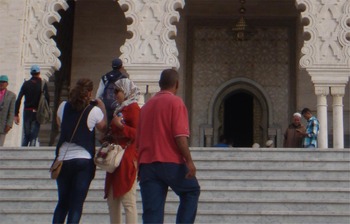
Reflective of its pluralistic traditions, influence by Europe, and location in the Arab periphery, Moroccan dress has Western, traditional, and religious elements. As elsewhere in North Africa, Western clothing is common for both genders, but religious styles are worn more often by women. Hijab (headscarf, without face veil, Figure 1), while traditionally worn in Morocco, has become more common as a result of Islamic revivalism in the 1970s (Mahmood Reference Mahmood2005).Footnote 6 Men may wear religious clothing or have Islamic-style grooming (e.g., beard), but most Moroccan men wear Western clothing and do not appear overtly religious. Traditional styles, such as the cloak and cap worn by the man in Figure 1, or Moroccan-style djallbe (loose coat) and traditional face veil for women, are mainly seen among older Moroccans. Modern, transnational styles of niqab (face veil), associated with salafi Islam, are rare in Morocco.
(Color online) Clothing style in Morocco (Rabat, 2012).

Dress, which takes on diverse styles, reflects identity in Arab and Muslim countries, as well as among Muslim minorities in Western countries (Lyons and Mandaville Reference Lyons and Mandaville2012). The most recognizable symbol of Islam worldwide, hijab is often essentializes as a symbol of oppression, yet it has complex and contradictory meanings. As Charrad (Reference Charrad2011, 429) notes: “Oppression, liberation, piety, cultural authenticity, heresy, and opposition to Westernization all compete to define the veil.” Movements have veiled and unveiled to resist colonialism and Western consumerism (Charrad Reference Charrad2011; El Guindi Reference El Guindi1999; Keddie Reference Keddie2007), linking hijab as much with agency and authenticity as with coercion when it is socially or legally required or repressed.
Many factors, including region and class, affect women's dress choice. Some don the traditional Moroccan djellaba and headscarf as a symbol of Arab or Moroccan identity. There is evidence of hijab being worn by wealthy, urban women in Morocco (Hessini Reference Hessini, Göçek and Balaghi1994), but poorer, rural, and Amazigh women more often wear hijab.Footnote 7 The late King Hassan II's daughters fulfilled royal duties unveiled since the 1950s (Maddy-Weitzman Reference Maddy-Weitzman2005).
Hijab has become politicized as a consequence of the rise of Islamist opposition movements since the 1970s. In Morocco, pictures of veiled women and girls were removed from school textbooks because, according to a government official, hijab represents only one political faction (Hamilton Reference Hamilton2006). Islamists may face economic repression, while women who wear the veil may encounter employment discrimination stemming from state repression or class-based stereotypes, reinforcing the advantages of the secular elite. Moroccan Nadia Fadir (Reference Fadir2009, 84) wrote about the job market: “Most of the time, the job announcement states that women should be ‘good looking and present herself well’ which automatically makes the hijab unacceptable. In many cases, as in mine, the reason for disqualification was given during oral feedback — the hijab!”
Despite its many social and political meanings, hijab is best understood as a symbol of religiosity and adherence to fundamentalist Islam (Essers and Benschop Reference Essers and Benschop2007). It provides interiority, allowing women to maintain traditionalism while accessing public space (Hessini Reference Hessini, Göçek and Balaghi1994). Hijab projects modesty and chastity — socially important traits — by protecting against perceptions of availability or immorality (Blaydes and Gillum Reference Blaydes and Gillum2013; Blaydes and Linzer Reference Blaydes and Linzer2008; Heyat Reference Heyat2008).
THEORY AND EXPECTATIONS
Although dress reflects personal choice, it plays a role in social identification, “the process of locating oneself, or another person, within a system of social categorizations” (Turner Reference Turner and Tajfel1982, 17–18). Social identity theory argues that individuals categorize themselves and others into social in- and out-groups and behave consistently with group membership (Tajfel et al. Reference Tajfel, Billig, Bundy and Flament1971). In the interviewer-respondent interaction, hijab, as well as religious dress for males, should signal real or perceived religiosity and identification with cross-national piety movements. Western dress signals secular orientation, particularly for females, who choose whether to wear hijab. Based on interviewer dress, as well as gender and class-based cues, respondents stereotype interviewers and may falsify or exaggerate responses — or refuse to divulge them all together — to avoid embarrassment, social sanction, or the appearance of disloyalty to their in-group. While actual consequences are unlikely, fear of potential sanction, in the form of loss of economic opportunities or reputational costs, may be enough to induce the respondent to edit his or her responses.
Religiosity-Of-Interviewer Response Effects
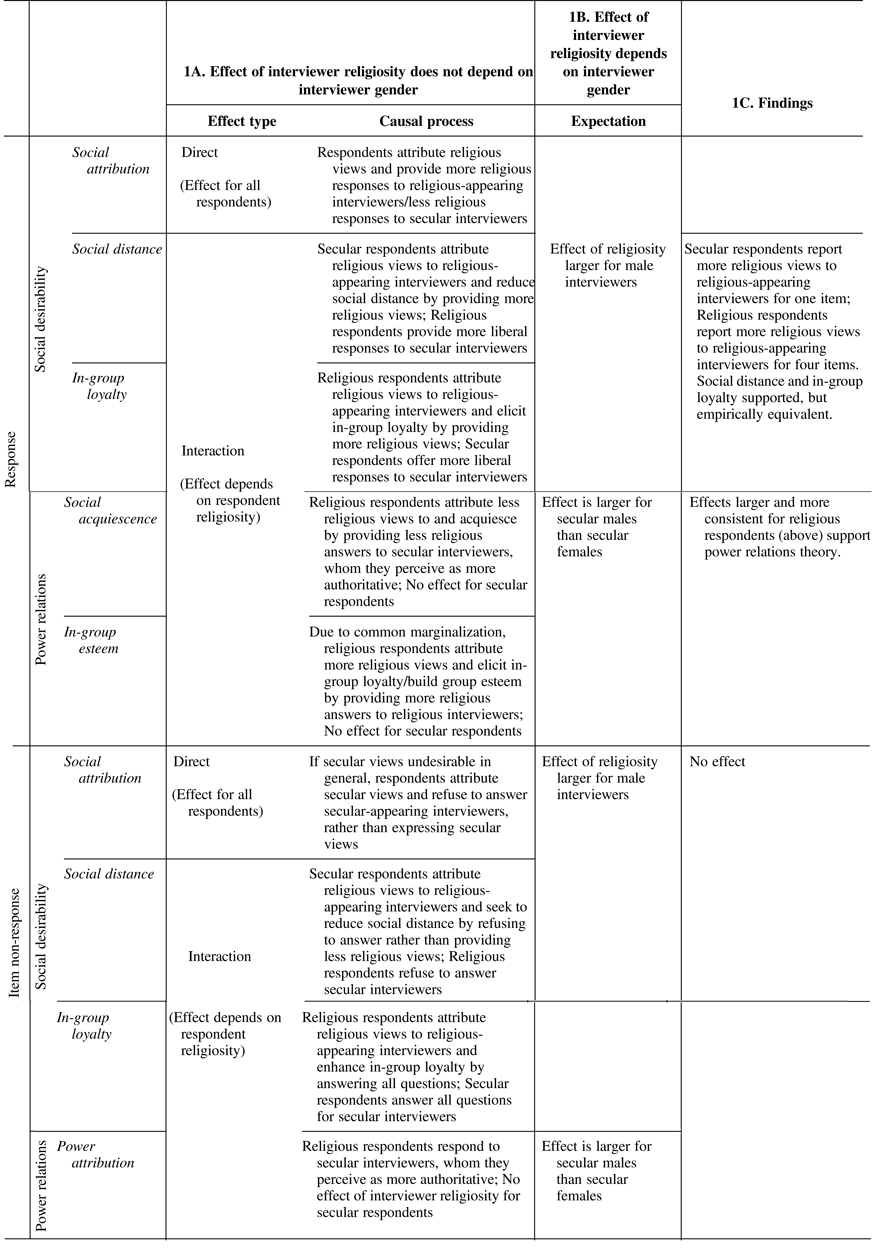
Two theoretical frameworks — social desirability and power relations — potentially explain response effects. As shown in column A of Table 1, social desirability theory posits that respondents engage in self-preservation and impression management by avoiding socially unacceptable views or conforming to socially-stereotyped views of the interviewer (Blaydes and Gillum Reference Blaydes and Gillum2013; DeMaio Reference DeMaio, Turner and Martin1984; Sudman and Bradburn Reference Sudman and Bradburn1974). Power relations theory takes into account inequality between groups, arguing that incentives to avoid socially undesirable views are more pronounced among members of vulnerable or less dominant groups (Kane and Macaulay Reference Kane and Macaulay1993).
Mechanisms underlying response and item non-response effects
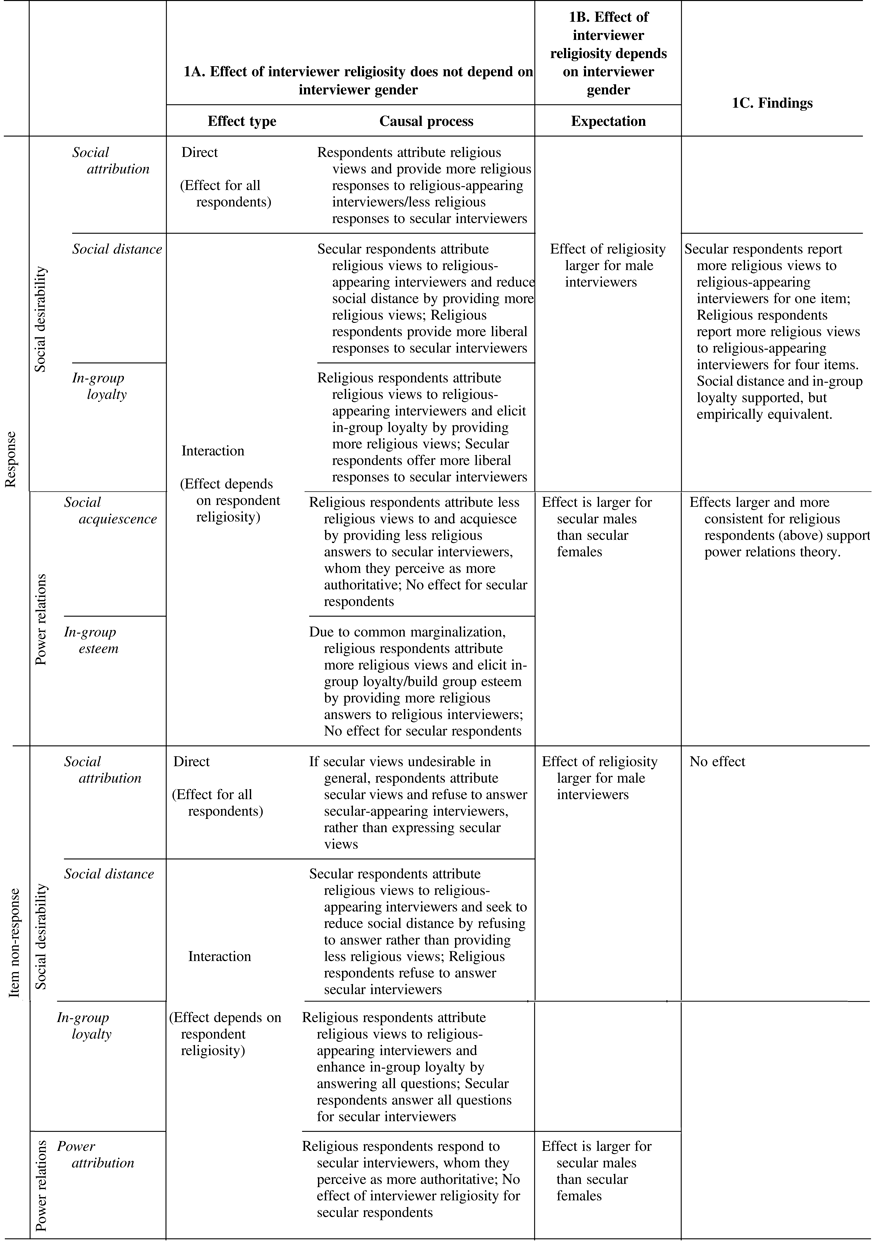
Three variants of social desirability — social attribution, social distance, and in-group loyalty models — are developed in the interviewer race literature in the United States (Gmel and Heeb Reference Gmel and Heeb2001; Lord, Friday, and Brennan Reference Lord, Friday and Brennan2005). Social attribution argues that all respondents conform to the interviewer's views, regardless of respondent identity (Gmel and Heeb Reference Gmel and Heeb2001). Because the effect depends only on interviewer traits, social attribution theory expects all respondents to report more religious views to religious-appearing interviewers and less religious views to secular-appearing interviewers (a direct effect).
Social distance theory posits that effects depend on the interviewer-respondent interaction; respondents edit their answers to conform to the stereotyped views of interviewers in order to reduce social distance (Webster Reference Webster1996; Williams Reference Williams1964). Secular respondents will provide more religious views to religious-appearing interviewers, while religious respondents will provide more secular answers when interviewed by a secular-appearing interviewer (an interaction effect). Some theorists also argue that in same-race dyads, respondents demonstrate loyalty and enhance in-group esteem by agreeing with the stereotyped views of their in-group (Anderson, Silver, and Abramson Reference Anderson, Silver and Abramson1988; Blaydes and Gillum Reference Blaydes and Gillum2013; Schuman and Converse Reference Schuman and Converse1971). However, when respondents' “true opinions” are not known, the predictions of social distance and in-group loyalty are empirically equivalent.
Power relations theory argues that when the respondent has lower social status than the interviewer, effects will be greater (Kane and Macaulay Reference Kane and Macaulay1993; Williams Reference Williams1964). A social acquiescence model expects that members of the non-dominant group — religious Moroccans — will acquiesce to the views of secular interviewers, due to fear of sanction from a higher status interviewer, whom they may associate with the secular state. In an authoritarian regime in which Islamist movements are repressed, citizens may worry about social or economic consequences of divulging Islamist views to a secular-appearing interviewer, even if consequences are actually unlikely. They may also seek to avoid embarrassment or criticism in the interview. In contrast, secular respondents are unlikely to edit their responses in conversations with a religious-appearing interviewer, due to the interviewer's equal or superior status. It is also plausible that members of the less powerful group will experience greater incentives to foster in-group loyalty and esteem as a result of the common experience of marginalization. Power acquiescence and in-group esteem models make empirically equivalent predictions.
Existing research supports social distance and in-group loyalty models, but also suggests larger effects for vulnerable respondents. Blaydes and Gillum (Reference Blaydes and Gillum2013) found larger effects in Egypt consistent with a social distance model for less educated and poorer respondents, as well as for Christians, who reported being less religious and more adherent to cultural practice to a female wearing hijab.
Intersectional Effects
Existing literature focuses on interviewer religiosity, but since most studies use same-gendered interviewing (Blaydes and Gillum Reference Blaydes and Gillum2013; Koker Reference Koker2009), they do not examine whether effects depend on interviewer gender. There is evidence of larger effects for male interviewers who wear Islamic-style clothing than conservative-appearing females. Benstead (Reference Benstead2013a) found higher reporting of voting for the Islamist Ennahda party in the 2011 Tunisian elections when the interviewer was a religious male than a religious female. As shown in column B of Table 1, social desirability theory expects larger effects for religious male than religious female interviewers because religious dress for men is rare and unambiguously signals Islamist orientation, while the headscarf is common among females. Power relations theory hypothesizes larger effects for secular male than secular female interviewers and religious male than religious female interviewers because of power differences between these groups. Because there were no religiously-dressed male interviewers in this study, the interviewer religiosity and gender interaction can only be tested across secular male and female interviewers.
Item Non-Response
Existing research does not consider how and why interviewer religiosity affects item non-response. Social desirability theory suggests that respondents might refuse to answer sensitive questions, rather than editing their responses. In support of a social attribution model, Berinsky (Reference Berinsky1999) shows that United States surveys overestimated support for racial integration because those in opposition were more likely to answer “don't know” than those who support it. In contrast, power relations theory argues that respondents skip fewer questions when the interviewer is authoritative, which leads to the expectation of lower item missing when the interview is male or secular-appearing. Benstead (Reference Benstead2013b) found respondents missed fewer questions when the interviewer was male, possibly due to higher authority of males than females in patriarchal societies.
Assuming most Moroccans hold relatively religious views, a social attribution model predicts respondents will be more likely to skip questions for secular male and female interviewers, than religious-appearing interviewers. However, a direct effect seems unlikely, given that secular responses may be undesirable in some situations and desirable in others, depending on the interviewer's in-group. Social distance and in-group loyalty expect respondents to skip answers when revealing them would create social distance, or violate in-group loyalty. In contrast, power attribution expects those with the highest status — secular males — will have lower rates of item-missing than those with least status — religious-appearing female interviewers.
Data and Methods
The data used to test these hypotheses are from a 2007 nationally-representative survey of 800 residents 18 years or older conducted face-to-face by 20 Moroccan students and faculty. The survey had 174 questions; the response rate was 42.9%.Footnote 8 The survey used the same interviewing team as the Arab Barometer, recruited two months earlier. The survey manager recorded interviewer gender and dress. The criterion for coding a male as overtly religious was having Islamic clothing or grooming, including an Islamic-style beard, forehead prayer mark, or Islamic-style clothing. Consistent with styles in Morocco, none of the 10 male interviewers appeared religious. Females with a headscarf (hijab) were coded as religious. Two of the female interviewers wore hijab without a veil, while eight wore Western clothing.
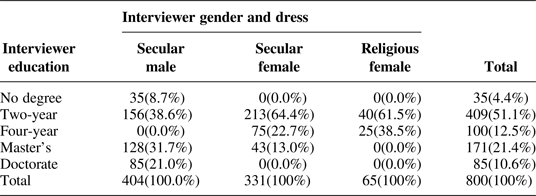
Table 2 shows the number of surveys by interviewer dress, gender, and education. Education is a proxy for age, which may affect reported religiosity. Morocco is a post-colonial country, where there has been resurgence in religious dress since the 1970s (Ahmed Reference Ahmed2011). Older interviewers may signal secularity because of generational shifts in religiosity or because they are more likely to be urban, Arab, and elite, due to only recent expansion of education to students from rural areas, Amazigh backgrounds, and popular classes.
Number of surveys conducted by interviewer gender, dress and education level
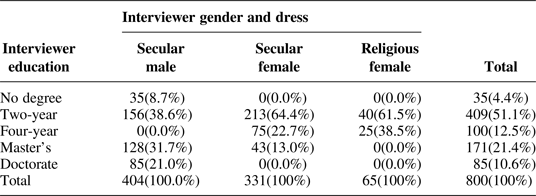
As will be discussed below, the study was quasi-experimental, requiring multivariate analysis to assess interviewer effects. However, the interviewer team offers some advantages. First, the interviewers' dress resembles that of Morocco's urban population (see Figure 1). Second, the interviewer core is similar to that of many cross-national surveys in Morocco, who often appear more secular, educated, and affluent than the general population. Although survey managers hire interviewers from other regions, most surveys are conducted by academics or for-profit firms in urban areas, largely with staff from these areas. These features enhance the generalizability of the findings to other Moroccan surveys conducted around 2007.
Interviewers received identical quotas and conducted mixed-sex interviews in one or two primary sampling units (PSUs). Multi-stage probability sampling was used to select households and quota sampling to select respondents. In the first stage, a random stratified sample of 12 electoral districts (the PSUs) throughout the country was selected using region and district magnitude as strata. In the second stage, sample lists were obtained from the National Statistics Office, consisting of randomly sampled addresses within systematically sampled blocks. Interviewers went to the addresses in their assigned block and used quotas to select one adult per household, where the strata were housing type, age, education, and gender. Quota proportions matched census data.
In the remaining nine PSUs, interviewers were randomly assigned to mixed-sex pairs and each pair to sampled blocks in their PSU. Interviewers worked independently, conducting mixed-sex interviews; while one interviewer conducted a survey, the other went to the next unit in the block. Interviewers had identical quotas, further minimizing the extent to which interviewer traits systematically affected respondent selection.
The design was quasi-experimental due to problems with randomization, which has been difficult to achieve elsewhere, including Mexico (Flores-Macias and Lawson Reference Flores-Macias and Lawson2008). Chi-squared tests showed that interviewer traits were related to some independent variables.Footnote 9 This occurred because males conducted interviews in three dangerous rural districts, resulting in a relationship between interviewer type and proportion rural and interviewer type and respondent education (p < 0. 001).
In some cases, due to social constraints, male interviewers could not complete all assigned interviews with females. Accordingly, female interviewers were more likely to interview females (p < 0.001), especially when the interviewer was not wearing hijab. Secular-appearing females conducted 64% of interviews with females, compared to 55% for females wearing hijab and 43% for males. These patterns offer insight into hijab's social meaning, suggesting it enhances women's access to public space (i.e., with males). Information on the traits of respondents who refused was not collected. However, mean refusals between completed interviewers were 0.85 for male, 2.05 for secular female, and 0.70 for religious female interviewers. Although the difference was not statistically significant, it suggests males had lower refusal rates, possibly due to higher authority, while females wearing hijab more easily established trust than females not wearing hijab.
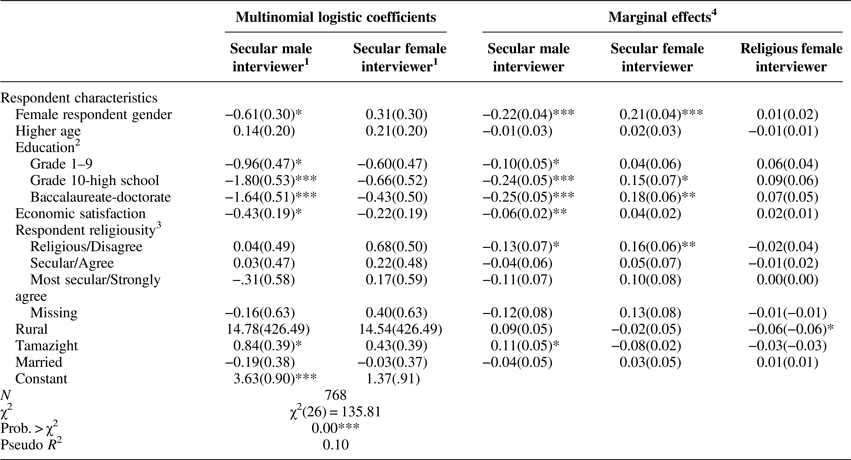
Because religiously-dressed females conducted interviews only in urban areas, they may have encountered more secular respondents than other interviewers, who conducted more rural interviews. Yet, as shown in Table 3, respondents gave more religious responses to these interviewers, despite being urban and expected to be more secular. For example, about 45% of respondents reported religious leaders should influence government to secular-appearing male or female interviewers, compared 56% to females wearing hijab.
Factors affecting interviewer assignment
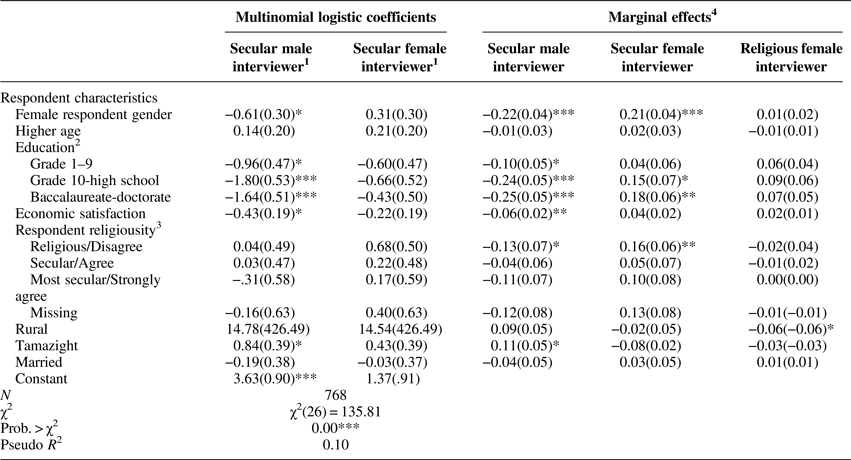
*p < 0.05 ** p < 0.01 ***p < 0.001 two-tailed test. Standard errors in parentheses. Reference groups: 1Female interviewer wearing headscarf. 2None. 3Most religious/strongly disagree. 4∂y/∂x change in y for one unit change in x/discrete change of dummy variable from 0–1. Comparison group is a married, Arabic-speaking female in Casablanca, with median age, economic satisfaction, education, and religiosity, interviewed by a male with a two-year degree.
To examine how interviewer traits shape respondent participation, I estimated a multinomial logistic regression with interviewer type as the dependent variable. The independent variables are the same as those in the main models.Footnote 10 As shown in Table 3, interviewers were 21% more likely to be female, not wearing hijab if the respondent was female and 22% more likely to be male if the interviewer was male (p < 0.001). Respondent gender was not systematically related to having a religious-appearing interviewer, which also suggests that headscarved women more easily enter public space. Under the quasi-experimental design, less educated, poorer, and Amazigh respondents were also more likely to be interviewed by males due to the respondents' rural residence. Yet, respondent religiosity did not predict interviewer type, suggesting that, to the extent interviewer characteristics affected the reporting of religious orientations, it was not explained by more religious people more readily participating when the interviewer appeared religious.
RELIGIOUSLY-SENSITIVE QUESTIONS
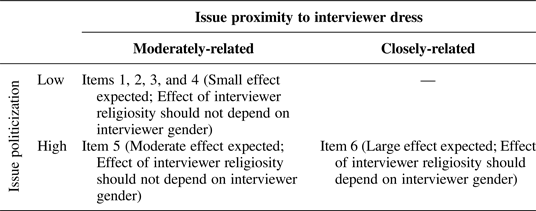
The survey contains six questions related to Islamic practice and belief.Footnote 11 The size of religiosity-of-interviewer effects likely depends on issue politicization (Huddy et al. Reference Huddy, Billig, Bracciodieta, Hoeffler, Moynihan and Pugliani1997; Sudman and Bradburn Reference Sudman and Bradburn1974), as well as issue proximity to interviewer dress. Intersectional effects may occur for all items (column B of Table 1) or specific issues, depending on their salience and relevance to observed interviewer traits (Table 4).
Expected effect size and type by issue politicization and relevance to observable interviewer trait
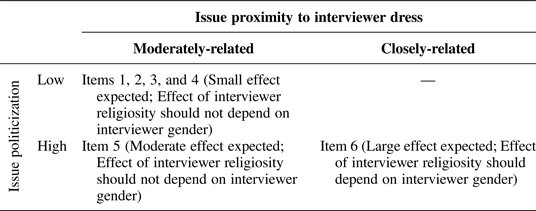
Effects should be small for Items 1–4 because these issues are not directly related to interviewer traits and not contentious. Morocco is a homogenous nation — 99% Sunni Muslim — limiting the salience of minority political rights (Item 3). Islam and the monarchy form the bedrock of Moroccan society and enjoy widespread legitimacy. Public discourse cannot breach the taboos of Islam or the king (Article 7), spelled out in the 1996 constitution and reflected in the country's motto, “God, the country, and the king.” Article 39 states that parliamentary immunity goes only as far as disrespecting Islam or the king, who is “Defender of the Faith” (“Constitution of Morocco 1996”). Small effects are therefore expected for Items 1–4, which asks about the role of religion in society, confidence in religious leaders, and the relationship between religion and politics.
-
• Item 1: For each item, please tell me whether the Parliament should accord it secondary (= 0), moderate (= 0), high (= 1), very high priority (= 1): Reinforce religion in society.
-
• Item 2: Please tell me whether you have a lot (= 1), some (= 0), not much confidence (= 0) in the following groups to help Morocco reach its important goals: Religious leaders.
-
• Item 3: People of all ethnicities and religions should have equal political rights. Strongly agree (= 0), agree (= 0), disagree (= 1), strongly disagree (= 1).
-
• Item 4: In your opinion how should the relationship between religion and politics be in Morocco? Please indicate a number between 1 and 7, where 1 is complete independence and 7 is complete fusion.
Two issues were politicized in Morocco at the time of the survey — the role of Islamic law (Item 5) and religious dress (Item 6) — due to the emergence of Islamist opposition movements and debate about family code reform. As shown in Table 4, moderate effects are expected for Shari'a law because of polarization in society surrounding its implementation (Benstead Reference Benstead2014), while large effects are expected for dress, due to its politicization and direct relevance to the observable trait. Religiosity-of-interviewer effects should also depend on interviewer gender for Item 6, due to the clear signal of religious or secular orientation communicated by women's dress.
-
• Item 5: In your opinion how should laws be made in Morocco? 1 corresponds to the people's wishes and 7 to Shari'a only.
-
• Item 6: When considering your choice of clothing, how important are religious considerations? Very (= 1), somewhat (= 0), not very (= 0), not at all important (= 0).
RESULTS AND DISCUSSION
For each item, I use multivariate regression to test the effect of interviewer dress and gender on responses and missing data, controlling for factors that may systematically affect whether interviewers agree or refuse to participate. To test whether effects depend on respondent religiosity, I divide respondents into religious and secular groups using a measure of support for or opposition to political Islam.Footnote 12 While answers to this item may be affected by interviewer traits, dichotomizing respondents is necessary to test the theoretical framework. Other measures, such as respondent dress, are not available. Analysis of interviewer assignment (Table 3) also finds this item does not predict interviewer type, suggesting that reverse causation is not occurring.
To control for regional variation in attitudes, I include district fixed effects. For scale items, I use ordinary least squares (OLS) regression.Footnote 13 For ordinal dependent variables, I dichotomize outcomes of the dependent variable using multinomial regressions results and analyze them using logistic regression.Footnote 14 I also create a variable equal to one if at least one of the six items is missing and zero if none are missing.
In addition, I control for respondent gender, age, education, economic satisfaction, rural residence, language, and marital status (Table A1). Except for the religiosity variable used to categorize respondents into groups, which is missing for 46 cases (6%), the independent variables are missing for no more than five cases (1%).Footnote 15 The results are robust to multiple specifications, including models with only a few variables. A Breusch-Pagan/Cook-Weisberg test for heteroskedasticity for OLS models is not significant, indicating the assumption of constant variance is not violated and supporting the robustness of the results.
Religiosity-of-Interviewer Response Effects
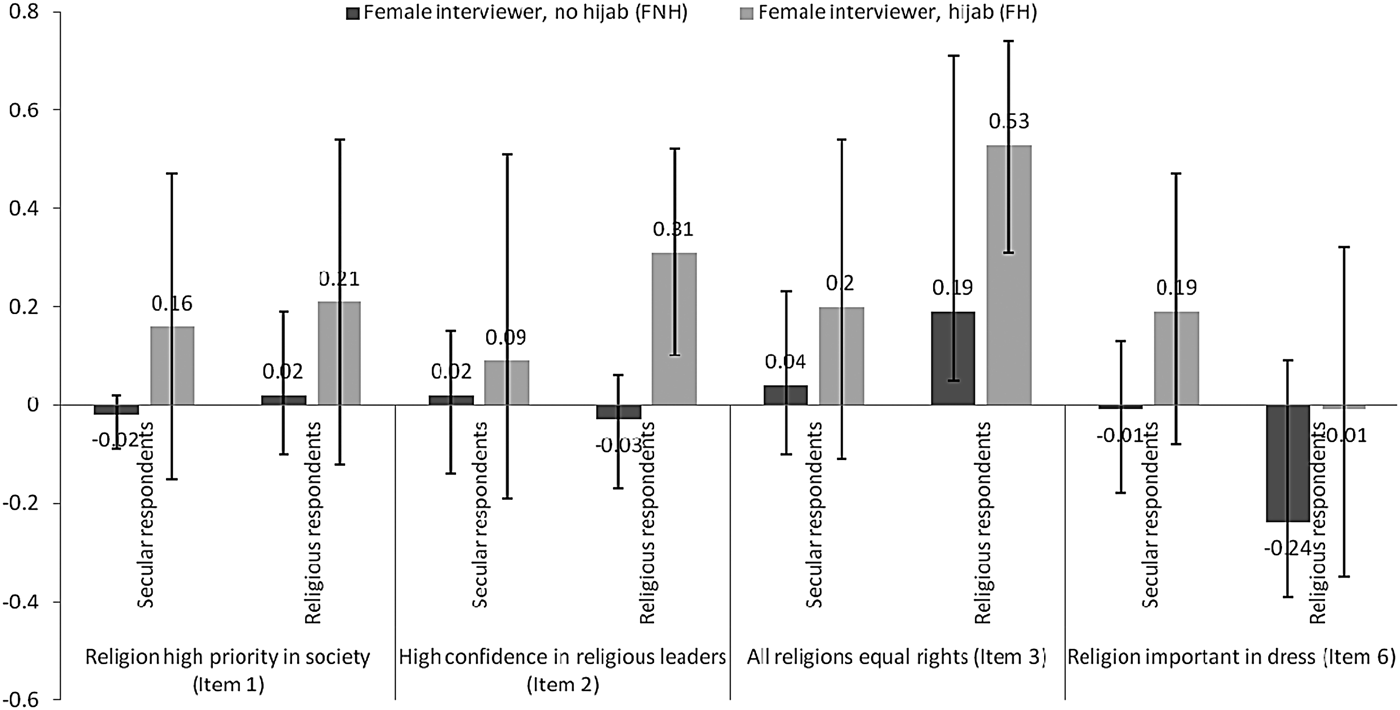
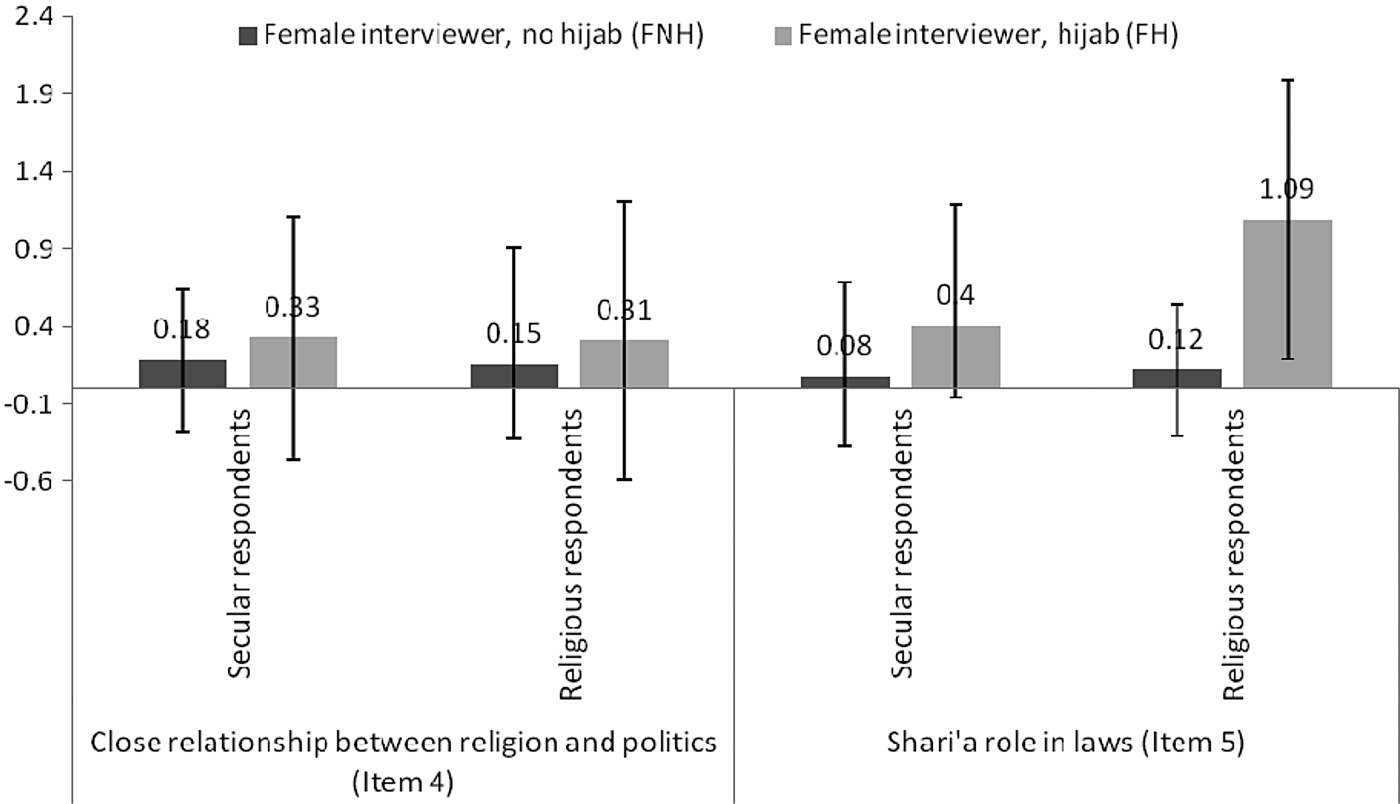
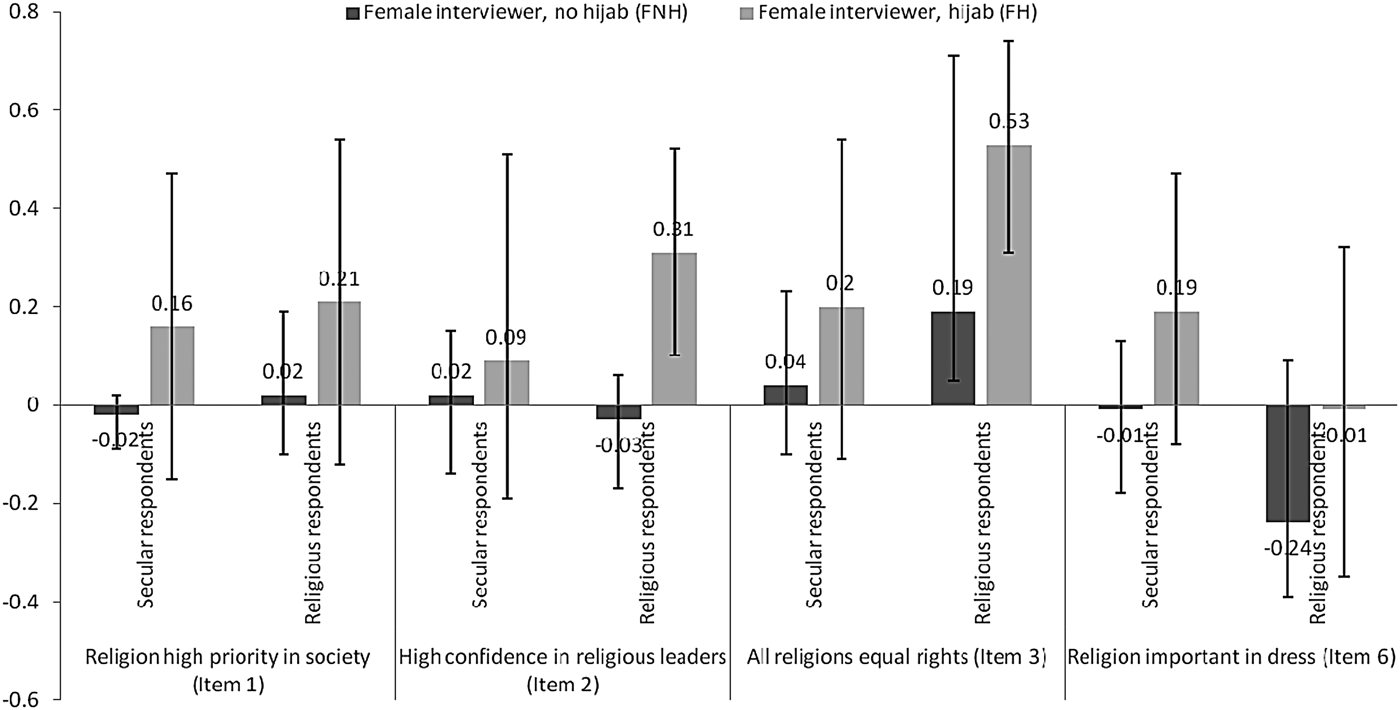
Figures 2 and 3 show that interviewer traits systematically affect responses, but effects are larger and more consistent for religious respondents, for whom four of six items are affected.Footnote 16 As shown in Figure 1, when interviewed by a female wearing hijab, religious respondents with median characteristics are 31% more likely to have high confidence in religious leaders than those interviewed by secular males (p < 0.01, Item 2) and 34% more likely to express this view than when interviewed by secular females (p < 0.01, Item 2). When interviewed by a female wearing hijab, religious respondents are 53% less likely to agree or strongly agree that minorities should have equal rights than when interviewed by secular males (p < 0.001, Item 3) and 34% more likely to respond in this way than when interviewed by secular females (p < 0.05, Item 3). Religious respondents also elicit 1.09 units greater support for Shari'a when queried by religious-appearing interviewers, compared to those interviewed by secular males (p < 0.05, Item 5), and 0.97 units higher compared to those interviewed by secular females (p < 0.05, Item 5).
Marginal effects of interviewer gender and dress on the probability of more religious response.
Effect of interviewer gender and dress on scale of more religious response.

The results suggest two mechanisms are at work. In conversation with secular-appearing interviewers, religious respondents appear to edit religious responses in order to reduce social distance and avoid sanction from secular-appearing interviewers perceived as linked to the secular, authoritarian state. When interviewed by religious-appearing interviewers, respondents may exaggerate religious views to enhance in-group esteem and safeguard their reputation in a society that values piety. Larger and more consistent effects for religious respondents support power relations theory.
Secular respondents, who are relatively economically-advantaged, appear to have minimal incentives to reduce social distance or enhance in-group loyalty, in support of power relations theory. When interviewed by a female wearing hijab, secular respondents are 20% more likely to say minorities should not have equal rights than when interviewed by secular males (p < 0.05, Item 3) and 16% more likely than when interviewed by secular females, although the difference is not statistically significant (Wald test, Item 3). This effect is not significant for the median respondent depicted in Figure 1, underscoring the conclusion that effects are more consistent for religious respondents.
Intersectional Effects
Theoretically, interviewer religiosity effects could depend on interviewer gender. For the five questions not directly related to dress choice, there is limited evidence of an interaction between interviewer dress and interviewer gender. For only one item — belief that minorities should not have equal rights (Item 3) — secular-appearing females are 19% more likely to elicit religious responses from religious respondents than secular male interviewers (p < 0.01). Religious respondents may be unwilling to express Islamist orientations to secular males, whom they link to the secular, authoritarian state.
Interviewer religiosity and gender intersect for the gendered issue — dress choice. Among religious respondents, secular female interviewers received less religious responses than secular males, due to the unambiguous signal of the presence or absence of a headscarf for women. Religious respondents are 24% less likely to say religious considerations are very important when interviewed by a female not wearing hijab than male interviewers (p < 0.001, Item 6).
Issue Salience and Proximity to Traits
As hypothesized, effects are large among religious respondents for support for Shari'a law (Item 5) and religious considerations in dress (Item 6). For religious respondents, the impact of having a religious interviewer is also substantial for minority political rights — a 53% increase in the probability of a more religious response to an interviewer wearing hijab. This illustrates the potential for bias, even for items that are not salient in public debate.
Item Non-Response
As shown in Figure 3, the results do not suggest that respondents refuse to answer rather than reveal socially undesirable views.Footnote 17
CONCLUSION AND IMPLICATIONS
This study illustrates the potential for bias arising from interviewer dress, particularly when religious attitudes are compared across countries, survey firms, or time. In Morocco, four of six items are significantly affected in the sample as a whole (Figures 2 and 3). The largest effects — and the greater possibility of bias — occur for politicized issues, many of which are common in existing literature, but large effects are also present for non-salient issues such as rights of non-Muslims.
The presence of larger and more consistent effects for religious respondents is revealing. Consistent with Blaydes and Gillum (Reference Blaydes and Gillum2013), more vulnerable Moroccans — in this case, religious citizens — appear to experience greater incentives to self-preserve. This finding sheds light on the dynamics surrounding religious-secular cleavages in a society with a relatively secular elite and ascendant Islamist movement. The largest effect is a 53% increase in the probability of reporting that religious minorities should not have equal political rights when the interviewer is a religious-appearing female, compared to a secular male. This effect is substantial and possibly arises as a result of two mechanisms: religious respondents may conform to the perceived views of secular respondents, whom they associate with the authoritarian state or exaggerate piety in conversation with religious-appearing interviewers in order to safeguard their reputation and increase in-group esteem.
Secular respondents appear relatively unaffected by social pressure that might lead them to edit their responses. While society values piety, secular respondents do not appear to be affected by reputational concerns in conversation with religious interviewers. In the sample as a whole (Figures 2 and 3), secular respondents are 20% less likely to oppose equal rights when interviewed by a secular male than a religious female, consistent with social distance or in-group loyalty models. There is no evidence respondents strategically refuse to answer sensitive questions rather than reveal undesirable views.
The findings also illustrate the complexity of intersecting religious, gender, and class identities in contemporary Morocco and underscore the importance of gathering data on interviewer traits in other contexts, in which social dynamics may differ. In Morocco, interviewer religiosity and interviewer gender interactively affect responses to religiously-sensitive questions. Thus, it may be problematic that researchers did not report interviewer gender or dress in a recent study of seven societies, which reported attitudes about whether women should be able to dress as they wish ranging from 56% in Tunisia to 14% in Egypt (Greene Reference Greene2014).
As in other Arab countries, interviewers in Morocco may dress in ways that signal secularity and affluence, leading to potential underestimation of religiosity. The presence and size of effects depends on interviewer traits, which may change over time, potentially leading to erroneous conclusions about attitude change. Over the past few decades, religious dress has become more common in many Arab countries. In Tunisia, few women — and even fewer men — wore religious attire under the secular Ben Ali regime. Yet, following the revolution, more Tunisians — in the population as well interviewer teams — could wear religious dress, possibly contributing to overestimation of religiosity or support for Islamist parties. Bias could stem not only from differences in interviewer dress, but also from shifts in the relative power and level of conflict between groups. In affluent Gulf countries, interviews are usually conducted by non-nationals, whose dress, religion, or socioeconomic status may differ from respondents, underscoring the need to collect data from a wide range of Middle East and North Africa contexts in order to build a comparative framework of religiosity-of-interviewer effects and better understand the conditions under which respondents will be willing to publically represent their true opinions. The same is true of authoritarian contexts, where survey research has become more voluminous, but little is known about the extent to which respondents self-preserve to prevent expressing views that might put them at odds with the regime.
To mitigate potential bias — and to allow readers to better assess survey results — interviewer dress should be recorded, reported, and controlled for in social surveys across the region. Future research on interviewer effects should increase the number of interviewers and include religiously-appearing males in order to fully test the theoretical models presented in this paper. Larger samples and a randomized design are needed and detailed information on refusals, including respondent gender and religious dress, should be recorded. Studies should examine a four-way interaction between interviewer-respondent religion and gender, and could examine other intersecting respondent or interviewer identities, such as income, rural origin, tribe, or national identity. Following the Arab transitions, as religion remains politicized, analysis of interviewer effects is critical for improving survey practice, exploring social dynamics, and building comparative frameworks of response and item non-response effects.
Supplementary materials and methods
To view supplementary material for this article, please visit http://dx.doi.org/10.1017/S1755048314000455.