Introduction
Ageism is defined as: “a process of systematic stereotyping and discrimination against people because they are old” (Butler, Reference Butler and Maddox1995, p. 38) and is a widespread human phenomenon. It is more pronounced among men and more prevalent among younger people, but is evident in both genders and all age groups, including the elderly (Levy and Banaji, Reference Levy, Banaji and Nelson2004). When people age they move from a social group of younger to a group of older adults. Ageism may then develop into a form of what we call “intragenerational ageism”, i.e. negative perceptions about people of one's own age (Bodner, Reference Bodner2009).
Sheltered housing is a dwelling arrangement designed specifically for elderly people (Shippee, Reference Shippee2009). It provides few opportunities for intergenerational interactions and more opportunities for intra-generational interactions. Interviews and observations conducted in sheltered housing communities demonstrate that although the tenants live with other older adults, they perceive themselves as belonging to a younger age group, and may therefore possess ageist attitudes towards people of their own age (Gamliel, Reference Gamliel2003; Gamliel and Hazan, Reference Gamliel and Hazan2006).
Previous studies found correlations between negative perceptions of old age and the perceived quality of life (QoL) at advanced age (Bodner and Cohen-Fridel, Reference Bodner and Cohen-Fridel2010; Hausdorff, et al., Reference Hausdorff, Levy and Wei1999). The term “quality of life” refers to a vast array of domains, including states of psychological distress or well-being, ability to function cognitively, socially, sexually and emotionally, perceived health, and the ability to perform daily activities (Stewart and King Reference Stewart, King, Abeles, Gift and Ory1994). The aim of the present study is, to examine differences in ageist attitudes and perceived QoL between elderly persons who live in sheltered housing and those who live in the community.
Sheltered housing – also termed assisted living, retirement community, continuing care retirement, and personal care home – is a way of living for the elderly which affords supportive services in home-like surroundings (Lightman, Reference Lightman1992). Sheltered housing in Israel is either private or supported by the government, and is designed according to a model aimed at preserving the autonomy and independence of the tenants (i.e. a separate unit with all the facilities necessary for independent living), which will provide supportive and long-term services according to their preferences (e.g. Chapin and Dobbs-Kepper, Reference Chapin and Dobbs-Kepper2001). The tenants in private sheltered housing live in relatively luxurious settings which provide them with many facilities. Only people with strong financial resources can afford this standard of living (Brodsky et al., Reference Brodsky, Schnoor and Be'er2001).
Perceptions of aging among elderly people who live in sheltered housing in Israel were studied comprehensively in two qualitative studies by Gamliel (Reference Gamliel2003) and Gamliel and Hazan (Reference Gamliel and Hazan2006). In these studies, the tenants were interviewed and observed for months while functioning in various areas of the house, especially in the lobby. Based on these interviews and observations, Gamliel (Reference Gamliel2003) described many of the tenants as “denier [deny-er] tenants” (i.e. tenants who deny their identity as elderly people). For example, she observed that some of the tenants volunteered to perform various functions in the house which were based on their past professional identity (e.g. roles of teachers, lecturers and lawyers). Others tried to ensure the removal of elders who were physically handicapped from the lobby to less conspicuous areas of the house. According to Gamliel (Reference Gamliel2003), these maneuvers enabled the tenants to deny their old age and decrease depressive feelings and dissatisfaction. In our view, by being “denier tenants” they could perceive themselves as belonging to a younger age group, a social coping mechanism which is described as an adjustable mechanism in old age (e.g. Kite and Wagner, Reference Kite, Wagner and Nelson2002).
The hypotheses of the current study are based on the above mentioned studies and findings, namely: (1) elderly people who live in private sheltered housing (and who deny their aging process) will report more ageist attitudes than those who live in the community; and (2) elderly people who live in private sheltered housing will report lower perceived QoL than those who live in the community, based on the inverse relations that were found between negative perceptions of aging and positive QoL.
These hypotheses will be examined according to gender differences, and in comparison with previous studies which found that elderly women demonstrate less ageist attitudes than elderly men (e.g. Bodner and Cohen-Fridel, Reference Bodner and Cohen-Fridel2010), and have a better capability for social relations (e.g. Davidson, Reference Davidson2000). In addition, we will explore the relations between perceived QoL, sociodemographic variables, and ageist attitudes among elderly people who live in sheltered housing and in the community.
Methods
Participants and procedure
Research assistants approached elderly people while they were taking part in social activities in day-centers and sheltered housing. They explained that the study aimed to examine opinions of elderly people about people of their own age. The participants agreed to take part in the study voluntarily. After they signed an informed consent form, they were given the questionnaires individually, and answered the questionnaire in the presence of a research assistant. The sample of participants from the private sheltered housing sector was recruited from a network of houses in which the habitants are of medium-high socioeconomic status. The characteristics of the sample are in accordance with previous descriptions of the population of private sheltered houses in Israel (e.g. Doron and Lightman, Reference Doron and Lightman2003). The sample of the community-dwelling participants was recruited from day-centers, located in medium to high socioeconomic status neighborhoods. The inclusion criteria for the participants were: a health condition that enabled participants to fully cooperate with the research assistances; age above 64 years; and a medium-high socioeconomic status (to avoid an impact of low economic status on ageist attitudes). Of this sample, 18% were excluded from data analyses because of incompletion of the questionnaires. Anonymity and confidentiality were ensured. The Bar-Ilan University Ethics Committee approved the study protocol.
Measures
Fraboni Scale of Ageism (FSA). This scale was developed by Fraboni et al. (Reference Fraboni, Saltstone and Hughes1990). A confirmatory factor analysis yielded four factors regarding ageism in older adults that explained 51.08% of the variance. The first factor, “intergenerational,” expresses the participants’ perception regarding their ingroup (with high internal reliability of Cronbach's coefficient, α = 0.73). The second factor, “separation,” represents the tendency to avoid direct or indirect contact with elderly people (α = 0.68). The third factor, “affective,” represents negative affects towards elderly people's expected utility to society (α = 0.60). Items associated with the fourth factor, “stereotypes,” represent a variety of negative attitudes toward the elderly (α = 0.58). The FSA thus yielded four separate scores for each participant's expressed ageism, based on the means of responses ranging from 1 (less ageist attitudes) to 6 (more ageist attitudes) for each factor.
SF-36 Health Status Scale. This questionnaire (Ware and Sherbourne, Reference Ware and Sherbourne1992) is commonly used in elderly people with limited morbidity who live in the community (Haywood et al., Reference Haywood, Garratt and Fitzpatrick2005). Participants are asked to score their evaluations on eight health scales, referring to the present week and to the past four weeks: (1) physical functioning; (2) role-physical; (3) bodily pain; (4) general health; (5) vitality; (6) role-emotional; (7) mental health; (8) social functioning. The higher the scores, the better the perceived QoL (e.g. a high score on bodily pain means less bodily pain). Cronbach's α reliability coefficients are over 0.80 for each of the scales, and there is evidence of good construct validity (Lewin-Epstein et al., Reference Lewin-Epstein, Sagiv-Shifter, Shabtai and Shmueli1998).
Demographic information was gathered from the participants about their gender, age, socioeconomic status, dwelling situation, formal education and marital status.
Data analysis
In order to test the first hypothesis we conducted two-way multivariate analysis of covariance (MANCOVA). Dwelling place (sheltered housing vs. community) and gender were the independent variables, and the four ageism measures (separation, affective, stereotypes, and intergenerational) were the dependent variables. Age was regarded as a covariate variable, because the participants’ ages spanned a range of 30 years. To test the second hypothesis, a two-way MANCOVA was conducted. Dwelling place and gender were the independent variables, the eight QoL scales served as dependent variables, and age was held as a covariate. With the aim of exploring the relations between perceived QoL and ageist attitudes among elderly persons who live in sheltered housing or in the community, four multiple linear regression analyses were conducted. The sociodemographic variables (gender, age, formal education, socioeconomic status and dwelling location) and the eight QoL scales (physical functioning, role-physical, bodily pain, general health, role-emotional, mental health, and social) served as explanatory variables (independent variables). The ageism factors (separation, affective, stereotypes, and intergenerational) were the dependent variables in each analysis separately. The SPSS version 18 was used for the statistical analyses.
Results
Comparative description of the study groups
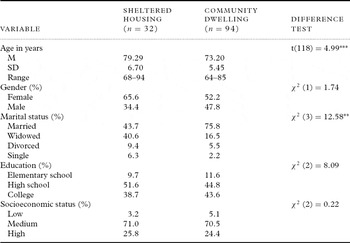
A comparison of the sociodemographic characteristics of the two study groups is summarized and presented in Table 1.
Background characteristics of the study groups

Note: Total N = 126.
**p < 0.01, ***p < 0.001.
The two groups differed in age and marital status. Community-dwelling participants were younger, and more of them were married. No differences were found on the other demographic variables: gender, level of education and socioeconomic status. The differences in the distribution of marital status and age were similar to those reported in previous studies (e.g. Doron and Lightman, Reference Doron and Lightman2003).
Differences in ageism between community-dwelling and sheltered housing groups
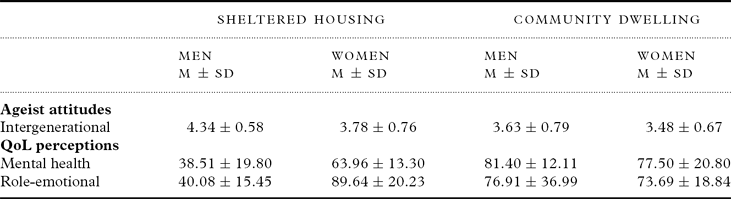
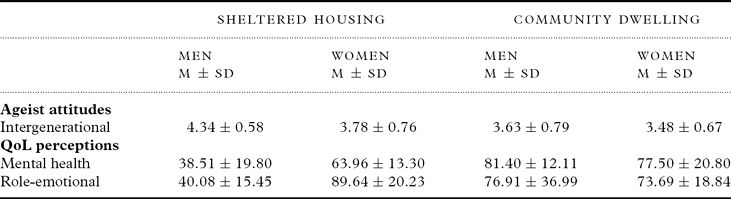
A two-way multivariate analysis of covariance (MANCOVA) was conducted to test the first hypothesis. The covariate variable was not significant (F(4, 112) = 1.63, p > 0.05), η 2 = 0.06. The MANCOVA revealed a significant interaction for dwelling place × gender for the factor of “intergenerational” (F(1, 115) = 4.42, p < 0.05, η 2 = 0.04), and is presented in Table 2. Further simple main effects analyses indicated that the perception of ageism in “intergenerational” was relatively low for elderly persons who live in the community, and did not indicate gender differences (see Table 2). In contradistinction, the perception of ageism in the “intergenerational” factor was generally high among the elderly who lived in sheltered housing, and indicated gender differences, such that men expressed significantly more negative attitudes than women regarding the idea of interacting with younger adults (see Table 2). The MANCOVA also revealed a main effect for dwelling place (F(1, 115) = 9.74, p < 0.01, η 2 = 0.08), regarding the “intergenerational” factor, which indicated that elderly persons living in sheltered housing expressed a higher level of the “intergenerational” factor (M = 3.92, SD = 0.67) than those who lived in the community (M = 3.54 SD = 0.73). Gender differences were also found on the factor of “separation” (F(1, 115) = 11.58, p < 0.001, η 2 = 0.09). Men scored higher than women on “separation” (M = 3.13, SD = 0.84 vs. M = 2.54, SD = 0.94, respectively).
Interaction means and standard deviations for gender × dwelling place (sheltered housing/community) regarding ageism and quality of life (QoL)*
*The higher the mean the higher the perception of QoL.
Differences in QoL between community dwelling and sheltered housing dwelling groups
A two-way MANCOVA was conducted to test the second hypothesis. Age was held as a covariate and was found to be significant (F(8,78) = 2.64, p < 0.05, η 2 = 0.21). The MANCOVA yielded significant interactions between dwelling place × gender which were found on the mental health scale (F(1,85) = 9.09, p < 0.01, η 2 = 0.10), and on the “role-emotional” scale (F(1,85) = 6.54, p < 0.01, η 2 = 0.07). The interactions are also presented in Table 2.
Further simple main effects analyses indicated that “mental health” reported by community-dwelling persons was higher than “mental health” reported by tenants in sheltered housing. However, among the elderly who live in sheltered housing, women reported better mental health than men, whereas no gender differences were found among elderly persons living in the community. The “role-emotional” scale also did not yield gender differences among elderly people who lived in the community. However, among the elderly who lived in sheltered housing, women reported better “role-emotional” (i.e. better functioning health) than men.
The MANCOVA also yielded a main effect for dwelling place on the “mental health” scale (F(1,85) = 29.12, p < 0.001, η 2 = 0.26), and on the “social functioning” scale (F(1,85) = 5.80, p < 0.05, η 2 = 0.07). Elderly people who lived in the community expressed better mental health (M = 79.45, SD = 12.78), than those who lived in sheltered housing (M = 51.23, SD = 29.82). However, the elderly who lived in sheltered housing evaluated their social functioning as higher (M = 94.94, SD = 22.54) than those who lived in the community (M = 76.70 SD = 20.09). The other QoL scales did not show significant differences with reference to dwelling place and gender.
Explanatory analyses of ageism
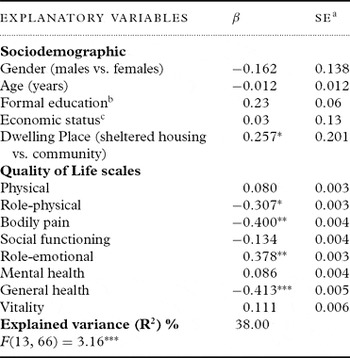
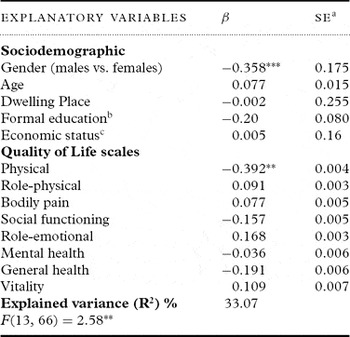
Four multiple regression analyses were conducted in order to examine the relations between perceived QoL and ageist attitudes. The sociodemographic variables and the QoL scales were the independent variables, and the ageism factors were the dependent variables in each analysis separately. The explained variance for the “affective” and “stereotypes” factors did not reach significance. We therefore do not present these regression analyses. Tables 3 and 4 summarize the results of the analyses for the “intergenerational” and “separation” factors, respectively.
Multiple regression analyses results for explaining the ageism (intergenerational)

a SE = standard error.
b Includes the categories of: elementary school, high school, college.
c Includes the categories of: low, medium, high.
*p < 0.05, **p < 0.01, ***p < 0.001.
Multiple regression analyses results for explaining the ageism (separation)

a SE = standard error.
b Includes the categories of: elementary school, high school, college.
c Includes the categories of: low, medium, high.
*p < 0.05, **p < 0.01, ***p < 0.001.
Dwelling place and the QoL scales (“role-physical,” “bodily pain,” “general health,” and “role-emotional”) contributed significantly to the explained variance of the “intergenerational” factor which expresses the participants’ perception regarding their ingroup age versus outgroups. The β coefficient of dwelling place indicated that elderly persons who live in sheltered housing express more ageism on “intergenerational” than those who live in the community. The β coefficients for the QoL scales of “role-physical”, “bodily pain” and “general health” were negative, indicating that the better the QoL in these aspects, the lower the ageism expressed. In contradistinction, the coefficient for the QoL scale of “role-emotional” was positive, indicating that the higher the score on this QoL scale, the higher the score on “intergeneration.” The remaining independent variables did not reach significance.
The regression analysis for the “separation” factor is presented in Table 4. The results show that only gender and the QoL “physical” scale contributed significantly to the explained variance of the “separation” factor which measures the tendency to avoid contact with elderly people. The β coefficients for both variables were negative, indicating that men were higher on separation than women, and that the higher the scores on the “physical” scale, the lower the score on “separation.” Dwelling place was not found to be a significant explanatory variable for “separation,” nor were the other QoL scales.
To summarize the results section, the analyses partially confirm the first hypothesis. Older persons who live in sheltered housing expressed more ageist attitudes on the “intergenerational” factor than those who live in the community. An interaction between dwelling place × gender was found for “intergenerational,” and gender differences were found for “separation”. The findings also partially support the second hypothesis. Tenants in sheltered housing expressed lower evaluations on the QoL scale of “mental health,” but higher evaluations on “social functioning.” No significant differences were found on the other QoL scales. The interaction effect of dwelling place × gender in “mental health” showed that older women who lived in sheltered housing reported better “mental health” than men, while no such gender differences were found among those living in the community.
The regression analyses indicate that the dwelling place is associated with ageism on the “intergenerational” factor (e.g. elderly who live in sheltered housing are more ageist). Furthermore, higher evaluations on the QoL scales of “bodily pain” and “role-emotional” and lower evaluations on “role-physical” and “general health” are connected with higher ageism on the “intergenerational” factor. Gender and “physical scale” are related to ageism on “separation,” such that women and higher scores on the “physical scale” are associated with less ageism.
Discussion
The results of our study suggest that the preference of elderly people to live in a uni-age setting (e.g. in private sheltered housing) is associated with the tenants’ intergenerational ageist attitudes. Intergenerational attitudes express a social perspective according to which the elderly should nurture social relations with people of their own age, instead of with younger adults. Gender differences concerning intergenerational ageist attitudes were also noted, so that men in sheltered housing favored relations with people of their own age, compared with women in sheltered housing and both men and women who live in the community.
Two different interpretations can be applied to these results. On the one hand, it is possible that the preference to associate with older and not with younger adults stems from low self-esteem. The elderly who live in sheltered housing may not consider themselves attractive enough for younger adults, and may, therefore unwillingly, compromise and accept the social presence of people of their own age. On the other hand, the preference to associate with elderly persons may not stem from self-ageism, but may in fact truly reflect social acceptance of people of their own age. According to this interpretation, the intentional choice to live with people of their own age in sheltered housing causes the elderly to be their ingroup, that is, the group to which they want to belong and which they prefer over younger age groups.
This second interpretation is based on the Social Identity Theory (SIT; Tajfel, Reference Tajfel1981), which has already been implemented in the study of age perceptions (Kite and Wagner, Reference Kite, Wagner and Nelson2002). According to this theory, our identity is comprised of personal and social identities. Our social identity reflects our belonging to various social groups. They become salient when we classify ourselves as peers in a particular group, based on a shared trait, such as gender, nationality, religion, profession, or age. This belonging causes the individual to define his/her social group as his/her ingroup, and all others who do not belong to this group as the outgroup. SIT adds that we achieve a social identity by finding differences between our ingroup and other outgroups, and by making social comparisons in order to empower our own social identity. This tendency is termed the “intergroup bias.” When we run out of positive perceptions of our ingroup, we prefer to desert it or try to decrease our sense of belonging to it.
Previous ethnographies on sheltered housing also support our finding regarding the social-age stratification that the elderly in sheltered housing construct (e.g. Gamliel and Hazan, Reference Gamliel and Hazan2006). These studies describe how healthy tenants react to visible signs of physical disability among their peers as defining characteristics of old age, and so label them as older persons and try to avoid them.
Another interesting result of our study was that gender is related negatively to ageism on the “separation” factor (e.g. women received lower scores than men on this factor). The “separation” factor represents avoidance of relations with the elderly, which is based on the view that their presence is unpleasant. It is possible that women are less ageist than men on this measure because they are more sociable. This interpretation is supported by previous studies which found that elderly women are characterized by a better ability to create and preserve social relations than elderly men (Davidson, Reference Davidson2000).
In contradistinction to the first hypothesis, no significant findings were found regarding the other two factors of ageism (“stereotypes,” and “affective”). It seems that life in a uni-aged setting has a more distinctive influence on the “intergenerational” and the “separation” factors of ageism than on other factors. Future studies based on qualitative (ethnographies) and quantitative research could clarify the relations between these factors and common forms of housing for the elderly.
In addition to differences in ageism, the current study also explored differences in the perceived QoL between elderly people who live in sheltered housing and in the community. People who live in sheltered housing received a lower score on the “mental health” factor than those who live in the community. This finding may be explained by differences in the family status of the two groups. As presented in the description of the participants (Table 1), a lower percentage of the tenants in sheltered housing were in couple relations compared with the participants who live in the community. Previous studies have demonstrated a positive correlation between good mental health and living as a couple (e.g. Manzoli et al., Reference Manzoli, Villari, Pirone and Boccia2007).
The analyses also revealed a significant interaction between gender and dwelling place on the “mental health” scale. That is, in sheltered housing men expressed lower “mental health” than women, whereas no such differences were found between genders in the community. This finding can be explained by differences in sociability between genders. As mentioned earlier, elderly women in general have a better ability to create and preserve social relations than elderly men, and mental health was found to be correlated with sociability (Davidson, Reference Davidson2000). It is therefore possible that the differences in “mental health” between men and women in sheltered housing are due to gender differences in the sociability trait.
Another interaction was found on the “role-emotional” scale, which measures limitations in functioning caused by emotional problems. Analyses showed that elderly people living in the community expressed relatively less emotional limitations, with no gender differences. In contradistinction, gender differences were revealed among the elderly who lived in sheltered housing, such that women expressed less emotional limitations than men. This difference can also be explained by women's better social adjustment. We should, however, keep in mind that these findings are not in line with other findings in the literature, which show more physical and emotional problems among elderly women (Deck et al., Reference Deck, Kohlmann and Jordan2002). These differences should therefore be examined in additional studies.
Another interesting finding in our study is that the elderly who live in sheltered housing obtained a higher score on the “social functioning” scale. This may be one of the advantages of sheltered housing over living in the community. Sheltered housing offers a variety of social activities (Gamliel and Hazan, Reference Gamliel and Hazan2006). The tenants do not need to make a great effort in order to take part in these social activities, even if they suffer from emotional or mental limitations, because these activities are brought to them in their residence. Moreover, the social presence of people of their own age (which activates social comparisons that can encourage them to join these activities), as well as encouragement by the staff to participate, may improve the social functioning of the tenants. In contradistinction, the existence of logistic limitations can make it harder for the elderly who live in the community to participate in such social activities. Evidence for an active social life and supportive social networks in sheltered housing can be found in Litwin (Reference Litwin1998).
The current study shows that living in a uni-age environment has complex implications for the tenants’ QoL and for the way in which they perceive people of their own age. A better understanding of the social reality of this type of dwelling is necessary in order to provide the tenants with the ability to take advantage of the opportunities offered by this setting. This can be done by developing a satisfying social network which will consist of people whom the tenants choose and perceive as their ingroup.
The present study has several limitations and therefore the results of the study should be interpreted with caution. For example, the participants were all volunteers with medium to high socioeconomical status, the size of the study groups was unbalanced, and the total number of participants was small. Furthermore, differences in marital status between the study groups, which could not be controlled statistically, can be regarded as a confounding variable. These limitations reflect difficulties in recruiting elderly volunteers for a study which requires the completion of questionnaires. Studies in which participants are rewarded for their participation may improve completion rates. In addition, an effort should be made in future studies to use a more representative sample. It is also important to try and refine the methodology of measurement of ageist attitudes, and develop tools that will enable implicit measurement of these attitudes, as well as qualitatively deep interviews. Future studies could also examine variables such as subjective well-being, perception of meaning in life, optimism, and other emotions found to be relevant for QoL in late life (Shmotkin, Reference Shmotkin2005). These variables can explain the different relations we found in this study between QoL and the extent of self-ageism among elderly persons living in the community compared with those in sheltered housing.
Conflict of interest
None.
Description of authors' roles
E. Bodner initiated and planned the study, and selected the relevant questionnaires. S. Cohen-Fridel analyzed the data. Both authors contributed to all stages of the study (data collection and preparation and writing of the paper). A. Yaretzky assisted in data collection, and commented on the final paper.