Implications
Periparturient metabolic transitions in rumen fermentation, post-rumen digestion, liver and adipose tissue metabolism and peripheral nutrient partitioning continue to challenge cow health and longevity. Prepartal controlled feeding of wheat grain (WG) with high starch and protein fermentation rates, low cation–anion difference and high-intake properties improved periparturient blood glucose and calcium, and increased milk fat and protein yields during 3-week post partum. Findings suggest the importance of diets with WG in improving calcium and energy states of transition heifers without feeding anionic salts.
Introduction
Ground wheat grain (WG) has successfully replaced ground barley grain in alfalfa hay-based dairy rations to economically maintain feed intake and milk production (Nikkhah, Reference Nikkhah2010). Prepartal provision of WG has alleviated periparturient hypocalcemia and hypoglycemia and improved milk production of multiparous cows (Amanlou et al., Reference Amanlou, Zahmatkesh and Nikkhah2008). WG possesses large amounts of easily fermentable starch and protein (Herrera-Saldana et al., Reference Herrera-Saldana, Huber and Poore1990) with a low cation–anion difference (CAD; e.g. 5.3 mEq/100 g; NRC, 2001). A major objective in the management of transition cows (3 weeks pre- and post-calving; Drackley, Reference Drackley1999) has been to hasten the adjustment of rumen microbes and papillae to high-starch diets, promote feed intake and reduce the risk of hypocalcemia and fatty liver (Goff and Horst, Reference Goff and Horst1997; Bobe et al., Reference Bobe, Young and Beitz2004). Increased prepartal dietary nonfiber carbohydrate (NFC) fermentability stimulates dry matter intake (DMI) and decreases blood nonesterified fatty acids (Dann et al., Reference Dann, Varga and Putnam1999). The calcium status of the periparturient cow can be improved by optimizing dietary calcium and potassium and supplementation with active metabolites of vitamin D and anionic salts pre partum. These can increase small intestinal calcium assimilation and induce some degree of metabolic acidosis and bone resorption (Goff and Horst, Reference Goff and Horst1997; Horst et al., Reference Horst, Goff, Reinhardt and Buxton1997). However, feeding anionic salts has depressed pre-partum DMI in heifers, causing excessive hepatic lipidosis (Moore et al., Reference Moore, Vandehaar, Sharma, Pilbeam, Beede, Bucholtz, Liesman, Horst and Goff2000).
Advancing current insights into transition cow management necessitates developing strategies that simultaneously adapt rumen and intermediary metabolism to high-energy lactation diets and improve calcium and energy balances. The result will be a reduction in the risk of post-partum abnormalities and improved production (Goff and Horst, Reference Goff and Horst1997). The prepartal use of wheat bran and high-potassium forages, with greater CAD and lower NFC than WG, is hypothesized to compromise the timely rumen adjustment to high-starch diets and increases the risk of hypocalcemia. This hypothesis is of significance to dairy heifers because they do not require, and thus, do not usually receive much non-forage NFC (NRC, 2001). In addition, first-calf heifers encounter dramatic periparturient elevations in mammary proliferation and calcium demand around parturition, compared to multiparous cows that have undergone such transitions around previous calvings. WG has a uniquely extensive endosperm degradation rate (e.g. 23.5%/h v. 8.8%/h for barley grain and 6.4%/h for corn grain; Herrera-Saldana et al., Reference Herrera-Saldana, Huber and Poore1990; Nikkhah and Ghorbani, Reference Nikkhah and Ghorbani2003). As such, WG feeding without wheat bran to prepartal heifers was hypothesized to improve rumen adaptation to postpartal diets and to increase intake of low CAD feed as well as energy and calcium. Increased nutrient balances will attenuate hypocalcemia and hypoglycemia that occur shortly post partum. As a result, the periparturient metabolic transition will be eased and milk production will be improved in fresh heifers. The main objective was to determine the effects of prepartal provision of diets with WG and reduced wheat bran on metabolic and productive indices in transition Holstein heifers.
Material and methods
Experimental design, treatments and heifer management
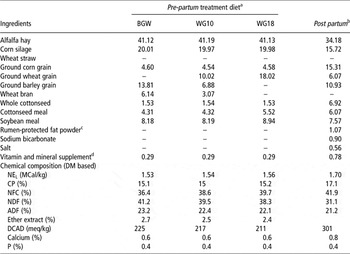
Fifteen Holstein heifers (25.9 ± 1.3 months; BW = 655 ± 28.3, body condition score (BCS) = 3.67 ± 0.40, mean ± s.d.) at 31 ± 6 days pre partum were divided to five blocks based on expected calving date and were randomly assigned to one of three treatments. Treatments were prepartal diets containing (i) ground barley grain and wheat bran (BGW) as commonly fed in many farms (Nikkhah et al., Reference Nikkhah, Alikahni and Amanlou2004; Amanlou et al., Reference Amanlou, Zahmatkesh and Nikkhah2008), (ii) 10% ground WG (WG10) or (iii) 18% ground WG (WG18; dry matter (DM) basis; Table 1). In replacing WG for barley grains, some changes in wheat bran use and very slight changes in soybean and cottonseed meals use were made to properly formulate balanced rations (Table 1). Thus, these dietary changes should be considered in interpreting treatment responses. All heifers received the same low-energy, dry cow-diet before entering the experiment. All heifers received the same lactation diet and were monitored for 21 days post partum. Diets were prepared as a totally mixed ration (TMR) and were delivered once daily at 1000 h for ad libitum intake. The pre-experiment diet had forage to a concentrate ratio of 67.8 : 32.2 with 30.7% alfalfa hay, 21.2% corn silage, 15.9% straw, 11.77% barley grain, 2.85% corn grain, 6.04% wheat bran, 4.12% soybean meal, 3.24% cottonseed meal, 3.61% cottonseeds, 0.4% mineral and vitamin supplement and 0.17% calcium carbonate. Diets were formulated using the NRC program (2001) to have similar forage percentages, that is, a 2 : 1 ratio of alfalfa hay and corn silage (Table 1). The prepartal diets contained no anionic salts. Wheat and barley grains were finely ground using an on-farm hammer mill. WG was obtained from a bulked source representing the grains used in broad regions of Iran, and contained 75% starch, 13% crude protein (CP), 11% neutral detergent fiber (NDF), 3.2% acid detergent fiber (ADF) and 2.3% ether extract, on a DM basis. The respective values for the barley grains were 58%, 11%, 20%, 7% and 2.2%. Heifers had unlimited access to fresh water at all times and were kept in yard houses (5 × 21 m) with a roofed area (5 × 8 m). The bunks and water troughs were located in the unroofed area. Each heifer had a feed bunk space of 1 m. Pre partum heifers were housed in three different pens, one for each treatment. Heifers were moved to a parturition box upon noticing early signs of calving. Heifers were kept in the parturition box for 85 ± 5 h and moved to a fresh heifer yard thereafter. In the parturition boxes, heifers had free access to fresh feed and water all the time under highly hygienic conditions. This experiment was conducted at the dairy facilities of Azar-Negin in the northwestern province of Eastern Azerbaijan from October through December of 2005. The facility had approximately 1100 dairy cattle with an average milk yield of 31.5 kg/cow per day (3.7% milk fat) at the time of the study. The cows were cared for according to the guidelines of the Iranian Council of Animal Care (1995).
Ingredient inclusion (% of diet DM) and chemical composition (DM based) of experimental diets

DM = dry matter; NFC = non-fiber carbohydrate; DCAD = dietary cation–anion difference calculated as [(Na++K+) – (Cl−+S−−)]; formulated with the NRC model (2001).
aBGW, diet with ground barley grain and wheat bran fed during 31 days pre partum; WG10, diet with 10% wheat grain; WG18, diet with 18% wheat grain on a DM basis during 31 days pre partum.
bAfter parturition, all heifers received the same post-partum diet.
cGP Feeds Ltd, Byley Industrial Estate, Middlewich, Cheshire, UK.
dContained 8000 g Mn, 2000 mg Cu, 10 000 mg Fe, 8000 mg Zn, 20 000 Mg, 21 mg CO, 55 mg Se, 55 mg I, 750 000 IU vitamin A, 100 000 IU vitamin D3 and 8500 IU vitamin E/kg supplement.
Feed, feces, urine and blood analyses
The prepartal daily amount of TMR and orts were measured for each group to calculate DMI. Feeds and orts were sampled daily, composited for each treatment, oven-dried at 60°C for 48 h and ground to pass through a 1-mm screen. All samples were analyzed for CP (Macro Kjeldahl Procedure; method 984.13; Association of Official Analytical Chemist (AOAC), 1990; NDF, Van Soest et al., Reference Van Soest, Robertson and Lewis1991; using Na-sulfite; ADF, method 973.18; AOAC, 1990), ether extract (method 920.39; AOAC, 1990), ash (method 942.05; AOAC, 1990). Calcium, P, K and Na were measured by inductively coupled plasma emission spectroscopy (method 968.08; AOAC, 1990) using an Atom Scan Spectrometer (Model ST-AAS-01, U-Therm Int. Ltd, Xiangtan, CN) after acid digestion. Blood was sampled via the coccygeal vein at 3-h post-feeding, at 7-day projected pre partum (5.6 ± 2 actual days; mean ± s.e.) and at 3-day post partum, and was placed on ice and centrifuged at 3000 g for 15 min. The serum was stored at −20°C until analysis for glucose (GOD–PAR enzymatic method), calcium (O-Cresolphthalein–complexone method), phosphorous (UV method), urea (Berthelot enzymatic method), total protein (Biuret method), albumin (Bromcresol green method), globulins and cholesterol (CHOD-PAR enzymatic method, Pars Azmun Laboratory, Tehran, Iran). The absorbance was read using a spectrophotometer (Perkin- Elmer, Colemen Instruments Division, Oak Brook, IL, USA).
BCS was recorded by three skilled people at the beginning of the experiment, at 1-day before parturition and at 21-day post partum. A 5-point scoring scale, with 1 being an emaciated cow and 5 describing an obese cow, was used (Wildman et al., Reference Wildman, Jones, Wagner, Boman, Troutt and Lesch1982). Urine was sampled manually by external stimulation of vulva at day 7 before expected calving. The urinary pH was measured immediately after sampling (pH meter; Model EIL ABB, Kent Taylor, UK). Grab fecal samples were taken from the rectum at 12-h intervals for 6 days (from day 9 to day 4 pre-calving) to determine apparent total tract nutrient digestibility. Each day, the fecal samples were obtained 2 h later than the previous day and were stored at −20°C until nutrient analysis. Feed and fecal samples were analyzed for DM, CP, and acid detergent insoluble ash as an internal marker for nutrient digestibility calculation (Nikkhah et al., Reference Nikkhah, Alikahni and Amanlou2004).
Heifers were milked four times daily at 0600, 1000, 1400 and 2200 h in a milking parlor. Milk production was recorded at each milking for 21-day post partum. Individual milk samples were collected weekly from the four consecutive milkings, preserved with potassium dichromate and kept at 4°C for fat, protein, lactose and solids-non-fat analysis by Milk-O-Scan (Lactostar 3560, Funke Gerber, Berlin, Germany). Before analysis, milk samples from the four daily milkings were pooled proportionally by volume for individual cows.
Calf and periparturient heifer status
Calves were weighed within 1 h of birth. Parturition difficulty (i.e. dystocia) was determined using a 5-point scale with a score of 1 needing no assistance and the score of 5 with cesarean or calf death. Placenta was diagnosed as retained if it was not expelled within 24 h of calving. Milk fever occurred if blood calcium dropped to <6 mg/dl. Subclinical hypocalcemia occurred if blood calcium decreased to <8 mg/dl. Calf status was scored at birth on a 4-point scale with 4 = healthy and 1 = dead. Udder edema was scored at 1-day pre partum upon observing first signs of calving and moving to calving boxes, based on a 4-point scale with 0 = no observable edema and 3 = severe edema.
Statistical analysis
Data were analyzed using the mixed linear models procedure of the SAS (SAS Institute, Cary, NC, USA; 2003; Wang and Goonewardene, Reference Wang and Goonewardene2004). The randomized complete block design model included a fixed effect of treatment and random effects of heifer within block by treatment and residuals. Repeated milk production data were analyzed with additional effects of time and its interaction with treatment. The interaction was not significant. Models with different covariance structures (AR (1), ARH (1), CS, CSH, UN) were tested and that with smaller fit criteria, AR (1), was adopted to account for dissimilar correlations of repeated measures on the same subject (Wang and Goonewardene, Reference Wang and Goonewardene2004). The prepartal and postpartal blood metabolites were analyzed independently. Mean values were estimated with the restricted maximum likelihood method and d.f. were calculated using the Containment method (SAS Institute, 2003). The biological polynomial trends of treatment effects were acquired using the CONTRAST statement of the SAS program to deduce how feeding the increasing amount of WG affected heifer performance. Orthogonal coefficients for unequally spaced treatments were acquired using PROC IML of SAS (SAS Institute, 2003). Significance was detected at P < 0.05 and trends were declared at P < 0.10.
Results
Peripheral blood metabolites
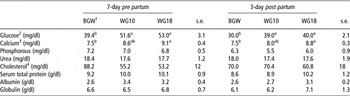
Prepartal WG as 10% and 18% of diet DM linearly and quadratically increased (P < 0.01) blood glucose at both 7-day pre partum and 3-day post partum (Table 2). Similar linear and quadratic increases were observed for blood calcium concentrations before (P < 0.01) and after (P = 0.01) calving. Blood phosphorous, urea, total protein and globulin concentrations were unaffected by diet (P > 0.10). Provision of WG tended to decrease linearly (P = 0.07) and quadratically decreased blood cholesterol at 7-day pre partum, but did not affect it at 3-day post partum (Table 2).
Effects of prepartal WG feeding on pre partum and post-partum blood concentrations of metabolites

WG = wheat grain.
a,bWithin pre-partum and post-partum periods, values with different superscripts differ at P < 0.05.
1The pre-partum conventional diet with ground barley grain and wheat bran; WG10, the pre-partum diet with 10% WG; WG18, the pre-partum diet with 18% WG on a dry matter basis. After parturition, all heifers received the same diet.
2Pre partum and post partum: P < 0.01 for both linear and quadratic effects.
3Pre partum, P = 0.01 for linear and quadratic effects; post partum, P < 0.01 for the linear effect and P = 0.02 for the quadratic effect.
4Pre partum: P = 0.07 for the linear effect; P = 0.04 for the quadratic effect.
Urine pH and parturition status
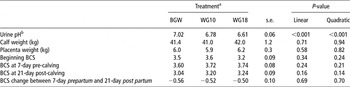
Urine pH was decreased significantly (P < 0.001) by feeding WG diets (Table 3). There were no cases of calf death, retained placentas, milk fever and obvious edema. The overall average across treatments was 78.6 days for pregnancy length, 1.5 for dystocia, 3.7 for calf health status, 1.1 for udder edema and 5.1 h for placental expulsion time since calving.
Effects of prepartal WG feeding on urine pH, calf and placenta weights and changes in BCS

WG = wheat grain; BCS = body condition score.
aBGW, the pre-partum conventional diet with ground barley grain and wheat bran; WG10, the pre-partum diet with 10% WG; WG18, the pre-partum diet with 18% WG, on a dry matter basis. After parturition, all heifers received a same diet.
bUrine was sampled manually at 7 days before expected calving.
DMI, nutrient digestibility, milk production and composition and BCS changes
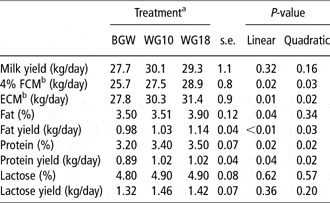
Milk fat percentage increased (P < 0.05) when WG was included at 18% but not at 10% of the prepartal diet DM. Yields of milk fat, fat-corrected milk and energy-corrected milk during 21-day post partum increased linearly (P < 0.05) in response to feeding WG. Feeding WG increased milk protein percentage and yield (P < 0.05, Table 4). Milk lactose percentage and yield and BCS were unaffected (P > 0.10). Group DMI were 10.1, 10.6 and 10.9 kg/day for BGW, WG10 and WG18, respectively. The prepartal apparent total tract DM digestibility was 54.3%, 59.9% and 56.3% and that of CP digestibility was 60.6%, 67.7% and 62% for BGW, WG10 and WG18, respectively.
Effects of prepartal WG feeding on milk production and composition during first 3 weeks post partum

WG = wheat grain; FCM = fat-corrected milk; ECM = energy-corrected milk.
aBGW, the pre-partum conventional diet with ground barley grain and wheat bran; WG10, the pre-partum diet with 10% WG; WG18, the pre-partum diet with 18% WG on a dry matter basis. After parturition, all heifers received a same diet.
bFCM = (0.399 × kg daily milk yield) + (15.02 × kg daily milk fat yield); ECM = [(kg of milk × 0.3246) + (kg of milk fat × 12.96) + (kg of milk protein × 7.04)].
Discussion
Considering the changes in dietary inclusion rates of dietary ingredients in balancing the treatments, heifers on BGW consumed about 1395 g barley grain and 622 g wheat bran, whereas heifers on WG10 consumed 1060 g WG, 731 g barley grain and 322 g wheat bran; and heifers on WG18 consumed about 1962 g WG with no wheat bran. WG contains more starch (e.g. 72% v. 58% in tthis study) with two to three times faster rumen degradation than barley grain (24%/h v. 10%/h; Herrera-Saldana et al., Reference Herrera-Saldana, Huber and Poore1990; Nikkhah and Ghorbani, Reference Nikkhah and Ghorbani2003). Daily starch intake was about 25% greater for WG18 than for BGW, that is, about 700 g/day. Intuitively, wheat gluten helps to develop a protein–starch complex upon mixing with saliva and initial digestion in the mouth that in turn stimulates food ingestion likely via psychostimuli (Forbes, Reference Forbes1995). Increased rumen starch fermentability, while controlling starch intake, in addition to reduced fibrous wheat bran may increase DM digestibility and microbial growth (NRC, 2001). Group monitoring of DMI should be considered in metabolic analysis of the above information.
Feeding palatable feedstuffs with low CAD and extensive starch and protein fermentability can help to effectively improve calcium balance and glucose synthesis, and reduce a requirement for the use of anionic salts. These mechanisms are consistent with earlier findings in mature cows (Amanlou et al., Reference Amanlou, Zahmatkesh and Nikkhah2008). Increased blood glucose pre partum could be related to increased DMI. Increased DMI post partum could be a carry over effect of the easier metabolic transition and improved hepatic adaptation of gluconeogenesis just after parturition under dramatic physiological changes.
Calcium plays critical roles in smooth muscle contraction and immune cell activation (Partiseti et al., Reference Partiseti, Deist, Hivroz, Fisher, Korn and Choquet1994; Kimura et al., Reference Kimura, Reinhardt and Goff2006). Thus, strategies preventing or attenuating peripartal hypocalcemia could improve immunity and energy status. As such, prepartal provision of diets with WG and reduced or excluded wheat bran increased blood calcium and glucose in this study, coupled with reduced urine pH. Decreased urine pH suggested a reduced extracellular alkalinity (Tucker et al., Reference Tucker, Harrison and Hemken1988; Vagnoni and Oetzel, Reference Vagnoni and Oetzel1998). More acidic circulating fluids can fortify bone resorption and 1, 25-dihydroxy-vitamin-D3-mediated small intestinal calcium absorption, thereby alleviating hypocalcemia (Horst et al., Reference Horst, Goff, Reinhardt and Buxton1997; Vagnoni and Oetzel, Reference Vagnoni and Oetzel1998). Unchanged post-partum blood cholesterol concurs with Amanlou et al. (Reference Amanlou, Zahmatkesh and Nikkhah2008). The lack of treatment differences in blood urea suggests a lack of major differences in hepatic urea output at 3-h post-feeding (Huntington, Reference Huntington1989).
The WG18-fed heifers produced 3.6 and 3.2 kg more energy-corrected and fat-corrected milk yield, respectively, than the BGW-fed heifers, showing that prepartal WG feeding increased mammary fat and protein synthesis, as a minimum of 40% to 50% of milk fat is synthesized in the mammary cells (Bauman et al., Reference Bauman, Brown and Davis1970). Increased milk protein yield was evident even when WG was used as 10% of the prepartal dietary DM. Others have shown higher milk fat percentage and yield when prepartal cows received greater and more fermentable concentrate (Minor et al., Reference Minor, Trower, Strang, Shaver and Grummer1998; Dann et al., Reference Dann, Varga and Putnam1999). In this study, WG was fed at controlled levels to prevent rumen acidosis that would otherwise reduce microbial efficiency. Increased milk fat and protein yield alongside elevated blood glucose suggest that rumen function was not impaired. Glucose forms glycerol and provides co-factors (e.g. NADPH) for de novo mammary fat biosynthesis (Bauman et al., Reference Bauman, Brown and Davis1970). Increased milk production agrees with earlier findings in multiparous cows (Amanlou et al., Reference Amanlou, Zahmatkesh and Nikkhah2008). The prepartal treatment effects carried over post partum for increased milk yield might be due to altered hepatic gene expression and increased milk substrate supply (Janovick-Guretzky et al., Reference Janovick-Guretzky, Dann, Carlson, Murphy, Loor and Drackley2007).
In summary, the provision of diets with WG and reduced wheat bran to pregnant heifers for about 5 weeks pre partum led to simultaneous improvements in peripheral glucose and calcium supplies. These were attained with no supplemental anionic salts and were followed by increased milk energy yield during 21-day post partum. Collectively, the data suggest that WG incorporated into prepartal diets with reduced or without wheat bran, facilitated improved metabolic transition in periparturient Holstein heifers.
Acknowledgments
The authors acknowledge the University of Zanjan (Zanjan, Iran) for financial support and research and teaching services, and the management board and staff at Azar-Negin Dairy Farm (Eastern Azerbaijan, Iran) for field facilities and excellent animal care.