


1. Introduction
The extent to which Wulfila's translation of the Bible represents native Gothic morphosyntax and to which it merely imitates that of its Greek source has long been debated, giving rise to radically different view-points.1
The Gothic language is recorded primarily in copies of a fourth-century Bible translation attributed to the Visigothic bishop Wulfila. Fragments of Wulfila's translation are found in the following sixth-century codices originating in northern Italy: Codex Argenteus; Codex Carolinus; Codex Gissensis; Codices Ambrosiani A, B, C, D; and Codex Taurinensis (originally part of Codex Ambrosianus A) (Braune 1981:2–8, Streitberg 1920:23–27). The collective contents of the above-mentioned codices include (mostly sparse) fragments of the Synoptic Gospels, the Epistles, the Book of Romans, and the Book of Nehemiah. Nearly half of the extant Gothic corpus is contained in Codex Argenteus, which consists of a large portion of the Synoptic Gospels. Aside from Wulfila's translation, the Gothic language is attested chiefly in fragments of a commentary on the Gospel of John known as Skeireins ‘explanation’, dated to around the fifth century, found in eight leaves of Codex Ambrosianus E and Codex Vaticanus Latinus (originally one manuscript) (Braune 1981:5–6). Though of dubious provenance, Skeireins is likely a translation from Greek and may possibly derive from the fourth-century commentary on the Gospel of John attributed to Theodore of Heracleia (see Schäferdiek 1981). Other traces of Gothic are found in fragments of a calendar, two alphabets, a small number of runic inscriptions, two commercial deeds, personal names in Latin and Greek sources, and isolated glosses. A form of the Gothic language may have survived up through the 16th century in the Crimea, though very little is known about it (see Stearns 1978 for a thorough treatment of the subject).
For a list of lexical and syntactic deviations in Gothic from the Greek, see Metlen 1933.
The aim of this paper is to assess the semantics of and Greek textual influence on Gothic complex verbs with pleonastic prepositions. These constructions feature directional PPs headed by prepositions that are “cognate” (that is, formally and semantically related) with the preverb.3
The term “preverb” is used here and throughout to denote either a prefix (bound morpheme) or particle (separable morpheme, which forms a syntactic unit with a verbal stem).
Here and throughout, the original text is given first, followed by a literal translation and a subsequent idiomatic translation. Streitberg's (1971) edition of the Gothic Bible is the source of the Gothic text. The Nestle-Aland 2001 edition of the Greek New Testament (Novum Testamentum Græce) is the source of the Greek text. All translations are my own, unless otherwise noted. The following forms are used for books in the New Testament, according to the Gothic sequence: Matt. = Matthew; John = John; Luke = Luke; Mark = Mark; Rom. = Romans; Cor. = Corinthians; Eph. = Ephesians; Gal. = Galatians; Phil. = Philippians; Col. = Colossians; Tim. = Timothy.

Similar constructions in Modern German have been called “pleonastic” because the same directional specification is expressed by the preverb and PP (Olsen 1996, McIntyre 2001:63–67). In the following, I explore how Gothic constructions with the prepositional prefixes us- ‘out of, from’, af- ‘from’, þairh- ‘through’, and the adverbial particle inn ‘in’, and their cognate prepositions compare to their Greek source. It is shown that while there are some co-occurrences of formally related preverbs and prepositions in Gothic that are independent of the Greek text, these rarely convey the same semantic information (the preverb is usually semantically vague), and so they are not truly pleonastic. Gothic prefix-preposition redundancy closely represents similar phenomena in the Greek source. Ultimately, patterns in the translation of Greek complex verbs with pleonastic prepositions suggest that the Greek influence on the Gothic is greater than has been previously acknowledged. Though very little scholarship has been devoted to this topic, the findings of this study contradict a general trend in scholarship on Gothic prefixation to view Greek influence on Gothic as minimal or insignificant.
The present paper is structured as follows. Section 2 provides a description of prefixation in Gothic and the theoretical development of prefixes and particles. Section 3 examines the nature of verbal prefixation in Greek and gives a general overview of the use of complex verbs with pleonastic prepositions in both languages. Section 4 discusses the possibility of Latin textual influence on Gothic, as well as other complicating factors that arise in comparing Gothic and Greek. The remaining sections individually treat pleonastic constructions with the preverbs us- ‘out’, af- ‘from’, þairh- ‘through’, and inn ‘in’, along with their corresponding PPs. The study concludes with a summary of findings and their bearing on the question of Wulfila's translation technique.
2. Prefixation in Gothic
An overview of the development of Gothic preverbs provides the necessary background for understanding why some may collocate with cognate adverbial particles or PPs more frequently than others. The following principle appears to be in effect in Gothic translations of Greek complex verbs with pleonastic PPs: Gothic preverbs that had become semantically vague through the process of grammaticalization or lexicalization were more frequently used in part-by-part translations of Greek pleonastic constructions because cognate PPs and adverbial particles reinforced their lost semantic content, while Gothic preverbs that were more transparent had less need for reinforcement and therefore were used less often in literal translations of Greek pleonasms.5
For background on grammaticalization, see Meillet 1912, Hopper & Traugott 2003.
It is generally believed that prepositions and preverbs in Indo-European languages both descend from adverbs (Kühner & Gerth 1898:448–453, 526–554, Wackernagel 1924:153–248, Kuryłowicz 1964: 171–178, Harnisch 1982:112–117).6
See also Booij & van Kemenade 2003 and the literature cited there.

Van Kemenade & Los (2003:97–99) suggest that Gothic prefixes support this development by maintaining vestiges of their earlier independent lexical status. Gothic prefixes are unique among those in Germanic languages in that they appear to be in the last stages of transition from separable to inseparable morphemes. Though they are otherwise bound to the verbal stem, they may be separated from it by intervening clitics. An example of this is given in 3, in which the clitic particle -uh- ‘but, and, now’ intervenes between the prefix us- (here uz-) ‘up’ and the verb hof ‘lifted’.7
For a thorough treatment of the syntax of Gothic clitics, see Eythórsson 1995: 103–142.

Gothic preverbs may be categorized according to layers of grammaticalization.8
For a detailed examination of the semantics of Gothic preverbs, see Curme 1914, Grewolds 1932–1933, and West 1982.
McIntyre (2001:8, note 2) pointed out that preverbal functions often outlast other functions, since affixes are frequently fossilized in morphologically complex words.
A less grammaticalized layer consists of prefixes that have prepositional counterparts. Each of these shows some signs of grammaticalization and lexicalization, though some are often compositional in meaning. Prepositional prefixes are believed to have developed from particles that were unstressed or weakly stressed before verbs but strongly stressed in nominal compounds.10
See Hirt 1931:145–146 and Bennett 1970:468
Some preverbs are both prepositional and adverbial and may be either compositional in meaning or semantically bleached. These result from the homophony of prepositional and adverbial elements and include ana ‘on, at’; du ‘to, toward’; faura ‘before, by’.
The least grammaticalized layer of preverbs consists of the separable particles inn ‘in’ and ut ‘out’, which are always resultative and semantically transparent. Inn and ut are originally adverbs that did not develop in composition with verbs. Their function as preverbs may be explained in terms of the semantic bleaching of the older prepositional prefixes in- and us-: it can be presumed that at one point, in- and us- were resultative but gradually lost this function. As they appear in Wulfila's translation, in- has a causative function and little, if any, semantic content, while us- has numerous spatial and metaphorical meanings as well as a perfective aspect. It is likely that in time the adverbs inn and ut were necessary to reinforce the lost resultative function of in- and us- and that with certain verbs they have already begun to form syntactic units and perhaps even morphological units.
A syntactic analysis of inn and ut is complicated by seeming inconsistencies in the pattern of separation and composition with their verbal stems. Inn and ut generally behave like corresponding particles in Old English (OE) and Old High German (OHG) in that they are separable in some contexts and the negative particle ni ‘not’ intervenes between the adverbial particle and its verbal stem (this is the case for inn, but it is uncertain whether this also holds for ut), pointing to the morphological independence of the adverbial particle. This is shown in 4a, in which ni ‘not’ appears between the particle inn and verb atgaggiþ ‘goes’. While ni is right-adjacent to particles, it is left-adjacent to prefixes, as is demonstrated by its position relative to the prefix af- ‘from’ (here lexicalized) in 4b.

There is a trend of asymmetry in the syntactic positions of inn and ut in main clauses and subordinate clauses similar to that in Modern German and Dutch: in main clauses they are postponed after the verbal stem, whereas in subordinate clauses they are preverbal (Delbrück 1910). Assuming that Gothic was an object-verb (OV) language, some scholars have interpreted this as evidence that verb-second word order was an innovation in Gothic.11
See van Kemenade & Los 2003:101 and Eythórsson 1995:46.
For a stress-based account of the separability of preverbs in modern German, see McIntyre 2001:53–60.
In this section, the theoretical development of Gothic preverbs was outlined, and it was shown that there is a strong correlation between syntactic status and semantic content in that prefixes have developed metaphorical meanings and grammatical functions, while particles have only spatial meanings. In the following section, a brief overview of the Greek system of prefixation is given, followed by a description of complex verbs with pleonastic PPs in Greek and Gothic.
3. Complex Verbs with Pleonastic Prepositions in Greek and Gothic
The system of prefixation in Greek varies significantly from that in Gothic. Most importantly, Greek contains only prepositional prefixes that are not separable from their verbal stems, while Gothic has prepositional, adverbial, and grammaticalized preverbs, some of which are separable in certain syntactic contexts. A study of the correspondences between Greek and Gothic preverbs in the New Testament demonstrated that there is a part-by-part relationship between Gothic and Greek—that is, one or more preverbs in Gothic corresponds to one or more preverbs in the Greek that it is translating—in about one-third of the instances in which they occur (Rice 1932:135). This figure most likely indicates significant influence of Greek on Gothic and is remarkable when the number of lexicalized complex verbs in Gothic and Greek, which ought to work against literal translations, is taken into consideration.
Despite the marked differences in Gothic and Greek verbal prefixation, both languages contain constructions that feature a preverb and its cognate preposition followed by a NP complement. Baldi (1979) explains the Greek constructions as follows: Greek (and Latin) prepositions are derived from preverbal particles, and as preverb-verb combinations became lexicalized, the preverbal particles were copied before NPs for semantic and functional reinforcement. Prepositions gradually developed from the reanalysis of these particles as part of the NP, and once prepositions took on relational (spatial, temporal, etc.) semantics, the preverbs could be deleted. According to Baldi (1979:58), constructions that contain both a preverb and cognate preposition are an intermittent stage in the copying of functions and semantic content from the preverb to the preposition.
The co-occurrence of complex verbs with pleonastic prepositions in New Testament Greek is more complex than Baldi describes. In some cases the prefix and the preposition function together in the construction, while in others either may be omitted without incurring much semantic change. The former appears to be due to semantic bleaching on the level of both the prefix and the preposition, in which case the presence of both may have reinforced the lost semantic content. An example of this is the construction eiselthein eis ‘to enter into’ (literally ‘to-in-go into’), in which eis- ‘into’ is a prefix and eis ‘into’ is the head of a PP. In the New Testament, the complex verb eiselthein ‘to enter’, although it is transitive, rarely if ever modifies direct objects in NP complements but rather relies on the preposition eis ‘into’ to assign case. This is shown in 5, in which the prefix eis- ‘in’ is combined with the verb ēlthen ‘came’ and followed by the PP eis ton oikon ‘into the house’.

Not only does the preposition eis ‘into’ appear necessary in this construction to assign case, but the prefix eis- is also indispensable since the preposition alone does not always fully convey the meaning ‘into’. In 6 below, the same verbal stem ēlthen ‘came’ appears as in 5 above. Whereas eisēlthen eis means ‘entered into’, the simplex verb + PP ēlthen eis in 6 means ‘came to’.

While in some instances both prefix and preposition seem to reinforce one another, in others the prefix or preposition may be omitted arbitrarily. In the pair below, the meaning ‘to take, deprive’ is expressed equally well by the co-occurrence of the prefix apo- [ap-] ‘from’ and the preposition apo [ap] ‘from’, as in 7a, or without the prefix, as in 7b.

Gothic contains similar constructions, almost all of which correspond directly to the structure of the Greek. However, not all part-by-part translations of Greek complex verbs with pleonastic prepositions are pleonastic in Gothic. It is shown below that the Gothic prefix was semantically bleached in some cases, and therefore did not specify the same directional information as its cognate preposition. In the approximately 20 instances in which Gothic features cognate preverbs and prepositions independently of Greek influence, only a handful appear to be truly redundant.
Three basic types of construction are discussed: those which contain a prepositional prefix and a cognate preposition (+ NP complement), such as þairhgaggan þairh (literally ‘to-through-go through’); those which contain a prepositional prefix and a cognate particle, as in usgaggan ut (literally ‘to out-go out’); and those which contain an adverbial particle and a cognate preposition (+ NP complement), such as inngaggan in (literally ‘to-in-go into’). As in Greek, there are instances in which the semantic import of the construction “preverb + verb + PP” (where the preverb and preposition are formally or semantically related) does not appear altered by the omission of either the preverb or the preposition. For example, the prefix af- ‘from’ in 8 is cognate with the preposition af ‘from’. The preposition modifies the personal pronoun imma ‘him’ (3rd person, masc. dat. sg.).

The phrase in 8 may also be expressed without the preposition af. In this case, the complex verb afniman ‘to deprive, take’ (literally ‘to-from-take’) modifies the indirect object imma ‘him’ (3rd person, masc. dat. sg.):

The same sense ‘to deprive, take’ may also be expressed by omitting the prefix af- while maintaining the preposition af. In 10, the preposition modifies the personal pronoun þus ‘you’ (2nd person, dat. sg.).

Given that the morphosyntax of the Gothic Bible is frequently attributed to the influence of its Greek source, particularly in older scholarship, the question remains as to whether Gothic constructions including complex verbs with cognate prepositions are mere imitations of the Greek, or whether they may have been inherent to the Gothic language. It is suggested below that, with some exceptions, Gothic preverb-preposition redundancy is attributable to Greek influence, and that the semantic bleaching of the Gothic preverb plays a role in facilitating literal translations of Greek complex verbs with pleonastic PPs. Specifically, the vaguer a preverb has become through polysemy, the greater its ability to translate its lexically corresponding Greek prefix, but the greater its need for reinforcement from cognate prepositions or particles.
4. Latin Influence and Textual Uncertainties
In assessing the extent to which Gothic pleonastic constructions may be influenced by Greek, a number of textual difficulties arise. For example, palpable lexical and syntactic influence on Gothic from pre-Vulgate versions of the Latin New Testament is well documented by scholars, and it is generally believed that Latinizations crept into the Gothic from Old Latin versions of the New Testament during the course of its transmission, which were not present in Wulfila's original translation.13
For an overview of the scholarship concerning the influence of Latin versions of the New Testament on Gothic, see Metzger (1977:375–394).
Jülicher's (1963) edition of the Old Latin New Testament is the source of the pre-Vulgate Latin citations here and throughout.

There is one other attestation of miþ- . . . miþ (Col. 2:13) that corresponds part-by-part to the Greek sun- ‘together with’ . . . sun ‘together with’.
The comparison of Gothic and Greek prefixation is further complicated by uncertainties concerning the Greek exemplar from which Wulfila translated. It is thought that Wulfila based his translation on a Byzantine version of the New Testament, but the exact exemplar is unknown (Metzger 1977:385). Furthermore, Wulfila's original translation is no longer extant, and only copies that date at least several centuries after the original remain. It must be emphasized that these factors make a highly accurate study of Gothic prefixes in comparison to the Greek source unlikely. The present study therefore draws its conclusions from general patterns in Gothic prefixation and prepositional use and is necessarily speculative at times.
In the sections below, constructions featuring the preverbs us- ‘out’, af- ‘from’, þairh- ‘through’, and inn ‘in’, and their respective cognate prepositions or particles, are discussed individually. In addition to these, there is one construction with faur- ‘before’, one with afar- ‘after’, and two with miþ- ‘with’ that are addressed in relevant places throughout the paper. In section 5 below, it is shown that the doubling of the prefix us- ‘out’ and preposition us ‘out of, from’ is attributable to the prefix's semantic ambiguity, as a consequence of which the addition of a cognate preposition or adverb may have helped to reinforce its meaning ‘out’.
5. Us-
In this section, two types of constructions are discussed, neither of which is pleonastic: those which contain the prefix us- ‘out, from’ and the cognate PP headed by the preposition us ‘out, from’, and those which contain the particle and prefix combination ut ‘out’ and us- ‘out, from’. Earlier scholarship has suggested that the prefix us- had lost its resultative function and that these constructions arose to reinforce the functionally and semantically weakened prefix (van Kemenade & Los 2003:101–103). This is borne out by a close examination of the contexts in which the doublings occur. Furthermore, because the prefix us- was so vague, it could be used by the Gothic translator in many cases to correspond to the Greek prefix ek- ‘out of, from’. In this way, the semantic bleaching of the prefix helped to facilitate a very literal translation from the Greek into Gothic.
The Gothic prefix us- (ur- before verbs beginning with <r>), derived from Proto-Germanic +uz (Kieckers 1928:274), is highly ambiguous in meaning.16
For a discussion of the etymology of us, see Gruber 1930, Johannisson 1939:65–67, Lehmann 1906, and Purtscher 1902:20–21.
For a different opinion, see Gruber 1930:13.
The co-occurrence of the prefix us- and a PP headed by the preposition us, while almost always mirroring the syntactic structure of the Greek source, is also attested independently of Greek. There are at least five instances in which the prefix us- (denoting ‘motion away from’) corresponds to a Greek simplex verb (three tokens) or a complex verb with a prefix that does not correspond semantically to us- (two tokens): two with the verb usniman ‘to take out, to take away’ (John 17:15, Col. 2:14), two with usbairan ‘to carry out’ (Luke 6:45, two tokens), and one with urrinnan ‘to go out from’ (Rom. 11:26). Though the prefix us- and preposition us carry a range of meanings, in these constructions the prefix connotes a general separation from the object, while the preposition further specifies motion out of an object. Thus the preposition seems to have functioned to disambiguate the meaning of the prefix.
In a more emphatic and semantically specific variant of the aforementioned construction, the PP is modified by the adverb ut ‘out’), yielding us- + verb + ut + us + NP. I have interpreted ut ‘out’ as an adverbial modifier of us + NP because ut us ‘out from’ is used as a unit to represent the Greek adverb/preposition exō ‘outside of’ in four out of five instances. While the preposition ek is commonly used to express ‘motion out of’ and is translated by the Gothic prefix us-, exō ‘outside of’ is spatially more transparent, and the Gothic reflects this in the translation ut us ‘out from’, which is more specific and emphatic than the preposition us ‘out of, from’ alone. This is shown in 12 below, in which the Gothic prefix us- corresponds to the Greek prefix ek- (here ex-) ‘out of, from’, and the Greek exō ‘outside of’ corresponds to the Gothic ut us ‘out from’. The preposition us modifies the dative object þamma weinagarda ‘the vineyard’, and exō modifies the genitive object tou ampelōnos ‘the vineyard’.

While ut us ‘out from’ is almost always a direct translation of exō ‘outside of’, the use of the particle ut ‘out’ alone with us-compounds is less dependent on the Greek. In eight instances, ut is in agreement with the Greek structure, and in five instances it is in disagreement. Van Kemenade & Los (2003:101–103) explained the particle-prefix combination as a reinforcement mechanism (the particle ut supplements the lost resultative function of the prefix us-). This is supported by particle-prefix combinations in Modern Germanic languages, in which only one element (usually the particle) may act as a resultative predicate (Blom 2005:243). An examination of us-verbs and the contexts in which they occur provide further evidence of the grammaticalization of the prefix.
The complex verb usgaggan (literally ‘to-out-go’) is sufficient in a number of instances to denote ‘to go out, exit’, although its most common significance is ‘to depart, go forth’, as demonstrated in 13.

Götti (1974:35–37) designates ‘to head out, depart’ as the usual sense of the complex verb usgaggan and suggests that usgaggan takes on the spatial meaning ‘to go out’ when reinforced by the particle ut (eight tokens) or a PP headed by the preposition us ‘out of, from’ (23 tokens). The collocation of ut and usgaggan therefore helps to establish the meaning ‘to go out’, and thereby to differentiate it from the complex verb's more common meaning ‘to depart’. In 14 below, ut complements the verb usgaggan, because the translation requires the meaning ‘to go out(side)’ rather than ‘to depart, leave.’ Here usgaggands ut ‘going out’ describes the act of exiting a house.

Similarly in 15, the semantic distinction between ‘to go out’ and ‘to depart’ is made clear through the particle ut, which contrasts with the particle inn ‘in’ later in the sentence.

The construction usgaggan ut resembles the verb-adverb collocation faursniwan faura ‘to precede, anticipate’ (literally ‘to-before-hasten before’) in which the prefix faur- ‘before’ has numerous abstract meanings and is here lexicalized with the verb sniwan ‘to hasten’. The adverb faura ‘before’ reinforces the lost temporal meaning of the prefix. Like usgaggan ut, this construction is not truly pleonastic because the adverb conveys information that the prefix does not.

The verb-adverb collocation atsteigan dalaþ ‘to descend’ (literally ‘to-down-climb down’) is similar to usgaggan ut and faursniwan faura. Like us- and faur-, the prefix at- is ambiguous in meaning: it signifies ‘to’, ‘at’, ‘toward’, and ‘down’, and also has a perfective function (Gould 1916:16). Although at- connotes downward motion in the complex verb atsteigan, and atsteigan is often sufficient to convey the meaning ‘to descend’, in three of 15 instances the adverb dalaþ ‘down’ is added, presumably to reinforce the meaning of the prefix.
Thus far, it has been shown that us-verbs form constructions with the cognate preposition us (+ NP complements) and particle ut in a number of instances that do not correspond to the structure of the Greek. These instances most likely indicate that the prefix was gradually becoming grammaticalized in Gothic. Competition between the prefix us- and the particle ut ‘out’ may further hint at the semantic bleaching of us-. Though both ut and us- correspond to the Greek ek- ‘out of, from’, the former is an adverbial particle and appears only four times in composition with a simplex verb, while the latter is pervasive and prepositional. Ut and us- also differ in that ut exclusively denotes ‘out’, whereas us- has numerous meanings and functions.
The preverbs us- and ut compete with each other in composition with the verbs bairan ‘to carry’ and gaggan ‘to go’. Us- is by far the more pervasive preverb, and the occasional substitution of ut is likely indicative of the progressive loss of the semantic force of us-. Whereas utgaggan is attested only twice, translating the Greek complex verb ekporeuesthai ‘to go out, exit, depart’ (literally ‘to-out-go’), usgaggan occurs 102 times in the Gothic corpus, most frequently translating the Greek complex verbs ekporeuesthai (twelve tokens) and exerchesthai (77 tokens) ‘to go out, exit, depart’ (literally ‘to-out-go’). While usgaggan is clearly preferred over utgaggan in translating Greek verbs meaning ‘to come/go out’, it is the more ambiguous of the two and is used additionally to translate the Greek erchesthai ‘to come, go’ (one token), as well as three verbs that mean ‘to go up’: anerchesthai (ten tokens), prosanabainein (one token), and anerchesthai (one token) (Rice 1932:113).
Although utgaggan and usgaggan are used synonymously, the former is resultative and substituted for the latter in cases where emphasis is required. In both instances of utgaggan, the particle ut is used in contrast with the preverb inn. The juxtaposition of ‘entering’ (inngaggan) and ‘exiting’ (utgaggan) appears in John 10:9, in which Christ depicts himself as a door through which one may enter (inngaggiþ) and exit (utgaggiþ). Similarly, in Mark 7:15, Christ preaches that nothing external may ‘enter into’ (inngaggando in) a man to harm him; rather, it is what proceeds ‘out of’ (utgaggando us) a man that may do him harm. A paraphrase of Mark 7:15 is found subsequently in Mark 7:20. It is significant that the same Greek verb and preposition (ekporeuesthai ek) are translated differently in the two passages. Whereas utgaggan us appears in the former, in which the verb is used in juxtaposition with verb inngaggan, usgaggan us is used in the latter, in which the verb inngaggan does not appear and no contrast is being made. The contrastive use of ut rather than us- with the preverb inn indicates that whereas the former clearly denoted ‘out’, the meaning of the latter was not sufficiently transparent to enable the preverb to stand in contrast with inn.
The development of the prefix etymologically related to us- in later West Germanic languages is consonant with the semantic bleaching of us- in Gothic. In Old High German and Old English, the forms corresponding to the Gothic preposition us fell into disuse at an early stage (Lehmann 1906:59).18
The prefix persists in the form of Modern German and Dutch er-.
Sievers' (1882) edition of the OHG translation of Tatian's Gospel Harmony is the source of the Latin and OHG text here and passim.

While neither Old High German nor Old English is a direct descendant of Gothic, the same process of grammaticalization that is attested in these languages may be reflected at an earlier stage in Gothic. This would support the idea that the impetus to qualify us-compounds with the preposition us or particle ut, and to replace the prefix us- with ut, stems from the gradual semantic bleaching of the prefix us-.
In summary, there are a number of co-occurrences of the prefix us- and the particle ut, or a PP headed by the preposition us, that are independent of any corresponding Greek structure. These have been explained as reinforcement mechanisms for the semantically and functionally ambiguous prefix us- and are not pleonastic because the preposition and particle express directional specification that the prefix does not (van Kemenade & Los 2003:101–103). The competition between the preverbs us- and ut, and the contrastive use of the latter with the preverb inn, provide further evidence of the semantic bleaching of us- and may indicate that, as with corresponding particles in later West Germanic, ut was becoming requisite to express the notion ‘out’.
These findings are comparable to those of the pleonastic construction af- . . . af ‘from- . . . from’ with some notable exceptions. In section 6 below, I suggest that like us- . . . us, af- . . . af constructions may have been idiomatic in Gothic, but that it is also possible that they arose from the mechanical translation of the Greek preposition apo ‘from’.
6. Af-
The prepositional prefix af- ‘from’ appears in constructions with the PPs headed by the preposition af ‘from’ in 27 instances. In this section, it is shown that like the construction us- . . . us, af- . . . af is heavily influenced by corresponding constructions in the Greek source, but also occurs independently of the Greek. These apparently unmotivated instances of af- . . . af are not easily accounted for, though the influence of Old Latin versions of the New Testament on the Gothic may play a role. Because there are a number of af- . . . af constructions that cannot be explained by Greek or Latin sources, and in some prefix-verb combinations it is the absence of the prefix that is more marked than its presence, it is reasonable to conclude that af- was lexicalized or grammaticalized in composition with some verbs. The unmotivated doublings of af- . . . af are perhaps most elegantly explained as arising from the combination of idiomatic Gothic complex verbs consisting of af- + verb and the presence of the preposition af, which may or may not have been motivated by the Greek.
In expressions that convey provenance, separation, or privation, Gothic favors constructions, at times at odds with the Greek source, in which the verb includes a prefix that indicates motion away from an object. In section 5, it was argued that the preposition us ‘out of, from’ and the particle ut ‘out’ were used in constructions with the semantically vague prefix us- ‘from, out’ to reinforce the lost resultative function of the prefix. Like us-, the prefix af- also appears to be in the process of semantic bleaching. Its basic meaning is spatial and connotes ‘motion away from’, but it can also have privative and pejorative senses as well as a perfective function. Its weakness is indicated by its interchange-ability with us- in instances where Greek attests no prefix. As seen in 18 and 19, the Greek simplex airei ‘takes away, removes’ is alternately translated with the complex verbs usnimiþ and afnimiþ, both of which mean ‘takes from, removes’. Both prefixes have a privative sense that the preposition af reinforces. In both cases, the complex verbs modify direct objects in the accusative (þata waurd ‘the word’ in 18, and fullon ‘filling’ in 19).


In a little more than half of the af- . . . af constructions (15 of 27), the structure of the Gothic mirrors that of the Greek precisely. The Gothic prefix af- translates the Greek apo-‘from’, and the preposition af translates the Greek preposition apo ‘from’.
The most common verb that occurs in af- . . . af pleonasms is niman ‘to take’ and the textual uncertainties surrounding the translation and transmission of the Gothic Bible are well represented in the incidence of this pleonasm. To express the concept ‘to take from’, Gothic uses niman + af (+ NP complement) ‘to take from’ six times and afniman + af (+ NP complement) ‘to take from’ (literally ‘to-from-take from’) nine times. Niman + af corresponds to the Greek simplex verbs + PP airein/lambaneιn apo (+ NP complement) ‘to take from’ in all but one instance (Col. 3:24), in which the Greek attests the complex verb apolēmpsesthe ‘you shall receive’ (literally ‘from-you-shall-take’). However, the simplex form of the same verb lēmpsesthe ‘you shall take’ is attested here in the Byzantine textual tradition (that is, presumably the same textual tradition as the Greek exemplar from which Wulfila made his translation), and it is likely that this is what the Gothic is translating. Afniman + af corresponds to the Greek in five instances (Matt. 9:15, Mark 2:20, 7:33, Luke 5:35, 16:3) and disagrees with the Greek in four instances (Matt. 9:16, Mark 2:21, Luke 8:18, 19:26). Three of these instances reflect the structure of the Latin auferre ab ‘to take from’ (literally ‘to-from-take from’) (Mark 2:21, Luke 8:18, 19:26).
Of the twelve pleonastic constructions in Gothic that do not completely reflect the structure of the Greek, in one instance (Luke 9:33) the prefix af- corresponds semantically to the Greek dia-, here meaning ‘apart, asunder’, so that the pleonasm af- . . . af may be motivated by the Greek dia- . . . apo. Five instances of af- . . . af agree with pleonasms present in the Latin Vulgate and are possibly attributable to the influence of pre-Vulgate Latin translations of the New Testament. In 20 below, for example, the Gothic af . . . af- construction (20a) agrees with the Latin a . . . ab- (‘from . . . from-’) in 20b, while the Greek does not contain a corresponding preposition or prefix (20c).
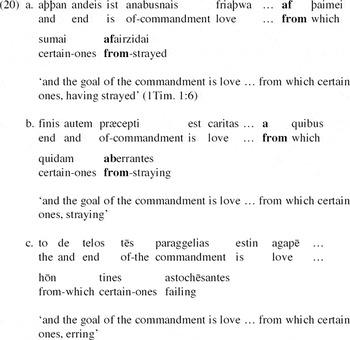
Latin influence on the Greek cannot be proven in cases such as 20, but the number of exact correspondences is striking. This leaves approximately seven Gothic pleonastic constructions that are difficult to account for through extant Greek or Latin sources. In these instances, the preposition af agrees with the Greek preposition apo, as expected, while the prefix af- corresponds to either no prefix in Greek or a prefix not semantically related to af- (such as meta- ‘along with’). As mentioned previously, the presence of the preposition af may be attributable to the influence of the Greek preposition apo, but it is difficult to ascertain whether this was the case since there is a very close correspondence between af and apo in pleonastic constructions (deviation from the Greek may have pointed to idiomatic Gothic, while the lack of deviation does not necessarily imply the same).20
The two exceptions (Mark 16:3 and 2 Tim. 1:15) are somewhat dubious. In Mark 16:23, ek ‘out’ corresponds to af, though the preposition apo is attested in Caesarian and Western textual traditions. In 2 Tim. 1:15, while there is no corresponding preposition in Greek to the Gothic af, Latin versions of the New Testament attest the preposition a ‘from’.
An analogous case may involve the doubling of the prefix afar- ‘after’ and preposition afar ‘after’ in 21 below, in which the complex verb afargagga ‘I pursue’ (literally ‘I-after-go’) corresponds to a simplex verb in Greek (diōkō ‘I-pursue’), while the preposition afar corresponds semantically to the Greek epi, here meaning ‘toward, after’. In this case, it seems that the verb afargaggan is lexicalized to mean ‘to pursue’, but it is unclear whether the preposition afar is idiomatic in Gothic or whether it is a mechanical translation of the Greek preposition.
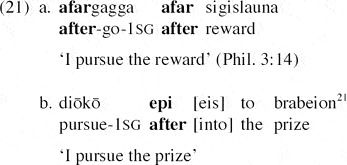
The word eis ‘into’ is bracketed here because it appears in some manuscript traditions rather than epi ‘after’.
In sum, most instances of af- . . . af (about 15 tokens) are faithful translations of the Greek apo- . . . apo. Of those that do not correspond to the Greek exactly, five agree with pleonastic constructions attested in the Latin Vulgate, though influence from Latin versions of the New Testament on Gothic in these instances is uncertain. It is possible, but difficult to prove, that the remaining seven pleonastic constructions may arise from a combination of the use of idiomatic compounds in Gothic along with the mechanical translation of the Greek preposition apo. It is perhaps equally likely, however, that there were some complex verbs in which the semantic force of af- may have been sufficiently weak as to have required a preposition denoting separation to strengthen its semantic import. If this were the case, the construction af- . . . af could be attributed to the grammaticalization or the lexicalization of the prefix af-, and the unprefixed verbal forms could be interpreted as motivated by simplex forms in the Greek.
In section 7, I argue that like af- . . . af constructions, pleonastic constructions with the prefix þairh- ‘through’ and pleonastic preposition þairh ‘through’ were heavily influenced by the Greek source. This is indicated by the infrequency with which the pleonastic forms in Greek were translated as such into Gothic, the lack of instances that do not correspond to the Greek structure, and the alternation between complex and simplex verbs + PPs in the translation of Greek pleonastic constructions.
7. þairh-
Greek contains pleonastic constructions that include the prefix dia- ‘through’ and its cognate preposition dia ‘through’ (+ NP complement). In these constructions, the preposition is redundant in that it has the same directional meaning as the prefix, is not necessary to assign case to objects in NP complements, and may be omitted without palpably altering the semantic import of the construction. The prefix, by contrast, seems essential for conveying spatiality, and the construction “dia- + verb + NP complement” is semantically different from the construction “simplex verb + dia + NP complement.” This is because in cases of the latter, the preposition dia has a metaphorical meaning rather than a spatial meaning.
Greek constructions with the prefix dia- and its cognate preposition dia are translated literally into Gothic with the prefix þairh- ‘through’ and a PP headed by the preposition þairh ‘through’ in about five of eight instances (Luke 4:30, 17:11, 18:25, Mark 2:23, 11:16). There are no constructions of this type that arise in Gothic independently of the Greek. These instances may be considered pleonastic because the prefix and preposition both contain the same spatial meaning.22
Elsewhere þairh- is grammaticalized and has a continuative function, which is still attested in cognates of þairh- in modern Germanic languages. Compare Gothic þairhwakan ‘to keep awake’ and the Modern German cognate durch-wachen ‘to keep awake’.
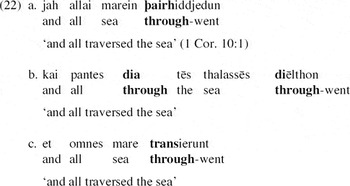
There is one instance in which the Gothic deviates from Greek pleonastic construction by omitting the preposition. This is demonstrated in 22 below, in which the Greek prefix dia- is rendered by the Gothic prefix þairh-, whereas the Greek preposition dia is not translated. The complex verb þairhiddjedun ‘traversed’ (literally ‘through-went’) modifies the direct object marein ‘sea’. While the Gothic (22a) and Greek (22b) do not match, the Gothic corresponds to the Latin (22c) construction attested in the Vulgate and may show influence of Old Latin versions of the New Testament.
The following set of textual parallels demonstrates that in pleonastic constructions the prefix þairh- may be replaced with another preposition (ga-) without altering the meaning of the phrase. In 23 and 24, the Gothic text is identical, with the exception that þairh(-) is both a preposition and prefix in 23a, but in 24a the prefix þairh- is replaced with ga-.


In 23b and 24b, both eiselthein ‘to enter’ and dielthein ‘to go through’ are attested as variants.23
See Götti 1974:58 for further discussion.

A textual echo of 25 is given in 26, although the structure in the latter is not pleonastic. The construction is pleonastic in Greek (26b), but the prefix dia- is not translated into Gothic (26a).

In each instance, þairh-verbs with pleonastic PPs correspond to similar structures in the Greek. A number of textual parallels in which pleonastic constructions are alternately maintained from the Greek or simplified indicate that there was not an outstanding semantic difference between the two. These factors, along with the lack of independent use, most likely indicate substantial influence from the Greek text.
In summary, it has been shown that the prefixes us- ‘out of, from’, af- ‘from’, and þairh- ‘through’ were often used along with their corresponding prepositions or particles in translations of Greek pleonastic constructions. The frequency of these constructions may reflect the semantic ambiguity of the Gothic prefixes, for which cognate prepositions and particles provided reinforcement. These findings contrast with those concerning the particle inn ‘in’ discussed in the next section.
8. Inn
The preverb inn ‘in’ indicates “motion into a place” and is semantically transparent. As discussed in section 2 above, inn is a particle in all cases except possibly when it combines with the verb gaggan ‘to go’. The lack of separation of inn from gaggan in main clauses may point to an inseparable complex verb.
Inn forms pleonastic constructions with the cognate preposition in ‘into’ (+ NP complement) in 15 instances. In each of these instances, the preposition in is directional and specifies “motion into.” Each Gothic pleonasm corresponds to a pleonasm in Greek (formed with the prefixes eis- and en- [em-] ‘into’ and the directional preposition eis ‘into’). In the majority of instances (48 out of 63), Gothic does not contain a part-by-part translation of Greek pleonastic constructions, and this indicates a strong tendency toward the simplification of the Greek pleonasms in the Gothic translation. When the Gothic deviates from the Greek model, the Greek prefix is not rendered into Gothic, whereas the preposition is always translated because it is necessary to assign case to an object in the NP complement.
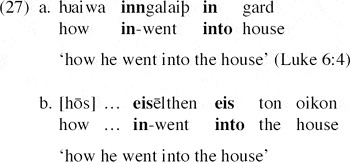
In inn . . . in constructions, the particle inn combines with three verbs of motion, here listed along with their incidence: gaggan ‘to go’ (seven); atgaggan ‘to come, go to, arrive’ (four); and galeiþan ‘to depart, go’ (four). In the relatively few cases in which the Gothic translator maintained the pleonastic structure of the Greek (about one out of every five instances), his choice appears arbitrary. This is indicated by a number of parallel passages in which a complex verb + PP is interchangeable with a simplex verb + PP (Mark 2:26, Luke 6:4, Mark 10:23, Luke 18:24, 9:4, 10:5). In the pair given below, the Greek pleonastic construction eisēlthen eis ‘entered into’ (literally ‘in-went into’) is translated pleonastically into Gothic in 27a, which reads inngalaiþ in, but not in 28a, which reads galaiþ in. In both instances, the Gothic preposition in ‘into’ modifies the accusative object gard ‘house’. Likewise, the Greek preposition eis ‘into’ modifies the accusative object ton oikon ‘the house’.

Given that Gothic complex verbs + PPs are used alternately with simplex verbs + PPs to render Greek pleonastic constructions in environments that are contextually and grammatically similar, the greater incidence of the latter in Gothic may point to the relatively strong semantic force of inn: both the particle inn and the preposition in are used to express ‘motion into’, and since the preposition is necessary in these constructions and satisfies the directionality requirement, the particle inn would have had a redundant quality.
The arbitrary use of inn in translating Greek pleonasms has parallels in OHG and OE biblical translations of Latin. The following discussion serves simply to highlight patterns common to the Gothic translation of Greek and the OHG and OE translations of Latin, which may indicate the textual influence of the sources on the languages translated. Before these are addressed, some background information is necessary.
Old High German and Old English had preverbs etymologically related to the Gothic prefix in- and particle inn. The form in could represent both preverbs in Old High German and Old English, although their functions were distinct: the OHG and OE prefix in- (usually on- in Old English) is cognate with the semantically empty Gothic prefix in- and often has a causative function in all three languages (as in Gothic inbrannjan, OHG inbrennen, OE onbærnan ‘to cause to burn, kindle’). The OHG and OE adverbial particle in ‘in’ corresponds to the Gothic particle inn and is semantically transparent and resultative in function. The remainder of the discussion focuses on the adverbial particle in. There are some instances in which OHG and OE in transitivizes the complex verb, indicating that its adverbial function was weakening. In the majority of cases, however, OHG and OE in meet the following diagnostic criteria for particles (as outlined in Fischer et al. 2000:182–185): in frequently separates from its verbal stem in main clauses, the negative particle ni ‘not’ intervenes between in and the verbal stem, and in precedes the infinitive marker (zi in OHG and to in OE).24
See Hiltunen 1983 for an analysis of OE separable complex verbs.
OHG and OE pleonastic constructions are formed with the particle in and a PP headed by the preposition in ‘into’ in Old High German and in/on/into ‘into’ in Old English. The particle is optional, while the preposition is necessary to license the object in the NP. Harrison (1970:22–25) attributed the OE pleonasms in the translated works of Bede, Orosius, and Boethius to Latin influence, while Reining (1916:68) suggested that the OHG pleonasms result from the functional weakening of the particle. It is difficult to ascertain what the origin of these constructions is because so much of the OHG and OE corpora consists of Latin translations and paraphrases. It can be said, however, that these pleonasms are rare in early Old High German and Old English, particularly in poetry. Their highest concentrations are in direct translations of Latin.
Prefixation in the Latin New Testament resembles that in the Greek, making a comparison of OE and OHG renditions of biblical Latin comparable to the Gothic translation of Greek. Similarities between Wulfila's rendition of the Greek Bible, the West Saxon Gospels (dated to the late tenth century), and the OHG translation of Tatian's Gospel Harmony (dated to the mid-ninth century) suggest that the incidence of complex verbs with the pleonastic prepositions in/on/into ‘into’ was likely motivated at least in part by the languages they translate.25
Though there is no complete rendition of the New Testament in Old High German, a translation of Tatian's Gospel Harmony survives from St. Gallen. The text is divided into two columns on the page, in which the Latin and Old High German stand side by side. The need for the columns to correspond to one another line by line facilitated a very close rendition (though less so than in an interlinear translation) of the Latin into Old High German.
In the West Saxon Gospels, Latin pleonastic constructions are translated pleonastically in 14 instances (Matt. 8:5, 10:11, 10:12, 12:4, 12:29, 26:41, Luke 9:4, 10:8, 10:10, Mark 7:24, 10:5, 22:10, John 3:5, 18:15), 13 of which are with the verb gangan ‘to go’, and one of which is with the verb faran ‘to travel, go’. There is little palpable semantic difference in the OE constructions gangan on/into ‘to go into’ and ingangan on ‘to go into’ (literally ‘to-in-go into’), except that it can be presumed that the latter is spatially more specific. The OE pair in 29 and 30 illustrates the arbitrariness with which the particle in was used to translate corresponding Latin prefixes. In 29a, the OE particle in translates the Latin prefix intro- ‘in’, and the OE preposition on translates the Latin preposition in ‘into’. In 30a, the Latin intro- is not represented in Old English, and the Latin preposition in is translated by the OE preposition into. While the OE preposition into in 30a is semantically more specific than on in 29a, into and on are often interchangeable.26
The Skeat edition (1871–1878) of the West Saxon Gospels is the source of the text in 29a and 30a.


As in Gothic and the West Saxon Gospels, there is variation in rendering pleonastic constructions in the Tatian translation, although they are more prevalent in the latter. There are two verbs that form pleonastic constructions with the particle in ‘in’ and a PP headed by a cognate preposition: gangan ‘to go’ and stigan ‘to climb, ascend’.27
For the sake of brevity, the verb gangan also includes the anomalous form gān.


Tatian contains 27 instances of ingangan in and 36 instances of gangan in. Ingangan in is used exclusively for the Latin introire/intrare in and ingredi in ‘to enter into’ (literally ‘to-in-go into’), in which there is the co-occurrence of the Latin prefixes intro-/in- ‘in’ and preposition in ‘into’.28
The Latin verb phrases corresponding to ingangan in are listed here with their incidence, followed by their location within the text:
ingredi in ‘to enter into’ (literally ‘to-in-go into’) (1); 2.3.
ingredi + acc. object ‘to enter’ (literally ‘to-in-go’) (1); 111.1.
introire/intrare in ‘to enter into’ (literally ‘to-in-go into’) (34); 4.1, 8.6, 18.1, 44.3, 44.7, 47.1, 62.6, 68.3, 84.6, 84.8 (two tokens), 87.8, 92.6, 93.2, 106.4 (two tokens), 110.1, 113.2, 117.2, 119.2, 133.6, 138.11, 147.1, 149.4, 149.5, 157.2, 180.1, 186.2, 195.1, 197.7, 220.4, 227.2.
The Latin verb phrases corresponding to gangan in are listed here with their incidence, followed by their location within the text:
exire in ‘to depart into’ (literally ‘to-out-go into’) (1); 70.1.
inire + acc. object ‘to enter’ (literally ‘to-in-go’) (1); 126.1.
ire in ‘to go in’ (2); 28.3, 223.3.
abire in ‘to depart into’ (literally ‘to-away-go into’) (8); 2.11, 4.1, 21.10, 54.8, 87.2, 135.31, 136.3, 241.1.
introire/intrare in ‘to enter into’ (literally ‘to-in-go into’) (15); 25.7, 34.2, 42.1 (two tokens), 46.5, 50.7, 63.1, 69.1, 87.2, 94.2, 106.4, 119.3, 159.4, 180.3, 192.3.
It has been demonstrated that a number of similarities exist in the translation of complex verbs with pleonastic PPs in the Gothic Bible, the West Saxon Gospels, and the OHG translation of Tatian. In all three texts the pleonastic structures in the Greek and Latin originals are frequently simplified by omitting the preverb. When the pleonastic structures are maintained, the translators' choice of complex verb over simplex verb appears to be arbitrary and the product of mechanical translation. With the exception of one instance in the Tatian translation, complex verbs with the pleonastic prepositions in/on/into consistently correspond to the structures of the Latin or Greek originals. These factors indicate that in all three languages into which the translations were made, these pleonasms were highly influenced by the source languages. This is not to say that the pleonastic constructions were unidiomatic, but rather that, as they appear in the texts, they have a highly derivative quality.
In this section, it has been shown that unlike Gothic prepositional prefixes, the adverbial particle inn is rarely used in translations of Greek pleonasms. This may be because its strong semantic force did not require much reinforcement. Similar patterns in Gothic, OHG, and OE biblical translations point to a certain amount of mechanical translation as the source of these pleonastic constructions.
9. Summary and Conclusion
The present study has endeavored to show that the Greek source of the New Testament from which the Gothic was translated had a profound influence on complex verbs with pleonastic prepositions in Gothic. The Greek contains numerous constructions in which the verbal prefix and corresponding PP specify the same directional movement. These are often translated into Gothic part-by-part with the Gothic prefixes us-, af-, þairh-, and the particle inn and corresponding PPs. Most complex verbs with pleonastic prepositions in Gothic precisely match the structure of the Greek they are translating. While there are some Gothic constructions in which formally and semantically related preverbs and prepositions co-occur independently of the Greek, only a handful of these are truly pleonastic. In most of these cases, the prefix has been lexicalized or grammaticalized and does not contain the same semantic information as its corresponding PP. Prefix-preposition redundancy in Gothic is thus rare except in part-by-part translations of Greek.
The grammaticalization or lexicalization of an individual preverb generally correlates with how often it occurs with its cognate preposition (+ NP complement) or particle. The more ambiguous the preverb is, the greater the need for semantic reinforcement from a PP or adverbial particle and the more likely the two are to co-occur in translations of Greek pleonasms. At one extreme is the collocation of the prefix us- ‘out, from’, which was shown to be semantically bleached and not resultative, and a PP headed by the cognate preposition us ‘out of, from’. Since the prefix had developed a range of abstract meanings, it was able to accommodate the semantic nuances of the Greek prefix ek- ‘out’ in most instances. The co-occurrence of the prefix and a PP headed by us or the adverbial particle ut functioned to reinforce the prefix's lost semantic content, and this is why these constructions are also found independently of the Greek. These constructions are not truly pleonastic, therefore, because only the preposition specifies directionality.
At the other end of the grammaticalization spectrum is the particle inn ‘in’, which has a purely spatial meaning and is assumed to represent a stage of grammaticalization prior to that of prefixes. Inn is rarely (that is, about one in every five instances) used to translate Greek pleonasms as such into Gothic, and this may be attributable to its strong semantic force, which required no supplementation from prepositions or particles. The degree of grammaticalization of the prefixes af- ‘from’ and þairh- ‘through’ lies somewhere between that of us- and inn. As prefixes, af- and þairh- were semantically weakened through polysemy and the development of grammatical functions. They were nevertheless semantically transparent enough to specify directionality, and so formed pleonastic constructions with their corresponding directional PPs. The construction “þairh- + verb + þairh + NP complement” represents the structure of the Greek in each instance. Pleonastic constructions consisting of the prefix af- and preposition af (+ NP complement) are somewhat difficult to account for due to textual uncertainties. It has been suggested either that apparently unmotivated instances of these pleonasms arise from the combination of lexicalized af-verbs and the mechanical translation of the Gothic preposition apo ‘from’ as af ‘from’, or that the preposition af may have served to reinforce the semantic import of the prefix if the latter was sufficiently weakened in its force through close composition with certain verbs.
Grammaticalization alone does not fully account for the incidence of Gothic complex verbs with pleonastic PPs. A number of factors hint that the Greek source was the influence behind many Gothic pleonasms. First, the majority of them corresponds part-by-part to the structure of the Greek. Second, there is variation between Gothic complex verbs + PPs and simplex verbs + PPs in grammatically and contextually similar passages, indicating that the presence or absence of the preverb is arbitrary. Third, there are very few pleonastic constructions independent of the Greek. Similar patterns are attested in OHG and OE biblical translations of Latin.
These findings suggest that prefix-preposition redundancy in Gothic is most often the result of the mechanical translation of corresponding Greek structures. Though little scholarship has been devoted to this topic, the trend in research on prefixation has been to minimize or overlook the influence of the Greek on Gothic. This study endeavored above all to show that the Gothic text should not be taken at face value, but rather in light of biblical Greek and Latin. Nevertheless, a number of deviations in Gothic from Greek suggest a style of translation that, while very closely adhering to the original sources, is far from “slavish.” The outcome is a text that carefully preserves the integrity of the Greek original without sacrificing the intelligibility of the translation.


