





Antimicrobial resistance (AMR) is a growing global health threat that has received increasing political attention over the last two decades.Footnote 1 AMR refers to a state in which disease-causing bacteria, viruses, fungi, and parasites evolve and become unresponsive to available antimicrobials.Footnote 2 Projections indicate that AMR-associated deaths could reach 8.22 million by 2050, which could cause a reduction in gross domestic product and increase poverty levels.Footnote 3 Low- and middle-income countries (LMICs) are reported to be more vulnerable to AMR-related health and economic consequences than high-income countries (HICs), particularly those in South Asia and Sub-Saharan Africa.Footnote 4 The high rates of AMR in LMICs are attributed to antimicrobial (mis)use in agriculture, food and animal production, human health, and the environment.Footnote 5 Structural inequities also drive AMR in LMICs, including increased disease burden, inadequate water, sanitation and hygiene, poor surveillance systems, inadequate human resources, insufficient or inefficient leadership, and weak regulatory frameworks, as do interrelated crises such as climate change and pandemics.Footnote 6 Economic costs of AMR are projected to increase poverty rates significantly in LMICs, thereby widening global north–south inequalities, as well as inequalities at the individual and community levels.Footnote 7 This calls for a keener focus on how governance is enacted in AMR containment and on ensuring that it is not only effective but also fair.
Since the 1940s, AMR governance has received attention, initially centering on the use of antibiotics in humans and animals, especially in HICs.Footnote 8 It emerged as a significant global policy issue in the 1980s and gained momentum through the 2000s as international organizations shifted from raising alarms and making resolutions on rational use and curbing AMR, to establishing governance structures for addressing the growing borderless and multisectoral threat.Footnote 9 This traction in the last two decades has been driven by increased political attention and global efforts regarding the integral role of governance in the containment of AMR, marked by the endorsement of the Global Action Plan (GAP) on AMR in 2015, and the subsequent political declarations in 2016 and 2024, respectively.Footnote 10 The GAP, adopted by the World Health Assembly and endorsed by the World Health Organization (WHO), Food and Agricultural Organization (FAO), and World Organization for Animal Health (WOAH), advocates for five strategic intervention areas for AMR containment: communication and education; surveillance and research; reduced infections through effective prevention and control; optimal use of antimicrobials; and investments in diagnostics, vaccine development and research.Footnote 11 The GAP calls for nations to adapt and implement National Action Plans (NAPs) in a context-specific and localized manner.
Central to the standardized framework provided by GAP and subsequent NAPs for AMR containment is the need for a holistic “One Health (OH) approach,” multisectoral collaborations, and coordinated international efforts to effectively address the complex challenges posed by AMR. A OH approach is defined as “an integrated, unifying approach that aims to sustainably balance and optimize the health of people, animals, and ecosystems.”Footnote 12 Practical implementation of OH necessitates the integration of “the 4Cs”: Communication, Coordination, Collaboration, and Capacity building, as well as ensuring that fundamental principles of equity, inclusivity, and trans-disciplinarity are upheld.Footnote 13
Some tools have been established to feed into the OH approach to AMR. For example, the Tracking AMR Country Self-Assessment Survey (TrACSS) was launched in 2016 by the tripartite (FAO, WOAH, WHO) to help monitor the establishment and implementation of the NAPs-AMR, and the Global Antimicrobial Resistance and Use and Surveillance (GLASS) framework endorsed by WHO in 2015 to help standardize AMR surveillance. In 2022, WOAH established a complementary structure, a global online database on antimicrobial use in animals (ANIMUSE) and in 2024, FAO developed an International FAO Antimicrobial Resistance Monitoring (InFARM), a global information system to support surveillance and monitoring of AMR and antimicrobial use (AMU) in livestock, aquaculture, and associated food products.Footnote 14 Other global instruments include the WHONET, a free computerized software application for microbiology data management, analysis of antimicrobial susceptibility tests, and reporting of resistant patterns from local to global levels, and the WHO Antibiotic classification tool (established in 2017) to support antibiotic stewardship efforts at a global, national, and local levels.Footnote 15 Despite these efforts, fewer studies have been conducted on the role of governance in AMR containment in LMICs than in HICs, suggesting that evidence informing LMICs’ AMR interventions is generated or anchored on HIC experiences.Footnote 16 Moreso, despite the recent evidence on the importance of inclusivity and equity considerations in AMR containment, particularly in relation to gender and other power asymmetries, reports show limited reflection of such considerations in policy design and policymaking processes.Footnote 17
Building on the increasing global attention towards AMR, this scoping review focuses on exploring AMR governance in LMICs as presented in peer-reviewed articles from 2000 to 2024.Footnote 18 Since 2000, there have been shifts in global focus for AMR governance, towards seeing the global south and OH approach as more central to AMR containment.Footnote 19 There have also been increasing rates of antibiotic consumption documented between 2000 and 2010, with gaps in data noted in Sub-Saharan Africa and Asia.Footnote 20 These shifts and gaps suggest a “glocal” governance approach is needed, in which actors should “think globally but act locally.” “Glocal governance” is defined as a flexible and collaborative decision-making process in a fair, democratic, and inclusive way among global and local actors guided by set human rights and international principles.Footnote 21 In a scholarly reflection on AMR stewardship, Rubin notes that “glocal” governance is central in aligning global and local needs and solutions through three potential strategies: AMR agenda setting, where global-level initiatives stimulate policy design and practices, local-level horizontal problem-solving networks, and multi-level collaborations tailored to country contexts.Footnote 22 Against this backdrop, this scoping review seeks to identify what the peer-reviewed literature suggests regarding the following questions:
-
1. How has governance in the AMR containment space been operationalized in LMICs from 2000 to 2024?
-
2. What areas of AMR governance in LMICs require strengthening to ensure equitable and sustainable change?
Following an overview of the findings, we review them in our discussion using a Just Transitions (JT) lens. JT is a relatively new concept in the AMR space; however, its origin stems from labour union action in the 1970s, which advocated for the fair treatment of workers in polluting industries whose jobs and well-being were affected by environmental protection regulations. Increasingly, the JT framework has been applied in the climate and environmental justice space in an effort to ensure all stakeholders are protected, fairly share benefits and burdens of climate action and are meaningfully involved in the transition process.Footnote 23 A Just Transition Framework advocates for fairness and inclusivity for all concerned in development processes, and especially the most disadvantaged and impacted populations.Footnote 24 In this scoping review, we employ a JT framework to unpack epistemic justice (how knowledge is produced, shared, and valued), procedural (fairness in how things get done), or distributive justice (fairness in how roles, resources, benefits, and burdens are allocated) concerns of AMR governance.Footnote 25 We adapt the OH 4Cs of communication, collaboration, coordination, and capacity building as operational domains to consider how AMR governance is conceived, practised, and implemented, in each case interrogating how just, equitable, and inclusive they are.
1. Methods
Our scoping review process was guided by the Arksey and O’Malley Framework aligned with the Preferred Reporting Items for Systematic Reviews and Meta-Analyses Extension for Scoping Reviews (PRISMA-ScR) guidelines.Footnote 26
1.1. Identifying relevant literature
We developed a comprehensive search strategy comprising six key concepts: AMR, governance, humans, animals, environment, and plant health for peer-reviewed articles (Table 1). We then conducted article searches in EMBASE (Ovid), CAB Abstracts (Ovid), Scopus, CINAHL (EBSCOhost), Web of Science Core Collection (Clarivate), PubMed, and Hinari (registry). Database searches were conducted from August to September 2024. A search strategy is shown in Table 1.
A search strategy adapted to EMBASE 1974 (Ovid) on 20/08/2024 based on inclusion–exclusion criteria

Table 1 Long description
The table is divided into two main sections. The first section lists criteria across six categories.
1. Population: Inclusion covers Animal, Plant, Environment, and Human health. Exclusion covers articles missing these categories.
2. Concept: Inclusion focuses on antimicrobial resistance governance. Exclusion covers articles not comprehensively discussing A M R governance.
3. Context: Inclusion is limited to Low- and-Middle-Income Countries. Exclusion covers Global or high-income countries.
4. Type of studies: Inclusion includes peer-reviewed primary and secondary research in English. Exclusion includes grey literature and non-English articles.
5. Time frame: Inclusion is January 2000 to December 2024. Exclusion is before 2000.
The second section details a search strategy adapted to E M B A S E 1974 Ovid. It lists 13 search steps with hit counts.
Step 1: Human or People terms in title (5,631,243 hits).
Step 2: A M R and drug resistance terms in title (111,518 hits).
Step 3: Governance, legislation, and policy terms in title (1,185,665 hits).
Step 4: Demographic terms in title (6,494,658 hits).
Step 5: Environmental and agricultural terms in title (950,034 hits).
Step 6: Livestock and animal terms in title (332,014 hits).
Step 7, 9, and 10: Intersection of steps 2, 3, 4, 5, and 6 (1 hit each).
Step 8: Intersection of steps 2 and 3 (4,163 hits).
Step 11: Limit step 8 to English, Embase or Medline, and years 2000 to 2025 (3,045 hits).
Step 12 and 13: Limit to articles, books, or reviews (2,683 hits).
Source: Authors.
1.2. Selecting the papers
Papers were selected based on a predetermined inclusion–exclusion criteria (Table 1). We included peer-reviewed articles published in English in the last 25 years (2000–2024), focused on LMICs, articulating AMR governance within or across human, animal, environment, and plant health. LMIC categorization was based on the World Bank income group classification.Footnote 27 The governance definition guiding this review was drawn from WHO framings of health governance, which constitutes the development of relevant policy, effective oversight, regulation, incentives, and accountability.Footnote 28
All identified records were collated and uploaded into the Rayyan systematic review management platform, and duplicates were removed. Two reviewers, MM and NO, independently screened titles and abstracts to assess their eligibility based on the inclusion criteria. The final search results were exported to EndNote version 20.6 for deduplication and full-text screening. Disagreements were resolved through discussions between the two reviewers (MM and NO), a third independent reviewer (EM), and other authors in the review. The review excluded grey literature, articles not published in English, and out of LMIC contexts, and those published before the year 2000. A detailed inclusion–exclusion criteria is presented in Table 1.
1.3. Data extraction, analysis, and presentation
A pre-defined data extraction form developed by MM was used to chart data from the 50 articles included for the review. The form was guided by emergent findings. Additional information extracted included: author information, year of publication, type of articles/methods, geographical information (country, area/territory, region), and the title and objectives of the study. These formed an initial basis for developing codes in Nvivo 12®, a qualitative analysis software.
The initial coding framework was based on the review questions and an inductive coding of the first set of 10 papers. The team then employed a step-by-step coding process where MM, NO and JK coded sets of 10 similar papers, after which additional codes were tabled for discussion with EM and AM and added into the codebook. As the team extracted data from the papers, information that seemed challenging to code was labelled as “unclear” and discussed in the next team meeting.Footnote 29 As described by Braun and Clarke, and more recently by Naeem and others, coded data were analysed thematically to identify trends and patterns and categorize such into themes.Footnote 30
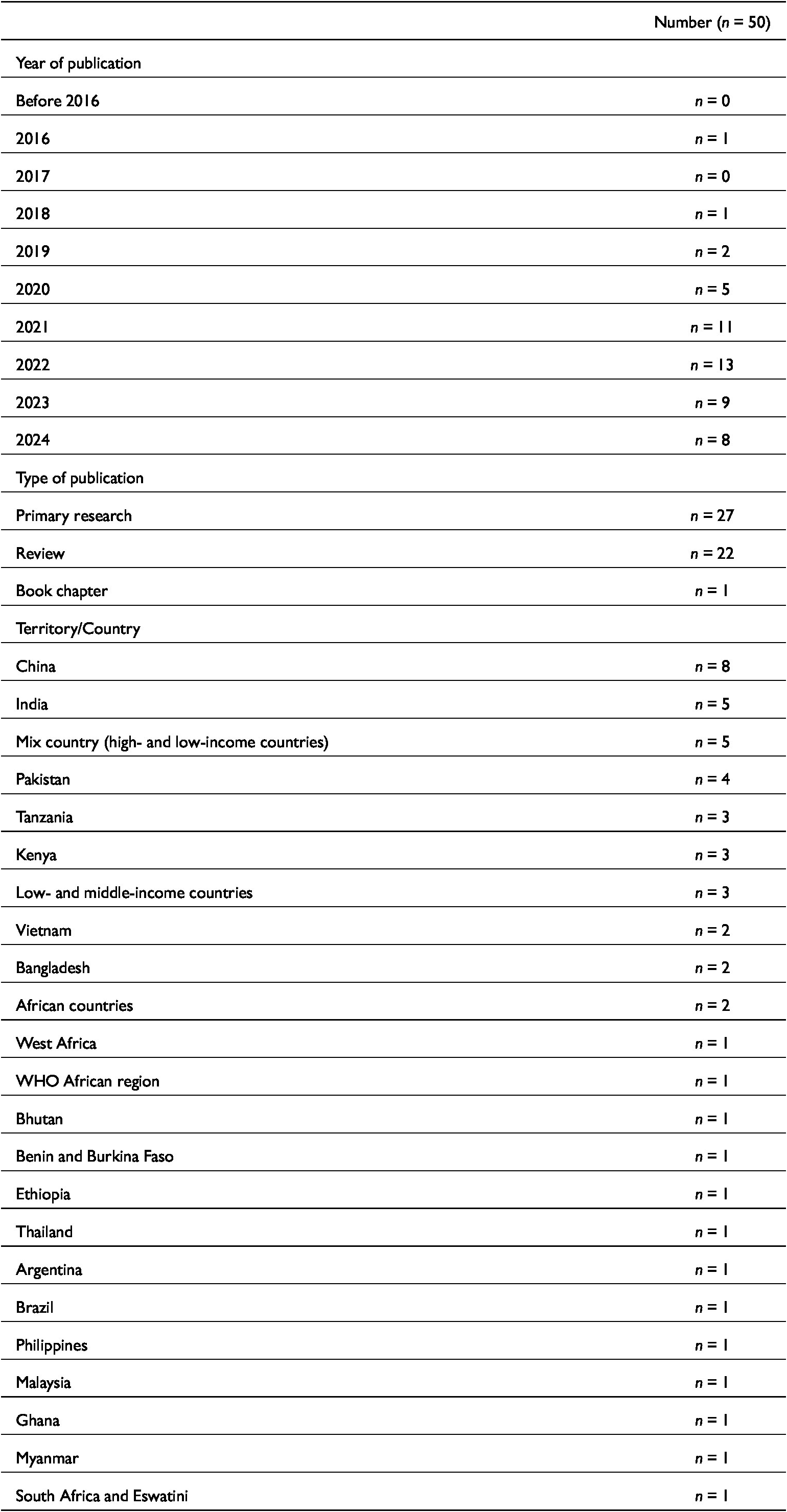
2. Results
The database search yielded 10,727 records. After title and abstract screening, 397 records remained, and 375 were retrieved and subjected to full-text screening. Fifty articles met the inclusion criteria (Figure 1). A summary of the 50 articles is detailed in Table 2. Of the 50 articles, 27 were primary research, 22 were reviews (scoping reviews, narrative reviews, literature reviews, or content analyses), and one book chapter. Of the included review articles, only five referenced primary research. The reviews were included to provide a broad exploration of governance meanings, given that the primary studies focused primarily on the implementation of AMR policies, and especially NAPs.
PRISMA flow diagram showing the study selection process for AMR governance in low- and middle-income countries.
Source: Adapted from Tricco et al. Reference Tricco, Lillie, Zarin, O’Brien, Colquhoun, Levac and Moher2018, Annals of Internal Medicine 169(7): 467–473).

Figure 1. Long description
The flowchart is organized into three vertical phases: Identification, Screening, and Included.
1. Identification Phase:
- Top-left box: Records identified from databases and registries n equals 10727. Sources include E M B A S E 2783, Scopus 5329, Hinari registry 449, Web of Science 270, C A B Abstracts 901, C I N A H L 543, and PubMed 452.
- Top-right box: Records removed before screening n equals 3701. This includes duplicate records removed n equals 3690, records marked as ineligible by automation tools n equals 11, and records removed for other reasons n equals 0.
2. Screening Phase:
- Central box 1: Records screened n equals 7026. An arrow points right to Records excluded n equals 6629.
- Central box 2: Reports sought for retrieval n equals 397. An arrow points right to Reports not retrieved n equals 22.
- Central box 3: Reports assessed for eligibility n equals 375. An arrow points right to Reports excluded n equals 325. Reasons for exclusion include Grey literature n equals 73, Does not describe A M R Governance n equals 160, High-income countries n equals 47, Global n equals 44, and Non-English n equals 1.
3. Included Phase:
- Central box 4: New studies included in review n equals 0 and Reports of new included studies n equals 0.
- Bottom box: Total studies included in review n equals 50 and Reports of total included studies n equals 0.
Descriptive characteristics of the included articles

Table 2 Long description
The table is divided into three main categories.
Year of publication:
* Before 2016: n equals 0
* 2016: n equals 1
* 2017: n equals 0
* 2018: n equals 1
* 2019: n equals 2
* 2020: n equals 5
* 2021: n equals 11
* 2022: n equals 13
* 2023: n equals 9
* 2024: n equals 8
Type of publication:
* Primary research: n equals 27
* Review: n equals 2
* Book chapter: n equals 1
Territory/Country:
* China: n equals 8
* India: n equals 5
* Mix country (high- and low-income countries): n equals 5
* Pakistan: n equals 4
* Tanzania: n equals 3
* Kenya: n equals 3
* Low- and middle-income countries: n equals 3
* Vietnam: n equals 2
* Bangladesh: n equals 2
* African countries: n equals 2
* West Africa: n equals 1
* W H O African region: n equals 1
* Bhutan: n equals 1
* Benin and Burkina Faso: n equals 1
* Ethiopia: n equals 1
* Thailand: n equals 1
* Argentina: n equals 1
* Brazil: n equals 1
* Philippines: n equals 1
* Malaysia: n equals 1
* Ghana: n equals 1
* Myanmar: n equals 1
* South Africa and Eswatini: n equals 1
Source: Compiled by authors from the included articles.
Across all papers, the LMICs covered included: low-income countries (Ethiopia and Burkina Faso), lower-middle-income countries (Kenya, Tanzania, Myanmar, Bangladesh, Vietnam, Bhutan, Pakistan, Ghana, Benin, Eswatini, Philippines, and India), and upper-middle-income countries (China, South Africa, Thailand, Argentina, Brazil, and Malaysia). Four papers were region-based (WHO African region, African countries, West Africa, LMICs) and five were a mix of high-, low-, and-middle-income countries. With regard to discipline coverage, 24 articles are published under clinical practice, microbiology, and pharmaceutical sciences, 12 in public health and health policy, and six in social science and humanities. Of the remaining nine, three are published in environment, agriculture and sustainable food systems, three in OH, and two in veterinary practice.
We found very few papers on AMR governance in LMICs before 2016, but more after 2020, and the highest number in 2021 and 2022. Eighteen of the fifty papers focused on NAPs, nine on national AMR policies and the influence of global guidelines in shaping local or national policies, seven on stewardship, five on the OH approach in AMR containment, and three on surveillance. The remaining eight papers had a broad and cross-cutting focus ranging from situational analyses of AMR (four), an anthropocentric framing of AMR (one), factors that influence AMR interventions (one), adoption and implementation of AMR governance policies/regulation at subnational levels (one), and government guidance funds financing model in development of antimicrobials (one) (Table 3). A detailed table is provided as Supplementary Material 1.
Thematic focus area of the included articles

Table 3 Long description
The table is organized into five columns: an index number, Thematic categories, Objective or focus of the article, Articles (Author/s), and Number of articles.
* Category 1: N A P / G A P (Total 18 articles). Focuses on feasibility, implementation challenges, and stakeholder perceptions of National and Global Action Plans. Key authors include Avello et al. 2024 and Ahmed et al. 2022.
* Category 2: A M R Policies (Total 9 articles). Covers sector-specific comparisons and governance evolution. Key authors include Avraam et al. 2021 and Chan et al. 2022.
* Category 3: One Health (Total 5 articles). Discusses multi-sectoral approaches in Vietnam, India, and Malaysia. Key authors include Mitchell et al. 2020 and Jani et al. 2021.
* Category 4: Stewardship (Total 7 articles). Examines antimicrobial use in livestock, aquaculture, and agriculture in L M I C s like Kenya and Bhutan. Key authors include Mendelson et al. 2016 and Hughes et al. 2024.
* Category 5: Surveillance (Total 2 articles). Focuses on W H O African Region progress and One Health surveillance in Vietnam. Authors: Gahimbare et al. 2024 and Bordier et al. 2018.
* Category 6: Surveillance and stewardship (Total 1 article). Assessment of diagnostic tools in Africa by Gulumbe et al. 2022.
* Category 7: Situation analysis (Total 4 articles). Covers health system bottlenecks and farming practices in Bangladesh and Pakistan. Key author: Sohaili et al. 2024.
* Category 8: Subnational levels (Total 1 article). Focuses on P P P s for A M S in Kerala. Author: Singh et al. 2021.
* Category 9: Anthropocentric framing of A M R (Total 1 article). Discusses ethical challenges and health hierarchies. Author: Cañada et al. 2022.
* Category 10: Interventions (Total 1 article). Factors influencing A M R interventions in H I C s and L M I C s. Author: Graells et al. 2023.
* Category 11: Funding (Total 1 article). Role of government guidance funds. Author: Husain et al. 2024.
Source: Compiled by authors from included articles.
Emergent themes in line with the review questions included: (i) AMR governance approaches: mimicry of the GAP as a central theme (ii) AMR governance in practice: governance mechanisms and tools, stakeholder involvement and interactions, a focus on the human and animal sectors, formal coordination and accountability structures, and data access and transparency (iii) Areas of strengthening for equitable and sustainable AMR governance. See Table 4 for a detailed summary of the emergent themes.
A summary of emergent themes in line with the scoping review questions

Table 4 Long description
The table is organized into four columns: Themes, Subthemes, and Number of Articles.
Theme 1: AMR governance approaches: mimicry of the G A P as a central theme.
- Subtheme: Country context-specific focus on A M R containment before G A P. Focuses on clinical monitoring and rational antibiotic use. 11 articles.
- Subtheme: Mimicry of the Global Action Plan G A P. Includes reliance on G A P objectives, subtle differences in N A P visions, and misalignment due to limited contextualization. 27 articles.
- Subtheme: Governance approaches tailored to specific contexts. Includes Public-Private Partnerships P P P s and contract governance between farmers and cooperatives. 2 articles.
Theme 2: AMR governance in Practice: competing priorities, complex coordination, and hierarchies.
- Subtheme: Governance mechanisms and tools. Includes surveillance, stewardship, and multisectoral frameworks. 14 articles.
- Subtheme: Stakeholder involvement and interactions. Addresses tokenism, absence of key stakeholders, and clashing interests. 28 articles.
- Subtheme: A focus on the human and animal sectors. Notes siloed operations across One Health sectors. 15 articles.
- Subtheme: Formal coordination and accountability structures. Discusses progress in establishing bodies versus limited functionality and structural barriers. 18 articles.
- Subtheme: Data access and transparency. Highlights limited dissemination of surveillance data and unclear indicators. 13 articles.
Theme 3: Areas of strengthening for an equitable and sustainable A M R governance.
- Subtheme: Strengthening multisectoral frameworks and processes. Focuses on national and subnational guidelines and O H-A M R/N A P s regulatory regimes. 18 articles.
- Subtheme: Leveraging existing country priorities, skills, and capacities. 18 articles.
- Subtheme: Strengthened capacity and resources. Addresses human resources, infrastructure, and political shifts. 22 articles.
- Subtheme: Establishing clear and sustainable funding modalities. Notes donor dependency and lack of domestic budgets. 22 articles.
- Subtheme: Addressing inclusivity and diversity gaps. Covers L M I C positioning, urban-rural inequalities, and gender considerations. 18 articles.
Number of Articles** Means that themes recur across multiple articles, and hence the totals should not be expected to tally to the 50 articles reviewed.
Source: Compiled by authors from the included articles
2.1. Operationalization of governance in the AMR containment space in LMICs from 2000 to 2024
2.1.1. AMR governance approaches: mimicry of the GAP as a central theme
The papers suggest that there is no universally accepted definition or “one-size-fits-all” or “single, logical pathway” to AMR governance.Footnote 31 Eleven articles describe context-specific country AMR containment initiatives prior to the endorsement of the GAP in 2015 with a focus on the human health sector and to a lesser extent the animal health sector.Footnote 32 For example, China and Argentina, with large agricultural economies, reportedly prioritized control of antibiotic use in humans and animals by emphasizing clinical monitoring and rational antibiotic use in their regulatory and surveillance frameworks.Footnote 33 In Argentina, Allel and colleagues report that AMR regulation began in the 1960s with the first law on medication and enforced prescription for antibiotic acquisition; and in 2007–2009 decrees required prescription for dispensing of veterinary medicines for usage in food-producing animals.Footnote 34 In China, regulatory guidelines on the rational use of antibiotics and a series of policies to control the use and residues of veterinary drugs have been reported since the 1990s.Footnote 35
However, 27 reviewed papers indicate a predominance of the Global Action Plan (GAP) in influencing the overall approach to AMR governance at country level, in the form of the NAPs.Footnote 36 A cross-country research investigating isomorphic dynamics in the development and implementation of NAPs in HICs and LMICs articulates that LMIC NAPs depict an “isomorphic mimicry” of the five strategic objectives of the GAP with limited contextualization.Footnote 37 Similarly, other articles note that while the need to optimize a OH approach is clearly stated in some NAPs, slight variations in line with local context exist.Footnote 38 As a result, LMICs are reported to end up with grand goals, yet with unrealistic targets, a lack of monitoring, and inadequate regulations due, in part, to unclear policy directions and capability challenges.Footnote 39
Within an overall pattern of mimicry, reviewed articles indicate that countries take varied approaches in operationalizing NAPs: top-down, decentralized, or a mix of both. China, for example, is reported to employ a top-down approach to AMR governance where the national government oversees the trickle-down of the adoption of NAP policies to lower-level administrative units.Footnote 40 Other countries, including Kenya, the Philippines, and Ethiopia, have decentralized systems in which national governments give policy direction, while implementation is undertaken by subnational administrative units.Footnote 41
Other models of governance described, less clearly linked to GAP, include public-private partnerships (PPPs), with reported positive results.Footnote 42 For instance, in Kerala State, India, a public–private partnership approach involving 18 professional medical societies, human, animal, and environment actors, and civil society organizations was reported to have successfully co-developed and implemented an antimicrobial stewardship plan.Footnote 43 In China, context-specific governance models in the form of contract governance, centred on voluntary and reciprocal relationship networks between farmers and cooperative organizations, have been explored.Footnote 44
2.1.2. AMR governance in practice
This section reflects on five key findings which includes: governance mechanisms and tools, stakeholder involvement and interactions, a focus on th e human and animal sectors, formal coordination and accountability structures and data access and transparency.
Governance mechanisms and tools
Reviewed literature articulates several governance mechanisms (strategies, frameworks, rules, and procedures to actualize the established AMR governance approaches or policies), to formalize and promote a structured response to AMR in LMICs. These include surveillance and stewardship procedures and practices for both human and animal health, such as monitoring and evaluation frameworks at the hospital level in Bangladesh, the promotion of an integrated and multisectoral surveillance system and processes in Argentina, awareness programmes, including the World Antimicrobial Awareness Week (WAAW) in China, and multidisciplinary and interdepartmental collaboration initiatives in Brazil.Footnote 45 Other context-specific and need-based tools reported include decrees, declarations, proclamations, bans, policies, rules, regulatory Acts, and guidelines, depending on the OH area of focus or specific GAP objective.Footnote 46
Many of these papers highlight that whether or not these mechanisms and tools achieve the desired AMR containment goals depends on the nature of interactions between an array of stakeholders with varied roles and responsibilities at different levels (Table 5): global (policy development, advisory, surveillance and advocacy, and funding); regional (ensuring contextual relevance and alignment); national (policy formulation, enforcement, coordination, surveillance, research, and funding); research and academic (data provision, dissemination, advocacy, and funding) and as individual champions/AMR protagonists (advocacy, mediation, policy brokerage between community and policymakers, and advisory).
A summary of AMR governance stakeholders and their roles and responsibilities drawn from the reviewed literature

Table 5 Long description
The table is organized into three columns: Stakeholders/actors, Examples of stakeholders/actors, and Roles and responsibilities.
* Global level: Includes the Quadripartite (F A O, W H O, W O A H, and U N E P). Their roles involve policy and advisory functions such as developing the global action plan (G A P), inspiring national action plans (N A Ps), and guiding databases like Tr A C S S and G L A S S. They also provide funding through the A M R Multi-Partner Trust Fund (M P T F) and conduct surveillance and advocacy.
* Regional networks and partnerships: Includes A M R S N E T, My O H U N, S E A O H U N, and E D E S. Their role is to ensure A M R efforts are regionally relevant and globally aligned.
* National level: Divided into two rows. First, national authorities (ministries and departments) responsible for policy formulation, enforcement, coordination, and funding. Second, regulatory agencies or committees (e.g., committees in Tanzania, Kenya, and Argentina) that enhance coordinated efforts and policy translation.
* Individual champions or A M R protagonists: Includes civil society organizations (C S Os), chambers of producers, and grassroots actors like farmers. Their roles include advocacy, mediation, policy brokerage, and influencing policy direction.
* Research and academic actors: Includes public, private, and intergovernmental entities. Their roles include data provision, dissemination, advocacy, and funding.
Source: Compiled by authors from the included articles.
Stakeholder involvement and interactions
Lack of clarity regarding specific stakeholder mandates across independent yet interconnected and crosscutting roles and responsibilities is reported to contribute to the stalling of AMR efforts and activities. At a country level, 15 articles report a lack of clear articulation of the roles and responsibilities of stakeholders and actors within and across departments, resulting in confusion and slow implementation of AMR activities.Footnote 47 In Ghana, for instance, Hein and colleagues note that the role of civil society organizations (CSOs) in AMR-related international collaboration remains vague and, in some instances, tokenistic.Footnote 48
Limited engagement and meaningful involvement of stakeholders in policy setting and implementation are reported to affect stakeholder ownership of AMR policy design and legitimacy of decision-making processes. Whereas articles report inclusive and participatory approaches involving a broad spectrum of stakeholders from the onset of policy setting and implementation in countries like the Philippines, India and Thailand; limited engagement of actors from the private sectors, community and research institutes in the development of official documents is reported in Tanzania, Vietnam, Brazil, India, China, and Myanmar.Footnote 49
Minimal or no representation of specific sectors and departments such as the environment, finance, and education in some stages of policy processes is reported in Brazil, Tanzania, Pakistan and China.Footnote 50 Hein and colleagues report that environmental stakeholders are less visible compared to animal and human health stakeholders in Ghana.Footnote 51 Similar studies in Vietnam, Brazil and India add that, when these stakeholders are included, their representation largely centres on the agriculture and food systems.Footnote 52 In agriculture, for instance, five articles suggest that plant health representation is often missing or overshadowed by departments which focus on other priorities.Footnote 53
Limited consultation between international and local stakeholders is reported to affect a sense of ownership and drive for the AMR agenda in LMICs. In a qualitative study in Vietnam, the authors report that limited involvement in decision-making leads to a minimal sense of ownership and commitment to AMR policy implementation among local stakeholders.Footnote 54 Similarly, individual champions (defined by Chan and colleagues as people with influence and expertise in the AMR field), who are reported to effectively influence policy direction and compliance in some HICs, have little influence in LMICs. According to Chan et al., the latter can be attributed to an overreliance on global leadership and diplomatic influence in setting AMR policy direction.Footnote 55
Overall, diverse yet clashing stakeholder interests in AMR governance are reported to create disharmony and to result in duplication of AMR efforts, unintended neglect of some AMR mandates, the enabling of siloed activities, and inequities. Papers describe clashes in political-economic interests, public health and Research and Development (R&D) interests, and interests across levels (global, regional, national, and subnational) and between domestic actors and donors.Footnote 56 The reviewed literature notes limited integration of gender and socio-economic considerations in NAPs and AMR-related policy documents, with populations often treated as homogenous.Footnote 57 Urban–rural inequalities in access to essential services and resources, particularly for rural communities, are underacknowledged.Footnote 58 Stakeholder interests and priorities are reported to vary across income contexts as LMICs are commonly positioned as reservoirs of AMR, which highlights the need to improve access to antimicrobials, unlike HICs that commonly prioritize biosecurity and surveillance.Footnote 59
A focus on the human and animal sectors
Sectoral prioritization, hierarchies, and siloed operations are reported to undermine the operationalization of the OH approach envisaged in most NAPs.Footnote 60 Reviewed articles suggest that AMR policy and initiatives focus on the human and animal sectors with a subtle neglect of the environment, plant health, wildlife, and agriculture/aquaculture, and food production and safety.Footnote 61 Specifically, the neglect or minimal integration of the environmental sector into key AMR policy documents and related sector-specific initiatives is widely reported.Footnote 62 For example, a study in Ethiopia argues that environmental surveillance and regulatory efforts are inadequate.Footnote 63 In India, such inadequacies are partly attributed to a lack of empirical data and evidence linking environmental factors to the AMR burden.Footnote 64
Formal coordination and accountability structures
Review articles report that many LMICs have established coordination and accountability agencies or bodies responsible for enabling cross-sectoral participation and collaboration, and for the implementation and translation of AMR policies into action.Footnote 65 Countries have reportedly set up regulatory agencies, secretariats, commissions or committees at national and subnational levels as country-specific governance models demand.Footnote 66 Examples include the National Antimicrobial Stewardship Interagency Committee (NASIC) in Kenya, the Multi-Sectoral Coordinating Committee (MCC) in Tanzania, and the National Commission for AMR control in Argentina.Footnote 67
However, limited or low functionality of these coordinating and accountability agencies has been reported, linked to an overreliance on donor support, for instance, in Tanzania and Ethiopia.Footnote 68 This challenge is compounded by coordination complexities and minimal harmonization of activities, communication, and cooperation in AMR containment across national and subnational levels.Footnote 69 Lack or limited power to act was also highlighted as affecting the functionality of coordination for policy implementation and translation. In India, for example, challenges in engaging with international bodies, such as the WHO, who has no ministerial authority in the country, were reported by Ghafur et al. (Reference Abdul, Mathai, Muruganathan, Jayalal, Kant, Chaudhary and Prabhash2013), cited in Rajkhowa et al.Footnote 70
Omission of accountability mechanisms in some NAPs, as reported in a study in Argentina, and rigidity in chains of command and evaluation modalities of AMR policies and actions, especially the NAP, are widely acknowledged in the literature.Footnote 71 As a result, an analysis of 15 African NAPs reports that commitments to AMR containment are rarely achieved within stipulated timeframes.Footnote 72
Beyond financial and human resources, more structural barriers to coordination have been reported. For example, disparities in laboratory infrastructure and regional inequalities are postulated to create barriers to harmonized data collection and implementation of OH surveillance strategies.Footnote 73 In Brazil and Ghana, studies also note that shifting political landscapes and competition over mandates and resources have stalled the desired OH approach in tackling AMR, exacerbating the coordination gaps.Footnote 74
Data access and transparency
While Chua et al.Footnote 75 state that transparency in AMR data is critical for enhancing public awareness, participation, trust, and collaboration, inconsistencies exist, especially in the frequency of reporting and a lack of clarity of the reporting authority as reported in several countries, including Ghana and Bangladesh. For example, Ghana did not submit its 2020 and 2021 data to the WHO’s Global Antimicrobial Resistance and Use Surveillance System (GLASS) report, while the lack of dissemination of surveillance data was emphasized in Bangladesh.Footnote 76 Five articles also report on unclear indicators for monitoring progress, as well as the “missing” openness of many countries in self-reporting to the Global Database for Tracking Antimicrobial Resistance (AMR) Country Self-Assessment Survey (TrACSS).Footnote 77
Articles articulate that the absence of proper documentation makes it challenging for policymakers and the public to effectively gauge the progress of implemented strategies.Footnote 78 While some countries, Tanzania for example, are reported to have a clear governance structure, a defined budget, and publicly available information on funding sources for all identified NAP activities, this level of openness is not always the norm as reported in other countries, such as Latin America and Asia.Footnote 79 Avello et al. report a lack of discussion and clarity of open access to the public for progress reports and funding allocations in most of Latin America’s NAPs, while Yang et al. state that China lacks guidelines for making data on funding allocations open and readily accessible for use in informing AMR policies.Footnote 80 In the African context, Harant observes a lack of a dedicated subpage for AMR on government websites, with documents only available through funding or health organization bodies and a lack of contact details for focal persons, making it difficult to request for information, while cautiously noting contextual online and offline preferences in government documentation.Footnote 81
Articles also report a lack of translation of available evidence into actionable and practical policies across contexts.Footnote 82 For example, Corrêa and colleagues state that highly heterogeneous contexts, varied policy priorities and unharmonized data-sharing frameworks in Brazil and other LMICs contribute to a lack of translation of available evidence into actionable and practical policies. In Vietnam, a qualitative study notes that there is poor consideration of technical reports and scientific evidence in the formulation and implementation of regulatory approaches.Footnote 83
Consequently, the lack of readily available data is reported to significantly hinder the understanding of the true incidence and impact of AMR across the OH sectors, particularly in continents like Africa.Footnote 84 A study in Ethiopia shows that environmental surveillance and regulatory efforts are inadequate or completely lacking in many countries.Footnote 85 This is partly attributed to a lack of empirical data and evidence linking environmental factors to the AMR burden as reported in India.Footnote 86
2.2. Areas of AMR governance in LMICs requiring strengthening to ensure equitable and sustainable change
The reviewed papers highlight the following areas as requiring strengthening:
2.2.1. Strengthening multisectoral frameworks and processes
Several papers argue that it is necessary to strengthen OH-AMR regulatory regimes and monitoring and evaluation frameworks.Footnote 87 Primary studies in Argentina, Myanmar, and Kenya stipulate that for this to happen, a shift from adopting international guidelines and standards without or with little consideration for varied local contexts and realities towards fostering inclusivity at national and subnational levels in setting guidelines and frameworks is required.Footnote 88
Regarding governance mechanisms and tools, according to Ahmed et al.Footnote 89 and Sohaili et al., there is a need to enhance practical approaches to AMR stewardship, infection prevention and control, and water, sanitation, and hygiene.Footnote 90 This is to be achieved through, among other initiatives, effective and efficient awareness and education approaches.Footnote 91 Some of the widely recommended approaches by the reviewed papers include customized and culturally relevant messaging in promoting effective and efficient AMR awareness, capacity building, and closing the research and evidence gap by translating available evidence into practical and actionable strategies.Footnote 92
2.2.2. Leveraging existing country priorities, skills, and capacities for retaining the gains made
To enhance multisectoral coordination and collaboration within, between, and across OH sectors, it is argued that there is a need to streamline and integrate varied stakeholder needs and interests through active participation and ensuring that meaningful engagement is recurrent for a sustainable and inclusive AMR governance.Footnote 93 Several authors argue that there should be a move away from overprioritization of human health (anthropocentrism) to meaningfully include or make visible the often-underrepresented sectors: the environment, plant health, wildlife, agriculture, aquaculture, and food production and safety in AMR-related efforts.Footnote 94
2.2.3. Strengthened capacity and resources
A shortage of diverse and skilled human resources and high turnover for AMR-related personnel are widely reported to have implications on competency, knowledge retention and overall AMR outcomes.Footnote 95 In addition, Chan and colleagues state that frequent leadership changes or political shifts are associated with a lag in the implementation of AMR policies, largely due to a lack of long-term institutional memory, inconsistent policy enforcement, and a lack of previous experience.Footnote 96 There are calls for investment if equitable and sustainable AMR governance is to be achieved.Footnote 97
2.2.4. Establishing clear and sustainable funding modalities
Eight of the reviewed articles recommend the need for clear and sustainable funding modalities, qualified human resources, and physical infrastructure.Footnote 98 This has been attributed to, among other things, only a few NAPs having mentioned incremental implementation plans to align with available resources.Footnote 99 A lack of or limited dedicated AMR budgets, high partner or donor dependency, and fund utilization driven by specific donor needs and priorities are also reported.Footnote 100 In addition to the need for clear and sustainable funding initiatives, articles recommend leveraging resources, skills, coordination, and capacity building on existing country priority areas and policies, as well as political priorities, as useful avenues to ensure the sustainability of AMR governance against competing and scarce resources.Footnote 101
2.2.5. Addressing inclusivity and diversity gaps from policy setting to implementation and uptake of the same
Integrating and mainstreaming equity and vulnerability lenses into policy design and implementation processes is highlighted in the reviewed literature as requiring a keener focus if AMR interventions are to be both effective and fair. This is due to the given inclusivity and diversity gaps regarding some sectors (as described above), the limited voice of stakeholders such as CSOs, and the limited consideration of the needs of special groups such as rural communities or the elderly during policy development and implementation.Footnote 102
3. Discussion
Our analysis indicates that it is only from 2016 that peer-reviewed literature on AMR governance in LMICs became visible, with much of it focusing on the implementation of the AMR GAP, primarily through NAPs. Our review highlights uneven implementation of NAPs in LMICs, reflecting political, economic, and ethical tensions across diverse stakeholders’ roles and the distribution of benefits and burdens. Using epistemic, procedural, and distributive justice lenses, which are constituents of a JT approach, can make some of these tensions visible and identify opportunities to develop equitable and sustainable governance solutions.Footnote 103 Epistemic justice focuses on fairness in how knowledge is produced, shared, and valued.Footnote 104 Procedural justice emphasizes transparent and inclusive decision-making, and “governance from below,” which in turn could lead to better contextualization of solutions, more realistic mapping of actions onto goals, and improved ownership, commitment, and accountability.Footnote 105 Distributive justice would help to make the interests of different stakeholders explicit, enabling focus on fair distribution of burdens and benefits towards equitable implementation.Footnote 106
The dearth in documenting home-grown initiatives for AMR governance in LMIC-focused peer-reviewed literature presents an epistemic knowledge gap. It may explain why global AMR governance initiatives have been informed primarily by data from HICs.Footnote 107 Advocating for epistemic justice while simultaneously strengthening data on AMR governance in LMIC contexts can give visibility to local realities and priorities and make a case for home-grown AMR governance initiatives.
Procedurally, many LMICs mimic the five strategic intervention areas of the 2015 AMR GAP in their NAPs despite their shortcomings in addressing gender and equity concerns.Footnote 108 In contrast, Europe shows a different pattern as numerous HICs are reported to deviate substantially from the set global standards by setting their own targets and goals independent of the GAP in response to their own contexts.Footnote 109 The risk with isomorphic mimicry is that LMICs might adopt the globally acceptable framing of AMR governance, which might give a superficial impression of progress without commensurate results.Footnote 110 To counter this risk, the reviewed literature recommends that while LMICs may align with the five strategic areas for AMR containment, contextualizing their approaches to local and regional realities, interests, and priorities remains paramount.Footnote 111
Recent studies have emphasized the need for “glocal” governance, which advocates for “thinking globally but acting locally.”Footnote 112 A “glocal” approach can align the global with the local when institutionalizing AMR responses.Footnote 113 This would minimize the risk of NAPs being too generalized to implement, having unrealistic objectives and targets, or little consideration for varied socio-economic, geographic, and multi-level realities.Footnote 114 “Glocal” governance can advance procedural justice in AMR containment by intentionally including LMIC voices, interests, priorities, and concerns into global AMR policy and contribute to addressing the gender and equity considerations gap in the GAP and LMIC NAPs.Footnote 115 This stresses the importance of a paradigm shift from merely adopting tools to recognizing need-based priorities and efforts, which are elements of procedural and distributive justice.Footnote 116
Challenges with stakeholder/actor involvement and conflicting interests affect the utilization of AMR governance mechanisms and tools. An integral part of “glocal efforts” is therefore to have a clear strategy for involving stakeholders/actors in AMR governance, considering how they are involved, and who is (in)visible, present or missing in the governance structures and processes, as well as their interests, all of which are aspects of procedural and distributive justice.Footnote 117 When implementing a OH approach to AMR governance, it is essential to consider power asymmetries between and among stakeholders, as they affect strategic vision, coordination, collaboration, participation, transparency, accountability, and equity.Footnote 118 Consequently, there is also a need to consider the opportunity cost of allocating resources towards multiple new initiatives, and to explore mainstreaming of AMR governance concerns into existing institutional structures and mechanisms.
For sustained and resilient governance efforts, there is a need to strengthen domestic resource mobilization and capacity building to curb overreliance on donor and/or partner support to achieve distributive justice in AMR containment. Strengthening existing financing mechanisms such as government budgets, public-private partnerships, and regional networks, through, for example, the integration of AMR containment priority needs into existing inter-ministerial budgets as well as aligning AMR containment with government priorities, is essential.Footnote 119 This may, in turn, foster ownership, commitments, and accountability, and may counter the perception of AMR as a foreign agenda or that the responsibility for AMR rests with the global north.Footnote 120
Overall, the transition from how AMR governance is currently enacted to forms that are more responsive and fairer to LMICs requires global and national actors to constantly reflect on how to minimize harm to affected countries and communities and avert potential unintended consequences. Focus should be on ensuring fairness, justice, equity, transparency, and accountability in the prioritization of LMIC needs and concerns, representation, voice, and the distribution of roles, responsibilities, resources, benefits, and burdens. Drafts of the new 2026–2036 AMR GAP (which is due to be completed and adopted in 2026) signal a shift in global governance towards fairer responses to AMR through addressing gender and equity concerns.Footnote 121 For instance, it proposes disaggregation of human health data by sex, age, and other social determinants for antimicrobial use surveillance and emphasizes the need to drive ownership of AMR responses while ensuring equity and reach, especially for at-risk populations, which were not addressed in the 2015 GAP.Footnote 122 We hope that once adopted, the 2026 GAP will catalyse inclusion of gender and equity considerations with a “glocal” approach as countries update their NAPs. While this complex expectation cannot be achieved instantaneously, incremental steps should be encouraged.
3.1. Limitations of the study
This review focused only on peer-reviewed articles published in English. This limitation means that our findings may have missed equally relevant and current information on the topic from grey literature. However, we acknowledge that grey literature, encompassing sources such as unpublished literature and government texts, could offer valuable insights.
4. Going beyond alignment
Beyond aligning with global frameworks, strengthening AMR governance in LMICs requires institutional and political commitment, just and equitable involvement of OH stakeholders, mainstreaming AMR into existing structures to leverage existing resources, skills, and institutional capacity, while contextualizing AMR containment responses to local needs, and sustainable human, infrastructural, and financial resources.
Supplementary material
The supplementary material for this article can be found at http://doi.org/10.1017/pub.2026.10206.
Acknowledgements
The authors thank Alex Maina, Vincent Kagonya, and Clare Chandler for their invaluable insights during the development of this paper. The authors also thank the anonymous reviewers for their constructive comments and suggestions.
Author contribution
E.N.M. conceptualized and obtained funding for the study. E.N.M., M.M.M., N.O., J.M.K., A.M., S.L., and S.M. provided input on the study design and methodology. M.M.M. performed the database search. M.M.M. and N.O. independently screened the articles and M.M.M, N.O., and J.M.K. extracted data from the included studies. M.M.M, N.O., and J.M.K., analysed the findings of the reviewed studies and drafted the review manuscript. E.N.M. and all co-authors provided guidance throughout the process. All authors contributed to the writing and reviewing of the scoping review manuscript.
Financial support
This research was funded by the Wellcome Career Development Award reference number 227329/Z/23/Z and the British Academy’s ODA Challenge-Oriented Research Programme Grants reference number (IOCRG\100070) supported under the UK Government’s International Science Partnerships Fund. The views expressed in this publication are those of the author(s) and not necessarily those of Wellcome, the British Academy, or the Health Services Unit.
Conflict of interests
The authors declare none.




 Open access

