Child maltreatment (CM) represents one of the most adverse and stressful challenges that a child may experience (Cicchetti & Lynch, Reference Cicchetti, Lynch, Cicchetti and Cohen1995) and has complex and multifaceted long-term sequelae. There is a clear link between CM and heightened risk for long-lasting problems in domains associated with poor emotion regulation and impulse control (Aldao, Nolen-Hoeksema, & Schweizer, Reference Aldao, Nolen-Hoeksema and Schweizer2010) including poor physical and mental health, drug and alcohol misuse, and criminal and other risky behaviors (Gilbert et al., Reference Gilbert, Widom, Browne, Fergusson, Webb and Janson2009; Pechtel & Pizzagalli, Reference Pechtel and Pizzagalli2011). However, there has been limited research examining the intersection of inhibitory control and emotion in the context of CM history. It is plausible that inhibitory control, the ability to prevent a response or stop an ongoing response (Nigg, Reference Nigg2017), is particularly disturbed during emotionally negative contexts for individuals who experienced maltreatment. For instance, when individuals with a history of CM encounter fearful stimuli in their environment, they might have trouble regulating their emotions while simultaneously avoiding distractions and engaging in goal-directed behavior. In fact, previous work has linked childhood abuse with deficits in emotional conflict regulation (Marusak, Martin, Etkin, & Thomason, Reference Marusak, Martin, Etkin and Thomason2015; Powers, Etkin, Gyurak, Bradley, & Jovanovic, Reference Powers, Etkin, Gyurak, Bradley and Jovanovic2015). Nonetheless, multifinality, or variance in outcomes has been observed in high-risk samples, including maltreated individuals (Cicchetti, Rogosch, Lynch, & Holt, Reference Cicchetti, Rogosch, Lynch and Holt1993). Recent research provides preliminary evidence that resilient adults show an improved ability to regulate emotions, dampen threat processing, and habituate stress responses (for review, see Moreno-López et al., Reference Moreno-López, Ioannidis, Askelund, Smith, Schueler and Van Harmelen2020), whereas adults with long-lasting negative effects of trauma exposure (e.g., experiencing post-traumatic stress disorder; PTSD) demonstrate impaired attentional control in the context of emotional information (Fani et al., Reference Fani, King, Clendinen, Hardy, Surapaneni, Blair and Ressler2019). Individual differences in adaptive functioning during adulthood may result from variation in the ability to inhibit impulses in the context of emotional distractions, underpinned by coordination of cognitive–affective brain circuits.
Executive function differences following CM
A growing body of research that compares individuals with and without CM indicates that executive functions (EF) generally, and inhibitory control in particular, are impaired following CM (van der Bij, den Kelder, Montagne, & Hagenaars, Reference van der Bij, den Kelder, Montagne and Hagenaars2020). Disruptions in EF, including attention shifting, cognitive and behavioral inhibition, working memory maintenance, and self-regulation and self-monitoring, have been identified consistently in both children and adults exposed to trauma. In children, exposure to familial trauma (relative to nonfamilial or no trauma exposure) has been associated with poorer performance on an EF composite including working memory, inhibitory control, auditory attention, and processing speed tasks (DePrince, Weinzierl, & Combs, Reference DePrince, Weinzierl and Combs2009) and on specific measures of inhibitory control (Cowell, Cicchetti, Rogosch, & Toth, Reference Cowell, Cicchetti, Rogosch and Toth2015). Children with substantiated abuse histories show more impaired inhibitory control relative to nonabused children, including nonabused children with psychiatric issues (Mezzacappa, Kindlon, & Earls, Reference Mezzacappa, Kindlon and Earls2001). Caregivers also report more EF challenges in children exposed to maltreatment relative to nonmaltreated children (Fay-Stammbach & Hawes, Reference Fay-Stammbach and Hawes2019). In adults exposed to childhood trauma, diminished inhibitory control has also been observed (Daly, Hildenbrand, Turner, Berkowitz, & Tarazi, Reference Daly, Hildenbrand, Turner, Berkowitz and Tarazi2017; Navalta, Polcari, Webster, Boghossian, & Teicher, Reference Navalta, Polcari, Webster, Boghossian and Teicher2006). Poor executive functioning, and elevated impulsivity in particular, often persists into adulthood in maltreated populations (Pechtel & Pizzagalli, Reference Pechtel and Pizzagalli2011).
Several mutually compatible theories have been proposed to explain the link between CM and impaired EF, and elevated impulsivity in particular. It has been posited that impulsive dispositions and associated behavioral difficulties tax parental resources, resulting in an elevated likelihood of child abuse, particularly when parents are prone to impulsivity themselves (Liu, Reference Liu2019). A transactional relationship may exist as parental corporal punishment has been associated with an increased likelihood of children engaging in misbehavior (Gershoff, Reference Gershoff2002). In addition, it has been theorized that the maltreating rearing environment, often marked by unpredictability, results in prioritization of short-term goals in the face of long-term uncertainties (Belsky, Schlomer, & Ellis, Reference Belsky, Schlomer and Ellis2012). Furthermore, maltreated children often are deprived of many of the experiences believed to promote adaptive functioning across the life span, rendering them vulnerable to physical and psychosocial maladjustment (Cicchetti & Lynch, Reference Cicchetti and Lynch1993; Cicchetti & Toth, Reference Cicchetti and Toth2005; Gilbert et al., Reference Gilbert, Widom, Browne, Fergusson, Webb and Janson2009). For instance, children in maltreating families are less likely to observe healthy emotion management in parents or to be taught how to cope with their own emotions (Muehlenkamp, Kerr, Bradley, & Larsen, Reference Muehlenkamp, Kerr, Bradley and Larsen2010). Finally, elevated impulsivity following CM has been linked to the impacts of early adversity on neural development. CM has the potential to alter brain structure and function via disruption of neurodevelopmental processes that occur during childhood and adolescence including, synaptic remodeling, glial cell proliferation, myelination, dendritic and axonal branching, and programmed cell death (de Graaf-Peters & Hadders-Algra, Reference de Graaf-Peters and Hadders-Algra2006; Sowell et al., Reference Sowell, Peterson, Thompson, Welcome, Henkenius and Toga2003). These alterations may be adaptive for children in maltreating contexts where it is important to be vigilant to threat and ready to flee, which sometimes translates to impulsive behaviors.
Psychobiology and neuroimaging research provide further insights into the link between CM and elevated impulsivity. Emerging evidence suggests that CM is associated with deficits in brain regions that support EF including lateral frontostriatal and parieto-temporal regions (Andersen et al., Reference Andersen, Tomada, Vincow, Valente, Polcari and Teicher2008; Bremner et al., Reference Bremner, Vermetten, Vythilingam, Afzal, Schmahl, Elzinga and Charney2004; Hanson et al., Reference Hanson, Chung, Avants, Shirtcliff, Gee, Davidson and Pollak2010; Hart & Rubia, Reference Hart and Rubia2012; Herzog et al., Reference Herzog, Niedtfeld, Rausch, Thome, Mueller-Engelmann, Steil and Schmahl2019; Mackiewicz Seghete, DePrince, & Banich, Reference Mackiewicz Seghete, DePrince and Banich2018; Mackiewicz Seghete, Kaiser, DePrince, & Banich, Reference Mackiewicz Seghete, Kaiser, DePrince and Banich2017). Within the frontal lobe, alteration of right inferior frontal gyrus (IFG) was recently identified as a potential neurodevelopmental consequence of early adversity (Luby, Barch, Whalen, Tillman, & Belden, Reference Luby, Barch, Whalen, Tillman and Belden2017; Sun, Haswell, Morey, & De Bellis, Reference Sun, Haswell, Morey and De Bellis2019). This region in particular has been implicated in inhibitory control with functional magnetic resonance imaging (fMRI) studies using paradigms such as the Go/No-Go and stop signal tasks (Aron, Robbins, & Poldrack, Reference Aron, Robbins and Poldrack2004; Bari & Robbins, Reference Bari and Robbins2013; Chikazoe, Konishi, Asari, Jimura, & Miyashita, Reference Chikazoe, Konishi, Asari, Jimura and Miyashita2007). Thus, altered functioning in the right IFG may help explain CM-related impairments in inhibitory control. While these alterations may have supported functioning that was adaptive in a maltreating context, they are not necessarily adaptive as maltreated children grow into adulthood and are in nonmaltreating contexts (Rieder & Cicchetti, Reference Rieder and Cicchetti1989). At the same time, it is possible that individuals who are more resistant to the negative consequences associated with CM show a unique neural pattern associated with their resilience. Mental health after CM has been shown to be aided by increased or more flexible connectivity between central executive brain regions and emotion-processing limbic regions (for review, see Moreno-López et al., Reference Moreno-López, Ioannidis, Askelund, Smith, Schueler and Van Harmelen2020). Little is known about how resilient functioning may relate to differences in the neural systems supporting EF.
Emotion regulation and processing differences following CM
Relative to the small body of work on EF in the context of CM, the findings of altered emotion regulation following CM are quite numerous. It has been shown that the high levels of stress hormones observed in maltreated children can alter neural systems, especially in prefrontal cortical regions involved in emotion regulation (Hart & Rubia, Reference Hart and Rubia2012; Pechtel & Pizzagalli, Reference Pechtel and Pizzagalli2011; Teicher, Samson, Anderson, & Ohashi, Reference Teicher, Samson, Anderson and Ohashi2016). The prefrontal brain regions most consistently identified as structurally altered following CM include ventromedial and orbitofrontal cortex (Hanson et al., Reference Hanson, Chung, Avants, Shirtcliff, Gee, Davidson and Pollak2010; Hart & Rubia, Reference Hart and Rubia2012). These prefrontal regions have been consistently implicated in the regulation of affective signals from subcortical structures including the amygdala (Phillips, Drevets, Rauch, & Lane, Reference Phillips, Drevets, Rauch and Lane2003). Elevated threat-related activation of the amygdala itself, particularly on the right side, has also been linked to childhood trauma (Grant, Cannistraci, Hollon, Gore, & Shelton, Reference Grant, Cannistraci, Hollon, Gore and Shelton2011; Nooner et al., Reference Nooner, Mennes, Brown, Castellanos, Leventhal, Milham and Colcombe2013; for review, see Hein & Monk, Reference Hein and Monk2017). Furthermore, frontolimbic functional connectivity – the degree to which activity in the prefrontal cortex (PFC) relates to activity in the limbic system – has also been shown to be altered in maltreated individuals during emotion-processing tasks (Fonzo et al., Reference Fonzo, Flagan, Sullivan, Allard, Grimes, Simmons and Stein2013; Jedd et al., Reference Jedd, Hunt, Cicchetti, Hunt, Cowell, Rogosch and Thomas2015). Thus, brain systems crucial to emotion processing and regulation, including prefrontal and limbic regions, as well as the connectivity between these regions, have been shown to be impacted by CM.
It is important to consider, however, that the impact of CM is not uniform; many individuals with maltreatment histories exhibit resilience in various domains of functioning. Thus, when only group differences in childhood trauma are evaluated, the impact of individual differences in adaptation may be masked. More recent research examining individual differences following CM provides preliminary evidence that altered emotion processing and improved emotion regulation may foster resilience. For instance, individual differences in threat processing have recently been identified as a transdiagnostic mechanism contributing to the emergence of psychopathology (Weissman et al., Reference Weissman, Jenness, Colich, Miller, Sambrook, Sheridan and McLaughlin2019). Further, a recent study indicates that greater recruitment of prefrontal control regions and stronger modulation of amygdala reactivity during emotional viewing and reappraisal are protective against psychopathology (Rodman, Jenness, Weissman, Pine, & McLaughlin, Reference Rodman, Jenness, Weissman, Pine and McLaughlin2019). Previously maltreated adults without clinically significant psychopathology symptoms have been shown to have lower information transmission from the right amygdala to other brain network nodes when compared to maltreated adults with significant symptomatology (Ohashi et al., Reference Ohashi, Anderson, Bolger, Khan, McGreenery and Teicher2019). Other research has demonstrated stronger amygdala connectivity in frontal and parietal regions during emotional viewing in maltreated adults with greater current adaptive functioning (Demers et al., Reference Demers, McKenzie, Hunt, Cicchetti, Cowell, Rogosch and Thomas2018). Together, these findings suggest that effective emotion regulation, subserved by strong frontolimbic modulation, may support resilience following CM.
Maltreatment-related differences in inhibitory control in the context of emotion
It remains unknown whether individual differences in inhibitory control in the context of negative emotional distractions and associated neural activation are also protective against negative impacts of early adversity. One behavioral study addressed this interface by using two versions of the laboratory Stroop task in a maltreated sample: (a) a non-emotional task, consisting of emotionally neutral male or female faces presented with a congruent or incongruent word (male or female), and (b) an emotional task, consisting of a neutral or fearful face paired with a congruent or incongruent emotion word (neutral or fearful). Participants were instructed to ignore the word and respond based on the face. Results revealed impaired performance on the emotional, but not the non-emotional task in women with more self-reported childhood abuse. These individuals had the most difficulty with incongruent fearful stimuli (Caldwell, Krug, Carter, & Minzenberg, Reference Caldwell, Krug, Carter and Minzenberg2014). Emotional Stroop tasks have been used in two recent, comparably smaller fMRI studies investigating the effects of emotional interference on neural activation in brain regions associated with cognitive control (Herzog et al., Reference Herzog, Niedtfeld, Rausch, Thome, Mueller-Engelmann, Steil and Schmahl2019; Mackiewicz Seghete et al., Reference Mackiewicz Seghete, Kaiser, DePrince and Banich2017). While both studies found effects of CM history on neural activation to emotional content in brain regions associated with cognitive control, the direction of findings was mixed. Herzog and colleagues used a region of interest (ROI) approach and showed greater activation in the dorsolateral PFC, ventromedial PFC, dorsal anterior cingulate cortex (dACC) in the context of trauma-related words in female patients with complex PTSD compared to healthy females with and without trauma exposure (Herzog et al., Reference Herzog, Niedtfeld, Rausch, Thome, Mueller-Engelmann, Steil and Schmahl2019). Their findings suggest current psychological functioning relates to emotional conflict regulation. In Mackiewicz and colleagues’ study, adult females exposed to childhood abuse showed greater activation of right IFG and the left cerebellum than the control group and less activation in the left dorsolateral PFC and right dACC compared to the control group during the cognitive control condition across all trial types, and greater activation in the left IFG than the control group during emotional trials in particular (Mackiewicz Seghete et al., Reference Mackiewicz Seghete, Kaiser, DePrince and Banich2017).
The extant literature on inhibitory control in emotional contexts following CM relies primarily on tasks like the emotional Stroop, where in some cases, the emotional stimuli are task-relevant, and in other cases, effects of word valence may be relatively weak. That is, in the study by Caldwell and colleagues, attention to and processing of the affective face stimuli is necessary for task performance (Caldwell et al., Reference Caldwell, Krug, Carter and Minzenberg2014). Therefore, this task likely indexes a variety of cognitive and emotional processes simultaneously, making it difficult to determine whether inhibitory control, separate from recognition or interpretation of emotional stimuli, is disrupted specifically in the context of negative distraction. In the studies by Herzog's and Mackiewicz's groups, which both use emotion color word Stroop tasks, the emotion word is considered task-irrelevant since reading the word is not actually required during the task and the word is a distractor that captures attention (Herzog et al., Reference Herzog, Niedtfeld, Rausch, Thome, Mueller-Engelmann, Steil and Schmahl2019; Mackiewicz Seghete et al., Reference Mackiewicz Seghete, Kaiser, DePrince and Banich2017). Yet, previous work has demonstrated that valence effects on PFC activation are more apparent when stimuli are emotional pictures than when they are words (Kensinger & Schacter, Reference Kensinger and Schacter2006). Therefore, a task with background emotional pictorial stimuli that are unrelated to the task goal may more robustly and accurately index the effect of emotional distraction on inhibitory control. As such, while preliminary evidence suggests CM may put one at risk for elevated emotional interference, the effect of negative emotional distraction on inhibitory control in adults with CM history requires further study.
The present study
In the present study, we evaluated the impact of task-irrelevant negative emotional content on inhibitory control and neural activity in a longitudinal sample of adults with documented histories of child maltreatment. Inclusion of a longitudinal nonmaltreated comparison group recruited from the same schools and neighborhoods as the CM group allowed us more to clearly isolate effects of maltreatment from high socioeconomic adversity. In addition, we assessed whether individual differences in current adaptive functioning related to behavioral or brain measures of inhibitory control in emotional contexts.
We predicted that previously maltreated adults would show poorer inhibitory control than nonmaltreated comparison adults under negative distraction, as prior work has shown that maltreated children are more vigilant to threat. Therefore, at the level of the brain, during conditions requiring inhibitory control during emotional distraction, we expected a hyperactive right amygdala response in the CM group, which would indicate greater emotional reactivity to negative valence image distractors during the inhibitory control task. We predicted hypoactive prefrontal regulation, as evidenced by less prefrontal activation, due to its protracted development (de Graaf-Peters & Hadders-Algra, Reference de Graaf-Peters and Hadders-Algra2006; Sowell et al., Reference Sowell, Peterson, Thompson, Welcome, Henkenius and Toga2003), its susceptibility to early life stress (Diorio, Viau, & Meaney, Reference Diorio, Viau and Meaney1993), and its role in inhibitory control (Arnsten & Rubia, Reference Arnsten and Rubia2012). In particular, we expected the CM group would show greater activation in the right IFG, a region known to play an important role in impulse control and emotion regulation, based on recent findings implicating functional connectivity for this region in risk for externalizing problems following early adversity (Luby et al., Reference Luby, Barch, Whalen, Tillman and Belden2017). Finally, we predicted that differences in frontal activity would relate to current adaptive functioning of the participants, such that greater adaptive functioning would be associated with greater frontal cortex engagement.
Method
Participants
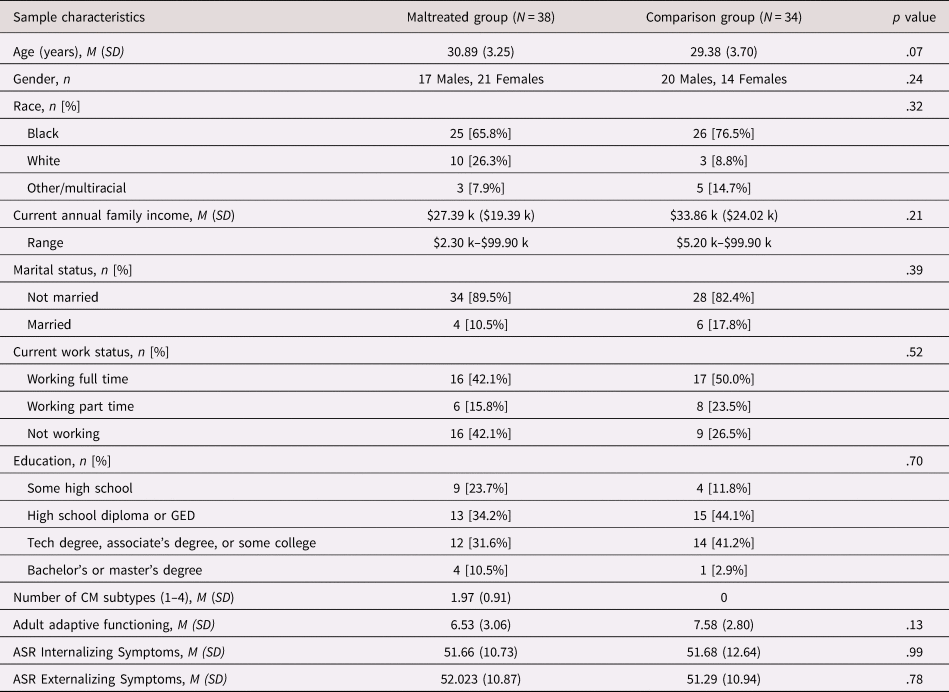
Participants included 72 adults (M = 30.18; 37 males and 35 females) from a longitudinal sample first recruited when they were 6−12 years old through a research summer camp for low-income, high-risk children. At the initial recruitment, 93% of parents reported a history of receiving public assistance. Thirty-eight participants had a history of CM as documented by Department of Human Services (DHS) records, and 34 participants were classified as non-CM based on a lack of DHS records of maltreatment through age 17. The Maternal Maltreatment Classification Interview (MMCI; Cicchetti, Toth, & Manly, Reference Cicchetti, Toth and Manly2003) was used to further verify CM history or the lack thereof. Comprehensive DHS records were coded using the maltreatment classification system to classify the type (i.e., neglect, physical abuse, sexual abuse, emotional abuse) of each report of substantiated maltreatment (Barnett, Manly, Cicchetti, & Toth, Reference Barnett, Manly, Cicchetti, Toth, Cicchetti and Toth1993). The majority (60%) of the CM group experienced more than one type of maltreatment. In adulthood, internalizing and externalizing symptoms were in the broad average range for 90% of the current sample, and not different between groups, suggesting that the present sample is relatively healthy and may represent a resilient subset of maltreated individuals. Relative to participants from the larger longitudinal sample who did not participate in this phase of the study, the current sample had lower rates of adolescent conduct disorder and attention problems and better self-reported attachment to fathers during adolescence, although there were no differences in demographics, maltreatment history, cognitive ability during adolescence, or other psychopathology measures during adolescence. All participants provided informed consent in compliance with the University of Rochester's Institutional Review Board and were compensated for their time. Demographic information for the current subsample is provided in Table 1.
Demographics and sample characteristics for the maltreated and comparison groups

Note: Statistical effects were tested by analyses of variance (ANOVA) or two-tailed t test as appropriate for the number of levels. ASR = Achenbach Adult Self-Report
Data from an additional 29 individuals were collected but excluded from the final analysis due to: serious mental illness identified by history of hospitalization (2 CM), structural brain anomalies (4 CM, 5 comparison), excessive head motion (7 CM, 5 comparison), or low response rate on the task (4 CM, 2 comparison). Imaging data were not collected on an additional 13 individuals who returned to the lab for the study but either had metal in the body (1 comparison), claustrophobia (3 CM), or were too large to scan (6 CM, 3 comparison). An additional 57 longitudinal participants were contacted and screened but either declined to participate at the adult time point, or were unable to participate due to incarceration, death, MRI contraindications, or job or personal scheduling conflicts.
Measure of adult adaptive functioning
Adult adaptive functioning, or competence, was assessed by examining each participant's competence or success on several stage-salient developmental tasks. A developmental task has been defined as a task typical to a certain period of life for which successful achievement leads to approval by society as well as competence or future successes (Havighurst, Reference Havighurst1956; Schulenberg, Bryant, & O'Malley, Reference Schulenberg, Bryant and O'Malley2004). We used a composite (range 0–14) of rank scores based on participants’ progress in seven domains of development: education, work, financial autonomy, romantic involvement, peer involvement, family involvement, and substance abuse. All participants completed the Adult Self-Report (ASR; Achenbach & Rescorla, Reference Achenbach and Rescorla2003) and a demographics questionnaire. Information from each domain was drawn from these measures. Adaptive functioning was defined in relation to others from similar economic and social backgrounds, given that participants were ranked on each developmental task relative to other study participants. For each domain, rankings were based on cutoffs that approximately divided the participants into thirds (lowest, middle, and highest; see details in the Appendix Material). This approach was based on work by Schulenberg et al. (Reference Schulenberg, Bryant and O'Malley2004) and has been previously published by our group (Demers et al., Reference Demers, McKenzie, Hunt, Cicchetti, Cowell, Rogosch and Thomas2018; Demers et al., Reference Demers, Handley, Hunt, Rogosch, Toth, Thomas and Cicchetti2019). Further details are included in the Appendix. While ranking based on comparison to others within the sample limits external validity, it increases our ability to observe individual variation within our study population.
Behavioral fMRI imaging paradigm
Participants underwent fMRI during performance of an International Affective Picture System (IAPS) Go/No-Go task (Cohen-Gilbert & Thomas, Reference Cohen-Gilbert and Thomas2013). The IAPS Go/No-Go measures the ability to inhibit a dominant response in the context of visual distractors. In this task, letters were presented sequentially in a small box at the center of the screen while negative, positive, neutral, or scrambled images were displayed in the background. Participants were instructed to ignore the background images and respond as quickly as possible with a button press to the presentation of every letter (Go stimuli), except the letter X (No-Go stimulus). The letters included H, P, R, S, T, and X. Go stimuli made up 73% of all trials such that participants acquired a prepotent tendency to press and needed to actively inhibit responses during No-Go trials.
Images were selected from the IAPS Lang, Bradley, & Cuthbert, Reference Lang, Bradley and Cuthbert2008), a collection of photographs selected to span a wide range of content and emotional valence. One hundred and eighty images were selected for use in this task. One third of the images had negative valence ratings (valence M = 3.17, SD = 0.58; arousal M = 5.53, SD = 0.83), one third had positive valence ratings (valence M = 7.36, SD = 0.39; arousal M = 5.05, SD = 0.82), one third ratings as close to neutral (5) as possible (valence M = 5.25, SD = 0.50; arousal M = 3.34, SD = 0.83). To create an additional emotionally neutral control condition that did not include object information, 120 of the selected IAPS images were also scrambled using a 32 × 32 grid.
The task was presented using E-Prime software (Psychological Software Tools Inc., Sharpsburg, PA) while participants were in the MRI scanner. The task included two runs, with trials blocked by stimulus valence within each run. Each run began and ended with a block of 15 scrambled image Go trials followed by a block of rest (fixation cross). Each run also included eight Go/No-Go blocks (two of each background type: negative, positive, neutral, or scrambled), presented in pseudorandom order. Each Go/No-Go block contained 15 trials, each with a unique IAPS image. Background IAPS images covered the entire screen and appeared for 200 ms before a small white box containing a black letter appeared in the center of the image for 500 ms. This design, with images presented alone prior to presentation of the letter stimulus, was used to make it more difficult for participants to ignore picture content. An inter-stimulus interval of 540 ms followed each trial. Participants’ responses (press or no press) and reaction times were recorded using a hand-held button box. Behavioral performance was measured by accuracy on No-Go trials across the emotional background types, and reaction time on accurate Go trials by background type.
fMRI data acquisition
Individuals were scanned on a Siemens 3 T TIM Trio whole-body scanner using a 32-channel head coil. High-resolution, T1-weighted images were acquired for each participant using an MPRAGE sequence (echo time [TE] = 3.4 ms, repetition time [TR] = 2,530 ms, field of view = 256 mm, matrix = 256 × 256, slice thickness = 1 mm, flip angle = 7°, 192 sagittal slices) for co-registration of functional images. Functional data were acquired using an echo-planar imaging sequence (TE = 30 ms, TR = 2,500 ms, field of view = 224 mm, matrix = 64 × 64, slice thickness = 3.5 mm with a 29% gap, flip angle = 90°, 36 interleaved oblique axial slices). To correct geometric distortion in the functional data, a fieldmap volume was collected immediately prior to the functional data acquisition using the same slice prescription (TE1 = 5.19 ms, TE2 = 7.65 ms, TR = 400 ms, field of view = 224 mm, matrix = 64 × 64, slice thickness = 3.5 mm with a 29% gap, flip angle = 60°, 36 interleaved oblique axial slices).
fMRI data analysis
Preprocessing
Functional imaging data were analyzed using FSL6.0.1 software. Head motion in the scanner was assessed and data points were censored based on the following parameters: (a) absolute motion exceeding one voxel of overall displacement from the first volume in the series and (b) relative motion exceeding one half voxel from one volume to the next. Volumes immediately preceding and following those that meet the relative motion criterion were also excluded. Motion displacement was quantified using the root mean square across the six head motion parameters. Participants with above threshold motion in more than 25% of data points (TRs) were excluded from further analyses, such that the final sample of 72 participants each had at least 171 TRs, or 7 min 8 s, of usable task data. In addition, usable structural scans were required for inclusion in the analysis. In addition to fMRI data quality, participants with less than 60% accuracy on Go trials with scrambled background images were deemed to demonstrate poor understanding of the task demands and were excluded from further analyses. fMRI preprocessing steps included motion correction with MCFLIRT, skull stripping using the Brain Extraction Tool, slice time correction, geometric unwarping based on a fieldmap volume, spatial smoothing using a 6-mm full width at half maximum Gaussian kernel, and high-pass temporal filtering with a filter cutoff of 100 s based on the block design task. Each participant's functional images were registered to the corresponding high-resolution anatomical image (using 6 df), which were in turn registered to the Montreal Neurological Institute standard space (152 individual T1 2-mm template) using 12 df.
Task analysis
Single-subject data were entered into a general linear model using gamma-convolved predictors for the four image-background conditions (negative valence, positive valence, neutral valence, scrambled images), with rest blocks serving as the unmarked baseline. Additional predictors of noninterest included a predictor for an unused buffer period (short fixation period at the beginning of the task), a predictor for the all-Go trial blocks, six predictors for head motion (three rotation and three linear translation), and a censoring (motion displacement) predictor for each motion-affected TR. The activation contrast of interest was response to negative > response to neutral.
Group analysis
Whole-brain mixed effects regression analyses were conducted to assess activation differences between the maltreated and comparison groups, with age and gender as centered nuisance variables. We used FSL/FEAT (FLAME 1) to correct for multiple testing across voxels with a voxel-level threshold of p < .005 and a cluster threshold (calculated using Gaussian random field theory maximum height thresholding) of p < .05.
Statistical analyses
We first conducted independent t tests or chi-square tests on demographic variables to confirm group equivalence, and on psychopathology variables to explore group differences in symptoms. To parallel the imaging contrast of negative versus neutral valence background conditions, we used 2 × 2 mixed-model analyses of variance (ANOVA) to test effects of group (CM vs. comparison) and emotional background type (negative vs. neutral) on task performance, with age and gender as covariates. Analyses were run on the main inhibitory measures, No-Go accuracy and Go trial reaction time, and also on Go trial accuracy. Follow-up paired-sample t tests were used to examine significant effects. To examine the relationship between adult adaptive functioning and task performance, another set of ANOVAs was run with this index as a covariate of interest. We used SPSS/ PASW 25.0 (SPSS, Chicago, IL) to conduct behavioral analyses.
Results
Group demographics and psychopathology
There were no group differences in age, gender race, ethnicity, other demographic variables, or psychopathology (see Table 1).
IAPS Go/No-Go task performance
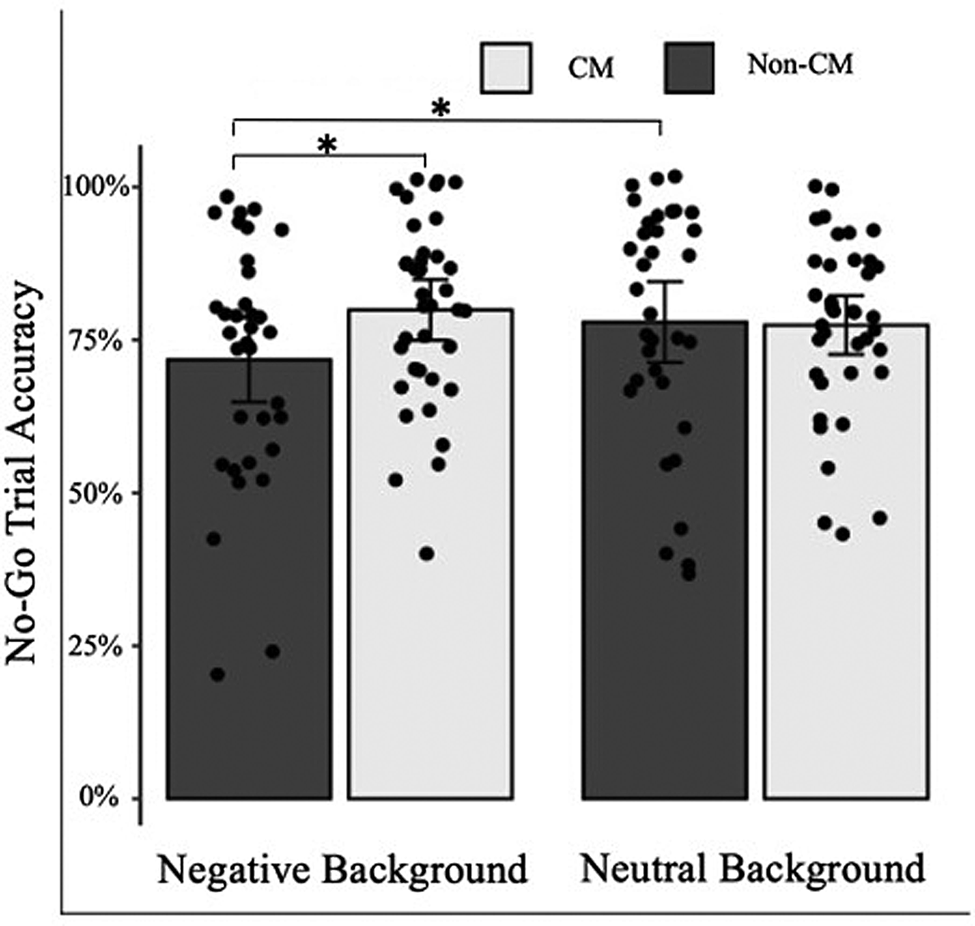
A mixed-model ANOVA was conducted to compare the effects of background image valence (neutral or negative), a within-subjects factor, and group (comparison or CM), a between-subjects factor, on No-Go accuracy. There was a statistically significant interaction between image valence and group for No-Go accuracy, F (1, 68) = 5.8787, p = .02, η2 = .081. Simple main effects analyses showed that the comparison group was significantly less accurate on trials with negative compared to neutral background images (p = .01, d = .45), but there were no accuracy differences by background image valence for the CM group (p = .30, d = .17). The CM group was more accurate than the comparison group on No-Go trials with negative backgrounds (t (70) = −1.98, p = .050, d = .47; see Figure 1 and Table 2), but there was no group difference for No-Go trials with neutral background [t (70) = 0.12, p = .90].
Accuracy on No-Go trials was impaired by negative background images relative to neutral backgrounds in the comparison group, but not the maltreated group. Accuracy on No-Go trials with negative background images was lower in the comparison group than the maltreated group. Error bars show 95% confidence intervals.

International Affective Picture System (IAPS) Go/No-Go task performance

Acc. = accuracy; CM = Childhood maltreatment; Comp = comparison group; RT = reaction time (in milliseconds). Values are given as mean (standard deviation).
A second mixed-model ANOVA was conducted to compare the effects of background image valence and group (comparison or CM) on Go trial reaction time. There were no significant interactions or main effects. When Go trial accuracy was inspected, there were no significant effects of image valence, group, and their interaction [F (68, 1) = 0.07, p = .79], F (68, 1) = 3.37, p = .07, F (68, 1) = 0.46, p = .50, respectively].
Finally, analyses were conducted to evaluate the association between adult adaptive functioning and task performance above and beyond the influence of group. There was a significant main effect of adult adaptive functioning on No-Go trial accuracy, F (1,67) = 3.9595, p = .050, d = .06, but not Go trial reaction time (p = .19). Greater adaptive functioning was associated with higher No-Go accuracy. There were no significant interactions between CM group and adult adaptive functioning for either accuracy or reaction time (ps > .68).).
As a check of our assumptions, we confirmed that when background images were scrambled, reaction time and accuracy did not differ between groups (No-Go trial accuracy, t (70) = −.33, p = .74; Go trial reaction time, t (70) = −1.51, p = .14).
Task-related brain activity
An analysis of task-related brain activation in the whole sample (all subjects, negative > neutral contrast) revealed significant activation in multiple brain regions, including visual cortex, PFC, cingulate gyrus, amygdala, and hippocampus. These regions are consistent with those reported in previous studies using Go/No-Go paradigms (e.g., Chester et al., Reference Chester, Lynam, Milich, Powell, Andersen and DeWall2016; Cohen-Gilbert et al., Reference Cohen-Gilbert, Nickerson, Sneider, Oot, Seraikas, Rohan and Silveri2017) and emotional tasks (Frank et al., Reference Frank, Dewitt, Hudgens-Haney, Schaeffer, Ball, Schwarz and Sabatinelli2014).
Group differences in task-related brain activity
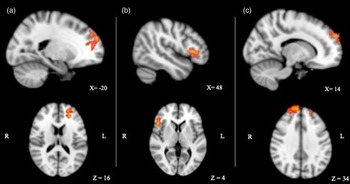
Comparison of task-related activity by group revealed that the comparison group recruited prefrontal regions (left frontal pole, right IFG, right frontal pole; Table 3 and Figure 2) more than the CM group when performing the inhibitory control task in the context of negative background images. Follow-up simple effects analyses using percent signal change values extracted from the three significant ROIs showed that the comparison group showed a 0.29%, 0.38%, and 0.15% mean difference signal change for the three ROIs respectively, whereas the CM group showed a 0.05%, 0.09% and .05% mean difference signal change for the three ROIs respectively.
The comparison group showed greater activity than the maltreated group for negative > neutral images in three prefrontal cortex (PFC) regions including (a) left frontal pole, (b) right inferior frontal gyrus, (c) right frontal pole (p < .05 cluster corrected).

Group differences in task-related brain activity for negative > neutral background image contrast

MNI = Minnesota Neurological Institute and Hospital
Relationship between current adaptive functioning and task-related activation
We evaluated whether differences in task activation were related to individual differences in current adaptive functioning across the full sample. Correlations were run between percent signal change values extracted from the three significant ROIs and adult adaptive functioning scores, with age and sex as covariates. Adult adaptive functioning was significantly related to task-related activity of the right frontal pole r (68) = .41, p < .001, but not related to task-related activity of the left frontal pole, r (68) = .22, p = .07, nor task-related activity of the right IFG, r (68) = .01, p = .98. Individuals with greater adult adaptive functioning showed more activity in frontal pole regions when the background images were negative compared to neutral. The relationship between adaptive functioning and right frontal pole activation survived Bonferroni correction for multiple comparisons.
Discussion
This study examined the interface between inhibitory control and emotion and associated neural underpinnings in the context of CM history. Contrary to our predictions, negative emotional images adversely affected inhibitory control in the comparison group, but not the maltreated group. In addition, relative to the maltreated group, the comparison group showed greater prefrontal activation during conditions when inhibitory control was required and when background images were negative compared to neutral. Better adaptive functioning in everyday contexts was related to this greater prefrontal activation and superior inhibitory control in the context of negative distractors.
In the present study, we did not observe the expected performance deficit in inhibitory control in our CM group. This could be due to the fact that the comparison group was well matched on other dimensions of early risk apart from CM which likely acted as confounds in prior studies. Therefore, our results suggest that CM history in healthy adults does not predict general impulsivity on a laboratory task when compared to peers from similar contexts. This finding is consistent with Liu's (Reference Liu2019) recent meta-analysis which also did not show support for an association with behavioral task performance. Liu (Reference Liu2019) did find an association between CM history and self- and parent-reported impulsivity, although only a small number of behavioral studies were included.
The effects of emotional distraction on behavioral performance differed by group. Accuracy was reduced in the context of negative images only for the comparison group and not the maltreated group. It is possible that adults with a history of maltreatment have learned based on their early experiences to maintain inhibitory control even in negative contexts. A group comparison of accuracy and reaction time for scrambled image backgrounds, which inherently do not require as much attention regulation, allowed us to rule out differences in inhibitory control in non-emotional contexts. Given the lack of more general group differences, it seems that the CM group is showing enhanced attention regulation in the face of negative images, rather than simply allocating more attentional resources to inhibitory control overall. The decreased emotion-related impulsivity seen in the maltreated group relative to the comparison group aligns with prior work reporting that young adults with child abuse histories demonstrated less impulsivity on laboratory-based measures than those without abuse histories (Sujan, Humphreys, Ray, & Lee, Reference Sujan, Humphreys, Ray and Lee2014). This adaptive strategy may reflect a form of long-term resilience despite early adverse experience.
It is also possible that the negative images used in this study were differentially arousing to the two groups, such that they were not arousing enough to elicit a strong interference response from adults in the maltreated group. It is possible that individuals with a history of CM have been relatively desensitized to negative images through consistent exposure to negative emotional contexts early in life. Previous research has suggested that arousal improves behavioral response inhibition in nonclinical populations (Shields, Sazma, & Yonelinas, Reference Shields, Sazma and Yonelinas2016). This effect, however, may be moderated by emotion-related impulsivity. In a recent study by Pearlstein, Johnson, Modavi, Peckham, and Carver (Reference Pearlstein, Johnson, Modavi, Peckham and Carver2019), individuals who rated themselves as having lower emotion-related impulsivity showed improving response inhibition on a trial-by-trial basis following increased arousal (indexed by pupil dilation), whereas for those rating themselves higher in emotion-related impulsivity, response inhibition declined following higher arousal. However, we did not measure either physiological or self-reported arousal in this study and therefore cannot address this possibility.
The accuracy detriment associated with negative backgrounds in the comparison group was unexpected although in a logical direction. Previous research in normative samples has shown a negligible effect of emotional distraction on task accuracy, whereas effects on reaction time are more typical (e.g., Chester et al., Reference Chester, Lynam, Milich, Powell, Andersen and DeWall2016; Cohen-Gilbert & Thomas, Reference Cohen-Gilbert and Thomas2013; Cohen-Gilbert et al., Reference Cohen-Gilbert, Nickerson, Sneider, Oot, Seraikas, Rohan and Silveri2017). However, in prior work with this task, younger adolescents (ages 13–14 years) showed poorer No-Go accuracy when the background image was negative (Cohen-Gilbert & Thomas, Reference Cohen-Gilbert and Thomas2013). Given that the adults in the current sample have all experienced high levels of stress vis-à-vis poverty, results may suggest that early adversity may lead to immature inhibitory control in the face of negative emotional content. However, without a low-risk control group in the present sample, this possibility cannot be tested. The comparison group's impaired behavioral performance on the task in the context of task-irrelevant negative images was accompanied by increased recruitment of frontal brain regions, including regions associated with inhibitory control (e.g., right IFG; Aron et al., Reference Aron, Robbins and Poldrack2004; Chester et al., Reference Chester, Lynam, Milich, Powell, Andersen and DeWall2016; Chikazoe et al., Reference Chikazoe, Konishi, Asari, Jimura and Miyashita2007), relative to the CM group. Although this particular EF domain (i.e., inhibitory control) has not been assessed in previous imaging studies of maltreatment, Schweizer and colleagues found similar evidence of enhanced cognition in the context of strong emotion following early adversity (Schweizer et al., Reference Schweizer, Walsh, Stretton, Dunn, Goodyer and Dalgleish2016). Their work suggests that the neural underpinnings of emotion regulation in healthy adolescents and young adults exposed to moderate childhood adversities may be operating more efficiently (Schweizer et al., Reference Schweizer, Walsh, Stretton, Dunn, Goodyer and Dalgleish2016) than in those with low adversity. Specifically, the group with higher childhood adversities showed enhanced emotion regulation over positive and negative affect during a film-based task, which was associated with reduced recruitment of frontal regulatory brain regions and amygdala activation. These findings align with our results of enhanced behavioral performance and reduced recruitment of brain regions associated with inhibitory control in the maltreated relative to comparison group. The sample and task paradigm used in the present study and in Schweizer's differed substantially (i.e., Schweizer's sample had moderate childhood adversity but not maltreatment, and the paradigm involved explicit instructions to regulate one's emotional reaction to film clips). Still, the similarity in results may indicate that generally healthy adults who experienced extreme stress in childhood may develop an enhanced ability to regulate their attention and emotional reactions in the context of task-relevant or -irrelevant emotional stimuli, at least within the controlled laboratory environment.
Others have also found CM history to be associated with differential activation in multiple prefrontal regions during emotionally charged EF tasks. For instance, one recent study found CM was associated with reduced activation in the left dorsolateral PFC and right dACC, and increased activation in the IFG (Mackiewicz Seghete et al., Reference Mackiewicz Seghete, Kaiser, DePrince and Banich2017), while another study found increased activation in dorsolateral PFC, dACC, and ventromedial and ventromedial PFC, and no differences in the right IFG (Herzog et al., Reference Herzog, Niedtfeld, Rausch, Thome, Mueller-Engelmann, Steil and Schmahl2019). However, in both of these studies, the maltreated groups had significantly higher levels of depression and/or PTSD symptomatology than the comparison groups. Unlike these two samples, the present sample may represent a resilient subset of maltreated individuals, as internalizing and externalizing symptoms were in the broad average range for 90% of the current sample. In this way, our sample is more similar to Schweizer's sample of healthy individuals exposed to moderate childhood adversities. Together, these studies may indicate that, in healthy adults with histories of early adversity and/or abuse, regulatory control is not disrupted by negative contexts, despite less recruitment of neural systems typically implicated in inhibitory control.
Better performance and more efficient neural recruitment of inhibitory control systems when engaged in a laboratory task does not necessarily extend to real-life application of these skills. Our results showed that across the entire sample, greater activation of the frontal pole related to higher levels of current adaptive functioning. Previous research indicates that activation in this brain region is involved in monitoring action outcomes (Koechlin, Reference Koechlin2011). The ability to monitor one's behavior and inhibit impulses within aversive contexts is likely critical to success in everyday situations reflected in the adaptive functioning measure. For instance, resisting the urge to use alcohol or other substances when depressed and refraining from hostile behavior when angered, can serve an individual in social relationships as well as educational and occupational progress. Our prior work in this sample has demonstrated that adult adaptive functioning also relates to frontolimbic functional connectivity, an index of efficient emotion regulation (Demers et al., Reference Demers, McKenzie, Hunt, Cicchetti, Cowell, Rogosch and Thomas2018). It is possible that the maltreated group is able to regulate their responding with less recruitment of typical neural systems despite negative distractions in a laboratory-based task, but that adaptive functioning within the real world requires greater activation of neural regions involved in inhibitory control for all participants.
This study makes several important contributions to the existing maltreatment and resilience literatures. First, unlike the previous studies on inhibitory control during emotional contexts in maltreated individuals, this sample includes both a larger total sample and a comparison group that is well-matched longitudinally on socioeconomic characteristics. The two groups also had similar levels of current internalizing and externalizing symptoms and current adaptive functioning. Therefore, we were better able to isolate effects specific to maltreatment without confounding group differences in poverty, general risk, or adult level of functioning. Unlike most studies of maltreatment that only evaluate risk factors, we also investigated promotive factors by examining whether group differences in neural activity related to individual differences in adaptive functioning. Similarly, the sample was assessed prospectively from childhood into adulthood, reducing typical measurement errors inherent in retrospective report. Finally, this study is unique in its focus on brain systems involved in inhibitory control during emotional distraction in the context of maltreatment history. The majority of prior work has used facial viewing tasks that do not tap into executive functioning skills in emotional contexts or have used emotional Stroop tasks that don't include highly arousing stimuli. In contrast, we examined inhibitory control during emotional contexts using a paradigm with task-irrelevant emotional stimuli, thereby allowing us to isolate the impact of negative emotional distraction on EF. Further, by using this paradigm in the scanner, we were able to evaluate the impact of negative emotional distraction on brain activation during inhibitory control.
Despite important contributions to the extant literature, this study had several limitations. First, the sample size per group limits our ability to confidently draw conclusions due to low statistical power and necessitates replication. Unfortunately, few prospective neuroimaging studies of maltreatment have large enough sample sizes to adequately power complex statistical analyses capable of teasing apart the influences of multiple risk factors for poor adaptive functioning. Although participants were followed longitudinally since childhood, MRI assessment was conducted only at the most recent time point in adulthood. Therefore, we cannot determine the directionality of the relationships between maltreatment, emotion-related inhibitory control, adaptive functioning, and brain circuitry. Also, without a low-risk control sample, we could not determine whether the observed disruptions in inhibitory control by negative stimuli are present only in individuals who have experienced high-risk early environments, including poverty, or would also be evident in low-risk adult populations. Additional work with a low-risk comparison group is needed to determine if relationships between current functioning and neural measures of inhibitory control are specific to adaptation after early adversity or if they can be generalized to adaptive functioning and competence, regardless of early environment. It is also possible that the composition of participants included in our comparison and maltreated groups is not representative of individuals from high-risk, low-income backgrounds. It is probable that current life stressors and factors related to adult adaptive functioning influenced which participants were able to continue in the study. For instance, some individuals had employment conflicts prohibiting research participation, while other individuals from the original sample (maltreated or not) were excluded based on incarceration, bullets or other metal fragments in the body, obesity significant enough to preclude MRI scanning, severe mental illness (e.g., schizophrenia) or cognitive impairment, or an inability to locate the individual for recruitment (e.g., homelessness or high mobility) – conditions that are often exacerbated by a history of chronic poverty, racial discrimination, and various forms of trauma. Consequently, our sample represents a restricted range of developmental outcomes seen in high-risk, low socioeconomic status populations. Replication with a larger sample is warranted. In addition, while adult adaptive functioning may indicate the capacity for resilience, further study of resilient processes throughout development is needed.
Finally, given the inherent constraints of fMRI, we chose to use a block design rather than an event-related design for the IAPS Go/No-Go paradigm. Therefore, we were unable to compare neural activity on Go and No-Go trials or accurate and inaccurate trials. Also due to the block design nature of the task, comparison of neural signal between negative and neutral blocks likely represents contextual monitoring more broadly than just inhibitory control. We also did not have any autonomic measures of arousal, so we were unable to determine if participants had different physiological reactions to the images in the task. As noted above, it is possible that performance by the maltreated group was less disrupted by task-irrelevant negative images because they found the images less arousing, perhaps owing to a systematic desensitization based on past life experiences. Future research should consider level of arousal, as well as level of emotion-related impulsivity (Pearlstein et al., Reference Pearlstein, Johnson, Modavi, Peckham and Carver2019) when evaluating the effect of emotional distraction on inhibitory control.
In conclusion, results suggest that psychiatrically healthy adults who endured CM may have an enhanced ability to regulate their attention and limit impulsive reactions in the context of task-irrelevant emotional stimuli within a laboratory task. This enhancement may reflect learning from earlier experiences such that the negative content in a laboratory setting may be less arousing and therefore less distracting for adults who have experienced CM. In addition, while early maltreatment experience may train enhanced inhibitory control in the face of negative or threatening stimuli, it is not necessarily synonymous with positive real-world outcomes. Adult adaptive functioning within real world contexts was associated with greater activation of neural regions involved in inhibitory control, suggesting that multiple risk and protective mechanisms may be at work in this sample.
Acknowledgments
We thank the staff at the Mt. Hope Family Center, University of Rochester, and the Institute of Child Development at the University of Minnesota. We thank the Minnesota Supercomputing Institute at the University of Minnesota for providing resources that contributed to the research results reported within this paper. We thank Emily Hunt and Pat Weber for work in data collection, and the families and longitudinal participants of the Mt. Hope Family Center for their participation.
Financial Statement
This work was supported by a McKnight Presidential Chair, William Harris Endowed Chair, and a Klaus J. Jacobs Research Prize (to DC), imaging support from the Rochester Center for Brain Imaging, and a pilot grant from the College of Arts, Science and Engineering, University of Rochester. Trainee support was provided by the University of Minnesota's Institute of Child Development via a National Institute of Mental Health National Research Service Award Grant no. 2T32MH015755-39 (to LAD).
Conflicts of Interest
None