The pressure difference between the pulsation chamber and the liner interior (Hamann & Osteras, Reference Hamann and Osteras1994) during machine milking, in combination with the liner's physical characteristics (wall thickness, material, tension, number of milking, etc.) affects the level of compression exerted on the inner teat tip tissues that helps re-evacuate the fluids in the teat (Mein & Reinemann, Reference Mein and Reinemann2009) and thus to reduce the congestion/oedema that may occur.
During machine milking, teat wall thickness (TWT) is diminished in high flow periods and increased in periods of low flow and during overmilking (Isaksson & Lind, Reference Isaksson and Lind1992). Overmilking is a troublesome issue because it affects teat condition and udder health (Rasmussen, Reference Rasmussen2004). Overmilking worsens the teat condition in the bovine: ring-shaped swelling at the teat base, teat discolouration and inflammation are increased (Hillerton et al. Reference Hillerton, Pankey and Pankey2002). Moreover, continuous overmilking for 4 months causes more damage to the epithelial lining, higher teat sinus injury and greater keratin loss than normal milking (Gleseon et al. Reference Gleeson, Jilroy, O`Callaghan, Fitzpatrick and Rath2003). In milking parlours where automatic cluster removal is not installed, there is some level of overmilking (Gleeson et al. Reference Gleeson, Jilroy, O`Callaghan, Fitzpatrick and Rath2003). This is important in small ruminants, as the level of automation on farms is low (Díaz et al. Reference Díaz, Romero, Perez, Soriano, Moya, Peris and Fernández2004; Gutierrez & Romero, Reference Gutierrez and Romero2006) and the presence of automatic cluster removers is scarce (Menzies, Reference Menzies2000; Tangorra et al. Reference Tangorra, Costa and Guidobono2012), increasing the risk of overmilking.
The negative effect of overmilking may be aggravated when the vacuum level is too high or teat massage decreases. This lack of massage can be due to the use of unsuitable liners for the teat size (Rasmussen, Reference Rasmussen2004). The use of too short liners affects the number of intramammary infections and increases the incidence of petechial haemorrhages (Mein et al. Reference Mein, Brown and Williams1983). Teats that are too short or too long for a given liner will not receive the full benefit of the pulsation characteristics, as the liner will not compress the teat end (Mein et al. Reference Mein, Williams and Reinemann2003). In Spain, some of the first goat milking machines were installed with liners for sheep, owing to the low market availability of liners specifically designed for goats, and although these are currently now available, it is still common to find goats being milked with sheep liners, especially in mixed flocks of goats and sheep. Moreover, it is known that through use liners undergo changes in the physical (flexibility increases, tension is reduced and changes occur in the body length; Davis et al. Reference Davis, Reinemann and Mein2000) and chemical properties (loss of plasticising and antidegradant; Boast et al. Reference Boast, Hale, Turner and Hillerton2008). Liner deterioration takes place gradually until the end of their useful life is reached, with observable changes in performance (Hillerton et al. Reference Hillerton, Boast, Middleton and Ohnstad2004) giving rise to effects on the teat similar to those caused by pulsation failure (Boast et al. Reference Boast, Hale, Turner and Hillerton2008). Additionally, we frequently come across liners twisted around their axis, especially when the liner tension has diminished through use, which has a great influence on the milking conditions and udder health (IDF, 2006).
Because there is scant information available on the effect of overmilking and liner characteristics on teat condition in small ruminants, we designed 7 experiments (4 in goats and 3 in sheep) to study the effect on teat wall thickness and teat canal length in goats and sheep of overmilking for 2 min, of milking with used (+3000 milkings) and twisted (45°) liners in goats and sheep, as well as the effect of milking goats with liners designed for sheep.
Materials and methods
Farm and animal management
The trials were carried out at the Training and Research Farm of Escuela Politécnica Superior de Orihuela (EPSO) belonging to the Universidad Miguel Hernández de Elche (UMH). The Murciano-Granadina goats and Manchega breed sheep were kept in loose housing, with daytime access to the exercise pens. Goats were machine milked once daily, always in the morning, while sheep were milked twice a day. The milking installation was Low Line (LB) (1×12×12), with electronic milk meters (Dematron 60, Gea Farm Technologies, Bönen, Germany). The Lactoflow devices incorporated in the Dematron 60 were programmed to cut off the milking vacuum level with the following parameters: milk flow rate 100 ml/min and delay time 20 s. For the experiments, we used teatcup with silicon liners especially designed for goats (Top Flow Z) and sheep (Top Flow S) (Gea Farm Technologies, Bönen, Germany). The experimental milking parameters used were: in goats, vacuum level of 40 kPa, VL; pulsation rate 90 ppm, PR; pulsation ratio 60%, PRT. In sheep, VL 36 kPa; PR 180 ppm; PRT 50%.
The machine milking routine for the animals consisted of teatcup attaching, mechanical milking and teatcup removal. Finally, after milking teats were immersed in an iodine solution.
Experimental design
The animals were milked until the start of each experiment with the most beneficial treatment for milking efficiency and the health state of the animal (without overmilking, new, well-placed liners and suitable teat clusters for the species). Sampling was performed before the start of each experiment, taking aseptic samples for bacteriological analysis and a milk sample for SCC (Fossomatic-5000; Foss-Electric S.A). Bacteriological analysis was carried out previous to milking from samples of milk obtained of teats carefully cleaned with 70% ethanol, discarding the first three streams of foremilk. Approximately 5 ml of milk were collected aseptically from each gland. Samples were kept at 4 °C for a maximum of 6 h until bacteriological analysis. Twenty μl of each sample were plated on blood agar plates (5% washed sheep erythrocytes; Biomerieux, Lyon, France). The plates were incubated aerobically at 37 °C and examined after 24, 48 and 72 h. Cultures with five or more identical colonies were considered positive for intramammary infection (IMI). If a gland did not have IMI and SCC was lower than 400 000 cells/ml in ewes and 1 000 000 cell/ml in goats, it was considered as free from mastitis. All animals included in the experiments were free from mastitis. Each experiment had a 2-d pre-experimental period where the animals continued to be milked under these conditions.
Overmilking
In goats (EXP 1), 24 animals (12 per batch) in their seventh month of lactation (milk yield, MY: 1·8±1·2 l; milking time, MT: 147·2±80·9 s) were used. In sheep (EXP 2), 22 ewes (11 per batch) in their third month of lactation were used (MY: 0·9±0·3 l; MT: 67·3±24·3 s). The experiment used a cross-over design with two treatments (without overmilking and 2 min overmilking) and two periods (2×4 d in goats; 2×4 d in sheep). Overmilking was applied after milk flow ceased in the transparent short milk tube, after observing that the automatic vacuum cutting device (Lactoflow) was triggered.
Liner age
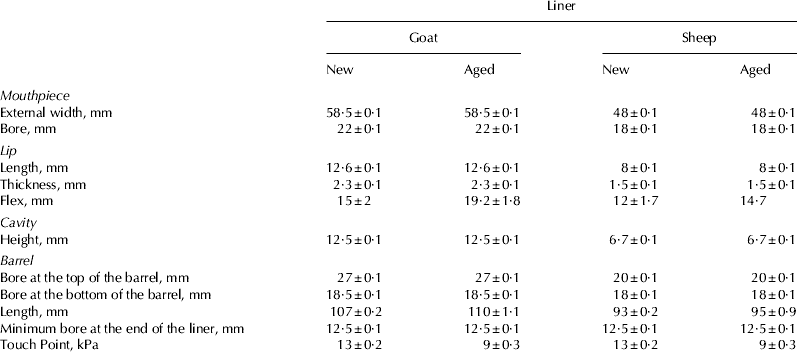
The new liners used were TopFlow Z and TopFlow S models for goats (EXP 3) and sheep (EXP 4), respectively (Gea-Westfalia-Surge, Bönen, Germany), whereas the used liners had undergone 1·5 years of use and over 3000 milkings. The line features are shown in Table 1. In goats, 20 animals (10 per batch) in their seventh month of lactation were used (MY: 1·8±1·3 l; MT: 131·7±68·7 s). In sheep (EXP 4), the 22 ewes (11 per batch) were in their third month of lactation (MY: 1·1±0·5 l; MT: 59·7±27·3 s). The design was cross-over with two treatments (new liners and naturally aged liners) and 2 periods (2×8 d in goats; 2×6 d in sheep).
Features of the goat and sheep liners used

Twisted liner
In goats (EXP 5), 22 animals (11 per batch) in their sixth month of lactation were used (MY: 2·0±1·2 l; MT: 144·5±82·3 s). In sheep (EXP 6), the 20 ewes (10 per batch) were in the second month of lactation (MY: 1·2±0·4 l; 68·4±23·0 s). We used a cross-over design with two treatments (liners positioned correctly on the teatcup and liners twisted 45° around their access) and two periods (2× d in goats; 2×6 d in sheep).
Liner type
The 20 goats (10 per batch) used were in their six month of lactation (EXP 7; MY: 1·7±1·2 l; MT: 160·8±79·8 s). The design was cross-over with two treatments (goat teatcups and sheep teatcups) and two periods (2×7 d).
Measured variables
The sampling days were the same in all experiments. On the second day of the pre-experimental phase, pre-and post-milking ultrasound scans were taken of the glands of all animals included in the experiments. During the experimental phase, a total of 4 controls were carried out; 2 checks on the two days prior to interchanging the glands (first period) and two checks on the two last days at the end of the experiment (second period). During these controls, ultrasound scans were performed before and after milking.
In all the controls, the MY (l) recorded on the electronic meters was noted and the MT (s) for each gland was monitored using a chronometer.
Ultrasound scanning was performed by the methodology described by Díaz et al. (Reference Díaz, Alejandro, Peris and Fernández2013) in goats. Measurements in sheep were taken following the same method as in goats, but adapted to this species by the authors Alejandro et al. (Reference Alejandro, Rodriguez, Peris and Díaz2014). The main difference is that the teat wall thickness measurement (TWT) in sheep is taken at 1·5 cm from the teat end, whereas in goats it is performed at 1 cm, because the teat sphincter length is greater in sheep. An Agroscan AL portable ultrasound unit (ECM, Noveko International Inc., France) was used, fitted with a 5-MHz linear probe: the ultrasound images obtained were recorded on videotape and digitally scanned with the Windows Movie Maker program. The images were processed with an IT program specifically designed to this end by the research team (ECOTEAT®) to obtain the following measurements: teat wall thickness (TWT, mean value of the two walls examined, cm), area of the teat walls (TWA, cm2), teat end area (TEWA, cm2) and teat canal length (TCL, cm). Thickness increment values were obtained by means of the following formula: Increment (%): 100*(after milking−before milking)/before milking.
At the start of the seventh experiment (sheep teatcup) the teat morphology of the animals were checked, measuring length and diameter.
Liner characteristics
Liner measurements were taken using a pair of callipers following the scheme described by Fernandez et al. (Reference Fernandez, Requena, Beltran, Peris, Rodríguez, Molina and Torres1997). The touch point (TP) with the aid of a manual vacuum pump (Medition Precision S.L., Zaragoza, Spain), a digital vacuum gauge (DVPM-01, Delaval International AB., Tumba, Sweden) and a methacrylate cover. The mouthpiece lip flex was measured using method described by Davis et al. (Reference Davis, Reinemann and Mein1999).
Statistical analysis
The association between the explanatory variables and teat tissue variables measured before and after milking and for the thickness increment were assessed using a stepwise linear mixed model procedure. Factors and first-order interaction terms that were significant at a P-value<0·05 were included in the final model (Proc Mixed, SAS Institute Inc, V.9.1. 2002). TWT, TWA, TEWA and TCL were included as outcome variables and the following as explanatory variables: Treatment, TRT with 2 levels, EXP 1 and 2 (1: overmilking, 2: without overmilking); EXP 3 and 4 (1: aged liner, 2: new liner); EXP 5 and 6 (1: twisted liner, 2: non twisted liner); EXP 7(1: sheep teatcup, 2: goat teatcup); Period (PER, 2 levels: 1: first period and 2: second period); Day nested at PER (PDAY, 2 levels: 1: first day in both period, 2: second day in both periods); the interaction of PER with TRAT; and milk yield (MY) and milking time (MT) as a covariate. Goat and gland nested goat were considered as random terms. In addition, a compound symmetry covariance structure was used to account for the repeated measurements. The model using this hierarchical structure provided the best fit for the variable when compared with different models considering other covariance and hierarchical structures (as assessed using Bayesian and Akaike information criteria).
Results
In the analysis of the TWT, TWA, TEWA and TCL values recorded in the pre-experimental period of each experiment, no significant differences were observed in any of the variables recorded between the left and right gland of the animals, nor between the glands of the animals included in the two experimental batches (data not shown).
Overmilking
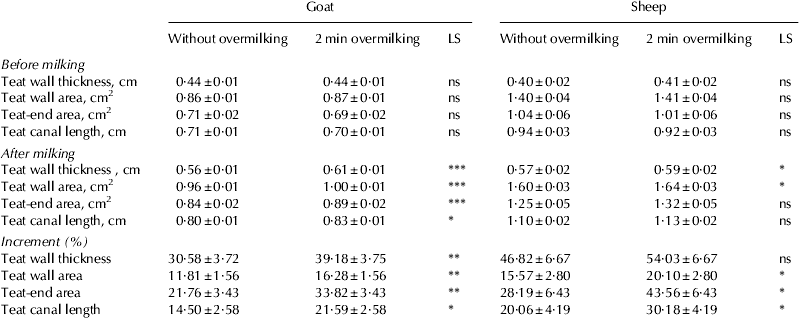
Table 2 shows the TWT, TWA, TEWA and TCL before and after milking, and the increments of the different variables in sheep and goats milked with and without overmilking. In goats, overmilking for 2 min caused a greater increase (P<0·05) in TWT, TWA, TEWA and TCL after milking than in those milked normally, so the increases in the variables after milking were significantly greater in the overmilked glands.
Effect of overmilking (+2 min) on teat wall thickness in goats and sheep (n=96 for goats; n=88 for sheep)
LS: Level of significance.
*P<0·05; **P<0·01; ***P<0·001; ns: non significant (P>0·05)
In sheep, overmilking for 2 min led to a greater increase in TWT and TWA (P<0·05) after milking, whereas TEWA and TCL were not affected. However, the increase in TWT did not vary significantly between the overmilked glands and those milked correctly, whereas significant differences were found in the increments of TWA, TEWA and TCL.
Liner age
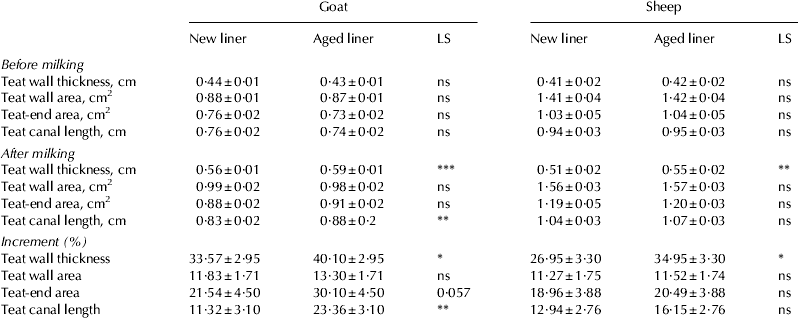
Table 3 shows TWT, TWA, TEWA and TCL, before and after milking, and the increments of these variables in sheep and goats milked with new liners and naturally aged liners. In goats, higher values of TWT and TCL were observed after milking with aged liners. Greater increments were also appreciated in TWT and TCL with the aged liners (P<0·05).
Effect of ageing liner (>3000 milkings) on teat wall thickness in goats and sheep (n=80 for goats; n=88 for sheep)
LS: Level of significance.
*P<0·05; **P<0·01; ***P<0·001; ns: non significant (P>0·05)
In the Manchega ewes, the line used only affected TWT (after milking and in the increment), showing higher values (P<0·05) than when milking was performed with new liners.
Twisted liners
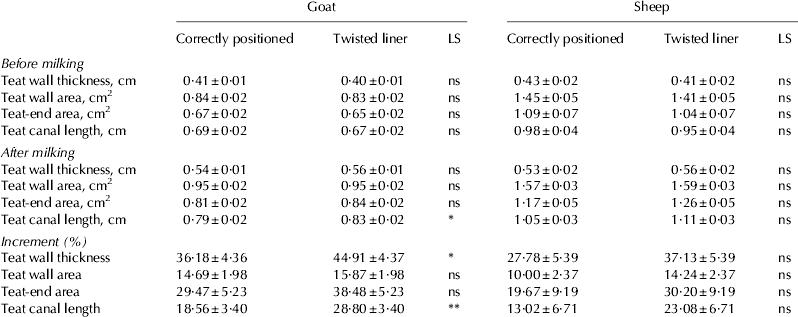
In goats, 2 animals suffered intramammary infection of the gland milked with the 45° twisted liners during the first experimental period and were removed. Table 4, shows that after milking the only significant differences observed were in TCL (P<0·05), although when the increments were observed the use of twisted liners gave higher values in TWT and TCL.
Effect of liner position on teat wall thickness in goats and sheep (n=80 for goats; n=80 for sheep)
LS: Level of significance.
*P<0·05; **P<0·01; ns: non significant (P>0·05)
In sheep, no significant differences were observed after milking in any variable between animals milked with twisted liners and those milked with correctly positioned ones.
Teatcup
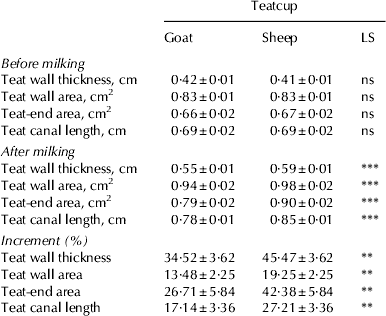
Average teat length of the goats included in the experiment was 40·9 mm (range 20·3–62·7 mm). Teat base diameter was 37·4 mm (range 11·2–73·6 mm) and the diameter at the tip was 7·03 mm (range 4·8–9·9 mm). Table 5 shows TWT, TWA, TEWA and TCL before and after milking, as well as the increments in teat thickness in goats milked with teatcups for goats and for sheep. Milking goats with teatcups for sheep caused a higher increase in all the post-milking variables studied. Significant differences were also found in the increments in the variables recorded after milking compared with their initial values.
Effect of milking with sheep and goat liners on teat wall thickness in goats (n=80)
LS: Level of significance.
**P<0·01; ***P<0·001; ns: non significant (P>0·05)
Discussion
Overmilking for 2 min in sheep and goats increased the degree of teat end congestion/oedema, showing an increase in the values for TWA, TEWA and TCL in both species, in addition to an increase of TWT in goats compared with normal milking. This agrees with the results obtained by Isaksson & Lind (Reference Isaksson and Lind1992) in the bovine, where TWT, measured by cutimeter, was greater with overmilking. Using an ultrasound technique, Pařilova et al. (Reference Pařilova, Stadnik, Ježkova and Štolc2011) found similar results in Holstein cows, while Gleeson et al. (Reference Gleeson, O'callaghan and Rath2002) reported that overmilking for 5 and 8 min in Holstein cows caused a linear increase in TWT, although this was not significant, and Paulrud et al. (Reference Paulrud, Clausen, Andersen and Rasmussen2005) indicated that overmilking tended to increase TWT (P=0·066) and TCL. The increase in thickness may effect the teat defence mechanisms, raising the likelihood of new intramammary infections (Neijenhuis et al. Reference Neijenhuis, Klungel and Hogeveen2001). Moreover, owing to the low or non-existent milk flow, a reverse pressure gradient may occur, allowing bacteria to enter the teat cistern (Rasmussen et al. Reference Rasmussen, Frimer and Decker1994). During overmilking, the average vacuum level in the teat is greater, as there is no milk flow to help dissipate the vacuum, and if this occurs frequently it may lead to capillary damage (Hillerton et al. Reference Hillerton, Pankey and Pankey2002). Gleeson et al. (Reference Gleeson, Jilroy, O`Callaghan, Fitzpatrick and Rath2003) reported that overmilking for 5 min over 4 months caused greater damage in the teat cistern and a greater loss of keratin than milking with automatic removal (0·2 kg/min.).
In addition to overmilking, another factor with a negative influence on teat tissues in goats and sheep is the utilisation of used liners (+3000 milkings), as TWT is increased in both species, as is TCL in goats. These outcomes coincide with those described by Boast et al. (Reference Boast, Hale, Turner and Hillerton2008) in the bovine, indicating that the use of worn liners (+5000 milkings) causes similar effects in the teats to those due to pulsation failure. There may be two different explanations for this. The first is associated with reduction of the mounting tension of the liners through use, which diminishes the liner compression (LC) applied to the teat (Mein et al. Reference Mein, Williams and Reinemann2003). In this work, we found a 3% increase in liner length, a lower percentage than reported by other authors using rubber liners (Davis et al. Reference Davis, Reinemann and Mein2000; Boast et al. Reference Boast, Hale, Turner and Hillerton2008), so it is possible that this stretching may not have affected the liner mounting tension to any great extent. The second is based on the fact that when the liners are nearing the end of their useful life, the body shape becomes slightly oval, which reduces wall resistance to collapse, diminishing the touch point (TP). As the TP is reduced, the residual vacuum available for massage increases, thereby raising the LC above the standard values in one milking (Mein & Reinemann, Reference Mein and Reinemann2009). In this experiment, the TP of the used liners was lower than that of the new liners, which might indicate that during milking a greater than optimum LC was applied, affecting the teat tissues. Although the manufacturer warns that TP is not a good indicator of wear and tear on silicone liners, as it does not change through use (Gea Farm Technologies, Bonen, 2010), other authors (Spencer et al. Reference Spencer, Shin, Rogers and Cooper2007) have reported that the TP (25·52 kPa) of triangular-closure silicon liners after more than 3000 milkings is lower than that of new liners (33·52 kPa). It is important to note that the manufacturer recommends changing the liners after 1500 working hours, or at least every year. Although the liners used in this experiment were nearing the end of their useful life (1500 h), they had been in use for over 18 months, which may have led to worsening of their physical and chemical properties, possibly leading to alterations in the fluid dynamics at tissue level in the teat end and walls.
With normal use of the milking machine through time, it is possible to find twisted liners, especially when the line tension has diminished owing to use. In the case of transparent plastic cups it is easy to detect, but in cups manufactured with opaque materials it would be necessary to carry out a periodical revision of the liner placement to avoid this, since in the experiments carried out in goats we observed an effect on the increase in TWT and TCL. Twisted liners hinder the movement of the line walls owing to the liner torsion, which can increase the tension on the walls and affect liner collapse on the teat tip. In sheep, no significant differences were found in the increment of the different variables, although a greater difference was observed (measured after−before milking) in TEWA and TCL (data not shown).
Liner design has a greater effect on milking characteristics than any other factor of the milking machine (Mein et al. Reference Mein, Williams and Reinemann2003). In the first milking machines in Spain, teatcups for sheep were installed owing to the lack of commercial availability of teatcups specifically designed for caprine livestock, which led to some farmers continuing to use them even though there are currently several teatcup models designed for goats. This same practice is carried out in mixed flocks of sheep and goats where there is a greater number of animals of the former species. In this sense, in the fieldwork of the research team under the ‘Milk Quality Improvement Programmes’ carried out by two goat farming associations from the Murcia region, more than 60% of the goat farmers were still using sheep teatcups (Díaz, personal communication). For the pulsation to be effective and able to apply the compression load to the teat tissues, the liner must be able to collapse totally beneath the teat. To do so, the liner barrel must be 25 mm longer than the teat at this stage, especially if we take into account that at the onset of milking bovine teats increase in length by around 40–50% (Mein, Reference Mein, Bramley, Dodd, Mein and Bramley1992). In this regard, Rønningen & Reitan (Reference Rønningen and Reitan1990) indicated that in the bovine the teat penetration depth is positively correlated with hardening of the teat upon palpation and with the incidence rates of clinical mastitis.
If we extrapolate these data to the conditions of the present work, it can be estimated that sheep liners would not have a long enough body for milking of teats of over 48 mm (93−25=68 mm; 68 mm/40–50%=45–48 mm). In this work, around 21% of teats exceeded the length of 48 mm and more than 42% were over 45 mm long (data not shown). Thus, a sheep liner would not properly perform the massage on the teat end in a high percentage of goats.
Choosing the ideal liner is determined by teat size (Fernandez et al. Reference Fernandez, Requena, Beltran, Peris, Rodríguez, Molina and Torres1997). Peris et al. (Reference Peris, Caja and Such1999) recommended liners at least 120 mm in length for suitable milking of Murciano-Granadina goats, data in line with those found in this work, where the liners were 119·5 mm in length (107 mm barrel length+12·5 mm cavity height).
Conclusions
The inappropriate use of liners whose useful life has expired, badly positioned in the cup (twisted) or not designed for the species to be milked, can affect the teat tissues. Likewise, the use of an unsuitable milking routine that leads to overmilking can cause congestion and oedema in the teat tissues, which may alter the defence mechanisms against intramammary infections. Long-term experiments (throughout lactation) are required to determine whether the increase in thickness observed in some experiments is sufficient to affect milking efficiency and mammary gland health status.
The authors are grateful to Patrice Emery (ECM, France) for his collaboration and providing the ultrasound material used in this work. The study was supported by project AGL2006-06909 (Ministerio de Educación y Ciencia of Spain and FEDER/ERDF).