Implications
The results show that ad libitum feeding of pelleted concentrates for rosé veal calves fed barley straw as only roughage source will cause some papillae aggregation, hyperaemia and necrosis of rumen wall and papillae and some indices of liver abscesses (LAs). Results also indicate that a concentrate based on more coarsely ground compared with the traditional finely ground ingredients or based on a higher proportion of rumen-escape starch in the concentrate will not be able to keep these pathological findings at a low level. Overall performance, carcass characteristics and rumen wall characteristics at time of slaughter could not be distinguished between liver-abscessed and non-abscessed rosé veal calves.
Introduction
A traditional feeding regime used for rosé veal production based on dairy bull calves includes ad libitum access to a high-starch concentrate-based diet. Often a pelleted concentrate of finely ground ingredients is used. The only roughage typically consists of wheat or barley straw. The incidence of LAs can be high in such a production system (11%, Kjeldsen et al., Reference Kjeldsen, Bossen and Fisker2002; 14%, Jarltoft et al., Reference Jarltoft, Larsen and Vestergaard2011), which is also known from intensively fed steers (12% to 32%; Brink et al., Reference Brink, Lowry, Stock and Parrott1990; 16%; Ramsey et al., Reference Ramsey, Mathison and Goonewardene2002; 10% to 20%; Williams et al., Reference Williams, Block, Christensen, Racz, Ataku, Wilderman and McKinnon2008). Often the liver-abscessed animals do not show reduced performance or carcass characteristics (Brink et al., Reference Brink, Lowry, Stock and Parrott1990; Jørgensen et al., Reference Jørgensen, Sehested and Vestergaard2007) and when the penalty is low (e.g., €1 per kg liver in Denmark), the incitement for the producer to reduce the incidence is also low.
One major reason for the development of LAs in this feeding situation is associated with the so-called: rumen acidosis–ruminitis–LA complex (Jensen et al., Reference Jensen, Deane, Cooper, Miller and Graham1954; Scanlan and Hathcock, Reference Scanlan and Hathcock1983; Nagaraja and Chengappa, Reference Nagaraja and Chengappa1998). Free access to concentrates leads to a low intake of straw of which calves rarely consume more than 7% to 8% of total dry matter intake (DMI) (Owens et al., Reference Owens, Secrist, Hill and Gill1998; Jørgensen et al., Reference Jørgensen, Sehested and Vestergaard2007). This is neither sufficient nor the ideal roughage to get a good stratification of the rumen content (Storm and Kristensen, Reference Storm and Kristensen2010), a high rumination activity, and a high buffering capacity via saliva (Owens et al., Reference Owens, Secrist, Hill and Gill1998) and thus it may not result in healthy rumen wall. However, rumen wall characteristics are not part of the veterinary inspection at slaughter, so only a limited number of field data exist that can relate rumen wall conditions to LAs at time of slaughter.
Use of pelleted concentrates and finely ground ingredients are known to induce rumen parakeratosis compared with more coarse ground ingredients (Hironaka et al., Reference Hironaka, Kimura and Kozub1979; Ørskov, Reference Ørskov1986) and might also lead to lower average daily gain (ADG) (Williams et al., Reference Williams, Block, Christensen, Racz, Ataku, Wilderman and McKinnon2008). Coarsely (2.6 mm) compared with finely (2.2 mm) ground barley did not affect performance of steers (Loe et al., Reference Loe, Bauer and Lardy2006). Based on evidence from flaked grain compared with dry-rolled grain (Owens et al., Reference Owens, Secrist, Hill and Gill1997), it seems promising for performance, feed conversion efficiency (FCE) and health to include more coarse ingredients.
Corn and sorghum will generally have a slower starch digestion in the rumen (i.e., a higher rumen by-pass) compared with wheat and barley (Axe et al., Reference Axe, Bolsen, Harmon, Lee, Milliken and Avery1987; Philippeau et al., Reference Philippeau, Martin and Michalet-Doreau1999; Larsen et al., Reference Larsen, Lund, Weisbjerg and Hvelplund2009). A higher amount of rumen-escape starch will increase rumen pH (Owens et al., Reference Owens, Secrist, Hill and Gill1998). In contrast, extensive processing of sorghum and of corn improves overall starch utilization by improving the ruminal starch digestion (Theurer, Reference Theurer1986). A slower rumen starch digestion was associated with less bloat (Ramsey et al., Reference Ramsey, Mathison and Goonewardene2002). There is also some promising evidence for slow-starch digestion of barley being related to a lower incidence of LA (Ramsey et al., Reference Ramsey, Mathison and Goonewardene2002). Feeding dry-rolled corn compared with dry-rolled barley led to higher ADG in steers (Loe et al., Reference Loe, Bauer and Lardy2006). Sorghum has a lower metabolizable energy (ME) content than wheat, barley and corn, which is generally compensated for by a concomitant higher feed intake and thus lower FCE when feeding sorghum (Owens et al., Reference Owens, Secrist, Hill and Gill1997).
Although we (Jørgensen et al., Reference Jørgensen, Sehested and Vestergaard2007) have shown that an increased cell wall content in the concentrate is a way to reduce LAs, it has been difficult to convince the rosé veal calf producers; because they claim growth rate and carcass conformation will be compromised by a concomitant lower starch level in the concentrate. Furthermore, many of the rosé veal producers’ current feeding system only gives opportunity of feeding pelleted concentrates. Thus, with these two constraints it has been a challenge to try to improve the health-related characteristics of a pelleted concentrate without reducing the total starch content and without compromising animal growth. Despite this, we hypothesize that it is possible to reduce starch accessibility in the rumen or to increase coarseness of concentrate and that this can improve rumen wall characteristics and maintain growth rate and carcass conformation.
The objective was to study the effect of rumen-escape starch and coarseness of ingredients in pelleted concentrates on performance, carcass quality and rumen wall characteristics in rosé veal calf production. Furthermore, a second objective was to relate rumen wall characteristics to the incidence of LAs, as this possible relation is not well documented for pelleted-concentrate-fed bull calves.
Material and methods
Animals, housing and pre-treatment feeding
Danish Holstein bull calves arose from private farms. Two batches of 34 calves were purchased 7 weeks apart. Calves were moved to the Danish Cattle Research Centre at 22 ± 1 and 26 ± 1 days of age and 57 ± 2 and 61 ± 2 kg BW for batch #1 and #2 calves, respectively. Calves of each batch were group-housed in two straw-bedded receiving pens (16 to 18 calves per pen) equipped with an automatic milk feeder, two water drinking troughs, a hay-rack and a 4 m concentrate trough. Calves were offered 6.4 l/day of milk replacer (896 g of 60% skim milk-based powder) divided into four daily meals. A pelleted low-starch high-fibre calf-concentrate and grass-meadow hay were available ad libitum. Calves were gradually weaned from 50 to 56 days of age. Average actual milk intake was 6.0 l/day and average concentrate intake was 0.81 kg/day in the pre-weaning period (24 to 65 days of age). At 77 ± 2 days of age calves were moved to the experimental pens.
Concentrate mixtures, treatments and experimental feeding and housing
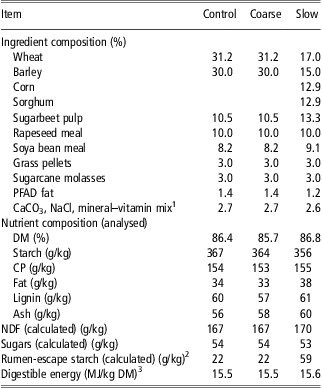
Treatments consisted of three types of concentrates; Control, Coarse and Slow. The Control concentrate was based on finely ground ingredients. In the Coarse-concentrate, all ingredients including barley and wheat were the same and included in same proportions as in Control concentrate but ingredients were coarsely ground before pelleting (Table 1). In the Slow-concentrate, approximately half the barley and wheat was replaced by finely ground sorghum and corn, which increased the estimated rumen-escape starch content to 59 g/kg compared with 22 g/kg in Control and Coarse (Norfor – The Nordic Feed Evaluation System, 2011). As planned and based on common feedstuff analyses (four pooled samples per concentrate type), all three concentrates had approximately the same total starch (362 g/kg), NDF (168 g/kg), CP (154 g/kg) and digestible energy (DE) (15.5 MJ/kg DM) content and a pellet diameter of 3.5 to 4 mm (Table 1).
Dietary composition and nutrient content of the three pelleted concentrates Control, Coarse and Slow, where Control and Coarse have the same composition, but vary in particle size, and where Slow contain a higher content of rumen-escape starch than Control but with similar particle size

PFAD = palm fatty acid distillate; DM = dry matter.
1Calcium carbonate (1.9% to 2.0%), sodium chloride (0.44%), calf-mineral and vitamin mixture (0.20%), and vitamin E mixture (0.09%).
2The rumen escape starch is calculated as the difference between total dietary starch and the total degradation of dietary starch in the rumen, where total degradation of dietary starch is the sum of the degradation of soluble starch in the rumen and the degradation of potentially degradable starch in the rumen (Norfor – The Nordic Feed Evaluation System, 2011).
3Digestible energy, DE (MJ/kg DM) = (SFU/kg DM + 0.369 + (0.347 × lignin (kg/kg DM))/0.0989, SFU = Scandinavian Feed Unit (Weisbjerg and Hvelplund, Reference Weisbjerg and Hvelplund1993).
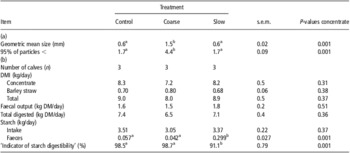
Before pelleting, all ingredients of the concentrate mixtures were analysed for particle size distribution by dry sieving (Waldo et al., Reference Waldo, Smith, Cox, Weinland and Lucas1971), using a Retsch AS200 sieve shaker (Retsch GmbH, Haan, Germany) with six sieves (sieve aperture of 4.75, 2.36, 1.0, 0.5, 0.212, 0.106 mm, and bottom pan), delivering results as show in Table 2. The geometric mean particle size (GPS) was used to characterize the particle size distribution (Waldo et al., Reference Waldo, Smith, Cox, Weinland and Lucas1971). The large percentage of particles retained on the 4.75 mm sieve, was because of clotting of particles in all three concentrates. Particles on this sieve were therefore excluded from the estimations shown in Table 2. Coarse concentrate had the greatest proportions of large particles with 50% < 1.6 mm and 95% < 4.4 mm, compared with averages of 50% < 0.8 mm and 95% < 1.7 mm in Control and Slow.
Feeding the experimental concentrates was initiated at time of weaning and was fully adapted at 84 ± 2 days of age, from which age on concentrate intake and growth rates were recorded (Table 3).
A production experiment was performed with the two batches each of 33 calves in 11 blocks (blocked according to herd of origin), and within each block calves were randomly assigned to one of three treatment groups, and were housed in six pens of 11 calves. Within batch, the three concentrate treatments were randomly assigned to three adjacent pens. The remaining two calves were not included in the study.
At eight and a half months of age, three complete blocks of calves (n = 9) were removed from batch #1 and moved to the experimental barn at Aarhus University, Foulum in order to get ‘an indicator of starch digestibility’ of the three diets. Thus, only data from the remaining 24 calves of batch #1 and the 33 calves of batch #2 were available for the production experiment.
Experimental pens (6 m wide and 8.4 m deep) had a straw-bedded resting area of 36 m2. Each pen was equipped with two drinking troughs and two automatic feed bins containing the pelleted concentrate. Concentrate was available ad libitum and feed bins were filled twice daily. Orts were removed twice weekly. Individual feed intake was recorded continuously by Insentec® roughage intake control (RIC) Feed System (Insentec BV, Marknesse, The Netherlands). A 3.5 m feeding table for barley straw was placed in front of each pen. Intake of barley straw could not be recorded precisely in this set-up, as calves were housed on straw-bedding, which is required for this type of rosé veal calf production.
Health recordings and veterinary treatments
No feed additives or preventive antibiotic treatments were given at arrival. No calves died or were culled before start of the experiment and all 57 calves completed the experiment. Upon arrival, calves were inspected and a few sick calves treated for diarrhoea and (or) pneumonia. Pneumonia was treated with a combination of antibiotics (Curamox; Boehringer Ingelheim Vetmedica GmbH, Copenhagen, Denmark) and Non-steroidal anti-inflammatory drug (NSAID) (Meloxicam, Metacam; Boehringer Ingelheim Vetmedica GmbH).
All calves were dehorned at 8 weeks of age and preventively vaccinated against ringworm (Bovilis Ringvac, Intervet Schering-Plough Animal Health, Intervet Danmark A/S, Ballerup, Denmark) (starting at 4 weeks of age). Calves in batch #2 were also vaccinated against BRSV, Parainfluenza type 3 virus and Mannheimia (Pasteurella) haemolytica (Bovilis Bovipast, Intervet Schering-Plough Animal Health) (starting at 4 weeks of age) following the instructions by the supplier.
Weighings and recordings
Calves were weighed at 2 consecutive days on arrival, at time of moving from receiving pens to experimental pens, and at time of slaughter. When approaching 350 kg BW, weekly weighing was used to estimate date of slaughter. The BW at slaughter limits were set at 380 to 400 kg BW for calves below 10 months of age. If not reaching this final BW before 10 months of age, calves were sent for slaughter because of age, as the production concept for rosé veal requires a calf age below 10 months.
‘Indicator of starch digestibility’
The trial used to get an ‘indicator of starch digestibility’ was carried out with 3 × 3 calves from batch #1 over a 63-day experimental period, including three 24-h sampling periods separated by 3-week intervals. The nine calves were 262 ± 8 days of age and 338 ± 4 kg, respectively, at initiation of the trial. Calves were housed in rubber-mattress-bedded tie-stalls (2 m wide and 2.5 m long). Stalls were only sawdust-bedded during non-sampling periods. Tie-stalls were raised 20 cm (back) to 25 cm (front) to allow urine drainage and to allow for total faeces collection during sampling periods. Each stall had two feeding troughs and there was free access to water. The barn was insulated with a 16 : 8 h L : D light cycle. The calves continued on their dietary treatments. Thus, they had ad libitum access to one of the three concentrates (Control, Coarse or Slow) and to straw. Concentrate was fed once and long spring barley straw twice daily. Concentrate intake was recorded throughout the experimental period, whereas straw intake was recorded for 7 days around each of the three sampling periods. All DM analyses on fresh feed samples and feed residues were determined at 60°C for 48 h in a forced air oven (Kristensen et al., Reference Kristensen, Sehested, Jensen and Vestergaard2007).
Total faecal output was collected during each of the two last 24-h sampling periods. Sub-samples (in duplo) of the total faecal output were stored at −20°C until analysis. Faecal samples were dried by the same procedure as used for feed samples, then ground through an 0.5 mm sieve and faecal starch was determined enzymatically (Kristensen et al., Reference Kristensen, Sehested, Jensen and Vestergaard2007). The ‘indicator of starch digestibility’ only gives an indication of the true starch digestibility.
Recordings at slaughter
Calves had free access to feed until loading on the truck and were then transported for 1 to 2 h to a commercial slaughter house and slaughtered within 1 h of arrival. As calves were slaughtered as close to reaching 10 months of age, a total of 13 slaughter days each with one to nine calves were needed. Thus, the number of calves per treatment slaughtered on a given slaughter day was not completely balanced (see the statistical analysis). The animals were stunned by captive bolt, bled and hung. Forestomachs were harvested from batch #2 (n = 33). The reticulo-rumen was cut open, emptied and rinsed in tap water. A macroscopic evaluation of the rumen wall characteristics in the atrium ruminis (two sites, ventrally (V) and laterally (L)) and in the cranial part of the ventral rumen sac (two sites, V and L) was made as described earlier (Jørgensen et al., Reference Jørgensen, Sehested and Vestergaard2007). In short, the rumen wall was scored for papillary aggregation or clumping (i.e., plaque formation), hyperaemia and necrosis using a scale from 0 (normal) to 4 (very severe plaque formation, extensive hyperaemia and severe necrosis). Measures of the papillae length (by use of a ruler) and scoring of shapes were carried out at 10 different locations for all four sites to account for the large variations in papillae sizes (Greenwood et al., Reference Greenwood, Morrill, Titgemeyer and Kennedy1997). The papillae shape was scored as descried earlier (Jørgensen et al., Reference Jørgensen, Sehested and Vestergaard2007): (1) short and slender; (2) short and leaf-like; (3) long and slender; (4) long and leaf-like. Thus, a higher score indicates a higher absorptive area of the papillae. For each characteristic, the mean within atrium (V and L) and within ventral rumen sac (V and L) are reported. A circular piece of rumen epithelia (73.9 cm2) from the ventral atrium ruminis was removed, stripped from the muscle layer, weighed and dried for 48 h at 60°C and weighed dry (mg DM/cm2) to get a representative measure of total rumen epithelium mass (Volmerhaus and Schnorr, Reference Volmerhaus and Schnorr1967).
The warm carcass weight was measured. The presence of LAs was assessed by the veterinary inspectors. The carcass was scored according to the EUROP system for conformation (1 to 15) and fatness (1 to 5) and scored for lean/fat colour (1 to 5).
Statistical analysis
Data from the 3 × 3 calves (from batch #1) in the ‘indicator of starch digestibility’ trial were analysed with a statistical model including the fixed effect of type of concentrate (Control, Coarse, Slow). The mean values of the two last sampling periods were used in the analysis. Data from the 57 animals in the production experiment were analysed with a model including the fixed effects of batch (1, 2) and type of concentrate. The effect of block was generally non-significant and was excluded from the model. Slaughter day (n = 13), although non-significant for most carcass data, was included as a fixed effect in the analysis of these data (see Table 4) but not for other data. For the rumen wall and papillae characteristics, only data from the 33 calves in batch #2 were available, so this model only included the fixed effect of type of concentrate. To evaluate if LA status affected performance, carcass characteristics and rumen wall characteristics, a model including the fixed effect of LA status (abscessed, n = 9 and non-abscessed, n = 48 for performance data and n = 6 and n = 27, respectively, for rumen wall data) was used. There was missing data from one animal on length of rumen papillae laterally in atrium and in rumen sac.
Owing to the balanced data, the GLM procedure of SAS (version 9.2, SAS Institute Inc., Cary, NC, USA) was used for all data except when analysing binary data (i.e., cases of sick/non-sick calves, number of carcasses with/without premiums and number of animals with/without LA) to which a χ 2-test (CATMOD procedure of SAS) was applied. Results for type of concentrate (Tables 2–5) or LA status (not shown) were expressed as least squares means with s.e.m. (except for χ 2 analysed data). Probability levels at or below 0.05 were considered significant.
Particle size distribution in concentrates before pelleting (a), and effect of type of concentrate on DMI of concentrate and barley straw, faecal output, and on ‘indicator of starch digestibility’ in 9 to 10 months bull calves (b)

DMI = dry matter intake; DM = dry matter.
a,bMeans with different superscript within a row are different (P < 0.05); ns = non significant (P > 0.1).
Results and discussion
‘Indicator of starch digestibility’
The ‘indicator of starch digestibility’ of Control and Coarse was similar (98.6%) (Table 2) and is in agreement with starch digestibility values reported by others (Galyean et al., Reference Galyean, Wagner and Owens1979; Axe et al., Reference Axe, Bolsen, Harmon, Lee, Milliken and Avery1987; Philippeau et al., Reference Philippeau, Martin and Michalet-Doreau1999) and is expected, since the seed coat has been cracked in the Coarse concentrate. Increased particle sizes of the Coarse concentrate may increase the selective retention time and lower the fractional rumen outflow rate of potential digestible starch, which will cause increased microbial fermentation of starch (Van Soest, Reference Van Soest1994).
Our ‘indicator of starch digestibility’ showed a lower value for the Slow concentrate (91.1%) than for Control and Coarse (98.6%, P < 0.001). Theurer (Reference Theurer1986) reported total tract starch digestibility of 91% for dry-rolled sorghum and corn in cattle. The reason for a lower starch digestibility when feeding the Slow concentrate can mainly be explained by a lower accessibility of the starch granules in corn and sorghum compared with barley and wheat (Larsen et al., Reference Larsen, Lund, Weisbjerg and Hvelplund2009).
Health and veterinary treatments
From arrival to time of slaughter, each calf was on average treated for 2.5 cases of pneumonia and 1.1 case of diarrhoea, most cases seen before weaning. There were a few cases of navel infections (n = 9), foul in the foot (interdigital necrobacillosis; n = 8) and intestinal inflammations (n = 10). No cases of diseases (P > 0.67) or numbers of treatments (P > 0.45) were related to the dietary treatments.
Performance and carcass quality
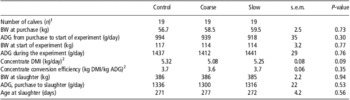
Intake of concentrate DM tended to be lowest for Coarse-fed calves (P < 0.09) (Table 3) but with no effects on growth performance. Straw was offered ad libitum but intake was not recorded. Therefore, it cannot be excluded that smaller differences in straw DM intake between dietary treatments have occurred and as such is a confounding factor for estimating total DMI (see also discussion below). There were no differences in BW at start or growth rate before or during the experimental period between dietary treatments. The growth rate was at a high performance level for this type of production and comparable to values seen in previous studies (Therkildsen et al., Reference Therkildsen, Vestergaard, Jensen, Andersen and Sejrsen1998; Jørgensen et al., Reference Jørgensen, Sehested and Vestergaard2007). Although several studies observed a better FCE when barley- and wheat-based concentrates were compared with sorghum and corn based (Kleen et al., Reference Kleen, Hooijer, Rehage and Noordhuizen2003; Bengochea et al., Reference Bengochea, Lardy, Bauer and Soto-Navarro2005; Castillo et al., Reference Castillo, Benedito, Pereira, Vázquez, Gutiérrez and Hernández2009) this was not the case in the present study. The actual batch of grain, its processing, degree of grinding and its proportion of the concentrate mixture are likely causes of the different outcome of these results.
BW, ADG, concentrate DMI, concentrate conversion efficiency, and age of Danish Holstein bull calves fed one of three pelleted concentrate mixtures

ADG = average daily gain; DMI = dry matter intake.
a,bMeans with different superscript within a row are different (P < 0.05).
1A total of 24 calves in batch #1 and 33 calves in batch #2. Nine of the calves in batch #1 were moved out of the production experiment at  $$$8\tfrac{1}{2} $$$
months of age in order to get an ‘indicator of starch digestibility’ (Table 2).
2Both concentrate DMI and concentrate conversion efficiency were calculated over the experimental period.
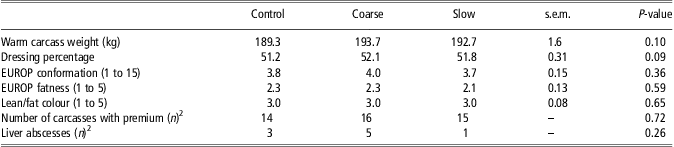
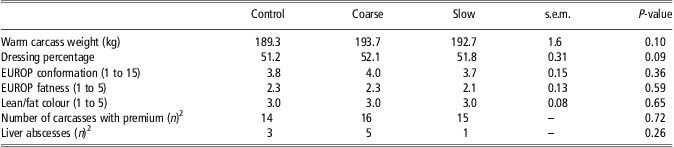
It is evident that the obtained BW at slaughter reflects the strategy chosen for time of slaughter (i.e., before 10 months of age) and because of similar ADG, age at slaughter was not affected. Carcass characteristics were also not affected by the dietary treatments (Table 4). The number of carcasses receiving a premium payment (EUROP conformation > 3.3) was high (80% of carcasses) and not different between dietary treatments.
Carcass characteristics, number of premiums and number of liver abcesses in rosé veal calves fed one of three pelleted concentrate mixturesFootnote 1
a,b Means with different superscript within a row are different (P < 0.05).
1 A total of 24 calves in batch #1 and 33 calves in batch #2. Besides type of concentrate (n = 3), the statistical model included slaughter day (n = 13) as a fixed effect to adjust for the different number of calves per treatment slaughtered on a given day.
2 χ 2-test (CATMOD procedure of SAS).
LAs were observed in nine of the 57 bull calves (three out of 24 in batch #1 and six out of 33 in batch #2). The incidence of LA (16%) was at a level that could be expected with ad libitum feeding of pelleted concentrates in experimental situations (Jørgensen et al., Reference Jørgensen, Sehested and Vestergaard2007) as well as in practice (Kjeldsen et al., Reference Kjeldsen, Bossen and Fisker2002; Jarltoft et al., Reference Jarltoft, Larsen and Vestergaard2011). Feeding high proportions of barley in the diet for steers (Ramsey et al., Reference Ramsey, Mathison and Goonewardene2002) showed similar results. Risk of LA is related to a low rumen pH and acidotic conditions seen for several hours over the day because of comparable types of high-concentrate feeding (Scanlan and Hathcock, Reference Scanlan and Hathcock1983; Nagaraja and Chengappa, Reference Nagaraja and Chengappa1998).
Rumen wall and papillae characteristics
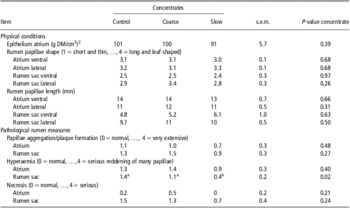
Dry weight of the epithelia from the ventral atrium ruminis (cranial ventral sac) was not different between type of concentrate (Table 5) indicating no differences in total rumen absorption capacity (Volmerhaus and Schnorr, Reference Volmerhaus and Schnorr1967). The visual macroscopic evaluation of the rumen papillae showed equally shaped papillae independent of dietary treatment. Although this evaluation was in good agreement with other studies (Greenwood et al., Reference Greenwood, Morrill, Titgemeyer and Kennedy1997; Beharka et al., Reference Beharka, Nagaraja, Morrill, Kennedy and Klemm1998), Beharka et al. (Reference Beharka, Nagaraja, Morrill, Kennedy and Klemm1998) and Greenwood et al. (Reference Greenwood, Morrill, Titgemeyer and Kennedy1997) also evaluated the papillae microscopically and they found a tendency for increased branching of papillae as the particle size in the diet decreased. The length of the rumen papillae measured at four sites was not affected by dietary treatments and was of similar length as observed for 32 to 36 weeks old Holstein steers (Nocek and Kessler, Reference Nocek and Kessler1980). In contrast, Beharka et al. (Reference Beharka, Nagaraja, Morrill, Kennedy and Klemm1998) reported increased papillae length with increased particle size in the concentrate, whereas Greenwood et al. (Reference Greenwood, Morrill, Titgemeyer and Kennedy1997) and Nocek and Kessler (Reference Nocek and Kessler1980) found that papillae length increased linearly with decreased particle size probably because of an increased total short chain fatty acid (SCFA) concentration in these later studies.
Effect of type of concentrate on rumen papillae shape and length and on the pathological measures of the rumen epithelium when examined macroscopicallyFootnote 1

a,b Means with different superscript within a row are different (P < 0.05).
1 A total of 33 animals of batch #2 (11 per treatment).
2 According to Jørgensen et al. (Reference Jørgensen, Sehested and Vestergaard2007).
Several studies report that feeding conditions that cause rapid fermentation rates and ruminal acidosis are strongly related to the development of ruminitis and parakeratosis (Ørskov, Reference Ørskov1986; Galyean and Rivera, Reference Galyean and Rivera2003). Ruminitis represents a condition of inflammatory lesions in the rumen mucosa (Scanlan and Hathcock, Reference Scanlan and Hathcock1983; Nagaraja and Chengappa, Reference Nagaraja and Chengappa1998), whereas parakeratosis appears as incomplete keratinization of the rumen papillae (Hinders and Owen, Reference Hinders and Owen1965). Pathological changes in the rumen epithelium can be observed macroscopically as redness (hyperaemia), aggregation (plaque formation) and necrosis of the rumen papillae. There were no significant differences in the incidence of papillae aggregation, redness or necrosis between dietary treatments, but in the cranial part of the ventral rumen sac, hyperaemia was lower in Slow compared with Control and Coarse (P < 0.02). However, for all three dietary treatments, some degree of ruminitis and parakeratosis were observed.
The reason for a no-effect of the type of concentrate per se, might be related to the ad libitum feeding of both concentrates and straw, so that individual calves prone to developing sub-acute ruminal acidosis may have compensated for this by concomitantly eating less concentrate for a short period (Schwartzkopf-Genswein et al., Reference Schwartzkopf-Genswein, Beauchemin, Gibb, Crews, Hickman, Streeter and McAllister2003). It is presumably a combination of high rumen SCFA production that stimulates satiety receptors (Schwartzkopf-Genswein et al., Reference Schwartzkopf-Genswein, Beauchemin, Gibb, Crews, Hickman, Streeter and McAllister2003), low pH and most importantly a high rumen osmolality (Cooper et al., Reference Cooper, Kyriazakis and Nolan1995) that cause reduced feed intake. In sheep, increasing osmolality in the rumen reduced the intake of a high-energy-density but not of a low-energy-density feed (Cooper et al., Reference Cooper, Kyriazakis and Nolan1995). However, we have no data to support if these or other factors were responsible for the slightly lower overall concentrate intake in Coarse-fed calves (Table 3). Straw intake was not measured in the present production experiment, but based on the above we did not expect major differences in sub-acidotic conditions between the three concentrates and thus in straw intake. Despite the ‘indicator of starch digestibility’ trial suggests no overall change in barley straw intake (Table 2), there might have been differences in the day-to-day intake between treatments. An earlier experiment showed a higher day-to-day variation in straw intake in bull calves that had LA at slaughter compared with non-abscessed bull calves (Jørgensen et al., Reference Jørgensen, Sehested and Vestergaard2007), as indicative of a different sub-acidotic condition during the growing period had affected straw intake.
LAs, rumen wall characteristics and performance
An analysis of rumen wall characteristics of non-abscessed (n = 27) and LA (n = 6) animals revealed no differences in any of the rumen wall characteristics. This is in agreement with our previous finding (Jørgensen et al., Reference Jørgensen, Sehested and Vestergaard2007) that despite a significant difference in LA status between two groups of concentrate-fed young bulls there was no significant differences in rumen wall and papillae characteristics at slaughter. Furthermore, despite a high starch level (Kleen et al., Reference Kleen, Hooijer, Rehage and Noordhuizen2003) and a low roughage intake (Kreikemeier et al., Reference Kreikemeier, Harmon, Brandt, Nagaraja and Cochran1990) on the one side, and bloat (Ramsey et al., Reference Ramsey, Mathison and Goonewardene2002), ruminal acidosis (Galyean and Rivera, Reference Galyean and Rivera2003), pathological rumen wall characteristics (Scanlan and Hathcock, Reference Scanlan and Hathcock1983) and LA (Jørgensen et al., Reference Jørgensen, Sehested and Vestergaard2007) on the other side are somewhat linked (Smith, Reference Smith1944; Jensen et al., Reference Jensen, Deane, Cooper, Miller and Graham1954; Tamate et al., Reference Tamate, Nagatani, Yoneya, Sakata and Miura1973), this is not a straight forward relation. However, when a more intensive grain feeding was compared with a less intensive feeding it caused a higher incidence of post mortem evaluated ruminal lesions and also a higher incidence of LA (Smith, Reference Smith1944; Jensen et al., Reference Jensen, Deane, Cooper, Miller and Graham1954; Tamate et al., Reference Tamate, Nagatani, Yoneya, Sakata and Miura1973). In contrast, our previous results with Holstein bull calves fed pelleted concentrates ad libitum showed that although a doubling of straw intake could improve rumen wall and papillae characteristics, this could not reduce the incidence of LA, but a lower starch and higher fibre content of the concentrates could reduce the incidence of LA (Jørgensen et al., Reference Jørgensen, Sehested and Vestergaard2007). The differences in results described above is probably related to the magnitude of changes in rumen wall abnormalities seen with the different feedings (Hironaka et al., Reference Hironaka, Kimura and Kozub1979) and with the timing of recording, as the rumen wall condition seen at slaughter does not necessarily reflect the situation at the time when the LA was established.
The LA status (n = 49 non-abscessed and n = 8 LA) also did not affect ADG, FCE, carcass weight or any carcass characteristics, which is in agreement with our overall finding in an earlier study (Jørgensen et al., Reference Jørgensen, Sehested and Vestergaard2007).
Conclusion
The results show that it is possible to obtain the same high levels of production performance and carcass value with all three types of concentrates. With the actual changes applied, neither more coarse ingredients nor additional rumen-escape starch in a pelleted concentrate fed ad libitum could improve rumen wall characteristics or reduce the incidence of LAs of rosé veal calves. No direct link was detected between rumen wall and papillae conditions and LAs at time of slaughter.
Acknowledgements
Feeding and management of calves by Allan Mikkelsen and staff at the Danish Cattle Research Centre, Foulum, is acknowledged. The help from Palle D. Sørensen and staff at Danish Crown's abattoir, Aalborg, in getting access to the reticulo-rumen of the calves is acknowledged. Jakob Kvistgaard, DLG a.m.b.a. is acknowledged for his interest in the project and for being responsible for the production of the experimental concentrates and for feed stuff analyses. Peder Nørgaard, University of Copenhagen is acknowledged for assistance with the dry-sieving analysis of particle size distribution. Barn staff and MSc students are acknowledged for their help with animal feeding and care and with total faecal collection, respectively. The study received financial support from Danish Cattle/Kvaegafgiftsfonden, grant 04.07, 2008–10, Landbrugets Hudefond grant B.2.208, the Ministry of Food, Agriculture and Fisheries, DFFE grant 3412-07-02038 and the Department of Animal Science, Aarhus University.