During the past two decades, there have been numerous studies on emotional intelligence (EI). The construct was first coined by Salovey and Mayer (Reference Salovey and Mayer1990) and was later theoretically reformulated, considering EI as a compendium of skills and abilities to perceive, understand, assimilate, and regulate one’s own and others’ emotions (Mayer & Salovey, Reference Mayer, Salovey, Salovey and Sluyter1997). Currently, there are two dominant EI models: an Ability Model, which defines EI as a set of abilities to process emotional information accurately and efficiently, such as the ability to perceive, assimilate, understand, and manage the information provided by the emotions; and the Trait or Mixed Model, for which EI is a combination of personality traits, social skills, and motivational aspects (Mayer, Salovey, & Caruso, Reference Mayer, Salovey, Caruso and Sternberg2000). Some instruments, based on Salovey and Mayer´s (1990) model, have been developed to assess relevant aspects of individuals’ perceptions of their emotional competencies. Since its introduction in 1995, the Trait Meta-Mood Scale (TMMS; Salovey, Mayer, Goldman, Turvey, & Palfai, Reference Salovey, Mayer, Goldman, Turvey, Palfai and Pennebaker1995) is one of the most widely used self-report measures based on Salovey and Mayer´s (Reference Salovey and Mayer1990) model, which assesses stable individual differences on perceived emotional intelligence (PEI) or the perception of one’s emotional competencies. The TMMS includes the following dimensions: Emotional Attention (i.e., perceived ability to focus on one’s emotions), Emotional Clarity (i.e., perceived understanding of one’s emotional states), and Emotional Repair (i.e., perceived ability to manage one’s emotions). In fact, the TMMS dimensions and symptoms of psychological maladjustment have been examined in the last decade. Specifically, it has been found that high scores on Clarity and Repair dimensions are negatively related to depression (Extremera & Fernández-Berrocal, 2006; Fernández-Berrocal, Alcaide, Extremera, & Pizarro, Reference Fernández-Berrocal, Alcaide, Extremera and Pizarro2006), social anxiety (Salovey, Stroud, Woolery, & Epel, Reference Salovey, Stroud, Woolery and Epel2002), personality disorders (Leible & Snell, Reference Leible and Snell2004), and eating disorders (Gilboa-Schechtman, Avnon, Zubery, & Jeczmien, Reference Gilboa-Schechtman, Avnon, Zubery and Jeczmien2006). Meanwhile, high scores on Clarity and Repair have been positively related to life satisfaction and wellbeing (Extremera, Salguero, & Fernández-Berrocal, Reference Extremera, Salguero and Fernández-Berrocal2011).
Despite the growing amount of research on EI in recent years, few studies have specifically explored the relationship between EI and aggressive behavior. For example, some research has revealed that the adolescents who reported higher scores in EI showed less aggressive behavior (Mayer, Perkins, Caruso, & Salovey, Reference Mayer, Perkins, Caruso and Salovey2001a) and delinquency (Siu, Reference Siu2009), and greater resistance to social pressure to react in a conflictive way (Mayer et al., Reference Mayer, Perkins, Caruso and Salovey2001a). Regarding PEI dimensions, some evidence suggests that sexually aggressive behavior in adolescents may be positively associated with higher Attention and negatively with Repair (Moriarty, Stough, Tidmarsh, Eger, & Dennison, Reference Moriarty, Stough, Tidmarsh, Eger and Dennison2001). For adult men, researchers found an inverse relationship between EI and potentially harmful behavior such as using illegal drugs, drinking alcohol excessively, and engaging in deviant behavior (Brackett, Mayer, & Warner, Reference Brackett, Mayer and Warner2004). Finally, for both adult men and women, EI has also been shown to have a mediating role on aggressive behavior (Mansfield, Addis, Cordova, & Dowd, Reference Mansfield, Addis, Cordova and Dowd2009). Speaking about the specific PEI dimensions, high scores in Attention (i.e., high tendency to observe, think about, and focus on one´s emotions), especially when accompanied by low scores in Clarity and Repair, tend to increase the emotional experience and to generate a ruminative and intrusive out-of-control process, which maintains rather than alleviates negative mood states (Nolen-Hoeksema, Wisco, & Lyubomisrsky, Reference Nolen-Hoeksema, Wisco and Lyubomisrsky2008; Rusting & Nolen-Hoeksema, Reference Rusting and Nolen-Hoeksema1998). Thus, an excessive focus on one’s own emotions might contribute to fostering aggression. Clarity, as opposed to the construct of alexithymia, refers to the ability to identify, distinguish, and describe one’s own emotional states (Salovey et al., Reference Salovey, Mayer, Goldman, Turvey, Palfai and Pennebaker1995). Alexithymics have been found to present violent collapses (Krystal, Reference Krystal1979). Therefore, Clarity might have a negative influence on overt aggression. Repair is the ability to regulate one´s emotional states. It refers to the individual´s belief about his/her ability to interrupt and decrease negative emotional states and to prolong positive ones. Consequently, Repair could be a negative predictor of aggression.
Undoubtedly, examining the effect of PEI dimensions on aggressive behavior is relevant given its potential use in school programs to prevent violence among children and adolescents (Durlak, Weissberg, Dymnicki, Taylor, & Schellinger, Reference Durlak, Weissberg, Dymnicki, Taylor and Schellinger2011). It is also relevant for adult clinical training programs aimed at increasing levels of EI, and work against the initiation and progression of harmful behaviors such as reducing domestic violence, sexual abuse, or illegal drug use, among others (Keefer, Parker, & Saklofske, Reference Keefer, Parker, Saklofske, Parker, Saklofske and Stough2009).
On the other hand, numerous studies have explored the moderating effect of gender in aggressive behavior. In short, males exhibit more physical and verbal violence (Cohn, Reference Cohn1991; Hyde, Reference Hyde1984; Knight, Fabes, & Higgins, Reference Knight, Fabes and Higgins1996; McGue, Bacon, & Lykken, Reference McGue, Bacon and Lykken1993; Schober, Bjarkqvist, & Somppi, Reference Schober, Bjarkqvist and Somppi2009), while women reported higher levels of indirect or relational violence (Björkqvist, Osterman, & Kaukiainen, Reference Björkqvist, Osterman, Kaukiainen, Bjorkqvist and Niemela1992; Crick & Gotpeter, Reference Crick and Grotpeter1995; Schober et al., Reference Schober, Bjarkqvist and Somppi2009). This gender difference in the display of aggressive behavior starts in preschool stages (Maccoby & Jacklin, Reference Maccoby and Jacklin1980). However, scarce research has examined the influence of age on aggressive behavior (for a valuable exception, see Scheithauer, Haag, Mahlke, & Ittel, Reference Scheithauer, Haag, Mahlke and Ittel2008). Aggressive behavior in childhood appears to be related to specific disorders of attention and behavior (Tackett, Waldman, & Lahey, Reference Tackett, Waldman and Lahey2009). In the case of adolescents, peer-to-peer violence seems to begin with isolating behaviors and, in the absence of repercussion, it later gives rise to physical aggression or coercion (Ortega, Reference Ortega2000; Pulido-Valero, Martín-Seoane, & Lucas-Molina, Reference Pulido-Valero, Martín-Seoane and Lucas-Molina2011). The display of physical and verbal violence decreases progressively from adolescence to old age (McGirr et al., Reference McGirr, Renaud, Bureau, Seguin, Lesage and Turecki2008).
A large number of researches have traditionally examined the relationship between personality traits and aggressive behavior, finding that Conscientiousness and Agreeableness are significantly and positively associated with self-control and inhibition of aggressive impulses (Huey & Weisz, Reference Huey and Weisz1997; Klimstra, Akse, Hale, Raaijmakers, & Meeus, Reference Klimstra, Akse, Hale, Raaijmakers and Meeus2010; Markon, Krueger, & Watson, Reference Markon, Krueger and Watson2005; Van Leeuwen, Mervielde, Braet, & Bosmans, 2004). Similarly, some studies have found that Openness to Experience is a negative predictor of aggression (Huey & Weisz, Reference Huey and Weisz1997; Klimstra et al., Reference Klimstra, Akse, Hale, Raaijmakers and Meeus2010; Van Leeuwen et al., 2004). In addition, previous studies have also shown a positive relation between Neuroticism and provoked aggression (Bettencourt, Talley, Benjamin, & Valentine, Reference Bettencourt, Talley, Benjamin and Valentine2006).
As mentioned previously, there are some studies exploring the effects of gender and personality on aggression. However, there is a gap in the literature regarding the incremental prediction and the moderating role of PEI on aggressive behavior. Unlike socio-demographic and personality dispositional traits, aspects of mood regulation are flexible and moldable and thus are susceptible to modification and training. Hence, knowledge of how these emotional regulators predict aggressive manifestations and interact with dispositional traits would be useful for the creation and implementation of aggression prevention programs. Strong predictors of aggression such as temperamental dispositions from the Big-Five were not controlled for in previous research on the relationship of EI and aggression. As noted recently, despite the fact that EI explains unique variance, it also partly overlaps, especially when self-report measures of EI are used, with other well-known assessed dimensions such as the Big-Five (Fernández-Berrocal & Extremera, 2008). Given the functional similarities among PEI and personality traits in predicting interpersonal related outcomes, predictive studies should examine whether EI accounts for incremental variance beyond that accounted for by other well-established personality traits, such as the Big-Five and socio-demographics. Also, moderation studies exploring the interaction between specific PEI and personality dimensions should control the effects of age, gender, and other personality traits. This would provide stringent tests of the predicting and moderating role of PEI on aggression in young adults over classic theoretically and empirically robust predictors. Thus, the present study attempts to analyze the predictive and incremental validity as well as the moderating role of the PEI dimensions on aggression among young adults from the community, after controlling for the effects of age, gender, and personality. It is hypothesized that age and gender will both relate to aggressive behavior: younger participants and men will exhibit more physical and verbal aggression, while women will experience more hostility and anger. In addition, we expect Conscientiousness and Agreeableness to be negative predictors of aggression, and Neuroticism to be a positive predictor. Finally, controlling the effects of age, gender, and personality, we expect PEI to independently contribute unique and significant variance to indicators of aggression and to play a significant moderating role between personality and aggression dimensions.
Method
Participants
To carry out our study, we used a Spanish community sample. 63 high school students and 250 university students volunteered in the study. Eleven participants were eliminated from the study for different reasons (i.e., not understanding Spanish as this was the language in which the questionnaires were administered, not completing all the battery of questionnaires, etc.). After deleting these 11 participants, the final sample was made up of 313 men (n = 122) and women (n = 191) ranging from 14 to 69 years old (M = 24.74, SD = 9.27).
Methods of Assessment
To evaluate the PEI, the Spanish and reduced version of the Trait Meta-Mood Scale (TMMS-24; Fernández-Berrocal, Extremera, & Ramos, Reference Fernández-Berrocal, Extremera and Ramos2004; original version of Salovey et al., Reference Salovey, Mayer, Goldman, Turvey, Palfai and Pennebaker1995) was used. The TMMS-24 is a 24-item Likert scale of five points (1 = not agree, 5 = strongly agree) that assesses the meta-knowledge of the mood states and provides an index of PEI by three dimensions: Attention, Clarity, and Repair. Cronbach’s alpha for three dimensions are satisfactory: Attention (α = .87), Clarity (α = .84), and Repair (α = .82).
To assess aggression, we used the Spanish version (Andreu, Peña, & Grana, Reference Andreu, Peña and Graña2002) of the Aggression Questionnaire (AQ; Buss & Perry, Reference Buss and Perry1992). The AQ evaluates four aggressive behavior subscales: Physical Aggression, Verbal Aggression, Hostility, and Anger. The Spanish version has adequate internal consistency for both the total scale and for the four subscales (α ranging from .68 to .88).
Personality was assessed using the Spanish version of the Big-Five Inventory (BFI-44; Benet-Martinez & John, Reference Benet-Martinez and John1998). The BFI-44 is a 44-item Likert scale of five points (1 = strongly disagree, 5 = strongly agree) that assesses the Big Five personality dimensions: Extraversion, Agreeableness, Conscientiousness, Neuroticism, and Openness to Experience. Alpha reliabilities for the scales are all adequate, ranging from .69 to .77 (Benet-Martinez & John, Reference Benet-Martinez and John1998).
Procedure
All the participants were recruited in the province of Málaga (Spain). Adults were enrolled at the Universidad de Málaga, and minors were students at a high school in the province of Málaga. Adult participants volunteered to complete the questionnaires. Parental consent was garnered before developing the study with participants younger than 18 years old. The consent form, which included an explanation of the study’s purpose, and the guarantee of anonymity and confidentiality was read to the parents and signed by them. Participants were tested individually. The questionnaire administration took place in a single 50 minute session. A researcher was always present during testing and encouraged participants to ask any question regarding the questionnaires.
Results
Descriptive statistics
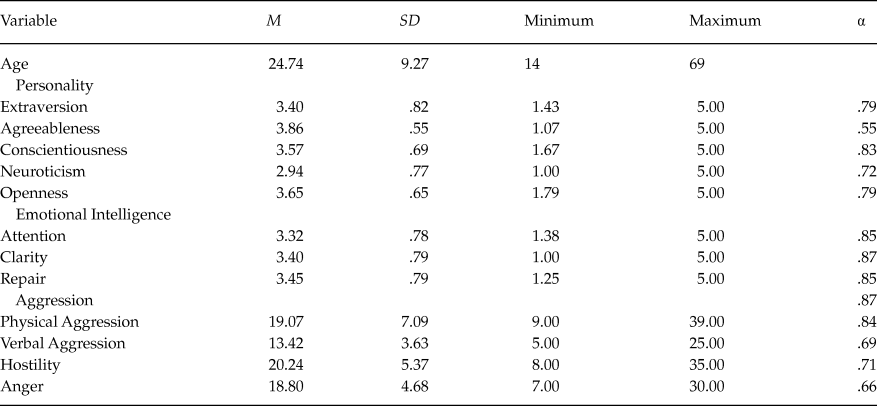
Descriptive statistics for age, gender, personality dimensions, PEI, and aggressive dimensions, as well as reliability of the different subscales used for the present sample are presented in Table 1.
Descriptive statistics

Note: N = 313.
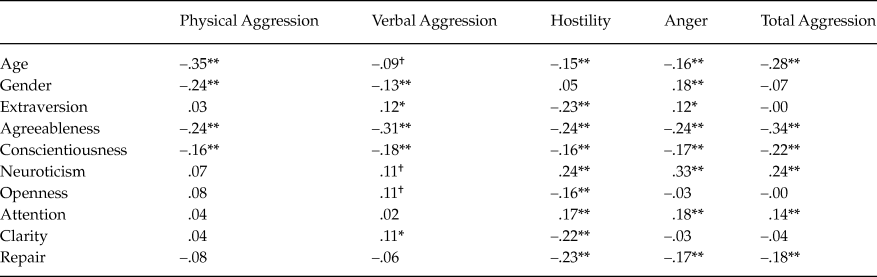
Correlations were computed between aggressive dimensions and age, gender, PEI, and personality (See Table 2). Not surprisingly, gender (male = 1, female = 2) correlated negatively with Physical Aggression, meaning that men exhibit more direct aggression, while women were found to experience more Anger. Age also correlated negatively with Physical Aggression, with younger individuals reporting more overt aggressive behavior. Correlations between Attention and aggression (Hostility and Anger) were positive and significant, whereas significant and negative correlations were found between Repair and aggression (Hostility and Anger). Clarity correlated negatively with Hostility and positively with Verbal Aggression.
Correlations between age, gender, personality and Perceived Emotional Intelligence (PEI) and aggressive behavior variables

Note: † p < .10; *p < .05; **p < .01.
Finally, Neuroticism correlated significantly and positively with Hostility and Anger, while Agreeableness and Conscientiousness correlated negatively with the four aggressive dimensions.
Gender differences
To examine differences in PEI and aggression patterns across gender, t-tests were computed. Men were found to score higher in Physical Aggression (t = 4.38; p < .001; η2 = .06) and Verbal Aggression (t = 2.39; p < .05; η2 = .02), while women scored higher in Anger (t = –3.21; p < .05; η2 = .03). Regarding PEI, the only gender difference was in Attention, with women scoring higher than men (t = –4.01; p < .001; η2 = .05).
Incremental Predictive Utility
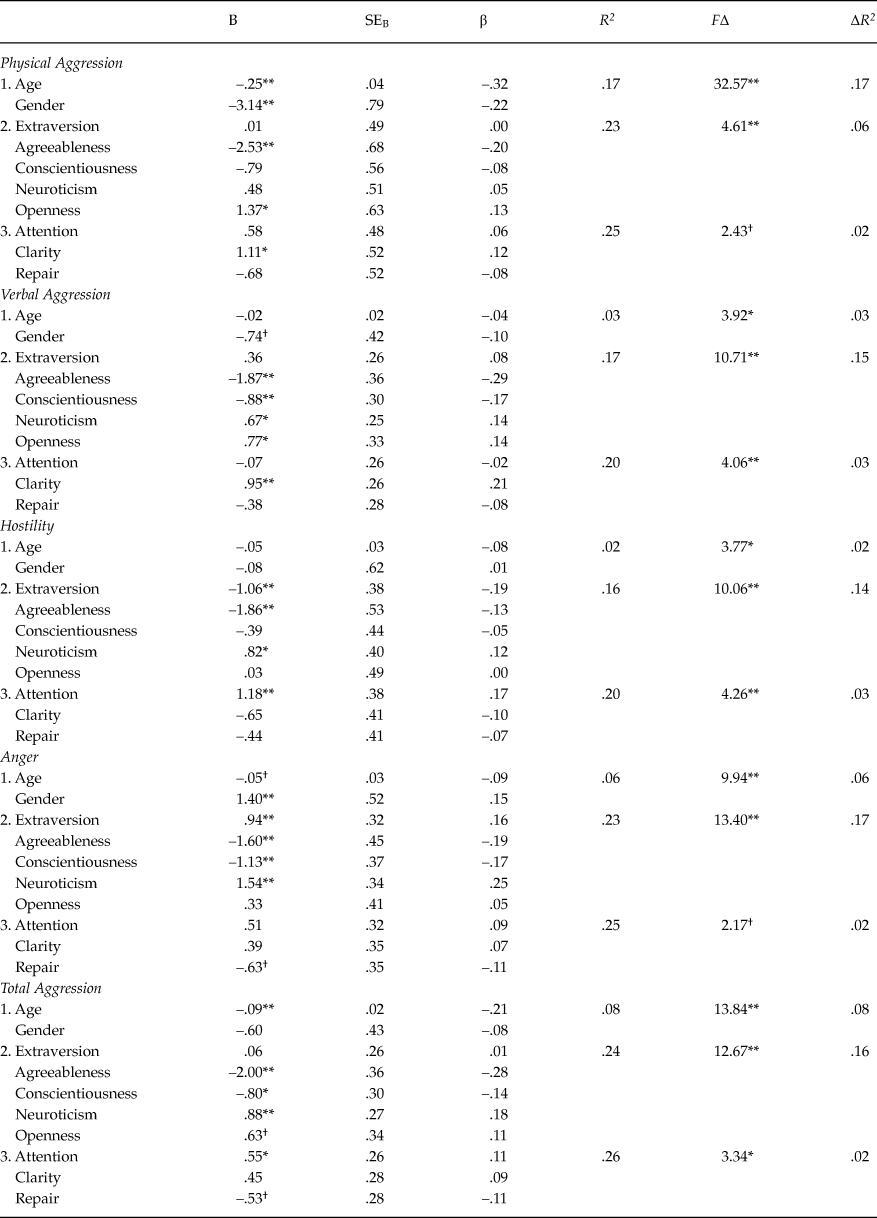
Next, we explored the effects of PEI dimensions on aggression beyond the effects of age, gender, and personality traits. To this end, we conducted several hierarchical multiple regression analysis where aggression dimensions were regressed onto age and gender in the first step, personality traits in the second step, and PEI dimensions in the final step (see Table 3). Aggression dimensions were included in separate analyses. Results indicated that age and gender accounted for significant variance of Physical Aggression (17%), Verbal Aggression (3%), and Anger (6%) in the first step, personality dimensions accounted for significant variance in the second step (especially in Verbal Aggression, Hostility, and Anger, accounting for 15%, 14%, and 17% of the total variance respectively), and PEI dimensions accounted for significant variance in the third step in Verbal Aggression and Hostility, accounting for 3% of the variance in both dimensions. Younger participants scored higher in Physical Aggression. Men reported higher levels of Physical and Verbal Aggression, while women scored higher in Anger. Participants who reported a higher degree of Neuroticism and Openness to Experience, as well as participants who reported lower scores of Agreeableness and Conscientiousness, obtained higher levels of aggression. Participants who showed a higher degree of Attention scored higher in Hostility and Total Aggression, whereas those who reported a higher degree of Repair obtained marginally significantly lower degrees of Anger and Total Aggression. Individuals who showed a higher degree of Clarity reported a higher degree of Verbal Aggression.
Predictive validity of Perceived Emotional Intelligence (PEI) beyond indicators of age, gender and personality

Note: † p < .10; *p < .05; **p < .01.
PEI as moderator of the relationship between personality and aggression
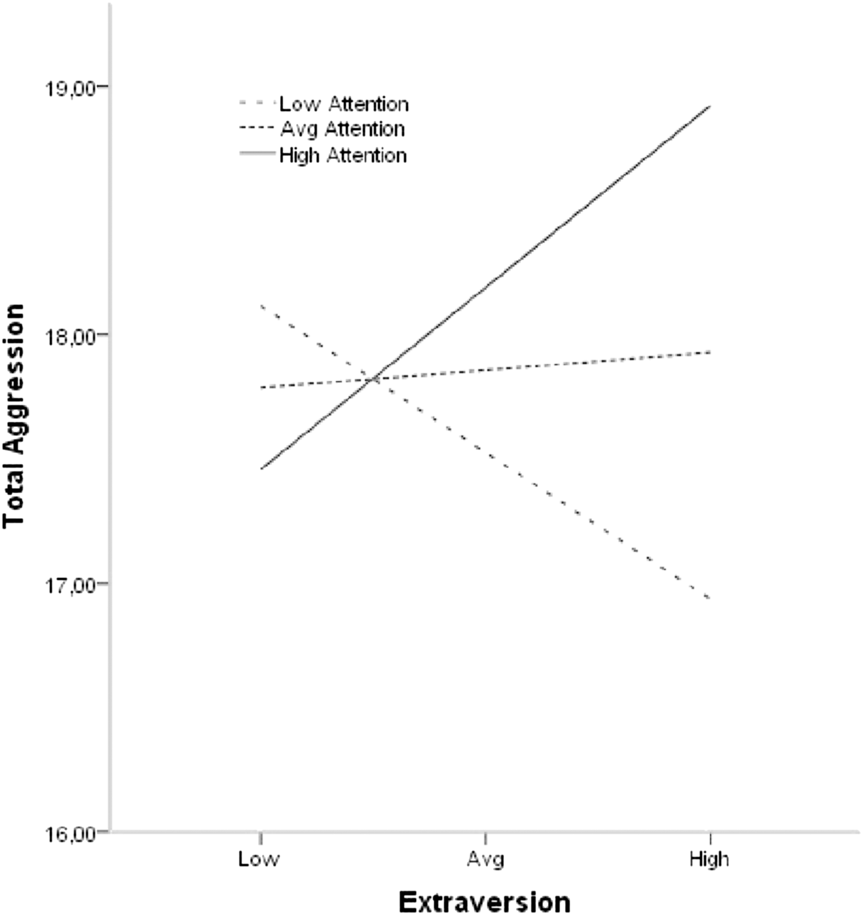
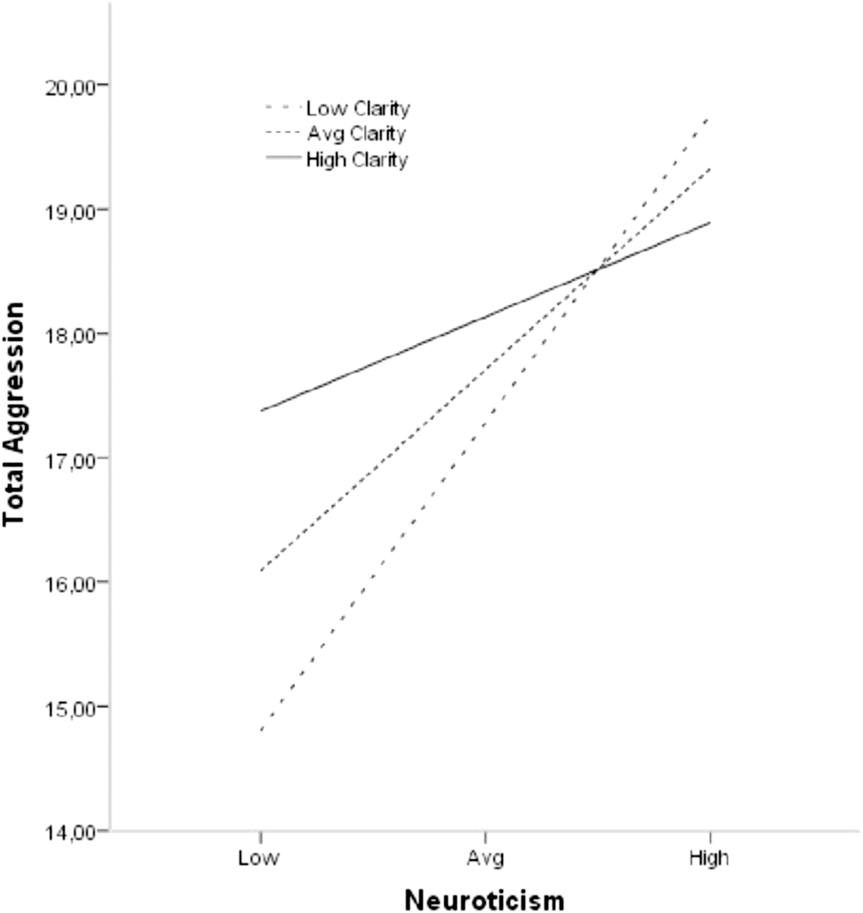
Subsequently, the study tested whether PEI dimensions moderated the relationship between aggression and personality, controlling the effects of covariates related to aggression (i.e., age, gender, and the rest of the PEI and personality dimensions). For this purpose, we conducted a moderation analysis using SPSS 19 and PROCESS, a computational procedure which implements moderation (Hayes, Reference Hayes2012). The interactions between the three PEI dimensions and four out of the Big-Five personality dimensions (Extraversion, Neuroticism, Agreeableness, and Openness to Experience) were significant predictors of aggression. For reasons of space, only figures representing the interaction between PEI and personality dimensions on Total Aggression are included (See Figures 1 and 2). Specifically, the interaction between Attention and Extraversion was a significant predictor of Physical Aggression (b = 1.49, t (313) = 2.82, p < .01), Verbal Aggression (b = .69, t (313) = 2.45, p < .05), and Total Aggression (b = .67, t (313) = 2.35, p < .05). Participants high in both Extraversion and Attention received the highest ratings of Physical and Total Aggression whereas those who were high in Extraversion and low in Attention scored the lowest in Physical and Total Aggression. Also, individuals low in Extraversion and high in Attention obtained the lowest ratings of Verbal Aggression. The interaction between Clarity and Neuroticism was a significant predictor of Anger (b = –.83, t (313) = –2.37, p < .05) and Total Aggression (b = –.71, t (313) = –2.50, p < .05). Individuals low in both Neuroticism and Clarity received the lowest scores in Anger and Total Aggression. The interaction between Attention and Agreeableness was a significant predictor of Anger (b = –1.23, t (313) = –2.19, p < .05) and Verbal Aggression (b = –.94, t (313) = –2.11, p < .05). Participants low in Agreeableness and high in Attention obtained the highest levels of Anger and Verbal Aggression. The interaction between Attention and Neuroticism was a significant predictor of Physical Aggression (b = –1.16, t (313) = –2.25, p < .05). Individuals low in both Neuroticism and Attention obtained the lowest scores of Physical Aggression. Finally, the interaction between Repair and Openness to Experience was a significant predictor of Hostility (b = –1.19, t (313) = –2.37, p < .05). Participants high in Openness to Experience and low in Repair received the highest ratings of Hostility.
Interaction of Attention and Extraversion in predicting Total Aggression.
Note: Regression lines were plotted representing groups high (one SD above the mean), avg (average) and low (one SD below the mean) in Attention and Extraversion.
† p < .10; *p < .05; **p < .01.

Interaction of Clarity and Neuroticism in predicting Total Aggression.
Note: Regression lines were plotted representing groups high (one SD above the mean), avg (average) and low (one SD below the mean) in Clarity and Neuroticism.
† p < .10; *p < .05; **p < .01.

Discussion
To the best of our knowledge, this is the first research examining the predictive and incremental validity of the PEI on aggressive behavior above and beyond the effects attributable to age, gender, and personality; it is also the first study to explore the moderating role of PEI dimensions on the aggression-personality relationship. The results show evidence of the effect of age, gender, personality, and PEI on aggressive behavior. In line with previous studies (Björkqvist et al., Reference Björkqvist, Osterman, Kaukiainen, Bjorkqvist and Niemela1992; Cohn, Reference Cohn1991; Crick & Gotpeter, Reference Crick and Grotpeter1995; Hyde, Reference Hyde1984; Knight et al., Reference Knight, Fabes and Higgins1996; McGue et al., Reference McGue, Bacon and Lykken1993; Schober et al., Reference Schober, Bjarkqvist and Somppi2009), gender appears to be a significant predictor of aggressive behavior: men scored higher in Physical and Verbal Aggression, while women reported experiencing more indirect or relational aggression (Hostility). Also consistently with previous research (McGirr et al., Reference McGirr, Renaud, Bureau, Seguin, Lesage and Turecki2008), age was found to be a negative predictor of Physical Aggression, meaning that overt aggression decreases with age. Personality traits were also shown to be associated with aggression. In line with previous studies (Bettencourt et al., Reference Bettencourt, Talley, Benjamin and Valentine2006; Klimstra et al., Reference Klimstra, Akse, Hale, Raaijmakers and Meeus2010; Markon, Krueger, & Watson, Reference Markon, Krueger and Watson2005), Neuroticism was a significant predictor of aggression, whereas Agreeableness and Conscientiousness were both negative predictors of aggression.
Controlling the effects of age, gender, and personality traits, PEI dimensions have demonstrated their ability to predict some significant and unique variances over aggressive behavior. Specifically, and consistently with previous studies (Moriarty et al., Reference Moriarty, Stough, Tidmarsh, Eger and Dennison2001; Salovey et al., Reference Salovey, Mayer, Goldman, Turvey, Palfai and Pennebaker1995), Attention was a positive predictor of aggression (for Hostility and Total Aggression), while Repair was a marginally negative predictor of Anger and Total Aggression. Clarity was shown to be a positive predictor of Verbal Aggression. These results indicate a number of points: the perceived attention paid to one´s emotional states leads to an increment of indirect aggressive behavior; the perceived understanding or clarity to discriminate one´s emotions results in an increment of verbally expressed aggression; and the perceived ability to regulate one´s emotional states leads to a better self-control of direct and indirect aggressive behavior. These results highlight the influence of PEI dimensions on aggression above and beyond the effects of age, gender, and personality.
Interaction analysis showed that PEI dimensions played a moderating role on the aggression-personality relationship among participants with extreme (high or low) scores on personality dimensions. Individuals scoring high in Extraversion with high levels in Attention obtained the highest levels of Physical and Total Aggression, while extraverts low in Attention reported the lowest levels of Physical and Total Aggression. Participants low in Neuroticism and Attention obtained the lowest ratings of Physical Aggression, and those scoring low in both Neuroticism and Clarity reported the lowest scores in Anger and Total Aggression. Individuals low in Agreeableness with high scores in Attention reported the highest levels of Anger and Verbal Aggression, and participants high in Openness to Experience with low scores in Repair obtained the highest levels of Hostility.
Altogether, the findings of the present research can be explained by the role that TMMS dimensions play in psychological adjustment (Fernández-Berrocal & Extremera, 2008). As it was pointed out in the introduction, high scores in Attention, especially when accompanied by low scores in Clarity and Repair, tend to maximize the emotional experience and generate an emotional spiral and a ruminative out-of-control process, which maintains negative mood states. Thus, higher levels of Hostility among individuals high in Attention could be explained by this ruminative and intrusive process generated by an excessive focus on one’s own emotions (Nolen-Hoeksema et al., Reference Nolen-Hoeksema, Wisco and Lyubomisrsky2008; Rusting & Nolen-Hoeksema, Reference Rusting and Nolen-Hoeksema1998). However, Attention seems to play a different role in aggressive behavior regarding the personality profile. The focus on own emotions promotes a greater aggressive manifestation among the extroverts and individuals scoring low in Agreeableness in our study. Furthermore, a low level in Attention prevents Physical Aggression among extroverts and those low in Neuroticism. However, focusing on personal feelings prevents introverts from exhibiting Verbal Aggression. The differential role of Attention in relation to introverts versus extroverts and those with low scores in Agreeableness might be explained by the behavioral inhibition of introverted-oriented individuals and/or the avoidance of social contact, especially when ruminating on their own feelings, which contrasts with the tendency of extroverted-oriented individuals and those with low scores on Agreeableness to externalize their feelings, which might cause them to manifest their aggressive impulses to others, particularly when focusing on their own emotions (Smits & Boeck, Reference Smits and Boeck2006). Contrarily, low levels in Attention among extroverts might have contributed to preventing expressions of aggression towards others. In the case of participants low in Neuroticism who tend to be emotionally stable and rarely react to stress, low levels of focusing on their own feelings might have reinforced their tendency to be calm and hence reduced their likelihood to become physically aggressive. Individuals scoring higher in Clarity showed higher scores of Verbal Aggression. Similarly, low levels in Clarity prevented individuals scoring low in Neuroticism from exhibiting Anger. Previous research has found alexithymia to have significantly stronger negative correlations with verbal reasoning compared to performance reasoning (Kroner & Forth, Reference Kroner and Forth1995), and also to present negative –although not significant- correlations with Verbal Aggression (Lundh & Simonsson-Sarnecki, Reference Lundh and Simonsson-Sarnecki2001). In addition, despite the fact that alexithymics are unaware of the underlying feelings expressed and, consequently, are unable to communicate their feelings to others, as it was indicated in the introduction, they usually have violent bursts of emotional behavior (Krystal, Reference Krystal1979). This research suggests that difficulty identifying personal feelings gives rise to emotional and verbal –although not physical- inhibition of violence; however, the understanding of own emotional states might contribute to raised anger and oral violence, especially in scenarios of provocation, which could probably explain the positive predictive role of Clarity on Verbal Aggression and the moderating role of Clarity on the Neuroticism-Anger relationship found in our study. Repair was found to be a marginally negative predictor of Anger and Total Aggression, as well as a moderator of the aggression-personality relationship, specifically preventing participants high in Openness to Experience from exhibiting Hostility. These results could be explained by the role of the expectations and capacity of emotional regulation as a protective factor of indirect aggressive behavior.
Overall, PEI dimensions assessed by TMMS explain 2 to 3% of the variance of Physical Aggression, Verbal Aggression, Hostility, and Anger, which means that PEI has a significant and relevant effect on aggression, once controlled for other influential variables such as age, gender, and personality. Although the predictive effects of PEI on aggression behavior were not large, incremental values such as these are not uncommon and have some merits in stringent designs (Hunsley & Meyer, Reference Hunsley and Meyer2003). As some researchers have pointed out, in the study of new theoretical constructs, such as EI, even findings that account for small amounts of variance independent of other well-known personality variables should be viewed as a reasonable contribution to the understanding of the mechanism involved in human functioning (Mayer et al., Reference Mayer, Salovey, Caruso and Sternberg2000). In addition to the relevant and substantial contribution of PEI factors as predictors of direct and indirect aggressive behavior, it has been demonstrated that PEI dimensions play an important moderating role on the relationship between personality profiles and aggressive behavior. These findings are in line with previous studies that found significant interactions between specific PEI dimensions and personality with psychological adjustment (Kämpfe & Mitte, Reference Kämpfe and Mitte2010; Rey, Extremera, & Durán, Reference Rey, Extremera and Durán2012).
The meta-knowledge of one’s emotional states explains episodes of overt aggression and mainly hostility beyond the effects of age, gender, and personality. These results have important and interesting implications for the prevention of aggression. Unlike basic socio-demographic characteristics and personality traits, EI is susceptible to modification by training (Durlak et al., Reference Durlak, Weissberg, Dymnicki, Taylor and Schellinger2011). The fact that PEI explains a significant and unique variance of aggression (controlling for the effects of socio-demographic factors and personality) implies that aggressive individuals, regardless of unchangeable conditions such as age, gender, and personality traits, could benefit from EI training programs. The implementation of educational programs of EI training in different contexts such as clinical practice, job environments, prisons, and schools might help to prevent the initiation and progression of harmful behaviors such as bullying, mobbing, domestic violence, or sexual abuse, among others. Such implementation might also be a new dimension to include in clinical disorder therapies associated with aggression, such as personality disorders or impulse control problems. In addition, since the interaction of certain personality profiles and PEI dimensions has been found to predict specific aggressive behaviors, it is expected that persons with some personality profiles could particularly benefit from training in specific emotional regulation. Moreover, the effectiveness of the aforementioned EI training programs might be increased by previous detection of personality profiles and further implementation of emotional training for those individuals whose aggressive manifestations –given their personality profile- are particularly influenced by PEI dimensions.
One limitation of this study is that data was collected with a cross-sectional design. Hence, it is not possible to know whether the influence of PEI dimensions on aggressive behavior persists over time. Besides, the present research has explored the predictive and incremental validity of PEI factors on aggression among young adults with data collected from the community. It would be interesting to replicate these findings with other age intervals and collectives, and compare community samples with clinical or inmate samples. In addition, it is noteworthy that all measures used in the present study are self-reported, which implies social desirability bias and shared reporter variance. Therefore positive appraisal bias and common method variance might have partially accounted for the effects observed. The Aggression Questionnaire (AQ; Buss & Perry, Reference Buss and Perry1992) is a self-report questionnaire of aggression. Also, the TMMS is a subjective measure of PEI or meta-knowledge of one´s emotional states, not an objective measure of EI. Although a perceived efficacy about emotional ability is a key factor in psychological adjustment, it does not grasp one´s emotional ability. However, both a perceived ability and objective skills independently contribute to meaningful life outcomes (Shulman & Hemenover, Reference Shulman and Hemenover2006), such as aggressive behavior. Thus, future work should explore the effects and the predictive and incremental validity of EI dimensions on aggressive behavior using both ability EI measures, such as the Mayer-Salovey-Caruso Emotional Intelligence Test (MSCEIT; Mayer, Salovey, & Caruso, Reference Mayer, Salovey and Caruso2001b), and self-reported EI measures, as well as objective indicators of aggressive behavior. Despite these limitations, our study underscores the predictive and incremental role of PEI on aggression, and thus has implications for clinical practice and for the prevention of aggression in diverse educational and social contexts.