


The nexus of music, identity, and politics is an important site for studying the role of music as part of the Issei's efforts to become part of the national fabric of the United States. This historiography engages the potential of music as a means to perform one's identity and construct how one is to be represented in a national culture. In choosing music as a medium for performing Japanese immigrants’ political and cultural identities, I intend to reveal its value not only as an aesthetic pleasure for Issei, but also as an affective response to their subordinated lives and an expressive form through which they sought to prove their worth and standing in forging a sense of national belonging.
Cultural politics frames well the agency of marginalized populations in their efforts to govern how they are represented. The challenge is to analyze how Issei music making activities enacted strategies devised to respond to increasingly anti-Japanese circumstances and resist the social identities imposed on them. In her book Immigrant Acts: On Asian American Cultural Politics (1996), Lisa Lowe is persuasive in identifying U.S. national culture as the political force that shapes American citizenry.Footnote 1 This premise reinforces Franz Fanon's assertion that culture is linked to nation: “The nation is not only the condition of culture, its fruitfulness, its continuous renewal, and its deepening. It is also a necessity.”Footnote 2 Lowe defines the role of culture not only as a means for one to identify and connect to a “national collective,” but also as a site through which one reconciles one's past history, and in the case of Asian Americans, ruptures the universals of that national collective.Footnote 3 In the United States, a unified national culture serves to gloss over past inequities and to mold its citizens within a culturally pluralistic agenda that supports its economic goals. What negates Asian American assimilation into the national culture is a complex and ambivalent relationship of the U.S. nation-state to its Asian immigrants, owing to the history of labor exploitation of this population within the economic sphere of American capitalism and to its victories in three wars in Asia in the twentieth century—Philippines, Japan, and Korea. This ambivalence, coupled with “orientalist racializations” of Asians as inassimilable due to basic differences of physique and intellect, the imagined threat of economic competition by the “yellow peril,” and attitudes of “Anglo-Saxon” or “Nordic” racial superiority, gave rise to Asian immigration exclusion acts and laws against naturalization in 1882, 1917, 1924, and 1934.Footnote 4 Repeal of the exclusionary laws, passed between 1943 and 1952, granted Asian immigrants the right to citizenship; however, the almost one-hundred-year period of racist restrictions have scarred the political landscape for Asians making their home in this country.Footnote 5
Lowe pinpoints Asian American cultural production as an alternative site to U.S. national culture. Cultural production in her view places music making as a means to reject reconciliation and the myth of national identity that have historically dislocated immigrants.Footnote 6 Within this framework, cultural work is inherently a political act, an immigrant act that responds to Asian American history of labor exploitation, discrimination, and exclusion.
In exploring the relationship between the cultural work of music making and how Issei identified themselves, I pose this question: “In what ways was music making a performance of social, cultural, and political identification for Issei in the United States?” To answer the question I draw on recent identity theory in anthropology modeled on literary and postmodern perspectives in the social sciences that emphasize narrating and performing identity. In the continual process of “becoming,” identity is regarded as something one can perform or enact, with performance regarded as a form of narrative. Along these lines, Deborah Wong treats performance “as constructive rather than reflective of social realities. If performance is a site of cultural production, then it is important to look closely at the realities created through performance. . . . When difference of any kind is explored through performance, the result is necessarily performative. . . . Performing something means making or becoming something.”Footnote 7 Wong's ideas speak to the possibility of power and agency in expressing one's identity through performance, driving marginalized individuals to secure greater resources for themselves.Footnote 8 Similarly, Judith Butler discusses performativity, a concept that describes how identities form by enacting or performing ethnicity, race, gender, and sexuality, rather than merely expressing these categories as traits.Footnote 9 Imposed racial, political, and economic boundaries subjugating Japanese Americans forged meanings of ethnicity and race onto their music making, imbuing performances with affect and power.
Sociologists politically frame the conception of ethnic identification, describing inequality as a product of the forces of domination and subordination. Ethnicity is now a political strategy for disenfranchised populations and a concept of the modern world that is tied to the state and to issues of nationhood. Brackette Williams asserts the political necessity of ethnicity in the strategic development of a national identity: “The concept of ethnicity. . . is most useful when used [in] the identity formation process in a single political unit, most specifically the nation-state.”Footnote 10 Consequently, groups that do not make themselves heard will be at a disadvantage and unable to contribute or partake in the building of a nation. This line of thinking follows the notion that ethnicity is “instrumental,” i.e., primarily a social construction that serves the political and economic goals of ethnic groups.
The premise that musical performance is narrative and as such establishes communication between performer and listener is an important line of investigation. Simon Frith describes identity as “an experiential process, which is most vividly grasped as music. . . because it offers, so intensely, a sense of both self and others, of the subjective in the collective.” Frith draws a parallel between how one experiences identity and how one experiences music. Both involve a matter of “becoming,” social interaction, and an aesthetic process.Footnote 11 In Japanese immigrant communities musical performance offered shared moments between musicians and audiences, reinforcing their social relationships and a common aesthetic. Central to musical performance is its story, a telling that embodies values, beliefs, and a way of being as expressed aesthetically in melodies, rhythms, and timbres. Thus, the aesthetic value attached to Japanese music and art sustained a continuum of Issei music making as they sought to make the United States their home.
How does cultural practice, in this case music, relate to a discussion of the Isseis’ sense of “home” and a desire to belong? In Cartographies of Diaspora: Contesting Identities, Avtar Brah distinguishes two conceptions of “home.” The first places “home” within the context of “narratives of ‘the nation,’” through which in racialized or nationalist discourses, “home” signifies a group's settlement “‘in’ a place but not ‘of’ it.” This conception chronicles the Isseis’ marginalized position socially, politically, and economically in the United States in the early twentieth century. Brah offers a second account of “home” as “the site of everyday lived experience. It is a discourse of locality, the place where feelings of rootedness ensue from the mundane and the unexpected of daily practice.” The daily practice in Issei life, encompassing Japanese customs, traditions, beliefs, sentiments, and music making in their segregated communities, created a sense of “home” for this generation as Issei sought to normalize their lives amidst inhospitable circumstances. This study spotlights music making because of its aesthetic appeal and the sense of “home as daily practice” it generated for Issei and their communities.
The research presented here draws primarily from historical, musical, and literary sources. Newspapers, community directories, and other public documents yielded invaluable information in piecing together Issei music making. Due to the passing of the Issei generation, interviews with individuals were not possible. First-hand Nisei (second generation) accounts provided a personal perspective on Issei lives. California is central to this study due to its high population density of Japanese Americans and the greater availability of historical information about them.
Arriving on American Shores
The arrival of Japanese to the continental United States from 1882 to 1924 is a complex story of enterprising students, merchants, farmers, and laborers who undertook the journey across the Pacific to American shores. Waves of immigrants came in response to agricultural displacement and poor wages, the lure of the West, and expansionist ideas of a newly emerging Japan. Promises of better wages, employment opportunities, and the chance for Japan to establish a political and economic foothold in the States fed the desire of the arriving Japanese immigrants.
From 1890 on, laborers and farmers came to the United States as sojourners, or what Japanese refer to as dekaseginin, with the hopes of accumulating wealth to pay off debts in Japan or serve as capital for business or other endeavors. During the 1890s small Japanese communities emerged, dotting the Pacific Coast and stretching from San Diego north to Vancouver. The 27,440 Japanese who arrived during the period between 1891 and 1900 filled these communities as workers in railroad construction, logging, canneries, agriculture, mining, domestic service, and the meatpacking, salt, and fishing industries (Figure 1). Others ran small businesses providing goods and services.Footnote 12
Issei loggers in Washington (1910–19). University of Washington Libraries, Special Collections, UW11554.

A second wave of immigration took place from 1901 to 1907 when 42,457 immigrants from Japan and an additional 38,000 laborers from Hawaii, whose contracts on plantations had ended, disembarked on the West Coast. A majority of these two groups were laborers from the agricultural prefectures of Wakayama, Hiroshima, and Yamaguchi, all located in the southwestern part of Japan's main island of Honshū. The Japanese contract laborers in Hawaii also hailed from these prefectures.
Anti-Asian agitation among white Californians, which had originated in opposition to Chinese immigrants thirty years earlier, resurfaced with this large influx of Japanese. Japanese farm laborers’ demands for higher wages from growers fueled the anti-Asian sentiment. In response to the growing Japanese exclusion movement, Issei leaders realized that Japanese immigrants needed to abandon their sojourner intent and become permanent residents in order to claim their right to live in the United States.Footnote 13 As part of the strategy to embed Japanese immigrants into American society and its economy, immigrant leaders encouraged agriculture as an occupation, building on Japanese laborers’ farming skills, as a way to strengthen their economic foundation in preparation for permanent residence.Footnote 14
Even though Japanese immigration shifted its focus from urban centers to the rural areas in the early 1900s, West Coast cities remained cultural centers of Japanese America. San Francisco in particular was Japanese America's cultural capital. That city's importance stemmed from its history as the major entry point for Japanese immigrants, and it served as the headquarters for the Japanese consul general and home to the most developed Nihonmachi, or Japantown.
Los Angeles and its surrounding vicinity also experienced tremendous growth. In 1903, more than 2,000 Japanese moved to Los Angeles from San Francisco in search of work. These laborers found employment with the Pacific Electric Railway as well as on farms in Moneta (Gardena), the San Gabriel Valley, and elsewhere. Following the 1905 earthquake in San Francisco, more Japanese moved to southern California to rebuild their lives. By the end of 1905, more than 10,000 Japanese made their home in the southern part of the state.Footnote 15 Further agricultural expansion of outlying areas by 1910 contributed to Los Angeles being considered an important metropolis of Japanese America.
Exclusionary attitudes toward Japanese were particularly strong in the Golden State, where Japanese farmers played a major role in the ascent of its burgeoning economy beginning around 1900. The success of Japanese laborers in the agricultural industry and the growing number of land-owning Japanese farmers became a concern for white farmers and organized labor. According to statistics from local Japanese reports, in 1905 Japanese were farming 61,858 acres either as landowners or as contract farmers. By 1913, the acreage farmed by Japanese increased to 281,687 (Figure 2).Footnote 16
Japanese agricultural workers in celery, sugar beets, and bean fields, circa 1920, Wintersburg, Huntington Beach, California. Photo courtesy of the Center for Oral and Public History, California State University Fullerton, CD1002.

Economic competition in the agricultural sector was not the only source of friction with the Japanese newcomers. The white population also based their exclusionary views on what they considered to be the “racial incompatibility and cultural deficiency” of this immigrant population.Footnote 17 The rising tide of discrimination resulted in pressuring the Japanese government to ban all labor emigration to the United States and Canada from 1900 on. Japanese laborers continued coming to the mainland by first acquiring passports to Hawaii and then migrating to the United States mainland. To plug this loophole, exclusionists pushed for further restrictions, which Theodore Roosevelt formalized in an executive order issued in March 1907, barring any alien from coming to the mainland if they held a passport destined to U.S. possessions, including Hawaii, the Canal Zone, or any other country. The euphemistically named Gentlemen's Agreement between Japan and the United States ended emigration of Japanese laborers to the U.S. mainland. The agreement did not terminate the entry of all immigrants, however, and passports continued to be issued to merchants, students, diplomats, tourists, parents, wives, and children of residents, as well as to rice farmers headed for Texas.Footnote 18 My paternal grandfather Matsujiro Asai (b. 1874, Osaka, Japan), who arrived in the United States in 1902, was one of the rice farmers who settled in Houston. Rice growing efforts failed, and my grandfather switched to growing fruits and vegetables instead.
To arrest the growth of Issei land ownership and competitive wholesale and produce markets, especially in central California, anti-Asian agitators created the 1913 California Alien Land Law. The law highlighted the vulnerable political status of Issei as “aliens ineligible for citizenship,” stipulating that non-citizens be prohibited from purchasing or leasing land for more than three years.Footnote 19 In spite of this law, Issei managed to increase their tenancy and Japanese agriculture continued to expand. Issei also circumvented the purchasing restriction by buying property in the name of their American-born children or via land companies they had formed.Footnote 20
An important development in the promotion of permanent residence in the United States was the entry of a large number of women between 1910 and 1920. Up until this time the majority of Japanese immigrants were male workers in their twenties and thirties. With permanent residence as a strategy for assimilating into American society, male émigrés either returned to Japan to marry, bringing back their brides, or sent for their wives. A majority of the women who came were “picture brides,” so-called after the practice of Japanese immigrant men who sent “pictures” of themselves in arranging marriages by proxy in Japan and having their “brides” subsequently sent to the United States to meet them (Figure 3). The newly formed families created a firm foundation for permanent settlements of Japanese in America.
Picture brides being processed at Angel Island, California (1910–19). Courtesy of California State Parks. Image 090-544.

The influx of Japanese women contributed to the growing anti-Japanese sentiment in the American West. Exclusionists made a case for what they considered the immorality of the picture-bride marriage custom as further proof of the Japanese immigrant's non-assimilability. The inevitability of an increased Japanese population, a “Mongolian horde,” further alarmed white racists. A majority of the women also became part of the work force, which fueled accusations that Japan skirted the Gentlemen's Agreement by issuing passports to picture brides. The California exclusionists’ growing national influence led to the U.S. government pressuring Japan against further emigration of picture brides. This restriction from 1920 on left a high percentage of Japanese men unable to marry and enjoy family life.Footnote 21
The 1910s and 1920s saw a shift in Issei employment from wage earners to owners or managers of small-scale private enterprises. During these two decades the number of Issei-run farms tripled. Japanese American farmers dominated truck farming in Southern California, onion and celery sales in Northern California, and the berry market on the whole West Coast. The biggest concentration of farms was near urban centers where produce was easily shipped to markets. This was true for the Los Angeles suburban towns of Moneta and Gardena, home to a large number of Japanese American farmers.Footnote 22
Unable to halt the economic advancement of Issei farmers, the Asiatic Exclusion League, a broad alliance representing labor, farmers, and patriotic and fraternal organizations, drafted another Alien Land Law in 1920, which was submitted to voters and passed by a vote of three to one. As an amendment to the 1913 law, it put an end to tenancy of any kind, leaving Japanese farmers completely dependent on white farmers and essentially returning them to the status of laborers with no say or legal recourse. It also prohibited non-citizens from serving as guardians for any leasing of land, which meant that Issei farmers could no longer lease land through their Nisei children. Such untenable situations, including abuses at the hands of white farmers, forced many Issei farmers in California to give up and head to urban centers or other states to seek opportunities.
All Japanese immigration abruptly ended with the 1924 Immigration Act. The law set quotas for immigrants at two percent of the total number of residents in the country as reported in the 1890 census. A provision made it mandatory for incoming immigrants to be eligible for citizenship. This requirement barred individuals of specific origin from the Asia-Pacific region—Japan, China, the Philippines, Laos, Siam (Thailand), Cambodia, Singapore, Korea, Vietnam, Indonesia, Burma, India, Ceylon (Sri Lanka), Turkey, and Malaysia. Based on the Naturalization Act of 1790, non-white immigrants were ineligible for naturalization as well. Issei reacted strongly to the completeness of their exclusion and many returned to Japan, taking their Nisei children with them. A central theme that emerges in this tale of Japanese immigrant history is the state of powerlessness that dashed Issei's hopes for economic betterment. Despite the grim political circumstances, Issei leaders, who were not easily discouraged, felt an obligation to peacefully expand Japan's influence.
A Tale of Two Countries
Recent scholarship on Japanese immigration history underscores the imperialist intentions of both the United States and Japan in the Pacific region, which set the stage for Japanese arriving in the American West. The tension and competition between the two countries accounts for much of the racial prejudice that Japanese immigrants endured, and the competing frontiers of both nations placed Issei in an impossible position of reconciling two nationalities. In Between Two Empires: Race, History, and Transnationalism in Japanese America, social scientist Eiichiro Azuma unravels the ideological strands of Japanese nation building and expansionism that were part of emigration. Japanese leaders of the Meiji era (1868–1912) considered emigration as a patriotic act geared toward the expansion of Japan politically, commercially, and territorially. Emigration had a nationalistic cast that the Meiji elite presumed all Japanese shared. This assumption proved false, as those who emigrated from rural areas were unconcerned with their duties as “imperial subjects,” and their reasons for going abroad were more personally and economically motivated. This discrepancy is indicative of the differences in class, education, and intent of the population that left Japan for American shores.Footnote 23
The two strategies employed by Japan in establishing its foundation for economic dominance, a subtle form of colonialism considered most likely to succeed, included mercantilism and labor. Immigrant leaders in urban areas focused on mercantilism. Entrepreneurial and educated young Japanese came to the States with the simultaneous goals of building a business while expanding Japan's economic reach. Mercantilism was part of Japan's expansionist effort to launch venues in foreign countries for its exported goods. The mass emigration of laborers to foreign countries was also a path toward Japan's “eastward expansionism,” thought to be a means to infiltrate and settle “its own frontier” in the Western Hemisphere. In the United States this strategy took form in the agricultural work of a majority of the laborers who came between 1885 and 1908.Footnote 24
In the late nineteenth and early twentieth centuries, the tandem development of Japanese nation building and imperialism and the United States’ international mission of Manifest Destiny and modernization converge in the experience of Japanese immigrants. Palumbo-Liu describes the deep role of the Pacific region in the modernization of America, and how Asian immigration was the complement of the movement of America into Asia.Footnote 25
The international scope of the United States’ expansion into Asia and the Pacific induced a defensive stance in its national conception, giving way to both a deep-rooted orientalist discourse and an apprehension of a changing world in the throes of modernization. The Pacific region's economic potential spurred an interest in this part of the world, and it became the focus in world fairs and exhibitions prior to World War I. A contradictory and somewhat hypocritical attitude emerged, however. Although people favored an “open door” policy that guaranteed trade between the United States and East Asian countries, their exclusionary views toward Asian immigrants conveyed an anxiety about preserving an American national identity.Footnote 26
Music Making in the Early Years to 1930
Issei musical activities from 1893 to 1930 demonstrate a strong identification with Japanese culture. The racial and cultural pride Issei felt grew out of the nationalism Japan enjoyed when it was unified for the first time during the Tokugawa and Meiji periods (1603–1912). Japanese people held a sense of pre-eminence even over the West, which had surpassed Japan in progress and material wealth. The disenfranchisement and prejudice Issei endured reinforced their ties to a homeland with a long and rich history of spiritual and cultural traditions.
Japan's rich culture, combined with a complex web of social relationships and obligations, shaped the immigrant's keen cultural identity. Issei, for the most part, considered themselves Japanese, a cultural identity tied to the roles they held within their native social hierarchy and reinforced by the segregated enclaves where they lived and worked and the racial discrimination they endured daily. Living in a new land, however, gradually transformed the way Issei viewed themselves as they negotiated the difficult terrain of simultaneously remaining Japanese citizens while participating in American life.
In Japan, aesthetic traditions based in Buddhist beliefs held music in high regard:
The aesthetic component of the self, considered immutable and everlasting, was believed to exist not only in all people but also in all aesthetic objects. If cultivated, the aesthetic self serves as a source of compassion and humanity toward all beings. The primacy of the arts within Shingon Buddhism underscores the importance of this cultivation. Within the Shingon sect music was included in the four art forms that are a part of its practices. For Kūkai, founder of Shingon Buddhism, beauty was an aspect of the Buddha's nature. The importance of aesthetics within the Shingon sect made it highly appealing to Heian culture (794–1190), a period of time when Japan was at the height of its cultural development.Footnote 27 Issei followed this aesthetic tradition.
Confucianism practiced within Japanese court life also cultivated a strong sense of music's importance in Japanese culture. Reverend Masao Kodani of the Senshin Buddist Church in Los Angeles affirmed the vital role of music for Issei:
Oh, I can't imagine being without music, which the third generation Sansei don't understand, and which their Issei grandparents did; that music, more than anything is essential. It comes from a Confucian tradition that says the most important department of government is the department of music. It was important because music embodied all the moral and ethical traditions of government. And if you knew that and could play music well, it meant you embodied all those principles. Music, thus, was absolutely essential. For Isseis, if you went to a party and didn't contribute a poem, song, or something, that meant you were not quite human—mijiko—“not quite ripened.” So the Issei view of performance was very deep.Footnote 28
Issei delighted in performing both traditional and contemporary Japanese music. Much of the music making took place in urban centers, where larger concentrations of Japanese resided. Both San Francisco and Los Angeles were major sites for music making. A variety of musical styles gave voice to the aesthetic impulse of the first generation.
Contexts and venues for music in Japanese enclaves prior to World War II varied. Performances took place in private homes, Christian churches, Buddhist churches, community halls, restaurants, and at picnics, bringing enjoyment and moments to socialize. Talent shows called engei-kai were common, and featured primarily Japanese music, dance, drama, and comedy that catered to Issei during the 1910s and 1920s. These shows became mainstays of community fundraising events, socials, and birthday celebrations for the Japanese emperor. Audiences soaked in the sounds of the koto (thirteen-stringed board zither), biwa (four- or five- stringed plucked lute), shamisen (three-stringed plucked lute), and shakuhachi (end-blown bamboo flute) while performances of classical Japanese dance, kabuki, and other theatrical sketches drew audiences, evoking “traditional sentimentalism” that emphasized Japanese ideals, such as filial piety, the courage of warriors, and the acceptance of duty.Footnote 29
One of the earliest Japanese musical genres taught in immigrant communities was gidayū-bushi narrative biwa music that became the soundtrack for bunraku puppet plays. The volume Zaibei Nihonjinshi [“The History of Japanese in America”] recorded information about a professional gidayū teacher who offered lessons in San Francisco as early as 1893.Footnote 30 Gidayū clubs formed, offering training and giving performances in both San Francisco and Los Angeles. Documentation indicates that Ujikoma-kai was one of the first gidayū groups in San Francisco organized by three Issei women in 1910. For assistance in the cultivation and training required by this tradition, groups invited teachers from Japan to instruct them. Japanese gidayū artists touring in the American West also advanced the activity of clubs well into the 1940s.Footnote 31
The popular tastes of Isseis favored kabuki theater performances. A kabuki play presented by the San Francisco Entertainment Club in 1893 was the earliest documented Japanese performance in the United States. An Issei impresario, Nishijima Isamu, founded the club, presenting amateur kabuki plays that he choreographed and performed. A growing influx of Japanese immigrants to the West Coast through the 1910s stimulated the emergence of kabuki troupes, one in Sacramento and two in Los Angeles. Performances given by kabuki actors and troupes invited from Japan in Los Angeles in 1916 and 1917 are evidence of the popularity of this musical theater genre (Figure 4).Footnote 32
Classical Kabuki dance performance. Courtesy of Densho: The Japanese American Legacy Project and the Mamiya Family.

Nagauta, a narrative shamisen genre performed as both accompaniment to kabuki theater and as chamber music, appeared early on in San Francisco, around 1895. Records indicate that Kineya Yasoyo offered lessons in nagauta of the Kineya school as well as Japanese dance. In 1931 she left San Francisco for Los Angeles, where she continued to transmit this narrative form. One of her students, Takaie Shōzō, became the first natori (professional status) trained in the United States, receiving her professional name, Kineya Yasokiyo, from the nagauta master Kineya Yajūrō IX in Japan. Studying nagauta was also possible in Southern California with Kineya Kimiyo, another performer and teacher who taught from 1913 on. Documentation shows other nagauta teachers in San Francisco and Los Angeles who taught Japanese dance as well.
The educated Issei elite favored yōkyoku, a genre of songs from the Nō theater that required knowledge of classical Japanese. Southern Californians were the most active practitioners of this art form in Japanese communities. Enthusiasts in Southern California banded together as early as 1907 in organizing the yōkyoku club Ginsei-kai. Because of the small numbers interested in the genre, the separate styles—Kanze and Hōshō—that exist in Japan gave way to a unified group. In 1917 the Ginsei-kai evolved into the more formal Yōkyoku Club, which further developed into the Southern California Yōkyoku Club in 1919. Activity of this genre picked up during the 1920s, beginning with the arrival of an instructor invited from Japan by the Southern Californian Kita Nōgaku-kai in 1925. Thirty members received formal training in the Kita school of yōkyoku. Also desiring to raise the level of their practice, the Southern California Yōkyoku Club divided itself into two separate groups aligned according to the two schools mentioned above—Hokubei Kanze-kai and Rafu Hōshō-kai. Both clubs proceeded to contact the head of their respective yōkyoku schools in Japan to request a disciple to come and teach. This heightened interest brought about increased membership in the Rafu Hōshō-kai, which grew to thirty members by 1929. The Hōshō style of singing continued to be popular during the 1930s with about one hundred people participating.Footnote 33 There is no evidence of yōkyoku being performed publicly; it appears that it served as private entertainment and a form of personal cultivation.
Another vocal genre, shigin, flourished following the arrival of Buddhist priests in the United States starting in 1898. Shigin involves singing Chinese classical poems set to ancient, classical melodies called koga. Mr. Seizo Oka, historian at the Northern California Japanese Cultural and Community Center pinpointed the nationalistic sentiments of shigin songs, “Russo-Japanese war generals recited these poems and adapted them to say what they wanted to say about Japan. Japanese memorized these poems. Shigin contributed to the rise of nationalism in Japan, and it became a source of pride for Japanese.”Footnote 34 It was practiced as a hobby or a form of personal enrichment.
With the large influx of Issei at the turn of the century, opportunities to study Japanese instrumental music blossomed during the 1910s. The 1914 Japanese American Yearbook published in San Francisco listed teachers for koto, shamisen, shakuhachi, and biwa.Footnote 35 The Yamada style of koto music appears to have been dominant early on in this city, starting in 1914. San Francisco's 1922 New World Directory lists the availability of two koto teachers—Tanaka Chikako and Nakamura Masako.Footnote 36 The consistent listing of teachers up through the 1940s points to the continuing popularity of koto performances in Japanese communities, likely due to the importance of playing this instrument as part of a young woman's training and cultivation.
Koto teachers taught in Los Angeles as well. Nakajima Chihoko, trained by her koto master father, began teaching Ikuta style koto in 1926. Her collaboration with a shakuhachi player in Southern California led to the formation of sankyoku, a chamber group consisting of koto, shakuhachi, and shamisen. During the 1930s, the Ikuta school flourished and grew to include about forty students. Performer Wakita Shin'ei and her shakuhachi player husband formed the Baidō-kai in Los Angeles, furthering opportunities to learn and perform both instruments.Footnote 37 A listing for one Ikuta teacher and one Yamada instructor appears in the 1941 Japanese American Directory.Footnote 38 As the consistent listing of teachers shows, koto playing continued to be popular among young Nisei women for whom flower arranging, and cooking were also part of a proper upbringing.
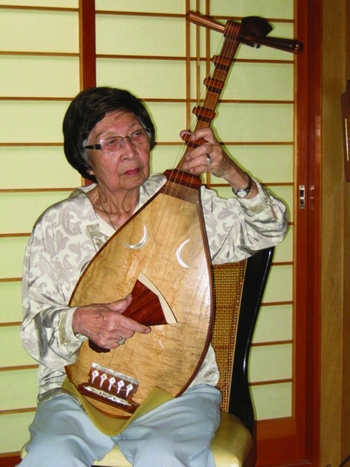
Solo biwa music was a carryover from the popularity of the instrument in Japan. Issei performed two biwa traditions: Satsuma biwa and Chikuzen biwa (Figure 5). Each school had its own repertoire of primarily historical narratives. Singing with biwa accompaniment was popular because of the martial spirit of the heroic songs.Footnote 39 Starting in 1914 teachers of both the Satsuma and Chikuzen styles offered lessons in San Francisco and Los Angeles. By 1919 the Chikuzen-biwa Club of Southern California gave its first formal concert. Great interest in this biwa style continued, as evidenced by the arrival of ten masters to the United States to give performances between 1928 and 1938.Footnote 40 The Chikuzen biwa style reached its apex in popularity in 1941 with the listing of three instructors in the Japanese American Yearbook.
Molly Kimura playing Chikuzen biwa, Sacramento, California, 2012. Photo by author.
Music of the bamboo end-blown flute, the shakuhachi, also made its way to the United States, and we find lessons being taught in both Los Angeles and San Francisco in 1914.Footnote 41 The traditional Kinko school offered lessons in Los Angeles, flourishing from 1922 on. Then in 1930, enthusiasts formed the club Shūchiku-kai around the more martial Tozan style, which had developed in Japan around 1904. Japanese instrumental styles were well represented in Issei urban communities.
Japanese immigrants also enjoyed listening to popular music from Japan. Japanese popular music of the day—ryūkōka—could be heard on local radio programs and in Japanese films shown in theaters in urban areas.Footnote 42 Composers and singers of ryūkōka enlivened the spirits of Japanese Issei and Nisei. A house band of the Teikoku Hotel in San Francisco, the Teikoku Band, played both Western and Japanese popular music for community functions.Footnote 43
“Japan Night” programming throughout the late 1920s and continuing into the decade of the 1930s documents the importance of Japanese musical arts among Issei and Nisei to both celebrate and validate their cultural heritage. These events were open to the public although the majority of audience members were Japanese American families. “Japan Night” events were only one of the many functions and recitals featuring music, dance, and sometimes theater performances regularly sponsored by organizations in churches and the community, youth social clubs, or music and dance teachers, both Japanese and Western. Displays of their cultural identity in “Japan Night” productions can be interpreted as a tacit response to the growing distrust and suspicion of Japanese in the United States, following Japan's military expansion in Manchuria and Korea in search of natural resources and increased political power.Footnote 44
Nisei college youth organized public events endorsing Japanese performing arts. One such occasion was the “Japan Night” program presented in 1930 at the University of Southern California under the auspices of the Academy of Japanese Culture of the University of International Relations and the Japanese Trojan Students’ Club. Programming included sankyoku, nō drama by the Kita School, and kabuki performed pantomime style by Nisei students. The nō drama in particular was notable because Kita school performances were usually held among circles of aficionados. “Japan Night” drew an audience of more than a thousand people both Japanese and American, thanks to the generous support and public relations of the Japanese Consulate, the Japanese Chamber of Commerce, and the Yokohama Specie Bank.Footnote 45
Similarly, an effort to educate Americans about Japanese culture culminated in a “Japan Day” event at the Pacific Southwest Exposition at Long Beach on 12 August 1928 with a large torii (Japanese gate) built especially for the occasion. Performances of Japanese shamisen music, songs, koto and shakuhachi duets, dance, and tea ceremony were all part of the Japanese programming presented twice during the day—1:00 to 2:00, and 5:30 to 6:30. The Exposition also featured opera performed by a soprano soloist, Miss Kyo Inouye, singing a selection from Puccini's Madame Butterfly, which in this context showcased the West's take on Japanese culture. A harmonica solo by Mr. H. Watanuki, and a parasol dance, “Dance of the Four Seasons,” by twenty young girls provided familiar cultural entertainment for the outdoor festival, which attracted Japanese and Americans. As sponsors of the Exposition, the Japanese Consulate, the Japanese Chamber of Commerce, and the Japanese Association planned the event as a diplomatic effort on the part of the Japanese government, and leaders gifted to the City of Long Beach and the Long Beach Chamber of Commerce Japan's national flags of the Rising Sun. Japanese performing arts in this diplomatic context served as symbols of a refined culture worthy of recognition, establishing how immigrants and their offspring were to be represented.Footnote 46
As an internationally minded community group, the Rotary Club of Whittier, whose membership included a sole Issei, Akira Mori, also hosted a “Japan Night” banquet on 17 January 1930 with the hopes of countering anti-Japanese sentiments. The Rotary Club invited more than fifty Japanese from the towns of Montebello and Whittier as their guests, entertaining them with a shamisen solo by Madame Sakaizawa, a Western soprano solo by Mrs. Kyo Yatsu, and Japanese dances by the Izutsuya dance school. The January gathering was a diplomatic partnership between the Rotary Club, the Japanese Consulate, and the Japanese Chamber of Commerce. The banquet hall decorations of Japanese and American flags and Japanese lanterns represented the Rotary Club members’ support of the Japanese community. The Japan Night performances also served as a sample program for an international night, which had been voted on to be held at all clubs in 1930.Footnote 47
Celebrations of the Japanese emperor's birthday likewise provided opportunities for Japanese music performance. The local Japanese Association, an affiliate of the Japanese Consulate, and the ten prefectural associations in Los Angeles sponsored a fête at Luna Park on 29 April 1928. A cultural program of Japanese dancing, music, and plays complemented the athletic activities of judo, kendo (fencing), wrestling, and races. The Consulate's involvement was typical for such observances, underscoring their political influence and support of Japanese culture within communities.Footnote 48
In rural areas of California, Japanese formed residential enclaves often out of necessity in hostile locales. These rural communities played a role in preserving Japanese traditions and customs, including the performing arts. Japanese odori dances, short plays, comedic dialogues (manzai), and musical numbers filled the benefit amateur talent show organized by the Ventura County American Japanese Civic League in Oxnard on Friday, 28 February 1941. The main performance attraction was “Shuto Gokoro” a Japanese play presented with a cast from the local area under the direction of Mr. Yamashita. Talent shows provided entertainment and social activity during slack times of the agricultural schedule, such as this winter event.Footnote 49
Radio broadcasts also promoted an interest in Japanese performing arts. The Japanese Cultural Broadcasting Society sponsored regular programming at KRKD Los Angeles. KFWM and KRWO broadcasting out of Oakland also had Japanese music programming one day a week on Sunday evenings at 9:00 pm. Radio programs were either broadcasts of selected recordings or live performances. KRKD's “Radio Menu” for weekly Friday broadcasts from 8:15 to 9:30 featured recordings of Japanese children's songs, Japanese popular songs, kabuki short songs (‘kouta’), folk songs, and naniwabushi. Other music was interspersed, such as band music by Boy Scout drum and bugle corps, while also including radio dramas and comic storytelling. One instance of a live performance broadcast from KRKD studios featured Madame Yasoyo Kineya, mentioned earlier, a noted nagauta performer who played “Yoshiwara Suzume” [“Yoshiwara Sparrow”]. The live program also debuted Dick Kunishima, a student at Los Angeles Junior College, who enacted Japanese comic dialogue, “Hoso Kyokou,” [“Broadcast Performance”] and sang the Japanese popular song, “Nihonbashi” (a neighborhood in Tokyo).Footnote 50
Since the majority of immigrants came to the United States as farmers and laborers, the music of this population comprised an important part of the Issei musical landscape. Traditionally, farmers played folk music and festival music, marking various stages of the agricultural cycle for Shinto-related observances. Issei farmers and laborers in rural areas, however, had little time or energy for musical pursuits. Many Japanese immigrants worked as seasonal laborers traveling from one farm to the next in search of employment, making it difficult to engage in musical activities.
The annual summer O-Bon festival, a Buddhist celebration to commemorate the dead, was widely practiced in immigrant communities. O-Bon rituals existed in many Japanese communities following the arrival of Buddhist missionaries who came to establish congregations in the United States, starting in 1898. Bushi and ondo folk song genres, both derived from Buddhist chants, served as musical accompaniment for Bon dances along with steady beats played on a taiko drum. In later years, if performers were available, takebue flute, gong, and shamisen were added to enhance the music.Footnote 51
Regional folk songs made their way to the United States in the memories of immigrants coming from the different provinces in Japan. Regional folk music is associated with laborers; such as the hole hole bushi sung by Japanese plantation workers in Hawaii.Footnote 52 It was natural for Japanese immigrants to draw on the melodies of work songs and folk tunes they knew to express, with fresh lyrics, their new circumstances and environment.
Singing was probably the most prevalent form of music making among Issei in rural areas, owing to its expressiveness and the fact that musical accompaniment was optional or not needed. In her book of short stories titled Songs My Mother Taught Me, Nisei writer Wakako Yamauchi writes poignantly of the hard scrabble lives of Issei tenant farmers.Footnote 53 Her characters express the futility of their lives in melancholic Japanese folk and popular songs. Yamauchi's stories and plays weave the singing of songs into the grim lives of the stories’ characters. The songs convey a longing for Japan and the family members they left behind, the smell of pine forests, or for foods desired. In the absence of actual documentation of Japanese songs in the lives of these immigrants, we have Yamauchi's stories. As a teenager growing up during the war and as an internee at the Poston Concentration Center in Arizona she has sensitively captured the pathos of disillusionment Isseis felt by quoting lyrics and referencing pentatonic melodies of prewar Japanese folk and popular songs that evoke what the Japanese American writer, Garrett Hongo, describes as “aestheticized melancholy.”Footnote 54 In the story “Songs My Mother Taught Me,” the folk song, “Mujo no Tsuki” [“Transient Moon”] figures prominently as a symbol of the mother's longing for Japan. Singing is also the choice of the father when inclement weather dashes his hopes for a good harvest and performs the “saddest and loneliest Japanese songs.” Footnote 55
In urban centers Issei engaged also in Western music making, ranging from European classical orchestral and chamber music, opera, and art songs to mandolin quartets, hymn singing, and vernacular songs. Issei interest in Western music reflects Japan's exposure to music of the West soon after it was forced to open its doors to Commodore Perry and his fleet in 1854. Japan embraced Western music in its efforts to modernize. Christian hymn singing was part of the Issei experience as an activity of fukuinkai—Japanese gospel societies—around the turn of the twentieth century. These societies were pro-Western organizations that attracted young intellectuals and encouraged assimilation into American society. 1910 is the earliest account of a Western music ensemble formed in Los Angeles. Issei, Seiichi Nako, created The Mikado Band an ensemble that performed brass band arrangements of opera excerpts. Seven years later Nako assembled a Japanese American orchestra. The orchestra played a role in cultivating interest in Western classical music by inserting Japanese music and drama into the repertoire as an enticement to attract Issei audiences.Footnote 56
The 1927 formation of the Japanese Community Orchestra in Los Angeles speaks to the appeal of European classical music. The orchestra performed two concerts annually. Their fifth concert, held at the Japanese Union Church on 2 March 1928, was a varied program:
-
1. Overture to “Norma”—V. Bellini
-
2. Symphony No. 6 in G Major, “Surprise”—Haydn
-
a. Andante
-
b. Menuetto
-
-
3. “Romanza” and “Jota,” Opus. 5, No. 6—Granados
-
4. Violin Solo—Tomio Yagura
Romance in C, Opus 4—Beethoven
-
5. Cello Solo—Michiyoshi Kono
Allegro from Concerto—Goltermann
-
6. Soprano solo—Miss Kyo Inouye
“Pace, pace, mio Dio”—Verdi
“Kojo no Tsuki”—Yamada
-
7. “Marche Militaire,” Opus 52, No. 1—Schubert
-
8. “Minuetto”—Mozart
-
9. Selection from “The Merry Widow”—LeharFootnote 57
Western classical music appealed to Issei intellectuals and progressives who viewed their participation and patronage of Western music as part of their class status and assimilation. A popular soprano, Miss Kyo Inouye, regularly sang both European classical and Japanese songs; “Kōjō no Tsuki” [“Moon over the ruined castle”] was a particular favorite among audiences. Although few of the first generation performed Western music, as parents they encouraged their Nisei children to master classical music as a way to gain acceptance into American society. However, the Issei's many efforts to facilitate their children's acceptance ultimately failed.
Dual Identities
Increasing exposure to and enjoyment of Western and American performing traditions detailed above did little toward acculturating Issei. The fact that a majority of Issei came as agricultural workers who intended to return to Japan with capital they had earned in the United States contributed to their failed assimilation. Since becoming an American was not part of their initial vision in immigrating to the United States, the general Issei population did not readily adopt American customs, lifestyle, or culture. As many realized the impossibility of amassing capital on their meager wages, Issei resigned themselves to remaining in the United States.
Dual identities surfaced as Issei loyalty and racial pride in the country of their birth vied with pressure to assimilate into American society. Azuma chronicles the Issei's position as “situational, elastic, and even inconsistent at times, but always dualistic at the core.”Footnote 58 Maintaining a dual identity was a tenuous and complex racial project. Japanese nationalism among Issei undermined their interest in becoming American citizens. Although they had a strong desire to do so, discrimination and racial bias placed them in a social and psychological state of reverting back to the Japanese racial and cultural moorings that provided a sense of well-being.
Issei community leaders criticized the general Issei population's reluctance to assimilate, and during the 1910s into the 1920s organized efforts to socialize them in American ways. The elite leadership coalesced around maintaining a dual identity, promoting cultural assimilation as a strategy to reform immigrants and accelerate their acceptance into mainstream America.Footnote 59 The cultural assimilation Issei leaders envisioned involved a “dual process of nationalization” both as Japanese and American, and not just to Americanize immigrants.Footnote 60 Assimilation efforts promoted congruencies between Japanese and American cultures in an attempt to equalize both nationalities in this dual identity.
A public relations campaign accompanied reform measures in order to shift American public attention away from immigrants of the less educated working class to the more refined echelon of Issei.Footnote 61 This project entailed presenting Japanese cultural events and performances in urban centers to expose and educate American audiences about their highly developed cultural traditions such as flower arranging, tea ceremony, and koto and shamisen music. Japanese diplomats and immigrant elites felt that racial oppression could be eradicated once Americans learned more about the long history and revered cultural traditions of Japan.
In an eclectic move, immigrant leaders countered white supremacy by considering themselves as “honorary whites,” which they equated with the thinking and behavior of a proper Japanese. Their efforts to convince immigrant communities to view themselves as “honorary whites” was generally supported and climaxed with the 1922 Ozawa v. United States legal case, in which Issei identification with whiteness was argued.Footnote 62 The argument was unsuccessful, making it impossible for Japanese to attain naturalized citizenship, an avenue Issei had hoped would be open to them. The collective experience of legal discrimination narrowed the differences among Japanese communities, intensifying their interdependence and group solidarity.
Forced to concede to their racial disenfranchisement, Issei took on the mantle of zaibei doho—“the Japanese in America.” Zaibei doho is an identity that emerged out of the Japanese immigrants’ collective experience of being “a racial Other in America.”Footnote 63 For immigrants, zaibei doho did not evoke an orthodox Japaneseness but a transculturated Japanese identity in which their native heritage was the source of their racially inassimilable status. This identity captured the meaning of what it was to be Japanese in a land where institutionalized racism intensified the dependence of Issei farmers and laborers on white employers, and where immigrant landowners and urban residents faced racial containment in their choices of where to live. As a collective identity, zaibei doho represented an erasure of class, age, social background, gender, occupation, and wealth among immigrants, bringing them together in a shared experience of subordination. Racial exclusionism in the form of legal discriminatory laws impelled Issei into a defensive stance that reinforced their Japanese ethnicity and self-reliance. The anger and resentment of Issei in their failure to successfully fight racial discrimination rekindled their patriotic identification with Japan.
American Sentiments and Music Making from 1930
Thus Japanese music performances took on varied meanings in the 1930s, when anti-Japanese sentiments in the United States reached new heights as Americans reacted to the rise of Japanese militarism in Asia. Issei responded in a number of disparate ways. Leaders continued to promote biculturalism, encouraging American socialization while validating Japanese culture. Pro-Japanese immigrants became more nationalistic, while others pushed to assimilate fully and pave a path to acceptance for their growing Nisei children.
Boycotts, organized picketing, and public demonstrations against Japanese-owned businesses and interests spurred immigrants to conjoin with Japanese consulates in establishing a “campaign of education” to promote Japan–U.S. relations. Traditional Japanese music and dance performances in the 1930s took on greater political meaning as vehicles in the campaign for advancing positive images of Japanese.Footnote 64 Issei elites launched the Japanese Cultural Center of Southern California (JCCSC) as a base for cultural diplomacy. The Center promoted the culture of “Old Japan” as a medium of educating white audiences. Performances of folk dancing, singing, koto and shamisen music, tea ceremony, and flower arrangement by immigrant and Nisei women highlighted what the Japanese consul considered the “real worth” of modern Japan.Footnote 65 Such promotion suggests the ways Issei leaders aspired to broaden the U.S. cultural landscape by including Japanese cultural traditions within it.
On the other hand, moves toward western equivalents of these traditions appeared in talent shows that more frequently showcased European classical performances of solo piano or violin, along with brass music of the Mikado Band, named for the Gilbert and Sullivan operetta set in Japan. The variety and mixture of musical styles and contexts in Japanese communities point to the rise of biculturalism as a result of Isseis’ attempts to bridge middle-class values of Japanese immigrants with that of white American mainstream society. As Japanese immigrants’ dual identity continued to be negotiated, Issei recognized the importance of Western classical music performance as an acculturative strategy.
Live concerts aired on radio in urban centers also reveal a growing inclination toward Western music of mainstream American society. For example, in 1930, KFWM in Oakland produced a one-hour program of mostly Western music and three Japanese pieces:
-
1. San Francisco Harmonica Band—“Carmen Prelude” (Bizet)
-
2. Xylophone Solo—Tom Tsuji, “Poet and Peasant” (Suppé)
-
3. Japanese Monologue—Mrs. Ujigoma Takemoto, “Sankatsu Hanichi at the Saloon”
-
4. Harmonica Solo—Minoru Okamoto, “Dove, Flute, and Drum” and “Barber of Seville”
-
5. Xylophone—Tom Tsuji, “Serenade” (Schubert) and “Intermezzo Russo” (Franke)
-
6. Vocal Solo—Tony T. Seki, “Japanese Woodman Song” (Arr. by T. T. Seki) and “Pagan Love Song” (Nacio H. Brown)
-
7. Violin Solo—Tony T. Seki, “The Moon Over the Ruined Castle” and “Japanese Cherry Dance” (Arr. by T.T. Seki)
-
8. San Francisco Harmonica Band—“Sarashi” (Arr. by T. Fukushima) and “Kappore” (Arr. by T. Fukushima)Footnote 66
The preference for Western instrumentation for all compositions in the broadcast is evident not only for European classical pieces, but also for arrangements of Japanese songs and band or orchestral music, such as “Sarashi” and “Kappore” played on harmonicas. The predominant use of Western instruments in this program shows the growing musical participation of Nisei who had learned them and were now reaching adulthood by the 1930s.
Transnational inclinations surfaced in the religious music making. Issei were divided in their choice of religious institutions to join. The use of the term “church” was a strategy by Buddhist temples to attract more acculturated Issei and young Nisei. Nichiren Buddhist churches featured traditional chanting and drums, while Japanese court music ensembles sometimes accompanied Buddhist rituals and services (Figure 6). Other Buddhist churches, however, promoted congregational singing of Buddhist hymns (wasan) in emulating Christian churches. In echoing the popularity of YMCA-sponsored youth groups, Buddhist churches set up Young Men's and Young Women's Buddhist Associations. Orchestras and smaller ensembles playing Japanese songs and popular music sometimes formed out of these groups, such as the Berkeley Young Men's Buddhist Association Orchestra, which performed for social dances of the “swing” era.Footnote 67
Buddhist procession (Japanese court music ensemble), 1933. Courtesy of Densho: The Japanese American Legacy Project and the Ishikawa Family.

Concurrently, however, Japan's increasing military prowess, noticeably its advance on Manchuria in 1937, stirred nationalism among Issei, and Japanese war songs (gunka) served as an effective propaganda tool to unite this generation in their patriotic fervor. In 1938, the Japanese government promoted the war song Aikoku Kōshin-kyoku (“Patriotic Marching Song”), which became instantly popular among immigrants.Footnote 68 Soon after, Kiyoshi Nozaki, an Issei from Arroyo Grande, California, composed a new arrangement of Aikoku Kōshin-kyoku, which became the unofficial song of Issei in Southern California. Participants sang both versions of the song at patriotic gatherings.Footnote 69 A renewed identification with Japan was the Issei's psychological and political response to their rejection as members of American society and an ever-increasing anti-Japanese sentiment.
The Issei dual (or divided) identity suddenly shifted after 27 September 1940, when Japan joined forces with the European Axis powers. In response, the American government ordered an embargo on scrap metal exports and froze all Japanese assets in the United States. Immigrant communities quickly ended their partnerships with Japanese consulates and replaced Japanese patriotism with undivided American loyalty. A bilingual booklet entitled Americanism included the Pledge of Allegiance, the Declaration of Independence, the Bill of Rights, and a statement of Issei and Nisei loyalty to the United States.Footnote 70 It was sent to Issei households in the entire region, yet a uniform shift could not occur because of individual degrees of loyalty to either Japan, the United States or both. Under such circumstances, the push to Americanize became more imperative, and the Japanese community's respectful outreach gestures to Americans in the past no longer capable of significant effect.
Conclusion
Issei identities emerged as an eclectic and contradictory composite of a strong inclination to retain a Japanese cultural identity, a desire to Americanize, and the interstitial social and cultural practices necessary to secure the conditions for their survival. The oppressive and shifting sociopolitical circumstances that Japanese immigrants faced affected Issei's emergent identities and music remained a stronghold through these changes. Issei music making arose as politicized cultural work in countering their social, economic, and political disenfranchisement. As an immigrant act, Japanese musical arts culturally validated and comforted Issei, but were not embraced as a valuable contribution to the national culture of a country that marginalized them.
The expression “Between Two Empires,” borrowed from the title of Azuma's book, best captures the complexity of transnational forces that shaped how Issei identified themselves. The boundaries of this generations’ cultural and political identity changed a number of times in response to pressure by Issei leaders as they negotiated their bi-national status within the context of the Pacific region's geopolitics and the racist ideology of American citizenship.
The concept of a bi-national identity was untenable due to racist attitudes in the United States, particularly California, and the tense economic and political competition with Japan. Issei attempted to maneuver between the two state ideologies of superiority and expansion by manipulating differences and emphasizing congruities. The resulting transculturated identity—zaibei doho (“Japanese in America”)—was a compromise that ultimately worked against Japanese immigrants. The growing xenophobia of American racial politics at the turn of the century made the arrival of Issei particularly ill timed. Issei leaders’ vision of being both frontier Americans and imperial Japanese, coupled with their sense of entitlement in being regarded as honorary whites proved to be delusional, considering the growing American fear of Japan's military prowess and imperialistic successes. Issei were doomed to lie outside the boundaries of citizenship and the national culture.
The arts were integral to the Isseis’ transculturated zaibei doho identity as a source for aesthetic enjoyment, as a political tool and symbol of cultural pride, and as a coping mechanism to transcend discrimination and bitterness. The affect and emotion expressed in traditional and Japanese popular music enriched Issei lives and provided some sense of affirmation in their unequal relationship with American society. Performing Japanese music subverted their subordination and underscored their ethnic cohesiveness. Western music making as an acculturative strategy was ineffective, but it did represent the face of progressive and well-educated Issei. Music making in general created an aesthetic and social space for Japanese immigrants, but more importantly, such activity constructed how they were to be represented—as both Japanese and American—in an attempt to become part of the national culture.
The aesthetic and cultural value Issei attached to music is the thread that connects music, identity, and politics in Issei life. A shared aesthetic experience of music strengthened Issei identities; socially, it sustained their communities, culturally, it was a source of pleasure and validation, and politically, it expressed a rearticulated form of Japaneseness, a recalibrated identity affirming their Japanese national origins yet staking a claim within U.S. national culture. Music making was one avenue Issei chose to demonstrate to Americans the value of their culture, hoping to contribute to the national fabric of the United States while expressing deep felt longing and pride.



