Introduction
It is commonplace to encounter an ascetic in a spiritual place, but few expect a middle-aged errant with overgrown fingernails and shredded socks on necrotized toes to be found on a university campus in India's capital. Even fewer imagine him to be caught claiming that with the advent of communism, madness in the world is coming to an end (Vidrohi in Bhasin Reference Bhasin2015). However, in the years 2014–15 it was an everyday experience for student activists at Jawaharlal Nehru University (JNU) to pass by the ‘secular ascetic’ par excellence of campus politics. Ramashankar Yadav, commonly known as Vidrohi (the rebel), attended all campus protests, never missing any occasion to harangue the public and recite eccentric poems in Hindi and Awadhi. Although his landed and relatively wealthy family from a middle-caste background (Shah Reference Shah2012) regularly offered support to him (Akbar, interview 2015), he had voluntarily lived as a vagrant at this notoriously leftist university since the 1980s, sleeping in the Students’ Union office or out in the open. He was often called ‘comrade’ by the majority of socialist and Marxist-inspired campus activists, and he would incite students to get involved in political activities (Singh Reference Singh2015). Once a JNU student, Vidrohi refused the assistance of relatives and subsisted on food and cigarettes provided by the students. Arguably one of the best-known mascots of left activism in New Delhi, it did not come as a surprise when, a few days after his sudden death on 8 December 2015, a eulogy was released by the mouthpiece of a communist party: ‘Vidrohi died as he had lived—surrounded by students out on a protest march’ (Krishnan Reference Krishnan2016).Footnote 1 Ahead of a cremation ceremony that reverberated with slogans chanted by JNU students, the then president of the Students’ Union spoke about the only place Vidrohi belonged: campus activism.
When the JNUSU [JNU Students’ Union] results were declared, he told me one thing. As we know that he didn't keep books, notebooks or pen, but he had a small pocket diary, he came to me and said, Azad [anonymized], please write your number in this diary. He said, ‘now I can stay one more year in the union office.’ He looked sad but there was a hope and belief in his eyes. The way he lived his life, his departure was also spectacular [he had a cardiac arrest during a sit-in]. Those who want to go for his cremation they can go, but we also must take one responsibility. Comrade Vidrohi, whenever and wherever … he never used to miss protests and marches. The march will be incomplete if we don't fulfil his dreams.
While scholarship on Marxism in India places emphasis on the economic sphere, it rarely scrutinizes the subjective routine and empirical ambitions of resolutely leftist politicians and activists such as Vidrohi. Not only do the aspirations of controversial secular ascetics interrogate how participant cohorts challenge structures of domination in Indian society, they also question the way in which the understanding of such domination prompts attempts to transform oneself. These ‘technologies of the self’, described by Michel Foucault as ascetic practices of self-transformation (Foucault Reference Foucault, Hurley and Rabinow1997: 282), can be seen in the case of Vidrohi both as the expression of ideological world views and as ways to embody an ethical form of political activism (Nielsen Reference Nielsen2012). Such processes of subjectivation, enabling modes of understanding of oneself (Greenblatt Reference Greenblatt1980: 2), are at the core of this article's enquiry. Concentrating its focus on the realm of left political leadership, this article examines how the adoption of such an identifiable set of political practices and selective self-presentations (Goffman Reference Goffman1978, De Certeau Reference Certeau1990) and self-actions (Wagner Reference Wagner and Battaglia1995) aim at successfully representing Indians from various sociological backgrounds, in particular the weakest sections of political society.
The argument is based on 16 months of ethnographic fieldwork at JNU in 2014–2015,Footnote 2 complemented by shorter, follow-up field visits between 2016 and 2020. I contend that it is by engaging with oneself, through what left campus activists call declassed practices, that one acquires the legitimacy to claim representation of the collective whole, including its subaltern sections. As empirical analysis will illustrate, declassing comprises a form of biographical reconfiguration—temporary or long-lasting—involving a symbolic forfeiting of one's social status. Thus, here to declass means to eliminate one's perceived class. By delving into the semantic matrix of the word in practice, I understand class in a broad way—as a metonymic notion that includes class in the Marxist sense as well as alternative forms of social stratification based on caste and gender. The gradual changes leading to identification with a ‘subaltern identity’ (Guha Reference Guha1982)—that is, with the identity of subordinated sections of the Indian population—can also be described as a ‘minoritizing process’ involving a rejection of the identities included in the dominant categories of society (Brun and Galonnier Reference Brun and Galonnier2016).
This study describes how declassing involves the use of practical techniques—somatic, aesthetic, oratory, territorial, and intellectual—in order to renegotiate one's status and erase signs and habits attached to economic and social privileges. Seven elements at the core of this activist practice are introduced: dress-code refashioning, segregation of space, anger against society, martyr identification, nonconformist career aspirations, induced risks of political disengagement, and fasting. I present their demanding commitments and their compromises as life-changing experiences that are also burdened with doubts, material constraints, and moral rewards during a period of transition in these activists’ lives. In line with the anthropological epistemic community, I embrace the view that the political attitudes of campus activists—for the most part young people—are negotiated rather than determined during infancy, thus leading to the development of prefigurative and idiosyncratic views of the world (Nisbett Reference Nisbett2007, Jeffrey and Dyson Reference Jeffrey and Dyson2016).
To make sense of the political efficiency of the declassing practice, the analysis engages with its ability to draw creatively on ascetic and sacrificial tropes. My understanding of asceticism is both empirical and theoretical. An ascetic is broadly defined as a person ‘characterized by or suggesting the practice of severe self-discipline and abstention from all forms of indulgence’ (The Oxford Dictionary of English 2016). Detaching asceticism from the religious realm, here the term is used in a secular fashion, as an enduring performance of bodily practices (Freiberger Reference Freiberger2006) comprising frugality in public spaces and the display of a set of restrictive moral postures. Such postures include an expression of repugnance for contemporary material culture (Miller Reference Miller2001) and for signs of caste and class hierarchy. Built upon a leftist cult of sacrificial martyrs and a Marxist pro-poor aesthetic, such an approach also aims at garnering political benefits.
Conceptually, ascetic maceration is understood broadly as work applied to the self or, even more straightforwardly, as the ‘politics of ourselves’ (Foucault Reference Foucault and Rabinow1984: 340–344, Foucault Reference Foucault1993: 199–223). While grounding asceticism of sections of the Indian left within the cultural framework of South Asian politics and its vibrant history of democratic participation, I am referring to the term ‘ascetic’ and its attributes (cf. infra) in a broad sense, rather than to its specifically Indian conception. This implies that activists are not considered religious specialists (Gupta Reference Gupta1974), either irreversibly contemplative, reclusive world renouncers (Dumont Reference Dumont1960), sexually abstinent (Van Dyke Reference Van Dyke, Paul and Vanaik2002), or followers of the path of a religious guru, nor am I depicting them as particularly interested in embracing monastic careers—either prior to or while pursuing their political activities (Hausner Reference Hausner2007). Furthermore, here the term ‘asceticism’ does not suggest material conditions such as itinerancy or sedentariness in a religious site (Bouillier Reference Bouillier2015), which may lead to significant wealth accumulation (Van der Veer Reference Van der Veer1989: 459) and the gaining of political leverage through securing party tickets.
By portraying declassing as an essential socializing and political tool, this article stresses specifically the sociocultural and socio-economic tensions of this practice. It shows that declassing is widely adopted by the upper and middle classes along with upper and middle castes, while such notions are questioned—and sometimes rejected—by those at the bottom of the social ladder. The latter, including sections of the former Untouchable Dalit community and marginalized Muslims, prefer to emphasize social assertiveness alongside material aspirations for themselves as a way to achieve social justice. This suggests that for left political organizations, the meaning of declassing, and the representative call attached to it, is not universal and largely depends on one's social background. The term ‘representation’ will be understood not in terms of an achieved state of affairs (such as electorally based representation) but as micro and everyday claims of being representative by political actors (Saward Reference Saward2006, Tawa Lama-Rewal Reference Lama-Rewal2016). Therefore, representative claim-making consists of proposals that ‘might or might not be accepted, rejected or rearticulated by the represented’ (Dutoya and Hayat Reference Dutoya and Hayat2016).
The argument is based on the assumption that it is possible to look beyond the simmering political cleavages of left politics in India. Indeed, this rich nebula has a long tradition of factionalism and sectarianism, based on regional, ideological, and tactical divides.Footnote 3 The article mainly understands the Indian left through the lens of its activists who are part of the broad umbrella of communist movements. Although the degree and significance of left fashioning for the production of representative claims might vary from one left organization to another, I suggest that such practices are relevant, widely shared, and constitutive of the left modality of politics in India at large.
Left politics is presented here in a holistic manner and, although many functional differences exist between left parties and their various front organizations, I hypothesize that left self-fashioning in general can be grasped by looking at the politics of its student organizations. Because of historical developments, which I will go on to survey, I posit that campus activism at Jawaharlal Nehru University can be the eye of the needle through which to observe the wider political implications of self-transformations for left politics in India. Although the elitist academic standards of the university make JNU pedagogically quite singular, the pan-Indian reach of the university as well as the inclusive nature of its admission policy ensures high levels of regional, caste, and class diversity. Additionally, it is probably one of the few spaces in India that encapsulates such a rich and diverse range of competing left politics.
The first two sections of the article establish the background of the study. The first draws upon approaches to left refashioning in South Asia and underlines their relevance for the study of Indian politics. I then profile the actors involved in JNU student politics and unravel their historical relationship with the Indian left at large. The third section examines how the ‘middle classness’ of many activists at JNU is negotiated in light of the notion of declassing, and how such ideas are challenged by politically active sections of Dalits and Muslims. It acknowledges the polyphony of declassing practices through surveying their oratory, visual, spatial, identificational, gendered, linguistic, moral, emotional, and corporeal components. The section also engages with the long-lasting consequences of left self-fashioning through a discussion of activist disengagement and their professional trajectories after their JNU years. While it recognizes that left self-fashioning can be renounced—thus leading individuals to quit activism—it also shows that their sustained political commitments have left a durable impact on their lives. Notably, former JNU student activists espouse academia and turn their backs on careers in the private sector and non-educational administration. In the final section I engage with the declassed expressions of feminist assertiveness and the moral injunctions towards defeminization that they entail for left female activists. The article explains how, overall, the social practice under study differs from religious and Hindu nationalist forms of political asceticism, and how it ultimately serves as a legitimizing political device in the eyes of the larger political community.
Self-fashioning, declassification, and the Indian left: a theoretical perspective
The micro-practices of subject-formation are central in understanding sociopolitical transformations. As noted by Ong (Reference Ong1996: 738), the process of becoming a subject is entangled in a dual process of self-making and being-made, occurring within ‘webs of power’ connected to civil society, the state, and political upbringing. The post-colonial canvas against which Indian ‘subject-ifications’ unfold has been researched extensively by Subaltern studies scholars (for example, Chatterjee Reference Chatterjee1986, Reference Chatterjee1989; Kaviraj Reference Kaviraj2005). Enriching this approach, a growing body of literature substantiates the study of self-making by looking at the way in which identity formation engages with post-colonial political ideologies such as Hindu nationalism, Nehruvian socialism, and economic liberalization (Chandra and Majumder Reference Chandra and Majumder2013).
Along with those three political fixtures of Indian modernity, Marxism historically constitutes a vigorous political force in the post-independence Indian landscape. Its locally embedded political machinery (Bhattacharyya Reference Bhattacharyya2009) as well as its hegemonic political culture (Joshi and Josh Reference Joshi and Josh2011) led many—sympathizers, cadres, activists, leaders—to become a communist (Dasgupta Reference Dasgupta, Nigam, Menon and Palshikar2014). Notwithstanding its internal discords and the decline of its influence nationally, competing streams of communism in India have produced a distinctive and enduring Marxist discourse in various locations throughout the country, in and beyond the states of West Bengal, Kerala, and Tripura where communist governments have been in power for an extended period of time.
The effects of such historical developments are likely to have contributed to the formation of a distinctive Marxist political modality in India. As noted by Dasgupta (Reference Dasgupta2005), the collective embracing of Marxism in Bengal could not have taken place without a contextual convergence of politics and culture. However, the doctrinaire stress of Marxism on labour and the state superstructure blinds it to the idiographic emergence of Marxist selves locally. Thus, conventional accounts undermine the ways by which the subjective concerns of Marxist selves help to legitimize communist narratives and representations in the context of India.
Since shared identification with communist figures is informative about the imagination and aspirations of its followers, such affective processes constitute an analytical entry point into the contemporary political relevance of Marxist self-making. For instance, Jaoul (Reference Jaoul2011), who in his study of the agricultural wing of the Communist Party of India (Marxist-Leninist) (CPI(ML)) in the state of Bihar, exemplifies how the appropriation of the Party by the poor and vice versa is achieved locally through subjective identification with sacrificial workers, peasants, and party cadres. One of them was Manju Devi, a young female activist who was murdered by a landlord militia and for whom a statue was commissioned. The account indicates that such figures encourage Party workers to change themselves and live the frugal life of a rural peasant to build ‘a long-term relation with the poor’ (ibid.: 369) and fight landed and wealthy oppressors.
As the case of Manju Devi indicates, a feature of various leftist movements in South Asia is the secular devotion towards martyrs, which provide exemplary role models in the pursuit of activists’ self-fashioning. They are described in the literature as ‘pure’ examples of self-sacrifice for a just cause (Lecomte-Tilouine Reference Lecomte-Tilouine2006) and exemplary figures involved in the efforts to determine historical truth (Verdery Reference Verdery2013, Vaidik Reference Vaidik2013). Ram (Reference Ram2016), locating martyrdom (rakthasakshithvam) practices among the youth wing of the Communist Party of India (Marxist) (CPI(M)) in the southern state of Kerala, underlines their inherent non-religious nature and their relevance as sociocultural institutions. Left self-fashioning thus nurtures close ties with leading sacrificial figures. As illustrated by Moffat (Reference Moffat2018), the great martyrs (shaheed-e-azam) such as the communist freedom fighter Bhagat Singh—executed by the British Raj—act as ‘historical spectres’ for future generations of activists, haunting contemporary political selves to complete the revolution left unfinished at Indian Independence.
Accounts of Maoist-led civil war in Nepal (1996–2006) also emphasize the importance of emulating selfless martyrs in order to become subjectively a dedicated member of the revolutionary community. Lecomte-Tilouine (Reference Lecomte-Tilouine2006) insists on the thaumaturgic effect of sacrifice in Maobadi guerrilla groups; through her anthropological study she shows how violence and sacrifice for the cause is omnipresent in the accounts produced by the wartime Communist Party of Nepal (Maoist), and how such behaviour is attached to a privileged modality, either Brahmanic or kingly. Ramirez (Reference Ramirez2002) notes that the Nepalese Maoist guerrilla relies on the heroism of martyrdom to develop a sense of personal offering to the high end of revolution. Even in a post-conflict context, this sense of internal struggle, battle against selfishness, and continuous experience of self-improvement was found in the psyche and recruitment strategies of Nepalese activists of the Young Communist League (the Maoist youth wing) (Hirslund Reference Hirslund2012). In a similar fashion, Snellinger (Reference Snellinger2012) notes that it is the narrative of suffering and sacrifice that underpins the notion of political public service for Nepali student activists (see also Zharkevich Reference Zharkevich2009).
The ascetic moulds of self-transformation generated through secular leftist politics can be further evidenced through a consideration of the fighting practices of former separatist guerrillas in Sri Lanka, the Liberation Tigers of Tamil Eelam (LTTE). While many of its ideologues were both Marxist-Leninists and secular Tamil nationalists, the leadership requested supporters to venerate deceased fighters as ascetics (sannyasis) who fought for a common cause, thus renouncing egoistic personal desires (Chandrakanthan Reference Chandrakanthan and Wilson2000, Shalk Reference Shalk1997). Natali (Reference Natali2004, Reference Natali2008) indicates that the veneration of Great Heroes (Maavenaar) is made through the establishment of graveyards which are compared to Hindu temples and in which ‘gods are seeded’. Roberts (Reference Roberts2005) suggests the existence of a form of cross-fertilization between religious idioms and LTTE secularism, in which ‘enchantment’ is nestled amid rational discourses. At a more general level, such cross-fertilization draws on the more general ability to appropriate and reinterpret dominant cultural idioms to envision a ‘new man’ (Sorensen Reference Sorensen and Sorensen2007: 27–33, Tromly Reference Tromly2012, Salton-Cox Reference Salton-Cox2013), whether it is nested in Marxist Christianism (Dussel Reference Dussel2003), Marxist Protestantism (Crossley Reference Crossley2018), Black Marxism (Robinson Reference Robinson1983), or Feminist Marxism (Barrett Reference Barrett2014).
Left biographical reconfigurations in India do not always unfold in conditions of war, internal or external (Menon Reference Menon2016). Dasgupta (Reference Dasgupta, Nigam, Menon and Palshikar2014), for instance, examines how the ‘body-politics of asceticism’ is constitutive of the self-making of CPI(M) Bengali communists who ruled the state from 1977 to 2011. While communist activists ‘simply cannot stand holy men’ (Reference Dasgupta, Nigam, Menon and Palshikar2014: 85), their ascetic self-styling is depicted as a secular reconfiguration of a theological political culture in circulation in South Asia. Their memoirs—many but not all from CPI(M)—reveal a form of conversion to a new kind of ascetic subjectivity, based on severe self-cultivation, physical regimentation, body deprivation, and firm control over desires (Reference Dasgupta, Nigam, Menon and Palshikar2014: 78–79).
Left self-fashioning in the literature on South Asia is often described as a practice of a certain social elite or cultured middle class, which is traditionally over-represented in the ruling sections of ‘radical’ political organizations (Kennedy and King Reference Kennedy and King2013). This is exemplified again by Dasgupta (Reference Dasgupta2005), who shows how Marxism, embraced by the pre-independence Bengali middle-class gentry (madhyabitta bhadralok), was inspired by the redeeming praises of intellectuals and poets such as the bohemian Marxist Samar Sen (1916–87). The ecstatic and dark romantic culture of the social group, comprising upper-caste Hindu landed elite, petty landowners, traders, and indigent literati, shaped the expression of Marxism in Bengal, making the ‘rebellion merge with revolution’ (ibid.: 87).
Armed guerrillas are not the only ones embracing the figure of the renouncer. Chandra (Reference Chandra2013) describes how several indigenous rights activists in India's tribal belt developed a ‘radical bourgeois self’ in order to disavow privileges of birth and the ordinary temptations of middle-class life. He notes, ‘the radical bourgeois self … sacrifices the ordinary householder's existence to pursue a distinctively Indian kind of individualism and freedom’ (ibid.: 2). Through examining their self-narratives, he suggests that the activist ascetic renunciation and the Marxian biographical reconfiguration can be understood as an exchange of capital, in which the Indian bourgeois exchanges economic capital in the form of material privileges for symbolic capital in the form of status and rank (ibid.: 4). The subaltern speaking in the name of deprived tribal populations becomes for the activist a tool for a personal post-materialist quest (ibid.: 41), which can lead to a misrepresentation of the actual grievances of local populations (Mawdsley Reference Mawdsley1998, Shah Reference Shah2012).
Clearly, left self-fashioning is associated with a language of self-renunciation that underlines paradoxical, yet striking, similarities with another form of self-fashioning: Hindu asceticism. Kaviraj (Reference Kaviraj, Strauss and O'Brien2007), who draws parallels between a class-/caste-based cultural production and the deployment of Marxism in South Asia, approaches the issue from a theoretical standpoint. He compares the erudite mastery of Marxist literature and historiography (in English mostly) by communist political leaders to the esoteric Sanskrit scholarship dominated by Brahman castes—who had the monopoly over religious exegesis. He argues that the assimilation of the abstract language of Western enlightenment, along with the willingness to understand the imported notion of class—and not the India-specific one of caste—as the universal grammar of social inequality gave Indian Marxism ‘Brahmanical’ overtones. As a result, the biographies of upper caste left leaders are full of references to their determined frugal morale.Footnote 4
Others insist on the self-fashioning politics of moral purification developed by radical left political figures. An example can be found in the ethnography of contemporary Maoist armed insurgency in the Indian states of Jharkhand and Chhattisgarh by Shah (Reference Shah2012). She argues that the fixed imaginary of Maoist renunciation embraced by veteran guerrillas, based on the concept of semi-feudal and semi-colonial exploitation, is no longer in tune with the political economy of mining in occupied areas. She gives the example of Gyan (see also Shah Reference Shah2014), an old-time Maoist leader who was known as a Hindu renouncer, ‘poring over Vedic texts [Hindu scriptures] and sitting on the Ganges's banks for hours’, before turning to armed communist militancy. Through the example of Gyan, Shah underlines how material renunciation continues into militancy, thus highlighting the ideological importance of the figure of the renouncer for the making of dedicated communist revolutionaries (ibid.: 342).
In these accounts, the outcome of political movements is largely unaffected by activists’ biographical reconfigurations. Self-fashioning appears as a by-product of activists’ ideologically informed attitudes and commitments, yet little is known about the legitimizing effects of such self-fashioning. A theoretical insight to make sense of biographical reconfigurations in shaping left representative claims is the concept of declassifying developed by Jacques Rancière (1940–). In the sociological tradition, to declass refers to a process, real or perceived, of descending in social mobility (Goblot Reference Goblot2015 [1925]). In this sense, being declassed is either the result of the eroding value of academic diplomas in a climate of mass education or due to the inability of new generations to attain a social status equivalent to that of their parents (Eckert Reference Eckert2014).
Departing from such approaches, Rancière defines the twin notion of declassification and disidentification as processes by which individuals abandon their predetermined social roles, enabling them to take up the cause of others (Rancière Reference Rancière1998: 212, 219–220, Blechman et al. Reference Blechman, Chari and Hasan2005: 288). Declassification is the way in which citizens escape the determinism of a social order that he calls the police, in which individuals’ distribution of places and roles is clearly identified and legitimized (Rancière Reference Rancière1999: 28). Processes of disidentification lead to the formation of political subjects who claim identities at odds with those defined by the social categories to which they belong—according to the police order (ibid.: 38).
Rancière theorizes a practice of self-fashioning that involves a rejection of one's socially fixed identity. Tassin (Reference Tassin2014: 158) understands this as an écart à soi (deviation from yourself), a transgression that enables individuals to bridge the gap between themselves and those displaying different pre-identifications based on gender, class, race, and so on (Rancière Reference Rancière and Rancière2004, Panopoulos Reference Panopoulos, Cornu and Vermeren2006). This overcoming of historically contingent social configurations is, for Rancière (Reference Rancière2005: 56), the definition of both politics and democracy as it produces egalitarian claims in which a universally shared meaning is produced (ibid.: 49). The practice of declassification leads to the inclusion of the ‘uncounted and the stigmatized’ (Rancière Reference Rancière2008: 560), not through identity politics and self-representation (Girola et al. Reference Girola, Leibovici, Murard and Tassin2014: 11), but through collectively claiming the impossibility of a particular form of identification. In return, discourses of disidentification—of breaking from an extant order—enable individuals to embrace subaltern identities and create political bonds (Norval Reference Norval2012).Footnote 5 Because social divisions imply that a section of a given community presents itself as the expression of the group as a whole, a ‘certain particularity’ has to assume a function of universal political representation (Laclau Reference Laclau and Panizza2005: 40–49). Such particularity carries the potential to challenge the social order precisely because it is capable of producing a political discourse under which discrete groups are ‘made equivalent’, thus facilitating collective mobilization (Laclau Reference Laclau1996: 70).
Keeping in mind the context of the study, I understand disidentification as a modality by which the Indian left claims, within the democratic public arena (Cefaï Reference Cefaï2016), universalistic representation against political adversaries (Mouffe Reference Mouffe2013). I specifically show how Rancière's concept offers an analytical lens through which we can comprehend the attempt by left activists—in particular those from non-subaltern backgrounds—to squander the social capital associated with their class, caste, and gender in the effort to claim representation for the downtrodden.
In a political space marked by abysmal inequalities, disidentification could be a powerful way for social elites to make the miscounted visible (Lievens Reference Lievens2014: 12) and affirm equality in the name of all. In a vernacularized democratic space in which assertions of caste, religion, ethnicity, and language constitute the backbone of its polity, disidentification constitutes a missing analytical link. It helps qualify and clarify the conflict over political representation between the left and proponents of identity politics in its various forms, who advocate recognition and redistribution while fighting against both invisibility and voicelessness. Through a case study of left politics on the JNU campus, the following sections show the reality of this tension and the political success of the practice of disidentification/declassification.
The voice of the left: student activism, academic elitism, and middle classness at JNU
JNU is a prestigious, English-medium, residential university (JNU 2018–19) with a long-running left culture and a vibrant student politics scene, in which the student wings of several regional and national left political streams are showcased (Singh and Dasgupta Reference Singh and Dasgupta2019). Neither apolitical nor grievance-based, student participation at JNU is, to follow Altbach's terminology (Reference Altbach1968, Reference Altbach, Forest and Altbach2006), primarily value oriented. Because campus activism at JNU revolves around ideational debates and not solely around material demands (Thapar Reference Thapar2016), it shares a similar strand of youth politics with the University of Hyderabad, Hyderabad Central University (Telangana), Jadavpur University, Presidency University (West Bengal), Allahabad University (Uttar Pradesh), and the Film and Television Institute of India (Maharashtra) (Garalytė Reference Garalytė2015, Deshpande Reference Deshpande2016, Pathania Reference Pathania2018). Like JNU, most of the politicized institutions of higher education are public, centrally funded, postgraduate-oriented, and teach predominantly social sciences and humanities subjects (Martelli and Garalytė Reference Martelli and Garalytė2020a). The emphasis on values is also visible in other niche educational spaces where liberal and post-materialist assertions such as autonomy, self-expression, and quality of life are made (Martelli Reference Martelli2017, Savory Fuller Reference Savory Fuller2018).
Broadly speaking, the type of activism at JNU contrasts with two other forms of student public participation. One revolves mainly around welfare, administrative, and campus-specific issues (Hazary Reference Hazary1987, Jeffrey Reference Jeffrey, Price and Ruud2010a). Such politics, led by brokers and local political entrepreneurs, is often motivated by prospects of personal gains (Jeffrey and Young Reference Jeffrey and Young2012, Reference Jeffrey and Young2014). While it tends to be more violent (Oommen Reference Oommen1974, Ullekh Reference Ullekh2018), it reproduces existing social hierarchies, whether woven around caste, class (Jeffrey Reference Jeffrey2010b, Kumar Reference Kumar2014), or gender (Lukose Reference Lukose2009). While different in nature, ideological and non-ideological student activism both have solid ties with off-campus party politics; universities therefore often serve as pools for the recruitment of cadres as well as springboards for aspiring netas (leaders) (Hazary Reference Hazary1987, Baruah Reference Baruah2013).
The third type of Indian student politics, somewhat paradoxically, relies on an anti-political discourse. Following the trail of privatization of higher education, such politics of anti-politics demands the ban of protests in the public space (Lukose Reference Lukose2009) and labels organized politics only in terms of corruption (Sitapati Reference Sitapati2011, Chatterjee Reference Chatterjee2012), unruliness, and time-wasting. Congruent with the disciplining public discourse on political activities in educational institutions (Lyngdoh Reference Lyngdoh2006, Teltumbde Reference Teltumbde and Bhattacharya2019), such attitudes are developed mainly by upper middle-class cohorts (Jaffrelot and Van der Veer Reference Jaffrelot and Van der Veer2008, Kumar Reference Kumar2017) across study disciplines, with particular acuteness among STEM (science, technology, engineering, and mathematics) students (Fernandez Reference Fernandez2018). Averse and acrimonious understandings of contentious politics put substantial emphasis on civic order, safety, and consumption rather than on dissent, justice, and redistribution. They also replace notions of social justice such as inclusiveness with those of individual merit (Subramanian Reference Subramanian2015, Henry and Ferry Reference Henry and Ferry2017).
The establishment of JNU in 1969 as a flagship postgraduate university in the social sciences first reflected the ambitions of the socialist left at the centre, structured around an alliance between the Communist Party of India (CPI) and the Indian National Congress (INC) (Batabyal Reference Batabyal2015). In 1971, a generation of upper-class students created and strengthened a Students’ Union (Pattnaik Reference Pattnaik1982). The Union, which was intended to be an instrument of politicizing the campus, was deeply influenced by Marxist thought, and it took direct part in the affairs of the university from the very beginning. After the state of emergency declared by Prime Minister Indira Gandhi (1975–1977), the Union reflected more clearly the regional domination of the Communist Party of India (Marxist) (CPI(M)) in West Bengal and Kerala (1977–2004) (JNUSU office bearers 2004). Finally, in the last 15 years, it has been promoting the student wing of the Communist Party of India (Marxist-Leninist) (CPI(ML)), a formerly anti-parliamentary Bihari-centric organization that converted to electoral democracy in the early 1990s (Jaoul Reference Jaoul, Gayer and Jaffrelot2008). Today, a non-negligible section of the younger generation of CPI(ML) office bearers are JNU graduates. Post-2016, state-sponsored and coordinated attacks on anti-government student activism in the country have triggered alliances between various oppositional student groups, causing a united front of left political outfits to emerge on the JNU campus (Martelli Reference Martelli2020).
Biographical accounts of former activists and professors (Souvenirs 2008–2010) are vivid testimonies to the leftist ethos of the university, as exemplified during the major protests that followed the arrest of Kanhaiya Kumar, the left (that is, member of the CPI) president of the Students’ Union on 12 February 2016, on charges of sedition (Scroll.in 2016). The reaction to this, and the arrest of two Maoist sympathizer activists over alleged anti-India speeches, was followed by daily meetings in the administration bloc, renamed ‘Freedom Square’ for the occasion (Youth Ki Awaaz 2016).
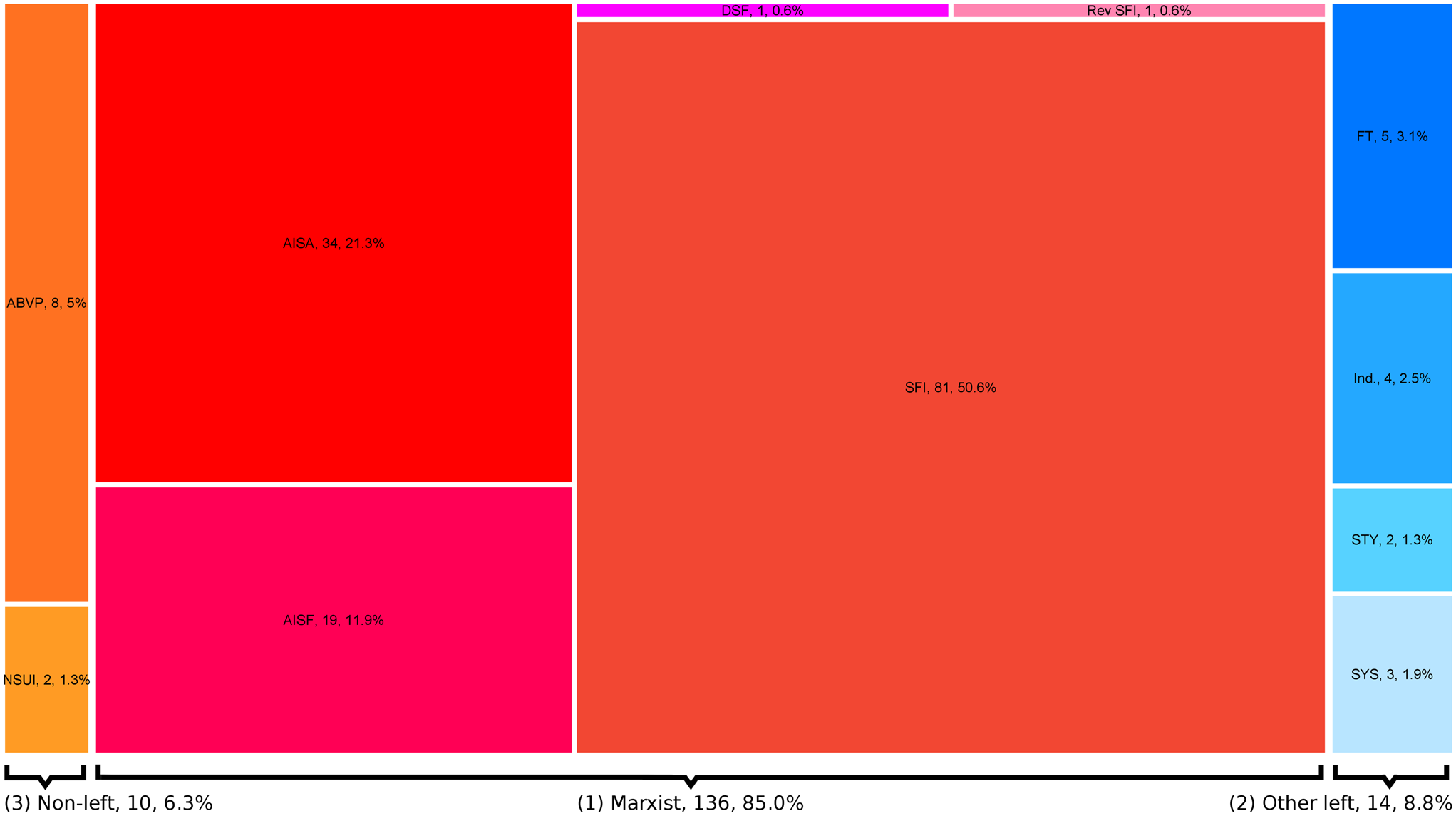
As with the Jawaharlal Nehru University Teachers Association (JNUTA), student organizations affiliated with leading left parties have dominated JNU student politics and won most of the Students' Union elections on campus. As exemplified by Figure 1 below, since its creation an overwhelming majority (85 per cent) of JNU Students' Union (JNUSU) elected representatives have been members of a Marxist student group: 81 of them were part of the Students’ Federation of India (SFI), the student wing of CPI(M); 34 from the All India Students’ Association (AISA), the student mass organization of CPI(ML); and 19 from the All India Students’ Federation (AISF), the student body of CPI. I focus mainly on the activists in these three student organizations along with two smaller ones: the Democratic Students’ Union (DSU),Footnote 6 supporter of the Communist Party of India Maoist (CPI(Maoist)), and the Democratic Students’ Federation (DSF), a splinter group of the SFI.
Weighted map of political affiliations of JNU Students’ Union representatives (1971–2017). Source: Author's fieldwork.Footnote 7
(1) Marxist student organizations
SFI: Students’ Federation of India, student wing of the Communist Party of India Marxist (CPI(M)).
AISA: All India Students Association, student wing of the Communist Party of India Marxist-Leninist (CPI(ML)).
AISF: All India Students Federation, student wing of the Communist Party of India (CPI).
DSF: Democratic Students’ Federation, splinter group of the SFI, associated with the Left Collective in West Bengal.
Rev. SFI: Revolutionary SFI is another splinter group of the SFI.
DSU: Democratic Students’ Union, supporter of the Communist Party of India Maoist (CPI(Maoist)). It usually does not contest JNU student elections.
(2) Other left student organizations
FT: Free Thinkers, a defunct non-affiliated socialist platform inspired by the ideas of Jayaprakash Narayan.
Ind.: Independent candidates with no official political affiliation.
STY: Solidarity, a defunct non-affiliated socialist platform named in the wake of the Solidarność movement in Poland.
SYS: Samata Yuvajan Sabha (Equal Youth Assembly), the youth wing of the defunct Samyukta Socialist Party (United Socialist Party).
(3) Non-left student organizations
NSUI: National Students’ Union of India, student wing of the Indian National Congress.
ABVP: Akhil Bharatiya Vidyarthi Parishad (All Indian Student Council), student wing of Rashtriya Swayamsevak Sangh (National Volunteer Corps, RSS). Strongly supports the current Hindu nationalist party in power, the Bharatiya Janata Party (Indian People's Party, BJP).
UDSF: United Dalit Students’ Forum, sympathizer of the Bahujan Samaj Party (Majority People's Party, BSP). It does not contest JNU student elections.
BAPSA: The Birsa Ambedkar Phule Students Association is a splinter group of the UDSF. Unlike the latter, it has contested elections since 2016.

While activists are a minority among JNU students, their numbers are not negligible. Among the 1,224 students I surveyed in 2014–2015 as part of my doctoral thesis (see also Martelli and Ari Reference Martelli and Ari2018, Martelli and Parkar Reference Martelli and Parkar2018), 33 per cent declared that they participated at least once a month in political activities and 23.1 per cent were members of a student organization on campus. Among those disclosing their political affiliation, 71.3 per cent were part of a Marxist student organization.
While the overwhelmingly leftist section of politically active students at JNU reflects, to a certain extent, the socioeconomic diversity found on campus, such groups have the tendency to over-represent middle-class profiles rather than upper-class ones (Martelli and Ari Reference Martelli and Ari2018). I point out the middle classness of JNU activists by showing their tendency to display a comparatively lower socio-economic status (Fernandes Reference Fernandes2006, Mishra and Parmar Reference Mishra and Parmar2017) when compared to the average JNU student. At a general level, the entrance policy of JNU—which implements affirmative action mechanisms—ensures higher levels of socio-economic diversity than other institutions in the country (Martelli and Parkar Reference Martelli and Parkar2018). As per the JNU Annual report 2014–15, 44.3 per cent of JNU students did not benefit from any government reservation scheme.
Among activists, more male participants and a higher proportion of non-elite profiles can be found, proxied by the background information of parents such as income, profession, education, and place of residence (Martelli and Ari Reference Martelli and Ari2018). As indicated in the survey, on average a higher proportion of political activists and political participants received their previous education in a language other than English when compared to non-activist cohorts, indicating humbler educational backgrounds—but not necessarily deprived ones. Amid its inclusiveness, student politics at JNU attracts middle castes in higher proportions (many of whom are from Uttar Pradesh and Bihar) who have pursued secondary education away from the main Indian metros (see Appendix). This highlights the dissonance between the middle-class upbringing of activists and the deprived backgrounds of those at the centre of leftist discourses. I turn now to the analysis of how such dissonance is addressed by Marxist activists through the practice of self-fashioning.
Squandering the heritage through declassing and the production of representative claims
When you live with humble people, you have to live like them.
(Berhampuri, interview 2014)
Some evidence of JNU activists’ self-fashioning does exist in the gender studies literature and constitutes a good analytical departure point. Barkaia (Reference Barkaia2014), for instance, indicates in her doctoral dissertation that several left female activists attempted to transcend their gendered experience by veering away from what they considered ‘bourgeois morality’ (Shivani, cited in ibid.: 108). She gives the example of Vanessa, a pro-Maoist activist who decided not to keep her hair very short in order to disassociate herself from the ‘urban elite’ (ibid.: 100). Similarly, Shipurkar (Reference Shipurkar2016) confirms that politically active women on campus do ‘look different’, for example, they wear kurtas (loose collarless shirts). Desquesnes (Reference Desquesnes2009: 79) provides additional evidence of this, mentioning the guilt of several female activists such as Isha, who tries to renounce ‘western practices’, such as wearing eyeliner (kajal), but finds it difficult to do so, and using predominantly English in her daily vocabulary. In line with these accounts, I found that activists’ fashion sense contrasted with the ‘average’ JNU student outfit.
Declassing vs asserting dress code: apologia and critique of left self-fashioning
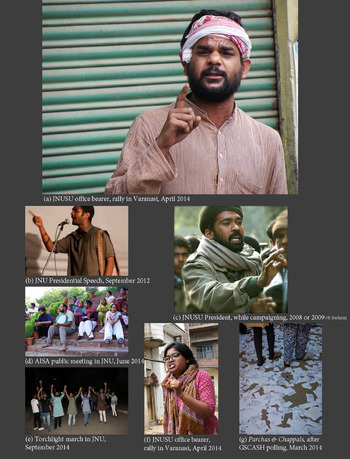
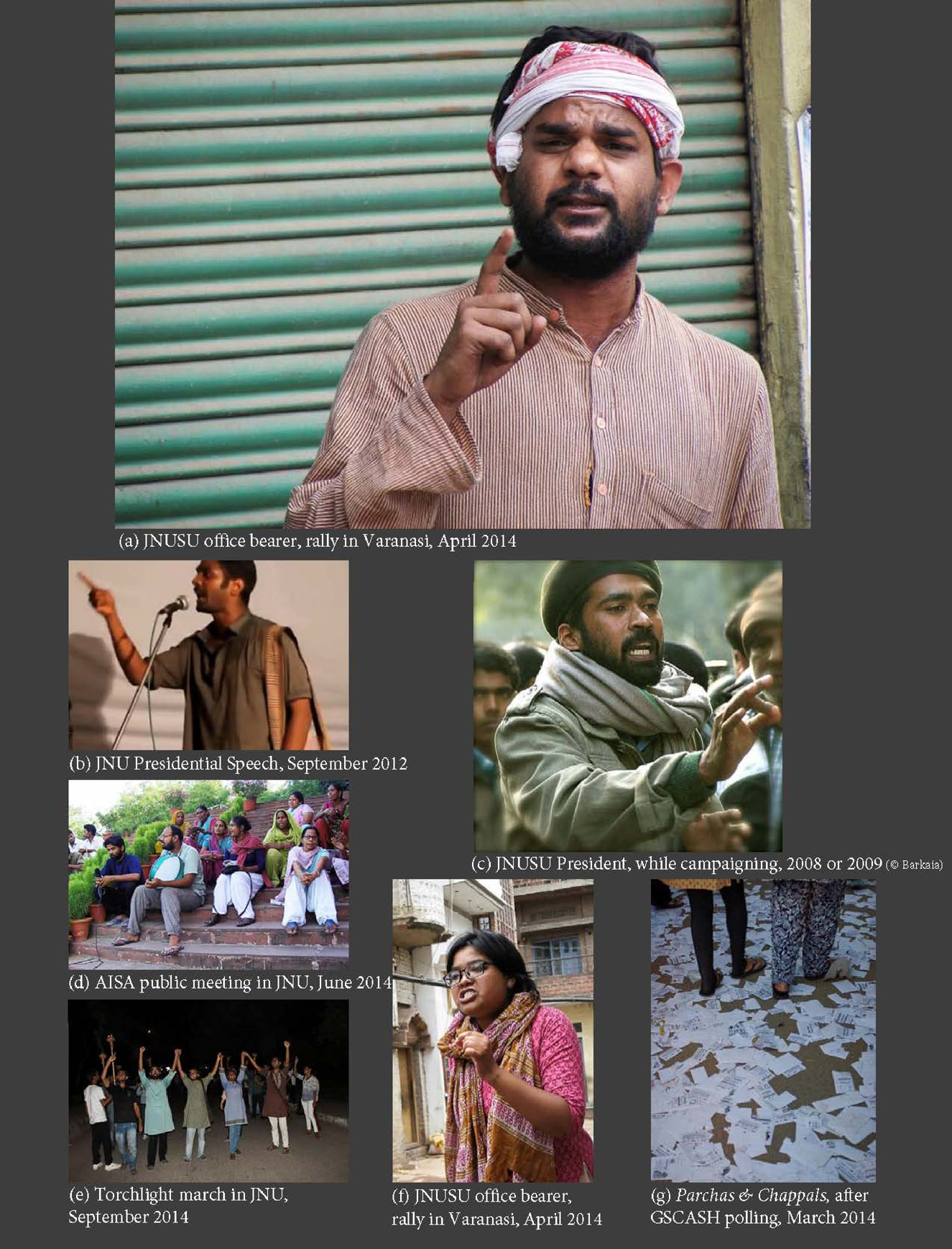
Once on the JNU campus, the aesthetic array of the left leader is highly identifiable. It comprises an unshaved beard for men, an unwashed, old, drab-coloured kurta, chappals (flip-flops) even in winter, gamcha (thin cotton towel to protect from the sun) in summer, and a jhola (jute shoulder bag) (see Figure 2). When attending rallies with activists, Drumi, a JNU PhD student used to speak sarcastically about their fashion sense: ‘It makes students think that activists are going to work with the masses by bus just after their speech … just as if they were always in movement, busy, so that they have to keep their things always with them.’
Contact print of different speeches by JNU activists. Source: Photos by author and K. Parkar, 2014.Footnote 8
The situated political significance of such activist chic becomes clearer when interrogating activists about the panoply of meaning they attach to the notion of ‘declassing’, which they often referred to as voluntary trajectories of social downlift. Sundar, a former JNU Students’ Union president (2012–13), was unequivocal about what to ascribe to this phenomenon: ‘Is being declassed a relevant question? Obviously yes, the problem of party leadership is that they have lost ground; lost touch with people … declassing is a very important thing, to communicate with people you need to be humble. My father is a factory worker … I do not need to declass that much, but in a sense we are all middle-class’ (Sundar, interview 2014). The following vignette, citing several statements about declassing, shows the pervasiveness of declassing idioms among the left at JNU, while being understood both as a fight against the economic elite and a challenge to the dominant elite.
-
[1] Leaders also have to fight against their own origin. The most difficult is to fight against yourself (Dipen, interview 2014).
-
[2] Without declassing you cannot reach the masses. You get corrupt if you have something to lose or to gain; if you have ambition. But I had only one ambition, the one of setting up and strengthening SFI and DYSF [youth wing of CPI(M)] … Declass is the way you should show the path … be exemplary. The personal is very important. You have to be exemplary and throw yourself into struggles (Akhil, interview 2014).
-
[3] We are all [he points at another comrade, Chandauli] middle-class and we need to declass, we have to follow the model of Chandrasekhar [a martyr]. But to declass is very tough because you have to relate with the working class (Barthi and Chandauli, interview 2014).
-
[4] Consumerist culture has penetrated the campus … and declassing, this is utopian, has to go with deculturing yourself … decolonizing the mind. It does not make any sense to raise expensive coffee and continue the fight. We come from a feudal society, we carry our past and have to break from it … there is always a mind to mimic someone upper than you … you can be lower caste and being casteist … you can be subaltern and aspire for power. The right thing is the aspiration to be humane (Tausiq, interview 2014).
-
[5] DSU comrades are deliberately not claiming scholarships, is this part of the declassing process? (Karim, interview 2014).
The centrality of the ‘declassing’ practice among the left on campus was recounted to me by Jitendra, a former activist for ‘Backward Classes’ at JNU (Anjaiah and Kumar Reference Anjaiah and Kumar2011), who had lost faith in the ability of current Indian left politicians to root out their ‘Brahmanical identity’. According to Jitendra, Puchalapalli Sundarayya (born Sundararami Reddy, 1913–85), one of the founder members of the CPI(M) in the state of Andhra Pradesh/Telangana, was the exception that proved the rule, as ‘he renounced his Reddy [upper caste] name, gave up his 5,000 acres [circa 20 square kilometres] of land and decided to castrate himself in order not to have Brahman descent’.
Another critical insight was provided by a senior professor at JNU who claimed that Marxism in India had incorporated the Gandhian visual of self-denial. ‘Well, Marxists are in a way sadhus [religious ascetics] in secular uniforms,’ he stated. This line of argument about the sacrificial leanings of the declassing practice was later substantiated when I encountered Pratap, a former All India Students’ Association campus leader. Pratap was elected in 2007 as president of the Students’ Union and has a deep knowledge of the kinds of frugality that total activist engagement entails.
Youth from middle-class background … urban class … when they start to associate themselves with the poor of the poor, you feel this connection, this need to declass. I used to have this kind of feeling, that I cannot eat costly food. No-one tells you that directly, it is a very unsaid thing. Actually it is a very unconscious dominance of Gandhi. He gave a particular image of politicians you know. It's culturally loaded. Moral guilt is there … It stays in your mind, where do you belong? To declass … sometimes this theoretical question has been taken at a superficial level. We wear unwashed kurta pyjama and dirty jeans, uncombed hairs, smoking cigarette … this framework of the revolutionary … Gandhi was the one who introduced peasantry in the freedom movement. Before it was elite, ruling-class … Gandhi introduced mass movement with this idea that he is a fakir, that he owns nothing and wants nothing … that image of him fighting for us. Particularly for the left … this idea of sacrificing everything got in their mind. If you are involved in a movement, automatically the movement gives you a form of living … but suppose he [the activist] is not part of the deprived … suppose he is middle-class … In Indian left movement, they are a lot of mass leaders who technically belong to the rich, to the upper crust. But the force, the energy of the movement you are part of … actually it inculcates to you a specific form of lifestyle. Because you are too much into it. You are an agrarian leader, you are not living like a contractor with car, you have to be there with the people. So declass is very necessary (Pratap, interview 2014).
His account is revealing in two respects. First, it confirms that declassing can be understood as a form of disidentification in which left activists try to divorce their middle-cum-higher-class selves. Second, it argues that the sacrificial modality of left self-fashioning resonates with the broader cultural repertoire of asceticism in India. Pratap's mention of the fakir (Muslim ascetic) also directs attention to Gandhi's austere discipline of non-attachment to material possessions and brahmachariya, understood as self-discipline, chastity, and sacrifice (Devji Reference Devji2010, Chakrabarty and Majumdar Reference Chakrabarty and Majumdar2010, Mehta Reference Mehta2010). I do not wish to claim that Gandhi directly inspires the ‘political technology’ of Marxist declassing. However, in line with Pratap, I want to suggest that Gandhi popularized the idea that intimate practices, especially body practices, expressed sincere alliance with the masses. Gandhi welded together ascetic language and popular politics. This connection was soon reinterpreted by Indian Marxist practitioners, while attracting sharp critique from sections of oppressed communities.
Keeping in mind the fact that declassing is a dominant modality of JNU campus politics, such practice sparks more ambiguous feelings among activists from Muslim and Dalit backgrounds. Because these politicized students fight against the common perception that they rank low in the social ladder, the idea of declassing was seen by them as a reinforcement of their already downgraded social status. In such cases, declassing discourses were complemented—and at times replaced—by assertive claims. Below are examples of how uneasy the compromise is between the politics of recognition and the politics of declassing.
-
[1] I am not supposed to go down, I am supposed to go up. Because of my unprivileged background [Muslim from a rural area of West Bengal] I find all this idea to declass ridiculous, though it was not the case when I was active in DSU … you have to take my activist commitment in an historical perspective, I wore jhole [jute bags] because I was imitating my peers, I was emulating. Now that I have stepped out I wear the jhole on particular occasions, at least I am aware of its symbol. You know, I still have 20 kurtas in my room, I have them but I don't wear them (Karim, interview 2014).
-
[2] This was in 2007. That Dalit fellow went on stage for his speech with an impeccable shirt, the Ambedkarite [Ambedkar is a Dalit figure] jacket and glasses. He tried to look smart. Still ABVP [a Hindu nationalist student organization] goons tried to destabilize him, use abuse words like ‘chocolate’ [in reference to his skin colour] (Lino, interview 2014).
-
[3] Class struggle is my class interest … my father is handicapped and we have only three acres of land. I would say I am lower-middle-class so I do not need to declass … rather I need to improve my standard of living. But I also need to decaste, you can see these things in the way you are eating … it is a difficult process because it's subconscious. Then I can become a shaheed [a martyr], where you eliminate yourself, eliminate your values (Venu, interview 2014).
For many activists from deprived sections of the population, to transform one's identification to a humbler social background would appear to contradict their aspirations, so the idea of squandering one's heritage was, in part, a narrative that was difficult to defend. In such cases, through discarding declassing practices, for some left activism became a way to affirm one's marginalized identity and avenge perceived forms of degradation. For example, Sumbul, a female candidate from AISF in the 2014 student elections, would claim on stage to be part of the pasmanda (most marginalized) section of the Muslim community before shouting, ‘Long live revolution … long live social justice’. Alongside declassing claims, assertive leftist claims often involved more personal experiences; for instance, a former JNUSU president would discreetly ascribe part of his activism to a reaction against an experience of perceived humiliation. An activist from the Backward Class category recalls being stopped by a supervisor at an entrance examination for an Indian Institute of Technology (IIT) because he could not afford a proper shirt (Venu, interview 2014).
Bearing in mind the emancipatory motto of the Dalit reformist Ambedkar (1891–1956), lower caste activists I encountered did claim that political assertiveness implied breaking the association between poverty and the stigma of inherited caste pollution, and for this reason some rejected the idea of declassing altogether. For instance, Hilsari, a Dalit involved in the CPI(M)-affiliated student organization SFI, was very clear about the inappropriateness of declassing:
After my MPhil submission I will have to work and send back some money home. I cannot afford to declass; I need to look assertive. Malls and Café Coffee Days [a popular coffee chain] are around you, why should you avoid them? See, when you want to look poor is that you are actually from a privileged background. I think it is quite irresponsible, I cannot afford that. Look at Ambedkar, he tried to dress up smartly, assert his own [Dalit identity] while people wanted him to remain dirty (Hilsari, interview 2015).
This statement underlines the contingent and situated nature of the concept of declassing for left activists: its relevance depends on the social origin of its upholders. Assertiveness instead of declassing is, in the words of many Dalits, a choice rooted into their personal experiences of social humiliation. I was troubled by the large number of examples provided by respondents. Tulsi, an office bearer of the United Dalit Students’ Forum (UDSF), a Dalit cultural organization, mentioned to me an event at which his professor had prevented him—but not his other classmates—from entering his home after he was asked to pick garden flowers.
Another instance of such humiliation was given by Patani, a member of the Birsa Ambedkar Phule Students Association (BAPSA), a Dalit political group. He told me the story of a conflict with his roommate who tried to avoid caste-based pollution by refusing to drink water from the same glass as him. Gradually emerging as the main anti-left platform on campus in 2016, the newly formed BAPSA challenged the assertion that the left was the most legitimate to represent the cause of the oppressed. Labelling left politics on campus as a ‘gallery space to patronize Dalits’ (Tulsi, interview 2015), BAPSA and UDSF challenged declassing politics by invoking an assertive ‘Ambedkarite politics’ (Kumar Reference Kumar2018, Pallikonda Reference Pallikonda2018).
The acceptability of the ‘left declassing’ discourse by the student population varies. With a few notable exceptions,Footnote 9 I encountered only a few JNU students who were completely alien to campus politics dominated by the left. While almost half of freshers declare that they do not participate in political activities, this number falls to under 10 per cent after completing five years of study (Martelli and Ari Reference Martelli and Ari2018, Martelli and Parkar Reference Martelli and Parkar2018). The normalization of left political language and its declassing tropes is visible on the night of the JNU Students’ Union election vote counting. Traditional left naras (slogans) are chanted but also parodied, and the ways of the activists are affectionately mocked. Laughter is not only there to express anti-left sentiments, but for one night to deride the seriousness of the dominant ideologies of JNU student politics. The content of the jokes shouted is not anecdotal, for it reveals how rooted the leftist political culture is at JNU. The jokes do not point primarily at a sexual or religious imaginary, they concentrate on the political folklore of the campus and the declassing culture it entails. For instance, two of the parodical tongue-in-cheek slogans take on the self-negligence of left activists by rephrasing two of their slogans: Nahi nahane wale ko ek dhakka aur do (Those who don't take bath, push them once more) and Lifebuoy bhi lal hai (Lifebuoy [India's best-selling red-coloured brand of soap] is also red), uttered after Pura campus lal hai (All campus is red).
To conclude, the Dalit and Muslim discourses on self-fashioning can be very different from those developed by other politically dominant sections among Marxist activists. The accounts presented above are a reminder that declassed meaning-making varies greatly according to one's social background and lived experience. Yet, precisely because it is contested, this form of self-fashioning shows its relevance in contemporary left student politics. It exemplifies how the left uses biographical reconfiguration—whether at substantive or superficial levels—to legitimize the claim that it represents the cause of the Indian underbelly. To map out further such representative claims, the next section delves into the additional everyday practices at the core of left self-fashioning.
The routinization of left self-fashioning: the day-to-day legitimation of representative claims
The decades-long dominance of left politics at JNU is an indication of the political legitimacy activists derive though mobilizing the declassed representative claim. As for many social phenomena, the activists' devotion to this political modality cannot be credible unless the practice of declassing is carried out repeatedly and over an extended period of time. Considering the centrality of day-to-day in situ socialization in the circulation of political attitudes at JNU (Martelli and Ari Reference Martelli and Ari2018, Martelli Reference Martelli2020), the efficacy of left self-fashioning relies on its everyday routinization in a shared living space where such practices are made visible. Thus, below I survey various ways in which declassing practices are made pervasive and are inherent to JNU campus politics. These routinized practices, introduced below, are: space segregation, martyr identification, anger emotionality, and fasting.
Nested within the competitive field of campus activism, these processes of individual fashioning accompany the daily trail of political activities organized on campus. While activists’ collective actions often focus on the general welfare of students and on admission inclusiveness, on other occasions they engage more widely with the socio-economic conditions of India's weaker sections of society, thus making the declassing claims congruent with political actions taken on campus. Thus, engaging and expressing ‘solidarity’ with the issues concerning the deprived inform and legitimize declassing claims.
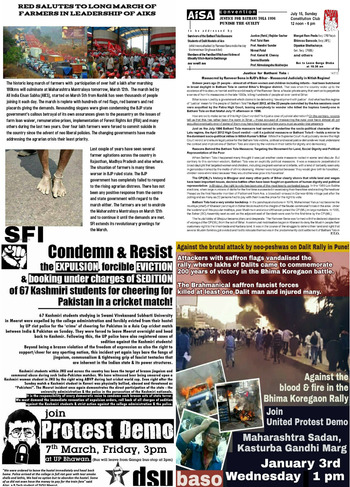
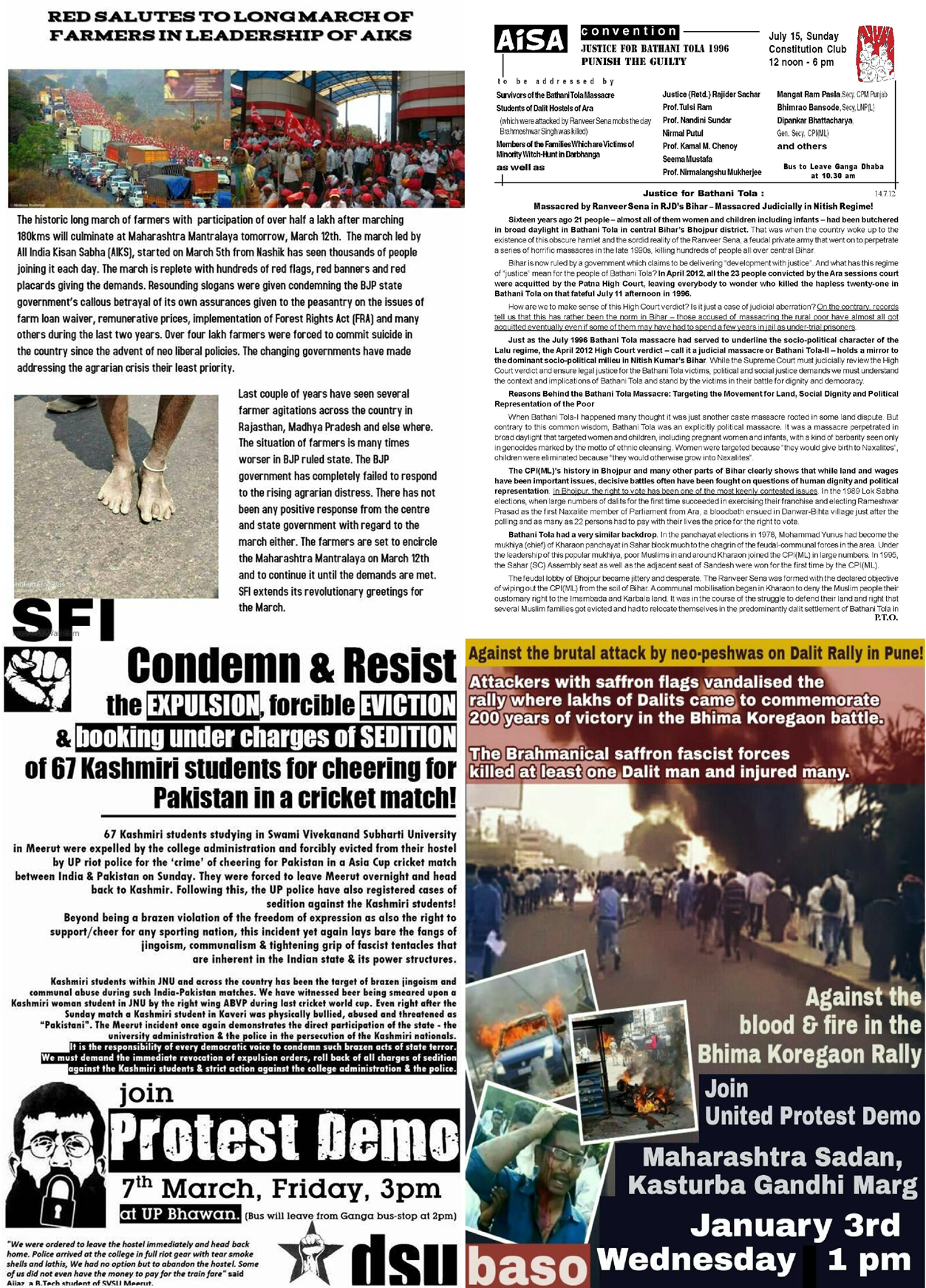
Such instances are many. They include: calls by left student organizations for a demonstration in support of the workers of the automobile manufacturer Maruti Suzuki; after launching strikes in 2012, which led to the burning-to-death of a manager in Manesar (Haryana), 147 of them were jailed (Nowak Reference Nowak2014). Other cases comprise protests against communal riots that took place in Muzaffarnagar (a district of Uttar Pradesh) in 2013, which led to the displacement of tens of thousands of individuals and to the deaths of 42 Muslims and 20 Hindus (Berenschot Reference Berenschot2014). The Students’ Union sent a ‘fact-finding’ team to collect evidence and to provide assistance to the victims. Additional initiatives include commemoration of the anniversary of the gang rape of Nirbhaya (‘fearless one’), a pseudonym given to the physiotherapy intern who was attacked on a bus in Delhi on 16 December 2012. Support is systematically ‘extended’ after the suicides of members of weaker sections of Indian society, such as Dalits and farmers. For illustrative purposes, below are four JNU pamphlets by four different left student organizations, vividly protesting in support of Dalits, Kashmiris, and poor famers (see Figure 3).
Four JNU pamphlets, 2012–2018. Source: Compilation by author.
Top left-corner: SFI congratulating the Kisan (farmer) long march, a large-scale protest organized by a sister organization in the state of Maharashtra (11 March 2018).
Top-right corner: AISA commemorating the denial of justice surrounding the 1996 case of the killing of 21 Dalit labourers in Bathani Tola in Bhojpur, Bihar, by Hindu militia, the Ranvir Sena (14 July 2012).
Bottom-left corner: DSU calling for a protest after the suspension of Kashmiri students who cheered for Pakistan in a cricket match (7 March 2014).
Bottom-right corner: BASO (splinter group of the DSU) protest call against anti-Dalit violence on the commemorative ground of the battle of Bhima Koregaon, Maharashtra (2 January 2018).
While the practice of declassing is tied to participation in political activities in support of the downtrodden, the moral injunctions it entails include refraining from visiting certain places. As indicated in the preceding account of Hilsari, this practice suggests that, along with the focus on visuality, left self-fashioning also involves strong spatial components. During my time on campus, I found that many left activists tended to circumvent commercialized areas and those that are perceived as ‘dirty’ living spaces. JNU Marxists tended to avoid being seen or visiting places where the ownership of costly objects such as a smartphone or a motorbike ‘have to be reflected upon’ (Berhampuri, interview 2014), thus boycotting the settings of ‘shining India’: malls, food chains, and branded coffee shops associated with the triumphant consumerism of the Indian middle class.
As a result, the spatial politics of activists leads to the superimposition of an ideological layer onto the actual map of the city, causing them to redraw territorial hierarchies. Contrary to commercialized areas, select food-stalls (dhabas) within the campus are seen as more compatible with a declassed way of life. One in particular, called Ganga Dhaba, was perceived by Pratap (interview 2015) as a refuge from the areas polluted by consumerism, an opinion he also expressed in an interview with The Indian Express:
With its thorny babools [acacia trees], rocks for chairs and tables, and deep pits and mounds, Ganga dhaba is a critique of today's glittering commercialized times … It is a symbol of free thought and open exchange of ideas, with its uncontrolled space where any number of people can huddle anyhow around any stone. Here, students have planned revolution as well as found romance. But now, it is not the locus of life on the campus that it used to be. If you walk a little ahead, you will find another eatery, the 24/7 dhaba, which seems to be what the Ganga dhaba is a critique of. Here, you will find tables and chairs, a well-ordered space, a bigger menu and fewer people in JNU chic—jeans and kurta. Ganga dhaba and the 24/7 dhaba spatialise the slow shift from Marx to market which has become visible on the campus (Pratap in Kumar Reference Kumar2013).
In contrast, malls and food chains were the least reputable spaces to be seen by left activists concerned about their political and public reputation. I vividly recall a revealing anecdote that manifested the taboo attached to glittering spaces. The 2015 April heat in Delhi was at its peak and I had promised Arpita, an active member of AISF, to treat her to a pizza as she had craved one during her most recent 10-day-long hunger strike. One evening, I finally convinced her and her comrade-friend Azad to go to a restaurant chain in the fashionable market next to campus. They claimed they had never been there before and accordingly much discussion focused on what they saw from the dining table. They concentrated their indignant comments on overweight customers and on waiters who expressed condescension towards customers ordering too little. As we were finishing our meal, the unexpected happened: three activists from a rival Marxist organization entered Pizza Hut to eat. After a fleeting moment of astonishment and awkward salutations, Hariti, Jitendra, and Priya disappeared from sight and went to eat on the lower floor. Making sure he could not be heard, Azad started laughing, ‘You know what they call me?’ he asked, but before I could respond he was already answering, ‘A revisionist. They are supposed to be real revolutionaries, radical ones. But what I find crazy is that their personal life goes against the principles they claim in public. Their private life is going against their political principles.’
The meeting of five Marxist leaders from two rival organizations at Pizza Hut was a truly incongruous moment: they were witness to each other's political sacrilege at odds with their understanding of the declassing code of conducts. Aside from the comical overtone of the example, it underlines how important the notion of exemplarity—real or claimed—is to the conduct of left politics. As shown here, the political legitimacy of self-fashioning is inseparable from this notion of exemplarity, whether applied directly to the self or when projected onto the commendable life of deceased martyrs.
Focusing on activists’ invocation of shaheeds, I now discuss their instrumental role in providing historical depth to the declassing practice. I suggest that the personification an ideal type of a declassed figure is the consecrated martyr, which facilitates activists’ personal identification with a political movement and the public display of their intimate appropriation of pro-people rationales. Because martyrs are admirable and irreproachable beings, they can—in the case of Indian communism—be ‘good to think with’ as symbols of declassed individuals who commit to their cause until death and enable comrades to show the masses the way forward.
On campus, several public celebrations of martyrs are organized annually. Organizations such as DSU and SFI organize memorial lectures in remembrance of the killing of several iconic party workers (Third Comrade Naveen Babu lecture 2014; SFI Central Executive Committee 2016). AISA also holds an annual celebration of the martyrdom of ‘Chandu’, alias Comrade Chandrashekhar (JNUSU president 1994–1996), and screens a homage documentary called Ek Minute Ka Maun (A Minute of Silence) on a JNU lawn (Basu and De Reference Basu and De2007?). Every last week of March, during the commemoration of his assassination,Footnote 10 Chandrashekhar is presented as a declassed communist who sacrificed his life for the fight against injustice and caste oppression in India. An AISA activist recounts that Chandu ‘led many agitations, he would interest anybody with his speeches … and Chandu could interest through his practice … of his life … declassed life in fact. … He didn't pay attention to what he is wearing … he never minded’ (Akbar, interview 2014). By rival organizations’ own admission, AISA—through constantly reclaiming Chandu's legacy—manages to appear to new students as a sincere, committed, and radical student organization on campus (Gowda, interview 2015).
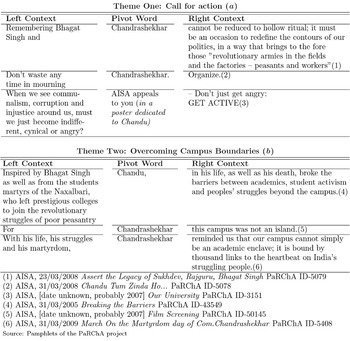
When it comes to achieving political mobilization, the invocation of Chandrashekhar's sacrificial self is by no means insignificant. Chandu is not only an inspiring figure for activists, but also a political totem instrumental to galvanizing, recruiting, and persuading ordinary students to join protests and participate in political activities. As displayed in the quotes from six AISA pamphlets (see Figure 4), Chandu's martyrdom captures the universe of social suffering that prevails outside of the microcosm of campus. Consequently, his sacrifice enables students to enlarge their political imaginary and locate current student politics within the larger historical framework of anti-class and anti-caste struggles.
Six concordances of words associated with Martyr Chandrashekhar in JNU pamphlets. Source: Compiled by author.Footnote 11

While the political significance of commemorating martyrs is not entirely encapsulated in the social phenomenon of self-fashioning, the credibility of left activists depends in part on their ability to harness an ideal version of declassing—the one imagined and embodied in the sacrificial lives of left martyrs—in their daily politics. The political ecology of left martyrology is important in building a legitimacy based on sincerity and emotional resonance (Traïni and Terry Reference Traïni and Terry2010), which in turn play an important role in the emergence and decline of student movements.
While not specific to Marxist activism, I envision anger against perceived injustice as a contributing factor to the declassing practices described above, as it entails the practice of emotional association with the suffering classes and castes. In outlining the inequality between the rich and the poor, and the consumerist heartlessness of the ‘bourgeois middle class’, activists regularly find ways to trigger affect, in particular emotions associated with social conflict over land, labour, love, or dignity.
In order to locate such embodied emotionality, I will now refer to the distinctive visual culture of JNU student politics, in particular its poster culture. Every year in summer,Footnote 12 each student organization mobilizes local artists in their ranks to draw posters several metres long and paste them on the campus's administrative and academic buildings. The result of this process is a saturation of political messages everywhere students look. Most of the 392 posters pasted on campus walls in 2014 were pictorial representations of the social oppression of workers, peasants, and so on. Three poster-making campaigns later, when questioned about the relevance of the display of raped women and massacred Dalits in his posters, Souradeep, an AISA male artist-cum-activist declared that:
… even though a woman is not part of my country, even though she is not my mother, my partner, or my sister … even though we don't know the actual experience of pain they face, all [these women] are in my landscape. How can you ignore? If you are engaged with the people, you can't ignore, even if you are an upper class. You have to take part in Dalits’ movements, because it's part of your landscape. We have to liberate each and every one. We are part of the same structure we call society. We are all, in a way, secondary order witnesses. So my posters and paintings, are spaces of morbidity … there are no other options, it's about the representation of politics … on the one hand, it is about criticizing society, and on the other, it is about criticizing yourself as well (Souradeep, interview 2017).
The ability to feel the suffering of the oppressed women and Dalits who surround him is crucial to Souradeep, who consequently uses this expressed emotion to ‘criticize himself’ as an elite member of Indian society. Later in the interview, he associates this privilege with his Hindu identity, which contrasts with the marginalized condition of Muslims in contemporary India. In his posters, self-reflexivity is mediated through the depiction of morbid subjects such as women aborting, agonized animals, half-starved farmers, or a couple of murdered valentines massacred by Hindu vigilantes for being engaged in inter-faith love.
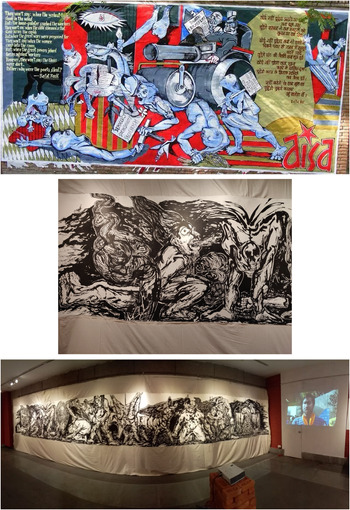
The embedded aesthetic of pain on JNU posters is exemplified by the four-metre acrylic poster inspired by Picasso's 1937 Guernica and a 1947 sketch by modernist artist Chittaprosad Bhattacharya (1915–1978) (see Figure 5). It was painted by Souradeep with the assistance of another student and pasted on a wall in front of an academic building. It displays a similar morbid aesthetic to his more recent 10-metre panoramic ink-on-canvas composition (see Figure 5) displayed as a scroll and commissioned for the ‘Memories of Change’ exhibition on student politics (Martelli Reference Martelli2019). The title ‘When nothing works then serious shit happens’ is inspired by a slogan against a 2013 bill regulating land evictions; it reflects on the violence endured by farmers when the state acquires their means of subsistence.
Two panoramic compositions by student activist artist Souradeep [anonymized], (2014, 2019). Source: Photos by the author.

Many elements representing class oppression can be found in the JNU poster. The dominance of the rich is symbolized by the enormous steamroller/tank. It is mounted by capitalists holding a newspaper with the headline ‘Towards a richer life’. Different categories of oppressed individuals are crushed under the weight of the oppressor class. The man holding the ear of wheat is the Indian peasant and the slender but muscled bodies lying on the floor represent workers’ corpses, contrasting with the fat capitalist. The grievances of the peasant-worker class are written on the sign held by a woman: ‘Fair wages, food, health, education’. The blue colour of the smashed individuals is an indication of their low caste identity. In India, symbols and colours have an acute political meaning, and blue connotes Dalit identity (Jaoul Reference Jaoul2006, Reference Jaoul2016). The ideological interpretation of the picture is provided in the corners of the poster though a verse from the poem ‘Dark Times’ (1937) by the dramatist Bertolt Brecht (1898–1956): ‘When the great powers joined forces against workers … why were the poets silent?’ The sense of this in the context of India is: ‘If Indian society is so unfair and violent, why are you not doing anything about it?’
As indicated by Souradeep, felt emotionality enables the artist to go beyond his privileged experience and join in the suffering of the toiling masses in order to represent them. By unfolding an aesthetic that encapsulates indictment and pleas, Souradeep's pamphleteer and graphic discourses use pathos to denounce, accuse, and incriminate the ‘bad people’ identified with India's crony capitalists, the zamindars (big landowners), imperial forces (the United States), neo-colonizers (Israel), and the corrupt Indian state.
Similarly, a pro-Maoist senior supporter will never miss an opportunity to recall the state of affairs in the country: ‘Don't you see the unbearable exploitation of the masses … see among them there is despair; people have the choice between dying alone or dying fighting’ (Sharad, interview 2015). Through calling upon mimetic grief, the activist allegorically becomes the deprived: he is therefore capable of political empathy. Declassing—the sincere attempt to side with those suffering—is a practice that enables activists to unleash a universe of negative feelings that command indignation and call for action. Such rallying cries are part of a rich set of means that activists have at their disposal to make political claims. Within such a repertoire of contention, one practice strikes me as particularly relevant to the study of left biographical reconfiguration: fasting.
Activists’ self-fashioning on campus is anchored to a daily political routine which involves organizing and participating in many public events.Footnote 13 One particular way of protesting—the hunger strike—engages with self-centred corporeal practices in support of the cause of needy students. I describe such practices as important for inserting the question of self-sacrifice into the realm of less political issues that affect students involving mostly infrastructural and administrative shortcomings on campus. Obviously, fasts belong to the wider ‘toolkit’ of South Asian politics (Reddy Reference Reddy2009) and many of them might have little to do with expressing empathy for the depressed classes. Within the left repertoire of contention, some JNU activists even admit favouring gheraos (blockades) over fasts (Desquesnes Reference Desquesnes2009). However, tied to a communist political agenda, fasts can become a fully fledged means of promoting one's selfless personal commitment while addressing the grievances of students, thus claiming effective representation.
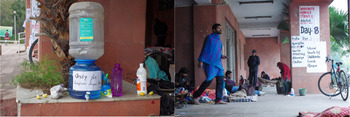
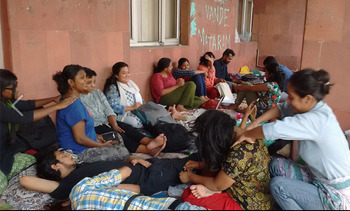
Along with being an instrument to satisfy student demands and gain leverage in negotiations with the JNU administration, fasting allows activists to put pressure on decision-makers in the name of distressed people—that is, poor students without on-campus accommodation or students unable to afford living costs. Because fasts demonstrate one's commitment to student welfare, political organizations usually ask future candidates for the Students' Union elections to participate in the hunger strikes organized on campus. A former JNUSU president acknowledges the relevance of hunger strikes in the following way:
We cannot sustain our politics on the basis of national and international issues only while doing nothing about campus issues. So what we did … we stood against the privatization of education, I sat on a hunger strike for a film institution, again I sat on a hunger strike on an issue of Aligarh Muslim University, where the [Students’] Union was being banned … that way we could link issues [national and local] … we could get mobilization for that … the issue of hostels, fellowships … fines for guests [in students’ accommodations] … the kind of restrictions there … I went on a hunger strike many times … I sat for 12 days, I sat for 7 days, I sat 2 days on an issue of a Kashmiri medical student being denied admission … Muslims were not given admission … we should take up those … when you don't address day-to-day issues … then it leads to depoliticization … (Gowda, interview 2015).
As noted by Gowda, participating in hunger strikes is a way to take action and show support for broader issues as well as for the material well-being of the community to be represented—in this case, the most vulnerable sections of the student population. On these occasions activists sit on mats under a covered courtyard in front of the administration building and begin their fast to death, only ingesting non-carbohydrate liquids. The purpose is to demand improvements to student conditions, such as restarting interrupted construction work for new hostels or increasing small research scholarships from Rs 3,000 to Rs 5,000 (40 to 60 euros). After a couple of days, doctors from the JNU health centre come to check the blood pressure and other vital indicators of those fasting. Because of the theatrical and life-endangering leanings of the practice, the fasting ground becomes the epicentre of political life on campus (see Figures 6 and 7), making hunger strikes the centre of gravity of JNU politics. By way of indicating their importance, no less than 4,101 among the 72,424 pamphlets I collected as part of my ethnographic work—covering the period 1973–2015—mention a hunger strike.
Hunger strike site. (Left) Water dispenser for hunger strikers at JNU Administration Bloc, December 2014. (Right) Poster listing the names of hunger strikers and the number of days of fasting. Source: Photos by author.

Online social media post, including the text: ‘Hunger strike in JNU day 2. Comrades sitting in hunger strike getting massage by fellow comrades’. Source: Pallavi, 29 April 2016.

The use of the individual body as a tool of contestation brings to the fore a form of self-sacrifice that appeals to different ideological communities in South Asia. The display of corporal sacrifice by left activists relates to somatic self-disciplines used within the pre-independence repertoire of political action. As outlined by Alter (Reference Alter2000: 66), hunger strikes make fasting bodies both political and moral, and such a devotional stance can also be applied to the fasting bodies of JNU left activists. Consequently, their endeavours are expressed through the reappropriation of a language of somatic constraints popularized by freedom fighters from different ideological horizons—Bhagat Singh, Batukeshwar Dutt, Jatindra Nath Das, Jayaprakash Narayan, Mahatma Gandhi, and so on.
Reinterpreted within the left ideological canon, such self-discipline has, at least indirectly, grounding in the declassing tradition. For instance, advertising weight loss, especially during political campaigns, would be an indubitable sign of devotion to activism. After declaring that he had lost five kilograms in a single month, Muzaffar, an AISA activist, restated the committed nature of JNU activism: ‘JNU activists are the most hard-working in India, both physically and mentally.’ The case of Muzaffar confirms how the politics of corporeal self-fashioning serves to legitimize leftist representative claims; this is why left student organizations have in their ranks public figures ready to go on a hunger strike if needed, especially prior to student elections.
References to martyrdom and fasting successfully mobilize aspirations for self-control (Shah Reference Shah2018) and manifest sincerity towards the cause of the deprived, thus strengthening the legitimacy of such practices within the larger left repertoire of contention in South Asia. Beyond the JNU political arena, hunger strikes are routinely called by the entire range of left parties. Examples include the CPI(ML) supporting the landless poor and sugar mill workers in Bihar (Liberation 2017, 2018), the CPI(M) defending rubber producers in Kerala (The Hindu 2015), the CPI(Maoist) protesting against the mistreatment of tribal political prisoners in Jharkhand (The Times of India 2014), and the CPI demanding compensation for farmers after floods in Bihar (Live Hindustan, Reference Hindustan2018).
The thread that underpins the popularity of hunger strikes, martyrs, and certain other declassing idioms among left activists is a certain readiness to foreground self-sacrifice politically. For instance, Bhojpura, an AISA Dalit female activist, declared in 2016 that ‘I sat on hunger strike for 16 long days for social justice and social inclusion. I was fighting to save the deprivation points [system of positive discrimination for the entrance examination] for marginalized caste and class … mainly students from marginalized caste and class were targeted’ (Bhojpura, social media post May 2016). It is mainly because fasting triggers the emotions associated with self-sacrifice that Bhojpura's post led to the accusation by Patani—another aforementioned Dalit activist from BAPSA—that Dalit martyrs and fasters of CPI(ML) endured self-harm in the sole interest of the organization's upper caste leadership.
Getting pain after seeing this [i.e. Bhojpura fasting] … Want to tell one thing that Dalits fight for this upper caste led left organizations since its inception by giving their lives, careers and everything they have. But still they become alone in their own fight for survival. Still they become alone in fighting and dying … and the upper caste comrades keep on extending their token murderous solidarities every time. When Dalits fight and works for your organizations like manual labourers giving their entire time and energy, is it not your organization's responsibility to save them in crisis instead of making them (victims) [of] your guns and pushing them towards death. Our [Dalit] students are coming from the first generation unlike you with so many responsibilities, working in your organizations putting their career at risk and on the top you are pushing them for hunger strike till death instead of you doing. Shame on you (Patani, social media post May 2016).
Recently 3 Dalit ML [i.e. CPI(ML)] workers were killed in Bihar. In a similar way we find the long list of Dalit martyrs for Liberation [i.e. CPI(ML)]. However, we have never seen the list of Dalits in Polit Bureau Committee of Liberation. Is it ‘Marx's agency’ or ‘Manu's Agency’ working in Liberation [i.e. CPI(ML)]? Where is the ‘Dalit Agency’? (Patani, Roundtable India May 2016).
Here Dalit political sacrifices within left organizations—whether in the form of martyrdom or hunger strikes—are seen by Patani as forms of oppression running against Dalit interests. By reclaiming her agency in the process of committing to a grand political ideal, Bhojpura's answer asserted that through declassing, CPI(ML) can overcome identity politics and represent discriminated groups—including marginalized castes, minorities, women, tribals, workers, labourers, and every other ‘marginalised section’ (Kumari Reference Kumari2016). In her words, this is possible only if the middle-class and upper-caste left leadership can prove that it can transcend its own social status:
Didn't Babasaheb [Ambedkar] say, ‘I was born in the Hindu religion indeed, but do not want to die in it’? Likewise, when a person born to the upper castes decides against living and dying as a part and representative of the Brahmanical and casteist order, they come and join the progressive and revolutionary movements and give their lives to it. And I consider such people to be worthy of respect. You claimed that only the Dalits and people from Backward Castes sacrifice their lives and become martyrs. I want to utter some names to you here. [She goes on to list 23 non-Dalit martyrs] (Bhojpura, Roundtable India May 2016).
Although the performativity of hunger strikes is undeniable, it is not always possible to assess how deeply transformative this occasional activity is. Beyond fasting, the question about the long-term biographical effects of left self-fashioning have as yet not been addressed. Thus, I will now examine to what extent declassed practices endure and evolve beyond the specific time-space of politicized campuses.
The biographical consequences of left self-fashioning: nonconformist career aspirations and induced risks of political disengagement
Scholarship in the West finds that sustained participation in left political movements has durable transformative effects (McAdam Reference McAdam1990; Pagis 2014; Bosi, Giugni and Uba Reference Bosi, Giugni and Uba2016).Footnote 14 Through engaging with the long-term consequences of self-fashioning, I describe how the practice of left politics on campus restricts JNU activists’ professional choices to secure ‘activist-compatible’ jobs, while not necessarily barring them from accessing established positions. Overcoming this apparent contradiction, the account below shows that left biographical reconfigurations during one's student days lead to the rejection en bloc of corporate jobs and otherwise prestigious civil service positions, while facilitating access to academic posts.Footnote 15 I argue that such professional choices are informed by the underpinning of a left morality in which declassing practices are grounded. The fact that activists tend not to ‘take up’ certain jobs is an additional sign that left representative claims are legitimate only if their standard-bearers show commitment to the declassed code of conduct.
In 2014–15, the current and former Marxist activists I interviewed clamoured to reject what many termed ‘job opportunism’. One of the founders of the SFI unit at JNU recalls: ‘I remember at the time preparing UPSC exams [civil service examination for administrative positions at the central level] for a comrade was just unthinkable. It was a shame’ (Suneet, interview 2014). While government jobs are still the favourite occupational preference of India's youth, despite the furthering of the country's liberalization (Kumar Reference Kumar2017), such prestigious positions are seen by most left activists as a form of selfishness, moral dishonesty, and political disavowal. By giving their workforce to the state machinery, controlled by rival political forces and corrupt elites, they would have to repudiate their own ideals. When asked in an interview if the aspirations of JNU activists were similar to those of the youth of their generation, pro-CPI(M) and JNU Emeritus Professor C. P. Bhambri answered in the negative: ‘The communist men on campus are deviant from the dominant socio-political system and will remain that way. In fact, these qualities make them stand out in the crowd’ (Times of India, 1 November 1998). Whether sociologically accurate or not, such self-perceived deviancy echoes the various understandings of declassing, as they all reject the tenets of middle-class careerism and consumerist social aspirations.
The few students who had decided to continue into full-time left political activism after their studies were likely to refer to their declassed identity. Some of them remain unmarried—or were married to a comrade—and relied on meagre allowances that their party puts at their disposal. In March 2014, during a field visit to a Scheduled Caste/Scheduled Tribe (SC/ST)Footnote 16 student residence in Bhojpur district in the state of Bihar, Arathi (in his mid-thirties) confessed to the difficulty of being a full-time member. As national vice-president of AISA, he had embraced the ascetic activist framework. But,
I live out of the donations of fellow comrades … of course my parents did not want me to join Maley [colloquial reference to CPI(ML)], they said that there is no career … Building the left movement requires a lot of efforts … it requires a lot of space. Finding a partner is not necessarily incompatible but the person needs to give you that space. Some have succeeded in finding somebody out [outside] of the Party [i.e. to marry] but it's not necessarily easy (Arathi, interview 2014).
Several individuals who had become full-timer workers in their parent communist party (after their time on campus) told me they had abandoned the comfort zone of a stable and properly paid job that would otherwise be their due as JNU graduates. Arathi admitted that declassing Marxist student leaders have few prospects: political careers at a national level are nearly impossible to attain, they do not aspire to ‘capitalist-based’ office jobs or exploitative businesses, and work in public administration is regarded as political treason. As shown in the case of Arathi, I would like to emphasize that many left activists find that their professional aspirations are in conflict with the expectations of at least some of their relatives and wider Indian society. The continuation of declassing practices after university thus often leads to what sociologists Goffman (Reference Goffman1961) and Becker (Reference Becker1963) have termed ‘deviant professional careers’.
Not only was employment in government and private companies demonized among the left JNU activists I interviewed, but so was involvement in mainstream politics. I often heard them making the following semantic distinction: the selfless political activist is different from the politician who seeks a career in a national apparatus such as the Indian National Congress or the Bharatiya Janata Party. One such example was given by Ronald De Souza, a former JNUSU office bearer, who differentiates between the bad public figure seeking ‘self-gain’ and ‘personal aggrandizement’ and the good public figure who acquires ‘heightened or radical consciousness through ideological engagement and praxis in order to transform aspects of society through the political process’ (De Souza Reference De Souza2004). I found that members of more mainstream student organizations could be more ambitious, preparing for public service exams and looking for the highly paid careers that come with hierarchical positions of power (Bharat, interview 2014; Gyan, interview 2014; Saharsi, interview 2015; Kashif, interview 2015). This required espousing mainstream values recognized by the family and the wider socioprofessional environment.
However, the declared willingness to embrace declassed careers was not always concretized among left activists. First, in the history of JNU student activism, a few—but important—left leaders have quit their organization in the past couple of years to join hands with the Indian National Congress or other national ‘mainstream parties’,Footnote 17 causing much dismay among activists (Martelli Reference Martelli2018a). Although these individuals are often labelled as political opportunists, political turncoating might also exemplify the difficulty of sustaining declassing claims in the long run. Second, as of 2020, a significant section of former left activists hold teaching positions at public and private universities both in India and abroad. My account of the 105 former office bearers (1971–2018) of JNU Students’ Union who are not currently students (see Figure 1) shows that they ended up working in academia (49 per cent), professional politics (19 per cent), and journalism (11 per cent) (Martelli and Ari Reference Martelli and Ari2018). Nearly 6 per cent of office holders are social workers and 15 per cent have other types of professional roles.
The social prestige attached to professorship is undeniable (Jayaram Reference Jayaram and Altbach2003) and in India securing an academic position is regarded as an enviable professional outcome. Thus, the reluctance of student activists to take up certain positions does not necessarily lead to professional disqualification and the rejection of ‘establishment’ occupations. This suggests a form of professional and moral bargaining on the part of many activists. While not engaging in ‘corrupting professions’, the majority does not renounce the opportunity to secure job security and a stable income, especially if that enables them to sustain a certain degree of political commitment after graduation.
Professor Samuel Divekar, former CPI all-timerFootnote 18 and JNUSU vice-president office bearer (1978–79), describes the transition between student activism and teaching activism as natural: ‘Those of us who wore jeans as students, wear them as professors.’ A prominent figure of JNU activism, former Students’ Union president (1974–75) and Aam Aadmi Party (Common Man's Party) Lok Sabha candidate in 2014, Professor J. P. Kashi, told me that the consequence of his time on campus was that he had remained politically active throughout his life (interview 2015). Professor Amarendra Mishra, another former president (twice, 2002–04), tried to be a full-timer for three years before becoming a JNU professor in economics. However, he did not see this shift as a renunciation of his activism: ‘that doesn't mean the politics has disappeared … the kind of things I teach, the kinds of things I write … are all political’. Even as they wear two hats, some scholars still distinguish between the role of politician and academic: for example, Zach Murti, JNUSU general-secretary 2001–02 and former Fellow at the Nehru Memorial Museum and Library, who maintains, ‘Before I was 50 percent politician, 50 percent academic … but it is impossible to keep both when you are campaigning on campus.’ In contrast with Zach's statement, many professors and senior activists did not see any discontinuity between the fields of politics and academia. For them, one informed the other and, when not constrained by administrative and other department-related responsibilities, the two could be conducted hand-in-hand.
The discrepancy between the declassing declarations of activists and the privileges they enjoy in terms of access to certain teaching positions—which are granted by their intellectual status and their ties with activist-academics—is spectacular. The paradox is deepened by the fact that while on campus, committed student activists are required to prioritize politics rather than their studies. The self-development of the activist profile involves regularly participating in protests and fewer opportunities for diligent academic research. Student activism at JNU appears to be, on the one hand, a form of sacrifice, while, on the other, it can be a professional advantage, as such behaviour facilitates activists’ access to sections of Indian academia in which left staff members are still influential. Left self-fashioning therefore shapes both career aspirations and representative claims but, as outlined below, such outstanding ‘politics of the self’ is not always consistent and continuous over time.
Though examining left activism from the perspective of political disengagement within the JNU campus space, I emphasize the versatility in the long run of left self-fashioning among youth during their intellectually formative years. The difficulty of sustaining declassing practices over time is an indication that the individual repercussions for such activism are fluctuating and lodge at an intimate level. The fact that the declassing modality is sometimes renounced or renegotiated by its exponents—independently from the rest of the student group—stresses that left self-fashioning is more than just a mechanical strategy for achieving political representation. Involving both material costs and moral rewards, for individual activists it also constitutes a central identity marker that is at stake when shifting political attitudes.
On campus, I met ‘declassed activists’ who, in the course of my fieldwork, were in the process of disengaging themselves from active politics, thus ‘turning passive’. Among them was the aforementioned Akbar, a 23-year-old AISA activist who had been elected joint-secretary of the Students’ Union the previous year. In January 2015, after confessing his confusion to me, he had stopped working for the organization and acknowledged he was compromising certain ideals he had previously professed. Below I display quotes from two interviews conducted eight months apart.
[Akbar, Thursday 13 May 2014] I am so addicted to this ideology … I can work, bring change for a small population. I already declassed myself, used to go to mall, now I just want to cover my body. I have shoes [i.e. not flip-flops] but I barely ever wear them. I go to Pizza Hut with my gamcha. At one level it's a stand against consumerism, at another level it's about working with the people.
[Akbar, Thursday 22 January 2015] I want to make white money, contribute to socialism … not going on the streets but making monetary contributions … I will maybe turn out as a bourgeois.
Expressing his desire to make money on his own, Akbar—an OBCFootnote 19 Muslim student from a modest, semi-rural family of small traders in Jharkhand—had broken with the imaginary of the full-time party worker while retaining an attachment to the idea of benevolence. He declared that he wanted to accumulate wealth, not for its own sake but in order to redistribute it among progressive activists. An interpretation of this could be that for cash-starved Akbar sacrificial duties had been partly replaced by a fantasized desire for generosity and largesse. Reasons for this move away from the declassing mould were many and involved both intimate conflicts with former comrades and exhaustion over the limited prospects offered by AISA politics.
His appearance now contrasted greatly with that of his activist days. He had replaced a kurta full of holes with a shirt and a hand-woven (khadi) jacket bought in a branded shop in Connaught Place, a place where relatively affluent Delhiites go shopping. Chappals had been replaced with branded shoes, and instead of his gamcha from Jharkhand, he had put on a brand-new shawl. When he and I visited the glittering mall next to the campus, he was relieved because he had shaved his beard and looked clean, and so he would not feel gazed upon when going through the security gate. For the first time he bought a blazer, and complained about the fact that the discount sales came exactly when he had no money left. On the way back to campus in the auto-rickshaw, he chatted on the new iPhone his brother had sent him from Saudi Arabia, where he works as a truck driver.
Akbar's case illustrates that the intensity of declassing behaviour evolves over time but still continues to have an impact on the long-term aspirations of activists. Declassing practices involve significant personal sacrifices, some of which appear difficult to sustain when stepping back from activism. It can be assumed that declassing practices raise the cost of high-level participation for leftist students at JNU and beyond, and therefore create obstacles to prolonged political commitment. When asked about their intention to move to full-time political activism after graduation, several senior leftist campus leaders expressed doubts. The common answer was ‘I don't know’ and may have reflected their hesitation regarding devotional forms of political commitment.
The episodic indecision and fluctuations in terms of commitment might be best exemplified by Gowda Kishore, former JNUSU president (1998–99) and now high-profile joint-secretary of the CPI(M)-led All India Kisan Sabha (Peasant Association). After a decade of teaching in Bangalore, he decided to return to full-time communist politics. After mentioning salary issues and problems related to organizing a decent wedding ceremony for himself, he admitted that the implications of declassing are always on his mind:
Yes it requires a lot of sacrifices … nobody wants your offspring to follow the path of Bhagat Singh [a freedom fighter martyr] even when you become an all-timer … It is a continuous questioning. But on the other hand, you are convinced you are not doing anything wrong (Gowda Kishore, interview 2015).
This example shows how personal and intimate declassing practices are for the left in India. It exemplifies how one of the main political forces standing in the way of an increasingly dominant Hindu nationalism in the county anchors its representative claim around the notion of social downlift. In a context in which religious forms of self-sacrifice—especially Hindu—are systematically brought forward in the public space, the next section distinguishes the left modality of asceticism from its saffron counterpart. It subsequently summarizes how such specific ‘asceticism in a secular uniform’ uses biographical reconfiguration as a way to put forward universalist representative claims. It also engages with how, for female left activism at JNU, the advertised removal of one's class can be accompanied by another removal: that of one's femininity.
Ascetics in a secular uniform? Fashioning, (de)gendering, and the left representative claim
Declassing the women's way: feminist defeminization and its critique
As in most social practices, the experience of declassing is coloured by gendered identities. Indubitably feminist in scope, left activism at JNU aims at female empowerment (Barkaia Reference Barkaia2014, Shipurkar Reference Shipurkar2016). More generally imagined around the lines of a proletariat-cum-peasant ideal and pitched against the many avatars of female exploitation, declassed feminism is envisioned as being anti-elitist in scope. However, I suggest that this praxis also imposes, at times, a burden of conforming on women who are part of left campus activism. Because specific self-practices of defeminization and desexualization are repeatedly mobilized to mark separation from the elite bourgeoise, such fashioning tends to flatten out the multiplicities of female expressions into the uniform framework of the selfless comrade.
Accordingly, many female activists—who in total represent one-third (29.8 per cent) of those affiliated to political organizations on campus (Martelli Reference Martelli2018a)—engage with the notion of sartorial social downlift through rejecting those attributes of femininity attached to varied elitist social symbols—including short hair or lipstick. Barkha, for instance, a former pro-Maoist activist, recalls that at protests she would:
make a conscious choice to fit in … I mean to wear a kurta which I never used to wear, and simple jeans too. Declassing is quite hard … on that point, I had an issue … I had miles to go. I tried not to use conditioner … and not to put too much kajal (eyeliner), not to wear comfy shoes and fancy clothes … but honestly, I couldn't handle this too much. I would skip some of those [political] trips you know because I thought I could not adjust, I would not know how to deal with the situation (Barkha, interview 2015).
Undeniably, the left commitment to those self-transformations that emulate the aesthetics of popular classes circulate widely across gender divides. Such refashioning by female respondents is mostly emphasized as a resolute political attempt to depart from gendered and patriarchal social representations set by the family and society at large (Pallavi, interview 2014; Panipati, interview 2015).Footnote 20 Through echoing similar left discourses outside campus, female activists at JNU refer to their substantive freedom within activist collectives and express strong aspirations towards emancipation (Roy Reference Roy2009), transformation (Barkaia Reference Barkaia2014), and even wilfulness (Ahmed Reference Ahmed2017).
Nevertheless, on an everyday basis, an empirical tension emerges between individual-based feminist assertiveness and feminist selflessness in the name of the toiling masses. Indeed, while female activists from self-perceived radical sections of the leftFootnote 21 tend to perform declassing as a form of desexualization, others prefer to express attachment to the downtrodden through juxtaposing visible attributes of femininity with the popular ethos. For instance, SFI activist and JNUSU office bearer Devika declares:
Of course, when I wear a handloom saree some comrades call me a savarna [forward caste] Marxist and a savarna feminist. They don't understand that in Bengal it is the cloth of the poor class of the country (Devika, interview 2018).
Through voicing the association of her colourful saree with popular classes, she exemplifies the possibility of asserting one's attachment to ‘the masses’ by subverting the meaning of a precious garment otherwise associated with traditional values of respectability, elegance, and married womanhood, especially in urban Bengal (Mount Reference Mount2017, Guha Reference Guha2018). As a result, not every female activist ascribes to the otherwise dominant aesthetic of defeminization. As a sign of their assertion of a public self that is distinct from that of male comrades, they hesitate less to publicize personal prose, jokes, or insights on their online profiles in a distinctively more intimate and personal manner. Moreover, on festive occasions they might wear earrings, make-up, or a saree, and they also consistently extend solidarities to queer activists wearing feminine attire (Martelli Reference Martelli2020).
Overall, declassed feminism tends to be fashioned not only against patriarchy, but also against feminisms associated with dominant classes, which are labelled as elite, bourgeois, or savarna. The concerns of the latter are portrayed as narrow, because they are blind to the structural violence exerted on female labour, which eventually sustains an ‘oppressive class-divided economy’ (Kavita, interview 2014) as well as an ‘oppressive ideology of beauty’ (Krishnan and Tanweer Reference Krishnan and Tanweer1997).
Finding in the moral economy of the deprived a counter-model to the liberal commodification of female agency, recurrent left activist discourses at JNU suggest that elite feminism is, in many respects, the accomplice of capitalist exploitation. Those feminists involved exclusively in the eradication of paternalist moral policing (Martelli Reference Martelli2017) are occasionally criticized or silenced, thus triggering public debates. For instance, PhD student Drumi (interview 2015), who argues in favour of co-educational residences as well as the installation of condom dispensers and the possibility of drinking alcohol in public campus spaces, reacted bitterly against left student organizations who decided not to support such agendas, dubbing them as upper-class concerns:
We must understand that in the garb of calling something ‘elitist’ probably there exists a deeper kind of Moralism. The working class becomes the forbearer of this Moralism along with revolution. Can the Left therefore begin to think of an immoral revolutionary? (Indecent proposal pamphlet, 15 April 2015).
The vilification of stylized upper-class womanhood is at times complemented by an invisibilization of individual grievances by female cadres, especially when those are perceived as ‘dividing’, ‘distracting’, or ‘diluting’ the effort towards strengthening the organization (Nair Reference Nair2019; Amita, interview 2019).Footnote 22 In extreme cases, the ideological targeting of elitist womanhood can even extend to questioning the relevance of women's sexual liberation for the advancement of the revolutionary project. For example, in late 2015, a group of JNU pro-NaxaliteFootnote 23 activists defending the right of unmarried activist comrades to have live-in relationships (and who were also fighting against their organization's shielding of a case of sexual harassment) were publicly singled out by a sister organization in Allahabad University (Uttar Pradesh) (Lahiri et al. Reference Lahiri, Bhattacharya, Sengupta, Aswathi, Dharshini, Reyaz, Saife, Bhattacharya, Paiker and Khalid2016) and accused of expanding ‘capitalist brothels’:
Boys who come from villages they have feudal and patriarchal values, but when they come to the cities, they counter it with liberal capitalist values … one of the consequences of this … is coming in the form of uninhibited sexual relations. And in many places this has become a big problem for [our] organizations. When boys and girls join these kinds of organizations [pointing at the JNU unit], they don't concentrate on work, they concentrate more on their relationships and they also consume drugs … In fact, consent and compromise [referring to live-in relationships as opposed to marriage] between two unequal persons cannot be considered democratic. In this form of consent, the powerful person will be in the advantageous position. This consent has always been a tool for strongmen [thakurs] in the villages and towns for physical/sexual exploitation of men and women. The only difference is the upper-class women do not consider it as their physical/sexual exploitation [i.e. sharerik shoshan] but the middle class and working women realize it sooner or later … Lenin considers this relation as an expansion of capitalist brothels (Inquilabi Chhatra Morcha, official social media post, 2015).
Grounded in egalitarian principles, the positioning of activists as anti-elite does not eradicate gender-based tensions within left collectives on campus. In fact, activists’ advertisement of selflessness is not experienced solely as a liberation and sometimes constitutes a moral constraint as well. Beyond Barkha's earlier emphasis on the difficulty of adjusting to the declassed modality, others mentioned that attempts to remove one's signs of social status were accompanied by occasional forms of patronization by male activists, who ‘preach about women rights and empowerment … but behave differently with female friends’ (Minu, interview 2014). Following a phase of political demobilization, Draupadi (interviews 2014, 2018) denounced publicly the intimate pressures towards rejecting elitism that were imposed on her by her then boyfriend within the organization:
He would mentally harass me saying that I was elite, have a good house in JNU and am not worthy of doing left politics. He would ask me to wear tailored clothes, and not Fabindia [brand] kurtas, to speak in Hindi and not in English … I used to emphatically say that I am also learning, that can't he take a stand for me in front of people? That why can't I wear Fabindia when my parents can now afford it after struggling with finances for so many years? (Draupadi, #MeToo social media post, 2018).
Peripheral markers of declassing: disowned linguistic elitism and guilt-driven morality
In the previous account, Draupadi's use of English—the medium of instruction at JNU but only one of the languages of everyday conversation—appears to her boyfriend to run contrary to the plebeian mould of left activism on campus. While reflexivity over various aspects of the declassing practice can be privately articulated in any conversant language, since the 1990s the public expression of everyday politics on campus has been predominantly in Hindi (Kavita, interview 2014). Its use signals to activists the need to reach out to the non-cosmopolitan sections of students hailing from North India whose numbers have increased significantly with the progressive implementation of reservations on campus.
This being said, the comradely critique of the inappropriate use of English in everyday life, as well as the overall reluctance of left activists to give public speeches in English (even in the presence of non-Hindi speakers among students), indicates an overall unwillingness to be associated with an urban-based, cultural elite incompatible with the declassing imaginary. Hence, we find the avoidance and disowning of symbols of high status, privilege, distinction, caste-class entitlement, upward social mobility, and ‘anxious aspiration’ (Deshpande Reference Deshpande2019), such as the use of English, in proxies’ attempts to associate exclusively with India's underbelly. For instance, Venu, a Tamilian son of a CPI(M) trade union leader and former JNUSU president, comments on a congratulatory note on his political journey he received after passing his PhD viva: ‘In Tamil Nadu we oppose Hindi like anything. But when I joined JNU I had to learn Hindi real fast, it is the language of politics here, it is the language of common people’ (Venu, interview 2017).
Although JNU is a progressive space not only from the point of view of multilingualism, but also from the perspective of gender inclusiveness, the wider field of politics in South Asia remains the quasi monopoly of men. As female cadres enter the predominantly male field of JNU student politics, tensions between certain individual desires and aspirations towards activist respectability do emerge. Across gender divides, such ambition to be a ‘good’ activist always seemed to be intertwined with moral and ethical considerations. On many occasions, current and previous students appeared to ground their ambition to be politically active in the need to escape a pervasive sense of guilt associated with the enjoyment of social advantages. Criticizing the self-centred motive behind ‘pro-deprived’ politics, the late Xaxa, a JNU tribal activist, wrote once in a poem:
I am not your data, nor I am your vote bank / […] I am not your field, your crowd, your history, / your help, your guilt, medallions of your victory / […] I make my own tools to fight my own battle, / For me, my people, my world, and my Adivasi [tribal] self! (Xaxa Reference Xaxa2011).
Overall, left activism led by relatively non-discriminated-against sections of the JNU community often emerges as both the inspiration and the instrument to neutralize and subvert such a sense of internalized guilt through actively dissociating with one's lofty origins. Hence, subaltern stances, such as the denunciation of gender discrimination against lower classes and castes, is for some left activists not only the result of an empathetic quest for radical alterity, but a spin-off effect of the rejection of perceived undue privileges attributed to the self. For instance, Rita, a former DSU activist, discusses the centrality of social guilt in building a radical political narrative, while, at the same time, acknowledging how it might result in the disavowal of a genuine feminist critique of popular classes:
Activists suffer the guilt …When you come from a better-off family there is [one]. There is a friend of ours … she used, to give a guy money. She wrote on Facebook, she was sympathetic to him … He was jerking off in front of her in one instance … The guilt is, since you have so much, and the person doesn't, then it becomes alright [for that person to indulge in sexual harassment] … It works in two ways. From middle-classes, you have the guilt of spending much because your parents have not actually seen the luxury. You suffer from that guilt in one class, for the better-off [it] is the opposite [mechanism]. You can be trapped in that guilt, by justifying things that are wrong. … Like the bourgeois upper caste thing, when there was an incident in JNU, about a Dalit guy raping a Dalit woman. Most of the left parties did not speak about it. … They romanticize poverty, see them as victims. Every small gesture will become a big gesture. That criticality is not there. Patronizing …Why people become activists, particularly in radical circles? I think there is a sense of guilt that travels with them. For instance, people in JNU who have left Kashmir long ago. They speak radically about Kashmir, even more than Kashmiris. … Charity is letting off this guilt. Charity, it is less demanding than asking radical questions. It's not what they live, what they say, sometimes they very earnestly do it, sometimes they believe in what they say, but after five years they get back to the fact that [it] is not the life they want to really live. That feeling of you being connected to that kind of politics at some point of time sustains with you for really the longer time. That's one of the characters that sustains with JNU (Rita, interview 2019).
The exogenous moral strains experienced by activists in the process of moulding themselves into the declassing paradigm inevitably raise the question of its authenticity: is it a self-driven process or rather an imposed one? Encounters with former cadres and student leaders who displayed forms of ‘reclassification’ after leaving campus seem to reinforce the understanding that left selflessness is more a prescribed posture than a genuine practice of the self. However, turning one's back on active left politics does not necessarily mean that one's previous active declassing ethos was altogether embraced at a superficial level. Some are like former JNU art student Anjali, who aspires to a comfortable life but keeps labelling her current job in a private modern art gallery as a moral betrayal, thus coining herself as a ‘sell-out’. Others are more like Salim. As an erstwhile activist, who first moved to journalism and then commercial advertising, he attempts to soften his ‘capitalist’ commitments and uphold his former ideals by giving time to morally compatible leanings:
You know after these years in SFI, I was basically lost, confused and frankly disappointed. For two years I did basically nothing … then I ended up in Tehelka [an investigation magazine], I did a story on a Coca-Cola plant in Andhra [state] which was polluting the ground badly, although they were obviously denying it. I went to talk to complaining farmers … In fact, because of that story, I contributed to the shutdown of the plant, which was a big victory …Two years later, it was the irony that was big: I ended up shooting a commercial for Coca-Cola … I was driving on the highway that goes to that very same plant … and there, do you know what I saw … on a big billboard on the side of the highway? My own fucking advertisement … Frankly, better not to boast too much, you never know where time takes you to … But now that I joined capitalism … twice a year I try to do something just and socially conscious. Now I am here to write a supportive piece [for a left leader contesting a parliamentary seat in Bihar] … I really want him to win … Some time ago I joined a food caravan on its way to Palestine …When we were in India it was all about Lenin and Bhagat Singh, then it got hijacked by Islamists within our group and we ran into a lot of troubles (Salim, interview 2019).
Thus, even when veering away from active participation in left politics, former activists find it relevant to position themselves vis-à-vis declassing. This indicates that declassing is not exclusively a contextual, transient, and instrumental projection onto the public realm of a set of rhetorical gimmicks; with varying degrees of intensity, the practice carries an indexical value and continues to inform self-construction beyond left campus activism. Salim's techniques to mitigate and neutralize the contradictions of his ‘reclassed’ social trajectory exemplify the empirical difficulty of viewing declassing as a superficial posture only. Because the sometimes drastic transformations of former activists’ selves away from the ideal of selflessness are cluttered with feelings of continuity, contradiction, guilt, irony, or nostalgia, they paradoxically underline the centrality of the paradigm in the forging of self-representations. A former AISA cadre who has emigrated to teach in South Korea admits: ‘I will always be a JNUite, declassing is an ideal for all of us … in fact I would like to be like martyr Chandu [Chandrashekhar], but I can't … way too hard: even Pratap [aforementioned] couldn't keep on declassing and ended up joining Congress: imagine that! [he repeats that twice]’ (Santosh, interview 2018).
The cases presented complement the argument of Dasgupta (Reference Dasgupta, Nigam, Menon and Palshikar2014), who indicates that ascetic tropes are constitutive of communist self-making. While an active commitment towards left self-styling is transient for many, its life course variability does not completely override the emotional and ethical commitments towards such practices. Amid processes of reclassification, declassed desires and aspirations can continue to inform self-perception as well as understandings of society. Additionally, as examined further below, the declassing claim by the Indian left is inseparable from an instrumental aspiration for political representation. Because the declassing praxis relies on a mimesis of the popular classes, it aims at abolishing the aesthetic distance between the people and their representatives (Ankersmit Reference Ankersmit1996: 25). All-in-all, commitments towards declassing are not only personal understandings of political participation, they are also, more broadly, performative narratives that contribute empirically to the daily legitimation of the left representative claim.
Fostering sincerity, access, and legitimacy through declassing
The argument goes that left self-fashioning and political representation are woven together in a manner that emphasizes the squandering of an activist's privileged credentials. While declassed modality can be labelled as ascetic (if we use the term in a general sense), I suggest that such asceticism should not be assimilated with its political enemy and religious counterpart: Hindu asceticism, embodied and represented by the figure of the sadhu or sannyasi (both Hindu religious ascetics).
First, the Hindu renunciate—in the pursuit of religious truth—is usually required to abandon society by living at its margins (Bouillier Reference Bouillier2015) and therefore can be considered ‘outclassed’ rather than ‘declassed’. Second, while declassed activists and sadhus may share the abandonment of part of their previous lives, their reasons for doing so appear to be in opposition. Indeed, the sadhu apprentice, with the help of a guru (Hausner Reference Hausner2007), pursues self-salvation while the middle-class left activist, with the support of comrades, defends the salvation of the depressed classes, advocating for their collective liberation from oppression.
It clearly appears that the ‘ascetic modality’ used for political purposes by some left activists is devoid of religious feeling and, in that sense, differs greatly from other traditions that call on renunciation, such as that of the pracharaks (preachers) or saints of the Hindu right-wing Rashtriya Swayamsevak Sangh (RSS, or the National Volunteer Corps). While the RSS—the Hindu nationalist's main flagbearer today—has often called upon pracharaks to become sadhus first (Jaffrelot Reference Jaffrelot1999: 40) and remain celibate, the type of asceticism it promotes also veers away from traditional religious self-salvation, targeting instead the collective salvation of the Hindu nation through social and organizational work (ibid.: 43). Thus, while remaining fundamentally different, ascetic tropes in left and Hindu nationalist practices might have one aspect in common: in their own way they have both adapted and transformed existing socially accepted traditions for their own organizational interests, thus ‘acquiring a sanctity of [their] own’ (Gold Reference Gold1991: 563).
Distinct from other streams of political asceticism, the figure of the declassed left is correctly understood as a strong reaction to the pervasiveness of hierarchy in Indian society and not as an enactment of strictly religious ideas. Because the practice is firmly grounded in the sentiment of class awareness, it is undoubtedly Marxist in character, but also finds inspiration in the revolutionary repertoire of secular icons such as the freedom fighter Bhagat Singh (Jaffrelot Reference Jaffrelot, Bataillon, Bozarslan and Jaffrelot2011: 151–155, Moffat Reference Moffat2018), who is by far the most popular political personage in JNU political pamphlets—he is mentioned in 1,151 pamphlets among those I collected and digitized.
While Bhagat Singh and Ambedkar appear to be role models, Gandhi and the ideology he represents are an enemy for communist student activists. However, through constituting the ‘tip of the iceberg’ of the practice of political asceticism in South Asia, part of the bodily protest repertoire Gandhi advocated has found itself reinterpreted by young left leaders at JNU. They have indirectly inherited his practice of frugality for the sake of representing the poor and challenging the hierarchical stratification of Indian society. I therefore suggest that the self-fashioning described here corresponds to a larger form of ‘subalternism’, in which various political traditions such as workerism, the cult of martyrs, and the selfless generosity of a few comrades (for example, Bankuri, interview 2015; Arathi, interview 2014) take a crucial role.
The declassing practices presented here do qualify as a set of moral postures and the expression of sincere engagement—a ‘commitment towards a particular dream, in which you learn to distinguish between your needs and your desires’ (Berhampuri, interview 2014)—rather than a systematic political strategy. However, the ethnographic material presented in the section above indicates how these postures, though contested, serve as a tool to appear distinguishable from the common student and politically legitimate to all and sundry. For instance, it has been described how a declassed dress code serves as a tool for middle-class and elite activists to embody a popular cause among sections of the JNU population, how the praise of martyrs translates into calls for action, and how the fasting ground becomes a centre of gravity in campus political life.
While relevant for the conduct of contemporary left politics at large, declassing self-fashioning does not everywhere override coexisting forms of activist self-presentations. The declassed modality acquires meaning when confronted with ‘mainstream’ practices of youth politics in India of which the left is also a part. As for other forms of power-centric politics, student activism in areas where the left is a dominant force will more frequently showcase aspiring middle-class leaders who relate only marginally to declassing tropes. In northern India some of them are found busy reproducing their power at the local level, notably by generating revenue streams that involve channelling contracts for businessman and seats for students in private universities (Jeffrey and Young Reference Jeffrey and Young2012). Declassing politics can be perceived as only marginally relevant for those activists, such as AISF activist Dhananjay (interview 2018) who, he admitted, decided to join AISF because it traditionally dominates student politics in his hometown of Begusarai (state of Bihar). At times, selfless cultivation can also be peripheral in the political repertoire of Kerala Marxist student politics (cf. Ullekh Reference Ullekh2018). For instance, Lukose (Reference Lukose2009) notes that the public nature of student activism led by the Students’ Federation of India (SFI) in small colleges attracts young men indulging in masculine sociality, including what one of her informants calls ‘chethu-fying’ (that is, acting like a chethu, a Malayalam word for being fashionable).
Assuming regional and gendered shades, the contrasting ways of being a communist are not necessarily mutually exclusive, yet the designation of such inherent contradictions within left politics informs activists’ notions of political ‘correctness’ and political ‘deviation’ at JNU. For instance, in the words of Devika, self-aggrandisement and careerism among comrades are widespread phenomena that tarnish the authenticity of CPI(M) activism. In her words, such behaviours should be eradicated, thus retaining in the movement only those for whom commitment is driven by genuine political selflessness:
In the first 15 years, CPM [CPI(M)] in West Bengal did great job … but in the next 15 years, they did blunder … they got corrupted. Look at my uncle, when he was young he got a bank job thanks to the party, and then used it to ripe benefits … like no transfer for instance. He is not committed at all to the cause, he is just an opportunist … Back then the party [CPI(M)] offered scholarships to some of his cadres. One of my friends had his PhD tuition at SOAS [School of Oriental and African Studies] in London paid off. Now that we are out of power these things are gone right … The fact that CPM is not ruling West Bengal anymore is good in a way, it enables us to know who our committed cadres are … who is really with us truthfully, who is not just aspiring to reap some personal benefits (Devika, interview 2018).
Understood in dialogue with other forms of political practices, the various shades of declassed self-fashioning are crucial as enabling tools of being; appearing as a ‘truthful activist’ thus grants access to campus students beyond inner circles of supporters. Such confined in-groups can be seen by politically active students as mere ‘fan clubs’, a term that Sharad, one of the main pro-Maoist organizers at JNU, used frequently in our late-night discussions. As indicated in the following quote, for him declassing is a way to avoid the danger of being both elitist—which is an obstacle for mass party building—and individualist—which is a danger for the cohesiveness of the organization. When asked how to overcome these obstacles, Sharad gave me the example of a comrade of his, who went empty-handed to settle in a tribal village in a conflict zone and accepted the idea of starving to death in front of a family's house in order to gain the owner's trust. He affirmed that the lady of the house refused to give him food for two days and, although he had a gun, he refused to force her to feed him, accepting the possibility of death by hunger. Sharad concluded the story saying that by setting these standards of commitment, the comrade ultimately won the trust of the household and that even in the face of ‘white terror’, they ultimately decided to feed him. The outcome of such a story—whether authentic or romanticized—illustrated for him the importance of declassing as a tool to gain access and promote one's politics: ‘You have to be part of the suffering of people, withstanding humiliation, and in that process, you show how humane you are. That is how you win over confidence.’ He went on to say:
You are talking to yourself, you have study circles, naturally, when you end up meeting with yourself … then there is room for stagnation … Some way down the line you tend to develop a form of cynicism. You also start getting slowly disinterested. You are more interested in getting PhD, tutorials, and naturally after some time you are not able to expand … It is a certain form of elitism, that makes you aloof … you are not organizing the students, you are not at all accessible. More and more students can join your organization, provided you are accessible, you are legible enough … you are less pedantic in your ways, also you develop a way of communication that is more accessible to the general students … One important aspect is the elitism in the campus, it is visible, not only among the students of a certain organization. The elitism gets into your politics as well. Along with this elitism comes the kind of socialization that happens in the campus … they are influences of a bourgeois sense of joy, freedom and individuality. What I am saying … the individual becomes important, too important. The individual self becomes the organization, instead of serving the organizational interests (Sharad, interview 2015).
Sharad summarizes the main argument of this study: left activists do perceive their declassing practices as facilitating their access to to-be-represented Indians from various social strata while also appealing to potential new recruits. Conventional wisdom has it that these are not the only strategies put in place by certain sections of activists in order to gain political ground. In every political movement, individuals routinely use a whole set of means to achieve their goals. Thus, when asked about what makes JNU activists successful, SFI activist Sundar evokes the qualities of hard work, oratory skills, and ‘connection; the ability to relate with people and a [Students’] Union that can reach the majority of students’. Declassing is a legitimizing practice that must be accompanied by a truthful ability to build on a sustained interaction with the people you aim to represent. As for other grassroots movements, political socialization is key to mobilization success and declassing practices are an instrumental aid in achieving political mileage.
Conclusion: withering away of left self-fashioning?
This analysis has shown that activists’ biographical reconfigurations encode claims of political representation by the left on an Indian campus. The case of left student activism at Jawaharlal Nehru University is an open window into the Indian political culture of declassing, understood via Jacques Rancière as a way to disidentify with upper- and middle-class social identities. This ethnographic account indicates that campus Marxists draw from a reappropriated aesthetic of selflessness in order to express connectedness with a universe of deprivation, thus contributing to the elucidation of the relation between Indian communism and daily self-fashioning practices.
By cultivating the practice of self-fashioning, leftist declassing has become a way to claim association with the Indian underbelly. It has developed as a way to imagine such people, represent them, and speak in their name. To be the voice of the ‘wretched of the earth’, Indian communists have to become like them—to be a peasant, to be a Dalit, to be a poor Muslim, to be an assaulted woman, to be a mining worker in a tribal state, or a contract worker in a production plant—hence the relevance of declassing.
While declassing traditions are located in the political history of Marxism in South Asia, they are also, at the grassroots level, the expression of varied sociological trajectories. The practice of declassing is preferred by less deprived sections of the Indian population, who use it as a device to emulate the social condition of those who are originally lower in status and wealth. In somewhat opposite fashion, those who actually belong to this Indian underbelly in their pre-campus lives are far more sceptical of—and even sometimes frankly hostile to—the idea of declassing as a real tool of social empowerment. Consequently, declassing does not have the exact same meaning for all respondents and the references attached to this practice vary significantly. Contested expressions of selflessness also display distinct gender overtones as they tend to conflate expressions of femininity with undesirable bourgeois selves. In the face of such variability, declassing can be considered a broad conceptual framework containing various specific competing interpretations, depending not only on one's social background, but also on individual subjectivities and specific traditions of political organizations.
To summarize the argument, it is possible to say that self-fashioning practices among Marxist activists in contemporary India cannot be understood without linking them to the issue of political proselytization. The biographical reconfiguration of being declassed that has been conceptualized here is expressed in part as a language to show ‘total commitment’ to the student community in its entirety, while drawing a visual, ideological, and emotional connection with the conditions of the poorer sections of the Indian population. Though contested—protean in its expression and paradoxical in many ways—declassing practices give left activists a relative access to all strata of a local community and enable them to pass down a certain political knowledge to the largest number of people.
By chronicling different, and sometimes contrasting, personal trajectories involved in Jawaharlal Nehru University campus activism, the declassed performativity appears as visual, corporal, spatial, identificational, moral, oratory, gendered, and linguistic. It is a highly demanding, emotionally intense activity, and it leads to professional deviance, but not necessarily to non-establishment positions. Because the task of declassing is arduous, it is often renegotiated when activists demobilize or withdraw from their organization, but it often remains a central idiom when framing self-perceptions and interpretations of the larger polity. Taking as evidence the case of JNU left politics in New Delhi, these criteria serve as an operational definition of youth Marxist self-fashioning praxis in India and the larger South Asian region.
Left self-fashioning emerges as the result of cross-fertilization between ideological idioms and sociocultural inheritances grounded in South Asian history. Scholarship will further benefit from extensive comparative analysis, aimed at understanding the extent to which biographical reconfigurations are mobilized by other leftist groups, both regionally and worldwide, in order to gain and consolidate popular support. Consequently, this contribution hopes to initiate additional inquiries about the circulation and emergence of different avatars of self-fashioning in political movements.
Through locating activists’ conflicted engagements with declassing at the crossroads of ideological and social trajectories, the article suggests that higher educational spaces should not be considered solely as illustrations of exogenous and encompassing social phenomena, comprising youth joblessness, consumerist aspirations, muscle politics, masculine assertions, merit-making, and caste reproduction. Instead, because this article posits campuses as enabling territories for the formation of political subjectivities, it suggests exploring youth self-making as part of the emerging research agenda on the prefigurative, value- and identity-based forms of youth participation in South Asia (Jeffrey and Dyson Reference Jeffrey and Dyson2016, Krishna Reference Krishna2017, Snellinger Reference Snellinger2018, Natrajan Reference Natrajan2018, Pathania Reference Pathania2018). Such an agenda could engage with the way in which trajectories towards netaization (becoming a political leader), invisibilization (activists’ demobilization), or institutionalization (professionalization of activism) introduce reconfigurations of the credentials acquired during student activists’ years on campus. All in all, research should not only be about what campuses can tell us about society, but also about how the formation of political subjectivities in campus can contribute to the production of broader sociopolitical practices and ultimately constitute formative steps innerving social change.
Furthermore, the article aims to bring further attention to the long-term implications for the life trajectory of those who have, day after day, attempted to change themselves as part of their political involvement (Fillieule and Neveu Reference Fillieule and Neveu2019). Whenever political participation upsets or fuels trajectories of social mobility, longitudinal studies are necessary to unpack the biographical consequences of youth involved in service provision, as well as on generations of those engaged with ideologies such as Maoism/Naxalism, environmentalism (for example, participants in the Narmada Bachao Andolan),Footnote 24 Hindu nationalism, or feminism (Martelli and Garalytė Reference Martelli and Garalytė2020a).
From a theoretical viewpoint, the examined streams of left student activism demonstrate the everyday appeal of practices that are part of what Rancière labels disidentification/declassification, and which give rise—in his own terms—to egalitarian political actions. Yet, the reluctance of sections of Dalit and Muslim communities to undergo declassing—leading them to emphasize instead aspirations for upward social mobility and overall identity assertiveness—points to two potential shortcomings in Rancière's political philosophy.
First, by focusing on how the dissolution of activists and protestors’ identities makes the invisible ones—the excluded, uncounted, dominated, powerless, etc.—visible, he invokes figures of alterity but also inadvertently silences them, by claiming universalism while effacing and depoliticizing their historically situated voices (Pribiag Reference Pribiag2019: 448–449). Hence, declassification can amount to mere political solidarity extended by others, ‘excluding victims themselves’ from the possibility of enunciation (Žižek Reference Žižek2000: 230–231). By labelling identity politics as categorically incompatible with any emancipatory stance against the imposed social order, Rancière makes the self-assertion of marginalized communities somewhat problematic (Davis Reference Davis2010: 88, Fraisse Reference Fraisse2013: 9). The all-or-nothing logic of radical equality in his work builds on disincorporated, transcendental, negative, and subtractive identifications. This clearly challenges the attempt by Subaltern studies’ scholars to make the ‘subaltern speak’ (Spivak Reference Spivak, Nelson and Grossberg1988), as they locate in lived experiences (Genel and Deranty Reference Genel and Deranty2016: 50) as well as in fixed marginal identities and their hybridizations loci of power disruption (Bhabha Reference Bhabha2004: 232–233). The unwillingness to acknowledge that declassification is a sociologically informed phenomenon leads his concept to—unintentionally—make political equality the preserve of upper and middle classes, for which the removal of one's identity is a more meaningful and generative political ‘sacrifice’ than it is for the poor.
Second, Rancière locates emancipatory politics in the realm of aesthetics and ‘theatrocracy’ (Hallward Reference Hallward2006: 112), thus conceiving equality to be the result of staged, disruptive, and dramatic sequences rather than the outcome of substantive and progressive economic and status redistribution. Because he emphasizes singular and sui generis moments of spectacular (yet ephemeral, sporadic, and intermittent) challenges to the status quo as the expression of politics, there is no acknowledgement of the progressive, organized, strategic, and incremental mobilizations that are necessary for social movements from below to emerge and sustain (McNay Reference McNay2014: 177–192). Declassification unquestionably enables political representation through making the uncounted visible; however, Rancière remains silent on how to sustain contestation and counterclaims for securing durable political change. In this case study, since student activism in Indian universities lacks resources and executive powers for achieving substantive social transformations, the campus left relies predominantly on Rancièrian theatrical forms of political representation in which activists’ self-fashioning assumes a central role.
Further enquiry into the genealogy of political practices would help to map the sedimented historical cross-fertilizations that infuse the ideological idioms circulating in South Asia. As outlined here, the political practice of declassing results from an interpenetration of political and cultural (including religious and artistic) domains which have crystallized into the secular fabric of left activism. The outcome of such interpenetration, resulting from the confluence of different sections involved in the nationalist, communist, and Gandhian movements, emerges as constitutive of the political protest repertoire of the left, including fasting and martyrdom. Subsequent studies would benefit by identifying the particular historical moments that foreground today's political practices of the self with regard to such historical cross-fertilizations.
The future of left self-fashioning practices in India is uncertain for a number of reasons. The deepening of consumerist practices among Indian youth drives away uncritical middle-classes selves—which constitute the core of India's demographic bulge—from the declassing ethos. Added to that, the access of declassed politics to the public space is questionable due to the rapid privatization of Indian higher education, which results in the criminalization of contentious politics and the naturalization of social stratifications in the name of merit (Lukose Reference Lukose2009, Subramanian Reference Subramanian2015). Additionally, amid stark regional variations, the various communist movements have steadily lost political ground in the past decades in terms of membership and electoral representation. Complementing this historical change, the rising political aspirations of marginalized sections at the turn of the 1990s have led Dalits and other groups to claim representation ‘by themselves’, thus eroding the universalistic representative claim of the left. Even more strikingly, in many places the current ruling party seems to have durably secured the support of younger, rural, poor, lower castes Hindus, attracted not only by its welfare politics, but also by its consistent anti-minorities stance (Chhibber and Verma Reference Chhibber and Verma2019), resulting in a further weakening of the plebeian stand of the secular parliamentary left.
The current dominance of Hindu nationalists in the centre has led to a systematic attempt to criminalize dissenting student politics both inside and outside campus spaces (Martelli and Garalytė Reference Martelli and Garalytė2020b). Between 2016 and 2020 at JNU, as in other leading public universities, activists were jailed and received death threats, physical injuries, and fines, while compulsory attendance was imposed to prevent public participation in politics until the Delhi High Court decided to suspend the decision (The Hindu, 2018). Overall, professorial opportunities for left activists were also severely curtailed. As indicated by Singh and Dasgupta (Reference Singh and Dasgupta2019), the negative image that Hindu nationalism attaches to JNU student politics has been projected as a normative generic representation of the institution by the—mainly hostile—mainstream media. Encapsulating the evils of the nation, the public discourse on JNU has been manufactured in such a way by the ruling dispensation so as to advance an illiberal understanding of Indian nationalism while delegitimizing the autonomy and relevance of public higher education. The systematic dismantling of the academic excellence of JNU by its vice-chancellor, notably through imposing the appointment of underqualified pro-RSS academic staff accelerated this turn (Singh Bal Reference Singh Bal2019). Whereas the array of biographical reconfigurations effectively redraws the contours of the left representative claim in contemporary campus politics, its current national impact is being increasingly challenged by its historical political enemies.
Appendix: Campus political engagement by socio-economic background of JNU students.
Source: Martelli's Attitude Survey on Politics at JNU (2014–15).Footnote 25