Introduction
Throughout Southeast Asia, the rapid increase in demand for beachfront properties has led to heated conflict over who has the right to live on, use, trade and do what with coastal lands, causing widespread insecurity of land tenure. In the Philippines, few fishing families have secured formal title or legal lease to the coastal land they inhabit.Footnote 1 With long histories of marginality, many are poorly equipped to negotiate an acceptable outcome for themselves when rich and well-connected people buy, formalise tenure over, and invest in beachfront property. Since the mid-1990s, coastal dwellers just north of Dumaguete City on Negros Island have been dragged into court cases by absentee title-holders, extended family members and others who want to evict them. A process of displacement, often referred to as ‘relocation’ by government departments, is under way in several areas.
Researchers who conduct ethnographic fieldwork in coastal communities undergoing tourism-related development frequently highlight the widespread problem of land tenure insecurity.Footnote 2 Several studies provide examples of fisherfolk who have been — or are in the process of being — evicted. Some scholars describe episodes of resistance and point out that some groups are better able to defend themselves than others.Footnote 3 Nevertheless, more systematic and detailed accounts of land tenure arrangements that are now being forged in the region's coastal zones are few and far between. In particular, there is little research on the interplay of formal and customary tenure arrangements that shape the outcome of conflicts over land in the littoral.
In this article I investigate how fishing families and other poor coastal dwellers experience, understand, react to and organise to defend themselves against the actions of those who seek to evict them, and how they differ in their capacities and capabilities to prevent such development-induced displacement. I analyse the negotiations, alliances and divisions that have accompanied increasing pressures on coastal land. The conflicting views and ideas of what constitutes or gives one the right to live along the shoreline in the case study material — among early settlers and newcomers, locals and cosmopolitans, rich and poor — demonstrate that more complex factors are at work regarding coastal dwellers' land tenure situation than is commonly proposed in the literature.
While recognising the importance of class and wealth in shaping an emerging land tenure regime in the coastal zones, the main thrust of this article highlights the way in which customary claims, kin-based mechanisms and early settler/newcomer distinctions interact with state-defined property law in conflicts over beach lots just north of Dumaguete City. In this peri-urban coastal location, I show that the descendants of the ‘original people of the place’ have been far less vulnerable to displacement pressure than families who settled at a later time and hold no or only peripheral kin links to the ‘original people’.
The first section introduces the field site and the background of the study. Next, I engage with the work of scholars who have examined coastal land tenure regimes, beachfront property development and displacement in the Philippines and the wider region. I provide a brief overview of the main themes in this literature and state how I intend to go beyond it. The main ethnographic section presents two case studies of conflict over land in the municipality of Sibulan. The article also provides a brief account of the state's response to these conflicts.
Background to the study site and methods
Negros is the fourth largest island in the Philippine archipelago and had a population of about 3.6 million people in 2007. The island is divided into two provinces, Negros Occidental and Negros Oriental. Between 2005 and 2008 I conducted 18 months of fieldwork among coastal dwellers in Sibulan, just a few kilometres north of Dumaguete City, the provincial capital of Negros Oriental. The main language in Negros Oriental is Cebuano and most of its residents are Catholic. The study site covered about 4 kilometres of the coastline in three barangays (‘villages’).Footnote 4
Negros is known as the ‘sugar island of the Philippines’. In the 1850s, the densely forested island was ‘opened up’ for sugar cane production.Footnote 5 Being sparsely populated, planters linked to foreign commercial houses relied on middlemen to recruit labour from surrounding islands.Footnote 6 Almost all coastal forest had been cleared by the 1890s. Most of this land was owned by a new and powerful hacendero (plantation owner) class. In the study site, two members of some of the largest sugar planter families on the island held private title to two-thirds of all lands. In some areas their titled lots reached all the way down to the shoreline.
During the 1950s and 1960s, in the wider Dumaguete area, the rate of buying, subdividing and selling land increased and displacement pressure from land owned by absentee title-holders became stronger. Jobs in the agricultural sector declined. The beach itself, however, was not considered to have particular investment or recreational value and several families who had combined fishing and farming in Sibulan settled on uninhabited, unclaimed coastal land and developed a stronger orientation to the sea. Many men became full-time fishers. They settled in kin-based house groups, eventually establishing larger neighbourhood clusters. When the sugar cane industry went into a deep recession in the second half of the 1970s and early 1980s, ex-cane workers from other parts of Negros Oriental also settled on unclaimed land in Sibulan. During the 1980s and 1990s, the beach of Sibulan became a lucrative place to establish vacation houses, smaller resorts and private residences. When court cases over coastal land started to proliferate during the second half of the 1990s, land tenure became very difficult for many coastal dwellers: almost 90 per cent of the residents in two of the barangays where fieldwork was conducted were subject to ‘ejectment’, a legal remedy to recover possession of and title to land.
In this article, the main focus is on land conflicts in Amio Beach, a hamlet (purok) within the barangay of Amio (pseudonym). I included 78 (out of a total of nearly 100) households in Amio Beach in a more detailed survey of land tenure, livelihood, income, education, housing and settlement history. These consisted of both rich and poor, early settlers and newcomers. To analyse the formation of kin-based settler groups and coastal property developments, I interviewed household heads about their settlement history, and made a map of all the houses and other structures along the coastline. Data such as maps, land use plans, development plans, historical records of landownership titles and transactions, and court documents were also collected from various municipal and provincial offices in Dumaguete City. I have supplemented this information with data from interviews and casual conversations with those involved in the land conflicts.
Land tenure, tourism and displacement in the Southeast Asian littoral
Studies of small-scale fishing communities being affected by wider political–economic forces are hardly new. Scholars have skilfully linked the transformations taking place in livelihood and community relations in Southeast Asia's coastal zones to much broader political, social and economic processes.Footnote 7 They have also criticised assumptions about the homogeneity of fishers, their patterns of resource use, and their communities.Footnote 8 Land tenure insecurity in coastal regions and among fisherfolk has received much less systematic and detailed attention than that in agrarian regions, however. The following section provides a brief overview of the main themes addressed in the literature on coastal land tenure in the context of increasing beachfront property and tourism developments.
Many scholars find a significant ‘disjuncture between the claims over resources that local peoples are making and the rights to those same resources that state institutions are willing to recognise’.Footnote 9 While some have documented the potential for a win–win situation between tourism and conservation — where problems such as coral reef destruction, over-fishing and livelihood insecurity can be mitigated with small-scale eco-tourism and community coastal resource managementFootnote 10 — others are less optimistic, especially those who link land tenure insecurity for poorer fisherfolk to expanding tourism.Footnote 11 The more critical scholars describe foreigners and wealthy local and national elites reaping the main benefits of tourism, while fisherfolk realise few benefits and are squeezed out. Rich newcomers gain the support of municipal and provincial elites while local fisherfolk become increasingly marginalised and vulnerable to displacement pressure. As Michael Fabinyi points out, ‘many such negative effects of tourism for local fisherfolk are bound up with larger questions of class, land tenure insecurity and governance patterns in Philippine society’.Footnote 12
The main reason for why such vulnerability is commonplace among fisherfolk has been pointed out in the literature: it was primarily landless and marginal peasants who settled close to the sea and turned to fishing as a main source of livelihood in the twentieth century.Footnote 13 As opportunities in agriculture declined, small-scale fishing and gleaning were activities that could be embarked upon without landownership or massive investment.Footnote 14 With rapidly declining fisheries in recent decades and an increasingly populated shoreline, poverty levels in fishing communities tend to be high. With long histories of dispossession, most fishing families have never been able to secure formal title or legal lease to land. It is too expensive and cumbersome, and they know that the institutions of land administration and management, as well as the judiciary, tend to operate in favour of the wealthy, powerful and well connected. Such histories of marginality help explain why many fishing families are poorly equipped to negotiate an acceptable outcome for themselves when rich and well-connected people want to buy, secure tenure over, and invest in ‘beachfront property’. There is a resemblance here to the more extensive literature on land tenure and class conflict in agrarian and urban contexts, disputes between large business owners/politicians/landlords and the urban poor/peasantry/farm labourers.Footnote 15
There is some evidence suggesting that as long as beachfront property and resort developments are small in scale (craft-type businesses), local residents are better able to broadly share in the benefits,Footnote 16 but the degree to which local people are either oppressed or able to reap benefits of coastal tourism also depends on the coherence and strength of the local community. On Panglao Island outside Bohol, Jose E. Bersales found that tourism was largely welcomed by the local communities to begin with, during an initial phase of small-scale, backpacker-style tourism.Footnote 17 With new rounds of investments and a further escalation in the real estate prices along the shoreline, encouraged by government policies to boost coastal tourism, conflicts increased, even within families. Bersales sees the strong web of kinship and rural community relations to be under much greater fragmentation pressure than ever before, being ripped apart by coastal tourism and social differentiation.Footnote 18 Similar pressures are evident in Sibulan, but I seek a somewhat different interpretation of both the process and the outcome by looking more closely at the kinship, place and community relationships that are implicated in land conflicts in Amio Beach.
Local responses to displacement pressures in agrarian contexts in the Philippines are frequently differentiated not only according to attributes of class and wealth, but also ethnicity.Footnote 19 Similar patterns can be observed in coastal regions. James F. Eder has shown how the timeline of settlement maps onto ethno-linguistic groups and patterns of resource use in the Palawan region. By the time Visayan migrants started to arrive in larger numbers in the 1970s, the best agricultural lands were already occupied and owned by earlier settler groups. This helps explain why many Visayans settled close to the shoreline and specialised in fishing.Footnote 20 The general trajectory seems to be that both poorer migrant fisherfolk and indigenous groups (who have long suffered under discriminatory practices by local elites) experience higher levels of land tenure insecurity than pioneer settlers in contexts of expanding tourism.Footnote 21
Ethnicity has also played a role in terms of patterns of resource use, land claims and displacement in Sibulan. During the 1970s and 1980s, Sama-Bajao migrant fishers and their families used to build temporary camps in the foreshores of Minaba and Amio during the main fishing season. Since the early 1990s, they were increasingly accused of illegal house building and fishing, and forced to leave. Being poor migrants belonging to a different ethno-linguistic and religious group, the Sama-Bajao were the first to be squeezed out of Sibulan when the shoreline began to be valued as lucrative real estate.Footnote 22
In the analysis presented here, however, ethnicity is not included. At the time of this study, the low-income settlers in Sibulan were almost without exception Cebuano-speaking Catholics. The focus is instead on how — under conditions of rising property prices and cosmopolitan influence in the coastal zone — kinship, place and community relations are reworked among poor coastal dwellers who, in terms of their ethno-linguistic and religious characteristics, can be said to be part of majority society. Within this category, I look at differentiation in terms of class and wealth, and how this interacts with differences between the descendants of the first people to live in the area and later arrivals.
Property law and customary tenure practices
Land and property in the coastal zone of the Philippines are far from fully formalised or consolidated. The laws and policies regulating the foreshore and the adjacent dry land areas are not only numerous, but also overlap and to some extent contradict each other. Customary land tenure practices are also diverse and intersect with property law in numerous ways. What follows is a brief account of the property laws and customary practices which ties more directly into the land conflicts discussed below.
In the Philippines, the foreshore has been classified as property of the public domain for a long time. The two dominant categories of ‘public’ and ‘private’ lands were established during early Spanish colonial rule in the Philippines. Also known as the Regalian Doctrine, Spanish rulers relied on the legal principle that all lands and resources that were not formally claimed and granted by the Crown as private property were presumed to belong to the state, being part of the public domain.Footnote 23 With American colonial rule in the Philippines came an even stronger emphasis on the importance of protecting private lands through state-guaranteed titles.Footnote 24 Drawing on the Regalian doctrine, the Land Registration Act of 1902 and the Public Land Act of 1903 made the distinction between private and public land, established the legal framework for private ownership and implemented the Torrens titling system (cadastral survey and registration). The new procedures for obtaining legal title worked to the advantage of those who knew how the system worked, ‘typically those within the colonial administration itself’.Footnote 25
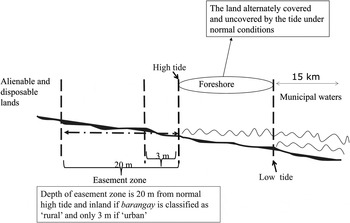
The Public Land Act states that the only mode of disposition of the foreshore is through lease. The dry land just above the high water mark is defined as an ‘easement zone’. At least since the Spanish Law of Waters of 1866, the purpose of ‘easement’ has clearly been to secure public access across the coastal zone.Footnote 26 The Water Code is the most important law regulating land adjacent to the foreshore and defines the size of the easement zone, the number of metres from normal high tide and inland which is intended for ‘public use in the interest of recreation, navigation, floatage, fishing and salvage’.Footnote 27 According to the Code, public land reaches 20 metres inland from the average high tide line in agricultural areas, 40 metres in forest areas and 3 metres in urban areas (see Figure 1). However, there is great uncertainty regarding who actually implements the provisions of the Water Code and enforces the easement in favour of the public.Footnote 28
Classification of the coastal zone

Adding complexity to land administration and management, local government units, especially municipalities and cities, exercise considerable control over the use of shore lands through a number of powers (the power to reclassify lands, enact zoning ordinances, process and approve subdivision plans for development purposes, issue special permits or licences).Footnote 29 In other words, there is much scope for interpretation and navigation among those who know how the system works. As Philip Kelly has shown, in a study of the politics of land classification, permissions and privileges linked to class and local political relations at the ‘rural–urban interface’ of Metro Manila, local elected officials and government employees in key positions frequently have vested interests in the process of reclassifying lands.Footnote 30 A similar situation exists in Sibulan, where a former barangay captain, a former mayor, a former head of the municipal assessors office, and at least three families closely linked to elite figures in the provincial government have established their own vacation houses on beachfront properties.
The government has in recent times been actively involved in promoting Foreshore Lease Agreements. This tenure product gives the lessee similar guarantees as private title in terms of control over land, but the lease expires after a maximum of 50 years (25 years, renewable for no more than 25 years). Several poor fishing families have at some stage filled in applications for Foreshore Lease Agreements, but they have not obtained contracts, as it is too expensive and difficult to complete all the requirements and win the bidding process. The Foreshore Lease Agreements are clearly designed to encourage investment in coastal tourism and beachfront property, and not to strengthen the tenure security of low-income coastal dwellers. This example just underscores the point that state-defined land tenure products in the Philippines continue to be designed to promote the interests of the well-to-do.
At the same time, as reflected in the 1987 Constitution, the Comprehensive Agrarian Reform Program and its extension, and in the Indigenous Peoples' Rights Act and the system of Certificates of Ancestral Domain Titles and Ancestral Land Titles, there has been an observable broadening of state concerns regarding the land tenure situation in the country. Active and strong civil society organisations have played a key role here. However, many of those who live very close to the shoreline are not in a position to utilise these programmes, only occasionally doing farm work and not being ‘indigenous’. Non-governmental organisations (NGOs) in the Philippines have taken very little interest in the problem of land conflicts and tenure insecurity in fishing communities. In Sibulan, several organisations have been active in establishing Marine Protected Areas, partly to encourage dive tourism, but not a single NGO has looked at the problem of tenure insecurity.
Since most fishing families and other poor coastal dwellers have been unable to obtain private title or formal lease, they have sought tenure security through other means. In Sibulan, ‘informal’ land tenure arrangements and customary claims — based on occupation, kin ties and historical claims — have for more than 100 years coexisted with and been used in relation to a system of formal land titles. In some contexts, there is a clear opposition between poor and rich in terms of how they claim rights to land. One woman said when faced with a ‘demand letter’ for eviction: ‘Naa mi katungod mopunjo sa yuta’ (it is our right to stay on the land). That right, this woman argued, was based on both her family's long-term residence on the land and in a right to livelihood. I refer to this as the katungod-model, a ‘customary rights’-view of who can own, inherit, use and sell various resources. The owner of an overseas recruitment agency and a beachfront property investor from Manila, Jennifer,Footnote 31 was of a different opinion. According to her, all the families living along the coast without formal title are squatters. Jennifer said: ‘I won in the RTC [Regional Trial Court]. They [the “squatters”] had no right to stay on the land.’ The wife of a fisherman's response to this statement, echoing the sentiments of poorer segments of the coastal population struggling to avoid eviction, was: ‘They have money — they get what they want.’ Jennifer was of the opinion that property law is what gives one the right to be a legitimate resident of the place. The katungod-model is in her opinion irrelevant in deciding who has what rights to land and the foreshore.
The property law model and the katungod model are not representations of two entirely different worldviews. The models overlap in view of certain aspects of what constitutes a right to own and possess land. The proven length of attachment to place has been included in the Philippine law on ‘ejectment’ and can form the basis for issuing or transferring ownership. Although many are technically landless or do not possess titled land, there is ‘gradation in land security’.Footnote 32 Several families have been able to obtain building permits and register their house lots with the municipal assessor's office (also on top of land that had already been issued private title in the name of someone else). Tax receipts are sometimes used as a legal basis for land claims, as proof of long-term possession ‘in the concept of an owner’. Coastal dwellers also claim occupational rights and ownership through inheritance. Many claim to live on ‘public land’, arguing that the Bureau of Lands has erroneously classified the land all the way to the sea as alienable and disposable. Some claim to be the descendants of the ‘original people of the place’ (lumad).Footnote 33 Poor coastal dwellers draw on many strings and mobilise different kinds of resources to secure tenure. The specific approach they take depends on a range of factors within the local community, their perception of what is accepted in the wider society and their ability to broker relationships between the ‘inside’ and the ‘outside’.
The customary model I refer to here is not meant to be understood as a remnant from a timeless past. Customary land tenure practices, Dante B. Gatmaytan reminds us, ‘have always been subject to testing, experimentation and change’.Footnote 34 With much ambiguity and confusion at the level of law and a multiplicity of overlapping and contradictory claims to the foreshore and adjacent dry land areas, a more complex articulation is needed, one which acknowledges strong internal and external influences in shaping land tenure arrangements.Footnote 35
In the following two sections, I present the case study material. The first case describes a ‘family feud’ linked to social differentiation within an extended kin group, showing how kinship, class and place relations figure in conflicts over land. The second case is of an alliance of fisherfolk and rich beach-house owners who defend themselves against an absentee title-holder in a court case over land. The first case is longer, as I present more ethnographic data to give a fuller picture and a better sense of the dynamics of these conflicts.
Kinship, class and place relations in a ‘family feud’ over land
In November 2005, a ‘demand letter’ was sent to 10 households living on ‘lot nr. 1375’ in Amio Beach, ordering the residents to ‘vacate immediately’. The lawyer who had written the letter threatened that if the people who lived on the lot failed to vacate, ‘I shall commence the necessary suit.’ The letter was written in an abstract, legalistic English. Several expressions were difficult to understand for the fishing families who lived on the lot — ‘relative thereto’, ‘commence the necessary suit’, ‘to forestall unnecessary waste of time, money and effort’. The letter did not say who had hired the lawyer.
Maria, who had lived on this portion of the beach her whole life, kept on staring at the printed letters on the white paper. She studied the signature of the lawyer at the bottom of the letter: Hansel T. Anito. It was a name she had never come across before. She could not accept what she had just heard. Then she looked at me and said (in Cebuano): ‘Mao ni among lugar’ (this is our place). As weeks and months passed by, it looked as if the people who were behind the eviction letter were not going to follow up on their threat, and the residents worried less about the episode.
Then, on 17 March 2006, an assistant from the Municipal Trial Court of Sibulan came to lot 1375 with a ‘summons’ ordering the residents, the ‘defendants’, to answer within 10 days the complaints made by the ‘plaintiffs’ in what was now Civil Case 544-06, an ‘ejectment case’. The residents' anxiety (kabalaka) was back, in full force. Maria yelled at the court assistant, cried in front of him, and tried to get him to agree that this was wrong. At the same time, Maria understood that the court assistant was just a messenger, a mailman. Had it been a higher-status person, this emotional outburst may not have happened. Maria, in the end, kept a copy of the summons and the list of complaints the assistant came to give her, but refused to sign any papers. Maria understood that they were given 10 days to respond to the plaintiffs' list of complaints to the Municipal Trial Court.
After the court assistant left, Maria, still in distress, wondered if they all had to go to court and be interviewed. The idea of being interrogated by a judge terrified her. She worried she would not understand the judge, of saying something wrong, of not knowing what would be the best thing to say. She asked herself, ‘Why is this happening to us?’
To answer this question, apart from the contextual information already given, I will discuss some of the details of the court case, describing the relationship between the people involved, how the various parties struggled and strategised to win the court case, and their differing outlook on who really owned this portion of the beach and what this entitled them to do with the land.
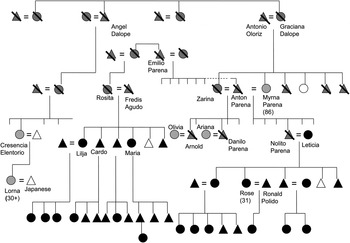
Maria's mother, Rosita Parena Agudo, settled on the disputed lot in Amio in 1977. The Agudo family had initially migrated to Sibulan from the island of Mindanao. Rosita had lived close to the beach in the neighbouring barangay of Minaba since 1943, but her family had been forced out because her husband, Fredis Agudo, was, according to one informant, ‘a troublemaker, always getting into fights with neighbours’. A petition was signed to have Fredis and his family evicted from Minaba. Rosita then asked her mother's brother's son, Anton Parena, for permission to relocate to the lot in Amio (see Figure 2). This lot had been issued Original Certificate of Title in 1937 and Anton was one of the legitimate heirs to this lot. The Parena family was said to have been one of the first families to establish themselves in coastal Amio. During my fieldwork, the Parena family name, transmitted patrilineally, carried solid ‘original people of the place’ status.Footnote 36
A family feud. Black (triangles and circles) refers to people living on ‘lot 1375’ in 2005–2006. Light grey refers to petitioners. Cresencia and Lorna lived in Dumaguete City. The other petitioners lived in Amio. White indicates the person lived elsewhere. Dark grey with a line across were deceased persons.

Anton was first married to Zarina Dalope Oloriz, the oldest daughter of one of the original title-holders, and had four children with her. When Zarina died in childbirth, Anton married Zarina's younger sister, Myrna. Myrna and Anton had already lived in a house on lot 1375 in the 1950s, but when Anton died, Myrna settled a few hundred metres inland from the beach, in the house of her youngest daughter. Although Rosita's family was given permission to stay on the lot in Amio, the title was not passed on to her. In 1983, Nolito Parena, one of Anton's sons, a fisherman, also settled on the 50 metre by 30 metre large lot, together with his wife Leticia.
Two days after the residents on lot no. 1375 received the court summons and were given 10 days to reply, Maria contacted the lawyer of Uy Condev to get help with the court case. Uy Condev is a construction company that builds, among other things, seawalls and beach houses. The company had bought several lots in the area, including the lot just north of lot 1375. Maria was the caretaker of the lot, picking up garbage washed onto the beach and maintaining the grass and bushes so it would look nice for potential buyers. Her job was also to make sure no one would settle on the lot.
Being a high-school graduate and a legitimate heir to the titled property, Rose Parena, married to Polido, took charge of the civil case on behalf of the Parena households who lived on the disputed lot. Her brothers were younger and had little formal education. Rose contacted the Public Attorney's Office in Dumaguete City to tease out their opinion on the case. At the same time she went along to the Uy Condev lawyer with Maria. Rose wanted to give him her version of the case.
In late March 2006, the defence attorney asked the residents on lot 1375 to make ‘family trees’ (genealogy charts), linking them to the Dalope siblings listed as owners on the title document. The family history tree was fragmentarily remembered by Rose. Many family members she knew only by nickname (angga), but she managed to link herself to Graciana Dalope with the help of older relatives living in the area. Maria could not link herself to the Dalope siblings as legitimate heir, not being in direct line of descent.
The plaintiffs, it became known to the defendants when they received the court summons, were some of the heirs of Angel Dalope et al. represented by Cresencia Elentorio and Myrna Parena. A rumour suggested that Cresencia Elentorio's daughter, Lorna, and her Japanese husband wanted to build a beach house on lot 1375. Olivia Parena and Ariana Calumpong Parena had also joined the plaintiffs, although this was meant to be part of a ‘hidden transcript’. Olivia and Ariana were the wives of Rose's father's father's sons. They were not the main sponsors and organisers of the legal case, but had been approached by Cresencia. Crescencia lived in Dumaguete City and had never lived on the disputed lot. The residents on lot 1375 were not able to find out who petitioner Buena Tuazon was.
Both Olivia and Ariana were from somewhat better-off households within the local extended Parena family. They had been able to send their children to college in nearby Dumaguete. Their children had developed stronger cosmopolitan orientations and many of them had separated themselves from poorer kin and neighbours. The families who lived on lot 1375 had lower income and educational achievements, relying on small-scale fishing and casual work to secure their livelihoods. The class and status differences that had widened between these two groups had arguably contributed to the richer branch of the family ignoring kin relations to the group they sought to evict.
The attorney asked the defendants to make copies of various documents to be used as evidence of ‘open, continuous and peaceful possession’ of the property. Maria made copies of a building permit, ‘Declaration of Real Property’ and a Foreshore Lease Application her mother had filled out. Rose and the other heads of households made copies of similar documents. All the ‘defendants’ then went to Dumaguete City to meet with the attorney and sign some papers. I went with them and was asked by Rose to read through the ‘Answer with counterclaim’ document their attorney had drafted.
In the document, the attorney argues that the plaintiffs have never been in possession of lot 1375 and are therefore ‘not in the position to “take back” what they have not possessed in the first place. A more accurate statement would be that the plaintiffs want to wrest and/or grab possession of the said property.’Footnote 37 He furthermore points out that the plaintiffs failed to mention that several of the defendants are the children of the plaintiff, Myrna Parena. The attorney goes on to argue that the area covered by the title has previously been covered by seawater, ‘but for reasons of accretion caused by the action of the sea, the dry area [of the beach] has expanded. Such areas belong to the public domain and are under the jurisdiction of the Department of Environment and Natural Resources (DENR)’. The defence attorney questioned the plaintiff's underlying motives and showed that there were several legal avenues open to the defendants. This was meant to discourage the plaintiffs from pursuing the case further.
Plaintiff Myrna Parena was the grandmother of four of the defendants. She was at this time 86 years old and senile. Being the oldest ‘legitimate heir’ alive, she was a key person in terms of legal authority to decide on the use of the property. Rose was convinced that Crescencia had approached Myrna and had her ‘sign’ the list of complaints without knowing what was going on. Myrna did not know how to read and write. Her signature was a thumbprint. The defendants talked of this as being an act equal to stealing. The petitioners had stolen Myrna's thumbprint. Rose was both surprised and very disappointed when she found out that her close neighbours and relatives Olivia and Ariana had signed the papers to have her family evicted.
Attorney Hansel T. Anito, Council for Plaintiffs, had his own interest in pursuing the case. He had negotiated for himself ‘25 per cent of the land, when possession is recovered, on a contingent basis, as attorney's fees’.Footnote 38 With a market value of perhaps 5,000 pesos per square metre (US$106) and the lot being approximately 30 by 50 metres, this translates to a potential attorney's fees of about 1,900,000 pesos (about US$40,000).
What happened over the next few months was a bit of a farce. The defendants showed up to scheduled meetings at the Municipal Trial Court three times. Each time the defendants arrived at the courthouse, they found that the session had been cancelled. They spent several hours each time, having to put on appropriate clothing and travel in tricycles to the courthouse located in Sibulan town. Rose and Maria both had their own mobile phones, yet their attorney did not call or text them to inform them about the cancellations. The defendants, on the other hand, were reluctant to text or call the attorney, not wanting to disturb him, thinking perhaps that he was busy with more important things. The mobile phone, at least in this case, was not used to overcome previous social boundaries.
The sociocultural differences between those subject to eviction and the attorney defending them limited their communication. Referring to the meeting between the defendants and the plaintiffs that eventually took place at the Municipal Trial Court, Rose said, ‘The judge did not ask us, only the lawyers were talking, and writing their position papers.’ The language used was difficult to understand for anyone who was not trained in the law. Maria and Rose felt at times inferior as they struggled to understand what was being said, along with the necessity for the legal procedures, and formal regulations and requirements. While being grateful for the attorney's help, they still found it difficult to trust a person they did not really know and to negotiate in this unfamiliar legal territory.
In the process of defending themselves against the civil case for ‘ejectment’, there were two somewhat different — at one level contradictory — arguments pursued by the Agudo and Parena families. Since the Parena families living on the disputed beach lot are direct descendants of the title-holders, they wanted to pursue an argument saying that not only had they lived on the land for a long time, but also that they were legitimate heirs of one of the original title-holders. The Agudo families, who are not linked to the title-holders as legitimate heirs, wanted in their defence to pursue the argument that they were living on public land, with the implication that they have a right to continue living there and, as a consequence of long and continuous occupation and possession of tax declaration documents, are entitled to decide on the use of the land.
Maria and her brother Cardo were of the opinion that they had the right to sell portions of the land they live on to others. This was one of the complaints raised by the plaintiffs, that the people who have been ‘tolerated’ on the land were now illegally selling it to a third party. When Rose confronted Maria and Cardo with the accusations made by the plaintiffs, they admitted they had made a written contract with a buyer of the space in front of Maria's house. When Rose told me about this, she became very emotional and had to turn away, take a break, and continue the conversation with me later. She did not agree with what Maria and Cardo had done. Rose also worried that their action had strengthened the plaintiffs' case. However, her own mother, also against Rose's will and knowledge at the time, had sold the right of one smaller portion of the lot to another family, not related by kin, in 1995, to pay off debts and be able to finish building a brick house. Rose understood that the driving motive was to get hold of much needed money, and could at one level sympathise with these actions, at least as long as none of those who lived on the land were displaced. But she preferred to save space on the lot for the children of family members who lived there.
This is a legal case where two house groups sharing one lot were clearly pitted against each other. Rose and the other descendants of Anton Parena living on the lot could, in one scenario, have joined the team of the plaintiffs to have the Agudo family evicted by having the Torrens title confirmed in court as valid. Instead, the residents came together to defend themselves against eviction. Was this co-operative capability a reflection of their adherence to similar norms of reciprocity and katungod principles rather than the dominant ideology of individual rights and private property? Both family groups had lived on the disputed lot for several decades and, with few exceptions, they all had their main source of livelihood in the place, a key reason for why they were willing to fight for the land. In addition to using the lots for housing, resting sheds, raising chickens and pigs, docking boats and storing fishing gear, both family groups had planted a few coconut trees on the lot. The Parena family had also planted some mangrove seedlings, not only as protection from the waves, but to assert their claim to the land. As elsewhere in the Philippines, the planting of trees and other permanent crops has long been a way to claim land as your own.Footnote 39 These house lots and the relationships they maintained there allowed for some sense of control over everyday events. They had grown emotionally attached to the place and the relationships they maintained with significant others in the neighbourhood. Despite disagreements over who had a right to sell the land, they were initially able to co-operate in defending themselves against eviction. The katungod model is useful here, to understand who are seen to have a right to live on the land. Long-term residence, kinship and a right to livelihood and a home are all relevant to understanding the way the residents on lot 1375 organised their defence. The case filed against the residents on lot 1375 was eventually dismissed by the Municipal Trial Court of Sibulan on 19 January 2007. The plaintiffs did not appeal the decision to the Regional Trial Court.
While the katungod-model is a useful distinction to property law, it is also important to acknowledge that there was an ongoing negotiation between the families living on the lot over who had what rights to specific portions of the land, and there was intense contestation over the question of rights to sell pieces of the land to outsiders. Lot 1375 was divided in two almost equal parts, one for the Agudo family and one for the Parena family. The boundary was marked by some trees and the walls of houses. Importantly, there were differences in the way the two family groups claimed rights to the lot. Rose and her close relatives who lived on the disputed lot emphasised that they were descendants of the original title-holders to the land and the ‘original people’ of Amio Beach. Apart from long-term occupation and use, the Agudo family's claim to the land was based on a relatively weak kinship link (ig-agaw igtaksa or first cousin) and copies of old tax declarations and some other documents. The Agudo family name did not carry ‘original people of the place’ status, and it was difficult for them to mobilise support within the wider neighbourhood for their land claims. The members of the Agudo family maintained a much smaller social network in the neighbourhood than the Parena house group members. When members of the Agudo family tried to sell a portion of lot 1375, the Parena extended family in Amio Beach reacted forcefully. Statements like ‘they are not really from here’ started to circulate.
On my visit to Amio in June 2008, there were signs of a clearer separation between the Parena and Agudo families living on lot 1375. A fence-like structure in the form of a resting shed had been put up by Rose's husband. Rose expressed disappointment to some of her Agudo neighbours for continuing to try to sell portions of the beach lot they lived on. Three of the Agudo households said they would agree to relocate if compensated. They had informed a former barangay captain of Amio that if they were given 50,000 pesos (US$1,064), they would agree to move. In a perhaps surprising move, Rose no longer considered Ariana an enemy. She had forgiven Ariana for signing the document to have Rose's family evicted. The explanation she provided was: ‘You know, she was the sponsor of Ryan's and my wedding.’ This statement referred to the practice of strengthening relationships by sponsoring baptisms and weddings, Ariana being the godmother (ninang) of Rose.Footnote 40 I also sensed that Rose was not too keen to go into the exact reasons for what had happened. Rose now spoke of some of the Agudo house group members as being ‘dili maayong silingan’ or ‘no good neighbours’. There had been several instances of men from both groups quarrelling when they were drunk.
In this case study of a ‘family feud’ over a beach lot, I have shown how kinship, place-based attachments and property law, along with social differentiation in terms of wealth, education and occupation, were relevant for how the parties understood who had what rights to the lot. Some family members with more of a middle-class status and stronger cosmopolitan orientations asserted their rights to the land in a somewhat opportunistic fashion. They seem to have been encouraged by a lawyer who wanted a share. Initially, all the residents on this lot were able to unite to defend themselves. When some of the Agudo members continued to try to sell portions of the lot to outsiders, conflict along kinship lines broke out, splitting the group in two. Instead of interpreting these developments as an example of ‘fragmentation’ of kinship and place-based community relations, the case study resembles a broader pattern where members of well-established ‘original people of the place’ families help forge a clearer separation from peripheral cousins and non-relatives to the advantage of closer kin. Through the conflict, the Parena family who lived on the disputed lot gained wider family, neighbourhood and state recognition for their land claims, while the Agudo family became increasingly vulnerable to displacement pressure.
In the next section, I present a court case where poorer long-term settled families and rich newcomers are brought together to defend themselves against an absentee title-holder.
Alliance between fishing families and rich newcomers
The Chan family bought 1.7 hectares of land from an old elite plantation owner in Amio Beach in 1967, but never used it. The Chans' intention was to establish a commercial fishpond, but the plan never materialised.
Many of the people subject to eviction in this case used to be fishermen and farm labourers and had lived on the disputed parcel of land for more than 20 years when they received a demand letter in the mid-1990s to vacate the beach property. They had moved onto the beach from their settlement a bit further away from the beach when farming jobs became less attractive compared with fishing and the land they lived on was subdivided and sold to town-based investors. Nevertheless, these families held wider recognition as some of the first people to live in the area and were able to claim unsettled land along the shoreline as their own and also sell ‘rights’ to portions of the beach to rich newcomers. The rich newcomers established beach houses or rest houses next to or interspersed between these long-term settled families. The group of richer newcomers consisted of a judge, an architect, a medical doctor, a college professor and a parish priest. There were also a few middle-income families who rented houses from some of these families.
It was the children of the deceased title-holder who claimed the land. They were of the opinion that the land was private property, covered by the Torrens Certificate of Title. They lived in Dumaguete. Their parents also used to live in Dumaguete and were among the main dried-fish dealers in the city. The plaintiffs claimed that the defendants, those who lived on or had vacation houses on the disputed portion of the beach, had known all along that the land they were using was the titled property of the Chan family.
Some meetings were held in the mid-1990s to seek a resolution to the conflict. At the last mediation meeting, in May 1996, the Provincial Environment and Natural Resources Officer told the defendants to vacate the land or make arrangements with the plaintiffs for their continued stay on the land (i.e. buy the land or pay rent for the land). The complaints of the plaintiffs were dismissed in the Municipal Trial Court of Sibulan in May 2001. The judge concluded that the land of the Chan family in Amio had eroded and was now under the sea or part of the foreshore. The Community Environment and Natural Resources Office in Dumaguete City conducted a foreshore inventory study in January 2003 and found that the titled property also covered the remaining dry portion of the beach. Later the same year, the Regional Trial Court in Dumaguete City reversed the decision of the Municipal Trial Court. The Regional Trial Court judge said the plaintiffs had the right to recover possession of the remaining dry portion of the property. Since the state had not reclaimed and reclassified the land as part of the public domain, it remained private property. The Court of Appeals upheld the decision of the Regional Trial Court in April 2007. It is a common opinion among ‘outsiders’ who have bought titled land and use the courts to force people off the land that the Municipal Trial Court will often take the side of the local residents. This is particularly the case if the ‘defendants’ are from long-term settled families with solid status as ‘locals’.
The alliance between richer newcomers and poorer fishing families in this court case can be seen as mutually beneficial. Richer newcomers shouldered the expenses of the poorer dwellers, while the latter group's long-term residence and political status in the neighbourhood had given the rich the opportunity to buy relatively cheap occupancy rights. When people sell their ‘rights’ or ‘waive their rights’ to a portion of land, this is a legally binding contract, but only as far as those rights are valid or do not compromise the legal rights of others, someone with a better right of possession. Furthermore, the fact that many of the original settlers on the beach relied on fishing and gleaning to make a living was an argument used to justify their continued right to live there.
According to Alvero, a wealthy beach-house owner who bought a lot from a long-term settled family in 1995, the easement zone ‘is intended for the marginal fishermen’. Through his attorney, Alvero had appealed against the decision of the Court of Appeals at the Supreme Court. He was of the opinion that this was a special case where the titled lot was eroded by the sea and the remaining portion of the beach was automatically part of the public domain — hence it could not be privately owned, only leased. He had obtained aerial photos of where the coastline had been, showing which land had eroded and where accretion had occurred. While being keen to fight the case in court, partly because he had built two beach houses on the lot and used them for family reunions and private residence, this beach-house owner also said that for him personally, it was no catastrophe to lose the civil case: ‘I can just move somewhere else.’
This case shows that new vertical links have taken shape, constructed around a beach recreational and real estate economy, partly because of the contested nature of land tenure. The mutual interest in securing tenure has brought neighbours of unequal social status together as one party in a land court case. It is members of families with ‘original people of the place’ status who have been able to forge the better vertical links. Despite being ‘landless’ in a narrow technical sense, they have been able to claim and sell some beachfront lots, remain in possession of residential lots and forge new and important relationships with some rich newcomers. Through these relationships, they channel work opportunities in the beach houses of the rich to family members living in the neighbourhood. They also seek sponsors of court cases, baptisms, weddings and education, as well as buyers of fish and other seafood. Rich beach-house owners, in turn, use the ‘customary claims’ of their poorer neighbours to secure tenure. And while there are also broader values of rights to livelihood and an obligation of the rich to care for the poor that comes to expression in this case, local leaders and brokers from the more influential coastal-dwelling families are today less focused on acting as hosts to migrant fishers and ‘poor newcomers’ than they were a few decades ago.
State response
State institutions have so far largely ignored the issue of securing coastal land tenure for low-income families. The response of local government institutions to the current land situation in coastal Sibulan has in one sense been passive, referring the disputes to the courts and not offering much in terms of resettlement. Some of the families who have been evicted and not found alternative places to rebuild their houses have been offered small lots through ‘the government assisted relocation project’. Three families that recently lost in the Municipal Trial Court and lacked connections and financial resources to pursue the case further were each given 1,000 pesos (US$21) and about 50 square metres of land under a long-term mortgage arrangement with the municipal government. The relocation site was further away from the beach, between a rice field and a nipa swamp.
As mentioned above, the government has been more active developing and promoting a new formal tenure product: foreshore leases. Being on the government's ‘top ten agenda of revenue generation’,Footnote 41 it is not a tenure product designed to help low-income coastal dwellers and fishing families strengthen their landownership claims, but an instrument designed for the well-off who seek exclusive ownership, increased control and state-guaranteed security for their beachfront investments. Another strategy of state officials and cosmopolitan property investors, as reflected in the comprehensive land use plan of the municipality of Sibulan, is to reclassify the coastal barangays of Sibulan as ‘urban’, as this reduces the easement zone from 20 to only 3 metres. If the land-use plan obtains final approval, the outcome of many court cases may be affected and work to the disadvantage of those who claim to live on ‘public land’. Very few of the fishing families living along the shoreline were aware of this proposed change in land classification.
At the same time, the ‘state’ is at the local level represented by familiar faces to the more influential neighbourhood leaders and brokers in Amio Beach. Political candidates seek to mobilise electoral support from what are considered to be ‘significant families’ — those who have lived there for a long time and belong to some of the larger family groups. By helping members of these influential families with land tenure problems, they can win votes and get help with the implementation of government projects in the barangay.Footnote 42 Settlers with more of a ‘migrant’ or ‘poor newcomer’ status are commonly seen as ‘insignificant’ in terms of their ability to mobilise support for local politicians, and consequently receive less support in turn.
Conclusion
The splitting up of land for sale to outsiders moving in for recreation, tourism business and ocean-view residence has led to disputes where kin allegiances, patron–client relationships and political alliances are breaking up, reinforced and transformed.
The high demand for ocean-view residences, vacation houses and resorts has resulted in a square metre price of beachfront properties in Sibulan that is more than 10 times the price of land further away from the beach. The high price of these properties has enticed long-term settled families and others with claim to ownership to sell their ‘rights’ to portions of the beach to rich newcomers.
During the time of my fieldwork, almost every square metre of the beach of Amio was claimed by more than two parties. To remain in possession of untitled land is becoming increasingly difficult for ‘informal’ coastal dwellers. Also titled land is difficult to hold on to and to claim possession of. Court cases have flourished since the second half of the 1990s. Among poorer segments of the coastal population, these conflicts create deep-felt anxiety over what will happen in the future. They find the experience of being dragged into legal cases for eviction extremely unsettling. Seen within the broader perspective of rising tides linked to global warming, Rebecca L. Austin correctly points out that poor coastal dwellers are likely to find themselves having to encroach upon the titled lands of others.Footnote 43 Hence, land conflicts involving fishing families are set to become even more widespread.
State institutions have so far first and foremost been keen to develop new instruments to allow outsiders with money to buy, own and lease the coastline and only secondarily concerned with tenure security of low-income coastal dwellers. As elsewhere in the region,Footnote 44 many coastal communities in the Philippines are poorly equipped to successfully negotiate land rights and manage other coastal resources against more powerful external interests. Yet after more than 100 years of living under a state-defined property regime that has catered primarily to the political-economic interests of the elite and middle class, instead of simple ‘fragmentation’ or ‘proletarianisation’, several members of fishing families have in Sibulan grouped together and established kin-based house groups and wider neighbourhood clusters, one where pioneer settler status and local livelihood projects define key aspects of who they are and how they associate with place. Some of these social formations have become relatively effective negotiating units in conflicts over land.
Erik Cohen, based on fieldwork in an area of rising coastal tourism in southern Thailand in the early 1980s, reports that outsiders' ability to enter into a locality through legal eviction depends on ‘the continued ability, desire, and resoluteness of the locals to fend off the intruders, that is, on factors such as the closeness and solidarity of the local community, resourcefulness of its leadership, and even its willingness to resort to violence’.Footnote 45 Long-term settled and well-established families in coastal Sibulan are better able to mobilise broader support within the barangay and have better connections to officials at the municipal government. Despite being, in the narrow, formal sense of ownership, landless, several low-income families in Sibulan have been able to claim coastal space as their own, consolidate their land claims and sell portions of it to rich newcomers.
The point here is not to ignore the fact that much power over the shoreline has been transferred to new user groups; decision-making power over land-use plans, zoning, ordinance formulation, taxation and development projects lies with municipal, provincial and national government agencies and power-brokers outside localised settler groups. Long-term settled groups who were able to claim land as their own and sell it to rich newcomers in the past now realise that the price they obtained for these lots was ‘very low’. Today, there is very little land left for them to sell. The ‘discovery’ of the shoreline as lucrative real estate has also led to physical enclosures of about half of the shoreline in the study area.
Nevertheless, the evidence of the claim I make, that local communities of long-term settled coastal dwellers have been able to reproduce older kinds of localised relations and establish new ones that are important to them despite massive displacement pressure, lies in the fact that they are still in possession of coastal lands. Despite more than 15 years of being threatened with legal cases and harassment, several extended family groups continue to exercise considerable control over these areas. And while there are also conflicts within extended family groups, the pattern of who groups together, comes into conflict, and how such conflicts are resolved suggests that a closer look at the ‘poor fisherfolk’ and the ‘local community’ concept is needed. In addition to the rich–poor and class-based differences that frequently play into the way rights are voiced and defended in conflicts over land, the ‘original people of the place’ versus ‘migrant’ distinction is also relevant. Hence it is useful to examine in more detail how kinship figures in house group and neighbourhood formation, and how discourses of primordialism are encouraged by increased cosmopolitan influences in the coastal zone. Such an analysis reveals that it is non-kin and more peripheral relatives of the ‘original people of the place’ who are finding it increasingly difficult to ‘become local’ and recognised as ‘real’ owners of the beach lots they live on. I describe, then, a tendency for ostracism, a shedding off of poorer ‘newcomers’ and non-kin to the advantage of closer kin linked to well-established families and rich newcomers.