Introduction
Parkinson's disease (PD) is a progressive neurodegenerative disease that affects approximately 120,000 people in the UK (Parkinson's Disease Society, 2007). PD is characterized by motor symptoms including tremor, rigidity, and bradykinesia that cause progressive physical disability. In addition, PD is associated with a range of non-motor symptoms including cognitive impairment, depression, and anxiety (Chaudhuri et al., Reference Chaudhuri, Healy and Schapira2006). In combination with the motor symptoms, these reduce health-related quality of life (QoL; Hinnell et al., Reference Hinnell, Hurt, Landau, Brown and Samuel2012) and limit social and occupational functioning (Raggi et al., Reference Raggi2010).
The strategies that individuals employ to deal with symptoms and consequences of chronic illness can impact upon their psychological well-being (Felton and Revenson, Reference Felton and Revenson1984). Coping research has identified two broad forms of coping: problem-focused (also described as active or task-focused) strategies, which involve facing challenges and seeking solutions to resolve the stressful situation, and emotion-focused coping, which describes emotional responses (e.g. anger) or avoidance (e.g. denial) employed in an attempt to manage the stress produced by the situation. Broadly, research has demonstrated how these different forms of coping can have differential influences on outcome. The term “outcome” is used to describe a broad disease-related construct including QoL and psychological well-being as well as negative symptoms of depression and anxiety. Problem-focused coping is typically associated with better outcome and therefore viewed as more effective than emotion-focused coping (Folkman and Lazarus, Reference Folkman and Lazarus1988). Support for this distinction can be found in PD. For example, a recent study found problem-focused coping strategies to be related to better health-related QoL and more avoidant coping to be related to poorer health-related QoL (Bucks et al., Reference Bucks, Cruise, Skinner, Loftus, Barker and Thomas2011). However, it remains unclear whether the primary factor is the specific use of problem-focused coping, the non-use of maladaptive emotion-focused coping, or the flexibility in use of strategy in particular situations (Montel et al., Reference Montel, Bonnet and Bungener2009).
Cognitive Behavioral Therapy (CBT) is attracting increasing attention as a means to treat depression and anxiety and improve QoL in PD (Dobkin et al., Reference Dobkin2011). In CBT, a range of approaches is typically used to increase the use of adaptive coping responses and decrease the use of those associated with poor outcome. Both in general and in relation to specific conditions, there is growing emphasis on providing specifically targeted therapies that address the particular context and constraints of the client group that not only show greater benefits but are also aligned with patient preferences (Craigie and Nathan, Reference Craigie and Nathan2009). Enhancement of adaptive coping skills may be a central aim of such interventions but evidence to support the approach in PD remains limited (Hurt et al., Reference Hurt2011). A recent clinical trial of tailored CBT for depression in PD (Dobkin et al., Reference Dobkin2011) showed significant improvement in depression associated with treatment. Problem-focused coping was not an explicit target of the intervention and no change was seen on a secondary outcome measure of such coping as a result of treatment. In contrast, a form of coping involving reframing of problems was targeted and did show change. This suggests that CBT can effect change in adaptive coping response with associated improvement in outcome, but the optimum targets of such intervention remain unclear. Although the study excluded patients with significant cognitive impairment, treatment outcome at follow-up was worse in those patients with executive dysfunction. Cognitive function, specifically executive function, predicted outcome four weeks after treatment (Dobkin et al., Reference Dobkin2012).
Cognitive impairment is common in PD with a point prevalence of dementia of 24%–31% (Aarsland et al., Reference Aarsland, Zaccai and Brayne2005). Furthermore, reports suggest that over 30% of PD patients without dementia display evidence of cognitive impairment, most commonly exhibiting executive dysfunction (Foltynie et al., Reference Foltynie, Brayne, Robbins and Barker2004). The relationship between cognition and depression in PD is reasonably well established (Santangelo et al., Reference Santangelo2009) but the direction of causality remains unclear. Coping strategies associated with better outcome, such as problem-focused, often require relatively high level cognitive functioning, including cognitive flexibility, adaptation, and planning skills, particularly in contrast to some emotion-focused strategies such as passive avoidance. Previous research in other groups has shown cognitive impairment to impact upon choice of coping response. Deficits in executive function have been associated with less use of problem-focused coping and greater use of coping strategies associated with poorer outcomes (Goretti et al., Reference Goretti2010), although in PD evidence is less clear (Montel and Bungener, Reference Montel and Bungener2008).
The primary aim of the present study was to investigate, using structural equation modeling (SEM) in a large cross-sectional cohort, the potential causal relationships between cognitive function, coping strategy, and outcome in patients with PD so that the results could be generalized to the types of patients likely to be candidates for CBT. The analysis excluded patients with dementia, but included those with mild cognitive impairment. We hypothesized a causal relationship between cognition and coping style. The model tested the specific hypothesis that cognition has an indirect effect on outcome mediated by coping. It was hypothesized that cognitive impairment would be associated with less use of higher level coping strategies such as task-oriented coping and greater reliance on coping styles that are less cognitively demanding. Furthermore, greater use of task-oriented coping was hypothesized to be associated with better outcome (QoL and psychological well-being).
Methods
Procedure
Cognition, coping, and outcome was examined in a sample of patients with a diagnosis of idiopathic PD according to Parkinson's UK Brain Bank clinical diagnostic criteria (Hughes et al., Reference Hughes1992), recruited as part of a prospective study of mood states in PD (Brown et al., Reference Brown2011). Patients were recruited consecutively via neurology and care of the elderly clinics. All were judged able to provide informed consent as defined by the Mental Capacity Act, 2005 (Ethics ref:07/MRE01/9, South East REC). Patients were assessed in their own homes.
Measures
The Coping Inventory for Stressful Situations (CISS; Endler and Parker, Reference Endler and Parker1999) is a self-report measure of coping style and describes the manner in which an individual responds to stressful situations. Coping is measured by three subscales: emotion-focused, task-oriented, and avoidance-oriented coping. The last can be subdivided into social diversion and distraction. Respondents rate the frequency of general use of different coping strategies on a five-point Likert scale. The four subscale version was employed in the present study as this has shown superior psychometric properties in PD (Hurt et al., Reference Hurt2011).
The Hospital Anxiety and Depression Scale (HADS; Zigmond and Snaith, Reference Zigmond and Snaith1983) was used to assess anxiety and depression. Subscale scores of >10 indicate “definite” depression or anxiety. The HADS has been validated for use in PD (Mondolo et al., Reference Mondolo, Jahanshahi, Grana, Biasutti, Cacciatori and Di Benedetto2006).
Health-related QoL was assessed using the Parkinson's Disease Questionnaire (PDQ-8; Jenkinson et al., Reference Jenkinson, Fitzpatrick, Petrone, Greenhall and Hyman1997). It generates a single index score ranging from 0 to 100 with a higher score indicating poorer health-related QoL.
The Unified Parkinson's Disease Rating Scale (UPDRS; Fahn and Elton, Reference Fahn, Elton, Fahn, Marsden, Goldstein and Calne1987) was used to assess motor symptoms. Higher scores indicate greater motor dysfunction. Hoehn and Yahr staging was used to assess overall rating of disease severity (1 = mild, unilateral disease; 5 = severe, bilateral disease).
The Addenbrooke's Cognitive Examination-Revised (ACE-R; Mioshi et al., Reference Mioshi, Dawson, Mitchell, Arnold and Hodges2006) provides a global index of cognitive function through the assessment of five domains: attention/orientation, memory, fluency, language, and visuo-spatial function. Higher scores indicate better functioning. The ACE-R has demonstrated reliability in a PD population (Reyes et al., Reference Reyes, Lloret, Gerscovich, Martin, Leiguarda and Merello2009). A total score of less than 83 indicates clinically significant cognitive impairment and possible dementia (Mioshi et al., Reference Mioshi, Dawson, Mitchell, Arnold and Hodges2006). Patients with higher scores may be cognitively intact or show mild cognitive impairment.
Participants
A total of 525 patients were assessed and 461 completed all the measures. Patients scoring less than 83 on the ACE-R were excluded from the analysis. The final sample consisted of 224 males and 123 females with a mean age of 65.8 years (range = 32–93, SD = 10.1). Participants had a mean UPDRS score of 24.4 (range = 4–55, SD = 10.8) and median score of 2 on the Hoehn and Yahr scale indicating mild to moderate disease, although the sample included some patients with more severe disease. Average duration of PD was 6.6 years (range = 0–39, SD = 5.9). Participants had a mean HADS anxiety score of 7.2 (range = 0–20, SD = 4.5) and depression score of 6.0 (range = 0–17, SD = 3.6). Overall, 10.4% showed evidence of definite depression and 23.3% anxiety. Mean ACE-R score was 91.9 (range = 83–100, SD = 10.3). Participants had a mean PDQ-8 score of 29.2 (range = 0–87.5, SD = 18.9).
Statistical analysis
All analyses were performed using IBM SPSS 19.0 and AMOS 19. The relationships between ACE-R, CISS, HADS, and PDQ-8 scores were assessed using Pearson correlations. SEM was used to test the hypothesized model that stipulated mediation of the causal effect of cognition on an outcome by coping, i.e. the model contained an indirect path from cognition to outcome via coping (Figure 1). The latent variable labeled “OutcomeLV” used in the model was based on HADS depression and anxiety, and PDQ-8. Following the Baron and Kenny (Reference Baron and Kenny1986) approach, the mediation model assumed that there are no unobserved confounders, although a secondary analysis was undertaken with socio-economic status (ONS, 2001) as a potential confounding variable to assess the robustness of the model. SEM was chosen for the data analysis as it allows: (1) confirmation of a hypothesized model, (2) testing of indirect effects, and (3) testing of latent variables.
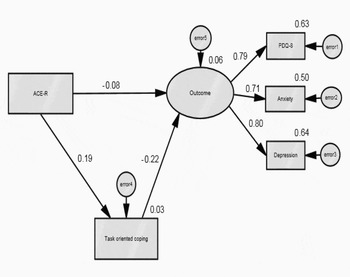
Structural equation model of global cognition, task oriented coping, and outcome showing standardized regression coefficients for each parameter.

A range of statistical tests is available to assess how well a hypothesized model fits the data. The chi-squared statistic (CMin) compares the fit of the hypothesized model to the data with that of the full (or saturated) model where all variables are correlated. A significant p-value suggests the hypothesized model does not fit the data as well as the saturated model and therefore important relationships are missing. However, chi-square is sensitive to small and potentially unimportant departures and is often significant for large samples. The Tucker-Lewis Index (TLI) and Comparative Fit Index (CFI) are relatively unaffected by sample size (Bollen, Reference Bollen1990). Values of ≥0.90 indicate an “adequate” fit of the data, while values ≥0.95 indicate a “good” fit of the data. The significance of indirect effects of cognition on outcome was demonstrated using non-parametric bootstrapping, a procedure that mimics the sampling process by regarding the sample as the target population and then proceeds to re-sample from this population and repeatedly calculate estimates. Inferences such as confidence intervals and p-values for each parameter estimate are then produced based on the simulated estimates (Byrne, Reference Byrne2001).
Results
On average, task-oriented coping was reported as being used the most by the sample (mean = 2.8, range = 1.0–4.8, SD = 0.75), followed by social diversion (mean = 2.4, range = 1.0–5.0, SD = 0.83), emotion-oriented (mean = 2.1, range = 1.0–4.4, SD = 0.68), and distraction the least (mean = 1.8, range = 1.0–3.5, SD = 0.53). Pearson's correlations revealed that poorer cognitive performance was associated with less use of task-oriented coping and greater depression. Greater use of distraction and emotion-focused coping was correlated with more depression, anxiety, and worse QoL, while task-oriented coping and social diversion showed the opposite pattern of association (Table 1). When specific cognitive domains were examined, language and memory were found not to be associated with coping. Fluency, attention and orientation, and visuo-spatial were all correlated with task-oriented coping. Weaker associations were seen between distraction and attention and orientation, and visuo-spatial subscales. The strongest correlation between coping and cognition was seen between task-oriented coping and total ACE-R score. Given the strength of this relationship, total ACE-R score was selected as the cognitive variable of interest (labeled “Cognition”) in the subsequent analyses. All cognitive domains were correlated with depression and health-related QoL except for language. Additionally, no relationship was seen between health-related QoL and verbal fluency.
Pearson's correlations between cognition, coping, depression, anxiety, and health-related quality of life

*p < 0.05 (2-tailed); **p < 0.01 (2-tailed).
Note: High HADS and PDQ-8 scores indicate worse outcome; high ACE-R score indicates better cognition. HADS = Hospital Anxiety and Depression Scale; PDQ-8 = Parkinson's Disease Questionnaire-8; ACE-R = Addenbrooke's Cognitive Examination-Revised.
Structural equation model
The coping score most strongly associated with cognition (task-oriented coping), and therefore with the potential to mediate any effect of Cognition on OutcomeLV, was considered in a SEM (see Figure 1 including the standardized regression coefficients). The task-orientated coping model provided a good fit of the data (CFI = 0.985; TLI = 0.962; χ 2 = 9.772, p = 0.044). As anticipated in a large sample, the chi-square test was significant. All paths between variables were statistically significant (p < 0.05) with the exception of the direct effect of Cognition on OutcomeLV. This is consistent with a full mediation effect of task-oriented coping on the relationship between Cognition and OutcomeLV. Lower ACE-R score predicted less use of task-oriented coping (standardized effect = 0.185, p = 0.005; bootstrapping inferences: CI = 0.072–0.291) and less use of task-oriented coping predicted poorer OutcomeLV (standardized effect = ‑0.123, p = 0.001, CI = –0.344–0.086). This resulted in a small but significant indirect effect of Cognition on OutcomeLV mediated by task-oriented coping (standardized indirect effect = −0.040, CI = −0.084 to −0.015, p = 0.002). Thus, lower ACE-R score was associated with less use of task-oriented coping, which in turn was associated with poorer outcome. Consistent with full-mediation, the standardized direct (non-mediated) effect of Cognition on OutcomeLV was non-significant (−0.082, p = 0.211). The addition of the confounding variable socio-economic status to the model did not change these conclusions.
Discussion
The present study explored the relationships between the level of cognitive function in patients with PD, their choice of coping styles, and a composite index of outcome. It tested the hypothesis that coping mediates the relationship between cognition and outcome. The correlational data were consistent with previous research. Cognitive function and coping were both associated with outcome; poorer outcome was associated with cognitive impairment and the use of emotion-focused strategies, while a task-oriented coping style was associated with better outcome. As hypothesized, poorer cognition generally predicted less use of task-oriented coping. The findings suggest that the degree of cognitive impairment may influence how PD patients approach day-to-day dilemmas, and therefore outcome. Although specific aspects of cognition such as executive function may seem more relevant to the ability to use coping strategies involving planning and other task-focused strategies, the present evidence suggested that an overall index of cognition was more reliably associated. This may suggest that other aspects of cognition including memory and language may also contribute to a patient's ability to utilize more adaptive strategies.
How might such results inform the management of patients with PD, and particularly the use of CBT to treat depression? Is there a role for targeting cognition as the primary treatment modality to improve outcome in patients without dementia, or as an adjunct to conventional CBT approaches? Cognitive remediation in PD has received little attention and none as a potential treatment modality for managing depression. Although there have been no trials of cognitive remediation, there is some evidence that the approach can be effective at improving cognition generally and particularly executive function in PD (Mohlman et al., Reference Mohlman, Chazin and Georgescu2011). It remains unknown whether such changes are sufficient or even necessary for improvements in mood. A recent case study of combinations of CBT and cognitive remediation in the treatment of anxiety in a patient with PD demonstrated significant improvements in anxiety symptoms without any concomitant change in cognitive function (Mohlman et al., Reference Mohlman2010). The results of the present study suggest that any cognitive remediation intervention should focus on whatever cognitive skills are needed to enhance adaptive coping styles.
Where CBT is applied in older adults, it is typically adapted to accommodate cognitive impairment rather than to remediate it directly, e.g. by adjusting the pacing of treatment, providing written material, and involving carers to help with practicing techniques (Laidlaw, Reference Laidlaw2001). An alternative, and more direct approach, is to specifically target the coping strategy itself in a way that allows for the presence of cognitive impairment and provides the patient with new or enhanced skills to cope with real-life problems. This approach treats cognitive impairment as an important contextual factor, both to the patient's condition and to treatments, but does not attribute it a specific causal role. One example of such an approach is Problem Solving Therapy (PST; Arean and Cook, Reference Arean and Cook2002) for depressed older adults. This teaches effective strategies to solve real-life problems while accommodating the executive problems commonly experienced in this group. Evidence exists for the efficacy of PST for the treatment of depression in older adults (Arean et al., Reference Arean, Perri, Nezu, Schein, Christopher and Joseph1993). A recent case study (Mackin et al., Reference Mackin, Arean and Elite-Marcandonatou2006) has illustrated the potential value of the approach in a patient with PD and mild cognitive impairment suffering from major depression.
A number of limitations for the present study should be acknowledged. First, patients with possible dementia were excluded, and so the nature of the relationships between cognition, coping, and outcome in this group is unknown and results should not be automatically generalized. Second, although the mediational role of coping on outcome was supported from the data, the effect sizes of the mediated relationships were small and thus a large amount of the variance in outcome remained unexplained. However, while more complex models could have been tested in an effort to understand a wider range of factors contributing to outcome in PD, the purpose of the present study was to focus on a limited set of variables suggested by previous research. It is acknowledged that other factors may make significant contributions, either independent of cognition and coping, or through interaction. Finally, the model tested in this study used a composite measure of cognition rather than exploring separate cognitive domains. The composite score was selected as it displayed the strongest relationship with coping. Furthermore, it is likely that cognitive impairment in different domains will have a combined effect on coping behavior, making a composite score the most productive way to look at the overall effect of cognition on coping and outcome.
Conclusions
The present study (1) provides evidence for associations between coping strategy and outcome in patients with PD, and (2) supports the hypothesis that choice of coping strategy mediates the relation between cognition and outcome in patients without dementia. Both adapted CBT-based approaches and directly targeted PST may have value in treating patients with depression. In contrast, the potential value of cognitive remediation as a primary or adjunct treatment is less certain. Finally, although SEM can be used with cross-sectional data to test causal and mediational models, more direct evidence will need to be sought from longitudinal evaluation. The most powerful tests come from causal-interventionist studies in which hypothesized factors such as cognition and coping are explicitly manipulated and the effect on outcome measured. Even small-scale clinical trials that target specific mechanisms can help test models and assumptions underlying the intervention and, in doing so, further refine treatment to improve outcome.
Conflict of interest
None.
Description of author's roles
C. Hurt formulated the research question, supervised the data collection, analyzed the data, and wrote the paper; S. Landau analyzed the data and assisted in writing the paper; D. Burn, J. Hindle, M. Samuel, and K. Wilson designed the study, supervised data collection, and assisted with writing the paper; and R. Brown formulated the research question, and also designed the study, supervised data collection, and assisted with writing the paper.
Acknowledgments
The authors acknowledge the following: Parkinson's UK; NIHR Biomedical Research Centre for Mental Health at the South London and Maudsley NHS Foundation Trust (SLaM) and Institute of Psychiatry, King's College London; NIHR Dementias and Neurodegenerative Diseases Research Network (DeNDRoN); Wales Dementias and Neurodegenerative Diseases Research Network (NEURODEM Cymru); NIHR Mental Health Research Network (MHRN); and British Geriatrics Society.