Elizabeth Eva Leach's new book was not out yet when I was planning a Spring 2011 seminar on Machaut, so I let its title guide me. Guillaume de Machaut: Secretary, Poet, Musician was obviously the monograph that finally brought Machaut's life and works into accord – one that explained the importance of his time as a court official to his music and poetry. I therefore put it on the syllabus for ‘Life and Works’ day under the provocative (I hoped) question ‘Does biography matter?’ It was a rookie mistake.
Leach's new book is not a ‘life and works’ study at all. Though it concerns itself with both Machaut's life and his musico-poetic output, it does so sequentially, placing much more emphasis on the latter. After the first chapter, which brings together all the surviving evidence of the historical Machaut that does not come from his own poetry, the ‘real’ Machaut is treated as much as a symbol as an actuality. His body serves as a metaphor for his oeuvre, the dismemberment of which by modern disciplinarity is the focus of chapter 2. After this the core section of the book explores a series of multivalent themes – ‘Creation’, ‘Hope’, ‘Fortune’ and ‘Death’ – with regard to their manifestation in Machaut's output, both musical and poetic. The result is that Machaut is ‘re-membered’ even as he is ‘remembered’.
In the lucid chapter 1 (‘Life: Guillaume de Machaut's Living’) Leach brings together the surviving information about Machaut that hails from sources external to his poetic works. Such an undertaking is necessitated by the shaky hold of truth in his dits (long narrative poems). The famous ‘Voir dit’ (‘True Story’ or ‘True Fiction’) is a case in point: the poem often refers to real persons and places, teems with scintillating details about Machaut's habits of book-making, and records impressive statements about the worth of his musical compositions. The narrator is even named Guillaume. But Guillaume also meets Hope in a field while walking, and succeeds in getting Venus to cast a concealing cloud around him and his sweetheart in order to allow them to consummate their passion. In other words, we cannot take Guillaume too literally.
If we subtract this uncertain evidence, we are left with the details preserved in a ‘skin trail’ (because it is largely on parchment) of archival documents (pp. 12–18). In fact we know rather less about Machaut than we think we know (p. 9). Most of what we do know is tied to finances. Following the lead of Roger Bowers, Leach is careful to separate the sources of Machaut's income from conclusions about his location – a point especially important in the case of Reims, where the composer held a canonicate from 1338, but probably did not reside until about 1360. Machaut's life's work was to be an administrator, certainly for King John of Luxembourg, and perhaps for King Charles of Navarre after John's death in battle in 1346. That his income during much of his life came from the church is not in conflict with his vocation: lords and kings petitioned for prebends on his behalf precisely because he was a useful retainer. And their purpose in doing so was not to send him away, but to reward him for good service and provide for him in his eventual retirement. A comparison with the career of Machaut's brother Jean – also a secretary and a canon at Reims – further clarifies the situation (pp. 15–17). Leach convincingly shows that Machaut's life is separable from his living.
Chapter 2 gives a history of Machaut scholarship from the rediscovery of some of his manuscripts in the mid-eighteenth century through to more or less the present moment. The title, ‘Resurrection: Dismembering Machaut’ alludes to Leach's main thesis here: that different scholarly disciplines have paid attention to different aspects of Machaut's work, bringing to them their own disciplinary agendas and biases. Machaut's poetic output was first mined for the historical detail it could provide. This led, in the eighteenth and nineteenth centuries, to an emphasis on La prise d'Alexandrie and Jugement dou roy de Navarre.Footnote 1
Machaut's first significant role in literary history was as an influence on Chaucer. This initially cast him in the light of a negative comparand (the rough material that Chaucer refined) but eventually benefitted him when Chaucer's borrowing came to be viewed as a tacit endorsement (pp. 40–2). Once Machaut's lyrical output had been edited, it also began to be explored on its own terms in two stages of enquiry which Leach convincingly aligns with Romantic and modernist preoccupations. In the former stage, Machaut's poetry was found to lack emotional authenticity due to the conventionality of its topoi. However, a modernist lens highlighted Machaut's formal play, rewriting the story of his works as the story of evolving poetic forms. A final phase of poetic criticism focused on Machaut's manipulations of lyrical personae and on the interactions between the narrative and lyric modes in his oeuvre (pp. 46–8).
The ensuing summary of scholarly engagement with Machaut's music draws out interesting differences between the literary and the musical reception. While in the former Machaut was a sort of ‘Johnny-come-lately’, writing after the ‘golden age’ of the trouvères, in music he was a distant forerunner of the Baroque and Classical German masters (p. 49). Many early studies of the music were hampered by the difficulties of the notation, which in turn led to faulty transcriptions with sonorities that sounded barbaric to early nineteenth-century commentators (pp. 51–7). However, the increased tolerance of dissonance in the first quarter of the twentieth century, combined with an interest in the numerical techniques which Machaut used to structure some of his compositions, led to a rehabilitation of his works.
The final discipline to be brought into the historiographical survey is art history, and it plays the special role of adhesive: it ‘can be credited with some of the movement toward interdisciplinary study of Machaut, since the materials that art history relies on – the manuscripts themselves – are not just composed of pictures’ (p. 73). There is some danger here of overstatement of art history's contribution as a discipline as opposed to the interdisciplinary approaches to Machaut by scholars of literature and music. In fact, of the twentieth-century scholars discussed in this section, only one – François Avril – is an art historian. The others mentioned are musicologists and literary scholars – interdisciplinary medievalists without whom Domenic Leo – the younger art historian mentioned – would not have been able to write his dissertation.Footnote 2 Thus this part of the story could be told somewhat differently by acknowledging that a number of scholars have approached Machaut with methodologies unbounded by discipline. The resulting picture would be less neat than that of Machaut being ‘dismembered’ by a triad of disciplines (history, literature, music) only to be re-membered in the latest phase of scholarship. It would also place the present book in a group of other enquiries, whereas the current narrative gives it the place of innovator: ‘what is new here [i.e. in Guillaume de Machaut] is the attempt … to gather up Machaut's scattered texts from their different modern disciplines so that their constituent threads can be woven back into their greater whole’ (pp. 79–80). That this attempt is laudable is certain. That it is new is perhaps more open to question. Leach continues: ‘More than most literary scholars (excepting those like Huot, Butterfield, and McGrady), I am keen to engage with Machaut's works in their manuscript copies … to appreciate their “notation” (literary and musical) and layout’ (p. 80). But these are big exceptions! All three of these scholars have published book-length studies on themes pertinent to Machaut.Footnote 3 And Huot, especially, has deeply influenced Leach.
The role assigned to Lawrence Earp in this account of disciplinary rift is also telling. Though he wrote the book on Machaut's books, the codicological investigations Earp carried out in his dissertation are not discussed in the section entitled ‘Machaut's Books: Pictures and Paratext’ – the one dealing with art history's contribution. Instead Earp emerges in the following section, ‘My Machaut: Machaut's Oeuvre’, where his work is called ‘as witness’ to the fitness of Leach, a musicologist, to write a book ‘designed to produce a more than musicological Machaut’: ‘Machaut's musical output is the most daunting ingredient of his work to deal with … on [this] point I call as witness the fact that the most thorough documentation of Machaut's life, works, and writing on them has been compiled by a musicologist, Lawrence Earp, to universal acclaim’ (p. 77). In other words, Earp was able to do his work because he could handle the notes, and everything else is easier. And for this same reason, the present book can handle the notes and everything else. But the Earp exemplum could have played a different role during the earlier, disciplinary discussion. There it would have borne witness to a body of scholarship – musicological, literary, very rarely exclusively art-historical – that has been dealing with Machaut as a complete package for some time. It in no way diminishes the importance of Guillaume de Machaut to acknowledge that Humpty Dumpty has been undergoing reconstruction for some time.
Chapter 3, ‘Creation: Machaut Making’, is about two things. The first of these is ‘Machaut's Book’ as an object intended to be read in a certain way. A number of his manuscripts enter the conversation, but Manuscript A (BnF fr. 1584) is in the limelight, since it contains two important framing devices that mediate the reader's experience: the famous index that records Machaut's wishes about order, and the Prologue. Leach convincingly argues that both of these privilege music. The chapter then turns to the two famous illustrations that accompany the Prologue – images of Nature and Love visiting Machaut with Sens, Music, Rhetoric, Sweet Thought, Pleasure and Hope in tow.Footnote 4 According to Domenic Leo's reading, rehearsed here in some detail, the images make salient a number of important dualities: old/young, sacred/secular, clerkly/aristocratic, indoors/out-of-doors.Footnote 5 Since they appear on two successive rectos in Manuscript A (p. 93), the prologue images also teach readers the ‘practical skill’ of turning pages, which they will need in order to compare them (p. 93). This didactic placement is replicated in Guillame de Machaut, where the images, though discussed together, are reproduced on pages 89 and 91.
The second main theme explored in chapter 3 is the role of happiness in poetic creation. Machaut's Prologue aligns music with joy, insisting that even sad lyrics should come from a joyful heart.Footnote 6 Elsewhere in his work, however, one can find statements that favour emotional authenticity, encapsulated most famously in the pithy couplet ‘car qui de sentement ne fait / son oeuvre et son chant contrefait’ (he who does not write from [his true] feelings falsifies his work and his song).Footnote 7 Leach argues that despite this seeming contradiction, Machaut's views on this point are unified: the poetics of joy outlined in the prologue trumps the poetics of authenticity in the couplet. She supports this claim with a virtuosic analysis of De triste cuer/Quant/Certes, a polytextual ballade whose voices simultaneously present different sides of the argument (pp. 103–19).Footnote 8
The final section of the chapter is again concerned with ‘technologies of the book’ – specifically, quotation and mise-en-page, which can create links between adjacent and distant lyrics. The connection between these technologies and Machaut's seemingly contrasting statements on emotional authenticity is that we need the former to understand the latter: ‘Understanding this topos [of music as joy] requires engagement with more than the single lyrics in which it functions. In the codex as a whole … these claims of the authenticity of sorrow are always met with lessons in consolation that typically use music as a consolatory vehicle’ (p. 131). In other words, the link between the chapter's two largely separate themes is in the page-turns.
The following two chapters treat two important and diametrically opposed themes: Hope, who acts to bolster lovers and poets in Machaut's allegorical universe, and Fortune, who works against them. The overarching message of both is that engagement with his music is central to understanding Machaut's thoughts on these matters.
Hope's leading role in Machaut's conception of love has been recently explicated by Sylvia Huot. Esperance, setting herself in opposition to the harmful influence of Desire, teaches lovers how to be self-sufficient in her.Footnote 9 This ‘hope for Hope's sake’, is the central theme of chaper 3 of Guillaume de Machaut (‘Hope: Loving’). Following Huot, Leach posits a ‘before’ and ‘after’ condition – in the former, the lover suffers because he has not learned to hope; in the latter, he does not because he has. This is exemplified in an adjacent pair of notated ballades (pp. 133–8). In the interpolated lyrics of the Remede de Fortune, this same Hopeless→Hopeful progression is staged musically through the shift from Ars antiqua to Ars nova notation. We may credit Hope with this transition because it occurs between her two songs. A move from despair to hope can also be observed in the ordering of the narrative dits, for example between the exuberant Dit dou Vergier and the Jugement dou Roy de Navarre, which explains how lovers can avoid the suffering caused by Desire. Finally, the same motif can be found in microcosm – in individual lyrics such as the Lay de plour, in which desire is sublimated.Footnote 10
Why Hope? Although it mostly focuses on Machaut and his imaginary lovers, chapter 3 is punctuated by references to the historical nobles for whom such discourse would have had a consoling role (e.g. pp. 132–3, 176–80). Leach points to the Royal Adultery Scandal of 1314 and also to rumours about the infidelity of Machaut's benefactress Bonne of Luxembourg (pp. 179–80). Whether true or not, such rumours point to the destabilising role of desires acted upon, to which Hope is an expedient and sanitised alternative. The final section of the chapter moves away from ‘Hope’ and towards more general aspects of ‘Loving’ – the merci, souffisance and ‘cuer’ (heart) which the lady may grant the lover. Music, in this context, could provide Hopeful lovers with ‘aural and visual satisfaction’ – the only kind they could reasonably hope for (p. 188).
A pair of ballades also frames chapter 5, ‘Fortune: Suffering’. In Il m'est avis (Ballade 22), a clerkly male narrator warns of the dangers of trusting in Fortune's fickleness.Footnote 11 And in De Fortune me doy pleindre (Ballade 23), a female courtly lover complains about her ill luck. The various themes at play here – Fortune's disruptive nature, her gender and the genders of those under her sway, and the ability of musical settings to record and mitigate the damage she causes – are subsequently treated in the chapter. In both ballades Fortune is a source of musical disruption (pp. 202–10). In Qui es/Ha! Fortune (Motet 8) she is a cause of structural and rhythmic ambiguity as well as dissonances (pp. 210–19). In the Remede's complainte, Tieus rit au main, the tedium of inveighing against the goddess would be demonstrated if all thirty-six stanzas of the strophic song were performed (pp. 227–31). And the Voir dit shows Fortune at her most destructive when first Tout Belle and then Guillaume is compared to her (pp. 231–41). In that case, gossip is to blame for the instability of both characters, and Leach identifies two poetic strategies for stilling the rumours and false reports of mesdisants: ‘praising ladies’ and ‘stressing the importance of the written representation of memory’ (p. 243). Not all of Machaut's portrayals of women are positive, but Leach argues that this inconsistency too is illusory: De petit po (Ballade 18) and J'ay tant/Lasse! (Motet 7) – two works which seem to cast women in a negative light but have nothing to do with Fortune – are shown to project female voices that are clerical, and thus gendered male. Their femininity is only ‘skin-deep’ (p. 249), like Fortune's ‘surface covering of a different interior’ (p. 254).
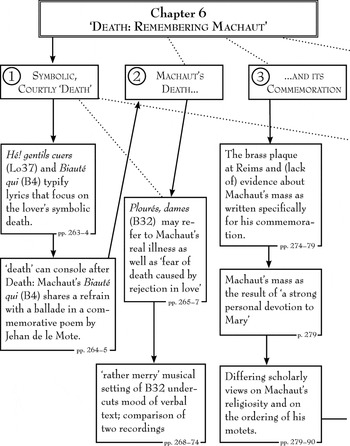
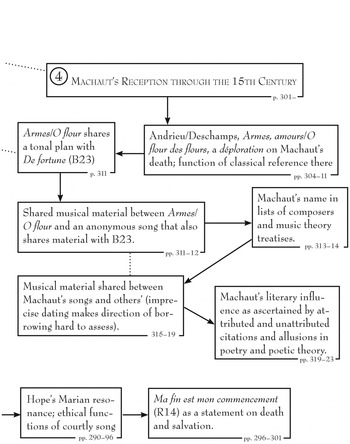
Appropriately for a book that begins with ‘Life’, the final chapter of Guillaume de Machaut is ‘Death: Remembering Machaut’. The title here implies reception, and this is one of several senses in which death is explored. The others are Machaut's actual death, his preparations for it, and the poetical ‘death’ which courtly lovers endure when their affections are not reciprocated. A schematic outline of the chapter is given as Figure 1, which here serves better than a summary because it can succinctly represent the links Leach articulates between these four different aspects of death and commemoration. Here, solid lines with arrows indicate the order in which content is presented in the chapter, while dotted lines map out other connections made in the text. As the figure shows, Leach's treatment of ‘death’ is appropriately multivalent. Similar diagrams may be drawn for ‘Hope’ and ‘Love’ as well. Indeed, this approach to the organisation of chapters around broad themes is one of the book's innovations. Chapters 4–6, each over sixty pages long, sequentially treat several complementary but largely separate aspects of their overarching themes.
Summary of chapter 6 (‘Death: Remembering Machaut’). Solid lines with arrows indicate the order in which the four kinds of death (circled numbers) are treated in the chapter. Dotted lines mark other connections drawn in the text.


In the case of chapter 6, the connection between lyrical and actual death is articulated through an analysis of Plourés Dames (Ballade 32), whose context in the Voir dit makes it open to both types of reading. Taking the ballade's seemingly joyful musical setting as a point of departure, Leach shows how it can be read as a ‘a piece of emotional blackmail’ which reminds me that if Machaut does indeed die, there will be no more songs as nice as it (p. 274).
Without a doubt the most provocative section of this chapter – and perhaps of the book – is that on ‘The Christian Machaut’ (pp. 279–301). Here two opposing scholarly camps are identified, which respond differently to ‘the mismatch between Machaut's secular works and his religious life’ (p. 280). One camp, reflective of the left-leaning climate of twentieth-century academia, ‘dismisses religious preoccupation from Machaut's works’, treats the mass as an anomaly or a piece of diplomacy, and stresses the fact that the majority of Machaut's output is secular. The other, ‘more recently ascendant’, points to Machaut's clerical post at Reims and his several overtly religious works as keys to reading a sacred meaning into his other, ‘seemingly’ secular output (pp. 280–1). There is a hint that the camp boundary is somewhere in the Atlantic: Roger Bowers is held up as a representative of the former group, and Anne Robertson of the American climate in which ‘overt religious expression [is] far more common among politicians and public figures’ (p. 282, n. 62).
Leach summarises the evidence for and against each camp's arguments in an even-handed and illuminating way (pp. 283–8). Where she herself stands is for a time hard to ascertain. Her characterisation of the secular camp's assertion that ‘a cleric like Machaut can be viewed … as a kind of civil servant, using the church to secure his income, and not a “conviction cleric”’ resonates with her exposition on ‘Machaut's living’ in chapter 1, where she argues, with Bowers, that Machaut's benefices were income meant to keep him with his princes, not pull him away from them and towards the church (pp. 19–20). On the other hand, she expresses distrust in chapter 2 of the distorting effect of ‘the liberal Western academy [which] tends to re-form its most prized subjects in its own democratic soft-left image’ (p. 76). In the end, the latter impulse seems to win out, and Leach adduces further evidence to support ‘the thrust of Robertson's interpretations, if not … her predominant emphasis on mystical literature and biblical commentaries’ (p. 290). The evidence in question is a recent argument by Sylvia Huot that, in a passage from Jean Froissart's Joli buisson de Jonece, a character's performance of ‘a new motet’ from Reims serves as a pivot from a courtly scene to a devotional one.Footnote 12
It is in some ways surprising that Leach sides with Robertson here. In addition to her discussion of Machaut's income cited above, evidence against the ‘American’ camp's reading might be found in the Prologue, which acts as a unifying voice for so many other parts of Guillaume de Machaut. Looking in this allegorical poem for Christian symbols, we find some embedded in a discussion of Music's power:
From here Machaut goes on to describe the miraculous singing power of two famous musicians – David, who ‘wanted to appease the anger of God’, and Orpheus, who ‘released Eurydice, that attractive and elegant woman, from Hell … these are manifest miracles Music creates. It's true, certainly.’ There's plenty of pious sentiment here, but it is surely significant that the mention of angelic song, and of the divine office, is being used to prove music's importance – and not the other way around. Even the saints ‘couldn't sing without music for their song’. Perhaps the idea that, for Machaut, the mass is exemplary of music's power, and not music of the mass's, might have too flippant a ring to it. Leach admires Robertson's ‘seriousness about the seriousness of Machaut's message’, and has elsewhere articulated the insufficiency of frivolity as a raison d'être for medieval musical works.Footnote 14 Her reading of the famous palindromic rondeau Ma fin est mon comencement is in line with this view: in addition to being ‘an artful piece of pleasure … that has elements of play’ for singers, readers and listeners: ‘R14 [(Ma fin)] is a seriously ethical statement on existence, forcing its singers and listeners to mediate on their own bodily deaths (since they come from, and go to, dust) and on their own soul's salvation (since the beginning and end is Christ – the consonant music of the universe’ (p. 298). Clearly pleasure and ethics are not mutually exclusive, and Leach's reminder that medieval courts were places where religious and secular culture coexisted ties together the two types of death that lie at the core of the chapter.
The final section of chapter 6 turns to Machaut's ‘immediate afterlife’ – his reception through the fifteenth century (p. 262). The end of the chapter thus connects neatly to the ‘Resurrection’ of Machaut's works and reputation as it is described in chapter 2.
In the course of Guillaume de Machaut, Leach pays a great deal of attention to order – appropriately so, given Machaut's concern for ordenance. In several cases, this involves teasing out narratives from adjacent lyrics. For example, Ballades 12 and 13 are used to illustrate the transition from Desire's influence to Hope's in chapter 4. In this context the latter work is singled out as ‘one of the most compact statements of the power of Hope to be found in Machaut's works’ (p. 133). But it may in fact be too compact. ‘Esperance’ is the first word, but she is not the only character here: she shares the first stanza with Dous Penser, Amours and Plaisant Accueil:
This state of things is contrasted with that articulated in Pour ce que tous (Ballade 12), in which an unhappy lover makes ‘songs of sorrowful sentiment’.Footnote 16 Because the two ballades are adjacent and they share a rhyme – ‘-ueil’ (as a result of which they also share three words: ‘accueil’, ‘dueil’, ‘recueil’) – and because one articulates a sad situation and the other begins with ‘Esperance’, they are read as a summary of hope's ability to sustain the lover. But it would perhaps be as easy to call them adjacent contrasting lyrics.
The link constructed between the ballades Il m'est avis (Ballade 22) and De Fortune (Ballade 23) at the head of chapter 5 is more convincing, since both songs explicitly refer to Fortune. Later these two serve as a frame for a series of lyrics from the Loange des Dames (Lo. 189–94), which ‘treats the theme of Fortune from a number of viewpoints that expressly link it to the issues of gossip and rumor’ (p. 255).Footnote 17 Only one of these – the rondeau Helas! pour ce que Fortune m'est dure (Lo. 189) – mentions Fortune by name; another describes women in terms that evoke the goddess (Lo. 193), two focus on gossip (Lo. 190, 192), and another ‘[exemplifies] the correct course of action’ for cheerfully suffering lovers (Lo. 191, p. 255). The last ballade in the series, Il n'est dolour (Lo. 194) is spoken in the voice of a woman pledging loyalty to her lover, an image that would not seem to fit within the same story, harking back instead to the poetics of Hope and joy articulated in chapter 4.Footnote 18 But Leach suggests that we identify the speaker of this lyric with the je of De Fortune, ‘in which another (the “same”) feminine voice begins to doubt her lover’ (p. 257). Proximity is made to do a lot of work here. In fact Il n'est dolour and De Fortune are separated by another balade in MSS Vg, B and D, and De Fortune is missing in MS E.Footnote 19 This of course in no way precludes an interpretation that takes the order in MSS A and C as its point of departure. But it does remind us that Machaut's courtly poetry is unified enough in its themes that other orderings of these poems might well make an equal amount of sense. It is as easy to imagine that the Loange tells the stories of a limited set of lovers (the same dame in Il n'est dolour and De Fortune) as that it evokes a multitude of singular voices exploring the subtle facets of courtly love from as many perspectives are there are poems.
As Ardis Butterfield and Lawrence Earp both note in their dust-jacket blurbs, Guillaume de Machaut is a synthetic book. It brings together a wide variety of perspectives from several fields, and creates a provocative new whole that is far more than a summary. The book models several approaches to integrating other scholars’ arguments with the exposition of new views. In all cases the detailed and helpful footnotes clarify whose argument is being presented. As for the main text, the rhetorical tactic depends to some extent on the scholar in question. Leach is gracious and explicit about her dependence on Earp, whose Guide to Research is woven seamlessly into the fabric of Guillaume de Machaut: ‘Any recent book on Machaut that is not heavily reliant on Earp's guide is a bad book, and what follows here will at times read like a lyricization of Earp's ever-useful narrative’ (p. 5). Chapters 1 and 6, which deal with reception, are the ones most indebted to Earp. Other authors are frequently present in the main narrative. For example, Roger Bowers is generally named in the main text when his views vis-à-vis Machaut's biography are summarised, as on pp. 29–30 and especially pp. 276–9. Similarly, when the argument from ‘Sarah Kay's book on French didactic poetry’ is presented on pp. 252–3, Kay is named eleven times in two pages. On the other side of the spectrum is Sylvia Huot, whose work is cited frequently throughout the book, but whose name is largely absent from the main text. A case in point is chapter 3, in which the discussions of Hope's role in Machaut's poetics and of poetry as consolation are heavily conditioned by Huot's work and especially her article ‘Guillaume de Machaut and the Consolation of Poetry’. Again, this is clear from the notes – on pp. 170–6 this article alone is cited twelve times. But Huot's name is given only once in this span.Footnote 20 Furthermore, in several places in this and other chapters, Huot's prose is quoted directly in the main text in support of the current argument, while her name appears only in the corresponding footnote. In four cases, the quotation is from this same article; in one it is from From Song to Book.Footnote 21
These different approaches to the work of different scholars highlight the difficulties of the synthetic approach – difficulties which, on the whole, Leach navigates masterfully. She has read, and is in dialogue with, an impressive array of literature, and is nevertheless able to project an authoritative voice which – not unlike Machaut's own – confidently says ‘I’. Machaut's book, after all, is also synthetic.
And just as her own work draws on the work of scholars in a series of disciplines, Leach has made an effort to make her book accessible to an equally wide variety of scholars. To this end, she includes a glossary of relevant musical terms (from ‘ambitus’ to ‘voice part’, pp. 327–36) and takes time to explain musical concepts patiently and clearly without dumbing down her arguments. For example, in the course of the discussion of De triste cuer/Quant/Certes (pp. 103–17) Leach teaches us about polytextuality, counterpoint and the cantus–tenor framework while also engaging in a sophisticated reading of Machaut's poetics of joy as they are manifest in this piece.Footnote 22 This is the best kind of writing, because there is something here for everyone.
That is, provided they are interested in Machaut. For Leach's book is unabashedly centred around Machaut – which perhaps goes without saying. This is not to say that Machaut is the only character in it. The pages include other agents, fictional (Toute Belle, Hope) and real (Deschamps, Chaucer); general (‘court servants who sang his songs or nobles who heard them’, p. 324) and specific (Yolande of Bar); medieval, modern (Robert Guiette) and postmodern (Sylvia Huot). But Machaut – or rather his oeuvre and the poetics that underlie it – is the hero. Philippe de Vitry's unexpected appearance in the penultimate paragraph of the book is therefore something of a surprise. He has received only passing reference up to this point:
What this sketch of Machaut's immediate reception history shows is that, wonderful as they are, the Machaut manuscripts have not misrepresented or overrepresented his historical importance … As a musician he shared an international contemporary reputation with Philippe de Vitry. In light of the fact that Vitry partook of the literate tradition of music theory and that much of his influence on the musical tradition can be linked to this fact, Machaut is by far the more influential on other composers through the media of music and poetry.
This is a strange assessment for a number of reasons, not least of which is that Vitry is no longer thought to have written a music theory treatise. Over twenty-five years ago Sarah Fuller showed that the group of treatises which speak of a new manner of composition reflect Vitry's practices rather than his writings.Footnote 23 In other words, the notation treatises, along with a body of motets (including some of Machaut's) which Daniel Leech-Wilkinson has argued are modelled on Vitry's, are attestations precisely to his influence on composers through his music.Footnote 24
The passage quoted above is perhaps indicative of a certain insecurity – not only in Guillaume de Machaut, but in Machaut studies in general – about the extent to which our picture of Machaut is skewed by the survival of his complete works manuscripts and by his own ego (indeed the two are linked). If we did not have the manuscripts, what would we have? True, ‘no contemporary evidence suggests that Machaut's work was anything other than highly regarded by his contemporaries’, but this is hardly a strong assertion (p. 74). It is also perhaps the case that not as much evidence as we would like suggests that Machaut was a highly regarded composer.Footnote 25 On the other hand, everything we access from the Middle Ages is skewed by the vagaries of survival of evidence. That Machaut is extraordinary is clear from his work, and it is made amply more clear by the sensitive treatment which that work receives in Leach's important new book.
For this is a book about Machaut, and it is the most wide-ranging one since Earp's Guide to Research. Leach has something perceptive to say about almost every genre in which the poet-composer wrote, and her ability to combine small points with big – to move from analyses of individual works or parts of works to big-picture arguments about themes as central to Machaut's world (and our own) as Hope, Fortune and Death – is thrilling. The author has read a dizzying amount of literature and combined it seamlessly with her own sensitive analyses. The result is not a ‘Life and Works’; Guillaume de Machaut convinces that the ‘Life and Works’ can never be written. Instead this is a book about the life of Machaut's works, and the ways in which our understanding of them has been shaped by readers, scholars, sources, and centuries of sens, music and rhetoric.