Introduction
The incidence of schizophrenia was long held to be homogeneous worldwide, leading to an emphasis on the genetic determination of the condition rather than on the contribution of social or environmental factors (Jablensky et al. Reference Jablensky, Sartorius and Ernberg1992). This tenet has been challenged, based on reports of significant variation in incidence between and within countries according to gender, urbanicity and, in particular, migration and ethnicity (McGrath et al. Reference McGrath, Saha, Welham, El Saadi, MacCauley and Chant2004; Cantor-Graae & Selten, Reference Cantor-Graae and Selten2005; Fearon et al. Reference Fearon, Kirkbride, Morgan, Dazzan, Morgan, Lloyd, Hutchinson, Tarrant, Fung, Holloway, Mallett, Harrison, Leff, Jones and Murray2006). An association between migration and schizophrenia was first described by the pioneer Ödegaard (Reference Ödegaard1932), who observed an increased risk among Norwegians migrants to the USA in the early twentieth century. However, only in recent decades has an interest in migration and schizophrenia been rekindled, especially after consistent reports of high incidence rates in Caribbean migrants to the UK (Harrison et al. Reference Harrison, Glazebrook, Brewin, Cantwell, Dalkin, Fox, Jones and Medley1997; Sharpley et al. Reference Sharpley, Hutchinson, McKenzie and Murray2001; Fearon et al. Reference Fearon, Kirkbride, Morgan, Dazzan, Morgan, Lloyd, Hutchinson, Tarrant, Fung, Holloway, Mallett, Harrison, Leff, Jones and Murray2006). Such elevated incidence rates were noted initially in the decades that followed large migration waves from Commonwealth countries after the Second World War. Later investigations of the incidence of schizophrenia have extended to other European countries. Increased incidence rates have been reported among Moroccan, Surinamese and Antillean migrants to The Netherlands (Selten & Sijben, Reference Selten and Sijben1994; Selten et al. Reference Selten, Slaets and Kahn1997; Veling et al. Reference Veling, Selten, Veen, Laan, Blom and Hoek2006), and among migrants in Denmark and Sweden (Cantor-Graae et al. Reference Cantor-Graae, Pedersen, McNeil and Mortensen2003; Leao et al. Reference Leao, Sundquist, Frank, Johansson, Johansson and Sundquist2006; Cantor-Graae & Pedersen, Reference Cantor-Graae and Pedersen2007). These studies have found increased rates of schizophrenia not only among first-generation immigrants (FGIs), who have a personal history of migration, but also among the growing population of second-generation immigrants (SGIs), their children born in the host society context. It was suggested that the risk may be even higher for SGIs than for FGIs (Harrison et al. Reference Harrison, Owens, Holton, Neilson and Boot1988). More recent studies in the UK have reported that migrants are at risk for all psychoses, and not only schizophrenia (Fearon et al. Reference Fearon, Kirkbride, Morgan, Dazzan, Morgan, Lloyd, Hutchinson, Tarrant, Fung, Holloway, Mallett, Harrison, Leff, Jones and Murray2006; Coid et al. Reference Coid, Kirkbride, Barker, Cowden, Stamps, Yang and Jones2008). A meta-analysis of 18 migrant studies found that a personal or family history of migration was associated with an approximately threefold risk elevation for schizophrenia (Cantor-Graae & Selten, Reference Cantor-Graae and Selten2005). Significantly higher risk estimates were observed among migrants from developing countries and among those from areas where the majority of the population is black. The authors also observed a higher risk for SGIs than FGIs; however, the meta-analysis was not adequately powered to provide a precise risk estimate, with only seven effect sizes from small second-generation samples.
Migration is now being increasingly recognized as a risk factor for schizophrenia (Selten et al. Reference Selten, Cantor-Graae and Kahn2007; Tandon et al. Reference Tandon, Keshavan and Nasrallah2008). Yet the relationship between migration and psychotic disorders remains unexplained. So far, biological factors, such as cannabis use or obstetric complications, have failed to account for the risk of schizophrenia among migrant groups (Fearon & Morgan, Reference Fearon and Morgan2006). In addition, socio-environmental factors, such as urbanicity, discrimination or socio-economic deprivation, are now being looked upon as potential contributing factors for psychotic disorders in migrants (Cantor-Graae, Reference Cantor-Graae2007). It is uncertain whether SGIs have a similar or even a higher risk than FGIs. Such determination is crucial to explain the association between migration and schizophrenia, and may provide valuable clues to understanding the social determinants of psychotic disorders. Indeed, the persistence or elevation of the risk in the second generation could not be strictly explained by a selection hypothesis or genetic factors, and would further highlight the role of post-migration factors. It should be noted that migrant studies and generational differences have yielded significant advances in uncovering the role of environmental factors in other conditions (Lin & Kelsey, Reference Lin and Kelsey2000), such as breast cancer and multiple sclerosis (Ramagopalan et al. Reference Ramagopalan, Dyment and Ebers2008).
Systematic reviews and meta-analyses provide a transparent approach to identify, abstract and critically appraise pertinent studies and integrate their results. In addition, they can widen the base of studies by addressing broader questions and exploring patterns of results from primary studies (Egger et al. Reference Egger, Smith and Altman2001). The current study is a meta-analytic review of population-based studies of the incidence of schizophrenia and related disorders among FGIs and SGIs. The aims of the study were: (1) to determine whether SGIs are at increased risk for schizophrenia and related disorders in comparison with non-migrant groups; (2) to determine the magnitude of the risk among SGIs compared to that of FGIs; and (3) to investigate potential sources of variation in the risk for psychosis among immigrants. To answer these questions, we conducted a meta-analysis to provide an estimate of the risk for schizophrenia and related disorders separately for FGIs and SGIs. The methodology for this study is based on the Meta-analysis of Observational Studies in Epidemiology (MOOSE) guidelines (Stroup et al. Reference Stroup, Berlin, Morton, Olkin, Williamson, Rennie, Moher, Becker, Sipe and Thacker2000).
Method
A librarian-assisted computerized search strategy was applied to Medline, PsycINFO and EMBASE databases to identify potentially relevant articles published between January 1977 and December 2008. A highly sensitive search string was developed with database-specific medical subject headings for the ‘migration’, ‘psychosis’ and ‘schizophrenia’ concepts. Reference lists of relevant articles were screened to locate additional articles, including a previous extensive review of schizophrenia incidence studies (McGrath et al. Reference McGrath, Saha, Welham, El Saadi, MacCauley and Chant2004). Forward and backward citation tracking was completed using the Web of Science. Experts on migration and psychosis were also contacted to ensure no study had been missed.
Specific criteria for inclusion in the review were established a priori to minimize methodological variations of studies to be entered in the meta-analysis. Studies were included in the review if they were: (1) published in a peer-reviewed journal in or after 1977; (2) written in English, French, Spanish, Dutch or German; (3) population-based incidence studies (first admission or first contact) of schizophrenia, first-episode psychosis or psychotic disorders in general; (4) reporting incidence rates for ⩾1 migrant group and a reference group (or numerator/denominator data that enabled such computations); (5) differentiating first- from second-generation migrants; and (6) providing age-adjusted incidence data. In light of the methodological concerns affecting early migrant studies, we selected 1977 as a conservative lower publication time limit for inclusion in our study, as did Cantor-Graae & Selten (Reference Cantor-Graae and Selten2005). Cochrane's study was the first to rigorously account for potential demographic differences between migrant and non-migrant populations (Cochrane, Reference Cochrane1977). Moreover, it is only in recent decades that researchers have investigated SGIs and differentiated them from foreign-born migrants.
All retrieved citations were screened independently by two reviewers in a threefold process, and selected after consensus. Citations were first screened for relevance using broad criteria. The second screen was based on abstracts and excluded studies that clearly did not meet ⩾1 inclusion criteria. Full-text articles were scrutinized in the final screen. When eligible studies reported findings from overlapping populations, we selected the version of the study with the largest sample size or the longest study period.
Detailed quantitative and qualitative data were extracted independently by two reviewers. The internal validity of each study was assessed based on methodological features and potential for selection bias, information bias and confounding. Each study attained a numeric quality score, using the scale from a prior systematic review of schizophrenia incidence studies (McGrath et al. Reference McGrath, Saha, Welham, El Saadi, MacCauley and Chant2004). As there is no consensus on using quality scores in meta-analyses of observational studies (Stroup et al. Reference Stroup, Berlin, Morton, Olkin, Williamson, Rennie, Moher, Becker, Sipe and Thacker2000), we conducted a broad quality appraisal and classified studies into higher, average and lower quality ranges. Studies were later stratified to determine whether their quality impacted on pooled effect sizes (Pai et al. Reference Pai, McCulloch, Gorman, Pai, Enanoria, Kennedy, Tharyan and Colford2004). Incidence data were extracted for each FGI and SGI group identified and also for their native counterparts. Given the large differences in data reporting and the need for comparable estimates for comparison and pooling purposes, incidence rate ratios (IRRs) were selected as the index measure of effect associated with migrant status. IRRs were preferred for their optimal statistical properties and their more intuitive meaning as risk estimates (Cooper et al. Reference Cooper, Hedges and Valentine2009). Age- and sex-adjusted IRRs were extracted or computed for each migrant group identified. Gender-specific IRRs were extracted when available. Authors were contacted when necessary, to ensure accuracy and completeness of data.
A descriptive synthesis of selected studies was first completed by tabulating the main study characteristics, including settings, observation periods, study populations and design features. Prior to initiating meta-analyses, the variance for each effect size was estimated using the same formula applicable to rate ratios (Borenstein et al. Reference Borenstein, Hedges, Higgins and Rothstein2009 a; Borenstein, Reference Borenstein2010): Variance=1/N m+1/N r, where N m is the number of migrant cases and N r is the number of reference cases. Variance estimates determine the weight of each effect size, more precise studies generally being assigned more weight. Analyses were conducted on a log scale to avoid the skewed distribution associated with IRR measures. A first analysis was conducted based on a comprehensive dataset including all available effect sizes to yield a pooled estimate of their risk for schizophrenia and related disorders in FGIs and SGIs. In an attempt to minimize heterogeneity due to methodological variation, a second analysis was conducted from the subset of studies that reported data on both migrant generations. The potential for publication bias was assessed by examination of a funnel plot displaying the standard errors of studies relative to their effect sizes, with the underlying assumption that non-publication of smaller studies would lead to an asymmetry in the expected funnel shape.
Analyses were conducted under the random-effects model, which, unlike a fixed-effects model, assumes that studies will have different true effect sizes as a result of variations in methodology or study populations (Borenstein et al. Reference Borenstein, Hedges, Higgins and Rothstein2009 b). Based on prior knowledge, it was expected that ethnicity and study countries would probably underlie variation across effect sizes. It also seemed unlikely that methods and populations could be regarded as equivalent across studies. A random-effects model was therefore justified a priori, presuming that true effects were distributed randomly around the mean effect size and considering two sources of variance: the within-study error and the between-studies variance. The latter refers to heterogeneity, which was estimated by Cochran's Q and I 2 statistics (Borenstein et al. Reference Borenstein, Hedges, Higgins and Rothstein2009 c). First, QW (Q within) was calculated for each analysis to determine whether heterogeneity was present across effect sizes, as suggested by a significant p value. The between-category homogeneity statistic QB was also used to test whether risk differences between various groups were significant.
Subgroup analyses served as the primary mode of investigating heterogeneity as they have the potential to identify relevant effect moderators, which may include substantive or methodological variables (Song et al. Reference Song, Sheldon, Sutton, Abrams and Jones2001). A possible gender effect was examined based on the available sex-specific effect sizes. We also examined the potential effect of visible minority status, based on the classification used by Statistics Canada (2008). Migrant groups were classified as either ‘black’, ‘other’ (non-black non-white) or ‘white’, based on the skin color of the majority population in migrants' countries of origin. An additional analysis was conducted to determine the potential effect of sociopolitical context by grouping effect sizes according to the main host countries. We also conducted a sensitivity analysis to test the robustness of findings (Egger et al. Reference Egger, Smith and Altman2001). An analysis including only higher quality studies was conducted to determine whether quality impacted the summary effect sizes. Sensitivity analyses were also conducted for two potentially salient design features: case ascertainment and diagnostic categorization. Effect sizes derived from all first-contact studies were compared to those from studies based on first-admissions only. We analyzed separately the studies that used standardized DSM-IV criteria for schizophrenia and those that used ICD-8, -9 or -10 criteria. Analyses were carried out using the Comprehensive Meta-Analysis statistical software, version 2.2 (Borenstein et al. Reference Borenstein, Hedges and Higgins2005).
Results
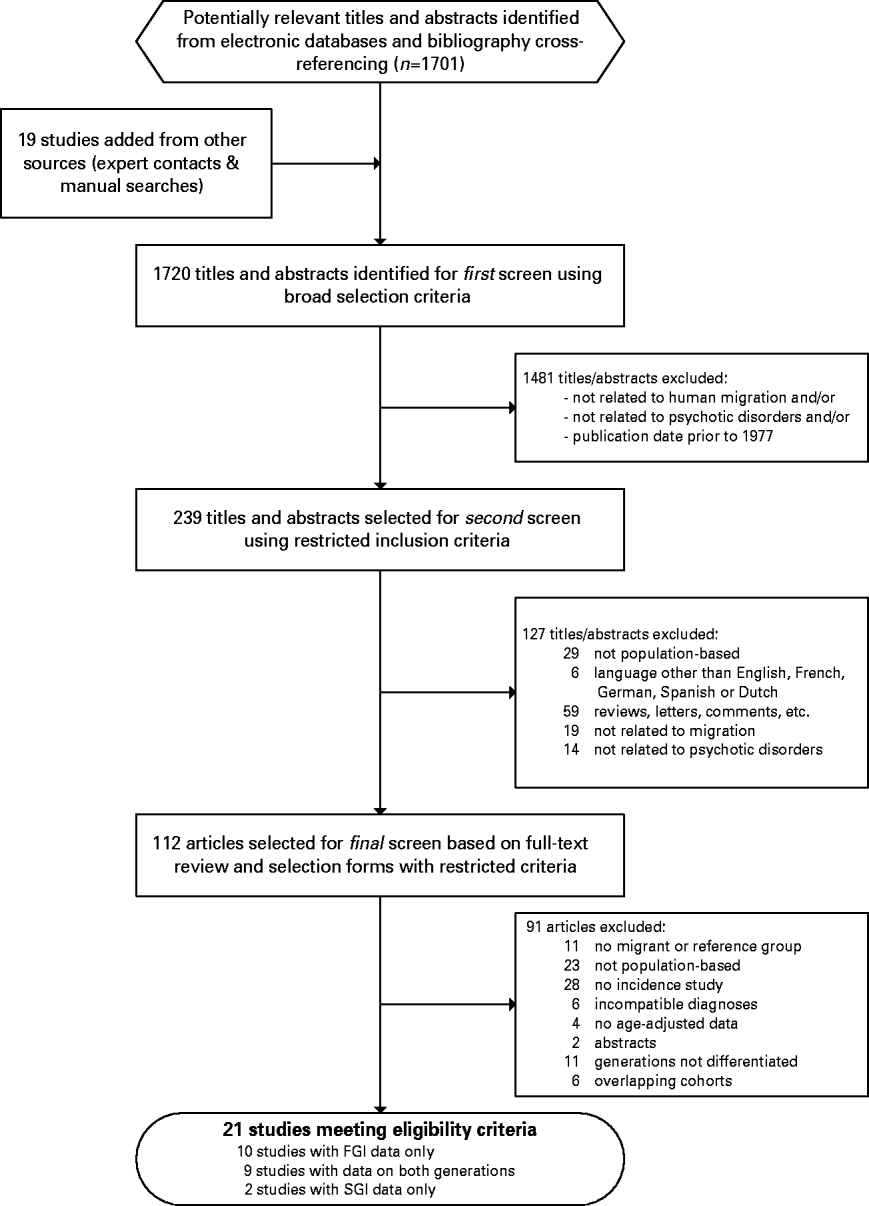
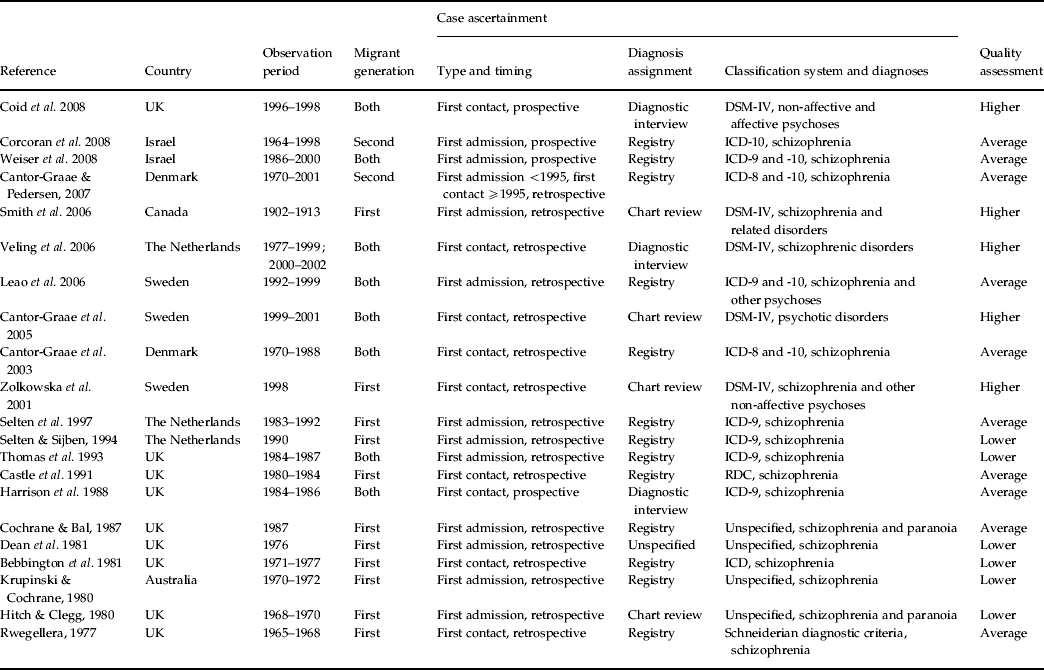
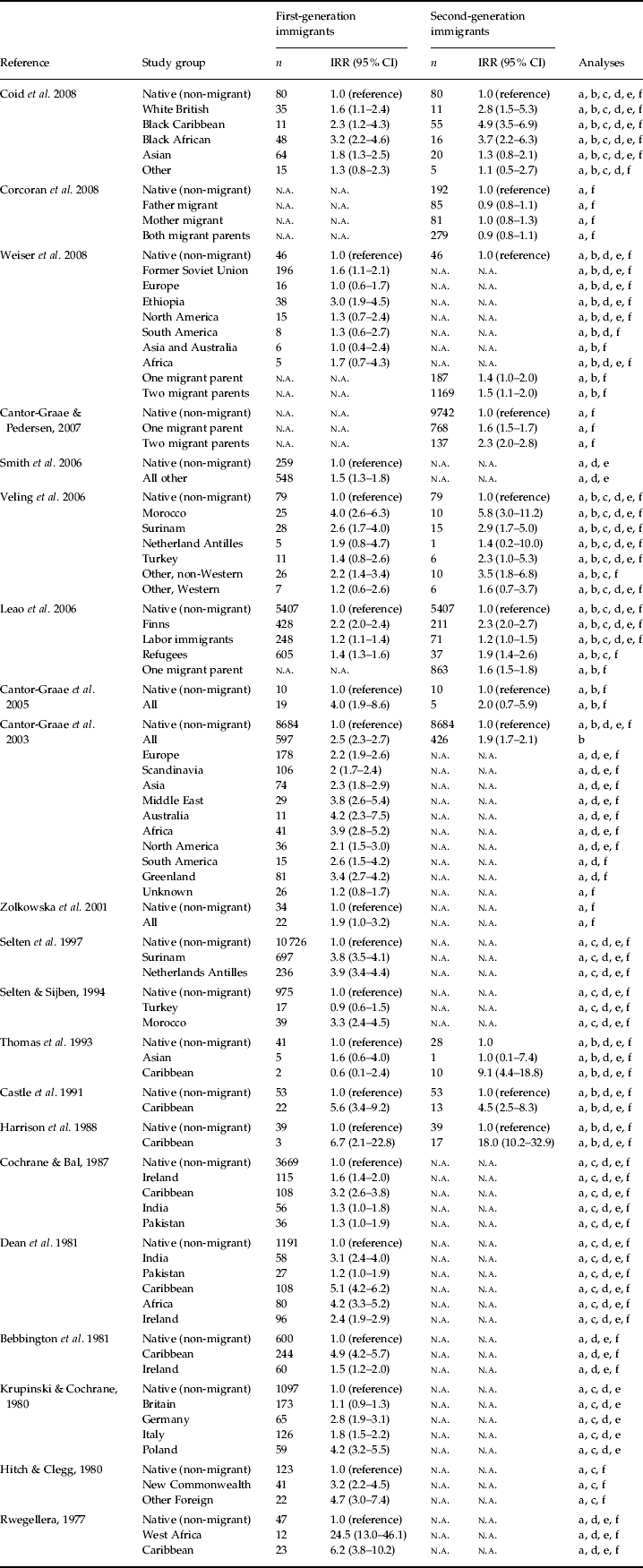
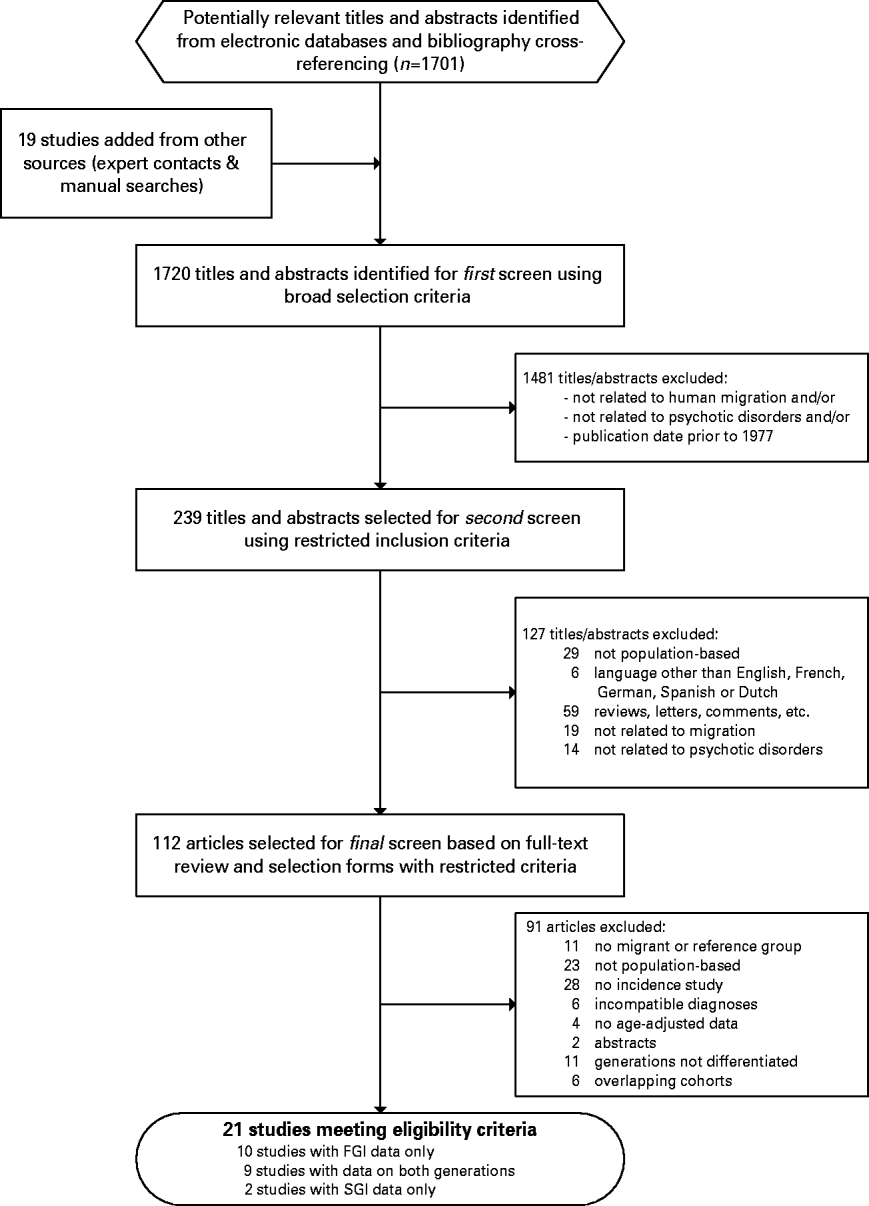
Out of 1720 potentially relevant publications, we identified 21 population-based migrant studies (Fig. 1). We extracted 61 FGI effect sizes and 28 SGI effect sizes, providing information on 5508 and 4422 cases respectively. Study characteristics are presented in Table 1 and their effect sizes are listed in Table 2. Among the retrieved studies, nine were conducted in the UK (Rwegellera, Reference Rwegellera1977; Hitch & Clegg, Reference Hitch and Clegg1980; Bebbington et al. Reference Bebbington, Hurry and Tennant1981; Dean et al. Reference Dean, Walsh, Downing and Shelley1981; Cochrane & Bal, Reference Cochrane and Bal1987; Harrison et al. Reference Harrison, Owens, Holton, Neilson and Boot1988; Castle et al. Reference Castle, Wessely, Der and Murray1991; Thomas et al. Reference Thomas, Stone, Osborn, Thomas and Fisher1993; Coid et al. Reference Coid, Kirkbride, Barker, Cowden, Stamps, Yang and Jones2008), three in The Netherlands (Selten & Sijben, Reference Selten and Sijben1994; Selten et al. Reference Selten, Slaets and Kahn1997; Veling et al. Reference Veling, Selten, Veen, Laan, Blom and Hoek2006), three in Sweden (Zolkowska et al. Reference Zolkowska, Cantor-Graae and McNeil2001; Cantor-Graae et al. Reference Cantor-Graae, Zolkowska and McNeil2005; Leao et al. Reference Leao, Sundquist, Frank, Johansson, Johansson and Sundquist2006), two in Israel (Corcoran et al. Reference Corcoran, Perrin, Harlap, Deutsch, Fennig, Manor, Nahon, Kimhy, Malaspina and Susser2008; Weiser et al. Reference Weiser, Werbeloff, Vishna, Yoffe, Lubin, Shmushkevitch and Davidson2008), two in Denmark (Cantor-Graae et al. Reference Cantor-Graae, Pedersen, McNeil and Mortensen2003; Cantor-Graae & Pedersen, Reference Cantor-Graae and Pedersen2007), one in Australia (Krupinski & Cochrane, Reference Krupinski and Cochrane1980) and one in Canada (Smith et al. Reference Smith, Boydell, Murray, Flynn, McKay, Sherwood and Honer2006). The single North American study was conducted recently but was based on hospital data from the early twentieth century (Smith et al. Reference Smith, Boydell, Murray, Flynn, McKay, Sherwood and Honer2006). Despite its much earlier observation period, it met all inclusion criteria and it used methods similar to that of contemporary studies. Almost all IRRs indicated higher risks for schizophrenia and related disorders among migrants than in their native counterpart. This held for both FGIs and SGIs (Table 2), with the exception of the Israel-based SGI cohort study (Corcoran et al. Reference Corcoran, Perrin, Harlap, Deutsch, Fennig, Manor, Nahon, Kimhy, Malaspina and Susser2008).
Study selection flowchart.
Basic characteristics and quality assessment of studies included in the meta-analysis

RDC, Research Diagnostic Criteria.
Incidence rate ratios (IRRs) and analyses for each migrant group in the meta-analysis

n, Sample size; CI, confidence interval; n.a., not applicable; a, meta-analysis from the comprehensive dataset; b, meta-analysis from the restricted data; c, gender-specific analysis; d, visible minority category analysis; e, ethno-racial category analysis; f, analysis based on host country.
All effect sizes from the comprehensive dataset were included in the urbanization, incidence type, diagnostic system and quality rating subgroup analyses.
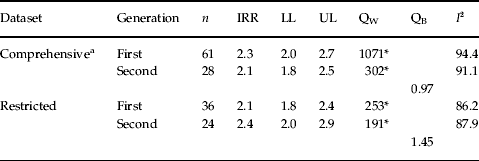
Analyses based on the comprehensive dataset (Table 3) yielded mean-weighted IRRs estimates of 2.3 [95% confidence interval (CI) CI 2.0–2.7] and 2.1 (95% CI 1.8–2.5) for FGIs and SGIs respectively. The magnitude of the risk did not differ significantly between the first and the second generations, as also indicated by the non-significant QB statistic. Both analyses were statistically significant for heterogeneity within subgroups, indicating that various migrant groups should not be regarded as coming from a homogeneous population sharing a common effect size. The second analysis based on the subset studies that reported data for both generations yielded IRRs of 2.1 (95% CI 1.8–2.4) and 2.4 (95% CI 2.0–2.9) for FGIs and SGIs respectively. Although much reduced in absolute value, heterogeneity remained statistically significant within both groups.
Main meta-analyses for first- (FGIs) and second-generation immigrants (SGIs)

n, Number of effect sizes; IRR, incidence rate ratio; LL, lower limit; UL, upper limit; QW, within-category homogeneity statistic; QB, between-category homogeneity statistic.
Levels of significance
* p<0.01.
a An analysis of the distribution of effect sizes yielded median IRR estimates (with 10% to 90% quantiles) of 2.1 (1.2 to 4.7) and 2.0 (1.0 to 5.2) for FGIs and SGIs, respectively.
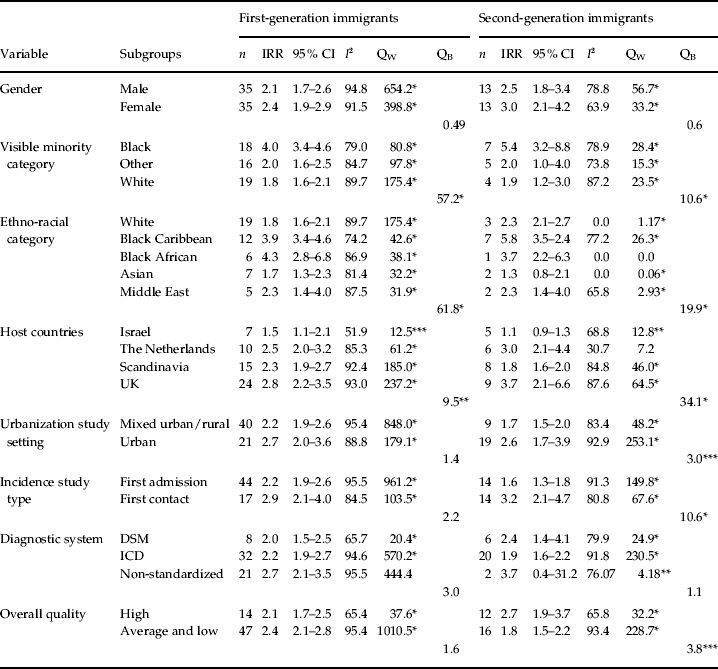
A careful exploration of heterogeneity was conducted through subgroup analyses based on the comprehensive dataset (Table 4). No significant differences were observed when comparing the risk of male versus female immigrants. However, significant between-group differences emerged when migrant groups were categorized according to the skin color of the majority of the population in their countries of origin. The mean-weighted IRR for FGIs from areas where most of the population is black was 4.0 (95% CI 3.4–4.6) versus 1.8 (95% CI 1.6–2.1) for groups classified as ‘white’ and 2.0 (95% CI 1.6–2.5) for groups classified as ‘other’. Risk estimates for migrant groups classified in the ‘black’ visible minority category were even higher for SGIs, with IRR 5.4 (95% CI 3.2–8.8) versus 1.9 (95% CI 1.2–3.0) for the ‘white’ category and 2.0 (95% CI 1.0–4.0) for the ‘other’ category.
Results of subgroup analyses for categorical moderators

n, Number of effect sizes; IRR, incidence rate ratio; QW, within-category homogeneity statistic; QB, between-category homogeneity statistic.
Levels of significance
* p<0.01, ** p<0.05, *** p<0.10.
Significant between-group heterogeneity was observed when grouping migrants according to host countries. For both generations, the highest IRRs were obtained in the UK (2.8 and 3.7 for FGIs and SGIs respectively), followed by The Netherlands (2.5 and 3.0) and Scandinavian countries (2.3 and 1.8). The lowest IRRs were observed in Israel (1.5 and 1.1). No significant between-group differences were observed when comparing urban settings to mixed rural–urban settings.
The results of first-admission studies, based on hospital admission incidence rates, were compared to those of first-contact studies, based on any first contact for psychosis, whether in hospital or in the community. There was a non-significant trend towards higher risk estimates in first-contact than in first-admission studies for FGIs, with respective IRRs of 2.9 (95% CI 2.1–4.0) and 2.2 (95% CI 1.9–2.6). However, significant differences emerged for SGIs, for whom first-contact studies yielded a mean-weighted IRR of 3.2 (95% CI 2.1–4.7), as opposed to 1.6 (95% CI 1.3–1.8) in first-admission studies, with statistically significant between-group heterogeneity (QB=10.6, p<0.01).
There were no significant effect differences between studies with non-standardized diagnostic classifications and those based on DSM-IV or ICD-8, -9 or -10. Sensitivity analyses based on methodological quality revealed no significant differences when higher quality studies were compared with studies in mid-quality and lower quality ranges. Higher quality studies yielded slightly higher risk estimates for the second generation, with a mean IRR of 2.7 (95% CI 1.9–3.7) for SGIs as opposed to 2.1 (95% CI 1.7–2.5) for FGIs. The examination of generation-specific funnel plots did not reveal any asymmetry suggestive of publication bias (available from the authors on request).
Conclusions
Our review confirms that an increased risk for schizophrenia and related disorders affects not only FGIs, with a personal history of migration, but also SGIs born to one or two migrant parents in the host country. This finding held for nearly all migrant groups identified. Our relative risk estimates are comparable for both migrant generations. Our review echoes previous findings of significant heterogeneity in incidence rates of schizophrenia and of increased risk associated with migration (McGrath et al. Reference McGrath, Saha, Welham, El Saadi, MacCauley and Chant2004; Cantor-Graae & Selten, Reference Cantor-Graae and Selten2005), but advances the literature in demonstrating the persistence of the risk in a similar magnitude in the second generation. This strongly suggests that post-migration factors are more important than pre-migration factors, such as selective migration or migration per se, in conferring an increased risk for psychotic disorders among immigrants. In addition, it may be more accurate to refer to migrant status than to migration in relation to the risk of psychosis. With 61 and 28 effect sizes for FGIs and SGIs respectively, our review could generate more precise estimates than prior reviews or individual studies. Relative risk estimates between 2 and 3 emphasize that migrant status, either FGI or SGI, cannot be disregarded as an important risk factor for psychotic disorders, with a risk magnitude within the same range as that associated with cannabis use, urbanicity or perinatal complications (Tandon et al. Reference Tandon, Keshavan and Nasrallah2008).
Significant heterogeneity was observed across FGI and SGI effect sizes, indicating that these could not be regarded as random estimates of a common effect shared by all groups and that other factors contribute to differences between risk estimates. Hence, our summary findings provide overall risk estimate for FGIs and SGIs, but should not be attributed to a specific migrant group. This is similar to the effects of other risk factors estimated at the population level but that may operate differentially within subgroups.
A major concern with any primary migrant study is that of determining whether the observed incidence rates are true or not, in particular for complex conditions such as psychotic disorders. The question of potential misdiagnosis has been the object of considerable debate in the UK, in particular with regard to the Afro-Caribbean population (Sashidharan, Reference Sashidharan1993; Bhui & Tsangarides, Reference Bhui and Tsangarides2008). A meta-analytic review enables us to appraise findings from primary studies in perspective and to note the remarkable consistency of increased risk across a diversity of migrant populations and host society contexts. Although the cross-cultural validity of current diagnostic categories has not been formally established (Alarcón et al. Reference Alarcón, Bell, Kirmayer, Lin, Üstün, Wisner, Kupfer, First and Regier2002), we did not observe significant differences between studies using DSM-IV, ICD-8 or -10 or non-standardized diagnostic criteria, or between higher quality studies and those with average and lower quality ratings. Some recent more rigorous investigations have used diagnoses assigned from clinical information, with blinding from any information about the ethnicity of patients (Fearon et al. Reference Fearon, Kirkbride, Morgan, Dazzan, Morgan, Lloyd, Hutchinson, Tarrant, Fung, Holloway, Mallett, Harrison, Leff, Jones and Murray2006; Coid et al. Reference Coid, Kirkbride, Barker, Cowden, Stamps, Yang and Jones2008). Of note, these investigations have yielded rates even higher than those of prior studies based on chart reviews. Another important methodological issue of early migrant studies in the UK stemmed from the doubts about the reliability of the census data available, especially concerns about the possible under-enumeration of the Afro-Caribbean population (Van Os et al. Reference Van Os, Castle, Takei, Der and Murray1996; Harrison et al. Reference Harrison, Glazebrook, Brewin, Cantwell, Dalkin, Fox, Jones and Medley1997). Indeed, if the denominator underestimated the actual population for a given migrant group, this could give rise to an artificially elevated incidence rate, unlike incidence rates obtained in Scandinavian countries that are generally regarded as having very accurate census data. Some authors have sought to address this issue by applying an estimated correction factor to denominator populations (Harrison et al. Reference Harrison, Owens, Holton, Neilson and Boot1988). However, even large uncertainties could hardly account for the five- to tenfold risk increase in some migrant groups relative to the host population. In addition, studies based on the more accurate 2001 census data still find consistently elevated risk among Caribbean migrants (Fearon et al. Reference Fearon, Kirkbride, Morgan, Dazzan, Morgan, Lloyd, Hutchinson, Tarrant, Fung, Holloway, Mallett, Harrison, Leff, Jones and Murray2006; Coid et al. Reference Coid, Kirkbride, Barker, Cowden, Stamps, Yang and Jones2008).
There were significant generational differences in risk estimates among some groups, especially in Caribbean migrants in the UK (Harrison et al. Reference Harrison, Owens, Holton, Neilson and Boot1988; Thomas et al. Reference Thomas, Stone, Osborn, Thomas and Fisher1993; Coid et al. Reference Coid, Kirkbride, Barker, Cowden, Stamps, Yang and Jones2008) and in Moroccan migrants in The Netherlands (Veling et al. Reference Veling, Selten, Veen, Laan, Blom and Hoek2006). However, these generational differences were not consistent across ethnic groups and countries. Significant between-group heterogeneity emerged when effect sizes were grouped according to study settings, with the highest estimates being observed in the UK, intermediate risk estimates in The Netherlands and Scandinavian countries, and the lowest in Israel. No study revealed a protective effect associated with migrant status. The study of an Israel SGI cohort is the only one in our review that did not observe an association between migrant status and schizophrenia (Corcoran et al. Reference Corcoran, Perrin, Harlap, Deutsch, Fennig, Manor, Nahon, Kimhy, Malaspina and Susser2008). The authors argued that this may result from the differential nature of migration to Israel. Unlike migrants to other European countries, Jewish migrants may in fact leave from a minority position in their source country to a Jewish state in which they are not perceived as ‘outsiders’ and are potentially less exposed to discrimination in the host society. Nonetheless, another Israel-based study found significantly elevated risk among some groups, especially among Ethiopian migrants, who may be considered most dissimilar to the majority population (Weiser et al. Reference Weiser, Werbeloff, Vishna, Yoffe, Lubin, Shmushkevitch and Davidson2008).
Perhaps one of the most important finding of this meta-analysis is the considerable variation in the risk magnitude associated with visible minority status, with immigrants from countries where the majority population is black presenting significantly higher risk for psychosis (IRR 4.0 and 5.4 for FGIs and SGIs respectively) than those from countries where the majority population is white (IRR 1.8 and 1.9 for FGIs and SGIs respectively) or other (IRR 2.0 in either generation). The risk of black migrants seems even higher in the second than in the first generation. A similar risk estimate (RR 4.8 without stratifying for generation) has been reported previously (Cantor-Graae & Selten, Reference Cantor-Graae and Selten2005). Our findings raise questions as to what may underlie an increased risk among migrants from areas as diverse as Jamaica, Surinam or Africa. In the absence of evidence of elevated incidence rates in source countries, such findings point at the contributory role of the social environment and suggest a common exposure to adverse social experiences such as discrimination. Various lines of evidence suggest that this may be the case. The experience of discrimination in itself has been linked to an increased risk of ulterior psychotic experiences (Janssen et al. Reference Janssen, Hanssen and Bak2003). A recent Dutch investigation observed a dose–response relationship between the level of discrimination reported by an ethnic group and the risk of psychoses in that group (Veling et al. Reference Veling, Hoek and Mackenbach2008 a). In addition, it has now been replicated in different studies that the relative incidence of psychotic disorders among immigrants increases as they form a decreasing proportion of the population (Boydell et al. Reference Boydell, van Os, McKenzie, Allardyce, Goel, McCreadie and Murray2001; Kirkbride et al. Reference Kirkbride, Fearon, Morgan, Dazzan, Morgan, Murray and Jones2007; Veling et al. Reference Veling, Susser, van Os, Mackenbach, Selten and Hoek2008 b). Such findings were attributed to the potential exposure to discrimination of isolated migrants and a possible buffering effect of social support in neighborhoods with higher ethnic density. If discrimination is in fact a factor contributing to the risk of psychoses among migrants, it is plausible that the experience of discrimination may vary across ethnic groups, thus contributing to a different risk load for psychosis. Such adverse social experiences may affect both migrant generations similarly.
Although visible minority status of migrant groups may be an important indicator of the risk associated with migration status, its effects seem to be context dependent. Most UK-based investigations have observed higher rates among Caribbean and Black African immigrants (Cochrane & Bal, Reference Cochrane and Bal1987; Harrison et al. Reference Harrison, Owens, Holton, Neilson and Boot1988; Coid et al. Reference Coid, Kirkbride, Barker, Cowden, Stamps, Yang and Jones2008). However, Dutch studies have observed higher rates in Moroccan immigrants than in Surinamese and Dutch Antilleans (Selten & Sijben, Reference Selten and Sijben1994; Selten et al. Reference Selten, Slaets and Kahn1997; Veling et al. Reference Veling, Selten, Veen, Laan, Blom and Hoek2006). Similarly to Black immigrants in the UK, Moroccans seem to be most the most likely to experience discrimination in The Netherlands (Veling et al. Reference Veling, Hoek and Mackenbach2008 a). Although visible minority status may be a relevant variable, the risk observed in a given group may be better conceived as resulting from a dynamic interaction between migrant and ethnic minority groups and host societies. This notion is compatible with the proposed social defeat hypothesis, according to which the chronic experience of social defeat, defined as one of subordinate position or ‘outsider status’ in a given environment, may lead to sensitization of the mesolimbic dopamine system, and an elevated baseline risk for psychotic disorders (Selten & Cantor-Graae, Reference Selten and Cantor-Graae2005, Reference Selten and Cantor-Graae2007).
Based on findings from the recent East London First Episode Psychosis study (Coid et al. Reference Coid, Kirkbride, Barker, Cowden, Stamps, Yang and Jones2008), which found higher incidence rates of psychosis in second- than in first-generation Caribbean migrants, it has been argued that the observed generational differences may actually reflect different age profiles between generations rather than differences in the risk load. We observed that the ethnic groups with the highest risk estimates for psychosis tend to present an even higher risk magnitude in the second generation than in the first, which include groups such as Black Caribbean migrants in the UK and Moroccans in The Netherlands. Although underlying putative risk factors may be comparable between generations, their cumulative effect may be higher among SGIs. Unlike their parents, whose exposure to adverse social experiences probably occurred only after migration, SGIs may be exposed to similar pathogenic effects for longer periods and at an earlier more crucial phase of their development. Even among FGIs, the experience of migration and of the post-migration environment is likely to differ significantly according to age and developmental phase.
Our findings point primarily to socio-environmental determinants, but do not exclude the possibility that other environmental or biological factors may contribute to the association between migrant status and psychotic disorders. There has been no consistent evidence yet to explain the migrant status effect by substance misuse, although this may be a factor in some specific groups (Sharpley et al. Reference Sharpley, Hutchinson, McKenzie and Murray2001; Veen et al. Reference Veen, Selten, Hoek, Feller, van der Graaf and Kahn2002;Cantor-Graae & Selten, Reference Cantor-Graae and Selten2005; Coid et al. Reference Coid, Kirkbride, Barker, Cowden, Stamps, Yang and Jones2008). Similar to the infectious hypothesis for the migration patterns in multiple sclerosis (Gale & Martyn, Reference Gale and Martyn1995), early exposure to viruses or other infectious agents, such as toxoplasma gondii, has been associated with a later risk for psychotic disorders and suggested as a candidate for the migrant effect (Cantor-Graae & Selten, Reference Cantor-Graae and Selten2005; Torrey et al. Reference Torrey, Bartko, Lun and Yolken2007). Vitamin D deficiency has been proposed as a hypothesis for the increased vulnerability for schizophrenia among dark-skinned immigrants who live in cold climates, in particular among SGIs who may have been exposed in the pre-natal period (McGrath, Reference McGrath1999; Dealberto, Reference Dealberto2007). This hypothesis could partially explain the differential risk associated with visible minority status, but could scarcely account for the higher risk among lighter-skinned immigrants in some contexts (e.g. Moroccans in The Netherlands) or other groups who moved to warmer climates.
To our knowledge, this contribution is the most extensive meta-analytic review of the risk for psychotic disorders among immigrants, especially for SGIs. However, there are several limitations to be considered in appraising the results of this study. First, meta-analyses represent secondary research of primary studies, and their validity is inevitably contingent on methodological quality and completeness of reporting of underlying studies. We have attempted to control for this by contacting authors and carefully assessing each study for quality. Second, as in any systematic review, studies may have been missed despite efforts to conduct a comprehensive and sensitive search. Third, although we could provide relatively precise estimates, some migrant groups had small sample sizes. Some studies may thus have lacked the power to demonstrate significant risk differences, in particular for SGIs. Given the relatively recent history of significant migration to Europe, it is likely that many SGIs have not yet gone through their period of risk. Finally, we provided mean-weighted estimates of the risk associated with migrant status. However, caution is needed in attributing these risk estimates to specific groups, given the significant heterogeneity of the findings.
This study adds further weight to the notion that socio-environmental factors contribute to the risk for psychosis among immigrants. Much could be learned by further exploring the factors underlying risk variations across groups and settings through comparative incidence studies using similar and rigorous methodology. Future studies of SGIs with larger sample sizes are also required, as generational differences may help to better disentangle the relationship between migration, ethnicity and psychosis, and shed further light on social causation mechanisms.
Acknowledgments
We thank the staff of the McGill Life Science Library and the Douglas Institute E. Cahn Library for their assistance in conducting the electronic searches for this review. We also thank E. Jarvis and J.-P. Selten who were contacted as experts, and the authors of the primary studies who responded to our information requests. F. Bourque also thanks C. Rousseau, E. Jarvis and N. Schmitz for their advisory role in conducting this study. F. Bourque is supported by a research training award from the Fonds de la recherche en santé Québec (FRSQ). A. Malla is supported by the Canada Research Chairs Program.
Declaration of Interest
None.