Introduction
Adverse childhood experiences (ACEs), including maltreatment and household dysfunction prior to the age of 18 years, have been linked to poor health and mental health outcomes (Felitti et al., Reference Felitti, Anda, Nordenberg, Williamson, Spitz, Edwards and Marks1998), including those in pregnancy (Madigan, Wade, Plamondon, Maguire, & Jenkins, Reference Madigan, Wade, Plamondon, Maguire and Jenkins2017; Mersky & Janczewski, Reference Mersky and Janczewski2018; Racine, Madigan, Plamondon, Hetherington, et al., Reference Racine, Madigan, Plamondon, Hetherington, McDonald and Tough2018). Recent research has demonstrated that parents’ exposure to adversity in childhood is also associated with intergenerational risk, such as physical and mental health problems in offspring (e.g. Folger et al., Reference Folger, Eismann, Stephenson, Shapiro, Macaluso, Brownrigg and Gillespie2018; Madigan et al., Reference Madigan, Wade, Plamondon, Maguire and Jenkins2017; Narayan, Lieberman, & Masten, Reference Narayan, Lieberman and Masten2021; Racine, Plamondon, Madigan, McDonald, & Tough, Reference Racine, Plamondon, Madigan, McDonald and Tough2018). As a result, there has been growing momentum to screen for ACEs in the prenatal primary care setting in order to identify mother–child dyads who may be most at risk of poor outcomes (Flanagan et al., Reference Flanagan, Alabaster, McCaw, Stoller, Watson and Young-Wolff2018; Schmidt, Narayan, Atzl, Rivera, & Lieberman, Reference Schmidt, Narayan, Atzl, Rivera and Lieberman2018). However, several cautions and considerations of this approach have been raised; for example, it fails to consider the role of adversity type and the potential impact of adversity experienced after age 18 years on health and functioning (Finkelhor, Reference Finkelhor2018; McLaughlin & Sheridan, Reference McLaughlin and Sheridan2016; Racine, Killam, & Madigan, Reference Racine, Killam and Madigan2020).
Pressing questions in clinical practice have therefore emerged: Should screening for adversity be constrained to under age 18 or, rather, should a cumulative adversity approach across the life span be adopted? Should one type of adversity be considered more clinically relevant for pregnancy health and mental health outcomes (e.g., sexual abuse) as compared to an overall cumulative score of adversity? To address these questions, the current study used a novel formative modeling framework to directly compare a cumulative adversity model with models differentially examining the influence of timing (childhood [0–5 years], middle childhood [6–12 years], adolescence [13 to ≤18 years], and adulthood [19+ years]) and type (i.e., physical, sexual, and emotional abuse) of adversity on maternal prenatal physical and mental health.
Early childhood adversity and pregnancy outcomes
It is now well established that ACEs are associated with poor prenatal and postnatal physical and mental health (e.g., Atzl, Narayan, Rivera, & Lieberman, Reference Atzl, Narayan, Rivera and Lieberman2019; Johnson et al., Reference Johnson, Woodward, Swenson, Weis, Gunderson, Deling and Lynch2017; Madigan, Wade, Plamondon, & Jenkins, Reference Madigan, Wade, Plamondon and Jenkins2015; McDonnell & Valentino, Reference McDonnell and Valentino2016; Muzik et al., Reference Muzik, Bocknek, Broderick, Richardson, Rosenblum, Thelen and Seng2013; for a review, see Racine et al., Reference Racine, Devereaux, Cooke, Eirich, Zhu and Madigan2021). Specifically, ACEs have been linked to prenatal health complications such as hypertension, diabetes, and chronic illness (Racine, Madigan, Plamondon, MacDonald, & Tough, Reference Racine, Madigan, Plamondon, MacDonald and Tough2018), as well as prenatal and postnatal mental health difficulties such as depression and posttraumatic stress disorder (PTSD) symptoms (Atzl et al., Reference Atzl, Narayan, Rivera and Lieberman2019; McDonnell & Valentino, Reference McDonnell and Valentino2016; Merrick, Narayan, Atzl, Harris, & Lieberman, Reference Merrick, Narayan, Atzl, Harris and Lieberman2020; Racine, Zumwalt, McDonald, Tough, & Madigan, Reference Racine, Zumwalt, McDonald, Tough and Madigan2020). The association between childhood adversity and prenatal health is hypothesized to occur through a process of biological embedding whereby the “wear and tear” of abuse on the biological system and the developing brain during childhood lead to alterations in the ability to regulate stress, the adoption of health-risk behaviors, and the subsequent development of chronic disease (Barboza Solis et al., Reference Barboza Solis, Kelly-Irving, Fantin, Darnaudery, Torrisani, Lang and Delpierre2015; Nelson & Gabard-Durnam, Reference Nelson and Gabard-Durnam2020).
The reproductive period has also been described as a particularly salient time to explore the health impact of early adversity due to the significant biological and emotional changes that occur during this time (Hoekzema et al., Reference Hoekzema, Barba-Muller, Pozzobon, Picado, Lucco, Garcia-Garcia and Vilarroya2017) as well as the costly nature of the reproductive process. Along with the impact of childhood abuse on the biological system, pregnancy and childbirth are hypothesized to act as an additional physiological burden (Shalev & Belsky, Reference Shalev and Belsky2016). Increases in energy expenditure, stress hormones, and the physical changes that accompany pregnancy may lead to further biological and health-related costs. Taken together, there is an established relationship between maternal exposure to childhood abuse/adversity and increased risk for poor physical health and mental health outcomes in the reproductive period.
A life course approach to adversity exposure and pregnancy outcomes
Despite the demonstrated associations between childhood exposure to adversity and maternal health in pregnancy, a criticism of the current literature is that exposure to child adversity rarely occurs at isolated periods in time (Finkelhor, Ormrod, Turner, & Hamby, Reference Finkelhor, Ormrod, Turner and Hamby2005). Unfortunately, many women who experience adversity in childhood continue to experience cycles of abuse and stress later in life (Messman-Moore, Long, & Siegfried, Reference Messman-Moore, Long and Siegfried2000), and these later life experiences may also relate to their health and functioning in pregnancy. Thus, the approach of “screening” for childhood trauma using the ACEs questionnaire in the prenatal care setting (Flanagan et al., Reference Flanagan, Alabaster, McCaw, Stoller, Watson and Young-Wolff2018; Sciolla, Reference Sciolla2018), without consideration of adverse experiences that have occurred beyond age 18 years, may be problematic. For example, it is well established that abuse in adulthood, including intimate partner violence, has a negative association with maternal physical and mental health (Alhusen, Ray, Sharps, & Bullock, Reference Alhusen, Ray, Sharps and Bullock2015). Specifically, women who report enduring abuse in adulthood are 50%–70% more likely to experience a physical health problem than women who are not abused (Campbell et al., Reference Campbell, Jones, Dienemann, Kub, Schollenberger, O'Campo and Wynne2002). Higher rates of physical health and mental health problems for women abused in adulthood may in part be explained by physiological responses that are activated by the stress associated with concurrent abuse (Campbell et al., Reference Campbell, Jones, Dienemann, Kub, Schollenberger, O'Campo and Wynne2002). Thus, recent experiences of abuse in adulthood have the potential to substantially influence physical and mental health outcomes in the peripartum period.
Timing of adversity
Given the implications of adversity experienced in adulthood for physical and mental health in pregnancy, a life course approach that considers exposure to adversity across multiple developmental periods is warranted (Ben-Shlomo & Kuh, Reference Ben-Shlomo and Kuh2002). A recent study by Dunn et al. (Reference Dunn, Soare, Raffeld, Busso, Crawford, Davis and Susser2018) examined three life course models, sensitive periods, recency, and accumulation of risk, to understand how the developmental timing of abuse experienced earlier in childhood is associated with psychopathology later in childhood. According to Dunn et al. (Reference Dunn, Soare, Raffeld, Busso, Crawford, Davis and Susser2018), exposure to adversity during specific times in development, called sensitive periods, has lasting implications for later health and mental health outcomes. Research in developmental psychopathology has generally supported early childhood as a sensitive period for exposure to adversity (Cowell, Cicchetti, Rogosch, & Toth, Reference Cowell, Cicchetti, Rogosch and Toth2015; Hambrick et al., Reference Hambrick, Brawner, Perry, Brandt, Hofmeister and Collins2019). For example, research has shown that exposure to adversity prior to age 3 years, rather than recent or cumulative exposure, predicted the most variability in epigenetic changes later in childhood (Dunn et al., Reference Dunn, Soare, Zhu, Simpkin, Suderman, Klengel and Relton2019; Marini et al., Reference Marini, Davis, Soare, Zhu, Suderman, Simpkin and Dunn2020). The severity of stress experiences prior to 5 years of age has also been shown to be associated with alterations in brain development (Humphreys et al., Reference Humphreys, King, Sacchet, Camacho, Colich, Ordaz and Gotlib2019). However, results of studies testing the sensitive period hypothesis are specific to the timing and types of adversities measured, as well as the outcomes (Gabard-Durnam & McLaughlin, Reference Gabard-Durnam and McLaughlin2019). Thus, studying the role of type and timing of adversity in predicting maternal physical and mental health outcomes, specifically, is warranted. One study found support for early childhood (i.e., prior to age 5 years) as a sensitive period for PTSD symptoms in pregnancy (Atzl et al., Reference Atzl, Narayan, Rivera and Lieberman2019). However, more research is needed to determine whether there are distinct sensitive periods in development that put individuals at risk for poor physical and mental health in pregnancy.
A second model discussed by Dunn et al. (Reference Dunn, Soare, Raffeld, Busso, Crawford, Davis and Susser2018), known as the recency model, suggests that physical and mental health outcomes are strongly influenced by events that are closer in time to the measurement of the outcome than those that are more distal (e.g., in early childhood). For example, compared with women who have not experienced any abuse, women reporting recent abuse have been shown to be twice as likely to report anxiety and depression (Carlson, McNutt, & Choi, Reference Carlson, McNutt and Choi2003) and more likely to engage in risky health behaviors such as smoking, binge drinking, and poor nutrition (McNutt, Carlson, Persaud, & Postmus, Reference McNutt, Carlson, Persaud and Postmus2002). By measuring adversity in early childhood, middle childhood, adolescence, and adulthood, the current study has the potential to inform whether exposure to adversity during an early sensitive period versus recent exposure to adversity is a more salient predictor of maternal health and mental health in pregnancy.
A third life span model to consider is the accumulation of risk model, which postulates that exposure to multiple risks over time is associated with poorer outcomes, in a dose–response manner (Evans, Li, & Whipple, Reference Evans, Li and Whipple2013). According to this theory, it is the accumulation of adversity across the life course, rather than the type or timing of any one particular experience, that contributes to poor health outcomes (Evans et al., Reference Evans, Li and Whipple2013; Rutter, Reference Rutter1979, Reference Rutter1981). For example, in a group of 210 women accessing mental health services, Follette, Polusny, Bechtle, and Naugle (Reference Follette, Polusny, Bechtle and Naugle1996) showed that, as the number of time periods of abuse increased, there was a graded increase in mental health problems including anxiety, depression, dissociation, and trauma symptoms. While the cumulative effect of abuse experiences on maternal physical and mental health has been demonstrated (Banyard, Williams, & Siegel, Reference Banyard, Williams and Siegel2001; Campbell, Greeson, Bybee, & Raja, Reference Campbell, Greeson, Bybee and Raja2008; Messman-Moore et al., Reference Messman-Moore, Long and Siegfried2000), to our knowledge no study has evaluated whether a cumulative risk model that incorporates adversity experienced across the life span better explains the association between adversity exposure and health outcomes in pregnancy than the effect of type or timing of adversity.
Types of adversity
Along with multiple life course models that consider the consequences of adversity timing on maternal outcomes in pregnancy, there is also the consideration of whether different adversity types (e.g., sexual abuse vs. physical abuse) play a role. Theoretical work suggests that type of adversity is critical for understanding the mechanisms and outcomes associated with these exposures (Humphreys & Zeanah, Reference Humphreys and Zeanah2015). A study examining the differential role of adversity subtypes of mental health symptoms in pregnancy found that maltreatment, but not household dysfunction, was a salient predictor (Atzl et al., Reference Atzl, Narayan, Rivera and Lieberman2019). Additional research examining the role of both the type and timing of childhood adversity on pregnancy-related outcomes found that the type of experiences, but not their timing, played a critical role in predicting maternal mental health symptoms (Merrick et al., Reference Merrick, Narayan, Atzl, Harris and Lieberman2020). Specifically, Merrick et al. (Reference Merrick, Narayan, Atzl, Harris and Lieberman2020) found that exposure to maltreatment (including physical, sexual, and emotional abuse) was a more salient predictor of PTSD symptoms in pregnancy than experiences of family dysfunction, such as a caregiver with a mental health or substance use issue. One conclusion that can be drawn from these findings is that differentiating between types of adversity exposure in a screening context may be relevant. However, it is also possible that a cumulative adversity score may be a more robust predictor of women's outcomes in pregnancy than a specific adversity type. Thus, in order to adequately inform the nature of questions in clinical practice, it is imperative to be able to compare direct effect models of adversity timing and type with a cumulative risk model.
Research examining the association between the type of childhood adversity exposure on later health and mental health outcomes in adulthood has demonstrated that childhood neglect, which includes not having basic health, educational, emotional, or safety needs met, especially in early childhood, is critical for understanding later outcomes (Raby et al., Reference Raby, Roisman, Labella, Martin, Fraley and Simpson2019; Strathearn et al., Reference Strathearn, Giannotti, Mills, Kisely, Najman and Abajobir2020). It has been shown that lack of exposure to a stimulating environment during this critical period of development may have lasting effects on brain development and subsequent functioning (Sheridan & McLaughlin, Reference Sheridan, McLaughlin, Asmundson and Afifi2020). Although experiences of childhood neglect are consequential for later development and mental health, experiences of adult neglect are challenging to measure. As such, the current study focuses exclusively on experiences of abuse (i.e., physical, sexual, and emotional abuse), which can be more easily operationalized across the developmental period of childhood, adolescence, and adulthood. In addition, previous research has demonstrated that experiences of physical, sexual, and emotional abuse in particular are associated with pregnancy mental health outcomes (Merrick et al., Reference Merrick, Narayan, Atzl, Harris and Lieberman2020). The current study thus focused on these three types of abuse.
Analytic approaches to studying life course models
To date, a major barrier to disentangling cumulative risk models from the independent effects of type and timing of adversity on health and well-being has been the inability to directly compare these models in the same modeling framework, and there has been a call for new statistical frameworks to disentangle the influence of adversity on physical health and mental health outcomes across the life span (Nelson & Gabard-Durnam, Reference Nelson and Gabard-Durnam2020). Although it is possible to directly compare the effects of independent time periods (i.e., are the effects for childhood abuse vs. adulthood abuse equal or not?) or adversity type (i.e., are the effects for physical abuse vs. sexual abuse equal or not?) in a hypothesis testing context, it remains challenging to directly compare the effect of a specific time period or adversity type to a cumulative risk model as these effects are not statistically independent. Specifically, since cumulative risk is operationalized as the sum of adverse experiences (Evans et al., Reference Evans, Li and Whipple2013; Rutter, Reference Rutter1979, Reference Rutter1981), the effect is not independent from the effects of adversity at specific developmental periods when entered simultaneously in the same model. Thus, it is challenging to statistically disentangle adversity at specific time periods and cumulative adversity (Hallqvist, Lynch, Bartley, Lang, & Blane, Reference Hallqvist, Lynch, Bartley, Lang and Blane2004). Strategies to circumvent this issue have been developed, such as selecting the “best” fitting model or the model that explains the most variance (e.g. Dunn et al., Reference Dunn, Soare, Raffeld, Busso, Crawford, Davis and Susser2018; Dunn et al., Reference Dunn, Soare, Zhu, Simpkin, Suderman, Klengel and Relton2019; Smith et al., Reference Smith, Hardy, Heron, Joinson, Lawlor, Macdonald-Wallis and Tilling2016), but these methods cannot formally contrast different hypothesized models. To move the field forward, the current study offers a novel structural equation modeling framework (i.e., formative model strategy) that allows the comparison of independent effects for timing and type of adversity to be compared with a cumulative model directly by using one structural equation model with different restrictions (Franke, Preacher, & Rigdon, Reference Franke, Preacher and Rigdon2008).
Current study
The overarching goal of the current study was to examine whether the effects of different types (i.e., physical, sexual, and emotional abuse) and timing (i.e., early childhood [0–5 years], middle childhood [6–12 years], adolescence [13–18 years], or adulthood [19+ years]) of adversity on maternal mental and physical health outcomes in pregnancy are best accounted for by a cumulative model or an independent effects model. To address this goal, we posed two primary research questions.
(a) Are the effects of different adversity timings and types on physical and mental health outcomes in pregnancy cumulative?
(b) Does the strength of the effect of adversity on maternal pregnancy outcomes vary as a function of its timing and type?
Based on a well-established literature of cumulative risk (Evans et al., Reference Evans, Li and Whipple2013), we hypothesize that a formative model of cumulative adversity would be a better fitting and parsimonious model. Further, based on literature demonstrating that recent experiences are stronger predictors of current functioning than past experiences (Hambrick et al., Reference Hambrick, Brawner, Perry, Brandt, Hofmeister and Collins2019; Lupien, McEwen, Gunnar, & Heim, Reference Lupien, McEwen, Gunnar and Heim2009), we hypothesize that adversity experienced in adulthood would be a more salient predictor of maternal pregnancy health and mental health than adversity experienced at other time points, regardless of adversity type. Understanding these differential associations will help guide assessment and screening practice related to childhood adversity in pregnancy, as well as identify the most opportune time for the implementation of interventions.
Method
Data source
Data were obtained from a longitudinal pregnancy cohort study (All Our Babies/Families Cohort, Tough et al., Reference Tough, McDonald, Collisson, Graham, Kehler, Kingston and Benzies2017). Pregnant women were recruited from community and healthcare laboratory offices in Calgary, Alberta, Canada, from May 2008 to December 2010. A total of 3,388 women were initially recruited and were followed during pregnancy and up to 8 years postpartum. Mothers included in the current study were fluent in English, less than 25 weeks gestation at the time of recruitment, accessing prenatal care, and older than 18 years of age. Participants included in the current study were those who completed self-report questionnaires of their anxiety, depression, stress, and physical health prior to 25 weeks gestation and retrospectively reported their lifetime adversity between 34 and 36 weeks gestation.
Information on study attrition and retention are presented elsewhere (Tough et al., Reference Tough, McDonald, Collisson, Graham, Kehler, Kingston and Benzies2017). A total of 3,388 women were originally enrolled in the study and 3,362 women completed questionnaire at less than 25 weeks gestation (99% participation rate). A total of 3,182 women completed the questionnaire between 34 and 36 weeks gestation (94% participation rate). This minimal attrition early in the study was not thought to impact study findings.
Procedure
Detailed information about the All Our Babies.Families study methods are published elsewhere (Tough et al., Reference Tough, McDonald, Collisson, Graham, Kehler, Kingston and Benzies2017). The study was approved by the institutional ethics review board at the University of Calgary and written informed consent was obtained from all participants.
In the current study, participants completed a retrospective questionnaire about their experiences of physical, sexual, and emotional abuse experienced across their life span. Experiences of neglect were also measured but were excluded from the current analyses due to the changes in the meaning of experiencing neglect across the life course (e.g., experiencing neglect in childhood is hypothesized to be qualitatively different than reporting experiencing neglect in adulthood). Prior to 25 weeks of pregnancy, women completed questionnaires related to their overall health, stress, anxiety, and depression.
Measures
Cumulative adversity in childhood, adolescence, and adulthood
Using a detailed questionnaire (see the Supplementary Material), mothers were asked to retrospectively report on whether they had experienced physical, sexual, or emotional abuse, and to report the years in which the abuse started and ended. These reports were recoded to indicate whether or not a mother had experienced abuse (yes = 1 or no = 0) for each year of her life up until when she provided the report. For example, if a woman reported that she experienced physical abuse between 3 and 6 years of age, she received a score of 1 for ages 3, 4, 5, and 6. Based on previous developmental research examining the timing of adversity exposure, we created four different cumulative scores for adversity: 0–5 years of age, 6–12 years of age, 13–18 years of age, and 19+ years of age. These time periods delineate developmental periods that are well established in the literature (i.e., early childhood, middle childhood, adolescence, and adulthood, respectively). In order to reduce the impact of missing data, sum scores for each of the four time periods were created by calculating a mean occurrence score across the years included in the time point measured and subsequently multiplying that score by the number of years in the time point to create a sum score. For example, using the same example as above, if a woman reported experiencing physical abuse between 3 and 6 years of age, her mean score for the 0–5 time point would be 0.5 [(0 + 0+0 + 1+1 + 1)/6]. The mean score was calculated for each abuse type (physical, sexual, and emotional abuse) and across each time period (0–5, 6–12, 13–18, and 19+ years) for a total of 12 observed variables. Previous research has demonstrated a high level of consistency among abuse reports from pregnancy and 36 months postpartum (Racine, Plamondon, McDonald, Tough, & Madigan, Reference Racine, Plamondon, McDonald, Tough and Madigan2020). Examining the frequency of abuse subtypes, between 0 and 5 years of age, 2.1% of women reported physical abuse, 3.2% reported emotional abuse, and 2.7% reported sexual abuse. Between 6 and 12 years of age, 3.4% of women reported physical abuse, 6.8% reported emotional abuse, and 5.1% reported sexual abuse. Between 13 and 18 years, 4.8% reported physical abuse, 9.8% reported emotional abuse, and 3.8% reported sexual abuse. Finally, in adulthood, 4.8% of women reported physical abuse, 13.0% reported emotional abuse, and 1.3% reported sexual abuse.
Prenatal stress
The Perceived Stress Scale (PSS) (Cohen, Kamarck, & Mermelstein, Reference Cohen, Kamarck and Mermelstein1983) was used to operationalize prenatal maternal stress. The PSS is a self-report, 10-item questionnaire that assesses an individual's self-reported ability to cope with stressful situations. In previous work, the PSS has demonstrated adequate internal consistency (Cronbach's alpha of .84 to .86) (Cohen et al., Reference Cohen, Kamarck and Mermelstein1983). The total PSS score ranges from 0 to 40, with higher scores indicating higher levels of stress. In the current study, items were averaged to create a composite.
Prenatal depression
Prenatal depression was measured using the Edinburgh Postnatal Depression Scale (EPDS) (Cox, Holden, & Sagovsky, Reference Cox, Holden and Sagovsky1987). The EPDS is a 10-item, self-report scale that has been widely used in pregnancy and the postpartum period (Chorwe-Sungani & Chipps, Reference Chorwe-Sungani and Chipps2017). Higher scores indicate higher depressive symptomatology. The EPDS has demonstrated adequate psychometric properties in previous research (Tsai et al., Reference Tsai, Scott, Hung, Zhu, Matthews, Psaros and Tomlinson2013). Again, items were averaged to create a composite.
Prenatal anxiety
The Spielberger State Anxiety Scale (Spielberger, Gorsuch, Lushene, Vagg, & Jacobs, Reference Spielberger, Gorsuch, Lushene, Vagg and Jacobs1983) was used to measure prenatal anxiety symptoms. This scale assesses 20 items about “how you feel right now” on a 4-point Likert scale. The total score ranges from 20 to 80 with higher scores indicating higher levels of state anxiety. This scale has been extensively used and validated in the perinatal period and has acceptable internal consistency, with a Cronbach's alpha of .82 (Meades & Ayers, Reference Meades and Ayers2011). Items were averaged to create a composite.
Prenatal physical health
The physical health component summary from the SF-12 Health Survey was used to operationalize maternal physical health prior to 25 weeks of pregnancy. The SF-12 is a generic measure of health status that was developed for monitoring health and is widely used in population-based surveys. The SF-12 is a short form of the original 36-item survey developed by the Medical Outcomes Study. The physical health component summary comprises six items about physical functioning, being able to fulfill one's physical role, bodily pain, and general health. Scores are standardized, with means scores of 50. Higher scores indicate higher self-rated physical health. Items were averaged to create a composite.
Statistical analyses
Formative models
Structural equation modeling is a statistical framework used to model unobserved or latent constructs. Latent constructs can be classified into two types – formative and reflective (Bollen & Diamantopoulos, Reference Bollen and Diamantopoulos2017).
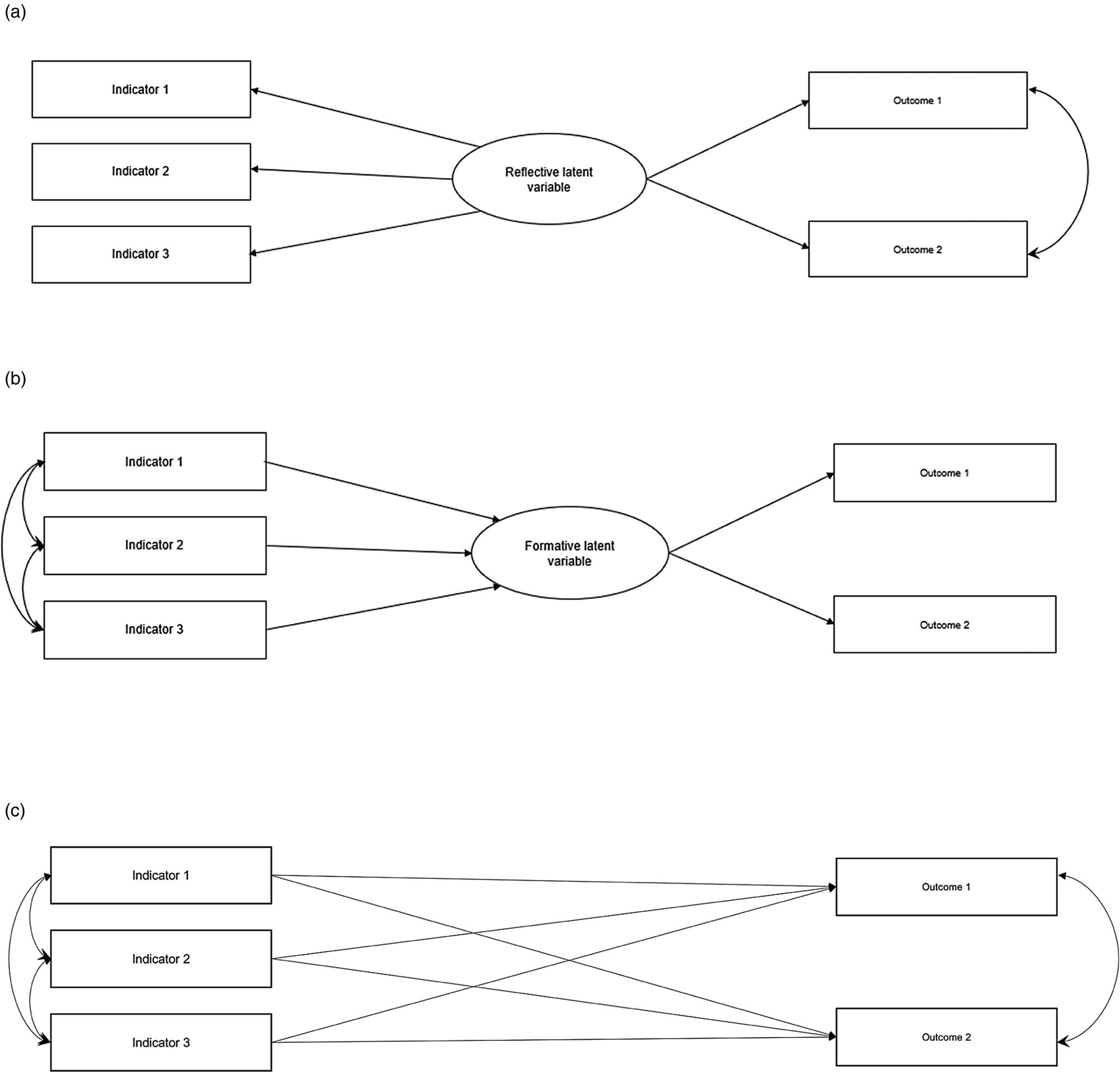
Reflective latent constructs, which are most commonly used, have indicators that share a common cause and are thus correlated with each other. This conceptual model is depicted in Figure 1 (panel A), where arrows point from the latent variable to the indicators. In that model, observed associations between the indicators are thought to result from (i.e., be caused by) their common cause: the unobserved latent variable. As a result, no arrows denoting associations between the indicators are depicted. For example, hopelessness, depressed mood, and negative affect are all indicators for the reflective latent construct of depression.
Panel a: reflective model. Panel b: formative model. Panel c: direct effects model with independent but correlated predictors. In all panels, circles denote latent variables and rectangles denote observed variables. Lines represent estimated paths.

While factor analyses can be used to model shared variance between indicators, this shared variance may or may not be causally related to the indicators. We can therefore distinguish common factor models, which simply capture shared variance between indicators, and reflective models, which assume that this shared variance is the result of a common cause shared by indicators (Van Bork, Wijsen, & Rhemtulla, Reference Van Bork, Wijsen and Rhemtulla2017). Since both models are fitted in the same way using factor analyses, conceptual and theoretical arguments should be considered when fitting these models. In the case of adverse experiences, factor analyses have been used to capture shared variance across indicators of adversity. While there are cases where a common cause could be argued (e.g., a single perpetrator committing various types of abuse), this may not always be the case (e.g., the co-occurrence of exposure to domestic violence and neighborhood violence). Both causal and noncausal explanations for the associations between various indicators of adversity may exist, depending on each individual. In many cases, however, researchers and clinicians are more concerned about the consequences of various adversities than about their causes.
In contrast, indicators of a formative construct are thought to have a common consequence rather than a common cause. This conceptual model is depicted in Figure 1 (panel B), where arrows point from the indicators to the formative latent variable and, as a result, the effects of the indicators on the outcomes are mediated by the formative latent variable. Indicators of a formative construct may or may not be correlated as they do not necessarily share a common cause. Indicators of a formative construct instead share a common (or similar) consequence with regard to specific outcomes, regardless of their causes, consistent with the notion of equifinality. The formative model depicted in panel B implies that the indicators have proportional effects on both outcomes (i.e., if indicator 1 has an effect twice as large on outcome 1 compared to indicator 2, then this difference should apply to all outcomes predicted by the composite variable). Here, whether the indicators are correlated or not is irrelevant – it is only the fact that they have proportional effects on the outcomes that matters. Alternatively, the formative latent variable may be thought of as capturing shared variance between the outcomes, representing an unobserved common pathway of influence between indicators and outcomes (Franke et al., Reference Franke, Preacher and Rigdon2008). In the case of adversity, this unobserved common pathway would be consistent with an allostatic load model whereby the accumulation of adversities – regardless of their type or timing – would result in higher odds of experiencing deleterious outcomes.
Fitting formative models using structural equation modeling offers several benefits with regard to formal hypothesis testing. First, structural equation modeling makes it possible to formally test whether the formative model adequately accounts for the observed associations and whether the formative model fits the data more or less poorly than alternative models. Second, the formative latent variable may fit the data relatively well but may only partially account for the associations between indicators and outcomes. In such a case, software can suggest adding direct effects from indicators to outcomes, thus indicating that the common pathway does not entirely account for the observed associations. Third, structural equation modeling can test whether the various indicators have equal effects on the formative factor or not. Ultimately, it can test whether adversities exert proportional effects on outcomes (e.g., one type of adversity could be a stronger predictor of all outcomes compared to other adversity types) or whether the effects are identical (i.e., each additional adverse experience predicts poorer outcomes regardless of timing or type).
In short, in a formative model the indicators define the latent construct (Layne et al., Reference Layne, Olsen, Baker, Legerski, Isakson, Pasalic and Pynoos2010). Conceptually, cumulative adversity could be considered a formative construct because it is caused by an accumulation in adversity at different time periods that may or may not be correlated with each other (for a more thorough discussion about formative models for understanding consequences of adversity, see Layne et al., Reference Layne, Olsen, Baker, Legerski, Isakson, Pasalic and Pynoos2010).
Statistical approach
Descriptive statistics were first estimated using SPSS version 24. To address the two primary research questions presented earlier in the paper, five structural equation models (Models 1–5) were estimated using MPlus Version 8. Based on simulation analyses for sample size requirements for analyses using structural equation modeling conducted in previous research, the sample of 3,362 participants used in the analyses was deemed adequate (Wolf, Harrington, Clark, & Miller, Reference Wolf, Harrington, Clark and Miller2013).
Model testing
Of the five structural equation models, Model 1 was an independent effects model where all paths were free to vary (see Figure 1, panel C for a conceptual example). Models 2–5 tested formative latent variables (see Figure 1, panel B for a conceptual example). Model 2 tested whether a formative latent variable accounted for the association between adversity and maternal prenatal outcomes where all paths contributing to the cumulative latent were free to vary. Model 3 tested whether a formative latent variable accounted for the association between adversity and prenatal outcomes where the paths for adversity within type were free to vary (i.e., the paths within time were constrained to equality). Model 4 tested whether a formative latent variable model accounted for the association between adversity and prenatal outcomes where the path for adversity within time were free to vary (i.e., the paths within type were constrained to equality). Model 5 examined a formative model where all paths – regardless of timing or type – were constrained to equality. The fit indices for all five models were examined and compared.
Model estimation
Within MPlus, analyses were performed with the maximum likelihood, which allowed for the inclusion of 3,362 participants, based on the “missing at random” assumption (Graham, Reference Graham2009). We used the MLR estimator, which is robust to non-normality (Yuan & Bentler, Reference Yuan and Bentler2000). To test whether a cumulative model was the best fitting model, model fit was evaluated using the comparative fit index (CFI), the Tucker–Lewis index (TLI), the root mean square error of approximation (RMSEA). For the CFI and TLI, values greater than .90 and .95 indicate an acceptable fit and a very good fit, respectively. For the RMSEA, values smaller than .08 and .06 indicate an acceptable fit and an excellent fit, respectively. The models were compared by looking at changes in CFI, TLI, and RMSEA, with changes in CFI ≤ .01, CFI ≤ .01, and RMSEA ≤ .015 indicating minor changes (Chen, Reference Chen2007; Cheung & Rensvold, Reference Cheung and Rensvold2002). We also looked at changes in the Bayesian information criterion (BIC), which penalizes models with more estimated parameters (i.e., less parsimonious models). For the BIC, smaller values indicate a better model and a difference of 10 is considered significant (Raftery, Reference Raftery1995). To address whether the strength of the effect of adversity on maternal postpartum outcomes varied as a function of adversity timing and type, we compared nested models with effects free to vary versus effects constrained to equality using the χ2 difference test for the overall model that was selected (i.e., cumulative vs. independent effects).
Results
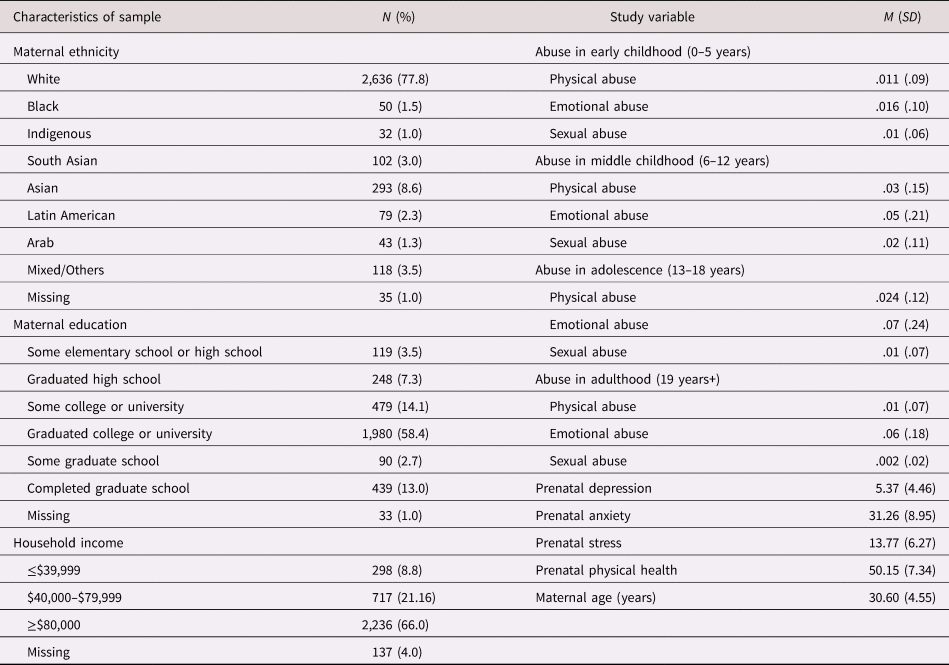
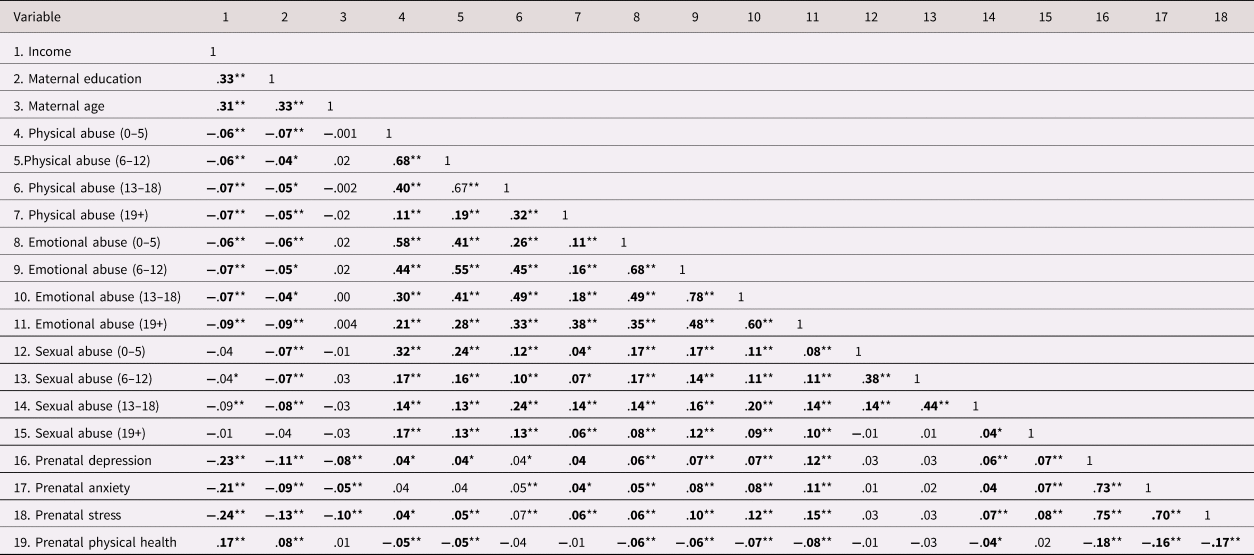
The demographic characteristics of the sample and the mean (M) and standard deviation (SD) of all the study variables are presented in Table 1. Associations among the study variables are reported in Table 2, with all associations in the expected directions between maternal pregnancy outcome variables and adversity timing and type.
Demographic characteristics of the sample

Pearson correlations among variables

Note: Boldface indicates statistical significance (*p<.05; **p<.01).
Model testing
Cumulative effect of adversity on maternal pregnancy outcomes
To test our first research question, we compared the fit of the independent effects model (Model 1) with the fit of the formative latent model (Model 2). Model fit indices for these models are presented in Table 3. Both models showed an excellent fit, with CFI ≥ .998, TLI ≥ .998, RMSEA ≤ .008. Importantly, the differences in CFI, TLI, and RMSEA between Models 1 and 2 were small (Δ < .01), indicating that Model 2 fitted the data as well as Model 1. The decrease in BIC was, however, substantial (Δ BIC = −259.195), showing that the cumulative risk model was preferable over the direct effects model (Model 1) as it was more parsimonious. This suggests that adversity at different periods and across different types exerts proportional effects on maternal mental and physical health during pregnancy, consistent with the cumulative model.
Model fit statistics for all independent effects and latent models

Note: Y–B χ2 = Yuan–Bentler scaled χ2 test for model goodness of fit, df = degrees of freedom, Scaling: unit of measurement for parameter estimates to be statistically identified and estimated, CFI = comparative fit index, TLI = Tucker–Lewis index, RMSEA = root mean square error of approximation, BIC = Bayesian information criterion.
Differential effects of adversity based on timing and type of adversity
To test our second research question, we tested whether the effects of abuse on the formative latent factor (and thus indirectly on the outcomes) varied as a function of timing and type. The models that constrained the paths from the abuse indicators to the formative latent factor to equality within time (Model 3) and within type (Model 4) both showed minor changes in CFI, TLI, and RMSEA (Δ < .01). The decreases in BIC were substantial (−49.179 and −47.684, respectively), showing that both Models 3 and 4 were preferable to Model 2 as they were more parsimonious. These models suggested that the paths were comparable across types and timing. To test this hypothesis, we tested Model 5, in which all paths were constrained to equality, regardless of abuse type and timing. Compared to Model 2, changes in CFI, TLI, and RMSEA were small (Δ < .01). However, the decrease in BIC was substantial (Δ BIC = −58.013), showing that the paths from the indicators of abuse to the cumulative risk index did not vary as a function of their type or timing.
To identify whether more parsimonious models led to a loss of information, we compared the proportion of variance explained in the cumulative factor across models with different equality constraints, as well as their 95% confidence intervals (CIs). The model without constraints explained 3.50% of variance (95% CI [1.70%, 5.00%]). Models with constraints on type and timing explained 2.40% (95% CI [1.10%, 3.80%]) and 2.80% (95% CI [1.30%, 3.80%]) of variance, respectively. The model with all paths constrained to equality explained 2.20% of variance (95% CI [0.50%, 3.50%]). While there was a tendency for the more parsimonious model to explain less variance, the 95% CIs all overlapped, indicating that there was no significant difference in the variance explained across models.
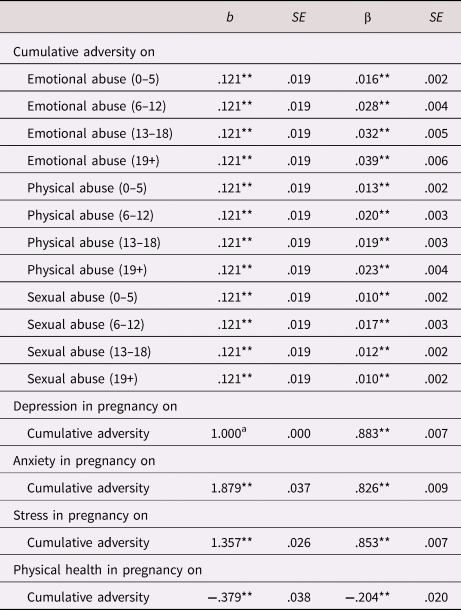
Parameter estimates from Model 5 are reported in Table 4. Examining the effects of the cumulative factor on maternal postpartum health and mental health outcomes in Model 5, the cumulative factor significantly predicted maternal stress, depression, state anxiety, and physical health in pregnancy in the expected directions. The unstandardized parameter estimates from each abuse indicator to cumulative adversity (the formative factor) are all equal since they were constrained to equality. The fact that they could be constrained to equality indicates that an increase in each abuse indicator (regardless of time or timing) increased the cumulative adversity score to the same extent. The standardized coefficients, however, differed slightly between abuse indicators. This is because each indicator accounted for a different proportion of the total variance in cumulative adversity depending on the amounts of individual differences in abuse indicators at a specific time point. When individual differences in abuse indicators are larger (indexed by a greater SD), then this abuse indicator will account for a larger proportion of the variance in cumulative adversity which, in turn, has a larger effect on the outcomes. The paths from each abuse indicator to the cumulative adversity latent factor were all small in magnitude (β = .010–.039).
Parameter estimates obtained in Model 5

Note: **p < .01.
a Parameter constrained to one to scale the latent formative factor.
Discussion
Using a novel statistical approach to testing life course theory, the current study examined whether the effects of different types and timing of adversity on maternal mental and physical health outcomes are best accounted for by a cumulative model and whether the effect of different adversity time periods (adversity in early childhood [0–5 years), middle childhood [6–12 years], adolescence [13–18 years], or adulthood [19+ years]) and types (physical, emotional, and sexual abuse) differentially contributed to maternal outcomes. The following three important findings emerged. (a) The formative latent model accounted for the association between various abuse indicators and maternal outcomes during pregnancy across adversity timing and type, thereby supporting the hypothesis that cumulative risk across the life course influences pregnancy outcomes. (b) Based on the models used in the current study, increases in indicators of abuse led to comparable increases in cumulative adversity, regardless of adversity type or timing. (c) The amount of variance explained by the abuse indicators varied slightly as a function of the amount of individual differences in exposure to abuse (i.e., the greater the inter-individual differences in abuse, the larger the effect of the standardized paths). To our knowledge, this is one of the first studies to use formative latent models to formally test the cumulative model of adversity. Formative models are a new and novel way of directly comparing life course models using the same statistical framework and may be useful for examining the role of adversity on other outcomes more broadly.
Through the use of formative models, the current study found that cumulative adversity across the life course is associated with maternal mental and physical health outcomes in pregnancy. These findings support theories on cumulative risk and allostatic load, whereby accumulated stress can lead to alterations in the physiological system, resulting in both health and mental health difficulties (Atkinson et al., Reference Atkinson, Beitchman, Gonzalez, Young, Wilson, Escobar and Villani2015; Evans et al., Reference Evans, Li and Whipple2013). Our findings are also consistent with the concept of equifinality, whereby various adversity timings and types can share common outcomes (Cicchetti & Rogosch, Reference Cicchetti and Rogosch1996). As stated earlier, however, formative models test whether indicators have proportional effects on the specific outcomes under study. Consequently, the current findings may or may not apply to other outcomes. Furthermore, whether the current findings apply in other populations (e.g., men, children) and on other outcomes (e.g., cardiovascular disease, PTSD) remains to be investigated. Taken together, for the outcomes in the current study, a cumulative effects model is the most parsimonious explanation for understanding the influence of retrospective reports of adversity across the life span on maternal outcomes. Further studies using a prospective, multi-informant design will be useful to further contrast various theories about the enduring consequences of early life adversity.
We also found that abuse types across different developmental periods did not differentially contribute to cumulative adversity in an absolute manner. The fact that unstandardized paths could be constrained to equality shows that each increase in the indicator led to comparable increases in the formative factor. From the perspective of practitioners wanting to assess adverse experiences that occurred in childhood, our findings support the idea of creating a sum of adversity occurrences by giving them equal weight, regardless of type or timing. Using a cumulative adversity score may in fact be a more trauma-informed way of obtaining information in a screening context as it does not require obtaining specific information about the timing and type of experiences, which may be uncomfortable or traumatic for patients and more cumbersome for clinicians in the context of a short interaction (Racine et al., Reference Racine, Killam and Madigan2020). That said, it is important to note that we did not consider the severity of abuse in the current study, which is consistent with how abuse is often assessed in the clinical setting. Future research needs to examine whether similar findings would hold when taking abuse severity into consideration.
Despite similarity in the unstandardized paths, there were some variations in the standardized paths. Variations in the standardized paths suggest that the total amount of variance in cumulative adversity varied slightly across indicator types and timing. The fact that the standardized paths varied slightly suggests that cumulative adversity accounts for a greater proportion of individual differences in outcomes when there is greater inter-individual variability in abuse type or timing. This latter finding might be useful to identify specific periods where individuals in a population may be at greater risk of exposure to certain types of adverse experience. Studies using a prospective, multi-informant design may be useful to test this possibility more stringently.
Implications
With mounting research demonstrating that maternal ACEs are associated with prenatal and perinatal mental health (for a review, see Racine et al., Reference Racine, Devereaux, Cooke, Eirich, Zhu and Madigan2021) and physical health (Madigan et al., Reference Madigan, Wade, Plamondon, Maguire and Jenkins2017) outcomes, there has been a movement to incorporate trauma-informed practice into prenatal patient and client care. This practice includes “screening” for previous experiences of adversity using the ACEs questionnaire (Flanagan et al., Reference Flanagan, Alabaster, McCaw, Stoller, Watson and Young-Wolff2018; Racine et al., Reference Racine, Killam and Madigan2020; Sciolla, Reference Sciolla2018). Findings from the current study suggest that, with regard to maternal outcomes during pregnancy, the specific type of adversity may not be as important as the cumulative impact of the occurrence of adversity at any given age. This is not to suggest that the type and timing of adversity do not matter, but rather that they may yield less information for understanding self-reported pregnancy outcomes when abuse is measured retrospectively. Practically, these results lend credence to attributing equal weights to different abuse types, regardless of their timing, with two caveats. First, taking into account the frequency of abuse (rather than just absence vs. occurrence) might be helpful to capture individual differences in cumulative adversity and, as a result, may predict outcomes more precisely. Second, abuse occurring in adulthood significantly contributed to cumulative adversity, indicating that screening tools that focus on abuse prior to the age of 18 are inadequate for understanding how adversity experiences may impact pregnancy outcomes. It is critical to note that inquiring about adversity experiences should be undertaken in the context of a trauma-informed approach with adequate training and referral resources for follow up (SAMHSA, 2014). Pathways of care and the identification of interventions that are effective in pregnancy and postpartum for reducing the consequences of adversity on maternal health are also needed.
Limitations
To our knowledge, this study is the first to examine the differential role of type and timing of adversity across the life span on maternal pregnancy health outcomes using a large longitudinal cohort. Despite this strength, the results of the study must be interpreted within the context of its limitations.
First, formative models apply to the specific indicators and outcomes considered (Franke et al., Reference Franke, Preacher and Rigdon2008). Our findings may therefore not generalize to a different population (e.g., as a function of age or sex), with different indicators of adversity (e.g., abuse vs. neglect) or with different mental health (e.g., PTSD) or physical health outcomes. The participants in the current study were advantaged as they had higher household incomes than the city, province, and country in which the data were collected (Calgary, Alberta, Canada). Thus, application of our findings to more socioeconomically disadvantaged samples is not recommended. In addition, although the prevalence of abuse in the current study was in line with those found in other large samples of pregnant women (Lukasse et al., Reference Lukasse, Schroll, Ryding, Campbell, Karro, Kristjansdottir and Schei2014), our findings may not apply to clinical samples where rates of previous trauma and abuse are substantially higher. Replication across a variety of scenarios, using the formative model approach, is therefore essential.
Second, the reports of abuse in the current study were based on self-report, were retrospective in nature, and were not substantiated by external sources. Although retrospective self-reports of adversity experiences continue to be the dominant method used in both clinical and research settings, concerns regarding retrospective reports of adversity have been identified (Baldwin, Reuben, Newbury, & Danese, Reference Baldwin, Reuben, Newbury and Danese2019), especially in regard to early childhood experiences (e.g., prior to age 5 years). Previous research has demonstrated that retrospective reports of childhood adversity yield elevated rates of false negatives or under-reports of adversity (Hardt & Rutter, Reference Hardt and Rutter2004). This is an important consideration in the interpretation of the findings in the current study. Future work involving data linkage to alternate sources of information, such as medical or social service records, may be useful. In addition, the interpretation of our findings is restricted to the operationalization of adversity (i.e., abuse) employed in the current study. A broader conceptualization of adversity across the life course, including poverty, exposure to violence, racism, and discrimination, is needed in future research. Furthermore, abuse severity has been identified as a factor in understanding differential health and mental health outcomes in adulthood (Clemmons, Walsh, DiLillo, & Messman-Moore, Reference Clemmons, Walsh, DiLillo and Messman-Moore2007). As such, consideration of how abuse severity may contribute to maternal health and mental health outcomes should be considered in future research. It is also important to note that, in the current study, maternal mental health and physical health outcomes were obtained via maternal self-report. We cannot preclude the potential influence of bias on health and mental health outcomes.
Third, we could not account for perpetrator relations in our analyses, which likely vary with the age of the reporter (e.g., in childhood, physical abuse may be at the hands of a caregiver while, in adulthood, by a partner). Moreover, recent work has argued that the chronicity and severity of adversity may play an important role in determining how adversity influences later health and mental health outcomes (Bush, Lane, & McLaughlin, Reference Bush, Lane and McLaughlin2016). Future adversity research should thus consider perpetrator relations, as well as the severity and chronicity of adversity across different time points as contributing to health outcomes.
Conclusions
Our findings suggest that, in the antenatal care context where screening for adversity is being considered, understanding women's cumulative adversity, rather than paying special attention to the type or timing of event, may help identify those who would benefit from additional support to optimize maternal postpartum health. Formative models are an innovative statistical approach for directly comparing life course models and may expand our understanding of the contribution of adversity to other maternal and child health outcomes.
Supplementary Material
The supplementary material for this article can be found at https://doi.org/10.1017/S0954579421000353
Author Contributions
Suzanne Tough and Sheri Madigan share senior authorship.
Acknowledgments
Dr. Suzanne Tough is the PI of the All our Babies/Families study. The authors acknowledge the contributions of the All Our Families research team and thank the participants who took part in the study.
Funding Statement
The All Our Babies/Families (AOB/F) study was funded by Alberta Innovates Health Solutions Interdisciplinary Team (grant #200700595), Calgary, Alberta, Canada and the Alberta Children's Hospital Foundation. Research support was provided to Dr. Madigan by the Canada Research Chairs Program. Dr. Racine was supported by a Postdoctoral Trainee Award from Alberta Innovates. Funding sources had no role in publication-related decisions.
Conflicts of Interest
None.