1. Introduction
Literature has been the topic of a state-of-the-art paper in Language Teaching twice before, though the angle taken in each case was different. Bernard Lott's survey, entitled Language and literature (Lott Reference Lott1988), was concerned mainly with examining literary language and the way linguistic thought was influencing (or not) literary criticism. There was a short section on teaching materials, divided between materials for mother-tongue readers and materials for second language (L2) learners. Lott makes the point that in the latter type of material, the approach is normally through the topic, ‘teaching becomes group guidance’, and goes on to claim that ‘the text itself . . . is generally treated in a rather perfunctory way, and its distinctive nature as literature, and as a display of language put to special uses, seems often to be lost sight of’ (Lott Reference Lott1988: 9). In the section ‘The way ahead’, Lott discusses research as well – but in his case the search is on for an ‘extended, practical methodology for investigating language as it is used in literature’ and the research is ‘aimed at producing an operational model for the analysis of style’ (ibid.). In contrast, Gilroy & Parkinson's (Reference Gilroy and Parkinson1996) survey was entitled Teaching literature in a foreign language. It looked at developments in literary theory, reader response, and communicative language teaching, and then went on to examine materials for learners and teachers, focusing mainly on books (both specialist collections and general coursebooks) and to a large extent excluding articles.
Both papers were – as state-of-the-art papers should be – very much of their period, reflecting the concerns of linguists and teachers at the time. But a number of points are noteworthy, and interestingly these are points concerning division and exclusion. The first important point is that neither paper looks at empirical research into literature in language teaching. It is true that there was far less research then than there is now (see also Carter Reference Carter2007), but whatever research there was then was not always accorded a place. Secondly, both papers focus very much on English, with only a few references to other languages, reflecting the predominance of English as the main global foreign language, and the division between it and other foreign languages. Having said that, it is also important to note other divisions in this area. Kramsch & Kramsch (Reference Kramsch and Kramsch2000) point out that, in general, foreign language teaching in the US has tended to remain enclosed within language boundaries, with separate professional organisations for different languages. Also in the US there is at university level the division between language teaching and learning and literature in general, a phenomenon which Kramsch & Nolden (Reference Kramsch and Nolden1994: 28) call ‘the institutionalized dichotomy between literary studies and language training’, as well as the division between the focus on language learning in the initial stages of an undergraduate degree, and literature learning in the later years of study (e.g. Murti Reference Murti, Bredella and Delanoy1996; Lyman-Hager Reference Lyman-Hager2000). Burnett & Fonder-Solano (Reference Burnett, Fonder-Solano, Scott and Tucker2002), for example, have documented the misunderstandings between literature teachers and language teachers, including incidents of actual hostility (see also Byrnes & Kord Reference Byrnes, Kord, Scott and Tucker2002; Fonder-Solano & Burnett Reference Fonder-Solano and Burnett2004).
There is some tentative agreement that these divisions are beginning to be bridged. I have previously suggested (Paran Reference Paran and Paran2006b) that in EFL, at least, there has been a move towards integrating language and literature, and Carter (Reference Carter2007: 10) suggests that at least some of the differences have begun eroding, and goes on to say that ‘literature has begun to assume a higher profile in contexts of second language acquisition, a dimension absent from the research radar in 1986’. The present paper, as its title suggests, continues this trend, and moves the discussion from the definition of literature, from the language of literature, and from a focus on textbooks, to a focus on the emerging research in this area. It focuses on the research done in recent years on reading, learning, and teaching literature in a variety of foreign languages. The focus will be on the research that has appeared since Gilroy & Parkinson's (Reference Gilroy and Parkinson1996) paper, although there are also references to previous papers as well, whenever relevant.
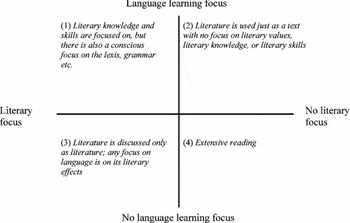
However, there is still an obvious need to delimit the area of enquiry that this paper will deal with. Figure 1 presents the relationship between literature and language learning as the intersection of two axes. The horizontal axis refers to the extent to which any programme or lesson focuses on literature or on literary competence and its development. Thus, on the left hand side of this axis, where the learners are learning a second or a foreign language, there is little wish on the part of teachers to teach language per se; even where there is an engagement with language, this engagement serves a literary aim (e.g. understanding the linguistic choices made by the writer). The vertical axis represents the extent of engagement with language learning: at one end we have a focus on language learning, where the teacher focuses explicitly on language learning and activities are specifically designed to further this aim. At the other end of the axis, we have classes or courses where there is no explicit focus on language learning at all.
The intersection of literature and language teaching.

The intersection of these two axes results, as Figure 1 shows, in four quadrants. Quadrant 1 represents a situation where both areas are focused on. Quadrant 2 shows a situation where no distinction is being made between what McRae (Reference McRae1991/2008) calls representational texts and referential texts, and representational texts are used in the classroom or in research settings without any focus on their literary qualities. Quadrant 3 exemplifies a situation where literature is discussed only as literature, and no overt focus is paid to language development: it is assumed that the learner has reached the linguistic level needed to discuss literature in the foreign language. This is the situation in many university courses around the world, and is indeed part of the deep divide discussed above. Finally, the fourth quadrant exemplifies extensive reading, where there is no focus on the literary qualities of what is being read (and indeed, the material being read may well be non-fiction) and where, in its purest form, there is no language learning work either. In such cases there is often no reference at all to what is being read, and indeed, the reference may be to ‘reading’ or to ‘books’ rather than ‘literature’. In between, there is a whole gamut of approaches in which the literature/reading balance is calibrated differently. Figure 1 is, of course, a simplification: there are other important elements that can enter into a reciprocal relationship with literature in the language classroom. One, for example, is reading and the study of reading comprehension. The other is the issue of culture, cultural knowledge, and intercultural competence. A true picture of the situation would most likely resemble a web, with a large number of possible permutations of the interactions between the strands. In this paper, however, I will not refer to these areas, and my focus will be mainly on the areas between the two extremes I have described above, i.e. approaches where the focus is both on language and on literature, though with differing weight given to each in different situations and contexts.
2. The role of literature in language learning and teaching: theory and research
2.1 Theoretical perspectives
The shifting relationship between language learning and literature is still the subject of a great deal of debate. In a study looking at the way in which published articles in the Modern Language Journal have dealt with these issues, Kramsch & Kramsch (Reference Kramsch and Kramsch2000) illustrate the movement from literature as part of an elitist study of foreign languages at the beginning of the 20th century to a view of literature as an authentic source of language at the end of the century. Hall (Reference Hall2005), in a similar examination of the papers published in the ELT Journal, discerns a move from a suspicious attitude towards literature in the middle of the 20th century, through attempts to incorporate it in communicative language teaching through humanistic techniques, reader response, and stylistics, highlighting a special ELT Journal issue in 1990 which focused on the shift from traditional methodologies to newer approaches. He then identifies the rise of a view which sees literature ‘as potentially playing a role in facilitating the learner's access to this English-using culture’ (Hall Reference Hall2005: 55).
One arena where the discussion has raged for some time is the use of literature in EAP courses in the US. Belcher & Hirvela (Reference Belcher and Hirvela2000), Hirvela (Reference Hirvela, Belcher and Hirvela2001a) and Vandrick (Reference Vandrick and Kroll2003) provide an overview of the area, linking the controversy to debates in L1 teaching of writing in the US. Belcher & Hirvela (Reference Belcher and Hirvela2000) show how, initially, composition and literature tended to be taught by the same people at the time when the two areas emerged as subjects worthy of academic study, and the two subjects have diverged and converged over the years. In the L2 context, Belcher & Hirvela (Reference Belcher and Hirvela2000) trace the rise of ESP and the way in which the focus among L2 composition teachers on discourse communities and the language needed to participate in them meant that literature and literary language were seen as unsuitable for inclusion in L2 teaching. However, they suggest that reading and writing only information-based texts may in fact prevent students from developing the ‘array of rhetorical and linguistic resources’ (Belcher & Hirvela Reference Belcher and Hirvela2000: 29) that they need for their writing. Vandrick (Reference Vandrick and Kroll2003) discusses the objections to the use of literature, such as the difficulties it might present, the lack of relevance of literature as preparation for academic writing genres, and the lack of motivation.
An important discussion of the arguments for and against using literature in the L2 classroom is Edmondson (Reference Edmondson, Mauranen and Sajavaara1997), whose overall position is that literature has nothing special to offer language teaching. Although the observations he makes at the beginning of his paper are drawn from a variety of contexts, the picture that he draws is one in which learners are exposed to the same type of literature teaching in L1 and L2, expecting a teacher-centred approach in which the teacher's interpretation is all that counts, and overall not caring much for literature. He then presents a number of arguments either against the use of literature, or suggesting that literature does not have any advantage over other texts. Overall, he suggests that other curriculum subjects probably provide a better insight into culture than literature does; that literary elements and references in the language are not more important than other cultural references; that literature is not more motivating than other texts, and can sometimes be extremely de-motivating, depending on the way the text is used; that there is no point examining isolated cases of successful lessons (what he calls the ‘Look at this!’ argument); and that literature does not activate cognitive mechanisms in any way that is different from other texts.
In Paran (Reference Paran and Paran2006b) I pointed out what I believe is the main fallacy of Edmondson's position and why it is important to debate these issues: namely, his view of language learning as focusing on language only, presenting what I call an isolationist position, whereby language learning is concerned with acquiring competence in the L2 and nothing more. Edmondson's view of the language learner chimes in with this, and is implicit in his phraseology: he talks about ‘the business of language learning’ (p. 42) and ‘the business of achieving proficiency or general competence in an L2’ (p. 45); the learners are ‘educational consumers’ and specific learners are ‘the products of at least eight years school learning’ (p. 43). This is similar to the trend that Shanahan (Reference Shanahan1997) identifies in foreign language teaching in the US, which he claims is a utilitarian business, which employs what he calls a ‘reductively utilitarian logic’ (1997: 165), where teaching a foreign language is justified mainly through its contribution to the learners’ careers.
This type of argumentation seems to be taking the learner as a person out of the equation: the focus is on the text, and on the learner as a language learning machine. In such a context, it may indeed be true that literary texts do not carry inherent characteristics making them suitable for language learning. The point is that literary texts are suitable because language is learned by human beings, and the interest and love of literature for its various qualities is a human characteristic, a common denominator in a way in which an interest in ‘history, geography, the economics or the architecture of other countries’ (Edmondson Reference Edmondson, Mauranen and Sajavaara1997: 46) is not. If we take as our starting point an understanding of the role of literature in daily life, the way in which narratives function in learning, the role of literature and narratives in education, and the language-literature link – all these are important in understanding that literature may have a place in L2 teaching more than the subjects mentioned by Edmondson in the quote above, or subjects such as ‘philosophy, art, contemporary political issues, or other subjects on the humanist agenda’ (Horowitz Reference Horowitz1990: 162). Language learning is not only about language – it is about learning as well; it is not only about training, but also about education. As Bredella points out, ‘literary texts in the foreign language classroom are not only important for foreign language learning, but also provide it with significant educational goals’ (Bredella Reference Bredella and Byram2000a: 380; see also Widdowson Reference Widdowson1992: 77–85 for a discussion of the educational relevance of poetry). Shanahan (Reference Shanahan1997) presents an integrated view of this area, stressing that ‘our fundamental goal as language professionals is to expand and enrich the lives of our students and the society in which they live’ (Shanahan Reference Shanahan1997: 171), and going on to explore the importance of the affective element of language learning and the importance of symbolic expression.
More recent theorising has shifted away from a limited, isolating perspective in which the different areas of language learning are compartmentalised and teaching has a utilitarian, market-economy driven purpose, to more holistic perspectives which take different aspects of the learner and the context of learning into account, looking at the whole person and the whole culture, in which literature is part of developing the whole person, and in which affective development and affective factors are taken into account. One example are Kern & Schultz (Reference Kern and Schultz2005), who view literature in a foreign language within a re-framing and re-defining of literacy. They explore parallels between new concepts of literacy and ‘the work of the literary specialist’ (2005: 383), suggesting that the multiple-layered reading of texts characteristic of literary readings can, within a larger literacy framework, be of use for the teaching of this type of reading.
2.2 Research perspectives
Interestingly, both the supporters of the use of literature in language education (e.g. Shanahan Reference Shanahan1997; Hanauer Reference Hanauer2001) and its opponents (Edmondson Reference Edmondson, Mauranen and Sajavaara1997) agree that there is little research in this area. Indeed, Edmondson articulates an important plea: ‘we need conceptual clarity regarding which role or roles foreign-language literature can or should play’ (1997: 44) in language teaching, and points out the paucity of empirical evidence for the claims being made regarding literature in language learning programmes. Since most of the writing in this area has been theoretical, the challenge for research is to validate these theoretical positions, and to support the claims that literature can contribute to language learning, that learners are motivated and interested in it, and that its study has something unique to contribute to language learning.
The question, however, is how research can show this, what we classify as research, and what type of knowledge we accept as valid. Some of the research discussed in this paper, in particular in sections 3 and 4, is strongly rooted in the various analytical traditions of applied linguistics and takes a very clear empirical approach. However, an emphasis on this type of research can easily lead us to ignoring other types of knowledge, resulting in a situation where ‘much of the interesting work done by teachers is not actually documented’ (Rönnqvist & Sell Reference Rönnqvist, Sell and Sell1995: 52). Rather than dismiss this type of evidence (as Edmondson Reference Edmondson, Mauranen and Sajavaara1997 does in his discussion of the ‘Look at this!’ argument), we should realise that a consideration of the large number of papers of this type results in an understanding of what it is that teachers actually do in their classrooms, and of the issues that are at the forefront of the concerns of the teaching profession. It is important to remember that classroom interaction can be explored through the testimony of a practitioner reflecting on what they do in class, which can become extremely valuable (see Delanoy Reference Delanoy, Bredella and Delanoy1996 for the importance of reflective practice within this context). Such papers are even more noteworthy when we realise that they are often a description not of one experience, but of repeated experiences and indeed experimentation with literature in the classroom. Thus Cranston (Reference Cranston2003) provides a large number of quick snapshots of different lessons in which she used poetry; Hess (Reference Hess2003, Reference Hess and Paran2006) is in each case a description of a lesson used with different classes; Völz (Reference Völz2001) is an account of a number of years of using short fiction by the same writer; Diaz-Santos (Reference Diaz-Santos2000) is based on three and a half years’ experience of using technothrillers in the classroom. Indeed, it is such papers that perform the bulk of the task of documenting teachers’ work, and through that, documenting what it is that is happening in language and literature classes.
This paper therefore draws on work by both practitioners and academics. I start with a consideration of empirical research into the contribution of literature to L2 learning. I then move to a discussion of the views of learners and teachers, followed by a discussion of methodological issues that arise from the research. I then turn to a consideration of changes in syllabuses and curricula, as revealed in practitioner papers. I conclude with an overview and a discussion of future trends.
3. Contribution of literature to language learning
3.1 The move to data-based discussion
Possibly the most important development in the field of literature in the language classroom in recent years is the way in which published work has added empirical exploration of the issues to theoretical discussions and practitioner research. Researchers have looked closely at the effect of different techniques and pedagogies (Isaac Reference Isaac2002; Scott & Huntington Reference Scott and Huntington2007); the interaction between instructor and students and among students (Mantero Reference Mantero2002; Weist Reference Weist2004); and the type and extent of output achieved (Boyd & Maloof Reference Boyd, Maloof, Hall and Verplaetse2000; Donato & Brooks Reference Donato and Brooks2004; Kim Reference Kim2004; Scott & Huntington Reference Scott and Huntington2007). Although the number of papers is small, this emerging area of enquiry is important because of the way these researchers focus on how learners as language learners are able to interact with the text, and on how literary texts influence classroom interaction. They also illustrate with data from the lessons themselves the learners’ engagement with literature and the benefits that accrue to them.
3.2 Research into cloze techniques
An almost emblematic group of articles, spanning ten years and illustrating this move from theory through practitioner evidence to research, is Mackay (Reference Mackay1992), Weston (Reference Weston, Carter and McRae1996) and Isaac (Reference Isaac2002). All three look at a language teaching technique which has regularly been adapted to a literary purpose: asking students either to fill in a gap in a text, or to choose between two or more alternatives to fill that gap (for illustrations of the technique in use see for example Carter & Long Reference Carter and Long1987: 109–124; Lazar Reference Lazar1994; Weston Reference Weston, Carter and McRae1996). Mackay (Reference Mackay1992) attacks this procedure, claiming that even native speakers find it very difficult to tackle successfully, and that for learners it presents a nearly impossible challenge. Weston (Reference Weston, Carter and McRae1996) attempts to refute Mackay's (Reference Mackay1992) points, highlights flaws in his argument (mainly that the poem he picks as an illustration would normally be a very weak contender for a cloze), and goes on to provide examples of her own work with the technique. However, Weston's own examples (taken from Middlemarch) do not totally justify the procedure; she herself acknowledges that many of them present very difficult choices. To me, at least, it is not quite clear what is gained from the discussion of the various alternatives, and my feeling is that the same points could have been made by examining these alternatives without the challenge of deciding which was the one actually chosen. Weston (Reference Weston, Carter and McRae1996) is thus a good example of a case study presented in a way which fails to convince this reader, at least. (The same is true of Scott (Reference Scott2001), where this technique is presented in French, with very little attempt to explain why it worked. Badran (Reference Badran, Lambrou and Stockwell2007), on the other hand, is more successful because of the way in which the technique is used to sensitise learners to their own use of vocabulary and the effects achieved by deviant collocation.)
Against this background, Isaac's (Reference Isaac2002) contribution to the debate is important because it is based on an empirical body of data collected from learners: she prepared a rational deletion multiple choice cloze exercise, which the learners were required to do as homework, and the data analysed consists of the class discussion of the choices the learners had made at home. Her analysis does in fact vindicate the technique, and indicates ‘that using gaps to highlight links in the semantic chains within an extract can provide learners with a way of grasping the cohesive structure of a text and can thus orient them towards its meaning’ (Isaac Reference Isaac2002: 30). She also relates participation patterns to proficiency (more proficient learners focused more on context and its role), as well as links them tentatively to age and background (learners with a more traditional background in literature tended to participate less). Importantly, Isaac (Reference Isaac2002) demonstrates that discussing the cloze exercise resulted in a more critical approach to the text, and also resulted in heightened affective engagement with it. She reinforces the view that the value of the technique is in the discussion that ensues from it, rather than in the activity on its own: she thus counteracts the suggestion that the technique is ‘functional and mechanistic’ (Benton Reference Benton, Bredella and Delanoy1996: 42). Most importantly, she counteracts Mackay's (Reference Mackay1992) claim that the technique is intrinsically problematic much more successfully than Weston (Reference Weston, Carter and McRae1996).
3.3 Interaction in the literature and language classroom
Other researchers have examined the type of talk and the type of interaction generated in the language and literature classroom and their contribution to L2 learning (Boyd & Maloof Reference Boyd, Maloof, Hall and Verplaetse2000; Mantero Reference Mantero2002; Donato & Brooks Reference Donato and Brooks2004; Kim Reference Kim2004; Weist Reference Weist2004; Scott & Huntington Reference Scott and Huntington2007). The findings illustrate the importance of two factors: the role of the teacher, and the role of the task.
Kim (Reference Kim2004) addressed three important questions that are at the front of the discussion in this paper: the evidence for affective involvement; the contribution of literature discussion to language development; and the students' perceptions of the use of literature. Kim (Reference Kim2004) observed a class of nine students in a university in the US, interviewed the students, and recorded the classroom. She grouped the data into five categories (literal comprehension, personal connections, cross-cultural themes, interpretation and evaluation) and shows how the students negotiate the different categories simultaneously. She illustrates how literature circles provided opportunities for extended output, and led to a great deal of interaction, characterised by responsiveness, emotional engagement and authenticity. The interactions in her data are shown to be in stark contrast to the more limited IRE (Initiation–Response–Evaluation) patterns found in many language lessons (see also 3.4 below). The amount of interaction also emerges as important in Meskill & Ranglova (Reference Meskill, Ranglova, Warschauer and Kern2000), where the instructors in the study ‘report that the amount and quality of student discourse as they undertook these activities was “astounding”’ (p. 32). However, this study describes a course which incorporated wide-ranging changes both in content and in method, and lasted a whole year, all of which make it difficult to disambiguate the causes of these effects.
Other researchers have shown language improvement in classes using literature in contrast with classes that did not. Yang (Reference Yang2001) compared between two classes in which part of the time was spent discussing shared readings and two classes which studied according to the previous study programme. The classes using literature outperformed the control groups. In another study, Yang (Reference Yang2002) used a pre-/post-test design to examine the improvement of two elective classes in which literature was used. The two classes read the same science fiction novels, but the first class experienced traditional teacher-centred lecturing on literature, resulting in a sharp drop in attendance. As a result, for the second class the researcher moved towards a student-centred approach, with a mixture of group work, whole class discussion, short lectures and writing tasks, as well as filmed versions of the pieces. There was no improvement in the results of the first group, but a statistically significant improvement in the results of the second. Lao & Krashen (Reference Lao and Krashen2000) is an interesting study, since it illustrates the difficulty of deciding what counts as a ‘literature class’ and what does not. The study involved two groups of university students. One group was assigned a number of books to read, and the majority of class time was spent discussing the readings, whereas the other group underwent a standard study skills course. The experimental group showed significant gains in vocabulary and in reading speed, in contrast to the control group. However, whereas Yang (Reference Yang2001) and Kim (Reference Kim2004) provide detail that illustrates that their classes fall within Quadrant 1 of Figure 1, Lao & Krashen (Reference Lao and Krashen2000) provide detail that suggests that in fact their work would fit more comfortably into Quadrant 4, and is more akin to extensive reading.
3.4 The role of the teacher
The two studies by Yang discussed above illustrate the importance of the task and the teacher in the literature/language classroom. This point is borne out by a number of studies which looked at teaching foreign languages in universities in the US, and which highlight the problems in this area. Mantero (Reference Mantero2002) analysed the discourse in a literature and language class in a Spanish department in the US, focusing on what he calls ‘text-centered talk’. Two frameworks were used to analyse the talk in the class. One was the Florida Taxonomy of Cognitive Behavior (Givens Reference Givens1976 in Mantero Reference Mantero2002), which is based on the well-known Bloom (Reference Bloom1956) taxonomy. The other was a framework specially devised for analysing classroom talk into different levels: utterance, dialogue, discourse, and progressive discourse (Mantero Reference Mantero2002: 443). The results of the analysis indicated that 60% of student responses were at the lowest of the taxonomy's seven categories, Knowledge of Specifics. Seventy-five percent of the talk was analysed at dialogue level, which at first looks encouraging until it becomes clear that many of the excerpts classified as dialogue are in fact dominated by teacher talk, and demonstrate a clear IRE pattern of interaction. The instructor seemed to believe that the text possessed an intrinsic meaning, and therefore many of the questions ‘already have answers’ (Mantero Reference Mantero2002: 451), i.e. they were display questions. Unsurprisingly, this led to the students talking not to each other, but to the teacher. In fact, although the course was billed as an introduction to Hispanic literature, its aims, once the data was analysed, turned out to be ‘based on superficial readings for specific information in the hopes of building a vocabulary base that will assist in building oral proficiency’ (Mantero Reference Mantero2002: 451).
Similar findings arise from another study which used a variety of measures to analyse classroom talk in a Spanish department in a US university, looking this time at discussions of poetry (Donato & Brooks Reference Donato and Brooks2004). Here, too, the findings indicate a preponderance of teacher talk (80% of the time) and, when students did talk, the same IRE pattern found by Mantero (Reference Mantero2002). Donato & Brooks (Reference Donato and Brooks2004) also demonstrate how the pedagogical stance of the teacher (manifest in the use of IRE and, within the Initiation part, the nearly absolute dominance of display questions) led to an inhibition of discussion in the classroom, resulted in word or phrase length utterances, and prevented the learners from developing topics. Another indication of the limited nature of the language produced was the fact that 80% of the verbs used were in the present. The instructor did not take up opportunities to push the students and to recast their language, instead reinforcing their elliptical and undeveloped responses. In their discussion, Donato & Brooks (Reference Donato and Brooks2004) highlight the importance of literature instructors drawing on knowledge in language learning and teaching, and putting that knowledge into use in their classrooms: indeed, they talk of ‘the catastrophic rift between language and literature instruction’ (p. 196).
In contrast to Donato & Brooks (Reference Donato and Brooks2004), who looked at an advanced literature class, Weist (Reference Weist2004) investigated an intermediate level Spanish course which focused on reading comprehension and incorporated literary texts for this purpose. Here she found that the teacher's aim was to enable the students to understand the texts, and for this purpose he moved from speaking only Spanish to using a great deal of English, including presenting some of the poems studied in English translations. Weist found that ‘the course seemed to follow the traditional view of the instructor as the dispenser of knowledge . . . the instructor was viewed as the one who knew what was important about the texts, and the students often expressed a feeling of tremendous responsibility to develop the ability to interpret the texts like the instructor’ (Weist Reference Weist2004: 214). Unsurprisingly, the instructor dominated classroom talk, speaking 90% of the time, though the students interviewed believed that they had taken part in a discussion.
At yet another proficiency level, Scott & Huntington (Reference Scott and Huntington2007) investigated a beginners’ class looking at a poem in French as a foreign language. Working within the framework set by the Standards for Foreign Language Learning in the 21st Century, their focus was on the way in which the learners used what the Standards call the interpretive mode, which centres on ‘the appropriate cultural interpretation of meanings that occur in written and spoken form’ (Standards, p. 36, in Scott & Huntington Reference Scott and Huntington2007: 4). Their focus was on comprehension, and they therefore asked the learners to discuss the poem in their L1, English. Two separate settings were investigated: small group discussion and whole class, teacher led discussion. The researchers found that in the small groups, focus on language and translation talk meant that there was very little interpretive talk about the poem; they suggest that it was the guidance of the teacher/moderator that enabled the teacher-moderated group to engage in interpretive talk. Interestingly, this chimes with Hanauer's (Reference Hanauer, Watson and Zyngier2007) investigation into learning literary interpretation in L1, where explicit modelling by a teacher had a stronger effect than group discussion. However, it is important to note that ‘the act of establishing small groups does not by itself engender student discussion’ (Boyd & Maloof Reference Boyd, Maloof, Hall and Verplaetse2000: 167); neither Hanauer (Reference Hanauer, Watson and Zyngier2007) nor Scott & Huntington (Reference Scott and Huntington2007) seem to have incorporated an active task design into the programme, i.e. a design which ensures that group work is scaffolded and purposeful, and that groups are kept ‘on task’; as a result, their conclusions about group work need to be interpreted with caution.
In welcome contrast to the studies above, Boyd & Maloof (Reference Boyd, Maloof, Hall and Verplaetse2000) is an example of the way in which teacher involvement can provide a beneficial effect in the classroom. The class investigated was an elective dealing with American language and culture, taken by the participants in order to improve their English language skills. The main aim of the study was to investigate the ways in which ESL students in a class using literature made connections with other areas in their lives. The researchers took a wide interpretation of intertextuality, including in this any links students made to other literature that they had read, the other learners in the class, their own personal experiences, other cultures and languages, and universal qualities and concepts. Boyd & Maloof (Reference Boyd, Maloof, Hall and Verplaetse2000) attribute a great deal of the success of the class to the roles which the teacher assumed in the classroom, to the way in which she built on the intertextual links offered by the students, and to the way in which she supported student talk, reacted to it, and elicited further student utterances. The teacher's skill resulted in an important achievement, the high amount of student talk (68%), in stark contrast to the studies presented above. One finding that does link these studies to Boyd & Maloof (Reference Boyd, Maloof, Hall and Verplaetse2000) is the importance of the links made: ‘classroom talk was more likely to extend into discourse when students did not have to interpret the meaning of “Literature” and relied on their own experiences and expertise to talk about a cultural topic’ (Mantero Reference Mantero2002: 449).
To sum up, the papers mentioned above raise important issues regarding the dominance of the teacher and their role in language/literature classes. Kim (Reference Kim2004: 163) ties these strands together when she suggests that ‘the teacher should play a significant role in orchestrating and supporting both student interaction with the text and interaction with other students'. However, the papers mentioned above also raise the issue of which language is being used in class. The more the focus is on literature rather than on language development, the more teachers (and researchers) seem to allow the use of the L1 in the class. This phenomenon cannot be criticised in and of itself, but can only be assessed in relation to the aims of the class or of the study. Thus what is worrying for teachers about the Weist (Reference Weist2004) study is not the use of the L1, but the implicit belief of the students that they were in fact having a good discussion. In this context, the account by Tucker (Reference Tucker2000) of using a poem in a beginners’ French class is illuminating. Consciously choosing a poem that was much beyond the current linguistic level of the students, and consciously employing a teacher-centred teaching technique that can only be termed idiosyncratic (presenting one line of the poem every day and discussing its meaning for 10 minutes in a mixture of English and French), and what must count as a dated overall task (memorising the poem), Tucker (Reference Tucker2000) nevertheless created a meaningful learning experience which challenged and motivated her learners.
3.5 The role of the task
This point leads us to the next important issue, namely, the crucial role of the task in the language and literature classroom. This point, too, is now beginning to be investigated empirically. Thus Kim (Reference Kim2004) found that the topics raised in the different lessons that she observed ‘largely depended on characteristics of the day's activities or assignments’ (p. 158). In Burnett & Fonder-Solano (Reference Burnett, Fonder-Solano, Scott and Tucker2002: 96) the course reader was perceived as unsatisfactory ‘due to its lack of pedagogical help’, and was therefore changed.
Beatty & Nunan (Reference Beatty and Nunan2004) compared a behaviorist and a constructivist design for learner dyads who were working with a CD-ROM, focusing on Mary Shelley's Frankenstein. The researchers hypothesised that a constructivist, open-ended interface would lead to more collaboration and a more exploration-oriented experience on the part of the students. However, this hypothesis was not confirmed, and in fact there was evidence in the data that the behaviorist interface led to more collaboration. Beatty & Nunan (Reference Beatty and Nunan2004: 179) conclude that ‘the greater degree of scaffolding provided by the behaviorist interface gave subjects using this interface more confidence to wander away from the tasks and explore the materials in greater detail’. Overall, the studies presented in this section illustrate how ‘local classroom conditions can encourage or restrict’ the potential that literature has for generating communication in the language classroom (Boyd & Maloof Reference Boyd, Maloof, Hall and Verplaetse2000: 166).
3.6 The role of the reader
The studies discussed in the previous section looked at what learners do, but always within the context of a classroom, with a strong element of teacher intervention. A further aspect of the move towards an empirical approach to this area has been research into the role of the reader and what the reader does as an individual when reading literature. Following from the theoretical arguments set out in Hanauer (Reference Hanauer1997), namely, that poetry is particularly suited for use in L2 learning because understanding poetry is inextricably linked to considering form, Hanauer (Reference Hanauer2001) asked learner dyads to read a poem, and try to understand it. It might be argued that a better way of accessing what learners do would have been an introspective or think-aloud task; however, Hanauer (Reference Hanauer2001) suggests that this would have raised problems of cognitive overload. Overall, the study illustrated how the task forced the participants in the study to stretch their knowledge and ‘extend their understanding of the potential range of uses and meanings of an existing linguistic structure’ (Hanauer Reference Hanauer2001: 319). The analysis of the learners’ discussion revealed that the majority of utterances concerned language, rather than literary form. In an analysis of the utterances into different categories, nearly 60% of utterances belonged to two categories: noticing, and interpretive hypothesis. The categories were then grouped into functions, with the most frequent function being constructing a local interpretation (40%), followed by the function of developing a local interpretation (21%) and collecting data (18%). Mattix (Reference Mattix2002) suggests that this is an artefact of the instructions, and argues that what is missing from the study is an affective and aesthetic element. To some extent, Hanauer (Reference Hanauer2001) deals with this issue by noting the way in which the learners directed their attention to language rather than literary issues, and uses it to pre-empt potential criticism of the use of poetry in the language classroom (namely that the learners might not be sufficiently focused on language). What Mattix (Reference Mattix2002) notes, however, may not just be the artefact of the instructions, but an indication that before they can deal with the aesthetic elements of a poem, L2 learners need to reach an understanding of the language and the meaning of the poem.
In contrast to Hanauer (Reference Hanauer2001), who focuses on the process of making meaning when confronted with a literary text, Fecteau (Reference Fecteau1999) focuses on the product, i.e. whether learners reading a literary text achieve an understanding of its literary qualities. This is an interesting study because it attempted to combine the concerns of reading teachers with those of literature teachers, and compared reading in L1 and in L2. Of interest here are the four multiple choice questions in which Fecteau sought to establish whether the learners had correctly identified the narrator, the tone, the themes, and the author's aim. However, even those participants who read the texts in L1 did not do particularly well, and Fecteau was forced to conclude that her participants’ ability ‘to identify literary features in a specific text was, at best, inconsistent’ (Fecteau Reference Fecteau1999: 488). However, the product orientation of the study means that it cannot really shed light on the way the students processed meaning, and the small number of questions raises important questions of validity and reliability.
4. Views of teachers and learners
4.1 What learners think
Findings in this area are still quite rare, and it is extremely difficult to make any generalisations, considering the high variation in terms of study focus and participant profile, the lack of similarity between the groups studied, and indeed the language studied. In some studies literature is examined under the heading ‘cultural readings’ (Harlow & Muyskens Reference Harlow and Muyskens1994) whereas in other cases literature is clearly separated from ‘cultural knowledge’ (e.g. Martin & Laurie Reference Martin and Laurie1993). Generally speaking, two types of research can be discerned in this context. One is large-scale surveys which look at the needs and wants of language learners and at the place of literature in this context. The other is specific feedback on courses that included literary texts.
4.1.1 Learner surveys
Different surveys have indicated the scepticism that learners have towards literature. Martin & Laurie (Reference Martin and Laurie1993) investigated the goals of students studying French in an Australian university, as well as their views of learning literature. It is interesting to note that Martin & Laurie (Reference Martin and Laurie1993) found that their respondents ‘saw a direct, almost mechanistic correspondence between the topic or activity and the skill it most clearly exercised. . . . they did not see much transfer between skills areas, but rather tended to compartmentalize their learning in each area’ (p. 192). Their respondents believed that literature study would contribute to their reading skills, but little to any of the other skills. This may well be connected to the way literature was taught. In follow up interviews, the researchers found that ‘what seemed to put the anti-literature students off was the obligation to study literature, as distinct from reading it for enjoyment or personal development. Literature did not interest them as part of a French course, not only because of scepticism about its contribution to the four skills, but because they did not feel competent to deal with it in a way which would oblige them to discuss it in a public forum’ (Martin & Laurie Reference Martin and Laurie1993: 201). Interestingly, the interviewees also commented on the differences between the ways in which textbooks present cultural knowledge, in pre-digested form, and the way in which cultural understanding is achieved through reading literature. Finally, the researchers concluded that there were important issues of methodology here, and simply going through the techniques of literary analysis with their learners would turn them off literature; they call for a more student-centred methodology which values the contribution of the learner to the discussion of literature.
In another large-scale survey, Harlow & Muyskens (Reference Harlow and Muyskens1994) investigated the immediate language learning goals of nearly 1400 intermediate level learners of French and Spanish in twelve US universities. Reading literature ranked 11th on a list of 14 goals (compared with reading non-literary texts, which ranked 7th). When asked to rank the importance of different activities in helping them to achieve these goals, the students ranked reading in 7th place, and cultural readings 13th (this result is, however, partly an artefact of the research methodology, since the survey explicitly asked the students to link their answer to this question to their language learning goals). The researchers suggest that the low ranking of cultural readings both as goal and as activity raises the issue of how to prepare students for later levels of study and for the ‘in-depth cultural analysis typically found in advanced courses’ (Harlow & Muyskens Reference Harlow and Muyskens1994: 151), thus highlighting the disjunction between language and literature teaching in foreign language departments. Although the findings are of interest, one potential problem with this study is that reading literature was presented as one element among more general ones such as vocabulary, grammar, speaking, listening, etc. It seems logical to assume that a more specialised goal would rank lower than more general ones. In addition, it is important to note that the means in this study were not in fact substantially different from each other, and that thirteen of the fourteen goals achieved a mean above 3 on a 1–5 Likert scale.
Studies looking at EFL students present similar results. Qiping & Shubo (Reference Qiping and Shubo2002), in an impassioned plea for raising the role of literature in English departments in China, report on a study that indicated that ‘34 percent of the teachers of English literature were found by the students to conduct “boring” classes, mainly because the teaching tended to be in the form of a monologue rather than a dialogue’ (p. 321). In Hungary, Kormos, Kontra & Csölle (Reference Kormos, Kontra and Csölle2002) found that students on English teacher training programmes were not reading a great deal of fiction; however, it is important to note that this still ranked first among the uses of English in the private domain. Among past graduates, this went down to joint 6th place, but the change in frequency was minimal. Overall, Kormos et al. (Reference Kormos, Kontra and Csölle2002) found that their students read less frequently in English than they expected. One large-scale survey which presents very different results is Davis, Carbón Correll, Kline & Hsieh (Reference Davis, Carbón Gorell, Kline and Hsieh1992), who surveyed 175 students of French and Spanish in two universities in the US. Their respondents found their literature studies rewarding, and nearly three quarters agreed or agreed strongly that undergraduate students in language departments should be encouraged to take literature courses. However, these findings should be considered with caution, since all the respondents were taking literature courses in foreign language departments.
4.1.2 Student response to courses incorporating literature
Markedly different results are exhibited in another strand in the research, one which examines the reactions of students to specific courses where literature was used. Unlike the surveys, the results in most of these studies are positive, though one could argue that this is not surprising, as these studies reflect cases where the students are often self-selecting, and the teacher is particularly enthusiastic about using literature. However, the picture that emerges is more complex than this. One interesting study is Hirvela (Reference Hirvela, Flowerdew and Peacock2001b), which examined the reactions of learners on an EAP writing course to texts of different types. Although this was a small-scale study (38 participants reading one text in each of four genres), it is noteworthy that the learners viewed the literary and semi-literary (essay) texts as the most enjoyable to read, the most interesting to read, and the most enjoyable to write about, though these two texts were also found to be the most difficult to read and the most difficult to write about. The literary and semi-literary texts also came first when learners were asked which text they would recommend for future use on similar courses. Interestingly, the academic and newspaper texts were seen as more helpful than the two other genres, but the differences here were very small. Hirvela (Reference Hirvela, Flowerdew and Peacock2001b) suggests that his findings support the advisability of using different types of texts over a student's academic career. This is very much in line with the thinking behind the course constructed by Kelly & Krishnan (Reference Kelly and Krishnan1995), though their students seemed to find engagement with literature more problematic. In a later study, Hirvela (Reference Hirvela2005) investigated the reaction of two groups of students to working with Graham Greene's The Tenth Man. Overall, the students approved of using literature in their studies, although their support was more qualified than that of the students in the earlier study. Hirvela (Reference Hirvela2005) suggests that for these learners, literature should be seen as one possible component of a course, and that its use should have a clearly defined academic purpose.
Diaz-Santos (Reference Diaz-Santos2000) reaches similar conclusions. He conducted a survey with three ESP classes who had read technothrillers. All three classes found the course valuable, interesting and informative, and students felt that they had learned a great deal. Like Hirvela (Reference Hirvela, Flowerdew and Peacock2001b), Diaz-Santos suggests that this approach can be combined with other approaches to ESP.
Yang (Reference Yang2001), using questionnaires and interviews, found strong support for the use of literature circles in a class of adult learners. The interviews suggested that the students felt that the discussions of the novel they were reading were ‘more “substantial” than simply answering grammar questions’ (Yang Reference Yang2001: 459). In the interviews, some of the students pointed out the similarities between discussing novels and their plots and narrating events in conversation outside the classroom. In a later study, Yang (Reference Yang2002) interviewed the learners in the two classes which experienced a different approach to literature. Students in the class where literature was taught in a more student-centred way showed a much more positive attitude to the literature used in the class. Importantly, though the students did not think the actual subject matter of the literature class would be of use to them, they realised that their language had developed and recognised the importance of that. They also acknowledged developments in their critical attitude towards their reading.
Like Yang (Reference Yang2001), Kim (Reference Kim2004) interviewed the students in the literature circles that she observed, and found an overall positive response indicating involvement and enthusiasm. She also found that the students believed that the discussion of their reading contributed to comprehension, once again indicating the importance of the activities associated with using literary works.
Meskill & Ranglova (Reference Meskill, Ranglova, Warschauer and Kern2000) found that their students responded favourably to a revised curriculum incorporating technology and literature in Bulgaria. However, the findings here need to be interpreted with caution (see section 3.3 above). Yeh (Reference Yeh2005) found that a class of 22 students on an advanced speaking and listening course reacted favourably to the use of poetry, and that 95.5% of the class believed the activity was beneficial to their language skills.
Schmidt (Reference Schmidt and Schabert2004) explored the attitudes of L2 learners in German secondary schools to studying Shakespeare in their English lessons. Her main finding was that most students accepted Shakespeare as an important part of their compulsory studies and thought he should be on the curriculum, but this was not accompanied by an actual interest in reading and studying Shakespeare. A cluster analysis of the responses of more than 400 learners in 28 different courses revealed a strong connection between the teaching approach that the learners had been exposed to (as revealed by their own answers) and their interest in the subject. Schmidt (Reference Schmidt and Schabert2004: 211) suggests that ‘pupils seem to profit most from a balanced combination of both learner-centred and text-centred approaches’.
Overall, then, the research indicates that learners who have been exposed to positive experiences with literature, and who are given the opportunity to read literature and respond to it, both benefit linguistically and enjoy the experience. What is particularly interesting about some studies (e.g. Hirvela Reference Hirvela, Flowerdew and Peacock2001b, Reference Hirvela2005; Yang Reference Yang2001, Reference Yang2002), is the way in which the students are voicing the same arguments in favour of using literature that methodologists voice – that it is enjoyable, that it deals with substantial and non-trivial topics, etc. This is true not only of language majors, but also of students at all levels who are majoring in other subjects. Thus Liaw (Reference Liaw2001) reports on the positive response of students in the College of Management in her institution to using short stories in a language class; the students felt that they had gained from it both linguistically and affectively. Minkoff (Reference Minkoff and Paran2006) reports on a literature elective in a business school in France which has run for several years. Tutaş (Reference Tutaş and Paran2006), working within Rosenblatt's (Reference Rosenblatt1978) transactional theory of reading, also shows how it is possible to work with students who have previously experienced a teacher-dominated, efferent mode of reading literature and to move them towards an aesthetic response. Both Liaw (Reference Liaw2001) and Tutaş (Reference Tutaş and Paran2006) used journals in their work with students, and this may be an important procedure for this type of work, reinforcing the points on the importance of task design made elsewhere in this paper. What may well be a determining factor is the way in which the learners are exposed to literature.
4.2 What teachers think
One important point here is that foreign language teachers normally receive no training in using literary texts in the classroom (Hirvela Reference Hirvela1989; Belcher & Hirvela Reference Belcher and Hirvela2000). Methodology handbooks often have no mention of literature (e.g. Hedge Reference Hedge2000; Richards & Renandya Reference Richards and Renandya2002), though Ur (Reference Ur1996), Celce-Murcia (Reference Celce-Murcia2001) and Carter & Nunan (Reference Carter and Nunan2000) are exceptions, and Harmer (Reference Harmer2001) includes literary texts in the section on reading. Kramsch (Reference Kramsch1993) suggests that non-native teachers may experience ‘feelings of inadequacy . . . when interpreting foreign literary texts’ (1993: 137), and that their own training in literary analysis may prevent them from using reader-response techniques in the classroom. McRae (Reference McRae, Bredella and Delanoy1996: 228), talking about literature teaching in general, suggests that ‘the dominant paradigm in literature teaching world-wide is still teacher-based input’, and Bernhardt (Reference Bernhardt, Scott and Tucker2002) has suggested that many readers of literature in L2 classrooms rely on the secondary literature for their views of the text. Subsequent research in the field bears out these observations (e.g. Mantero Reference Mantero2002; Donato & Brooks Reference Donato and Brooks2004; Weist Reference Weist2004; see section 3 above). These points are related: the lack of training then means that if teachers want to use literature later on in their teaching, they do not have the methodological wherewithal to do so, cannot engage in an informed debate in this area, and fall back on teaching the way they were taught, perpetuating teacher-centred approaches. The absence of training also sends out a powerful message that literature is not something that is worth dealing with.
The Harlow & Muyskens (Reference Harlow and Muyskens1994) study discussed above included a survey of 59 French and Spanish instructors. Like their students, these teachers ranked literature 11th on the scale of 14 goals for language instruction; in terms of activities, they ranked cultural readings 10th on the list of 19 activities, which was higher than their students. (Note, however, that the reservations expressed above apply to the teacher survey as well.)
One important point in this context is the ability of teachers to understand their own methodological needs. Weist (Reference Weist2004), for example, found that the teacher that she observed had never taken a methodology course, but did not perceive this as a problem, although the classes she observed were ‘plagued by misconceptions and unrealistic expectations of both students and instructors’ (Weist Reference Weist2004: 218–219). In another study that examined teachers’ attitudes, Gilroy (Reference Gilroy1995) looked at views of teachers in a convenience sample of teachers in her institution. Gilroy's informants did use literature in the classroom, mainly as ‘an added extra’ (p. 8), and viewed it as a resource like any other. They did not use it regularly, and did not feel the need for training in this area.
In stark contrast to the teacher in Weist (Reference Weist2004) is the study by Burnett & Fonder-Solano (2002; see also Fonder-Solano & Burnett Reference Fonder-Solano and Burnett2004) in which they examine their routes to teaching literature, their beliefs about it and their own teaching practices and approaches to teaching literature. They document the split between literature and language in university foreign language departments. Interestingly, one of the two authors, Burnett, felt a great lack of confidence in her ability to teach literature, rooted mainly in her own negative experiences as a student of literature. In both papers the authors explore the differences in training that they received as well as their perceptions concerning what a course at this level should consist of. Another study of a teacher setting out to establish a literature elective with no training in literature or literature teaching is Minkoff (Reference Minkoff and Paran2006), who documents his personal exploration of issues of literature teaching as he prepared the course.
The new focus on literature, however, means that this situation is changing, and we now have descriptions of courses which aim to train teachers in this area (e.g. Martin Reference Martin and Paran2006; McNicholls Reference McNicholls and Paran2006; Rosenkjar Reference Rosenkjar and Paran2006). It is therefore possible that the generation of teachers being trained now are less worried about their ability to use (or teach) literature in L2 settings.
5. Extending approaches and methodologies
The previous sections have emphasised the importance of the teaching approach and the tasks used by teachers. This section looks at the attempts to adjust the type of teaching that occurs in the language and literature classroom, and at the documentation, by practitioners, of their experimentation with different types of teaching and different types of lessons.
5.1 Reader response
One approach adopted by a large number of teachers in different contexts is the reader-response approach, which within foreign language teaching has often been based on the work of Rosenblatt (e.g. Reference Rosenblatt1978). Ali (Reference Ali1993) describes the five features of the way she adopted this approach in the Malaysian context: invoking a schema for comprehension, sharing the initial response, repeated reflections in a reading diary, teacher intervention through group tasks, and project work. Liaw (Reference Liaw2001) implemented a similar programme, which included schema activation, discussions, role plays and dramatisations, with a very strong stress on journal writing – learners were required to write in their journals and handed them in for grading. Tutaş (Reference Tutaş and Paran2006) describes the move from a teacher-dominated study of literature to a transactional approach; importantly, she shows the development in the language used to write about literature in a class that was taught along reader response lines. Many of the other studies discussed in other sections in this paper incorporate elements of reader response and the activities associated with the approach, such as role plays, group discussions, reader's journals and projects.
5.2 Focusing on the task
A number of papers address the issue of task from a classroom perspective. Durant (Reference Durant, Carter and McRae1996) is a particularly detailed discussion of these issues. He suggests a major methodological principle for designing tasks for the language and literature classroom, namely, that the role of the teacher is to construct group activities that will provide the learners with the scaffolding needed to reach an interpretation. Clearly, this type of thinking presents a methodological bridge between the teacher dominated classrooms described in the research discussed above, and the communicative language classroom. Paran (Reference Paran1999) suggests that some group activities mirror Wilkins’ (Reference Wilkins1976) distinction between analytic and synthetic approaches: rather than being presented with an analysis of the work (as would happen in a teacher-centred approach), here learners need to construct their own analysis of the poem, making this an analytic approach to learning. Baurain (Reference Baurain2007) describes a way of dealing with literary tasks in large classes (by which he means a class of about 100 students). This involved what he calls a ‘multitasking structure’, which consisted of six task categories. Each group was assigned one of the tasks, and worked on it for about 60% of class time, after which groups presented their work to other groups.
5.3 Literature and technology
The concept of technology, or, more exactly, what would be considered as ‘new’ technologies, is a fluid one. Technologies which were once considered new and revolutionary are now incorporated into teaching almost as a matter of course. Film and video, for example, are part and parcel of any L2 course which incorporates literature, and this is well documented in a large number of papers. Rönnqvist & Sell (Reference Rönnqvist, Sell and Sell1995) document the use of video in conjunction with young adult literature (YAL); Delanoy (Reference Delanoy, Bredella and Delanoy1996) discusses a teaching unit which focused on poems that were taken from the film Dead Poets Society, in itself a film about L1 literature teaching. Veteto-Conrad (Reference Veteto-Conrad1997) discusses the use of feature films and documentaries in various formats. Lao & Krashen (Reference Lao and Krashen2000) showed their students films of most of the books that the students read. A recent example is Yeh (Reference Yeh2005), who describes the way in which Powerpoint and on-line video were incorporated into a poetry lesson, as well as into student assignments after the lesson.
However, it is probably safe to say that the word ‘technology’ as currently used will probably refer to electronic media and electronic means of communication. In its simplest manifestations, teachers have used email to arrange written discussions between learners in different countries reading the same piece of literature (Jackstädt & Müller-Hartmann Reference Jackstädt, Müller-Hartmann and Edge2001) or between language learning classes and their L1 counterparts in another country (Meskill & Ranglova Reference Meskill, Ranglova, Warschauer and Kern2000). Gombocz (Reference Gombocz2001) describes how email is used to circulate questions prior to a session to students at remote locations on a distance programme. Hirvela (Reference Hirvela2007) takes this further, using asynchronous computer-mediated communication to enable his ESL learners to correspond with the author of the novel they were reading. Though the students were grateful for this opportunity, and some of them entered into a meaningful dialogue with him, the group as a whole did not participate or write as much as had been hoped. Hirvela (Reference Hirvela2007:53) concludes that this study thus ‘complicates rather than clarifies our understanding of the use of computers in composition instruction’.
The use of the web and its resources is now almost commonplace, with teachers either requiring that their students access the internet directly, or downloading and arranging materials for the students (e.g. Beatty & Nunan 2000, Schulte Reference Schulte and Paran2006; see Gombocz Reference Gombocz2001 for a list of websites for German literature; see Browner, Pulsford & Sears Reference Browner, Pulsford and Sears2000 for websites for literature in English). Other quite basic procedures are using the internet and the web to access additional resources (King Reference King2000) or for project work (Schaumann Reference Schaumann2001) or using chat software for role play, which in this case might mean assuming the role of characters from literary works, or of writers (Fraser Reference Fraser1999). Another technological advance is corpora and concordancing; Louw (Reference Louw, Wichmann, Fligelstone, McEnery and Knowles1997) shows how L2 learners who may mistrust their intuitions regarding connotations of words they encounter in literary texts can use corpora to check and verify their thoughts.
Where courses incorporate technology, the design of the interface and of the tasks that are provided is of the utmost importance; Gombocz (Reference Gombocz2001) suggests that ‘the key to the success of the telecourse has been the translation of reliable classroom practices to the virtual environment, along with an extended use of electronic and audio-visual educational resources’ (Gombocz Reference Gombocz2001: 64). The study by Beatty & Nunan (Reference Beatty and Nunan2004) discussed in section 3.5 above is an example of the importance of task design in this field.
Schulte (Reference Schulte and Paran2006) is a good example of how a fully elaborated procedure, the Webquest (!www.webquest.org) can contribute to language learning through an engagement with literature. This is also a good example of the way in which task designers consider different technological solutions to the issues that arise – in this case, the decision to provide the learners with the material they need on a CD ROM, rather than ask them to go on to the web and find the information there.
More ambitiously, Meskill & Ranglova (Reference Meskill, Ranglova, Warschauer and Kern2000) describe the way literature and technology were integrated in a new curriculum for university students in Bulgaria. The approach is characterised by three principles: the use of literature (in this case, short stories) as content, collaboration as a way of learning, and technology as the mediating tool through which the collaboration is organised. Importantly, the writers start the discussion of technology with low-level technology – integration of audiotaped selections from the short stories into the programme; use of concordancing and corpora to research linguistic issues that arise from the literary selections; extensive use of word processing; email collaboration with a partner group in the US. The language gains of a group studying the revised curriculum and a group studying the traditional curriculum were compared. The revised curriculum group showed mean gains that were significantly higher than those of the experimental group on three out of five measures (reading and vocabulary, writing, and grammar).
Overall, traditional classroom and homework activities are increasingly being moved over to technological media. As more and more of the students are digital natives – and indeed, as teachers are becoming more digitally savvy – teachers are finding it easier to incorporate new technologies into teaching literature in a foreign language.
5.4 Integrating language and literature
We have seen how in many cases writers comment on the division between language departments and literature departments, between language teaching and literature teaching. Responses to this have been at a variety of levels. Paesani (Reference Paesani2005) is an example of response at the lesson level, and presents a lesson plan in which a poem is used to teach the French relative pronouns que and où. Although the poem (by the well known poet Jacques Prévert) which she chooses for this is appropriate for the task, the question that arises is to what extent this is a literature and language lesson, and to what extent this is a language lesson which merely happens to use a literary text. (A similar question arises, for example, from a consideration of lessons in which teachers use poems written by themselves to illustrate specific linguistic phenomena, e.g. Woore Reference Woore2007.)
One strand has been the reciprocal relationship between literature and language awareness. Chan (Reference Chan1999) provides an extensive list of activities that can be used to raise language awareness when teaching a short story. Picken (Reference Picken2005) illustrates the relationship in the opposite direction: raising the awareness of learners to metaphors in order to enable them to recognise invisible metaphors when reading poetry.
Finally, there are a number of cases where language and literature are integrated in a thoughtful manner through a process of curricular innovation which sometimes encompasses whole departments. One such comprehensive revision of a curriculum is described in Byrnes & Kord (Reference Byrnes, Kord, Scott and Tucker2002), where the authors describe the revision of a four-year German undergraduate curriculum, which takes ‘a content-oriented and task-based approach in all courses’ (2002: 49). This is a fine example of the integration of language and literature teaching and the cross-fertilisation of the two areas in terms of pedagogic approach. Meskill & Ranglova (Reference Meskill, Ranglova, Warschauer and Kern2000) illustrate a successful revision of the literature curriculum in Bulgaria. Butler (Reference Butler and Paran2006) is an example of the integration of language and literature in a historically black university in South Africa. Lin (Reference Lin and Paran2006) is an interesting discussion of the response to the changes in the English language syllabus and the Literature in English syllabus in Singapore. This is taken to the level of approach and of task, with an example of how teaching can respond to and incorporate elements from both syllabuses. Hoecherl-Alden (Reference Hoecherl-Alden2006) provides an example of a structured curriculum in which learners begin by reading children's literature, move through young adult literature, and end up reading a contemporary novel. Sell (Reference Sell1995) is an interesting collection of papers in that it documents the way literature is incorporated into foreign language education in one system of education from nursery level through primary, middle, and secondary schooling up to university level. (See also the papers in Brumfit & Benton Reference Brumfit and Benton1993 for descriptions of syllabuses from a large number of countries across the world; Parkinson & Reid-Thomas Reference Parkinson and Reid-Thomas2000: 160–161 for a brief discussion of syllabuses in the Bulgarian, Malaysian and Cameroonian context; Vethamani Reference Vethamani and David2004 on trends in Malaysia.)
5.5 Extending the contexts and the contents of teaching literature
The attempt to create a bridge between language courses at the beginning of language study and literature courses at a later stage has had two consequences. One is the realisation that even at a later stage of language learning, students need linguistic support when reading literature, as well as specific support in using the language of literary argumentation and criticism (Byrnes & Kord Reference Byrnes, Kord, Scott and Tucker2002). On the other hand, many teachers and researchers focus on the possibility of using and teaching literature at the early stages of language learning. One aspect of this is the use of children's literature with young learners which we have seen above. But other writers have used and taught more complex literature successfully with adult beginners as well (e.g. Lazar Reference Lazar1994, Paesani Reference Paesani2005 and Hoecherl-Alden Reference Hoecherl-Alden2006, which is an example of integrating literature at all levels).
There is also a clear understanding that literature can be used in a wide variety of learning contexts. The work by Hirvela (Reference Hirvela, Flowerdew and Peacock2001b, Reference Hirvela2005) in EAP contexts is a case in point (see section 4.1.2 above). Bloch (Reference Bloch1995), Liaw (Reference Liaw2001), and Minkoff (Reference Minkoff and Paran2006) are examples of teaching literature in management situations; Torres (Reference Torres2004) is an example of teaching Spanish in business courses; Viswamohan & Torche (Reference Viswamohan, Torche and Beaven2007) provide examples of using literature in ESP contexts.
Finally, literature is also used as a way of introducing and encouraging critical thinking (Gajdusek & vanDommelen Reference Gajdusek, vanDommelen, Carson and Leki1993; Diaz-Santos Reference Diaz-Santos2000), and critical literacy (Thompson Reference Thompson2000; Zubair Reference Zubair2003). Kern & Schultz (Reference Kern and Schultz2005) provide an example of a curriculum where literature (both whole works and excerpts), films, art, and newspaper articles are used together in the development of critical reading skills.
5.6 Stylistics and second language learning
One important approach which has been linked to the re-emergence of literature within the context of L2 learning and teaching is stylistics, and many of the important textbooks and teachers’ manuals in the last three decades have taken a stylistic approach (e.g. Widdowson Reference Widdowson1975, Reference Widdowson1992; Carter & Long Reference Carter and Long1987; McRae Reference McRae1991/2008; Carter & McRae Reference Carter and McRae1996; Watson & Zyngier Reference Watson and Zyngier2007). Nevertheless, the relationship between stylistics and L2 learning has not been an easy one; in fact, McRae & Clark (Reference McRae, Clark, Davies and Elder2004: 328) suggest that ‘stylistics has always caused controversy: there are those who deny its usefulness, and those for whom it is an essential branch of applied linguistics’.
Part of this uneasy relationship is that, although there is a strong element of empirical enquiry within stylistics, this empirical approach has not yet extended to a rigorous examination of classrooms and language learning and even less so to L2 learners. As Hanauer (Reference Hanauer2001) suggests, stylistics has focused on the analysis of texts, rather than on the process of understanding these texts. Watson & Zyngier (Reference Watson and Zyngier2007) is a case in point. Of the fifteen chapters in a volume entitled Literature and stylistics for language learners, less than half deal either explicitly or implicitly with L2; the rest either focus on L1 situations, or focus on textual analysis. None of the papers actually tackles the language learning aspect head on; what the reader is then left with is the feeling that language learning issues are assumed to have been resolved, rather than the feeling that these are issues that need to be tackled on an ongoing basis in L2 contexts. Indeed, Clark & Zyngier (Reference Clark and Zyngier2003) suggest that it is not the aim of activities within a pedagogical stylistics framework to achieve an improvement in the learners’ linguistic competence, although this may well be a ‘by-product of such an activity’ (p. 349). This then probably means that the writers would position themselves in quadrant 3 of Figure 1, where the focus is not on language learning, but rather on literature and on language, or, as they put it, ‘on creativity and the multiplicity of meanings produced through patterns of language, rather than the patterns of language themselves, or any consequent accuracy on the part of students in their reproduction’ (Clark & Zyngier Reference Clark and Zyngier2003: 349). Unfortunately, this can result in a situation where the concerns of stylistics seem remote from the concerns of the language teacher in the classroom.
This point takes us back to the first confrontation regarding the role of stylistics in language learning, the vitriolic attack by Gower (Reference Gower1986), in which writers arguing for stylistics were accused of writing ‘gobbledygook’ (p. 127) and ‘the spirit of what they've written’ was called ‘deadly dull (I mean deadly and dull)’ (p. 127). Curiously enough, this has not been responded to in the literature, possibly because of the feeling that it was impossible to interact with such name calling. But although Gower's attack was both vicious and guilty of setting up various false dichotomies (e.g. contrasting stylistic analysis with reader response), it is important to note that it is true, and was even truer at the time, that a great deal of stylistic analysis does not address issues of dealing with the language learner. What is focused on are issues in stylistic analysis, and what seems to be implied is that language learning issues do not exist.
There are, however, notable exceptions in which writers who adopt a stylistic approach also deal with issues of language learners. Holst (Reference Holst, Carter, Walker and Brumfit1989) is an example of a stylistic analysis followed by specific questions and tasks where the linguistic sophistication required is quite clearly within the scope of language learners. Other examples are papers such as Lazar (Reference Lazar1990) and Davies (Reference Davies1998), which illustrate a stylistic approach to reading novels in the L2 classroom. Rosenkjar (Reference Rosenkjar and Paran2006) illustrates a combination of the traditional three-phase reading lesson, in which pre-reading activities ensure that students have the background knowledge and the linguistic knowledge to deal with the poem, with additional activities that focus on an analysis along stylistic lines to illustrate how the poem achieves its meaning. However, such examples are not very common, and many papers in stylistics with L2 learners do not isolate the language issues, and seem to assume that language issues have been dealt with. Thus Crisp (Reference Crisp2006), Plummer & Busse (Reference Plummer and Busse2006) and Short, Busse & Plummer (Reference Short, Busse, Plummer, Watson and Zyngier2007) discuss the different manifestations of the same web-based course in stylistics in different contexts, but with minimal attention to the learners as L2 learners. The only discussion of this issue arises in Crisp (Reference Crisp2006), where L2 English majors complained that the linguistic knowledge imparted at the beginning of the course was already known to them. In general, clearer evidence needs to be provided that language issues do not arise because they do not present a problem, or an acknowledgement be made that they do not arise because the research design does not enable them to manifest themselves.
One important strand in the contribution of stylistics is the way in which it has looked more systematically at language awareness. As Clark & Zyngier (Reference Clark and Zyngier2003) state, the purpose of the pedagogical stylistics which they advocate is ‘to promote linguistically aware readers who can perceive the qualities of language which are manipulated for particular effects (including the aesthetic)’ (p. 342). Zyngier, Fialho & do Prado Rios (Reference Zyngier, Fialho, do Prado Rios, Watson and Zyngier2007) move this to the realm of literary awareness, and describe a study which attempted to raise literary and language awareness with EFL learners at a low-intermediate level. The data consisted of journal entries which were then coded for signs of awareness at three levels: absence of awareness, signal of awareness, and presence of awareness. The value of the study is mainly in showing the variations in awareness at different stages of the course, and pointing out the different influences on the level of awareness exhibited.
If stylistics wishes to capture an important place in language learning it will have to address the issues which language teachers and learners are preoccupied with, and will have to demonstrate the usefulness of the approach to language teaching. The type of rigorous attention to task design exemplified in Durant (Reference Durant, Carter and McRae1996) and Rosenkjar (Reference Rosenkjar and Paran2006) is an example of best practice and illustrates how pedagogical considerations are often the same whether the objective is to teach language or teach literary analysis; as such, stylistics clearly has much to offer language teachers. However, what we now need is research that will back up the intuitive endorsement of these techniques for language learning; and we do need stylisticians to engage less in conversation among themselves, and more with language teachers.
6. Extending the curriculum
6.1 General issues
A general move in literature and language teaching has been a general extension of the curriculum in terms of text types and writers taught. There are, of course, still situations where this has not happened, and where the same writers and works keep being taught. Thus Beck (Reference Beck1995), Hermes (Reference Hermes, Börner and Vogel1995) and Nünning (Reference Nünning1998) all surveyed their students to find out what they had read in secondary school, and found that there was a small number of works that were read by the vast majority of respondents. But this may only matter if those were the only pieces that the learners were reading. It may be more informative to examine whether in addition to the small number of canonical works that they cite, students have also read or studied other pieces; the variation there might be revealing. This section examines the evidence that teachers are increasingly using a wider variety of works.
6.2 Non-native and minority literatures
The first moves towards teaching non-native literatures were the calls articulated by Sridhar (Reference Sridhar and Kachru1982), Kachru (Reference Kachru, Brumfit and Carter1986) and Talib (Reference Talib1992), and numerous papers attest to the way in which practitioners have responded to these challenges. Vethamani (Reference Vethamani, Carter and McRae1996) discusses the use of works from new literatures in English in a south-east Asian context; McRae (Reference McRae, Bredella and Delanoy1996) also discusses these issues; Chan (Reference Chan1999) presents as his example the work of a Singaporean writer. Vandrick (Reference Vandrick1996) discusses the use of multicultural literature in the US context, and surveys a variety of textbooks which include such works in their selection (see also Vandrick Reference Vandrick and Kroll2003). Thompson (Reference Thompson2000) used the works of indigenous Australian writers, and Völz (Reference Völz2001) describes the use of works by Terry McMillan, written in Black English. This trend is not confined to English: in German, Veteto-Conrad (Reference Veteto-Conrad1997) describes a course focusing on minority literature in German, including Turkish writers and Afro-Germans. In French and Spanish, Burnett & Fonder-Solano (Reference Burnett, Fonder-Solano, Scott and Tucker2002) illustrate the process of moving from a traditional literature course to one ‘using as many marginal writers and texts as mainstream works’ (p. 92).
The motivation in each case varies. Both Kachru (Reference Kachru, Brumfit and Carter1986) and Talib (Reference Talib1992) focus on the use of non-native literature in the context in which it was written: indeed, some of the pedagogic activities which Talib (Reference Talib1992) suggests rely on the students' prior acquaintance with the language variety being used. There is thus a wish to increase the relevance of the literature being taught to the specific context of teaching, through focusing on the local variety of the language. An obvious case in point is Youssef & Carter (Reference Youssef and Carter1999), who had Venezuelan EFL students studying in Trinidad and Tobago perform a play in the Trinidadian dialect. Having said that, many of the cases mentioned above use non-native literatures in contexts different from the context of writing: the aim here is quite simply to exhibit the richness of literatures in English, though always bearing in mind Rönnqvist & Sell's (Reference Sell1995) caveat – that it is difficult, if not impossible, to achieve any suitably wide representation of English literatures on a language programme.
6.3 Extending the genres taught
The opening up of the curriculum includes genre as well. Gordon, Zaleski & Goodman (Reference Gordon, Zaleski, Goodman and Paran2006) include creative non-fiction in the range of genres they discuss; Stewart & Santiago (Reference Stewart and Santiago2006) describe a Spanish course and an ESL course in which the same piece of autobiographical fiction was used, in the original Spanish and in an English translation, respectively. Other teachers have used a variety of non-canonical genres as well, such as science fiction (Yang Reference Yang2002), detective fiction (Yang Reference Yang2001), and technothrillers (Diaz-Santos Reference Diaz-Santos2000).
6.3.1 Using children's literature
One major body of literature that is being increasingly used in the language classroom is children's literature and young adult literature. The use of literary texts with children, in particular, illustrates two trends of thought: the broadening of the concept of literature to include nursery rhymes and children's books; and the realisation that in a foreign language, learners might react well to literature that had been written specifically for their own age group. This is well documented in the literature: Martin (Reference Martin and Paran2006) describes the ways in which beginning teachers are trained to use children's literature; McNicholls (Reference McNicholls and Paran2006) is a similar description, though in his case this has a dual purpose, and the children's literature is also used as a vehicle for teaching language to the trainees on the programme.
Williams (Reference Williams and Sell1995) documents her use of three types of literature with children in a nursery school in Finland: nursery rhymes, fairy tales and picture books. Indeed, fairy tales are often cited as important because they illustrate the role of literature in the psychological development of the child, providing additional support for the importance of using literature in educational settings (see Ghosn Reference Ghosn2002; McNicholls Reference McNicholls and Paran2006 and Davidheiser Reference Davidheiser2007 for discussion of these issues).
Children's literature can be used with older L2 learners as well. One example is the teacher training programme described by McNicholls (Reference McNicholls and Paran2006). Another example is Ho (Reference Ho2000), who illustrates how children's literature can be used with adults preparing for university studies in English. Davidheiser (Reference Davidheiser2007) shows how fairy tales can be used at university language courses, illustrating their use in German as a foreign language both at beginners’ level and at advanced level. Interestingly, Davidheiser (Reference Davidheiser2007) also shows how fairy tales can be used in an introductory course in which they are taught in the L1 (English). Berg & Martin-Berg (Reference Berg, Martin-Berg, Scott and Tucker2002) also discuss the use of fairy tales in the teaching of stylistics in French as a foreign language.
6.3.2 Using young adult literature
O'Sullivan & Rösler (Reference O'Sullivan and Rösler2002) include a detailed discussion of the rationale for the use of young adult literature (YAL). Tracing the use of YAL in English, German and French as foreign languages back to the 1920s and 1930s, they survey a large number of courses in which YAL is creatively used to teach language. Rönnqvist & Sell (Reference Rönnqvist and Sell1994, Reference Rönnqvist, Sell and Sell1995) articulate the main reasons for using YAL: namely, that teenagers will respond particularly well to literature that is geared towards them in terms of topics, themes, characters and genre.
The case of German as a foreign language is interesting in this respect. A great part of the children's books and YAL discussed in practitioner papers seem to deal with intercultural issues or with cultures in conflict, thus providing an opportunity to raise these issues in the classroom. Moffitt (Reference Moffit1998) describes a project dealing with a novel about a young Turkish girl in Germany; Schulz (Reference Schulz1998) deals with a YAL novel about the Holocaust; Metcalf (Reference Metcalf1998) chose children's books about World War Two and the post-war years; Dollenmayer & Even (Reference Dollenmayer and Even2005) describe a course using a novel whose protagonists are an Irish girl and a German boy, and which employs a bilingual writing technique. It is hard to know, however, whether this focus on intercultural issues represents the choices that the language teachers made, or whether this is a general phenomenon in German YAL literature.
7. Conclusion and future research directions
This paper has considered the research into the use of literature in L2 settings. I have demonstrated that principled evidence is emerging showing the benefits of using literature, and we are now in a better position to refute the claims made, for example, by Edmondson (Reference Edmondson, Mauranen and Sajavaara1997). There are, of course, various points which still need to be addressed. It goes without saying that more research is needed in all of the areas discussed in this paper. Although I have made a case in support of practitioner evidence, we still need more empirical studies into what happens in literature and language classrooms, along the lines of the papers discussed in section 3, as well as what happens when individuals read literature in their L2, along the lines of the investigation described by Hanauer (Reference Hanauer2001). We also need more systematic evaluation of courses, and systematic enquiries into the views of the learners. We also need to investigate issues of testing in the language and literature classroom (Paran forthcoming). On a more general level, there is a sense in which more recent views of literature as discourse have not yet impacted on the L2 classroom, and this impact will also need to be researched (see Hall Reference Hall2005 for an in-depth exposition of this area, as well as for an extensive discussion of possible research projects). Other areas were not discussed in this paper at all: the role of literature in a foreign language in supporting inter-cultural competence (for an overview see Bredella Reference Bredella and Byram2000b), or the role of creative writing in L2 learning (see, for example, Ensslin Reference Ensslin2006; Spiro forthcoming). An overview that would encompass those would go a long way towards transforming the possibly simplistic Figure 1 in this survey to a more extensive model of the ways in which literature can be used in L2 learning and teaching.
Possibly the most important point to observe – and it is important because this is not immediately apparent – is that most of the detailed empirical studies discussed in this paper were conducted almost entirely in university settings. This bias towards university teaching is probably an artefact of the difficulties that researchers are facing in researching primary and secondary school settings: academics will normally have better access to university students than to schools; research in schools may often require parental consent. School settings are therefore represented in this paper mainly through practitioner evidence. We thus need two types of information. One is survey research that will demonstrate the extent of the use of literature in the L2 classroom in primary and secondary school settings. We then need research into the way literature is taught in these settings, how it is perceived by teachers and received by students, and how successful it is in promoting language proficiency. These school settings are, after all, the locus of most language learning in the world, and there are important aspects of this learning (and teaching) that are still unexplored.
It is clear that literature does have something very special to offer to language learning. As Hanauer (Reference Hanauer1997) has argued, it combines attention to meaning with attention to form. We have evidence that it is motivating and engaging, and, in the cases where learners show resistance to and dislike of literature, we understand why it is the case. We understand its value for the learner, and we are also beginning to understand the importance of the learning task that is provided by the teacher for the success of language learning in this context and for the success of literary understanding as well. Clearly, providing adequate direction and clear scaffolding is vital. This scaffolding may be provided by a textbook or a reader, but more often than not, it is provided by the teacher, who is important in two ways. One is how the task is set up; the second is how the teacher reacts to the way the discussion is going, providing scaffolding as and when it is needed. Overall, we are also beginning to understand the role of the teacher in this area, providing us with the beginnings of an understanding of how to go about training teachers who will be competent and confident in confronting the issues involved in using literature in the language classroom.
Acknowledgements
I would like to thank Elizabeth Clark for her valuable help at the initial stages of this project. Thanks are due to Graeme Porte for his support and his patience, and to the anonymous reviewers for some extremely valuable comments on the previous draft of this paper.
Amos Paran is the course leader of the MA TESOL by Distance Learning at the Institute of Education, University of London. His main research interests are reading in a foreign language, distance education, and literature in foreign language learning and teaching. He is the editor of Literature in language teaching and learning (TESOL, 2006) and co-editor (with Lies Sercu) of Testing the untestable in language education (Multilingual Matters, forthcoming). He was the coordinator of the IATEFL Literature, Media and Cultural Studies Special Interest Group between 1996 and 2008.