Introduction
The incidence of dementia has been steadily increasing and there are more elderly people living with dementia due to significant increase in life expectancy (Hampel et al., Reference Hampel2011). The proportion of people over 65 years of age is expected to double worldwide from the current 6.9% to 16.4% from the year 2000 to 2050 (United Nations Department of Economic and Social Affairs, 2010). A greater burden of care for elderly patients with dementia is therefore imminent, urging healthcare professionals and policy-makers to search for cost-effective and accessible healthcare options that will meet the care needs of people with dementia and enhance their quality of life. This has also prompted the emergence of strategies and services geared toward deinstitutionalization and community living of individuals with dementia. An important goal of such services has been to engage their family and community in the care of the elderly. As a result, informal caregivers of people with dementia have increasingly assumed the responsibility of care at home and provision of financial and social support.
Informal caregivers face several challenges and stressors, including financial strain, increased vulnerability to emotional and physical burnout, and disruption in household and work routines as a result of the demands of caregiving (Brodaty and Donkin, Reference Brodaty and Donkin2009; Chan, Reference Chan2010; Ornstein and Gaugler, Reference Ornstein and Gaugler2012; Zwaanswijk et al., Reference Zwaanswijk, Peeters, van Beek, Meerveld and Francke2013). Several studies have highlighted the plight of informal caregivers; some have reported a range of caregiver burden (Mehta, Reference Mehta2005; Kurasawa et al., Reference Kurasawa2012), while others have presented them in the context of deinstitutionalization of care (Tew et al., Reference Tew, Tan, Luo, Ng and Yap2010; Bakker et al., Reference Bakker2012). Regardless of this, the plight and challenges faced by informal caregivers are often not given due importance and emphasis by the formal healthcare system and their needs largely remain unmet. To tailor healthcare and other supportive services to informal caregivers’ needs, insight into their challenges and expectations, is crucial. This should not be limited to the needs of training on nursing and supervision of the person with dementia, but should encompass their own psychological, physical, and financial needs.
Singapore is a South-East Asian country with a developed economy and a multi-ethnic population: 74.2% residents are of Chinese descent, 13.4% are Malays, 9.2% are of Indian descent, and the rest belong to other ethnic groups (Department of Statistics, Republic of Singapore, 2010). Over 99% of the Singapore population aged 15 years and above is fluent in English, Mandarin, Malay, or Tamil languages. In 2011, elderly residents aged 65 years and above constituted 9.3% of the general population. With low fertility and rapid aging, dementia care is expected to exert severe burden on the family and healthcare system in Singapore. There are an array of geriatric services in Singapore, including services specific for people with dementia; these comprise both inpatient and outpatient services, dementia-specific day care centers and nursing homes, home-based services, including medical, nursing, meal, and housekeeping services (Ng, Reference Ng2003; Sitoh, Reference Sitoh2003). In addition to these, there are various caregiver support services, including helplines, counseling services, support groups, and training for informal caregivers of people with dementia (Alzheimer's Disease Association, 2013). Despite the availability of these services, their appropriateness or adequacy from an informal caregivers’ perspective is yet to be documented.
Previous studies have investigated and established the burden of care on informal caregivers (Lim et al., Reference Lim, Sahadevan, Choo and Anthony1999; Tan et al., Reference Tan, Wong and Allen2005; Stajduhar et al., Reference Stajduhar, Funk, Toye, Grande, Aoun and Todd2010; Tew et al., Reference Tew, Tan, Luo, Ng and Yap2010). Caregivers in Singapore face many barriers as they balance caregiving with other personal commitments such as career, relationships, and family responsibilities. They are also at risk for burden and psychological stress and depression. However, these studies were largely quantitative in nature and caregivers’ challenges and associated unmet needs have not been comprehensively explored. Culturally, a large majority of the Singapore population regards “filial piety” highly. Social and healthcare policies also rely heavily on the dogma of “family is the first line of support.” Ethnic differences in the social and community support for caregiving to elderly persons have been reported, where variations in the number of informal caregivers were observed, particularly in minority ethnic groups (Teo, Reference Teo1996). Although there are no representative national figures on the exact number of informal caregivers, it was estimated that there were about 210,800 informal caregivers in Singapore looking after seniors, disabled children, and physically and mentally ill people in the year 2004 (Lee, 2004). As per the National Survey of Senior Citizen in Singapore conducted in the year 2005, an estimated 5% of senior citizens were dependent, and required family care. About 1% of senior citizens required total physical assistance or were bedridden, 6.7% of senior citizens aged 65–74 years and 7.4% of those aged 75 years and above were considered to be as “at-risk,” as they were living in two-member households, and required physical assistance or were bedridden (Ministry of Community Development, Youth and Sports, 2005). With the aging population these figures are estimated to have increased significantly. Moreover, with the introduction of a multitude of new services and policies for the elderly over last five years, it was of interest to obtain inputs from the caregivers in the context of the current healthcare, social and cultural structure in Singapore.
The primary aim of this study is to elucidate the perceived unmet needs of informal caregivers of people with dementia in Singapore. Using a qualitative design, focus group discussions (FGDs) and semi-structured interviews (SIs) were conducted with informal caregivers to identify these needs. This paper does not present the magnitude and trajectory of the care or helpfulness of the services accessed, instead it highlights the salient challenges that caregivers face while attending to their relative and managing their care.
There is a dearth of simple, disease-specific caregiver needs assessment tools for dementia. As a secondary aim, the qualitative findings were used to generate a list of unmet needs of informal caregivers. To ascertain its face and content validity and obtain further inputs from professionals, expert panel sessions were conducted. A self-administered checklist of caregivers’ needs was developed following the expert panels.
Methods
Ethical aspects
Ethics approval for the study was obtained from the institutional ethics committee. Written informed consent was obtained from the participants prior to FGDs and SIs. Participants were provided SG$60 (equivalent to US$48) as inconvenience fees for their travel and time.
Study design
A qualitative research design using thematic analysis was employed to explore caregivers’ experiences. FGDs and SIs were used to collect data using a semi-structured interview guide.
Sampling
A mixture of theoretical and purposive sampling methods were used for the study (Strauss and Corbin, Reference Strauss and Corbin1998) that maximized diversity in terms of caregivers’ experiences, age, gender, ethnicity, and education. FGDs comprised five to eight participants. The first FGD was conducted with caregivers fluent in English and belonging to different ethnicities. Following this, two FGDs each were conducted with Chinese, Malay, and Indian caregivers. Content was reviewed and three more FGDs were conducted, one for each of the three ethnic groups. While recruiting caregivers for FGDs, poor participation was observed from some groups such as elderly primary caregivers, those providing constant care and supervision, and those unable to attend FGDs due to employment or health-related reasons. The team was unable to schedule a separate FGD for this group despite continual attempts to coordinate it due to caregivers’ varying availability. To avoid missing experiences of these caregivers who may have unique needs (Raivio et al., Reference Raivio2007), it was decided to interview them individually at their convenience through SIs. Purposive sampling was employed and informal caregivers were interviewed using the same interview guide. A total of ten FGDs and 12 SIs were conducted over a period of six months from December 2011 to May 2012.
Recruitment
Multiple recruitment strategies were used to contact informal caregivers. Referrals from geriatric psychiatrists from three tertiary hospitals and healthcare employees were requested via emails. Recruitment posters that were available in four languages (English, Mandarin, Malay, and Tamil) were placed at outpatient clinics, voluntary welfare organizations, such as the Alzheimer's Disease Association, and nursing homes. For the purpose of the study, an informal caregiver was defined as an unpaid family member or friend of a person with dementia who assisted in their self-care, medical needs, and also provided informational, financial, and emotional support (Stajduhar et al., Reference Stajduhar, Funk, Toye, Grande, Aoun and Todd2010). Singapore residents aged 21 years and above, who had a relative or friend diagnosed with dementia for at least one year before the study, were closely involved in providing care, and were able to converse in any of the above four languages were eligible to participate in the study as informal caregivers.
Participants
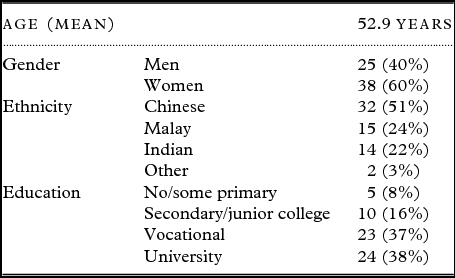
A total of 63 caregivers participated in the study. The average age of the informal caregivers (N = 63) who participated in FGDs and SIs was 52.9 years; the majority were of Chinese ethnicity (51%), followed by Malay (24%), Indian (22%), and other (3%) ethnic groups (Table 1). Of the caregivers, 37 (60%) were children of the person with dementia, 13 (20%) were spouses, and the remaining 13 (20%) were siblings, grandchildren, or daughters/sisters-in-law. The age of the person with dementia varied from 54 to 93 years, and their duration of diagnosis ranged from 1 to 23 years.
Socio-demographic background of the participants (N = 63)
Data collection
A semi-structured interview guide was designed to explore the needs of the caregivers. A funnel approach (Morgan, Reference Morgan1996) was used for data collection where the discussion first started with broad questions like, “Tell us about your experiences while caring for your relative with dementia.” Probes such as “how did you find out about the illness?” and “how do you manage the care at home and outside?” were used to collect additional information. The discussion was then steered toward challenges and unmet needs using an activity where the caregivers were asked to list these on a sheet of paper, followed by a focused discussion on each of these. Discussion was continued until no further need or challenge was identified by the caregivers. At the end of the discussion, caregivers were asked to highlight any other suggestions or expectations that might improve and simplify their caregiving role. During the discussions, the informal caregivers were also reminded to exclude the challenges solely related to other medical problems that their relative might have. The language of FGDs and SIs were decided on the basis of the language preference of the informal caregivers. Of the ten FGDS, four were conducted in English, three in Mandarin, and three in Malay. Among the 12 SIs, six caregivers were interviewed in English, and two each in Mandarin, Malay, and Tamil. All FGDs and SIs were audio-recorded.
Data analysis
Verbatim transcripts of the audio-recorded conversation from the FGDs and SIs were created and verified by listening to the tapes and validating the content. Data were also reviewed and compared concurrently along with data collection. Discussions in non-English languages were translated into English before the analysis. Thematic analysis was concurrently conducted (Boyatzis, Reference Boyatzis1998). Data were coded by two researchers independently, who coded words or phrases used by the informal caregivers while describing their experiences. The codes were then sorted into larger themes and sub-themes while comparing them against each other. Any lack of clarity or disagreement was resolved through discussions within the coders as well as the team to generate new codes or modify the code description. Data were analyzed using ATLAS.ti software version 5.5.
Expert panel sessions
Based on the observation of qualitative discussions, a list of informal caregivers’ needs was created. These were then reorganized to identify the main categories of needs. A further review and grouping was performed to form a consolidated list, comprising 25 categories of needs. This list was circulated among professionals and policy-makers along with a short rationale on their impact and relevance. Two stage expert panel inputs using a modified Delphi approach (Hsu and Sanford, Reference Hsu and Sanford2007) were used to (1) obtain professional caregivers’ opinion on the needs identified for the informal caregivers, and (2) identify additional needs to be included in the checklist of informal caregivers’ needs for dementia. The first expert panel included six members engaged in elderly care research and services, and comprised two researchers, one geriatric psychiatrist, two medical social workers, and one psychiatric nurse. The panel members independently rated every need from a 4-point scale (not relevant, somewhat relevant, quite relevant, and very relevant) upon reviewing the rationale provided and from their own experiences prior to the panel discussion. Ratings were then discussed and debated at a single panel discussion until a decision was reached on the relevance of each need. Needs given a final score of 3 or more were included in the checklist. These needs were then converted into positively worded self-report statements. For example, the sub-theme, “Support from employer” was converted into a statement, “The support that I receive from my employer while taking care of my relative/friend is adequate.” The final measure comprising the needs was then circulated via email among ten experts (two researchers, three geriatric psychiatrists, two medical social workers, one psychiatric nurse, one occupational therapist, and one policy-maker) for their inputs on their content and relevance.
Results
Thematic analysis
Following the analysis of the data from FGDs and SIs, following four main needs or themes were identified: (i) need for emotional and social support, (ii) need for information, (iii) need for support on finances, and (iv) need for accessible and appropriate facilities for people with dementia. Several sub-themes were identified under the main needs.
Need for emotional and social support
Informal caregivers experienced several physical and mental stressors in their daily involvement with the care management of their relative with dementia. Their caregiving duties and their own health imposed physical strain and limitations on themselves. However, more than the physical burden, overall, caregivers expressed their inability to provide optimum care for their loved one with dementia as a greater cause of emotional burden and guilt:
The fear of someone very dear to you will one day not recognize who you are, things that caregiver will encounter, mainly in the first stage …at that time we do not know how to handle (it) because we fear, we keep thinking, one day if my mom not recognize (us), how are we going to handle that part? (P5FE002)
Managing their relative's emotions and behaviors was another challenging task that often distracted the caregiver from their routine activities and personal life. Assistance and understanding from spouses and siblings were reported to be useful in maintaining emotional stability and balancing care provision. Although most caregivers reported positive experiences in the support they received from their family, several difficulties were also expressed. Family conflict arising from their relative's behavior, lack of acceptance of the illness, unequal care participation and lack of family support, inability to reach healthcare decisions amicably, safety concerns about other family members, in particular for children in the household, and refusal to contribute toward expenses caused severe emotional strains on the caregivers who often felt isolated and helpless:
When it comes to my dad, it is mentally draining, very draining for my wife, very draining for my kids also. Even to the extent, my daughter doesn't want to step near him or even go near him. He has created a sort of fear within the home. (P6FE003)
In addition, the effort to manage an uncertain future with the unstable, financially demanding, and evolving nature of the illness often led to anxiety and worry. Since caring for a person with dementia was tedious and challenging, informal caregivers felt depressed with little hope for the future and were tired of the constant demands of caregiving, thereby expressing the need for respite:
I think caregivers recognize there's a need for, what they call respite care. They (should) take leave to care for themselves, take a break, short holiday. Or just rest. (P5FE002)
Unexpected and unmanageable behavior of the relative with dementia often caused strife with neighbors and embarrassment in the community. Many caregivers expressed being restricted to stay indoors to avoid such embarrassment, stigma, or safety issues. In general, caregivers felt that the community as a whole did not understand dementia very well, leading to unpleasant reactions and impossible expectations. Common socially unpleasant situations reported were instances where the person with dementia was loud and disruptive at night, abusive toward family members and others, and uncooperative while taking public transport. These experiences deterred informal caregivers from socializing, enlisting their relative to day care or rehabilitation centers, and from taking the person out for a walk. This real and perceived lack of support and understanding from the society also led to anger and frustration:
If only people could be educated! I observe in the case of my grandmother, she just disappeared from social gatherings … she talks funny sometimes and all that but it's because she has the disease. (P4FE001)
While some caregivers adopted a positive attitude and felt accepting the situation was important to deal with their emotional needs, very few caregivers reported receiving counseling services or participating in support groups. Family was the biggest resource that caregivers relied on for emotional support. In few instances, caregivers mentioned helpful religious groups that eased their anxiety. Caregivers felt that more awareness on dementia and its manifestations among the general public would alleviate their difficulties and make their needs and challenges more appreciated by the community.
Need for information
All the participants expressed a strong unmet need for basic information on dementia, including its identification, causes and risk factors, recognizing early signs, available treatment options, and their expected outcomes, in order to be better prepared about what to realistically expect, thereby allowing for informed care decision-making and better management of their relative with dementia. The need for “hands-on” information on handling unique situations in the context of available resources and language and physical and social capacity of the caregiver was also raised:
The problem lies with the doctor … they can't tell you exactly what to do. When I asked the doctor, he said “you need to notice yourself.” He said that my mother's condition would get worse after six to nine months, but he did not tell me how to deal with it either. (P12SIC002)
Informal caregivers’ information needs were also related to the availability of healthcare services and options in Singapore for their relative as well as themselves, for example, counseling services or support groups for caregivers. Caregivers were either unsure or expressed lack of knowledge of services provided by voluntary or religious organizations:
What type of services we need, like support centers for dementia or other types of care centers – who will be able to help us or give us counseling on how to handle this kind of emotional (problem). (P6FE002)
Caregivers spent considerable time searching for additional information about the illness and different types of treatments, drawing upon varied sources, including doctors, other healthcare professionals and caregivers, the Internet, and the television. Caregivers also expressed the need to have timely information that is specific to the different stages of dementia as well as information on available training resources for themselves and for their paid domestic help. Administrative procedures required to access or expedite access to services were found to be cumbersome and informal caregivers felt that having a booklet or helpline resource for such information would be useful. Caregivers emphasized the need to have the information in multiple languages and disseminated through multiple modes such as the print, media, and online portals.
Need for support on finances
The cost of medications, consultation with clinicians, visit to day care centers, and hospitalizations exerted severe financial burden on informal caregivers. Many caregivers expressed that they preferred to take care of their relative at home because of the high costs of hospice and nursing home care. Other commonly stated expenses were transportation, domestic help's salary, assistive devices, and daily consumables for sanitation such as diapers and toilet paper. Costs also escalated in emergency care situations, where a home-based service was essential or hospitalization was required. Worst affected were the “sandwich generation” informal caregivers who were providing care to their parent with dementia while concurrently supporting their own children. Being the primary and often the sole financial provider also compounded their difficulties in fulfilling their responsibilities:
The money that I use for medication is (meant) for my children's schooling. (P9FM003)
Some caregivers reported reducing or giving up employment altogether to provide care for their relative at home, resulting in a loss of earnings. Need to stay employed to be able to manage healthcare expenses, save for the future, and provide basics for their children were strongly expressed by male caregivers. Very few women with dementia had any savings, making their care more burdensome:
I have to work. My wife is not working, I have two children, so the only solution I have for my dad right now is nursing home or long term stay. But they are expensive. (P6FE003)
Need for accessible and appropriate facilities
Caregivers expressed several areas for improvement in services for dementia that covered adequacy, accessibility, and affordability of the available service options. They mentioned that while services or nursing homes for the elderly were available, there were very few dementia-specific residential care centers. Day care centers also required that the person with dementia attending their facility be accompanied at all times by another person. At times, day care centers had requested the caregivers to explore other options due to the disruptive behavior of their relative with dementia:
I had admitted him to a nursing home three days ago; yesterday they called me and said that they had to throw him out, because he was caught with problems. And he even molested the staff there, so they threw him back (to the hospital). (P6FE003)
During the discussions, a number of issues had emerged: administrative “red-tape,” shunting from one healthcare site to another, quality of long-term care, negative perceptions of hospice and other elderly care facilities, and perceived shortcomings of the training and skill of the healthcare staff were evident. One of the underlying reasons for avoiding day care centers and nursing homes also seemed to be their low perceived usefulness of intervention and unprofessional or discriminatory service standards of the healthcare staff:
What she does over there is just to kill her time, they will just let her walk around, they to do minimal exercise there, and it helps them only (a) little bit. (P1FC001)
Related needs on easy and quick access, continuity of care, and lack of affordable home-based services also surfaced. Almost all the caregivers expressed frustration by the long waiting time at medical clinics. Lack of ambulance or transport services further hindered access to services that required considerable travel and effort:
It's always a very long waiting time, very long …my dad cannot control his bowels and he gets angry very fast … I tell them (clinic staff), please help me to let him go first … Then my dad starts to get angry, very angry and that's when everybody starts to look at us …there's nothing that I can do … when my dad finally throw a tantrum, then they let my dad go first. I want a hospital to be more understanding for the dementia patient, reduce our waiting time. (P10FT001)
Caregivers were unhappy with the aesthetic makeup of the nursing homes and elderly care centers. They felt that the centers were “too institutionalized,” lowering their utility and acceptance among people with dementia. Some also reported the inability of day care centers and nursing homes to cater to the ethnic requirements of people with dementia. Malay caregivers expressed the dearth of centers that provided halal food (food that is according to the dietary requirements specified in Islam), while both Malay and Indian caregivers also felt that the activities at the day care centers were largely in Mandarin language (since majority of the patients were Chinese):
Place with food that is not halal, would we eventually want to send our mothers with food that is not (religiously) appropriate. (P8FM003)
Given the traditional expectations from the extended family and society, many caregivers were against the idea of long-term residential care. Two categories of caregivers preferred such long-term residential care. The first were the sole caregivers who were employed and needed financial stability and balance with their other responsibilities, and the second were the children of opposite gender who expressed “feeling awkward” while attending to some hygiene and care needs:
As a man, some things I cannot do (for my mother), like (help with) toilet or bathe and so on, that becomes a problem. (P7FM001)
Caregivers with supportive siblings found it easier to manage care needs at home, but felt the need for more day care options to access helpful interventions and keep their relative with dementia engaged in activities. Some caregivers also expressed the need to have overnight care centers or services that allowed the caregivers to rest well and be ready to handle daytime activities better. The need for more and affordable short-term respite centers was also expressed to allow caregivers to “recharge” and “connect with their own family”:
I wish there are particular care centers, 24 hours, specialized, those that (can also) train (family) for taking care of dementia patient. (P3FC003)
Expert panel sessions for the Caregivers’ Needs Checklist for Dementia (CNCD) measure
The expert panels endorsed all the needs identified for informal caregivers (Table 2). The list of needs, rationale for including them, and mean grading for each given by the experts is presented in Table 2. Experts found the list of caregivers’ needs for dementia to be relevant and comprehensive, demonstrating its acceptable face validity. However, an additional category on “alternative care arrangements” was recommended by the panelists to obtain specific information on this need. Needs were then converted into positively worded self-report statements. For example, the sub-theme, “Support from employer” was converted into a statement, “The support that I receive from my employer while taking care of my relative/friend is adequate.” A 5-point response scale (strongly agree, agree, disagree, strongly disagree, I did not want (need specified)/these services) was added to the statements to obtain feedback from the caregivers. An excerpt of the measure is provided in Table 3.
Needs’ categories included in the Caregivers’ Needs Checklist for Dementia, rationale for including them that was discussed, and mean rating given by experts

Note: *On a scale of 1 – not relevant, 2 – somewhat relevant, 3 – quite relevant, and 4 – very relevant.
Excerpt of the caregivers’ needs checklist for dementia
Discussion
The primary goal of the study was to elicit needs of informal caregivers of people with dementia in Singapore in the current healthcare and social structure. The study highlighted that informal caregivers faced several unmet and complex needs while caring for a relative with dementia. In Singapore the family emerged as a major care provider for people with dementia, a pattern observed worldwide across different countries. According to a report in 1995, about 90% of the elderly lived with at least one of their children and/or spouse in Singapore (Chan, Reference Chan1997). A projection for the next 20 years based on a modeling study posits that while the prevalence of dementia is likely to increase in Singapore, the family size will significantly shrink (Thompson et al., Reference Thompson, Riley, Eberlein and Matchar2012). The role of an informal caregiver will therefore intensify and impose higher burden on this limited care resource, thus it is timely and imperative to understand and assess their needs.
This study uncovered several unmet needs. The information most commonly desired and perceived inadequate were facts on the causes, detection, progression of the illness, and availability of services for people with dementia and their caregivers. Similar findings have been widely reported in the literature (Wackerbarth and Johnson, Reference Wackerbarth and Johnson2002; Lai and Chung, Reference Lai and Chung2007; Hirakawa et al., Reference Hirakawa, Kuzuya, Enoki and Uemura2011; Washington et al., Reference Washington, Meadows, Elliott and Koopman2011; Boughtwood et al., Reference Boughtwood2012). Among our participants, the more educated caregivers seemed to have accessed more information resources, but they expressed a need for continual, practical, and “jargon-free” information.
Of the four perceived needs identified in this study, many caregivers very strongly expressed emotional needs. In addition to adjusting emotionally to the changes in the behavior and functioning of their relative, the informal caregivers faced numerous physical demands while managing difficult situations, and these stressful situations can be further compounded by family conflict, lack of support from other family members and/or employers, and the feeling of guilt for “not doing enough.” These results support previous research that has shown that emotional experiences are the biggest challenge faced by informal caregivers (Pinquart and Sörensen, Reference Pinquart and Sörensen2003). In this study, emotional and social needs seem to be interconnected with behavioral symptoms of the person with dementia, family size and structure, and other responsibilities of the caregiver. Previous quantitative studies conducted in Singapore found that duration of caregiving, depression, and dementia patient's disturbed behavior, in particular repetition, disinhibition and agitation, and incontinence, were predictive of poor caregiver outcomes (Lim et al., Reference Lim, Sahadevan, Choo and Anthony1999; Meiland et al., Reference Meiland, Kat, van Tilburg, Jonker and Dröes2005). Psycho-education, case management, social groups, and the Internet-based services have proved effective in reducing the psychological strain of caregivers (Chiu et al., Reference Chiu2009; Martín-Carrasco et al., Reference Martín-Carrasco2009; Pimouguet et al., Reference Pimouguet, Lavaud, Dartigues and Helmer2010; Laakkonen et al., Reference Laakkonen, Hölttä, Savikko, Strandberg, Suominen and Pitkälä2012).
Caregivers needed assistance for the financial burden of the illness. This was not unexpected; studies have estimated a direct annual cost of US$156 billion for dementia (Aoyagi and Shephard, Reference Aoyagi and Shephard2011). In countries like the United States and Australia, where healthcare is largely covered by insurance, caregivers paid US$83 billion (Alzheimer's Association, 2007) and AU$3.2 billion (approx. US$2.5 billion) (Alzheimer's Australia, 2003) respectively. In Singapore, the mode of payment is based on a copayment process (whereby the individuals also contribute partly to the cost apart from the Government subsidy), and this can further add to the expenses. For some caregivers, meeting these needs involved extensive efforts in seeking healthcare subsidies, managing their personal responsibilities, and coordinating their relative's medical care and finances. These were significant challenges for the caregivers. Several studies have naturally reported the cost of treatment and services as a major barrier to service use in dementia (Brodaty et al., Reference Brodaty, Thomson, Thompson and Fine2005; Lim et al., Reference Lim, Goh, Chionh and Yap2012). Cost reduction interventions like use of physical activity in the elderly leading to lesser medical problems and effective case management have been recommended (Pimouguet et al., Reference Pimouguet, Lavaud, Dartigues and Helmer2010; Aoyagi and Shephard, Reference Aoyagi and Shephard2011). This study also highlighted various components of financial strain, which could be included in estimating the cost of illness and in health economic evaluations. For the first time, the need for assistance with the costs and procedures associated with hiring a paid helper or maid, and training them were reported.
Nearly half of the caregivers preferred and were happy with home-based care, and this was mentioned largely in relation to people with advance dementia, where they had poor mobility and manageable behavioral problems. Questionnaire-based studies conducted in Singapore and elsewhere have reported several factors for care preferences – employment, available help in caring, and gender are some of the factors (Nieboer et al., Reference Nieboer, Koolman and Stolk2010; Li et al., Reference Li, Kyrouac, McManus, Cranston and Hughes2012; Lim et al., Reference Lim, Goh, Chionh and Yap2012; Wang et al., Reference Wang, Shyu, Tsai, Yang and Yao2012). However, the service needs observed in our qualitative study were largely influenced by convenience, cultural expectations, and financial woes. The areas of improvement in service delivery included timely access, continuity, affordability, better coordination of health and social care, quality of care particularly in the long-term residential care setting, and healthcare professionals’ communication and caring skills and attitude.
Another important contribution of this research is the generation of the Caregivers’ Needs Checklist for Dementia (CNCD) measure for estimating the perceived unmet needs of caregivers. While several studies have used the Zarit Burden Inventory for caregivers of people with dementia (Tan et al., Reference Tan, Wong and Allen2005; Liew et al., Reference Liew, Luo, Ng, Chionh, Goh and Yap2010), none have measured specific unmet needs. To the best of our knowledge, scales measuring the needs of caregivers of people with dementia are limited, with only two reported in the literature (Wancata et al., Reference Wancata2005; Chow et al., Reference Chow, Pio and Rockwood2011). The survey used by Chow et al. Reference Chow, Pio and Rockwood(2011) focuses on general and particular aspects of frontotemporal dementia syndromes, making it long and highly specific. On the other hand, the measure developed by Wancata et al. Reference Wancata(2005) is semi-structured and complex, which limits its use in a survey setting. The CNCD was generated as a short, self-report checklist to estimate the unmet needs of informal caregivers in an ongoing population-wide survey. Further testing and modification is being conducted on the CNCD to establish its reliability and validity in an ongoing quantitative survey.
Some limitations of the study should be noted. The majority of our caregivers were women and many were unemployed. It is possible that inclusion of more men and employed women may have improved the richness of the analysis. The sample, however, included participants with varying education and socio-demographic backgrounds. We excluded caregivers who were recently (less than one year) informed of their relative's illness. Although their needs may vary from those who have been taking care of a relative with dementia for more than one year (Silva et al., Reference Silva, Kergoat and Shatenstein2013; Zwaanswijk et al., Reference Zwaanswijk, Peeters, van Beek, Meerveld and Francke2013), our study did not intend to perform analysis based on the stage or duration of dementia. Some variations in the level of participants’ involvement with care and role are expected, as the definition of informal caregiver used in the study was broad. Needs were also solely explored from the perspective of informal caregivers; we, however, could not obtain participants’ feedback on our interpretations as consent to re-contact them was not included in the study consent. Irrespective of these limitations, this is the first study that reports unmet needs of informal caregivers and highlights the areas that seek attention from healthcare sector and policy-makers. It also included inputs from caregivers belonging to the three main ethnic groups in Singapore and uncovered important service limitations.
Conclusions
Informal caregivers are willing to support people with dementia in the community because of personal attachment and preferences, financial limitations, and social expectations, but there is a clear demand to address their unmet needs for information, services, respite, and emotional and financial support. Caregivers desire information to first identify the problem and then to make informed decisions as the illness progresses. In the context of dementia, a disease with poor and uncertain prognosis, practical challenges were less salient for caregivers than their emotional needs. Psychological counseling services and accessible respite care options are essential to meet their needs. Results also carry implications for clinical practice. Clinicians could prepare caregivers for the emotional aspects of caregiving by providing them timely and adequate information. Appreciating the unmet service needs identified in this study will help plan and enhance ethnically appropriate services and alleviate caregivers’ anxiety. Recognizing the role of informal caregivers in dementia care and forging greater communication between informal caregivers and the formal healthcare sector will not only enhance the quality of life of people with dementia and their caregivers but also aid the effective management of people with dementia.
Conflict of interest
None
Description of author roles
Janhavi Ajit Vaingankar designed the study, collected, verified, and analyzed the data, developed the caregivers’ needs checklist, and wrote the manuscript. Mythily Subramaniam and Louisa Picco analyzed the data and provided intellectual inputs on the caregivers’ needs checklist and manuscript content. Goi Khia Eng, Saleha Shafie and Rajeswari Sambasivam, respectively, designed the Chinese, Malay, and Tamil language interviews, and collected, translated, and participated in interpreting the data. Yun Jue Zhang and Vathsala Sagayadevan transcribed and translated the data, verified the transcripts, and provided intellectual inputs in designing the caregivers’ needs checklist. Siow Ann Chong supervised the overall study design, provided inputs on the manuscript content, and approved the manuscript version to be published.
Acknowledgments
The study was funded by the Ministry of Health, Singapore, and Singapore Millennium Foundation of the Temasek Trust. We thank Dr. Edimansyah Abdin and Ms. Nurulfathiyah Bte Mohamed Thoimi for note taking and transcribing the Malay language focus group discussions. The research team is grateful to the participants who generously shared their time, experience, and opinions for the purpose of this study.