


1. INTRODUCTION
Dialects in Europe are changing, and a general tendency is that dialects are leveling towards a standard variety. However, there is not necessarily one uniform leveling process. This paper describes the linguistic situation in three different dialect areas in Sweden – Inland West Sweden, Coastal West Sweden and the small rural village Torsby in Northern Värmland – in order to compare the processes of dialect change. The main objective is to establish what has happened to the language systems in these dialect areas over 60–70 years. This is done by investigating how much of the traditional dialect system is still in use in 2000–2010 compared to the mid-20th century, and whether new linguistic variants have appeared.
Many previous studies on dialect change have focused on a limited selection of linguistic variables as a basis for discussing processes of change. This is usually done by relating the frequency of dialect variants to the use of standard variants. The main objective of the present study is rather to describe how a dialect system may change over time, and hence the analyses are concerned with how much of the traditional dialect spoken in the mid-20th century is still in use, and whether new variants have appeared. This approach makes it possible to compare three areas, even though the linguistic variables vary.
The article begins with an overview of processes of dialect change in Europe in Section 2. In Section 3, the data and locations discussed in the study are introduced, and in Section 4, the analysis of the data is presented. After that, in Section 5, the results of the study are presented one area at a time, and the findings for the separate locations are compared. Finally, some possible explanations for the similarities and differences in processes for dialect change are discussed in Section 6.
2. PROCESSES FOR DIALECT CHANGE
Many previous studies have concluded that contact between language users is the foundation for language change, since speakers adapt their linguistic features to those used by their interlocutors (see e.g. Trudgill Reference Trudgill1986, Giles, Coupland & Coupland Reference Giles, Coupland, Coupland, Giles, Coupland and Coupland1991, Hinskens Reference Hinskens1998). Auer & Hinskens (Reference Auer and Hinskens1996, Reference Auer and Hinskens2005) have proposed a model for this change, in which three steps lead to language change. The first step involves face-to-face interaction between speakers of different varieties (see e.g. Giles Reference Giles1973; Coupland Reference Coupland1980, Reference Coupland1984; Trudgill Reference Trudgill1986): the more traditional dialect speaker will usually accommodate to the more standardized or innovative speaker (Auer & Hinskens Reference Auer and Hinskens1996, Reference Auer and Hinskens2005; but see Nilsson Reference Nilsson2015b). In the second step, speakers change their behavior more permanently and use specific linguistic features with speakers who do not use such features themselves. The likelihood of this happening is larger if a speaker is frequently exposed to a linguistic feature. In order for language change to take place – the third step – a large number of speakers in a society must use the new form.
The change itself may result in a number of new linguistic landscapes. One of the most common is leveling towards a national standard or regional standard variety. Such leveling has taken place in many European countries, including Denmark (Pedersen Reference Pedersen2005, Gregersen & Kristiansen Reference Gregersen and Kristiansen2015a), Norway (Sandøy Reference Sandøy2015a), the Netherlands, Germany, Spain, Poland, England, Greece and Russia (Auer Reference Auer, Delbecque, Van der Auwera and Geeraerts2005). (Further accounts of language standardization in Europe can be found in Kristiansen & Coupland Reference Kristiansen and Coupland2011 and Kristiansen & Grondelaers Reference Kristiansen and Grondelaers2013.) This is also the case in Sweden, and because of urbanization and frequent contact with speakers of other varieties a smaller proportion of the population speaks traditional dialects today compared to the mid-20th century (see e.g. Thelander Reference Thelander1979, Sundgren Reference Sundgren2002, Nilsson Reference Nilsson2009, Svahn & Nilsson Reference Svahn and Nilsson2014). On the other hand, this leveling may have slowed down, and some researchers report that there are quite stable speech communities as well (e.g. Sundgren Reference Sundgren2002, Nilsson Reference Nilsson2015a). Similar situations are found in other Nordic countries such as Finland, Norway, and particularly Iceland (Ivars Reference Ivars2003; Sandøy Reference Sandøy, Gunnarsson, Bergström, Eklund, Fridell, Hansen, Karstadt, Nordberg, Sundgren and Thelander2004, Reference Sandøy2015a; Friðriksson Reference Friðriksson2008). Researchers have suggested language policies, personal identification with local values and close-knit social networks as reasons for stability (Røyneland Reference Røyneland2005, Friðriksson Reference Friðriksson2008). Dialects in contact may also affect each other in a number of ways, and may form new varieties such as mixed, fudged, scrambled and fused lects, and also koines (see e.g. Siegel Reference Siegel1985, Trudgill Reference Trudgill1986, Chambers & Trudgill Reference Chambers and Trudgill1998, Auer Reference Auer1999, Auer, Hinskens & Kerswill Reference Auer, Hinskens and (eds2005, Kerswill Reference Kerswill, Chambers, Trudgill and Schilling-Estes2013). A dialect may also replace another dialect, i.e. dialect shift. These possible outcomes of dialect contact are discussed further in Sections 5 and 6.
3. LOCATIONS AND DATA
From a European perspective, Sweden is relatively sparsely populated. However, 85% of the approximate population of 9.4 million live in Sweden's 1956 villages (Svanström Reference Svanström2013). Most of the informants investigated in this article live in such locations, with populations ranging from 1,400 to 66,000. Some informants also live outside these villages or small towns in rural areas.
The data discussed in this paper is derived from two comprehensive studies of dialect change: Dialect Change in West Sweden (Svahn & Nilsson Reference Svahn and Nilsson2014) and Dialect Change in Rural Sweden (Nilsson Reference Nilsson2015a).
Dialect Change in West Sweden investigated two traditional dialect areas, Västergötland (here referred to as Inland West Sweden) and Bohuslän (Coastal West Sweden), close to Sweden's second largest city, Gothenburg. The main objective was to study the current linguistic situation as well as to explore how dialects have changed over the past 50–70 years, and to discuss the reasons for this change. As previous studies suggested that the Gothenburg variety was rapidly gaining ground in the surroundings of the urban area (Grönberg Reference Grönberg2004), another major objective was to investigate how far into the surrounding region the Gothenburg variety had spread. In total, the project investigated the speech of 115 informants in nine locations at a distance of 45–130 km from Gothenburg in 2007–2009. The recordings consist mainly of sociolinguistic interviews with adolescents aged 16–18 years, usually interviewed in groups of three. The investigation also included interviews with adults and some self-made recordings with both age groups. The informants were in most cases born in the area, or had moved there at an early age, and most informants’ parents (at least one, and often both) were born in the same area.
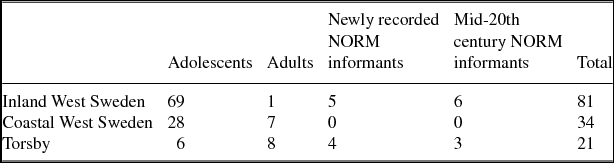
In Inland West Sweden (see Figure 1), recordings were made in six locations: Kinna (population 14,500), Borås (66,300), Trollhättan (44,500), Sollebrunn (1,400), Vara (3,800) and Skara (10,800). In each location 10–12 adolescents were recorded. Six adults were also recorded across the area, and in total six adults and 69 adolescents were recorded in Inland West Sweden.
Map of the areas investigated.

In order to discuss the real time change in the areas investigated, six recordings made in 1948–1967 with informants born in 1875–1887 (as well as one 17-year-old girl born in 1944) were also included. When these recordings were made, the most traditional dialect speakers of a speech community, so-called NORM-speakers (Chambers & Trudgill Reference Chambers and Trudgill1998) were often sought out. Today, most studies instead try to include informants who are representative of the population in a given location. Consequently, data collected today does not represent speakers comparable to those recorded in the mid-20th century (Nilsson Reference Nilsson2009, Bockgård & Nilsson Reference Bockgård and Nilsson2011). This discrepancy was addressed by including five speakers who were considered very traditional by others in the same speech community in the data recorded by the project. Hence, it is possible to compare today's NORM-speakers to those recorded in the mid-20th century (see also Nilsson Reference Nilsson2009). The project also compared the dialect in use with a very thorough description of the traditional dialect system (Götlind & Landtmanson Reference Götlind and Landtmanson1940–Reference Götlind and Landtmanson1950).
In Coastal West Sweden (see Figure 1), three locations were studied. In Uddevalla (population 30,500), 12 adolescents were recorded, in Stenungsund (population 10,000), 12 adolescents and six adults, and in Skärhamn (population 3,200), four adolescents and one adult. In total, the speech of seven adults and 28 adolescents was investigated in Coastal West Sweden. For Coastal West Sweden no comparison was made with older recordings, but the traditional dialect features investigated were described by Bertil Björseth in 1946 (Björseth Reference Björseth1946; see also Lindroth Reference Lindroth1920 and Kvillerud Reference Kvillerud1999).
Dialect Change in Rural Sweden focused on processes of dialect change in rural Sweden. The main objective was to compare processes for linguistic change in demographically similar locations, and to discuss reasons for change from a micro-level interactional perspective. Here, the results from one of these locations, Torsby, is presented. Torsby is a small rural village in the northern part of Värmland (see Figure 1). There are approximately 4,000 inhabitants and the closest urban center, Karlstad (population 61,600), is 100 km away (or 1 hour and 15 minutes by car). Torsby is, and has always been, quite isolated, and the traditional dialect has been described as stable and un-influenced by other varieties (Broberg [Reference Broberg1973] Reference Broberg2001; see also Noreen Reference Noreen1877 and Kallstenius Reference Kallstenius1927).
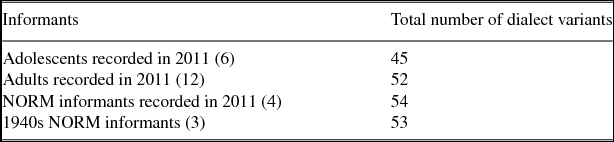
The Torsby recordings were made in 2011 and here the speech of six adolescents and 12 adults is analyzed. The project recorded several other informants as well, and the ones chosen for analyses here include the least and the most traditional dialects speaker in each group of informants. Of the adults, four were chosen to represent traditional dialect speakers, or NORM-speakers, as in the project Dialect Change in West Sweden. All informants were born in the area or moved there at an early age, and in most cases, their parents were from the area as well. These recordings were compared to recordings from 1946 with three informants born in 1872–1889. Table 1 provides an overview of the informants from each area.
The informants.

All the newly recorded informants in both projects participated in sociolinguistic interviews in which they talked about their daily life and background. In addition, most informants filled out an extensive questionnaire about their mobility, lifestyle choices, social background and values. Together, the interviews and questionnaires provide important information about the informants, and their language use is correlated to parts of this information in Sections 5 and 6.
4. ANALYSES
In this paper two types of linguistic variables are discussed: (i) dialect variables, which may be realized as either dialect variants or standard variants, and (ii) new variables, which may be realized as either new variants or standard variants. These are thus two distinct sets of variables, and so the dialect variables are never realized as new variants.
The concept of dialect as well as that of a standard variety are problematic. In Sweden, a spoken standard variety is an abstract notion, or ideal, that is rarely found in real conversations, but rather used by announcers on TV and in the performing arts (Thelander Reference Thelander, Moberg and Westman1996, Teleman Reference Teleman2003, Magnusson Petzell & Nilsson Reference Magnusson Petzell and Nilsson2015). Standard Swedish has been described as the opposite of dialects and sociolects (Josephson Reference Josephsson2004), and does not reveal the geographical or social background of a speaker (Teleman Reference Teleman2003). Here, standard variants are variants that are neither geographically distinguished, nor are they new variants. What should be considered to be dialect variants in a Swedish context or not has been problematized by Svahn (Reference Svahn2003; see also Svahn & Nilsson Reference Svahn and Nilsson2014), who concludes that dialects today are heterogeneous, and there is extensive inter- and intraindividual variation. Similarly, Auer (Reference Auer, Delbecque, Van der Auwera and Geeraerts2005:7) includes regional and urban varieties in the concept of dialect. Here, dialect variants are linguistic features that are geographically distinguished, and include regional features. These are usually described in the literature as traditional dialect features. Of course, dialects as well as the standard variety in Sweden, and elsewhere, have always undergone change, and intra- and interindivdual variation has always been present (see e.g. Coupland Reference Coupland2009, Pedersen Reference Pedersen2009, Auer & Spiekermann Reference Auer and Spiekermann2011, Kristiansen Reference Kristiansen2016, as well as the contributions in Kristiansen & Coupland Reference Kristiansen and Coupland2011).
The concept of new variants refers to linguistic features that have not previously been documented in the area, nor are present in the recordings from the mid-20th century, but have in some cases been documented in other areas. These can be (i) Gothenburg features, (ii) features that signal urbanity/modernity and can be found in many parts of Sweden, and (iii) features that seem to be part of an ongoing change in the Swedish vowel system. The Gothenburg variety is not standard Swedish; it is an urban variety that evolved in the late 19th century within the working class (Andersson Reference Andersson, Kotsinas and Helgander1984). The eight Gothenburg features found in other locations than Gothenburg include one prosodic and seven phonological features. Exactly what these features index (Silverstein Reference Silverstein2003, Johnstone & Kiesling Reference Johnstone and Kiesling2008) has not yet been investigated, but in another context than Gothenburg city they likely index urbanity (Svahn & Nilsson Reference Svahn and Nilsson2014). Features described in previous literature as signals of urbanity/modernity include the damped /iː/ and /yː/ (see e.g. Elert Reference Elert1989). Finally, features that seem to be part of an ongoing change in the Swedish vowel system are the opening of /æː/ and /œː/, as well as [œ] > [ɵ] (Leinonen Reference Leinonen2010a, Reference Leinonenb; Wenner Reference Wenner2010).
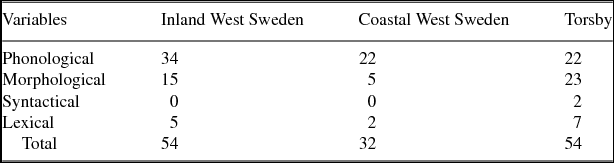
The choice of variables is data driven: within both studies, all the recorded data was listened to and all variants that were not standard variants were noted. For example, in Inland West Sweden, and also in Torsby, an informant might use the traditional uvular R. If someone does this, the variable /r/ is included in the investigation. This variable can be realized as either the dialect variant [R] or the standard variant [r]. In this study, all variables have two possible realizations: the dialect variables are either realized as one dialect variant or one standard variant and the new variables are either realized as one new variant or one standard variant. Most variables are phonological or morphological, but a few syntactical, lexical and one prosodic variable were analyzed (see Tables 2 and 3). Of course, some linguistic features may be more marked than others, and the use of such features have the potential to index for example local or urban. This is further discussed in Nilsson & Wenner (to appear).
The different traditional dialect variables investigated in each area.

The different new variables investigated in each area.

In total, the studies have analyzed 54 traditional dialect variables in Torsby, 54 in Inland West Sweden and 29 in Coastal West Sweden. Further, 18 new variables have been analyzed. Analyses of such a large number of variables make it possible to see how large part of the traditional dialect system used in the mid-20th century is still in use in the early 21st century, as well as what the traditional dialect is being replaced with (the standard and/or something new). For all the informants investigated in Torsby and Inland West Sweden, each variable has been analyzed (usually an informant has tokens of most variables), which gives a picture of each individual's idiolect or linguistic repertoire. In this paper, the informants’ repertoires represent the dialect situation in the respective locations, and I investigate how much the system varies in its use by different age groups in the different locations, as well as how much of the dialect system is in use today compared to the mid-20th century.
In Inland West Sweden and Torsby the data was examined thoroughly and, as far as possible, frequency was noted for the realization of the linguistic variables by each informant. This was not done in Coastal West Sweden; there it was simply noted if a certain dialect variant was present in an informant's repertoire or not. The intra-individual variation in the coastal informants’ repertoires discussed here is therefore not as well documented as for the other informants. However, I present no statistics from any locations in this article as many of the phonological variables investigated cannot easily be analyzed as either dialect or standard/ new or standard. This is especially the case with the vowels investigated. For example, in all the studied areas the traditional dialect realization of the variable /öːr/ (i.e. long ö in front of /r/ in words such as smör ‘butter’ and rör ‘pipe’) is [øːr] (the standard variant is [œːr]). However, when /öːr/ is pronounced without stress, it is difficult to determine whether it is realized as the dialect or the standard variant. It would perhaps be possible to omit all cases of un-stressed vowels; unfortunately, it is not always easy to draw the line between what is stressed and un-stressed in natural speech, and such a venture risks leading to arbitrary and misleading results. Besides, there are several cases of un-stressed vowels clearly realized as the dialect variant. Further, as dialects have always been undergoing change, it is difficult to say whether some of the dialect features in the recordings made in the mid-20th century have already leveled towards standard, or if those features have always coincided with the Swedish standard realization of that particular variable. Therefore, intra-individual variation is not presented here, but the tendency is that there is a direct correlation between realizing many variables as the traditional dialect variants and frequency, i.e. the more of the dialect system used by an informant, the more frequently that informant realizes dialect variables as the dialect variant. Instead, this article focuses on how similar or different speakers in the investigated areas sound in the early 21st century compared to the mid-20th century.
As the data discussed comes from two separate studies with slightly different objectives, the three datasets differ in size and in which age groups most recordings are made for. However, by investigating to what extent the same dialect system is in use after 60–70 years, this study shows tendencies in the processes in each location, and these processes may then be compared.
5. RESULTS
In this section the results from each location are presented, first Inland West Sweden in Section 5.1, then Torsby in Section 5.2 and finally Coastal West Sweden in Section 5.3. In Section 5.4, the results from the three areas are compared.
5.1 Dialect change in Inland West Sweden
As mentioned above, the informants recorded in the mid-20th century were chosen because they were traditional dialect speakers and it is therefore expected that they use many dialect variants. The most traditional NORM informants from that time realizes 41 dialect variables out of the 54 investigated as the dialect variant and the other five between 30 and 40. These informants realize many of the dialect variables with both the dialect and standard variants and there is quite extensive intra-individual variation (Svahn & Nilsson Reference Svahn and Nilsson2014).
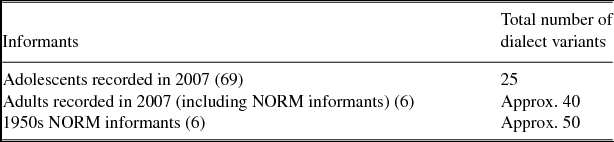
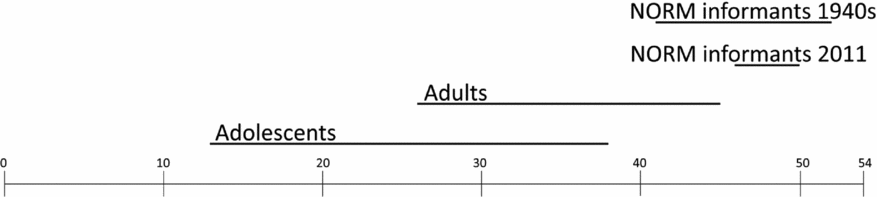
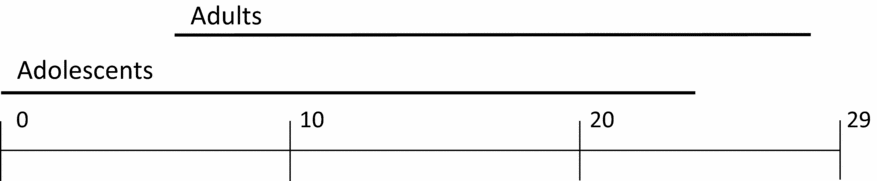
In the data recorded in 2007, the NORM informants (aged 40–63 years) realize between 32 and 39 dialect variables as the dialect variants, and the only other adult, a 51-year-old woman, 15. Compared to the informants recorded in the 1950s, some of the NORM informants recorded in 2007 use a similar proportion of the traditional system. The 69 adolescents realize between two and 20 dialect variables as the dialect variant. Compared to the adults, they are clearly more leveled in general. Figure 2 illustrates how many dialect variables are realized as the dialect variant in each of the groups of informants investigated in Inland West Sweden. Table 4 illustrates how much of the traditional dialect system each category of informants uses.
The span of the number of traditional dialect variants used by the four groups of Inland West Sweden informants. (As there is only one adult informant in this data set, the line indicating the span for ‘Adults’ is very short.)

Total number of dialect variants found in each category of informants in Inland West Sweden. The numbers in parentheses indicate the number of informants in each group.
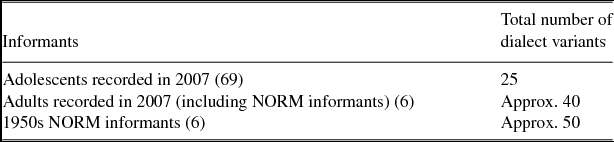
As illustrated in Table 4, there are 25 different dialect variants found among the adolescents recorded in 2007 (although no individual uses more than 20 different dialect variants) and 40 among the adults recorded in 2007 (of whom most are selected NORM-speakers). In the older recordings, there are approximately 50 different dialect variants. Although some speakers today are quite traditional dialect speakers, the dialect is obviously leveling towards the standard.
As mentioned in Section 4 above, recordings were made in several locations at different distances from Gothenburg and of various sizes. The dialect situation in these locations is however very similar. The project related linguistic variation to gender, socio-economic conditions, level of education, stated propensity for moving and other lifestyle choices. It turned out that an important factor was stated moving propensity: informants who reported wanting to continue living in the same location used more traditional variants than those who were willing to move. The same tendency was noted by Monka (Reference Monka2015) in a Danish context. There was also a clear correlation between gender and dialect use: the tendency was that the most leveled speakers are (young) women.
Twenty-three of these young women, as well as 10 young men, also used new features, although in general individual speakers used only one or two different new variants and only sporadically in the recordings, and the intra-individual variation is extensive. The new variants in this area, mainly fricatives, are urban (i.e. they signal an urban lifestyle and have probably spread from Sweden's largest cities, Stockholm and Gothenburg), while the new vowel realizations seem to be part of an ongoing change in the Swedish vowel system (see Leinonen Reference Leinonen2010a, Reference Leinonenb; Wenner Reference Wenner2010). Although this area is situated on the outskirts of Gothenburg, no typical variants from the Gothenburg variety were found in these locations (however, it is likely that the new variants have spread from Gothenburg as they most likely index urbanity; see Svahn & Nilsson Reference Svahn and Nilsson2014).
There is a pattern in the use of the new variants: it seems that the more new variants used by an informant, the less likely it is that the said informant will have many traditional dialect variants in his or her repertoire. Vice versa, the most traditional dialect speakers use no new variants. It seems that new variants enter the language system when leveling is already underway.
5.2 Dialect change in Torsby
In Torsby, the most traditional NORM informant recorded in the 1940s realizes 52 out of the 54 investigated dialect variables as dialect variants. The other two informants realize 41 and 44 as the dialect variants respectively, and must be considered to be rather traditional dialect speakers. The four NORM informants chosen to represent the traditional dialect recorded in 2011 realize as many as 46–50 dialect variables as dialect variants (and they do so frequently), i.e. as many as the NORM informants recorded in the 1940s. Some of the newly recorded adults and adolescents are also very traditional dialect speakers, but there is clear inter-individual variation: the adults realize between 26 and 45 of the dialect variables as dialect variants and the adolescents between 13 and 38. In general, the intra-individual variation among the adults and adolescents recorded in 2011 is greater than in both groups of NORM informants, and they also realize dialect variables as standard variants more frequently.
Figure 3 illustrates how many traditional dialect variants are used in each of the groups of informants investigated. It appears that the adolescents as a group are more leveled than the adults. This is also the case when we turn to the total use of dialect variants within each category of informants (see Table 5).
The span of the number of traditional dialect variants used by the four groups of Torsby informants.

Total number of dialect variants found in each category of informants in Torsby. The numbers in parentheses indicate the number of informants in each group.
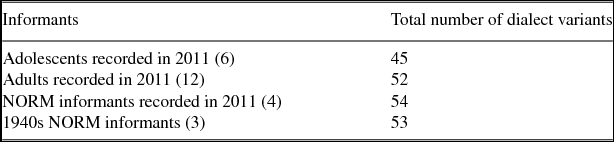
As illustrated in Table 5, there are 45 different dialect variants found among the newly recorded adolescents (although no individual uses more than 38 different variants) and 52 among the adults. In the group of newly recorded NORM informants there are actually 54 different dialect variants found, compared to 53 in the 1950s recordings.Footnote 1 From this, it seems that although most speakers do not use as many different dialect variants as the combined groups do together, a large part of the traditional dialect system is still in use. Torsby can therefore be described as quite a stable dialect area. Another factor contributing to Torsby's stability as a speech community is the fact that there are no new variants in any of the informants’ speech.
The interviews and questionnaires reveal that most informants are very content in residing in Torsby and have no plans of moving. They also spend most of their time in Torsby, and have close-knit social networks. Further, they express positive attitudes towards the traditional dialect. The least traditional dialect speakers are young women, but the inter-individual variation is extensive, and a couple of the younger women are quite traditional dialect speakers. Some of the most leveled informants plan to, or at least express a desire to, move from Torsby (a tendency also found in Inland West Sweden, see also Monka Reference Monka2015).
Naturally, the informants in Torsby are not immune to change. There are several informants, especially adolescents, who mostly use standard variants in the recordings. This is also true for some 60-year-olds, who probably learnt in school to switch to a more standardized variety when speaking to someone not local. The dialect in Torsby is indeed leveling towards the standard, but it is a slow change compared to the other Swedish locations investigated, and no new variants have as yet entered the language system.
5.3 Dialect change in Coastal West Sweden
In Coastal West Sweden the recordings made in 2007–2009 were compared to older literature describing the dialect (Lindroth Reference Lindroth1920, Björseth Reference Björseth1946, Kvillerud Reference Kvillerud1999). The project noted 29 traditional dialect features in the informants’ speech, and these were described as traditional dialect in the literature. The most traditional informant in Coastal West Sweden realizes 28 dialect variables out of the 29 investigated as dialect variants. The other adults realize between six and 19 as the dialect variant, and the adolescents 0–24. This is illustrated in Figure 4.
The span of the number of traditional dialect variants used by the two groups of Coastal West Sweden informants.

Obviously, the inter-individual variation is extensive: within this area, we find speakers who use no traditional dialect variants at all, and speakers who are much more traditional dialect speakers. As illustrated in Table 6, there are 25 dialect variants found among the adolescents recorded in 2007–2009, and 29 among the adults.
Total number of dialect variants found in each category of informants in Coastal West Sweden. The numbers in parentheses indicate the number of informants in each group.

The recordings in Coastal West Sweden were made in three separate locations, and these constitute three separate linguistic situations. In Uddevalla, the situation is very similar to that of Inland West Sweden: considering the speech of 12 adolescents it appears that the traditional dialect is leveling towards the standard (the most traditional adolescent here use 18 dialect variants). The new variants found here are the same as in Inland West Sweden, and there is no trace of the Gothenburg variety. In Stenungsund, however, there is a clear dialect shift. Most informants report connections to Gothenburg: many have at least one parent or a spouse from Gothenburg. The percentage of Gothenburg born residents in Stenungsund is high, and a large number of the population commutes to Gothenburg for work (Statistics Sweden (http://www.scb.se/en); Lutz Ewert, personal communication, June 2011, Gothenburg city council).
Contact with Gothenburg has led to a situation where younger speakers sound as if they come from Gothenburg, in some cases with a few traces of the traditional dialect (they realize between zero and seven of the investigated dialect variables as dialect variants). This is the same for the adults up to the age of approximately 55; older adults in Stenungsund tend to mix the Gothenburg variety with more traditional dialect features (up to 19 traditional dialect variants). This variety is not a scrambled, fudged or mixed lect as defined by Chambers & Trudgill (Reference Chambers and Trudgill1998), nor is it a koiné (Kerswill Reference Kerswill, Chambers, Trudgill and Schilling-Estes2013). Rather, the speakers of this variety have a pool of linguistic resources (see also Bellander Reference Bellander2010) – Gothenburg variants, traditional dialect variants, other new variants (urban and vowel change) and standard variants – and they use these variants in different combinations: a combilect (Svahn & Nilsson Reference Svahn and Nilsson2014). The dialect situation in Skärhamn, the third location, is heterogeneous. A combilect is used by the four adolescents investigated, mixing typical Gothenburg variants and urban features with quite marked traditional dialect variants (as well as standard variants). These informants all express positive attitudes towards their own village and at least three of them state that they wish to live there as adults. They do however visit Gothenburg occasionally, and one has a girlfriend there.
The project recorded more adults in Skärhamn (not included in this investigation, but see Nilsson Reference Nilsson2015b), and the inter-individual variation is extensive. For example, two women of the same age (early 50s), with similar backgrounds, participated in one interview. One of the women is the most traditional of all recorded informants in Coastal West Sweden (with over 50 traditional dialect features in her speech), while the other woman sounds as if she is from Gothenburg.
5.4 Comparison of the three dialect areas
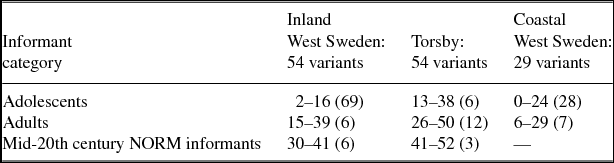
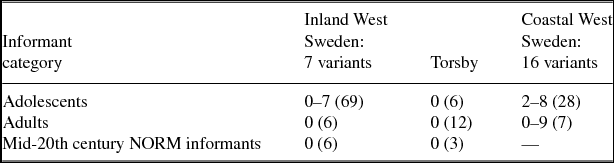
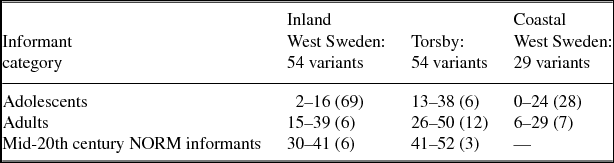
There are both similarities and differences between the three areas investigated. Tables 7 and 8 illustrate the use of traditional dialect variants and new variants respectively in Inland West Sweden, Torsby and Coastal West Sweden. In these tables, the NORM informants recorded in 2007–2011 are presented together with the other adults recorded during these years.
Number of traditional dialect variants used by the informants in the three areas investigated. The numbers in parentheses indicate the number of informants in each group.
Number of new variants used by the informants in the three areas investigated. The numbers in parentheses indicate the number of informants in each group.

In all the areas investigated, there is an ongoing leveling towards the standard. When comparing the older data (both recordings and written descriptions) to the new recordings it is apparent that parts of the dialect system used in the mid-20th century are being replaced today by standard variants, as well as, in the case of Coastal West Sweden, new variants from the Gothenburg variety. Comparing the recorded adolescents with the adults in the modern data, this process seems to be on-going, as the adolescents in general are more leveled than older informants.
The processes of change in Inland West Sweden and Torsby seem to have quite a lot in common. However, Torsby is more stable than Inland West Sweden. When the adolescents in these two areas are compared, the difference is considerable: of the 54 dialect variables investigated in each area the adolescents in Inland West Sweden realize between two and 16 as dialect variants (and the rest as standard variants), compared to Torsby where the adolescents realize between 13 and 38 as dialect variants. Out of the 54 variables investigated in each location, the Inland West Sweden adolescents make use of a total of 25 traditional dialect variants, compared to 45 in Torsby. The same pattern is found among the adults and also among the informants born in the late 19th century; it seems that the leveling towards the standard started earlier, or has proceeded faster, in Inland West Sweden than in Torsby. Torsby appears to be a relatively stable speech community (see also reports on stable speech communities in Ivars Reference Ivars2003, Sandøy Reference Sandøy, Gunnarsson, Bergström, Eklund, Fridell, Hansen, Karstadt, Nordberg, Sundgren and Thelander2004, Røyneland Reference Røyneland2005 and Friðriksson Reference Friðriksson2008).
Another difference between the two areas is the presence of new features in the speech of adolescents in Inland West Sweden, and the absence of new features in Torsby. It seems that the appearance of new features has to be preceded by a leveling towards the standard; in other words, a very traditional dialect speaker does not usually use new features, and, in general, the speakers using new features are among the most leveled in the data. Possibly, Torsby and Inland West Sweden are following the same pattern of development, although Inland West Sweden is further along in the leveling process. If this is indeed the case, speakers in Torsby will eventually have new features in their repertoires as well.
In Coastal West Sweden, several processes are operating at the same time and leveling towards the standard is obviously one of them: among the informants in Stenungsund, the informants over the age of 55 years are more traditional than adults in their thirties. These in turn realize more traditional dialect variables as dialect variants than the adolescents investigated. Compared to older descriptions of the traditional dialect in the area, all informants in Stenungsund are clearly becoming more leveled. In Uddevalla, the adolescents recorded seem to be following the same patterns of leveling as those in Inland West Sweden.
Besides dialect leveling, there are also two other processes at work in Coastal West Sweden: the use of a combilect and a dialect shift (both which were started by contact with the Gothenburg variety). The shift in Coastal West Sweden seems to have been in progress at least since the 1940s. Björseth (Reference Björseth1946) states that the dialect speakers in the area are in contact with Gothenburg speakers, and that this may influence the reported ongoing leveling. It is hard to conclude whether the combilect in Skärhamn is a first step in the process towards dialect shift, or if it there are two separate processes leading to two possible varieties: the new combilect and the Gothenburg variety. Some evidence suggests that it might actually be the same process: in Stenungsund, speakers older than 55 years tend to use a combilect rather than the Gothenburg variety used by the younger generations. On the other hand, the combilect speakers in Skärhamn are not as leveled as the Stenungsund informants, but rather are mixing very traditional dialect variants with Gothenburg variants, standard variants and other new variants. This, together with the fact that there are actually combilect speakers living side by side with very traditional speakers and Gothenburg speakers in Skärhamn, suggests that we are dealing with different processes affecting different speakers in the speech community.
6. CONCLUDING REMARKS
The focus of this article has mainly been on describing how dialects change and comparing these processes. As we have seen above, the traditional dialects are still in use by at least some speakers in most of the locations investigated. There are, however, differences in how much of the traditional dialect is used and by how many. In addition, the extent to which new linguistic features are used varies. Some locations are relatively stable linguistically and others are characterized by considerable heterogeneity and change. In this section, I will discuss some possible explanations as to why the dialects in the areas investigated seem to be undergoing linguistic change in different ways (see also Svahn & Nilsson Reference Svahn and Nilsson2014, Nilsson Reference Nilsson2015a).
As mentioned in Section 2 above, previous research on dialect change has concluded that dialects change when speakers are in contact with speakers from other language areas, as they adapt their linguistic features to those of their interlocutors (Trudgill Reference Trudgill1986, Giles et al. Reference Giles, Coupland, Coupland, Giles, Coupland and Coupland1991, Hinskens Reference Hinskens1998). In Auer & Hinskens’ (Reference Auer and Hinskens1996, Reference Auer and Hinskens2005) model for dialect change, three components have to be fulfilled in order for dialect change to occur. In the following, these components are discussed in relation to the findings of this study:
-
(i) Face-to-face interaction between speakers of different varieties. All speakers in the areas investigated engage in interaction with speakers of different varieties, but to various extents. Torsby is fairly isolated, and the informants there report less contact with speakers from other locations compared to informants in, for example, Stenungsund, where many informants have daily connections to the larger city of Gothenburg. As a result, linguistic change is not very fast in Torsby, whereas in Stenungsund the change towards standard Swedish and the Gothenburg variety is rapid. According to Auer and Hinskens’ model, the more traditional dialect speaker will accommodate to the more standardized or innovative speaker by adopting the linguistic features used by the interlocutor or by avoiding traditional dialect features. This seems to be the case in Stenungsund.
-
(ii) Speakers change their behavior more permanently, and use specific linguistic features with speakers who do not use such features themselves. This step in the process is more likely to be reached if a speaker is frequently exposed to a linguistic feature. It is fair to assume that most speech communities have speakers who behave in this way, some more than others. Given that the dialect situation in most locations is heterogeneous, it is likely that speakers who use standardized forms as well as new variants also use these from time to time in interactions with more traditional dialect speakers. The impact of this may be smaller in Torsby, on the one hand, as it is a fairly homogeneous speech community and larger, on the other hand, in the area around Stenungsund and Skärhamn, where some speakers speak the more traditional dialect, others the Gothenburg variety and some are combilect speakers.
-
(iii) A large number of speakers in a society must use the new form. In the data analyzed, the impact of this component becomes apparent when two smaller urban centers, Borås in Inland West Sweden and Stenungsund in Coastal West Sweden, are compared. Both locations are situated at approximately the same distance from Gothenburg (60 and 50 km respectively) and daily commuting to Gothenburg is extensive. The number of residents born in Gothenburg is similar in both locations but Borås’ population is six times larger, making the Gothenburg-born percentage significantly higher in Stenungsund. Over the last 60 years, there has been much closer contact between citizens of Gothenburg and citizens of Stenungsund than between citizens of Gothenburg and those of Borås. This may explain the dialect shift from a traditional dialect to the urban Gothenburg variety that has taken place in Stenungsund since the mid-20th century, whereas there were no signs of Gothenburg features in Borås at all (Svahn & Nilsson Reference Svahn and Nilsson2014). It seems that, in order for a dialect shift to take place, a large enough proportion of the population has to be in contact with a new variety (see also Nilsson Reference Nilsson2015b). The likelihood of a large enough percentage of a population being in contact with a new urban variety, like the Gothenburg variety, usually decreases the greater the geographical distance. Therefore, it is not surprising that new variants are used less and less the further away we get from Gothenburg, both in Inland West Sweden and Coastal West Sweden (and of course Torsby).
Obviously, several factors influence the way dialects change in Sweden (and elsewhere), including geographical factors as well as the proportions of speakers of other varieties in a given location. Although this has not been the focus here, speakers’ attitudes towards, and perceptions of, traditional dialect, the standard and modern/urban varieties in the separate areas of course contribute to the path change takes. It should also be noted that this study is based on two projects with slightly different objectives, and that the datasets are not collected in the same way. However, since both projects have been concerned with how much of the dialect is still in use in the early 21st century compared to the mid-20th century, the projects are similar enough to shed some light on processes for dialect change in Sweden.
In conclusion, there are various processes of dialect change in Sweden. In the areas investigated here, dialect leveling has occurred to various degrees (in Inland West Sweden, Uddevalla and Torsby) and there is one case of a clear dialect shift (Stenungsund) as well as a new, mixed variety, a combilect (in Skärhamn and Stenungsund). By investigating a large part of the linguistic system, i.e. as many variables as possible in each location, it has been possible to compare and discuss the processes of change in three different dialect areas in Sweden.
ACKNOWLEDGEMENTS
The project Dialect Change in West Sweden was funded by Riksbankens Jubileumsfond (RJ) – The Swedish Foundation for Humanities and Social Sciences – and also by the Institute for Language and Folklore. The project Dialect Change in Rural Sweden was funded by the Swedish Academy with support from the Knut and Alice Wallenberg Foundation (KAW 2009:0296) and the Swedish Research Council (VR). I would also like to express my gratitude to the three anonymous reviewers and NJL editor Marit Julien for valuable comments, as well as to Jenny Öqvist for insightful feedback on an earlier draft of this manuscript. I am also grateful to Margareta Svahn for our many discussions on the dialect situation in West Sweden, to Tobias Müller and Bengt Edqvist for help with the figures, and to Mary Chambers for proof reading.