Introduction
Multimodality management with surgery, radiotherapy and chemotherapy has helped improve the disease control and survival rates in locally advanced head and neck cancers (HNC).Reference Bernier, Domenge and Ozsahin1–Reference Bonner, Harari and Giralt3 However, close proximity of several critical organs such as optic pathways, brain stem and spinal cord sometimes limit high dose delivery from conventional radiotherapy technique. Modern delivery systems are being explored to overcome these challenges and help provide curative options in these situations. A significant step forward has been the application of stereotactic body radiotherapy (SBRT) in extracranial disease sites. CyberKnife robotic radiosurgery (Accuray, Sunnyvale, CA, USA) which is a real-time image-guided SBRT is definitely a step forward towards the management in critical scenarios as explained.
In the present study, we report our experience of using CyberKnife SBRT boost for primary HNC.Reference Adler, Murphy, Chang and Hancock4, Reference Chang and Adler5 This study highlights the preliminary treatment outcomes and acute complications of CyberKnife SBRT boost.
Materials and methods
Patient characteristics
A total of 9 HNC patients were treated by CyberKnife SBRT boost between January 2013 and January 2014. CyberKnife SBRT boost was offered to primary HNC patients after conventionally fractionated intensity-modulated radiation therapy (IMRT) with or without concurrent chemotherapy.
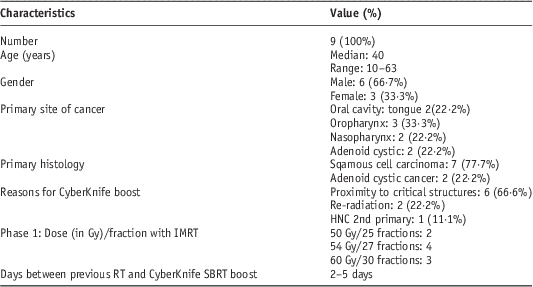
Table 1 shows the characteristics of patients and tumours. The cohort consisted of six males and three females, with a median age of 40 years (range: 10–63 years). The primary reasons for CyberKnife boost being location of critical organs in six cases, re-irradiation in two cases and a 2nd primary recurring after 5 years in one case. Median interval between the initial radiation and CyberKnife boost was 3 days (range: 2–5 days). Histological types included squamous cell carcinoma (n=7) and adenoid cystic carcinoma (n=2).
Patient and disease characteristics

Abbreviations: HNC, head and neck cancers; IMRT, intensity-modulated radiation therapy; RT, radiotherapy; SBRT, stereotactic radiotherapy.
Treatment procedure
Before CyberKnife boost all the patients underwent conventionally fractionated IMRT. After complete staging investigations a thermoplastic mask for head and neck region was fabricated following which planning computed tomography (CT) scan with contrast covering areas from vertex to thoracic onlet was carried out. The images were transferred to planning computer (Focalsim) and target volumes were generated. The gross tumour volume (GTV) was marked on the planning CT scan with the help of magnetic resonance imaging (MRI) and positron emission tomography–computed tomography (PET–CT) scan whoever is applicable. Additional help from radiologist was also taken whenever required. Clinical target volume (CTV) was generated with a 1·5–2 cm margin around GTV with exclusion of natural anatomic barriers and inclusion of potential areas of risk as per sub sites of HNC. Planning target volumes were generated by adding a 0·5 cm margin to CTV and it was ensured that initial treatment included primary disease and prophylactic nodal area in patients with nasopharyngeal cancer, oropharyngeal cancer and oral cavity cancers, while for adenoid cystic cancer additionally potential areas of perineural spread was also covered. The median dose schedule was 54 Gy in 27 fractions and seven to nine field IMRT plan was generated. The phase 1 dose constraints for IMRT plan was as follows: Bilateral parotids or at least one parotid mean dose was kept around 26–30 Gy depending upon bulk of primary disease, spinal cord maximum dose kept below 38 Gy and so as for brain stem except for nasopharyngeal primary were up to 45 Gy was allowed in phase 1. Other organs at risk (OAR) like mandible, oral cavity, larynx and trachea were contoured and given constraints as much as feasible.
All of them received concurrent chemotherapy with injection Cisplatin at 30 mg/m2 weekly and the same has been carried out under Medical oncology supervision After completion of phase 1 IMRT the planning process for CyberKnife boost was carried out.
The CyberKnife SBRT procedure consists of four steps: (1) mould preparation with thermoplastic cast, (2) simulation CT image acquisition based on skull-bone landmarks, (3) treatment planning and (4) treatment delivery. First, a customised thermoplastic mask for head and neck immobilisation was fabricated once the patient completed phase 1 IMRT. Simulation CT scans without and with intravenous contrast were then obtained with a 1 mm slice thickness from the top of the skull to the thoracic inlet, ensuring at least 10 cm margin cranially and caudally from gross disease. DICOM images were transferred to the CyberKnife treatment planning system (Multiplan-Accuray Sunnyvale, CA, USA) for the patient’s contour and anatomical information. For tumour volume delineation in phase 2 CyberKnife boost, MRI of the head and neck region with 1 mm slice with no gap and no tilt in all cases and positron imaging tomographic contrast scan (PET-CECT) (if available from diagnostic work-up) were used in consultation with radiologist.
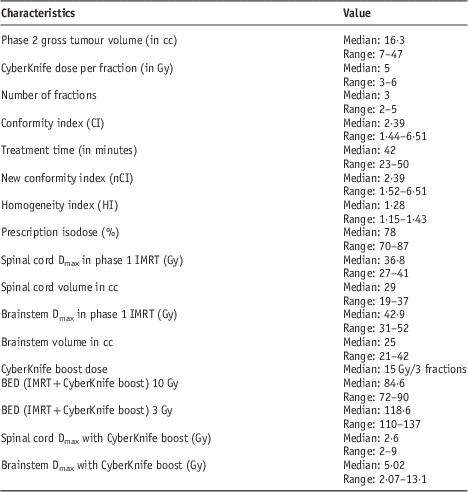
For the treatment planning, target volumes and OAR were defined based on simulation CT images fused with additional imaging. The GTV was defined as the visible tumour in the imaging studies after phase 1 IMRT. Additional margin for planning target volume (PTV) of 3–5 mm was given for anticipated internal physiological variations such as respiration and swallowing movements. Inverse planning computer algorithm determined the number, direction and duration of treatment beams. The total dose and fractional dose were determined individually according to the tumour volume, prior radiotherapy dose and proximity to OAR and the patient’s general condition. The algorithm used for dose calculation in CyberKnife was Ray-tracing. Patients were treated with a median dose of 5 Gy per fraction with median of 3 fractions (range: 2–5 fractions) prescribed to 90% of the PTV (D90). A median dose of 15 Gy in 3 fractions prescribed to isodoses ranging between 70 and 89% was the most frequent regimen for CyberKnife boost. The median GTV after phase 1 IMRT was 16·3 cm3 (range: 7–47 cm3).
The biological effective dose (BED) was calculated based on the linear quadratic model using the α/β ratio of 10 Gy for tumour effects and based on D90 and D100. Although one of the limitations of using BED formulation is the lack of experimental validity for large doses per fraction and short overall treatment duration, it currently serves as a useful model for biological comparison of different fractionation schedules. The median values for total (combined IMRT and CyberKnife boost) BED 10 Gy (for tumour and acute effects) and BED 3 Gy (late effects) was 84·6 and 118·6 Gy, respectively.
The third step of CyberKnife SBRT is the actual treatment delivery. During treatment, two orthogonally positioned diagnostic X-ray cameras provided real-time images of the patient’s anatomy. Either skull or spine tracking was used to determine the tumour motion. Median treatment duration was 42 minutes per fraction (range: 23–50 minutes), depending on the dose per fraction, the number of beam nodes and patient’s compliance. The treatment was performed on consecutive days except Sundays. Table 2 summarises the treatment parameters.
Treatment characteristics
Abbreviations: IMRT, intensity-modulated radiation therapy; BED, biological effective dose.
Toxicity evaluation
The acute and late morbidities where applicable were recorded using RTOG acute and late morbidity scoring criteria. The treatment was well tolerated.
Statistical analysis
All statistical analyses were performed using SPSS version 18·0 (manufacturer IBM, International Business Machines Corporation). Last follow-up status was estimated from last fraction of CyberKnife to last follow-up and all patients having stable disease and above were taken as locally controlled. For objective local assessment after CyberKnife both response evaluation criteria in solid tumours (RECIST) version 1.1 and PERCIST version 1.0 (PET-based response evaluation) criteria was employed.Reference Eisenhauer, Therasse and Bogaerts6
The basic frequencies were calculated using SPSS software and mean, median and range were the main factors which were considered. Disease free survival was calculated by using Kaplan–Meier survival curves with patients being divided into groups locally controlled or not. Loco-regional responses as per objective criterion was divided into complete, partial, stable disease and progression, respectively.
Results
Treatment results
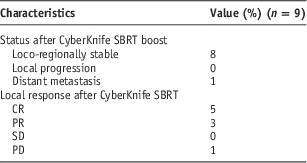
Patients were followed up at 1 month, 3 months and then every 3 monthly after CyberKnife SBRT boost as and when applicable. The follow-up was thorough clinical examination including endoscopies (indirect and direct laryngoscopies) where required and first response evaluation imaging was done between 10 and 12 weeks post treatment. The median follow-up duration was 8 months (range: 6–19 months). Loco-regional response rates were determined on the basis of radiographic and clinical assessment (Table 3).
Clinical outcome and response to CyberKnife SBRT boost
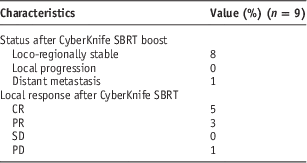
Abbreviations: SBRT, stereotactic radiotherapy; CR, complete response; PR, partial response; SD, stable disease; PD, progressive disease.
Eight patients were locally controlled and only one patient developed distant metastasis till last follow-up. As per objective response evaluation with RECIST, there were five complete responses. A patient of adenoid cystic carcinoma developed distant metastasis to sternum 3 months after treatment. The toxicities recorded as per RTOG acute and late toxicity grading criteria, revealed mostly grade 2 acute oral mucositis, acute oesophagitis and grade 2 skin reactions mostly. As such with CyberKnife boost no grade 3 or more acute effects were observed, though consequential acute effects persisted due to phase 1 IMRT.
This is an early documentation of results after CyberKnife SBRT for primary HNC.
Although median follow-up period was too short to evaluate late adverse events, no grade 3 or worse late toxicity could be observed in surviving patients. All patients completed the planned CyberKnife SBRT boost schedule without interruption.
Discussion
Originally, the CyberKnife system was specifically developed to perform frameless stereotactic radiosurgery for intracranial lesionsReference Adler, Murphy, Chang and Hancock4 and the technique can now be applied to deliver high doses of radiation to tumours anywhere in the body with greater precision as compared with other more conventional techniques. The system allows conformal treatment to tumours throughout the head and neck region.
With the limited scope of surgery and poor benefit from other retreatment options, high-dose radiation therapy has come into the horizon for the last couple of years.Reference Bachar, Goh, Goldstein, O’Sullivan and Irish7–Reference Cacicedo, Navarro and Alongi11 Though there are no prospective or retrospective data for a comparison of re-irradiation using conventional fractionation IMRT with SBRT, it has a clear advantage over conventional fractionation with IMRT.Reference Siddiqui, Patel and Khan10, Reference Fuks and Kolesnick12, Reference Roh, Jang and Kim13 The CyberKnife robotic radiosurgery system is an innovative and intelligent tool for SBRT delivery due to (a) non-invasive immobilisation technique, (b) an inverse treatment planning technique with tumour receiving the maximum dose allowable with (c) the restriction of the maximum normal structure tolerance dose, (d) real time continuous tracking of the target during treatment with two ortho-voltage X-rays and correction before delivery of treatment in real time. All this together with short treatment duration as an outpatient has the potential benefit of better compliance to treatment.
The present study though deals with the use of CyberKnife SBRT boost primary HNC patients after IMRT in view of disease in close proximity to critical organs hindering radical dose delivery 2nd primary HNC after several years warranting full dose of radiotherapy. The data pertaining to CyberKnife boost after IMRT is limited mainly because of concerns regarding use of large dose per fractionation for relatively large target volume.
Few studies have investigated feasibility and clinical outcome of CyberKnife SBRT boost for HNC. A study by Le et al. presented excellent local control with boost radiotherapy and it reached up to 100% at 3rd year and also had acceptable late toxicities. There were 45 patients with nasopharyngeal cancer who received boost radiotherapy and among them 12 patients were treated using the CyberKnife boost.Reference Le, Tate and Koong14 In that study, a median dose of 12 Gy at 80–85% isodose line were delivered in a single fraction after a median total dose of 66 Gy by conventional radiotherapy, with an interval of 4–8 weeks. Doses to surrounding normal structures were not fully evaluated. Takashi Uno et al. also reported for ten patients the role of CyberKnife boost. The patients were given such treatment in view of tumours in close proximity to optic pathway, brainstem or mandible. With a median follow-up of 6 months, six patients showed complete response and only three patients had grade 3 oral mucositis. The dose received to the OARs was also acceptable.Reference Uno, Isobe and Ueno15
With the limited data regarding CyberKnife boost in HNC after IMRT, our study has several concerns like (1) it is based on a non-randomised heterogeneous cohort of patients from a single institution presenting to our practice consecutively. Therefore, no definitive causal inferences should be drawn from our findings. (2) As toxicities were determined based on chart reviews rather than prospectively collected, it is possible that not all complications were noted. (3) A median follow-up of 8 months was not enough to fully assess the long-term complications due to CyberKnife boost and finally (4) there is a known weakness in the dosimetric analysis where it is still under development to evaluate cumulative dose from different radiotherapy modalities. It is already technically possible to treat multiple nodal metastases simultaneously, however, care should be taken in applying this method until above-mentioned dosimetric problem is solved.
Recent literature also suggested SBRT alone for elderly HNC patients and although single centre but the outcome data is quite encouraging. This though beyond the scope of this paper, highlights the emerging role of hypofractionated treatment in HNC management.Reference Vargo, Ferris, Clump and Heron16
However, it is clear that this technique offers definite advantages over conventional fractionated radiation therapy and is a viable option for patients who have disease in close proximity to critical organs or 2nd primary HNC requiring radical dose delivery. Although more clinical experiences and longer follow-up are needed to validate our results, we believe CyberKnife SBRT boost for head and neck tumours might evolve as a standard of care in near future.
Conclusion
CyberKnife SBRT boost is an attractive option for primary HNC especially where disease is in close proximity to critical structures hindering radical dose delivery. In the cases of 2nd primary HNC where there is scope for radical dose delivery, CyberKnife boost after phase 1 IMRT would also be a feasible option. Future prospective analysis and optimum assessment of total BED in a properly selected case might actually benefit the use of CyberKnife SBRT boost.
Acknowledgement
The authors acknowledge to all the members of the department and patients whose ailment always serves as a motivating factor.
Financial support
None.
Conflicts of Interest
None.
Ethical Standards
This is to state that ‘The authors assert that all procedures contributing to this work comply with the ethical standards of the relevant national guidelines on human experimentation (Drug and Cosmetic Acts, India) and with the Helsinki Declaration of 1975, as revised in 2008, and has been approved by the institutional committees (Medanta Institutional Review Board)’.