Talking as learning
Previous writing about musical learning through talk has sought to reveal insights into both the development of music and literacy skills (Barrett, 1990; Auker, 1991). The importance of developing a language for musical criticism through peer evaluating or appraising of children's own composing work, has been a familiar feature of classroom music lessons in the UK. This has particularly gained credibility because of its relationship with the formative assessment processes which typically require teachers to question pupils to monitor learning and to gain feedback. These processes of appraisal, evaluation and assessment in the classroom at all ages, highlight the importance of dialogue in recent years as an integral part of classroom processes in UK classrooms. Talk in the classroom can be used for the purposes of developing dialogic skills, such as when encouraging evaluation and reflection. Questioning also helps teachers to understand the thinking processes and interaction of young children engaged in musical tasks. In this, it draws on previous research where questioning and thinking skills are encouraged in very young children (Cremin et al., Reference CREMIN, BURNARD and CRAFT2006; Chappell et al., Reference CHAPPELL, CRAFT, BURNARD and CREMIN2008).
Mercer and Littleton (Reference MERCER and LITTLETON2007) suggest that dialogue lies at the heart of how children learn and develop through classroom experiences. They see the processes of teaching, learning and cognitive development as connected by dialogue. Alexander (Reference ALEXANDER2004/2006) views talk as central to extending pupils' thinking and in fostering their learning and developing their understanding. His classroom-centred research has highlighted the importance of ‘dialogic teaching’ and has, during the last decade, been influential in shaping National Strategies aimed to change practice in primary schools in England (DfES, 2003). More recently the ‘Cambridge Review’ (Alexander et al., Reference ALEXANDER2009b) has reaffirmed the need for the teaching of younger children in classrooms to include interaction and in particular dialogic teaching, ‘where classrooms are full of debate and discussion that is collective, reciprocal, supportive, cumulative, critical and purposeful’ (Alexander, Reference ALEXANDER2009a, p. 29) These authors perceive talk in the classroom as something more than just interactive teaching but rather as stimulating and extending children's thinking skills in order to advance their understandings of a task or topic. Particularly relevant to this study is their view of talk as analysing or solving problems, as exploring and evaluating ideas and as a collaborative act which requires participants to listen and be receptive to alternative viewpoints and to think about what they hear (Alexander, 2006, p. 39). Also relevant to this study is the writing of Kanellopoulos-Panagiotis (Reference KANELLOPOULOS-PANAGIOTIS2007), who explores talk about musical thinking through a study of children's reflections on their own improvisations. In this way he discusses their ability to ‘philosophise’ about music and to engage in what is here referred to as ‘meta-cognitive thinking’.
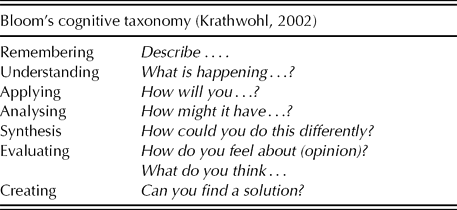
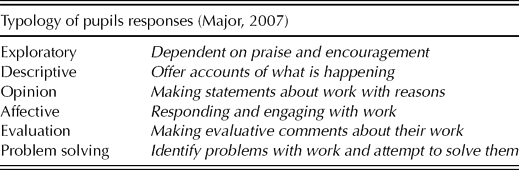
Early research on interaction in the classroom (Barnes et al., Reference BARNES, BRITTON and ROSEN1969) led to a national literacy initiative across the curriculum. However, in the 1970s and 80s, sociological research into interaction in the classroom (Barnes, Reference BARNES1976; Edwards & Mercer, Reference EDWARDS and MERCER1987, Edwards & Westgate, Reference EDWARDS and WESTGATE1994) found that teacher questioning rarely achieved more than brief responses from pupils and that teacher-led questions dominated and stifled active participation. Barnes and Todd (Reference BARNES and TODD1977) worked with children talking in small groups, and provided some examples of talk being used to further learning and understanding but they found that talk between children without the intervention of the teacher depended on all participants sharing the same ideas about what is relevant to the discussion. Siraj-Blatchford et al. (Reference SIRAJ-BLATCHFORD, SYLVA, MUTTOCK, GILDEN and BELL2002) also emphasise the role of the adult working with small groups of very young children, stressing the importance of open-ended questions that ‘provoke speculation and extend the imagination’ (47). ‘Dialogic talk’ in the 21st century focuses on pupil learning and thinking with the teacher and pupils working together, sharing ideas and moving pupil understanding forward (Alexander, Reference ALEXANDER2004/2006; Mercer & Littleton, Reference MERCER and LITTLETON2007). In this study then, dialogue is an integral part of the music composing process, designed to further young children's understandings through teacher questioning and to help them to link the musical and non-musical aspects of the activity. In this way it is similar to ‘appraising’ or evaluating music (Major, Reference MAJOR2008). They were also encouraged to evaluate and think about their musical decision-making during the music composing process. Consistent with the learning aims of the primary literacy strategy (DfES, 2003) children were encouraged to give reasons, to provide evidence for their views, to consider alternative opinions, and to respond to the opinions and contributions of others. A similar research project with older pupils talking about their music composing (Major, Reference MAJOR2007) led to the development of a ‘typology of pupil talk about composing’. Here, six main types of dialogic response were identified: exploration, description, opinion, affective response, evaluation and problem solving (see Table 2 for definitions of types of responses). Work with pupils aged 11–16 years of age revealed that evaluative and problem-solving responses (higher order responses) from pupils in dialogue with each other were more likely when activities were designed which engaged and interested pupils in the task. It also became apparent that affective engagement is essential for higher order responses in talk about music composing. These findings were taken into account when designing activities with younger pupils aged 6 and 7 years. The role of the adult is significant, in creating time and ‘space’ for rich conversational experiences which contribute to the development of young children's thinking and understanding (Robson, Reference ROBSON2006). Cremin et al. (Reference CREMIN, BURNARD and CRAFT2006) highlight the practice of ‘standing back’ by creating time and space to foster ‘possibility thinking’ in young learners. This research aimed to avoid adult-dominated conversation and ‘closed’ questions which are likely to provoke limited responses (Robson, Reference ROBSON2006, citing Wood, 1998) therefore the interview questions were carefully considered and Bloom's cognitive taxonomy (see Table 1) (Krathwohl, Reference KRATHWOHL2002) is used to evaluate the link between the types of teacher questions and the quality of pupil responses.
Types of questioning

Wells (Reference WELLS1999), in his socio-cultural approach to dialogic teaching, provided an analysis of the Vygotskian concept of the ‘zone of proximal development’ (ZPD),Footnote 1 and the impact that this has on dialogic interaction in the classroom. In this view the role and importance of talk as a tool for learning is highlighted. Mercer (Reference MERCER2000) refers to a sharing of ideas between the teacher and pupil in sustained talk. This is a form of ‘scaffolding’ by the teacher and builds upon Vygotsky's ZPD. Mercer's ‘intermental development zone’ (IDZ) is a shared communicative space where the teacher and learner use talk and joint activity to explore ideas. He uses the term ‘interthinking’ to describe this process. Mercer's IDZ focuses on a more equal relationship between teacher and pupil(s) where the teacher still teaches but where the pupils also contribute important insights and where collaboration and negotiation can take place through dialogue. In music education specifically, dialogue has become increasingly important in the classroom through peer appraisal or evaluation of children's music compositions (Major, Reference MAJOR2008).
Good practice in music lessons (exemplified in Mills, Reference MILLS2005), involves dialogue as a learning tool to reinforce prior learning and, as an assessing tool, to monitor learning through questioning. Most significantly, dialogue allows pupils to evaluate and reflect on their own and others’ musical creations or performances. In music lessons the four main strands of activity; performing, composing, listening and appraising/evaluating should ideally be treated holistically and children typically compose in pairs or groups, they perform for each other and therefore listen to each other's performances and they are encouraged by the teacher to talk constructively about what they hear using newly acquired or appropriate terminology. Pupils further their understanding of the task during the process of composition through their hearing of other performances and through their learning by negotiation and talk. Such learning is experiential in nature. Glasersfeld (Reference GLASERSFELD1989) called this ‘viable knowledge’, to describe learning where understandings are explored through practical activities. ‘Active learning’ is common today in classrooms and is often referred to as ‘experiential knowledge’. Implicit in this is the reflection upon these activities in order to construct meanings (Younker, Reference YOUNKER, Burnard and Hennessy2009).
In this context, Burnard's research (Reference BURNARD2000a) focuses on helping children to make sense of their composing and improvising processes through reflective talk. Children are encouraged to say why they are doing it and how they are doing it. Green (Reference GREEN1999) further explores the social construction of musical meaning in the context of music experiences. For enjoyment and understanding to occur, Green implies that links have to be made between affective (an appreciation of what is heard), cognitive (an understanding of the structure or other musical device) and extra musical events (for example, remembering a TV theme that it resembles). Relating musical activities to extrinsic ideas is important when working with children in the classroom. In this project, the imaginative music task was linked to other learning across the curriculum (The Great Fire of London), allowing children to use their learning to stimulate their ideas in their composition task and to synthesise ideas with musical sound.
Three main aims then were the focus of this study. These were to provide an opportunity for young children, aged 6 and 7 years old, to engage in evaluative and problem solving discussion while composing music; to evaluate how the teacher can effectively support children's thinking about the process of composing music; and to analyse the relationship between teacher questioning and the quality of pupil's dialogic responses. In addition, it is hoped that the outcomes might provide some suggestions for music lessons when dialogic teaching and learning is a central part of the musical task. In particular, talk is viewed here as an important aspect of learning during group music lessons at all ages and evaluation and reflection are recognised as important aspects of music composing lessons.
Method
A case study approach was selected as the most manageable way to extract the richness of detail required in the interpretation of meanings from the data, by aiming, ‘to illuminate the general by looking at the particular’ (Denscombe, 2003, p. 36) through an ‘interpretivist’ approach requiring the research and reader to construct their own meanings from the materials and explanations presented. The school, located in a socially advantaged area of London with over 400 pupils on roll, has two specialist music teachers who are also generalist classroom teachers. All pupils in the school receive a weekly music lesson in a dedicated music room. Two year 2 classes (children aged 6 and 7 years) were chosen for paired, mixed gender music composing interviews.Footnote 2 Eight pairs were extracted from their whole class lessons during afternoon sessions over a period of four weeks. They met with the researcher in a location outside the classroom (often an ante-room or even on occasions in the playground) for a structured music composing task. Neither of the authors in this project are practitioners in the school. One researcher had a music education background as a teacher trainer; the other was an early years specialist who conducted the paired music composing interviews with year 2 classes in the school. It is interesting to note that the latter researcher is not a musician or music educator so her role in guiding the music learning was similar to that of a generalist primary school teacher.
The composing task
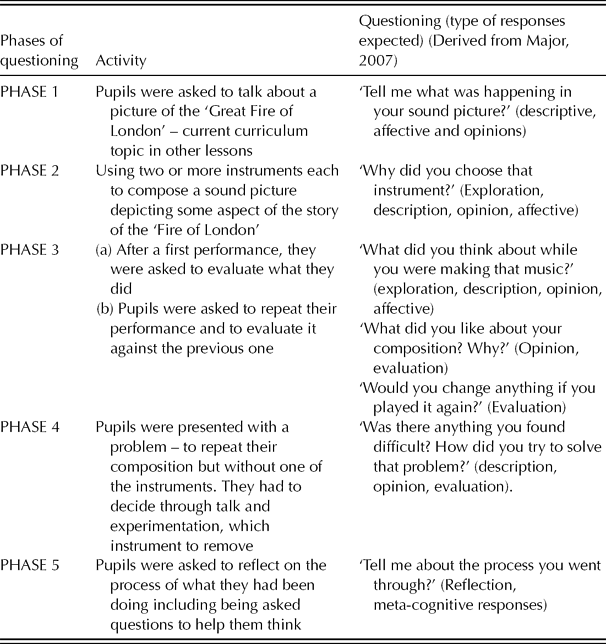
The research initially focused on the findings of previous research into pupil talk with older children (Major, Reference MAJOR2007) which suggested that, when children affectively engage with their work and reflect on a problem-solving activity, they are likely to be more analytical and use critical thinking skills. The aim of this project then, was to analyse the responses of younger children. Music composing work was a regular part of music lessons in the school and these pupils were familiar with the percussion instruments used in the paired ‘music composing interviews’. Each interview lasted between 15 and 30 minutes. They were semi-structured and the typology of pupil talk (Major, Reference MAJOR2007; see Table 3) was initially used to construct the activities and open-ended questions in order to encourage higher order responses from the pupils. The composing task drew on children's prior knowledge of ‘The Great Fire of London’ explored in other curriculum subject areas. The researchers felt that this would provide pupils with the best opportunity to use their ideas in representing the events in their music. A picture of the ‘Great Fire’ was used as a stimulus. Previous research (Major, Reference MAJOR2007) found that when older children, aged 11–14 years, composed using stories of imaginative themes (e.g. a spooky house), they were much more effective and enthusiastic. The findings of this research were used to design aspects of this project with younger children.
Table 3 describes the musical composing task and the questioning planned by the researchers.
Data were analysed using a range of ‘types of pupil responses’; exploratory, descriptive, opinion, affective, evaluative and problem solving (see Table 2). Bloom's cognitive taxonomy and its revisions were used to categorise teacher questioning: remembering, understanding, applying, analysing, synthesis, evaluating, creating (see Table 1). A significant aspect of the analysis of data was the extent to which links could be made between the type of question asked and the type of typical pupil response.
Types of pupil responses

The interviews
Consent was sought from parents through the school. The interviews were conducted in close collaboration with the class teacher (a music specialist) who explained the purpose of the research to the children before asking if they wanted to take part. However, power-relations are inherent in the relationships between adults and children which raises questions about the authenticity of the children's choices (Mayall, Reference MAYALL, Christensen and James2000). For example, the children were asked if they wanted to volunteer but the class teacher nominated the pairs from the larger sample of volunteers and selected mixed gender pairs upon her own initiative. Pollard (Reference POLLARD and Walford1987, p. 103) also raises issues about, ‘the way in which the children perceive the researcher – his or her ‘identity'’, as part of the trust-building process and also in the explanations offered to children. Although it is impossible to ascertain the children's understanding of the situation, each paired session began with a description of the context and an explanation of the various roles involved. When taking part in the ‘music composing interviews’, the children were active participants in the research, providing new insights into the questions asked and responses given.
Analysis procedures
The data were originally coded through searching for the already identified ‘types of pupils responses’ (Table 2) but it was soon acknowledged that this method revealed self-evident information, since the research design promoted and encouraged evaluative and problem-solving dialogue within the tasks. However, the questioning soon revealed itself as an equally useful topic for discussion and the impact that the adult questioning had on the responses from these young children. The findings also revealed some unexpected outcomes which provide significant implications for those engaged in dialogue in the classroom and for similar classroom research projects.
Findings
In articulating the findings the following aspects of pupil dialogue and engagement in the music composing task have been discussed: (1) observations related to lower order talk; (2) the importance of affective engagement in an imaginative task to encourage higher forms of discourse such as evaluation and synthesis; (3) the talk related to solving a problem within a musical composing task and the development of negotiation and reasoning which might result; (4) meta-cognitive skills and reflection on the processes of composing music; and (5) the important role of questioning, especially for targeting higher-order thinking and discourse.
Exploratory, descriptive and opinion type responses
Lower order responses are in evidence in all eight music composing interviews. The children plan together what instrument sounds they are going to use to depict chosen aspects of the topic. They describe what they have learnt about the ‘Great Fire’ in their other lessons. They engage in exploratory talk, characterised by short, hesitant phrases and they offer opinions. When they are asked to choose one instrument to remove from their composition (see Phase 4 in Table 3), they engage in some debate about which instrument this should be. One pupil provides a justification for his decision, ‘it doesn't sound loud enough for buildings falling down’ and so they suggest that the drum will need to be played harder in order to replace the sound which will be removed. There is careful thinking and debate here, leading to a decision. Although they offer opinions (a lower-order response), they are also providing justifications and reasons, an important skill in developing evaluative skills and a useful link bridging lower-level thinking with evaluative and higher-level thinking.
The music composing task and research strategies

Affective engagement and synthesis
The link between motivation, engagement and an imaginative composing task has been highlighted and previous research suggested that when children do not engage affectively with a task, their dialogue and thinking is less evaluative. The use of the cross-curricular topic in this project aimed to provide a high level of synthesis between musical sounds and ideas from the ‘story’. Not a feature of previous research, synthesis was seen to be important in this project as a strong aspect of the children's discourse. Synthesis is increasingly being seen to be important (Gardner, Reference GARDNER2006; Claxton, Reference CLAXTON2007), linked to ‘making sense’ and ‘meaning making’. Claxton (Reference CLAXTON2007) cites Peter Senge's term ‘systems thinking’ to describe the process where ‘learners get pleasure from seeing how things fit together’ (Reference CLAXTON2007, p. 27). ‘Synthesis’ featured in Bloom's questioning categories (Table 1) but had not been previously considered as a type of response (see Table 2). The imaginative music composing task linked to a cross-curricular theme provided pupils with the opportunity to fit together musical ideas and story ideas and to talk about their decisions. The importance of visual and imaginative stimuli in music making with young children is clearly demonstrated here and resulted in effective and imaginative musical compositions.
Most of the pupils used a specific instrument to depict an idea. They provide clear descriptions of which instruments represent which events. For example, in one composition, the ‘clatterpillar’Footnote 3 represents people running, the glockenspiel plays the part of the swooping flames but also houses falling down (banging the wood at the side of the glockenspiel). The scraping of the sand blocks represents people running. Most pairs make decisions collaboratively. In the following dialogue, two pupils are explaining their decisions to the researcher (R). They discuss which instrument they could manage without in the next version of their composition (a problem-solving activity).
Sian Well it can't really be this (glockenspiel) or this one, can it?
R Why not?
Sian Because these are quite good for the running so that can't be it.
Dean Yes, but this can't be it.
Sian That could go but that's a really good thing for like smashing in the water, because lots of people would be smashing in the water.
Sian This is a good instrument for it (rainmaker) because when you turn it over (sound of the rainmaker) it sounds like a lot of boats and things. And that one (egg shaker), that doesn't really do much does it?
Dean No, and it's a little bit like escaping like (taps egg shaker on table). Hmm. This one?
Sian Yes.
Dean It doesn't go with much.
Sian Yes, it doesn't really go with all the music we've got at the moment.
It is clear from the above discussion that pupils are synthesising aspects of the story with the instruments playing those roles and that affective engagement and synthesis link together and feature strongly in the dialogues about their work.
Evaluative discussion and problem-solving
Typically children were not evaluative when talking together about their work. Questioning was usually required to elicit an evaluative response. One of the aims of the research was to provide young children with opportunities to evaluate and problem-solve. Lizzie and David were particularly imaginative in their thinking about the different versions of their composition. In order to justify the idea that there were three versions; the third where they had to remove the instrument, they suggested that the different versions in fact tell a story in three parts, like three ‘chapters’. In doing so they were evaluating their work and providing a solution and an imaginative explanation. In research with more mature composers, aged 16 years (Major, Reference MAJOR2007), problem-solving marked the highest form of dialogue and critical analysis when the composer would be searching for a solution to a problem, which they had identified, in the music. It is interesting that affective engagement always appeared to be necessary for this stage of thinking about the music. Refining compositions through solving a problem is part of the process even for established composers. Since affective engagement with the topic and the synthesis of ideas were so interrelated in this project, it is not surprising that these very young children were able to effectively solve problems through discussion and it is interesting that all pairs solved the problem through thinking and talking, rather than through musical experimentation of sounds. These pupils were engaging in aspects of reasoning by thinking about the implications for the story. David and Lizzie learn from each other through talk as they build up a negotiated picture of what they are doing. Mercer and Littleton (Reference MERCER and LITTLETON2007) discuss this type of negotiation, citing Anderson et al. (Reference ANDERSON, CHINN, WAGGONER, NGUYEN, Osborn and Lehr1998) who talk about collaborative reasoning. They describe children as ‘expressing their positions, suggesting new ideas and . . . actively collaborating on the construction of arguments’ (Mercer and Littleton, Reference MERCER and LITTLETON2007, p. 63). Mercer calls it Exploratory Talk and describes it as ‘the embodiment of critical thinking . . . which is also essential for successful participation in ‘educated’ communities of discourse’ (p. 66).
Lucy and John talk together while they are deciding which instruments to use for their musical story. This is one of the few examples of discourse which is continuous without any intervention by the interviewer.
Lucy So . . . this is like . . . you could say this is like people running away (guiro)
John Yes.
(sound of drum beats and sand blocks at the same time)
Lucy We could do a bit of that and then we could have . . . like bang, bang. You could do two of them.
John Yes, okay, I'll try . . .
Lucy and you have . . .
John I'll try (said emphatically)
(Sound of drum and sand blocks at the same time)
Lucy Yes . . . and so we go . . . so we go to (banging and sandblocks again) I meant like if we do like this and then you try and do one big one and one big one of that. John. Okay!
Lucy Do you think we could do that? (sound of sandblocks being hit together sharply)
No, no like this. You go . . . you rub it and then say so for maybe a few seconds and then go (sound of two loud drum beats) and do that.
John Could do that a little bit harder.
Sound of sand blocks rubbing, guiro then two drum beats (few seconds duration)
Lucy Yes. So ready?
(Sound of sand blocks rubbing, guiro then two drum beats).
John Okay, then what can we do with this?
Lucy Okay
John We could do . . . G . . . G (sound of glockenspiel being played softly – muted)
John I think we need a low note.
(sound of muted note on glockenspiel going up and down in slow melody)
Lucy What do you think?
John Okay!
Lucy Then we could just have (sound of glockenspiel notes going up without muting)
Like up to G (upward scale – softly) and then we could have some more . . .
John (interrupting) I know let's do a really (sound of high glockenspiel notes loudly) loudly,
like people screaming.
Lucy Oh yeah, really high pitched notes. So we go that. . .we have this (sound of guiro) and then we have bang, bang, (sound of drum) and then we have like dun-dun-dun-dun-dun-dun (sound of high notes on glockenspiel) and then we could have those sand blocks at the end like finishing. (sound of sandblocks being hit together sharply) Yeah? So let's just have a practice through, ready?
Mercer (Reference MERCER and LITTLETON2007) has suggested that ‘children frequently work alongside each other rather than with each other . . . they interact, but rarely ‘interthink'’ (p. 57). He goes on to describe such talk as the embodiment of critical thinking and of constructive criticism. His view is that children seldom talk in this way in school. We would suggest that in a creative activity such as creating art work, a music composition or a design artefact, the kind of engagement between pupils working together may well be collaborative and may develop such skills of critical, evaluative thinking and constructive criticism. In the conversation above, the two pupils are collaborating and making decisions together in order to compose a piece of music.
They evaluate the usefulness of each sound for the purposes of their story and it is clear that the pupils are affectively engaged in this topic. Their negotiation during the composing process suggests that they ‘engage critically but constructively with each other's ideas. Statements and suggestions are offered for joint consideration . . . partners all actively participate, and opinions are sought and considered before decisions are jointly made’ (Mercer, Reference MERCER and LITTLETON2007). Lucy and John do show the above characteristics but one aspect of Mercer's interthinking, as ‘publicly accountable’ knowledge with evidence of reasoning, would seem to be difficult to realise with such young children. David and Lizzie's previous discussion, about their decision to use all three pieces to form ‘chapters in the story’, might be seen to be a form of reasoning and their explanation would stand up as ‘accountable knowledge’. We could say that David and Lizzie were engaging in deduction here. Robson (Reference ROBSON2006, p. 175) gives an example of deduction or reasoning in a discussion between a child aged two years and his Mum and suggests that even very young children can question and reason deductively. It is suggested that being able to engage in these more advanced thinking skills requires a favourable contextual situation. As elsewhere, we have argued that when children are fully engaged in an imaginative task, they are more likely to engage in ‘higher forms’ of thinking.
Meta-cognition and reflection
In the final phase of each interview, the researcher asked pupils to reflect on the composing process and what they had been doing. Some of these responses demonstrated the children's ability to reflect on their own practice. They discussed the value of questions to prompt ideas and they discussed the usefulness of discussion with each other during the musical composing process. David and Lizzie gave the analogy of a game of tennis or football when you would call to each other and indicate what you wanted someone else to do. They felt that talking to each other, explaining their ideas, during the process of musical composing was really important. They offer critical evaluation of how they might have improved their work. Robson (Reference ROBSON2006, p. 187) highlights the importance and value of ‘supporting the development of children's personal reflections, both on their own ideas and representations and on those of others’. In order to do this Robson suggests that modelling meta-cognitive strategies, including thinking aloud and problem solving are of value in the development of thinking in young children.
The importance of questioning
The findings highlight the importance of questioning and of the adult in encouraging higher forms of thinking and discourse. One of the aims of the study was to support and scaffold children's thinking and to look at the relationship between the teacher's questioning and the pupil responses. It is clear that Vygotsky's ZPD is significant here in encouraging higher forms of dialogic responses in pupils through teacher and peer scaffolding. Equally it is clear that Mercer's IDZ (Mercer, Reference MERCER2000), a shared communicative space, is also significant both through dialogue and body language (intuitive thinking) in furthering learning and encouraging quality dialogue and higher-order thinking. The interthinking (Mercer, Reference MERCER and LITTLETON2007, p. 57) or collaborative discourse which encourages mutual collaboration and reasoning, engaging with each others’ ideas, between the researcher and the pupils, places each in a more equal role. This is an important feature of critical reflection on art works. Without mutual respect, regardless of age, when evaluating artefacts or musical compositions, there can be no progress or high-quality discussion. Burnard shares this view (Reference BURNARD2000b) and writes, ‘children can talk eloquently about their own musical experience when their creativity is cherished and musical beliefs are respected and accepted’ (243).
The discourse in this study revealed that when adults ask questions which require recall or remembering, pupil responses tend to be exploratory or descriptive but when adults ask open-ended questions and when they knowingly encourage evaluative, problem-solving and reflective responses, then these higher-thinking responses are demonstrated in children's dialogue. It is also clear that their thinking is aided by the questioning and through allowing them time to think and clarify their ideas. Once again, when discussing early years children's thinking, Robson (Reference ROBSON2006) suggests that ‘giving sufficient, uninterrupted, time to children's problem-solving supports the development of deeper understanding and more complex knowledge’ (187).
Summary of findings
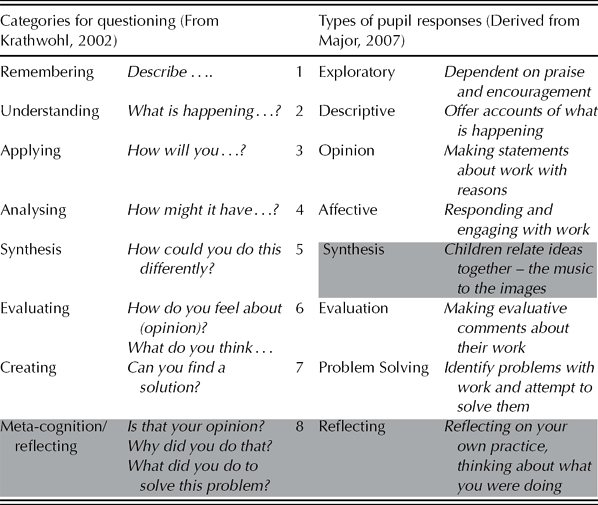
Young children were found to be capable of evaluating their own musical composing work, or talking through problems and negotiating solutions with each other. Choosing a task which captured their imagination and one with which they had prior knowledge and involvement, allowed them to be more effective in their composing because of their enthusiasm for the task and their readiness to synthesise ideas with musical sounds. Table 4 shows the addition of synthesis to pupils’ responses. This was not a feature of previous research.
New typology of teacher questioning and pupil responses

Shaded sections show categories and types added to the originals as a result of the findings from the data in this study.
The children's enthusiasm and engagement with the task (affective engagement) is seen as a prerequisite for evaluative talk. ‘Reflection’ on the processes of composing was also not a feature of the original typology of talk (Table 2). In this project, younger pupils were encouraged to reflect on the processes of talking about their music composition by the researcher. Significantly, the responses were dependent on the questioning. Table 4 includes ‘metacognition’ and ‘reflection’ as essential high-order skills and these children were capable of very profound comments in evaluating what they had been doing.
Conclusions
This research has highlighted some important pointers for the importance of encouraging young children to develop their discourse skills through other cross curricular subject areas.
Of particular importance is that imaginative tasks, such as working on an imaginative music composition, provide an arena for developing pupil's discourse skills. The research findings support the idea that engagement or affective involvement with a topic encourages effective higher-order thinking and discussion. This highlights the notion that developing interaction and speaking skills can be effectively woven into other activities in the teaching day, with qualitative results. Further to this, affective engagement in a task also encourages more evaluative forms of thinking and may motivate them to solve problems and to reflect on their learning. Teacher questioning might therefore serve the purpose of helping pupils to think critically about what they are doing and encourage evaluative and critical dialogue in the context of practical activities across the arts.
The findings also confirm that young children are able to discuss ideas and problems together with each other, to negotiate and find agreement, and most significantly to display tentative skills of deduction and reasoning while finding a solution to a problem. However, the research confirmed that the important role of focused questioning, targeting higher level thinking, allowed pupils to develop their critical thinking skills and dialogic responses further. In evaluating the data in this study, it is clear that when pupils are engaged in a creative ‘hands on’ skill-based task, their dialogue and thinking is enhanced by their engagement with the project.
Most significantly and perhaps surprising was that young children of 6–7 years are capable of developing meta-cognitive skills of reflecting on the processes that they have been working on. Self-evaluation and reflection has become a common feature of many classrooms, encouraging peer assessment of each other. The suggestion here that this may further help them to develop higher-order thinking and speaking skills when affectively engaged in a creative or imaginative topic, supports a case for using broader aims to justify the important place for arts in the curriculum.
The ‘typology of teacher questioning and pupil responses’ demonstrates ways in which teachers can fashion questions in order to encourage higher-order responses and the data collected showed a direct link between the questions and their corresponding responses. The findings suggest that new ‘types of talk’ should be added to previous versions of this typology; the categories of ‘synthesis of ideas’ and of ‘reflection on processes’. The findings of this study therefore also would support an additional type of questioning for Bloom's taxonomy (see Table 4); that of meta-cognition which encourages children to reflect.
Future research might explore the shared meaning of communication through not only the dialogue, but also through the ‘unspoken’ language of the music composed. Young children demonstrate ‘unspoken’ meanings in their body language and actions. In the words of Polanyi, ‘we can know more than we can tell’ (Polanyi, Reference POLANYI1967). The limitations of looking at only the dialogue in relation to children's music-making point to further research in this area. A further area of future research might involve the role of ‘synthesis’, since the combining of ideas, here of non-musical ideas with musical sounds, were evidenced in the lower order types of responses. Most significantly, activities to encourage negotiation and reasoning through dialogue (‘interthinking’, Mercer, Reference MERCER and LITTLETON2007) in young children might prove revealing and insightful. This research supports the idea that imaginative tasks encourage children to engage in dialogue and music activities might provide a springboard for this.
Acknowledgements
The research was funded by the ‘Froebel Educational Research Institute’ as a pilot study. The help and willingness of Sheen Mount Primary School in South West London for allowing us to observe and record music lessons and to carry out paired musical interviews is appreciated.