Courtship in spiders functions in mate recognition, orientation, stimulation of the female, suppression of female nonsexual responses, and may also convey information about male quality for female mate choice (Uhl and Elias Reference Uhl and Elias2011). Inhibiting the female's predatory response is likely an important function of courtship (Robinson Reference Robinson1982), particularly in highly sexually dimorphic and cannibalistic species, including those in the genus Latrodectus Walckenaer (Araneae: Theridiidae). Male strategies that apparently alleviate the risk of cannibalism include inducing a quiescent state in the female before copulation ensues, and wrapping the female with a silk “bridal veil” that might maintain her quiescence via a silk-borne male pheromone (Ross and Smith Reference Ross and Smith1979; Breene and Sweet Reference Breene and Sweet1985).
Web reduction, the cutting and bundling of sections of the female's web and wrapping them with silk, is a common element of precopulatory displays of Latrodectus males. Some reports imply that all males engage in web reduction (Kaston Reference Kaston1970; Breene and Sweet Reference Breene and Sweet1985; Harari et al. Reference Harari, Ziv and Lubin2009), whereas others contradict this conclusion (Ross and Smith Reference Ross and Smith1979; Anava and Lubin Reference Anava and Lubin1993; Segoli et al. Reference Segoli, Arieli, Sierwald, Harari and Lubin2008; Stoltz et al. Reference Stoltz, Elias and Andrade2008) but do not report quantitative data (except Anava and Lubin Reference Anava and Lubin1993). Web reduction has been shown to lessen male–male competition in linyphiid spiders (Araneae: Linyphiidae) by lowering pheromone emission from the female's silk, thus reducing attraction of other males (Watson Reference Watson1986; Schulz and Toft Reference Schulz and Toft1993). Other proposed functions of web reduction include decreasing the likelihood of courtship displays being interrupted by rival males or prey (Rovner Reference Rovner1968; Forster Reference Forster1995), and transmitting, or improving transmission of, a male's vibratory or silk-borne chemical signals (Anava and Lubin Reference Anava and Lubin1993; Berendonck Reference Berendonck2003), but none of these proposed functions has been experimentally investigated.
Male western black widows, Latrodectus hesperus Chamberlin and Ivie, are attracted to airborne pheromone emanating from females’ webs (Kasumovic and Andrade Reference Kasumovic and Andrade2004). Contact with the web elicits courtship in males (Kaston Reference Kaston1970; Ross and Smith Reference Ross and Smith1979). While elements of courtship have previously been described, a more detailed and quantitative report of the complete courtship sequence will allow the formulation of testable hypotheses about the function of individual behavioural elements, including web reduction. Our objectives were to (1) quantitatively analyse the courtship sequence in L. hesperus; and (2) reveal potential relationships between the pattern and duration of courtship behaviour by males (particularly web reduction) and their consequent mating success and the females’ responses.
Immature black widows were collected in summer 2009 from Island View Beach, on the Saanich peninsula of Vancouver Island, British Columbia, Canada (48° 35′ N, 123° 22′ W, elevation 3–4 m). Spiders were kept in the laboratory at 20–25°C on a reversed 12:12 hour (light:dark) light regime to facilitate experimentation during the spiders’ nocturnal activity phase. They were housed singly in Petri dishes (15 × 2.5 cm) and reared to adults on a diet of house flies and house crickets. Females were fed 2 days before testing them in mating trials to control for starvation level and minimise the likelihood that they would cannibalise courting males.
Just after moulting, mature females (n = 12) were placed in wood-frame boxes (30 × 30 × 20 cm) with clear plastic and mesh sides, and were allowed to build a web for 2–4 weeks. For mating trials, a virgin male 2–4 weeks postmaturity was randomly assigned to each female and introduced onto her web, which was illuminated by a 25 W incandescent lamp. Each trial was video recorded with a Canon XL2 camcorder (Canon Canada, Mississauga, ON, Canada) until at least one copulation had occurred or >4 hours had elapsed. Males were left in the boxes and those that eventually died without being consumed by the female were removed and stored in ethanol. The size of preserved males was estimated by measuring the tibia–patella length of leg I. Video recordings were analysed using Jwatcher v1.0 (Blumstein et al. Reference Blumstein, Daniel and Evans2006). In addition to scoring the occurrence of courtship elements, we quantified female responses and the sequence of events as follows: (1) aggression of females was quantified by counting the number of times the male dropped off the web or walked away from the female immediately following her movement towards him; (2) latency to the female's quiescence was measured as time from the male's first movement on the web until his first contact with the female's abdomen. Abdominal instead of leg-to-leg contact was chosen as an indicator of quiescence because it was always followed by the male mounting the motionless female; (3) latency to first copulation was recorded as the time from the male's first movement on the web until his insertion of a pedipalp; and (4) copulation duration was recorded as the time from the male's insertion of a pedipalp until he had fully withdrawn the embolus. Data were analysed by nonparametric statistics (Mann–Whitney U-tests; Spearman rank correlations), using JMP 8.0 software (SAS Institute Inc. 2009).
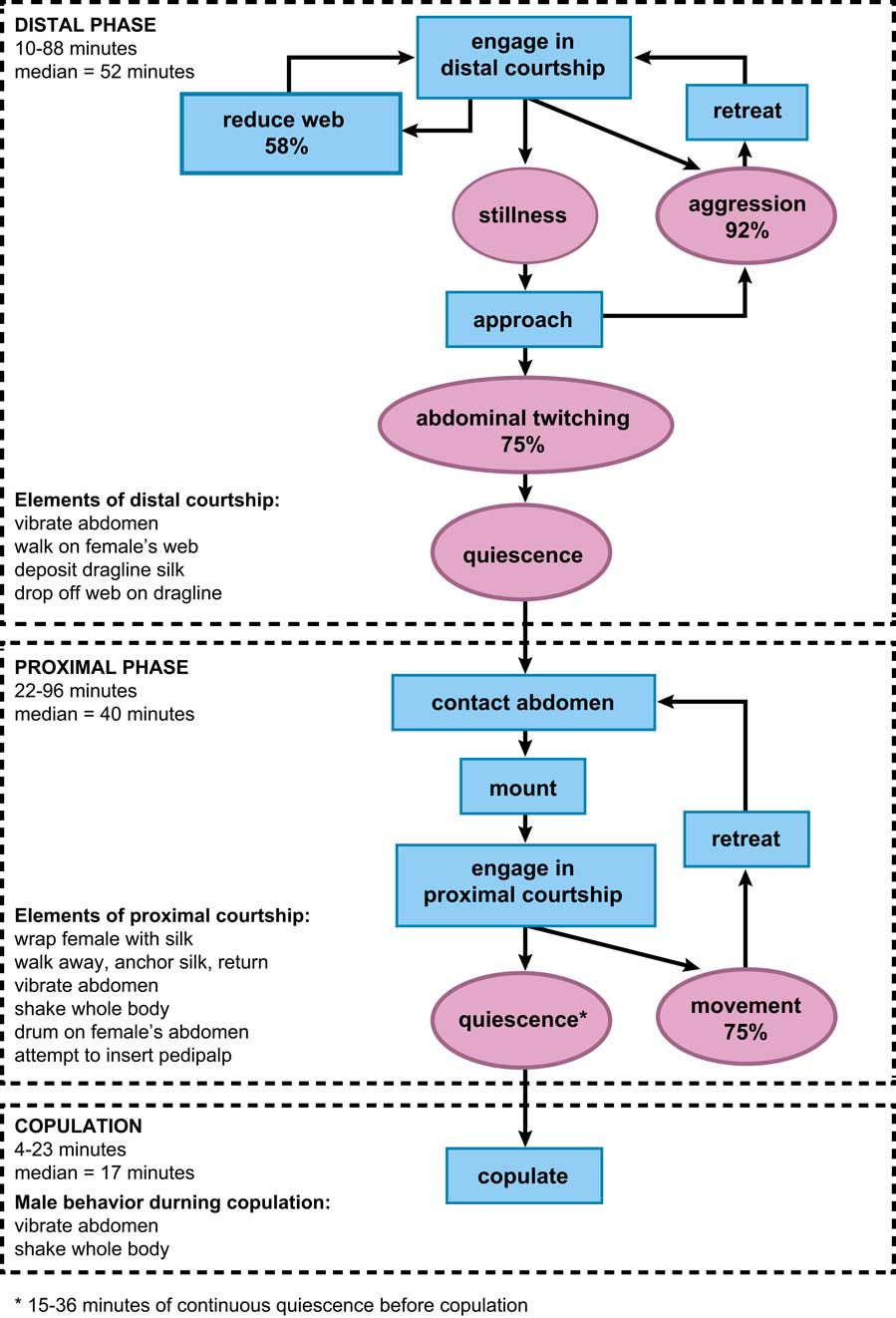
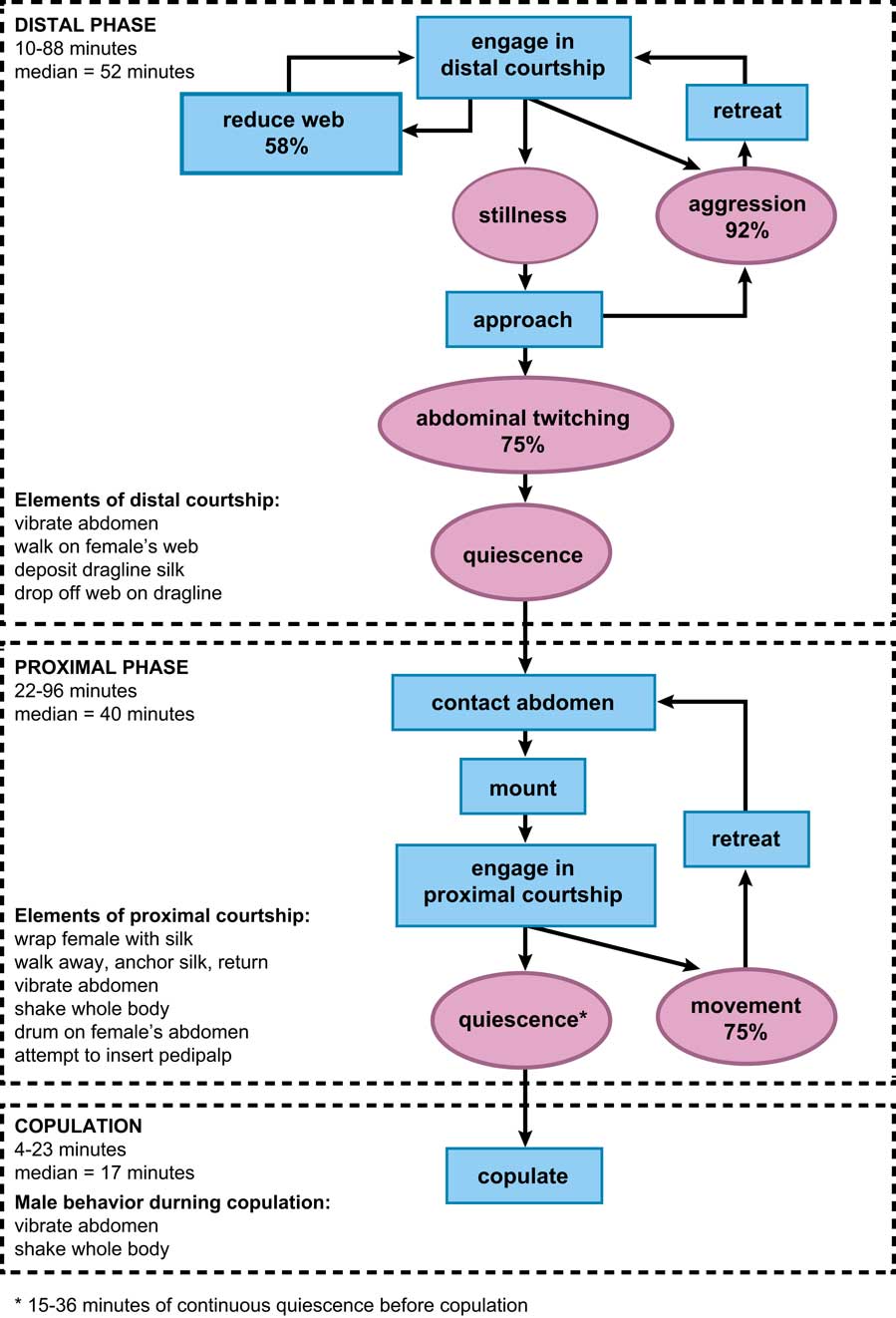
Precopulatory courtship can be divided into distal and proximal phases (summarised in Fig. 1), based on observations of 12 independent mating trials. During the distal phase, the male actively explored the web, continuously trailing dragline silk. All males periodically paused and vibrated their abdomens dorsoventrally. Fifty-eight percent of males engaged in web reduction behaviour, spending 40%–90% of the distal phase cutting threads of the female's web, bundling the loose silk into thick ropes and balls, and wrapping them extensively with silk (Fig. 2A). The remaining 42% of males did not visibly reduce the female's web, but spent 0%–7% of this phase occasionally cutting threads and laying down silk by pulling it from their spinnerets with legs IV, with the remaining time spent engaging in other elements of distal courtship. Eventually, the male approached the female, alternating between abdominal vibrations and walking slowly forward, until he made contact with one or more of her legs. If the female did not respond with aggression, she either remained still or repeatedly twitched her abdomen dorsoventrally before becoming fully quiescent.
Summary of the courtship sequence for Latrodectus hesperus, indicating the time spent in each phase. Actions of males are in blue rectangles, and responses of females are in pink ovals. Distal courtship, proximal courtship, and copulation consist of cycles of multiple behavioural elements that are listed in the bottom left corner of each dashed box. Elements that did not occur in every mating trial are indicated as percentage of replicates in which they occurred. Quantitative data are based on 12 replicates for the distal phase and 11 for the proximal phase and for the copulation.
(A) Photograph of a male Latrodectus hesperus engaged in web reduction behaviour (note the dense rope of silk that is the result of his cutting, bundling, and wrapping with silk the section of the female's web which formerly covered the empty space in the bottom two thirds of the image). (B) Mean (+SD) number of instances of aggressive behaviour by female L. hesperus in the distal courtship phase towards males that did (n = 7), or did not (n = 5), engage in web reduction (U = 4.5, P < 0.05). (C) Mean (+SD) latency to female L. hesperus quiescence (time from the male's first movement on the web until his first contact with the female's abdomen) for males that did (n = 7), or did not (n = 5), engage in web reduction (U = 1, P < 0.01). (D) Correlation between time to female L. hesperus quiescence and time to copulation for males that copulated at least once (ρ = 0.688, P = 0.019, n = 11). One male that did engage in web reduction did not copulate within 4 hours and was excluded from the analysis.

During the proximal phase, the male remained on the female's abdomen or close by her on the web. Typically, each bout of abdominal vibration on the female was followed by a sudden violent shake of the male's whole body. After the onset of quiescence, 75% of females occasionally moved, but all females remained completely motionless for 15–36 minutes (median = 22 minutes) before copulation occurred. Eleven males copulated at least once before 2.5 hours of courtship had elapsed; the remaining male failed to copulate within 4 hours, even though the female remained motionless for >2 hours.
Males that engaged in web reduction experienced less female aggression than males that did not (0–6 instances of aggression, median = 3 instances, n = 7 versus 2–53 instances, median = 19 instances, n = 5; U = 4.5, P < 0.05; Fig. 2B). Web-reducing males also induced female quiescence more quickly (10–62 minutes, median = 28 minutes, n = 7 versus 54–88 minutes, median = 72 minutes, n = 5; U = 1, P < 0.01; Fig. 2C). Female aggression and time to female quiescence were not significantly correlated (ρ = 0.428, P = 0.165, n = 12). Time to female quiescence was positively correlated with time to first copulation in the 11 trials in which at least one copulation occurred (ρ = 0.688, P = 0.019, n = 11; Fig. 2D). Copulation duration was not correlated with courtship duration (ρ = 0.007, P = 0.984, n = 11).
Male size was not correlated with female aggression (ρ = −0.195, P = 0.589, n = 10), time to female quiescence (ρ = 0.115, P = 0.751, n = 10), or percentage of the distal phase spent engaging in web reduction behaviour (ρ = 0.600, P = 0.067, n = 10). Two males that did not engage in web reduction were cannibalised after mating and thus were not included in statistical analyses. The percentage of the distal phase that males spent engaging in web reduction behaviour was negatively correlated with their age postmoult to mature adults (ρ = −0.604, P = 0.038, n = 12), but was not correlated with the age of females post-molt to mature adults, which is equivalent to the age of their webs (ρ = 0.343, P = 0.275, n = 12).
Our quantitative analysis of the courtship sequence in L. hesperus indicates that the female's sustained quiescence is required for copulation to occur. All but one male copulated at least once, but variation in the latency to copulation suggests that differences in male strategies, male quality, or female receptivity affect the length of courtship required for successful mating. The strong relationship between web reduction by males and the females’ responses (Fig. 2) suggests that web reduction in L. hesperus plays a role in sexual communication, possibly in addition to, or instead of, lessening male–male competition. Web reduction behaviour could transmit, or improve transmission of, vibratory and/or chemical signals that function to suppress female aggression, induce female quiescence, or convey information about male quality for mate choice by females.
Our study adds to current knowledge of courtship behaviour in L. hesperus in that we quantify the sequence of behavioural elements, note the percentage of males engaging in web reduction behaviour, and provide evidence for an alternative function of web reduction. We report for the first time the 15–36-minute period of sustained female quiescence that consistently precedes copulation. Elements of proximal courtship other than the wrapping of the female with silk have been largely overlooked elsewhere. The male's repeated bouts of abdomen vibrations followed by violent shakes while courting on the female's abdomen have not been previously mentioned. We speculate that the male's shakes may “test” the female's responsiveness, as a means to ensure that she is fully quiescent. That males vibrate their abdomens throughout both phases of courtship hints that this behaviour might transmit an essential signal. The extent to which vibratory, chemical, and tactile signals are involved in inducing and maintaining female quiescence warrants further study.
Web-reducing male L. hesperus experienced less aggression from females and induced their quiescence more quickly than did males not engaging in web reduction. Accelerated quiescence induction seems to ultimately minimise the duration of precopulatory courtship. The females’ ostensibly positive responses to web-reducing males are somewhat surprising because web reduction incurs costs in the form of lost resources (silk), diminished opportunity for prey capture, and web reconstruction and repair (Schneider and Lubin Reference Schneider and Lubin1998). Our results suggest that web reduction by males may improve their mating success by lessening aggression and accelerating induction of quiescence in females.
Lowering male–male competition is the only experimentally supported function of web reduction behaviour in spiders. This function was demonstrated in several linyphiids, in which only females that remain virgins for 7–10 days after their adult moult incorporate pheromone into their silk. Males reduce the web size of these highly receptive virgin females by >90% before mating, thus minimising pheromone emission from the silk and rendering the web less attractive to other males. Mated females then rebuild their webs void of pheromone (Rovner Reference Rovner1968; Watson Reference Watson1986; Schulz and Toft Reference Schulz and Toft1993). Similar changes in pheromone production by female Latrodectus hasselti Thorell (Andrade and Kasumovic Reference Andrade and Kasumovic2005; Stoltz et al. Reference Stoltz, McNeil and Andrade2007) suggest that web reduction by conspecific males may serve the same function as in linyphiids but no data are reported regarding the percentage of males engaging in web reduction or the extent to which webs are reduced. Web modifications may otherwise affect male–male competition by reducing both access routes to the female and the area a male must defend against rivals (Rovner Reference Rovner1968; Forster Reference Forster1995). Male L. hesperus equally respond to webs of juvenile females, and adult virgin and mated females (Ross and Smith Reference Ross and Smith1979), and males in our study typically reduced the size of virgin females’ webs by much less than 50%. Whether or not web reduction in Latrodectus spp. lessens male–male competition remains to be investigated.
Several alternative explanations for the function of web reduction are consistent with the results of our study. Web reduction might alter signal transmission characteristics of the web (Berendonck Reference Berendonck2003), improving both the signal-to-noise ratio of the male's vibratory message and the female's ability to receive it. Web reduction behaviour could directly convey signals to the female via the high-amplitude web vibrations produced when silk threads are cut. It might also facilitate the female's assessment of a male's quality based on the time and energy he invests in web reduction, vibrations he produces during silk-cutting, or the amount of pheromone-impregnated silk he deposits (Anava and Lubin Reference Anava and Lubin1993; Berendonck Reference Berendonck2003; Harari et al. Reference Harari, Ziv and Lubin2009). We need to test experimentally whether any of these mechanisms explain the observed responses of females to web-reducing males in our study.
Not all Latrodectus males engage in web reduction (69% of Latrodectus revivensis Shulov, Anava and Lubin Reference Anava and Lubin1993; 58% of L. hesperus, this study). Age-related differences in the pheromone content of females’ webs are unlikely to explain this variation in courtship behaviour in L. hesperus. All females were virgins 2–4 weeks past their final moult, and we found no relationship between the age of females (equivalent to the age of webs) and the propensity of males to engage in web reduction. Instead, we propose that a signal or cue from a receptive female, which might be her stillness, elicits web reduction behaviour, whereas a cue from a less receptive female – possibly aggressiveness – elicits an alternate pattern of courtship. This concept is consistent with results of a recent study suggesting that the behaviour of L. hesperus females has a greater effect on the courtship of males than do chemical cues on the web (Johnson et al. Reference Johnson, Trubl, Blackmore and Miles2011). Alternatively, it is conceivable that only high-quality males may engage in web reduction behaviour. Male size as a possible indicator of male fitness was not correlated with web reduction in our study, but the age of mature males was negatively correlated with the percentage of distal courtship they spent engaging in web reduction. As mature males do not forage, their body condition deteriorates over time, possibly affecting their ability to engage in energetically costly web reduction behaviour. Having shown here that web reduction is associated with accelerated induction of quiescence and less aggression in females, we will now test whether the occurrence of this behaviour is male- or female-driven.
Acknowledgements
The authors thank Sean McCann for the photograph and Stevo DeMuth for graphical illustrations. Funding was provided by a Natural Sciences and Engineering Research Council of Canada (NSERC) Discovery Grant and by an NSERC Industrial Research Chair to G.G., with Contech Enterprises, SC Johnson Canada, and Global Forest Science as sponsors.