




Introduction: image history as a semiotic problem
In the lower register of the Ghent Altarpiece, painted by Hubert and Jan van Eyck and completed in 1432, a fine network of cracks runs across the paint film (Figure 1a). Cracks of this kind form as oak panels swell and shrink with changes in humidity, straining the ground and paint layers built up on them, which respond differently to moisture (Mecklenburg, Tumosa, and Erhardt Reference Mecklenburg, Tumosa, Erhardt, Dorge and Howlett1998, 464–65, 482). Figure 1b shows a detail of an image generated for this study with Stable Diffusion XL (SDXL), an openly released text-to-image model. The prompt asked for a close view of one painted eye and cheek in a 15th-century Flemish portrait by Jan van Eyck, one of the two painters of the altarpiece in Figure 1a, with a dense network of dark craquelure across the entire paint film, and the resulting surface is crossed by a similar network of cracks. Naming the painter draws on whatever visual qualities the model associates with his name, although no particular source can be identified in the output. Both images in Figure 1 are flat reproductions, but only Figure 1a reproduces a layered object; Figure 1b reproduces an array of pixel values, and whatever layers it acquires when printed record the printing rather than the history the image depicts. When two images appear side by side in this way, one generated by a diffusion model in seconds and the other built up over many studio sessions, they may present themselves with comparable visual completeness. Less evident, and less often examined, is what each image carries about the conditions of its making, and where, within the arrangement of material and system that produced it, that information resides.
(a) Detail of the face of an apostle in the central panel of the Ghent Altarpiece, the Adoration of the Mystic Lamb, by Hubert and Jan van Eyck, completed 1432, Saint Bavo’s Cathedral, Ghent, showing craquelure across the paint film. Macrophotograph in visible light, after treatment, cropped. Closer to Van Eyck, closertovaneyck.Kikirpa.Be; © Lukasweb.Be-Art in Flanders vzw. (b) Detail of an image generated for this study with SDXL base 1.0 (stabilityai/stable-diffusion-xl-base-1.0, revision 4621659840), run with the diffusers library 0.41.0 and PyTorch 2.11.0 on an NVIDIA T4 GPU in a Google Colab notebook, from the prompt “cracked old oil painting surface, dense network of authentic dark craquelure across the entire paint film, close-up detail of one painted eye and pale cheek in a 15th-century Flemish portrait by Jan van Eyck, prominent age cracks cutting through the painted eyelid, pupil, and skin, small irregular polygonal paint islands, slight cupping along crack borders, aged amber varnish, muted earth pigments, museum conservation macro, sharp focus.” Negative prompt: “smooth flawless skin, clean uncracked paint film, pristine varnish, intact surface, photographic eye, realistic wet eyeball, moist cornea, modern portrait, 3D render, cartoon, digital illustration, coarse black drawn lines, thick marker lines, dry mud cracks, broken glass, peeling paint chips, frame, ruff, collar, hat, text, signature, watermark.” The text encoders read at most 77 tokens, including start and end tokens, so the final words of the main prompt were cut off and had no effect. Seed 141421; Euler discrete scheduler; 45 steps; guidance scale 7.6; 1024 × 1024 pixels; generated on October 7, 2026. AI-generated image (SDXL); not edited other than by cropping and resizing.

The central contribution of this article is to treat production history as a socially organized object of interpretation: something made available, withheld, translated, or controlled through the material and institutional organization of image-making. Whether it can be recovered is a semiotic matter, which depends on the relation between material support, technical procedure, institutional access, and cultural interpretation. The question is therefore not only how images signify, but how the conditions of their making become available as signs, and to whom.
Peirce’s account of the sign as a relation among a sign, the object that determines it, and the interpretant that it produces provides the vocabulary for this problem (Peirce Reference Peirce, Hartshorne and Weiss1932, 2.228, Reference Peirce, Hartshorne and Weiss1933, 4.536). The craquelure of the Ghent panels is an index of the processes that produced it, but it becomes evidence of those processes only when conservators, curators, or courts take it up as such. The generated cracks resemble such an index, and for viewers who read surfaces through habits formed by old paintings, they are icons of an index. They are also indices in their own right, since their appearance is determined by a generative system and, through the images in its training data, by many earlier images, usually without a traceable link to any single one. This relocation of an index’s object is what the article calls indexical displacement. The analytical term proposed here, forensic latency, names the condition in which an image’s production history stands in real connection to it but can be turned into evidence only by particular interpreters, with particular means, in particular forums.
The comparison is not between human and machine images in general, but between two arrangements of semiosis: one in which production history is materially lodged in the image-object, and another in which it is distributed across technical, documentary, and institutional systems. The distinction concerns the principal evidential site of production history, not its only one: painted objects are also embedded in institutional systems of custody, conservation, ownership, and expertise, while digital images may carry metadata, watermarks, fingerprints, or other provenance signals. Icons of indices are not new: trompe l’oeil painters and forgers have simulated wear and craquelure for centuries, and photography long ago separated the look of a cracked surface from the surface itself. What distinguishes the generated image is where the connections that ground it are located and who can reach them.
The analysis is a comparative study grounded in documented practices of interpretation: published technical studies of the Ghent Altarpiece and the public reception of its restoration, judgments in two disputes involving image generators, regulatory texts, and images generated for this study with an openly released model, their settings recorded in the captions.
Signs, interpreters, and forensic latency
Social semiotic work has long treated images as socially shaped resources for making meaning (Kress and van Leeuwen Reference Kress and van Leeuwen2006, 2; Kress Reference Kress2010, 79). The question pursued here requires a more precise account of how a mark comes to stand for the process that produced it, and for whom. For Peirce, a sign is something that “stands to somebody for something in some respect or capacity” and creates in that person’s mind an equivalent or more developed sign, its interpretant (Peirce Reference Peirce, Hartshorne and Weiss1932, 2.228). The interpretant is not the interpreter but what the sign produces in an interpreter by determining it, in Peirce’s words, “to a feeling, to an exertion, or to a Sign” (Peirce Reference Peirce, Hartshorne and Weiss1933, 4.536). In the cases discussed here, it may be a viewer’s impression of age, a conservator’s intervention, a written report, or a verdict; interpreters are the persons and institutions in whose experience and conduct such effects occur. Peirce defines an index as a sign that refers to its object by being really affected or actually modified by that object (Peirce Reference Peirce, Hartshorne and Weiss1932, 2.248). His examples include the weathercock, an index of the wind’s direction because it turns with the wind and so stands in a real connection with it (2.286); on the same basis, the directional texture of a brushstroke may be read as an index of the gesture that produced it. Peirce adds that an index would cease to be a sign without its object, but not without an interpretant: a bullet hole remains the trace of a shot whether or not anyone attributes it to one (2.304).
Two questions must therefore be kept apart. One is whether a real connection exists between a mark and the process it appears to indicate. The other is who takes the mark as a sign of what, on what grounds, and with what consequences. A viewer who takes generated cracks for the marks of age has produced an interpretant no less real than a conservator’s; what differs is whether the object it attributes is the object that determined the sign. Peirce’s distinction between the immediate object, the object as the sign represents it, and the dynamical object, the reality that determines the sign to represent it as it does (Peirce Reference Peirce, Hartshorne and Weiss1933, 4.536), makes the difference precise. When painted and generated cracks are taken as signs of age, rather than of drying, damage, or deliberate imitation, they share an immediate object: age, as the cracks represent it. Their dynamical objects differ: in one case the hardening, embrittlement, and mechanical stress of a particular paint film on particular boards, in the other a sampling procedure, a seed, a prompt, and regularities learned from a corpus of training images. Nakassis (Reference Nakassis2018, 286, 296) locates in indexicality a foundational ambivalence between immediacy and presence on one side and mediation and representation on the other: the analysis of an indexical sign cannot take its connection to an object as simply given, yet must assume that connection, as sign users do. Forensic practices are institutionalized ways of working on that ambivalence, by testing whether the object that a sign appears to indicate is the object that determined it.
Interpretants are also socially organized. Which features of a surface count as signs of age, and of what kind of age, is learned in specific institutions and unevenly distributed. Agha’s account of enregisterment provides terms for this: through enregisterment, a repertoire of performable signs, which need not be linguistic, comes to be linked to stereotypic indexical values, and the persons acquainted with that link form its social domain (Agha Reference Agha2007, 64, 80–81). Many who recognize such a repertoire cannot interpret it fully, a competence that often depends on specialized training (156–57). Conservators learn to tell age cracks from drying cracks and both from cracks in a later varnish, whereas a viewer without that training may read any crack simply as a sign of age. Keane’s notion of semiotic ideology names the assumptions, explicit or tacit, that underlie the trained and the untrained reading alike, including assumptions about which signs are caused and which are made (Keane Reference Keane2018, 65, 68–69). Whether different readers can orient to the same object depends in part on the documents available to them: for painted surfaces, conservation reports, technical images, and provenance records; for generated images, metadata, model documentation, and generation logs.
Social semiotics has often described these matters through the concept of affordance, taken from Gibson’s ecological psychology and reworked, in relational terms, as what a material resource makes possible in relation to particular social practices (Gibson Reference Gibson1986, 127–29; van Leeuwen Reference van Leeuwen2005, 4–5). This article does without it. Agha (Reference Agha2025, 578) has argued that, in the quasi-scientific register Gibson built around affordances, undisclosed metalinguistic operations convert attributes that speakers of English can predicate of things into properties said to be manifest in the things themselves to all animals that perceive them. Many narratives about what people see and touch, he observes, do not arise in the encounter itself. They are formulated elsewhere and spread unevenly through society by their own circulation, assigning those who rely on them different positions in social organization. These social processes become non-recoverable in attempts to gloss phrases such as the affordances of things (579). Relational versions of the concept address part of this difficulty by treating affordance as a relation between material and practice. The present analysis needs to keep the two apart, because it asks how the conditions under which a history persists in a material relate to the practices through which that history is recovered, and by whom. What oil paint does is limited and concrete. Once dried by polymerization, it retains in its physical structure the texture of marks, the stratigraphic sequence of layers, and cracking patterns formed under the conditions of aging, all of which stand in real connection to past events (Mecklenburg, Tumosa, and Erhardt Reference Mecklenburg, Tumosa, Erhardt, Dorge and Howlett1998, 482; David, Tumosa, and Mecklenburg Reference David, Tumosa and Mecklenburg2005, 143). Whether those connections become evidence, and for whom, is a matter of interpretive practice.
The concept of forensic latency joins the forensic sense of evidential reconstruction to what Carlo Ginzburg called the evidential or conjectural paradigm, in which traces, symptoms, clues, and marginal pictorial details allow otherwise inaccessible realities to be inferred, though only partially and probabilistically (Ginzburg Reference Ginzburg1989, 96, 101–2, 105, 118). Forensic latency applies this logic to the production histories of images. It names the condition in which a production history stands in real connection to an image but has not been, or cannot be, converted into evidence by a given interpreter with the means and standing available in a given forum. It is thus not a property of an image alone but a socially organized condition of recoverability: what can be recovered from an image, by whom, through which techniques, and under what institutional permissions depends on the organization of interpretive practices. Latency is always latency for someone. It is also relative to the claim at issue: the same image or record can support one claim about its history while leaving another unsettled. It shrinks when instruments improve, records are kept, or a court orders disclosure, and it grows when objects are withheld, logs are deleted, or model weights are kept private.
The distinction between object-bound and system-distributed forensic latency can now be stated without appeal to the powers of materials. It concerns where an image’s production history principally resides, how it is preserved, and under what conditions it can be reached. Under object-bound forensic latency, much of this history is embedded in the material support of the image, where it remains unless aging, damage, or later treatment alters or removes it, and where it is recovered by examining the object through imaging, sampling, and comparison. Under system-distributed forensic latency, it is dispersed across the technical and institutional systems through which the image was produced, where it survives largely in whatever records, files, and model versions are kept. It is recovered by reading those records, by re-running a generation with the same model, seed, and settings, or by inferring properties of the system from its outputs: model fingerprinting attributes an image to one of several known generators (Yu, Davis, and Fritz Reference Yu, Davis and Fritz2019), and membership inference tests whether a particular image was among a model’s training data (Carlini et al. Reference Carlini, Hayes, Nasr, Jagielski, Sehwag, Tramèr, Balle, Ippolito and Wallace2023; Shokri et al. Reference Shokri, Stronati, Song and Shmatikov2017). Re-running shows that recorded settings can produce a given image, not that they produced it, and its force depends on the records and on whatever else supports them. Examination, the reading of records, re-running, and inference are institutional practices rather than properties of media, and the disputes discussed below show each of them at work.
Latent surface and latent space
Painted surfaces preserve material residues of their own making: underdrawn contours and successive stages of composition. Infrared reflectography makes this especially clear, because it can reveal underdrawing beneath paint and allow the visible surface to be compared with earlier stages in the build-up of a composition (Faries Reference Faries1975, 89). These residues are indices in Peirce’s sense, standing in a real connection with the actions that produced them. The surface also goes on changing after the painter has finished: binding media and varnishes alter its appearance as their optical properties change (de la Rie Reference de la Rie1987, 1, 10), and oil paint films continue to change chemically for centuries, although their mechanical properties change little after the first few decades (David, Tumosa, and Mecklenburg Reference David, Tumosa and Mecklenburg2005, 143, 145, 147–48).
Pentimento names a particularly legible form of this residue. When a painter revises a compositional decision and covers an earlier passage with new paint, the covered passage remains physically present beneath the visible surface (Faries Reference Faries1975, 131). In some cases, earlier decisions become partially legible to ordinary viewing as covering layers or coatings change optically over time (de la Rie Reference de la Rie1987, 1); in others, they become legible through infrared reflectography (Bambach Reference Bambach1999, 26). A pentimento is best understood here as an indexical trace of a change of mind: a prior decision materially preserved within the layered structure of the object.
Conservation science has developed a sustained practice of reading these traces. Cross-section analysis, in which a minute paint sample is mounted and prepared to reveal the layer sequence at microscopic scale, allows researchers to reconstruct the sequence of paint application, identify pigments and binding media, and distinguish original material from later restorations (Khandekar Reference Khandekar2003, 52, 54). These techniques do not give transparent access to material truth: reflectograms, radiographs, and cross-section images are themselves mediated signs, produced through instruments, protocols, expertise, and institutional decisions. What conservation analysis organizes is a practice of reading in which the object remains the principal evidential site.
Diffusion models generate images by iterative denoising. In training, Gaussian noise is progressively added to images until the signal is destroyed, and the model learns to predict the noise at each step; in generation, it applies this learned reversal step by step, beginning from pure Gaussian noise, to produce images matching the data distribution (Ho, Jain, and Abbeel Reference Ho, Jain and Abbeel2020, 6841, 6843, 6846). In latent diffusion models, such as the architecture used in Stable Diffusion, this takes place in a compressed latent representation produced by a pretrained autoencoder, and the result is decoded into an image at the end (Rombach et al. Reference Rombach, Blattmann, Lorenz, Esser and Ommer2022, 10685–87).
The production history of a diffusion-generated image is thus distributed across a system rather than embedded in an object. The output image is shaped at every stage by conditions that reside outside it: the composition of the training dataset, which encodes the aesthetic, cultural, and demographic properties of images collected at a particular historical moment; the model architecture and its parameters; the random seed, which fixes the noise from which sampling begins; the sampler and its settings; and the prompt, which steers sampling toward configurations the model associates with the linguistic input. Each of these is a real condition of the image’s existence. None is deposited in the output as a separable layer, although traces of some of them may surface in it, as later sections show.
The word latent describes both the hidden layers of a painting and the representational space of a diffusion model, but the two uses point to structures that differ in their semiotic character. The latent surface, as the term is used here, refers to the paint layers beneath the topmost visible film: the ground preparation, the underdrawing, earlier compositional states, the pentimenti. These are latent in the sense that they are physically present beneath what ordinary vision can access, awaiting recovery through appropriate technical means. The latent surface is an accumulation of material indices, laid down in temporal sequence and preserved as a physical stratigraphy within the same object whose visible surface the viewer encounters.
In a latent diffusion model, each image is encoded as a latent representation, a multichannel array at reduced resolution that keeps the spatial layout of the image, and the latent space is the space of such representations (Rombach et al. Reference Rombach, Blattmann, Lorenz, Esser and Ommer2022, 10686–87). What the diffusion model learns is a probability distribution over this space, organized by features and regularities of the training data (Goodfellow, Bengio, and Courville Reference Goodfellow, Bengio and Courville2016, 501–3, 690), and each generation traces one path through it from a random starting point toward a region of high probability. The latent space is not a layer beneath a visible surface. To move through it is not to excavate toward a particular historical deposit but to traverse a field of probability, in which different positions correspond to different image configurations.
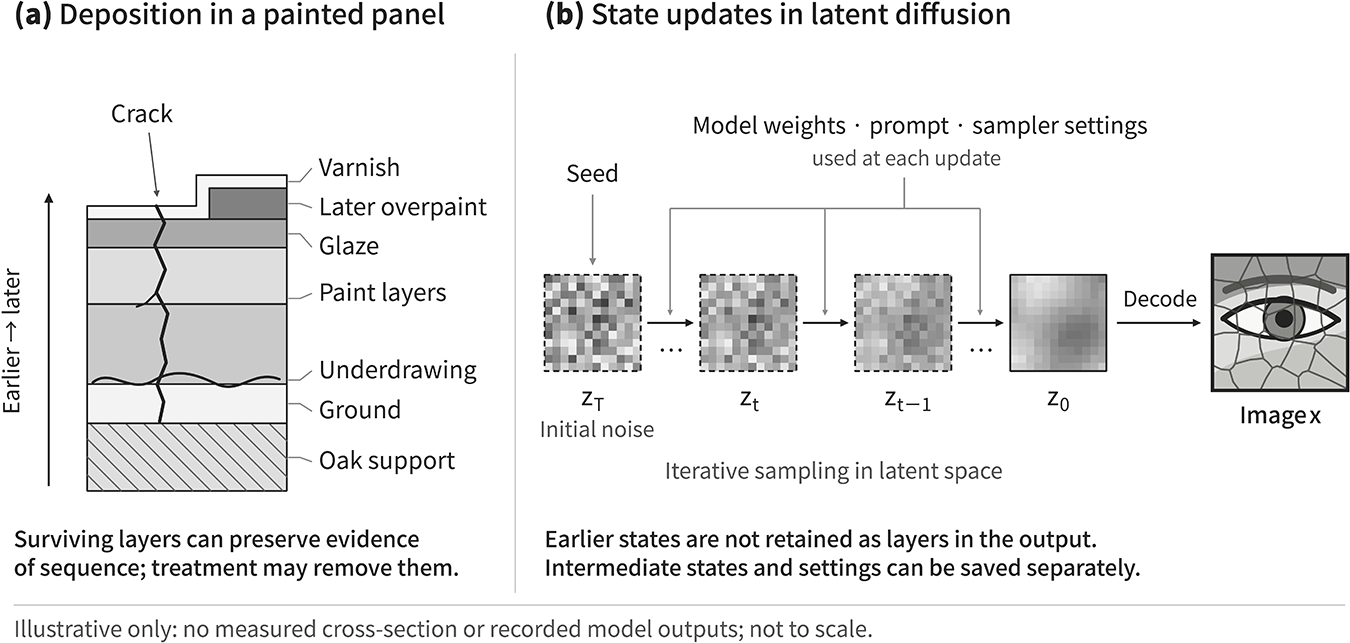
Painting and diffusion sampling differ in how successive states are retained. The latent surface of a painting is the product of accumulation: each layer was deposited after the preceding one and constrained by it, and an investigator examining a cross-section can determine which layers are earlier and which are later because the sequence is materially inscribed in the ordering of the strata. A diffusion model also works in sequence, since its sampler passes through tens of steps from noise toward image, but each step overwrites the previous state, and nothing of the intermediate states survives in the output as a separable layer (Figure 2). Convergence resolves noise; accumulation deposits traces. Much of the painted history can be excavated because deposition does not remove what came before, although later treatment can. The history of a generated image can be run again only if the conditions of generation were recorded, in which case the whole trajectory will arrive, with the same model, seed, settings, software, and hardware, at the same image or very nearly so.
Deposition and state updates. (a) Schematic cross-section of a painted panel, with a crack running through the layers above the support. (b) Schematic sampling trajectory in latent diffusion: the seed fixes the initial noise; the model weights, prompt, and sampler settings are used at each update; each state in a dashed frame is replaced by the next; and the final latent state is decoded into the image. Generation settings can be recorded in file metadata or in accompanying records. Neither the panel nor the generated image preserves a complete history.

Figure 2 Long description
Two parts are shown. The first part, labeled ′a′, illustrates a schematic cross-section of a painted panel. It shows multiple layers from top to bottom: varnish, later overpaint, glaze, paint layers, underdrawing, ground and oak support. A crack runs vertically through these layers. An arrow labeled ′Earlier to later′ indicates the sequence of layer deposition. Text below states that surviving layers can preserve evidence of sequence, though treatment may remove them. The second part, labeled ′b′, depicts state updates in latent diffusion. It begins with a ′Seed′ leading to a series of states labeled z subscript T, z subscript T minus 1, z subscript 2, z subscript 1 and z subscript 0, each within dashed frames. Arrows indicate iterative sampling in latent space, with model weights, prompt and sampler settings used at each update. The final state, z subscript 0, is decoded into an image labeled ′Image x′, represented by an eye symbol. Text notes that earlier states are not retained in layers in the output, but intermediate states and settings can be saved separately.
A latent surface is therefore not a metaphorical equivalent of a latent space. Both are present without being manifest, but the latent surface can be recovered through proximity and appropriate analytical means; the latent space only to the degree that access to the model and its documentation allows. The contrast also clarifies what the three-dimensionality of paintings means here. A diffusion output is a two-dimensional array of pixel values. Generated images can be given physical form, printed in relief or executed by a painting robot. The Next Rembrandt, a portrait generated from data on Rembrandt’s paintings, was printed in 13 layers of ink to imitate the relief of brushwork (Westall Reference Westall2016). The printed or painted object then acquires a stratigraphy of its own, but its layers record the passes of the printer or the movements of the machine, not the history that the image depicts. What matters is not whether an image is flat or layered but which history its layers belong to.
The style of history and the history of making
Diffusion models trained on large image corpora and prompted toward art-historical styles can produce outputs that exhibit, with considerable visual plausibility, the surface characteristics associated with aged and materially worked objects: the directional texture of brushwork, the tonal complexity of layered glazes, the characteristic craquelure of an aging paint film, and something resembling the spectral quality of pentimento, an earlier state glimpsed through a covering layer. To call these effects simulations, or to declare them inauthentic, does not explain what happens semiotically when a diffusion model renders material history plausibly. Two terms are used here to describe it. Style of history refers to the visual configurations associated with objects that have accumulated material time, the formal properties that conventions of material-historical reading treat as signs of temporal depth and accumulated process. History of making refers to the specific sequence of events through which a particular image was produced, together with the changes it has since undergone. In a painted object, these are material events that leave recoverable indexical traces in its layers.
Prompt-based image systems routinely make it possible to request images described as old master painting, aged oil painting, cracked varnish, or museum painting with craquelure. Such prompts solicit visual signs that conventionally belong to material histories of painting: age cracks, patinated surfaces, translucent overpainting, and traces of revision. Figure 3 shows four images generated from the prompt used for Figure 1b with four different seeds, together with a fifth produced by running the first seed again. The crack patterns change with the seed, and in two of the four images they are barely visible, although the prompt asks for them across the entire paint film; the second run reproduces the first image. The series shows how closely the cracks depend on the settings of generation; it does not show how viewers would read them. Whatever these cracks index, it is not the aging of the depicted paint film. The captions make selected conditions of the images’ production available to the reader; those conditions cannot be inferred from the depicted cracks alone.
Images generated with SDXL base 1.0 (revision as in Figure 1b) from the prompt and negative prompt given for Figure 1b, with identical settings (Euler discrete scheduler, 45 steps, guidance scale 7.6, 1024 × 1024 pixels). (a–d) Seeds 314159, 271828, 161803, and 141421; (d) is the image shown in detail in Figure 1b. (e) Seed 314159 run again in a new session on October 7, 2026; identical to (a) pixel for pixel. The prompt and settings were revised over several trial runs with the same four seeds. AI-generated images (SDXL); not edited other than by resizing.

A generated file can carry indices of the technical processes that produced it, such as compression artifacts or model fingerprints, as well as records of those processes in its metadata. The visual signs at issue here are a narrower matter: when diffusion models generate craquelure, pentimento, glazing, or impasto, these signs are not indices of the material aging, revision, layering, or brush movement whose traces they resemble. Photographic reproduction offers an instructive contrast. A high-resolution photograph of a painting can reproduce the visual appearance of cracks, brushwork, glazing, or pentimento without carrying the painting’s stratigraphic history within its own material support. Yet the photograph remains indexically related to a particular object under particular conditions of exposure: it records the surface state of that painting at a determinate moment through a causal optical relation, the relation Barthes understood as the photograph’s attestation that what it shows has been (Barthes Reference Barthes1981, 76–82). Its indexicality is displaced from the painting’s internal history to the photographic event. A diffusion-generated image is not the record of any specific painted object at any specific moment, but a sampled configuration produced from statistical regularities learned across many images.
In Peirce’s terms, the crack patterns in a diffusion-generated image are icons of those found in aged oil paintings: they refer to aging by resembling its traces (Peirce Reference Peirce, Hartshorne and Weiss1932, 2.247). Peirce (2.248) notes that an index, being affected by its object, shares some qualities with it and so involves a sort of icon; generated cracks reproduce that icon without the actual modification that makes an index a sign. For viewers who read surfaces through habits formed by old paintings, they are therefore icons of an index, a class of signs with a long history. Some Chicago tour buses devoted to the city’s gangland history are painted with bullet holes. Such signs invert Peirce’s example of the bullet hole: like any icon, they would keep their significance even if no shot had ever been fired (2.304). Forgery belongs to the same family. When Han van Meegeren bound his pigments in a synthetic resin, baked the finished canvases to harden the paint, and rolled them to crack it, so that the pictures would pass as Vermeers, he manufactured icons of age (Coremans Reference Coremans1949, 20–21; Lopez Reference Lopez2008, 107–9). His cracks were nonetheless indices of what he had done. After his confession, radiographs distinguished those cracks from genuine age cracks, and laboratory tests showed that the paint withstood strong alkalis and acids that attack old oil paint and identified its binder as a phenol-formaldehyde resin (Coremans Reference Coremans1949, 9–11, 13–15; Lopez Reference Lopez2008, 215). The forger’s history of making remained in his paintings, which is why it could be found once examiners knew what to look for.
The generated cracks are indices as well, and here the difference lies. Their dynamical object, what determined them to represent age as they do, is a generative system: the model’s parameters, the prompt, the seed, and the sampler. Through the model’s training, they are connected to the images in its training data and, insofar as these included photographs of cracked paintings, to the aging of real paint films. The connection usually runs to a population of training images rather than to an identifiable source: a generated crack pattern depends on how cracks appear across the training data as a whole. In the Ghent panels a crack comes bundled, in Keane’s (Reference Keane2003, 414) sense, with the chemistry of its pigments, the behavior of its varnish, and the structure of its support, and each can be checked against the others; a generative model extracts the visual quality of cracking from that bundle and reproduces it in a different bundle, that of a digital image. Here indexical displacement can be stated fully: the generated cracks point to a particular sampling event shaped by a model trained on many images, rather than to the aging of the paint film they appear to represent.
The relocation is a matter of degree. Studies of memorization have shown that diffusion models can reproduce individual training images almost exactly, especially images duplicated many times in the training data (Carlini et al. Reference Carlini, Hayes, Nasr, Jagielski, Sehwag, Tramèr, Balle, Ippolito and Wallace2023, 5257–58), and that Stable Diffusion sometimes replicates foreground or background elements of particular training images (Somepalli et al. Reference Somepalli, Singla, Goldblum, Geiping and Goldstein2023, 6054–55). At that extreme, a generated image, or part of it, regains an index of a single object, and a history that was latent becomes legible to anyone able to find the source. The watermarks discussed in the next section lie between the two ends of the range. A mark repeated across very many training images can be learned as a recurrent visual feature, and when it reappears it points to a body of images and to their source rather than to any single photograph. Most generated surfaces lie at the other end, where the connection to any particular image is too diffuse to trace.
The style of history is not produced without interpretants; it is produced from them. Whatever association a model has formed between the word craquelure and a visual pattern was learned from images paired with text. For the earlier versions of Stable Diffusion, that text was alternative text, the words that web pages supply in place of images: their training data were drawn from subsets of LAION-5B, a collection of 5.85 billion image-text pairs extracted from Common Crawl, a public archive of the web, and filtered with CLIP (Contrastive Language-Image Pre-training), an earlier image-text model (Schuhmann et al. Reference Schuhmann, Beaumont, Vencu, Gordon, Wightman, Cherti and Coombes2022, 25278, 25281–83). Some of that text is a list of keywords or product tags rather than a description (25283, 25286), but even such lists record which words were attached to which images. A model trained on such pairs inherits an archive of prior construals. Individual entries, each pairing an image’s web address with its text, can be inspected where the dataset is accessible, but they do not record who supplied the text or for what purpose, and a generated output does not ordinarily identify which training examples shaped a particular feature. For SDXL, the version used for the figures here, the model cards no longer record how the models were trained (Getty Images v Stability AI 2025a, para. 42). Prompt terms that circulate among users (old master, patina, cracked varnish) are what Agha (Reference Agha2007, 22, 74) calls metasemiotic typifications, which group diverse visual qualities as signs of pastness. The style of history can accordingly be described as a repertoire of signs of age enregistered among viewers of old paintings; these users included (80–81), one that generative models now reproduce on demand.
Alois Riegl’s distinction between age-value, which rests on the perception of visible marks of decay and needs no scholarly knowledge, and historical value, which rests on knowledge of where a particular object stands in the development of human activity, helps to specify what is reproduced (Riegl Reference Riegl1982, 31–34). A generated surface can display the marks on which age-value rests without having undergone the passage of time to which, for Riegl, such marks testify (32). Riegl himself noted that the response to age-value presupposes some fit between the state of decay and the actual age of an object, and that judging this fit takes some art-historical knowledge (34). The generated surface has a history of its own, but not the one it shows.
Hito Steyerl has described generated images as mean images that “replace likenesses with likelinesses” and “shift the focus from photographic indexicality to stochastic discrimination” (Steyerl Reference Steyerl2023, 82). The present analysis accepts the first claim and qualifies the second. Steyerl notes that such images need no indexical reference to their object (82), and she describes causality in them as adrift within opaque processes (95). What generated images lack, then, is an index of the objects they depict, not indexicality as such. Her own precedent, Francis Galton’s composite portraits (87, 89), makes the point: a photograph made by superimposing many exposures is an index of all its sitters at once rather than of any one of them. It is because generated images index the populations and systems that produced them that they can be read, as Steyerl reads them, as visualizations of those populations (84–85).
Signs in history: production histories in dispute
The difference between these arrangements matters most where production histories are contested. Richard Parmentier’s distinction between signs of history and signs in history describes what happens there. Signs of history, in his account, are representations of the past in any medium, from a monument or a name to a historical painting; signs in history are signs of history that, because they represent the past, also become players in social life, as when a commemorative plaque is seized, defaced, or reinscribed in a political struggle (Parmentier Reference Parmentier1987, 11–12; Reference Parmentier2007, 273). The two concepts form what Parmentier calls an inclusion hierarchy rather than an opposition, since nothing can be a sign in history without first being a sign of history (Parmentier Reference Parmentier2007, 273). Cracked surfaces, painted or generated, are signs of history in this sense. The question is how, and by whom, they are made into signs in history.
Such conversions are rarely uncontested. Slotta’s study of the Royal Commission hearings on the 1950s relocation of Inuit families to the High Arctic shows how letters written by the relocatees at the time were read by defenders of the government’s account as private and uncoerced expressions of their views, and by the Commission as distorted by the coercive conditions under which they had been written, recording less the relocatees’ views than the officials’ belief that the relocatees were content (Slotta Reference Slotta2015, 145–49). The documents did not change; their interpretants did, and with them the documents’ standing as evidence. Goodwin’s analysis of how members of a profession teach others to see evidence in the categories relevant to their work offers a model for tracing such shifts (Goodwin Reference Goodwin1994, 608, 622). The beating of Rodney King had been videotaped, and the tape was the principal evidence against the police officers charged with it, yet they were acquitted at their first trial; at the second, two of them were convicted after the prosecution gave the jury new ways of looking at the same tape (615–16, 621). The three disputes below are read with the same questions in mind: who noticed which features of an image, what process they took those features to indicate, on what grounds, and how the judgment was later supported, limited, or overturned.
The first dispute concerns an object whose history is lodged in its layers. In the first phase of the recent conservation of the Ghent Altarpiece, which treated the exterior of the wings, macro X-ray fluorescence scanning, paint cross-section analysis, and related imaging were used to confirm extensive overpaint, assess the condition of the Van Eycks’ original paint layers, and visualize original material beneath later interventions (Van der Snickt et al. Reference Van der Snickt, Dubois, Sanyova, Legrand, Coudray, Glaude, Postec, Van Espen and Janssens2017, 4875–78). What scholars had taken for the Van Eycks’ own brushwork could thereby be reclassified as later overpaint (4877). When the treatment of the lower register was completed in 2019, the removal of 16th-century overpaint from the head of the Lamb of God revealed a face with forward-looking eyes and a shorter muzzle (Figure 4; Van der Snickt et al. Reference Van der Snickt, Kathryn, Sanyova, Dubois, John, Gifford, Legrand, Laquière and Janssens2020, 3–4), which went viral and was widely mocked as disturbingly human (Wu Reference Wu2019).
The head of the Lamb of God in the central panel of the Ghent Altarpiece (a) in 2010, before treatment, and (b) after the removal of 16th-century overpaint, completed in 2019. The dashed line, drawn by the author after Van der Snickt et al. (Reference Van der Snickt, Kathryn, Sanyova, Dubois, John, Gifford, Legrand, Laquière and Janssens2020, Figure 2), marks the outline of the head before the overpaint was removed. Macrophotographs in visible light, cropped. Closer to Van Eyck, closertovaneyck.Kikirpa.Be; © Lukasweb.Be-Art in Flanders vzw.

The face had been anticipated before it was uncovered. Macro X-ray fluorescence scanning and reflectance imaging spectroscopy, carried out during the treatment by researchers from the University of Antwerp, the National Gallery of Art in Washington, and the Royal Institute for Cultural Heritage in Brussels, had distinguished the Eyckian face from the 16th-century head painted over it and allowed its features to be predicted beneath the overpaint (Van der Snickt et al. Reference Van der Snickt, Kathryn, Sanyova, Dubois, John, Gifford, Legrand, Laquière and Janssens2020, 3–4, 8, Figure 2H). When the study was published in 2020, the Smithsonian report on the restoration was updated to present it as confirming the restorers’ work (Wu Reference Wu2019). The images answered a question about sequence, not about appearance: the unfamiliar face lay beneath the familiar one and was therefore earlier. The same study shows the limits of such evidence. Imaging and the removal of the overpaint together showed that the Lamb’s hindquarters had been enlarged with lead white paint before the 16th-century restoration, but the study could not establish whether the change was made by the original painters or by another hand at a very early date, and the enlarged contour was left untouched (Van der Snickt et al. Reference Van der Snickt, Kathryn, Sanyova, Dubois, John, Gifford, Legrand, Laquière and Janssens2020, 6–7). The object did not yield a complete history. It yielded a history whose parts could be dated with different degrees of confidence, and the restoration was calibrated to those degrees.
The second dispute concerns an image generator. Getty Images v Stability AI arose from allegations concerning the use of Getty’s images in the training of Stable Diffusion; the issues that survived to judgment in the High Court of England and Wales in November 2025 included claims that generated outputs bore Getty’s trade marks (Getty Images v Stability AI 2025a). Versions of Getty’s watermarks appeared, often blurred and garbled, in generated images resembling stock photographs, and Getty presented them as traces of its images in the training data. The court did not treat them as a single kind of sign. It found that iStock watermarks in outputs of the first series of models were identical to the registered marks, while blurred and distorted versions of the Getty Images watermark in outputs of version 2.1 were similar enough to cause confusion without being identical; for the most recent versions it found no infringement, because there was no evidence that users in the United Kingdom had actually generated such images.
Two features of the reasoning matter here. The court graded resemblance. Identity and similarity are legal thresholds, but they are also judgments about how closely a generated sign reproduces a registered one, and the distortions introduced by the model moved some watermarks from one category to the other. The court also asked who would read the watermarks and how. Trade mark law construes its interpreter as the average consumer, and the court distinguished among technically skilled users who download the model, developers who reach it through an interface, and less experienced users of a web application, before accepting that a clear watermark in its conventional position could signal a commercial connection with Getty. It found support in a message to Getty Images from a user who had found iStock watermarks on well over half the images produced by one prompt and asked whether they were legal to use in his projects and how Stable Diffusion licensed material from Getty. Stability read his later reply as showing that he had made no assumption about origin; the court found him confused as to origin and rejected the suggestion that he was an outlier, unrepresentative of the average consumer (Getty Images v Stability AI 2025a, paras. 394–97).
Agha (Reference Agha2015, S178) describes trade mark law as a metasemiotic discourse, articulated by legal institutions, that enables otherwise diverse object-signs to identify a single manufacturer and to index its proprietary rights. Manufacturers, he shows, treat such a mark as indexing their proprietary rights, while consumers, routinely aware that it distinguishes one manufacturer from others, take it chiefly to indicate that the item in hand is a faithful replica of the branded product. The perceivable mark stays the same while its sign values differ in part from one participation framework to the next (S179). The watermarks have received several construals. Getty treated them as evidence that its images had been used in training; the court assessed them, from the standpoint of the average consumer, as possible indications of a commercial connection; and the present analysis treats them as recurrent features learned from the many training images that carried them. All three construals link the marks to Getty and differ over what that link indicates. Trade mark law was here applied to marks reproduced by the model during generation, and the same residue of a system’s history becomes a different sign in each construal.
The court’s treatment of copyright is equally telling. Getty contended that the model itself was an infringing copy of its works imported into the United Kingdom. The court rejected the claim, holding, on the evidence before it, that the model weights neither are nor store infringing copies of Getty’s works and are the product of patterns and features learned during training (Getty Images v Stability AI 2025a, para. 600). The finding is a legal one, but in the terms of this article it bears on where part of the model’s production history lies: for this claim, the court distinguished the effects of training on the model from the presence in it of an infringing copy. Permission to appeal on this point was granted on December 16, 2025 (Getty Images v Stability AI 2025b).
The third dispute shows the other route to a system-distributed history. In Li v Liu, decided by the Beijing Internet Court on November 27, 2023, the plaintiff claimed copyright in an image he had generated with Stable Diffusion and posted online, which the defendant had used without permission (Beijing Internet Court 2023, 1–2). The question was whether the image reflected the plaintiff’s own intellectual contribution, and the court answered it by reconstructing the history of making. The plaintiff submitted a video in which he reproduced the generation process with the prompts and parameters he said he had used, and described how, after seeing the first results, he had added prompts and modified parameters until he obtained the image in dispute; in an inspection in court, changing the prompts or parameters produced different images (2–7). The court assessed this demonstration together with the original image file, screenshots from the platform on which the image had been posted, and the parties’ statements, and held that the process reflected the plaintiff’s aesthetic choices and personal judgment (10–12); it recognized the image as a work of fine art (13–14). Its production history was not excavated from the image. It was reconstructed from a reproduction of the process and from the plaintiff’s account of it, which the court accepted in the absence of contrary evidence.
Re-running is not confined to generated images: in 1945 Van Meegeren painted a new picture in Vermeer’s manner under supervision to prove that he had painted the works he was accused of selling (Coremans Reference Coremans1949, 25; Lopez Reference Lopez2008, 208). Like a re-run, his demonstration showed at most that he could produce such a picture, not that he had produced the ones in question, and the stronger evidence came from examining the paintings themselves (Coremans Reference Coremans1949, 39). Examining the Beijing image could not show how it had been made: its history became evidence through the plaintiff’s account, supported by a reproduction of the process that depended on his knowing the prompts and parameters and on the model’s being openly available.
These cases show why the distinction between object-bound and system-distributed latency matters. In each, the same evidence supported one claim about an image’s history and left another open: imaging established the sequence of layers in the Ghent panels but not who enlarged the Lamb’s hindquarters; the watermarks linked outputs to Getty’s archive, not to particular training images; the plaintiff’s reproduction showed what the stated settings could produce, not that they had produced the image in dispute. The kind of evidence also differed. In the restoration, the object remained the main site of examination; in the two disputes involving image generators, features visible in an image became evidence of its production only in combination with what was known about the system behind it, from experiments, records, and demonstrations. Where histories are distributed in this way, evidence moves toward whoever holds datasets, model weights, and logs, and disputes turn on access to them. Getty could argue about its watermarks because they surfaced in outputs; about images whose connection to its archive left no visible residue, it could say much less. The Beijing plaintiff’s account would have been harder to substantiate without the prompts and parameters, or without access to the model. Large institutions may be able to mobilize litigation and expert evidence to make aspects of system-distributed history partially visible, while individual artists and publics often lack comparable means of access.
The politics of recoverability: semiotic power and platform opacity
The asymmetry between object-bound and system-distributed forensic latency is also political: it concerns unequal power over the interpretation of images. Hodge and Kress’s concept of logonomic systems directs attention to the rules that regulate who may produce, communicate, receive, or legitimize meanings, about what topics, under what circumstances, and with what modalities (Hodge and Kress Reference Hodge and Kress1988, 4). The relevant question here is what rules govern who may reconstruct an image’s production history. For painted surfaces, such rules include conservation ethics, museum custody, sampling protocols, loan agreements, and access to technical equipment. For diffusion-generated images, they include platform terms of service, restrictions on reverse engineering, the availability of model and dataset documentation, prompt and seed logging practices, and emerging obligations to disclose training data. Such rules are part of the organization of recoverability itself, and they help delimit the social domain of competence in reading an image’s history.
The degree of system-distributed recoverability varies across systems. Openly released models may make prompts, seeds, model versions, sampling settings, and model weights available to technically skilled users, while closed commercial platforms may restrict access to comparable information. System-distributed forensic latency is thus itself institutionally variable. Painted objects, for their part, can be withdrawn from view when they pass into private collections, and treatment can alter them, but much of what access would reveal goes with the object when it changes hands.
Lisa Gitelman and Virginia Jackson argue that data are not simply given but produced through interpretive acts that select, organize, and classify (Gitelman and Jackson Reference Gitelman, Jackson and Gitelman2013, 2–3, 8–9). Applied to image-training corpora, this implies that generated images carry, within their system-distributed histories, traces of the decisions that shaped the data: which images were collected, how they were labeled, and what cultural assumptions were encoded in those choices (Crawford and Paglen Reference Crawford and Paglen2021, 1105–11). The interface, as Wendy Chun argues, comes to stand in for the machine and effaces the medium of computational action (Chun Reference Chun2011, 3, 86–87); recovering the system-distributed history of a generated image means working against the grain of an interface that presents the image as a direct response to the prompt.
Recent documentation frameworks, including model cards, represent an early institutional response to these conditions (Mitchell et al. Reference Mitchell, Wu, Zaldivar, Barnes, Vasserman, Hutchinson, Spitzer, Raji and Gebru2019, 220–23). The EU AI Act extends this response into a regulatory framework. Providers of general-purpose models must publish summaries of their training content (European Parliament and Council 2024, art. 53(1)(d); European Commission 2025), and under article 50(2), providers of systems that generate synthetic images must mark their outputs in a machine-readable format so that they can be detected as artificially generated (European Parliament and Council 2024). China’s measures on labeling AI-generated and synthesized content, in force since September 2025, require covered service providers to write implicit labels into file metadata, recording what the measures call information on the elements of production, including the content’s status as generated or synthesized, the provider’s name or code, and a content number; explicit labels are required in specified situations, although providers may, under certain conditions, supply content without them at a user’s request (Cyberspace Administration of China 2025, arts. 2–5, 9, 14). In semiotic terms, these rules legislate indexicality. They require that a conventional mark, a symbol in Peirce’s sense, be attached to outputs so that they can be recognized as generated and, in China, traced to their provider. Such marks differ from the traces discussed so far. They are written into the file by the producing system according to a protocol rather than left by the process they report; they can be stripped or forged, and their evidential value depends on technical implementation, recordkeeping, and enforcement. They carry selected elements of a production history within the file, and so reduce forensic latency for those equipped to read them, but they do not by themselves reconstruct the history of making.
Conclusion
This article has asked where an image’s production history resides and under what conditions it can be read. The answer differs, at once semiotically and politically, between painted surfaces and diffusion-generated images. In painted surfaces, much of that history is carried in the material layers of the object as real connections to the processes that produced it, reachable in principle through physical access, analytical means, and institutional permission. In diffusion-generated images, that history is distributed across a technical and institutional system, and what survives of it can be recovered only through records, re-running, or statistical inference, all of them institutionally mediated and unevenly distributed.
Put in Peirce’s terms, the difference is not between indexical and non-indexical images. Generated craquelure is an icon of an index for viewers who read surfaces through habits formed by old paintings, and an index of a generative system and of a population of prior images. The concept of forensic latency makes the difference analytically available without presupposing an aesthetic hierarchy between the two kinds of image, and it locates the difference where Parmentier’s distinction suggests it should be sought, in the conversion of signs of history into signs in history.
Access to painted histories has its own economies of expertise, institutional privilege, and physical preservation, but the difference acquires political weight when the systems that hold generated histories are proprietary. After generative AI, the painted surface may be understood as a particular kind of sign, whose history remains largely open to readings that do not depend on the disclosure decisions of platform operators and model providers. For those who design provenance standards and regulate generative systems, the analysis suggests that labels and watermarks, however necessary, cannot substitute for access to the systems themselves. When the generated image and the painted surface appear side by side as finished images, the question is not only what they show, but where the histories that made them remain available to be read, by whom, and under what social conditions.



 Open access

