INTRODUCTION
For the last 7 years the Milano Bicocca laboratory has been involved in mortar dating using optically stimulated luminescence (OSL); more recently, participation to the MODIS project (Hajdas et al. Reference Hajdas, Lindroos, Heinemeier, Ringbom, Marzaioli, Terrasi, Passariello, Capano, Artioli, Addis, Secco, Michalska, Czernik, Goslar, Hayen, Van Strydonck, Fontaine, Boudin, Maspero, Panzeri, Galli, Urbanová and Guibert2017; Hayen et al. Reference Hayen, Van Strydonck, Fontaine, Boudin, Lindroos, Heinemeier, Ringbom, Michalska, Hajdas, Hueglin, Marzaioli, Terrasi, Passariello, Capano, Maspero, Panzeri, Galli, Artioli, Addis, Secco, Boaretto, Moreau, Guibert, Urbanová, Czernik, Goslar and Caroselli2017) presented us with the challenge of applying radiocarbon (14C) dating.
As OSL mortar dating is not yet an accepted dating technique, we tried to validate it on samples from independently dated sites (Panzeri Reference Panzeri2013; Panzeri et al. Reference Panzeri, Cantu, Martini and Sibilia2017, Reference Panzeri, Caroselli, Galli, Lugli, Martini and Sibilia2019; Tirelli et al. Reference Tirelli, Lugli, Galli, Hajdas, Lindroos, Martini, Maspero, Olsen, Ringbom, Sibilia, Caroselli, Silvestri and Panzeri2020). In total we analyzed 22 samples, using both multi-grain (MG, Fleming Reference Fleming1970) and single grain (SG, Murray and Roberts Reference Murray and Roberts1997; Bøtter-Jensen and Murray Reference Botter-Jensen and Murray2002) techniques, which did not always give satisfactory results. 14C dating was also attempted on samples from the same sites, with results not always encouraging mainly due to the experimental difficulties in separating the anthropogenic carbon from the geogenic carbon (Marzaioli et al. Reference Marzaioli, Lubritto, Nonni, Passariello, Capano and Terrasi2011; Boaretto and Poduska Reference Boaretto and Poduska2013).
In this paper we report more recent dating results obtained on mortar samples from other independently dated Italian sites: the Roman city walls of Milano (II–III AD), the medieval Priorato Cluniacense dei Santi Pietro e Paolo (Castelletto Cervo, Biella, XI–XIII AD), and the late Renaissance outer wall of the Certosa di Pavia (XVI–XVII AD). Thermoluminescence (TL) dating was systematically done on the bricks associated to each mortar sample, to obtain further independent chronological information. While OSL could be generally successfully applied, 14C dating could be attempted only on the mortar samples of Certosa di Pavia, the only ones giving after chemical digestion enough carbon for the analysis.
METHODS
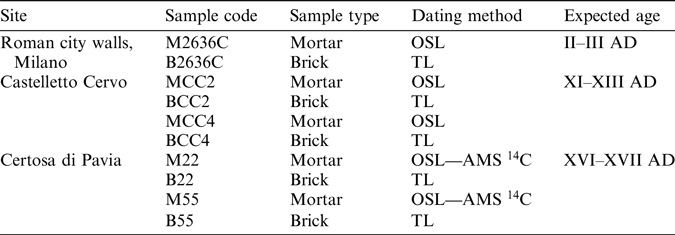
Bricks and mortars (Table 1) were sampled in daylight and the inner part of each sample was used for luminescence measurement. All the laboratory procedures were performed under dim red light.
List of the dated samples, including dating methods and expected age.

For TL dating of bricks, the polymineral fine grain technique (4–11 mm, Zimmerman Reference Zimmerman1971) was used and the multiple aliquot additive dose (MAAD, Aitken Reference Aitken1985) protocol was applied to evaluate the archaeological dose (named hereafter Equivalent Dose, De). TL dating was performed using an in-house system equipped with a photomultiplier tube (EMI 9235QB) coupled to a blue filter (Corning BG12). The samples were heated from RT to 480 °C at 15 °C s−1. Artificial irradiations were carried out by means of a 1.85 GBq 90Sr-90Y beta source (dose rate to the sample position, fine-grain fraction: 4.21 Gy min−1) and a 37 MBq 241Am alpha source (dose rate to the sample position, fine-grain fraction: 14.8 Gy min−1).
To determine the OSL mortar De, the quartz inclusion technique (Fleming Reference Fleming1970) was applied. The 180–250 μm quartz fractions were extracted according to the standard procedures (Mejdahl Reference Mejdahl1985; Preusser et al. Reference Preusser, Degering, Fuchs, Hilgers, Kadereit, Klasen, Krbetschek, Richter and Spencer2008) and the absence of feldspars was checked using IR stimulation (830 ± 10 nm; constant stimulation power 360 mW/cm2). The single aliquot regenerative dose protocol (SAR, Murray and Wintle Reference Murray and Wintle2000) was used, applying both multi-grain and single grain techniques. OSL measurements were carried out using TL-DA-20 Riso reader with a 90Sr/90Y beta source as an irradiation source (dose rate to the sample position, coarse-grain fraction: 0.12 ± 0.01 Gy s−1). Photons were detected by a bialkali photomultiplier tube (EMI 9235QB) coupled to a 7.5 mm Hoya U-340 filter. MG aliquots were prepared by fixing the quartz grains onto 10-mm-diameter stainless steel disks with silicon oil (covered area: about 3 mm diameter, corresponding to roughly 300 grains).
The OSL was stimulated in the case of the MG technique by an array of blue LEDs (470 ± 30 nm) for 40 s at 125 °C with a constant stimulation power of 54 mW cm−2. Individual De values were accepted if the following criteria occurred:
-
recycling ratio between 0.9 and 1.1;
-
recuperation < 5%.
The SG analysis were performed by a 10 mV Nd:YVO4 solid state diode pump laser emitting at 532 nm. The grains were rejected if one of the following conditions was not satisfied (Medialdea et al. Reference Medialdea, Thomsen, Murray and Benito2014):
-
signal less than 3 standard deviation above the background;
-
recycling ratio out of 0.75–1.25 range;
-
error associated to the test dose >25%;
-
signal of the natural De out of the range of the laboratory regeneration doses.
The selection criteria used to analyze the SG measurements were less strict than for MG due to the low luminescence of the single quartz grains. The preheat temperature value was experimentally selected by the dose recovery preheat plateau test.
For dose-rate determination, 238U and 232Th concentrations were derived from alpha counting using ZnS (Ag) scintillator discs and assuming a Th/U concentration ratio equal to 3.16 (Aitken Reference Aitken1985). Contribution due to 40 K content was obtained from the total concentration of K measured by flame photometry. The saturation water content (W) ranged from 12 to 28%, assuming for calculations an amount of water (F) corresponding to 75 ± 5% of W. The attenuation of the beta particles in coarse grain quartz used for mortar dating was taken into account (Bell Reference Bell1979). The gamma external contribution, mainly deriving from the radioactivity of a 30-cm-diameter sphere centered at the sampling point (Aitken Reference Aitken1985), was evaluated from the radioactivity concentrations of the mortars themselves and of the surrounding bricks (Galli et al. Reference Galli, Martini, Maspero, Panzeri and Sibilia2014), applying the infinite matrix approximation with updated conversion factors (Guérin et al. Reference Guérin, Mercier and Adamiec2011). Polarizing light microscopy was used to roughly determine the binder:aggregate ratio.
For 14C, the mortar samples were prepared following the method proposed by Marzaioli et al. (Reference Marzaioli, Lubritto, Nonni, Passariello, Capano and Terrasi2011). To separate the geogenic fraction of carbonates from the anthropogenic one, the binder minerals were broken using a sequence of cooling in liquid nitrogen and heating in oven, and the produced mineral powder was suspended in water. The density difference between the two fractions corresponds to a different sedimentation velocity, so it should be possible to isolate the lighter anthropogenic calcite. This was sieved to obtain the fraction <200 μm. When available, carbonate lumps were also dated. For comparison, the bulk material, simply scratched with no granulometric selection was also measured.
Samples were chemically digested with pure H3PO4 and the CO2 produced during the first 15 seconds of the reaction was collected. The gas was then reduced to elemental carbon following Vogel et al. (Reference Vogel, Southon, Nelson and Brown1984), and the isotopic ratios were measured at the National Institute for Nuclear Physics (INFN) LABEC laboratory in Florence, Italy. The obtained 14C ages were calibrated using OxCal software (v. 4.3.2, Bronk Ramsey Reference Bronk Ramsey2009) and IntCal13 atmospheric calibration curve (Reimer et al. Reference Reimer, Bard, Bayliss, Beck, Blackwell, Bronk Ramsey, Grootes, Guilderson, Haflidason, Hajdas, Hatt, Heaton, Hoffmann, Hogg, Hughen, Kaiser, Kromer, Manning, Niu, Reimer, Richards, Scott, Southon, Staff, Turney and van der Plicht2013).
RESULTS
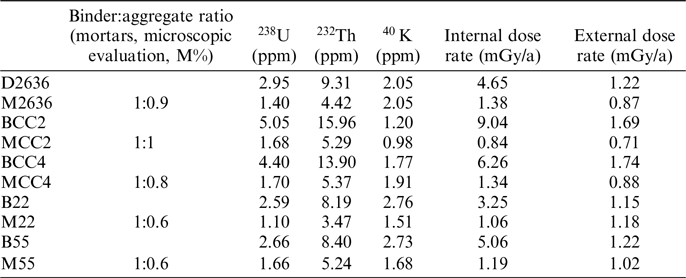
The data related to the petrographic composition of the samples, the main radioactivity concentrations and the corresponding dose rates are reported in Table 2. The binder:aggregate ratio is similar for all the samples, although M22 and M55 from Certosa di Pavia seem to show a little higher amount of binder.
Binder aggregate ratio, radioactive content, internal and external dose rate of brick and mortar samples.

Milano
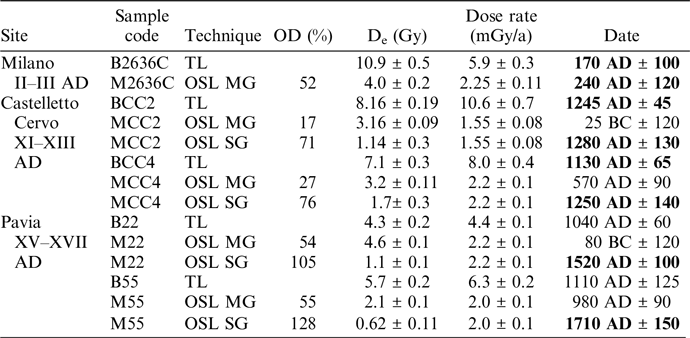
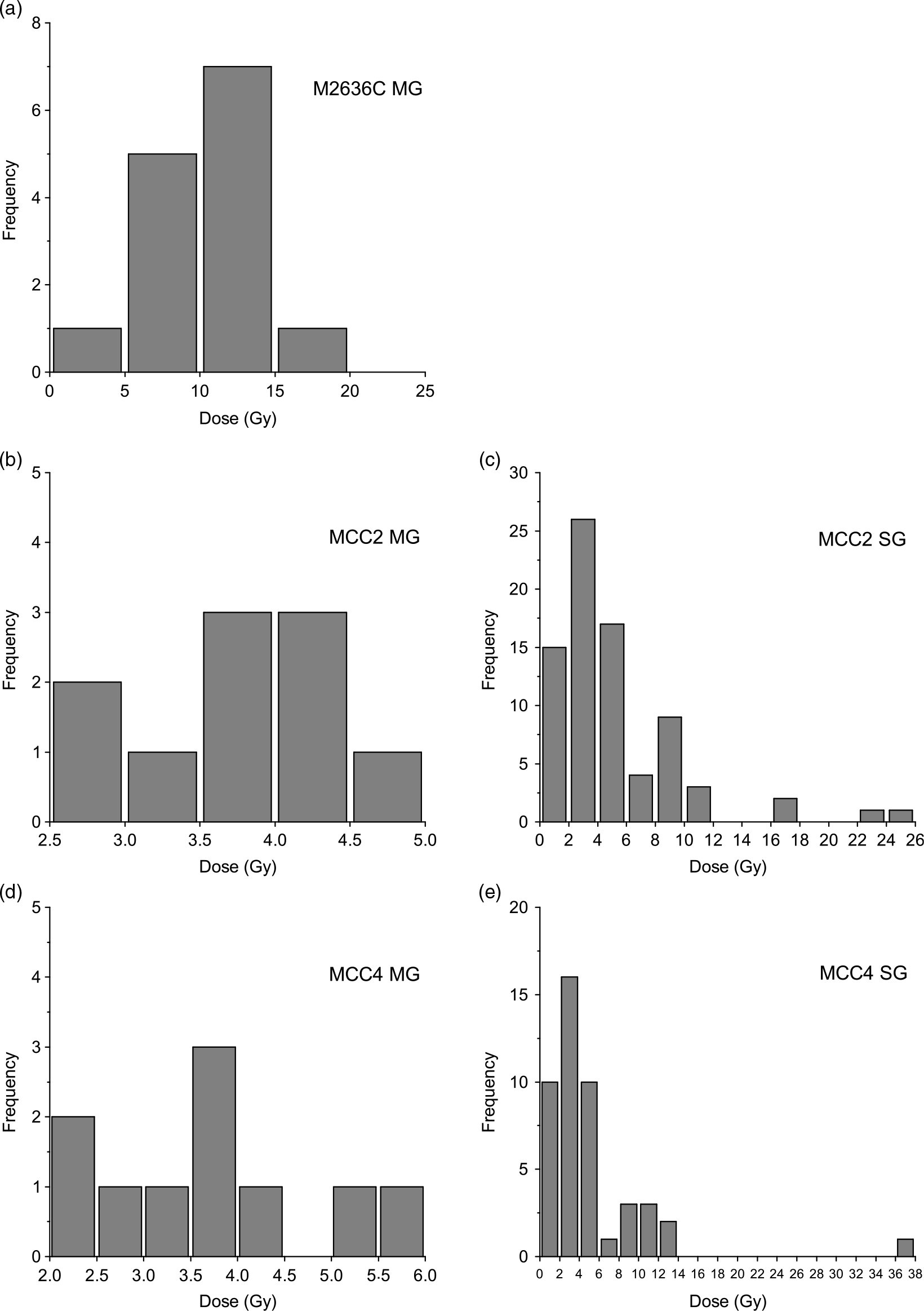
The TL age obtained on the brick sample B2636C (Table 3, first row) correctly set the Roman city wall of Milano in the II–III century AD, as the OSL dates of the associated mortar sample obtained with the MG technique (Table 3, second row). This is a strong indication that the zeroing of the quartz geological luminescence signal during mortar making was effective and that all the quartz grains have the same De, whose distribution being only affected by the experimental uncertainty of the measurements. This is confirmed by the Gaussian distribution of the values of the De obtained for this sample, as shown in Figure 1a.
Site, sample code, dating technique, Overdispersion (OD, obtained with CAM model, Galbraith et al. Reference Galbraith, Roberts, Laslett, Yoshida and Olley1999), De, dose rate and date. The data in agreement with the expected age are reported in bold.

Equivalent dose distribution for MG and SG techniques applied to Milano (a) and Castelletto Cervo (b, c, d, e) samples.

Castelletto Cervo
TL dating of two bricks from Priorato Cluniacense dei Santi Pietro e Paolo of Castelletto Cervo confirmed that the building was erected in the XII–XIII century AD (Table 3, 3rd and 6th rows).
The application of the OSL-MG protocol to mortars resulted in ages very much older than expected, indicating a partial or inhomogeneous bleaching of the quartz grains during the mortar manufacturing process. The non-Gaussian distribution of the De is possibly due to the fact that most of the quartz grains retain part of their geological OSL signal (Figures 1b and 1d). The application of SG protocol, whose De distribution is reported in Figures 1c and 1e, coupled with MAM (Galbraith et al. Reference Galbraith, Roberts, Laslett, Yoshida and Olley1999) allowed us to overcome the problem by using only grains that were completely or better bleached to calculate the De. It is unnecessary to point out that the application of this procedure is limited by the number of grains required to obtain a relevant amount of significant data. In fact, less than 2% of the measured grains satisfied the conditions reported before.
Certosa di Pavia
Two bricks of the Late Renaissance (XVI–XVII century) outer wall of the Certosa di Pavia were dated by TL to late Medieval period (XI–XII century). They are evidently reused as already found in several other structure of the complex (Galli et al. Reference Galli, Martini, Maspero, Panzeri and Sibilia2014). The production of bricks in Late Middle Ages at Certosa di Pavia is in fact well documented in historical archives.
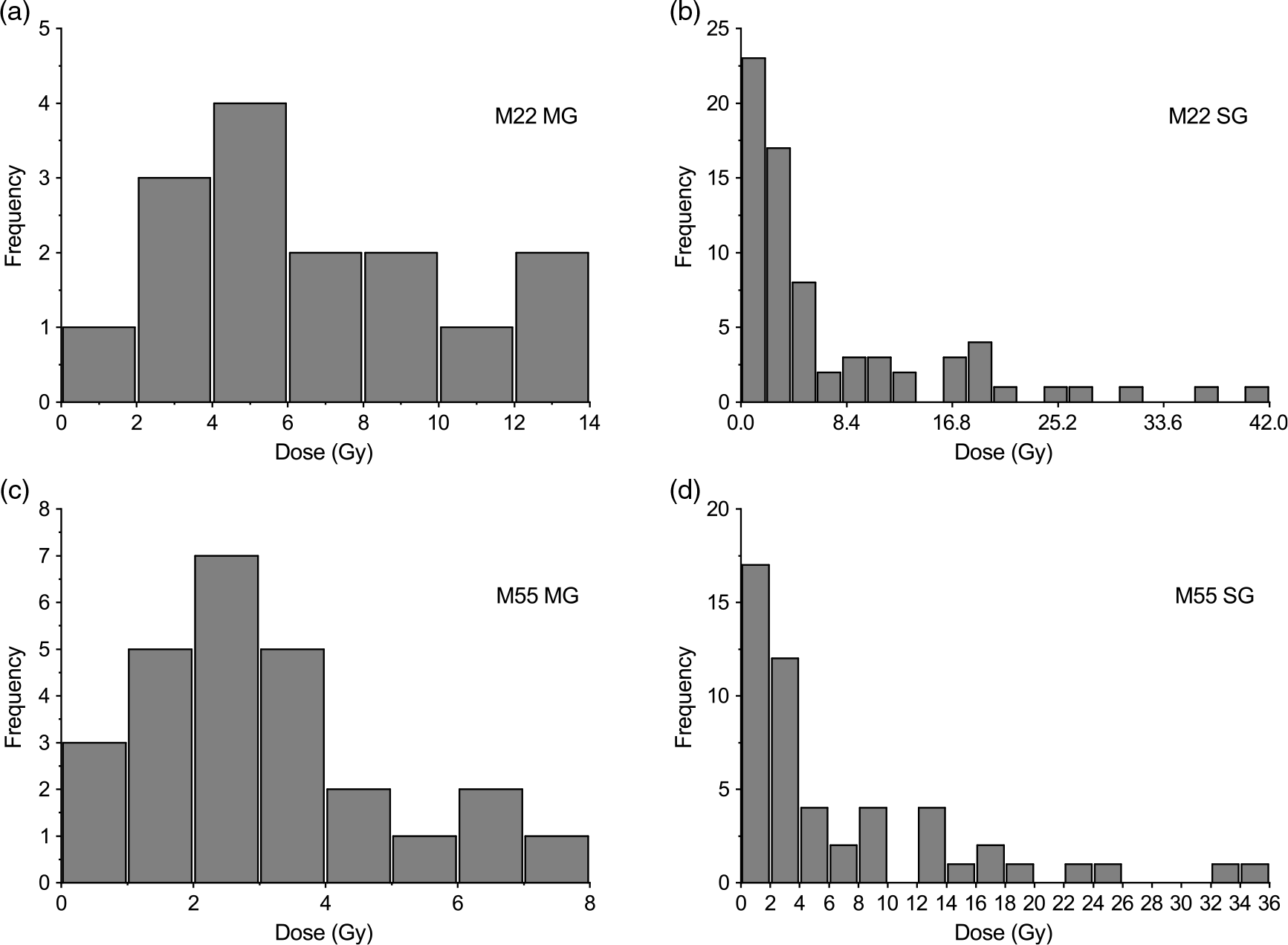
For these mortars, the very same considerations just reported for samples of Castelletto Cervo applied: even in this case, the application of the SG technique (De distributions reported in Figures 2b and 2d) allowed to overcome the age overestimation obtained with MG protocol (De distributions are reported in Figures 2a and 2c).
Equivalent dose distribution for MG (a, c) and SG (b, d) techniques applied to Certosa di Pavia samples.

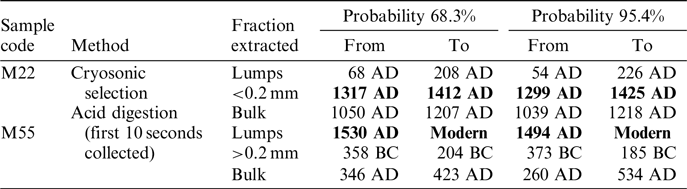
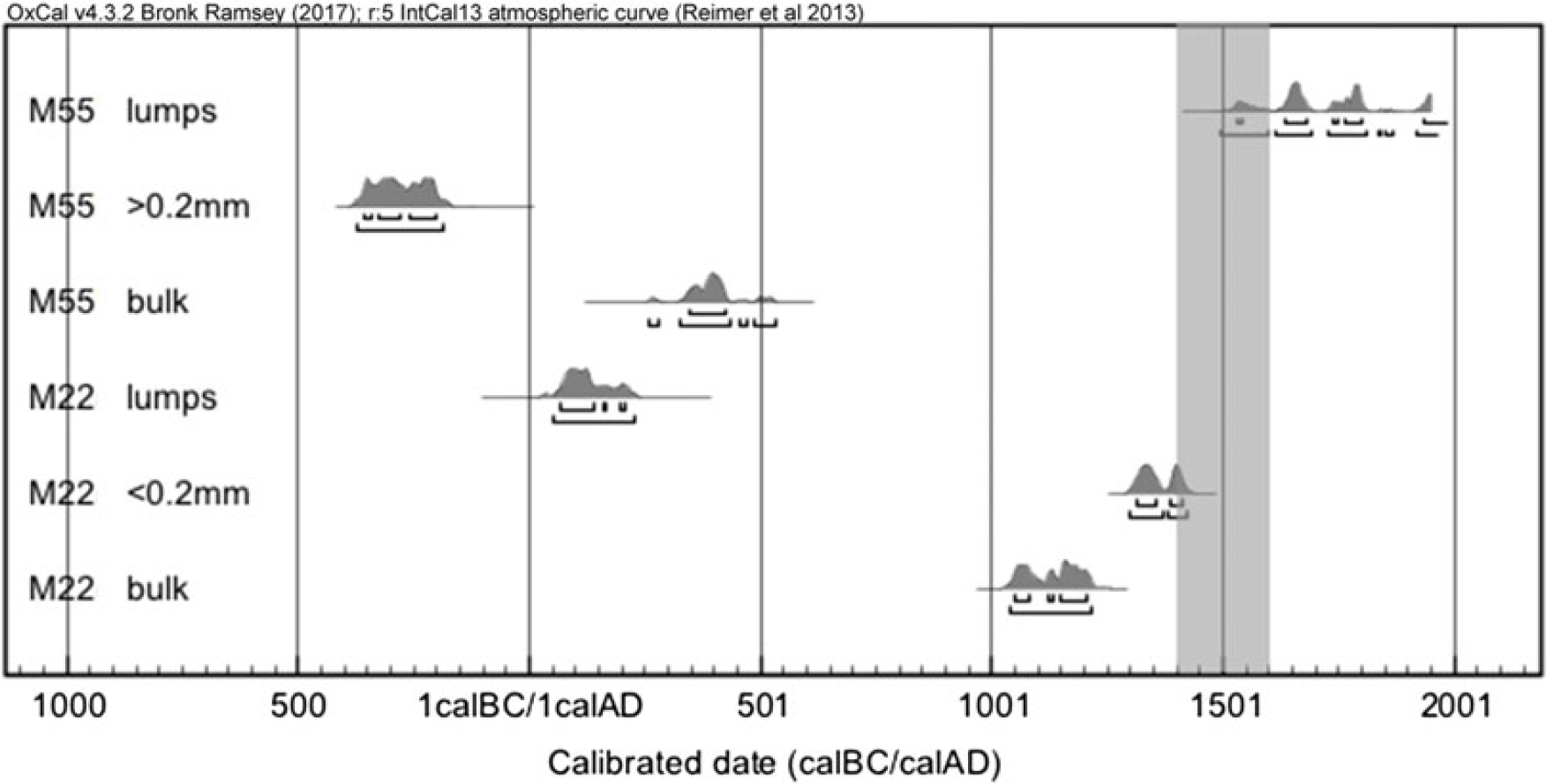
Radiocarbon dating was attempted on M22 and M55 mortar and the results are reported in Table 4 and in Figure 3. Only the fine fraction of the anthropogenic carbonate of sample M22 gave a date compatible with the OSL one (± 2σ), while lumps and bulk are affected by a severe overestimation, deriving from a strong contamination of geogenic carbonate. In Mortar M55, the bulk and the coarse fraction resulted contaminated by geogenic carbon, while the amount of fine fraction was too scarce for AMS isotopic analysis. One of the available lumps gave a date well matching the expected one.
Results of 14C dating of fractions of Certosa di Pavia mortar samples.

14C probability density curves of Certosa di Pavia samples. The expected age lies under the shaded band.

DISCUSSION
Considering all 27 mortar samples dated in our laboratory by OSL previously and in this paper, 17 (63%) gave results in agreement with the expected age. Most of them (76%) required the application of SG protocol, while for the others (23%) the experimentally simpler MG protocol proved to be successful.
For the five samples presented in this paper, we observed that the OSL shine-down curves of the MG aliquots systematically showed a dominant fast component, usually associated with good dosimetric properties of extracted quartz (Bailey et al. Reference Bailey, Smith and Rhodes1997). We found that this is a necessary but not sufficient condition to obtain reliable dating results: only one sample of five gave a date compatible with the expected one. An explanation could be the lack of an effective resetting event.
These experimental evidences confirm that the partial or incomplete bleaching is a crucial point for mortar OSL dating. The application of the MG technique is reliable only if all the grains analyzed emit the same amount of luminescence; this occurs if they were all fully bleached during the mortar manufacturing process. However, if mortar contains grains not completely set to zero, they emit higher luminescence signal, generally different depending on their bleaching degree. In this case the use of the SG technique is compulsory (even if time-consuming) because it allows discarding the contribution of the not-well-bleached grains. Based on the experimental evidence, the laboratory methodology for OSL mortar dating could be improved as follows: after a first MG analysis, if the resulting De distribution is in good agreement with a Gaussian curve, the resulting age can be assumed to be reliable. On the contrary, with an asymmetric-tailed curve, the more complex and time-consuming SG technique should be applied to minimize the contribution of non-bleached quartz grains. The further application of the MAM statistical method could greatly improve the accuracy of the experimental data. However, neither its application nor that of other statistical methods developed to obtain the best selection of the fully bleached grains (the internal-external consistency criterion, IEU, Thomsen et al. Reference Thomsen, Murray, Botter-Jensen and Kinahan2007 or that recently proposed by Guibert et al. Reference Guibert, Christophe, Urbanova, Guerin and Blain2017) could guarantee successful dating in a few of our previous case studies (Panzeri et al. Reference Panzeri, Cantu, Martini and Sibilia2017).
The results of 14C dating highlight the complexity of the crucial selection phase of suitable carbonate fraction due to the heterogeneity and on-site contamination of the raw material. Moreover, no correlation between the binder:aggregate ratio and the datability of the mortars was found. The lack of material to perform analysis on a wider set of samples did not allow a precise statistical approach, but the main parameters involved in the dating process seem to be the granulometry of the sample and the prior characterization of mortar components (geogenic and anthropogenic), as already widely reported (Regev et al. Reference Regev, Poduska, Addadi, Weiner and Boaretto2010; Addis et al. Reference Addis, Secco, Marzaioli, Artioli, Arnaus, Passariello, Terrasi and Brogiolo2019; Toffolo et al. Reference Toffolo, Regev, Dubernet, Lefrais and Boaretto2019). In particular, FTIR analysis of the calcite fraction in mortar seems to be a promising test for identifying with good reliability the anthropogenic fraction of carbonates, based on the different ratio of the characteristic peaks of amorphous and crystalline calcite (Regev et al. Reference Regev, Poduska, Addadi, Weiner and Boaretto2010).
CONCLUSION
This study reports the more recent results obtained on archaeological mortars at Milano-Bicocca laboratories using both OSL and 14C techniques. The main problem associated with OSL dating is the incomplete bleaching of the quartz fraction during mortar manufacturing and laying. The application of the MG standard technique often led to an age overestimation. The use of the SG technique with the application of different statistical methods in most cases allowed us to obtain reliable ages. Nevertheless, it was not always successful in identifying the completely bleached quartz grains.
For 14C dating, the presence of geogenic calcite and its separation from the anthropogenic fraction is fundamental for the selection of suitable samples. The results show that a successful dating analysis requires previous characterizations to assess the nature of the mortar components, and avoid unusable fractions, as happened with samples from Certosa di Pavia where similar mortars, and even different fractions of the same sample, gave completely different results. In conclusion, the results obtained with OSL and 14C are promising but not completely satisfying. The crucial research goal is still the definition of a general protocol working for any mortar.