The media inform the public about various accidents and disasters that happen around the world every day. Climate changes, human manipulation of nature, and the rapid development of technology have increased the vulnerability of people and the risk of accidents. In this regard, statistics indicate an increasing number of accidents and disasters around the world.Reference Brandt, Mayer and Mason 1 With these increases in frequency of accidents and disasters, knowledge about and preparation for combating disasters has also increased. Specialized systems have been developed to respond to accidents and disasters, of which the Emergency Operation Center (EOC) is one of the most important. One of the important responsibilities assigned to the EOC is providing inter-organizational coordination among the agencies responsible for providing health services in disasters.Reference Brandt, Mayer and Mason 1
Coordination refers to performing synchronized activities,Reference Kotlarsky, Van Fenema and Willcocks 2 such as elucidating processes, duties, and structuresReference Arshinder, Kanda and Deshmukh 3 and managing the relationship between independent activities.Reference Boella and Van Der Torre 4 HillReference Hill 5 defined coordination as the harmonious integration of the specialists of all organizations involved in order to succeed in obtaining desired results. Disaster management plans are complex networks of organizational communication that include the participation of national, local, and public organizations; private and business communities; nongovernmental organizations; volunteer groups; universities; media; and foreign sponsor organizations. Coordination among these organizations has remained the main challenge in disaster management.Reference Quero 6 It is worth mentioning that the existence of a comprehensive plan considering all significant risks is necessary in every organization.Reference Ghazizadeh, Mesdaghinia and Ardalan 7 A comprehensive model of coordination should include all required definitions at the execution level.Reference Carson and Swinnen 8 Also, the process of planning should include coordination with other organizations, the designation of organizations and interest groups, and integration with other existing plans.Reference Salkin 9 The advantages of coordination have been stated by Drawback and Hoatmer as follows: developing financial stability in organizations, increasing the innovation of personnel in the related organizations, attracting public and government support for the development of such organizations, gaining more authority, decreasing interruptions in providing services, continuing the required services, and decreasing redundancies.Reference Sadr 10
The results of studies conducted in Iran have shown an absence of coordination between organizations providing health care and rescue services, which has been considered to be one of the main problems of responsive organizations at the time of disasters.Reference Abolghasemi, Radfar and Khatami 11 From the perspective of these organizations, this problem has led to inadequate application of resources and inefficient responses.Reference Khankeh, Mohammadi and Ahmadi 12 Therefore, a comprehensive plan for disasters is needed to ensure rapid responses and coordinated management in mass casualty disasters.Reference Emami, Tavakoli and Alemzadeh 13
Reports have also repeatedly emphasized the lack of coordination in response to accidents and disasters. For example, poor inter-organizational coordination was documented and reported by the witnesses of the Bam earthquake. The relief teams dispatched to Bam were not previously well informed and had not previously coordinated with each other. Such issues resulted in increased response time and increased casualties.Reference Ardalan, Mazaheri and Vanrooyen 14
A coordination system has been developed in Britain for emergency services called the Emergency Management Combined Response System (EMCRS), which is a general framework with 3 layers of command, control, and regulation. The EMCRS was created to improve the coordination among organizations at the time of disasters.Reference Hill 5 In Switzerland, a binomial model is used for providing medical services.Reference Dami, Fuchs and Péclard 15 The multifactorial barriers to creating coordination in the Indonesian tsunami were the political and social structures of the affected region and the structure and incentives of the organizations that were supposed to respond to the disasters. Moreover, inappropriate personnel and a lack of necessary equipment have been reported as known problems in uncoordinated responses in disasters.Reference Zoraster 16
Thus, coordination is a critical factor for success in organizing disaster responses.Reference Chatterjee, Gupta and Jain 17 In recent years, many efforts have been made to improve the management of and reduce the risks of disasters. However, reviewing the available Iranian and non-Iranian literature and studies shows that the concept of coordination in disasters is a missing or, optimistically, a less considered link for which there is not any general model or pattern. Considering the Iranian studies and empirical evidence suggesting the lack of coordination in response to disasters, it seems necessary to design and develop an Iranian model in order to improve inter-organizational coordination among the organizations involved in disaster responses.
Methods
This was a qualitative study based on grounded theory with the approach of Corbin and Strauss,Reference Corbin and Strauss 18 which is more flexible and has more emphasis on memoing than the 1998 version. The research method of “grounded theory” was innovated in 1960 by Barney Glaser and Anselm Strauss. This approach is rooted in symbolic interactionism doctrine or symbolic convergence and is considered field research. The basis of grounded theory is that people who have experienced similar conditions express common meanings and behaviors.Reference Glaser and Strauss 19
Sampling and Data Collection
The participants of the study consisted of 19 men and 3 women who were experts in the field of health in disasters. All of the participants had at least 3 years of experience in health management in disasters (including 5 emergency medicine specialists, 3 PhDs in health in disasters, 6 general physicians, 2 nurses, 3 PhDs in health management, 1 surgeon, 1 PhD in social work, and 1 PhD in health). The purposeful sampling method was used for the initial interviews, and according to the emerging codes and categories, the required data were collected by using theoretical sampling. Participant selection, data collection, and data analysis continued until theoretical saturation was reached and a detailed and accurate description of experiences was obtained.
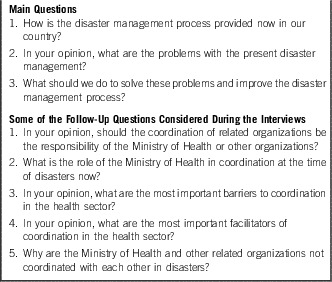
We conducted in-depth interviews to collect the required data. Each interview began with general questions about the participants’ own experiences of health management in the disaster process and their perceptions of “Barriers to and facilitators of inter-organizational coordination in response to accidents and disasters.” Probing questions were also used to clarify information and gather additional data. The main questions and some of the questions considered during the interviews are presented in Table 1.
The Main Questions and Some of the Follow-Up Questions Considered During the Interviews

The interviews lasted from 20 to 60 minutes so that there was not any association between the time of the interviews and the interviewees’ expertise. Ten interviews were conducted between January and April 2014 and 12 interviews between March and December 2015 by the author (IM).
The research team was a multi-professional team including both male and female researchers with different backgrounds from Iran, including 1 specialized surgeon (MR) with experience in public health and participation in disaster management, 1 PhD in health in disasters (HRK) with experience in qualitative studies and policy in health, 2 researchers in disaster management (MB and RR) with experience in qualitative studies and policy in emergency, and 1 health management researcher (RZ) with experience in qualitative studies and policy in health.
Data Analysis
All interviews were recorded, transcribed, and approved by the participants and were then analyzed line by line. The analysis was performed according to the method suggested by Corbin and Strauss. Data collection and analysis were performed simultaneously such that the data from each interview were analyzed before the next interview was started. Unanswered questions from the prior interview were emphasized more in the next interview. Accordingly, the first interviews directed the next ones.
Three types of open, axial, and selective coding were used in the present study. All interviews were reviewed line by line and repeatedly in the open coding stage and the coding was performed by the researchers using the related keywords and phrases. A total of 735 initial codes were extracted in this stage. A total of 43 subcategories were identified after continuous comparison of codes in the axial coding stage. Finally, 10 main categories were determined in the selective coding stage after comparing the subcategories of the previous stage. The collected data were analyzed by using MAXQDA 2010 software (VERBI Software GmbH).
Ethical Considerations
Obtaining oral consent before conducting interviews, retaining anonymity, ensuring confidentiality of information, and observing the participants’ rights of withdrawing from the study or interview at any time were some of the ethical considerations in the present study.
Results
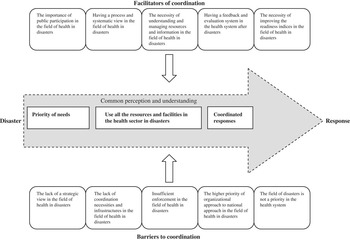
A total of 22 experts (19 males and 3 females) working in various fields of health with academic and management experience in health management in disasters participated in this study. Their mean age was 44 years. The educational level of the participants varied from undergraduate to different specialties of medicine. According to the interviews, 735 initial codes were approved by the research team and grouped into 43 subcategories after comparison of the conceptual codes. The results indicated that the process of coordination between the health organizations is currently inappropriate. Close subcategories were then divided into 10 main categories and 2 groups of barriers to and facilitators of coordination (Figure 1).
Barriers To and Facilitators of Inter-Organizational Coordination in Response to Disasters.

The coordination barriers included:
-
1. The lack of a strategic view in the field of health in disasters.
According to the interviews, a clear approach in the field of health in disasters was lacking. One example of the participants’ quotes was as follows:
-
∙ The lack of risk mapping in the field of health in disasters:
“The first important process in coordination which has been neglected in our country is having good knowledge of threats. In fact, we should have clear understanding of the risks of natural disasters. First, we need a complete mapping of risks across the county (even the rural regions) which provides us with the information about types of threats in each area.” (P2)
-
2. The lack of coordination of necessities and infrastructures in the field of health in disasters.
According to the interviews, coordination and infrastructures in the field of health in disasters was insufficient. One example of quotes stated by the participants is as follows:
-
∙ Insufficient attention to the main function of the EOC in the field of health in disasters:
“The first reason for our lack of coordination in [the] Bam earthquake was the fact that we did not have a coordinated structure. We did not have EOC. However, despite the current presence of EOC, the people involved do not fit with this structure. They do not have EOC vision. They do not see the management as a single unit. Everyone works on his own accord. Any clear vision has not been emerged in our managers yet. It is being improved gradually but it is still far from ideal.” (P5)
-
3. Insufficient enforcement in the field of health in disasters.
Unfortunately, efforts in developing countries, especially Iran, that stop at the theoretical level and do not have necessary enforcement are considered ineffective. Thus, having enforcement for successful operations is one of the factors for creating expected effectiveness in all topics, especially coordination. In other words, in the present study, the results showed that one of the reasons for the lack of coordination in the field of health in disasters was insufficient enforcement. One example of the participants’ quotes is as follows:
-
∙ The lack of clear boundaries in the field of health in disasters:
“Coordination means that all persons should know their activity boundaries, their common activities and the activities they should cooperate with each other.” (P3)
-
4. The higher priority of an organizational approach to a national approach in the field of health in disasters.
According to the participants’ statements in this study, the organization-centeredness and the lack of national approaches are the most important reasons for the lack of coordination among the organizations responsible for providing health services in disasters. One example of the participants’ quotes is as follows:
-
∙ Totalitarianism in the field of health in disasters:
One of the new findings of the present study was totalitarianism in this field. Unfortunately, due to the dominance of traditional management (funding based on reports), the organizations involved in the field of health in disasters show great enthusiasm for assigning the activities to themselves and do not have any interest in team activities. This results in the creation of destructive inter-organizational frictions.
“This is exactly the culture all of us have within which we like to tag our names to every activity and avoid team works.” (P9)
-
5. The field of disasters is not a priority in the health system.
According to the results, the lack of health managers’ faith in disaster management, the instability of management in disasters due to political changes, and ignoring the counseling principles by health policy-makers are some of the important reasons for the lack of coordination in this field. One example of the participants’ quotes is as follows:
-
∙ The lack of faith in the field of disasters by health system authorities:
“Identifying the resources such as human, supportive, and financial resources and identifying the human and physical resources with knowledge about the application of them are important issues. More importantly, the knowledge alone is not important, and the belief and faith is more important. Unfortunately, we neglect this fact when selecting our managers and directors. This way was good in the past. This issue should be paid more attention.” (P6)
The coordination facilitators included:
-
1. The importance of public participation in the field of health in disasters.
Based on the participants’ statements, the key to the success of developed countries in disaster management is the fact that they focus mainly on their citizens so that some of these countries merely oversee the disaster management. Paying attention to the importance of public participation is one of the factors improving the field of health in disasters. One example of the participants’ quotes is as follows:
-
∙ Paying attention to coordination at the scene of accidents in the field of health in disasters:
“We created this via the 24-hour responses in all universities. Over the years, all university presidents and the treatment deputy of ministry of health know that if a disaster or something serious happens in their region, they should call the EOC of the ministry of health and universities when no one responds to them. Now, this good thing has happened that a link has been created between the lowest ranked individuals and the highest ranked directors and managers of the ministry of health.” (P5)
-
2. Having a process and systematic view in the field of health in disasters.
The results of the present study demonstrated that having common language for organizational interactions, a systemic and comprehensive vision for rolling the interconnected links, inter-organizational management in the health system, and, most importantly, paying attention to the complexities of the field of health in disasters due to the importance of disaster management are the most essential factors in improving coordination in the field of health in disasters. These were explained in one of the participants’ quotes as follows:
-
∙ The complexities of the field of health in disasters:
“Coordination in all areas depends on a variety of factors and according to the complexity of a specific area, the factors become complex. A disaster, as a complex and critical issue, depends on a variety of cultural, economic, and social factors. The contextual factors can determine the success or failure of the coordination process.” (P3)
-
3. The necessity of understanding and managing resources and information in the field of health in disasters.
If an individual has access to information, the real need can be recognized and, accordingly, the required resources can be deployed. The management of this information and resources requires a correct definition of the actual role of the EOC. One example of the participants’ quotes is as follows:
-
∙ Paying attention to the importance of information and resources management in the field of health in disasters:
“These coordination headquarters have two existential philosophies. One is the resource management and the other is information management. These are the most important issues in coordination. Basically, we have problems with them in our country. Each organization may be responsible for its own professional works, but the problems start when they come to the scene.” (P2)
-
4. Having a feedback and evaluation system in the health system after disasters.
Evaluation and monitoring are considered as one of the management principles which, as a control system, highlight the strengths and weaknesses of a system for users. The findings of this study indicate that if there is an evaluation system, the evaluation and monitoring in the field of health in disasters play an important role in preventing inconsistencies from recurring and increase the coordination in the next disaster. One of the participants’ quotes is as follows:
-
∙ Having an evaluation and control system in the field of health in disasters:
“Pay attention to this point that coordination is actually a tool by which you can deliver the resources available in different organizations to the needy in a coordinated and better way so that they do not get anything twice and also a place does not have any defect”. (P8)
-
5. The necessity of improving the readiness indexes in the field of health in disasters.
The findings of the present study show that improving the readiness indicators, including the indicators of carrying out the appropriate maneuvers and designing educational programs in the field of health in disasters, can lead to the promotion of coordination indexes. There is a direct association between preparation before disasters and coordination after disasters. One of the participants’ quotes is as follows:
-
∙ The necessity of designing educational programs in the field of health in disasters:
“How much do we have media and broadcasting education about this issue? How much education about earthquake is in our educational books? Should not the Red Crescent enter into teaching? Education should include the topics of disaster management. How many units of disaster management are teaching to the people in our universities? I would say these are people and none of them are specialized fields.” (P9)
Discussion
Disaster management is a complex activity that requires special attention, relevant expertise, and close cooperation among all related organizations and institutions in various dimensions and at different national and regional levels. Not only is this collaborative participation required at the time of a disaster, but it should also be evident at various stages of readiness before and after disasters. Therefore, a single institution or ministry cannot perform disaster management alone; it requires the support and participation of the 3 branches. However, the authorities and responsibilities of these organizations overlap to some extent for many issues, which may lead to parallel activities, decreased efficiency, and increased costs. Therefore, the use of a strategic plan for disaster management is necessary so that the direction of activities and the chain of processes are determined and disturbances are prevented.Reference Khankeh, Khorasani-Zavareh and Johanson 20 When speaking of coordination, some directors and managers of the National Disaster Management Organization repeatedly emphasize that coordination is good, while the findings of the present study show that coordination is provided more at the scene and not in those headquarters formed at the macro level without knowing the needs of the scene. Rabii and colleaguesReference Rabiee, Ardalan and Poorhoseini 21 concluded that personalization of activities in the field of crisis and disaster management led to functional damage. Haghparast-Bidgoli and colleaguesReference Haghparast-Bidgoli, Hasselberg and Khankeh 22 concluded that the inadequacy of strategic infrastructures and the lack of a strategic view in the field of health in disasters were some of the barriers to coordination, which is consistent with the results of the present study. Van Scotter and colleaguesReference Van Scotter, Pawlowski and Cu 23 showed that the lack of a long-term view and required time for providing coordination were barriers to coordination. Majchrzak and colleaguesReference Majchrzak, Jarvenpaa and Hollingshead 24 found that the organization of personnel, dynamic organization, and human resources networking for quick and timely responses to disasters were important requirements for coordination in disasters. In a study conducted by Azizpour and colleagues,Reference Azizpour, Zangiabadi and Esmaeilian 25 the lack of skilled manpower and a disaster management unit were the main factors contributing to a lack of coordination.
The results of the current study showed that the primary reasons for many inconsistencies existing in the field of health in disasters were the organizational and totalitarian approaches in the field, so that many participants believed that trying to reduce the organizational frictions could be a common and effective strategy in this area. In the study by Quero,Reference Quero 6 the lack of common values, lack of system structure, and lack of a suitable strategy were mentioned as reasons for the lack of coordination between the public and private sectors in response to disasters. The lack of national plans for responding to disasters and poor organizational communication were the most important reasons for poor coordination of disaster management in the study by Rabiei and colleagues.Reference Rabiee, Ardalan and Poorhoseini 21
The results of the present study showed that totalitarianism in the field of health in disasters, having political and advertising views, and competing in providing unreal statistics and information by related authorities in order to obtain a bigger budget and not staying ahead of other organizations were some of the major challenges in the field of health in disasters. Therefore, making efforts to improve a national approach and to avoid organizational and advertising approaches can be important duties of policy-makers and managers that require developing an appropriate culture to reduce totalitarianism. Defining health-based common and national goals and having a common understanding in this area can be ways of overcoming barriers to inter-organizational coordination.
Currently, disaster management is seen as a marginal issue based on reactive activities and has been considered as an unimportant duty of managers. However, disaster management is a vital duty and requires defining and monitoring objectives, planning, organizing, controlling, and coordinating the activities before, during, and after disasters. Therefore, disaster management can be provided effectively in the country when it has an independent nature and the managers apply it carefully at the time of disasters. Also, the results of the present study indicated the necessity of having a local view of disaster management, whereas we have 90% national views, 9% provincial views, and only 1% local views now, which should be revised and corrected.
International experience suggests that performing emergency response operations in large natural disasters is beyond the ability of official forces. Performing successful operations and reducing the damage and casualties by related organizations will be possible only through organized group efforts of all people and citizens of the society.Reference Ghazizadeh, Mesdaghinia and Ardalan 7 PrizziaReference Prizzia 26 believe that coordination with local authorities and related organizations is an important factor in providing coordination. Because good and desirable coordination in providing health services must obtain information from the disaster scene and the first stage of coordination should be started on-scene, it is necessary to pay special attention to and use a local approach rather than headquarters and temporary committees for planning and coordination.
The results of studies show that the main reason for the success of developed countries in the field of disasters is an understanding of the importance of public participation and a strengthening of the community-based approach. Developed countries have entrusted disaster management to the local citizens, and the national governmental organizations are only responsible for planning, policy-making, and monitoring.
The necessity for training and developing an appropriate culture in the field of health in disasters was another finding of the current study. According to the viewpoints of some participants, providing and developing required education can improve inter-organizational coordination. Providing insufficient education for public communication and the lack of synergies in the field of education about disasters were some barriers to coordination. Educational programs are one of the pillars of development in the field of disaster management.
In addition to the results mentioned above, understanding and managing resources and information in the field of health in disasters was an important facilitator of coordination. If we do not have enough knowledge and management of available resources in accordance with our missions and objectives, good and desirable coordination will not be achieved.
In the study of Djalali and colleagues,Reference Djalali, Castren and Khankeh 27 not giving priorities to operational planning and a lack of knowledge about resource allocation to hospital preparedness were the main barriers to coordination. Also, in the study by Khankeh et al,Reference Khankeh, Khorasani-Zavareh and Johanson 20 the lack of sufficient resources in the field of health in disasters was a barrier to the provision of required services at the time of disasters.
Furthermore, one of the results of the present study obtained for the first time was the fact that the true and real functions of the EOC are coordination and control, not operational and field functions. Most individuals and top managers of the health system think that the EOC is a center for commanding and operating, whereas in fact it is a center for coordination and control that is used to collect required information, distribute the collected information, and make the necessary coordination in order to perform the command and operation functions.
Another new finding of the current study was the neglect of the importance of counseling by health authorities and managers so that the majority of top managers in this field avoid allocating time to counseling and delegate this duty to unskilled employees.
The results of the current study indicate that a lack of belief in work and activities in the field of disaster, the existence of some traditional attitudes to this field, the lack of management stability in the field of disaster management, and authorities and top managers not providing scientific consultants are some major barriers to coordination. It is recommended that the related authorities and managers in the field of health in disasters take steps to provide scientific consultations based on scientific and empirical evidence if they have no knowledge about disaster management.
Limitations
This study was conducted on the basis of the experience and opinions of experts in the field of health in disasters working in the health sector and not on others outside the health sector. Therefore, it is necessary to conduct another similar study to determine the opinions and experience of other people, such as managers and policy-makers who are involved in the coordination process in disasters but are outside the health sector.
Conclusion
Disaster management is a relatively young science in our country. Unfortunately, however, after a decade of its life, the field of disaster management has not experienced appropriate growth and development for various reasons, including the lack of appropriate legislation on establishing disaster management organizations and the inefficiency of disaster management structure in the country. Also, some experts believe that despite the growth in some areas such as providing pre-hospital services, other areas such as effective coordination in the field of health are not effective.
The results of the present study suggest that taking some structural and infrastructural measures are necessary to increase effective coordination in the health sector. Some of these measures include strengthening the authorities’ belief in the field of health in disasters, strengthening the national approach in the field of health in disasters rather than an organizational approach, meeting the coordination requirements, paying special attention to public participation, reducing the inter-organizational frictions in the field of health in order to share the available resources and information, improving the level of preparedness with a focus on people and training and educational programs, and developing an evaluation and control system in the field of health in disasters. Finally, in order to improve preparedness and produce effective responses, the authors recommend that a coordination center in the field of health with a focus on the Secretariat of Healthcare workgroup should be established in the Ministry of Health and the duties and job description of the partner and supporting organizations should be developed and real and appropriate maneuvers be carried out.
Acknowledgment
This study was a part of a PhD thesis entitled “Barriers to and facilitators of inter-organizational coordination among organizations responsible for providing health services in response to disasters: a qualitative study.” The authors thank the Deputy of Research in Baqiyatallah University of Medical Sciences.